
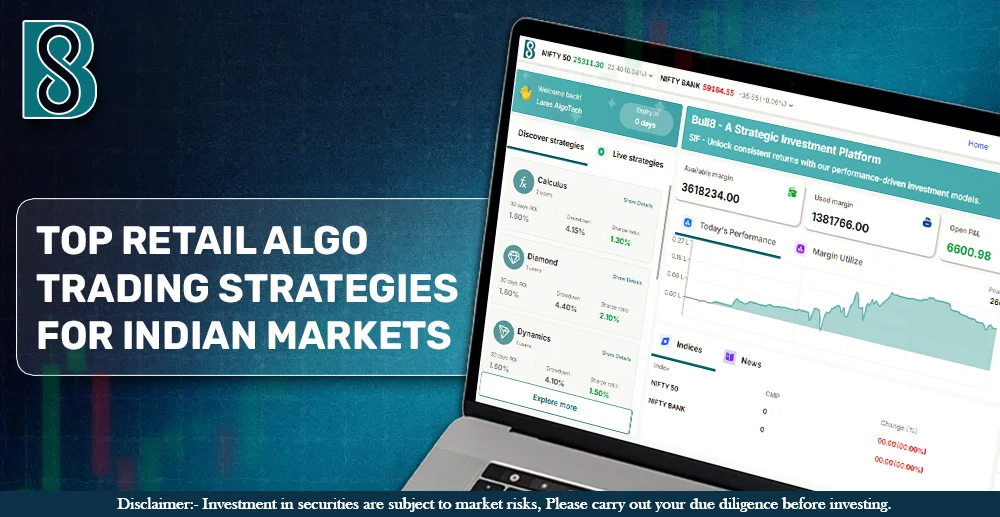
Introduction: The Rise of Retail Algo Trading in India
The Indian stock market has undergone a significant transformation over the last decade. What was once dominated by institutional investors and professional traders is now increasingly accessible to retail participants. Thanks to technological advancements, retail traders today have access to sophisticated trading tools that were previously available only to hedge funds and large financial institutions.
One of the biggest developments driving this change is the rapid adoption of algorithmic trading. Retail investors are moving away from emotional, manual decision-making and embracing automated systems that execute trades based on predefined rules and market conditions. This shift has led to growing interest in retail algo trading strategies, which help traders improve discipline, consistency, and execution speed.
With increasing internet penetration, mobile-first investing, and regulatory support for retail automation, algorithmic trading is becoming mainstream in India. Modern platforms like Bull8 have made it possible for everyday traders to deploy professional-grade strategies without coding knowledge or technical expertise.
The popularity of the best retail algo trading app solutions is growing because traders are looking for smarter ways to participate in markets while minimising emotional mistakes. Whether trading Nifty options, Bank Nifty, Sensex derivatives, or equity stocks, algorithmic strategies offer a systematic approach that can help traders navigate market volatility.
In this guide, we will explore some of the most effective retail algo trading strategies used in Indian markets and understand how modern retail algo trading software helps automate them efficiently.
What Are Retail Algo Trading Strategies?
Retail algo trading strategies are rule-based trading methodologies that use computer algorithms to identify opportunities and execute trades automatically.
Instead of manually monitoring charts and placing orders, traders define specific conditions such as the following:
Price movements
Technical indicators
Volatility levels
Trend direction
Risk parameters
Once these conditions are met, the algorithm executes trades automatically.
A typical algorithm can:
Enter positions
Set stop losses
Book profits
Exit trades
Manage risk
This removes emotional decision-making and improves consistency.
Modern retail algorithmic trading software enables traders to automate strategies without requiring programming skills. Plug-and-play platforms have simplified algorithmic trading, making it accessible to beginners and experienced traders alike.
Why Retail Traders Prefer Algo Trading
Several factors are contributing to the rise of algorithmic trading among retail participants.
Elimination of Emotions
Fear and greed often lead to poor trading decisions. Algorithms follow rules strictly without emotional interference.
Faster Execution
Markets move rapidly. Algorithms execute trades within milliseconds after conditions are met.
Consistency
A strategy is executed the same way every time, reducing human errors.
Time Efficiency
Traders don’t need to monitor charts all day.
Better Risk Management
Automated stop losses and position sizing improve capital protection.
These advantages explain why many traders are searching for the best retail algo trading app to automate their market participation.
Top Retail Algo Trading Strategies for Indian Markets
Trend-Following Strategy
Trend following remains one of the most popular and reliable algorithmic strategies.
How It Works
The algorithm identifies a sustained market trend and enters trades in the direction of that trend.
Common indicators include:
Moving Averages
MACD
Supertrend
ADX
Example
If Nifty is trading above its 50-day and 200-day moving averages, the algorithm may generate a buy signal.
Similarly, if prices fall below key averages, the system may trigger a sell signal.
Advantages
Works well in strong trends
Easy to automate
Suitable for beginners
Best Markets
Nifty
Bank Nifty
Large-cap stocks
Mean Reversion Strategy
Markets often move away from their average price and eventually revert back.
Mean reversion algorithms capitalise on these temporary deviations.
How It Works
The algorithm identifies overbought or oversold conditions using:
RSI
Bollinger Bands
Standard Deviations
Example
If Bank Nifty becomes excessively oversold, the system may initiate a buy trade expecting prices to return toward the average.
Advantages
Effective in range-bound markets
Generates frequent opportunities
Suitable for index trading
Risks
Can struggle during strong trending phases.
Breakout Trading Strategy
Breakout trading is extremely popular among Indian traders.
How It Works
The algorithm identifies key support and resistance levels.
When the price breaks these levels with strong momentum, a trade is triggered.
Example
Nifty trading between 24,800 and 25,000 for several sessions may generate a buy signal once 25,000 is broken with high volume.
Advantages
Captures strong momentum moves
Suitable for volatile markets
Works well during major news events
Common Indicators
Volume
ATR
Price Action
VWAP
Option Premium Selling Strategies
Option premium selling has become one of the most widely used algorithmic approaches in India.
How It Works
The strategy benefits from time decay in options.
Algorithms create hedged structures such as the following:
Iron Condors
Iron Butterflies
Credit Spreads
Short Strangles
Why Popular?
Most options expire worthless, allowing premium sellers to benefit from theta decay.
Advantages
Consistent income potential
Defined risk structures
Ideal for automated execution
Many modern retail algo trading software platforms specialise in automated premium-selling strategies.
Volatility-Based Trading Strategy
Volatility is a critical component of market behaviour.
These strategies adapt based on market volatility levels.
How It Works
Algorithms monitor:
India VIX
ATR
Historical Volatility
Implied Volatility
Example
During periods of low volatility, the strategy may focus on premium selling.
During high volatility, it may switch to directional trades or hedged setups.
Advantages
Adaptive approach
Better risk management
Suitable for changing market conditions
Momentum Trading Strategy
Momentum strategies focus on stocks or indices showing strong price movement.
How It Works
Algorithms identify assets with increasing buying or selling pressure.
Indicators include:
Relative Strength
Volume Expansion
Price Breakouts
Example
If a stock gains 5% with strong volume and institutional participation, the algorithm may initiate a momentum trade.
Benefits
Captures strong trends early
Suitable for active traders
Works across multiple market segments
Intraday Scalping Algorithms
Scalping strategies seek small profits from multiple trades throughout the trading session.
How It Works
Algorithms execute numerous trades using:
Order flow
Bid-ask spread analysis
Price momentum
Market microstructure data
Advantages
Frequent opportunities
Quick trade cycles
Minimal overnight risk
Challenges
Requires fast execution and robust infrastructure.
This is where advanced retail algo trading software becomes essential.
Index Option Trading Algorithms
Index options are among the most liquid instruments in India.
Popular Instruments
Nifty Options
Bank Nifty Options
Sensex Options
How It Works
Algorithms use:
Volatility analysis
Premium decay
Directional signals
Risk management rules
Benefits
High liquidity
Efficient execution
Multiple strategy possibilities
Many of the most successful retail traders focus exclusively on index-based algorithmic strategies.
Multi-Strategy Portfolio Approach
Professional traders rarely depend on a single strategy.
How It Works
Multiple algorithms run simultaneously.
Examples:
Trend Following
Premium Selling
Momentum Trading
Volatility Trading
Benefits
Diversification
Reduced drawdowns
Improved consistency
This approach is becoming increasingly common among users of the best retail algo trading app platforms.
Risk-Managed Automated Trading Strategy
The most important strategy is often risk management itself.
Core Components
Position sizing
Stop losses
Capital allocation
Daily loss limits
Kill switches
Why It Matters
Even profitable strategies can fail without proper risk controls.
Modern algorithmic systems automatically enforce these rules to protect capital.
Key Features to Look for in Retail Algo Trading Software
Not all platforms offer the same capabilities.
When choosing a solution, consider the following features.
Plug-and-Play Strategies
Ready-to-use algorithms allow traders to start quickly without coding.
Real-Time Execution
Low-latency execution helps capture opportunities efficiently.
Risk Management Controls
Look for:
Stop loss automation
Trailing stop loss
Capital limits
Daily drawdown controls
Broker Integration
Direct broker connectivity ensures seamless trade execution.
Mobile Accessibility
A quality platform should provide both web and mobile access.
Transparency
Users should have complete visibility into trades, positions, and performance.
Why Bull8 Is Built for Retail Algo Trading
Bull8 has been designed specifically for retail traders seeking institutional-grade automation.
Key advantages include
Plug-and-Play Strategies
No coding required.
Direct Broker Integration
Trades execute directly in your own account.
Professional Risk Management
Built-in safeguards help manage market exposure.
Multi-Strategy Support
Run multiple strategies simultaneously.
Real-Time Monitoring
Track positions and performance from anywhere.
User-Friendly Interface
Simple enough for beginners while powerful enough for experienced traders.
These features make Bull8 a strong contender for traders searching for the best retail algo trading app in India.
Common Mistakes to Avoid in Algo Trading
Even with automation, traders can make mistakes.
Over-Optimization
Avoid creating strategies that only work on historical data.
Ignoring Risk Management
Risk controls should always come before profit expectations.
Using Too Many Strategies
Focus on quality rather than quantity.
Chasing Short-Term Performance
Evaluate strategies over longer timeframes.
Lack of Diversification
Avoid depending entirely on one market condition.
The Future of Retail Algo Trading in India
The future of algorithmic trading in India looks extremely promising.
Several trends are accelerating adoption:
Increased retail participation
Better broker APIs
Mobile-first trading platforms
AI-powered analytics
Regulatory support
Faster internet infrastructure
As technology continues to evolve, algorithmic trading is expected to become a standard part of retail investing and trading.
Platforms that combine simplicity, automation, transparency, and robust risk management will likely lead this transformation.
Conclusion
The growth of retail algo trading strategies is reshaping how Indian traders participate in financial markets. What was once available only to institutions is now accessible to retail investors through advanced yet user-friendly technology.
From trend following and momentum trading to premium selling and volatility-based systems, there are numerous strategies that can be automated effectively. The key is choosing an approach that aligns with your risk profile, trading objectives, and market understanding.
A reliable retail algo trading software platform can help traders execute strategies efficiently while maintaining discipline and consistency. As adoption continues to grow, finding the best retail algo trading app becomes increasingly important for those seeking a competitive edge in today’s fast-moving markets.
With platforms like Bull8, retail traders can access sophisticated automation, professional-grade risk controls, and plug-and-play strategies that simplify the trading experience while keeping control firmly in their own hands.
FAQs
What are retail algo trading strategies?
Retail algo trading strategies are automated rule-based trading methods that execute trades without manual intervention.
Is algorithmic trading legal in India?
Yes, algorithmic trading is legal in India when conducted through approved brokers and compliant platforms.
Do I need coding knowledge to use algorithmic trading?
No. Modern plug-and-play platforms like Bull8 allow traders to use pre-built strategies without coding.
Which markets can be traded using algorithms?
Algorithms can be used in equities, futures, options, commodities, and currency markets.
What is the biggest advantage of algo trading?
The biggest advantage is eliminating emotional decision-making while ensuring disciplined execution.
Are retail algo trading strategies profitable?
Profitability depends on strategy quality, market conditions, and risk management practices.
Can beginners use retail algo trading software?
Yes. Many platforms are specifically designed for beginners with user-friendly interfaces.
What makes Bull8 different?
Bull8 offers plug-and-play automation, direct broker integration, risk management tools, and institutional-grade strategies designed for retail traders.
What is the best retail algo trading app in India?
The best retail algo trading app is one that offers easy strategy deployment, direct broker integration, strong risk management tools, real-time monitoring, and a user-friendly interface. Platforms like Bull8 are designed to provide institutional-grade algorithmic trading solutions for retail traders.
How much capital is required to start retail algo trading?
The capital required depends on the strategy being used. Some index option strategies can be started with relatively lower capital, while diversified multi-strategy portfolios may require larger investments. Traders should always allocate capital based on their risk tolerance.
Can retail algo trading software trade automatically without supervision?
Yes, modern retail algo trading software can execute trades automatically based on predefined rules. However, traders should regularly monitor strategy performance, risk exposure, and market conditions.
Is retail algo trading suitable for beginners?
Yes. Many modern platforms provide plug-and-play strategies that allow beginners to start algorithmic trading without coding knowledge or extensive market experience.
What are the risks involved in retail algo trading?
Common risks include market volatility, strategy underperformance, technical failures, and poor risk management. Using proper stop-loss mechanisms and capital allocation rules can help mitigate these risks.
Can I use multiple algo trading strategies simultaneously?
Yes. Many experienced traders use a multi-strategy approach to diversify risk and improve consistency across different market conditions.
Which Indian markets are best suited for retail algo trading?
Retail algo trading is commonly used in:
Nifty Options
Bank Nifty Options
Sensex Options
Equity Stocks
Futures Contracts
Commodity Markets
How does algo trading help reduce emotional trading?
Algorithms follow predefined rules and execute trades automatically. This eliminates decisions driven by fear, greed, panic, or overconfidence, which are common causes of trading losses.
What is the difference between manual trading and retail algo trading?
Manual trading requires traders to analyse charts and place orders themselves, while retail algo trading software automatically identifies opportunities and executes trades based on programmed logic.
Are retail algo trading strategies only for intraday trading?
No. Retail algo trading strategies can be designed for intraday trading, swing trading, positional trading, option trading, and long-term trend-following approaches.
How important is risk management in algorithmic trading?
Risk management is one of the most critical components of successful algorithmic trading. Features such as stop losses, capital limits, trailing stops, and kill switches help protect trading capital during adverse market conditions.
Can retail algo trading software work during highly volatile markets?
Yes. Advanced retail algo trading software can adapt to changing market conditions through volatility filters, dynamic position sizing, and automated risk controls.
What features should I look for in retail algo trading software?
Important features include:
Plug-and-play strategies
Real-time execution
Direct broker integration
Mobile and web access
Risk management tools
Live performance tracking
Multi-strategy support
Does retail algo trading guarantee profits?
No. No trading strategy can guarantee profits. Algorithmic trading helps improve execution, discipline, and consistency, but market risks always remain.
Can retail traders use AI-powered algo trading strategies?
Yes. Many modern platforms are incorporating AI and machine learning technologies to enhance signal generation, risk management, and strategy optimisation.
Why are retail algo trading strategies becoming popular in India?
Growing retail participation, better technology, faster internet connectivity, improved broker APIs, and simplified trading platforms have contributed to the rapid adoption of retail algorithmic trading across India.
Why choose Bull8 for retail algo trading?
Bull8 offers:
Ready-to-deploy algorithmic strategies
Direct broker connectivity
Automated risk management
Real-time trade monitoring
User-friendly interface
Institutional-grade trading technology designed specifically for retail traders
These features make Bull8 a powerful solution for traders looking to automate their trading journey with confidence.
