What Is AlgoTrading Meaning, Strategies & Risks.jpg
Introduction
Trading involves more than identifying an opportunity. Traders also need to decide when to enter, how much capital to allocate, when to exit, and how to respond if market conditions change. Following these decisions consistently can become challenging, especially when prices move quickly.
Algo Trading uses computer programs to carry out trading instructions according to predefined rules. These rules may relate to price, volume, technical indicators, timing, or position limits. Automation can reduce repetitive manual work, but it does not remove market risk or guarantee profitable trades.
Understanding how algo trading works, where it can help, and what can go wrong is essential before using it.
Regulatory information reviewed: 9 October 2026.
What Is Algo Trading?
Algo Trading, short for algorithmic trading, is the use of software to generate and execute trading orders when specified conditions are met.
An algorithm is a set of instructions. In trading, those instructions might tell a system to buy an instrument when a particular signal appears, limit the quantity purchased, and exit when another condition occurs.
NSE describes automated trading as a facility that automatically generates and sends buy or sell orders to the exchange when specified parameters are fulfilled, without manual order entry.
A strategy can be relatively simple, such as following a moving-average crossover, or more complex, involving several indicators and instruments.
Algo Trading does not necessarily use artificial intelligence. Many systems follow fixed rules written by a trader or developer. AI-based systems may use statistical models or machine learning, but they still require careful testing, execution controls and ongoing monitoring.
How Does Algo Trading Work?
An algorithmic trading system connects strategy logic with market data, risk controls and order execution.
The System Receives Market Data
The software receives information such as prices, trading volume or order-book data. Depending on the strategy, it may evaluate every price update or wait until a candle closes.
Accurate, timely data matters. Missing or delayed information can affect signals and trading decisions.
The Algorithm Checks Trading Conditions
The program compares incoming information with its predefined rules.
For example, a strategy may require a price breakout, minimum trading volume and a permitted trading time before generating an entry signal.
Risk Checks Evaluate the Order
Before submission, controls may check available margin, position size, existing exposure and trading limits. A signal should not automatically override these safeguards.
The Order Is Submitted
The system sends the order through the permitted broker connection. The broker processes it and routes it to the exchange, subject to applicable checks.
Execution and Positions Are Monitored
An order submission does not mean a trade has occurred. Orders can remain pending, execute partially or be rejected.
The system must track these outcomes and manage exits based on actual positions. Reliable order-status handling is as important as generating the original signal.
A Simple Example of Algo Trading
Consider a hypothetical strategy that evaluates a liquid equity instrument using completed price candles.
Its rules could be:
Generate an entry signal when a short-term moving average crosses above a longer-term moving average.
Allow only one open position.
Use a predefined quantity within the capital limit.
Submit a permitted limit order.
Exit when the opposite crossover occurs or the defined risk condition is triggered.
If the entry order remains unfilled, the system needs instructions for cancelling or managing it. If only part of the quantity executes, exit orders must reflect that actual quantity.
This example illustrates automation rather than a recommended strategy. Moving-average systems can experience repeated losses in sideways markets, and their results depend on parameters, costs and execution.
Common Types of Algo Trading Strategies
Different strategies use different assumptions about market behaviour.
Trend-Following Strategies
Trend-following systems attempt to participate in an established price direction. They may use moving averages, breakouts or other trend indicators.
They can struggle when prices repeatedly change direction without developing a sustained trend.
Momentum Strategies
Momentum systems look for defined measures of price strength or weakness. A strategy might assess recent price movement alongside trading volume.
A key risk is entering after a move has already become extended or immediately before momentum reverses.
Mean-Reversion Strategies
Mean-reversion strategies assume that certain price deviations may move back towards a reference level.
However, a price that appears unusually high or low can continue moving further away. The reference level and conditions for abandoning the trade must be clearly defined.
Arbitrage Strategies
Arbitrage systems attempt to capture price differences between related instruments or markets.
Apparent opportunities may disappear after accounting for transaction costs, execution delays and the risk of one side executing without the other.
Execution Algorithms
Some algorithms focus on managing order execution rather than selecting trading opportunities.
For example, TWAP-based approaches distribute orders over time, while VWAP-based approaches use trading volume as an execution reference. Their purpose is to manage execution objectives; they do not guarantee a favourable price.
Manual, Semi-Automated and Fully Automated Trading
The main difference between these approaches is how much responsibility the software takes for implementing instructions.
Approach
Typical workflow
Human involvement
Manual trading
The trader analyses conditions and places orders
Required for each trading decision and order
Semi-automated trading
Software assists with signals, order preparation or selected execution steps
Approval or intervention is required at defined stages
Fully automated trading
Software generates and submits orders under predefined rules
Required for setup, supervision and strategy changes
Semi-automated workflows vary between platforms. Users should understand exactly which actions require confirmation and which occur automatically.
Fully automated trading still needs supervision. Traders remain responsible for deciding whether a strategy should run, reviewing its behaviour and responding to problems.
Benefits of Algo Trading
Algo Trading can make the implementation of a trading plan more consistent.
A correctly configured system can apply the same conditions repeatedly, reducing discretionary changes at the moment of execution. It can also reduce the effort involved in repeatedly entering orders or monitoring several predefined conditions.
Automation may process signals faster than manual workflows. However, actual execution depends on the broker, connectivity, exchange processing, liquidity and order type.
Another benefit is recordkeeping. Logs can help traders review signals, submitted orders, rejections and completed trades. These records make it easier to investigate differences between expected and actual behaviour.
The value of automation comes from implementing defined instructions reliably. It cannot turn an unsuitable strategy into a successful one merely by executing it faster.
Risks and Limitations of Algo Trading
Understanding the risks is essential because automation can repeat mistakes quickly.
Flawed Strategy Logic
A strategy may use incorrect assumptions or poorly defined conditions. Software can execute those rules precisely while still producing undesirable outcomes.
Ambiguous instructions also create problems. A system needs clear rules for entries, exits, partial execution and exceptional situations.
Overfitting
Overfitting occurs when a strategy is adjusted too closely to historical data.
It may appear impressive in a backtest because its settings capture past patterns that do not repeat. Testing across different periods and using unseen data can help assess this weakness.
Slippage and Trading Costs
Actual execution prices can differ from expected prices. Brokerage, spreads, exchange charges, taxes and other applicable costs can substantially change results.
Strategies involving frequent trading are particularly sensitive to these costs.
Technical Failures
Internet disruptions, expired authentication, server problems, stale data or software errors can interrupt execution.
A recovery process should check existing orders and positions before restarting. Otherwise, a system could submit duplicate orders or operate with an incorrect view of exposure.
Liquidity and Partial Execution
An order may execute only partly or remain unfilled. In strategies involving multiple instruments, unequal execution can create unintended exposure.
Leverage and Changing Markets
Leveraged positions can magnify losses. A strategy that performed adequately in one environment may struggle when volatility, liquidity or market direction changes.
Automation does not remove these risks. It makes the quality of risk controls and monitoring more important.
Backtesting and Risk Management
Backtesting evaluates how a strategy would have behaved using historical data. It is useful for identifying weaknesses, but it is not proof of future performance.
A meaningful backtest should include realistic transaction costs, execution assumptions and the information available at each decision point.
Using future information accidentally creates look-ahead bias. Testing only surviving instruments can also distort results. Data quality and testing methods therefore deserve as much attention as the final performance chart.
Useful measures include maximum drawdown, average gains and losses, losing streaks, exposure and sensitivity to costs. Win rate alone is insufficient: a strategy can win frequently while occasional large losses outweigh those gains.
Paper trading provides another opportunity to inspect live signals and system behaviour. However, simulated execution may differ from real fills.
Before deployment, define position limits, maximum exposure, daily loss limits and conditions for stopping the strategy. Alerts and emergency controls should support a clear response process.
Stop-loss instructions also have limitations. Gaps, liquidity constraints or order-handling issues may prevent execution at the expected price.
Latest Algo Trading Rules in India
Algo Trading in India operates within SEBI and exchange requirements. A retail user should understand the arrangement through which the strategy is offered, rather than relying on a platform’s marketing description.
SEBI issued its “Safer participation of retail investors in Algorithmic trading” framework on 4 February 2025, followed by an implementation timeline extension on 30 September 2025.
NSE’s current algorithmic trading pages reference its consolidated circular NSE/INVG/73992, dated 30 April 2026, for relevant application procedures. Its algo-provider page also provides an exchange empanelment list and was updated on 8 October 2026. That page update should not be interpreted as a new regulation issued that day
Important areas include order identification, applicable algorithm registration requirements, provider empanelment, hosting arrangements and API access controls.
NSE’s linked retail algo FAQ explains that client API orders require appropriate algo tagging, including standardised tagging within the stated 10-orders-per-second threshold. It also distinguishes tech-savvy clients using their own API setup from users accessing broker-hosted provider systems: a personal static IP should not be described as mandatory for every retail algo user. Detailed circulars prevail over the FAQ where requirements differ.
Before activation, ask the broker to explain the requirements applicable to the chosen setup. Exchange registration or provider empanelment does not establish that a strategy will be profitable.
How Can Beginners Get Started?
Begin with the instrument and strategy rather than the software.
Understand how the instrument trades, what can cause losses and how margin works where relevant. Write down the entry, exit and risk rules clearly enough to explain them without relying on a platform interface.
Next, verify the broker and provider arrangements, review costs and test the strategy. Check how the system handles rejected orders, connectivity interruptions and open positions.
Coding knowledge may help with custom development, while no-code tools can simplify configuration. Both approaches require an understanding of the underlying rules.
Deploy only after testing and defining monitoring responsibilities. Review actual execution and system behaviour regularly.
Conclusion
Algo Trading helps implement predefined trading instructions through software. Its usefulness depends on strategy design, realistic testing, reliable execution and effective risk controls. For retail users, understanding current requirements and maintaining supervision are essential parts of using automation responsibly.
FAQ
Is Algo Trading Legal in India?
Algo Trading is permitted within the applicable SEBI and exchange framework. Users should confirm that their broker, provider and trading setup meet the requirements relevant to the service being used.
Can Beginners Use Algo Trading?
Beginners can learn to use algorithmic trading tools, but they should first understand trading instruments, order execution and potential losses. Automation does not replace basic market knowledge or risk management.
Do I Need Coding Knowledge for Algo Trading?
Coding is useful for developing custom systems. Some platforms offer no-code configuration, but users still need to understand strategy rules, testing assumptions, platform limitations and the actions performed automatically.
Does Algo Trading Guarantee Profits?
No. Algorithmic strategies can lose money because of market changes, flawed logic, trading costs or execution problems. Strong historical results do not guarantee that future trading will produce similar outcomes.
How Is Algo Trading Different From AI Trading?
Algo Trading follows programmed instructions. AI trading may use machine learning to analyse data or generate signals. Many algorithms use fixed rules without AI; both approaches require testing and oversight.
Do All Retail Algo Users Need a Static IP?
Requirements depend on the setup. NSE’s FAQ distinguishes tech-savvy clients using their own API arrangements from users of broker-hosted systems. Confirm the applicable requirement with the broker before activation.
WebSocket vs REST API for Real-Time Market Data.jpg
Introduction
Algorithmic trading depends on the timely movement of information. Price changes, bid–ask updates, traded volumes and order-status messages must travel between exchanges, brokers and trading platforms efficiently. Even a well-designed strategy can behave differently from its backtest if it receives delayed data or incomplete updates.
Two technologies commonly used for this communication are REST APIs and WebSockets. Although they are frequently compared, they are not exact substitutes. REST is an architectural approach generally used for request-and-response communication, while WebSocket is a communication protocol designed to maintain a persistent, two-way connection.
REST stands for Representational State Transfer. A REST API allows a client, such as a trading application, to request information from a server through standard HTTP methods.
For example, a trading application may send a request to:
Retrieve the latest price of a security
Download historical candle data
Check available account margin
View open positions
Place, modify or cancel an order
Retrieve the current order book
Download completed trade records
Every REST API interaction generally follows a request-and-response structure. The client sends a request, the server processes it and then returns a response.
If an application needs another update, it must send another request. This makes REST suitable for actions performed occasionally or whenever a user or system explicitly asks for information.
Example of REST-Based Market Data Retrieval
Suppose an algo-trading system wants to check the latest price of an index. It sends an HTTP request to the broker or market-data server. The server responds with information such as:
Last traded price
Open price
Day high and low
Traded volume
Timestamp
If the system needs the price again after one second, it must send a new request. Repeating this process continuously is called polling.
What Is a WebSocket?
WebSocket is a protocol that establishes a persistent connection between a client and a server. After the initial connection is created, both sides can exchange data without opening a new HTTP connection for every update.
In market-data systems, the client usually subscribes to selected instruments. The server then pushes new data whenever an update becomes available.
For example, after subscribing to an index or stock, the platform may continuously receive:
Last traded price updates
Bid and ask prices
Market-depth changes
Traded volume
Open interest
Tick-by-tick market information
Order and trade notifications
This streaming model makes WebSocket more suitable for continuously changing information. Instead of repeatedly asking, “Has the price changed?”, the application receives an update when the server has new information to send.
WebSocket vs REST API for Real-Time Market Data
Technical factor
REST API
WebSocket
Communication model
Request and response
Persistent, two-way communication
Connection
Usually a separate request for each action
Connection remains open.
Data delivery
Client requests data
The server can push updates.
Real-time suitability
Limited when frequent polling is required
Well suited to streaming updates
Communication overhead
Higher with repeated requests
Lower after establishing the connection
Common trading uses
Orders, positions, margins and historical data
Live quotes, ticks, depth and order updates
Implementation
Comparatively straightforward
Requires connection-state management
Failure handling
Individual requests can be retried
Reconnection and resubscription are required
Rate limits
Usually applied per request
Subscription and message limits may apply
Resource usage
Can increase with frequent polling
Efficient for continuous streams
Why Real-Time Market Data Matters in Algo Trading
An algorithm makes decisions according to the information it receives. If market data is delayed, missing or processed in the wrong order, the strategy may generate a signal based on conditions that no longer exist.
Consider a strategy that enters a trade when the market price crosses a specified level. If the application checks prices through REST polling every five seconds, the crossover may happen between two requests. By the time the next response arrives, the price could have moved considerably.
A WebSocket stream can deliver the update closer to the moment it becomes available. However, using WebSocket alone does not guarantee low latency. Actual performance also depends on:
The broker or data provider’s infrastructure
Internet and network quality
Server location
Application processing speed
Data serialisation format
Subscription limits
System load
Exchange-to-broker connectivity
Therefore, traders should evaluate the complete data path instead of judging performance only by the communication protocol.
Advantages of REST APIs in Algo Trading
Simple Request-and-Response Structure
REST APIs are relatively easy to understand, test and integrate. A developer can make a request and inspect the returned response without managing a continuously active connection.
Suitable for Account Information
Information such as available margin, holdings, completed orders and historical records may not require tick-by-tick streaming. REST is usually efficient for retrieving such information when needed.
Useful for Historical Market Data
Backtesting systems frequently use REST APIs to download historical candles, prices and volume records for specific time periods.
Easier Error Isolation
Because requests are independent, the application can retry a failed request without rebuilding an entire streaming session.
Appropriate for Order-Related Actions
Many broker integrations use REST endpoints to place, modify and cancel orders. After submitting an order, the platform may use a WebSocket stream to receive subsequent status changes.
Limitations of REST for Real-Time Market Data
The main limitation of REST is the need for repeated polling. Frequent polling can create several problems:
Additional communication overhead
Increased server load
Greater bandwidth consumption
Delayed detection of price changes
Risk of exceeding API rate limits
Inconsistent intervals between updates
For example, polling hundreds of instruments every second could require a large number of requests. A broker may restrict these requests to protect system stability. Once the limit is reached, additional requests may be delayed or rejected.
Polling is not always unsuitable. It can work for strategies operating on longer timeframes where a few seconds of delay does not materially affect signal generation. It is less appropriate for systems that require continuous tick-level monitoring.
Advantages of WebSocket for Market-Data Streaming
Continuous Data Delivery
Once the subscription is active, the server can deliver updates without waiting for the client to send repeated requests.
Reduced Communication Overhead
The connection remains open, so the application does not need to repeatedly establish new request cycles for every price update.
Faster Event Detection
WebSocket allows an algorithm to process price movements, volume changes and order updates as they arrive. This is valuable for intraday, momentum and event-driven strategies.
Efficient Multi-Instrument Monitoring
Depending on the provider’s subscription limits, one WebSocket connection may carry data for multiple instruments. This is usually more efficient than sending separate REST requests for every symbol.
Real-Time Order Updates
WebSockets can also deliver messages when an order is accepted, partially filled, completed, cancelled or rejected. This helps the trading system maintain an updated internal order state.
Challenges of Using WebSockets
WebSocket-based systems require more careful engineering than simple REST requests.
Connection Interruptions
Internet instability, server maintenance or network issues can terminate the connection. The application should detect the disconnection and reconnect safely.
Resubscription
After reconnecting, the system may need to authenticate again and resubscribe to all required instruments.
Missing or Out-of-Order Messages
A disconnection may cause the application to miss some updates. Where supported, sequence numbers and timestamps can help detect gaps or incorrectly ordered messages.
Heartbeat Management
Some providers send heartbeat or ping messages to confirm that the connection is active. The application must respond correctly and detect when those messages stop arriving.
Data Processing Pressure
A fast-moving market can generate a high volume of messages. If the application cannot process them quickly enough, an internal backlog may develop. Developers may need queues, batching and efficient data structures to manage high-throughput streams.
Why Modern Trading Systems Often Use Both
In practice, the most effective answer to WebSocket vs REST API for real-time market data is often a hybrid system.
A trading platform may use WebSocket for:
Live prices and market depth
Tick-by-tick updates
Order-status notifications
Trade confirmations
Live profit-and-loss updates
The same platform may use REST APIs for:
Login and authentication
Historical data retrieval
Margin and account information
Placing or modifying orders
Position reconciliation
End-of-day reports
This combination uses each technology where it is most effective. WebSocket handles continuous event streams, while REST handles specific commands and on-demand information.
Important Technical Factors for Algo Traders
Latency
Latency is the time taken for data to travel from its source to the trading application. Protocol choice matters, but network distance, broker infrastructure and application design can have an equally important impact.
Data Accuracy
Fast but incomplete data can be dangerous. The system should validate instrument identifiers, timestamps, prices and sequence information before using an update.
Reconnection Logic
A reliable application should automatically detect connection failures, reconnect with controlled retry intervals and restore its previous subscriptions.
Rate and Subscription Limits
REST APIs may impose request limits, while WebSocket services may limit the number of instruments, connections or messages. Traders should understand these limits before deploying a strategy.
Security
REST connections should use HTTPS, while WebSocket connections should use WSS. Authentication tokens, credentials and API keys must be stored securely and should never be exposed in application logs or frontend code.
Monitoring
A production trading system should monitor data delays, connection health, rejected messages, missed heartbeats and abnormal gaps. If reliable data is unavailable, the safest response may be to stop generating new orders until the connection is restored.
How This Matters for Bull8 Users
Bull8 is designed to help traders automate predefined strategies while using features such as risk parameters, live monitoring, broker connectivity, stop-loss controls and Go-Flat functionality.
For an automated trading platform like Bull8, dependable communication is important because strategies must receive relevant market information and keep track of orders, positions and risk conditions. Different broker or data-provider integrations may use REST, WebSocket or a combination of both depending on the function being performed.
Users should also understand that real-time connectivity does not remove market risk. Order execution can still be affected by volatility, liquidity, slippage, network conditions and broker-side limitations. Automated trading should therefore be used with clearly defined capital limits and risk-management controls.
Which Technology Is Better?
Neither technology is universally better. The correct choice depends on the task.
Choose REST when the application needs:
Historical data
Occasional price checks
Account and margin information
Order-placement commands
Reports and transaction records
Choose WebSocket when the application needs:
Continuous market-data streaming
Rapid price-update detection
Real-time order notifications
Live market-depth information
Simultaneous monitoring of multiple instruments
For most complete algo-trading systems, combining REST and WebSocket provides the most practical architecture.
Conclusion
The comparison of WebSocket vs REST API for real-time market data is ultimately about choosing the correct communication model for each trading function. REST offers simplicity and is effective for commands, historical information and on-demand queries. WebSocket provides persistent streaming and is generally better suited to live prices, market depth and immediate order updates.
Successful algo trading requires more than selecting a fast protocol. Reliable data handling, reconnection logic, security, accurate timestamps, risk controls and infrastructure monitoring are equally important.
Bull8 enables traders to approach automation through structured strategies and predefined controls. However, every user should understand the role of connectivity, execution conditions and market risk before deploying an automated strategy in the live market.
Disclaimer: This content is intended only for educational purposes and should not be considered investment advice or an assurance of trading performance.
Options trading gives market participants the flexibility to create strategies for different price expectations. Some strategies are designed for strongly bullish conditions, while others work better when the expected price movement is moderate. One such limited-risk strategy is the Bull Call Spread in Options Trading.
A bull call spread may be considered when a trader expects the price of an underlying asset to rise before expiry but does not anticipate an unlimited or exceptionally large rally. Instead of purchasing a call option alone, the trader buys one call option and sells another call option with a higher strike price.
The premium received from selling the higher-strike call reduces the overall cost of the position. In return, however, the strategy’s maximum profit becomes limited.
This beginner-friendly guide explains the meaning, construction, payoff, breakeven point, potential benefits, risks and practical use of a bull call spread.
Understanding Call Options First
Before learning about a bull call spread, beginners should understand how a call option works.
A call option gives its buyer the right, but not the obligation, to buy an underlying asset at a predetermined price on or before expiry, depending on the contract type. This predetermined price is called the strike price.
The call option buyer pays a premium to obtain this right. A call buyer generally expects the underlying asset’s price to rise. If the price moves sufficiently above the strike price, the call option may become profitable. If the expected upward movement does not occur, the buyer can lose the premium paid.
For example, suppose a stock is trading at ₹1,000. A trader expecting an upward move may purchase a ₹1,000 strike call option. If the stock rises significantly, the option’s value may increase. However, the buyer has to pay the entire option premium upfront, and time decay can reduce the option’s value as expiry approaches.
A bull call spread attempts to lower this initial premium cost by combining a purchased call with a sold call.
What Is a Bull Call Spread in Options Trading?
A Bull Call Spread in Options Trading is a bullish vertical spread created using two call options:
Buy one call option at a lower strike price.
Sell one call option at a higher strike price.
Use the same underlying asset.
Select the same expiry date.
Use an equal quantity of both options.
The premium paid for the lower-strike call is normally higher than the premium received for the higher-strike call. Therefore, the strategy is generally established for a net debit, which is why it is also known as a bull call debit spread.
The Options Industry Council describes the bull call spread as a vertical spread containing two calls with the same expiry but different strike prices. The higher-strike short call helps offset part of the cost of the lower-strike long call. Options Industry Council
The strategy is considered bullish because it benefits from an increase in the underlying asset’s price. However, both the maximum profit and maximum loss are limited.
How Is a Bull Call Spread Constructed?
Assume that an underlying stock is trading at ₹1,000. A trader expects its price to rise moderately over the next few weeks and believes it could reach approximately ₹1,100 by expiry.
The trader creates the following spread:
Option position
Strike price
Premium
Buy one call
₹1,000
₹60 paid
Sell one call
₹1,100
₹25 received
The net premium paid is:
Net debit = Premium paid − Premium received
Net debit = ₹60 − ₹25 = ₹35 per unit
The ₹35 net debit is the initial cost of the spread, excluding brokerage, taxes and other charges. It also represents the maximum possible loss per unit if the position is held until expiry.
Actual contract-level profit or loss must be calculated by multiplying the per-unit amount by the applicable lot size.
Bull Call Spread Payoff Explained
The result of the strategy at expiry depends on where the underlying asset closes relative to the two strike prices.
In this example:
Lower strike price: ₹1,000
Higher strike price: ₹1,100
Net debit: ₹35
Difference between strikes: ₹100
Maximum Loss
The maximum loss occurs when the underlying asset expires at or below the lower strike price of ₹1,000.
In this situation:
The ₹1,000 call expires worthless.
The ₹1,100 call also expires worthless.
The trader loses the net debit paid.
Maximum loss = Net premium paid
Maximum loss = ₹35 per unit
Although this does not mean the strategy is safe, it allows the trader to calculate the theoretical maximum loss at entry, assuming the spread is executed and managed as intended.
Maximum Profit
The maximum profit occurs when the underlying asset expires at or above the higher strike price of ₹1,100.
The long ₹1,000 call has an intrinsic value of ₹100, while the gain beyond ₹1,100 is offset by the short ₹1,100 call.
Maximum profit = Difference between strike prices − Net debit
Maximum profit = ₹100 − ₹35 = ₹65 per unit
The profit remains limited to ₹65 per unit even if the stock rises to ₹1,150, ₹1,200 or higher at expiry.
Breakeven Point
The expiry breakeven point is calculated by adding the net debit to the lower strike price.
Breakeven = Lower strike price + Net debit
Breakeven = ₹1,000 + ₹35 = ₹1,035
The strategy begins producing an expiry profit when the underlying asset closes above ₹1,035, excluding transaction costs.
Profit and Loss at Different Expiry Prices
The following table illustrates the theoretical payoff per unit at expiry:
Price at expiry
Long ₹1,000 call
Short ₹1,100 call
Net payoff after ₹35 debit
₹950
₹0
₹0
–₹35
₹1,000
₹0
₹0
–₹35
₹1,020
₹20
₹0
–₹15
₹1,035
₹35
₹0
₹0
₹1,050
₹50
₹0
₹15
₹1,075
₹75
₹0
₹40
₹1,100
₹100
₹0
₹65
₹1,150
₹150
–₹50
₹65
This table applies at expiry. Before expiry, the spread’s market value can also be affected by time remaining, implied volatility, interest rates, liquidity and changes in the underlying price.
When May Traders Consider a Bull Call Spread?
A Bull Call Spread in Options Trading is generally associated with a moderately bullish market outlook. It may be studied when a trader expects:
The underlying asset to rise before expiry.
The upward movement to remain within a particular price range.
A clear target near the higher strike price.
The cost of a standalone call to be relatively high.
A need to define both maximum loss and maximum profit.
For instance, if a trader expects an asset trading at ₹1,000 to reach approximately ₹1,080 or ₹1,100, a bull call spread may align with that view. If the trader expects a very large and sustained rally, the short higher-strike call could become a disadvantage because it limits the upside.
The strategy should be based on a well-researched market view, not merely on the assumption that its limited loss makes it easy or low-risk.
How to Select the Strike Prices
Strike selection can significantly affect a bull call spread’s cost, probability and reward potential.
Selecting the Long Call Strike
The lower-strike call is the primary bullish component of the strategy. Traders commonly study:
An at-the-money call
A slightly in-the-money call
A slightly out-of-the-money call
An in-the-money long call normally costs more but may have a higher delta. An out-of-the-money long call may cost less but requires a larger upward move to become profitable.
Selecting the Short Call Strike
The higher-strike call generally represents the trader’s expected price target. Selling this option reduces the net cost, but it also places a ceiling on the maximum profit.
A closer short strike may generate a higher premium and reduce the net debit. However, it also creates a narrower spread and limits the potential profit sooner.
A more distant short strike allows more room for the underlying asset to rise, but the premium received may be smaller. This results in a higher net cost.
Strike selection therefore involves a trade-off between:
Initial cost
Maximum loss
Maximum profit
Breakeven point
Probability of reaching the target
Available liquidity
How to Select the Expiry
Both call options must have the same expiry date. When selecting an expiry, traders should consider how much time their expected price movement may require.
A very short expiry may have rapid time decay and leave little time for the market view to work. A longer expiry may cost more because the options contain greater time value.
The chosen expiry should correspond with the reason for the trade. If the expected move is linked to an event, traders should also consider the uncertainty and possible change in implied volatility surrounding that event.
Beginners should avoid selecting expiry dates merely because the premiums appear inexpensive.
Advantages of a Bull Call Spread
Defined Maximum Loss
The maximum theoretical loss at expiry is generally limited to the net debit paid. This makes the risk easier to calculate before entering the position.
Lower Cost Than Buying a Call Alone
The premium received from the sold call offsets part of the premium paid for the purchased call. Therefore, the net cost is usually lower than the cost of the long call by itself.
Lower Breakeven Than the Standalone Long Call
Because the short call reduces the net premium, the expiry breakeven can be lower than that of the purchased call alone.
Suitable for a Moderate Bullish View
The strategy provides a structured way to express a bullish view when the trader has a realistic price target rather than an expectation of unlimited upside.
Predefined Reward-to-Risk Profile
The maximum profit, maximum loss and expiry breakeven can all be calculated before entry. Cboe also characterises a bullish vertical call spread as a defined-risk strategy in which the sold higher-strike call reduces the initial outlay but caps the upside. Cboe
Risks and Limitations
Profit Is Capped
The biggest limitation is that the higher-strike short call restricts the maximum profit. If the asset rises sharply, the spread cannot fully participate beyond the upper strike.
The Entire Net Debit Can Be Lost
If the asset expires at or below the lower strike, both options may expire worthless. The trader can lose the entire premium paid for the spread.
Time Decay Still Matters
The sold call partly offsets the time decay of the purchased call, but it does not remove it completely. The combined effect depends on the selected strikes, time remaining and underlying price.
Implied Volatility Can Affect the Position
Changes in implied volatility influence the values of both options. Since one call is purchased and another is sold, their volatility effects partially offset each other, but not necessarily equally.
Liquidity and Slippage
Wide bid-ask spreads can increase the cost of entering and exiting the trade. Low liquidity may make it difficult to execute both legs at the desired combined price.
Settlement and Expiry Risk
Contract settlement can vary by instrument and market. Traders must understand whether a contract is cash-settled or subject to delivery-related obligations. Broker square-off policies and exchange rules should be checked before expiry.
Charges Affect the Final Result
Broking, taxes and other transaction costs are not included in simple payoff illustrations. These charges can move the actual breakeven above the theoretical breakeven.
Effect of Option Greeks
The value of a bull call spread before expiry is influenced by several option Greeks.
Delta
A bull call spread generally has positive net delta. Therefore, its value tends to increase when the underlying asset rises. However, the short call reduces the total delta compared with holding the long call alone.
Theta
The long call loses value due to time decay, while the short call benefits from it. These effects partly offset each other. Theta can change as the underlying price moves and expiry approaches.
Vega
The long call has positive vega, while the short call has negative vega. This reduces the spread’s overall sensitivity to implied volatility compared with a standalone long call.
Gamma
The strategy’s net gamma is affected by the relationship between the underlying price and both strikes. Its behaviour can change considerably near expiry.
Beginners do not need to master every Greek immediately, but they should understand that an options spread can gain or lose value before expiry even when the underlying price has not moved significantly.
Bull Call Spread vs Long Call
Factor
Bull call spread
Long call
Number of legs
Two calls
One call
Initial cost
Usually lower
Usually higher
Maximum loss
Net debit paid
Premium paid
Maximum profit
Limited
Theoretically unlimited
Breakeven
Usually lower
Usually higher
Best-suited outlook
Moderately bullish
Strongly bullish
Complexity
Moderate
Relatively simple
A long call offers greater upside potential, but it may involve a higher premium. A bull call spread reduces the cost and breakeven in exchange for limiting the maximum profit.
Bull Call Spread vs Bull Put Spread
Both strategies express a bullish market view and can have limited profit and limited loss. However, their construction and initial cash flow differ.
A bull call spread:
Uses two call options.
Buys the lower strike.
Sells the higher strike.
Usually creates a net debit.
A bull put spread:
Uses two put options.
Sells the higher strike.
Buys the lower strike.
Usually creates a net credit.
The two strategies can produce similar expiry payoff shapes when strikes and pricing are appropriately aligned, but their margin, settlement, assignment and cash-flow characteristics may differ.
Common Mistakes Beginners Should Avoid
Choosing an Unrealistic Upper Strike
An extremely distant short-call strike may provide very little premium, reducing the cost-saving benefit of the spread.
Focusing Only on Maximum Profit
Maximum profit is achieved only if the underlying reaches or exceeds the upper strike at expiry. Traders must consider whether that price target is realistic.
Ignoring the Net Debit
The strategy’s risk should be calculated using the actual combined premium, not only the premium of the purchased call.
Entering Illiquid Contracts
Poor liquidity can lead to unfavourable execution. Both legs should have reasonable trading volume and bid-ask spreads.
Holding Until Expiry Without a Plan
Waiting until expiry can introduce settlement, delivery and execution risks. Traders should decide in advance when they will exit, adjust or close the spread.
Using Mismatched Quantities or Expiries
A standard bull call spread uses an equal quantity of calls with the same expiry. Mismatched positions can create a different and potentially riskier strategy.
Basic Risk-Management Checklist
Before entering a Bull Call Spread in Options Trading, consider the following questions:
What is the reason for the bullish view?
What is the expected price target?
How much time may the anticipated move require?
What is the total net debit?
What is the maximum loss at the applicable lot size?
Is the maximum possible profit reasonable relative to the risk?
Are both options sufficiently liquid?
What charges will affect the trade?
What is the exit plan if the market moves against the position?
What are the settlement and expiry obligations?
Defined risk should never be confused with insignificant risk. Position size must remain consistent with the trader’s capital and risk tolerance.
Frequently Asked Questions
Is a bull call spread bullish or bearish?
A bull call spread is a bullish options strategy. It generally benefits when the underlying asset rises, but its maximum profit is limited by the higher-strike call that has been sold.
Can the loss exceed the net premium paid?
For a properly constructed equal-ratio bull call spread, the theoretical maximum expiry loss is generally the net debit paid. However, execution errors, mismatched quantities, settlement obligations, transaction charges and improper handling of the legs can affect the actual result.
Why sell the higher-strike call?
Selling the higher-strike call generates premium that reduces the cost of purchasing the lower-strike call. In exchange, it limits the strategy’s maximum profit.
What is the breakeven formula?
The theoretical expiry breakeven is:
Lower call strike + Net premium paid
Transaction charges should also be considered when calculating the practical breakeven.
Can a bull call spread be closed before expiry?
Yes. The position can generally be closed by selling the purchased call and buying back the sold call. Traders often use a combined spread order where supported to reduce execution risk.
Does a bull call spread guarantee profit?
No. If the underlying asset fails to rise sufficiently, the position may produce a partial or complete loss. It is a limited-risk strategy, not a guaranteed-profit strategy.
Conclusion
A Bull call spread in options trading combines a lower-strike long call with a higher-strike short call using the same underlying asset, expiry date and quantity. It is designed for a moderately bullish outlook and offers a clearly defined theoretical profit-and-loss range.
The premium received from the short call reduces the cost of the long call, but it also limits the maximum profit. Maximum loss is generally the net debit, maximum profit is the difference between the strikes minus that debit, and the expiry breakeven is the lower strike plus the net debit.
For beginners, the strategy can be a useful way to understand how multiple options can be combined to create a defined payoff. However, success still depends on market direction, strike selection, timing, volatility, liquidity, position sizing and disciplined risk management.
Disclaimer: This article is for educational purposes only and does not constitute investment advice. Options involve significant risk. Study the contract specifications, settlement rules and associated costs before trading.
Best AI-Powered Algo Trading Software in India What to Look For copy.jpg
Artificial Intelligence (AI) is transforming the way people trade in the stock market. What was once available only to institutional investors and hedge funds is now accessible to retail traders through modern AI-powered algo trading platforms.
Today’s traders no longer rely solely on emotions, manual execution, or constant screen monitoring. Instead, they use intelligent trading software that can analyze market data, execute trades instantly, manage risks automatically, and follow predefined trading rules with discipline.
However, with dozens of platforms claiming to be “AI-powered,” choosing the right software can be confusing.
In this guide, we’ll explain what AI-powered algo trading software actually means, the features that matter, how to evaluate a platform, and why Bull8is becoming one of the preferred choices for Indian retail traders.
What Is AI-Powered Algo Trading Software?
AI-powered algo-trading software combines the following:
Artificial Intelligence
Algorithmic Trading
Automation
Risk Management
Real-time Market Analysis
Instead of placing orders manually, traders define rules, strategies, and risk parameters. The software continuously monitors market conditions and executes trades whenever those predefined conditions are met.
Unlike traditional automated systems that only follow fixed instructions, AI-enabled platforms can improve decision-making by processing large volumes of market information faster than humans.
The result is
Faster execution
Better discipline
Reduced emotional trading
Improved consistency
Smarter trade management
Why AI Is Becoming Important in Trading
The Indian stock market has become significantly more competitive.
Millions of retail traders now participate daily in:
Equity
Futures
Options
Index Trading
Bank Nifty
Nifty
Commodity Markets
Markets react within milliseconds.
Manual trading often suffers from the following:
Delayed execution
Emotional decision-making
Missed opportunities
Late exits
Inconsistent discipline
AI helps solve these challenges through intelligent automation.
Benefits of AI-Powered Algo Trading Software
Lightning Fast Execution
Speed matters.
Even a delay of one or two seconds can significantly impact option trading.
AI-powered software executes trades almost instantly after conditions are satisfied.
This helps reduce slippage and improves entry accuracy.
Emotion-Free Trading
Fear and greed remain the biggest enemies of traders.
AI never
Panics
Gets excited
Takes revenge trades
Deviates from rules
It simply follows the strategy.
Continuous Market Monitoring
Humans cannot watch charts throughout the day.
AI systems monitor markets continuously and identify trading opportunities instantly.
This allows traders to remain productive without staring at multiple screens.
Better Risk Control
Professional traders know that protecting capital is more important than maximizing profits.
Modern AI trading platforms automatically manage:
Stop Loss
Target
Trailing Stop Loss
Daily Loss Limits
Capital Allocation
Position Size
Trade Quantity
Increased Trading Discipline
Many traders know profitable strategies but fail because they don’t follow them consistently.
AI removes this inconsistency by following predefined trading rules every time.
Features to Look for in the Best AI-Powered Algo Trading Software in India
Choosing the right platform requires evaluating several important factors.
AI-Based Strategy Support
Good software should support intelligent strategy execution.
Look for platforms that can automate:
Entry logic
Exit logic
Trend following
Mean reversion
Breakout trading
Momentum trading
Scalping
Options strategies
No-Code Strategy Creation
Not every trader knows programming.
The best platforms allow traders to build strategies without coding.
This makes automation accessible to beginners as well as experienced traders.
Fast Order Execution
Execution quality directly impacts profitability.
Your platform should provide:
Low latency
Quick order routing
Stable execution
Minimal delays
Especially for options trading, execution speed is critical.
Smart Risk Management
Every professional platform should include:
Automatic Stop Loss
Trailing Stop Loss
Target Exit
Daily Loss Limit
Maximum Trade Limit
Position Limits
Time-Based Exit
Without proper risk controls, automation alone cannot ensure long-term success.
Broker Integration
The software should integrate with leading Indian brokers.
Easy API connectivity enables seamless order execution without switching between multiple platforms.
Live Monitoring Dashboard
A professional dashboard should display:
Live P&L
Active Orders
Positions
Trade History
Risk Status
Strategy Performance
Real-time visibility allows traders to stay informed while automation handles execution.
Multiple Strategy Support
Professional traders rarely depend on one strategy.
A modern platform should allow users to manage multiple strategies simultaneously.
Examples include:
Scalping
Intraday Momentum
Breakout Trading
Options Buying
Options Selling
Positional Strategies
Cloud-Based Trading
Cloud-based platforms provide several advantages.
They work without depending entirely on a local computer.
Benefits include:
Better uptime
Remote monitoring
Improved reliability
Continuous execution
Secure Login & Data Protection
Trading software should prioritize security through the following:
Two-Factor Authentication (2FA)
Encrypted communication
Secure API connections
User authentication
Protected trading credentials
Easy-to-Use Interface
Complicated software increases mistakes.
The best AI-powered platforms offer:
Clean dashboards
Simple navigation
Easy strategy activation
Quick configuration
Beginner-friendly workflows
Common Mistakes Traders Make While Choosing AI Trading Software
Many traders focus only on marketing claims.
Instead, avoid these common mistakes:
Choosing Only Based on Price
Cheaper software may lack reliability, support, and advanced features.
Ignoring Risk Management
Automation without proper risk controls can amplify losses.
No Backtesting
Always verify whether strategies have been tested on historical data before deployment.
Overlooking Customer Support
Reliable technical support becomes crucial during live market hours.
Selecting Unstable Platforms
Frequent downtime can result in missed trades and financial losses.
Why Retail Traders Prefer AI Automation
Retail traders often have full-time jobs.
They cannot monitor charts throughout the trading session.
AI-powered automation offers:
Time efficiency
Consistent execution
Reduced stress
Better discipline
Automated monitoring
This enables traders to participate in the market without constant manual intervention.
Bull8 – AI-Powered Algo Trading for Retail Traders
Bull8 is designed specifically for Indian retail traders seeking intelligent, rule-based automation without unnecessary complexity.
Rather than encouraging speculative trading, Bull8 focuses on disciplined execution based on predefined strategies and robust risk management.
The platform is built to respond quickly once strategy conditions are met, helping minimize execution delays in fast-moving markets.
Beginner-Friendly Experience
Bull8 offers an intuitive interface that enables traders to activate and manage strategies with minimal complexity.
Advanced Risk Management
The platform includes practical controls such as the following:
Stop Loss
Trailing Stop Loss
Target Exit
Capital Management
Position Controls
Daily Risk Limits
Strategy Flexibility
Bull8 supports multiple trading styles, including the following:
Intraday Trading
Options Buying
Options Selling
Scalping
Index Trading
Rule-Based Execution
Live Performance Tracking
Users can monitor:
Running P&L
Open Positions
Strategy Status
Executed Orders
Risk Parameters
through a centralized dashboard.
Is AI Trading Software Suitable for Beginners?
Yes—but only when used responsibly.
Beginners should:
Understand market basics.
Learn how their chosen strategy works.
Start with smaller capital.
Test strategies before deploying them live.
Avoid expecting guaranteed profits.
AI enhances execution and discipline, but it does not eliminate market risk.
Future of AI-Powered Algo Trading in India
India’s trading ecosystem continues to evolve with the following:
Faster market infrastructure
Improved broker APIs
Cloud computing
Machine learning advancements
Increasing retail participation
Over the next few years, AI-driven trading platforms are expected to become even more sophisticated, offering smarter analytics, enhanced personalization, and improved automation while remaining accessible to individual traders.
How to Choose the Right AI Trading Platform
Before selecting a platform, ask these questions:
Does it support rule-based automation?
Is it easy for beginners to use?
Does it offer strong risk management tools?
Is order execution fast and reliable?
Does it integrate with trusted brokers?
Can I monitor trades in real time?
Does it support multiple strategies?
Is customer support responsive?
Is the platform secure?
Does it fit my trading style and goals?
A platform that performs well across these areas is more likely to support disciplined, consistent trading.
Conclusion
AI-powered algo trading software is reshaping how retail traders participate in India’s financial markets. By combining automation, fast execution, and structured risk management, these platforms help traders follow their strategies with greater consistency and less emotional interference.
The best solution isn’t the one with the most buzzwords—it’s the one that provides reliable execution, transparent risk controls, ease of use, and dependable support.
For traders seeking an AI-assisted, rule-based automation platform built for the Indian market, Bull8 offers a practical combination of intelligent execution, user-friendly design, and professional-grade risk management tools that can help streamline the trading process.
FAQs
What is AI-powered algo trading software?
AI-powered algo trading software uses artificial intelligence along with predefined trading rules to automate market analysis and trade execution while helping traders manage risk more efficiently.
Is AI trading software legal in India?
Yes. Algorithmic trading is permitted in India when conducted through authorized broker infrastructure and in accordance with applicable regulations and exchange guidelines.
Can beginners use AI-powered trading platforms?
Yes. Many modern platforms are designed with beginner-friendly interfaces and no-code strategy options, though users should first understand basic market concepts and risk management.
Does AI guarantee profitable trades?
No. AI improves execution speed, consistency, and discipline, but it cannot predict markets with certainty or guarantee profits.
What features should I prioritize when choosing AI algo trading software?
Focus on execution speed, risk management, broker integration, ease of use, strategy flexibility, live monitoring, security, and reliable customer support.
Why is risk management important in automated trading?
Risk management tools such as stop-loss orders, trailing stop-loss, position sizing, and daily loss limits help control downside risk and protect trading capital.
Can AI-powered software trade options in India?
Many platforms support rule-based automation for options strategies, provided they are integrated with compatible brokers and configured correctly.
Why is Bull8 suitable for retail traders?
Bull8 is designed for retail traders with AI-assisted rule-based automation, fast execution, intuitive workflows, live monitoring, and comprehensive risk management features, making automated trading more accessible and disciplined.
Best No-Code Algo Trading Platform in India – A Complete Guide for Smart Retail Traders.jpg
Introduction
The Indian stock market has evolved significantly over the past few years. Faster internet, improved trading infrastructure, and advanced broker APIs have made algorithmic trading accessible to retail traders. What was once reserved for hedge funds and institutional investors is now available to individual traders through modern no-code trading platforms.
The best no-code algo trading platform in India allows traders to automate strategies without writing a single line of code. Whether you trade options, futures, equities, or indices, no-code platforms help remove emotional decisions while improving execution speed and consistency.
Instead of manually monitoring charts throughout the day, traders can define rules, activate strategies, manage risk automatically, and receive real-time performance updates.
This guide explains everything you need to know about choosing the right no-code platform, its benefits, must-have features, and why modern traders are increasingly adopting automation.
What is a No-Code Algo Trading Platform?
A no-code algo trading platform enables traders to automate buying and selling decisions without programming knowledge.
Instead of Python, Java, or complex coding, traders simply:
Select a strategy
Configure trading parameters
Set risk limits
Connect their broker
Start automated execution
The platform continuously monitors live market conditions and executes trades according to predefined rules.
This makes algorithmic trading accessible even for beginners.
Why No-Code Trading is Becoming Popular in India
Retail participation in India’s stock market has grown rapidly. Along with this growth comes the need for disciplined execution.
Many traders struggle with:
Emotional trading
Fear during market volatility
Missing trade entries
Delayed exits
Overtrading
Lack of consistency
No-code automation helps solve these problems by following predefined rules without emotions.
As a result, traders can focus more on strategy rather than execution.
Benefits of Using the Best No-Code Algo Trading Platform in India
No Programming Knowledge Required
Perhaps the biggest advantage is simplicity.
You don’t need to learn the following:
Python
APIs
SQL
Java
Automation scripting
Everything is managed through an easy dashboard.
Faster Trade Execution
Markets move within milliseconds.
Manual execution often leads to the following:
Late entries
Missed opportunities
Poor pricing
Automated execution reduces these delays significantly.
Emotion-Free Trading
Fear and greed remain two of the biggest reasons traders lose money.
Algorithms execute exactly as instructed.
No panic buying.
No emotional selling.
No revenge trading.
Consistency
Professional trading depends on consistency rather than occasional profits.
Automation ensures every signal follows the same process.
Better Risk Management
Modern no-code platforms allow traders to configure the following:
Maximum daily loss
Stop-loss
Trailing stop-loss
Profit targets
Position sizing
Capital allocation
Risk controls remain active throughout trading hours.
Time Saving
Manual traders spend hours watching charts.
Automation monitors markets continuously.
This saves considerable time while maintaining trading discipline.
Features to Look for in the Best No-Code Algo Trading Platform in India
Choosing the right platform requires evaluating several important features.
Easy User Interface
The platform should be simple enough for beginners while offering advanced controls for experienced traders.
Look for:
Clean dashboard
Simple navigation
Quick strategy activation
Mobile compatibility
Plug-and-Play Strategies
Many traders prefer ready-made strategies instead of building their own.
A quality platform should provide:
Index strategies
Options strategies
Intraday strategies
Hedged strategies
Premium harvesting strategies
Broker Integration
Smooth connectivity with supported brokers ensures seamless order execution.
Good platforms support secure API integration for faster execution.
Live Monitoring
Real-time dashboards should display:
Running positions
Open orders
P&L
Margin usage
Strategy performance
Risk Controls
Strong risk management features should include:
Daily loss limits
Auto square-off
Kill switch
Capital limits
Maximum trades
Trade cooldown
Cloud-Based Trading
Cloud deployment provides the following:
Better uptime
Remote accessibility
Continuous execution
Reduced dependency on personal computers
Mobile Accessibility
Modern traders expect to monitor strategies anytime.
Mobile apps should provide:
Notifications
Live P&L
Strategy control
Trade history
How No-Code Platforms Work
A simplified workflow looks like this:
Step 1
Open your trading account.
Step 2
Connect your broker.
Step 3
Choose your preferred strategy.
Step 4
Configure:
Capital
Stop-loss
Target
Risk settings
Step 5
Start automated execution.
The platform continuously watches market movements and executes trades according to your selected rules.
Why Retail Traders Prefer No-Code Platforms
Today’s traders seek convenience without compromising performance.
No-code automation offers:
Easy onboarding
Lower learning curve
Faster deployment
Reduced operational complexity
Better discipline
This explains why many traders are switching from manual execution to retail algo trading software for day-to-day trading activities.
Common Trading Strategies Available
Most no-code platforms support various trading styles.
These include:
Trend Following
Captures sustained directional market movement.
Breakout Trading
Executes trades when price breaks important levels.
Mean Reversion
Trades expecting prices to return toward historical averages.
Options Selling
Uses hedged premium collection strategies.
Intraday Trading
Designed for same-day positions.
Momentum Trading
Focuses on strong price movements supported by market momentum.
Who Should Use a No-Code Algo Platform?
These platforms are ideal for:
Beginners
No technical coding knowledge required.
Working Professionals
Cannot monitor markets all day.
Experienced Traders
Want disciplined execution.
Options Traders
Need faster execution with defined risk.
Intraday Traders
Require quick entries and exits.
Advantages Over Manual Trading
Manual Trading
No-Code Algo Trading
Emotional decisions
Rule-based execution
Delayed entries
Fast execution
Human error
Automated process
Limited monitoring
Continuous monitoring
Fatigue
Consistent execution
Missed opportunities
Real-time execution
Risk Management Matters
Even the best no-code algo trading platform in India cannot guarantee profits.
Successful trading always depends on:
Strategy quality
Proper risk management
Capital allocation
Market conditions
Discipline
Automation improves execution—not certainty.
Important Factors Before Selecting a Platform
Before choosing any platform, evaluate:
Ease of Use
Can beginners understand it?
Security
Is user data protected?
Execution Speed
How quickly are orders processed?
Stability
Can the platform handle volatile markets?
Customer Support
Is technical help available when needed?
Strategy Flexibility
Can you switch between different strategies?
Mobile Experience
Can you manage trades remotely?
Why Automation is the Future of Retail Trading
The financial markets continue becoming more competitive.
Manual execution alone is becoming increasingly difficult because the following are true:
Markets move faster.
Volatility changes rapidly.
News impacts prices instantly.
Human emotions affect decision-making.
Automation enables traders to stay disciplined and execute strategies consistently.
This is why adoption of retail algo-trading software continues to grow among Indian retail participants.
Common Mistakes Beginners Should Avoid
Many new traders assume automation guarantees profits.
Avoid these mistakes:
Using excessive leverage
Ignoring stop-loss settings
Running multiple strategies without understanding them
Overallocating capital
Frequently changing strategies
Ignoring market conditions
Automation works best when combined with sound trading practices.
Tips for Beginners
If you’re new to algorithmic trading:
Start with small capital.
Learn how your strategy works.
Understand risk before returns.
Monitor performance regularly.
Avoid emotional interference.
Focus on consistency instead of quick profits.
Why Bull8 is a Smart Choice for Retail Traders
Bull8 is designed to simplify algorithmic trading for retail investors through an intuitive no-code experience. Instead of requiring coding skills or complex setup, the platform offers ready-to-use strategies, automated execution, and built-in risk management.
Key advantages include the following:
No-code, beginner-friendly interface
Plug-and-play strategy deployment
Automated order execution
Live strategy monitoring
Advanced risk management tools
Cloud-based infrastructure
Mobile accessibility
Fast broker connectivity
Real-time performance tracking
By combining simplicity with automation, Bull8 helps traders focus on strategy while reducing emotional decision-making and execution delays.
Conclusion
The demand for the Best No-Code Algo Trading Platform in India continues to grow as more retail traders embrace automation. These platforms eliminate the need for programming knowledge, improve execution speed, enforce trading discipline, and provide robust risk management features.
Whether you are a beginner looking for an easier way to automate trades or an experienced trader seeking greater consistency, a reliable no-code platform can simplify your trading journey. The key is to choose a solution that offers secure broker integration, intuitive controls, cloud-based reliability, and effective risk management.
Remember, no platform can guarantee profits, but the right technology can help you execute your trading plan with greater precision and consistency. By combining a sound strategy, disciplined risk management, and a dependable no-code solution like Bull8, retail traders can trade more confidently in today’s fast-moving markets.
FAQs
What is a no-code algo trading platform?
A no-code algo trading platform lets users automate trading strategies through a graphical interface without writing any programming code.
Is no-code algo trading suitable for beginners?
Yes. These platforms are designed for beginners and experienced traders alike, making algorithmic trading accessible without coding expertise.
Can I use a no-code platform for options trading?
Yes. Many no-code platforms support options, futures, equities, and index-based strategies with built-in risk management.
Does automated trading eliminate trading risk?
No. Automation improves execution and discipline, but market risk still exists. Proper position sizing and risk controls remain essential.
What should I look for in the best no-code algo trading platform in India?
Look for an easy-to-use interface, broker integration, cloud-based execution, live monitoring, strong risk management, mobile access, and reliable customer support.
7 Features Every Option Trading Platform Should Have in 2026.jpg
Introduction
The popularity of options trading in India has grown rapidly over the past few years. Improved internet connectivity, greater financial awareness, and easy access to technology have encouraged more retail traders to participate in the derivatives market. At the same time, the expectations from an option trading platform have changed dramatically.
Today’s traders are not just looking for a platform to place buy or sell orders. They expect fast execution, automated trading capabilities, advanced risk management, real-time analytics, and a user-friendly interface that helps them make informed decisions.
Whether you are a beginner exploring options trading or an experienced trader looking to automate your strategies, selecting the right option trading platform can significantly impact your trading performance.
In this comprehensive guide, we’ll explore the seven essential features every option trading platform should offer in 2026 and explain why these features matter for consistent and disciplined trading.
Why Choosing the Right Option Trading Platform Matters
A Retail trading platform is more than just software. It serves as the foundation of your entire trading experience.
A reliable platform helps you:
Execute trades quickly
Reduce manual errors
Manage trading risks effectively
Monitor portfolio performance
Save time through automation
Maintain discipline during volatile markets
In contrast, a slow or outdated platform can lead to delayed executions, missed opportunities, and poor trading outcomes.
As competition in the financial markets continues to grow, traders increasingly rely on technology to gain an edge.
Feature 1: Fast and Reliable Order Execution
One of the most important features of any option trading platform is execution speed.
Options prices can change within seconds, especially during market openings, major news announcements, or expiry sessions. Even a slight delay in execution may impact entry price, exit price, and overall profitability.
A high-quality platform should provide the following:
Low-latency execution
Stable order routing
Minimal order delays
High server reliability
Smooth performance during market volatility
Fast execution becomes particularly important for strategies such as the following:
Scalping
Intraday option buying
Option selling
Expiry trading
Momentum trading
When your platform responds instantly, you gain better control over your trades and reduce the chances of slippage.
Remember, in options trading, every second matters.
Feature 2: No-Code Automated Trading
Automation has transformed the way retail traders participate in the stock market.
Modern traders increasingly prefer automated option trading because it removes emotional decision-making and improves execution consistency.
The ideal option trading software should allow traders to automate strategies without requiring programming knowledge.
Look for features such as the following:
One-click strategy activation
Ready-to-use trading strategies
Rule-based execution
Automatic entry and exit
Strategy scheduling
Real-time monitoring
No-code automation allows beginners and professionals alike to trade systematically without writing complex algorithms.
Instead of manually monitoring charts all day, traders can allow predefined rules to execute trades automatically.
This helps reduce stress while improving consistency.
Feature 3: Advanced Risk Management Tools
Successful traders understand that protecting capital is more important than chasing profits.
A professional option trading platform should include multiple built-in risk management features.
These include:
Stop Loss
Automatically exits trades when losses reach a predefined level.
Trailing Stop Loss
Protects profits while allowing winning trades to continue.
Daily Loss Limits
Stops trading after reaching a specified daily loss amount.
Capital Allocation
Allows traders to control how much capital is deployed in each strategy.
Auto Square-Off
Automatically closes positions before market close if required.
Emergency Kill Switch
Immediately exits all open positions during unexpected market conditions.
Risk management tools help traders remain disciplined and avoid emotional decisions during highly volatile sessions.
No trading strategy can eliminate losses completely, but proper risk management can significantly improve long-term consistency.
Feature 4: Multiple Strategy Support
Markets constantly change.
A strategy that performs well in trending markets may struggle during sideways conditions.
Therefore, every best-option trading platform should allow traders to run multiple strategies simultaneously.
Examples include:
Option Buying
Option Selling
Iron Condor
Straddle
Strangle
Calendar Spread
Directional Strategies
Hedging Strategies
Running multiple strategies helps diversify risk rather than depending on a single setup.
Professional traders often allocate capital across different approaches instead of relying on one trading method.
An advanced platform should also allow independent monitoring of each strategy’s performance.
This makes portfolio management significantly easier.
Feature 5: Live Performance Dashboard and Analytics
Modern trading is driven by data.
A professional option trading platform should provide a comprehensive dashboard showing real-time trading insights.
Useful analytics include:
Live Profit & Loss
Daily Performance
Weekly Reports
Monthly Reports
Win Rate
Average Profit
Average Loss
Risk-Reward Ratio
Drawdown Analysis
Trade History
These reports help traders evaluate what is working and identify areas for improvement.
Without performance tracking, traders often repeat the same mistakes because they lack measurable insights.
Regular analysis supports better decision-making and encourages disciplined trading habits.
Feature 6: Simple and User-Friendly Interface
Powerful technology should also be easy to use.
Many traders avoid complicated platforms filled with unnecessary features.
A user-friendly interface allows traders to focus on strategy rather than figuring out complicated software.
This is especially valuable for beginners entering the world of options trading.
Simple design improves productivity while reducing operational errors.
Feature 7: Strong Security and Reliable Infrastructure
Financial data security should never be compromised.
A trusted option trading platform in India must invest in secure technology and reliable infrastructure.
Important security features include:
Secure login authentication
Two-factor authentication (2FA)
Encrypted communication
Secure cloud infrastructure
Protected APIs
Regular security updates
Reliable server uptime
Strong security protects trading accounts, personal information, and financial transactions from unauthorised access.
Reliable infrastructure also ensures that the platform remains available during high market activity.
Downtime during trading hours can result in missed opportunities and unnecessary risks.
Bonus Features That Add Even More Value
While the seven core features are essential, many modern traders also look for additional capabilities that improve convenience and efficiency.
Some valuable additions include:
Broker integration
Cloud-based trading
Paper trading environment
Strategy templates
Backtesting tools
Mobile trading support
Portfolio analytics
Instant alerts
Trade notifications
Multi-device synchronization
These features make trading more flexible and help traders continuously improve their performance.
Common Mistakes Traders Make When Choosing an Option Trading Platform
Many traders choose a platform based only on pricing.
However, lower costs do not always translate into better trading experiences.
Some common mistakes include:
Ignoring Execution Speed
A slow platform can impact entry and exit prices.
Choosing Only Based on Brokerage
Technology often matters more than marginal broking savings.
No Risk Controls
Platforms without robust risk management expose traders to unnecessary losses.
Complex User Interface
Difficult software reduces efficiency and increases the likelihood of mistakes.
Lack of Automation
Manual execution often introduces emotional decision-making.
Poor Customer Support
Reliable support becomes critical when technical issues arise during market hours.
Selecting a platform should involve evaluating technology, reliability, ease of use, and safety—not just pricing.
Why Bull8 Is Designed for Modern Retail Traders
Retail traders today expect technology that simplifies trading while providing professional-level capabilities.
Bull8 is built with these expectations in mind.
The platform focuses on delivering an efficient trading experience through features such as the following:
Plug-and-play strategy deployment
No-code automated trading
Multiple strategy execution
Built-in risk management tools
Live performance tracking
User-friendly interface
Real-time monitoring
Fast order execution support
Instead of requiring traders to build complex algorithms, Bull8 enables users to deploy and manage strategies with minimal effort.
Whether you are beginning your options trading journey or looking to streamline your existing workflow, Bull8 offers technology designed to support disciplined and systematic trading.
Who Can Benefit from Bull8?
Bull8 is suitable for a wide range of market participants, including the following:
Beginners exploring options trading
Working professionals with limited trading time
Retail traders seeking automation
Traders who prefer rule-based execution
Option buyers
Option sellers
Experienced traders managing multiple strategies
Its intuitive interface and automation capabilities make it accessible to users with varying levels of market experience.
The Future of Option Trading Platforms
The next generation of trading platforms will continue to evolve through technology.
Some major trends shaping the future include:
Artificial intelligence-driven analytics
Smarter automation
Enhanced risk management
Cloud-based infrastructure
Faster execution systems
Personalized trading dashboards
Advanced portfolio insights
Mobile-first trading experiences
As technology advances, traders will increasingly rely on intelligent platforms that simplify execution while improving consistency and discipline.
Conclusion
Choosing the right option trading platform is one of the most important decisions a trader can make. While attractive pricing may catch your attention, long-term success depends on technology, execution quality, automation, and effective risk management.
The seven features discussed in this guide—fast order execution, no-code automation, advanced risk controls, multiple strategy support, performance analytics, user-friendly design, and strong security—form the foundation of a reliable trading platform.
Platforms such as Bull8combine these essential capabilities to help retail traders trade more systematically and efficiently. By leveraging automation, built-in risk management, and an intuitive user experience, traders can focus on strategy and discipline rather than manual execution.
As the Indian options market continues to evolve, selecting a modern, feature-rich platform can help traders stay prepared for changing market conditions and build a more consistent trading journey.
Top Benefits of Using Retail Algo Trading Software for Daily Trading.jpg
The Complete Guide to Retail Algo Trading in India
The Indian stock market has undergone a remarkable transformation over the last decade. From investors placing orders through phone calls to brokers, to today’s instant mobile trading applications, technology has completely changed how people participate in the financial markets. Yet, one challenge remains constant for most retail traders—making decisions under pressure.
Emotions such as fear, greed, hesitation, and overconfidence often influence trading decisions more than logic or data. A trader may enter a position too late due to fear of missing out (FOMO), exit a profitable trade too early, or ignore stop-loss levels in the hope that the market will reverse. These emotional mistakes can significantly impact long-term profitability.
This is where retail algo trading is reshaping the trading landscape. Instead of manually monitoring charts throughout the day, traders can now rely on predefined algorithms that execute trades automatically based on specific rules and market conditions. Modern algorithmic trading platforms make it possible for retail investors to access technology that was once available only to large financial institutions and hedge funds.
The rise of affordable trading APIs, improved internet infrastructure, cloud computing, artificial intelligence, and regulatory support has accelerated the adoption of retail algorithmic trading in India. Today, traders no longer need to be programmers or quantitative analysts to benefit from automation. Many platforms provide ready-to-use, plug-and-play strategies designed specifically for retail participants.
As India’s financial ecosystem continues to evolve, the introduction of a structured regulatory framework for retail algorithmic trading has further increased transparency, investor protection, and confidence in automated trading solutions. This has encouraged more traders to explore automation as a disciplined and systematic approach to market participation.
This comprehensive guide explains everything you need to know about retail algo trading in India, including how it works; its benefits; regulatory developments; popular trading strategies; risk management practices; and how to choose the right platform for long-term success.
What Is Retail Algo Trading?
“Retail algo trading” refers to the use of computer-based algorithms to automatically execute trades in financial markets according to predefined rules. These rules may be based on price movements, technical indicators, volume, volatility, time, or various market conditions.
Unlike manual trading, where individuals constantly monitor price charts and place orders themselves, algorithmic trading systems analyse market data continuously and execute trades instantly when predefined conditions are met.
Simply put, an algorithm is a set of instructions.
For example:
Buy Nifty call options when the 20 EMA crosses above the 50 EMA and RSI is above 60. Exit if profit reaches 20 points or stop-loss hits 10 points.”
Once these rules are configured within an algorithmic trading platform, the system continuously monitors live market data and executes trades automatically without requiring constant manual intervention.
This automation significantly reduces human error while improving execution speed and consistency.
Why Is Retail Algo Trading Becoming Popular?
Several factors have contributed to the rapid growth of algorithmic trading among retail investors:
Faster Market Movements
Financial markets react instantly to economic news, earnings announcements, geopolitical events, and global developments. Human traders often struggle to react within seconds, whereas algorithms can process data and execute trades almost immediately.
Emotion-Free Decision Making
Retail traders frequently face psychological biases such as the following:
Fear
Greed
FOMO
Revenge trading
Overtrading
Confirmation bias
Algorithms execute only the predefined trading plan without emotional interference.
Improved Discipline
Successful trading requires consistency rather than occasional lucky trades. Algorithmic systems follow the same rules repeatedly, helping traders maintain discipline over time.
Time Efficiency
Many traders cannot actively monitor the market during trading hours due to professional or personal commitments. Automated trading allows strategies to operate without continuous supervision.
Manual Trading vs Retail Algo Trading
Feature
Manual Trading
Retail Algo Trading
Decision Making
Human
Rule-based Algorithm
Speed
Seconds or Minutes
Milliseconds
Emotional Influence
High
None
Execution Accuracy
Depends on Trader
Highly Consistent
Multiple Trades
Limited
Easily Managed
Monitoring
Continuous
Automated
Scalability
Low
High
Discipline
Varies
Consistent
The objective of algorithmic trading is not to predict the future but to execute a well-defined trading strategy consistently and efficiently.
Evolution of Algorithmic Trading in India
Algorithmic trading was initially introduced for institutional investors and large broking firms. These organisations used sophisticated systems to execute large orders with minimal market impact and high precision.
Retail investors had limited access to such technology due to:
High infrastructure costs
Lack of APIs
Technical complexity
Regulatory limitations
Limited awareness
Over time, several technological advancements changed this landscape.
Phase 1: Institutional Dominance
During the early years, algorithmic trading was largely restricted to:
Investment banks
Foreign Institutional Investors (FIIs)
Mutual funds
Proprietary trading firms
High-Frequency Trading (HFT) desks
Retail participation was minimal.
Phase 2: API-Based Trading
As brokers began offering secure trading APIs, developers gained the ability to build custom trading systems. This marked the beginning of accessible automation for technically skilled retail traders.
However, coding expertise was still required, limiting widespread adoption.
Phase 3: No-Code Automation Platforms
The emergence of user-friendly platforms eliminated the need for programming knowledge. Traders could now:
Choose predefined strategies
Configure risk parameters
Define capital allocation
Enable automated execution
Monitor performance through intuitive dashboards
This significantly lowered the barrier to entry for retail participants.
Phase 4: Retail Algo Trading
The Indian regulatory environment has evolved to address the growing adoption of retail algorithmic trading. Regulatory guidelines now emphasise the following:
Investor protection
Risk controls
Secure API usage
Broker oversight
Transparency in automated execution
Responsible deployment of retail algorithms
These developments have enhanced confidence in algorithmic trading among retail investors and encouraged the growth of compliant platforms.
How Retail Algo Trading Works
Understanding the workflow of an algorithmic trading system helps traders appreciate the technology behind automated execution.
Step 1: Market Data Collection
The algorithm continuously receives live market information such as the following:
Price movements
Volume
Open Interest
Bid-Ask Spread
Volatility
Option Chain Data
Index Levels
This data forms the foundation for decision-making.
Step 2: Strategy Evaluation
The trading engine evaluates predefined conditions based on the selected strategy.
Examples include:
Moving Average Crossover
Breakout Strategy
VWAP Strategy
Option Selling Strategy
Momentum Trading
Mean Reversion
Volatility-Based Entry
Trend Following
The system continuously checks whether all required conditions are satisfied.
Step 3: Signal Generation
When every condition is met, the algorithm generates a trading signal.
For example:
Buy Nifty CE
Sell Bank Nifty PE
Exit Existing Position
Modify Stop-Loss
Trail Profit
Square Off Position
Signals are generated without emotional bias or hesitation.
Step 4: Automated Order Execution
The trading platform sends the order to the connected broker through secure APIs.
Depending on the strategy, the system may place the following:
Market Orders
Limit Orders
Stop-Loss Orders
Stop-Limit Orders
Bracket Orders (where supported)
Basket Orders
Execution occurs within milliseconds, minimising delays that often occur during manual trading.
Step 5: Position Monitoring
After execution, the system continues monitoring the open position in real time.
It automatically manages the following:
Profit Targets
Stop-Loss Levels
Trailing Stop-Loss
Time-Based Exits
Volatility-Based Adjustments
Risk Limits
Maximum Daily Loss
This ensures positions are managed according to predefined rules without requiring constant manual supervision.
Step 6: Exit Strategy
Every successful algorithm includes clearly defined exit criteria.
Common exit triggers include:
Target achieved
Stop-loss hit
Trend reversal
Time-based square-off
Volatility spike
End-of-day exit
Portfolio risk threshold reached
By following predefined exits, the algorithm helps eliminate impulsive decisions that often arise during periods of market volatility.
Core Components of a Retail Algo Trading Platform
A robust retail algorithmic trading platform typically includes the following:
These components work together to provide traders with a seamless, disciplined, and scalable trading experience.
Manual Trading vs Algo Trading: Which Is Better for Modern Traders?
Every trader enters the market with the same objective—to generate consistent returns while managing risk effectively. However, the method of achieving that goal can vary significantly. Some traders rely on manual decision-making, while others use algorithmic systems that automate the trading process.
Neither approach guarantees profits. Success depends on the quality of the trading strategy, disciplined execution, sound risk management, and continuous learning. That said, Retail Algo Trading offers several operational advantages by removing emotional decision-making and improving execution consistency.
What Is Manual Trading?
Manual trading involves analysing the market, identifying opportunities, placing orders, and managing open positions entirely by yourself. The trader decides when to buy, sell, modify stop-losses, or exit a trade based on market observations.
Manual traders often use the following:
Technical analysis
Fundamental analysis
Price action
Candlestick patterns
News and economic events
Market sentiment
While experienced traders can succeed with this approach, it demands constant focus and quick decision-making—especially during volatile market conditions.
What Is Algo Trading?
In Retail Algo Trading, a predefined set of rules determines when trades should be executed. Once those rules are configured, the system continuously monitors live market data and executes trades automatically when the specified conditions are met.
For example, a strategy might be programmed to:
Buy a call option when short-term momentum aligns with a trend indicator.
Place a predefined stop-loss immediately after entry.
Book profits at a fixed target or trail the stop-loss.
Exit all open positions before market close.
Because the execution follows predefined rules, the algorithm avoids hesitation and emotional reactions.
Detailed Comparison: Manual Trading vs Retail Algo Trading
Parameter
Manual Trading
Retail Algo Trading
Decision Making
Human judgment
Rule-based automation
Speed
Seconds to minutes
Milliseconds
Emotional Bias
High
Eliminated from execution
Discipline
Can vary
Consistent with predefined rules
Monitoring
Continuous manual attention
Automated monitoring
Order Accuracy
Depends on the trader
High, subject to market execution conditions
Multiple Positions
Difficult to manage simultaneously
Can monitor multiple strategies and instruments
Scalability
Limited
Easier to scale with proper risk controls
Backtesting
Manual or limited
Often built into platforms
Time Requirement
High
Lower during market hours once configured
Key takeaway: Automation improves execution efficiency and consistency, but it does not eliminate market risk. A poorly designed strategy can still lose money.
Why Retail Traders Often Struggle with Manual Trading
Many retail traders experience inconsistent results not because they lack knowledge, but because psychological and operational challenges interfere with disciplined execution.
Emotional Decision-Making
Markets move rapidly, especially in derivatives such as options. Traders often react emotionally by:
Exiting profitable trades too early.
Holding losing trades for too long.
Increasing position size after losses.
Chasing fast-moving markets.
Algorithms simply execute predefined rules without fear or greed.
Delayed Execution
Even a small delay in placing an order can change the trade outcome during volatile sessions.
Automation can:
Detect conditions instantly.
Generate a signal.
Send the order to the broker through secure APIs.
Reduce reaction time compared with manual execution.
Lack of Consistency
Many traders follow a strategy for a few days, then switch approaches after a series of losses.
Successful trading generally depends on consistent execution over a meaningful sample of trades rather than frequent strategy changes.
Human Errors
Common manual mistakes include:
Entering the wrong quantity.
Selecting the wrong strike price.
Missing a stop-loss.
Forgetting to square off intraday positions.
Placing duplicate orders.
Well-designed automated workflows can reduce these operational errors, although users should still monitor their systems.
Understanding the Retail Algo Framework (2026)
As algorithmic trading became increasingly accessible to retail investors, the need for a structured regulatory framework also grew. To support innovation while enhancing investor protection, the Indian securities regulator introduced guidelines for retail algorithmic trading.
The framework is designed to promote safer participation by encouraging proper risk controls, transparency, and responsible deployment of automated strategies.
Why Was a Retail Algo Framework Needed?
Retail algorithmic trading has expanded due to:
Better internet connectivity.
Availability of broker APIs.
User-friendly trading platforms.
Growing awareness of automation.
Wider adoption of options trading.
Without appropriate oversight, automated systems could expose traders to operational risks such as the following:
Unintended order placement.
Poorly configured strategies.
Excessive order generation.
Inadequate risk management.
The regulatory approach aims to reduce these risks while allowing responsible innovation.
Key Objectives of the Framework
The framework broadly focuses on:
Investor Protection
Encouraging safeguards that help retail traders use automated systems responsibly.
Transparency
Promoting clarity regarding how trading systems operate and how orders are routed.
Risk Controls
Supporting mechanisms such as the following:
Position limits.
Stop-loss functionality.
Daily loss controls.
Order validation.
Monitoring of automated activity.
Broker Oversight
Brokers play an important role in supervising API access and implementing operational safeguards within their infrastructure.
Fair Market Practices
The framework seeks to maintain orderly markets by reducing the likelihood of disruptive automated activity.
Why Regulation Benefits Retail Traders
Some traders initially viewed additional regulation as a hurdle. In practice, stronger standards can increase trust in the ecosystem.
Benefits include:
Greater confidence in compliant platforms.
Better operational safeguards.
Improved transparency.
Enhanced protection against misuse.
Encouragement of responsible innovation.
For long-term adoption, regulatory confidence is just as important as technological advancement.
Major Benefits of Retail Algo Trading
Automation is not about eliminating risk—it is about improving execution quality, consistency, and operational efficiency.
Emotion-Free Execution
One of the biggest advantages of algorithmic trading is that the system follows predefined rules instead of emotions.
The algorithm does not:
Panic during market declines.
Become overconfident after profits.
Chase momentum impulsively.
Take revenge trades after losses.
Faster Trade Execution
Markets can move significantly within seconds.
Automated systems:
Monitor data continuously.
Generate signals immediately.
Send orders through connected broker infrastructure.
Help reduce manual reaction delays.
Improved Discipline
Every trade follows predefined conditions.
This creates consistency in:
Entries.
Exits.
Position sizing.
Stop-loss placement.
Risk management.
Ability to Monitor Multiple Opportunities
Manual traders often focus on only one or two charts.
Algorithmic systems can simultaneously evaluate multiple things:
Indices.
Stocks.
Options contracts.
Technical indicators.
Strategies.
The actual capacity depends on the platform and system resources.
Better Risk Management
Many modern platforms provide features such as the following:
Fixed stop-losses.
Trailing stop-losses.
Daily loss limits.
Position size controls.
Time-based exits.
Portfolio-level risk settings.
These tools help traders maintain discipline and manage exposure.
Time Efficiency
Many traders have full-time jobs or businesses.
Automation allows them to:
Configure strategies before the session.
Monitor performance periodically.
Reduce the need for continuous screen time.
Regular oversight is still important to ensure systems operate as intended.
Consistent Strategy Execution
Consistency is one of the most valuable aspects of algorithmic trading.
Instead of making different decisions under similar market conditions, the algorithm applies the same predefined logic each time. This consistency makes it easier to evaluate whether a strategy has a genuine edge over a large number of trades.
Who Should Use Retail Algo Trading?
Retail algorithmic trading is suitable for a wide range of market participants, provided they understand the risks and use appropriate risk management.
Working Professionals
People with limited time during market hours may benefit from automation, as it reduces the need for constant manual monitoring.
Options Traders
Options traders often face rapidly changing premiums and volatility. Automated execution can help implement predefined strategies more consistently.
Intraday Traders
Intraday trading frequently requires quick entries and exits.
Automation can assist with:
Timely execution.
Automated stop-loss placement.
Target management.
End-of-day square-off.
Systematic Traders
Traders who prefer rule-based approaches may find algorithmic platforms well suited to their style.
Experienced Investors Exploring Automation
Investors familiar with market dynamics who want to improve execution efficiency can explore automated strategies after understanding the platform and associated risks.
Who Should Be Cautious?
Retail algo trading is not ideal for those who:
Expect guaranteed profits.
Want “set-and-forget” investing with no oversight.
Use excessive leverage without understanding the risks.
Trade without a defined risk management plan.
Deploy strategies they have not evaluated.
Automation is a tool—not a substitute for knowledge, discipline, or prudent decision-making.
Common Myths About Retail Algo Trading
Myth 1: Algo Trading Always Makes Money
Reality: No strategy is profitable under all market conditions. Performance depends on market behaviour, strategy design, execution quality, and risk management.
Myth 2: Algo Trading Is Only for Institutions
Reality: Retail traders now have access to user-friendly platforms that support rule-based automation without requiring advanced programming skills.
Myth 3: You Must Know Coding
Reality: Many modern platforms offer no-code or low-code environments with ready-to-use strategies, making automation accessible to a broader audience.
Myth 4: Automation Removes All Risk
Reality: Market risk remains. Automation can improve execution discipline, but it cannot eliminate losses or predict future price movements.
Essential Features of a Modern Retail Algo Trading Platform
Choosing the right retail algo trading platform is one of the most important decisions a trader can make. Even the best trading strategy may underperform if executed on a platform with poor infrastructure, limited risk controls, or unreliable connectivity.
A modern platform should do much more than place orders. It should provide a secure, scalable, and user-friendly environment that helps traders automate strategies while maintaining control over risk.
Below are the essential features every retail trader should evaluate before selecting an algorithmic trading platform.
Rule-Based Strategy Automation
The foundation of any algorithmic trading platform is its ability to automate trading decisions based on predefined rules.
Instead of manually watching charts all day, traders configure conditions such as the following:
Entry rules
Exit rules
Stop-loss levels
Profit targets
Time-based exits
Position sizing
Once activated, the platform continuously monitors market conditions and executes trades only when the specified criteria are met.
This structured approach helps maintain consistency and reduces emotional interference.
Plug-and-Play Trading Strategies
Not every trader has programming knowledge or wants to build algorithms from scratch.
Modern retail platforms increasingly offer plug-and-play strategies that allow users to do the following:
Select a ready-made strategy
Configure capital allocation
Set personal risk limits
Start automated execution with minimal technical setup
These solutions make algorithmic trading more accessible, especially for beginners.
Secure Broker API Integration
A reliable algorithmic trading platform should integrate securely with supported broking APIs.
This enables:
Real-time order placement
Order modification
Position monitoring
Portfolio synchronization
Secure API connectivity is critical for efficient execution and operational reliability.
Real-Time Market Data
Algorithms are only as effective as the data they receive.
An effective platform should process live information such as the following:
Price movements
Volume
Open Interest
Bid-Ask Spread
Option Chain Data
Volatility
Market depth (where applicable)
Real-time data helps ensure trading decisions are based on current market conditions rather than delayed information.
Built-In Risk Management
Risk management is often more important than the entry signal itself.
Professional-grade retail platforms typically include features such as:
Fixed Stop-Loss
Trailing Stop-Loss
Maximum Daily Loss Limit
Position Limits
Capital Allocation Controls
Trade Quantity Restrictions
Auto Square-Off
Portfolio Risk Monitoring
These safeguards help traders maintain discipline and protect capital.
Live Dashboard and Performance Monitoring
A comprehensive dashboard allows traders to monitor the following:
Open positions
Running profit and loss
Closed trades
Daily performance
Capital utilization
Order status
Strategy health
Easy access to performance metrics supports better decision-making and strategy evaluation.
Strategy Backtesting
Before deploying any algorithm with real capital, traders should evaluate how it would have performed using historical market data.
Backtesting helps answer questions such as the following:
How did the strategy perform during trending markets?
What was the maximum drawdown?
What was the average win rate?
How much risk did it take to generate returns?
Was performance consistent across different market phases?
While historical results cannot guarantee future outcomes, backtesting is an important part of the strategy development process.
Multi-Strategy Support
Market conditions change frequently.
A strategy that performs well in a trending market may struggle during range-bound or highly volatile periods.
Platforms supporting multiple strategies allow traders to diversify their approach instead of depending on a single trading method.
Examples include:
Trend Following
Option Selling
Breakout
Mean Reversion
Momentum
Scalping
Volatility-Based Strategies
Diversification can help reduce dependence on one market regime, though it does not eliminate risk.
Popular Retail Algo Trading Strategies
Different market environments require different trading approaches. Below are some of the most commonly used rule-based strategies.
Trend-Following Strategy
Trend following is one of the simplest and most widely used algorithmic approaches.
The objective is to identify and participate in established market trends.
Typical indicators include the following:
Moving Averages
EMA Crossovers
ADX
Supertrend
Example:
Buy when the 20 EMA crosses above the 50 EMA.
Exit when the crossover reverses or a predefined stop-loss is triggered.
Trend-following strategies generally perform best during strong directional markets.
Breakout Strategy
Markets often consolidate before making significant moves.
Breakout strategies attempt to capture these movements when price exceeds key support or resistance levels.
Common conditions include:
The price breaks previous day’s high
Volume increases
Volatility expands
Confirmation candle closes beyond resistance
These strategies may experience false breakouts during sideways markets, making risk management essential.
Mean Reversion Strategy
This approach assumes that prices tend to return toward their historical average after moving significantly away from it.
Common indicators include:
Bollinger Bands
RSI
Moving Average Distance
Mean reversion strategies can work well in range-bound markets but may struggle during strong trends.
Momentum Strategy
Momentum strategies focus on securities that are already moving strongly in one direction.
Signals may be based on:
Relative Strength
Volume Expansion
Price Acceleration
Breakout Confirmation
The goal is to participate in sustained momentum while managing downside risk through predefined exits.
Option Selling Strategies
Option selling strategies are commonly used by experienced traders who aim to benefit from:
Time decay (Theta)
Stable or range-bound markets
Controlled volatility
Popular structures include the following:
Iron Condor
Short Strangle
Credit Spreads
Covered Calls
Because option selling can involve significant risk under certain market conditions, strong risk controls and position management are essential.
Volatility-Based Strategies
Market volatility changes continuously.
Some algorithms adjust their trading behaviour based on volatility indicators such as the following:
India VIX
Average True Range (ATR)
Implied Volatility
These strategies may reduce exposure during periods of extreme uncertainty or adapt position sizing according to market conditions.
Risk Management: The Foundation of Successful Retail Algo Trading
Many traders spend most of their time searching for the “perfect strategy”. In reality, long-term success often depends more on disciplined risk management than on finding the ideal entry signal.
A well-designed algorithm should include robust controls to manage downside risk.
Position Sizing
Never risk a disproportionate amount of capital on a single trade.
Appropriate position sizing helps ensure that one losing trade does not significantly impact the overall portfolio.
Stop-Loss Management
Every automated strategy should define clear exit criteria for losing trades.
Common stop-loss methods include:
Fixed Point Stop-Loss
Percentage Stop-Loss
Volatility-Based Stop-Loss
Indicator-Based Stop-Loss
Time-Based Exit
Using stop-losses does not prevent losses but helps limit their size.
Maximum Daily Loss Limit
Many professional traders stop trading after reaching a predefined daily loss threshold.
Automated systems can enforce this rule by:
Closing open positions.
Blocking new trades for the day.
This helps prevent emotional overtrading after losses.
Diversification Across Strategies
Relying on a single strategy can increase vulnerability to changing market conditions.
Diversifying across different approaches may improve resilience.
Examples:
Trend Following
Option Selling
Breakout
Momentum
Mean Reversion
Diversification should be combined with appropriate capital allocation and monitoring.
Continuous Monitoring
Although algorithms automate execution, they should not be left completely unattended.
Traders should periodically review the following:
Strategy performance.
Broker connectivity.
API status.
Market conditions.
Risk metrics.
Platform alerts.
Regular monitoring helps identify operational issues before they become significant problems.
Common Mistakes Retail Algo Traders Make
Automation can improve execution, but it cannot compensate for poor planning or unrealistic expectations.
Below are some common mistakes to avoid.
Mistake 1: Expecting Guaranteed Profits
No trading strategy wins all the time.
Even well-designed algorithms experience the following:
Losing trades.
Drawdowns.
Changing market conditions.
Successful traders focus on long-term consistency rather than short-term perfection.
Mistake 2: Ignoring Risk Management
Some traders spend weeks selecting strategies but only minutes thinking about risk controls.
Without appropriate safeguards, even a profitable strategy can lead to substantial losses during adverse market conditions.
Mistake 3: Frequent Strategy Switching
Changing strategies after every losing streak prevents meaningful evaluation.
Every systematic approach requires a sufficient number of trades before its performance can be assessed objectively.
Mistake 4: Over-Leveraging
Using excessive leverage can amplify both gains and losses.
A disciplined trader aligns position size with the following:
Capital.
Risk tolerance.
Strategy characteristics.
Mistake 5: Blindly Following Others
A strategy that works for one trader may not suit another.
Factors such as:
Capital.
Trading objectives.
Risk appetite.
Time horizon.
should influence strategy selection.
Mistake 6: Ignoring Platform Reliability
Choosing a platform solely based on low pricing may overlook critical factors such as:
Stability.
Customer support.
Security.
Risk controls.
Infrastructure quality.
Reliability is especially important for automated execution.
How to Choose the Best Retail Algo Trading Platform in India
Before selecting a platform, evaluate the following:
✔ Secure broker integration
✔ Strong risk management features
✔ Rule-based automation
✔ Plug-and-play strategy options
✔ Transparent pricing
✔ Reliable infrastructure
✔ Live monitoring dashboard
✔ Strategy backtesting capabilities
✔ Responsive customer support
✔ Educational resources and documentation
✔ Regular platform updates
✔ Compliance with applicable regulations and broker requirements
A careful evaluation helps ensure the platform aligns with your trading goals and operational needs.
Why Bull8 Is Built for Modern Retail Algo Traders
Retail trading has changed dramatically over the last few years. Today’s traders expect more than just a trading application—they want speed, automation, transparency, robust risk controls, and a simple user experience.
Bull8 is designed with these evolving needs in mind. Its objective is to make retail algo trading accessible to traders who want to automate strategy execution without building complex systems from scratch.
Rather than requiring traders to monitor charts continuously, Bull8 provides an environment where predefined, rule-based strategies can be deployed with integrated risk controls and real-time monitoring.
Whether you are a working professional, an active options trader, or someone exploring algorithmic trading for the first time, Bull8 focuses on making automation practical, structured, and easier to manage.
Key Features of Bull8
Plug-and-Play Strategy Deployment
Many retail traders are interested in automation but do not have programming experience.
Bull8 offers a plug-and-play approach that enables users to deploy supported strategies without writing code, helping reduce the technical barrier to entry.
Rule-Based Trade Execution
Bull8 executes trades according to predefined strategy conditions.
This approach helps:
Maintain consistency.
Reduce emotional decision-making.
Execute trades more efficiently than manual workflows.
Follow predefined entry and exit rules.
Integrated Risk Management
Risk management is a core component of systematic trading.
Bull8 includes features designed to support disciplined execution, such as the following:
Stop-loss controls
Trailing stop-loss functionality
Position management
Capital allocation settings
Automated square-off options (where applicable)
Strategy-level risk parameters
These controls help traders align execution with their risk management plan.
Live Monitoring Dashboard
A centralised dashboard allows users to monitor the following:
Open positions
Profit and loss
Strategy status
Trade activity
Portfolio performance
Having access to live information helps traders stay informed while their strategies are running.
Suitable for Different Experience Levels
Bull8 is designed to support the following:
Beginners exploring automation.
Working professionals with limited market time.
Active options traders.
Experienced systematic traders.
The platform’s simplified workflow allows users to focus more on strategy selection and risk management rather than manual execution.
Built for the Indian Market
Bull8 is designed specifically for Indian retail market participants, with support for trading workflows relevant to domestic exchanges and broker integrations.
Continuous Platform Improvement
Financial markets evolve continuously.
Modern algorithmic trading platforms should regularly improve:
Stability
Performance
User experience
Risk controls
Strategy support
Continuous enhancement helps platforms adapt to changing market conditions and user expectations.
Why Retail Traders Prefer Automated Trading
Retail participation in Indian financial markets continues to grow.
Several factors are driving increased adoption of automation:
More Working Professionals Are Trading
Many traders cannot monitor the markets throughout the day.
Automation allows predefined strategies to execute while users focus on their professional responsibilities, provided they continue to monitor performance appropriately.
Faster Market Movements
Today’s markets respond quickly to the following:
Economic announcements
Corporate earnings
Global events
Interest rate decisions
Policy changes
Automated systems help reduce delays associated with manual order placement.
Growing Awareness of Risk Management
Retail traders are increasingly recognising that successful trading depends not only on identifying opportunities but also on controlling risk.
Modern platforms support this through built-in risk management tools.
Better Technology Access
Cloud infrastructure, secure APIs, and improved trading software have made automation more accessible than ever before.
Technology that was once available mainly to institutional participants is now increasingly available to retail traders.
The Future of Retail Algo Trading in India
The Indian trading ecosystem is evolving rapidly.
Several long-term trends are likely to influence the future of retail algorithmic trading.
Increased Automation
Automation is expected to become a standard part of retail trading rather than a niche capability.
As platforms become more intuitive, more traders are likely to adopt rule-based execution.
Artificial Intelligence and Data Analytics
AI and advanced analytics are increasingly being used to support:
Pattern recognition
Market analysis
Strategy optimization
Risk assessment
Portfolio monitoring
These technologies can enhance decision support, though they do not eliminate uncertainty or guarantee trading success.
Smarter Risk Management
Future platforms are expected to include more adaptive risk controls, such as:
Dynamic position sizing
Volatility-based exposure adjustments
Portfolio-level monitoring
Automated alerts
Scenario analysis
These tools can help traders respond more effectively to changing market conditions.
Greater Regulatory Maturity
As retail algorithmic trading grows, the regulatory environment is also expected to evolve.
Continued emphasis on:
Investor protection
Transparency
Secure API usage
Operational safeguards
can strengthen confidence in the broader ecosystem.
Better User Experience
Future trading platforms are likely to focus on:
Simpler interfaces
Improved onboarding
Mobile-first experiences
Better educational resources
More intuitive strategy deployment
Ease of use will remain an important factor for wider adoption.
FAQs
What is Retail Algo Trading?
Retail Algo Trading is the use of predefined algorithms to automatically execute trades based on specific market conditions, reducing manual intervention while following a rule-based trading approach.
Is retail algo trading legal in India?
Yes. Retail algorithmic trading is permitted within the applicable regulatory framework. Traders should always use compliant platforms, supported broker integrations, and follow relevant exchange and regulatory requirements.
Do I need coding knowledge to start algo trading?
Not necessarily. Many modern platforms, including plug-and-play solutions, allow users to deploy predefined strategies without writing code.
Is algo trading suitable for beginners?
Beginners can explore algorithmic trading after understanding the basics of financial markets, trading strategies, and risk management. Starting with smaller capital and learning gradually is generally advisable.
Does Bull8 execute trades automatically?
Yes. Bull8 supports automated execution for configured strategies, subject to the platform’s features, broker integration, and user-defined settings.
Can algo trading eliminate trading losses?
No. No trading method can eliminate market risk. Algorithmic trading helps improve execution discipline, but profits and losses remain dependent on market conditions and strategy performance.
What markets can be traded using retail algo platforms?
Supported markets depend on the broker and platform but may include equities, futures, options, and other exchange-supported segments.
How important is risk management in algo trading?
Risk management is essential. Position sizing, stop-losses, daily loss limits, and capital allocation are key elements of responsible algorithmic trading.
Can working professionals use Bull8?
Yes. Bull8 is designed to support traders who may not be able to monitor markets continuously during trading hours.
Is backtesting enough before using a strategy?
Backtesting is valuable for evaluating historical performance, but it does not guarantee future results. Strategies should also be monitored in live market conditions and reviewed regularly.
Can I run multiple strategies simultaneously?
Many retail algorithmic trading platforms support multiple strategies, depending on platform capabilities, broker integration, and available capital.
What should I consider before choosing an algo trading platform?
Evaluate factors such as:
Security
Broker compatibility
Risk management features
Reliability
Customer support
Ease of use
Performance monitoring
Transparent pricing
Is algorithmic trading only for large institutions?
No. Advances in technology have made algorithmic trading accessible to retail traders through user-friendly platforms and broker APIs.
Can I monitor my trades after automation starts?
Yes. Modern platforms provide dashboards that display live positions, order status, and portfolio performance, allowing traders to supervise their strategies.
What is the biggest advantage of retail algo trading?
One of the biggest advantages is disciplined, rule-based execution. By following predefined trading rules consistently, traders can reduce emotional decision-making and improve operational efficiency.
Final Thoughts
Retail trading is entering a new era where technology plays an increasingly important role in how strategies are executed. While automation does not guarantee profits, it offers significant advantages in terms of speed, consistency, discipline, and operational efficiency.
The long-term success of any trader depends on several key principles:
Building a well-defined trading plan.
Using appropriate risk management.
Selecting reliable technology.
Monitoring strategy performance.
Continuously learning and adapting to market conditions.
Algorithmic trading should be viewed as a disciplined framework for executing strategies—not as a shortcut to guaranteed returns.
Why Bull8 Is a Strong Choice for Retail Algo Trading
Bull8 combines automation, user-friendly workflows, and structured risk management to help retail traders adopt a systematic approach to the markets.
With features such as plug-and-play strategies, rule-based execution, live monitoring, and integrated risk controls, Bull8 is designed to simplify the adoption of retail algo trading while supporting disciplined trading practices.
Whether you are just beginning your automation journey or looking to improve consistency in your existing trading process, Bull8 provides a platform built to support modern retail traders.
Best Retail Algo Trading Platform in India: Complete 2026 Buyer’s Guide for Smart Traders
Algorithmic trading has transformed the way financial markets operate across the world. What was once reserved for institutional investors, hedge funds, and proprietary trading firms has now become increasingly accessible to retail traders in India. With the evolution of broker APIs, cloud computing, automation technologies, and the implementation of SEBI’s retail algorithmic trading framework, retail traders today can leverage sophisticated trading tools without having to build complex infrastructure from scratch.
Whether you are an options trader, an intraday trader, or a working professional seeking disciplined trade execution, selecting the best retail algo trading platform in India has become one of the most important decisions in your trading journey.
This comprehensive 2026 buyer’s guide explains everything you need to know before choosing a retail algorithmic trading platform.
Introduction
The Indian stock market has witnessed remarkable growth in retail participation over the past few years. Millions of investors and traders now actively trade across equity, derivatives, commodities, and currency markets using advanced digital platforms. Alongside this growth, trading technology has evolved rapidly, making algorithmic trading increasingly accessible to individual traders rather than being limited to institutional participants.
Manual trading often requires constant monitoring of price movements, rapid decision-making, and strict emotional discipline. In reality, many traders struggle with fear, greed, delayed execution, overtrading, and inconsistent risk management. Even experienced traders may find it difficult to execute every trade exactly according to their predefined rules during volatile market conditions.
The growing adoption of retail algorithmic trading has been supported by technological advancements such as cloud-based infrastructure, faster broker APIs, mobile trading applications, real-time risk engines, and intelligent automation. The introduction of SEBI’s retail algo framework has also encouraged a more structured ecosystem where automation can be implemented with greater transparency and standardised risk controls.
Today, traders are increasingly looking for a retail algo trading platform that simplifies automation without requiring programming expertise. Modern platforms offer plug-and-play strategies, automated execution, live dashboards, integrated risk management, and real-time monitoring that help traders execute predefined strategies with greater consistency.
In this guide, you will learn:
What a retail algo trading platform is
How algorithmic trading works
Current trends shaping India’s retail algo ecosystem
Essential features every trader should evaluate
SEBI-related considerations
Risk management capabilities
How to compare different platforms
Why Bull8 is emerging as a preferred solution for retail traders
What is a retail algo-trading platform?
A retail algo trading platform is a technology-driven software system that enables individual traders to automate predefined trading strategies using algorithms instead of manually placing every order.
Rather than constantly watching market charts throughout the trading session, traders define a set of trading rules. The platform continuously monitors live market data, evaluates trading opportunities based on those rules, performs risk validation, and automatically executes trades whenever predefined conditions are met.
Unlike traditional manual trading, modern retail algorithmic platforms aim to reduce emotional interference while improving execution consistency.
How Algorithmic Trading Works
Every algorithm follows a logical sequence:
Market data is received in real time.
Trading rules are continuously evaluated.
Risk parameters are verified.
Eligible orders are sent to the broker.
Orders are monitored until completion.
Exit conditions are automatically executed.
The trader remains in control of the strategy while the software manages the repetitive execution process according to predefined instructions.
Manual Trading vs Automated Trading
Manual Trading
Automated Trading
Human decision-making
Rule-based execution
Requires constant monitoring
Continuous automated monitoring
Emotional influence
Predefined logic
Slower execution
Faster order processing
Higher chances of missed trades
Consistent execution
Manual stop-loss updates
Automatic risk controls
Difficult to manage multiple positions
Simultaneous strategy monitoring
Automation does not eliminate market risk, but it helps reduce many execution-related errors associated with manual trading.
Core Components of an Algo Trading Platform
Trading Strategy
This defines when to enter, modify, or exit trades based on predefined market conditions.
Broker API
The API securely connects the platform to the broking account, enabling order placement, modification, and cancellation.
Risk Engine
The risk engine evaluates trading limits before any order is executed. It checks parameters such as position size, exposure, capital allocation, and predefined loss thresholds.
Order Management System (OMS)
The OMS manages the complete lifecycle of every order from submission to execution.
Execution Engine
This component ensures that eligible orders are transmitted efficiently to the exchange through the broker’s infrastructure.
Monitoring Dashboard
A centralised dashboard enables traders to monitor the following:
Active positions
Executed trades
Daily profit and loss
Strategy status
Margin utilization
Risk alerts
Together, these components create an integrated environment that supports disciplined trading execution.
Indian Retail Algo Trading Market in 2026
Retail algorithmic trading in India has evolved significantly over recent years. Improvements in trading infrastructure, increased internet accessibility, broker API availability, and user-friendly automation tools have expanded access to algorithmic trading beyond professional institutions.
Today, retail traders increasingly seek technology-driven solutions that simplify execution while providing greater control over trading workflows.
Growing Retail Participation
Retail participation in Indian capital markets continues to expand across multiple asset classes, including:
Equities
Futures
Options
Commodities
Currency derivatives
As participation grows, traders are increasingly exploring automation to manage execution complexity.
API Adoption is accelerating.
Modern brokers increasingly provide API connectivity, enabling approved platforms to automate order execution within supported frameworks. This has encouraged software developers to build solutions tailored specifically for retail users.
AI-Assisted Execution
Artificial intelligence is increasingly being used to improve operational efficiency through the following:
Pattern recognition
Execution optimization
Monitoring assistance
Performance analytics
Risk notifications
These technologies support trading workflows but do not predict markets with certainty.
Cloud-Based Infrastructure
Cloud deployment has reduced the need for traders to maintain dedicated hardware. Cloud infrastructure offers the following:
Improved availability
Better scalability
Centralized updates
Simplified deployment
Reduced maintenance
Mobile Algo Trading
Many platforms now allow users to monitor strategies through smartphones, enabling traders to review positions, risk alerts, and performance while away from their desks.
Low-Latency Execution
Advancements in network infrastructure and optimised software architecture have improved execution speed, helping reduce delays between signal generation and order placement.
Democratization of Algorithmic Trading
Historically, sophisticated algorithmic trading capabilities were primarily available to institutional participants with significant technological resources.
Today, user-friendly interfaces, cloud deployment, broker APIs, and plug-and-play strategy models have significantly lowered the entry barrier for retail traders. While institutional firms continue to maintain advanced proprietary systems, retail users now have access to increasingly sophisticated tools that support systematic trading approaches.
Manual Trading vs Retail Algo Trading
Feature
Manual Trading
Retail Algo Trading
Market Monitoring
Continuous
Automated
Execution Speed
It depends on the trader.
Rule-based automation
Emotional Impact
High
Reduced
Multiple Trades
Difficult
Easier to manage
Stop Loss Management
Manual
Automated
Position Monitoring
Manual
Real-time
Discipline
Trader-dependent
Strategy dependent
Scalability
Limited
Higher
Lifecycle of an Algo Trade
Understanding the lifecycle of an algorithmic trade helps traders appreciate how automation functions behind the scenes.
Step 1: Market Signal
The strategy continuously scans live market conditions.
Step 2: Rule Validation
Entry conditions are evaluated according to predefined logic.
Step 3: Risk Check
Capital allocation, exposure limits, and predefined safeguards are verified.
Step 4: Order Execution
Eligible orders are transmitted through the connected broker.
Step 5: Live Monitoring
Open positions are continuously monitored.
Step 6: Exit Management
The strategy exits positions according to predefined conditions such as targets, stop losses, trailing stops, or scheduled exits.
This structured workflow helps maintain consistency throughout the trading process.
Why More Retail Traders Are Switching to Algo Trading
Modern financial markets operate at extraordinary speed. Prices can change multiple times within seconds, especially in actively traded instruments such as index options, stock futures, and liquid equities. For many retail traders, keeping pace with these rapid market movements through manual execution alone has become increasingly challenging.
One of the primary reasons traders are exploring retail algorithmic trading is the desire to follow a more systematic approach. Instead of relying solely on real-time emotions or split-second manual decisions, algorithmic platforms execute predefined trading rules consistently.
Emotional Decision-Making
Fear and greed remain two of the most common challenges in manual trading. Traders may hesitate before entering a valid setup, exit profitable positions too early, or hold losing positions longer than planned. Automation helps reduce these execution inconsistencies by following predefined rules without emotional intervention.
Delayed Execution
In fast-moving markets, even small delays between identifying a trading opportunity and placing an order can affect execution quality. Algorithmic systems are designed to process trading rules continuously and send eligible orders automatically once conditions are met.
Missed Trading Opportunities
Manual traders cannot monitor every market movement throughout the day. Working professionals, business owners, and individuals with limited screen time may miss potential setups simply because they are occupied with other responsibilities. Automated monitoring enables strategies to remain active according to configured parameters, even when the trader is away from the screen.
Overtrading
Another common challenge is taking unnecessary trades due to boredom, impulsiveness, or the desire to recover previous losses. Algorithmic systems execute trades only when predefined conditions are satisfied, helping maintain greater consistency.
Screen Fatigue
Monitoring charts for extended periods can be mentally demanding. Automation reduces the need for continuous manual observation by allowing the platform to track market conditions in real time.
Practical Scenario
Imagine a trader who follows a rule-based options strategy with clearly defined entry, stop-loss, and exit conditions. During a busy workday, manually monitoring every price movement may not be practical. An algorithmic platform can continuously observe the market, validate the predefined rules, and execute eligible trades according to the configured strategy while the trader remains informed through the monitoring dashboard.
Rather than replacing trading knowledge, automation supports disciplined execution of an existing trading plan.
Analytics support informed decision-making when evaluating strategy behaviour.
Trade History
A detailed execution log enables traders to review previous trades for analysis and record-keeping.
Common information includes:
Entry time
Exit time
Instrument
Quantity
Execution price
Order status
Strategy name
Trade history supports both learning and compliance.
Performance Reports
Reporting tools help traders evaluate performance over different time periods.
Reports may summarise:
Daily activity
Weekly performance
Monthly summaries
Strategy comparisons
Risk metrics
Trading statistics
Structured reporting assists in maintaining a disciplined trading journal.
Easy User Interface
Sophisticated technology should not require complicated navigation.
An intuitive interface allows traders to:
Activate strategies easily
Understand platform status
Configure parameters
Monitor activity
Access reports quickly
Cloud Infrastructure
Earlier algorithmic trading systems required traders to maintain dedicated desktop computers or servers running throughout market hours. This setup involved regular maintenance, software updates, power backups, and internet stability.
Today, many modern platforms use cloud infrastructure to simplify deployment and improve reliability.
Cloud-based platforms offer several advantages:
Centralized strategy management
Reduced dependency on personal computers
Improved uptime
Automatic software updates
Better scalability
Easier maintenance
For retail traders, cloud execution removes much of the operational complexity while enabling access from multiple devices.
Low-Latency Execution
In financial markets, even small execution delays can influence trade outcomes. ‘Low latency’ refers to minimising the time between a trading signal and order placement.
Modern algo platforms optimise execution by using the following:
Efficient order routing
Optimized software architecture
High-performance servers
Fast broker API communication
Stable network infrastructure
Although no platform can eliminate market dynamics such as slippage or volatility, reducing unnecessary delays contributes to more consistent execution.
AI-Based Monitoring
Artificial intelligence is increasingly being integrated into modern AI trading platform India solutions—not to predict markets with certainty, but to enhance platform efficiency and monitoring.
AI-assisted features may include:
Strategy health monitoring
Performance analytics
Pattern recognition
Execution alerts
Risk notifications
Dashboard insights
These capabilities help traders stay informed and respond more effectively to changing market conditions.
Smart Order Execution
Professional execution engines aim to transmit orders efficiently while following predefined trading rules.
A modern execution engine typically performs the following sequence:
Receives the trading signal.
Validates risk parameters.
Confirms broker connectivity.
Sends the order through the broker API.
Tracks execution status.
Updates the monitoring dashboard.
This structured process helps maintain consistency throughout the order lifecycle.
API Integration
Application Programming Interfaces (APIs) act as the communication bridge between the trading platform and the broker.
APIs enable functions such as:
Order placement
Order modification
Order cancellation
Position retrieval
Margin updates
Portfolio synchronization
Secure API integration is one of the most important components of a modern algo trading platform in India.
Intelligent Order Routing
When a strategy generates a valid trading signal, the platform determines how the order should be transmitted through the broker’s infrastructure.
Intelligent routing helps ensure that:
Orders follow predefined logic.
Risk validation occurs before execution.
Execution status is monitored.
Traders receive timely updates.
High-Speed Data Processing
Algorithmic trading depends on processing large volumes of live market data.
Modern platforms continuously analyse the following:
Market prices
Bid-ask spreads
Volume
Open interest
Order status
Strategy conditions
Efficient data processing enables the platform to evaluate trading rules in real time.
Failover Systems
Technology failures can occur due to internet interruptions, server issues, or connectivity problems.
Many professional platforms incorporate failover mechanisms designed to improve operational continuity.
Examples include:
Backup servers
Redundant infrastructure
Automatic reconnection
Session recovery
Error notifications
These systems contribute to greater platform reliability.
Auto Recovery
Unexpected interruptions should not always require manual intervention.
Modern platforms increasingly include recovery mechanisms that can:
Restore platform connectivity
Reconnect broker sessions
Synchronize open positions
Resume monitoring after interruptions
Such capabilities improve operational resilience without guaranteeing uninterrupted service.
Why Technology Matters
An excellent trading strategy alone is not enough.
Execution quality depends on:
Stable infrastructure
Reliable connectivity
Fast data processing
Secure authentication
Efficient risk management
Continuous monitoring
The best retail algorithmic trading platforms combine these technologies to support disciplined and systematic execution.
Risk Management Features That Matter Most
Successful trading is not only about identifying opportunities—it is equally about managing risk. Experienced traders often emphasise that protecting capital is essential for long-term participation in the markets.
Modern retail algo trading platforms incorporate multiple layers of automated risk management that help traders follow predefined limits consistently.
Maximum Daily Loss
Many traders define a daily loss threshold before beginning the trading session.
If cumulative losses reach the configured limit, the platform may:
Pause new entries
Restrict further trades
Notify the trader
Await manual review
This feature helps prevent excessive trading during unfavourable market conditions.
Position Sizing
Position sizing determines how much capital is allocated to each trade.
Effective position sizing supports:
Better diversification
Controlled exposure
Improved capital management
Reduced concentration risk
Instead of placing oversized trades, traders can allocate capital according to their overall trading plan.
Capital Protection
Modern platforms often allow traders to configure limits that prevent excessive capital deployment.
Examples include:
Maximum exposure
Strategy-wise allocation
Portfolio allocation
Instrument-specific limits
Capital protection features encourage disciplined portfolio management.
Kill Switch
A kill switch is an emergency control that allows traders to stop automated activity under predefined circumstances.
Depending on platform functionality, it may:
Halt new trades
Close active strategies
Disable execution
Allow manual intervention
This feature is particularly useful during unexpected market conditions or operational issues.
Volatility Filters
Highly volatile markets may behave differently from normal trading conditions.
Volatility filters can help strategies avoid operating when predefined market conditions exceed configured thresholds.
These filters are designed to support disciplined execution rather than predict market direction.
Some platforms incorporate additional safeguards to manage trading activity during extraordinary market events.
Strategy Pause
There may be situations where traders prefer to temporarily suspend a strategy without removing its configuration.
Strategy pause functionality allows users to do the following:
Stop execution temporarily
Review market conditions
Modify parameters
Resume when appropriate
Future of Retail Algo Trading in India
The future of retail algorithmic trading in India looks increasingly promising as technology, regulation, and market participation continue to evolve. What was once considered a niche segment primarily used by institutional investors is steadily becoming an integral part of the retail trading ecosystem. Improvements in cloud computing, broker APIs, artificial intelligence, and user-friendly platforms are making automated trading more accessible than ever before.
While manual trading will continue to have its place, the adoption of automation is expected to grow as traders seek greater efficiency, disciplined execution, and better operational control.
Below are some of the major trends likely to shape the future of retail algo trading platform solutions in India.
AI-Assisted Trading
Artificial intelligence is expected to play a greater role in improving trading workflows. Rather than replacing traders, AI will increasingly assist with:
Strategy monitoring
Market analysis
Trade analytics
Risk notifications
Performance insights
Intelligent dashboards
AI can help traders process large volumes of information more efficiently, enabling better-informed decisions.
Machine Learning Enhancements
Machine learning technologies may further improve how trading systems analyse historical market behaviour and optimise operational workflows.
Possible applications include:
Adaptive risk models
Improved execution analytics
Strategy optimization
Performance evaluation
Market condition classification
These tools are intended to support decision-making rather than guarantee trading outcomes.
Voice-Based Trading Interfaces
As conversational AI becomes more advanced, future trading platforms may incorporate voice-enabled functionality.
Potential features could include:
Portfolio summaries
Strategy status updates
Risk notifications
Performance reports
Voice-assisted navigation
Such innovations could improve accessibility and user convenience.
Advanced reporting can help traders continuously evaluate and refine their trading processes.
Smarter Risk Engines
Risk management is expected to become even more sophisticated.
Future risk engines may include:
Dynamic exposure monitoring
AI-assisted risk alerts
Adaptive volatility controls
Intelligent capital allocation
Automated scenario analysis
These enhancements can contribute to more structured and disciplined trading.
Personalized Algorithms
Rather than offering identical strategies to every trader, future platforms may allow greater personalisation.
Examples include:
Customized risk settings
Personalized dashboards
Individual capital allocation
Strategy customization
User-specific alerts
This flexibility enables traders to tailor automation according to their objectives and trading style.
Cloud-Native Architecture
Cloud-first deployment is expected to become the industry standard.
Benefits include:
Improved scalability
Better availability
Faster software updates
Enhanced security
Simplified maintenance
Cloud-native infrastructure also supports seamless access across multiple devices.
Faster API Ecosystems
Broker APIs continue to improve in terms of speed, reliability, and functionality.
Future enhancements may include:
Faster authentication
Improved order synchronization
Better reporting
Enhanced monitoring
Expanded broker integrations
Reliable APIs remain one of the most critical components of modern algorithmic trading.
Greater Regulatory Maturity
As retail participation grows, India’s algorithmic trading ecosystem is expected to mature further through evolving regulatory frameworks, improved operational standards, and increased transparency.
A well-regulated environment can help build confidence among retail traders while supporting responsible adoption of automation.
2026 Retail Algo Trading Trends
The following trends are expected to define the next phase of retail algorithmic trading in India:
✔ Increased adoption of plug-and-play strategies
✔ Greater use of AI-powered analytics
✔ Improved mobile trading experiences
✔ More cloud-native trading platforms
✔ Enhanced broker API ecosystems
✔ Smarter risk management systems
✔ Increased transparency in execution
✔ Better strategy monitoring dashboards
✔ Personalized automation workflows
✔ Wider participation from retail traders
These developments are making algorithmic trading increasingly practical for traders across different experience levels.
Glossary of Common Algo Trading Terms
Understanding key terminology helps traders navigate the world of algorithmic trading more confidently.
API (Application Programming Interface)
A secure connection that enables communication between the trading platform and the broker for order execution and account information.
Algorithm
A predefined set of trading rules that determines when trades should be entered, modified, or exited.
OMS (Order Management System)
A system responsible for managing the complete lifecycle of trading orders.
RMS (Risk Management System)
A module that validates exposure, position size, margin, and predefined risk limits before and during trade execution.
Latency
The time taken for information or orders to travel between systems. Lower latency generally supports faster execution.
Slippage
The difference between the expected execution price and the actual executed price due to market conditions.
Execution Engine
The software component responsible for transmitting eligible orders through the broker’s infrastructure.
Plug-and-Play Strategy
A pre-configured algorithmic strategy that can be deployed without requiring programming knowledge.
Dashboard
A centralised interface displaying strategy status, positions, risk metrics, and trading performance.
Backtesting
The process of evaluating a trading strategy using historical market data. Historical performance should not be interpreted as a guarantee of future outcomes.
Cloud Trading
Deployment of trading systems on cloud infrastructure rather than relying solely on local computers.
Kill Switch
A risk control that allows traders to immediately stop automated trading activity under predefined circumstances.
Conclusion
Algorithmic trading has evolved from being an institutional advantage to becoming an increasingly accessible tool for retail traders across India. Advances in technology, cloud infrastructure, broker APIs, and user-friendly software have made automation practical for traders with varying levels of experience.
Choosing the best retail algo trading platform in India involves more than comparing subscription costs or marketing claims. Traders should carefully evaluate technology, execution quality, risk management, transparency, platform stability, reporting capabilities, and ease of use.
A reliable platform should empower traders to execute predefined strategies with discipline while maintaining visibility into positions, risk parameters, and overall performance. Features such as plug-and-play deployment, cloud-based execution, live dashboards, automated risk controls, and broker integration are becoming essential components of modern trading platforms.
Bull8 is emerging as a strong option for retail traders by focusing on simplified automation, disciplined execution, comprehensive monitoring, and user-friendly design. Rather than promising unrealistic returns, the platform emphasises technology, structured workflows, and risk-aware trading practices.
As India’s retail algorithmic trading ecosystem continues to mature, traders who embrace automation responsibly, understand their strategies, and prioritise disciplined risk management will be better positioned to navigate increasingly dynamic financial markets.
Before selecting any platform, evaluate its features, transparency, compliance considerations, and suitability for your individual trading style and objectives. A thoughtful platform selection today can support a more systematic and informed trading journey tomorrow.
FAQs
What is the best retail algo trading platform in India?
The best platform depends on your trading goals, preferred asset classes, broker compatibility, ease of use, risk management features, and transparency. Traders should evaluate platforms based on technology, operational reliability, and suitability rather than marketing claims alone.
Is algorithmic trading legal in India?
Algorithmic trading operates within the applicable regulatory framework. Traders should use supported broker integrations and remain updated with the latest guidelines issued by SEBI and their broking.
Can beginners use a retail algo trading platform?
Yes. Many modern platforms provide plug-and-play strategies and intuitive interfaces that make algorithmic trading more accessible to beginners.
Do I need coding knowledge?
Not necessarily. Many retail platforms offer no-code or low-code deployment options through pre-configured strategies.
What is Plug and Play Algo Trading?
Plug-and-play trading enables users to deploy predefined algorithmic strategies without writing program code.
Is algo trading only for institutions?
No. Retail traders increasingly have access to algorithmic trading platforms designed specifically for individual users.
Does algorithmic trading eliminate risk?
No. Automation can improve execution discipline, but market risk remains an inherent part of trading.
Can I monitor my strategies from a mobile phone?
Many modern platforms, including Bull8, offer mobile accessibility for monitoring positions, dashboards, alerts, and performance.
What should I look for in an algo trading platform?
Important factors include:
Ease of use
Risk management
Broker integration
Reporting
Cloud infrastructure
Dashboard quality
Customer support
Platform stability
Why is risk management important in algorithmic trading?
Risk management helps control exposure, protect capital, and maintain disciplined execution during changing market conditions.
What is a broker API?
A broker API enables secure communication between the trading platform and the broking for order execution and account information.
Can working professionals benefit from automated trading?
Yes. Automated monitoring and execution can help working professionals manage predefined strategies without continuously watching the markets.
Is cloud-based trading better than desktop-only trading?
Cloud infrastructure can improve accessibility, scalability, and operational convenience by reducing dependency on a personal computer.
How does Bull8 support retail traders?
Bull8 offers plug-and-play strategy deployment, automated execution, live monitoring, risk management features, dashboard visibility, and a user-friendly interface designed for retail participants.
What is the future of retail algo trading in India?
The future is expected to include AI-assisted analytics, smarter risk engines, cloud-native platforms, improved APIs, personalised automation, and continued growth in retail participation.
Why Choose Bull8?
If you’re looking for the best retail algo trading platform in India that combines plug-and-play automation, advanced risk management, live strategy monitoring, cloud-based execution, and a user-friendly experience, Bull8 provides a technology-driven ecosystem designed specifically for modern retail traders.
How Plug-and-Play Algo Strategies Are Changing Retail Trading in India.jpg
Introduction
The Indian stock market has witnessed a massive transformation over the last decade. With increasing internet penetration, mobile trading applications, and easy access to broking services, retail participation in the stock market has reached record levels. Millions of traders now actively trade equities, futures, options, commodities, and currencies.
However, despite technological advancements, one challenge continues to affect retail traders: consistent profitability. Many traders struggle with emotional decision-making, lack of discipline, delayed execution, and the inability to monitor markets throughout trading hours.
This is where algorithmic trading is creating a significant shift. Traditionally, algo trading was available only to institutions, hedge funds, proprietary trading firms, and high-net-worth investors with access to sophisticated technology and quantitative teams.
Today, platforms like Bull8 are democratising algorithmic trading through plug-and-play algo strategies. Retail traders can now access institution-grade automated trading systems without learning coding, building algorithms, or managing complex infrastructure.
Plug-and-play strategies are changing the way retail traders approach the markets by offering automation, speed, consistency, and risk management. They are making advanced trading technology accessible to everyone—from beginners and working professionals to experienced traders looking for systematic execution.
In this article, we explore how plug-and-play algo strategies are revolutionising retail trading in India and why they are becoming the preferred choice for modern traders.
What Are Plug-and-Play Algo Strategies?
Plug-and-play algo strategies are pre-built automated trading systems that allow traders to start algorithmic trading with minimal setup.
Instead of developing strategies from scratch, traders simply connect their broker account, select a strategy, define risk parameters, and activate the system.
The strategy automatically handles:
Trade entries
Trade exits
Stop losses
Profit booking
Position management
Risk controls
Real-time execution
Unlike traditional algorithmic trading, users do not need the following:
Coding knowledge
API development experience
Quantitative expertise
Dedicated servers
Technical infrastructure
The objective is simple:
Make algorithmic trading accessible to every retail trader.
Platforms such as Bull8 provide ready-to-deploy strategies that enable traders to benefit from automation while maintaining complete control over their own trading accounts.
Why Traditional Retail Trading Faces Challenges
Retail traders often encounter several obstacles that affect performance and long-term success.
Emotional Trading
Fear and greed are among the biggest reasons traders lose money.
Common mistakes include:
Exiting winning trades too early
Holding losing positions too long
Overtrading after losses
Revenge trading
Ignoring stop losses
Emotions frequently override trading plans.
Lack of Discipline
Even traders with profitable strategies often fail because they cannot follow their rules consistently.
Human behaviour tends to interfere with systematic execution.
Slow decision-making
Markets move rapidly.
By the time a trader is
Identifies an opportunity
Confirms a setup
Places an order
The market may already have moved.
Monitoring Difficulties
Many retail traders are:
Working professionals
Business owners
Students
They cannot monitor charts throughout the day.
Missing opportunities becomes common.
Risk Management Issues
Manual traders often fail to do the following:
Control position sizing
Maintain proper stop losses
Limit daily losses
Manage exposure
This increases risk significantly.
Plug-and-play algo strategies directly address these challenges through automation.
The Rise of Retail Algo Trading in India
India’s retail trading ecosystem has evolved dramatically.
Several factors are driving the growth of retail algo trading:
Better Technology
Modern trading platforms offer:
Faster execution
Cloud infrastructure
Mobile accessibility
Real-time monitoring
Lower Entry Barriers
Previously, algo-trading required the following:
Technical teams
Expensive infrastructure
Advanced coding
Today, plug-and-play systems remove these barriers.
Growing Awareness
Retail traders increasingly understand:
Importance of systematic trading
Risk management
Data-driven decision-making
Regulatory Framework
The evolution of retail algo regulations has increased confidence in algorithmic trading adoption.
Demand for Automation
Traders want:
Consistency
Speed
Reduced emotional involvement
Automation fulfils these requirements effectively.
As a result, retail algo trading is becoming one of the fastest-growing segments in India’s financial markets.
How Plug-and-Play Algo Strategies Work
The workflow is remarkably simple.
Step 1: Account Connection
Users connect their broker account to the platform.
Step 2: Strategy Selection
Traders choose a suitable strategy based on the following:
Risk appetite
Capital availability
Trading objectives
Step 3: Risk Configuration
Users define:
Capital allocation
Maximum exposure
Daily loss limits
Position size
Step 4: Strategy Activation
The algorithm begins monitoring the market.
Step 5: Automated Execution
The system automatically:
Identifies opportunities
Places orders
Manages positions
Exits trades
Step 6: Performance Monitoring
Users can monitor:
Live positions
P&L
Trade history
Risk metrics
through a dashboard or mobile app.
The process eliminates complexity while maintaining transparency.
Key Benefits of Plug-and-Play Algo Strategies
No Coding Required
One of the biggest advantages is accessibility.
Users can start algo-trading without learning:
Python
APIs
Quantitative modeling
Strategy programming
This makes automation available to everyone.
Emotion-Free Trading
Algorithms execute predefined rules.
They do not experience:
Fear
Greed
Stress
Excitement
As a result:
Trades are executed objectively.
Rules are followed consistently.
Decision quality improves.
Faster Execution
Markets move in milliseconds.
Algorithms can:
Scan opportunities instantly
Execute orders quickly
React to market changes immediately
This provides a significant execution advantage.
Consistent Strategy Implementation
A profitable strategy works only when executed consistently.
Algorithms ensure:
Every signal is followed
Every stop loss is respected
Every exit rule is applied
without deviation.
Advanced Risk Management
Professional risk controls are built into modern algo systems.
Features often include:
Capital protection
Daily loss limits
Stop losses
Trailing stops
Exposure limits
Volatility filters
This helps traders preserve capital.
Time Efficiency
Working professionals no longer need to spend hours watching charts.
Algorithms operate automatically while users focus on the following:
Careers
Businesses
Family
Other commitments
This convenience is driving rapid adoption.
Why Bull8 Is Making Algo Trading Accessible
Bull8 is designed specifically for retail traders seeking institution-grade trading solutions without complexity.
The platform offers:
Plug-and-Play Deployment
No coding required.
No technical setup required.
Expert-Backed Strategies
Developed by experienced quantitative teams and market professionals.
Direct Broker Integration
Trades execute directly in the user’s own broker account.
Benefits include:
Transparency
Security
Full control
Multi-Asset Trading Capability
Users can trade:
Equity
Futures
Options
Multiple market segments
through a single ecosystem.
Advanced Infrastructure
Bull8 provides:
Server-based execution
High reliability
Real-time monitoring
Institutional-level technology
User-Friendly Interface
The platform is designed for simplicity while maintaining professional functionality.
This combination makes Bull8 a powerful solution for retail traders entering the world of automated trading.
How Plug-and-Play Strategies Improve Trading Performance
While no strategy guarantees profits, plug-and-play algorithms can improve trading behaviour significantly.
Better Discipline
Algorithms execute exactly as designed.
Reduced Human Error
Manual mistakes are minimised.
Faster Reactions
Systems respond instantly to changing market conditions.
Better Risk Control
Capital protection mechanisms are automatically enforced.
Data-Driven Decisions
Algorithms rely on predefined logic rather than market opinions.
Collectively, these factors contribute to more structured trading.
Who Should Use Plug-and-Play Algo Strategies?
Working Professionals
Individuals with limited time can automate trading activities.
Beginners
New traders gain access to structured systems without learning complex technology.
Experienced Traders
Seasoned traders can enhance execution efficiency and discipline.
Investors Seeking Automation
Those looking for systematic participation can benefit from automated strategies.
Business Owners
Busy entrepreneurs can stay active in markets without constant monitoring.
Plug-and-play algo strategies are suitable for a wide range of market participants.
The Future of Retail Trading in India
The future of trading is increasingly automated.
Several trends support this evolution:
AI-Powered Decision Making
Artificial intelligence will continue enhancing strategy performance and adaptability.
Greater Retail Participation
More individuals are entering financial markets each year.
Improved Accessibility
Technology costs continue to decline.
Better Infrastructure
Cloud computing and broker integrations are becoming more robust.
Wider Algo Adoption
Algorithmic trading is expected to become mainstream among retail traders.
Just as online trading replaced traditional broker-assisted trading, automated trading is likely to become the next major evolution.
Platforms like Bull8 are positioned at the centre of this transformation.
Conclusion
Plug-and-play algo strategies are fundamentally changing retail trading in India.
They eliminate many traditional barriers associated with algorithmic trading, including coding requirements, infrastructure costs, and technical complexity. By providing automation, speed, discipline, and risk management, these strategies enable retail traders to access tools that were once available only to institutions.
For traders struggling with emotional decision-making, inconsistent execution, or lack of time, plug-and-play algorithms offer a practical and efficient solution.
Bull8 is helping lead this revolution by offering easy-to-use, institution-grade algo trading systems that allow users to trade through their own broker accounts while maintaining complete control and transparency.
As automation continues to reshape financial markets, plug-and-play algo strategies are expected to become an essential component of modern retail trading. Traders who embrace these technologies today may be better positioned to navigate tomorrow’s increasingly competitive markets.
FAQs
What is a plug-and-play algo strategy?
A plug-and-play algo strategy is a ready-made automated trading system that can be activated without coding or technical development.
Do I need programming knowledge to use Bull8?
No. Bull8 is designed for retail traders and does not require coding knowledge.
Are plug-and-play strategies suitable for beginners?
Yes. They simplify algorithmic trading and provide structured execution for new traders.
Can I use my own broker account with Bull8?
Yes. Bull8 executes trades directly through your connected broker account.
How do algo strategies reduce emotional trading?
Algorithms follow predefined rules and execute trades automatically without fear or greed.
Are plug-and-play algo strategies safe?
They include various risk management tools, but market risks always exist. Traders should use appropriate risk controls.
Can working professionals use automated trading?
Absolutely. Automation allows traders to participate in markets without monitoring charts all day.
What markets can be traded through Bull8?
Depending on the setup, users can access equities, futures, options, and other market segments.
Is algo trading the future of retail trading?
Industry trends suggest that automated and systematic trading will continue growing rapidly among retail participants.
Why is Bull8 becoming popular among retail traders?
Bull8 offers institution-grade automation, direct broker integration, advanced infrastructure, risk controls, and user-friendly plug-and-play strategies.
Best Retail Algo Strategies for Nifty and Bank Nifty Traders.jpg
Introduction: Why Nifty & Bank Nifty Traders Are Moving to Algo Trading
The Indian stock market has witnessed a remarkable transformation over the last few years. What was once dominated by institutional players and professional traders is now increasingly being driven by retail participation. Along with this growth, algorithmic trading has emerged as one of the most significant trends shaping the future of trading in India.
In 2026, retail traders are no longer satisfied with traditional manual trading methods. They seek speed, discipline, consistency, and data-driven decision-making. This shift has led to a surge in demand for Retail Algo Strategies for Nifty and Retail Algo Strategies for Bank Nifty, allowing individual traders to access sophisticated trading systems that were once available only to hedge funds and large institutions.
Among all market instruments, Nifty and Bank Nifty continue to be the preferred choice for active traders. These indices offer excellent liquidity, tight bid-ask spreads, high trading volumes, and multiple opportunities throughout the trading session. Whether markets are trending, range-bound, or volatile, Nifty and Bank Nifty provide ideal conditions for systematic trading strategies.
However, manual trading comes with several challenges. Traders often struggle with emotional decision-making, delayed execution, inconsistent discipline, and poor risk management. Fear and greed frequently influence trading decisions, causing traders to deviate from their plans and make costly mistakes.
This is where algorithmic trading creates a significant advantage. Automated systems execute predefined trading rules without emotions, hesitation, or human error. They monitor markets continuously, react instantly to changing conditions, and follow risk management protocols consistently.
Bull8 has been designed specifically to bridge this gap for retail traders. As an advanced retail algo trading platform, Bull8 provides institutional-grade automated strategies that help traders participate in Nifty, Bank Nifty, and Sensex markets with greater confidence, discipline, and efficiency.
By combining automation, research-driven models, and advanced risk management, Bull8 enables retail traders to access some of the top algo trading strategies in India while maintaining complete control of their trading accounts.
What Makes a Successful Nifty & Bank Nifty Algo Strategy?
Many traders assume that profitable algorithmic trading simply means automating buy and sell signals. In reality, successful algorithmic trading involves much more than identifying market entries. A robust trading strategy requires a complete framework that combines opportunity identification, risk management, capital allocation, and execution efficiency.
Key Elements of Profitable Algo Strategies
Defined Entry and Exit Rules
Every successful strategy starts with clearly defined conditions for entering and exiting trades. These rules eliminate guesswork and ensure consistency across different market environments. The strategy reacts to market data rather than trader emotions.
Risk Management Systems
Risk management is often more important than signal generation. A strategy may generate winning trades, but without proper risk controls, a few losses can erase months of gains. Professional-grade strategies incorporate multiple layers of protection.
Position Sizing
Institutional traders understand that position sizing determines long-term survival. Effective algorithms calculate appropriate exposure levels rather than allocating excessive capital to a single opportunity.
Hedging Mechanisms
Modern option-based strategies use hedging techniques to reduce directional risk. Hedged positions can help control losses during unexpected market movements while maintaining the potential for consistent income generation.
Intraday Risk Controls
Intraday risk management systems continuously monitor exposure, volatility, and unrealised losses. If predefined risk thresholds are reached, positions can be adjusted or closed automatically.
Real-Time Execution
Markets move rapidly. Delayed execution can significantly impact performance. Algorithmic systems monitor opportunities continuously and execute orders instantly when conditions are met.
Why Retail Traders Need Institutional-Level Systems
Large institutions invest heavily in technology because speed and consistency matter. Retail traders face the same market conditions and therefore benefit from similar capabilities.
Institutional-level systems provide:
Faster execution
Consistent strategy implementation
Reduced emotional interference
Improved risk control
Better capital efficiency
Continuous market monitoring
For traders searching for retail algo strategies for Nifty or retail algo strategies for Bank Nifty, access to institutional-style infrastructure can significantly improve execution quality and overall trading discipline.
Bull8 combines these institutional capabilities into an easy-to-use platform that enables retail traders to deploy some of the top algo trading strategies in India without requiring programming skills or complex technical expertise.
Common Trading Challenges Faced by Retail Traders
Most retail traders enter the market with the goal of generating consistent returns. However, many struggle not because of a lack of market knowledge but because of psychological and execution-related challenges.
Fear and Greed
Fear and greed remain the two most powerful emotions in trading. Traders often exit profitable trades too early due to fear while holding losing positions too long in hopes of recovery.
Late Entries
Many traders wait for confirmation after a move has already occurred. By the time they enter, much of the opportunity has disappeared.
Overtrading
The desire to recover losses or increase profits frequently leads traders to take unnecessary trades. Excessive trading often results in higher transaction costs and poor decision-making.
Missing Opportunities
Markets can create opportunities within seconds. Retail traders who are busy with work or other commitments may miss high-probability setups entirely.
Poor Risk Management
Many traders focus heavily on profits while neglecting downside protection. Lack of stop-loss discipline can quickly damage trading capital.
Manual Execution Delays
Even when traders identify opportunities correctly, delays in order placement can impact performance. In fast-moving markets like Nifty and Bank Nifty, execution speed matters significantly.
How Bull8 Solves These Challenges
Bull8 addresses these issues through automation and disciplined execution:
Removes emotional decision-making
Executes predefined trading plans automatically
Monitors markets continuously
Applies risk management consistently
Eliminates execution delays
Prevents impulsive trading behaviour.
By leveraging automated systems, traders can focus on long-term strategy performance rather than reacting emotionally to short-term market fluctuations.
Bull8: Your Intelligent Trading Companion
Bull8 is designed to simplify algorithmic trading for retail participants while providing access to institutional-grade trading technology. The platform combines advanced research, automation, and execution infrastructure into a user-friendly ecosystem.
Expert-Backed System
Bull8 strategies are developed by experienced quantitative professionals who leverage data-driven research and systematic trading methodologies.
Research-Driven Models
Every strategy undergoes rigorous analysis and refinement before deployment.
Institutional-Grade Logic
The same principles used by professional trading desks inspire the design of Bull8’s strategy framework.
Effortless Automation
One of the biggest barriers to algorithmic trading has traditionally been coding and infrastructure requirements. Bull8 eliminates these complexities.
No programming required
Plug-and-play deployment
Automated trade execution
Easy strategy activation
Direct Broker Integration
Bull8 executes trades directly through the trader’s own broking account.
Benefits include:
Complete transparency
Full account ownership
Enhanced security
No third-party fund transfers
Multi-Asset & Broker-Neutral Platform
Bull8 supports multiple brokers and asset classes, allowing traders flexibility and scalability.
Mobile & Web Access
Users can monitor and manage strategies through both mobile and web interfaces.
Real-Time Portfolio Monitoring
The platform provides:
Live position updates
Performance tracking
Risk monitoring
Strategy analytics
Portfolio visibility
This combination of automation, transparency, and institutional-grade infrastructure makes Bull8 one of the most advanced solutions for traders seeking retail algo strategies for Nifty, retail algo strategies for Bank Nifty, and other top algo trading strategies in India.
Among the most popular retail algo strategies for Nifty, Calculus has been designed for traders who prioritise consistency, disciplined risk management, and systematic premium income generation. The strategy focuses on capturing opportunities within Nifty Options while maintaining a strong emphasis on capital protection.
Strategy Objective
The primary goal of calculus is to generate steady risk-adjusted returns through intelligent premium collection. Rather than relying solely on directional market predictions, the strategy uses a combination of market analysis, option pricing dynamics, and risk controls to identify favourable opportunities throughout the trading session.
How Calculus Works
Captures Option Theta Decay
Time decay, also known as theta decay, is one of the most predictable characteristics of options. As option contracts approach expiry, their time value gradually declines. Calculus is designed to systematically benefit from this phenomenon through carefully structured option positions.
Uses Directional and Neutral Setups
Markets do not always trend in one direction. Sometimes they remain range-bound, while at other times they move strongly upward or downward. Calculus dynamically deploys directional and non-directional setups based on prevailing market conditions.
Intraday Execution
All positions are managed within the trading day. This helps reduce overnight gap risk and keeps exposure aligned with intraday market behaviour.
Multi-Layered Hedging
Risk control remains a critical component of the strategy. Multiple hedging layers help manage adverse market movements and protect capital during periods of heightened volatility.
Ideal For
Calculus is particularly suitable for:
Conservative traders
Premium income seekers
Working professionals
Risk-conscious investors
Traders seeking systematic execution
Key Benefits
Controlled risk exposure
Fully automated execution
No emotional decision-making
Intraday position management
Reduced overnight risk
Institutional-grade logic
For traders searching for dependable retail algo strategies for Nifty, Calculus offers a disciplined approach focused on consistency rather than speculation.
Matrix is one of Bull8’s most versatile strategies and is designed to generate income across a wide variety of market environments. Unlike strategies that perform well only during specific market phases, Matrix is engineered to adapt to changing conditions.
Strategy Objective
The primary objective of Matrix is to harvest option premiums systematically while maintaining balanced risk exposure. By combining multiple methodologies, the strategy seeks to create a diversified approach to Nifty options trading.
Core Methodology
Momentum Trading
When strong trends emerge, Matrix can identify and participate in directional opportunities using predefined quantitative models.
Range-Bound Trading
Not all market sessions trend aggressively. During sideways conditions, Matrix utilises structures that can potentially benefit from stable price movement.
Multi-Leg Option Structures
The strategy incorporates sophisticated option combinations designed to balance opportunity and risk. These structures allow exposure to multiple market scenarios while maintaining disciplined controls.
Dynamic Hedging
Market conditions evolve rapidly. Matrix continuously monitors volatility and price action to adjust risk exposure whenever necessary.
Why Traders Like Matrix
Works in Multiple Market Environments
One of Matrix’s biggest advantages is its adaptability. Whether markets are trending, consolidating, or experiencing moderate volatility, the strategy is designed to remain relevant.
Strong Volatility Protection
Volatility can create opportunities but also increase risk. Matrix incorporates protective mechanisms to manage sudden market fluctuations.
Automated Decision Making
The strategy removes emotional bias and executes based entirely on predefined rules.
Key Benefits
Diversified trading logic
Reduced emotional trading
Automated execution
Dynamic market adaptation
Professional risk controls
Intraday management
As one of the top algo trading strategies in India, Matrix offers traders a balanced framework for consistent market participation.
Quantum (NSE) – Fast Theta Decay Capture Strategy
Quantum has been developed for traders seeking systematic premium harvesting through efficient intraday execution. The strategy focuses on capturing opportunities created by rapid option time decay while maintaining disciplined risk management.
Strategy Focus
Quantum is specifically designed to capitalise on theta decay opportunities within Nifty options. Since time decay accelerates as expiry approaches, the strategy aims to identify favourable conditions for premium collection.
Key Features
Intraday Premium Harvesting
The strategy seeks opportunities throughout the trading session and manages positions actively to optimise risk-adjusted performance.
Adapts to Trending Markets
When directional momentum emerges, Quantum adjusts its approach to align with prevailing market behaviour.
Adapts to Sideways Markets
Range-bound markets often create favourable conditions for option premium decay. Quantum can leverage such environments systematically.
Diversified Hedges
Protective hedges are incorporated to reduce exposure during unexpected market movements.
Suitable For
Quantum is ideal for:
Premium income traders
Systematic investors
Traders seeking disciplined execution
Individuals looking for automation
Market participants focused on consistency
Benefits
Automated trade management
Institutional-grade risk controls
Intraday exposure management
No emotional interference
Continuous market monitoring
Quantum represents a practical choice for traders looking for modern retail algo strategies for Nifty focused on premium decay opportunities.
Theorem (NSE) – Balanced Nifty Income Strategy
Theorem has been designed for traders who value stability and disciplined income generation. Instead of pursuing aggressive returns, the strategy focuses on maintaining consistency across varying market conditions.
Strategy Objective
The strategy seeks to generate steady returns by utilising proven market patterns combined with robust risk management frameworks.
Highlights
Theta Decay Capture
The theorem systematically identifies opportunities to benefit from the natural decline in option time value.
Directional Equilibrium
Rather than depending entirely on bullish or bearish views, the strategy balances directional exposure to adapt to different market conditions.
Volatility Management
Volatility is continuously monitored to maintain favourable risk-reward characteristics.
Intraday Exits
Positions are managed within the trading session to reduce overnight uncertainty.
Best For
The theorem is suitable for:
Conservative traders
Long-term systematic participants
Traders prioritizing stability
Risk-aware investors
Advantages
Balanced risk-reward profile
Consistent execution
Automated monitoring
Reduced emotional trading
Professional-grade controls
For traders exploring retail algo strategies for Nifty, Theorem provides a disciplined and stability-focused alternative.
Markets constantly evolve. Dynamics has been developed to adapt alongside them, making it one of Bull8’s most flexible algorithmic strategies.
Unique Advantage
The core strength of Dynamics lies in its ability to respond intelligently to changing market environments rather than relying on a single trading style.
Key Features
Trend-Following Models
When markets demonstrate clear directional strength, Dynamics can align itself with prevailing trends.
Sideways Market Models
The strategy also incorporates mechanisms designed for range-bound environments.
Dynamic Hedging
Risk controls adjust automatically as volatility and market conditions change.
Automated Execution
Every trade is executed according to predefined rules without emotional interference.
Ideal Traders
Dynamics is ideal for:
Active traders
Adaptive investors
Professionals seeking automation
Traders operating across different market cycles
Benefits
Flexible market participation
Real-time adaptation
Automated risk controls
Continuous monitoring
Consistent execution
Dynamics stands among the top algo trading strategies in India for traders seeking versatility across multiple market regimes.
Diamond is Bull8’s flagship strategy for Sensex options traders, offering institutional-grade execution with sophisticated risk controls.
Strategy Objective
The objective is to generate steady intraday premium income while maintaining disciplined risk management and capital protection.
Methodology
Volatility Compression Trades
The strategy identifies periods where volatility conditions create favourable opportunities.
Option Theta Decay
Diamond systematically leverages time decay dynamics within option pricing.
Mean Reversion Models
Statistical market behaviour is used to identify potential opportunities when prices deviate from expected ranges.
Layered Hedging
Multiple protection mechanisms help manage downside risk effectively.
Advantages
Strong Downside Protection
Risk management remains a central component of the strategy.
Fully Automated
All execution decisions follow predefined quantitative rules.
Intraday Exits
Positions are generally managed within the trading day to reduce overnight exposure.
Ideal For
Index options traders
Systematic investors
Premium collection traders
Risk-conscious market participants
Diamond demonstrates how retail traders can access sophisticated execution previously available only to institutions.
Why Bull8 Strategies Are Different from Typical Algo Trading Software
Many algorithmic platforms simply automate order placement. Bull8 goes significantly further by providing a complete institutional-grade trading ecosystem.
Institutional Research
Every strategy is developed using extensive quantitative research and systematic testing.
Layered Hedging
Bull8 incorporates multiple protection mechanisms rather than relying on simple stop-loss models.
Strategies are designed within current exchange and regulatory frameworks.
Broker-Neutral Architecture
Traders maintain flexibility and control through direct broker connectivity.
OMS & EOMS Infrastructure
Bull8 utilises advanced Order Management System (OMS) and Execution Order Management System (EOMS) technology.
Advanced Server-Based Execution
Server-side execution ensures strategies continue functioning efficiently without requiring constant user intervention.
These capabilities position Bull8 among the providers of the most advanced top algo trading strategies in India.
Advanced Risk Management: The Core of Every Bull8 Strategy
Successful trading begins with protecting capital. Every Bull8 strategy incorporates robust risk management systems designed to support long-term sustainability.
Key components include the following:
Downside protection mechanisms
Volatility controls
Margin optimization
Automated stop-loss frameworks
Exposure management
Real-time portfolio monitoring
Rather than focusing solely on profits, Bull8 prioritises risk-adjusted performance and capital preservation.
How Bull8 Helps Retail Traders Trade Like Institutions
Institutional traders rely on technology, research, and disciplined execution. Bull8 brings these advantages to retail traders through the following:
Quant-driven models
Automated trade execution
Real-time analytics
Continuous strategy monitoring
Capital allocation controls
Transparent performance tracking
This enables retail participants to access professional-grade trading infrastructure without needing programming expertise or large institutional budgets.
Conclusion: Trade with Intelligence. Execute with Confidence.
The future of trading belongs to systematic execution, disciplined risk management, and technology-driven decision-making. As markets become increasingly competitive, manual trading limitations become more apparent. Retail traders require tools that can help them execute efficiently, manage risk effectively, and remain consistent regardless of market conditions.
Bull8 offers a comprehensive suite of strategies, including Calculus, Matrix, Quantum, Theorem, Dynamics, Equation, and Diamond, each designed to address different market opportunities while maintaining strong risk controls.
Whether you are searching for retail algo strategies for Nifty, retail algo strategies for Bank Nifty, or the top algo trading strategies in India, Bull8 provides institutional-grade capabilities within a user-friendly retail platform.
FAQs
What are retail algo strategies for Nifty?
Retail Algo Strategies for Nifty are automated trading systems that execute trades in Nifty index derivatives based on predefined rules. These strategies remove emotional decision-making and help traders execute trades with discipline, speed, and consistency.
Why is Nifty popular for algorithmic trading?
Nifty is one of the most liquid indices in India, offering high trading volumes, tight spreads, and multiple trading opportunities throughout the day. Its liquidity and efficiency make it ideal for algorithmic trading strategies.
What are retail algo strategies for Bank Nifty?
Retail Algo Strategies for Bank Nifty are automated trading models specifically designed to trade Bank Nifty options and futures. These strategies use quantitative rules, risk management systems, and automated execution to capture market opportunities.
Is algo trading legal for retail traders in India?
Yes. Algo trading is legal for retail traders in India when conducted through compliant platforms and brokers that follow SEBI and exchange regulations. Traders should always use authorised and regulated platforms.
How does Bull8 help retail traders?
Bull8 provides institutional-grade algorithmic trading strategies, automated execution, real-time portfolio monitoring, advanced risk management, and direct broker integration, allowing retail traders to trade systematically without coding.
Do I need coding knowledge to use Bull8 strategies?
No. Bull8 is designed as a plug-and-play retail algo trading platform. Traders can activate and monitor strategies without any programming or technical development skills.
What is the calculus strategy in Bull8?
Calculus is a Nifty options premium collection strategy that aims to generate risk-adjusted income through theta decay capture, directional and neutral setups, intraday execution, and multi-layered hedging mechanisms.
What makes Matrix different from other strategies?
Matrix combines momentum trading, range-bound trading, dynamic hedging, and multi-leg option structures. It is designed to perform across different market environments, making it one of the most versatile strategies on Bull8.
What is theta decay in options trading?
Theta decay refers to the reduction in an option’s time value as it approaches expiry. Many premium collection strategies, including several Bull8 strategies, aim to systematically benefit from this natural decay process.
Are Bull8 strategies fully automated?
Yes. Bull8 strategies are designed for automated execution. Once activated, trades are executed according to predefined rules and risk management parameters without requiring manual intervention.
Can I trade in my own broking account with Bull8?
Yes. Bull8 integrates directly with supported brokers, allowing traders to execute strategies in their own trading accounts. This ensures transparency and full control over funds and positions.
Does Bull8 hold client funds?
No. Bull8 does not take custody of client funds. Trades are executed directly through the trader’s linked broking account, ensuring security and transparency.
What risk management features are available in Bull8?
Bull8 strategies include the following:
Automated stop-loss systems
Dynamic hedging
Exposure management
Intraday risk controls
Volatility monitoring
Real-time portfolio supervision
Which Bull8 strategy is suitable for conservative traders?
Calculus and Theorem are often preferred by traders seeking relatively conservative and stability-focused approaches due to their emphasis on risk management and controlled premium collection.
Can Bull8 strategies adapt to changing market conditions?
Yes. Strategies such as Matrix and Dynamics are specifically designed to adapt to trending, range-bound, and changing volatility environments through dynamic trading models and risk controls.
What is the advantage of automated execution over manual trading?
Automated execution offers:
Faster order placement
No emotional interference
Consistent strategy implementation
Reduced execution delays
Better risk discipline
Continuous market monitoring
Is Bull8 suitable for beginners?
Yes. Bull8 simplifies algorithmic trading through a user-friendly interface and pre-built strategies, making it suitable for both beginners and experienced traders.
How does Bull8 differ from traditional algo trading software?
Bull8 combines institutional research, layered hedging, advanced OMS/EOMS infrastructure, broker-neutral architecture, server-based execution, and real-time risk monitoring, providing a complete trading ecosystem rather than just order automation.
Can I monitor my portfolio in real time on Bull8?
Yes. Bull8 offers real-time portfolio monitoring through both web and mobile platforms, allowing traders to track positions, performance, and risk exposure at any time.
Why are Bull8 strategies considered among the top algo trading strategies in India?
Bull8 strategies are built using quantitative research, institutional-grade execution logic, dynamic hedging frameworks, advanced risk controls, and automated trade management. These features make them among the most advanced top algo trading strategies in India for retail traders.
Which is the best retail algo strategy for Nifty traders?
The best strategy depends on a trader’s risk appetite and objectives. ‘Calculus’, ‘Matrix’, ‘Quantum’, ‘Theorem’, ‘Dynamics’, and ‘Equation’ are among Bull8’s leading retail algo strategies for Nifty, each designed for different market conditions and trading styles.
What is the future of retail algo trading in India?
Retail algo trading Software is expected to grow rapidly as more traders adopt automation, systematic execution, and technology-driven strategies. Platforms like Bull8 are making institutional-grade trading accessible to retail participants across India.
Top Retail Algo Trading Strategies for Indian Markets.jpg
Introduction: The Rise of Retail Algo Trading in India
The Indian stock market has undergone a significant transformation over the last decade. What was once dominated by institutional investors and professional traders is now increasingly accessible to retail participants. Thanks to technological advancements, retail traders today have access to sophisticated trading tools that were previously available only to hedge funds and large financial institutions.
One of the biggest developments driving this change is the rapid adoption of algorithmic trading. Retail investors are moving away from emotional, manual decision-making and embracing automated systems that execute trades based on predefined rules and market conditions. This shift has led to growing interest in retail algo trading strategies, which help traders improve discipline, consistency, and execution speed.
With increasing internet penetration, mobile-first investing, and regulatory support for retail automation, algorithmic trading is becoming mainstream in India. Modern platforms like Bull8 have made it possible for everyday traders to deploy professional-grade strategies without coding knowledge or technical expertise.
The popularity of the best retail algo trading app solutions is growing because traders are looking for smarter ways to participate in markets while minimising emotional mistakes. Whether trading Nifty options, Bank Nifty, Sensex derivatives, or equity stocks, algorithmic strategies offer a systematic approach that can help traders navigate market volatility.
In this guide, we will explore some of the most effective retail algo trading strategies used in Indian markets and understand how modernretail algo trading software helps automate them efficiently.
What Are Retail Algo Trading Strategies?
Retail algo trading strategies are rule-based trading methodologies that use computer algorithms to identify opportunities and execute trades automatically.
Instead of manually monitoring charts and placing orders, traders define specific conditions such as the following:
Price movements
Technical indicators
Volatility levels
Trend direction
Risk parameters
Once these conditions are met, the algorithm executes trades automatically.
A typical algorithm can:
Enter positions
Set stop losses
Book profits
Exit trades
Manage risk
This removes emotional decision-making and improves consistency.
Modern retail algorithmic trading software enables traders to automate strategies without requiring programming skills. Plug-and-play platforms have simplified algorithmic trading, making it accessible to beginners and experienced traders alike.
Why Retail Traders Prefer Algo Trading
Several factors are contributing to the rise of algorithmic trading among retail participants.
Elimination of Emotions
Fear and greed often lead to poor trading decisions. Algorithms follow rules strictly without emotional interference.
Faster Execution
Markets move rapidly. Algorithms execute trades within milliseconds after conditions are met.
Consistency
A strategy is executed the same way every time, reducing human errors.
Time Efficiency
Traders don’t need to monitor charts all day.
Better Risk Management
Automated stop losses and position sizing improve capital protection.
These advantages explain why many traders are searching for the best retail algo trading app to automate their market participation.
Top Retail Algo Trading Strategies for Indian Markets
Trend-Following Strategy
Trend following remains one of the most popular and reliable algorithmic strategies.
How It Works
The algorithm identifies a sustained market trend and enters trades in the direction of that trend.
Common indicators include:
Moving Averages
MACD
Supertrend
ADX
Example
If Nifty is trading above its 50-day and 200-day moving averages, the algorithm may generate a buy signal.
Similarly, if prices fall below key averages, the system may trigger a sell signal.
Advantages
Works well in strong trends
Easy to automate
Suitable for beginners
Best Markets
Nifty
Bank Nifty
Large-cap stocks
Mean Reversion Strategy
Markets often move away from their average price and eventually revert back.
Mean reversion algorithms capitalise on these temporary deviations.
How It Works
The algorithm identifies overbought or oversold conditions using:
RSI
Bollinger Bands
Standard Deviations
Example
If Bank Nifty becomes excessively oversold, the system may initiate a buy trade expecting prices to return toward the average.
Advantages
Effective in range-bound markets
Generates frequent opportunities
Suitable for index trading
Risks
Can struggle during strong trending phases.
Breakout Trading Strategy
Breakout trading is extremely popular among Indian traders.
How It Works
The algorithm identifies key support and resistance levels.
When the price breaks these levels with strong momentum, a trade is triggered.
Example
Nifty trading between 24,800 and 25,000 for several sessions may generate a buy signal once 25,000 is broken with high volume.
Advantages
Captures strong momentum moves
Suitable for volatile markets
Works well during major news events
Common Indicators
Volume
ATR
Price Action
VWAP
Option Premium Selling Strategies
Option premium selling has become one of the most widely used algorithmic approaches in India.
How It Works
The strategy benefits from time decay in options.
Algorithms create hedged structures such as the following:
Iron Condors
Iron Butterflies
Credit Spreads
Short Strangles
Why Popular?
Most options expire worthless, allowing premium sellers to benefit from theta decay.
Advantages
Consistent income potential
Defined risk structures
Ideal for automated execution
Many modern retail algo trading software platforms specialise in automated premium-selling strategies.
Volatility-Based Trading Strategy
Volatility is a critical component of market behaviour.
These strategies adapt based on market volatility levels.
How It Works
Algorithms monitor:
India VIX
ATR
Historical Volatility
Implied Volatility
Example
During periods of low volatility, the strategy may focus on premium selling.
During high volatility, it may switch to directional trades or hedged setups.
Advantages
Adaptive approach
Better risk management
Suitable for changing market conditions
Momentum Trading Strategy
Momentum strategies focus on stocks or indices showing strong price movement.
How It Works
Algorithms identify assets with increasing buying or selling pressure.
Indicators include:
Relative Strength
Volume Expansion
Price Breakouts
Example
If a stock gains 5% with strong volume and institutional participation, the algorithm may initiate a momentum trade.
Benefits
Captures strong trends early
Suitable for active traders
Works across multiple market segments
Intraday Scalping Algorithms
Scalping strategies seek small profits from multiple trades throughout the trading session.
How It Works
Algorithms execute numerous trades using:
Order flow
Bid-ask spread analysis
Price momentum
Market microstructure data
Advantages
Frequent opportunities
Quick trade cycles
Minimal overnight risk
Challenges
Requires fast execution and robust infrastructure.
This is where advanced retail algo trading software becomes essential.
Index Option Trading Algorithms
Index options are among the most liquid instruments in India.
Popular Instruments
Nifty Options
Bank Nifty Options
Sensex Options
How It Works
Algorithms use:
Volatility analysis
Premium decay
Directional signals
Risk management rules
Benefits
High liquidity
Efficient execution
Multiple strategy possibilities
Many of the most successful retail traders focus exclusively on index-based algorithmic strategies.
Multi-Strategy Portfolio Approach
Professional traders rarely depend on a single strategy.
How It Works
Multiple algorithms run simultaneously.
Examples:
Trend Following
Premium Selling
Momentum Trading
Volatility Trading
Benefits
Diversification
Reduced drawdowns
Improved consistency
This approach is becoming increasingly common among users of the best retail algo trading app platforms.
Risk-Managed Automated Trading Strategy
The most important strategy is often risk management itself.
Core Components
Position sizing
Stop losses
Capital allocation
Daily loss limits
Kill switches
Why It Matters
Even profitable strategies can fail without proper risk controls.
Modern algorithmic systems automatically enforce these rules to protect capital.
Key Features to Look for in Retail Algo Trading Software
Not all platforms offer the same capabilities.
When choosing a solution, consider the following features.
Plug-and-Play Strategies
Ready-to-use algorithms allow traders to start quickly without coding.
Direct broker connectivity ensures seamless trade execution.
Mobile Accessibility
A quality platform should provide both web and mobile access.
Transparency
Users should have complete visibility into trades, positions, and performance.
Why Bull8 Is Built for Retail Algo Trading
Bull8 has been designed specifically for retail traders seeking institutional-grade automation.
Key advantages include
Plug-and-Play Strategies
No coding required.
Direct Broker Integration
Trades execute directly in your own account.
Professional Risk Management
Built-in safeguards help manage market exposure.
Multi-Strategy Support
Run multiple strategies simultaneously.
Real-Time Monitoring
Track positions and performance from anywhere.
User-Friendly Interface
Simple enough for beginners while powerful enough for experienced traders.
These features make Bull8 a strong contender for traders searching for the best retail algo trading app in India.
Common Mistakes to Avoid in Algo Trading
Even with automation, traders can make mistakes.
Over-Optimization
Avoid creating strategies that only work on historical data.
Ignoring Risk Management
Risk controls should always come before profit expectations.
Using Too Many Strategies
Focus on quality rather than quantity.
Chasing Short-Term Performance
Evaluate strategies over longer timeframes.
Lack of Diversification
Avoid depending entirely on one market condition.
The Future of Retail Algo Trading in India
The future of algorithmic trading in India looks extremely promising.
Several trends are accelerating adoption:
Increased retail participation
Better broker APIs
Mobile-first trading platforms
AI-powered analytics
Regulatory support
Faster internet infrastructure
As technology continues to evolve, algorithmic trading is expected to become a standard part of retail investing and trading.
Platforms that combine simplicity, automation, transparency, and robust risk management will likely lead this transformation.
Conclusion
The growth of retail algo trading strategies is reshaping how Indian traders participate in financial markets. What was once available only to institutions is now accessible to retail investors through advanced yet user-friendly technology.
From trend following and momentum trading to premium selling and volatility-based systems, there are numerous strategies that can be automated effectively. The key is choosing an approach that aligns with your risk profile, trading objectives, and market understanding.
A reliable retail algo trading software platform can help traders execute strategies efficiently while maintaining discipline and consistency. As adoption continues to grow, finding the best retail algo trading app becomes increasingly important for those seeking a competitive edge in today’s fast-moving markets.
With platforms like Bull8, retail traders can access sophisticated automation, professional-grade risk controls, and plug-and-play strategies that simplify the trading experience while keeping control firmly in their own hands.
FAQs
What are retail algo trading strategies?
Retail algo trading strategies are automated rule-based trading methods that execute trades without manual intervention.
Is algorithmic trading legal in India?
Yes, algorithmic trading is legal in India when conducted through approved brokers and compliant platforms.
Do I need coding knowledge to use algorithmic trading?
No. Modern plug-and-play platforms like Bull8 allow traders to use pre-built strategies without coding.
Which markets can be traded using algorithms?
Algorithms can be used in equities, futures, options, commodities, and currency markets.
What is the biggest advantage of algo trading?
The biggest advantage is eliminating emotional decision-making while ensuring disciplined execution.
Are retail algo trading strategies profitable?
Profitability depends on strategy quality, market conditions, and risk management practices.
Can beginners use retail algo trading software?
Yes. Many platforms are specifically designed for beginners with user-friendly interfaces.
What makes Bull8 different?
Bull8 offers plug-and-play automation, direct broker integration, risk management tools, and institutional-grade strategies designed for retail traders.
What is the best retail algo trading app in India?
The best retail algo trading app is one that offers easy strategy deployment, direct broker integration, strong risk management tools, real-time monitoring, and a user-friendly interface. Platforms like Bull8 are designed to provide institutional-grade algorithmic trading solutions for retail traders.
How much capital is required to start retail algo trading?
The capital required depends on the strategy being used. Some index option strategies can be started with relatively lower capital, while diversified multi-strategy portfolios may require larger investments. Traders should always allocate capital based on their risk tolerance.
Can retail algo trading software trade automatically without supervision?
Yes, modern retail algo trading software can execute trades automatically based on predefined rules. However, traders should regularly monitor strategy performance, risk exposure, and market conditions.
Is retail algo trading suitable for beginners?
Yes. Many modern platforms provide plug-and-play strategies that allow beginners to start algorithmic trading without coding knowledge or extensive market experience.
What are the risks involved in retail algo trading?
Common risks include market volatility, strategy underperformance, technical failures, and poor risk management. Using proper stop-loss mechanisms and capital allocation rules can help mitigate these risks.
Can I use multiple algo trading strategies simultaneously?
Yes. Many experienced traders use a multi-strategy approach to diversify risk and improve consistency across different market conditions.
Which Indian markets are best suited for retail algo trading?
Retail algo trading is commonly used in:
Nifty Options
Bank Nifty Options
Sensex Options
Equity Stocks
Futures Contracts
Commodity Markets
How does algo trading help reduce emotional trading?
Algorithms follow predefined rules and execute trades automatically. This eliminates decisions driven by fear, greed, panic, or overconfidence, which are common causes of trading losses.
What is the difference between manual trading and retail algo trading?
Manual trading requires traders to analyse charts and place orders themselves, while retail algo trading software automatically identifies opportunities and executes trades based on programmed logic.
Are retail algo trading strategies only for intraday trading?
No. Retail algo trading strategies can be designed for intraday trading, swing trading, positional trading, option trading, and long-term trend-following approaches.
How important is risk management in algorithmic trading?
Risk management is one of the most critical components of successful algorithmic trading. Features such as stop losses, capital limits, trailing stops, and kill switches help protect trading capital during adverse market conditions.
Can retail algo trading software work during highly volatile markets?
Yes. Advanced retail algo trading software can adapt to changing market conditions through volatility filters, dynamic position sizing, and automated risk controls.
What features should I look for in retail algo trading software?
Important features include:
Plug-and-play strategies
Real-time execution
Direct broker integration
Mobile and web access
Risk management tools
Live performance tracking
Multi-strategy support
Does retail algo trading guarantee profits?
No. No trading strategy can guarantee profits. Algorithmic trading helps improve execution, discipline, and consistency, but market risks always remain.
Can retail traders use AI-powered algo trading strategies?
Yes. Many modern platforms are incorporating AI and machine learning technologies to enhance signal generation, risk management, and strategy optimisation.
Why are retail algo trading strategies becoming popular in India?
Growing retail participation, better technology, faster internet connectivity, improved broker APIs, and simplified trading platforms have contributed to the rapid adoption of retail algorithmic trading across India.
Why choose Bull8 for retail algo trading?
Bull8 offers:
Ready-to-deploy algorithmic strategies
Direct broker connectivity
Automated risk management
Real-time trade monitoring
User-friendly interface
Institutional-grade trading technology designed specifically for retail traders
These features make Bull8a powerful solution for traders looking to automate their trading journey with confidence.
The Rise of Plug-and-Play Algo Trading Platforms in India.jpg
Introduction: How Trading is Evolving in India
The Indian stock market has undergone a massive transformation over the last decade. What was once considered a specialised activity dominated by institutional investors and professional traders has now become accessible to millions of retail participants. The widespread availability of smartphones, affordable internet connectivity, online brokerages, and financial education has encouraged more people to participate in the markets than ever before.
Today, retail investors are not just investing for the long term; many are actively participating in intraday trading, options trading, futures trading, and other market opportunities. However, as trading activity increases, traders are discovering that manual decision-making often comes with limitations. Emotional reactions, delayed execution, and inconsistent strategies can significantly impact trading performance.
This shift has led to the growing adoption of technology-driven solutions, especially retail algo trading software in India. Algorithm-based systems allow traders to automate market analysis, trade execution, risk management, and position monitoring. Instead of manually watching charts throughout the day, traders can now rely on technology to execute predefined strategies with speed and precision.
One of the biggest developments in recent years is the emergence of plug-and-play algo-tradingplatforms. These platforms have simplified automation by eliminating the need for coding expertise. Earlier, algorithmic trading was largely limited to hedge funds, proprietary trading firms, and institutional investors. Today, retail traders can access ready-made strategies, connect their brokers, and start automated trading within minutes.
The increasing popularity of retail algo trading is changing how people interact with financial markets. Modern platforms provide web-based dashboards, mobile accessibility, risk management tools, and strategy deployment features that make automation available to everyone.
As technology continues to evolve and regulations create a safer trading environment, Algo Trading is rapidly moving from a niche concept to a mainstream trading solution. The future of trading in India is becoming increasingly automated, efficient, and accessible.
What is Algo Trading?
Algo Trading, also known as algorithmic trading, refers to the use of computer programs and predefined rules to execute trades automatically in financial markets. Instead of manually placing buy and sell orders, traders create or use strategies that generate trading signals based on specific market conditions.
An algorithm can monitor price movements, volume, volatility, technical indicators, and multiple market variables simultaneously. When predefined conditions are met, the system automatically executes the trade without requiring human intervention.
For example, a simple strategy may be designed to buy a stock when its price crosses above a moving average and sell when it falls below another threshold. Once activated, the algorithm continuously monitors the market and executes trades according to the strategy rules.
The primary advantage of algorithmic trading is speed. Markets move quickly, especially in derivatives and options trading. Algorithms can react within milliseconds, whereas human traders may take several seconds or even minutes to respond.
Traditional manual trading relies heavily on human judgement. Traders must constantly analyse charts, monitor news, place orders, manage stop losses, and track positions. This process can be stressful and prone to emotional decisions.
By contrast, automated trading software follows predefined instructions consistently. It does not panic during market volatility, become overconfident after profits, or hesitate when opportunities arise.
Today, algorithmic trading is widely used across equities, futures, options, currencies, and commodities. Major exchanges such as the NSE and BSE have witnessed increasing adoption of automated execution systems as brokers provide better API infrastructure and technology integration.
As awareness grows, algo trading is no longer limited to institutions. Retail traders are increasingly embracing automation to improve efficiency, reduce emotional bias, and achieve greater consistency in their trading activities
The biggest challenge that prevented retail traders from adopting algorithmic trading in the past was complexity. Building an algorithm traditionally required programming skills, quantitative knowledge, infrastructure setup, and ongoing maintenance. For most traders, these requirements created a significant barrier to entry.
This challenge has been solved through the emergence of plug-and-play algo-trading platforms.
A plug-and-play system is designed to simplify the entire trading automation process. Instead of creating algorithms from scratch, users can choose from ready-made strategies, connect their broker account, define risk settings, and start trading automatically.
One of the most attractive aspects of a modern algo trading platform is that no coding knowledge is required. Traders do not need to learn programming languages such as Python, Java, or C++. The platform handles all technical aspects while users focus on selecting strategies and managing capital.
Most platforms offer a collection of pre-built strategies designed for different market conditions. These strategies may target trend-following opportunities, volatility-based setups, option premium collection, breakout trades, or intraday momentum movements.
Broker integration is another important feature. Users can connect their trading accounts through secure APIs, allowing automated execution directly from the platform.
Accessibility has also improved significantly. Today’s retail algo trading platform solutions are available through both web and mobile applications. Traders can monitor performance, adjust settings, pause strategies, and view positions from anywhere.
Modern platforms also include risk management tools such as the following:
Stop-loss automation
Capital allocation controls
Position limits
Daily loss limits
Trailing stop losses
Emergency kill switches
These features make automation safer and more practical for retail participants.
By removing technical barriers and simplifying execution, Plug-and-Play Algo Trading platforms have democratized access to algorithmic trading. What once required an entire development team can now be accomplished with a few clicks.
Why Plug-and-Play Algo Trading is Growing Rapidly in India
India is currently experiencing one of the fastest-growing retail trading ecosystems in the world. Several powerful factors are driving the adoption of Algo Trading in India, particularly among retail participants.
Rapid Internet Penetration
Affordable smartphones and low-cost data plans have brought millions of Indians online. Market access is no longer limited to metropolitan cities. Traders from Tier-2 and Tier-3 cities can participate in the markets through mobile applications and web platforms.
Mobile-First Trading Culture
India’s retail trading ecosystem is increasingly mobile-driven. Most traders now access markets through smartphones. Modern algorithmic platforms have adapted to this trend by offering mobile-based monitoring, execution control, and performance tracking.
Retail Participation Boom
The number of retail trading accounts has increased significantly over the past few years. New investors are seeking efficient ways to participate in the markets without spending the entire day monitoring charts. This demand naturally supports the growth of automation.
Affordable Technology
Technology that was once available only to institutions has become accessible to retail traders at a fraction of the cost. Cloud computing, broker APIs, and scalable infrastructure have reduced the cost of running automated systems.
Better Broker APIs
Many brokers now offer stable and secure APIs that allow platforms to execute trades automatically. Improved connectivity has made algorithmic execution more reliable and efficient.
Increasing Awareness of Trading Psychology
Retail traders are becoming more aware of how emotions affect decision-making. Fear, greed, overtrading, revenge trading, and hesitation can negatively impact performance. Automated systems help reduce these emotional influences.
SEBI’s Regulated Algo Ecosystem
Regulatory developments are playing a crucial role in the growth of algo trading in India. SEBI has introduced frameworks that promote transparency, accountability, and investor protection. As regulations become clearer, confidence in algorithmic trading continues to grow.
Demand for Consistency
Traders increasingly understand that long-term success depends on disciplined execution rather than occasional market predictions. Automated systems are designed to follow predefined rules consistently, making them attractive to retail participants.
As these trends continue, experts expect the adoption of Automated Trading and the Best Algo Trading Platform solutions to accelerate significantly. India is moving toward a future where technology-driven execution becomes a standard part of the trading process rather than an optional advantage.
Major Challenges of Manual Trading
Despite the availability of advanced trading tools and real-time market data, a large number of traders still rely entirely on manual trading. While manual trading can work for experienced market participants, it often presents several challenges that affect consistency and long-term profitability. As market conditions become faster and more competitive, these limitations become even more noticeable.
Emotional Decision-Making
One of the biggest problems with manual trading is emotional decision-making. Human emotions such as fear, greed, excitement, frustration, and overconfidence can significantly influence trading decisions. A trader may exit a winning trade too early out of fear or hold a losing trade too long hoping for a recovery. These emotional reactions often lead to poor outcomes.
Fear and Greed Cycle
Fear and greed are responsible for many trading mistakes. During market rallies, traders may enter positions late because of FOMO (Fear of Missing Out). During market declines, they may panic and exit positions at the wrong time. This emotional cycle can make it difficult to follow a disciplined strategy consistently.
Missing Trading Opportunities
Financial markets move quickly, especially in derivatives trading. A trader cannot monitor every stock, index, or option contract simultaneously. As a result, profitable opportunities may be missed simply because the trader was not watching the market at the right time.
Slow Execution
Manual trading requires analysing charts, making decisions, entering orders, and confirming execution. Even a delay of a few seconds can impact entry and exit prices. In highly volatile markets, speed matters, and manual execution often struggles to compete with automated systems.
Human Errors
Typing mistakes, incorrect quantity selection, wrong stop-loss placement, and accidental order execution are common errors in manual trading. Such mistakes can result in unnecessary losses and increased risk exposure.
Lack of Consistency
Many traders have profitable strategies but fail to execute them consistently. Some days they follow their rules, while other days emotions take over. This inconsistency can make performance unpredictable.
How Algo Trading Solves These Problems
Algo Trading eliminates many of the challenges associated with manual execution. Algorithms follow predefined rules without emotional interference. They execute trades instantly, monitor multiple opportunities simultaneously, and maintain consistency regardless of market conditions.
A modern automated trading system can apply risk controls, stop losses, and position sizing automatically. This reduces human errors and helps traders stay disciplined. Instead of reacting emotionally to market fluctuations, traders can rely on systematic execution.
As trading becomes increasingly technology-driven, many retail participants are recognising that automation offers a practical solution to the limitations of manual trading.
Key Features of Modern Plug-and-Play Algo Platforms
Modern algo trading software has evolved far beyond simple automation tools. Today’s plug-and-play platforms provide sophisticated features that help retail traders participate in the market with greater efficiency, discipline, and control. These features are designed to simplify trading while improving execution quality.
Ready-Made Strategies
One of the most attractive features of modern platforms is access to pre-built trading strategies. Instead of developing complex algorithms from scratch, traders can choose from strategies designed for various market conditions.
Examples include:
Trend-following strategies
Option premium harvesting
Intraday momentum strategies
Breakout systems
Volatility-based approaches
This makes automation accessible even to beginners.
Auto Entry and Exit
The core purpose of an automated trading system is automatic execution. Once market conditions meet predefined criteria, trades are executed automatically. Similarly, exits occur according to predetermined rules without requiring manual intervention.
Risk Management Controls
Successful trading depends as much on risk management as it does on identifying opportunities. Modern platforms allow traders to define the following:
Maximum daily loss
Capital allocation limits
Position size restrictions
Maximum open trades
Portfolio exposure controls
These safeguards help prevent excessive risk-taking.
Stop Loss Automation
Manual stop-loss management can be difficult during volatile market conditions. Automated systems place and manage stop losses instantly, helping traders protect their capital even when they are not actively monitoring the market.
Trailing Stop Loss
Trailing stop-loss functionality allows profitable trades to lock in gains as the market moves favourably. This feature helps maximise profits while reducing downside risk.
Live Monitoring
Real-time dashboards allow traders to monitor:
Active positions
Profit and loss
Capital utilization
Trade history
Risk metrics
This provides complete transparency into trading activity.
Multi-Strategy Deployment
Advanced platforms allow users to run multiple strategies simultaneously. For example, a trader may run a trend-following strategy alongside an option-selling strategy. This diversification can help improve portfolio stability.
Capital Protection Features
Modern Algo Trading Software includes safety mechanisms such as:
Daily loss limits
Auto shutdown controls
Emergency kill switches
Margin monitoring
Risk alerts
These features help protect trading capital during unexpected market events.
Cloud-Based Execution
Many modern platforms operate through cloud infrastructure. This ensures that strategies continue running even when the trader’s device is turned off.
The combination of automation, risk management, and accessibility has made modern automated trading systems increasingly popular among retail traders seeking consistent execution and improved efficiency.
Benefits of Algo Trading for Retail Traders
The rise of retail algo trading has transformed how individual traders participate in financial markets. What was once considered a sophisticated institutional tool is now helping retail traders improve efficiency, consistency, and risk management.
Faster Execution
Markets can move within seconds. A delay in execution may result in missed opportunities or unfavourable prices. Algorithms execute trades instantly when conditions are met.
For example, if a breakout strategy identifies a trading opportunity, an algorithm can enter the position immediately without waiting for human confirmation.
Emotion-Free Trading
Emotions are often a trader’s biggest enemy. Fear, greed, panic, and overconfidence can disrupt decision-making.
Algo trading removes emotional interference by following predefined rules. Whether the market is highly volatile or moving sideways, the system executes trades objectively.
Consistency
Consistency is one of the most important factors in long-term trading success. Algorithms execute the same strategy repeatedly without deviation.
For example, if a strategy requires entering every qualifying signal, the algorithm will follow that rule consistently, unlike human traders who may hesitate or second-guess decisions.
Better Risk Management
Algorithms can automatically implement:
Stop losses
Position sizing rules
Daily loss limits
Capital allocation restrictions
This structured approach helps traders manage risk more effectively.
Time Savings
Manual trading often requires constant chart monitoring. Automated systems can monitor markets throughout the trading session without requiring continuous attention.
A working professional can activate a strategy in the morning and monitor results periodically instead of spending hours watching charts.
Scalability
Managing multiple trades manually can be challenging. Algorithms can simultaneously monitor and execute trades across multiple instruments and strategies.
For example, a trader may deploy separate strategies for:
Nifty options
Bank Nifty options
Equity stocks
Index futures
without increasing workload significantly.
Portfolio Diversification
Diversification helps reduce risk. Retail Algo Trading enables traders to deploy different strategies across multiple market segments.
Instead of relying on a single trade setup, traders can diversify across:
Trend-following systems
Momentum strategies
Option income strategies
Intraday opportunities
Practical Example
Consider two traders following the same breakout strategy:
Trader A trades manually and occasionally misses signals because of work commitments.
Trader B uses an algorithm that monitors markets continuously and executes every qualifying trade automatically.
Over time, Trader B is likely to achieve greater consistency because the strategy is applied systematically without interruption.
As technology continues to evolve, the benefits of Algo Trading are making automation increasingly attractive to retail traders across India.
How Bull8 Makes Algo Trading Simple for Everyone
One of the main reasons many traders hesitate to adopt automation is the misconception that algorithmic trading is complicated. Bull8 has been designed specifically to remove these barriers and make algo trading accessible to everyone, regardless of technical background.
No Coding Required
Traditional algorithmic trading often required programming skills and strategy development expertise. Bull8 eliminates this requirement completely.
Users do not need to learn the following:
Python
Java
API programming
Quantitative modeling
The platform is designed to be simple and user-friendly.
One-Click Strategy Deployment
Bull8 offers pre-built strategies that can be activated with minimal setup. Traders can select a strategy, configure risk parameters, connect their broker, and start automated execution quickly.
This significantly reduces the complexity associated with traditional automation.
Web and Mobile Accessibility
Modern traders need flexibility. Bull8 provides both web-based and mobile access, allowing users to monitor performance from anywhere.
Whether at home, travelling, or working, traders can remain connected to their automated strategies.
Pre-Built Strategies
Bull8 provides ready-made strategies designed for different market conditions and trading styles.
These strategies help users benefit from automation without spending months developing and testing algorithms.
Advanced Risk Controls
Risk management remains a central focus of the platform.
Bull8 includes:
Stop-loss automation
Capital allocation controls
Risk limits
Position monitoring
Protective trading safeguards
These features help users trade with greater confidence.
Real-Time Monitoring
Transparency is essential for successful automation. Bull8 offers real-time dashboards that provide visibility into the following:
Active positions
Strategy performance
Profit and loss
Capital utilization
Risk exposure
Users maintain full control while benefiting from automation.
Easy Broker Connectivity
Broker integration is straightforward. Traders can securely connect supported brokers and allow strategies to execute trades automatically through approved connections.
Built for Retail Traders
The platform has been developed specifically for retail market participants. The goal is to make retail algo trading practical, accessible, and efficient.
Whether someone is new to automation or already familiar with algorithmic trading, Bull8 provides the tools necessary to participate in modern markets without unnecessary complexity.
As a result, Bull8 is helping more traders transition from manual execution to systematic, technology-driven trading.
Common Myths About Algo Trading
Despite its growing popularity, several misconceptions still surround algo trading. Understanding the reality behind these myths can help traders make informed decisions.
Myth 1: Algo Trading is Only for Institutions
Many people believe that only hedge funds and large financial institutions can use algorithmic trading.
Reality: Modern plug-and-play platforms have made automation accessible to retail traders. Today, individuals can use ready-made strategies without institutional infrastructure.
Myth 2: Coding Knowledge is Required
This is one of the most common misconceptions.
Reality: Most modern platforms provide no-code environments where traders can activate strategies without writing a single line of code.
Myth 3: Algo Trading Guarantees Profit
Some traders assume automation guarantees success.
Reality: No trading method guarantees profits. Algorithms simply execute predefined strategies efficiently. Risk management and market conditions remain important factors.
Myth 4: Only Professionals Can Use It
Many beginners believe algorithmic trading is too complicated.
Reality: Plug-and-play platforms are specifically designed to simplify automation for retail users.
Myth 5: It Requires Huge Capital
Another misconception is that automated trading requires large investments.
Reality: Many traders start with modest capital and gradually scale as they gain experience and confidence.
Ultimately, algo trading is simply a tool. Success depends on strategy quality, discipline, risk management, and realistic expectations rather than the technology itself.
SEBI Regulations and the Future of Algo Trading
As algo trading in India continues to gain popularity, regulatory oversight has become increasingly important. The rapid growth of retail participation in automated trading has encouraged regulators to establish frameworks that promote transparency, investor protection, and responsible use of technology.
The Securities and Exchange Board of India (SEBI) has been actively working to create a structured ecosystem for retail algorithmic trading. The objective is not to restrict innovation but to ensure that automation is implemented safely and fairly across the market.
One of the key focuses of the retail algo framework is accountability. Under evolving regulations, brokers and technology providers are expected to maintain proper controls over automated trading systems. This helps reduce the risk of unauthorised strategies, system misuse, and operational failures.
Investor protection is another major priority. Modern frameworks encourage the following:
Risk management mechanisms
Position limits
Audit trails
Strategy monitoring
Secure API access
User authentication controls
These safeguards help create a safer environment for traders adopting automation.
Transparency requirements are also becoming more important. Market participants increasingly demand visibility into how strategies operate, what risks they carry, and how trades are executed. Greater transparency improves trust and encourages broader adoption.
The future of SEBI algo trading rules is likely to focus on balancing innovation with investor protection. As technology evolves, regulations will continue adapting to ensure that retail traders can benefit from automation while minimising operational risks.
For traders, this is a positive development. A regulated environment creates confidence and encourages responsible growth of retail algo trading in India. As frameworks mature, more retail participants are expected to adopt automated trading solutions through approved and compliant platforms.
The combination of technology, broker infrastructure, and regulatory support is helping establish a strong foundation for the next phase of algorithmic trading growth in India.
Future Trends in Algo Trading Platforms
The evolution of algo trading is far from complete. As technology continues advancing, algorithmic trading platforms are becoming smarter, faster, and more accessible. Several emerging trends are expected to shape the future of automated trading over the coming years.
AI-Powered Trading
Artificial intelligence is becoming increasingly integrated into trading systems. AI-powered platforms can analyse large volumes of market data, identify patterns, and support better decision-making.
While traditional algorithms follow predefined rules, AI-based systems can adapt to changing market conditions and improve efficiency over time.
Machine Learning Models
Machine learning enables trading systems to learn from historical market behaviour. These models can identify relationships that may not be immediately visible through conventional analysis.
Cloud infrastructure is becoming a standard feature of modern automation platforms.
Benefits include:
Improved reliability
Reduced hardware dependency
Continuous strategy execution
Better scalability
Traders no longer need expensive computers running throughout the trading session.
Mobile Algo Trading
India is a mobile-first market, and mobile automation is expected to grow rapidly. Future platforms will offer more advanced features directly through smartphones, including strategy deployment, monitoring, risk controls, and analytics.
Personalized Strategies
As technology improves, traders will gain access to more personalised automation solutions.
Platforms may allow customisation based on the following:
Risk appetite
Capital size
Trading style
Preferred asset classes
This can create a more tailored trading experience.
Multi-Asset Automation
Future systems are likely to support automation across multiple asset classes simultaneously.
Examples include:
Equities
Futures
Options
Commodities
Currencies
ETFs
This diversification can improve portfolio flexibility and opportunity generation.
Enhanced Risk Management
Future platforms will continue strengthening protective mechanisms through:
Real-time risk monitoring
Dynamic position sizing
Portfolio-level controls
Automated shutdown mechanisms
These improvements will make automated trading even safer for retail participants.
As innovation accelerates, algo trading platforms will become increasingly intelligent, user-friendly, and accessible. The next generation of trading technology is expected to bring institutional-grade capabilities to everyday traders.
Why 2026 is the Perfect Time to Start Algo Trading
The year 2026 represents a significant opportunity for traders looking to embrace automation. Several important developments have converged to make this one of the most favourable periods for adopting algo trading.
Technology Has Matured
In the past, algorithmic trading often required specialised infrastructure and technical expertise. Today, technology has become far more accessible.
Modern platforms provide the following:
User-friendly interfaces
Ready-made strategies
Cloud-based execution
Mobile access
Integrated risk controls
This maturity has reduced the complexity traditionally associated with automation.
Growing Retail Adoption
Retail traders across India are increasingly adopting technology-driven solutions. As awareness grows, automation is becoming a mainstream trading tool rather than a niche institutional advantage.
The success of retail-focused platforms has demonstrated that automated trading can be practical for everyday market participants.
Better Regulatory Environment
The evolution of retail algorithmic trading regulations has increased confidence in the ecosystem. Regulatory frameworks are helping establish standards for safety, transparency, and accountability.
This creates a more secure environment for traders exploring automation.
Lower Entry Barriers
One of the most significant changes is the reduction in entry barriers.
Traders no longer need the following:
Programming skills
Advanced quantitative knowledge
Expensive infrastructure
Large institutional budgets
Plug-and-play solutions have made automation available to a much wider audience.
Accessibility Through Modern Platforms
Today’s plug-and-play algo trading platforms allow traders to activate strategies with minimal setup. Users can connect brokers, configure risk settings, and begin automated execution through intuitive interfaces.
Competitive Advantage
Markets are becoming increasingly efficient and fast-moving. Automation helps traders compete more effectively by improving execution speed, consistency, and discipline.
For these reasons, 2026 is an ideal time for traders to explore algo trading, learn about automation, and leverage technology to enhance their market participation.
Conclusion: The New Era of Smart Trading
The Indian trading landscape is undergoing a remarkable transformation. Technology is changing how traders analyse markets, manage risk, and execute trades. What was once available only to large institutions is now becoming accessible to retail participants through modern automation platforms.
Throughout this article, we explored how algo trading is reshaping financial markets. We discussed the limitations of manual trading, the rise of plug-and-play platforms, the benefits of automation, and the role of regulations in creating a safer ecosystem.
The advantages of automated trading are becoming increasingly clear:
Faster execution
Emotion-free decision-making
Better consistency
Improved risk management
Enhanced scalability
Greater efficiency
As markets become more competitive, relying solely on manual execution may become increasingly challenging. Automation allows traders to focus on strategy and risk management while technology handles execution and monitoring.
The growth of retail algo trading demonstrates that automation is no longer a luxury reserved for institutions. Modern platforms have removed many traditional barriers by providing ready-made strategies, intuitive interfaces, and secure broker connectivity.
Choosing the right algo trading platform remains an important decision. Traders should look for platforms that prioritise simplicity, transparency, reliability, and risk management.
Bull8 is helping drive this transformation by making plug-and-play algo trading accessible to everyday traders. With no coding requirements, pre-built strategies, web and mobile accessibility, real-time monitoring, and robust risk controls, Bull8 provides a practical path toward modern automated trading.
The future of trading is increasingly automated, data-driven, and technology-enabled. Traders who embrace innovation today will be better positioned to participate in the next generation of financial markets.
Whether you are a beginner exploring automation or an experienced trader seeking greater efficiency, the rise of Algo Trading in India marks the beginning of a new era of smart trading.
FAQs
What is Algo Trading?
‘Algo trading’ refers to the use of computer algorithms to automatically execute trades based on predefined rules and market conditions.
Is algo trading legal in India?
Yes. Algo trading is legal in India when conducted through approved brokers and compliant trading systems following applicable regulations.
Do I need coding knowledge for algo trading?
No. Modern plug-and-play platforms like Bull8 allow traders to use automated strategies without writing code.
What is a Plug-and-Play Algo Trading Platform?
It is a platform that provides ready-made trading strategies and automation tools that can be activated with minimal setup.
How does algo trading reduce emotional trading?
Algorithms follow predefined rules and execute trades automatically, removing fear, greed, and impulsive decision-making.
Can beginners use algo trading?
Yes. Many retail-focused platforms are designed specifically for beginners and provide user-friendly interfaces.
Is algo trading only for professional traders?
No. Retail traders increasingly use automated trading platforms to improve execution and discipline.
How much capital is required to start algo trading?
Capital requirements vary depending on the strategy, broker, and market segment. Many traders start with relatively modest capital.
What are the main benefits of algo trading?
Benefits include faster execution, consistency, risk management, automation, and reduced emotional influence.
Can Algo Trading guarantee profits?
No. No trading method can guarantee profits. Performance depends on strategy quality, market conditions, and risk management.
What features should I look for in an algo trading platform?
Look for risk controls, ready-made strategies, broker integration, real-time monitoring, stop-loss automation, and user-friendly design.
Is mobile algo trading available?
Yes. Many modern platforms offer mobile apps that allow users to monitor and manage automated strategies.
Best Algo Trading Apps in India for Retail Traders in 2026.jpg
Introduction to Algo Trading in India
The Indian stock market has changed rapidly over the last few years. Earlier, trading was mostly dominated by professional traders, institutions, and full-time market participants. But today, retail traders are becoming a major force in the market. With the rise of smartphones, affordable internet, easy Demat account opening, and advanced trading platforms, more people are actively participating in stock market trading than ever before.
In 2026, traders are no longer relying only on manual buying and selling methods. Retail traders are now looking for smarter ways to trade because market movements have become faster, more volatile, and highly competitive. This shift has increased the popularity of the best algo trading apps in India among beginners, working professionals, and active traders.
Manual trading often creates emotional pressure. Fear, greed, hesitation, and panic can impact trading decisions. Many traders enter trades late, exit too early, or miss opportunities completely because they cannot monitor the market continuously. This is where an advanced Algo Trading App becomes highly useful.
Algorithmic trading helps traders automate their trading decisions based on predefined rules and strategies. Instead of manually placing orders every time, traders can use automated systems that execute trades instantly when conditions are met. This improves speed, accuracy, and discipline.
Another major reason behind the growth of automated trading is the increasing importance of speed in modern markets. Even a few seconds of delay can change trade results, especially in options trading and intraday trading. Retail traders now understand that automation can help reduce delays and improve execution quality.
The growth of mobile-first trading has also made algorithmic trading more accessible. Traders can now monitor strategies, track positions, receive alerts, and manage trades directly from their smartphones. This convenience has helped the best algo trading apps in India become more popular among retail investors.
Today, automated trading is no longer limited to institutions or coding experts. Modern platforms are making retail algo trading simple, accessible, and beginner-friendly. As India continues moving toward technology-driven investing, algorithmic trading is becoming an important part of the future of trading.
What is an algo trading app?
An Algo Trading App is a software platform that automates trading decisions based on predefined rules, conditions, and strategies. The word “algo” comes from “algorithm”, which means a set of instructions designed to perform a task automatically.
In stock market trading, an algorithm can decide when to buy, when to sell, how much quantity to trade, and how risk should be managed. Instead of manually placing trades, traders can use automated systems that execute orders instantly when market conditions match the strategy rules.
Algorithmic trading has become one of the fastest-growing segments in the Indian financial market because it removes emotional decision-making and improves execution efficiency.
The best algo trading apps in Indiaare designed to simplify this process for retail traders. These apps allow traders to automate strategies without requiring deep technical knowledge or coding skills.
How Algo Trading Apps Work
Most algorithmic trading platforms work through broker APIs. APIs help the app connect directly with the trading account. Once connected, the strategy monitors the market continuously and automatically executes trades whenever the conditions are fulfilled.
For example:
Buy Nifty options when a breakout occurs
Exit automatically at target profit
Place stop-loss orders instantly
Manage position sizing automatically
This entire process happens without manual intervention.
Rule-Based Trading Systems
Rule-based trading is one of the biggest strengths of an algo trading app. The system follows predefined logic strictly. Unlike human traders, algorithms do not panic during volatility or become greedy during profits.
These rule-based systems help traders maintain discipline.
Automation vs Manual Trading
Manual trading requires continuous screen monitoring, quick decision-making, and emotional control. This becomes difficult for many retail traders.
Automated trading solves these problems through:
Faster execution
Automated entries and exits
Real-time risk management
Consistent strategy implementation
Reduced emotional interference
Key Features of Modern Algo Trading Apps
Modern platforms offer several useful features:
Pre-Built Strategies
Ready-made expert-designed strategies for beginners and experienced traders.
Auto Execution
Trades are executed automatically without manual order placement.
Entry & Exit Automation
Positions open and close automatically based on strategy logic.
Risk Management Automation
Stop-loss, capital allocation, and trade limits can be predefined.
The Best Algo Trading Apps in India are helping retail traders move from emotional trading toward systematic and technology-driven trading methods.
Why Algo Trading is Growing Rapidly in India
Algorithmic trading is growing rapidly in India because the trading ecosystem has evolved significantly over the last few years. Retail participation in the stock market has increased dramatically, and traders are now looking for smarter and faster ways to trade efficiently.
One of the biggest reasons behind this growth is the rise in Demat accounts. After 2020, millions of new investors entered the Indian stock market. Young traders, first-time investors, and mobile-based traders became active participants in equity and options trading.
As the number of traders increased, competition also increased. Traders realised that manual execution was becoming less effective in fast-moving markets. This created strong demand for the best algo trading apps in India.
Rise of Mobile-First Traders
India has become one of the world’s largest smartphone-driven internet markets. Most retail traders now use mobile trading applications instead of traditional desktop terminals.
This mobile-first approach has made automated trading more accessible. Traders can:
Activate strategies from smartphones
Monitor trades live
Receive instant notifications
Track portfolio performance remotely
This convenience is one of the biggest reasons why the Algo Trading App industry is expanding rapidly.
Faster Internet and Advanced Trading Apps
High-speed internet and better cloud infrastructure have improved trading technology significantly. Modern apps now provide:
Real-time execution
Live market data
Faster order processing
Server-based trading systems
Stable connectivity
Earlier, algorithmic trading was mostly used by institutions with expensive infrastructure. But now retail traders can access advanced automation directly from their phones.
Rise of Options Trading
Options trading has become extremely popular among retail traders in India. Weekly expiry trading, Bank Nifty trading, and index options have attracted millions of participants.
Options markets move very quickly. Manual execution delays can cause major losses or missed opportunities. Algorithmic trading helps traders react instantly.
This is why many traders are shifting toward automated systems.
Emotion-Free Execution
Emotional trading remains one of the biggest reasons why traders lose money. Fear, greed, revenge trading, and hesitation can impact decisions badly.
Algo trading helps remove emotional interference because the system follows predefined rules consistently.
Technology-Driven Trading Culture
India is moving toward technology-driven trading practices. Retail traders are becoming more aware of:
Strategy-based trading
Data-driven decisions
Automated execution
Risk-controlled systems
The popularity of the best algo trading apps in India is expected to grow even further as more traders adopt systematic and disciplined trading methods.
Key Features Every Best Algo Trading App Should Have
Choosing the right trading platform is extremely important for retail traders. Not every platform provides the same level of execution quality, automation capability, or risk management support. The best algo trading apps in India combine speed, reliability, automation, and user-friendly technology to help traders trade efficiently.
Before selecting any algo trading app, traders should understand the key features that make a platform powerful and reliable.
a) Pre-Built Strategies
One of the most important features of modern algo trading platforms is access to pre-built strategies.
Most retail traders do not know how to create trading algorithms from scratch. Pre-built strategies solve this problem by offering ready-made systems designed by market experts.
These strategies are usually based on:
Trend-following systems
Momentum trading
Options selling
Scalping logic
Volatility-based execution
Platforms like Bull8 provide professionally built strategies such as:
Calculus
Matrix
Diamond
This makes retail algo trading easier for beginners and busy traders.
b) No Coding Required
Earlier, algorithmic trading required programming knowledge. Traders needed coding expertise in Python, APIs, or advanced trading software.
Modern retail platforms have changed this completely.
The best algo trading apps in India now offer no-code automation, allowing users to activate strategies easily without technical complexity.
This has made algorithmic trading accessible to:
Beginners
Working professionals
Non-technical traders
Investors with limited market experience
c) Real-Time Trade Execution
Speed is extremely important in modern trading.
Markets can move rapidly within seconds, especially in options trading. Delayed execution can impact profitability significantly.
A good Algo Trading App should provide:
Fast order placement
Real-time signal processing
Instant strategy execution
Minimal execution delay
This helps traders capture opportunities efficiently.
d) Risk Management Features
Risk management is one of the most critical parts of trading success.
Strong algo trading platforms provide automated risk management features such as:
Stop-loss automation
Position sizing
Capital allocation controls
Daily loss limits
Automated exits
These features help traders control emotional decisions and maintain discipline.
e) Backtesting & Forward Testing
Backtesting allows traders to test strategies using historical market data.
Forward testing helps traders analyse strategy performance in live market conditions before deploying full capital.
Good platforms offer:
Historical strategy analysis
Performance reports
Drawdown analysis
Win ratio tracking
This improves decision-making quality.
f) Broker Integration
A reliable Algo Trading App should integrate smoothly with brokers.
Mobile-first trading is becoming the future of retail automation.
h) Cloud/Server-Based Trading
Cloud-based trading is one of the biggest technological upgrades in retail algorithmic trading.
Instead of relying on local computers, cloud systems execute trades from high-speed servers.
Benefits include:
Faster execution
Better stability
Reduced internet dependency
Continuous strategy execution
Bull8 strongly focuses on server-based execution for retail traders.
i) Live Alerts & Notifications
Real-time notifications help traders stay updated about:
Trade entries
Trade exits
Stop-loss hits
Profit booking
Strategy updates
This improves monitoring convenience.
j) Multi-Strategy Portfolio Management
Professional traders often use multiple strategies simultaneously.
Advanced platforms help traders:
Diversify trading styles
Reduce dependency on one strategy
Manage risk effectively
Balance portfolios intelligently
Bull8 supports strategy diversification for smarter retail trading.
The future of the best algo trading apps in India lies in combining automation, simplicity, speed, and disciplined execution into one seamless platform experience.
Common Myths About Algo Trading Apps
As algorithmic trading becomes more popular among retail traders, many misconceptions are also spreading in the market. Some traders believe algo trading is too complicated, while others think it guarantees profits automatically. These myths often stop traders from understanding how modern automation platforms actually work.
The reality is that the best algo trading apps in India are becoming more beginner-friendly, accessible, and practical for everyday retail traders.
Let’s understand some of the most common myths about algo trading apps.
Myth 1: “Algo Trading is Only for Experts”
This is one of the biggest misconceptions in the trading industry.
Earlier, algorithmic trading was mostly used by institutions, hedge funds, and professional traders with advanced infrastructure. Because of this, many retail traders still think algo trading is only for highly experienced market participants.
But modern platforms have changed completely.
Today’s retail-focused platforms offer:
Pre-built strategies
One-click activation
Beginner-friendly dashboards
Automated execution systems
The best algo trading apps in India are specifically designed to simplify automation for ordinary traders.
Myth 2: “Coding is Compulsory for Algo Trading”
Many traders avoid automation because they believe coding knowledge is mandatory.
In reality, no-code algorithmic trading is growing rapidly in India.
Modern platforms now allow users to:
Select strategies
Configure risk settings
Connect broker accounts
Activate automation
All without writing a single line of code.
Platforms like Bull8 are helping remove technical barriers for retail traders.
Myth 3: “Algo Trading Guarantees Profits”
This is a dangerous misconception.
No trading system can guarantee profits because markets are always uncertain.
Algorithmic trading helps improve:
Discipline
Execution speed
Consistency
Risk management
But losses are still possible.
The purpose of automation is not guaranteed returns. The real goal is structured and systematic execution.
Responsible traders should always understand market risk before using any algo trading app.
Myth 4: “Only Big Institutions Use Algorithms”
Institutional traders have used algorithms for years, but retail participation is now growing rapidly.
Today, retail traders can access:
Mobile-based automation
Cloud trading systems
API integrations
Ready-made strategies
This has made algorithmic trading affordable and accessible.
The retail algo trading ecosystem in India is expanding quickly because technology is becoming simpler and cheaper.
Myth 5: “Algo Trading is Illegal in India”
Algorithmic trading is legal in India when used within exchange and regulatory guidelines.
SEBI and exchanges allow algorithmic trading through approved broker infrastructure and compliant systems.
Many brokers now officially support:
API trading
Automated execution
Strategy-based systems
Retail traders should always choose reliable and compliant platforms.
Myth 6: “Algo Trading Means Zero Monitoring”
Automation reduces manual work, but traders still need proper monitoring and risk awareness.
Users should regularly:
Track performance
Understand strategy logic
Manage capital allocation
Monitor risk exposure
Even the best algo trading apps in India require responsible usage and disciplined trading practices.
Myth 7: “Algo Trading Removes All Risk”
Trading always involves risk, regardless of whether it is manual or automated.
Algo trading helps:
Control emotions
Improve execution
Maintain discipline
But it cannot eliminate market risk completely.
Proper risk management remains essential in every trading method.
The future of retail trading in India is becoming increasingly automation-driven, and understanding these myths can help traders make better and more informed decisions.
Important Things to Check Before Choosing an Algo Trading App
Choosing the right trading platform is extremely important because the quality of your trading infrastructure can directly impact execution, risk management, and overall trading experience.
With many platforms entering the market, traders should carefully evaluate features, reliability, and usability before selecting an algo trading app.
The best algo trading apps in India are not just about automation. They should also provide speed, stability, transparency, and proper risk controls.
Here are the most important factors traders should check before choosing an algorithmic trading platform.
Reliability and Stability
Reliability is one of the most critical factors in algorithmic trading.
A platform should:
Run strategies smoothly
Avoid execution interruptions
Handle high market volatility efficiently
Maintain system stability during active trading sessions
Frequent technical issues can impact trading performance significantly.
Traders should always choose platforms with stable infrastructure.
Execution Speed
Modern markets move extremely fast, especially in:
Options trading
Scalping
Intraday setups
Expiry-day sessions
A few seconds of delay can change trade results completely.
The best algo trading apps in India focus heavily on:
Fast order execution
Real-time strategy processing
Low-latency systems
Cloud and server-based execution systems usually provide better performance.
Broker Compatibility
Broker integration is another important factor.
A good platform should connect smoothly with reliable brokers for:
Direct order execution
Position synchronization
Automated order management
Before selecting a platform, traders should verify:
Supported brokers
API stability
Integration quality
Risk Management Features
Risk management is essential in algorithmic trading.
Strong platforms should provide:
Stop-loss automation
Capital allocation controls
Daily risk limits
Position sizing management
Automated exits
Without proper risk controls, automation can become dangerous.
User Interface and Simplicity
Complex dashboards often confuse retail traders.
The ideal Algo Trading App should offer:
Beginner-friendly navigation
Clean strategy management
Easy activation process
Simple portfolio tracking
Retail traders usually prefer platforms that are easy to operate from mobile devices.
Backtesting and Strategy Analysis
Before deploying capital, traders should understand how strategies performed historically.
A quality platform should provide:
Historical backtesting
Performance reports
Drawdown analysis
Win ratio tracking
This helps traders make more informed decisions.
Quality of Strategies
Not all pre-built strategies are reliable.
Traders should evaluate:
Strategy transparency
Risk behavior
Market suitability
Performance consistency
Professional strategy development is important.
Mobile App Support
Modern retail trading is mobile-driven.
The Best Algo Trading Apps in India provide:
Mobile strategy control
Real-time notifications
Trade tracking
Portfolio management
Mobile accessibility improves flexibility significantly.
Customer Support
Good support becomes important during:
Technical issues
Broker connectivity problems
Strategy setup queries
Platform guidance
Reliable customer support improves the overall experience.
Pricing Transparency
Traders should always understand:
Subscription fees
Hidden charges
Brokerage impact
Additional API costs
Transparent pricing builds trust.
Cloud and Server Infrastructure
Cloud-based trading systems are becoming increasingly important in retail automation.
Server-based execution provides:
Better speed
Improved stability
Continuous strategy operation
Reduced dependency on local devices
Platforms like Bull8 strongly focus on server-based execution for retail traders.
Transparency and Trust
Traders should avoid unrealistic profit claims.
A reliable platform should:
Explain risks clearly
Maintain transparency
Provide strategy details
Focus on disciplined execution
Choosing the right platform can make a major difference in a trader’s long-term experience with automation.
Future of Algo Trading Apps in India
The future of retail trading in India is becoming increasingly technology-driven, and algorithmic trading is expected to play a major role in this transformation. As more traders adopt automation, the demand for smarter, faster, and more accessible platforms will continue growing rapidly.
The best algo trading apps in India are evolving beyond simple automation tools. They are becoming complete trading ecosystems powered by cloud technology, advanced analytics, and intelligent execution systems.
Rise of AI-Driven Trading
Artificial intelligence is expected to influence the next generation of trading platforms.
Future algo trading systems may include:
AI-based market analysis
Smart trade filtering
Adaptive execution systems
Automated market pattern recognition
Predictive risk management
AI-driven systems can help traders improve decision-making efficiency and execution quality.
Retail Automation Boom
Retail participation in India’s stock market is already growing rapidly.
Young traders, mobile-first investors, and technology-savvy users are increasingly shifting toward automation because they want:
Faster execution
Better discipline
Reduced emotional trading
Convenient strategy management
This retail automation boom is expected to continue strongly in 2026 and beyond.
Growth of Cloud Trading
Cloud infrastructure is becoming one of the most important parts of modern trading systems.
Cloud-based algo trading offers:
Better execution speed
Continuous strategy operation
Reduced local device dependency
Improved scalability
This makes trading more reliable and accessible for retail users.
Mobile-First Algorithmic Trading
India is one of the world’s largest mobile internet markets.
Future trading platforms will continue focusing heavily on:
These features are becoming increasingly important in options trading and intraday strategies.
Younger Traders Adopting Automation
The new generation of traders prefers:
Technology-driven systems
Data-based decisions
Simplified automation
Mobile-first trading experiences
This trend is pushing trading platforms toward more beginner-friendly and automated ecosystems.
Increased Awareness About Discipline
Retail traders are gradually understanding that long-term trading success depends heavily on:
Discipline
Risk management
Consistency
Structured execution
Algorithmic trading supports these goals effectively.
As adoption increases, the future of the best algo trading apps in India looks extremely strong. Automation is expected to become a standard part of retail trading rather than an advanced niche feature.
Why Bull8 Can Be a Smart Choice for Retail Traders
As retail traders increasingly move toward automation, they need platforms that are simple, reliable, and designed specifically for Indian market conditions. Bull8 is positioning itself as a modern retail-focused platform that simplifies algorithmic trading for beginners as well as active traders.
Bull8 combines automation, strategy execution, and mobile accessibility into one user-friendly ecosystem, making it a strong contender among the best algo trading apps in India.
Beginner-Friendly Platform
One of the biggest strengths of Bull8 is simplicity.
Many traders hesitate to enter algo trading because they believe:
Coding is required
Setup is complicated
Algorithms are difficult to manage
Bull8 removes these barriers through a beginner-friendly experience designed for retail traders.
Users can access pre-built systems without technical complexity.
No Coding Required
Traditional algorithmic trading often required programming knowledge and API development.
Bull8 simplifies this completely by offering:
Ready-made strategies
Easy activation systems
Simplified user controls
This makes the platform suitable for:
First-time traders
Working professionals
Non-technical users
Busy traders
Pre-Built Strategies
Bull8 offers professionally designed strategies that help traders automate execution without creating systems manually.
Popular strategy examples include:
Calculus
Matrix
Diamond
These systems are designed to support structured trading approaches for different market conditions.
Automated Execution
Bull8 focuses strongly on automation-driven trading.
The platform helps traders:
Execute trades automatically
Reduce emotional decisions
Maintain discipline
Improve consistency
Automation also helps traders participate in markets even when they are busy.
Trade Even When You’re Offline
Bull8’s positioning statement:
“Trade Even When You’re Offline”
perfectly reflects the modern retail trading lifestyle.
Many users cannot monitor charts continuously due to:
Office work
Business activities
Meetings
Travel schedules
Bull8 allows strategies to continue functioning through server-based execution systems.
Mobile + Web Accessibility
Modern traders prefer flexibility.
Bull8 offers:
Mobile monitoring
Web-based access
Real-time tracking
Strategy management convenience
This improves accessibility significantly.
Designed for Indian Retail Traders
Bull8 focuses specifically on Indian market participation and retail trading behaviour.
The platform is designed for:
Options traders
Intraday traders
Part-time traders
Retail investors seeking automation
Focus on Risk Management
Bull8 also emphasises disciplined trading through:
Automated stop-loss systems
Risk management controls
Structured execution models
This helps traders avoid impulsive decisions.
As the demand for automation continues growing, Bull8 is emerging as a modern Algo Trading App built specifically for the next generation of Indian retail traders.
X` 5. Benefits of Using Algo Trading Apps
The popularity of the best algo trading apps in India is increasing because traders are now realising the practical advantages of automation. Modern markets move very quickly, and manual trading often becomes stressful, inconsistent, and emotionally exhausting. Algo trading apps help traders simplify the entire process through automation, discipline, and faster execution.
For retail traders in 2026, using an Algo Trading App is no longer just about convenience. It has become an important tool for improving trading efficiency and maintaining consistency.
Emotion-Free Trading
One of the biggest benefits of algorithmic trading is emotion-free execution.
Many traders struggle with:
Fear during market volatility
Greed during profitable trades
Hesitation while entering trades
Panic during losses
Revenge trading after bad trades
These emotions often lead to poor decisions.
An automated trading system follows predefined rules without emotional interference. Once the strategy is activated, the system executes trades exactly as programmed.
This improves discipline significantly.
Faster Trade Execution
Modern markets move within seconds, especially in:
Nifty options
Bank Nifty options
Scalping trades
Expiry-day trading
Manual traders often face delays while:
Analyzing charts
Calculating entries
Placing orders
Managing stop-losses
Even a small delay can affect trade quality.
The Best Algo Trading Apps in India provide faster execution because trades are executed automatically when conditions match the strategy rules.
This helps traders capture opportunities more efficiently.
Consistency in Trading
Consistency is one of the hardest things to achieve in manual trading.
Many traders:
Change strategies frequently
Exit trades emotionally
Ignore stop-loss rules
Overtrade after profits
Algo trading systems maintain consistency because they follow the same logic repeatedly.
An Algo Trading App helps reduce screen dependency by automating:
Trade entries
Exits
Stop-loss management
Profit booking
Traders can focus on other activities while the system works in the background.
Trade While Busy
One of the biggest advantages of automated trading is convenience.
Working professionals, business owners, and busy traders often cannot monitor the market continuously.
Algo trading allows users to:
Activate strategies
Let systems execute trades automatically
Monitor performance remotely
This is why many retail traders are shifting toward automation.
Scalability
Manual trading becomes difficult when managing multiple strategies or instruments simultaneously.
Algo trading platforms allow traders to:
Run multiple strategies
Diversify positions
Manage larger portfolios efficiently
This improves scalability significantly.
Better Risk Management
Risk management is critical in trading success.
Modern algo trading platforms provide:
Automated stop-loss systems
Capital allocation controls
Risk limits
Position sizing automation
This helps traders avoid impulsive decisions.
Real-World Example
Imagine a trader manually monitoring Bank Nifty options during expiry.
The market moves rapidly. The trader:
Misses the ideal entry
Enters late
Exits emotionally
Faces execution delay
Now compare this with automation.
An algorithm:
Detects conditions instantly
Executes trades automatically
Places stop-loss immediately
Exits according to predefined rules
This difference explains why the best algo trading apps in India are becoming essential tools for modern retail traders.
Manual Trading vs Algo Trading Apps
Retail traders often compare manual trading with automated trading before shifting toward algorithmic systems. While both methods have their own advantages, the modern trading environment is increasingly favouring automation because of speed, discipline, and efficiency.
The best algo trading apps in India are helping traders move from emotionally driven execution toward structured and rule-based trading systems.
Below is a detailed comparison between manual trading and algo trading.
Manual trading often becomes emotional because traders react to market movements psychologically.
For example:
Traders hesitate during breakout entries
Panic sell during volatility
Hold losing trades emotionally
Exit profitable trades too early
Algo trading platforms solve this problem through disciplined automation.
The strategy follows rules consistently regardless of emotions.
Speed Matters in Modern Markets
Execution speed has become extremely important in 2026 markets.
In manual trading:
Traders analyze setups manually
Enter orders slowly
Face execution delay
In automated trading:
Signals are detected instantly
Orders execute automatically
Risk controls activate immediately
This creates a major execution advantage.
Reduced Human Error
Manual trading often involves:
Wrong quantity entry
Incorrect stop-loss placement
Delayed exits
Missed opportunities
The best algo trading apps in India reduce these errors through automation and predefined systems.
Better for Modern Retail Traders
Today’s retail traders are:
Working professionals
Students
Entrepreneurs
Part-time traders
Most people cannot monitor markets all day.
Algo trading platforms provide:
Flexibility
Background execution
Mobile monitoring
Reduced stress
Automation Does Not Mean “No Risk”
It is important to understand that algorithmic trading does not guarantee profits.
However, automation helps traders:
Improve discipline
Maintain consistency
Reduce emotional mistakes
Execute strategies more efficiently
This is one of the biggest reasons why retail participation in automated trading is increasing rapidly in India.
How Bull8 is Changing Retail Algo Trading in India
Retail trading in India is evolving rapidly, and Bull8 is emerging as a modern platform designed specifically for retail traders who want smarter, faster, and more disciplined trading solutions.
Unlike traditional trading systems that require constant monitoring and emotional decision-making, Bull8 focuses on automation, simplicity, and technology-driven execution. The platform is helping traders shift from stressful manual trading toward structured algorithmic execution.
Bull8 is positioning itself as a strong contender among the best algo trading apps in India because it simplifies algorithmic trading for beginners as well as active traders.
Retail Algo Trading — Done Right
Bull8 is built around a simple philosophy:
“Retail Algo Trading — Done Right”
The goal is to make algorithmic trading accessible to ordinary retail traders without requiring coding expertise or complicated setup processes.
Many traders want automation but hesitate because they believe algo trading is:
Too technical
Only for institutions
Difficult to manage
Coding dependent
Bull8 removes these barriers by offering a beginner-friendly ecosystem.
Pre-Built Strategies for Retail Traders
One of Bull8’s strongest features is its pre-built strategy ecosystem.
Instead of creating algorithms manually, users can access ready-made systems designed by experts.
Some popular Bull8 strategies include:
Calculus
An intraday premium collection strategy designed for dynamic market conditions with hedged execution models.
Matrix
A diversified strategy focused on momentum and range-bound opportunities with smart risk balancing.
Diamond
A Sensex options-based strategy designed for volatility compression and intraday premium decay opportunities.
These strategies help traders participate in automated trading without deep technical knowledge.
No Coding Required
Traditional algorithmic trading platforms often require:
API coding
Python programming
Technical setup
Advanced customization
Bull8 simplifies this entire process.
Users can activate strategies directly without coding. This makes the platform highly suitable for:
Beginners
Working professionals
Busy traders
Non-technical users
Server-Based Execution
Execution speed plays a major role in modern trading.
Bull8 uses server-based execution systems that help improve:
Order speed
Strategy stability
Real-time execution efficiency
Instead of depending entirely on local devices or unstable internet connections, cloud/server execution helps strategies operate more efficiently.
This is especially useful in:
Intraday trading
Options trading
Expiry-day volatility
Fast-moving markets
Mobile + Web Platform Accessibility
Modern retail traders prefer flexibility.
Bull8 offers:
Mobile accessibility
Web-based management
Remote monitoring
Real-time tracking
This allows traders to manage strategies conveniently from anywhere.
Trade Even When You’re Offline
One of Bull8’s strongest positioning statements is:
“Trade Even When You’re Offline”
This reflects the growing need for automated systems that continue working even when traders are busy with work, meetings, travel, or daily routines.
This is highly attractive for:
Office professionals
Entrepreneurs
Part-time traders
Students
Automated Risk Management
Bull8 also emphasises risk-controlled trading.
The platform supports:
Stop-loss automation
Position sizing
Capital allocation management
Strategy diversification
These features help traders reduce emotional decisions and maintain better discipline.
Strategy Diversification
Bull8 encourages traders to diversify strategies instead of depending on a single setup.
Users can manage:
Multiple trading systems
Different market conditions
Various risk levels
Diversified execution styles
This improves portfolio balance.
Designed for Indian Retail Traders
Bull8 focuses specifically on Indian retail trading behaviour and market conditions.
The platform aims to simplify:
Options trading automation
Retail strategy execution
Mobile-first algo trading
Beginner-friendly automation
As retail participation continues growing, Bull8 is becoming part of the next generation of best algo trading apps in India built specifically for modern Indian traders.
Types of Traders Who Can Use Algo Trading Apps
One of the biggest misconceptions about algorithmic trading is that it is only designed for professional traders or institutions. In reality, modern automation platforms are built for different types of retail traders with varying levels of experience.
The best algo trading apps in India are making automated trading accessible to beginners, working professionals, part-time traders, and even busy business owners.
Beginners
Many beginners struggle with:
Understanding market timing
Managing emotions
Following discipline
Handling volatility
Algo trading apps simplify this process through pre-built strategies and automated execution.
Beginners can start with:
Ready-made systems
Automated stop-losses
Simplified strategy activation
Mobile-based monitoring
This reduces confusion and emotional mistakes.
Intraday Traders
Intraday trading requires:
Fast execution
Quick decision-making
Constant monitoring
Algo trading platforms help intraday traders automate:
Entries
Exits
Stop-loss placement
Trade management
This improves efficiency significantly.
Working Professionals
Working professionals often cannot track markets continuously during office hours.
An Algo Trading App allows them to:
Activate strategies
Let systems execute trades automatically
Monitor positions remotely
This flexibility is one of the biggest reasons why automation is growing rapidly.
Options Traders
Options markets move very quickly, especially during expiry sessions.
Algo trading helps options traders:
Execute faster
Manage volatility
Reduce emotional mistakes
Automate premium-selling systems
This is highly useful in Nifty and Bank Nifty trading.
Part-Time Traders
Many retail traders participate in markets as a secondary activity.
Part-time traders benefit from:
Reduced screen time
Automated execution
Better discipline
Simplified strategy management
Busy Entrepreneurs
Business owners often miss opportunities because they cannot monitor charts continuously.
Automated trading systems help entrepreneurs stay active in markets without affecting their primary business activities.
Data-Driven Traders
Some traders prefer systematic and logic-based trading approaches instead of emotional decision-making.
Algo trading platforms provide:
Rule-based execution
Strategy testing
Performance tracking
Structured systems
This appeals strongly to data-driven traders.
The flexibility and accessibility of the Best Algo Trading Apps in India are making algorithmic trading suitable for almost every category of retail trader in 2026.
FAQ
Which is the best algo trading app in India?
The answer depends on your trading style, experience level, and automation requirements. The best algo trading apps in India usually provide features like pre-built strategies, broker integration, automated execution, mobile accessibility, and strong risk management tools. Retail traders often prefer platforms that are beginner-friendly and do not require coding knowledge. Bull8 is emerging as a popular retail-focused platform because it offers no-code automation, server-based execution, and ready-made trading strategies designed specifically for Indian traders. Traders should always evaluate platform reliability, execution speed, risk controls, and strategy quality before choosing an algo trading app.
Is algo trading legal in India?
Yes, algorithmic trading is legal in India when used according to exchange and regulatory guidelines. SEBI allows automated trading through approved broker APIs and compliant trading systems. Many brokers officially support API-based trading and retail automation tools. Traders should always use reliable and transparent platforms that follow proper trading infrastructure standards. The growing adoption of the Best Algo Trading Apps in India shows that algorithmic trading is becoming increasingly accepted among retail participants. However, traders should avoid unrealistic profit expectations and understand that market risk always exists, regardless of whether trading is manual or automated.
Can beginners use algo trading apps?
Yes, modern algo trading platforms are increasingly designed for beginners. Earlier, algorithmic trading was considered technical and complicated, but today’s platforms simplify the process significantly. Many apps now provide pre-built strategies, one-click activation, mobile-based monitoring, and automated execution systems. Beginners can start using an Algo Trading App without coding knowledge or advanced technical expertise. Platforms like Bull8 focus strongly on retail-friendly automation that helps new traders avoid emotional decision-making and improve trading discipline. However, beginners should still understand market basics, risk management, and strategy behaviour before deploying capital.
Do I need coding knowledge for algo trading?
No, coding knowledge is no longer compulsory for retail algo trading. Earlier, traders needed programming skills like Python or API development to automate strategies. But modern platforms have introduced no-code automation systems where users can activate pre-built strategies directly. The Best Algo Trading Apps in India now focus heavily on simplifying automation for ordinary traders. Traders can configure strategies, manage risk settings, connect broker accounts, and monitor trades without writing code. This has made algorithmic trading more accessible for working professionals, beginners, and non-technical users who want automation without programming complexity.
What is the minimum capital required for algo trading?
There is no fixed minimum capital requirement for algorithmic trading because it depends on the strategy, broker margins, and trading style. Some traders begin with smaller capital, while others allocate larger portfolios for multiple strategies. Options trading strategies may require different margin levels compared to equity-based systems. The best algo trading apps in India usually allow traders to choose position sizing and capital allocation based on individual risk tolerance. Beginners are often advised to start with manageable capital, understand strategy behaviour, and gradually scale exposure after gaining confidence and experience.
Are algo trading apps safe?
Algo trading apps can be safe when traders choose reliable platforms with proper risk management and secure broker integration. Good platforms provide features like stop-loss automation, capital allocation controls, and stable server-based execution systems. However, no trading method is risk-free because stock markets always involve uncertainty. Traders should avoid platforms that promise guaranteed profits or unrealistic returns. The best algo trading apps in India focus on disciplined execution, transparency, and structured automation rather than false promises. Traders should also use secure passwords, reliable brokers, and proper capital management practices for safer trading experiences.
Can I use Bull8 on mobile?
Yes, Bull8 supports mobile-based trading accessibility for retail traders. Modern traders prefer monitoring strategies and positions directly from smartphones because it provides flexibility and convenience. Bull8 allows users to track trades, monitor execution, manage strategies, and receive real-time notifications remotely. Mobile-first automation is becoming an important feature among the Best Algo Trading Apps in India because most retail traders now use smartphones for market participation. This helps working professionals, business owners, and busy traders stay connected with their trading systems without requiring continuous desktop monitoring throughout the trading session.
What are pre-built trading strategies?
Pre-built trading strategies are ready-made algorithmic systems designed by market experts. Instead of creating trading logic manually, traders can directly activate these strategies on automated platforms. These systems are usually based on technical indicators, momentum analysis, options strategies, volatility behaviour, or trend-following models. The Best Algo Trading Apps in India provide pre-built strategies to simplify automation for retail traders. Platforms like Bull8 offer strategies such as Calculus, Matrix, and Diamond for different trading approaches. Pre-built systems help beginners access automation without coding or advanced market programming knowledge.
Is algo trading profitable?
Algorithmic trading can help improve execution quality, discipline, and consistency, but profitability is never guaranteed. Market conditions change continuously, and every strategy carries risk. The main advantage of an Algo Trading App is that it removes emotional interference and executes trades according to predefined rules. Traders may benefit from faster execution, better risk management, and reduced manual errors. However, successful trading still depends on factors like strategy quality, capital management, market understanding, and discipline. Traders should focus on structured execution and realistic expectations rather than assuming automation guarantees profits.
Which brokers support algo trading in India?
Many brokers in India now support algorithmic trading through APIs and automated trading infrastructure. Broker support has increased significantly because retail participation in automation is growing rapidly. Traders should always verify whether the platform integrates smoothly with their preferred broker before choosing an algo trading system. The best algo trading apps in India usually support multiple broker integrations for seamless order execution and position management. Good broker integration helps improve execution speed, stability, and strategy synchronisation. Traders should also check API reliability, broking costs, and platform compatibility before starting automated trading.
What is server-based algo trading?
Server-based algo trading refers to automated execution systems that run strategies on cloud or remote servers instead of depending completely on a local computer or device. This setup improves stability, execution speed, and continuous operation. Server-based systems are especially useful during high-volatility trading sessions where execution timing matters significantly. Platforms like Bull8 focus strongly on server-based execution for retail traders. The best algo trading apps in India are increasingly moving toward cloud infrastructure because it allows traders to automate strategies more efficiently while reducing dependency on personal internet connectivity or local hardware limitations.
Can I automate options trading?
Yes, options trading can be automated using algorithmic trading platforms. In fact, options trading is one of the fastest-growing areas in retail automation because options markets move very quickly and require fast execution. Algo trading platforms can automate entries, exits, stop-loss placement, and position management for options strategies. The Best Algo Trading Apps in India support automation for Nifty, Bank Nifty, and other index options trading systems. Automated options trading helps reduce emotional decision-making and execution delays, especially during expiry-day volatility and high-speed market movements.
What is the difference between manual and algo trading?
Manual trading requires traders to monitor charts continuously, analyse setups manually, place orders themselves, and manage emotions during market volatility. Algo trading, on the other hand, uses predefined rules to automate trade execution. The biggest advantages of algorithmic trading include faster execution, reduced emotional interference, automated risk management, and better consistency. The Best Algo Trading Apps in India are helping retail traders shift from emotional trading toward structured automation. While manual trading depends heavily on human decision-making, algo trading focuses on disciplined and rule-based execution systems.
How does risk management work in algo trading?
Risk management in algorithmic trading is usually automated through predefined controls and execution rules. Traders can configure stop-loss levels, capital allocation limits, maximum trade exposure, and position sizing rules before activating strategies. Good automation platforms help reduce emotional mistakes by following these risk controls consistently. The Best Algo Trading Apps in India provide multiple risk management features designed for retail traders. However, traders still need to monitor strategies regularly and manage capital responsibly because automation cannot completely eliminate market risk or guarantee profitable outcomes in every condition.
Why are retail traders shifting toward automation?
Retail traders are increasingly shifting toward automation because modern markets move very quickly and manual trading often becomes emotionally stressful. Traders want faster execution, better discipline, reduced screen time, and more systematic trading methods. Automation allows traders to participate in markets even while working, travelling, or managing other responsibilities. The popularity of the best algo trading apps in India is growing because they simplify trading through pre-built strategies, mobile accessibility, and no-code execution systems. Retail traders now see automation as a practical way to improve consistency and reduce emotional trading errors in fast-moving markets.
Why Are Market Lots Different for Different Stocks Lot Sizes, SEBI Rules & How They Affect Traders. jpg
Introduction to Market Lots in Trading
The Indian stock market has evolved rapidly over the past few years. With increasing algo trading app participation, the rise of derivatives trading, and the growth of automated trading systems, traders today are exposed to various concepts that directly affect their profits, losses, and overall trading experience. One such important concept is the market lot size.
For beginners entering the world of derivatives trading, lot sizes often create confusion. Many traders wonder why they cannot buy just one share in futures and options trading like they do in the cash market. Others ask why the lot size of Nifty is different from Bank Nifty’s or why high-priced stocks like MRF have smaller contract quantities compared to lower-priced stocks.
Understanding the market lot size is extremely important because it directly affects:
Margin requirements
Trading exposure
Risk management
Position sizing
Capital allocation
Strategy execution
In simple terms, a lot size in trading refers to the minimum number of shares or units that must be traded in a derivatives contract. In the cash market, traders can usually buy even a single share. However, in futures and options trading, contracts are standardised and traded in fixed quantities known as market lots.
For example:
One Nifty futures contract represents a fixed number of index units.
One Bank Nifty options contract also comes with a predefined quantity.
Stock derivatives like Reliance, Infosys, or TCS each have their own futures and options lot sizes.
These fixed quantities are not random. Exchanges like the National Stock Exchange of India and regulators like the Securities and Exchange Board of India determine lot sizes based on several factors such as stock price, liquidity, volatility, and risk management requirements.
The concept of stock market lot sizes exists mainly to standardise contracts and maintain a balance between accessibility and risk control. If lot sizes were too small, speculative trading could increase dramatically. If lot sizes were too large, retail traders would struggle to participate in the derivatives market.
This is why exchanges periodically revise lot sizes based on market conditions and changing stock prices.
For modern traders, especially those using automation and algorithmic systems, understanding futures and options lot sizes becomes even more important. Algo trading platforms like Bull8 help traders manage position sizing, automate quantity calculations, and execute strategies systematically while considering lot-based exposure and margin requirements.
In today’s trading environment, lot sizes are no longer just technical numbers. They are a critical part of trading psychology, risk management, and systematic execution.
What Is a Lot Size in the Stock Market?
A lot size in trading refers to the predefined quantity of shares or units included in one derivative contract. In futures and options trading, traders cannot trade random quantities. Instead, they must trade according to the lot size specified by the exchange.
For example:
If the lot size of Nifty is 75, then one Nifty options contract represents 75 units.
If the lot size of Reliance is 250, then one futures contract represents 250 shares of Reliance.
This system helps exchanges standardise contracts and simplify trading, settlement, risk management, and margin calculations.
In the Indian derivatives market, lot sizes are determined by the exchange and regulated under the framework provided by SEBI. These quantities are reviewed periodically depending on stock prices and market dynamics.
Why Does Lot Size Exist?
The main objective behind a market lot size is standardisation.
Without standardised contracts:
Margin calculations would become difficult.
Liquidity would get fragmented.
Pricing efficiency would be reduced.
Risk management systems would become more complex.
Lot sizes ensure that all traders participate using uniform contract structures.
Cash Market vs F&O Market
A major confusion among beginners is the difference between the equity cash market and derivatives trading.
Feature
Equity Delivery Market
Futures & Options Market
Quantity
Any quantity
Fixed lot quantity
Buying 1 Share
Allowed
Not allowed
Margin
Full amount
Margin-based
Purpose
Investing
Trading/Hedging
Standardization
Flexible
Contract-based
In delivery trading, an investor can buy even a single share of Infosys or Reliance. However, in F&O trading India, traders must buy or sell the minimum lot quantity specified by the exchange.
Examples of NSE Lot Size
Below are examples of commonly traded derivative contracts.
Stock/Index
Approx. Lot Size
Approximate Contract Value
Nifty
75
₹18–20 Lakhs
Bank Nifty
35
₹18–22 Lakhs
Reliance
250
It depends on stock price
Infosys
300
It depends on stock price
TCS
175
It depends on stock price
These values keep changing as stock prices fluctuate and exchanges revise lot sizes periodically.
What Is Contract Value?
The contract value is calculated as:
For example:
If Reliance trades at ₹3,000 and its lot size is 250:
Contract Value = 3,000 × 250 = ₹750,000
This does not mean traders need the full amount immediately. Since derivatives are margin-based instruments, traders only need to maintain a percentage of the contract value as margin.
This is where concepts like the following:
options margin
futures margin
exposure
leverage
become important.
Understanding the option lot size and futures lot size helps traders estimate:
required capital
potential profit/loss
leverage exposure
portfolio risk
For beginners, ignoring lot size is one of the biggest mistakes in derivatives trading.
Why Different Stocks Have Different Lot Sizes
One of the most common questions among traders is the following:
“Why are market lots different for different stocks?”
The answer lies in how exchanges maintain standard contract values while balancing accessibility, liquidity, and risk.
Different stocks trade at different prices. Some stocks are highly volatile, while others are relatively stable. Some stocks have extremely high liquidity, while others have lower participation levels. Because of these differences, exchanges cannot keep the same lot size for every stock.
Stock Price Matters the Most
The biggest factor affecting stock market lot sizes is the price of the stock.
Higher-priced stocks generally have smaller lot sizes.
Lower-priced stocks usually have larger lot sizes.
This is done to maintain a roughly standardised contract value across derivatives contracts.
Example
Suppose:
Stock A trades at ₹5,000
Stock B trades at ₹500
If both had a lot size of 1,000 shares:
Stock A contract value = ₹5,000,000
Stock B contract value = ₹500,000
This would make Stock A contracts extremely expensive and inaccessible for most traders.
Therefore, exchanges reduce the lot size for high-priced stocks.
Example: MRF vs Reliance
MRF is one of the most expensive stocks in India. Its share price is significantly higher than Reliance’s.
As a result:
MRF gets a smaller lot size.
Reliance gets a relatively larger lot size.
This ensures that contract values remain within acceptable ranges for traders.
Liquidity Considerations
Liquidity refers to how actively a stock is traded.
Highly liquid stocks generally attract more derivative participation. Exchanges design lot sizes in a way that supports smooth trading activity.
If lot sizes are too large:
Retail participation may decline.
Bid-ask spreads may widen.
Market depth may reduce.
If lot sizes are too small:
Excessive speculation may increase.
Risk management becomes difficult.
Hence, lot sizing helps maintain healthy liquidity in the derivatives market.
Volatility Impact
Volatility is another major reason why lot sizes are different.
Highly volatile stocks can create large profit and loss swings. Exchanges may reduce lot sizes for such stocks to control risk exposure.
For example:
A volatile stock moving 10% in a day can create huge losses if the lot size is very large.
Smaller lot sizes help reduce sudden risk spikes.
This approach supports market stability.
Standardization of Contract Value
One key objective of exchanges is maintaining standardised derivative contract values.
The NSE generally aims to keep derivative contract values within a practical range for market participants.
This helps:
retail traders participate
institutions hedge efficiently
brokers manage risk properly
exchanges maintain orderly markets
This is why derivative contract value becomes a core factor in determining lot sizes.
Risk Balancing
Lot sizes also help balance market risk.
Imagine if Bank Nifty had a very large lot size:
Margin requirements would rise sharply.
Retail traders would face higher risk.
Volatility exposure would increase.
Conversely, very small lot sizes could encourage reckless leverage.
Therefore, exchanges continuously adjust lot sizes to maintain a balance between:
accessibility
liquidity
risk management
participation
Index Lot Sizes vs Stock Lot Sizes
Indexes like Nifty and Bank Nifty also have different lot sizes because their volatility and movement patterns differ.
Bank Nifty
More volatile
Higher intraday swings
Faster premium decay
Nifty
Relatively stable
Broader market representation
Lower volatility compared to Bank Nifty
Because of these differences, exchanges structure index lot sizes differently.
Why Traders Must Understand Lot Sizes
Many beginners focus only on premium prices and ignore actual exposure.
For example:
Buying a ₹200 option may appear cheap.
But if the lot size is 75:
Actual exposure = ₹15,000
Similarly, profit and loss calculations also depend entirely on lot quantity.
Understanding why lot sizes are different helps traders:
estimate risk accurately
avoid oversized positions
calculate exposure properly
manage leverage efficiently
design systematic trading plans
For algorithmic traders, lot size awareness becomes even more important because automation depends heavily on accurate position sizing and exposure control.
Platforms like Bull8 help traders automate quantity calculations and execute strategies according to predefined risk parameters instead of emotional decisions.
SEBI & NSE Rules Behind Lot Sizes
The Indian derivatives market is one of the largest in the world. To maintain stability, transparency, and risk control, regulators and exchanges follow strict frameworks while deciding lot sizes.
The two main entities responsible for regulating and managing derivatives contracts are the following:
Securities and Exchange Board of India
National Stock Exchange of India
These organisations ensure that futures and options contracts remain standardised, accessible, and risk-managed.
SEBI’s Role in Derivatives Regulation
SEBI acts as the primary regulator of India’s securities market.
Its responsibilities include:
protecting investors
maintaining market integrity
controlling excessive speculation
ensuring fair trading practices
regulating derivatives trading frameworks
When it comes to SEBI lot size rules, the regulator focuses heavily on balancing retail participation and market stability.
SEBI understands that derivatives trading involves leverage, which increases both profit potential and risk exposure. Therefore, lot sizes cannot be designed randomly.
NSE’s Role in Deciding Lot Sizes
While SEBI provides the regulatory framework, the NSE manages operational aspects like:
derivative contract specifications
strike intervals
expiry structures
lot size revisions
contract value adjustments
The NSE periodically reviews lot sizes based on stock prices and contract values.
Minimum Contract Value Guidelines
One of the most important concepts behind NSE derivative rules is maintaining a minimum contract value.
Exchanges aim to keep derivative contracts within a standardised notional range.
Why?
Because if contracts become too small:
speculative activity may rise excessively
trading becomes unstable
retail overleveraging increases
If contracts become too large:
participation reduces
liquidity falls
retail traders get excluded
Therefore, exchanges maintain a balanced contract structure.
Why Lot Sizes Change Periodically
Lot sizes are not permanent.
They change because stock prices keep changing.
Suppose a stock doubles in price over time.
If the lot size remains unchanged:
contract value also doubles
margin requirements increase sharply
retail accessibility decreases
To solve this, exchanges reduce the lot size.
Similarly, if stock prices fall significantly, lot sizes may increase.
Example of Lot Size Revisions
Over the years, traders have witnessed multiple
Nifty lot size revisions
Bank Nifty lot size changes
stock derivative quantity adjustments
These revisions directly affect:
margin requirements
trading strategies
position sizing
capital deployment
2025–2026 Focus on Retail Risk Management
In recent years, SEBI has become increasingly focused on retail derivatives participation.
Reasons include:
surge in retail options trading
increasing leveraged speculation
rising expiry-day activity
rapid growth of zero-day options trading
As a result, SEBI and exchanges are continuously refining:
contract structures
exposure norms
margin systems
risk frameworks
The objective is to ensure that traders participate responsibly.
How Exchanges Decide Revised Lot Sizes
The process generally includes:
Reviewing Average Stock Price
If stock prices rise significantly over time, the exchange may reduce the lot size.
Maintaining Standardized Contract Value
Exchanges try to maintain derivative contract values within practical ranges.
Evaluating Liquidity
Highly liquid stocks may support more flexible lot structures.
Assessing Volatility
Highly volatile instruments may require tighter exposure management.
Why Traders Must Monitor Lot Size Changes
Ignoring lot size revision announcements can create major trading problems.
A revised lot size can impact the following:
margin requirements
strategy performance
hedging structures
capital allocation
portfolio risk
For example:
A trader running an option selling strategy based on old lot sizes may suddenly face higher margin requirements after a revision.
This is especially important for:
scalpers
intraday traders
option sellers
hedgers
algo traders
Systematic traders and automated trading platforms constantly monitor these changes to avoid execution mismatches.
Modern platforms like Bull8 help traders adapt automatically by recalculating quantities, exposure, and strategy allocation based on updated lot structures.
How Lot Sizes Affect Margin Requirements
One of the most important aspects of derivatives trading is understanding how market lot size directly impacts margin requirements. Many beginners enter futures and options trading by only looking at option premiums without realising that the actual exposure depends on the total contract value, which is calculated using lot size.
In F&O trading India, traders do not pay the entire contract value upfront. Instead, brokers block a certain percentage of the total value as margin. This margin acts as collateral against potential losses.
Because lot sizes determine contract value, they also determine how much trading capital is required.
Understanding Margin in Simple Terms
Margin is the amount a trader must maintain in their trading account to open and hold a derivatives position.
There are different types of margins:
Initial Margin
Exposure Margin
SPAN Margin
Intraday Margin
Overnight Margin
The margin amount depends on:
Lot size
Underlying price
Volatility
Risk exposure
Exchange requirements
Contract Value and Margin Relationship
The basic relationship works like this:
This means:
Bigger lot size = higher exposure
Higher exposure equals a larger margin requirement
Example: Nifty Futures
Suppose:
Nifty trades at 25,000
Lot size is 75
Then:
Contract Value = 25,000 × 75 = ₹1,875,000
The exchange may require approximately a 10–15% margin.
So traders may need around ₹1.8–₹2.5 lakhs to trade one lot.
Example: Reliance Futures
Suppose:
Reliance trades at ₹3,000
Lot size is 250
Then:
Contract Value = 3,000 × 250 = ₹750,000
Margin requirement may vary depending on volatility and broker policies.
Bigger Lot Sizes Increase Capital Requirement
A common mistake among beginners is underestimating the effect of lot quantity.
For example:
A trader sees an option premium of ₹100 and assumes the total cost is ₹100.
But if the lot size is 75:
Actual premium value = ₹7,500
This becomes even more significant for option sellers because selling options requires larger margin blocks.
Intraday vs Overnight Margin
Margin requirements also differ depending on trade duration.
Intraday Margin
Lower margin
Position closed same day
Higher leverage
Overnight Margin
A full margin required
Higher safety requirements
Greater risk control
Lot sizes directly affect both categories.
Larger contracts require larger capital deployment.
Capital Efficiency and Lot Sizes
Professional traders focus heavily on capital efficiency.
The goal is not just making profits.
The goal is maximising returns while controlling risk.
If lot sizes are too large:
Traders may overallocate capital.
Portfolio diversification is reduced.
Risk concentration increases.
This is why systematic traders carefully calculate exposure before entering trades.
Why Margin Awareness Matters in Options Trading
Many retail traders lose money because they focus only on:
premium movement
directional bias
expiry momentum
while ignoring:
contract value
margin utilization
leverage exposure
This becomes dangerous during volatile market conditions.
A small move in a large lot can create significant mark-to-market losses.
How Algo Trading Helps Manage Margin Exposure
Modern algorithmic trading systems are increasingly designed to handle the following:
quantity calculations
exposure management
margin optimization
automated scaling
capital allocation
Platforms like Bull8 help traders execute strategies systematically by automatically considering:
lot-based exposure
available margin
position sizing
multi-lot scaling
predefined risk limits
Instead of emotional overtrading, algorithmic systems help traders maintain discipline and capital efficiency.
Why Lot Sizes Matter for Retail Traders
Retail traders often underestimate leverage.
Even one lot can represent exposure worth several lakhs.
Understanding options margin, futures margin, and trading capital requirements is essential before entering F&O trading.
Lot sizes are not just technical specifications.
They determine:
how much capital you need
how much risk you take
how quickly profits and losses move
how efficiently you can manage your portfolio
This is why experienced traders always evaluate contract value before placing trades.
Impact of Lot Sizes on Risk Management
Risk management is one of the most important pillars of successful trading. In derivatives trading, lot size plays a critical role in determining how much risk a trader takes on every position.
Many traders focus heavily on strategy selection, indicators, and market direction but ignore position sizing. However, even a good strategy can become dangerous if lot sizes are too large relative to account size.
This is why understanding lot size risk is essential for both beginners and experienced traders.
Why Lot Size Is Directly Linked to Risk
In futures and options trading, profits and losses are calculated based on the total quantity in the contract.
This means:
Larger lot sizes amplify gains
Larger lot sizes also amplify losses
Even a small market move can create significant P&L swings when exposure is large.
Example of Risk Amplification
Suppose:
A trader buys one Nifty option
Premium moves ₹20 against the position
Lot size is 75
Loss = ₹1,500
Now imagine holding 10 lots.
Loss becomes ₹15,000 instantly.
This is why proper position sizing in trading becomes crucial.
Position Sizing and Capital Protection
Professional traders do not decide positions emotionally.
They calculate:
maximum acceptable loss
risk per trade
total portfolio exposure
stop-loss distance
leverage utilization
Lot size becomes the foundation of this entire process.
Overleveraging: A Common Retail Mistake
One of the biggest reasons retail traders lose money in derivatives is overleveraging.
Many traders use maximum margin utilisation because:
leverage appears attractive
profits look larger
quick gains seem possible
However, oversized lot exposure can destroy trading capital during volatility spikes.
Example of Dangerous Exposure
Suppose a trader has ₹1 lakh capital.
Instead of trading small, they take multiple large Bank Nifty lots using leverage.
A sharp intraday move can:
wipe out account capital
trigger margin calls
force broker square-offs
This is why exchanges and brokers closely monitor derivatives exposure.
Stop-Loss Planning and Lot Sizes
Lot sizes also affect stop-loss strategy.
Suppose:
stop-loss = 20 points
lot size = 75
Risk per lot = ₹1,500
If trader takes 5 lots:
Risk = ₹7,500
Without proper calculation, traders unknowingly exceed acceptable risk levels.
Risk-to-Reward Ratio
Professional trading is not about random entries.
It is about maintaining favourable:
risk-to-reward ratios
controlled exposure
disciplined execution
Lot size directly impacts this balance.
Even profitable systems fail when position sizes become irrational.
This is one reason why systematic trading performs better than emotional trading.
How Algo Trading Improves Risk Management
Modern algorithmic systems are designed to automate discipline.
Instead of emotional quantity selection, algorithm systems use predefined rules.
Platforms like Bull8 help traders manage:
automated position sizing
exposure control
strategy allocation
stop-loss execution
margin-aware trading
This creates a more structured approach to derivatives trading.
Automated Risk Management in Bull8
Bull8’s strategy-based execution helps traders avoid common retail mistakes such as the following:
oversized lot allocation
emotional scaling
inconsistent quantity selection
impulsive leverage usage
Its automated systems focus on:
risk-managed execution
disciplined allocation
systematic trading
emotion-free decision-making
This becomes especially important during highly volatile market conditions.
Why Beginners Must Respect Lot Size
Many new traders underestimate how powerful leverage can be.
Even one derivatives lot can represent exposure worth several lakhs.
Understanding trading risk management is impossible without understanding lot size.
Before taking any derivatives trade, traders should calculate the following:
total exposure
maximum loss
margin utilization
stop-loss risk
account percentage at risk
This approach improves long-term survival in trading.
How Lot Size Changes Affect Traders
Lot size revisions are among the most important updates in the derivatives market. Whenever exchanges revise contract quantities, the impact spreads across traders, brokers, institutions, algo systems, and even market participation levels.
Many retail traders ignore these announcements until they suddenly face the following:
higher margin requirements
reduced position sizes
strategy mismatches
exposure changes
Understanding how lot size revision works is essential for anyone involved in futures and options trading.
Why Exchanges Revise Lot Sizes
Lot sizes change mainly because stock prices change over time.
If a stock price rises significantly:
contract value increases sharply
margin requirements become expensive
retail participation declines
To maintain balance, exchanges reduce the lot size.
Similarly, if stock prices fall drastically, exchanges may increase lot sizes to maintain standardised contract values.
Example: Nifty Lot Size Changes
Over the years, traders have seen multiple revisions in the following:
Nifty lot size
Bank Nifty lot size
stock derivatives quantities
These changes are introduced to keep contracts accessible while controlling excessive leverage.
Impact on Existing Positions
When lot size changes are announced, traders with existing positions may experience adjustments depending on exchange guidelines.
Possible impacts include:
revised contract quantities
changes in hedge ratios
modified spread structures
altered strategy calculations
Institutional traders and algo systems must quickly adapt to these changes.
Margin Increase or Decrease
Lot revisions directly affect margin requirements.
Reduced Lot Size
Lower exposure
Lower margin requirement
Better retail accessibility
Increased Lot Size
Higher exposure
Higher capital requirement
Greater leverage risk
This directly influences participation levels in the derivatives market.
Impact on Retail Traders
Retail traders are highly sensitive to margin changes.
Suppose:
one Bank Nifty lot suddenly requires much higher margin
Many small traders may reduce participation.
This is why exchanges carefully balance the following:
accessibility
liquidity
risk control
Impact on Scalpers
Scalpers depend on rapid execution and smaller point movements.
Lot size changes can affect:
daily profit potential
execution flexibility
capital rotation
transaction efficiency
Smaller lots often improve flexibility for short-term traders.
Impact on Option Sellers
Option sellers are heavily affected by lot revisions because their strategies involve margin-intensive positions.
Changes can impact:
hedging structures
premium collection
capital efficiency
return calculations
Even small revisions can significantly alter overall portfolio risk.
Impact on Hedgers
Institutional hedgers use derivatives for portfolio protection.
Algorithmic trading systems depend heavily on standardised execution logic.
Lot size changes require updates in the following:
strategy parameters
quantity calculations
exposure controls
margin estimation
risk allocation systems
Platforms using automation must adapt instantly.
Why Automated Platforms Have an Advantage
Manual traders often forget to update calculations after revisions.
This can create:
margin shortages
oversized trades
execution mismatches
unexpected exposure
Modern platforms like Bull8 help solve this problem through automated execution systems that dynamically adjust the following:
quantities
exposure
margin awareness
strategy sizing
This reduces operational errors and improves systematic trading performance.
Why Traders Must Stay Updated
Ignoring exchange circulars is dangerous in derivatives trading.
Every trader should regularly monitor:
NSE derivative updates
SEBI announcements
revised contract specifications
margin framework changes
Because even small lot size revisions can significantly affect:
profitability
leverage
capital deployment
risk exposure
strategy performance
For serious traders, lot size changes are not minor technical updates.
They are major risk management events.
Market Lot vs Quantity in Equity Delivery
One of the most common confusions among beginners is the difference between market lots in derivatives trading and quantity selection in equity delivery trading.
Many new traders assume that buying one option contract is similar to buying one share in the cash market. However, the two systems are completely different.
Understanding the distinction between equity quantity vs lot size is essential before entering futures and options trading.
Equity Delivery Trading
In the equity cash market, traders and investors can buy almost any quantity of shares.
For example:
1 share of Reliance
5 shares of Infosys
17 shares of TCS
There is usually no fixed minimum quantity requirement.
This type of trading is commonly called the following:
CNC trading
delivery investing
cash market investing
Here, ownership of shares gets transferred to the investor’s Demat account.
Futures & Options Trading
In derivatives trading, contracts are standardised.
This means traders cannot choose random quantities.
Instead, they must trade according to the predefined futures and options lot size set by the exchange.
For example:
If Nifty lot size is 75
Trader must buy or sell in multiples of 75
Allowed quantities become:
75
150
225
300
and so on.
Random quantities are not permitted.
Delivery vs F&O
Feature
Equity Delivery
Futures & Options
Quantity Flexibility
Any quantity
Fixed lot quantity
Ownership
Yes
No direct ownership
Margin-Based
No
Yes
Leverage
Low
High
Risk Level
Moderate
High
Expiry
No expiry
Fixed expiry
CNC vs MIS
Another important distinction is between CNC and MIS orders.
CNC (Cash and Carry)
Delivery-based investing
Full capital required
Shares transferred to Demat
MIS (Margin Intraday Square-off)
Intraday leveraged trading
Lower margin
Higher risk
In derivatives trading, leverage plays a major role because exposure depends on lot sizes.
Why This Difference Matters
Many beginners accidentally take oversized F&O positions because they compare derivatives with cash market investing.
For example:
Buying one share of Reliance and buying one Reliance futures lot are completely different risk exposures.
Understanding this distinction is critical for:
capital protection
leverage management
systematic trading
risk control
How Algo Trading Platforms Handle Lot Sizes Automatically
As derivatives trading becomes more technology-driven, traders are increasingly moving toward automation and systematic execution. One of the biggest advantages of modern algorithmic trading software is its ability to manage lot sizes, exposure, and risk automatically without requiring constant manual calculations.
For many retail traders, manually handling the following:
quantity calculations
margin requirements
multi-lot scaling
exposure balancing
stop-loss allocation
can become difficult, especially during fast-moving market conditions.
This is where automated trading systems and modern platforms like Bull8 provide a significant advantage.
Why Manual Lot Management Is Difficult
In traditional manual trading, traders must continuously calculate:
how many lots to trade
available margin
risk per trade
stop-loss exposure
overall portfolio allocation
This becomes even more complicated when trading multiple instruments, such as:
Nifty
Bank Nifty
stock options
futures contracts
hedged strategies
A small mistake in lot calculation can lead to the following:
excessive leverage
margin shortage
oversized exposure
emotional panic
uncontrolled losses
How Algo Trading Simplifies Execution
Modern automated trading platforms use predefined logic to execute trades systematically.
Instead of emotional decisions, algorithmic systems follow structured rules.
These systems automatically handle:
quantity calculations
position sizing
strategy allocation
margin awareness
stop-loss execution
multi-lot management
This creates discipline and consistency.
Automated Position Sizing
One of the most important features of algorithmic trading is automated position sizing.
The system can calculate lot quantity based on the following:
available capital
predefined risk percentage
strategy rules
volatility levels
margin availability
For example:
A trader may decide:
maximum 2% capital risk per trade
The algo system automatically determines how many lots can be traded safely.
This removes emotional overexposure.
Margin-Aware Trading
Many retail traders ignore margin utilisation until their broker issues a margin call.
Algo systems continuously monitor:
available margin
blocked margin
real-time exposure
leverage usage
This helps prevent accidental overtrading.
Platforms like Bull8 help traders execute trades more systematically by considering:
capital efficiency
margin requirements
lot-based exposure
strategy-specific allocation
Multi-Lot Scaling
Professional traders often scale positions gradually instead of entering large exposure immediately.
Algo systems can automate:
staggered entries
partial exits
scaling logic
pyramiding strategies
hedged adjustments
This becomes especially useful in volatile options trading.
Strategy-Based Allocation
Different trading strategies require different exposure structures.
For example:
Intraday Scalping
smaller stop-loss
faster execution
controlled lot sizing
Option Selling
larger margin awareness
hedged positions
controlled leverage
Positional Futures Trading
overnight margin management
volatility-based allocation
Algorithmic systems automatically adapt quantity allocation according to the strategy framework.
Server-Based Execution Advantage
One major challenge in manual trading is execution delay.
In fast-moving markets:
even milliseconds matter
slippage increases
emotional hesitation affects entries
Server-based algo systems improve consistency by executing trades automatically according to predefined logic.
Bull8’s server-based execution model helps traders maintain disciplined execution without constant manual intervention.
Emotion-Free Trading
One of the biggest reasons traders fail is emotional decision-making.
Common emotional mistakes include:
increasing lot size after losses
revenge trading
panic exits
impulsive overleveraging
Algo systems eliminate much of this emotional interference.
Instead of reacting emotionally, the system follows predefined rules.
This creates a more professional trading approach.
Bull8 and Retail Algo Trading
The growth of retail algo trading platform adoption in India shows how traders are moving toward automation and systematic execution.
Bull8 positions itself around the following:
pre-built strategies
automated execution
risk-managed trading
margin-aware systems
server-based execution
retail-friendly algo trading
Instead of manually calculating every trade, traders can focus more on:
strategy selection
risk discipline
portfolio allocation
long-term consistency
Why Lot Size Automation Matters in 2026
As India’s derivatives market grows rapidly, manual execution is becoming increasingly difficult.
Modern trading now involves:
rapid volatility
expiry-day spikes
algorithmic competition
real-time risk management
Automated systems help traders adapt more efficiently.
Understanding lot sizes is important.
But systematically managing them is even more important.
This is why automation is becoming a key part of modern derivatives trading.
Common Mistakes Traders Make With Lot Sizes
Even experienced traders sometimes underestimate the importance of lot sizes. For beginners, this problem becomes even more serious because many enter derivatives trading without fully understanding exposure and leverage.
Ignoring market lot size is one of the most common reasons traders face the following:
sudden losses
margin shortages
emotional panic
overleveraging
account blowups
Understanding these mistakes can help traders avoid unnecessary risk.
Ignoring Total Contract Value
Many beginners only look at option premium prices.
For example:
“Option premium is just ₹100.”
But they forget that the premium must be multiplied by the lot size.
If lot size is 75:
Actual exposure = ₹7,500
In multiple lots, exposure increases rapidly.
Ignoring contract value leads to poor risk estimation.
Trading Oversized Positions
One of the biggest option trading mistakes is taking excessive lot exposure relative to account size.
Traders often use maximum leverage because they want larger profits quickly.
However, oversized positions can create:
rapid mark-to-market losses
emotional stress
forced broker square-offs
capital destruction
Professional traders focus on survival first, profits second.
Every derivatives trader should regularly monitor exchange circulars.
Ignoring Margin Requirements
Another major mistake is assuming available capital equals safe capital.
A trader may technically have enough margin to take a position.
But using excessive margin utilisation leaves no safety buffer during volatility.
This increases liquidation risk.
Emotional Overtrading
After profits or losses, many traders impulsively increase lot sizes.
Examples include:
doubling quantity after losses
revenge trading
aggressive averaging
random scaling
This behaviour usually destroys trading discipline.
Confusing Equity Investing with F&O Trading
Some beginners compare futures trading with dividend investing.
Buying one futures lot is completely different from buying one share.
Derivatives involve leverage and amplified risk.
Ignoring this distinction becomes dangerous.
No Position Sizing Plan
Many traders enter positions without defining the following:
maximum acceptable loss
account risk percentage
stop-loss exposure
capital allocation rules
Without structure, trading becomes gambling.
Why Systematic Trading Helps
Disciplined trading requires:
controlled exposure
predefined allocation
proper margin utilization
emotion-free execution
This is why modern traders increasingly prefer structured systems and algorithmic execution over impulsive manual trading.
Platforms like Bull8 help traders maintain consistency through:
automated position sizing
strategy-based execution
predefined risk management
controlled leverage allocation
Avoiding these common mistakes can significantly improve long-term trading survival.
Beginner Tips Before Trading F&O Lots
Futures and options trading can appear exciting because of leverage and fast profit opportunities. However, many beginners enter derivatives trading without understanding the risks associated with lot sizes and exposure.
Before trading any derivatives contract, traders should build a strong understanding of:
lot size mechanics
leverage
margin requirements
risk management
systematic execution
Below are some essential beginner tips.
Start Small
New traders should avoid taking large positions initially.
Instead of maximising leverage:
start with smaller exposure
learn market behaviour.
understand volatility
observe option decay
study margin fluctuations
Small position sizing improves learning and reduces emotional pressure.
Understand Real Exposure
Never judge a trade only by premium price.
Always calculate:
Many traders underestimate how quickly exposure grows in derivatives trading.
Learn Risk Management First
Most professional traders focus more on risk than profit.
Before taking any trade, calculate:
maximum acceptable loss
stop-loss distance
position size
leverage utilization
Without risk management, long-term survival becomes difficult.
Monitor Lot Size Revisions
Exchanges periodically revise the following:
Nifty lot size
Bank Nifty lot size
stock derivatives quantities
Ignoring these updates can disrupt strategies and margin planning.
Always monitor exchange announcements.
Avoid Emotional Trading
Increasing lot size emotionally after profits or losses is extremely dangerous.
Emotional overtrading often leads to the following:
revenge trading
impulsive entries
oversized positions
rapid capital erosion
Discipline matters more than excitement in derivatives trading.
Use Hedged Strategies
Hedged trading structures reduce risk compared to naked directional trades.
Beginners should initially focus on:
defined-risk strategies
hedged option structures
controlled exposure setups
This improves stability.
Use Automation and Structured Systems
Manual trading becomes difficult during volatile markets.
Systematic trading platforms help improve consistency through:
automated execution
predefined quantity allocation
risk-managed strategies
emotion-free trading
Platforms like Bull8 help traders execute strategies with better structure and controlled exposure management.
Focus on Consistency, Not Quick Profits
Successful trading is not about one big trade.
It is about:
controlled risk
disciplined execution
consistent strategy application
long-term survival
Understanding lot size in trading is one of the first major steps toward professional trading discipline.
Future of Lot Sizes in India’s Growing Derivatives Market
India’s derivatives market has witnessed explosive growth over the last few years. Retail participation has increased dramatically, and futures & options trading has become one of the most actively traded segments globally.
As this growth continues, the future of stock market lot sizes and derivatives contract structures will likely evolve significantly.
Rising Retail Participation
Millions of new traders are entering the market through:
mobile trading apps
discount brokers
educational content
algorithmic trading platforms
This growing participation is forcing regulators and exchanges to rethink contract accessibility.
Retail traders prefer:
lower capital requirements
smaller exposure
flexible trading sizes
This may influence future lot design structures.
SEBI’s Focus on Risk Management
As derivatives activity rises, the Securities and Exchange Board of India is increasingly focused on the following:
reducing reckless leverage
improving transparency
controlling speculative excess
strengthening risk frameworks
Future reforms may include:
tighter exposure controls
revised margin systems
smarter contract standardization
The goal will remain balancing participation and stability.
Growth of Algo Trading in India
Algorithmic trading is becoming increasingly popular among retail traders.
Modern traders now seek the following:
automation
systematic execution
strategy-based trading
risk-managed systems
This trend is accelerating the growth of retail algo trading India.
Platforms like Bull8 are helping retail traders move toward the following:
automated execution
server-based trading
margin-aware strategies
disciplined position management
Possibility of Smaller Contracts
Globally, exchanges have introduced the following:
mini contracts
micro futures
smaller option structures
India may also move toward more flexible derivative products for retail accessibility.
Smaller contracts could help:
beginners participate safely
improve diversification
reduce excessive leverage
enhance risk control
Dynamic Risk-Based Structures
Future derivatives markets may increasingly use:
volatility-based margining
dynamic contract sizing
AI-driven risk systems
automated exposure management
Technology and regulation will likely evolve together.
AI and Automated Trading Evolution
The next phase of trading will likely involve:
AI-assisted execution
smart portfolio balancing
automated hedging
adaptive risk management
Manual trading may gradually reduce as systematic trading gains popularity.
Why Understanding Lot Sizes Will Always Matter
No matter how advanced markets become, lot sizes will remain central to the following:
exposure calculation
leverage management
margin planning
risk control
trading discipline
Traders who ignore lot sizing often underestimate risk.
Those who understand and manage lot sizes properly usually survive longer in the market.
Conclusion
Understanding lot sizes is not just about knowing quantities — it is about understanding exposure, leverage, margin, and disciplined trading.
Whether trading Nifty options, Bank Nifty futures, or stock derivatives, lot sizes directly affect:
capital requirements
risk management
profit and loss movement
strategy performance
As India’s derivatives market grows, systematic and disciplined trading will become even more important.
Platforms like Bull8 are helping traders move toward the following:
automated position sizing
risk-managed execution
strategy-based trading
emotion-free execution
margin-aware automation
In modern trading, success is no longer just about predicting market direction.
It is about managing risk intelligently, allocating exposure properly, and executing systematically.
Understanding lot sizes is the foundation of that discipline.
FAQs
Why do stocks have different lot sizes?
Different stocks have different lot sizes because exchanges try to maintain balanced contract values. High-priced stocks usually get smaller lot sizes, while lower-priced stocks receive larger quantities.
Who decides F&O lot sizes in India?
Lot sizes are determined by exchanges like the National Stock Exchange of India under the regulatory framework of the Securities and Exchange Board of India.
What is the lot size of Nifty?
Nifty lot size changes periodically based on exchange revisions. Traders should always check the latest NSE circulars for updated contract specifications.
Why does SEBI change lot sizes?
SEBI and exchanges revise lot sizes to maintain balanced contract values, improve risk management, and ensure derivatives remain accessible to traders.
How does lot size affect margin?
Larger lot sizes increase total contract value, which increases required margin and trading exposure.
Can beginners trade large lot sizes?
Beginners should generally avoid oversized exposure. Starting with controlled positions and proper risk management is safer.
What happens after a lot size revision?
Lot-size revisions may affect the following:
margin requirements
strategy calculations
hedge structures
capital deployment
Traders must adjust accordingly.
Are lot sizes the same in equity and options?
No. Equity delivery allows flexible quantity buying, while futures and options trading uses fixed contract quantities.
How do algo trading platforms manage lot sizes?
Modern algo systems automatically calculate quantity allocation, margin utilisation, exposure management, and risk-based execution.
What is the minimum capital required for F&O trading?
Capital requirements vary depending on:
lot size
volatility
margin rules
trading strategy
Some strategies require significantly larger capital than others.
Why are high-priced stocks given smaller lots?
High-priced stocks receive smaller lot sizes to keep contract values manageable and accessible for traders.
Does lot size impact profits and losses?
Yes. Profit and loss calculations are directly multiplied by the lot quantity.
What is contract value in options trading?
Contract value is the total exposure represented by one derivative contract.
How often does NSE revise lot sizes?
The exchange reviews lot sizes periodically based on stock price movements and market conditions.
Is lot size important in risk management?
Absolutely. Lot size is one of the most critical components of leverage, exposure, and position sizing in Algo trading Software.
The stock market offers many ways to generate profits, but one strategy that has consistently remained popular among conservative traders and long-term investors is the covered call strategy. This strategy is widely used by investors who already own stocks and want to generate additional income from their portfolio.
In simple words, a covered call strategy involves holding shares of a stock and simultaneously selling a call option against those shares. The trader earns an option premium, which serves as an additional source of income. Because the trader already owns the stock, the risk is lower compared to naked call writing.
Over the years, covered calls have become especially popular among investors looking for:
Monthly income from stocks
Safer option-selling strategies
Passive cash flow from investments
Portfolio enhancement methods
Hedged options trading techniques
The strategy is considered relatively conservative because the investor already owns the shares. If the market moves against the trader, the stock ownership provides some level of protection. This is why many professional investors use covered calls as part of long-term portfolio management.
A covered call works best when the trader expects the stock price to remain sideways or rise slightly. In such situations, the trader can repeatedly collect option premiums while continuing to hold the stock.
One major reason behind the popularity of covered call strategies is time decay. Options lose value as expiry approaches, and option sellers benefit from this decline. Since covered call traders are selling options, they often earn profits even when the stock does not move significantly.
Another advantage is that the premium received reduces the effective purchase cost of the stock. This creates a small downside cushion during market corrections.
In modern options trading, especially in the Indian stock market, covered calls are increasingly used by retail trading software users who want consistent returns instead of highly risky speculative trading. Many investors use this strategy on large-cap stocks, banking shares, IT companies, and stable blue-chip companies.
Although the strategy is considered safer than naked option selling, it still carries risks. A sudden market crash can reduce stock value significantly, and a strong rally may cap profits because the shares may get called away.
Still, for disciplined traders and investors, the covered call strategy remains one of the most practical methods for generating regular income from stock holdings.
What Is a Covered Call Strategy?
A covered call strategy is an options trading strategy where an investor owns shares of a stock and sells a call option on those same shares to generate additional income.
The word “covered” means the trader already possesses the underlying shares. This ownership protects the trader from unlimited losses that usually occur in naked call writing.
The strategy combines two positions:
Long stock position
Short call option position
Let us understand this using a simple example.
Suppose an investor owns 100 shares of a company trading at ₹1000 per share. The investor believes the stock may remain stable or rise slightly over the next month. Instead of simply holding the shares, the investor sells a call option with a strike price of ₹1050 and receives a premium of ₹20 per share.
Here is what happens next:
If the stock remains below ₹1050, the option expires worthless.
The investor keeps the premium income.
The investor also continues holding the shares.
If the stock rises above ₹1050:
The buyer of the call option may exercise the option.
The trader may need to sell shares at ₹1050.
The profit becomes limited beyond that level.
This strategy is widely used because it helps investors earn extra returns from stocks they already own.
The covered call strategy is often compared to earning “rent” from your stock portfolio. Just as a property owner rents out property to earn income, an investor “rents out” stock ownership through call option selling.
The premium earned acts as additional cash flow and can improve overall portfolio returns.
A covered call strategy is generally suitable for:
Long-term investors
Income-focused traders
Conservative option sellers
Investors with sideways market outlook
It is not ideal for traders expecting explosive upward rallies because profits become capped after the strike price.
One important concept in covered calls is obligation. When you sell a call option, you accept the obligation to sell shares at the strike price if the buyer exercises the option.
Since you already own the shares, the obligation is manageable. This is why brokers and exchanges treat covered calls as lower-risk strategies compared to naked calls.
Many professional investors repeatedly use covered calls month after month to generate consistent income from their holdings.
How Covered Call Strategy Works
The covered call strategy follows a straightforward structure, but understanding each step carefully is important before using it in real trading.
The process generally involves:
Buying or holding shares
Selling a call option
Collecting premium income
Waiting for expiry
Let us break this down step by step.
Holding the Underlying Stock
The first requirement is ownership of shares. Since call options in India are traded in lots, traders usually hold shares equivalent to one option lot size.
For example:
If the lot size is 500 shares, the trader must own 500 shares.
These shares act as protection for the call option sold.
This stock ownership is what makes the strategy “covered.”
Selling a Call Option
Once the trader owns shares, they sell a call option against those holdings.
The trader chooses:
Strike price
Expiry date
Number of lots
The trader receives premium income immediately after selling the call option.
Strike Price Selection
The strike price determines how much upside profit the trader allows.
For example:
ATM strike gives higher premium
OTM strike gives lower premium but more upside potential
Many conservative investors prefer slightly out-of-the-money strikes.
Expiry Date Selection
The trader also chooses an expiry date.
Common choices include:
Weekly expiry
Monthly expiry
Monthly expiries are often preferred for stable income generation.
Possible Outcomes
If Stock Remains Sideways
This is usually the ideal outcome.
Option expires worthless
The trader keeps the premium.
Shares remain in the portfolio.
If Stock Falls
The premium earned provides partial downside protection.
Although stock value declines, the premium reduces overall losses.
If Stock Rises Sharply
If the stock price moves above the strike price:
Shares may get assigned
A trader sells shares at strike price
Upside profit becomes capped
This is the biggest limitation of covered calls.
Time Decay Advantage
Time decay works in favor of option sellers.
As expiry approaches:
Option value decreases
Seller benefits
Probability of retaining premium improves
This makes covered calls popular among income-oriented traders.
Components of a Covered Call Strategy
Understanding the major components of a covered call strategy is essential for successful implementation.
Each element plays a vital role in determining profitability, risk, and overall performance.
Underlying Stock
The foundation of the strategy is the stock itself.
A trader must own shares before selling covered calls. Stable and fundamentally strong stocks are usually preferred because they reduce downside risk.
Ideal stocks often include:
Large-cap companies
Banking stocks
IT companies
Dividend-paying stocks
Call Option
The second component is the call option being sold.
A call option gives the buyer the right to purchase shares at a predetermined strike price before expiry.
The seller receives premium income in exchange for accepting this obligation.
Strike Price
The strike price is the level at which shares may be sold if the option gets exercised.
Strike selection directly impacts:
Premium received
Profit potential
Assignment probability
Lower strike prices:
Higher premium
Higher assignment risk
Higher strike prices:
Lower premium
More upside flexibility
Expiry Date
Expiry date determines the duration of the trade.
Shorter expiries:
Faster time decay
Frequent premium collection
More active management
Longer expiries:
Slower decay
Larger premium
Reduced flexibility
Option Premium
The premium is the income earned from selling the call option.
This premium depends on:
Implied volatility
Time remaining
Strike price
Market demand
Higher volatility generally increases premium value.
Lot Size
In the Indian market, options are traded in fixed lot sizes.
Traders must hold shares according to lot requirements.
Example:
Lot size = 250 shares
Trader must own 250 shares
Time Decay (Theta)
Theta measures how rapidly option value declines over time.
Covered call sellers benefit from theta decay because:
Option price gradually decreases
Probability of profit improves near expiry
Theta is one of the biggest advantages of option-selling strategies.
Experienced covered call traders often monitor IV before entering positions.
Covered Call Strategy Example With Numbers
A practical example makes it easier to understand how the covered call strategy actually works.
Suppose an investor buys shares of a company at ₹1000 per share.
The trader purchases:
100 shares
Total investment = ₹1,00,000
Now the trader sells:
1 call option
Strike price = ₹1050
Premium received = ₹20 per share
Total premium collected:
₹20 × 100 = ₹2000
This premium is credited immediately.
Scenario 1: Stock Remains Below ₹1050
Suppose expiry arrives and stock closes at ₹1020.
The call option expires worthless because the buyer will not purchase shares at ₹1050 when market price is ₹1020.
Result:
Trader keeps ₹2000 premium
Shares remain owned
Additional profit from stock rise = ₹20 per share
Total gain:
Stock profit = ₹2000
Premium income = ₹2000
Total = ₹4000
Scenario 2: Stock Falls to ₹950
Now assume stock falls sharply.
Loss on stock:
₹1000 − ₹950 = ₹50 per share
Total stock loss:
₹50 × 100 = ₹5000
But premium income offsets part of this loss.
Adjusted loss:
₹5000 − ₹2000 = ₹3000
This shows how covered calls provide partial downside protection.
Scenario 3: Stock Rises Above ₹1050
Suppose stock rises to ₹1100.
Since the strike price is ₹1050:
Shares may get assigned
Trader sells shares at ₹1050
Maximum stock profit:
₹1050 − ₹1000 = ₹50 per share
Total stock gain:
₹5000
Add premium income:
₹2000
Total profit:
₹7000
Even though stock reached ₹1100, trader profit remains capped because shares must be sold at strike price.
Breakeven Point
Breakeven formula:
Stock Purchase Price − Premium Received
₹1000 − ₹20 = ₹980
If stock stays above ₹980, strategy remains profitable overall.
Maximum Profit
Maximum profit occurs when stock closes at or above strike price.
Formula:
(Strike Price − Purchase Price) + Premium
= ₹1050 − ₹1000 + ₹20
= ₹70 per share
Maximum Loss
Theoretically, maximum loss occurs if stock becomes worthless.
Loss formula:
Stock Price Paid − Premium Received
= ₹1000 − ₹20
= ₹980 per share
This example clearly shows that covered calls offer:
Income generation
Limited upside
Partial downside protection
But they do not eliminate stock ownership risk entirely.
Payoff Diagram of Covered Call Strategy
The payoff structure of a covered call strategy is one of the easiest ways to understand how profits and losses behave under different market conditions.
A covered call combines:
Long stock position
Short call option position
Because of this combination, the profit graph looks very different from simple stock ownership.
The strategy provides:
Limited profit potential
Partial downside protection
Income from premium collection
A covered call payoff diagram usually has three major zones:
Profit Zone
Breakeven Zone
Loss Zone
Understanding the Payoff Structure
Suppose:
Stock purchase price = ₹1000
Strike price sold = ₹1050
Premium received = ₹20
The payoff behavior changes depending on stock movement at expiry.
When Stock Remains Below Strike Price
If the stock closes below ₹1050:
The call option expires worthless
Seller keeps the premium
Shares remain with the trader
Example:
If stock closes at ₹1020:
Stock gain = ₹20
Premium gain = ₹20
Total gain = ₹40 per share
This is why covered calls work well in sideways markets.
When Stock Falls
If the stock price declines:
The stock position loses value
Premium provides limited protection
Example:
If stock falls to ₹950:
Stock loss = ₹50
Premium received = ₹20
Net loss = ₹30
The premium acts like a cushion against downside movement.
However, if the market crashes significantly, losses can still become large because stock ownership risk remains.
When Stock Rises Above Strike Price
If stock price rises above strike price:
Option buyer may exercise the contract
Shares get sold at strike price
Profit becomes capped
Example:
If stock reaches ₹1100:
Trader still sells shares at ₹1050
Additional upside beyond ₹1050 is lost
This is the major trade-off in covered call strategies.
Shape of the Payoff Diagram
The covered call payoff graph usually shows:
Limited upside profit
Slight downside protection
Flat profit line above strike price
The graph initially rises with stock movement but becomes flat once the stock crosses strike price.
This flat zone represents maximum profit.
Key Features of Covered Call Payoff
Limited Maximum Profit
Profit stops increasing beyond strike price because shares may be called away.
Downside Risk Still Exists
Large stock declines can still create significant losses.
Premium Reduces Risk
The premium lowers breakeven point slightly.
Best Outcome
The best outcome usually occurs when stock closes near strike price at expiry.
Why Payoff Understanding Matters
Many beginners enter covered calls without fully understanding the payoff behavior.
A proper payoff understanding helps traders:
Select correct strike prices
Estimate maximum returns
Manage risk properly
Avoid unrealistic expectations
Covered calls are income-generating strategies, not unlimited profit strategies.
This distinction is extremely important.
Advantages of Covered Call Strategy
The covered call strategy has remained popular for decades because it offers multiple advantages to investors and traders.
Compared to many aggressive options strategies, covered calls are relatively conservative and easier to manage.
Below are the major benefits of using covered calls.
Generates Regular Income
One of the biggest advantages is premium income generation.
Every time a trader sells a call option:
The premium is collected upfront
Cash flow increases
A portfolio generates additional returns
Many investors repeatedly sell calls every month to create steady income from long-term holdings.
This is especially useful for:
Retired investors
Passive income seekers
Conservative traders
Better Use of Idle Holdings
Many investors simply hold stocks without generating extra returns.
Covered calls allow investors to monetize those holdings.
Instead of waiting for stock appreciation alone, traders can:
Earn option premiums
Enhance portfolio returns
Improve overall capital efficiency
This makes covered calls a productive portfolio management strategy.
Lower Risk Than Naked Call Writing
A naked call seller does not own shares.
This creates theoretically unlimited risk if stock prices rise sharply.
In covered calls:
The trader already owns shares
Risk becomes more controlled
Assignment obligations are manageable
Because of lower risk, brokers also provide better margin treatment for covered calls.
Benefits From Time Decay
Time decay is one of the strongest advantages for option sellers.
Options lose value gradually as expiry approaches.
Covered call traders benefit because:
Option premiums decline daily
Probability of option expiry improves
Seller gains from theta decay
Even if stock remains stagnant, time decay may still help generate profits.
Useful in Sideways Markets
Many traders struggle during sideways markets because stocks fail to trend strongly.
Covered calls perform well in such conditions because:
Premium income continues
Small price movements are acceptable
Option decay benefits seller
This makes the strategy effective during low-momentum phases.
Partial Downside Protection
The premium collected reduces effective stock purchase cost.
Example:
Stock bought at ₹1000
Premium received = ₹20
The effective cost becomes ₹980
This creates a small cushion during corrections.
Although protection is limited, it still improves risk-reward balance compared to simple stock ownership.
Disciplined Profit Booking
Many investors become emotional and fail to book profits properly.
Covered calls automatically create a profit target through strike price selection.
This encourages:
Structured trading
Planned exits
Disciplined investing
Suitable for Long-Term Investors
Long-term investors often hold shares for years.
Covered calls allow them to generate recurring income while continuing to hold quality businesses.
This combination of:
Capital appreciation
Dividend income
Option premium income
can significantly improve long-term returns.
Helps Reduce Portfolio Volatility
Premium income can reduce portfolio fluctuations over time.
Even during small market declines:
Option premiums soften losses
Income smoothens returns
Portfolio becomes more stable
This makes covered calls useful for conservative portfolio strategies.
Simple Strategy for Beginners
Compared to advanced option spreads and complex derivatives strategies, covered calls are easier to understand.
The strategy teaches beginners about:
Options pricing
Strike prices
Time decay
Volatility
Expiry behavior
This makes it an excellent starting point for new option traders.
Risks of Covered Call Strategy
Although covered calls are considered safer than naked option selling, they are not risk-free.
Many beginners incorrectly assume that covered calls guarantee profits. In reality, the strategy still carries several important risks.
Understanding these risks is essential before using the strategy with real capital.
Limited Profit Potential
The biggest drawback of covered calls is capped upside.
Once stock price crosses strike price:
Profit stops increasing
Shares may get assigned
Additional rally benefits are lost
Example:
Stock bought at ₹1000
Strike price sold at ₹1050
Stock rallies to ₹1200
Trader still exits near ₹1050.
This opportunity loss can feel frustrating during strong bull markets.
Downside Risk Remains
Covered calls do not eliminate stock ownership risk.
If stock price falls sharply:
Stock losses can become significant
Premium only offers limited protection
Example:
Stock falls from ₹1000 to ₹800
Premium received = ₹20
Net loss still becomes ₹180 per share
This shows why stock selection remains extremely important.
Market Crash Risk
During major market crashes:
Premium income becomes insignificant
Stock value may collapse rapidly
Covered calls cannot fully protect capital
Many traders underestimate this risk because they focus only on premium income.
Assignment Risk
If stock price rises above strike price before expiry:
Option buyer may exercise early
Shares may get sold unexpectedly
This is known as assignment risk.
Assignment becomes more common near:
Dividend dates
Deep ITM situations
Expiry periods
Missing Large Bullish Moves
Covered calls work poorly during explosive rallies.
If a trader expects:
Strong earnings breakout
Major news event
Sharp bullish trend
selling covered calls may not be ideal.
The strategy sacrifices unlimited upside in exchange for stable income.
Poor Strike Price Selection
Incorrect strike selection can reduce profitability.
Understanding IV is crucial for successful covered call trading.
Liquidity Risk
Some stocks have poor options liquidity.
This creates:
Wide bid-ask spreads
Slippage
Difficulty entering or exiting trades
Traders should usually focus on liquid stocks with active options markets.
Emotional Trading Mistakes
Many traders make emotional decisions such as:
Rolling positions unnecessarily
Chasing premium aggressively
Selling calls during strong bullish trends
Discipline is critical in covered call strategies.
Taxation Complexity
Frequent covered call trading may create:
Short-term gains
Business income implications
Higher compliance requirements
Traders should understand taxation rules carefully.
Risk Management Is Essential
Despite being relatively conservative, covered calls still require:
Proper stock selection
Position sizing
Volatility analysis
Strike management
Expiry planning
Successful covered call traders focus more on risk control than premium chasing.
When Should You Use the Covered Call Strategy?
Timing plays a very important role in covered call trading.
Although the strategy can generate regular income, it performs best only under specific market conditions.
Using covered calls in the wrong environment can reduce profits or increase risk.
Understanding when to use the strategy is therefore essential for long-term success.
Best Market Conditions for Covered Calls
Covered calls work best in:
Sideways markets
Mild bullish markets
Low to moderate volatility conditions
These environments allow traders to:
Earn premium income
Retain stock ownership
Avoid assignment risk
Sideways Market Conditions
This is considered the ideal environment for covered calls.
When stock prices move within a range:
Options gradually lose value
Time decay benefits seller
Premium income becomes consistent
Since the stock does not move aggressively, the trader can repeatedly sell call options month after month.
Many professional traders actively use covered calls during consolidating markets.
Mild Bullish Outlook
Covered calls also work well when the trader expects limited upside.
Example:
Stock may rise slightly
Trader expects resistance near a certain level
Premium plus moderate stock appreciation creates profit
In such situations:
Premium income boosts total return
Assignment may still generate acceptable profit
This creates a balanced income strategy.
Low Volatility Environments
Stable markets often favor covered call writing because:
Stocks move gradually
Sudden breakouts become less likely
Predictability improves
However, traders must balance this with premium size because low volatility also reduces option premiums.
Long-Term Stock Holdings
Covered calls are highly suitable for investors already holding quality stocks.
Instead of keeping shares idle:
Calls can be sold repeatedly
Portfolio income increases
Capital efficiency improves
This approach is widely used in dividend portfolios and retirement-focused investing strategies.
When Markets Become Overheated
Sometimes stocks become temporarily overvalued after sharp rallies.
In such cases, investors may sell covered calls because:
Further upside may slow
Premiums become attractive
Risk-reward improves
This strategy can help lock in gains gradually.
When Not to Use Covered Calls
Covered calls should generally be avoided during:
Strong bullish breakout expectations
Major earnings events
High uncertainty periods
Extreme market volatility
Strong Bullish Market
If a trader expects a huge rally:
Covered calls may cap profits
Assignment risk becomes high
Opportunity loss increases
In such situations, direct stock ownership may perform better.
Highly Volatile Stocks
Very volatile stocks can move sharply in either direction.
This creates:
Assignment risk
Rapid stock losses
Unstable strategy outcomes
Covered calls are usually safer on stable large-cap companies rather than speculative stocks.
Before Major Events
Traders often avoid covered calls before:
Earnings announcements
Budget releases
Major policy decisions
Global economic events
These events can create explosive price movements.
During Bear Markets
Covered calls provide only limited downside protection.
During deep bear markets:
Premium income may not offset stock losses
Capital erosion becomes possible
In such environments, defensive strategies may work better.
Importance of Market Outlook
Before entering a covered call trade, traders should evaluate:
Market trend
Volatility
Stock momentum
Support and resistance
Upcoming events
The strategy works best when expectations are realistic and disciplined.
Best Stocks for Covered Call Strategy
Stock selection is one of the most important factors in successful covered call trading. Even though the strategy generates premium income, choosing the wrong stock can lead to heavy losses during market declines or missed opportunities during strong rallies.
A good covered call stock should ideally provide:
Stability
Strong liquidity
Consistent option premiums
Lower volatility
Long-term growth potential
Professional traders usually prefer fundamentally strong companies instead of speculative or highly volatile stocks.
Characteristics of Ideal Covered Call Stocks
Before selecting stocks for covered calls, traders should evaluate certain key characteristics.
Stable Price Movement
Stocks with stable price behavior are generally better suited for covered calls.
Stable stocks:
Reduce sudden downside risk
Lower assignment uncertainty
Provide predictable premium opportunities
Highly volatile stocks can create emotional and financial pressure.
High Liquidity
Liquidity is extremely important in options trading.
Liquid stocks usually offer:
Tight bid-ask spreads
Faster order execution
Better pricing efficiency
Poor liquidity may lead to slippage and difficulty exiting trades.
In India, liquid stocks are generally found in:
Nifty 50
Bank Nifty constituents
Large-cap sectors
Active Options Chain
A strong options chain ensures:
Better premium availability
Higher trading participation
Easier strike selection
Stocks with low option activity may not provide attractive premiums.
Moderate Volatility
Covered call traders often prefer moderate implied volatility.
Very low volatility:
Reduces premium income
Very high volatility:
Increases stock movement risk
Balanced volatility creates optimal conditions.
Fundamentally Strong Companies
Since traders own shares in covered calls, long-term quality matters.
Strong businesses usually provide:
Better resilience during corrections
Lower bankruptcy risk
Stable long-term appreciation
This makes blue-chip companies ideal candidates.
Popular Sectors for Covered Calls
Certain sectors are commonly preferred for covered call strategies.
Banking Stocks
Large banking companies are often suitable because they have:
High liquidity
Strong options participation
Stable institutional interest
Examples may include:
Major private banks
Leading PSU banks
Financial institutions
Banking stocks also provide active weekly options opportunities.
IT Stocks
Technology companies are another common choice.
Benefits include:
Stable long-term growth
Strong institutional participation
Good option premiums
Large-cap IT companies usually attract significant options activity.
FMCG Stocks
Consumer goods companies are relatively defensive.
These stocks often show:
Lower volatility
Stable business models
Consistent investor demand
Covered calls on FMCG stocks may provide conservative income opportunities.
Energy and Infrastructure Stocks
Large energy companies and infrastructure leaders can also work well when market conditions are stable.
These stocks often have:
High market capitalization
Strong liquidity
Active derivatives participation
Dividend-Paying Stocks
Many investors combine:
Dividend income
Option premium income
This creates dual cash flow from the same investment.
Dividend-paying companies are therefore popular for covered call portfolios.
Stocks to Avoid
Not all stocks are suitable for covered calls.
Traders generally avoid:
Penny stocks
Illiquid stocks
Highly speculative companies
Extremely volatile momentum stocks
These can create unpredictable outcomes.
Importance of Portfolio Diversification
Professional investors rarely use covered calls on a single stock only.
Diversification helps reduce:
Company-specific risk
Sector risk
Earnings event exposure
A diversified covered call portfolio may include:
Banking
IT
Energy
FMCG
Pharma
This creates more stable income generation.
Long-Term Perspective Matters
Covered calls are most effective when traders are comfortable owning the stock even during temporary market declines.
Therefore, stock selection should prioritize:
Quality businesses
Long-term growth
Strong fundamentals
instead of only chasing high option premiums.
Covered Call vs Naked Call Strategy
One of the most important comparisons in options trading is between covered calls and naked calls.
Although both strategies involve selling call options, the risk profile is completely different.
Understanding this difference is essential for traders before entering any option-selling position.
What Is a Naked Call?
A naked call strategy involves selling a call option without owning the underlying stock.
In this case:
Trader receives premium
But does not hold shares
Risk becomes theoretically unlimited
If stock price rises sharply, the naked call seller may face massive losses.
What Is a Covered Call?
A covered call involves:
Owning shares
Selling call option against those shares
Because shares are already owned, assignment obligations can be fulfilled more safely.
This significantly reduces risk.
Major Difference Between Both Strategies
The core difference is stock ownership.
Covered Call
Shares owned
Lower risk
Limited upside
Premium income
Naked Call
No shares owned
Unlimited risk
Higher margin requirement
Speculative strategy
Risk Comparison
Risk is the biggest distinction between these strategies.
Covered Call Risk
Loss occurs mainly if stock price falls.
Since trader owns shares:
Risk behaves like stock ownership
Premium provides slight cushion
Naked Call Risk
If stock rises sharply:
Losses can become unlimited
Trader may need to buy shares at very high prices
This makes naked calls extremely dangerous for beginners.
Margin Requirement
Brokers usually require much higher margin for naked calls.
Covered Calls
Lower margin because:
Shares act as collateral
Risk is partially hedged
Naked Calls
Higher margin because:
Risk exposure is unlimited
Broker faces larger liability
Profit Potential
Covered Call
Profit limited beyond strike price
Premium adds income
Naked Call
Profit limited to premium received
Losses potentially unlimited
Even though naked calls may appear attractive due to premium income, the risk-reward balance is unfavorable for most traders.
Suitable Traders
Covered Call Suitable For
Long-term investors
Conservative traders
Income-focused investors
Beginners learning option selling
Naked Call Suitable For
Advanced traders
Experienced derivatives professionals
Traders with strict risk management systems
Beginners should usually avoid naked calls.
Emotional Pressure
Naked calls often create extreme emotional stress because losses can expand rapidly during rallies.
Covered calls are psychologically easier because:
Trader owns shares
Risk becomes more manageable
Strategy feels more structured
Example Comparison
Suppose stock price = ₹1000
Trader sells ₹1050 call.
Covered Call
Trader owns stock
Stock rises to ₹1100
Shares sold at ₹1050
Profit remains limited but manageable
Naked Call
Trader does not own stock
Must buy shares at ₹1100
Sell at ₹1050
Large loss occurs
This example clearly shows why covered calls are safer.
Why Covered Calls Are More Popular
Covered calls are widely used because they combine:
Lower risk
Regular income
Portfolio enhancement
Better capital efficiency
This makes them one of the most practical option-selling strategies for retail investors.
Covered Call vs Cash Secured Put
Covered calls and cash-secured puts are often compared because both are conservative option-selling strategies designed to generate income.
Many professional traders consider them closely related strategies because their payoff structures can become similar under certain conditions.
However, they still differ in execution, psychology, and capital usage.
What Is a Cash-Secured Put?
A cash-secured put strategy involves:
Selling a put option
Keeping enough cash to buy shares if assigned
The trader receives premium income while waiting for potential stock purchase opportunities.
This strategy is commonly used by investors willing to buy stocks at lower prices.
Similarity Between Covered Calls and Cash-Secured Puts
Both strategies:
Generate premium income
Work best in sideways to mildly bullish markets
Benefit from time decay
Carry limited profit potential
Require disciplined risk management
Both are often considered income-generation strategies.
Core Structural Difference
Covered Call
Trader already owns shares
Sells call option
Cash-Secured Put
Trader does not own shares initially
Sells put option
Keeps cash ready for assignment
This creates a different portfolio approach.
Income Generation Comparison
Both strategies generate income through premium collection.
However:
Covered Calls
Income comes from:
Stock ownership
Call premium
Possible dividends
Cash-Secured Puts
Income comes mainly from:
Put premium
Potential stock purchase discount
Covered calls may offer more diversified income sources.
Market Outlook Difference
Covered Calls
Best when trader expects:
Sideways movement
Mild bullishness
Cash-Secured Puts
Best when trader wants:
To accumulate shares
Enter stock positions at lower prices
The trader mindset differs significantly.
Capital Requirement
Covered Calls
Capital needed for:
Buying shares
Cash-Secured Puts
Capital needed as:
Cash reserve for possible stock assignment
Both strategies require substantial capital compared to naked option selling.
Assignment Impact
Covered Call Assignment
Shares may get sold away
Cash-Secured Put Assignment
Trader may receive shares
This creates opposite portfolio outcomes.
Risk Comparison
Covered Calls
Main risk:
Stock price decline
Cash-Secured Puts
Main risk:
Stock assignment during market fall
Both strategies still carry stock-related downside risk.
Which Strategy Is Better?
There is no universally superior strategy.
Choice depends on trader goals.
Covered Calls May Be Better For
Existing shareholders
Dividend investors
Portfolio income generation
Cash-Secured Puts May Be Better For
Investors waiting to buy stocks
Traders seeking lower entry prices
Cash-rich conservative investors
Strategic Combination
Many professional traders combine both strategies.
Example:
Sell cash-secured puts
Get assigned shares
Start selling covered calls
This creates a complete options income cycle.
Covered Call Strategy for Monthly Income
One of the biggest reasons investors use covered calls is the potential to generate monthly income from stock holdings.
Instead of depending only on capital appreciation, traders can create recurring cash flow through regular option premium collection.
This makes covered calls especially attractive for:
Retired investors
Passive income seekers
Conservative traders
Long-term portfolio managers
How Monthly Income Is Generated
Covered call income mainly comes from selling call options repeatedly.
The process generally follows this cycle:
Own shares
Sell call option
Collect premium
Wait for expiry
Repeat strategy
This repeated premium collection creates recurring portfolio income.
Weekly vs Monthly Expiry
Covered call traders usually choose between:
Weekly expiry
Monthly expiry
Weekly Expiry
Advantages:
Faster premium collection
More frequent opportunities
Faster time decay
Disadvantages:
Higher transaction frequency
More active monitoring
Greater emotional pressure
Monthly Expiry
Advantages:
Stable premium collection
Lower trading frequency
Easier portfolio management
Disadvantages:
Slower income cycle
Longer holding periods
Many long-term investors prefer monthly expiries because they are easier to manage.
Income Consistency
Covered calls can generate relatively stable income when used properly.
However, traders must understand:
Income is not guaranteed
Market conditions matter
Stock selection matters
Volatility affects premium size
Consistent monthly returns require discipline and realistic expectations.
Compounding Benefits
One powerful advantage of covered calls is compounding.
Premium income can be:
Reinvested into additional shares
Used to expand portfolio size
Used for long-term wealth creation
Over time, repeated premium collection may significantly improve overall portfolio growth.
Realistic Return Expectations
Many beginners expect unrealistic returns from covered calls.
In reality:
Consistent moderate returns are more sustainable
Aggressive premium chasing increases risk
Professional investors often focus on:
Stability
Capital preservation
Controlled income generation
rather than speculative profits.
Dividend Plus Premium Income
Covered calls become even more attractive when combined with dividend-paying stocks.
This creates two income streams:
Dividend income
Option premium income
This combination is commonly used in conservative investment portfolios.
Best Stocks for Monthly Income Covered Calls
Ideal stocks usually include:
Blue-chip companies
Stable large-cap stocks
Liquid options stocks
Moderate volatility shares
Quality stocks reduce downside risk while supporting regular premium opportunities.
Portfolio-Based Covered Calls
Many investors use covered calls across multiple stocks instead of relying on one position.
Benefits include:
Better diversification
Reduced company-specific risk
More stable overall income
A diversified covered call portfolio may create smoother returns over time.
Risks of Chasing High Premiums
High premiums often come from:
Highly volatile stocks
Risky market conditions
Unstable companies
Traders should avoid selecting stocks only because premiums appear attractive.
Quality and stability matter more than premium size alone.
Long-Term Wealth Creation Approach
Covered calls work best when viewed as:
A disciplined income strategy
A portfolio enhancement method
A conservative long-term investing tool
Successful investors focus on consistency rather than short-term excitement.
How Beginners Can Start Using Covered Calls
Covered calls are often considered one of the best option-selling strategies for beginners because they combine stock ownership with premium income generation. However, new traders should still learn the process carefully before using real capital.
A step-by-step approach helps reduce mistakes and improves confidence.
Step 1: Learn Basic Options Concepts
Before starting covered calls, beginners should understand:
What call options are
Strike price meaning
Expiry dates
Option premiums
Lot sizes
Time decay
Without these basics, traders may struggle to manage positions properly.
Understanding options terminology is essential because covered calls involve both stock investing and derivatives trading.
Step 2: Open a Trading and Demat Account
To trade covered calls in India, investors need:
Trading account
Demat account
Options trading activation
Most brokers require:
KYC completion
Financial information
Risk disclosure acceptance
Some brokers may also require experience declarations before enabling derivatives trading.
Step 3: Start With Quality Stocks
Beginners should avoid risky or speculative stocks.
Instead, they should focus on:
Large-cap companies
Stable businesses
Highly liquid stocks
Stocks with active option chains
Strong companies reduce downside risk and make the strategy easier to manage emotionally.
Step 4: Buy the Required Shares
Since covered calls require stock ownership, the trader must buy shares equal to one option lot.
Example:
If lot size is 250 shares:
Trader must own 250 shares
The stock position becomes the foundation of the strategy.
Step 5: Choose the Right Strike Price
Strike selection is one of the most important decisions.
Conservative Beginners Usually Prefer:
Slightly out-of-the-money strikes
This allows:
Some upside participation
Reasonable premium collection
Lower assignment probability
Very close strike prices may limit profits too quickly.
Step 6: Select the Expiry Date
Beginners often start with monthly expiry contracts because they are easier to manage than weekly options.
Monthly expiries offer:
Lower stress
Reduced overtrading
Simpler position management
As traders gain experience, they may later explore weekly expiries.
Step 7: Sell the Call Option
After selecting strike and expiry:
Sell one call option against owned shares
Premium gets credited immediately
This premium becomes the income component of the strategy.
At this point, the covered call position becomes active.
Step 8: Monitor the Position
Beginners should monitor:
Stock movement
Option premium decay
Implied volatility
Distance from strike price
Monitoring helps traders prepare for assignment or adjustments if necessary.
Step 9: Understand Expiry Outcomes
At expiry, one of three things usually happens:
Stock Remains Below Strike
Option expires worthless
The trader keeps the premium.
Shares remain owned
Stock Near Strike
Assignment possibility increases
Profit approaches maximum zone
Stock Above Strike
Shares may get called away
Trader exits near strike price
Understanding these outcomes prevents panic during expiry.
Step 10: Repeat the Process
Many investors repeatedly use covered calls to generate regular income.
After one expiry cycle ends:
Trader may sell another call option
Continue generating premium income
Improve portfolio cash flow
This repeated cycle creates long-term income potential.
Beginner Mistakes to Avoid
New traders often make several common mistakes.
Chasing High Premiums
High premiums often indicate high risk.
Choosing Volatile Stocks
Sharp price movement can create large losses.
Selling Deep ITM Calls
This severely limits upside potential.
Ignoring Market Trend
Covered calls work poorly during explosive bullish rallies.
Overtrading Weekly Expiry
Frequent trading increases stress and transaction costs.
Importance of Patience
Covered calls are not designed for overnight wealth creation.
Successful traders focus on:
Consistency
Risk control
Quality stocks
Disciplined income generation
Patience is one of the biggest advantages in covered call trading.
Common Mistakes in Covered Call Trading
Although covered calls are relatively conservative, many traders still lose money because of poor execution and emotional decision-making.
Avoiding common mistakes is critical for long-term success.
Choosing Weak or Risky Stocks
One of the biggest mistakes is selecting stocks only because they offer high premiums.
High premiums often exist because:
Stock is highly volatile
Company fundamentals are weak
Market uncertainty is high
If stock price collapses sharply, premium income may not compensate for the loss.
This is why quality stock selection matters more than premium size.
Selling Calls Too Close to Current Price
Many beginners sell at-the-money or deep in-the-money calls simply to collect larger premiums.
However, this creates:
High assignment probability
Very limited upside
Reduced participation in stock growth
Conservative traders usually prefer slightly out-of-the-money calls.
Ignoring Market Trend
Covered calls work best in sideways or mildly bullish markets.
Using them during:
Strong breakout phases
Bull market rallies
Momentum-driven trends
can lead to opportunity loss.
Many traders regret capped profits during major stock rallies.
Not Understanding Assignment Risk
Some beginners panic when shares get assigned.
In reality, assignment is a normal part of covered call trading.
If stock crosses strike price:
Shares may get sold
Maximum profit may already be achieved
Traders should enter covered calls only if they are comfortable selling shares near strike price.
Overtrading Weekly Expiries
Weekly options may appear attractive because they provide frequent premium opportunities.
However, excessive weekly trading can lead to:
Emotional stress
Higher transaction costs
Frequent adjustments
Poor decision-making
Many beginners perform better with monthly expiries initially.
Some traders sell calls without checking IV levels.
Low IV Problems
Small premiums
Poor income potential
High IV Problems
Increased stock movement risk
Higher uncertainty
Balancing IV conditions is important.
Using Covered Calls During Earnings
Earnings announcements can create sharp stock movement.
Possible outcomes include:
Massive rallies
Sudden crashes
High volatility expansion
Selling covered calls before earnings can become risky because profits may get capped during strong upward moves.
Lack of Exit Planning
Some traders enter covered calls without deciding:
Profit target
Adjustment strategy
Exit conditions
This creates confusion during market volatility.
A proper plan should exist before trade entry.
Emotional Attachment to Stocks
Many investors refuse to let shares get assigned because they become emotionally attached to the stock.
This may lead to:
Unnecessary rolling
Poor strike decisions
Reduced discipline
Covered call traders must accept that assignment is part of the strategy.
Not Diversifying Positions
Concentrating covered calls in a single stock increases risk significantly.
Diversification helps reduce:
Sector-specific risk
Earnings risk
Company-specific volatility
A diversified portfolio generally creates more stable returns.
Ignoring Taxation and Costs
Frequent covered call trading may create:
Brokerage expenses
Short-term taxation
Compliance complexity
Ignoring these costs may reduce actual profitability.
Unrealistic Expectations
Some beginners expect covered calls to generate huge monthly returns consistently.
In reality, covered calls are designed for:
Moderate income
Conservative enhancement
Long-term consistency
Aggressive expectations often lead to poor risk-taking behavior.
Covered Call Strategy in Indian Stock Market
Covered call strategies have become increasingly popular in the Indian stock market as more retail investors learn about options trading and income-generation techniques.
With the growth of NSE derivatives trading, traders now have access to highly liquid option contracts across many large-cap stocks and indices.
Covered calls are especially suitable for Indian investors who already hold long-term equity portfolios and want to generate additional cash flow.
Growth of Options Trading in India
India has witnessed massive growth in derivatives participation over recent years.
This growth has been driven by:
Retail trading awareness
Online trading platforms
Mobile trading apps
Weekly expiry contracts
Lower brokerage competition
As more traders learn about option-selling strategies, covered calls have become increasingly common.
Availability of Covered Call Stocks in India
The Indian market offers many stocks suitable for covered calls.
Popular sectors include:
Banking
IT
Energy
FMCG
Financial services
Large-cap stocks generally provide:
Better liquidity
Stable premiums
Active options trading
These qualities are important for efficient covered call execution.
NSE Options Structure
In India, stock options trade in lot sizes.
Example:
One option contract may represent 250 shares
Trader must own equivalent shares for covered calls
Lot sizes vary across different stocks.
This means capital requirements may become substantial for some large-cap companies.
Weekly and Monthly Expiry System
Indian markets offer both:
Weekly expiry
Monthly expiry
Weekly contracts provide:
Faster premium opportunities
Higher trading frequency
Monthly contracts provide:
More stability
Easier management
Lower emotional pressure
Many conservative investors prefer monthly covered calls.
Margin Benefits
Covered calls generally require lower margin compared to naked option selling.
Because shares are already owned:
Risk becomes partially hedged
Broker exposure reduces
This makes covered calls more capital-efficient than many speculative option strategies.
Popular Covered Call Stocks in India
Covered calls are commonly used on:
Banking leaders
IT companies
Index-heavy large caps
High-liquidity stocks
These companies usually provide:
Active option chains
Strong institutional participation
Better pricing efficiency
Liquidity is extremely important in covered call execution.
Taxation Basics in India
Covered call taxation may involve multiple components.
Possible taxation categories include:
Capital gains on shares
Business income from options
Short-term or long-term treatment
Tax treatment may depend on:
Trading frequency
Holding period
Trader classification
Professional tax guidance is often recommended.
SEBI Regulations and Safety Measures
Indian derivatives trading operates under SEBI regulations.
Key areas include:
Margin rules
Position limits
Risk management systems
Expiry settlement procedures
SEBI periodically updates derivatives regulations to improve market stability and investor safety.
Importance of Liquidity in India
Not all Indian stock options have sufficient liquidity.
Illiquid options may create:
Wide bid-ask spreads
Slippage
Execution problems
Covered call traders usually focus on stocks with:
High open interest
Strong trading volume
Active participation
Covered Calls for Indian Long-Term Investors
Many Indian investors traditionally focus only on buying and holding shares.
Covered calls allow them to:
Enhance portfolio returns
Generate recurring income
Improve capital efficiency
This makes the strategy highly attractive for conservative investors.
Risks in Indian Markets
Although covered calls are relatively safer, Indian markets still carry risks such as:
Sudden gap-down movements
Event-based volatility
Global market shocks
Regulatory announcements
Risk management remains essential even in conservative strategies.
Growing Awareness Among Retail Traders
As financial education improves in India, covered calls are gradually becoming more popular among retail investors seeking structured and disciplined income strategies.
The strategy appeals to traders who prefer:
Stability
Predictable income
Controlled risk
Long-term portfolio growth
instead of aggressive speculation.
Covered Call Strategy for Long-Term Investors
Covered calls are not only for active traders. In fact, many long-term investors use this strategy to improve portfolio performance and generate recurring income from stocks they already own.
For investors who plan to hold quality companies for years, covered calls can become an excellent portfolio enhancement tool.
Why Long-Term Investors Use Covered Calls
Traditional investing usually focuses on:
Capital appreciation
Dividend income
Covered calls add a third income source:
Option premium income
This combination can significantly improve overall portfolio returns over time.
Turning Idle Holdings Into Income Assets
Many investors hold shares passively without generating any regular cash flow beyond dividends.
Covered calls allow those same shares to generate:
Monthly income
Periodic cash flow
Additional yield
This improves portfolio productivity without requiring aggressive speculation.
Dividend Plus Premium Combination
One of the biggest advantages for long-term investors is combining:
Dividend income
Option premium income
Capital appreciation
This creates a multi-layered income approach.
Example:
Investor owns blue-chip stock
Receives annual dividends
Sells monthly call options
Earns recurring premium income
Over time, these additional returns may become substantial.
Conservative Wealth Building
Covered calls fit well within conservative investing philosophies because the strategy encourages:
Patience
Discipline
Structured returns
Lower-risk option selling
Rather than chasing rapid profits, the focus remains on steady portfolio enhancement.
Ideal Stocks for Long-Term Covered Calls
Long-term investors usually prefer:
Blue-chip companies
Strong fundamentally sound businesses
Stable large-cap stocks
Companies with consistent earnings
These stocks typically provide:
Better downside resilience
More stable premiums
Lower emotional stress
Income During Sideways Markets
Long-term investors often face frustration when markets remain stagnant for months.
Covered calls help solve this problem because:
Premium income continues even during sideways movement
Portfolio generates cash flow without requiring major rallies
This makes the strategy valuable during consolidation phases.
Reducing Effective Purchase Cost
Every premium received reduces the effective stock acquisition cost.
Example:
Stock purchased at ₹1000
Premium earned repeatedly over time
Effective holding cost gradually declines
This improves long-term risk-reward balance.
Assignment Is Not Always Bad
Many long-term investors fear assignment.
However, assignment can still produce acceptable outcomes if:
Strike price selected carefully
Profit target achieved
Premium already collected
Some investors even use assignment strategically for planned exits.
Retirement Income Strategy
Covered calls are widely used globally in retirement-focused investing because they can create:
Predictable income
Lower portfolio volatility
Better cash flow management
Retirement investors often prioritize consistency over aggressive growth.
The strategy reduces emotional trading tendencies such as:
Panic selling
Overtrading
Impulsive speculation
This structure helps long-term investors remain focused on steady wealth creation.
Risks Still Exist
Even for long-term investors, covered calls still carry risks.
Major concerns include:
Large market declines
Opportunity loss during huge rallies
Poor strike selection
Therefore, careful stock selection and risk management remain essential.
Long-Term Perspective Matters Most
Covered calls work best when investors focus on:
Consistency
Portfolio quality
Capital preservation
Long-term compounding
The strategy rewards discipline more than excitement.
Advanced Covered Call Adjustments
As traders gain experience with covered calls, they often learn that successful option selling is not only about entering trades correctly but also about managing positions intelligently after entry.
Market conditions constantly change, and advanced covered call adjustments help traders:
Protect profits
Reduce losses
Improve flexibility
Extend income opportunities
Professional traders rarely leave positions unmanaged until expiry. Instead, they actively adjust trades depending on stock movement, volatility, and market outlook.
Why Adjustments Matter
A covered call position may require adjustment because:
Stock price rises sharply
Market becomes highly volatile
Strike price gets threatened
Trader wants additional premium income
Market outlook changes
Without adjustments, traders may face unnecessary assignment or reduced profitability.
Rolling a Covered Call
One of the most common adjustments is called rolling.
Rolling means:
Closing the existing call option
Selling another call option with different strike or expiry
This helps traders continue generating income while managing risk.
Rolling Up
Rolling up means:
Buying back the current call option
Selling a higher strike price call
This adjustment is used when stock price rises strongly.
Benefits
Allows more upside participation
Delays assignment
Maintains covered call position
Example
Current position:
Stock at ₹1000
Sold ₹1050 call
Stock rises to ₹1080.
Trader may:
Close ₹1050 call
Sell ₹1120 call
This increases profit potential.
Rolling Forward
Rolling forward means extending expiry duration.
The trader:
Buys back near-expiry option
Sells a later-expiry option
This adjustment helps continue premium collection.
Advantages
Additional time decay opportunity
More premium income
Better flexibility
Rolling forward is common when traders want to continue holding shares long term.
Rolling Down
Rolling down means shifting to a lower strike price.
This usually happens when:
Stock declines significantly
Trader wants larger premium collection
Risks
Higher assignment probability
Lower upside participation
Rolling down should be used carefully.
Defensive Covered Call Adjustments
Sometimes markets become highly volatile or bearish.
Defensive adjustments may include:
Selling closer strikes
Reducing position size
Temporarily avoiding new covered calls
Using protective puts alongside covered calls
These approaches aim to reduce downside exposure.
Closing the Position Early
Professional traders do not always wait until expiry.
If most premium has already decayed:
Position may be closed early
Profit locked in
Capital redeployed elsewhere
Example:
Sold option for ₹20
Option falls to ₹2
Trader buys back option
Majority of profit already captured
This reduces unnecessary expiry risk.
Managing Assignment Risk
When stock price approaches strike price near expiry:
Assignment probability increases
Traders may decide to:
Accept assignment
Roll position
Close trade entirely
The decision depends on:
Market outlook
Tax considerations
Portfolio goals
Volatility-Based Adjustments
Implied volatility changes can affect option pricing dramatically.
High Volatility Environment
Traders may:
Sell farther OTM calls
Collect larger premiums
Reduce aggressive positioning
Low Volatility Environment
Traders may:
Sell slightly closer strikes
Improve premium collection
Volatility awareness improves adjustment quality.
Combining Covered Calls With Other Strategies
Advanced traders sometimes combine covered calls with:
Protective puts
Collar strategies
Ratio call writing
Diagonal option structures
These combinations create more flexible risk-reward profiles.
Importance of Discipline
Advanced adjustments should not become emotional reactions.
Many traders over-adjust positions unnecessarily, leading to:
Excessive trading costs
Confusion
Poor risk management
Adjustments should always follow a predefined strategy.
Goal of Advanced Adjustments
The ultimate purpose of covered call adjustments is to:
Improve consistency
Protect capital
Extend income generation
Adapt to changing markets
Experienced traders understand that flexibility is one of the biggest strengths of options trading.
Covered Call Strategy During Market Volatility
Market volatility plays a major role in the performance of covered call strategies.
Volatility affects:
Option premiums
Stock movement
Assignment probability
Risk exposure
Understanding how covered calls behave during volatile conditions is essential for proper risk management.
What Is Market Volatility?
Volatility refers to the speed and magnitude of price movement in the market.
High volatility means:
Large price swings
Increased uncertainty
Higher option premiums
Low volatility means:
Stable price movement
Lower option premiums
More predictable behavior
Covered call traders must adapt according to volatility conditions.
How Volatility Affects Option Premiums
Implied volatility is one of the biggest drivers of option pricing.
High Volatility
Option premiums increase
Covered call income improves
Assignment risk may rise
Low Volatility
Premiums become smaller
Income potential decreases
Strategy becomes less attractive
This is why many option sellers prefer elevated IV conditions.
Advantages of Covered Calls During High Volatility
High volatility can create excellent premium-selling opportunities.
Benefits include:
Larger premium income
Better downside cushion
Faster premium decay after volatility normalizes
Example:
A stock with elevated IV may provide significantly larger premiums for the same strike price.
This improves overall income generation.
Risks During High Volatility
Despite attractive premiums, volatility also increases risk.
Possible dangers include:
Sharp stock declines
Sudden rallies
Gap-up or gap-down movements
Emotional decision-making
Large stock movement may overwhelm premium income.
Covered Calls During Market Crashes
During market crashes:
Premiums rise sharply
But stock losses may become severe
Example:
Premium earned = ₹25
Stock declines ₹150
The premium only offsets a small portion of the decline.
This shows why covered calls are not full downside protection strategies.
India VIX measures overall market volatility expectations.
Rising VIX
Higher uncertainty
Larger premiums
Increased market movement risk
Falling VIX
Stable markets
Smaller premiums
Covered call traders often monitor VIX before selling options.
Historical Volatility (HV)
Historical volatility measures past stock movement.
Comparing HV with IV helps traders evaluate whether options are relatively expensive or cheap.
This improves premium-selling decisions.
Moving Averages
Many traders use moving averages to identify trend direction.
Common averages include:
20-day moving average
50-day moving average
200-day moving average
Covered calls generally work better when stock trends remain stable rather than extremely bullish.
Earnings Calendar
Earnings announcements can create major stock movement.
Covered call traders often check:
Upcoming earnings dates
Corporate events
Dividend announcements
before entering trades.
This helps avoid unexpected volatility.
Risk Management Tools
Professional traders also use:
Position sizing rules
Stop-loss planning
Portfolio diversification
Hedging strategies
These tools improve long-term survival and consistency.
Importance of Combining Multiple Indicators
No single indicator guarantees success.
Experienced covered call traders combine:
Technical analysis
Volatility analysis
Option chain study
Market trend evaluation
to make better decisions.
The goal is not perfect prediction but improved probability management.
Taxation of Covered Call Income in India
Taxation is an important aspect of covered call trading that many beginners ignore.
Even if a strategy generates consistent premium income, poor understanding of taxation can reduce actual profitability and create compliance issues later.
Indian traders should understand how different components of covered call trading may be taxed.
Components of Covered Call Taxation
Covered call strategies may involve multiple types of income:
Stock capital gains
Option premium income
Dividend income
Each component may receive different tax treatment.
Taxation of Stock Holdings
When shares are sold, taxation depends on holding period.
Short-Term Capital Gains (STCG)
If shares are sold within 12 months:
Gains may qualify as short-term capital gains
Long-Term Capital Gains (LTCG)
If shares are held beyond 12 months:
Gains may qualify as long-term capital gains
Tax treatment depends on prevailing Indian tax regulations.
Taxation of Option Premium Income
Option trading income is generally treated differently from stock investing.
Frequent derivatives trading may be classified as:
Business income
Speculative or non-speculative business activity depending on regulations
Option premium income from covered calls may therefore require proper accounting treatment.
Business Income Consideration
Active option traders often report derivatives income under business income categories.
This may involve:
Profit and loss statements
Expense deductions
Tax audits under certain turnover conditions
Professional accounting advice may become important for active traders.
Dividend Taxation
If the covered call stock pays dividends:
Dividend taxation rules may also apply
This creates another taxable income component within the strategy.
Turnover Calculation Complexity
Options trading turnover calculation in India can become complex.
It may include:
Premium received
Absolute profit and loss calculations
Expiry settlement values
Many traders incorrectly estimate turnover and later face compliance confusion.
Record Keeping Importance
Covered call traders should maintain proper records of:
Stock purchases
Option selling transactions
Premium received
Brokerage charges
Expiry outcomes
Accurate documentation helps during tax filing and audits.
Brokerage and Expense Deductions
Certain trading-related expenses may be deductible under applicable tax rules, such as:
Brokerage charges
Internet expenses
Research tools
Trading software
However, eligibility depends on tax classification and applicable laws.
Importance of Professional Guidance
Tax rules for derivatives trading can change periodically.
Therefore, serious traders often consult:
Chartered accountants
Tax professionals
Financial advisors
to ensure proper compliance.
Why Tax Awareness Matters
Ignoring taxation can create problems such as:
Incorrect filings
Penalties
Compliance notices
Reduced actual returns
Successful covered call trading requires attention not only to profits but also to taxation efficiency.
FAQs on Covered Call Strategy
Is covered call strategy safe?
Covered call strategy is generally considered safer than naked call selling because the trader already owns the underlying shares. However, it is not completely risk-free. If stock prices fall sharply, the investor can still face significant losses. The premium received only provides limited downside protection. The strategy is best suited for disciplined investors using quality stocks in stable market conditions.
Can beginners use covered calls?
Yes, covered calls are often recommended as one of the best option-selling strategies for beginners. The strategy is relatively simple because it combines stock ownership with option premium income. However, beginners should first understand basic concepts such as strike price, expiry, premium, and assignment before using real capital. Proper stock selection and risk management are very important.
What is the maximum profit in covered call strategy?
Maximum profit is limited in a covered call strategy. It occurs when the stock price reaches or exceeds the strike price at expiry. The total profit includes stock appreciation up to strike price plus the option premium received. Any stock movement above the strike price does not increase profits because the shares may get called away.
What is the maximum loss in covered calls?
The maximum loss occurs if the stock price falls significantly or becomes worthless. Since the trader owns shares, downside risk remains similar to stock ownership. The premium received slightly reduces the loss but cannot fully protect against major declines. This is why covered calls should ideally be used on fundamentally strong companies.
Is covered call strategy profitable?
Covered call strategy can be profitable when used correctly in sideways or mildly bullish markets. Traders generate income through option premium collection while continuing to hold stocks. Long-term investors often use covered calls to improve portfolio returns and generate recurring income. However, profitability depends on stock selection, market conditions, and disciplined execution.
Which stocks are best for covered calls?
Stable and liquid large-cap stocks are generally considered best for covered calls. Stocks with active options trading, moderate volatility, and strong fundamentals are preferred. Banking stocks, IT companies, energy companies, and dividend-paying blue-chip businesses are commonly used because they provide better liquidity and lower downside risk.
Weekly or monthly expiry: which is better?
Both weekly and monthly expiries have advantages. Weekly expiries provide faster premium collection and more trading opportunities, while monthly expiries offer more stability and easier management. Beginners often prefer monthly expiries because they reduce overtrading and emotional stress. Experienced traders may use weekly expiries for active income generation.
Covered call vs naked call: which is safer?
Covered calls are significantly safer than naked calls because the trader already owns the shares. In naked call writing, losses can theoretically become unlimited if stock prices rise sharply. Covered calls reduce this risk because the shares can be delivered if assignment occurs. This makes covered calls more suitable for conservative investors and beginners.
Can covered calls generate monthly income?
Yes, many investors use covered calls specifically to generate monthly income. By repeatedly selling call options against long-term stock holdings, traders can create recurring premium income. However, returns are not guaranteed and depend on market conditions, volatility, and stock performance. Consistency and realistic expectations are important.
Is covered call strategy good in bearish markets?
Covered calls are generally not ideal for strongly bearish markets because stock ownership risk remains. Although premium income provides limited downside protection, major stock declines can still create significant losses. The strategy works best in sideways or mildly bullish conditions rather than during aggressive market crashes.
Conclusion
The covered call strategy remains one of the most practical and widely used option-selling strategies in the financial markets. It combines stock ownership with option premium income, allowing investors to generate additional cash flow from shares they already hold.
For long-term investors, covered calls can improve portfolio efficiency by adding a recurring income component alongside capital appreciation and dividends. For traders, the strategy offers a relatively conservative approach to options trading compared to naked option selling.
What is a Portfolio in Algo Trading Beginner’s Guide.jpg
Introduction: Why Portfolio Matters in Algo Trading
Are you trading multiple strategies but still unsure how to manage them together? This is one of the most common problems traders face today. Many traders jump from one trade to another, try different strategies randomly, and still struggle to achieve consistency. The real issue is not the lack of strategies—it is the lack of structure. This is where the concept of a Portfolio in Algo Trading becomes crucial.
In simple terms, a portfolio is a structured collection of strategies, trades, and capital working together toward a common goal—consistent returns with controlled risk. Instead of relying on isolated trades, a portfolio approach ensures that every decision is part of a bigger system.
There is a big difference between random trading and a structured portfolio. Random trading is emotional, inconsistent, and unpredictable. A portfolio, on the other hand, is systematic, rule-based, and designed to balance risk and reward. This shift from randomness to structure is what separates amateur traders from smart traders.
In algo trading, the importance of a portfolio becomes even greater. Since algorithms execute trades based on predefined rules, combining multiple strategies into a portfolio helps diversify risk and improve performance across different market conditions. It also removes emotional interference, ensuring disciplined execution every time.
This is where platforms like Bull8 Algo Trading come into play. Bull8 is designed to help traders build and manage portfolios efficiently using pre-built strategies, automation, and risk control systems. It simplifies complex trading processes into a structured workflow.
The core philosophy remains simple: Trade with structure. Not stress.
In this guide, you will learn everything about Portfolio in Algo Trading—from basic definitions to advanced strategies, real-world examples, risk management techniques, and how to build a smart portfolio using Bull8.
🔹 2. What is a Portfolio in Algo Trading? (Core Definition)
A Portfolio in Algo Trading refers to a collection of multiple trading strategies, assets, and capital allocations managed together through automated systems. Instead of relying on a single trade or strategy, traders use a portfolio approach to distribute risk and improve consistency.
To understand this better, let’s break it down.
A single trade is just one position in the market. It can result in profit or loss based on market movement. However, when you combine multiple trades and strategies, you create a portfolio that works collectively. This reduces dependency on any one outcome.
Now consider the difference between manual trading and algo portfolios. In manual trading, decisions are often influenced by emotions such as fear, greed, or hesitation. Execution can be delayed, leading to missed opportunities. In contrast, an algo portfolio operates based on predefined rules. It executes trades instantly without emotional interference.
A portfolio is not just about holding multiple trades. It includes:
Different strategies
Different assets
Different timeframes
Structured capital allocation
For example:
Strategy A: Intraday options trading
Strategy B: Positional trading
Strategy C: Hedging strategy
Each strategy serves a different purpose. While one captures short-term opportunities, another protects capital, and a third focuses on long-term trends. Together, they create a balanced system.
In simple terms, a portfolio can be understood as:
Portfolio = Basket of strategies working together
This approach ensures that even if one strategy underperforms, others can compensate, maintaining overall stability.
In algo trading, portfolios are even more powerful because execution is automated. Strategies run simultaneously, monitor market conditions, and take actions without delay. This improves efficiency and consistency.
A well-designed Portfolio in Algo Trading is not about maximizing profits in one trade. It is about building a system that generates sustainable returns over time with controlled risk.
🔹 3. Types of Portfolios in Algo Trading
There are multiple ways to structure a Portfolio in Algo Trading, depending on trading style, risk appetite, and market exposure. Understanding these types helps traders design a portfolio that suits their goals.
Strategy-Based Portfolio
This type focuses on combining multiple strategies on the same asset. For example, a trader may use different strategies on Nifty options—one for trending markets, another for sideways markets, and a third for volatility spikes. This ensures that the portfolio performs across different conditions.
Asset-Based Portfolio
Here, diversification is achieved by investing in different asset classes such as equities, options, and commodities. If one market underperforms, another may perform better, balancing overall returns.
Time-Based Portfolio
This portfolio combines strategies based on timeframes. For example:
Intraday strategies for daily income
BTST strategies for short-term moves
Positional strategies for long-term trends
This ensures continuous engagement with the market across time horizons.
Risk-Based Portfolio
In this approach, strategies are divided based on risk levels. Conservative strategies focus on capital protection, while aggressive strategies aim for higher returns. A mix of both creates a balanced portfolio.
Diversified Portfolio
This is a combination of all the above approaches. It includes multiple strategies, assets, and timeframes to create maximum diversification.
Now let’s connect this with Bull8.
Bull8 provides pre-built strategies that fit perfectly into a portfolio structure:
Calculus: Designed for steady income through intraday options
Matrix: A diversified strategy combining multiple logics
Diamond: Focused on Sensex-based opportunities
By combining these strategies, traders can build a strong Portfolio in Algo Trading without needing technical expertise.
Each strategy plays a specific role, ensuring that the portfolio remains balanced, adaptive, and performance-driven.
🔹 4. Why Portfolio is Important in Algo Trading
A Portfolio in Algo Trading is not just a strategy choice—it is a necessity for long-term survival and growth in the market. Many traders fail because they rely on a single strategy or a single trade idea. When that one approach stops working, their entire performance collapses. A portfolio solves this problem by distributing risk and creating stability.
The biggest advantage of a portfolio is risk reduction through diversification. When multiple strategies are running together, losses in one strategy can be offset by gains in another. This reduces the overall impact of market uncertainty. Instead of experiencing sharp ups and downs, traders get a smoother equity curve.
Consistency is another major benefit. Markets do not behave the same way every day. Sometimes they trend strongly, sometimes they move sideways, and sometimes they become highly volatile. A single strategy may only work in one type of market condition. But a portfolio includes strategies designed for different conditions, ensuring performance across all scenarios.
For example, if a trending strategy underperforms during a sideways market, a range-based strategy can generate profits. This balance is what makes a Portfolio in Algo Trading more reliable than single-strategy trading.
Another important factor is better capital utilization. Instead of keeping capital idle or overexposing it to one idea, a portfolio allocates funds across multiple strategies. This ensures that capital is always working efficiently.
One key concept to understand is:
One strategy loss does not mean total portfolio loss.
This is the core strength of portfolio-based trading.
Now let’s look at the Bull8 advantage.
Bull8 is designed to support portfolio-based trading with:
Built-in risk management systems
Multi-strategy execution
Server-based automation for faster execution
With Bull8, traders can run multiple strategies simultaneously without manual intervention. The system ensures disciplined execution and monitors performance continuously.
In simple terms, a Portfolio in Algo Trading transforms trading from a risky activity into a structured process. It provides stability, consistency, and control—three elements that are essential for long-term success.
🔹 5. Key Components of an Algo Trading Portfolio
Building a successful Portfolio in Algo Trading requires more than just selecting strategies. It involves combining multiple components in a structured way to ensure performance and risk control. Each component plays a critical role in determining the overall outcome.
Capital Allocation
Capital allocation is the foundation of any portfolio. It defines how much money is assigned to each strategy. Proper allocation ensures that no single strategy dominates the portfolio or creates excessive risk.
For example, a trader may allocate:
40% to intraday strategies
30% to hedging strategies
30% to momentum strategies
This balanced approach reduces dependency on one strategy.
Strategy Selection
Choosing the right strategies is crucial. Not all strategies work consistently. Traders must select proven, backtested, and reliable strategies that perform well in different market conditions.
A strong Portfolio in Algo Trading includes strategies with different logics, such as trend-following, mean reversion, and hedging.
Risk Management
Risk management is the backbone of portfolio stability. Without it, even the best strategies can fail. Important aspects include:
Stop-loss levels
Maximum drawdown limits
Position sizing rules
These controls ensure that losses are contained and capital is protected.
Diversification
Diversification spreads risk across different strategies, assets, and timeframes. It reduces the impact of any single failure and improves overall performance stability.
A diversified portfolio is always more resilient than a concentrated one.
Execution Speed
In algo trading, execution speed is critical. Even a small delay can impact profitability, especially in fast-moving markets like options trading. Millisecond execution ensures better entry and exit prices.
Now let’s connect this with Bull8.
Bull8 simplifies all these components through automation:
Auto execution of strategies
Built-in risk control systems
No emotional decisions
Server-based speed for better execution
With Bull8, traders do not need to manually manage each component. The platform integrates everything into a seamless system.
A well-structured Portfolio in Algo Trading is not about complexity—it is about clarity, discipline, and system-driven execution.
🔹 6. Portfolio vs Manual Trading: Key Differences
Understanding the difference between manual trading and a Portfolio in Algo Trading is essential for modern traders. The gap between the two approaches is not just about technology—it is about mindset, execution, and consistency.
Let’s break it down in a structured way.
Manual Trading vs Algo Portfolio:
Emotion-driven vs Rule-based
Slow execution vs Millisecond execution
Inconsistent results vs Structured performance
Single trades vs Multi-strategy system
In manual trading, decisions are often influenced by emotions. Traders may hesitate before entering a trade, exit too early due to fear, or hold losses due to hope. These emotional reactions lead to inconsistent results.
On the other hand, an algo portfolio follows predefined rules. Every trade is executed based on logic, not emotions. This ensures discipline and consistency.
Speed is another critical factor. In manual trading, execution depends on human reaction time, which can lead to delays. In fast-moving markets, even a few seconds can result in missed opportunities or poor trade entries.
In contrast, a Portfolio in Algo Trading operates at millisecond speed. Orders are executed instantly, ensuring optimal pricing and reducing slippage.
Consistency is where algo portfolios truly outperform manual trading. Manual traders often struggle to maintain discipline over long periods. They may switch strategies frequently or deviate from their plan.
An algo portfolio eliminates this problem by sticking to a structured system. Multiple strategies run simultaneously, ensuring balanced performance.
Another key difference is scalability. Manual trading limits the number of trades a person can manage. In contrast, an algo portfolio can handle multiple strategies and trades at the same time without any additional effort.
Key insight:
Manual trading me delay = loss
Algo portfolio = speed + discipline
This shift from manual execution to automated portfolio management is what defines modern trading success.
A Portfolio in Algo Trading is not just an upgrade—it is a complete transformation of how trading is approached.
How Portfolio Works in Algo Trading (Step-by-Step)
Understanding how a Portfolio in Algo Trading works is essential for building confidence and clarity. While the concept may sound complex, the actual process becomes simple when broken down into structured steps.
Step 1: Select Strategies
The first step is choosing the right strategies. These strategies should be based on different market behaviors such as trend-following, range trading, or hedging. The goal is to ensure that your portfolio performs in multiple market conditions rather than depending on a single approach.
A strong portfolio typically includes a mix of:
Intraday strategies
Momentum strategies
Hedging strategies
This combination ensures balance and adaptability.
Step 2: Allocate Capital
Once strategies are selected, the next step is allocating capital. Each strategy should receive a portion of the total capital based on its risk level and expected performance.
For example:
40% capital to stable income strategies
30% to hedging strategies
30% to growth-focused strategies
This structured allocation prevents overexposure to any one strategy.
Step 3: Set Risk Parameters
Risk management rules are defined at this stage. This includes:
Stop-loss levels
Maximum drawdown limits
Position sizing
These rules ensure that losses are controlled and the portfolio remains stable even during adverse market conditions.
Step 4: Execute Automatically
This is where algo trading becomes powerful. Once everything is set, the system executes trades automatically based on predefined rules. There is no need for manual intervention, ensuring speed and accuracy.
Step 5: Monitor Performance
Even though execution is automated, monitoring is important. Traders should regularly review performance, check drawdowns, and ensure that strategies are functioning as expected.
Now let’s see how Bull8 simplifies this entire process.
With Bull8, traders can build and run a Portfolio in Algo Trading without technical complexity. The platform handles execution, risk control, and monitoring, allowing traders to focus on strategy selection and growth.
This step-by-step approach transforms trading into a structured, repeatable system.
🔹 8. Real Example of an Algo Portfolio
To truly understand a Portfolio in Algo Trading, let’s look at a practical example.
Assume a trader has a capital of ₹1,00,000. Instead of using the entire amount in a single strategy, the trader builds a diversified portfolio.
Portfolio Structure:
₹40,000 → Intraday options strategy
₹30,000 → Hedging strategy
₹30,000 → Momentum strategy
Each part of the portfolio serves a different purpose.
Scenario 1: Trending Market
In a strong trending market, momentum strategies perform well. The ₹30,000 allocated to momentum trading generates profits. The intraday strategy may also benefit depending on direction, while the hedging strategy provides protection.
Overall result: Portfolio generates profit with controlled risk.
Scenario 2: Sideways Market
In a range-bound market, momentum strategies may struggle. However, intraday options strategies that capture time decay can perform well. The hedging strategy continues to protect capital.
Overall result: Loss in one strategy is offset by gains in another.
Scenario 3: Volatile Market
During high volatility, markets move unpredictably. Hedging strategies become crucial in protecting capital. Intraday strategies may capture quick opportunities, while momentum strategies may reduce exposure.
This example clearly shows that a Portfolio in Algo Trading is designed to balance outcomes. Instead of relying on one market condition, it adapts to all scenarios.
Now let’s connect this with Bull8.
Bull8 offers strategies like:
Calculus for steady intraday income
Matrix for diversified performance
Diamond for Sensex-based opportunities
By combining these strategies, traders can create a balanced portfolio without manual effort.
The key takeaway is simple:
A well-designed portfolio does not aim to win every trade. It aims to win consistently over time.
Risk Management in Algo Portfolio
Risk management is the most critical part of a Portfolio in Algo Trading. Without proper risk control, even the best strategies can lead to significant losses. Successful traders focus more on protecting capital than chasing profits.
Position Sizing
Position sizing determines how much capital is used in each trade. It ensures that no single trade has a large impact on the overall portfolio. Proper sizing helps maintain balance and prevents excessive losses.
Maximum Drawdown Control
Drawdown refers to the decline in portfolio value from its peak. Setting a maximum drawdown limit ensures that trading stops or adjusts when losses reach a certain level. This prevents further damage to capital.
Stop-Loss Rules
Stop-loss is a predefined level where a trade is exited to limit losses. In algo trading, stop-loss rules are executed automatically, ensuring discipline without emotional interference.
Strategy Correlation
One often overlooked factor is correlation between strategies. If multiple strategies behave similarly, they may all lose at the same time. A strong portfolio includes strategies with low correlation to reduce this risk.
Capital Protection Mindset
The most important principle is:
High returns without risk control = dangerous
Traders must prioritize stability over aggressive profits.
Now let’s see how Bull8 supports risk management.
Bull8 is built with a risk-first approach:
Built-in risk control systems
Automatic stop-loss execution
Continuous monitoring of strategies
Daily performance tracking
These features ensure that traders do not have to manually manage risks. The system enforces discipline at all times.
A well-managed Portfolio in Algo Trading focuses on survival first and growth second. Because in trading, protecting capital is the key to long-term success.
Common Mistakes in Portfolio Building
Building a Portfolio in Algo Trading is powerful, but many traders make critical mistakes that reduce its effectiveness. Understanding these mistakes can help you avoid losses and build a more stable system.
Over-Diversification
Diversification is important, but too much diversification can dilute returns. Adding too many strategies without proper planning leads to confusion and poor performance tracking. A portfolio should be balanced, not overloaded.
Using Untested Strategies
One of the biggest mistakes is including strategies that are not properly tested. Many beginners copy strategies blindly from others without understanding their logic or performance history. This increases risk and reduces reliability.
A strong portfolio should only include:
Backtested strategies
Forward-tested strategies
Proven performance records
No Risk Control
Ignoring risk management is a serious mistake. Without stop-loss rules, drawdown limits, and position sizing, even a good strategy can cause large losses.
A Portfolio in Algo Trading must always have defined risk parameters to protect capital.
Emotional Interference
Even in algo trading, some traders interfere manually when they see temporary losses. They stop strategies early, change settings frequently, or override the system.
This defeats the purpose of automation.
The core principle is:
System-based trading works only when you trust the system.
Ignoring Strategy Correlation
Many traders unknowingly use multiple strategies that behave similarly. When market conditions change, all strategies may lose together. This increases risk instead of reducing it.
A good portfolio includes strategies with different logics and behaviors.
Lack of Monitoring
Although algo trading is automated, it does not mean “set and forget forever.” Traders must review performance regularly and make necessary adjustments.
Beginner Trap
Beginners often chase high returns and ignore risk. They try aggressive strategies without understanding drawdowns.
The result is unstable performance.
A smart Portfolio in Algo Trading is built with discipline, testing, and continuous improvement—not shortcuts.
How Bull8 Helps You Build a Smart Portfolio
Creating and managing a Portfolio in Algo Trading can be complex, especially for beginners. This is where Bull8 simplifies the entire process by providing a structured, user-friendly, and powerful trading ecosystem.
Pre-Built Expert Strategies
Bull8 offers ready-to-use strategies designed by experienced traders and quants. These strategies are built for different market conditions, allowing you to create a diversified portfolio without technical expertise.
Examples include:
Calculus for steady intraday income
Matrix for diversified strategy execution
Diamond for Sensex-based trading
Each strategy plays a unique role in your portfolio.
No Coding Required
One of the biggest barriers in algo trading is coding. Bull8 removes this completely. You can build and run a portfolio without writing a single line of code.
This makes algo trading accessible to everyone—from beginners to experienced traders.
Server-Based Execution
Bull8 uses server-based execution, which means trades are executed even when your device is offline. This ensures uninterrupted trading and faster execution.
Speed matters in trading, and Bull8 ensures millisecond-level performance.
Built-in Risk Control
Risk management is integrated into the system. From stop-loss to drawdown control, Bull8 ensures that your portfolio operates within defined risk limits.
This eliminates emotional decision-making.
Real-Time Monitoring
Bull8 continuously tracks performance, execution quality, and strategy behavior. This helps traders stay informed and make better decisions when needed.
Once activated, your portfolio runs automatically.
Key philosophy of Bull8:
Guess mat karo. System follow karo.
Your trading goes on autopilot
Bull8 transforms trading into a structured, disciplined, and efficient process. It empowers traders to build a strong Portfolio in Algo Trading without complexity.
Benefits of Portfolio-Based Algo Trading
A Portfolio in Algo Trading offers multiple advantages that make it superior to traditional trading approaches. These benefits are the reason why more traders are shifting toward portfolio-based systems.
Consistent Returns
A portfolio combines multiple strategies, ensuring that performance is not dependent on a single approach. This leads to more consistent returns over time.
Even if one strategy underperforms, others can compensate.
Reduced Risk
Diversification reduces overall risk. By spreading capital across different strategies and assets, the impact of losses is minimized.
This creates a more stable trading experience.
Better Decision-Making
In a portfolio system, decisions are based on data and rules, not emotions. This improves accuracy and removes impulsive actions.
Traders follow a structured plan instead of reacting to market noise.
Time-Saving
Manual trading requires constant monitoring. A portfolio-based algo system automates execution, saving time and effort.
Traders can focus on strategy improvement instead of watching the market all day.
Emotion-Free Trading
Emotions are one of the biggest challenges in trading. Fear and greed often lead to poor decisions.
A Portfolio in Algo Trading eliminates emotional interference by following predefined rules.
Scalability
A portfolio allows traders to scale their trading without increasing workload. Multiple strategies can run simultaneously without additional effort.
Adaptability
Markets change constantly. A portfolio adapts to different conditions through its diversified structure.
Whether the market is trending, sideways, or volatile, the portfolio remains active and responsive.
Long-Term Stability
The ultimate goal of trading is not short-term gains but long-term growth. A portfolio-based approach ensures stability, discipline, and sustainability.
In summary, a Portfolio in Algo Trading is not just a strategy—it is a smarter way to trade. It combines automation, diversification, and discipline to deliver better results.
Portfolio Optimization Techniques
Building a Portfolio in Algo Trading is just the beginning. To achieve consistent performance, traders must continuously optimize their portfolio. Optimization ensures that the portfolio adapts to changing market conditions and remains efficient over time.
Rebalancing Strategies
Markets evolve, and so should your portfolio. Rebalancing involves adjusting capital allocation between strategies based on performance. If one strategy consistently outperforms, you may increase its allocation. Similarly, underperforming strategies may require reduced exposure.
Regular rebalancing helps maintain the intended risk-return balance.
Performance Tracking
Tracking performance is essential for optimization. Traders should analyze:
Profit and loss trends
Drawdowns
Win-loss ratios
Strategy-specific returns
This data-driven approach helps identify strengths and weaknesses within the portfolio.
Removing Underperforming Strategies
Not all strategies work forever. Market dynamics change, and some strategies may lose their effectiveness. Removing or replacing underperforming strategies is critical to maintaining portfolio efficiency.
A disciplined trader focuses on results, not attachment to strategies.
Adding New Strategies
To keep the portfolio adaptive, traders should introduce new strategies that align with current market conditions. This ensures that the portfolio remains relevant and diversified.
Continuous Improvement
Optimization is not a one-time task—it is an ongoing process. A successful Portfolio in Algo Trading evolves continuously based on data, performance, and market behavior.
With platforms like Bull8, monitoring and optimization become easier through real-time insights and structured execution.
Portfolio vs Single Strategy: Which is Better?
A common question among traders is whether to use a single strategy or a Portfolio in Algo Trading. While a single strategy may seem simple, it comes with significant limitations.
Single Strategy Approach
A single strategy depends entirely on specific market conditions. For example, a trend-following strategy performs well only in trending markets. When conditions change, performance declines.
This creates instability and uncertainty.
Portfolio Approach
A portfolio combines multiple strategies designed for different conditions. This ensures that performance remains balanced regardless of market behavior.
For instance:
Trend strategies perform in directional markets
Range strategies perform in sideways markets
Hedging strategies protect capital during volatility
Together, they create a stable system.
Risk Comparison
A single strategy exposes the trader to concentrated risk. If the strategy fails, the entire capital is affected.
In contrast, a Portfolio in Algo Trading spreads risk across multiple strategies, reducing the impact of any single failure.
Stability Comparison
Portfolios offer smoother equity curves and consistent performance, while single strategies often show high fluctuations.
Final Verdict
While single strategies may deliver short-term gains, they lack long-term reliability.
A portfolio is always safer, more stable, and more scalable.
For serious traders, the choice is clear—a Portfolio in Algo Trading is the smarter approach.
Who Should Use Algo Portfolios?
A Portfolio in Algo Trading is suitable for a wide range of traders and investors. It is not limited to experts—it is designed for anyone looking for structured and disciplined trading.
Beginners
Beginners often struggle with emotional decision-making and lack of experience. A portfolio-based approach helps them follow a structured system without needing deep market knowledge.
With platforms like Bull8, beginners can start with pre-built strategies and gradually learn.
Working Professionals
People with full-time jobs do not have the time to monitor markets continuously. Algo portfolios automate trading, allowing them to participate in the market without constant attention.
Automation ensures that opportunities are not missed.
Full-Time Traders
Even experienced traders benefit from portfolios. Instead of manually managing multiple trades, they can automate execution and focus on strategy development and optimization.
Investors Shifting to Automation
Traditional investors looking to move into active trading can use algo portfolios as a bridge. It combines systematic investing with trading opportunities.
Risk-Conscious Traders
Traders who prioritize capital protection and consistency find portfolio-based trading more reliable than aggressive, single-strategy approaches.
In short, a Portfolio in Algo Trading is ideal for anyone who wants to trade with discipline, efficiency, and long-term focus.
Future of Portfolio-Based Trading in India
The future of Portfolio in Algo Trading in India is rapidly evolving. With increasing awareness, technological advancements, and retail participation, portfolio-based trading is becoming the new standard.
Rise of Algo Trading
Algo trading is no longer limited to institutions. Retail traders are adopting automated systems to improve execution speed and reduce emotional errors.
This shift is driving demand for structured portfolio-based solutions.
Increasing Retail Participation
India has seen massive growth in retail traders over the past few years. As more people enter the market, the need for disciplined and risk-managed trading approaches is increasing.
A portfolio-based system provides exactly that.
Technology-Driven Trading
Advancements in technology are making algo trading more accessible. Platforms are becoming user-friendly, eliminating the need for coding and complex setups.
This allows more traders to adopt portfolio-based trading.
Role of Platforms like Bull8
Platforms like Bull8 are playing a key role in this transformation. By offering:
Pre-built strategies
Automated execution
Built-in risk management
Server-based systems
Bull8 is making it easier for traders to build and manage a Portfolio in Algo Trading.
Shift Toward System-Based Trading
The future belongs to traders who rely on systems, not emotions. Portfolio-based trading aligns perfectly with this shift by combining structure, discipline, and automation.
India’s trading ecosystem is moving toward smarter, technology-driven solutions—and portfolio-based algo trading is at the center of this evolution.
Conclusion
A Portfolio in Algo Trading is not just a concept—it is the foundation of smart and sustainable trading. Throughout this guide, we explored how portfolios bring structure, discipline, and consistency to trading.
Instead of relying on random trades or single strategies, a portfolio approach combines multiple strategies, assets, and risk controls into one cohesive system. This reduces risk, improves performance stability, and ensures long-term growth.
We also saw how portfolio-based trading adapts to different market conditions—whether trending, sideways, or volatile. This adaptability is what makes it superior to traditional trading methods.
Risk management plays a crucial role, ensuring that losses are controlled and capital is protected. Combined with automation, it creates a powerful system that works efficiently without emotional interference.
Platforms like Bull8 make this process simple and accessible. With pre-built strategies, automated execution, and built-in risk management, traders can focus on growth rather than complexity.
The key takeaway is clear:
Stop random trading. Start portfolio-based trading with Bull8.
A well-structured Portfolio in Algo Trading is your path to disciplined, consistent, and stress-free trading.
FAQs
What is a Portfolio in Algo Trading?
A Portfolio in Algo Trading is a structured combination of multiple trading strategies, assets, and capital allocations managed through automated systems. Instead of relying on a single trade, traders use portfolios to diversify risk and improve consistency. It allows different strategies to work together across market conditions, ensuring stability and better performance. This approach removes emotional decisions and creates a disciplined, rule-based trading system for long-term success.
Why is Portfolio in Algo Trading important?
A Portfolio in Algo Trading is important because it reduces risk and improves consistency. By combining multiple strategies, traders avoid dependency on one approach. If one strategy underperforms, others can balance the outcome. This diversification leads to smoother returns and better capital protection. It also ensures structured trading, where decisions are rule-based rather than emotional, making it a more reliable way to trade in dynamic market conditions.
How does Portfolio in Algo Trading reduce risk?
A Portfolio in Algo Trading reduces risk by spreading capital across different strategies, assets, and timeframes. This diversification ensures that losses from one strategy do not significantly impact the overall portfolio. Additionally, built-in risk management tools like stop-loss and drawdown control further protect capital. By balancing different market approaches, a portfolio minimizes volatility and provides more stable performance compared to single-strategy trading.
What are the key components of Portfolio in Algo Trading?
The key components of a Portfolio in Algo Trading include capital allocation, strategy selection, risk management, diversification, and execution speed. Each component plays a vital role in ensuring the portfolio performs efficiently. Proper allocation prevents overexposure, while risk management protects capital. Diversification balances performance, and fast execution ensures better trade entries and exits. Together, these elements create a structured and disciplined trading system.
Can beginners use Portfolio in Algo Trading?
Yes, beginners can easily use a Portfolio in Algo Trading, especially with platforms offering pre-built strategies. It simplifies trading by removing the need for manual decision-making and technical expertise. Beginners can start with a structured approach, reducing emotional errors and improving consistency. With automation handling execution and risk control, new traders can focus on learning while still participating in the market effectively and safely.
What is the difference between single strategy and Portfolio in Algo Trading?
A single strategy depends on specific market conditions, making it risky and inconsistent. In contrast, a Portfolio in Algo Trading combines multiple strategies to handle different scenarios. This ensures stable performance regardless of market movement. While single strategies may give short-term gains, portfolios provide long-term consistency, reduced risk, and smoother returns. This makes portfolio-based trading a more reliable approach for serious traders.
How much capital is required for Portfolio in Algo Trading?
The capital required for a Portfolio in Algo Trading depends on the number of strategies and risk tolerance. Even with a moderate amount, traders can allocate funds across multiple strategies to create a balanced portfolio. The key is proper distribution rather than the total amount. A well-structured portfolio focuses on risk management and diversification, ensuring effective utilization of capital regardless of size.
How often should Portfolio in Algo Trading be updated?
A Portfolio in Algo Trading should be reviewed regularly to ensure optimal performance. Traders should monitor results, track drawdowns, and evaluate strategy effectiveness. Updates may include rebalancing capital, removing underperforming strategies, or adding new ones. However, frequent unnecessary changes should be avoided. The goal is to maintain a stable, data-driven system that adapts to market changes without disrupting overall performance.
Is Portfolio in Algo Trading suitable for working professionals?
Yes, a Portfolio in Algo Trading is ideal for working professionals because it automates trading. With pre-set strategies and rules, trades are executed without constant monitoring. This allows individuals to participate in the market while focusing on their jobs. Automation ensures no missed opportunities and eliminates emotional decisions, making it a convenient and efficient solution for those with limited time.
What are the benefits of Portfolio in Algo Trading?
The main benefits of a Portfolio in Algo Trading include consistent returns, reduced risk, better capital management, and emotion-free execution. It allows traders to run multiple strategies simultaneously, improving adaptability across market conditions. Automation saves time and ensures disciplined execution. Overall, a portfolio approach transforms trading into a structured, scalable, and reliable process for long-term growth.
What Makes Bull8 the Best Algo Trading App for Retail Traders in India.jpg
Introduction: The Rise of Algo Trading in India
The Indian stock market has witnessed a massive transformation over the past few years. With the rise of retail investors post-2020, more individuals are actively participating in trading and investing. However, along with this growth comes a major challenge—emotional decision-making. Many traders struggle with fear, greed, overtrading, and inconsistent strategies. This is where technology steps in. The shift from manual trading to automated systems has driven the popularity of the algo trading app. An algo trading app uses predefined rules and data-driven strategies to execute trades automatically. Instead of guessing market direction, traders can rely on logic, speed, and discipline. Among the many platforms available today, Bull8 stands out as one of the best algo trading app solutions for retail traders in India. It is designed specifically for individuals who want professional-level trading without complexity. “Guess mat karo. System follow karo.” — This philosophy perfectly defines Bull8.
What is an algo-trading app?
Before understanding why Bull8 is the best, it’s important to know what an algo-trading app actually does. An algo trading app is a software platform that allows traders to automate their trading strategies. It works based on predefined conditions such as:
Price movements
Technical indicators
Time-based rules
Risk management parameters
Once these rules are set, the system executes trades automatically without human intervention.
Why Algo Trading is Growing Fast:
Eliminates emotional trading
Ensures faster execution
Enables disciplined strategy execution
Works 24/7 without fatigue
Allows backtesting and optimization
For retail traders, this is a game-changer. Instead of constantly watching charts, they can rely on automation.
Why Retail Traders Need an Algo Trading App
Retail traders often face limitations that professional traders don’t:
Limited time
Lack of discipline
Slow execution
Emotional biases
Inconsistent strategies
An algo trading app bridges this gap by providing automation, speed, and consistency.
Common Problems in Manual Trading:
Entering trades late
Exiting too early due to fear
Holding losses too long
Missing opportunities
Overtrading
How an Algo Trading App Solves This:
Executes trades instantly
Follows predefined rules
Maintains discipline
Removes emotional bias
Optimizes performance
This is exactly where Bull8 empowers retail traders.
What Makes Bull8 the Best Algo Trading App in India?
Bull8 is not just another trading tool—it’s a complete ecosystem for retail algo trading. Let’s break down the key features that make it the best algo trading app. Rule-Based Automated Trading At the core of Bull8 lies rule-based execution. Instead of making random decisions, traders follow structured strategies. Every trade is based on logic, not emotion. Benefits
No guesswork
Consistent execution
Clear entry & exit rules
Improved decision-making
This makes Bull8 ideal for both beginners and experienced traders.
Pre-Built Strategies for Easy Start
One of the biggest barriers in algo trading is strategy creation. Bull8 solves this by offering pre-built strategies. These strategies are:
Backtested
Optimized
Ready to deploy
Popular Strategy Concepts:
Intraday options strategies
Trend-following systems
Premium decay strategies
Hedged positions
This means even a beginner can start trading without coding or technical expertise.
No Coding Required – Beginner Friendly
Traditional algo trading platforms often require programming knowledge. But Bull8 is designed for retail traders, not developers. What makes it simple:
In trading, speed matters. Even a delay of a few seconds can impact profits. Bull8 ensures fast and reliable execution through automated systems. Advantages:
Instant order placement
Reduced slippage
Better entry and exit points
Improved profitability
This gives retail traders an edge similar to professional traders.
Built-In Risk Management System
One of the biggest reasons traders lose money is poor risk management. Bull8 focuses heavily on risk-first trading. Risk Features:
Stop-loss integration
Position sizing control
Strategy-based risk limits
Hedging mechanisms
This ensures that traders protect their capital while aiming for consistent returns.
Trade Directly in Your Own Account
Security is a major concern for traders. Bull8 integrates directly with brokers, allowing users to trade in their own trading account.
Why this matters
No fund transfer risk
Full transparency
Complete control over funds
Secure execution
This builds trust and makes Bull8 a reliable algo trading app.
Mobile-Based Algo Trading
Modern traders need flexibility. Bull8 allows users to manage their strategies directly from their smartphones.
Key Benefits
Trade anytime, anywhere
Monitor performance in real-time
Start/stop strategies instantly
User-friendly mobile interface
This makes algo trading accessible even for busy professionals.
Multi-Strategy Deployment
Bull8 allows traders to run multiple strategies simultaneously.
Why this is powerful
Diversification of risk
Multiple income streams
Reduced dependency on one strategy
Balanced portfolio approach
This feature is typically used by professionals, but Bull8 brings it to retail traders.
Emotion-Free Trading Experience
The biggest advantage of using an algo trading app like Bull8 is emotional control.
Removes
Fear of loss
Greed for extra profit
Panic during volatility
Overconfidence
Instead, traders follow: Data Strategy Discipline This leads to more consistent results over time.
Designed Specifically for Indian Retail Traders
Unlike global platforms, Bull8 is built with a focus on the Indian market.
Why this matters
Strategies suited for NSE & BSE
Works with Indian brokers
Designed for Indian trading patterns
Simplified for local users
This makes Bull8 one of the most relevant algo trading app options in India.
Bull8 vs Traditional Trading: A Quick Comparison
Feature
Manual Trading
Bull8 Algo Trading App
Decision Making
Emotional
Rule-based
Execution Speed
Slow
Instant
Discipline
Inconsistent
High
Monitoring
Constant
Automated
Risk Management
Manual
Built-in
Scalability
Limited
High
This clearly shows why more traders are switching to Bull8.
Who Should Use Bull8?
Bull8 is suitable for the following:
Beginners
Want simple, ready-to-use strategies
No coding knowledge required
Working Professionals
Limited time for trading
Need automation
Active Traders
Want faster execution
Need disciplined strategies
Investors
Looking for structured trading approach
Want risk-controlled systems
Future of Trading: Automation is the Key
The future of trading is not manual—it’s automated. As markets become faster and more competitive, traders who rely on emotions will struggle. On the other hand, those using algo trading apps will have a clear advantage. Automation brings
Speed
Precision
Consistency
Scalability
Bull8 is leading this shift by making algo trading accessible to everyone.
Conclusion: Why Bull8 is the Best Algo Trading App
Choosing the right platform can make or break your trading journey. Bull8 stands out as the best algo-trading app because it combines the following:
Simplicity
Automation
Speed
Risk management
Accessibility
It empowers traders to move from guesswork to structured trading. If you want to trade like a professional without complexity, Bull8 is the ideal choice. Stop guessing. Start following a system.Trade with discipline. Not emotions.Bull8 – Retail Algo Trading, Done Right.
Manual Trading vs Algo Trading Why Retail Traders Are Switching Fast.jpg
Introduction: The Shift Every Trader Must Understand
A few years ago, trading was all about instinct.
Traders would sit in front of charts, analyze patterns, watch the news, and make decisions based on experience and gut feeling. It worked—sometimes. But today, the game has completely changed. Earlier traders used charts. Today, systems trade charts.”
The financial markets have evolved rapidly. What started as manual trading has now moved into a world driven by data, speed, and automation. We’ve transitioned from human decision-making to machine execution—and this shift is happening faster than most retail traders realize.
In India, nearly 55–60% of trades are now executed through algorithms, while globally, this number goes as high as 80%. This means the majority of trades are no longer being placed manually—they are being executed by systems that react in milliseconds.
Now ask yourself
Can a manual trader really compete in a market where decisions are made in milliseconds?”
This is the core challenge retail traders are facing today.
Markets have become faster, more competitive, and more data-driven. Price movements happen in seconds. Opportunities appear and disappear instantly. And in such an environment, human reaction time often becomes the biggest limitation.
Yet, many retail traders are still relying on traditional manual trading methods—analyzing charts, waiting for confirmation, hesitating before entering trades.
Manual Trading vs Algo Trading is no longer just a comparison—it’s a transformation happening in real time.
Manual trading is based on effort, emotions, and personal judgment.
Algo trading is based on logic, speed, and automation.
And as more traders understand this difference, they are making a clear choice.
They are switching.
Fast.
Platforms like Bull8 are making this transition easier than ever by bringing automation, strategy execution, and risk management into a simple, mobile-first experience. This is not about replacing traders. It’s about upgrading how traders operate.”
What is Manual Trading?
Manual trading is the traditional way of participating in the stock market.
It simply means that the trader makes every decision manually—from analyzing charts to placing orders and managing positions.
There is no automation. No system executing trades for you.
Everything depends on you.
In manual trading, a typical process looks like this
You open charts and analyze price movements
You apply indicators like RSI, MACD, or moving averages
You track news, global markets, and sentiment
You decide when to enter a trade
You manually place the order
You monitor the trade continuously
You decide when to exit
It sounds straightforward—but in reality, it’s mentally exhausting.
Manual trading requires constant attention. You need to be alert, focused, and quick in decision-making. Even a small delay can result in missed opportunities or losses.
One of the biggest advantages of manual trading is flexibility.
You have full control.
You can change your strategy anytime. You can adapt based on market conditions. You can take decisions based on experience and intuition.
For many traders, this feels empowering.
But there’s a hidden problem. Manual trading depends on how you feel. Markets don’t.
Emotions play a huge role in manual trading.
Fear can make you exit too early.
Greed can make you hold too long.
FOMO (Fear of Missing Out) can push you into bad trades.
Even experienced traders struggle with this.
Another limitation is speed.
Markets move quickly—but human reactions are slow. By the time you analyze, confirm, and execute a trade, the opportunity may already be gone.
Then comes inconsistency.
One day you follow your strategy perfectly.
Next day, emotions take over.
The result?
Unpredictable performance. Manual trading is not just about skill—it’s about controlling your psychology.
And that’s where most retail traders struggle.
What is Algo Trading?
Algo trading, or algorithmic trading, is a modern approach where trades are executed automatically based on predefined rules.
Instead of manually analyzing and placing trades, you create a system that does it for you.
Simple.
If condition is met → trade is executed automatically.
There is no hesitation. No second guessing. No delay.
Just execution.
At its core, algo trading works on three main components:
Strategy Logic
This defines the rules of your trade.
For example:
If Nifty crosses a certain level → Buy
If profit reaches a target → Exit
If loss hits a limit → Stop
These rules are clearly defined before the trade even begins.
Market Data
The system continuously monitors live market data.
It tracks price movements, volume, volatility, and other inputs in real time.
Execution Engine
Once conditions are met, the system automatically places the trade.
No manual intervention required.
This is where algo trading becomes powerful. Algo trading removes emotions and replaces them with discipline.
Unlike manual trading, there is no emotional interference.
The system doesn’t feel fear.
It doesn’t hesitate.
It doesn’t overthink.
It simply follows rules.
Algo trading has evolved rapidly in India over the last few years. Earlier, it was limited to institutions and large traders. But today, with the rise of APIs, cloud technology, and platforms like Bull8, it has become accessible to retail traders.
Now, you don’t need coding skills.
You don’t need complex setups.
You just need a strategy—and a platform that can execute it.
There are different types of algo trading strategies, such as:
Trend Following: Capturing market momentum
Options Strategies: Earning from time decay and volatility
Mean Reversion: Betting on price returning to average
Breakout Trading: Entering when price breaks key levels
Each strategy follows predefined rules, making trading structured and consistent.
Another major advantage is speed.
Algo systems execute trades in milliseconds.
Humans can’t compete with that.
And then comes scalability.
You can run multiple strategies at the same time—something impossible in manual trading.
Manual trader sochta hai… Algo trader execute karta hai.
This is the real difference.
Algo trading is not just a tool—it’s a shift in mindset.
From guessing → to system-based execution.
From effort → to automation.
From inconsistency → to discipline.
Manual Trading vs Algo Trading: Core Differences
When we talk about Manual Trading vs Algo Trading, the difference is not just in execution—it’s in mindset, structure, and outcomes.
Manual trading is human-driven.
Algo trading is system-driven.
Let’s break this down clearly:
Comparison Table
Factor
Manual Trading
Algo Trading
Decision Making
Emotional & judgment-based
Rule-based & logical
Speed
Slow (seconds to minutes)
Instant (milliseconds)
Emotion Impact
High (fear, greed, FOMO)
Zero (system executes rules)
Consistency
Low (varies daily)
High (same rules always)
Scalability
Limited (1–2 trades at a time)
Multiple strategies simultaneously
Time Required
High (constant monitoring)
Low (automated execution)
Accuracy
Depends on trader skill
Data-driven & tested
Understanding the Difference Deeply
Speed is Everything
Markets don’t wait.
A breakout can happen in seconds. A reversal can wipe out profits instantly. Manual traders often react late, while algo systems act instantly. By the time you click ‘Buy’, the opportunity may already be gone.
Discipline Gap
Manual traders know their strategy—but often fail to follow it.
Skip stop-loss
Exit early
Hold losing trades
Algo trading removes this gap.
The system follows rules—every single time.
Consistency vs Mood
Manual trading depends on how you feel that day.
Tired? You hesitate.
Confident? You overtrade.
Algo trading doesn’t have moods. Same rules. Same execution. Every time.
Scalability Advantage
A manual trader can manage limited trades.
But an algo system can:
Run multiple strategies
Trade across instruments
Execute simultaneously
This creates diversification and reduces dependency on a single trade.
Final Insight
Manual trading is unpredictable. Algo trading is structured.
In today’s fast markets, structure beats instinct.
And that’s why more traders are shifting toward automation.
Why Manual Trading Fails Most Retail Traders
Let’s be honest.
Most retail traders don’t fail because they lack knowledge.
They fail because of execution.
And that’s where manual trading breaks down.
Emotional Trading – The Biggest Enemy
This is the number one reason.
Fear.
Greed.
FOMO.
These emotions silently destroy trading performance.
You enter late because you’re unsure
You exit early because you’re scared
You hold losses hoping the market will reverse Emotion destroys strategy.
Even if you have a perfect setup, emotions can ruin it.
Lack of Discipline
Most traders know what to do.
But they don’t do it consistently.
Ignoring stop-loss
Taking random trades
Overtrading after a loss
Revenge trading
Manual trading gives you freedom—but too much freedom creates mistakes.
Slow Execution
Markets move fast.
Humans don’t.
By the time a manual trader:
Identifies the setup
Confirms the signal
Places the order
The move is already gone. Opportunities don’t wait for confirmation.
Time Dependency
Manual trading is not part-time friendly.
You need to:
Sit in front of screens
Track charts continuously
Monitor every move
For working professionals, this becomes impossible.
Missed trades become common.
Inconsistency in Results
One day you follow rules.
Next day you break them.
One day profit.
Next day loss.
No stability.
No repeatable system. Manual trading depends on mindset. Algo trading depends on system.
A Real-Life Scenario
You see a breakout forming.
You wait for confirmation.
Price moves up.
You hesitate.
You enter late.
Then price reverses.
You exit in panic.
Loss.
Sound familiar?
This cycle repeats for most traders.
Final Takeaway
Manual trading is not just about skill.
It’s about controlling your emotions, timing, and discipline—simultaneously.
And that’s extremely difficult.
Why Algo Trading is Winning in 2026
The shift toward algo trading is not a trend.
It’s a transformation.
And in 2026, algo trading is clearly leading the way.
Let’s understand why.
Emotion-Free Trading
This is the biggest advantage.
Algo trading removes:
Fear
Greed
Hesitation
Overthinking
The system doesn’t panic.
It doesn’t doubt.
It simply executes. No emotions. Only rules.
Lightning-Fast Execution
Speed is power in trading.
Algo systems execute trades in milliseconds.
Humans take seconds.
And in trading, seconds matter. You react. Algo executes.
This speed advantage helps capture opportunities instantly.
Backtestin g Power
Before risking real money, you can test your strategy.
Check historical performance
Analyze win rate
Optimize parameters
This reduces guesswork.
Manual traders often rely on assumptions.
Algo traders rely on data.
Consistency in Execution
Manual traders break rules.
Algo traders follow them.
Every trade in algo trading follows the same logic.
No deviation.
No emotional interference. Consistency creates long-term results.
Multi-Strategy Capability
This is where algo trading becomes powerful.
You can:
Run multiple strategies simultaneously
Trade different instruments
Diversify risk
Manual trading cannot match this level of scalability.
Smart Risk Management
Algo trading allows predefined risk control:
Stop-loss automation
Position sizing
Risk per trade limits
No emotional mistakes.
No last-minute decisions.
Time Freedom
You don’t need to sit in front of charts all day.
The system works for you.
You can trade while:
Working a job
Traveling
Relaxing
Trade without screen stress.
Retail Accessibility (Bull8 Positioning)
Earlier, algo trading was limited to institutions.
Today, platforms like Bull8have changed that.
Now retail traders can:
Start with pre-built strategies
Use one-tap automation
Trade directly from mobile
Avoid coding completely
Retail Algo Trading — Done Right.
Market Reality: The Shift Has Already Happened
Let’s stop thinking about the future for a moment.
Because the truth is— The shift to algo trading is not coming. It has already happened.
In India, more than 60% of trades are now executed through algorithms. Globally, that number is even higher—reaching 70–80% in advanced markets like the US.
This means something very important:
The majority of market activity is no longer human-driven.
It is system-driven
Institutional Dominance
Large institutions, hedge funds, and proprietary trading firms have been using algorithmic trading for years.
Why?
Because they understand one thing:
Speed + discipline = advantage
They don’t rely on emotions.
They don’t wait for confirmation.
They don’t hesitate.
They deploy systems.
Retail Traders: Late but Catching Up
For a long time, retail traders didn’t have access to this technology.
Algo trading required:
Coding knowledge
Expensive infrastructure
Direct exchange connectivity
But that has changed.
With the rise of:
APIs
Cloud-based platforms
Mobile trading apps
Algo trading has now become accessible to everyone.
Rapid Growth in Adoption
Over the last 2–3 years, retail participation in algo trading has grown significantly.
More traders exploring automation
More platforms offering no-code solutions
More awareness about disciplined trading
Retail traders are not early anymore—they are catching up.
The Hard Truth
Markets today are faster than ever.
Opportunities don’t wait.
Price movements are sharp, quick, and unpredictable.
And in this environment:
Manual traders are reacting
Algo traders are executing
That’s the difference.
Final Insight
The market doesn’t slow down for manual traders. It rewards those who adapt.”
The shift has already happened.
The only question is—
Are you adapting with it?
Why Retail Traders Are Switching Fast
The shift from Manual Trading vs Algo Trading is not just a trend—it’s a response.
A response to frustration.
A response to inconsistency.
A response to missed opportunities.
Retail traders are switching fast because they are tired of struggling with manual trading limitations.
Let’s understand the real reasons behind this shift.
Easy Access to Technology
Earlier, algo trading was complex.
Today, it’s simple.
Modern platforms have removed the technical barriers. Traders no longer need expensive setups or deep technical knowledge.
Everything is now:
Cloud-based
User-friendly
Accessible from mobile
What was once complex is now just a few clicks away.
No Coding Required
One of the biggest myths about algo trading was:
You need to know coding
Not anymore.
Platforms like Bull8 offer:
Pre-built strategies
Simple interfaces
One-tap execution
This means even beginners can start.
No technical background required.
Time Freedom
Manual trading demands time.
A lot of it.
You need to sit in front of charts, monitor every move, and react quickly.
But retail traders today are:
Working professionals
Business owners
Students
They don’t have 6–8 hours daily to watch markets.
Algo trading solves this. Set your strategy. Let the system work.
You don’t need to track every candle.
Better Accuracy with Data
Manual trading often relies on judgment.
Algo trading relies on data.
Strategies are:
Tested
Backtested
Optimized
This improves accuracy and reduces guesswork. Data replaces assumptions.
Controlled Risk Management
One of the biggest challenges in manual trading is managing risk.
Traders often:
Skip stop-loss
Hold losing trades
Take oversized positions
Algo trading fixes this.
Everything is predefined:
Stop-loss levels
Risk per trade
Exit conditions
No emotional decisions. Risk is controlled before the trade even begins.
Consistent Execution
Consistency is where most traders struggle.
Manual trading depends on:
Mood
Confidence
Mental state
Algo trading eliminates this.
Every trade follows the same rules.
No deviation. Consistency is the foundation of long-term success.
Mobile-Based Trading (Bull8 Advantage)
Today’s traders want flexibility.
They want to trade from anywhere.
With platforms like Bull8, you can:
Start strategies from your phone
Monitor trades in real-time
Activate automation in one tap
Trading is no longer tied to screens. It’s in your pocket.
Reduced Stress & Mental Pressure
Manual trading is stressful.
Constant decisions. Constant monitoring. Constant uncertainty.
Algo trading reduces this pressure.
You don’t need to:
Overthink
Second guess
Panic
Less stress. More structure.
Final Insight
Retail traders are not switching because it’s trendy.
They are switching because it works. They want results—not stress.
And algo trading delivers exactly that.
Role of SEBI & Regulations
One of the biggest concerns around algo trading has always been: Is it safe? Is it legal?
Let’s clear this.
Yes—algo trading is legal in India.
And more importantly—
It is now regulated and structured.
SEBI’s Role in Algo Trading
The Securities and Exchange Board of India (SEBI) is the regulatory authority that oversees trading activities in India.
Over the years, SEBI has introduced frameworks to ensure that algo trading is:
Transparent
Controlled
Safe for retail traders
New Framework (2025–2026)
SEBI has taken steps to make retail algo trading more structured and accessible.
Key focus areas include:
Approval of algo strategies
Broker-level monitoring
Risk management systems
Audit trails for transparency
This ensures that every trade executed through an algorithm is tracked and verified.
Built-In Safety Measures
Modern algo trading platforms now include:
Pre-defined risk checks
Trade validation systems
Position limits
Broker integration
This reduces misuse and increases reliability.
Transparency & Control
Unlike earlier misconceptions, algo trading does not mean loss of control.
In fact:
Trades are executed in your own trading account
You can monitor everything in real time
You can start or stop strategies anytime
Regulation = Trust
SEBI’s involvement has increased trust in algo trading.
It is no longer seen as risky or unregulated.
It is now
Structured
Monitored
Approved
Final Insight
Algo trading is no longer a grey area. It’s a regulated evolution of trading.”
With proper rules, safety systems, and oversight—
Retail traders can now adopt algo trading with confidence.
Common Myths About Algo Trading
As algo trading becomes more popular, many misconceptions still hold traders back. Let’s gently clear some of the most common myths around Manual Trading vs Algo Trading so you can make informed decisions.
Myth 1: Algo Trading is Only for Experts
Many traders believe that algo trading is only meant for professionals or institutions.
In reality, that is no longer the case.
Today, platforms are designed in a way that even beginners can use them comfortably. With pre-built strategies and simple interfaces, traders can start without deep technical knowledge. Algo trading has become beginner-friendly.
Myth 2: It Requires Coding Skills
This used to be true in the past.
However, modern platforms like Bull8 have removed this barrier completely. You no longer need to write code or understand programming languages.
Everything is simplified into:
Strategy selection
One-tap execution
Easy monitoring
No coding. Just structured trading.
Myth 3: Algo Trading Always Gives Profits
This is an important misconception.
Algo trading is not a guaranteed profit system. It works based on strategies, and outcomes depend on how well those strategies perform in different market conditions. It improves discipline—not guarantees profits
Myth 4: It is Too Complex to Understand
At first glance, algo trading may sound technical.
But when you break it down, it is simply: If this happens → do this.
That’s it.
With user-friendly platforms, even complex strategies are presented in a simple and understandable way.
Myth 5: Algo Trading is Expensive
Another common belief is that automation comes at a high cost.
Today, retail-focused platforms offer affordable pricing models, making algo trading accessible to a wider audience. It is no longer limited to high-net-worth traders
Final Thought
Algo trading is not complicated anymore—it is simply structured.
Once you move beyond these myths, you begin to see its true value.
Risks in Algo Trading
While algo trading offers many advantages, it is important to understand that no system is completely risk-free.
A balanced approach always works best.
Strategy Risk
Every strategy works under certain market conditions.
If the market behavior changes, the strategy may not perform as expected.
This is why testing and continuous monitoring are important.
Technical Risk
Algo trading depends on systems and technology.
Occasionally, there may be:
Internet issues
Platform delays
Execution glitches
Although rare, these situations should be considered.
Over-Optimization
Sometimes traders try to over-perfect a strategy using past data.
This may lead to unrealistic expectations in live markets.
A strategy that looks perfect in the past may not behave the same in the future.
Market Uncertainty
Markets are dynamic.
Unexpected events like:
Economic news
Global developments
Sudden volatility
can impact any trading system.
Import ant Perspective
Algo trading reduces emotional risk—but market risk always exists.
The goal is not to eliminate risk completely, but to manage it wisely.
Smart Approach
Successful traders focus on:
Proper risk management
Realistic expectations
Continuous learning
Final Thought
Smart traders do not avoid risk—they manage it with discipline.
Bull8: Making Algo Trading Simple for Retail Traders
As the shift from Manual Trading vs Algo Trading continues, one important question arises: How can a retail trader start algo trading easily?
This is where Bull8 plays a meaningful role.
Bull8 is designed to simplify algo trading so that traders can focus on results rather than complexity.
One-Tap Automation
Bull8 allows traders to activate strategies with just one tap.
No complicated setup. No technical steps. Start your algo in seconds.
Pre-Built Strategies
For beginners, creating strategies can feel challenging.
Bull8 solves this by offering ready-to-use strategies that are:
Structured
Tested
Easy to understand
This helps traders begin their journey with confidence.
No Coding Required
One of the biggest advantages of Bull8 is its simplicity.
You do not need:
Programming knowledge
Technical expertise
Complex tools
Everything is designed to be user-friendly. Trading becomes accessible to everyone.
Mobile-First Trading Experience
Bull8 is built for modern traders.
You can:
Start strategies from your phone
Monitor trades anytime
Stay connected to the market without being tied to a screen
Trade from anywhere, anytime.
Built-In Risk Management
Risk control is a key part of successful trading.
Bull8 includes features like:
Pre-defined stop-loss
Controlled position sizing
Strategy-based exits
This ensures that discipline is maintained in every trade.
Multi-Strategy Execution
Instead of relying on a single approach, Bull8 allows traders to run multiple strategies at once.
This helps in
Diversifying trades
Reducing dependency on one setup
Improving overall balance
Bull8 Philosophy
Guess mat karo. System follow karo.
Bull8 encourages traders to move away from emotional decisions and adopt a structured approach.
Final Insight
Bull8 is not just a platform.
It is a bridge between traditional trading and modern automated trading.
It helps traders:
Save time
Reduce stress
Improve discipline
Trade with structure
Trade with structure. Not stress.”
Real-Life Example: Manual vs Algo Trader
To truly understand the difference between Manual Trading vs Algo Trading, let’s look at a simple real-life scenario.
The Manual Trader
Rahul is a retail trader.
Every morning, he opens his charts, checks indicators, and scans for opportunities. He spends time analyzing levels, waiting for the “perfect” setup.
Today, he spots a breakout.
He thinks
Should I enter now… or wait for confirmation?
He waits.
The market moves.
Price goes higher.
Now he feels FOMO.
He enters late.
Suddenly, the market reverses.
He panics.
He exits early.
Loss.
By the end of the day, Rahul feels tired, confused, and frustrated. I knew the setup… but I couldn’t execute it properly.
The Algo Trader
Now let’s look at Aman.
Aman uses a system-based approach.
His strategy is already defined.
Entry conditions are fixed
Stop-loss is pre-set
Target is clear
When the market reaches the defined level—
The system executes automatically.
No hesitation.
No delay.
No emotional decision.
The trade is managed exactly as planned.
Whether profit or loss—
The process remains consistent.
The Core Difference
Both Rahul and Aman saw the same market.
Same opportunity.
Same movement.
But the outcome was different.
Why?
Rahul relied on emotion and timing
Aman relied on system and execution
Final Insight
Manual trader sochta hai… Algo trader execute karta hai.
This is the real gap.
Not knowledge.
Not strategy.
Execution.
The future of trading is not a prediction anymore.
It is already unfolding.
And it clearly points in one direction—
Automation.
Rise of AI and Data-Driven Trading
Markets are becoming more data-intensive.
Artificial intelligence and machine learning are being integrated into trading systems to improve:
Decision-making
Pattern recognition
Strategy optimization
This means trading will become smarter and more efficient over time.
Retail Participation is Growing
Earlier, advanced trading tools were limited to institutions.
Now, retail traders have access to:
Automated platforms
Real-time data
Strategy-based execution
This is leveling the playing field.
Technology is empowering retail traders like never before.
Faster Markets, Smarter Systems
Markets are evolving rapidly.
Price movements are quicker.
Volatility is higher.
Opportunities appear and disappear in seconds.
In such conditions
Manual trading struggles to keep up
Algo trading adapts instantly
Shift in Trading Mindset
The traditional mindset of
I will analyze and trade manually
is gradually being replaced by:
I will build a system and let it execute
This is a major psychological shift.
Will Manual Trading Disappear?
Not completely.
Manual trading will still exist for:
Learning
Strategy building
Market understanding
But for execution—
Automation will dominate.
Final Insight
Manual trading will become optional. Algo trading will become standard.
The traders who adapt early will gain an advantage.
Others may struggle to keep up.
Final Conclusion
The comparison of Manual Trading vs Algo Trading is no longer just a discussion.
It is a decision every trader must make.
Manual Trading
Requires constant effort
Depends on emotions and discipline
Limited by time and speed
Inconsistent in execution
Algo Trading
System-driven approach
Emotion-free execution
Fast and scalable
Consistent and structured
The Reality
Markets today are:
Faster
More competitive
More data-driven
In such an environment, relying only on manual trading can become a limitation.
The Shift
Retail traders are not switching randomly.
They are evolving.
They are choosing:
Structure over guesswork
Systems over emotions
Consistency over uncertainty
Bull8 Perspective
With platforms like Bull8, this transition becomes simple.
You don’t need to be a technical expert.
You just need the right approach. Guess mat karo. System follow karo.
Final Words
Markets reward discipline—not emotions.
And discipline comes from systems.
Not from guesswork.
Closing Thought
If you want to stay relevant in today’s markets—
Adapt.
Upgrade.
Evolve.
Because in the world of Manual Trading vs Algo Trading— Traders who adapt win. Others struggle.
Real-Life Example: Manual vs Algo Trader
To truly understand the difference between Manual Trading vs Algo Trading, let’s look at a simple real-life scenario.
The Manual Trader
Rahul is a retail trader.
Every morning, he opens his charts, checks indicators, and scans for opportunities. He spends time analyzing levels, waiting for the “perfect” setup.
Today, he spots a breakout.
He thinks:
Should I enter now or wait for confirmation?
He waits.
The market moves.
Price goes higher.
Now he feels FOMO.
He enters late.
Suddenly, the market reverses.
He panics.
He exits early.
Loss.
By the end of the day, Rahul feels tired, confused, and frustrated. I knew the setup… but I couldn’t execute it properly.
The Algo Trader
Now let’s look at Aman.
Aman uses a system-based approach.
His strategy is already defined.
Entry conditions are fixed
Stop-loss is pre-set
Target is clear
When the market reaches the defined level—
The system executes automatically.
No hesitation.
No delay.
No emotional decision.
The trade is managed exactly as planned.
Whether profit or loss—
The process remains consistent.
The Core Difference
Both Rahul and Aman saw the same market.
Same opportunity.
Same movement.
But the outcome was different.
Why?
Rahul relied on emotion and timing
Aman relied on system and execution
Final Insight
Manual trader sochta hai… Algo trader execute karta hai.”
This is the real gap.
Not knowledge.
Not strategy.
Execution.
Key Takeaway
In the debate of Manual Trading vs Algo Trading, the market rewards:
Discipline
Speed
Consistency
And these are exactly what algo trading delivers.
Future of Trading: What’s Next?
The future of trading is not a prediction anymore.
It is already unfolding.
And it clearly points in one direction—
Automation.
Rise of AI and Data-Driven Trading
Markets are becoming more data-intensive.
Artificial intelligence and machine learning are being integrated into trading systems to improve:
Decision-making
Pattern recognition
Strategy optimization
This means trading will become smarter and more efficient over time.
Retail Participation is Growing
Earlier, advanced trading tools were limited to institutions.
Now, retail traders have access to:
Automated platforms
Real-time data
Strategy-based execution
This is leveling the playing field. Technology is empowering retail traders like never before.
Faster Markets, Smarter Systems
Markets are evolving rapidly.
Price movements are quicker.
Volatility is higher.
Opportunities appear and disappear in seconds.
In such conditions:
Manual trading struggles to keep up
Algo trading adapts instantly
Shift in Trading Mindset
The traditional mindset of:
I will analyze and trade manually
is gradually being replaced by:
I will build a system and let it execute
This is a major psychological shift. Will Manual Trading Disappear?
Not completely.
Manual trading will still exist for:
Learning
Strategy building
Market understanding
But for execution—
Automation will dominate
Final Insight
Manual trading will become optional. Algo trading will become standard.”
The traders who adapt early will gain an advantage.
Others may struggle to keep up.
Final Conclusion
The comparison of Manual Trading vs Algo Trading is no longer just a discussion.
It is a decision every trader must make. Manual Trading
Requires constant effort
Depends on emotions and discipline
Limited by time and speed
Inconsistent in execution
Algo Trading
System-driven approach
Emotion-free execution
Fast and scalable
Consistent and structured
The Reality
Markets today are:
Faster
More competitive
More data-driven
In such an environment, relying only on manual trading can become a limitation.
The Shift
Retail traders are not switching randomly.
They are evolving.
They are choosing:
Structure over guesswork
Systems over emotions
Consistency over uncertainty
Bull8 Perspective
With platforms like Bull8, this transition becomes simple.
You don’t need to be a technical expert.
You just need the right approach. “Guess mat karo. System follow karo.”
Final Words
“Markets reward discipline—not emotions.”
And discipline comes from systems.
Not from guesswork.
Closing Thought
If you want to stay relevant in today’s markets—
Adapt.
Upgrade.
Evolve.
Because in the world of Manual Trading vs Algo Trading— “Traders who adapt win. Others struggle.”
FAQs
What is the main difference between Manual Trading vs Algo Trading?
The key difference in Manual Trading vs Algo Trading lies in how trades are executed. In manual trading, a trader analyzes charts, makes decisions, and places trades manually. This process depends heavily on emotions, experience, and timing. On the other hand, algo trading follows predefined rules where trades are executed automatically when conditions are met. This removes emotional bias and improves consistency. While manual trading offers flexibility, algo trading provides speed, discipline, and scalability. In today’s fast markets, many traders prefer algo trading because it ensures structured execution without hesitation or delay.
Is algo trading better than manual trading for beginners?
When comparing Manual Trading vs Algo Trading, beginners often find algo trading more structured and easier to follow. Manual trading requires constant monitoring, emotional control, and quick decision-making, which can be overwhelming for new traders. Algo trading simplifies this by automating execution based on predefined strategies. Many modern platforms offer beginner-friendly interfaces and pre-built strategies, allowing new traders to participate without deep technical knowledge. However, beginners should still understand market basics. Algo trading helps reduce emotional mistakes, but success still depends on using the right strategy and maintaining proper risk management.
Is algo trading legal in India?
Yes, algo trading is completely legal in India and is regulated by the Securities and Exchange Board of India (SEBI). When discussing Manual Trading vs Algo Trading, legality is not a concern for either method. SEBI has introduced guidelines to ensure transparency, risk control, and proper monitoring of algorithmic trades. Retail traders can use algo trading through broker-integrated platforms that comply with these regulations. This means trades are executed safely within your own trading account. With proper rules and safeguards in place, algo trading is now considered a structured and secure way of participating in the market.
Can I do algo trading without coding knowledge?
In the past, algo trading required programming skills, but this is no longer the case. In the context of Manual Trading vs Algo Trading, one major advantage of algo trading today is accessibility. Modern platforms provide no-code or low-code solutions, allowing traders to use pre-built strategies and simple interfaces. You can activate trades with just a few clicks without writing a single line of code. This makes algo trading suitable for beginners as well as experienced traders. The focus shifts from coding to understanding strategies and managing risk effectively.
Why are traders switching from manual to algo trading?
The shift from Manual Trading vs Algo Trading is happening because traders want better consistency, speed, and discipline. Manual trading often leads to emotional decisions, delayed execution, and inconsistent results. Algo trading solves these issues by automating trades based on predefined rules. It executes trades instantly, removes emotional bias, and allows traders to run multiple strategies simultaneously. Additionally, it saves time, making it ideal for working professionals. As markets become faster and more competitive, traders are switching to algo trading to stay relevant and improve their overall trading performance.
Is algo trading always profitable?
No, algo trading is not guaranteed to be profitable. In the debate of Manual Trading vs Algo Trading, both methods depend on the quality of strategy and risk management. Algo trading improves execution and discipline but does not eliminate market risk. A poorly designed strategy can still result in losses. However, algo trading allows backtesting and structured execution, which can improve decision-making over time. Traders should focus on building realistic expectations, testing strategies, and managing risk properly rather than assuming guaranteed profits from automation.
What risks are involved in algo trading?
When comparing Manual Trading vs Algo Trading, both involve risks, but the nature of risk differs. Algo trading carries risks such as strategy failure, technical glitches, and changing market conditions. While it removes emotional mistakes, it cannot eliminate market uncertainty. Sudden volatility or unexpected events can impact performance. However, algo trading helps manage risk better through predefined stop-loss and position sizing. The key is to monitor strategies regularly and avoid over-optimization. Smart traders understand that risk is part of trading and focus on managing it effectively.
How does Bull8 help in algo trading?
In the discussion of Manual Trading vs Algo Trading, platforms like Bull8 simplify the transition to automation. Bull8 offers one-tap execution, pre-built strategies, and a mobile-first experience, making algo trading accessible to retail traders. It removes the need for coding and provides built-in risk management features such as stop-loss and position control. Traders can run multiple strategies and monitor performance easily. Bull8 focuses on making trading structured and disciplined, helping users move away from emotional decisions toward a system-based approach.
Can I run multiple strategies in algo trading?
Yes, one of the biggest advantages in Manual Trading vs Algo Trading is scalability. In manual trading, managing multiple trades simultaneously is difficult and stressful. Algo trading allows traders to run multiple strategies at the same time without manual intervention. This helps in diversification and reduces dependency on a single trade or setup. Each strategy operates independently based on its rules, ensuring consistency and efficiency. This multi-strategy capability is one of the main reasons traders prefer algo trading in modern markets.
Will manual trading disappear in the future?
Manual trading will not completely disappear, but its role is changing. In the comparison of Manual Trading vs Algo Trading, manual trading will continue to be useful for learning, market understanding, and strategy development. However, for execution, algo trading is becoming more dominant due to its speed, consistency, and efficiency. As technology advances and markets become faster, more traders will adopt automation. Manual trading may become optional, while algo trading becomes the standard approach for structured and disciplined trading.
How Algo Trading with Mobile App is Changing Trading in India.jpg
Introduction – The Rise of Mobile-Based Algo Trading
Over the last few years, India’s trading landscape has undergone a massive transformation. What was once limited to desktop terminals, broker offices, and professional traders is now accessible to anyone with a smartphone. The rise of algo trading with mobile app technology is redefining how retail investors participate in the markets.
Post-2020, India witnessed an unprecedented surge in retail participation. Low-cost internet, easy account opening, and digital-first platforms brought millions of new traders into the ecosystem. But along with access came challenges—volatility, emotional decision-making, and lack of discipline. This is where mobile algo trading India is stepping in as a game-changer.
Today, traders are no longer tied to bulky desktop setups or complicated software installations. The shift from desktop-based trading to mobile-first trading platforms is not just a trend—it’s a fundamental change in behavior. People want speed, simplicity, and control—and they want it on their phones.
Today, your entire trading system can run from your pocket.”
This is not just a statement—it’s the reality of modern trading.
With the emergence of automated trading app ecosystems, traders can now execute strategies automatically without constantly monitoring charts. Instead of manually placing trades, users can rely on rule-based systems that follow predefined logic—eliminating emotional errors and improving consistency.
For example, imagine a trader who wants to capture breakouts in the market. Instead of waiting and watching charts all day, an algorithm can automatically detect the breakout and execute trades instantly. This level of efficiency was once available only to institutions—but now, it’s accessible to retail traders through algo trading with mobile app solutions.
The demand for automation is growing rapidly because modern markets move fast. Price changes happen in milliseconds, and manual traders often struggle to keep up. Automation bridges this gap by ensuring speed, precision, and discipline.
Moreover, mobile-based algo platforms are designed with simplicity in mind. You don’t need coding knowledge, complex setups, or years of experience. With just a few taps, traders can deploy strategies, manage risk, and track performance—all from a single interface.
In 2026, the evolution of trading is clear:
Desktop → Mobile
Manual → Automated
Emotional → Rule-based
And at the center of this transformation is algo trading with mobile app, empowering everyday traders to trade smarter, faster, and more efficiently than ever before.
What is Algo Trading with Mobile App?
To understand the impact of algo trading with mobile app, it’s important to first understand what algorithmic trading actually means.
Algorithmic trading, commonly known as algo trading, is a method of executing trades using predefined rules and instructions. These rules can be based on price movements, technical indicators, timing, or risk parameters. Instead of manually placing buy or sell orders, the system automatically executes trades when the conditions are met.
Now, when this powerful capability is integrated into a mobile platform, it becomes algo trading with mobile app—a seamless way to automate trading directly from your smartphone.
An automated trading app India allows users to:
Select or create trading strategies
Define entry and exit conditions
Set risk management rules
Execute trades automatically
All of this happens without constant manual intervention.
Let’s break it down with a simple example:
Suppose a trader wants to buy a stock when it crosses ₹100 and sell it when it reaches ₹110 or drops to ₹95.
In manual trading:
The trader must monitor the price continuously
Place orders manually
React quickly to changes
In algo trading with mobile app
The trader sets these rules once
The app monitors the market automatically
Trades are executed instantly when conditions are met
This eliminates delays, reduces stress, and improves efficiency.
Manual Trading vs Mobile Algo Trading
Factor
Manual Trading
Mobile Algo Trading
Execution Speed
Slow (human-dependent)
Instant (automated)
Emotional Influence
High
None
Monitoring Required
Constant
Minimal
Consistency
Varies
Rule-based
Accessibility
Limited
Anywhere via mobile
The biggest advantage of algo trading with mobile app is accessibility. Earlier, algorithmic trading required coding knowledge, advanced software, and expensive infrastructure. Today, modern platforms simplify everything into user-friendly mobile interfaces.
With automated trading app India, even beginners can participate in algorithmic trading without technical expertise. Pre-built strategies, intuitive dashboards, and guided workflows make it easy for anyone to get started.
Another key benefit is discipline. Algorithms do not panic during market crashes or become greedy during rallies. They follow predefined rules—ensuring consistent execution.
In essence, algo trading with mobile app is not just about convenience—it’s about transforming how trading decisions are made. It shifts the focus from reaction-based trading to system-based trading.
This is why more traders in India are moving towards automation, leveraging mobile platforms to bring structure, speed, and scalability into their trading journey.
Why Traders Are Switching to Mobile Algo Trading in 2026
The trading landscape in India is evolving rapidly, and one of the biggest shifts we are witnessing in 2026 is the transition toward algo trading with mobile app. Traders are no longer relying solely on manual execution—they are embracing automation for better performance, efficiency, and peace of mind.
So, why exactly are traders switching?
Speed & Execution Advantage
In modern markets, speed is everything. Prices can change within milliseconds, especially during high volatility.
Manual traders often face:
Delayed entries
Missed opportunities
Slippage
With algo trading with mobile app, trades are executed instantly when predefined conditions are met. This ensures better price capture and improved efficiency.
Trade Anytime, Anywhere
One of the biggest advantages of mobile algo trading benefits is flexibility.
You no longer need:
A trading desk
Multiple screens
Continuous monitoring
Whether you’re at work, traveling, or relaxing at home—your trading system continues to operate seamlessly through your mobile app.
Elimination of Emotional Trading
Human psychology is one of the biggest reasons traders lose money.
Common issues include:
Fear during losses
Greed during profits
Overtrading
Panic selling
With algo trading with mobile app, decisions are rule-based, not emotion-driven. The system follows logic, ensuring disciplined execution every time.
Real-Life Scenarios
Let’s understand this shift with real-world examples:
Office Professional
A 9-to-5 employee cannot monitor markets all day. With mobile algo trading, strategies run automatically while they focus on their job.
Student Trader
Students learning trading can use automated systems to avoid emotional mistakes and build discipline early.
Part-Time Trader
Someone trading alongside another business can rely on automation to manage trades without constant attention.
Consistency Over Guesswork
Manual trading often depends on:
Gut feeling
Market noise
Random decisions
In contrast, algo trading with mobile app is based on predefined strategies. This ensures consistency, which is critical for long-term success.
Risk Management Built-In
Modern mobile algo platforms include:
Stop-loss automation
Position sizing
Drawdown control
This helps traders protect capital—something manual traders often struggle with.
The shift is clear: Manual Trading = Reaction Mobile Algo Trading = Structure
In 2026, traders are not just looking for profits—they are looking for systems that deliver discipline, speed, and scalability. That’s why algo trading with mobile app is becoming the preferred choice for modern traders in India.
How Algo Trading with Mobile App Works (Step-by-Step)
Understanding how algo trading with mobile app works is crucial for anyone looking to adopt this modern approach. The good news? It’s much simpler than most people think.
Modern platforms like Bull8 have simplified the entire process into a few easy steps:
Connect → Select Strategy → Start Trading
Let’s break it down step-by-step.
Step 1: Download the Algo Trading App
The first step is to install an algo trading app download from a trusted provider.
Once installed:
Create your account
Complete basic verification
Access the dashboard
Modern apps are designed to be user-friendly, ensuring even beginners can navigate easily.
Step 2: Connect Your Broker
To execute real trades, the app needs to connect with your trading account.
This is done via:
Secure API integration
Broker authentication
With platforms like Bull8:
You connect your broker once
The app executes trades automatically on your behalf
Security is a top priority, with encrypted connections ensuring safe transactions.
Step 3: Select a Strategy
This is where the real power of algo trading with mobile app comes in.
Instead of creating strategies from scratch, users can:
Choose pre-built strategies
Select based on risk profile
Analyze past performance
These strategies are typically:
Backtested
Forward-tested
Designed by experts
This removes the complexity of strategy creation for beginners.
Step 4: Allocate Capital
Once the strategy is selected, you decide how much capital to allocate.
The system allows you to:
Control exposure
Manage risk
Diversify across strategies
This ensures that your trading remains structured and aligned with your financial goals.
Step 5: Start Automation
Now comes the most important step—automation.
Once activated:
The app monitors the market continuously
Executes trades automatically
Follows predefined rules
You don’t need to:
Watch charts
Time entries
Panic during volatility
The system handles everything.
How the Flow Works
Here’s a simplified flow of algo trading with mobile app:
Market data is analyzed in real-time
Strategy conditions are checked
Trade signals are generated
Orders are executed instantly
Risk management rules are applied
All of this happens within seconds—without manual intervention.
Bull8 Simplified Approach
Bull8 makes this entire process extremely simple: Connect Broker Select Strategy Start Automated Trading
No coding. No complexity. No confusion.
Key Advantage
The biggest advantage of this system is that it combines:
Speed
Discipline
Automation
This ensures that traders can focus on strategy selection rather than execution stress.
Key Features of a Good Algo Trading Mobile App
As the adoption of algo trading with mobile app grows in India, not all platforms offer the same level of quality, reliability, and performance. Choosing the best algo trading mobile app requires understanding the key features that truly matter for successful trading.
A powerful mobile algo trading app is not just about automation—it’s about combining technology, risk management, and usability into one seamless experience.
Let’s explore the most important algo trading app features every trader should look for:
Pre-Built Strategies
One of the biggest barriers in algorithmic trading has always been strategy creation. Not every trader knows coding or quantitative modeling.
A good app should provide:
Ready-to-use strategies
Expert-designed systems
Multiple risk profiles
Why it matters:
Pre-built strategies allow beginners to start quickly without technical complexity, while experienced traders can diversify easily.
Backtesting Engine
Backtesting allows traders to test a strategy on historical data before using real money.
Key capabilities include:
Historical performance analysis
Strategy validation
Risk-return evaluation
Why it matters:
Without backtesting, trading becomes guesswork. A strong backtesting engine ensures strategies are data-driven and reliable.
Risk Management Tools
Risk management is the backbone of successful trading.
A good app must include:
Stop-loss automation
Position sizing controls
Drawdown limits
Capital allocation tools
Why it matters:
Even the best strategy can fail without proper risk control. These tools protect capital and ensure long-term sustainability.
Real-Time Alerts & Execution
Markets move fast, and timing is critical.
A reliable app should provide:
Instant trade execution
Real-time notifications
Strategy updates
Why it matters:
Delays can lead to missed opportunities or poor entries. Real-time execution ensures accuracy and efficiency.
Portfolio Tracking
A comprehensive dashboard is essential for monitoring performance.
Look for features like:
Live P&L tracking
Strategy-wise performance
Capital allocation overview
👉 Why it matters:
Tracking helps traders understand what’s working and what’s not, enabling better decision-making.
Secure Login & Data Protection
Security is non-negotiable in financial applications.
Key elements include:
Encrypted login systems
Secure API integration
Data privacy protection
👉 Why it matters:
Your capital and personal data must remain safe. A secure platform builds trust and reliability.
Final Insight
The difference between an average and the best algo trading mobile app lies in how well it integrates these features into a simple, user-friendly interface.
A great app should:
Simplify complex processes
Enable fast execution
Ensure disciplined trading
In today’s fast-moving markets, traders need more than just access—they need systems that deliver consistency and control. That’s why choosing the right platform for algo trading with mobile app is a critical decision that directly impacts performance.
Bull8 Mobile App – Built for Retail Traders
In a market filled with complex tools and overwhelming platforms, Bull8 stands out with a clear mission:
Retail Algo Trading — Done Right.
The Bull8 algo trading app is specifically designed for retail traders who want to leverage automation without dealing with coding, complexity, or confusion.
Designed for Simplicity
One of the biggest challenges in algo trading has always been accessibility. Many platforms require:
Coding knowledge
Technical setups
Advanced market understanding
Bull8 eliminates these barriers.
With its intuitive interface, users can:
Navigate easily
Select strategies quickly
Start trading in minutes
This makes algo trading with mobile app accessible to everyone—from beginners to experienced traders.
Pre-Built Strategies – No Coding Required
Bull8 provides expertly designed, pre-built strategies that are:
Backtested across multiple market conditions
Forward-tested for real-world performance
Built by professionals
This means:
No coding. No guesswork. Just structured trading.
Risk-First Approach
Unlike many platforms that focus only on returns, Bull8 prioritizes risk management.
Key features include:
Predefined stop-loss mechanisms
Controlled drawdowns
Capital protection strategies
This ensures traders don’t just aim for profits—but also protect their capital.
Real-Time Execution
Speed is critical in trading, and Bull8 delivers:
Instant order execution
Minimal slippage
Reliable performance
With algo trading with mobile app, Bull8 ensures that every trade is executed precisely when conditions are met.
Built for Real Traders
Bull8 understands the needs of retail traders:
Limited time
Limited resources
High emotional pressure
The platform solves these challenges by providing:
Automated execution
Structured strategies
Easy monitoring
The Bull8 Advantage
Bull8 simplifies algo trading into three steps:
Connect Broker → Select Strategy → Start Trading
This streamlined process removes friction and allows traders to focus on what truly matters—strategy and discipline.
Final Thought
The Bull8 algo trading app is not just another trading platform—it’s a complete ecosystem designed for modern retail traders.
In a world where speed, discipline, and automation define success, Bull8 empowers users to trade smarter using algo trading with mobile app technology—without the complexity traditionally associated with algorithmic trading.
Benefits of Algo Trading with Mobile App
The growing popularity of algo trading with mobile app is not just a trend—it’s a reflection of real advantages that modern traders are experiencing. From convenience to discipline, mobile-based algorithmic trading offers multiple benefits that significantly improve trading outcomes.
Let’s explore these in detail:
Convenience – Trade Anytime, Anywhere
One of the biggest advantages is flexibility.
With algo trading with mobile app, traders can:
Manage trades on the go
Monitor performance anytime
Stay connected without being tied to a desk
Whether you’re traveling, working, or relaxing—your trading system continues to run seamlessly.
Speed – Instant Execution
Markets move fast, and timing is crucial.
Manual trading often leads to:
Delayed entries
Missed opportunities
Slippage
With automation:
Trades execute instantly
Market opportunities are captured efficiently
This speed advantage can significantly impact profitability.
Discipline – The Biggest Edge
Trading success depends more on discipline than intelligence. Manual trading depends on mood. Algo trading depends on rules.
In manual trading:
Fear leads to early exits
Greed leads to overtrading
Panic causes losses
In algo trading with mobile app:
Decisions are rule-based
No emotional interference
Consistent execution
This ensures long-term stability.
Automation – Zero Manual Stress
Automation eliminates the need for constant monitoring.
With mobile algo trading:
Strategies run automatically
Market conditions are tracked in real-time
Trades are executed without manual input
This reduces stress and allows traders to focus on planning rather than reacting.
Multi-Strategy Execution
Diversification is key in trading.
With algo trading with mobile app, users can:
Run multiple strategies simultaneously
Spread risk across setups
Optimize returns
This is difficult to achieve in manual trading due to time and attention limitations.
Emotional vs Rule-Based Trading
Aspect
Manual Trading
Algo Trading
Decision Making
Emotion-driven
Rule-based
Consistency
Low
High
Stress Level
High
Low
Scalability
Limited
High
Final Insight
The real benefit of algo trading with mobile app is not just automation—it’s transformation.
It transforms:
Random trading → Structured trading
Emotional decisions → Logical execution
Time-consuming processes → Efficient systems
For modern traders in India, this is not just an upgrade—it’s a necessity.
Mobile Algo Trading vs Desktop Algo Trading
As technology evolves, traders are increasingly shifting from traditional desktop platforms to algo trading with mobile app solutions. While desktop trading once dominated the market, mobile platforms are quickly becoming the preferred choice—especially with platforms like Bull8 leading the way.
Let’s compare both approaches:
Mobile vs Desktop Algo Trading
Feature
Mobile App
Desktop
Accessibility
Anytime, anywhere
Limited to location
Ease of Use
High (user-friendly UI)
Moderate (complex interfaces)
Setup
Quick & simple
Time-consuming
Learning Curve
Low
Higher
Execution
Fast & automated
Fast but setup-heavy
Monitoring
Real-time on phone
Requires system access
Flexibility
Very high
Limited
Why Mobile is the Future
The biggest advantage of algo trading with mobile app is accessibility.
With mobile platforms like Bull8:
Your trading system is always with you
You can monitor performance instantly
You don’t need dedicated setups
This aligns perfectly with modern lifestyles, where mobility and flexibility are essential.
Limitations of Desktop Trading
Desktop platforms still offer:
Advanced customization
Deep analytics
However, they come with limitations:
Require setup and maintenance
Lack portability
Not suitable for on-the-go trading
For retail traders, these challenges can reduce efficiency.
Bull8 – Mobile-First Advantage
Bull8 is built with a mobile-first approach, ensuring:
Simple onboarding
Fast execution
Seamless automation
Unlike traditional systems, Bull8 focuses on making algo trading with mobile app accessible and practical for everyday traders.
Final Conclusion
The shift from desktop to mobile is inevitable.
👉 Desktop = Control + Complexity
👉 Mobile = Simplicity + Accessibility
In 2026 and beyond, traders are choosing platforms that fit their lifestyle—and mobile algo trading is leading this evolution.
With Bull8, traders don’t just adapt to this change—they stay ahead of it.
Who Should Use Algo Trading Mobile Apps?
The rise of algo trading with mobile app has made algorithmic trading accessible to a wide range of users—not just professionals or institutions. Today, anyone with a smartphone and a trading account can leverage automation.
Let’s understand who can benefit the most:
Beginners
For beginners, trading can feel overwhelming:
Too many indicators
Emotional decisions
Lack of experience
With algo trading with mobile app, beginners can:
Use pre-built strategies
Avoid emotional mistakes
Learn structured trading
Use case:
A beginner starts with a simple strategy and observes how rule-based trading works—without risking impulsive decisions.
Working Professionals
People with full-time jobs often struggle to monitor markets.
With mobile algo trading:
Trades run automatically
No need for constant screen time
Strategies execute during office hours
👉 Use case:
An office worker deploys a strategy in the morning, and trades execute automatically while they focus on work. 🎓 3. Students
Students interested in financial markets can benefit from early exposure to structured trading.
They can:
Learn risk management
Understand market behavior
Avoid emotional trading patterns
👉 Use case:
A student uses algo trading with mobile app to practice disciplined trading with small capital.
Part-Time Traders
Many traders cannot dedicate full time to markets.
With automation:
Strategies run in the background
Time commitment reduces significantly
Use case:
A business owner uses mobile algo trading to participate in markets without affecting their primary work.
Experienced Traders
Even experienced traders face challenges:
Overtrading
Emotional bias
Execution delays
With algo trading with mobile app, they can:
Automate proven strategies
Scale trading across multiple setups
Improve consistency
Use case:
An experienced trader runs multiple strategies simultaneously, optimizing returns while maintaining discipline.
Final Insight
The beauty of algo trading with mobile app is that it adapts to every type of trader.
Whether you’re:
Learning
Earning
Scaling
Automation provides a structured path.
In 2026, trading is no longer about how much time you spend—it’s about how efficiently your system works.
Real-Life Use Cases of Mobile Algo Trading
To truly understand the power of algo trading with mobile app, let’s look at how it fits into real-life situations.
The Office Professional
Rahul works a 9-to-5 job and cannot monitor markets all day.
Earlier:
Missed opportunities
Entered trades late
Made emotional decisions
Now, with algo trading with mobile app:
He deploys a strategy before work
Trades execute automatically
He checks performance during breaks
Result: Passive participation without stress.
The Multi-Strategy Trader
An experienced trader wants to run multiple strategies.
Manual trading limits:
Cannot track multiple setups
Execution delays
High mental pressure
With automation:
Multiple strategies run simultaneously
Risk is diversified
Execution is instant
Result: Scalable trading without overload.
Avoiding Emotional Mistakes
One of the biggest challenges in trading is psychology.
Common mistakes:
Exiting early due to fear
Holding losses due to hope
Overtrading after losses
With algo trading with mobile app:
Trades follow predefined rules
No emotional interference
Consistent execution
Result: Discipline replaces impulsive behavior.
Trading While Traveling
Imagine being on a trip and still participating in markets.
With mobile algo trading:
No need for laptop setups
Real-time monitoring via phone
Automation handles execution
Result: Freedom + flexibility.
Passive Wealth Building
Some traders don’t want active involvement.
With automation:
Strategies run continuously
Performance is tracked easily
Minimal intervention required
Result: Trading becomes systematic rather than time-consuming.
Final Insight
The biggest strength of algo trading with mobile app is its ability to fit into real life—not disrupt it.
It allows traders to:
Stay disciplined
Stay consistent
Stay efficient
This is why more traders are integrating automation into their daily routines. Risks of Algo Trading with Mobile Apps
While algo trading with mobile app offers significant advantages, it is important to understand that it is not risk-free. Transparency builds trust—and every trader should be aware of potential challenges. Over-Optimization (Curve Fitting)
Some strategies perform extremely well in backtesting but fail in live markets.
Why?
Overfitting to historical data
Unrealistic assumptions
Risk:
A strategy that looks perfect on paper may not perform in real conditions. Poor Strategy Selection
Not all strategies are reliable.
Common issues:
Lack of proper testing
No risk management
Unrealistic return expectations
Risk
Using weak strategies can lead to consistent losses. Market Volatility
Markets are unpredictable.
Events like:
Global news
Economic changes
Sudden crashes
can impact strategy performance.
Risk:
Even well-designed algorithms can face drawdowns. Execution Risks
Technology plays a key role in algo trading.
Possible issues include:
Network delays
Slippage
Broker/API failures
Risk:
Execution gaps can affect profitability. Over-Reliance on Automation
Automation does not mean “set and forget forever.”
Traders must:
Monitor performance
Review strategies
Adjust when needed
Risk:
Ignoring performance can lead to unnoticed losses. Key Truth Automation is powerful—but only when strategy is strong.”
Algo trading is a tool—not a guarantee. Final Thought
The goal is not to avoid risks—but to manage them effectively.
Understanding these risks ensures that traders approach algo trading with mobile app with the right mindset—focused on discipline, not shortcuts. How Bull8 Minimizes These Risks
While risks are a natural part of trading, the right platform can significantly reduce them. Bull8 is built with a clear philosophy: Risk-first platform, not return promises. Backtesting Across Market Conditions
Bull8 strategies are not tested on limited data.
They are evaluated across:
Trending markets
Sideways markets
Volatile phases
Crash scenarios
This ensures strategies are robust—not over-optimized. Forward Testing (Minimum One Quarter)
Backtesting alone is not enough.
Bull8 ensures:
Strategies are tested in live conditions
Performance is validated over time
Minimum 1 quarter of forward testing ensures real-world reliability. Built-In Risk Management System
Bull8 prioritizes capital protection through:
Stop-loss mechanisms
Controlled exposure
Drawdown limits
This ensures traders don’t take uncontrolled risks. Continuous Monitoring
Bull8 does not stop at deployment.
The platform includes:
Daily performance tracking
Strategy evaluation
Execution monitoring
This ensures issues are identified early. Execution Efficiency
Bull8 focuses on:
Fast execution
Reliable infrastructure
Minimal slippage
👉 This improves real-world performance. 🎯 Final Insight
Bull8 is not designed to promise unrealistic returns.
It is designed to:
Build discipline
Ensure consistency
Protect capital
In the world of algo trading with mobile app, this approach creates long-term trust and sustainability. Step-by-Step Guide to Start Algo Trading with Mobile App
Starting with algo trading with mobile appis easier than ever. With platforms like Bull8, the process is simple, structured, and beginner-friendly. Step 1: Choose the Right Platform
Start by selecting a reliable platform like Bull8.
Look for:
Pre-built strategies
Strong risk management
Easy-to-use interface
Bull8 is designed specifically for retail traders. Step 2: Open a Demat & Trading Account
To trade in markets, you need:
Demat account (to hold securities)
Trading account (to execute trades)
Ensure your broker is compatible with the platform. Step 3: Connect Your Broker
Using secure API integration:
Link your trading account
Enable automated execution
This allows the app to place trades on your behalf. Step 4: Select a Strategy
Choose a strategy based on:
Risk appetite
Capital
Market preference
Bull8 provides:
Pre-tested strategies
Performance insights Step 5: Start with Small Capital
Always begin with limited capital.
This helps:
Understand system behavior
Manage risk
Build confidence
Step 6: Start Automation
Activate the strategy.
Now:
Trades execute automatically
Market is monitored continuously
Risk is managed systematically
Step 7: Monitor Performance
Even with automation, review:
Performance metrics
Drawdowns
Strategy behavior
Golden Rule Start small. Scale smart.” Final Insight
With algo trading with mobile app, the focus shifts from execution to strategy.
Bull8 simplifies the journey:
Connect → Select → Automate
Making trading structured, disciplined, and scalable. Future of Algo Trading with Mobile App in India
The future of algo trading with mobile app in India looks extremely promising. As technology evolves and market participation increases, automation is becoming a central part of trading. Rising Retail Participation
India has seen a massive increase in retail traders:
More Demat accounts
Higher market awareness
Digital-first investors
This growth is driving demand for automation. SEBI Regulations & Framework
Regulatory bodies like SEBI are working towards:
Standardizing algo trading
Ensuring transparency
Protecting retail investors
This will create a safer ecosystem for mobile algo trading. AI + Automation Integration
Future platforms will include:
AI-driven strategies
Predictive analytics
Smarter risk management
This will make algo trading with mobile app even more powerful. Mobile-First Ecosystem
With smartphone penetration increasing, mobile platforms will dominate.
Traders prefer:
Simplicity
Accessibility
Real-time control
Future Prediction By 2030, most retail trading will be automated. Final Insight
The shift toward automation is not temporary—it’s structural.
India is moving toward a future where trading is:
Data-driven
System-based
Mobile-first
And algo trading with mobile app will be at the center of this transformation. Why Algo Trading with Mobile App is the Future
The evolution of trading is clear—manual processes are being replaced by structured, automated systems. Limitations of Manual Trading
Manual trading struggles with:
Emotional decision-making
Slow execution
Limited scalability
In fast-moving markets, these limitations can significantly impact performance. Speed of Modern Markets
Markets today operate at:
Millisecond speeds
High volatility
Continuous data flow
Manual traders simply cannot keep up. Need for Discipline
Success in trading requires:
Consistency
Risk management
Rule-based execution
This is exactly what algo trading with mobile app provides. The Mobile Advantage
Mobile platforms bring:
Accessibility
Simplicity
Automation
With platforms like Bull8, traders can:
Execute strategies efficiently
Monitor performance anytime
Scale trading easily
Final Thought
The question is not whether you will switch to algo trading—but when.
Conclusion
In 2026 and beyond, trading success will depend on:
Systems over instincts
Discipline over emotions
Automation over manual effort
And at the center of this shift is algo trading with mobile app—empowering traders to move from uncertainty to structured success with platforms like Bull8.
FAQ
What is algo trading with mobile app?
Algo trading with mobile app refers to using a smartphone application to execute trades automatically based on predefined rules. Instead of manually placing trades, the app analyzes market conditions and executes buy or sell orders instantly. Platforms like Bull8 algo trading app simplify this process by offering pre-built strategies, making it accessible even for beginners. This method removes emotional decision-making and improves execution speed. In India, algo trading with mobile app is gaining popularity because it allows traders to automate strategies, manage risk efficiently, and participate in markets anytime, anywhere.
Is algo trading with mobile app safe in India?
Yes, algo trading with mobile app is safe when used through trusted platforms like Bull8 that follow secure API integrations and proper risk management systems. Safety depends on factors such as platform reliability, broker integration, and user discipline. Bull8 ensures encrypted connections, secure login systems, and structured execution. However, traders must understand that while technology is safe, market risks still exist. Using strong strategies and proper capital allocation is essential. Overall, algo trading with mobile app in India is becoming safer with evolving regulations and better infrastructure.
Can beginners use algo trading with mobile app?
Absolutely. One of the biggest advantages of algo trading with mobile app is that beginners can start without coding knowledge. Platforms like Bull8 algo trading app offer pre-built strategies that are already tested, making it easier for new traders to get started. Beginners can learn structured trading, avoid emotional mistakes, and gradually build confidence. Instead of focusing on complex analysis, they can focus on understanding risk and performance. This makes algo trading with mobile app an ideal starting point for anyone entering the stock market.
How does Bull8 algo trading app work?
The Bull8 algo trading app works on a simple three-step process: Connect Broker → Select Strategy → Start Trading. Users link their trading account securely, choose a pre-built strategy, and activate automation. The app then monitors market conditions in real-time and executes trades automatically based on predefined rules. Bull8 focuses on simplicity and risk management, making algo trading with mobile app easy for retail traders. It eliminates manual execution stress and ensures disciplined trading through structured systems.
What are the benefits of algo trading with mobile app?
Algo trading with mobile app offers multiple benefits including speed, automation, and discipline. Traders can execute strategies instantly without delays, reducing slippage and missed opportunities. Platforms like Bull8 allow users to trade anytime, anywhere, making it highly convenient. It also removes emotional decision-making, ensuring consistent execution. Additionally, traders can run multiple strategies simultaneously, which is difficult in manual trading. Overall, algo trading with mobile app improves efficiency, scalability, and long-term trading performance.
Do I need coding knowledge for algo trading with mobile app?
No, coding is not required for algo trading with mobile app when using platforms like Bull8 algo trading app. Bull8 provides pre-built, ready-to-use strategies designed by experts, allowing users to automate trading without technical skills. This makes algorithmic trading accessible to retail traders. Earlier, algo trading required programming knowledge, but modern apps have simplified the process. Now, anyone can start trading using simple steps without worrying about coding or complex setups.
What is the minimum capital required to start?
The minimum capital for algo trading with mobile app depends on the strategy and risk profile. With platforms like Bull8, traders can start with relatively small capital and gradually scale. It is always recommended to begin with limited funds to understand how the system works. Starting small helps manage risk and build confidence. As performance becomes consistent, traders can increase capital. Bull8 encourages a disciplined approach with proper capital allocation rather than aggressive investment.
Can I trade while working a full-time job?
Yes, this is one of the biggest advantages of algo trading with mobile app. With Bull8, traders can automate strategies that run throughout the day without manual intervention. This makes it ideal for working professionals who cannot monitor markets constantly. The app executes trades automatically based on predefined rules, allowing users to focus on their job. You can simply check performance during breaks, making trading convenient and stress-free.
Is algo trading better than manual trading?
Algo trading with mobile app is generally more efficient than manual trading because it eliminates emotional decision-making and improves execution speed. Manual trading depends on human reaction, which can be slow and inconsistent. In contrast, platforms like Bull8 execute trades instantly and follow predefined rules. While manual trading can still work for experienced traders, automation provides better discipline, scalability, and consistency. This is why many traders in India are shifting towards algo trading.
What risks are involved in algo trading with mobile app?
Algo trading with mobile app involves risks such as poor strategy selection, market volatility, and execution delays. Even with platforms like Bull8, traders must understand that no strategy guarantees profits. Over-optimization and unrealistic expectations can also lead to losses. However, Bull8 minimizes risks through backtesting, forward testing, and strong risk management systems. Traders should always monitor performance and use proper capital allocation to manage risks effectively.
Can I run multiple strategies at once?
Yes, one of the key advantages of algo trading with mobile app is the ability to run multiple strategies simultaneously. With Bull8 algo trading app, traders can diversify across different setups, reducing risk and improving performance consistency. This is difficult to achieve in manual trading due to time and attention limitations. Multi-strategy execution allows traders to capture different market opportunities efficiently.
How does Bull8 ensure risk management?
Bull8 follows a strict risk-first approach. The platform includes features like stop-loss automation, position sizing, and drawdown control. All strategies are backtested and forward-tested before deployment. Additionally, Bull8 monitors performance daily to ensure consistency. This makes algo trading with mobile app safer and more structured. Instead of focusing only on returns, Bull8 prioritizes capital protection and disciplined execution.
Can I stop or modify strategies anytime?
Yes, with algo trading with mobile app, users have full control over their strategies. In Bull8, you can pause, modify, or stop strategies anytime directly from your mobile. This flexibility ensures that traders can adapt to changing market conditions. Unlike traditional systems, mobile platforms provide real-time control, making trading more dynamic and user-friendly.
Is algo trading with mobile app legal in India?
Yes, algo trading with mobile app is legal in India when done through regulated brokers and compliant platforms like Bull8. SEBI is actively working on frameworks to ensure safe and transparent algorithmic trading for retail investors. As long as traders use authorized platforms and follow guidelines, algo trading is completely permissible. The ecosystem is evolving to make it more accessible and secure.
Why should I choose Bull8 for algo trading?
Bull8 algo trading app is built specifically for retail traders, offering simplicity, automation, and strong risk management. It provides pre-built strategies, real-time execution, and an easy-to-use interface. Unlike complex platforms, Bull8 focuses on disciplined trading without coding requirements. With its risk-first approach and continuous monitoring, Bull8 ensures reliable performance. For anyone looking to start algo trading with mobile app, Bull8 offers a complete, user-friendly solution.

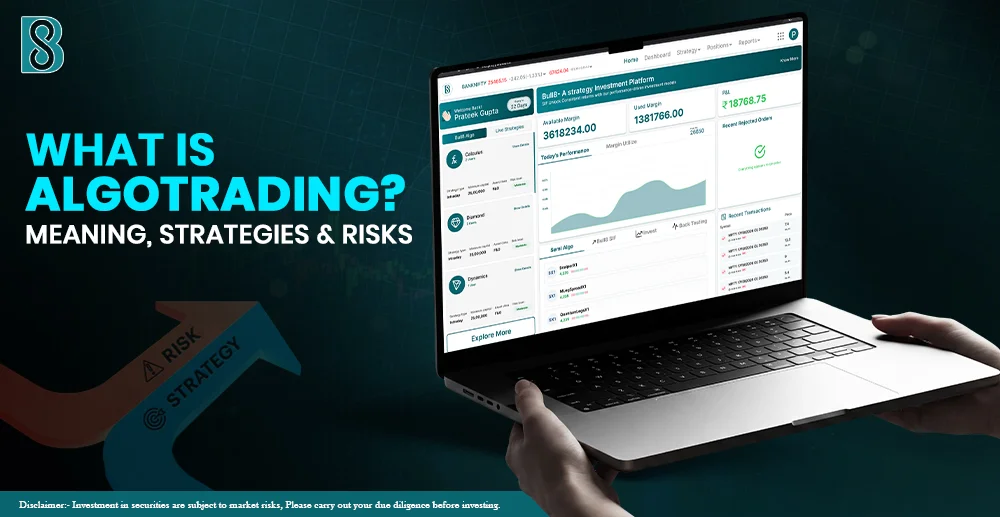


 Data
Data 

