What Is AlgoTrading Meaning, Strategies & Risks.jpg
Introduction
Trading involves more than identifying an opportunity. Traders also need to decide when to enter, how much capital to allocate, when to exit, and how to respond if market conditions change. Following these decisions consistently can become challenging, especially when prices move quickly.
Algo Trading uses computer programs to carry out trading instructions according to predefined rules. These rules may relate to price, volume, technical indicators, timing, or position limits. Automation can reduce repetitive manual work, but it does not remove market risk or guarantee profitable trades.
Understanding how algo trading works, where it can help, and what can go wrong is essential before using it.
Regulatory information reviewed: 9 October 2026.
What Is Algo Trading?
Algo Trading, short for algorithmic trading, is the use of software to generate and execute trading orders when specified conditions are met.
An algorithm is a set of instructions. In trading, those instructions might tell a system to buy an instrument when a particular signal appears, limit the quantity purchased, and exit when another condition occurs.
NSE describes automated trading as a facility that automatically generates and sends buy or sell orders to the exchange when specified parameters are fulfilled, without manual order entry.
A strategy can be relatively simple, such as following a moving-average crossover, or more complex, involving several indicators and instruments.
Algo Trading does not necessarily use artificial intelligence. Many systems follow fixed rules written by a trader or developer. AI-based systems may use statistical models or machine learning, but they still require careful testing, execution controls and ongoing monitoring.
How Does Algo Trading Work?
An algorithmic trading system connects strategy logic with market data, risk controls and order execution.
The System Receives Market Data
The software receives information such as prices, trading volume or order-book data. Depending on the strategy, it may evaluate every price update or wait until a candle closes.
Accurate, timely data matters. Missing or delayed information can affect signals and trading decisions.
The Algorithm Checks Trading Conditions
The program compares incoming information with its predefined rules.
For example, a strategy may require a price breakout, minimum trading volume and a permitted trading time before generating an entry signal.
Risk Checks Evaluate the Order
Before submission, controls may check available margin, position size, existing exposure and trading limits. A signal should not automatically override these safeguards.
The Order Is Submitted
The system sends the order through the permitted broker connection. The broker processes it and routes it to the exchange, subject to applicable checks.
Execution and Positions Are Monitored
An order submission does not mean a trade has occurred. Orders can remain pending, execute partially or be rejected.
The system must track these outcomes and manage exits based on actual positions. Reliable order-status handling is as important as generating the original signal.
A Simple Example of Algo Trading
Consider a hypothetical strategy that evaluates a liquid equity instrument using completed price candles.
Its rules could be:
Generate an entry signal when a short-term moving average crosses above a longer-term moving average.
Allow only one open position.
Use a predefined quantity within the capital limit.
Submit a permitted limit order.
Exit when the opposite crossover occurs or the defined risk condition is triggered.
If the entry order remains unfilled, the system needs instructions for cancelling or managing it. If only part of the quantity executes, exit orders must reflect that actual quantity.
This example illustrates automation rather than a recommended strategy. Moving-average systems can experience repeated losses in sideways markets, and their results depend on parameters, costs and execution.
Common Types of Algo Trading Strategies
Different strategies use different assumptions about market behaviour.
Trend-Following Strategies
Trend-following systems attempt to participate in an established price direction. They may use moving averages, breakouts or other trend indicators.
They can struggle when prices repeatedly change direction without developing a sustained trend.
Momentum Strategies
Momentum systems look for defined measures of price strength or weakness. A strategy might assess recent price movement alongside trading volume.
A key risk is entering after a move has already become extended or immediately before momentum reverses.
Mean-Reversion Strategies
Mean-reversion strategies assume that certain price deviations may move back towards a reference level.
However, a price that appears unusually high or low can continue moving further away. The reference level and conditions for abandoning the trade must be clearly defined.
Arbitrage Strategies
Arbitrage systems attempt to capture price differences between related instruments or markets.
Apparent opportunities may disappear after accounting for transaction costs, execution delays and the risk of one side executing without the other.
Execution Algorithms
Some algorithms focus on managing order execution rather than selecting trading opportunities.
For example, TWAP-based approaches distribute orders over time, while VWAP-based approaches use trading volume as an execution reference. Their purpose is to manage execution objectives; they do not guarantee a favourable price.
Manual, Semi-Automated and Fully Automated Trading
The main difference between these approaches is how much responsibility the software takes for implementing instructions.
Approach
Typical workflow
Human involvement
Manual trading
The trader analyses conditions and places orders
Required for each trading decision and order
Semi-automated trading
Software assists with signals, order preparation or selected execution steps
Approval or intervention is required at defined stages
Fully automated trading
Software generates and submits orders under predefined rules
Required for setup, supervision and strategy changes
Semi-automated workflows vary between platforms. Users should understand exactly which actions require confirmation and which occur automatically.
Fully automated trading still needs supervision. Traders remain responsible for deciding whether a strategy should run, reviewing its behaviour and responding to problems.
Benefits of Algo Trading
Algo Trading can make the implementation of a trading plan more consistent.
A correctly configured system can apply the same conditions repeatedly, reducing discretionary changes at the moment of execution. It can also reduce the effort involved in repeatedly entering orders or monitoring several predefined conditions.
Automation may process signals faster than manual workflows. However, actual execution depends on the broker, connectivity, exchange processing, liquidity and order type.
Another benefit is recordkeeping. Logs can help traders review signals, submitted orders, rejections and completed trades. These records make it easier to investigate differences between expected and actual behaviour.
The value of automation comes from implementing defined instructions reliably. It cannot turn an unsuitable strategy into a successful one merely by executing it faster.
Risks and Limitations of Algo Trading
Understanding the risks is essential because automation can repeat mistakes quickly.
Flawed Strategy Logic
A strategy may use incorrect assumptions or poorly defined conditions. Software can execute those rules precisely while still producing undesirable outcomes.
Ambiguous instructions also create problems. A system needs clear rules for entries, exits, partial execution and exceptional situations.
Overfitting
Overfitting occurs when a strategy is adjusted too closely to historical data.
It may appear impressive in a backtest because its settings capture past patterns that do not repeat. Testing across different periods and using unseen data can help assess this weakness.
Slippage and Trading Costs
Actual execution prices can differ from expected prices. Brokerage, spreads, exchange charges, taxes and other applicable costs can substantially change results.
Strategies involving frequent trading are particularly sensitive to these costs.
Technical Failures
Internet disruptions, expired authentication, server problems, stale data or software errors can interrupt execution.
A recovery process should check existing orders and positions before restarting. Otherwise, a system could submit duplicate orders or operate with an incorrect view of exposure.
Liquidity and Partial Execution
An order may execute only partly or remain unfilled. In strategies involving multiple instruments, unequal execution can create unintended exposure.
Leverage and Changing Markets
Leveraged positions can magnify losses. A strategy that performed adequately in one environment may struggle when volatility, liquidity or market direction changes.
Automation does not remove these risks. It makes the quality of risk controls and monitoring more important.
Backtesting and Risk Management
Backtesting evaluates how a strategy would have behaved using historical data. It is useful for identifying weaknesses, but it is not proof of future performance.
A meaningful backtest should include realistic transaction costs, execution assumptions and the information available at each decision point.
Using future information accidentally creates look-ahead bias. Testing only surviving instruments can also distort results. Data quality and testing methods therefore deserve as much attention as the final performance chart.
Useful measures include maximum drawdown, average gains and losses, losing streaks, exposure and sensitivity to costs. Win rate alone is insufficient: a strategy can win frequently while occasional large losses outweigh those gains.
Paper trading provides another opportunity to inspect live signals and system behaviour. However, simulated execution may differ from real fills.
Before deployment, define position limits, maximum exposure, daily loss limits and conditions for stopping the strategy. Alerts and emergency controls should support a clear response process.
Stop-loss instructions also have limitations. Gaps, liquidity constraints or order-handling issues may prevent execution at the expected price.
Latest Algo Trading Rules in India
Algo Trading in India operates within SEBI and exchange requirements. A retail user should understand the arrangement through which the strategy is offered, rather than relying on a platform’s marketing description.
SEBI issued its “Safer participation of retail investors in Algorithmic trading” framework on 4 February 2025, followed by an implementation timeline extension on 30 September 2025.
NSE’s current algorithmic trading pages reference its consolidated circular NSE/INVG/73992, dated 30 April 2026, for relevant application procedures. Its algo-provider page also provides an exchange empanelment list and was updated on 8 October 2026. That page update should not be interpreted as a new regulation issued that day
Important areas include order identification, applicable algorithm registration requirements, provider empanelment, hosting arrangements and API access controls.
NSE’s linked retail algo FAQ explains that client API orders require appropriate algo tagging, including standardised tagging within the stated 10-orders-per-second threshold. It also distinguishes tech-savvy clients using their own API setup from users accessing broker-hosted provider systems: a personal static IP should not be described as mandatory for every retail algo user. Detailed circulars prevail over the FAQ where requirements differ.
Before activation, ask the broker to explain the requirements applicable to the chosen setup. Exchange registration or provider empanelment does not establish that a strategy will be profitable.
How Can Beginners Get Started?
Begin with the instrument and strategy rather than the software.
Understand how the instrument trades, what can cause losses and how margin works where relevant. Write down the entry, exit and risk rules clearly enough to explain them without relying on a platform interface.
Next, verify the broker and provider arrangements, review costs and test the strategy. Check how the system handles rejected orders, connectivity interruptions and open positions.
Coding knowledge may help with custom development, while no-code tools can simplify configuration. Both approaches require an understanding of the underlying rules.
Deploy only after testing and defining monitoring responsibilities. Review actual execution and system behaviour regularly.
Conclusion
Algo Trading helps implement predefined trading instructions through software. Its usefulness depends on strategy design, realistic testing, reliable execution and effective risk controls. For retail users, understanding current requirements and maintaining supervision are essential parts of using automation responsibly.
FAQ
Is Algo Trading Legal in India?
Algo Trading is permitted within the applicable SEBI and exchange framework. Users should confirm that their broker, provider and trading setup meet the requirements relevant to the service being used.
Can Beginners Use Algo Trading?
Beginners can learn to use algorithmic trading tools, but they should first understand trading instruments, order execution and potential losses. Automation does not replace basic market knowledge or risk management.
Do I Need Coding Knowledge for Algo Trading?
Coding is useful for developing custom systems. Some platforms offer no-code configuration, but users still need to understand strategy rules, testing assumptions, platform limitations and the actions performed automatically.
Does Algo Trading Guarantee Profits?
No. Algorithmic strategies can lose money because of market changes, flawed logic, trading costs or execution problems. Strong historical results do not guarantee that future trading will produce similar outcomes.
How Is Algo Trading Different From AI Trading?
Algo Trading follows programmed instructions. AI trading may use machine learning to analyse data or generate signals. Many algorithms use fixed rules without AI; both approaches require testing and oversight.
Do All Retail Algo Users Need a Static IP?
Requirements depend on the setup. NSE’s FAQ distinguishes tech-savvy clients using their own API arrangements from users of broker-hosted systems. Confirm the applicable requirement with the broker before activation.
What Is a Cash Flow Statement Meaning, Types, Importance and Analysis.jpg
Introduction
A business can report a profit and still struggle to pay salaries, suppliers or loan instalments. This happens because recording revenue does not always mean receiving cash immediately. Similarly, an expense recorded in the accounts may not involve a cash payment during the same period.
A cash flow statement helps explain this difference. It shows how cash enters and leaves a business, where the money comes from, and how it is used.
Understanding this statement helps business owners, investors and lenders assess cash generation, funding needs and financial flexibility. However, the most useful insights come from reading it alongside the balance sheet, income statement and accompanying notes.
What Is a Cash Flow Statement?
A cash flow statement is a financial statement that reports the movement of cash and cash equivalents during a specified accounting period.
It divides these movements into three categories:
Operating activities: Cash generated or used in everyday business operations.
Investing activities: Cash spent on or received from long-term assets and investments.
Financing activities: Cash raised from or returned to lenders and owners.
In simple terms, it answers three questions: Where did the cash come from? Where did it go? How did the cash balance change?
For example, a business may receive money from customers, purchase machinery and repay a loan during the same year. The cash flow statement records these transactions under different sections, making their financial impact easier to understand.
What Are Cash and Cash Equivalents?
Cash generally includes cash on hand and demand deposits with banks.
Cash equivalents are short-term, highly liquid investments that can readily be converted into a known amount of cash and carry an insignificant risk of changes in value. They normally have a maturity of three months or less from the date of acquisition. An investment does not qualify merely because it can be sold quickly.
Why Is a Cash Flow Statement Prepared?
The statement is prepared to explain changes in a business’s cash position and help users assess its ability to generate and use cash.
An income statement shows profitability. A balance sheet shows assets, liabilities and equity at a particular date. The cash flow statement connects these reports by explaining actual cash movements over a period.
Its main objectives include:
Assessing Cash Generation
It shows whether everyday operations produce cash to support the business. This is especially useful when sales and profits are growing but customer payments are taking longer to arrive.
Understanding Cash Usage
The statement identifies whether money is being used for routine expenses, asset purchases, debt repayment or distributions to owners.
Evaluating Funding Needs
A business with insufficient operating cash may need to draw on reserves, borrow money or raise equity. The statement helps reveal this dependence on external funding.
Supporting Financial Planning
Historical cash flows provide a starting point for planning payments, capital expenditure and borrowing requirements. Future budgets must also consider expected changes in sales, costs and collection periods.
What Are the Three Types of Cash Flow?
The three types of cash flow represent different business activities. Each section should be interpreted according to what caused the inflow or outflow.
Cash Flow from Operating Activities
Operating cash flow reflects cash generated or consumed by the principal revenue-producing activities of a business.
Typical cash inflows include:
Payments received from customers.
Cash collected for services provided.
Receipts from the business’s ordinary operating activities.
Typical cash outflows include:
Payments to suppliers.
Salaries and wages.
Rent, utilities and routine operating costs.
Income tax payments, generally, unless specifically attributable to investing or financing activities.
Example: A business collects ₹25 lakh from customers and pays ₹18 lakh towards suppliers, employees and other operating expenses. Assuming there are no other operating cash movements, its operating cash flow is ₹7 lakh.
Positive operating cash flow means operations generated more cash than they consumed during that period. Persistent negative operating cash flow requires investigation, particularly in an established business.
Cash Flow from Investing Activities
Investing cash flow shows cash movements associated with acquiring or disposing of long-term assets and investments that are not cash equivalents.
Typical outflows include:
Buying machinery or equipment.
Purchasing land or buildings.
Acquiring investments.
Paying cash to acquire another business.
Typical inflows include:
Selling machinery or property.
Selling investments.
Recovering principal on loans made to other parties, where classified as investing activities.
Example: A business pays ₹8 lakh for new equipment and receives ₹2 lakh from selling old equipment. Its net investing cash flow is negative ₹6 lakh.
Negative investing cash flow may reflect expansion or asset replacement. Positive investing cash flow may reflect asset sales. Neither result establishes financial strength or weakness on its own.
Cash Flow from Financing Activities
Financing cash flow explains cash movements that change the business’s borrowings or contributed capital.
Typical inflows include:
Proceeds from issuing shares.
Money received through loans.
Proceeds from issuing debt instruments.
Typical outflows include:
Repayment of loan principal.
Share buybacks.
Dividend payments, where classified as financing activities.
Example: A business borrows ₹5 lakh and repays ₹2 lakh of existing loan principal. Its net financing cash flow is positive ₹3 lakh.
A financing inflow increases cash, but borrowing also creates repayment obligations. A financing outflow may reflect debt reduction or capital returned to owners.
Classification note: Interest and dividend cash flows require particular care. Their treatment depends on the applicable accounting framework and the nature of the entity. For non-financial entities under Ind AS 7, interest paid is classified as financing, while interest and dividends received are classified as investing.
Comparison of the Three Categories
Category
Main purpose
Common inflows
Common outflows
Operating
Explain cash from everyday business activities
Customer collections
Suppliers, salaries and routine expenses
Investing
Explain cash used for assets and investments
Asset or investment sales
Machinery, property and investment purchases
Financing
Explain cash raised from or returned to capital providers
Borrowings and share issues
Loan principal repayments and share buybacks
Cash Flow Statement Format with an Example
The following simplified example illustrates how the three sections connect opening and closing cash balances.
Particulars
Amount
Net cash from operating activities
₹12,00,000
Net cash used in investing activities
(₹8,00,000)
Net cash used in financing activities
(₹2,00,000)
Net increase in cash and cash equivalents
₹2,00,000
Opening cash and cash equivalents
₹3,00,000
Closing cash and cash equivalents
₹5,00,000
Figures are hypothetical. Amounts in brackets represent outflows.
In this example, operations generated ₹12 lakh. The business used ₹8 lakh for investing activities and ₹2 lakh for financing activities, leaving a net cash increase of ₹2 lakh.
Where applicable, exchange-rate effects on cash and cash equivalents are presented separately in the reconciliation.
Methods of Preparing a Cash Flow Statement
The direct and indirect methods are alternative ways to present operating cash flow. They are not additional types of business activity.
Direct Method
The direct method presents major categories of operating cash receipts and payments.
A simplified calculation is:
Operating cash movement
Amount
Cash collected from customers
₹30,00,000
Payments to suppliers
(₹16,00,000)
Payments to employees
(₹6,00,000)
Other operating payments
(₹3,00,000)
Income taxes paid
(₹1,00,000)
Net operating cash flow
₹4,00,000
This method makes it easy to see the main sources of operating cash and the largest cash expenses.
Indirect Method
The indirect method starts with an appropriate profit figure and adjusts it for non-cash items, items associated with investing or financing activities, and changes in operating working capital.
For example:
Adjustment
Amount
Profit before tax
₹6,00,000
Add: Depreciation
₹1,50,000
Less: Gain on sale of equipment
(₹50,000)
Less: Increase in trade receivables
(₹2,00,000)
Less: Increase in inventory
(₹1,00,000)
Add: Increase in trade payables
₹1,00,000
Cash generated from operations
₹5,00,000
Less: Income taxes paid
(₹1,00,000)
Net operating cash flow
₹4,00,000
This is a simplified illustration with no other adjustments.
Depreciation is added back because it reduced accounting profit without creating a cash payment in that period. The gain on the equipment sale is removed from operating profit because the related sale proceeds belong in investing cash flow.
Both methods should produce the same operating cash flow when prepared using consistent records and classifications.
Importance of a Cash Flow Statement
Helps Assess Liquidity
Liquidity is the ability to meet obligations as they fall due. Cash flow information helps readers understand whether collections and available funding support payments to employees, suppliers and lenders.
However, a historical cash flow statement does not provide a complete payment schedule. The timing of future obligations also matters.
Explains the Difference Between Profit and Cash
Credit sales can increase profit before customers pay. Inventory purchases can consume cash before the goods are sold. Non-cash expenses can reduce profit without reducing current-period cash.
The cash flow statement helps explain these differences.
Shows How Growth Is Funded
Expansion may be funded through operating cash, existing reserves, borrowing or new equity. Understanding the funding source helps assess whether growth is placing pressure on the business.
Supports Debt Assessment
Lenders and investors can examine operating cash generation alongside borrowing, repayments and upcoming maturities.
A business’s capacity to repay debt depends on more than its reported profit or year-end cash balance.
Helps Evaluate Earnings Quality
Comparing profit with operating cash flow can reveal whether earnings are converting into cash.
A temporary gap may result from seasonality or expansion. A persistent gap may require closer examination of receivables, inventory and revenue recognition.
How to Read and Analyse a Cash Flow Statement
A useful analysis examines the causes of cash movements and how they develop over time.
Step 1: Start with Operating Cash Flow
Check whether core operations generated cash. Compare several years where available.
Ask whether cash generation is recurring or whether it benefited from unusual collections, customer advances or delayed supplier payments.
Step 2: Compare Operating Cash Flow with Profit
Suppose profit rises each year while operating cash flow declines. This does not automatically prove a problem, but it raises questions.
Possible explanations include:
Customers taking longer to pay.
Inventory increasing ahead of expected demand.
Rapid growth consuming working capital.
Unusual accounting gains increasing profit.
Read the relevant notes before reaching a conclusion.
Step 3: Examine Working Capital Changes
Working capital can explain much of the difference between profit and operating cash.
Change
Usual effect on operating cash flow
Increase in trade receivables
Reduces cash conversion
Decrease in trade receivables
Improves cash conversion
Increase in inventory
Uses cash
Decrease in inventory
Releases cash
Increase in trade payables
Preserves cash temporarily
Decrease in trade payables
Uses cash
These effects assume the changes arise from ordinary operating transactions. Acquisitions, foreign-exchange movements and other non-cash changes can complicate the calculation.
Step 4: Review Capital Expenditure
Capital expenditure is spending on long-term assets.
Try to distinguish between expenditure required to maintain existing operations and expenditure intended to support growth. The cash flow statement may not provide this split, so management commentary and notes can be useful.
A large investment outflow should be assessed against the business’s funding capacity and expected operating needs.
Step 5: Calculate Free Cash Flow
A commonly used calculation is:
Free cash flow = Operating cash flow − Capital expenditure
If operating cash flow is ₹15 lakh and capital expenditure is ₹6 lakh, free cash flow is ₹9 lakh.
This indicates cash remaining after the capital expenditure included in the calculation. It is not necessarily surplus cash available for distribution: debt payments, lease obligations and other commitments may still need to be met.
Definitions of free cash flow vary, so check how it has been calculated before comparing businesses.
Step 6: Examine Financing Dependence
Check whether borrowing or equity fundraising is supporting expansion or covering repeated operating shortfalls.
New funding can be appropriate. The concern is whether the business has a sustainable plan for generating cash and meeting its obligations.
Step 7: Review the Closing Cash Balance and Notes
A higher closing cash balance can result from borrowing or asset sales, even when operations consume cash.
Also examine restricted balances, debt maturities and significant commitments. Cash shown in the accounts may not all be freely available for everyday use.
What Do Positive and Negative Cash Flow Mean?
The meaning depends on the section being analysed.
Result
Possible interpretation
What to investigate
Positive operating cash flow
Operations generated cash
Whether the source is sustainable
Negative operating cash flow
Operations consumed cash
Collections, costs, working capital and growth
Positive investing cash flow
Assets or investments were sold
Reasons for the disposals
Negative investing cash flow
Cash was invested in assets or investments
Funding capacity and investment purpose
Positive financing cash flow
Capital was raised
Repayment obligations or ownership dilution
Negative financing cash flow
Capital was repaid or returned
Whether remaining liquidity is adequate
A positive total cash movement does not automatically indicate a healthy business. Similarly, a negative total movement may reflect planned investment or debt repayment.
Cash Flow vs Profit: What Is the Difference?
Basis
Cash flow
Profit
What it measures
Cash received and paid
Income less recognised expenses
Timing
Based on cash movements
Usually based on accrual accounting
Credit sales
Affect cash when collected
Can affect profit before collection
Depreciation
Does not create a current cash outflow
Reduces accounting profit
New borrowing
Creates a financing cash inflow
Is not sales revenue or profit
Main insight
Cash generation and funding
Profitability
Example: A business records a ₹1 lakh credit sale, but the customer pays the following month. The sale can affect current-period profit, while the cash receipt appears in the later period.
This is why profit and cash flow should be analysed together.
Limitations of a Cash Flow Statement
It Reports Historical Movements
Past cash generation does not guarantee future cash generation. Customer demand, input costs and payment behaviour may change.
It Does Not Measure Overall Profitability
Borrowing or selling assets can increase cash even when a business is making losses.
It Can Be Influenced by Timing
Collecting customer payments earlier or paying suppliers later can improve reported cash flow temporarily.
It Does Not Fully Explain Cash Availability
Payment restrictions, future commitments and the timing of obligations require information from other disclosures.
It Requires Separate Information About Non-Cash Transactions
An asset acquired entirely through a non-cash arrangement does not create a cash flow at acquisition. Significant non-cash investing and financing transactions are excluded from cash flow totals and disclosed elsewhere in the financial statements. They should not be treated as irrelevant or ignored.
Free cash flow is entirely available for dividends.
A large cash balance removes the need to examine debt and commitments.
Each figure becomes more useful when connected to its underlying transaction and business context.
Frequently Asked Questions About Cash Flow Statements
What is a cash flow statement in simple words?
A cash flow statement shows money received and paid by a business during a particular period. It separates cash movements into operating, investing and financing activities and explains how the opening cash balance changed into the closing balance.
What are the three main parts of a cash flow statement?
The three main parts are operating activities, investing activities and financing activities. They show cash from routine business operations, cash related to long-term assets and investments, and cash raised from or returned to lenders and owners.
How do you calculate net cash flow?
Add net cash flow from operating, investing and financing activities. For example, ₹10 lakh from operations, negative ₹6 lakh from investing and negative ₹1 lakh from financing produce a net cash increase of ₹3 lakh. Exchange-rate effects, where applicable, are reconciled separately.
Can a profitable business have negative cash flow?
Yes. A profitable business may have negative cash flow because customers have not paid, inventory has increased, or significant cash has been spent on assets or debt repayment. The reason matters more than the negative figure alone.
Is negative cash flow always a bad sign?
No. Negative cash flow can result from planned expansion, equipment purchases or loan repayments. Persistent negative operating cash flow deserves closer attention, especially where an established business repeatedly needs external funding to meet routine expenses.
What is the difference between direct and indirect cash flow methods?
The direct method lists operating cash receipts and payments. The indirect method adjusts a profit figure for non-cash items, relevant non-operating items and working capital changes. They are different presentations of operating cash flow and should produce the same total.
Why is depreciation added back in the cash flow statement?
Under the indirect method, depreciation is added back because it reduced accounting profit without requiring a cash payment in that period. The adjustment does not create cash. Cash paid to purchase the asset is recorded separately when the payment occurs.
How do accounts receivable affect cash flow?
An increase in operating receivables generally means more recognised revenue remains uncollected, reducing cash conversion. A decrease may indicate collections. Changes should be interpreted carefully because write-offs, acquisitions and other adjustments can also affect receivable balances.
How does inventory affect operating cash flow?
Increasing inventory generally ties up cash in goods that have not yet been sold. Reducing inventory can release cash. However, very low inventory may create supply problems, while increased inventory may be intentional ahead of seasonal demand.
What is the difference between operating cash flow and free cash flow?
Operating cash flow measures cash generated or used by operations. Free cash flow commonly subtracts capital expenditure from operating cash flow. It helps assess cash remaining after asset spending, but its definition varies and it does not automatically represent distributable cash.
Is a loan received treated as cash flow or income?
Loan proceeds are generally a financing cash inflow. They are not income from selling goods or providing services. The borrowing increases cash and creates a liability, which must be considered when assessing financial strength.
What are warning signs in a cash flow statement?
Potential warning signs include repeated operating cash deficits, profits rising while cash generation weakens, rapidly increasing receivables, frequent asset sales to fund routine expenses and continued borrowing to cover operating shortfalls. These indicators require investigation rather than an automatic conclusion.
Is a cash flow statement mandatory for every business in India?
No. Requirements depend on the entity and applicable rules. Section 2(40) of the Companies Act, 2013 allows the financial statements of a One Person Company, small company and dormant company to omit the cash flow statement. Eligibility and any other applicable requirements must still be checked.
What is the difference between a cash flow statement and a balance sheet?
A cash flow statement explains cash movements over a period. A balance sheet reports assets, liabilities and equity at a particular date. One describes movements; the other describes the financial position at the reporting date.
What is the difference between a cash flow statement and a cash flow forecast?
A cash flow statement reports historical cash movements. A cash flow forecast estimates future receipts and payments. Forecasts help plan funding needs, but their reliability depends on assumptions about collections, expenses, investment and financing.
Can cash flow be positive when a business reports a loss?
Yes. Non-cash expenses may contribute to an accounting loss without an equivalent current cash payment. Collections, borrowing or asset sales can also increase cash. Examine the separate cash flow sections to understand whether operations themselves generated cash.
What is a good operating cash flow ratio?
The operating cash flow ratio is commonly calculated as operating cash flow divided by current liabilities. There is no universal ideal value. Interpretation depends on the industry, seasonality, liability measurement and payment timing, so comparisons should use consistent calculations and multiple periods.
How Do Stop-Loss and Trailing Stop-Loss Work in Algo Trading.jpg
Introduction
A trading strategy needs more than an entry signal. It also needs a clear answer to two questions: when should a losing trade be closed, and how should an exit change when the market moves favourably?
Stop-loss and trailing stop-loss ruleshelp answer these questions. In algo trading, software can monitor defined conditions and initiate an exit without requiring the trader to make a fresh decision each time.
However, automation does not remove market risk. A stop can trigger without filling immediately, and the execution price can differ from the intended level.
For retail traders exploring Bull8, understanding these distinctions is an essential part of evaluating a strategy and its risk controls.
What Is a Stop-Loss in Algo Trading?
A stop-loss is a predefined exit condition intended to manage an adverse price movement. For a long position, the stop usually sits below the entry price. For a short position, it usually sits above it.
NSE explains that an exchange stop-loss order activates when the relevant market price reaches or crosses its trigger. A sell stop triggers when the last traded price reaches or falls below the trigger; a buy stop triggers when it reaches or rises above it.
In algo trading, an exit condition may also be monitored by the trading platform rather than held as an exchange stop order. Knowing where the condition is maintained matters when assessing connectivity and execution risks.
A Simple Stop-Loss Example
Suppose a hypothetical strategy buys a stock at ₹500 and sets a stop at ₹490.
The planned price risk is:
₹500 − ₹490 = ₹10 per share
For 100 shares, the planned exposure between entry and stop is ₹1,000, before charges and any execution difference.
If the trigger condition is met, the strategy initiates its exit process. This does not mean the final loss must equal ₹1,000. A lower selling price or additional costs can increase it.
These figures illustrate the mechanism, not a recommended stop distance.
Trigger Price and Execution Price Are Different
The trigger price activates the order or exit instruction. The execution price is the price at which the trade actually happens.
The distinction becomes especially important during rapid market movements.
Stop-Market Orders
Where supported, a stop-market order becomes a market order after activation. It seeks execution at available market prices, so the trigger does not guarantee the fill price.
Stop-Limit Orders
A stop-limit order becomes a limit order after activation. It can execute only at its limit price or better, but it may remain unfilled if available prices do not satisfy that condition.
For example, consider a hypothetical sell stop-limit with a ₹490 trigger and ₹489 limit. Once activated, it permits a sale at ₹489 or higher. If available bids drop to ₹486, it may remain pending.
Order availability and validation requirements depend on the instrument, exchange and broker. Traders should verify the supported order type before deploying a strategy.
What Is a Trailing Stop-Loss?
A trailing stop-loss adjusts its exit threshold when the trade moves favourably. In a conventional trailing rule, it does not move backwards when the market reverses.
For a long position, the stop follows rising prices. For a short position, it follows falling prices. The distance may be expressed as an amount or percentage, depending on the implementation.
A fixed stop answers, “Where should the initial exit be?”
A trailing stop adds, “How should that exit change as the trade progresses?”
Trailing can move an exit threshold beyond the entry price, but it cannot guarantee a profitable exit.
How a Trailing Stop Works: A Practical Example
Assume a hypothetical long strategy enters at ₹200, activates trailing immediately and uses a ₹10 distance from the highest observed price since activation.
Price movement
Highest observed price
Trailing stop
Entry at ₹200
₹200
₹190
Price rises to ₹210
₹210
₹200
Price rises to ₹225
₹225
₹215
Price falls to ₹220
₹225
₹215
Price reaches ₹215
₹225
Exit condition is met
When the price retreats to ₹220, the stop remains at ₹215. Moving it down to ₹210 would widen the risk after the favourable movement.
If the exit fills at ₹215, the gross gain would be ₹15 per unit. Actual results depend on the fill, position size and charges.
This example assumes continuous trailing. A strategy that updates only at specified intervals or price steps can behave differently.
How Does Trailing Work for a Short Position?
For a short position, falling prices are favourable, so the trailing threshold moves down.
Imagine a hypothetical instrument sold at ₹300 with an immediately active ₹12 trailing distance. Its initial threshold is ₹312.
If the price falls to ₹280, the threshold becomes ₹292. If it then rises to ₹286, the threshold stays at ₹292. A rise to that level meets the exit condition.
The strategy must still specify the order used to close the position and what happens if it does not fill.
Fixed Stop-Loss vs Trailing Stop-Loss
Feature
Fixed stop-loss
Trailing stop-loss
Exit threshold
Remains at its defined level
Adjusts after favourable movement
Reference
A predetermined price or condition
A moving reference defined by the strategy
Typical purpose
Define the initial adverse exit
Adapt the exit as the trade progresses
Main tradeoff
Does not automatically follow gains
Can trigger during temporary reversals
Execution certainty
No guaranteed fill at the trigger
No guaranteed fill at the trigger
A strategy can combine both: an initial stop may operate first, with trailing activated only after a specified favourable movement.
That activation condition must be explicit. “Trailing enabled” alone does not explain the complete rule.
Which Trailing Parameters Should Traders Understand?
Before activating an algo, review the meaning and units of each setting.
Initial stop: What exit condition applies immediately after entry?
Activation threshold: Does trailing begin immediately, or only after a favourable move?
Trailing distance: Is the gap measured in rupees, price points, percentage or strategy profit and loss?
Update step: Does the threshold change continuously or only after a specified price movement?
Price reference: Is the rule monitoring the traded instrument, an underlying index or combined strategy value?
Exit scope: Does the trigger close one position, selected legs or the entire strategy?
For example, a ₹5 option-premium movement and a five-point index movement are different inputs. Confusing them can produce an exit very different from the one intended.
For multi-leg strategies, exiting one leg also changes the remaining exposure. The exit rule needs to account for the strategy as a whole.
How Can Traders Evaluate Stop Settings?
There is no universally suitable stop distance. An exit rule needs to be assessed alongside the entry logic, holding period and instrument.
A very tight stop may respond to ordinary price fluctuations. A wider stop allows more movement but increases planned risk for the same position size.
Position sizing connects these choices. In a simplified stock example, a ₹2,000 planned risk budget and ₹10 entry-to-stop distance imply 200 shares before costs and execution adjustments. Increasing that distance to ₹20 halves the corresponding quantity to 100 shares.
Derivatives require additional attention to contract quantities, leverage and changing exposure. This arithmetic does not establish a guaranteed maximum loss.
When testing settings, compare drawdowns, repeated stop-outs, trading costs and results across different market conditions. Avoid selecting a distance solely because it produces the strongest historical result.
Why Can an Automated Stop Fail to Deliver the Expected Exit?
Several factors can affect the outcome:
Slippage and sudden movement: A market exit can fill beyond the trigger. FINRA highlights that fast-moving markets can create substantial differences between stop and execution prices.
Insufficient liquidity: The available quantity may be inadequate, resulting in multiple fills or an incomplete exit.
Unfilled limit orders: A triggered stop-limit can remain pending when its limit condition cannot be met.
Connectivity problems: Platform-monitored conditions rely on the systems and connections involved in detecting and sending the exit.
Rejected instructions: An order or modification may be rejected, requiring the strategy to detect the failure and respond.
Temporary reversals: A brief move can activate a stop before the market resumes its previous direction.
Monitoring should therefore cover actual order status and remaining positions, not just whether the strategy generated an exit signal.
What Should Bull8 Users Check Before Going Live?
Bull8 presents its retail algo offering around strategy automation, execution and risk management. bull8.ai For a specific strategy, users should confirm the precise stop behaviour rather than assume every strategy has identical controls.
Ask whether the stop is maintained at the exchange or monitored by the platform. Check when trailing activates, how modifications are confirmed and what happens after a rejection or disconnection.
Also confirm whether stopping the algo closes existing positions or merely prevents new entries. Establish how to verify any remaining exposure through the broker account.
A demonstration or controlled test should make these behaviours understandable before live deployment.
Making Exit Rules Part of a Defined Trading Process
Stop-loss and trailing stop-loss rules support a structured exit process, but their effectiveness depends on clear parameters, suitable position sizing and reliable handling of execution events.
For traders exploring Bull8, the practical next step is to review the selected strategy’s documented exit logic and understand its limitations. Knowing how a stop triggers, adjusts and completes an exit helps traders assess automation with greater clarity.
This article is educational. Examples are hypothetical and exclude charges unless stated. Trading involves risk, and automated exits do not guarantee a maximum loss or profit.
Semi-Automated Algo Trading Software for Strategy-Led Traders
Semi-Automated Algo Trading Software for Strategy-Led Traders
Trading often involves two different jobs: deciding whether an opportunity fits your plan and carrying out that plan accurately once you decide to act. Bull8 brings these steps together with semi-automated algo trading software designed for retail traders who want clear rules, practical controls and visibility over their orders.
With a semi-automated approach, you remain involved at a defined decision point. You can review a setup, select or configure the relevant strategy, check the quantity and risk limits, and authorise the action where the chosen workflow requires it. The software then helps carry out the specified steps according to the settings and available order workflow.
Bull8 supports a broader retail algo trading experience that includes semi-automated strategies, basket trading, backtesting, strategy monitoring and broker connectivity. Explore the tools, understand how each workflow operates, and choose an approach that matches your experience and risk tolerance.
Explore Bull8 Semi-Automated Strategies
What Is Semi-Automated Algo Trading?
Semi-automated algo trading combines trader input with rule-based software execution. The trader decides when to activate, approve or adjust a trade at a specified stage; the software handles the instructions assigned to it. The precise division of responsibility depends on the strategy and its configuration.
For example, a trader may identify a potential options spread, specify its legs and quantities, and review the order before submitting the basket. A different setup might require the trader to activate a predefined rule set and monitor subsequent orders. In both cases, the essential question is the same: Which decisions do you make, and which actions does the software perform?
This approach can be useful for traders who have a defined method but do not want to assemble every order manually. It can also help someone moving from discretionary trading toward a more consistent process. Semi-automation does not remove market risk, make a weak strategy effective or guarantee that every leg of a basket will fill at the expected price.
Before using any semi-automated trading platform, review its approval steps, order types, execution logic, supported broker connections and controls for incomplete or rejected orders. These operational details matter as much as the strategy idea.
How Does Bull8’s Semi-Automated Workflow Fit Into a Trading Day?
Bull8 is built around selecting and managing strategies, monitoring activity and connecting execution through a supported broker. Its public product information describes strategy management, mobile monitoring, backtesting and broker connectivity. The exact settings and availability of individual workflows should be checked during onboarding.
Start with a defined trading plan.
Decide what market condition the strategy is meant to address. Write down the underlying instrument, direction, entry condition, order type, position size, intended exit and circumstances in which you will stand aside.
A rule such as “trade only after confirmation” is too vague unless confirmation has a measurable definition. Clear conditions make the strategy easier to test, execute and review.
Select the relevant strategy or basket.
Choose a supported Bull8 workflow that matches the plan. For a multi-leg position, confirm the buy or sell direction of each leg, contract, expiry, strike and quantity.
Review the total position rather than judging individual orders in isolation. An options spread can behave very differently if one leg is omitted or filled later than another.
Set limits before execution.
Consider the capital allocated to the strategy, maximum acceptable loss, number of entries, time window and exit conditions. If the relevant controls are available for that workflow, set them before the trade begins.
A platform control can enforce a configured rule, but the trader remains responsible for deciding whether that rule is suitable.
Review and authorise the trade.
At the trader-controlled point, verify the order details and the live market context. Prices, spreads and available liquidity may have changed since a basket was prepared. If the setup no longer meets your rules, do not submit it merely because the order is ready.
Monitor orders and positions.
Check the status of every order after submission. A submitted order is not the same as a filled order. Monitor partial fills, rejections, margin requirements and the resulting net position. Use the available strategy dashboard and broker records to understand what has actually executed.
Review the outcome.
After the session, compare planned rules with actual entries, exits and costs. Record deviations and review them before changing the strategy. This feedback loop helps traders distinguish a strategy issue from an execution or process issue.
Semi-Automated Strategies and Trading Workflows on Bull8
Bull8’s semi-automated offering can be understood through three practical use cases. Traders should confirm each strategy’s current configuration options in a product walkthrough.
MLegSpreadX1: A structured multi-leg basket
MLegSpreadX1 is positioned as a semi-automated multi-leg basket workflow. A trader can plan buy and sell legs as one strategy rather than treating each order as a separate idea. This is relevant for options traders who use spreads and need to assess the combined position before acting.
The operational check is especially important: review each leg’s contract and side, the intended ratio between legs, quantities, margin, order sequencing and what happens if only part of the basket executes. A basket is a coordinated workflow; it does not guarantee simultaneous fills or a fixed net entry price.
Suitable use case: A trader has already defined a spread structure and wants a repeatable way to prepare, review and place its component orders.
MLegX2: Flexible basket construction
MLegX2 is presented as a semi-automated basket workflow for up to four legs. It may suit a trader who needs more flexibility in constructing a defined options position. Additional legs can create more ways for an order to be misconfigured, so a final review before placing the trade is essential.
Check every leg’s side, expiry, strike and quantity; then look at the net risk of the basket. If a leg is rejected or remains open, review the resulting exposure before taking further action. Avoid assuming that a planned hedge is in place until the corresponding order is confirmed as filled.
Suitable use case: A trader who understands the payoff and risks of a multi-leg structure and wants to organise its execution in one workflow.
ScalperX1: Predefined parameters for active trading
ScalperX1 is a semi-automated workflow built around trader-selected parameters and limits. For active intraday traders, the appeal is the ability to decide the setup and define the conditions that guide the subsequent action.
Rapid trading is sensitive to spreads, slippage, fees and sudden price changes. A scalping idea therefore needs careful testing and position sizing. Maximum profit or loss settings, where available, should be treated as rules or triggers rather than a guarantee that an exit will occur at an exact price.
Suitable use case: A trader with a specific intraday process who wants a repeatable execution framework and can monitor live orders closely.
See Which Bull8 Workflow Fits Your Trading Plan
Essential Features to Evaluate in Semi-Automated Algo Trading Software
Clear trader approval and execution steps
Look for a workflow that explains when the trader must act, when an order is transmitted and what happens after it is submitted. Ambiguity can cause duplicated orders or unintended exposure. A product demonstration should walk through a complete trade, including cancellation, rejection and partial fill scenarios.
Basket trading with leg-level visibility
A basket should make the instrument, side, contract, lot size and order status visible for every leg. This matters particularly for options spreads. A trader needs to know whether the expected hedge is active, whether the net position changed and how to respond if the basket is incomplete.
Risk settings that match the strategy
Evaluate available position limits, capital allocation, entry limits, stop loss settings and the ability to pause or exit a strategy. Check whether a limit applies to one order, a position, a strategy or the whole account.
Also ask how a control behaves during a sharp gap or an illiquid market. A trigger can result in an order, but the fill price still depends on market conditions and order type.
Backtesting with realistic assumptions
Historical testing can help you inspect how a defined rule set behaved on past data. Examine the sample period, market conditions, transaction costs, slippage assumptions and the number of trades.
Backtests are research tools, not forecasts. A result that looks impressive before costs may change materially after realistic execution assumptions.
Broker connection and order records
Confirm whether your broker and intended instruments are supported. Check the permissions needed to connect the platform, how you can review and revoke access, and where executed orders appear. The broker’s official order and trade records remain important for reconciliation.
Monitoring and interruption controls
A practical interface should help you identify active strategies, open orders, positions and any failed actions. Test how to pause a workflow and what happens to existing positions when you do. “Pause” and “exit” are different operations; traders should understand both before the market opens.
Usable information for beginners and experienced traders
A polished interface is helpful, but clarity is more important. The software should explain what each setting does, show order previews where applicable and make potential exposures easy to inspect. When a feature is unclear, obtain a walkthrough before using it for live trades.
Semi-Automated, Fully Automated and Manual Trading: What Changes?
Approach
Trader’s role
Software’s role
Main point to review
Manual trading
Makes decisions and enters orders
Provides the trading interface
Order entry accuracy and discipline
Semi-automated trading
Makes or approves defined decisions
Carries out the configured workflow
Approval point, order handling and oversight
Fully automated trading
Defines or selects a strategy and supervises it
Generates and sends orders under its rules
Monitoring, limits and strategy behaviour
These categories describe a division of tasks, not a ranking of safety or likely returns. The right approach depends on the strategy, the trader’s experience, the quality of testing and the ability to monitor what happens in the account.
An Illustrative Semi-Automated Strategy Workflow
Suppose a trader is considering an options spread after a defined market condition occurs. The trader checks liquidity in both contracts, confirms the intended long and short legs, sizes the position, and reviews the potential exposure under the planned structure.
The trader then approves the prepared basket. After submission, the trader checks both order statuses. If one leg remains unfilled, the trader follows a prewritten contingency plan rather than assuming the spread is complete. At the end of the session, the trader records entry costs and any difference between expected and actual fills.
This is a process example, not a trade recommendation. Contract selection, margin and loss potential vary by position and market conditions.
Risk Controls to Consider Before Going Live
Begin with a small, clearly defined use case. Check whether the strategy’s rules still make sense after realistic costs, and verify how the platform displays incomplete orders. Set an account-level loss limit if your trading process supports one, and decide when you will stop trading for the day.
Have a plan for a rejected order, broker disconnection, delayed market data or a temporary inability to access the app. Know how to inspect and manage the position directly through your broker if needed. Review permissions and secure your account with the authentication methods available to you. Do not share login credentials or approval codes.
Options and intraday trading can lead to substantial losses. Predefined stop conditions, baskets and automated exits are useful process controls, but they cannot guarantee an exit price, continuous connectivity or protection against every market event. Trading decisions should be made with a clear understanding of the product, position and potential loss.
For retail algorithmic trading in India, the operational and approval framework is subject to SEBIand exchange requirements. Check that the broker and platform workflow you intend to use is supported and follows the applicable current process.
Why Explore Bull8?
Bull8 brings strategy selection, rule-based execution, basket workflows and monitoring into one retail trading platform. Its public product material describes backtesting, broker connectivity and the ability to manage or pause strategies through a mobile-friendly interface. These features give traders a starting point for building a documented workflow and checking it during live use.
The next step is a platform demonstration. Ask to see the semi-automated approval point, an example basket, the order status screen and the controls available for your intended strategy. Confirm supported brokers, instruments and current product availability before using real capital. A useful platform is one you understand well enough to operate and supervise.
Explore Bull8’s Semi-Automated Trading Software
See the workflow, review the controls and find a strategy format that fits your trading plan.
FAQs
Is semi-automated algo trading the same as fully automated trading?
No. In a semi-automated workflow, the trader makes or approves a decision at a defined stage, while software performs the configured execution tasks. A fully automated strategy may generate and send orders when its programmed conditions are met without approval of each trade. Always verify the exact approval and order flow for the strategy you select; product labels alone do not explain how the system operates.
Does a basket order guarantee that all legs execute together?
No. A basket groups the instructions for a multi-leg trade, but actual fills depend on the market, order types, liquidity and the platform and broker workflow. One leg may fill while another remains pending or is rejected. Review the live status of each leg and prepare a contingency plan for an incomplete position.
Can I use my own trading strategy with Bull8?
Bull8’s public materials describe prebuilt strategies and support for custom strategy development in certain contexts. Availability, eligibility, testing and approvals may differ by use case. Ask the Bull8 team whether your specific rules can be configured in the retail semi-automated workflow before assuming a custom strategy can be deployed.
Does backtesting show what I will earn in live trading?
No. Backtesting shows how a strategy would have behaved on the historical data and assumptions used in the test. Future prices, liquidity, charges, slippage and order fills can differ. Review the methodology and consider tests across different market conditions rather than relying on one performance figure.
What should I check before connecting a broker account?
Confirm broker support, required permissions, authentication, relevant product access and the process for disconnecting the account. Understand where orders are transmitted, how you can verify fills in the broker account and what happens if connectivity fails. Never share credentials or one-time passwords outside an authorised login flow.
Which Bull8 semi-automated strategy should I choose?
Start with the trading structure you actually understand. MLegSpreadX1 and MLegX2 are positioned around multi-leg basket workflows, while ScalperX1 is orientated toward predefined parameters for active trading. Review current configuration options, exposure, execution steps and monitoring requirements in a walkthrough before selecting one. No strategy is suitable for every trader or every market condition.
Turning a trading idea into rules is only the beginning. Before considering live use, a trader should test those rules against historical data to understand how the strategy might have behaved under different conditions. This process is known as backtesting.
Retail algo platforms have made testing more accessible by bringing strategy creation, historical analysis, and risk controls into a structured environment. However, a backtest is neither a prediction nor a guarantee. It is an evidence-building exercise that helps traders question an idea before putting capital at risk.
This guide explains how backtesting works, what traders should evaluate, and how a retail algo platform such as Bull8 can support a more disciplined strategy-development process.
What Is Backtesting in Algo Trading?
Backtesting is the process of applying predefined trading rules to historical market data. The system checks when the strategy would have generated entry and exit signals, calculates the theoretical outcome of those trades, and produces performance statistics for review.
For example, a trader could test a trend-following idea that enters when a short-term moving average crosses above a longer-term average. The system applies those conditions to past data and records qualifying trades.
A useful backtest should define:
The instrument or market segment being studied
Entry and exit conditions
Position size and capital allocation
Stop-loss and profit-exit rules
Trading hours and strategy frequency
Brokerage, taxes, slippage, and other transaction costs
The historical period and data interval
Clear rules matter because vague decisions cannot be tested consistently. If a strategy depends on intuition that changes from one trade to the next, its historical result may not be repeatable.
Why Backtesting Trading Ideas Matters
Backtesting helps traders move from assumption to measurable evidence. An idea may sound logical, but its weaknesses often become visible only after it is evaluated across numerous historical situations.
It checks the logic.
A backtest shows whether the rules produced positive, negative, or inconsistent results within the selected dataset. It cannot prove future success, but it can reveal ideas that failed historically.
It Reveals Risk, Not Just Profit
Net profit alone can mislead. A strategy may show a theoretical gain while experiencing an unacceptable drawdown. Testing exposes losing streaks, volatility, and trade concentration.
It Supports Rule Refinement
Testing may reveal that a stop-loss is too narrow, entries are too frequent, or results depend on a few exceptional trades. These findings can guide refinement without repeatedly changing the rules simply to fit past data.
It Encourages Disciplined Decisions
Written rules reduce impulsive reactions by defining entries, exits, and risk responses in advance. This creates a clearer foundation for paper trading and further evaluation.
How Retail Algo Platforms Support Strategy Evaluation
A retail algo platform can replace disconnected spreadsheets, charts, and manual calculations with a unified strategy-research workflow.
Rule-Based Strategy Setup
The first step is translating an idea into objective instructions. A platform may allow users to select instruments, indicators, price conditions, trading windows, order logic, and risk parameters. This makes the strategy easier to test consistently.
Rules must be specific. “Buy when the market looks strong” is not testable; defined price, indicator, and time conditions are. The user remains responsible for ensuring that the logic is coherent and suitable for their requirements.
Access to Historical Testing
Retail algo platforms can apply defined rules across historical data and simulate qualifying trades. This saves time compared with manually reviewing charts and recording hypothetical entries.
Tests should include trending, range-bound, volatile, and relatively quiet market phases. Testing only a favorable period may exaggerate the apparent reliability of a strategy. Data quality, corporate actions, contract changes, and selected candle intervals can also affect results.
Performance Reports and Meaningful Metrics
A responsible strategy evaluation goes beyond final profit. Platforms can present metrics that explain how the result was generated.
Important measurements include:
Total trades: Indicates whether the test contains a sufficiently meaningful sample.
Win rate: Shows the percentage of profitable trades but should be reviewed with average profit and average loss.
Profit factor: Compares the strategy’s gross theoretical profit with its gross theoretical loss.
Maximum drawdown: Shows the largest historical decline from a peak to a subsequent trough.
Average gain and loss: Helps traders understand the payoff structure of the strategy.
Consecutive losses: Highlights the emotional and financial pressure that may occur during an unfavorable period.
Risk-adjusted performance: Evaluates performance in relation to the volatility or risk taken.
No single metric establishes strategy quality. A high win rate, for example, may hide occasional losses large enough to outweigh numerous small gains.
Transaction-Cost and Slippage Assumptions
Ignoring implementation costs is a common backtesting error. Brokerage, exchange charges, and taxes reduce theoretical results.
Slippage refers to the difference between the expected trade price and the price at which the order is actually filled. It can significantly affect fast or frequently traded strategies.
Liquidity, bid-ask spreads, and order size also matter. Assuming every order will be filled instantly at the displayed price can create an overly optimistic result. Traders should include realistic costs and stress-test the strategy using less favorable slippage assumptions.
Risk-Control Evaluation
Backtesting allows users to study how stop-losses, trailing stop-losses, daily loss limits, capital caps, and time-based exits might have influenced historical behavior.
On Bull8, tools such as stop-loss settings, capital controls, volatility filters, and Go-Flat functionality can support defined operating boundaries. However, these features cannot eliminate market risk, price gaps, execution risk, or technical disruptions.
Common Backtesting Errors Retail Traders Should Avoid
Overfitting Historical Data
An overfitted strategy contains too many parameters that have been tailored to a specific dataset. It may appear highly effective in the backtest but fail when market conditions change.
Traders should prefer understandable rules supported by a defensible market rationale instead of excessively optimized models.
Using a Short or Favorable Test Period
A short historical period rarely represents the full range of market behavior. Traders should use broader data and examine the strategy separately across bullish, bearish, sideways, and volatile market conditions.
Look-Ahead and Survivorship Bias
Look-ahead bias occurs when a backtest uses information that would not have been available when the simulated trading decision was made.
Survivorship bias occurs when the dataset excludes instruments that disappeared, were delisted, or became inactive. Both problems can make historical results appear stronger than they actually were.
Ignoring Execution Realities
Illiquidity, rapid price movements, gaps, partial fills, latency, and system availability can make live outcomes different from theoretical results. These factors must be considered before a strategy is used in live markets.
Treating a Backtest as a Forecast
Regulations, volatility, liquidity, market participation, and price relationships can change. Backtesting is a decision-making filter, not a certainty engine or prediction of future performance.
Write the hypothesis: Explain why the trading idea may have a logical or behavioural basis.
Define exact rules: specify entries, exits, instruments, timings, position sizing, and risk limits.
Select appropriate data: Use a relevant timeframe and include different market environments.
Add realistic costs: account for applicable charges, bid-ask spreads, and conservative slippage assumptions.
Review multiple metrics: study drawdowns, losing streaks, trade distribution, and stability—not only the final outcome.
Validate separately: test the strategy using out-of-sample data that was not involved in developing or optimising the rules.
Stress-test the strategy: Examine what happens when transaction costs rise, entries are delayed, or market volatility changes.
Use paper trading: observe the strategy in current market conditions without immediately putting capital at risk.
Monitor cautiously: if the strategy is eventually used live, apply suitable limits and compare its actual behaviour with the backtest.
How Bull8 Helps Retail Traders Evaluate Ideas
Bull8 brings strategy automation, semi-automated execution, basket trading, backtesting, and monitoring tools together within a retail algo trading platform. Users can explore rule-based trading ideas, assess their historical behaviour, and monitor relevant positions, orders, and P&L through a unified interface.
Backtesting helps users inspect a strategy before considering deployment, while risk-management features can support defined operating limits. Nevertheless, the responsibility for selecting assumptions, interpreting results, and determining whether a strategy suits an individual’s objectives and risk tolerance remains with the trader.
Frequently Asked Questions
Can a profitable backtest guarantee profitable live trading?
No. A backtest describes theoretical historical behaviour under specified assumptions. Live results can differ because of changing market conditions, liquidity, slippage, execution timing, transaction costs, and technical issues.
How much historical data should traders use?
There is no universal period. The dataset should cover varied market conditions and provide a meaningful number of trades. The appropriate duration also depends on the instrument, timeframe, and strategy frequency.
What is out-of-sample testing?
Out-of-sample testing evaluates the strategy using historical data that was excluded from rule development. It helps indicate whether the logic is reasonably robust or simply fitted to the original dataset.
Conclusion
Backtesting trading ideas gives retail traders a structured way to examine strategy logic, risk, and historical consistency before considering real-market use. Retail algo platforms make this process more accessible by combining rule creation, historical testing, performance reports, and risk settings within one workflow.
The value of a backtest depends on the quality of its rules, data, and assumptions. Traders should include realistic costs, evaluate different market conditions, avoid overfitting, and follow historical testing with out-of-sample validation and paper trading.
When used responsibly, Bull8can support this disciplined evaluation process while helping retail traders keep their strategy decisions organized, measurable, and risk-aware.
Disclaimer: This content is for educational purposes only and does not constitute investment advice or a recommendation to buy or sell any security. Trading and algorithmic strategies involve market, execution, and technology risks. Historical or simulated results do not guarantee future performance.
How Slippage, Brokerage and Market Liquidity Affect Backtesting Results
Introduction
Backtesting helps traders study how a trading strategy would have behaved using historical market data. It can provide useful information about entries, exits, trade frequency, drawdowns and risk. However, an impressive backtest may produce very different results in live market conditions.
Simplified backtests often assume perfect execution: every order is filled instantly, at the exact signal price and without cost. Real orders must interact with available buyers and sellers. Prices can move, charges apply, and the required quantity may not be available at one price.
Slippage, broking and market liquidity can therefore materially affect backtesting results. Their impact is especially important for intraday, scalping, options and high-turnover algo strategies.
What Is Backtesting in Algo Trading?
Backtesting applies predefined trading rules to historical data to estimate how a strategy might have performed in the past. Traders commonly review the number of trades, win rate, average trade result, drawdown, profit factor and risk-adjusted performance.
Backtesting is a research process—not a prediction. Its usefulness depends on the quality of the data, the strategy logic and the realism of its execution assumptions. Historical results do not guarantee future performance.
Why Backtested and Live Results Can Differ
A basic test may assume an order is executed at a candle’s open, close or another reference price. In live trading, the outcome can be affected by:
Price movement between signal and execution
Bid–ask spread and available market depth
Order size, order type and volatility
Broking, taxes and exchange-related charges
Partial fills, rejected orders or execution delays
Consequently, a strategy’s gross backtested result may differ substantially from its estimated net result after realistic trading costs.
What Is Slippage in Backtesting?
Slippage is the difference between the price expected by a strategy and the price at which an order is assumed or actually executed.
Suppose a strategy produces a buy signal at ₹500, but the order executes at ₹501. The ₹1 difference is adverse slippage. If the order executes at ₹499, it experiences favourable slippage. Conservative tests generally model a reasonable adverse allowance rather than depend on favourable fills.
Slippage may occur when the market moves quickly, the spread is wide, market depth is low, the order is large or a stop order is triggered during a sharp price move.
Market orders prioritise execution over price. Limit orders provide price control, but they may be only partially filled or not filled at all. A reliable backtest should reflect this trade-off.
How Slippage Changes Strategy Performance
Slippage can affect both sides of a trade. A higher buy price increases entry cost, while a lower sell price reduces exit value:
Net trade result = Gross trade result − Entry slippage − Exit slippage − Trading charges
Assume a strategy completes 200 trades with an average gross result of ₹120 per trade. Its theoretical gross result is ₹24,000. If combined entry and exit slippage averages ₹35 per trade, ₹7,000 is removed before broking and other charges are considered.
This matters when the average edge is small. A high win rate does not make a strategy robust if its average net gain is lower than the realistic cost of entering and exiting.
How to Model Slippage Realistically
No single assumption suits every strategy or instrument. Common models include:
Fixed-point slippage: Adds a fixed number of points or ticks to each order.
Percentage-based slippage: Applies a percentage of the expected execution price.
Bid–ask model: Assumes buys execute near the ask and sells near the bid.
Volatility-adjusted model: Increases the allowance when volatility rises.
Depth-based model: Estimates fills using available quantity at multiple price levels.
Instead of relying on one optimistic input, traders can test normal, moderately adverse and stressed slippage scenarios.
How Broking and Trading Charges Affect Backtesting
Borrowing is only one component of transaction cost. Depending on the instrument and segment, trades in India may also involve exchange transaction charges, Securities Transaction Tax, GST, SEBI-related fees, stamp duty and depository charges where applicable.
Charges can vary by segment, transaction type, exchange, regulation and broker pricing. Traders should use the latest official schedules and their broker’s current tariff rather than permanently hard-coding an old rate.
The NSE’s guidance on contract notes confirms that transaction charges and detailed trade information form part of trade reporting. Actual contract notes can help traders compare modelled costs with recorded costs. (NSE contract-note FAQs)
The complete relationship is:
Estimated net result = Gross result − Broking − Taxes and levies − Exchange charges − Slippage − Market impact
Why trade frequency matters
A low-frequency strategy may absorb a modest cost per trade more easily than a high-turnover strategy. Suppose two strategies produce the same gross result, but one completes 20 trades and the other completes 400. If their average round-trip cost is similar, the second strategy loses a much larger amount to transaction costs.
Turnover, average cost per trade and net expectancy should therefore be core backtesting metrics.
What Is Market Liquidity?
Market liquidity is the ability to buy or sell an instrument without causing a significant price change. It is influenced by trading activity, bid–ask spread and quantities available in the order book.
NSE explains that a liquid market allows larger orders to be executed without high transaction costs. It also distinguishes fixed charges from execution costs created by insufficient liquidity. (NSE: Impact Cost)
A liquid instrument typically has a narrow spread and adequate quantity near the best prices. An illiquid instrument may have wide spreads and limited depth, making theoretical backtest prices difficult to achieve.
Bid–Ask Spread, Market Depth and Impact Cost
The bid is the highest price a buyer is willing to pay; the ask is the lowest price a seller will accept. The difference is the bid–ask spread.
If a test buys and sells only at the last traded price, it may ignore this immediate execution cost. A more realistic model assumes buying at or near the ask and selling at or near the bid.
Spread alone does not capture the effect of a large order. If only 100 shares are available at the best ask, an order for 1,000 shares may consume multiple price levels. Its average execution price will then be worse than the displayed best ask.
NSE defines impact cost as the percentage price degradation experienced when executing a specified quantity relative to an ideal price. It changes with order size and outstanding orders, making it a practical measure of liquidity. (NSE: Impact Cost)
Liquidity also changes through the day and during volatile events. Daily OHLC data cannot show intraday changes in spread, depth or the sequence of prices within each candle. Short-term strategies may require granular data and more conservative assumptions.
Which Strategies Are Most Sensitive?
Strategy type
Cost sensitivity
Primary concern
Scalping
Very high
Tight targets may be consumed by costs.
Intraday algo strategy
High
Frequent orders and rapid price changes
Options strategy
High
Variable spreads and liquidity
Basket or multi-leg strategy
High
Legs may execute at different prices.
Swing strategy
Moderate
Gaps and stop-order slippage
Low-frequency strategy
Lower
Fewer trades, but liquidity still matters.
Multi-leg strategies require special attention. A test may assume all legs execute simultaneously at displayed prices. In practice, one leg can fill while another moves or remains pending. Spread, costs and possible slippage should be applied to every leg.
Practical Cost-Adjusted Backtesting Example
Consider this illustrative result for an intraday strategy:
Item
Simplified test
Cost-adjusted estimate
Gross result
₹60,000
₹60,000
Broking and charges
₹0
₹12,000
Slippage and spread
₹0
₹9,000
Market impact
₹0
₹3,000
Net result
₹60,000
₹36,000
The strategy logic has not changed, but its interpretation has. The simplified result overstates the cost-adjusted estimate by ₹24,000. These figures are illustrative and do not represent expected performance or a return claim.
Common Backtesting Mistakes
Results can be overstated when traders:
Assume zero broking, spread and slippage
Execute every order at a candle’s exact close
Assume every limit order receives a complete fill
Ignore rejected orders, delays and partial fills
Test large quantities without checking liquidity
Ignore costs on individual legs of a basket
Optimise parameters excessively on the same data
These assumptions can introduce bias and create false confidence.
How to Make Back testing More Realistic
Include every applicable cost.
Model broking, statutory levies, exchange charges and other relevant expenses. Review the assumptions whenever fee structures change.
Use realistic execution prices.
Where the data permits, the model buys from the ask side and sells from the bid side. Do not assume that every order executes at the last traded price.
Match order size with liquidity.
Use volume or depth filters. A strategy should not assume that a large quantity can be executed at one price when the market cannot reasonably support it.
Model missed and partial fills
Touching a limit price does not prove that the entire order would have filled. Add logical rules for incomplete orders, cancellations and rejections.
Account for execution delay.
Include a realistic delay between signal generation and assumed execution, particularly for short-term strategies. Even a brief delay can change a fill in a fast market.
Test different market regimes.
Evaluate trending, sideways, volatile and low-liquidity periods. Conduct sensitivity analysis using higher slippage, wider spreads and reduced available volume.
Validate unseen and forward data.
Develop the strategy on one dataset and validate it on unseen data. Paper trading or forward testing can then help compare simulated assumptions with live market behaviour before capital is used.
Metrics to Review After Costs
In addition to gross results and win rate, review net result, average net outcome per trade, turnover, cost per trade, maximum drawdown, profit factor, expectancy and strategy capacity at different order sizes. The difference between gross and net performance should remain clearly visible.
Conclusion
Slippage, broking and market liquidity directly affect execution prices, order completion and net strategy performance. Their influence is greatest in strategies with frequent trades, tight targets, large quantities or multiple legs.
A credible backtest should include applicable charges, realistic spread and slippage assumptions, order-size limits, missed fills and stress scenarios. Its objective is not to display the highest historical number but to provide a more honest estimate of how a strategy could behave in practical market conditions.
Bull8 helps retail users explore systematic trading ideas through backtesting and strategy tools in a structured environment. Backtest outputs should always be treated as research estimates, assessed with realistic costs and followed by appropriate risk evaluation. They do not guarantee future performance.
FAQ’s
What is slippage in backtesting?
It is the difference between the expected order price and the assumed execution price. It can result from spread, volatility, latency, order size or insufficient liquidity.
Should broking be included in every backtest?
Yes. Broking and all applicable charges should be included to estimate net performance. Use current official and broker-specific schedules.
Why does liquidity affect backtesting results?
Liquidity determines how easily an order can be filled near the expected price. Low depth can produce worse execution, partial fills and higher market impact.
Can slippage make a positive backtest negative?
Yes. A strategy with a small edge or high trade frequency may lose its theoretical advantage after realistic entry and exit slippage.
Do backtesting results guarantee live results?
No. Live results may differ due to market conditions, liquidity, execution, costs and system behaviour. Historical results do not guarantee future performance.
How OHLC Data Helps Identify Market Trends in Algo Trading
Markets generate thousands of price changes during every trading session. For a trader, reading every individual movement is difficult. For an algorithm, processing raw tick-by-tick information can also be unnecessarily complex for many strategies. OHLC data solves this problem by summarising price activity into four useful values: open, high, low and close.
These four prices help a retail algo trading system understand where a market started, how far it moved, where it faced resistance or support and where it finished during a selected period. When OHLC data is analysed across multiple candles, it can help classify the market as bullish, bearish, range-bound or volatile.
However, OHLC data is not a prediction tool by itself. It becomes useful only when it is converted into objective conditions and combined with appropriate confirmation, execution and risk-management rules.
What Is OHLC Data in Algo Trading?
OHLC represents four price values recorded for a particular timeframe:
Open: The first recorded or officially recognised price of the period.
High: The highest traded price during that period.
Low: The lowest traded price during that period.
Close: The last or officially calculated closing price of the period.
The selected period can be one minute, five minutes, fifteen minutes, one hour, one day or even one week. For example, a five-minute candle summarises all eligible trades completed during those five minutes into four prices.
Consider this illustrative five-minute data:
Time
Open
High
Low
Close
10:00–10:05
₹1,000
₹1,012
₹996
₹1,009
The price opened at ₹1,000, reached a high of ₹1,012, fell as low as ₹996 and closed the period at ₹1,009. Because the close is above the open and relatively near the high, this candle suggests buying strength during that interval. It does not, however, confirm that the price will continue rising.
An algorithm does not have to “look” at a candle as a human does. It can calculate the same information numerically and compare it with earlier periods.
What Each OHLC Price Reveals About the Market
Every component of an OHLC candle provides a different piece of information.
Open Price: The Starting Point
The open price shows where trading activity began during the selected interval. On a daily chart, it may reflect the market’s response to overnight developments, global cues, corporate announcements or changes in demand and supply.
Algorithms commonly compare the current open with the previous close:
Current open above previous close: Gap-up opening
Current open below previous close: Gap-down opening
Current open near previous close: Relatively neutral opening
A gap is not automatically a bullish or bearish signal. The system must analyse what happens after the opening. A gap-up followed by a weak close may indicate selling pressure, while a gap-down followed by recovery may show buying interest at lower levels.
High Price: The Upper Boundary
The high represents the highest price accepted during the period. It helps an algorithm identify:
Potential resistance areas
Breakout attempts
Recent swing highs
Volatility expansion
Price rejection from higher levels
When the market repeatedly approaches a level but fails to close above it, that area may act as resistance. A close above the earlier high can be used as one condition for a breakout, although additional confirmation is normally required.
Low Price: The Lower Boundary
The low is the lowest traded price during the interval. It can help locate:
Potential support levels
Breakdown attempts
Swing lows
Downside volatility
Rejection from lower prices
If price repeatedly falls near a level and recovers, an algorithm may classify it as a support zone. A close below that zone could indicate a possible breakdown.
Close Price: The Confirmation Point
The close receives significant attention because it shows where the market ended the period relative to its open, high and low.
A close near the high can suggest that buyers maintained control until the period ended. A close near the low may reflect sustained selling pressure. A close near the middle indicates a more balanced outcome.
Waiting for a candle to close can reduce premature signals, but it also creates some delay. This is a common trade-off between confirmation and speed.
How OHLC Data Creates Candlesticks
A candlestick is simply a visual representation of OHLC data.
The difference between the open and close forms the candle’s body. The distances from the body to the high and low form the upper and lower wicks.
A candle is generally considered bullish when the close is above the open and bearish when the close is below the open. However, the size and location of the body provide more information than colour alone.
An algorithm can calculate:
Candle Body = |Close − Open|
Candle Range = High − Low
Upper Wick = High − Maximum of Open or Close
Lower Wick = Minimum of Open or Close − Low
It can also measure how much of the total range is occupied by the body:
Body-to-Range Ratio = |Close − Open| ÷ (High − Low)
A higher ratio may indicate stronger directional movement. A smaller ratio may reflect indecision or rejection, although its meaning depends on the preceding trend and market context.
How OHLC Data Identifies an Uptrend
An uptrend is more than a single bullish candle. It is a market structure in which price generally forms higher highs and higher lows.
An OHLC-based algorithm may define an uptrend using conditions such as:
The current high is above the previous high.
The current low is above the previous low.
Closing prices are rising across several periods.
The close remains above a selected moving average.
Bullish candles close in the upper portion of their ranges.
Price closes above a previous resistance level.
Here is a simplified data example:
Candle
Open
High
Low
Close
1
₹500
₹507
₹496
₹504
2
₹504
₹512
₹501
₹509
3
₹509
₹518
₹506
₹516
The highs rise from ₹507 to ₹512 and then ₹518. The lows rise from ₹496 to ₹501 and then ₹506. Closing prices also move upward. Together, these observations indicate a developing bullish structure.
A basic algorithmic rule could be:
Classify the market as an uptrend when the latest three completed candles form higher highs and higher lows, and the latest close remains above the 20-period moving average.
This is only an illustrative rule. A practical strategy would also define volume, volatility, liquidity, risk and exit conditions.
How OHLC Data Identifies a Downtrend
A downtrend normally develops through lower highs and lower lows. It indicates that buyers are unable to push the price back to earlier highs and sellers continue to accept lower prices.
An algorithm may classify a bearish trend when:
The latest high is below the previous high.
The latest low is below the previous low.
Closing prices decline over several periods.
Price remains below a moving average.
Bearish candles close near their lows.
Price closes below established support.
Consider another illustrative dataset:
Candle
Open
High
Low
Close
1
₹820
₹824
₹811
₹814
2
₹814
₹818
₹804
₹807
3
₹807
₹811
₹796
₹799
The falling highs, lows and closes suggest sustained selling pressure. An algorithm could use these conditions to activate a trend-following setup or prevent a long-only strategy from entering.
Identifying a Sideways or Range-Bound Market
Not every market produces a clear trend. Prices frequently move between a defined support zone and resistance zone without establishing a lasting direction.
OHLC characteristics of a range-bound market may include:
Similar highs across several candles
Similar lows across several candles
Frequent movement above and below a moving average
Small candle bodies
Overlapping price ranges
Repeated breakout failures
No consistent sequence of higher highs or lower lows
For example, if the highest price recorded across 20 candles is ₹1,050 and the lowest is ₹1,020, while most closes remain inside that band, an algorithm may classify the market as range-bound.
This classification matters because a trend-following strategy may generate repeated false signals in a sideways market. A range-trading system, on the other hand, may look for price rejection near the upper and lower boundaries.
Market-regime identification allows an algorithm to decide not only when to trade but also when its strategy may be unsuitable.
Measuring Trend Strength with OHLC Data
Knowing the direction of a trend is not enough. An algorithm should also assess whether that movement is strong, weak or losing momentum.
Close Location Value
The position of the close inside the candle’s range can be measured as:
Close Location = (Close − Low) ÷ (High − Low)
The value normally falls between 0 and 1:
A value near 1 means the close is near the high.
A value near 0 means the close is near the low.
A value near 0.5 means the close is near the centre.
Suppose a candle has a high of ₹220, a low of ₹200 and a close of ₹218:
(218 − 200) ÷ (220 − 200) = 0.90
The closing price is in the top 10% of the candle’s range, indicating that buyers controlled much of that period. One candle is insufficient for a conclusion, but consistently high values during rising prices may support a bullish trend assessment.
Range Expansion
A widening high-low range may indicate increasing volatility or momentum. A narrowing range may indicate declining activity or consolidation.
Algorithms can compare the current range with an average:
Range Expansion Ratio = Current High-Low Range ÷ Average Range of Previous 20 Candles
A ratio above 1 means the current candle is wider than its recent average. Whether this is bullish or bearish depends on the direction of the close and the surrounding market structure.
Using OHLC Data to Identify Breakouts
A breakout happens when price moves beyond a recognised resistance level. A breakdown occurs when price falls below support.
A basic bullish breakout condition might be:
The current close is greater than the highest high of the previous 20 completed candles.
A bearish breakdown condition might be:
The current close is lower than the lowest low of the previous 20 completed candles.
Using the close instead of the intraperiod high or low can help filter brief price spikes. However, false breakouts can still occur. An algorithm may therefore add:
Volume confirmation
Minimum breakout distance
Volatility threshold
Market-trend filter
Retest condition
Time-of-day filter
Maximum entry-price deviation
For example, a system might accept a bullish breakout only when the close is at least 0.25% above resistance and the volume is higher than its recent average. The values must be tested for the chosen instrument rather than treated as universal settings.
Previous-Day High, Low and Close in Intraday Strategies
Previous-day OHLC levels are frequently used because they provide objective reference points before the new session begins.
An intraday algorithm may track:
Previous-day high as potential resistance
Previous-day low as potential support
Previous-day close as a sentiment reference
Current open relative to the previous close
Current price position inside the previous day’s range
Suppose the previous day’s high was ₹1,240, its low was ₹1,190 and its close was ₹1,225. If the next session opens at ₹1,232 and later closes a five-minute candle above ₹1,240, the system may identify a potential breakout.
The breakout alone should not directly imply a trade. The strategy must still evaluate liquidity, volatility, position size, stop-loss distance and the risk of entering after an extended move.
OHLC Analysis Across Different Timeframes
The same instrument can appear bullish on a five-minute chart and bearish on a daily chart. This is not a contradiction. Each timeframe describes a different section of market activity.
One- and five-minute candles: Useful for short-term execution but highly sensitive to noise.
Fifteen-minute and hourly candles: Provide a broader intraday view.
Daily candles: Commonly used for swing and positional analysis.
Weekly candles: Help identify broader market structure.
A multi-timeframe algorithm may use the daily chart to determine the primary direction and a shorter timeframe to identify entries. For instance, it could permit bullish entries on a fifteen-minute chart only when the daily close is above a long-term moving average.
The higher timeframe provides context, while the lower timeframe provides execution detail. Too many timeframes, however, can produce conflicting filters and an overcomplicated strategy.
Combining OHLC Data with Volume and Volatility
OHLC shows where price moved, but not how much participation supported that move. Volume can add this missing context.
A breakout accompanied by relatively high volume may show broader market participation. A breakout with low volume may be more vulnerable to reversal. Volume should still be interpreted carefully because its behaviour differs across cash equities, derivatives and trading sessions.
Volatility can be measured using the high, low and previous close. Average True Range, or ATR, estimates recent price movement and can help an algorithm:
Avoid trading during abnormally quiet periods
Reduce exposure during extreme volatility
Set adaptive stop-loss distances
Compare movement across different instruments
Avoid using a fixed risk distance in every condition
Indicators should be used to answer specific questions. Adding multiple indicators based on the same closing-price data may create the illusion of confirmation without providing genuinely independent information.
Using OHLC Data for Entry, Exit and Risk Rules
A complete algo strategy must define much more than market direction.
Entry Rules
An OHLC-based entry may require:
Confirmed trend structure
Close above resistance
Price above a moving average
Minimum candle-body strength
Suitable volume and volatility
Acceptable spread and liquidity
Exit Rules
The system may exit when:
Price closes below a recent swing low
The trend structure changes
A volatility-adjusted stop-loss is triggered
A predefined risk-reward level is reached
The position remains open beyond a time limit
A maximum daily loss is reached
Position Sizing
The distance between the entry and stop-loss can determine position size:
Position Size = Maximum Permitted Trade Risk ÷ Risk Per Unit
If a strategy permits a maximum trade risk of ₹1,000 and the difference between entry and stop-loss is ₹10 per share, the theoretical position size would be 100 shares before accounting for applicable limits, costs, liquidity and execution constraints.
Risk rules should be calculated before an order is placed. They should not depend on a trader’s reaction after the market moves.
Backtesting an OHLC-Based Algo Strategy
Historical OHLC data allows a strategy to be evaluated before live deployment. A responsible backtest should include:
Clearly defined entry and exit conditions
Reliable and correctly timestamped data
Broking and applicable transaction costs
Realistic slippage assumptions
Position-sizing rules
Maximum exposure limits
Different market regimes
Out-of-sample testing
Forward or paper testing
Analysis of drawdown and losing sequences
A critical limitation is that a single OHLC candle does not reveal the exact order in which its high and low occurred.
Suppose a daily candle has:
Open: ₹100
High: ₹110
Low: ₹95
Close: ₹108
If a strategy had both a target at ₹108 and a stop-loss at ₹97, daily OHLC data alone may not reveal which level was reached first. Using lower-timeframe data or conservative assumptions can reduce this form of backtesting error.
Developers should also avoid lookahead bias. A strategy cannot use the final high, low or close of a candle before that candle has been completed.
Limitations of OHLC Data
Although OHLC data is efficient and widely used, it has important limitations:
It compresses many individual trades into four values.
It does not show the exact intraperiod price sequence.
It may hide sudden changes inside a candle.
A completed-candle signal may enter after part of the move has occurred.
Low-liquidity instruments can produce unreliable candles.
Data adjustments and closing-price methods can vary.
Technical patterns may fail after unexpected news.
The reliability of an OHLC strategy depends on the quality of its data. Missing candles, duplicated records, incorrect timestamps, unadjusted corporate actions and mismatched time zones can materially distort a backtest.
Common Mistakes When Using OHLC Data
Algo traders should avoid several frequent errors:
Treating one bullish candle as proof of an uptrend
Entering every high breakout without confirmation
Using incomplete candles as completed signals
Applying identical settings to every instrument
Ignoring spreads, slippage and liquidity
Testing only during favourable market periods
Optimising parameters until they perfectly fit historical data
Using too many indicators derived from the same prices
Assuming automation removes market risk
Deploying a strategy without risk limits and ongoing monitoring
SEBI has also cautioned investors about dealing with unregulated platforms offering algorithmic trading and about performance or return claims. Users should evaluate the regulatory status, transparency and risk controls of any service before sharing credentials or deploying capital. SEBI investor caution
Best Practices for OHLC-Based Algo Strategies
For a more disciplined development process:
Start with simple, explainable conditions.
Use completed candles unless the strategy explicitly handles live updates.
Test different market regimes, not only strong trends.
Keep training, validation and out-of-sample data separate.
Use realistic execution assumptions.
Combine signal logic with strict position and loss limits.
Maintain logs of signals, orders, rejections and executions.
Monitor live behaviour for data or execution failures.
Review the strategy when market conditions change.
Never describe historical backtest results as guaranteed future returns.
Conclusion
OHLC data provides a practical framework for converting market activity into measurable algo trading rules. Open prices help assess the starting context, highs and lows reveal trading boundaries, and closes help confirm how each period ended.
Across multiple candles, this information can identify higher highs, higher lows, lower highs, lower lows, breakouts, consolidations and changes in volatility. It can also support entry filters, trailing stops, position sizing and market-regime classification.
Its simplicity is both its strength and its limitation. OHLC data makes price behaviour easier to process, but it removes the detailed sequence of intraperiod trades. Therefore, a reliable strategy should use clean data, objective rules, realistic backtesting, execution controls and disciplined risk management.
OHLC-based algorithms do not need to predict every market move. Their purpose is to respond consistently when predefined conditions appear—and to control risk when the market behaves differently from historical expectations.
Frequently Asked Questions
What does OHLC mean in algo trading?
OHLC stands for Open, High, Low and Close. These values summarise price activity during a selected timeframe and can be converted into rules for trend identification, entries, exits and risk management.
Which OHLC price is most useful for identifying trends?
The close is commonly used for confirmation, while highs and lows help determine market structure. A reliable trend assessment normally uses all four values across multiple candles rather than relying on a single price.
How can an algorithm identify an uptrend?
An algorithm can look for higher highs, higher lows and rising closing prices. It may also require the price to remain above a moving average or close above resistance before classifying the structure as bullish.
How does OHLC data identify a downtrend?
A sequence of lower highs, lower lows and falling closes may indicate a downtrend. Additional momentum, volatility and volume filters can help determine whether the downward move has sufficient strength.
Can OHLC data identify a sideways market?
Yes. Repeated highs and lows within a limited range, overlapping candles and the absence of consistent directional structure can help an algorithm classify the market as sideways.
What is an OHLC breakout strategy?
It is a rule-based strategy that monitors whether the price closes above an earlier high or below an earlier low. Practical breakout systems generally include confirmation, liquidity and risk-management conditions.
Which timeframe is best for OHLC analysis?
There is no single best timeframe. The choice should match the strategy’s intended holding period, execution speed, trading costs and tolerance for market noise.
Can OHLC data be used for stop-loss placement?
Yes. Recent lows may support stop-loss placement for long positions, while recent highs may be used for short positions. Volatility and position size should also be considered.
Is OHLC data sufficient for algo trading?
OHLC data can support many strategies, but it does not show volume, order-book activity or the exact sequence of trades inside a candle. The required data depends on the strategy’s objective and execution style.
Does an OHLC-based strategy guarantee profitable trades?
No. OHLCdata describes historical and current price behaviour but cannot guarantee future results. Every strategy requires testing, execution controls, monitoring and clearly defined risk limits.
Disclaimer: This article is intended for educational purposes only and should not be considered investment advice or a recommendation to buy or sell any security. Algo trading involves market, execution, technology and operational risks.
How an Order Management System Works in Algo Trading
Introduction
Algorithmic trading is not limited to generating buy or sell signals. Once a strategy identifies a trading opportunity, the instruction must be converted into a valid order, sent to the broker, tracked in real time and managed according to predefined risk conditions. An Order Management System in algo trading helps coordinate this entire process.
An order management system, commonly called an OMS, acts as an operational bridge between an algorithmic strategy, the broker’s trading system, and the exchange. It manages the order lifecycle—from initial creation to execution, modification, rejection, or cancellation.
For retail traders using automated strategies, understanding how an OMS works is important. It explains what happens after an algorithm generates a signal and how technology helps maintain speed, consistency, and control throughout the execution process.
What Is an Order Management System in Algo Trading?
An order management system in algo trading is a software component that receives trading instructions from a strategy and manages them until their lifecycle is complete.
Suppose an algorithm generates an instruction to buy a particular quantity of a security at a defined price. The OMS validates that instruction, converts it into the format required by the broker, submits the order, and monitors its status.
Depending on the strategy and system configuration, an OMS may handle:
Buy and sell orders
Market and limit orders
Stop-loss and stop-limit orders
Order modifications
Order cancellations
Partial executions
Rejected orders
Position updates
Trade logs and reports
A well-designed OMS does more than transmit an order. It helps ensure that every instruction follows the strategy’s conditions, platform rules and configured risk limits.
Why Is an OMS Important for Algorithmic Trading?
Markets can move quickly, especially during periods of high volatility. A delay between signal generation and order placement may affect the execution price or cause the opportunity to disappear.
Manual order management also introduces the possibility of emotional decisions, typing errors, and delayed responses. An OMS automates many operational steps so that orders can be handled according to preset rules.
The system supports algorithmic trading by providing:
Consistent order placement
Faster transmission of instructions
Real-time order-status tracking
Automated modification and cancellation
Position and quantity monitoring
Predefined risk checks
Accurate execution records
An OMS does not guarantee that every order will execute at the expected price. Execution still depends on market liquidity, volatility, order type, connectivity, and exchange conditions. However, it can create a structured process for managing orders more efficiently.
How Does an Order Management System Work?
The functioning of an OMS can be understood through the complete journey of an order.
The Trading Strategy Generates a Signal
The process begins with the algorithmic strategy. It continuously analyses relevant information according to its programmed logic.
Depending on the strategy, this data may include:
Market prices
Trading volume
Technical indicators
Volatility
Time-based conditions
Price breakouts
Option-chain information
Predefined entry and exit rules
When all required conditions are satisfied, the strategy generates a signal. For example, the signal may instruct the system to buy 100 shares using a limit order.
At this stage, the signal represents a trading decision, but it has not yet become a live exchange order.
The Signal Is Converted into an Order
The OMS receives the signal and converts it into a structured order request. This request contains the information needed by the broker’s system.
Typical order details include:
Trading symbol
Exchange
Buy or sell direction
Order quantity
Order type
Limit or trigger price
Product type
Strategy identification
Time-in-force instruction
The OMS checks that the request contains valid and complete information. An incomplete instruction should not be forwarded for execution.
Pre-Trade Validation Is Performed
Before sending the order, the OMS may conduct several validation and risk checks. These checks help prevent invalid, oversized or duplicate orders from reaching the broker.
Common validations can include:
Whether the instrument is available for trading
Whether the quantity falls within the configured limit
Whether sufficient funds or margin may be available
Whether the price is within an acceptable range
Whether the market session is open
Whether the order violates the strategy’s capital limit
Whether a similar order is already pending
Whether the maximum daily loss or position limit has been reached
If an instruction fails a validation check, the OMS may block it and record the reason. This pre-trade layer is an important part of controlled algorithmic execution.
The Order Is Routed to the Broker
Once validated, the order is sent to the connected broker through the available integration.
The broker’s trading and risk systems may perform additional checks before forwarding the instruction to the exchange. If the order satisfies the applicable requirements, it enters the exchange’s order book.
This stage is called order routing. Its performance can depend on several factors, including network quality, broker infrastructure, platform architecture and system load.
The Exchange Processes the Order
The exchange attempts to match the submitted order with an available opposite order.
For example, a buy order must be matched with a corresponding sell order. Whether the order is executed depends on factors such as:
Order type
Limit price
Available liquidity
Market depth
Price-time priority
Current market conditions
A market order generally seeks execution at the best available price, but the final price may differ from the price visible when the signal was generated. A limit order provides price control, but it may remain unexecuted if the market does not reach the specified price.
The OMS Receives Order-Status Updates
After submission, the OMS continuously receives updates from the broker. An order may move through several states:
Pending
Open
Partially filled
Completely filled
Modified
Cancelled
Rejected
Expired
These updates are important because the trading strategy must know the actual order status before taking its next action.
For example, a strategy should not assume that a position exists merely because it submitted a buy order. It needs confirmation of execution.
Partial Fills Are Managed
Sometimes an order is executed only partially due to limited liquidity.
Suppose an algorithm submits an order for 500 units, but only 300 units are initially available at the required price. The OMS records the execution of 300 units while continuing to monitor the remaining quantity.
Based on its configuration, the system may:
Leave the remaining order open
Modify its price
Cancel the unexecuted quantity
Wait for additional liquidity
Adjust the related exit order
Partial-fill management is essential because the strategy’s intended quantity and actual position may be different.
Exit Orders and Risk Controls Are Applied
Once the entry order is executed, the system may activate predefined exit conditions. These can include:
Stop-loss
Trailing stop-loss
Target price
Time-based exit
Strategy-level square-off
End-of-day Go-Flat instruction
The OMS monitors the position and coordinates the required exit order when a condition is triggered.
Risk controls should be configured before deployment rather than added after a position is created. They do not eliminate market risk, slippage, gaps or execution delays, but they provide a structured framework for responding to defined conditions.
Records Are Updated
Every order event should be recorded. This includes order placement, exchange acknowledgement, modification, execution, cancellation and rejection.
Detailed order records help traders:
Review strategy performance
Identify execution problems
Compare intended and actual trades
Analyse slippage
Investigate rejected orders
Maintain operational records
Improve strategy configurations
Reliable logs are especially useful when multiple strategies or instruments are being managed simultaneously.
OMS vs EMS: What Is the Difference?
An Order Management System is sometimes confused with an Execution Management System, or EMS.
An OMS primarily manages the overall order lifecycle, including validation, status tracking, position updates and records. An EMS focuses more specifically on how orders are executed, including routing logic, execution methods and market interaction.
In modern algo-trading platforms, OMS and EMS functions may be closely integrated. This combined infrastructure can manage a trade from strategy signal to final execution while maintaining a unified record of every action.
Important Features of an Algo-Trading OMS
A reliable Order Management System should support more than basic order placement.
Real-Time Order Tracking
The system should display whether an order is pending, open, filled, rejected or cancelled. Delayed or unclear information can lead to incorrect strategy decisions.
Duplicate-Order Prevention
Temporary connectivity problems or repeated signals may produce duplicate requests. The OMS should identify and control such situations to avoid unintended exposure.
Risk-Limit Monitoring
Capital allocation, maximum quantity, position limits, daily loss thresholds and other safeguards should be checked before and during execution.
Error and Rejection Handling
Orders can be rejected because of invalid prices, insufficient margin, incorrect quantities, closed markets or technical issues. The OMS should capture the reason and respond according to predefined logic.
It should not repeatedly submit a rejected order without an appropriate rule or limit.
Position Reconciliation
The OMS should compare its internal records with the position information received from the broker. This helps identify mismatches caused by partial fills, rejected orders or connectivity interruptions.
Emergency Controls
An emergency stop or Go-Flat feature can help stop strategy activity and initiate position-closing instructions when permitted by the configured system. Such controls should be tested carefully before live use.
Audit Trail
Every system action should carry a timestamp and relevant reference information. A clear audit trail supports troubleshooting and post-trade analysis.
Common Challenges in Order Management
Even a technically strong OMS operates within a wider trading ecosystem. Several external and internal challenges can affect execution.
Network Latency
A delay in communication between the platform, broker and exchange may affect order timing.
Slippage
The executed price may differ from the expected price, especially in volatile or illiquid markets.
Connectivity Failures
Internet, broker-system or exchange-related interruptions can delay status updates and create uncertainty about an order’s actual state.
Sudden Volatility
Sharp price movements may trigger orders at significantly different prices or prevent limit orders from executing.
System Mismatches
The strategy may show one position while the broker reflects another because of partial fills, manual intervention or delayed updates. Regular reconciliation is therefore important.
How Bull8 Supports Structured Algo Execution
Bull8 is designed to help retail traders convert rule-based strategies into automated trading actions. Its integrated order-management and execution framework coordinates strategy signals, order placement, status updates and risk controls through a structured workflow.
Users can configure features such as capital limits, stop-loss, trailing stop-loss, volatility filters, live P&L monitoring and Go-Flat controls. Bull8 also provides strategy monitoring through web and app interfaces, helping users review their active orders and positions without relying entirely on manual execution.
The purpose of automation is not to promise profits or remove market risk. It is to help execute predefined rules consistently and reduce unnecessary manual intervention. Traders should understand the strategy, test its behaviour, review order logs and begin with appropriate risk limits before using any automated setup in live markets.
Best Practices Before Using an OMS for Live Trading
Before activating an algorithmic strategy, traders should:
Test the complete order lifecycle in a controlled environment
Understand how each order type behaves
Set practical capital and quantity limits
Check the handling of rejected and partial orders
Test stop-loss and Go-Flat instructions
Monitor broker and network connectivity
Review order and trade logs regularly
Avoid deploying an untested strategy with significant capital
Keep manual emergency controls available
Follow applicable broker, exchange and regulatory requirements
Testing should cover not only ideal conditions but also failed orders, volatile markets, lost connectivity and other exception scenarios.
FAQ’s
What is an Order Management System in algo trading?
An Order Management System (OMS) is a software system that receives trading signals, validates order details, sends orders to the broker and monitors them until they are executed, cancelled, rejected or expired.
How does an OMS work in algorithmic trading?
An OMS converts a strategy signal into a structured order, conducts predefined risk checks, routes the order through the broker and tracks its status using real-time updates.
Why is an Order Management System important for algo traders?
An OMS helps automate order placement, reduce manual errors, monitor executions and maintain consistency. It also supports risk controls, position tracking and detailed order records.
What types of orders can an OMS manage?
Depending on the platform and broker integration, an OMS may manage market, limit, stop-loss and stop-limit orders. It can also process order modifications, cancellations and partial executions.
Can an OMS prevent trading losses?
No. An OMS cannot prevent losses or guarantee returns. It helps enforce predefined execution and risk-management rules, but market volatility, slippage, liquidity and technology failures can still affect trading outcomes.
How does an OMS handle partially executed orders?
The OMS records the executed quantity and continues tracking the remaining quantity. Based on its configuration, it may keep the balance open, modify its price or cancel the unexecuted portion.
What happens when an algo-trading order is rejected?
The OMS records the rejection status and its available reason, such as an invalid price, insufficient margin or incorrect quantity. It may then stop, modify or resubmit the order according to predefined rules.
What is the difference between an OMS and an EMS?
An OMS manages the complete order lifecycle, including validation, tracking and record-keeping. An Execution Management System focuses more specifically on order routing and execution. Some algo-trading platforms integrate both systems.
Does an OMS perform risk checks before placing an order?
Yes, a well-designed OMS can check capital allocation, order quantity, available margin, position limits, duplicate orders and other configured conditions before forwarding an order to the broker.
How does Bull8 support order management in algo trading?
Bull8 helps convert rule-based strategy signals into automated trading actions. Its order-management framework supports order monitoring, capital limits, stop-loss, trailing stop-loss, volatility filters, live P&L and Go-Flat controls. These tools support structured execution but do not guarantee profits or eliminate market risk.
Conclusion
An Order Management System in algo trading is the operational engine that manages what happens after a strategy generates a signal. It validates the instruction, routes the order, monitors execution, handles partial fills, updates positions and maintains a detailed record of the complete order lifecycle.
A capable OMS can improve consistency, operational visibility and risk control, but it cannot guarantee execution quality or trading outcomes. Market liquidity, volatility, infrastructure and strategy design continue to influence every trade.
With Bull8, retail traders can access a structured environment for automating strategies and managing orders through predefined execution and risk-management rules. The objective is straightforward: automate the process, monitor every action and trade with greater speed and control.
Retail Algo Strategies for Options Trading Everything You Need to Know.jpg
Introduction
Options trading often requires traders to analyse changing premiums, select suitable strikes, monitor volatility, and manage positions within a limited period. When these activities are performed manually, delays, emotions, or execution errors can affect the trading process.
Retail algorithmic trading offers a more systematic approach. It enables traders to define their trading conditions in advance and use software to monitor the market, place orders, and manage exits according to those rules.
However, automation should not be confused with guaranteed success. An algorithm can execute instructions efficiently, but it cannot predict every market movement or eliminate the risks associated with derivatives.
This guide explains how retail algo strategies for options trading work, the types of strategies that may be automated, their potential benefits, major risks and the safeguards traders should consider.
What Are Retail Algo Strategies for Options Trading?
Retail algo strategies for options trading are predefined, rule-based trading systems created for individual traders. These systems use software to perform selected trading activities automatically when specified market conditions are satisfied.
Depending on the platform and strategy, an algorithm may automate:
Monitoring the price of an underlying asset
Selecting an expiry or strike price
Tracking option premiums
Generating entry and exit signals
Placing single-leg or multi-leg orders
Applying a stop-loss or trailing stop-loss
Managing open positions
Monitoring strategy-level profit and loss
Closing positions at a specified time
The trader decides the strategy, capital allocation and risk parameters. The algorithm is responsible for following the configured instructions.
In simple terms, the trader defines what should happen and under which conditions, while the software handles monitoring and execution.
Can Retail Traders Use Algo Strategies for Options Trading?
Yes, retail traders can use algo strategies for options trading if their chosen platform supports options contracts, compatible brokers, relevant order types and suitable risk controls.
Algo trading is no longer limited to large institutions. Retail-orientated platforms now provide predefined strategies, rule-based configuration and automated execution tools that can be used without building an entire system from scratch.
The regulatory framework is also evolving. SEBI issued a circular on the safer participation of retail investors in algorithmic trading in February 2025, followed by implementation-related updates. Traders should therefore confirm the latest requirements, broker processes and platform compliance before activating an algorithm. SEBI’s retail algorithmic trading circular
Access to automation does not remove the trader’s responsibilities. Before deploying a strategy, a trader should understand:
How the options strategy is structured
Under which conditions it can lose money
How much capital and margin it requires
How strike and expiry selection affect the position
Whether the contracts have sufficient liquidity
What happens if one or more orders are not executed
How the algorithm behaves during rapid market movements
How Does Algo Options Trading Work?
The exact workflow depends on the software, broker and strategy, but a typical automated options trade follows these steps.
The trader chooses a strategy
The user selects a predefined strategy or creates rules based on price, time, volatility, technical indicators or other supported inputs.
The underlying instrument is selected
The strategy is linked to an eligible index, stock or other supported underlying instrument.
Contract-selection rules are defined
The system may be instructed to select contracts based on:
At-the-money, in-the-money or out-of-the-money strikes
Fixed premium ranges
Specific expiries
Strike distance from the spot price
Volume or open-interest conditions
Option Greeks, where supported
Entry conditions are configured.
The trader defines when the strategy should enter the market. An entry may depend on a particular time, price movement, indicator signal or volatility condition.
Capital and risk limits are set.
Before deployment, the user defines the permitted capital, position size, stop-loss, maximum number of trades and other risk limits.
The algorithm monitors the market.
The system continuously checks live market data to determine whether all configured conditions have been satisfied.
Orders are placed.
When the entry criteria are met, the algorithm sends the required order instructions through the connected broker.
The position is managed.
The system monitors premiums and the combined position. It may modify or exit the trade if a stop-loss, target, trailing stop, time condition or emergency instruction is triggered.
Types of Retail Algo Strategies Used in Options Trading
Options strategies can be grouped according to the market conditions they are designed to address. The following categories are educational examples, not trading recommendations.
Directional Strategies
A directional strategy is based on the expectation that the underlying asset may move upward or downward.
Examples include:
Long call
Long put
Bull call spread
Bear put spread
Protective put
An algorithm may monitor a breakout, moving average, momentum indicator or another specified signal before entering the position.
Non-Directional Strategies
Non-directional strategies are generally structured around a particular price range, volatility expectation or the passage of time rather than a strong directional view.
Examples include:
Short straddle
Short strangle
Iron condor
Iron butterfly
These strategies can carry significant risk, especially during sharp market moves. Selling uncovered options can expose traders to substantial or theoretically unlimited losses in certain positions.
Volatility-Based Strategies
Volatility-based algorithms use volatility-related conditions as part of their entry and exit logic.
They may consider:
Implied volatility
Historical volatility
Changes in option premiums
A volatility index
Differences between implied and realised volatility
A strategy based on volatility still needs protection against sudden market gaps, volatility expansion and inadequate liquidity.
Time-Based Strategies
Time-based algorithms enter or close positions at predefined times. A trader may instruct the system to avoid the opening minutes, enter after a particular time or square off all positions before the market closes.
These rules are simple to understand, but time alone does not make a strategy effective. Market conditions and risk limits remain important.
Indicator-Based Strategies
These strategies use technical indicators to generate signals. Common inputs can include:
Moving averages
Relative Strength Index
VWAP
Price breakouts
Momentum indicators
Support and resistance levels
The indicator usually tracks the underlying asset, while the algorithm uses a defined rule to select and trade the related options contract.
Single-Leg and Multi-Leg Options Automation
A single-leg strategy contains one options position, such as buying a call or put. It is usually easier to automate because the system needs to manage only one contract and one set of exit conditions.
A multi-leg strategy combines two or more options positions. Examples include spreads, straddles, strangles, iron condors and iron butterflies.
Multi-leg automation can help coordinate the position, but it introduces additional execution challenges.
Legging Risk
Legging risk arises when one order is executed but another is delayed, rejected or filled at an unfavourable price. During the delay, the trader may have an unintended directional or volatility exposure.
A robust platform should have clear rules for:
The sequence in which legs are placed
Maximum acceptable execution delay
Handling rejected or partially filled orders
Exiting an unmatched position
Monitoring the combined strategy instead of only individual legs
Important Inputs Used by an Options Algorithm
An options algorithm may evaluate several variables simultaneously.
Underlying Price
The price of the index or stock can determine the directional signal and the strike that the system selects.
Option Premium
Premium-based rules may be used to select contracts or trigger entries and exits. Premiums can change quickly because of price, volatility and time decay.
Strike Price and Expiry
Strike and expiry selection significantly influence risk. Near-expiry contracts may react sharply to movements in the underlying and can lose time value rapidly.
Implied Volatility
Implied volatility reflects the market’s expectation of future movement. A rise or fall in implied volatility can affect option premiums even when the underlying price does not move significantly.
Volume, Open Interest and Bid-Ask Spread
These factors can help assess whether a contract has sufficient trading activity. A wide bid-ask spread can increase execution costs and slippage.
Option Greeks
Where supported, an algorithm may consider:
Delta: sensitivity to movement in the underlying
Gamma: rate of change in delta
Theta: effect of time decay
Vega: sensitivity to implied volatility
Rho: sensitivity to changes in interest rates
Greeks are estimates rather than guarantees. They change as market conditions, time and the underlying price change.
Benefits of Retail Algo Strategies for Options Trading
Faster Rule-Based Execution
An algorithm can act as soon as its predefined conditions are satisfied. This may reduce the delay involved in identifying a signal and manually entering multiple order details.
Greater Consistency
The same entry, exit and position-sizing rules can be applied to every eligible trade. This helps prevent arbitrary changes during market hours.
Reduced Emotional Interference
Fear, greed, hesitation and the urge to recover losses can influence manual decisions. Automation can reduce emotional interference at the execution stage, provided traders do not repeatedly override or alter their systems impulsively.
Continuous Market Monitoring
A system can monitor prices and strategy conditions throughout trading hours without requiring the trader to watch every market movement manually.
Easier Management of Multiple Legs
Automation can help place and monitor the legs of a complex options position. However, the platform must also be able to handle partial fills, rejected orders and unexpected margin changes.
Systematic Risk Controls
Stop-losses, capital limits, time-based exits and maximum-loss rules can be built into the strategy. These controls support discipline, although they cannot guarantee execution at the expected price.
Risks and Limitations of Algo Options Trading
Options and algorithmic trading combine market risk with execution and technology risk. Traders need to understand both.
Time Decay
An options contract loses time value as it approaches expiry, although the rate of decay is not constant. A directional view may be correct, but a purchased option can still lose value if the move is too small or arrives too late.
Changes in Implied Volatility
A fall in implied volatility can reduce a purchased option’s premium. A sharp rise in volatility can significantly affect option-selling strategies.
Slippage
Slippage occurs when an order executes at a price different from the expected price. It can increase during volatile markets, in illiquid contracts or when a strategy sends several orders together.
Market Gaps
A stop-loss does not guarantee execution at the trigger price. If the market gaps, the order may be filled at a substantially different price.
Liquidity Risk
An options contract may show a theoretical value but lack sufficient buyers or sellers near that price. Low liquidity and wide spreads can materially affect actual results.
Technical Failures
Possible problems include:
Internet or network disruption
Broker-system downtime
Stale market data
API connectivity errors
Delayed order updates
Incorrect contract mapping
Software or configuration errors
Strategy Risk
Automation makes execution faster, but it also executes weak or incorrect rules consistently. A strategy based on overfitted data, unrealistic assumptions or poorly chosen parameters can produce repeated losses.
Regulatory and Broker-Level Changes
Order rules, margin requirements, position limits, contract availability and retail-algo processes may change. Traders should review current information from SEBI, exchanges and their broker before using a strategy.
The risks are not merely theoretical. SEBI reported that 93% of individual traders in the equity F&O segment incurred losses between FY22 and FY24. This does not mean every trader or strategy will have the same result, but it demonstrates why options automation must be approached with caution. SEBI’s equity F&O study
Risk Controls an Options Algo Should Include
Risk management should be part of the strategy from the beginning, not added after a loss occurs.
Capital Allocation Limit
Only a predefined amount of capital should be available to the strategy. This helps prevent one strategy from using the entire account balance.
Position-Sizing Rules
The position size should be calculated according to the available capital, margin requirement and acceptable risk.
Strategy-Level Stop-Loss
For multi-leg positions, monitoring the combined strategy loss may be more meaningful than observing each leg separately.
Daily Loss Limit
A daily risk limit can stop new trades and close eligible positions once a predetermined threshold is reached.
Maximum Trade Limit
A trade-count restriction can help reduce repeated entries during noisy or unsuitable market conditions.
Trailing Stop-Loss
A trailing stop may adjust as the position moves favourably. It should be configured carefully because excessive sensitivity can result in frequent exits.
Volatility Filter
The algorithm can be instructed to avoid new positions when volatility falls outside a predefined range.
Margin Monitoring
Options margin requirements can change. The system should detect insufficient margin before placing orders and monitor open positions for margin-related risk.
Duplicate-Order Protection
The platform should prevent repeated orders from being sent because of delayed responses or multiple triggers.
Re-Entry Controls
If re-entry is allowed, the number of re-entries and their conditions should be limited. Unlimited re-entry can lead to overtrading.
Go-Flat Functionality
A Go-Flat or emergency square-off feature can help close eligible open positions and stop further strategy execution. It is an important operational safeguard, though actual execution still depends on liquidity and broker or exchange availability.
Backtesting Retail Options Strategies
Backtesting applies a strategy’s rules to historical data to evaluate how the system might have behaved in earlier market conditions.
It can help traders study:
Trade frequency
Winning and losing periods
Drawdowns
Average gains and losses
Sensitivity to different parameters
Performance in trending and range-bound markets
The effect of transaction costs
However, options backtesting is particularly challenging. A realistic test should account for historical strike availability, expiry cycles, bid-ask spreads, liquidity, slippage, brokerage and statutory charges.
Backtested performance can be overstated when a model assumes that every trade was filled immediately at the displayed price. Historical results also cannot predict future performance.
Why Paper Testing Matters
After backtesting, a strategy can be observed in a simulated or controlled environment before full deployment.
Paper testing may reveal:
Incorrect strike selection
Unexpected trade frequency
Faulty entry or exit logic
Problems with multi-leg sequencing
Position-sizing errors
Differences between expected and real-time signals
Nevertheless, simulated trading cannot reproduce all live-market conditions. Paper orders do not always experience the same slippage, queue position, partial fills, margin pressure or emotional response as real orders.
A sensible transition may involve backtesting, paper observation and limited-capital deployment, followed by periodic review.
How to Choose Algo Trading Software for Options Trading
Retail traders should evaluate a platform beyond the number of strategies it advertises.
Important considerations include:
Support for single-leg and multi-leg options strategies
Compatibility with the trader’s broker
Transparent strike and expiry-selection rules
Real-time order and position monitoring
Capital-allocation controls
Strategy-level stop-loss
Trailing stop-loss support
Daily risk limits
Volatility filters
Go-Flat functionality
Backtesting or historical analysis
Execution logs and order records
Strong security and two-factor authentication
Clear pricing
Responsive technical support
Compliance with applicable regulatory and broker requirements
Traders should also understand whether a strategy is fully automated, semi-automated or signal-based. These models require different levels of monitoring and user intervention.
Are Retail Algo Strategies Suitable for Beginners?
A beginner can use an algo platform, but automation should come after learning the foundations of options.
Before activating a strategy, a user should understand:
Calls and puts
Strike prices
Expiry dates
Option premiums
Intrinsic and time value
Implied volatility
Option Greeks
Margin requirements
Liquidity and slippage
Assignment or settlement rules
Maximum possible loss
A user-friendly platform can simplify order execution. It cannot replace knowledge of the financial product being traded.
Beginners should avoid selecting a strategy only because its past performance appears attractive. They should first understand why the strategy enters a trade, what market condition it is designed for and how it behaves when that assumption fails.
How Bull8 Supports Systematic Options Trading
Bull8 is a retail-focused algo-trading platform designed to make automated trading more structured and accessible. It enables users to select predefined strategies, allocate capital and apply risk parameters before execution.
Depending on the chosen strategy and supported configuration, Bull8 can help users access features such as:
Fully automated strategy execution
Predefined trading strategies
Capital-allocation controls
Stop-loss and trailing stop-loss
Volatility-based filters
Live P&L monitoring
Broker connectivity
Go-Flat functionality
Web and mobile access
Security controls such as two-factor authentication
Bull8’s role is to execute predefined instructions and provide monitoring and risk-control tools. It does not guarantee profits, prevent every loss or remove the need to understand options trading.
Final Thoughts
Retail Algo Strategies for options trading can automate market monitoring, contract selection, order placement, position management and predefined exits. They may help retail traders follow a more disciplined process while reducing delays and emotional interference during execution.
At the same time, options remain complex and high-risk instruments. Time decay, volatility changes, market gaps, slippage, liquidity constraints and technical failures can all affect outcomes. Automating a strategy does not make the underlying strategy safe or profitable.
Retail traders should understand the options structure, test their logic carefully, define strict capital limits and use a platform with strong risk-management controls. In automated options trading, the quality of the rules and safeguards matters just as much as the speed of execution.
FAQs
What are retail algo strategies for options trading?
They are predefined, rule-based systems that help individual traders automate activities such as market monitoring, options selection, order placement and position management.
Can retail traders automate options trading in India?
Yes, subject to the applicable SEBI framework, exchange rules, broker requirements and the features supported by the selected algo-trading platform.
Which options strategies can be automated?
Directional, non-directional, volatility-based, time-based and indicator-based strategies may be automated. Examples include long calls, long puts, spreads, straddles, strangles and iron condors.
Can an algorithm select strike prices automatically?
Some platforms can select strikes according to predefined rules such as ATM position, strike distance, premium range or supported options metrics.
Can multi-leg options strategies be automated?
Yes, but the system needs appropriate controls for order sequencing, partial fills, rejected orders, margin availability and legging risk.
Does algo trading remove emotions completely?
It can reduce emotional interference during execution, but users can still make emotional decisions while choosing strategies, changing parameters or overriding the system.
Is backtesting enough before live trading?
No. Backtesting is useful, but it may not fully represent live slippage, liquidity, transaction costs, partial fills and technical conditions.
What is the biggest risk in automated options trading?
There is no single risk. Market movements, volatility, time decay, insufficient liquidity, incorrect strategy rules and technical failures can all result in losses.
Is options algo trading suitable for beginners?
Beginners may use an algo platform only after learning how options, margins, volatility, expiry and risk management work. Ease of execution does not reduce product complexity.
Does an options trading algorithm guarantee profits?
No. Algorithms execute predefined rules. They cannot guarantee profits or prevent losses.
How to Avoid Emotional Investing When Markets Are Volatile.jpg
Introduction
Market volatility can test even the most experienced investor. When stock prices rise or fall sharply, financial news becomes alarming and portfolio values change quickly, emotions can easily take control. Fear may encourage investors to sell quality investments at an unfavourable time, while greed or fear of missing out may push them to buy without adequate research.
Although market movements cannot be controlled, investors can control how they respond. Learning how to avoid emotional investing when markets are volatile can help you make more disciplined decisions based on financial goals, risk tolerance and reliable information rather than temporary market sentiment.
This guide explains the psychology behind emotional investing and provides practical ways to remain disciplined during uncertain market conditions.
What Is Emotional Investing?
Emotional investing means making investment decisions primarily because of fear, excitement, greed, anxiety or social pressure rather than following a planned and research-based process.
For example, an investor may sell after a sharp market decline because they are afraid prices will continue falling. Another investor may buy a rapidly rising stock simply because everyone is discussing it online. In both cases, the decision is influenced more by emotion than analysis.
Emotions are a natural part of investing. The objective is not to eliminate them completely but to prevent them from controlling financial decisions.
Common emotional reactions include:
Panic selling during market corrections
Buying investments because of FOMO
Taking excessive risks after earning a profit
Making repeated trades to recover a loss
Holding an unsuitable investment because of emotional attachment
Constantly changing strategies based on short-term news
Why Do Volatile Markets Trigger Emotional Decisions?
Volatility refers to significant price movements within a particular period. During highly volatile conditions, stock prices may change rapidly in response to economic data, company results, geopolitical events, interest-rate expectations or investor sentiment.
These sudden movements create uncertainty. When investors see their portfolio value falling, the possibility of further losses may feel more important than their original financial plan. Similarly, a rapidly rising market can create urgency and encourage investors to participate without properly evaluating risk.
The continuous flow of market updates can intensify these reactions. Mobile notifications, television debates, social-media predictions and messages from friends may make investors feel that they must act immediately.
However, frequent market activity does not mean that every investor must continuously change their portfolio. A suitable response depends on individual goals, investment horizon, asset allocation and risk capacity.
Common Behavioural Biases in Investing
Understanding behavioural biases can help investors recognise when emotions are influencing their decisions.
Loss Aversion
Loss aversion refers to the tendency to feel the pain of a financial loss more strongly than the satisfaction of an equivalent gain. This may cause an investor to sell during a temporary decline simply to stop the emotional discomfort.
It can also have the opposite effect. Some investors continue holding a fundamentally weak investment because selling would require them to accept the loss.
Herd Mentality
Herd mentality occurs when investors follow the actions of a larger group without conducting independent research. During volatile markets, people may buy because others appear optimistic or sell because widespread fear has developed.
Popularity alone does not make an investment suitable for your objectives.
Fear of Missing Out
FOMO usually develops when an asset rises quickly and receives extensive attention. Investors may worry that they are missing an opportunity and enter at a price or risk level they would normally avoid.
FOMO can lead to rushed research, unsuitable position sizes and unrealistic expectations.
Recency Bias
Recency bias means giving excessive importance to recent events. Following several declining sessions, an investor may assume that prices will continue falling indefinitely. After a sustained rally, the same investor may believe gains will continue without interruption.
Recent performance alone does not reliably indicate future results.
Confirmation Bias
Confirmation bias is the tendency to seek information that supports an existing opinion while ignoring conflicting evidence. An investor who is emotionally attached to a stock may focus only on positive commentary and dismiss genuine risks.
Overconfidence
A few successful decisions may cause investors to overestimate their ability to predict market movements. This can result in excessive trading, inadequate diversification or taking more risk than originally planned.
FINRA has noted that overconfidence can be connected with frequent trading and under-diversification, which may increase portfolio risk.
Signs That Emotions May Be Controlling Your Investments
Emotional investing is not always obvious. Some warning signs include:
Checking your portfolio repeatedly throughout the day
Feeling pressured to act after every market headline
Buying an investment because it is trending online
Selling without reviewing the original investment rationale
Increasing risk to recover previous losses quickly
Using emergency money for speculative investments
Frequently changing your long-term strategy
Losing sleep because of normal market movements
Making decisions without considering financial goals
If these behaviours are familiar, it may be time to create a more structured decision-making process.
How to Avoid Emotional Investing When Markets Are Volatile
The following practices can help investors maintain discipline during periods of uncertainty.
Define Your Financial Goals
Every investment should be connected to a purpose, such as retirement, education, buying a house or building long-term wealth. A clear goal provides context during market fluctuations.
When volatility increases, ask whether the market movement has changed your goal or investment horizon. If the answer is no, an immediate decision may not be necessary.
Goals should ideally include a target, expected time frame and suitable level of risk.
Create a Written Investment Plan
A written plan can act as a reference point when emotions are high. It should define:
Your financial objectives
Investment horizon
Risk tolerance
Preferred asset allocation
Maximum acceptable exposure to a single investment
Portfolio review frequency
Conditions under which an investment may be sold
Rebalancing rules
Writing these rules in advance reduces the likelihood of creating new ones in response to fear or excitement.
Understand Your Risk Tolerance
Risk tolerance includes both your financial capacity and emotional ability to handle losses. An investor may have enough income to accept market fluctuations but may still feel extremely uncomfortable when portfolio values fall.
If ordinary volatility causes severe anxiety, the portfolio may be taking more risk than the investor can comfortably manage. Risk tolerance should be reviewed when income, financial responsibilities, goals or investment time horizons change.
Maintain an Emergency Fund
Investing money that may be required for immediate expenses can create pressure to sell during an unfavourable market period.
Keeping an adequate emergency fund separate from long-term investments may reduce the need to withdraw money because of medical costs, job loss, repairs or other unexpected expenses.
The suitable emergency amount will depend on household expenses, employment stability and personal circumstances.
Use Appropriate Asset Allocation
Asset allocation means distributing investments across suitable asset categories based on goals, time horizon and risk tolerance. Different asset classes may respond differently to changing market conditions.
A properly considered allocation can reduce dependence on the performance of one market segment. However, asset allocation and diversification do not guarantee profits or eliminate the possibility of losses.
Avoid Concentrating the Portfolio
A concentrated portfolio may experience larger fluctuations if a particular company, industry or theme performs poorly. Diversification can help manage this concentration risk.
Diversification should be meaningful. Buying several investments from the same sector may not provide adequate protection because they can be affected by similar economic factors.
Automate Regular Investments
A predetermined investment schedule can reduce the urge to identify the perfect time to enter the market. Regular investing encourages consistency and shifts attention away from daily price movements.
According to FINRA’s investor guidance, periodic investing and passive approaches may help reduce reactions driven by FOMO or panic.
Regular investing does not assure profits or prevent losses. Investors should still evaluate product suitability, costs, risks and personal circumstances.
Introduce a Cooling-Off Period
Not every market development requires an immediate response. Before making a major unplanned decision, consider introducing a cooling-off period of 24 to 48 hours.
During this period:
Review the original investment rationale
Check information through credible sources
Evaluate whether the fundamentals have changed
Consider transaction costs and tax implications
Compare the decision with your written plan
This pause can help separate a considered decision from an emotional reaction. Predetermined risk controls, however, should be followed according to the investor’s established plan.
Limit Portfolio Checking
Watching every price movement can increase stress without improving decision quality. Long-term investors may benefit from reviewing their portfolio according to a planned schedule rather than several times each day.
The appropriate review frequency depends on the investment strategy. The important point is to avoid checking prices simply to respond emotionally to normal fluctuations.
Rebalance According to Rules
Market movements can change the portfolio’s original asset allocation. Rebalancing involves bringing the allocation back towards its planned proportions.
Instead of rebalancing based on predictions, investors can review their allocation at predetermined intervals or when it moves beyond an established range. Before rebalancing, consider suitability, costs and applicable taxes.
Maintain an Investment Journal
An investment journal creates accountability. Before buying or selling, record:
Why you are making the decision
Information used for the analysis
Main risks involved
Expected holding period
Conditions that could invalidate the decision
How the investment supports your financial goal
Your emotional state at the time
Reviewing previous entries can reveal patterns such as chasing trends, reacting to headlines or trading excessively after losses.
Use a Checklist Before Buying or Selling
A structured checklist is one of the most effective ways to avoid emotional investing when markets are volatile.
Before acting, ask:
Does this decision support my financial goal?
Has my investment horizon changed?
Has the underlying investment case materially changed?
Am I reacting only to a short-term price movement?
Do I understand the potential risks?
Does this decision fit my planned asset allocation?
Am I following other investors without independent research?
Would I make the same decision if markets were calm?
Have I verified the information through credible sources?
Can I explain the decision without referring to fear or excitement?
If the answers are unclear, further research may be more appropriate than immediate action.
Manage the Influence of News and Social Media
Financial news is useful when it provides verified information and context. However, sensational headlines and constant predictions can encourage unnecessary activity.
To manage information overload:
Follow reliable and regulated sources
Verify claims before making decisions
Separate factual reporting from personal opinion
Avoid anonymous tips and guaranteed-return claims
Limit non-essential market notifications
Do not treat social media popularity as investment research
Be cautious of urgency-based messages
Consuming more information does not always produce better decisions. Quality, relevance and reliability matter more than volume.
Mistakes to Avoid During Market Volatility
Investors should be particularly careful about:
Panic selling without reviewing fundamentals
Trying to predict the exact market top or bottom
Chasing assets that recently delivered strong performance
Abandoning a long-term plan after a short-term decline
Using leverage without understanding the additional risk
Investing borrowed or emergency funds
Averaging down without conducting fresh research
Increasing trade sizes to recover losses
Acting on unverified tips
Ignoring personal risk tolerance
Markets can remain uncertain longer than expected. Decisions should therefore be based on preparation and risk management, not confidence in short-term predictions.
When Should You Consult a Financial Professional?
Consider speaking with a qualified financial professional if you are unsure about your risk profile, approaching an important financial goal, managing a concentrated portfolio or experiencing anxiety that repeatedly affects your decisions.
Professional guidance cannot remove market risk or guarantee returns, but it may help you evaluate choices in the context of your circumstances.
Frequently Asked Questions
What is emotional investing?
Emotional investing occurs when fear, greed, excitement, regret or social pressure becomes the primary reason for buying, selling or holding an investment. Such decisions may conflict with the investor’s goals, risk tolerance or original plan.
How can I avoid emotional investing when markets are volatile?
Create a written plan, define your goals, maintain suitable asset allocation, diversify appropriately and use a decision checklist. Limiting portfolio monitoring and introducing a cooling-off period before unplanned decisions can also help.
Should I sell investments when the market falls?
A market decline alone does not determine whether an investment should be sold. Review whether the underlying investment case, financial goal, time horizon or risk capacity has materially changed. Consider professional guidance when uncertain.
How often should I check my investment portfolio?
The appropriate frequency depends on your strategy and circumstances. Long-term investors may not need to monitor every intraday movement. A planned review schedule can help prevent unnecessary reactions to temporary volatility.
Can diversification prevent losses?
No. Diversification cannot guarantee returns or completely prevent losses. Its purpose is to manage concentration risk by reducing dependence on a single investment, company, sector or asset class.
Does regular investing remove market risk?
Regular investing does not remove market risk or guarantee a profit. It may, however, create a disciplined process and reduce the pressure to time every market movement.
What is the biggest emotional mistake during volatile markets?
One of the most common mistakes is making an immediate, unplanned decision based solely on fear or FOMO. Investors should first review their goals, research, risk tolerance and written strategy.
Conclusion
Volatile markets can create powerful emotional pressure, but short-term uncertainty should not automatically replace a well-considered financial plan. Investors who define clear goals, understand their risk tolerance, maintain suitable diversification and follow predetermined rules may be better positioned to make disciplined decisions.
Ultimately, the most reliable way to avoid emotional investing when markets are volatile is to focus on the factors you can control: your research, behaviour, asset allocation, information sources and decision-making process.
Disclaimer: This article is for educational purposes only and does not constitute investment, legal or tax advice. Securities-market investments are subject to market risks. Evaluate all relevant information and consult a qualified professional where necessary.
What Is Smart Order Routing in Algo Trading A Complete Guide for Traders.jpg
Introduction
Creating a trading signal is only one part of an algorithmic trading system. The next challenge is execution: where should the order be sent and under what conditions? When the same security is available on more than one eligible exchange, prices and quantities may differ at a given moment.
This is where smart order routing in algo trading becomes relevant. A Smart Order Router, or SOR, assesses eligible destinations using predefined factors such as price, cost, speed, available quantity and likelihood of execution or settlement.
SOR does not predict whether the market will rise or fall. It operates after an order decision has been made and determines how that order reaches the market, subject to client instructions, broker controls and exchange requirements.
This guide explains how SOR works, why it matters in algorithmic trading, its benefits and limitations, and what traders should check before depending on it.
What Is Smart Order Routing in Algo Trading?
Smart Order Routing is a technology-driven process that selects an execution destination from the venues available to the routing system. Instead of sending every order to a predetermined exchange, it reviews current market information and applies configured rules.
The National Stock Exchange of India states that SEBI approved the SOR facility through Circular No. CIR/MRD/DP/26/2010 dated August 27, 2010. The exchange explains that a broker’s trading engine may choose the execution destination using considerations such as price, cost, speed, execution and settlement probability, size and order nature. NSE also notes that a member must submit prescribed documents and obtain registration for the facility.
Three points are important:
SOR is part of the execution infrastructure.
It uses objective, predefined routing parameters.
Its availability depends on the broker’s approved system, supported exchanges, instruments and account setup.
SOR is not a trading strategy. A strategy decides whether to buy or sell; a router decides where the resulting order should be sent.
Why Smart Order Routing Matters in Algorithmic Trading
Prices in an electronic market can change rapidly. When the same security trades on multiple exchanges, the best bid, best offer and displayed depth may differ. A timely signal can still receive a poor fill if execution logic ignores those differences.
Smart Order Routing in Algo Trading connects strategy logic with market access by evaluating the venues available to the broker. The actual fill—not the quote visible when a signal appeared—determines the execution outcome.
For example, a strategy generates a buy order for 500 shares. Exchange A displays 300 shares at ₹250.00, while Exchange B displays 700 shares at ₹249.95. If other conditions are acceptable, the router may prefer Exchange B because its offer is lower and its displayed quantity can cover the order.
The lowest visible price is not the only consideration. A quote that disappears before the order arrives may be less useful than a slightly different price with accessible liquidity.
How Does a Smart Order Router Work?
Although architecture varies, the process usually follows these stages:
Order creation: A manual instruction or algo signal specifies the instrument, side, quantity, order type and price condition.
Risk validation: Systems check funds or margin, quantity limits, price bands, positions, permissions and instrument eligibility.
Market comparison: The router reads the best prices, available quantities, depth, timestamps and status of supported destinations.
Venue scoring: Configured rules compare price, cost, latency, size and expected fill probability.
Order transmission: The order is sent to the selected exchange. An approved system may split or sequence an eligible quantity when its rules and the client’s instructions allow it.
Execution monitoring: The order management system tracks acknowledgement, rejection, partial fill, completion or cancellation.
Record-keeping: Timestamps, routing decisions and execution messages are logged for reconciliation, monitoring and investigation.
Main Factors Used by Smart Order Routing
Price: A buy router generally prefers a lower acceptable offer, while a sell router prefers a higher acceptable bid, subject to other rules.
Liquidity: The best price may cover only a small quantity. Depth helps the system assess how much is realistically executable.
Speed: Data and orders travel through technology infrastructure. Delay can determine whether a displayed quote remains available.
Costs: Depending on the approved model, the router may consider applicable transaction costs alongside price.
Execution probability: A slightly different price with accessible depth may be more useful than a quote likely to disappear.
Order characteristics: Quantity, urgency, order type and limit price can influence the route.
Venue status: The destination must be available, connected and eligible for the instrument and order.
Smart Order Routing vs Traditional Order Routing
In fixed routing, the trader or system selects a specific exchange in advance. With smart routing, the system compares eligible venues using defined criteria before choosing the destination.
The difference can be summarised as follows:
Area
Fixed Routing
Smart Order Routing
Destination
Selected in advance
Selected by routing logic
Venue comparison
Usually manual
Automated across eligible venues
Decision factors
User’s immediate choice
Price, cost, speed, size and execution conditions
Response to changing data
Depends on manual action
Systematic, subject to configuration
Control
Direct venue selection
Client instructions plus approved routing rules
Neither method guarantees a fill or a favourable price. Fixed routing may be suitable when a trader deliberately wants a particular venue. Smart routing may be useful when systematic venue comparison is a priority.
Key Benefits of Smart Order Routing in Algo Trading
Systematic venue selection: SOR follows a consistent decision process instead of relying on hurried manual comparison.
Better use of liquidity: It can identify a venue whose displayed quantity better matches the order, though full execution is not assured.
Potentially lower slippage: Venue comparison may reduce avoidable differences between expected and filled prices, but it cannot eliminate slippage.
Faster decisions: The system can evaluate routing rules more consistently than a person switching between order books.
Execution discipline: A defined hierarchy and activity logs make routing behaviour easier to monitor and review.
Alignment with automation: Strategy, risk, order-management and routing rules can operate as a structured execution chain.
Limitations and Risks Traders Should Understand
Smart does not mean infallible. Smart order routing in algo trading remains dependent on data quality, infrastructure, configuration and market conditions.
Stale data: A quote may change while the router is processing the order.
Partial fills: Displayed quantity may be insufficient or taken before the order arrives.
Connectivity failure: Broker, network or exchange issues can delay routing, making monitoring and fallback access essential.
Incorrect configuration: Prioritising price while ignoring accessible quantity can produce unwanted results.
Market impact: Larger orders may alter the order book; splitting them can also increase execution time.
No guaranteed outcome: SOR uses available information and rules but cannot guarantee the best price, full execution or profit.
Restrictions: Instruments, order types, connections and venues may not be universally supported.
SOR, Order Management and Risk Management: How They Connect
A robust automated workflow has multiple layers:
Strategy engine: Generates the entry, exit or adjustment signal.
Risk layer: Checks capital allocation, quantity, stop-loss rules and exposure limits.
Order management system: Creates, tracks, modifies and reconciles orders.
Smart order router: Selects the eligible execution destination.
Broker and exchange infrastructure: Validates and processes the order.
These components solve different problems. A sophisticated router cannot rescue a weak trading strategy, and a strong strategy cannot compensate for missing risk controls. Traders evaluating the best algo trading software in India should therefore look beyond entry signals and review the complete order lifecycle, including broker connectivity, execution visibility, risk checks, failure handling and activity logs.
What Traders Should Check Before Using SOR
Before relying on Smart Order Routing in Algo Trading, ask the broker or service provider the following questions:
Is the SOR facility approved and enabled for the relevant exchange segment?
Which exchanges, instruments and order types are supported?
Which factors determine the routing decision, and in what priority?
Can the client choose between smart routing and a specific exchange?
How are partial fills, rejections and remaining quantities handled?
What happens when market data or exchange connectivity is unavailable?
Are all routing decisions, acknowledgements and fills visible in the order log?
What costs apply, and are they considered in the routing logic?
Which risk validations run before submission, and is alternative order entry available if SOR fails?
Clear answers make it easier to understand what the system can do and where manual supervision remains necessary.
How Bull8 Supports a Structured Algo-Trading Workflow
Bull8 helps traders move from strategy selection to automated execution through a structured platform experience. Its workflow can include broker connectivity, one-click strategy activation, stop-loss and trailing stop-loss controls, capital limits, volatility filters, live P&L monitoring and Go-Flat functionality.
SOR and an algo platform should not be treated as identical technologies. The routing facility generally belongs to the approved broker and exchange-access layer, while Bull8 manages strategy automation, order instructions, monitoring and risk parameters within its supported integrations. Actual SOR availability depends on the connected broker, exchange segment, instrument and required permissions.
The strategy decides when to act; Bull8 helps automate and monitor the configured workflow; the risk layer validates the order; and broker infrastructure determines how an eligible order reaches the exchange. Every automated setup still requires supervision.
FAQ’S
What is Smart Order Routing in Algo Trading?
It compares eligible destinations and routes an order using factors such as price, cost, speed, size and execution likelihood. It does not generate the trading signal.
Is SOR the same as algorithmic trading?
No. Algorithmic trading generates or manages orders according to strategy rules. SOR focuses on selecting an execution venue.
Does smart routing always provide the lowest execution price?
No. The lowest quote may change or lack sufficient quantity. Costs, speed and fill probability may also affect routing, and no price or fill is guaranteed.
Can Smart Order Routing split an order?
Some approved systems may split or sequence eligible orders when their rules and client instructions permit. Behaviour depends on the broker’s facility.
Is SOR useful for retail algo traders?
It may help when a supported security trades on multiple eligible venues. Its value depends on liquidity, order size, costs and broker support.
Can SOR prevent slippage?
It may reduce avoidable slippage but cannot eliminate it. Price changes, limited liquidity, partial fills and latency still affect execution.
Does Bull8 guarantee execution through SOR?
No. SOR depends on the connected broker, approved setup, eligible exchanges and live conditions. Users should verify integration details before deployment.
Conclusion
Smart Order routing in Algo trading helps a broker’s trading engine choose among eligible destinations through systematic criteria. Price, size, speed, cost and execution probability can all affect the decision.
SOR is only one part of automated trading. Strategy quality, risk limits, connectivity, monitoring, fallback procedures and post-trade review remain important. Routing discipline cannot remove market risk or guarantee favourable fills.
Bull8brings strategy automation and configurable risk management into a unified workflow, helping traders execute predefined rules without depending on emotional, last-minute decisions. Before going live, traders should understand their broker’s routing facility, test the complete setup under realistic conditions and monitor every automated order carefully.
Disclaimer: Trading and investing in securities involve market risk. This article is for educational purposes only and does not constitute investment advice, a recommendation or an assurance of returns. Features, exchange access and routing availability may vary by broker, segment and regulatory approval. Verify current terms with the relevant intermediary before trading.
Options trading gives market participants the flexibility to create strategies for different price expectations. Some strategies are designed for strongly bullish conditions, while others work better when the expected price movement is moderate. One such limited-risk strategy is the Bull Call Spread in Options Trading.
A bull call spread may be considered when a trader expects the price of an underlying asset to rise before expiry but does not anticipate an unlimited or exceptionally large rally. Instead of purchasing a call option alone, the trader buys one call option and sells another call option with a higher strike price.
The premium received from selling the higher-strike call reduces the overall cost of the position. In return, however, the strategy’s maximum profit becomes limited.
This beginner-friendly guide explains the meaning, construction, payoff, breakeven point, potential benefits, risks and practical use of a bull call spread.
Understanding Call Options First
Before learning about a bull call spread, beginners should understand how a call option works.
A call option gives its buyer the right, but not the obligation, to buy an underlying asset at a predetermined price on or before expiry, depending on the contract type. This predetermined price is called the strike price.
The call option buyer pays a premium to obtain this right. A call buyer generally expects the underlying asset’s price to rise. If the price moves sufficiently above the strike price, the call option may become profitable. If the expected upward movement does not occur, the buyer can lose the premium paid.
For example, suppose a stock is trading at ₹1,000. A trader expecting an upward move may purchase a ₹1,000 strike call option. If the stock rises significantly, the option’s value may increase. However, the buyer has to pay the entire option premium upfront, and time decay can reduce the option’s value as expiry approaches.
A bull call spread attempts to lower this initial premium cost by combining a purchased call with a sold call.
What Is a Bull Call Spread in Options Trading?
A Bull Call Spread in Options Trading is a bullish vertical spread created using two call options:
Buy one call option at a lower strike price.
Sell one call option at a higher strike price.
Use the same underlying asset.
Select the same expiry date.
Use an equal quantity of both options.
The premium paid for the lower-strike call is normally higher than the premium received for the higher-strike call. Therefore, the strategy is generally established for a net debit, which is why it is also known as a bull call debit spread.
The Options Industry Council describes the bull call spread as a vertical spread containing two calls with the same expiry but different strike prices. The higher-strike short call helps offset part of the cost of the lower-strike long call. Options Industry Council
The strategy is considered bullish because it benefits from an increase in the underlying asset’s price. However, both the maximum profit and maximum loss are limited.
How Is a Bull Call Spread Constructed?
Assume that an underlying stock is trading at ₹1,000. A trader expects its price to rise moderately over the next few weeks and believes it could reach approximately ₹1,100 by expiry.
The trader creates the following spread:
Option position
Strike price
Premium
Buy one call
₹1,000
₹60 paid
Sell one call
₹1,100
₹25 received
The net premium paid is:
Net debit = Premium paid − Premium received
Net debit = ₹60 − ₹25 = ₹35 per unit
The ₹35 net debit is the initial cost of the spread, excluding brokerage, taxes and other charges. It also represents the maximum possible loss per unit if the position is held until expiry.
Actual contract-level profit or loss must be calculated by multiplying the per-unit amount by the applicable lot size.
Bull Call Spread Payoff Explained
The result of the strategy at expiry depends on where the underlying asset closes relative to the two strike prices.
In this example:
Lower strike price: ₹1,000
Higher strike price: ₹1,100
Net debit: ₹35
Difference between strikes: ₹100
Maximum Loss
The maximum loss occurs when the underlying asset expires at or below the lower strike price of ₹1,000.
In this situation:
The ₹1,000 call expires worthless.
The ₹1,100 call also expires worthless.
The trader loses the net debit paid.
Maximum loss = Net premium paid
Maximum loss = ₹35 per unit
Although this does not mean the strategy is safe, it allows the trader to calculate the theoretical maximum loss at entry, assuming the spread is executed and managed as intended.
Maximum Profit
The maximum profit occurs when the underlying asset expires at or above the higher strike price of ₹1,100.
The long ₹1,000 call has an intrinsic value of ₹100, while the gain beyond ₹1,100 is offset by the short ₹1,100 call.
Maximum profit = Difference between strike prices − Net debit
Maximum profit = ₹100 − ₹35 = ₹65 per unit
The profit remains limited to ₹65 per unit even if the stock rises to ₹1,150, ₹1,200 or higher at expiry.
Breakeven Point
The expiry breakeven point is calculated by adding the net debit to the lower strike price.
Breakeven = Lower strike price + Net debit
Breakeven = ₹1,000 + ₹35 = ₹1,035
The strategy begins producing an expiry profit when the underlying asset closes above ₹1,035, excluding transaction costs.
Profit and Loss at Different Expiry Prices
The following table illustrates the theoretical payoff per unit at expiry:
Price at expiry
Long ₹1,000 call
Short ₹1,100 call
Net payoff after ₹35 debit
₹950
₹0
₹0
–₹35
₹1,000
₹0
₹0
–₹35
₹1,020
₹20
₹0
–₹15
₹1,035
₹35
₹0
₹0
₹1,050
₹50
₹0
₹15
₹1,075
₹75
₹0
₹40
₹1,100
₹100
₹0
₹65
₹1,150
₹150
–₹50
₹65
This table applies at expiry. Before expiry, the spread’s market value can also be affected by time remaining, implied volatility, interest rates, liquidity and changes in the underlying price.
When May Traders Consider a Bull Call Spread?
A Bull Call Spread in Options Trading is generally associated with a moderately bullish market outlook. It may be studied when a trader expects:
The underlying asset to rise before expiry.
The upward movement to remain within a particular price range.
A clear target near the higher strike price.
The cost of a standalone call to be relatively high.
A need to define both maximum loss and maximum profit.
For instance, if a trader expects an asset trading at ₹1,000 to reach approximately ₹1,080 or ₹1,100, a bull call spread may align with that view. If the trader expects a very large and sustained rally, the short higher-strike call could become a disadvantage because it limits the upside.
The strategy should be based on a well-researched market view, not merely on the assumption that its limited loss makes it easy or low-risk.
How to Select the Strike Prices
Strike selection can significantly affect a bull call spread’s cost, probability and reward potential.
Selecting the Long Call Strike
The lower-strike call is the primary bullish component of the strategy. Traders commonly study:
An at-the-money call
A slightly in-the-money call
A slightly out-of-the-money call
An in-the-money long call normally costs more but may have a higher delta. An out-of-the-money long call may cost less but requires a larger upward move to become profitable.
Selecting the Short Call Strike
The higher-strike call generally represents the trader’s expected price target. Selling this option reduces the net cost, but it also places a ceiling on the maximum profit.
A closer short strike may generate a higher premium and reduce the net debit. However, it also creates a narrower spread and limits the potential profit sooner.
A more distant short strike allows more room for the underlying asset to rise, but the premium received may be smaller. This results in a higher net cost.
Strike selection therefore involves a trade-off between:
Initial cost
Maximum loss
Maximum profit
Breakeven point
Probability of reaching the target
Available liquidity
How to Select the Expiry
Both call options must have the same expiry date. When selecting an expiry, traders should consider how much time their expected price movement may require.
A very short expiry may have rapid time decay and leave little time for the market view to work. A longer expiry may cost more because the options contain greater time value.
The chosen expiry should correspond with the reason for the trade. If the expected move is linked to an event, traders should also consider the uncertainty and possible change in implied volatility surrounding that event.
Beginners should avoid selecting expiry dates merely because the premiums appear inexpensive.
Advantages of a Bull Call Spread
Defined Maximum Loss
The maximum theoretical loss at expiry is generally limited to the net debit paid. This makes the risk easier to calculate before entering the position.
Lower Cost Than Buying a Call Alone
The premium received from the sold call offsets part of the premium paid for the purchased call. Therefore, the net cost is usually lower than the cost of the long call by itself.
Lower Breakeven Than the Standalone Long Call
Because the short call reduces the net premium, the expiry breakeven can be lower than that of the purchased call alone.
Suitable for a Moderate Bullish View
The strategy provides a structured way to express a bullish view when the trader has a realistic price target rather than an expectation of unlimited upside.
Predefined Reward-to-Risk Profile
The maximum profit, maximum loss and expiry breakeven can all be calculated before entry. Cboe also characterises a bullish vertical call spread as a defined-risk strategy in which the sold higher-strike call reduces the initial outlay but caps the upside. Cboe
Risks and Limitations
Profit Is Capped
The biggest limitation is that the higher-strike short call restricts the maximum profit. If the asset rises sharply, the spread cannot fully participate beyond the upper strike.
The Entire Net Debit Can Be Lost
If the asset expires at or below the lower strike, both options may expire worthless. The trader can lose the entire premium paid for the spread.
Time Decay Still Matters
The sold call partly offsets the time decay of the purchased call, but it does not remove it completely. The combined effect depends on the selected strikes, time remaining and underlying price.
Implied Volatility Can Affect the Position
Changes in implied volatility influence the values of both options. Since one call is purchased and another is sold, their volatility effects partially offset each other, but not necessarily equally.
Liquidity and Slippage
Wide bid-ask spreads can increase the cost of entering and exiting the trade. Low liquidity may make it difficult to execute both legs at the desired combined price.
Settlement and Expiry Risk
Contract settlement can vary by instrument and market. Traders must understand whether a contract is cash-settled or subject to delivery-related obligations. Broker square-off policies and exchange rules should be checked before expiry.
Charges Affect the Final Result
Broking, taxes and other transaction costs are not included in simple payoff illustrations. These charges can move the actual breakeven above the theoretical breakeven.
Effect of Option Greeks
The value of a bull call spread before expiry is influenced by several option Greeks.
Delta
A bull call spread generally has positive net delta. Therefore, its value tends to increase when the underlying asset rises. However, the short call reduces the total delta compared with holding the long call alone.
Theta
The long call loses value due to time decay, while the short call benefits from it. These effects partly offset each other. Theta can change as the underlying price moves and expiry approaches.
Vega
The long call has positive vega, while the short call has negative vega. This reduces the spread’s overall sensitivity to implied volatility compared with a standalone long call.
Gamma
The strategy’s net gamma is affected by the relationship between the underlying price and both strikes. Its behaviour can change considerably near expiry.
Beginners do not need to master every Greek immediately, but they should understand that an options spread can gain or lose value before expiry even when the underlying price has not moved significantly.
Bull Call Spread vs Long Call
Factor
Bull call spread
Long call
Number of legs
Two calls
One call
Initial cost
Usually lower
Usually higher
Maximum loss
Net debit paid
Premium paid
Maximum profit
Limited
Theoretically unlimited
Breakeven
Usually lower
Usually higher
Best-suited outlook
Moderately bullish
Strongly bullish
Complexity
Moderate
Relatively simple
A long call offers greater upside potential, but it may involve a higher premium. A bull call spread reduces the cost and breakeven in exchange for limiting the maximum profit.
Bull Call Spread vs Bull Put Spread
Both strategies express a bullish market view and can have limited profit and limited loss. However, their construction and initial cash flow differ.
A bull call spread:
Uses two call options.
Buys the lower strike.
Sells the higher strike.
Usually creates a net debit.
A bull put spread:
Uses two put options.
Sells the higher strike.
Buys the lower strike.
Usually creates a net credit.
The two strategies can produce similar expiry payoff shapes when strikes and pricing are appropriately aligned, but their margin, settlement, assignment and cash-flow characteristics may differ.
Common Mistakes Beginners Should Avoid
Choosing an Unrealistic Upper Strike
An extremely distant short-call strike may provide very little premium, reducing the cost-saving benefit of the spread.
Focusing Only on Maximum Profit
Maximum profit is achieved only if the underlying reaches or exceeds the upper strike at expiry. Traders must consider whether that price target is realistic.
Ignoring the Net Debit
The strategy’s risk should be calculated using the actual combined premium, not only the premium of the purchased call.
Entering Illiquid Contracts
Poor liquidity can lead to unfavourable execution. Both legs should have reasonable trading volume and bid-ask spreads.
Holding Until Expiry Without a Plan
Waiting until expiry can introduce settlement, delivery and execution risks. Traders should decide in advance when they will exit, adjust or close the spread.
Using Mismatched Quantities or Expiries
A standard bull call spread uses an equal quantity of calls with the same expiry. Mismatched positions can create a different and potentially riskier strategy.
Basic Risk-Management Checklist
Before entering a Bull Call Spread in Options Trading, consider the following questions:
What is the reason for the bullish view?
What is the expected price target?
How much time may the anticipated move require?
What is the total net debit?
What is the maximum loss at the applicable lot size?
Is the maximum possible profit reasonable relative to the risk?
Are both options sufficiently liquid?
What charges will affect the trade?
What is the exit plan if the market moves against the position?
What are the settlement and expiry obligations?
Defined risk should never be confused with insignificant risk. Position size must remain consistent with the trader’s capital and risk tolerance.
Frequently Asked Questions
Is a bull call spread bullish or bearish?
A bull call spread is a bullish options strategy. It generally benefits when the underlying asset rises, but its maximum profit is limited by the higher-strike call that has been sold.
Can the loss exceed the net premium paid?
For a properly constructed equal-ratio bull call spread, the theoretical maximum expiry loss is generally the net debit paid. However, execution errors, mismatched quantities, settlement obligations, transaction charges and improper handling of the legs can affect the actual result.
Why sell the higher-strike call?
Selling the higher-strike call generates premium that reduces the cost of purchasing the lower-strike call. In exchange, it limits the strategy’s maximum profit.
What is the breakeven formula?
The theoretical expiry breakeven is:
Lower call strike + Net premium paid
Transaction charges should also be considered when calculating the practical breakeven.
Can a bull call spread be closed before expiry?
Yes. The position can generally be closed by selling the purchased call and buying back the sold call. Traders often use a combined spread order where supported to reduce execution risk.
Does a bull call spread guarantee profit?
No. If the underlying asset fails to rise sufficiently, the position may produce a partial or complete loss. It is a limited-risk strategy, not a guaranteed-profit strategy.
Conclusion
A Bull call spread in options trading combines a lower-strike long call with a higher-strike short call using the same underlying asset, expiry date and quantity. It is designed for a moderately bullish outlook and offers a clearly defined theoretical profit-and-loss range.
The premium received from the short call reduces the cost of the long call, but it also limits the maximum profit. Maximum loss is generally the net debit, maximum profit is the difference between the strikes minus that debit, and the expiry breakeven is the lower strike plus the net debit.
For beginners, the strategy can be a useful way to understand how multiple options can be combined to create a defined payoff. However, success still depends on market direction, strike selection, timing, volatility, liquidity, position sizing and disciplined risk management.
Disclaimer: This article is for educational purposes only and does not constitute investment advice. Options involve significant risk. Study the contract specifications, settlement rules and associated costs before trading.
How Broker APIs Integrate with Algo-Trading Platforms.jpg
Introduction
Retail Algo trading has changed how traders analyse markets, generate trading instructions, and manage orders. Instead of continuously monitoring charts and manually placing every order, traders can use rule-based systems to automate selected trading activities.
However, an algo-trading platform cannot independently send orders to a stock exchange. It must connect with the trader’s registered stockbroker. This connection is established through a broker API.
A broker API works as a secure communication bridge between the broker’s trading infrastructure and an algo-trading platform. It helps exchange market data, account information, order instructions, and execution updates between the two systems.
This guide explains how broker APIs integrate with algo-trading platforms, how the order flow works, and what traders should evaluate before using an API-based trading setup.
What Is a Broker API?
API stands for Application Programming Interface. It is a set of protocols and technical rules that allows two software applications to communicate with each other.
In algorithmic trading, a broker API enables an external trading platform or custom application to interact with a broking account. Depending on the permissions provided, an API may allow the platform to:
Access live or delayed market data
View available funds and margins
Check open positions and holdings
Place buy and sell orders
Modify or cancel pending orders
Track order and execution status
Retrieve historical market information
Access instrument and contract details
A broker API does not decide when or what to trade. It only transfers data and authorised instructions. The trading logic remains within the algo-trading platform or the trader’s custom strategy.
What Is an Algo-Trading Platform?
An algo-trading platform is a technology system that uses predefined rules to generate and execute trading instructions.
These rules can be based on different market conditions, including:
Price movements
Technical indicators
Trading volume
Volatility levels
Time-based conditions
Entry and exit prices
Stop-loss rules
Position-sizing limits
Portfolio-level risk controls
For example, an algorithm may be configured to generate an instruction when an asset’s price moves above a defined technical level. When the condition is met, the platform creates an order request and sends it to the connected broker through the API.
Algo trading can support faster and more consistent execution. However, it cannot eliminate market, liquidity, technical, or operational risks.
Why Do Algo-Trading Platforms Need Broker APIs?
An algo-trading platform may analyse data and generate trading signals, but it requires broking infrastructure to place actual orders.
The broker API connects three important components:
The algo-trading platform evaluates market conditions and generates instructions.
The broker API transfers data and order requests between the systems.
The broker’s order management system validates eligible orders and routes them to the exchange.
Without API integration, a platform may display charts, analyse strategies, or generate alerts, but it cannot transmit orders through the trader’s broking account.
How Broker API Integration Works
API integration involves several technical and operational stages. The exact process can differ depending on the broker, platform, API structure, and applicable regulations.
Activating API Access
The trader must have an active account with a stockbroker that provides API facilities. In some cases, API access must be activated separately.
The broker may provide credentials such as the following:
API key
Client ID
Secret key
Access token
Session token
Redirect URL
Authorised IP details
These credentials are sensitive. Traders should never share them publicly or store them in unsecured files.
Authenticating the User
Authentication confirms that the platform and user are authorised to access the broking account.
The login process may include:
User ID and password
Personal identification number
One-time password
Two-factor authentication
Token-based authorisation
Approved static IP
After successful authentication, the broker may generate an access token. The platform uses this token to send API requests during the authorised session.
If the token expires or becomes invalid, the platform may lose access until the user completes authentication again.
Connecting the Algo Platform
The trader connects the algo-trading platform with the broking account using the broker’s authorised integration process.
The platform must map its order fields to the broker’s required API structure. A typical order request may include:
Trading symbol
Exchange name
Instrument token
Buy or sell instruction
Order type
Product type
Quantity
Price
Trigger price
Order validity
Strategy or client tag
If any mandatory field is missing or incorrectly formatted, the broker may reject the request.
Receiving Market Data
An algorithm needs market data to evaluate predefined trading conditions. Depending on the integration, this information may come through a broker API, WebSocket connection, or another authorised data source.
Market data can include the following:
Last traded price
Bid and ask prices
Market depth
Opening price
Daily high and low
Trading volume
Open interest
Time-stamped tick data
The platform continuously processes the available information. When market conditions match the strategy rules, it may prepare the relevant trading instruction.
The reliability of the data connection is important. Delayed or incomplete data can affect the algorithm’s behaviour.
Evaluating Strategy Conditions
After receiving the required data, the algo engine compares it with the rules configured in the strategy.
A simplified strategy may include rules such as the following:
Enter when the price moves above a specified level.
Use only a predetermined quantity.
Apply a fixed stop-loss.
Exit when the target, stop-loss, or time condition is reached.
Avoid placing a new order if a position is already open.
Before sending an order, the platform may perform additional checks related to capital, quantity, trading hours, and duplicate instructions.
Sending the Order Request
When the trading conditions are satisfied, the platform creates an order request and sends it to the broker’s API endpoint.
The request usually travels through an encrypted connection and follows a structured format such as JSON.
The broker’s system may then validate:
User authentication
Available funds or margin
Instrument eligibility
Permitted order type
Quantity and price limits
Product and exchange details
Risk-management conditions
Applicable regulatory controls
Submitting an API request does not guarantee execution. The request may be accepted, rejected, or remain pending depending on the validation results and market conditions.
Routing the Order to the Exchange
If the order passes the broker’s checks, the order management system routes it to the relevant stock exchange.
The exchange attempts to match the order with an eligible counter-order. Actual execution depends on factors such as
Available liquidity
Order price
Order quantity
Order type
Queue position
Current market conditions
The order may be fully executed, partially executed, pending, cancelled, or rejected.
Receiving Order-Status Updates
After submitting an order, the algo-trading platform must track its status.
The platform may receive updates through:
API status requests
WebSocket notifications
Order book updates
Trade book updates
Broker-generated execution messages
An order-status response may contain:
Broker order ID
Exchange order ID
Order timestamp
Average execution price
Filled quantity
Pending quantity
Rejection reason
Current order status
Correctly tracking this information is essential. The algorithm should not assume that a position has been created merely because an order request was submitted.
Managing Positions and Exits
Once an order is executed, the platform begins monitoring the open position. It may continue analysing prices and other conditions to manage stop-losses or exits.
Possible risk controls include
Maximum capital allocation
Maximum quantity per order
Daily loss limit
Maximum number of open positions
Duplicate-order prevention
Restricted trading instruments
Automatic square-off rules
Emergency exit controls
Trading-session time limits
Risk controls are particularly important in automated trading because an incorrect rule or repeated request can generate multiple orders quickly.
REST APIs and WebSockets
Broker integrations commonly use REST APIs and WebSockets. Although both allow systems to communicate, they have different purposes.
REST API
A REST API is normally used for individual requests such as the following:
Placing an order
Modifying an order
Cancelling an order
Checking available funds
Viewing positions
Retrieving the order book
The algo platform sends a specific request, and the broker returns a response.
WebSocket
A WebSocket maintains an ongoing connection between the broker and the trading platform. It is commonly used for:
Live market-price updates
Order-status notifications
Trade confirmations
Position updates
Real-time data streaming
REST APIs generally support actions, while WebSockets deliver continuous updates. Most modern integrations use both.
Important Risk Checks During API Integration
A reliable integration should include risk checks at different stages of the order journey.
Pre-Trade Risk Checks
These checks happen before an order is submitted. They may verify:
Whether sufficient funds are available
Whether the requested quantity is within the limit
Whether the instrument is permitted
Whether the market is open
Whether a similar order is already pending
Whether the account-level risk limit has been reached
Post-Trade Risk Checks
These checks happen after execution. They may monitor:
Open positions
Unrealised profit or loss
Filled and pending quantities
Stop-loss availability
Daily account exposure
Exit and square-off conditions
Both pre-trade and post-trade controls are necessary for disciplined order management.
Common Broker API Integration Challenges
API-based trading involves several possible operational and technical issues.
API Downtime
The broker API or algo-trading platform may become temporarily unavailable. During such periods, order placement or position monitoring may be interrupted.
Network Latency
Network delays can affect how quickly market data reaches the platform and how fast an order instruction reaches the broker.
Token Expiry
Access tokens may expire after a specified period. If the session is not renewed, the platform may lose its connection to the broking account.
API Rate Limits
A broker may restrict the number of requests that can be submitted within a particular time. Excessive requests can be rejected or delayed.
Order Rejections
Orders can be rejected because of insufficient margin, incorrect symbols, invalid prices, quantity restrictions, or exchange-level conditions.
Partial Execution
An order may be only partially filled. The algorithm must correctly manage the executed quantity and the quantity that remains pending.
Market-Data Disconnection
If the data feed disconnects, the platform may receive outdated information. A well-designed system should detect the issue and pause affected operations where necessary.
Duplicate Orders
A network retry or incorrect response-handling mechanism may generate duplicate requests. Unique order identifiers and duplicate-order checks help manage this risk.
Security Practices for API-Based Trading
API credentials can provide access to sensitive broking functions. Traders should follow strong security practices:
Never share an API key, secret key, or access token.
Enable two-factor authentication.
Use only trusted and verified platforms.
Review permissions before authorising access.
Avoid storing credentials in unprotected files.
Restrict API access to approved IP addresses where supported.
Regularly monitor login, order, and trade activity.
Revoke access that is no longer required.
Keep trading applications and operating systems updated.
Report unauthorised activity immediately.
Security is a shared responsibility involving the broker, platform provider, and user.
What to Check Before Connecting an Algo Platform
Before integrating a broking account with an algo-trading platform, traders should evaluate:
Whether the broker officially supports API access
Whether the platform supports the selected broker
Authentication and encryption standards
API availability and rate limits
Order and trade reconciliation processes
Risk-management features
Error alerts and system notifications
Technical and customer support
API and platform-related charges
Availability of detailed activity logs
Data-feed reliability
Applicable broker, exchange and regulatory requirements
Traders should also understand whether the platform offers signal-based, semi-automated, or automated execution. The applicable controls and approval process may differ between these models.
Conclusion
Broker APIs are the communication layer that connects algo-trading platforms with broking infrastructure. They allow authorised systems to exchange market data, account information, order requests, and execution updates.
The integration process generally includes authentication, market-data streaming, strategy evaluation, order validation, exchange routing, and continuous status monitoring. REST APIs are commonly used for actions such as placing or modifying orders, while WebSockets support real-time market and order updates.
However, API integration alone does not make a strategy successful or risk-free. Trading outcomes can be affected by market volatility, liquidity, latency, data interruptions, order rejections, and software errors.
Traders should choose a secure and reliable integration, understand the strategy’s logic, test it carefully, apply strict risk limits, and monitor every live trading session. They should also ensure that their API-based trading activities comply with the latest broker, exchange, and regulatory requirements.
About Lares Algotech
Lares Algotech India Pvt. Ltd. is a leading stockbroker in India, offering reliable and technology-driven trading services across equity, derivatives, currency, and commodity market segments. With a strong focus on secure execution, professional support, and effective risk management, Lares Algotech helps modern traders participate in the financial markets with greater convenience and confidence. The company is registered with SEBI and provides trading access to major Indian stock exchanges, including NSE, BSE, and MCX.
Disclaimer: Trading and investing in securities involve market risk. Algorithmic trading does not guarantee profits or prevent losses. Technical failures, network latency, liquidity conditions, and order rejections may affect execution. This article is intended for educational purposes only.
Technology has transformed how Indian traders access and participate in the stock market. A process that once required calling a broker, manually recording prices, and waiting for order confirmation can now be completed through a web or mobile platform within seconds.
However, easier market access has also created new challenges. Traders must process large amounts of information, respond to price movements, manage risk, and control emotional decisions—all while markets continue to move rapidly.
Modern retail trading software brings market data, order execution, strategy management, risk controls, and performance monitoring together on a single platform. Depending on its features, the software may support manual, semi-automated, or automated trading.
But what benefits does such software actually offer? Can it improve the trading process, and what should Indian traders check before choosing a platform?
Let us understand.
What Is Retail Trading Software?
Retail trading software is a digital platform that enables individual traders to monitor markets, place orders, manage positions, and review their trading activity.
A basic trading application may provide features such as the following:
Live market prices
Buy and sell order placement
Charts and technical indicators
Portfolio monitoring
Order and trade history
Advanced retail trading software may offer additional capabilities, including:
Rule-based order execution
Predefined entry and exit conditions
Stop-loss and trailing stop-loss controls
Capital allocation settings
Maximum profit or loss limits
Strategy activation and monitoring
Automatic position square-off
Live profit and loss tracking
Broker API integration
The software does not replace the trader’s responsibility. Instead, it provides tools that can make trading more organized, controlled, and efficient.
How Does Retail Trading Software Work?
Although features differ across platforms, the general workflow is straightforward.
First, the trader connects or logs in through a supported broker account. The trader then selects an instrument, contract, or trading strategy and defines relevant parameters.
These parameters may include:
Entry price or condition
Exit price or condition
Order quantity
Stop-loss level
Maximum open lots
Trading capital limit
Execution time
Square-off time
Trailing price settings
Once the setup is activated, the software may monitor the configured conditions and send orders through the connected broker. The trader can then monitor order status, positions, and profit or loss from the platform dashboard.
The level of automation depends on the software and the selected strategy. Some platforms require the trader to confirm every order, while others can execute orders after the user activates a predefined setup.
Major Benefits of Using Retail Trading Software in India
Faster Order Execution
Execution speed can be important in active trading, especially during volatile market conditions.
In manual trading, a trader must analyze the market, open an order window, select the contract, enter the quantity, choose an order type, and confirm the order. A delay at any stage may result in a different execution price or a missed opportunity.
Retail trading software can simplify this process by allowing traders to configure important details beforehand. When the required condition is met, the system can execute the order according to the selected settings.
Faster execution does not guarantee a favorable price or profitable trade. Liquidity, slippage, volatility, broker connectivity, and exchange conditions can still affect the final execution. However, software can reduce delays caused by repeated manual steps.
Reduced Emotional Decision-Making
Fear and greed are among the most common challenges in trading.
A trader may enter after a sudden price rise because of fear of missing out. Another may refuse to close a losing position because they expect the market to reverse. Sometimes, a trader exits a profitable position too early and then takes another unplanned trade out of frustration.
Rule-based trading software helps traders define their conditions before entering the market. Once entry, exit, and risk parameters are set, the platform can follow those instructions without being influenced by excitement or panic.
This does not completely remove emotions. Traders can still interfere with their systems or change settings. Nevertheless, predefined rules create a structure that can support more disciplined decision-making.
Automated Buy and Sell Execution
One of the primary advantages of automated trading software in India is its ability to execute orders based on predefined conditions.
Instead of manually placing every buy and sell order, traders can configure a strategy and allow the software to manage specific execution tasks.
Depending on the platform, automation may support the following:
Scheduled order execution
Entry after a price condition is met
Exit at a predefined target
Stop-loss execution
Trailing price adjustments
Position square-off at a selected time
Strategy-level risk limits
This can be valuable for active traders who need to manage several tasks during market hours.
Automation should not be confused with guaranteed performance. The software only follows the logic and parameters provided to it. A poorly designed strategy can produce poor results more efficiently, which is why understanding the setup remains essential.
Better Risk Management
Risk management is one of the most important parts of trading. Even a well-researched strategy can experience losses when the market behaves differently from expectations.
Retail trading software can allow traders to define risk controls before activating a trade. These may include:
Stop-loss
Trailing stop-loss
Maximum loss per strategy
Capital allocation limit
Maximum open quantity or lots
Daily risk limits
Automatic square-off
Go-flat functionality
For example, a trader can decide how much capital to allocate to a strategy and define when the position should be closed if the market moves against it. This is more systematic than deciding what to do after a loss has already started increasing.
Risk controls may reduce exposure, but they cannot eliminate risk. Stop-loss orders can experience slippage, particularly during sharp movements, low liquidity, or gap openings. Technical or connectivity issues may also affect execution.
Improved Trading Discipline
A trading plan is useful only when it is followed consistently.
Manual traders sometimes change their rules in the middle of a trade. They may increase quantity after a loss, move the stop-loss further away, or continue trading after reaching their daily limit.
Retail trading software encourages users to plan important parameters in advance. When entry, exit, quantity, and risk settings are clearly defined, traders have a framework to follow.
Over time, this process may help develop better habits, such as:
Planning before entering a trade
Maintaining consistent position sizing
Avoiding random entries
Respecting risk limits
Closing positions according to defined rules
Reviewing decisions using trading records
Discipline does not come automatically with software, but the right tools can make disciplined execution easier.
Less Dependence on Continuous Chart Watching
Manual trading often requires traders to remain in front of a screen for extended periods. They must monitor price movements, check open orders, and decide when to enter or exit.
A rule-based trading platform can monitor configured conditions on behalf of the user. This may reduce the need to watch every market tick continuously.
This benefit can be particularly relevant for working professionals and traders who cannot monitor charts throughout market hours.
However, reduced screen time should not mean complete neglect. Traders should monitor their broker account, order status, internet connection, software notifications, and open positions. Automated or semi-automated systems still require responsible supervision.
Real-Time Position and P&L Monitoring
A clear dashboard can help traders understand what is happening in their accounts.
Modern retail trading platforms may display the following:
Active strategies
Open positions
Pending and completed orders
Rejected orders
Average traded price
Invested or allocated capital
Live profit and loss
Strategy status
Available risk controls
Instead of moving between different screens, traders can review essential information in one place.
This centralized visibility can be especially useful when multiple positions or strategies are active. Traders can identify unusual activity and take corrective action more quickly.
Multiple Strategy Management
Some active traders use different setups for different market conditions or instruments. Managing them manually can become complicated.
Advanced software may allow a trader to view and control multiple strategies from a single dashboard. The trader may be able to:
Allocate capital separately
Start or stop an individual strategy
Monitor strategy-level P&L
Apply individual risk limits
Square off selected positions
Review strategy-wise order history
Centralized strategy management can improve organization, but traders should avoid activating more strategies than they can understand or supervise.
Convenient Web and Mobile Access
Retail traders increasingly expect flexibility. They may want to configure a strategy from a desktop and monitor its activity from a mobile device.
Software with web and mobile access can make it easier to
Review active positions
Check live P&L
Monitor orders while away from a desk
Receive important updates
Stop a strategy if required
Access trading records
Convenient access does not reduce the need for security. Traders should use strong passwords, enable available authentication controls, and avoid accessing trading accounts through unsecured public networks.
Better Record-Keeping and Trade Review
A trader cannot improve a process without reviewing it.
Retail trading software can maintain structured records of orders, trades, and strategy activity. These records may help traders examine:
Entry and exit timing
Average execution price
Winning and losing trades
Strategy-wise performance
Rejected or missed orders
Slippage
Maximum drawdown
Whether risk rules were followed
For example, a trader may discover that a strategy performs differently during high-volatility periods. Another may notice that repeated manual intervention is reducing consistency.
These observations do not guarantee better future results, but they can support more informed evaluation.
Greater Operational Efficiency
Trading involves more than choosing whether to buy or sell. Traders must calculate quantity, track orders, monitor risk, and close positions within their intended trading window.
Software can bring these activities into a structured workflow. This reduces repetitive manual work and helps the trader focus on strategy selection, risk, and review.
Operational efficiency becomes particularly valuable when traders handle multiple contracts or frequent orders. However, increasing the number of trades is not automatically beneficial. Efficiency should support a sound process—not encourage overtrading.
Support for Rule-Based Trading
Rule-based trading replaces vague decisions with measurable conditions.
Instead of saying, “I will buy when the market looks strong,” a trader defines the following:
What represents strength
Which instrument will be selected
When the order will be placed
How much quantity will be used
Where the position will be exited
How much loss will be accepted
A rule-based trading software can execute or support these instructions consistently. This can make the trading process easier to test, monitor, and review.
Manual Trading vs Retail Trading Software
Factor
Manual Trading
Retail Trading Software
Order placement
Every order is entered manually
Orders may follow configured conditions
Execution speed
Depends on user action
Repetitive steps may be automated
Emotional influence
Usually higher
Predefined rules can reduce interference
Monitoring
More continuous attention required
Software can monitor selected conditions
Risk controls
Often managed manually
Controls may be configured in advance
Multiple strategies
More difficult to manage
A centralized dashboard may simplify monitoring
Record-keeping
May require separate records
Order and strategy data can be organized.
Supervision
Required
Still required
The objective is not necessarily to replace manual trading. Some traders may prefer manual decision-making with software-assisted execution, while others may use more automated workflows. The right approach depends on the trader’s experience, strategy, and comfort with technology.
Who Can Benefit from Retail Trading Software?
Beginners
Beginners may benefit from a simple interface and clearly defined trading parameters. However, they should first understand basic concepts such as order types, leverage, position sizing, and stop-losses.
Software should not be used as a shortcut to avoid learning.
Intraday Traders
Intraday traders can use fast execution, scheduled square-off, live P&L monitoring, and predefined risk limits. These tools can be helpful because intraday positions often require timely decisions.
Options Traders
Options traders may use software for contract selection, order execution, quantity control, and predefined exits. They must still understand option pricing, liquidity, volatility, expiry, and the possibility of rapid losses.
Working Professionals
People who cannot continuously monitor charts may find rule-based monitoring and mobile access useful. Nevertheless, users should ensure that they can respond if an order is rejected or a technical problem occurs.
Risks and Limitations Traders Should Know
Retail trading software offers convenience, but it also introduces technology-related risks.
Potential limitations include the following:
Internet or server interruptions
Broker API connectivity failures
Delayed or rejected orders
Slippage during volatile conditions
Incorrectly entered parameters
Strategy logic errors
Software or device failure
Over-reliance on automation
Unexpected market events
Backtested performance also has limitations. Historical results may not account fully for changing market conditions, liquidity, charges, taxes, or actual execution quality.
Before using a strategy with meaningful capital, traders should understand its logic, test the workflow carefully, and start with controlled exposure.
Regulatory and Security Considerations in India
Indian traders should use platforms that operate within the applicable broker, exchange, and regulatory framework.
SEBI introduced a framework in February 2025 for the safer participation of retail investors in algorithmic trading, and its implementation timeline was subsequently revised. Traders and platforms should therefore follow the latest requirements issued by SEBI, stock exchanges, and their brokers. SEBI’s retail algorithmic-trading framework and the implementation timeline update provide the official regulatory context.
NSE also maintains information about its framework and exchange-empanelled algorithm providers. Because requirements can be updated, users should verify a platform’s current status, broker compatibility, and permitted workflow before subscribing or trading. NSE’s empanelled algo-provider information.
Security checks should include:
Two-factor authentication
Secure broker integration
Clear login and access controls
Transparent permissions
Reliable customer support
Data privacy practices
Clear pricing and risk disclosures
Never share a trading password, PIN, or OTP with another person or an unverified platform.
How to Choose Retail Trading Software in India
Before selecting a platform, ask the following questions:
Does it support my broker and preferred market segment?
Is the interface easy to understand?
What manual, semi-automated, or automated controls are available?
Can I set capital, quantity, and loss limits?
Can I monitor orders and P&L in real time?
What happens if an order is rejected?
Can I stop a strategy or square off positions quickly?
Are the charges transparent?
Is customer support available when required?
Does the platform make unrealistic or guaranteed-return claims?
Choose a platform based on execution controls, transparency, reliability, and suitability—not only on advertised past performance.
How Bull8 Supports Modern Retail Traders
Bull8 is designed to help retail traders move towards structured, rule-based execution.
Through its trading platform, users can access features such as one-click strategy activation, live position monitoring, predefined parameters, and risk-management controls. Depending on the selected setup, traders may configure factors such as capital allocation, stop-loss, trailing controls, maximum loss, and automatic square-off.
Bull8 can help reduce repetitive manual actions and bring strategy monitoring, execution, and risk settings into a more organized workflow. Web and app access also helps users monitor relevant trading activity across supported devices.
However, Bull8 should be treated as an execution and trading-technology platform—not as a guarantee of profit. Users must understand each strategy, verify its settings, monitor their accounts, and trade according to their financial capacity and risk tolerance.
FAQ
What is retail trading software?
Retail trading software is a digital platform that helps individual traders view market information, place orders, manage positions, and monitor trading activity. Advanced platforms may also offer rule-based execution, strategy management, and predefined risk controls.
Can beginners use retail trading software?
Yes, but beginners should learn market basics before using automated features. They must understand order types, stop-losses, position sizing, leverage, and the risks of the selected instrument.
Does trading software guarantee profits?
No. Trading software can improve execution, monitoring, and discipline, but it cannot predict every market movement or eliminate losses. Any platform claiming guaranteed returns should be approached cautiously.
What is the difference between manual and automated trading?
In manual trading, the trader personally places and manages each order. In automated trading, software executes specific actions according to predefined instructions. Semi-automated trading combines trader selection with software-assisted execution.
Is retail algo trading allowed in India?
Retail algorithmic trading is subject to frameworks and implementation standards issued by SEBI, exchanges, and brokers. Traders should verify the latest applicable requirements and use supported, authorized routes.
Can retail trading software reduce emotional trading?
It can help by executing predefined rules instead of relying entirely on real-time emotional decisions. However, users must avoid repeatedly changing parameters or interfering with the strategy without a valid reason.
Can trading software eliminate the need to monitor trades?
No. Software can reduce continuous manual work, but traders should still monitor connectivity, rejected orders, active positions, system alerts, and risk limits.
What features should I check before choosing a platform?
Look for broker compatibility, easy controls, live monitoring, stop-loss features, capital limits, automatic square-off, security, transparent pricing, customer support, and compliance with current requirements.
Conclusion
The main benefits of using retail trading software in India include faster execution, predefined risk controls, improved discipline, reduced repetitive work, and better visibility of orders and positions.
Disclaimer: Trading and investing in securities involve market risk. This content is for educational purposes only and should not be considered investment advice or a guarantee of returns.
What Is VPS in Algo Trading A Complete Guide for Traders.jpg
Introduction
Algorithmic trading depends on more than just a well-designed strategy. The environment in which your trading software runs can also influence reliability, connectivity, monitoring, and execution consistency.
Imagine that you have created an automated trading strategy and started it on your home computer. During market hours, your internet connection suddenly drops, your laptop restarts after an update, or there is a power cut. Even if the trading logic is working correctly, the system may no longer be able to communicate with the broker as intended.
A Virtual Private Server provides a remotely hosted computing environment where trading applications, scripts, broker APIs, and supporting software can operate without depending continuously on a trader’s personal laptop or home internet connection.
But what exactly is a VPS? Does it really make trading faster? How does it relate to a static IP? And does every algo trader need one?
This complete guide explains these questions in practical terms.
What Is VPS in Algo Trading?
VPS stands for Virtual Private Server.
A VPS is essentially a virtual computer hosted on a physical server in a professional data centre. Instead of keeping the trading application running on your personal desktop or laptop, you can install and run it on this remote server.
The VPS has its own allocated resources, which may include:
CPU or vCPU
RAM
Storage
Operating system
Internet connectivity
IP address
You can generally connect to it remotely from your desktop or laptop and manage it much like another computer.
In the context of algo trading, a VPS can be used to host trading software, scripts, APIs, monitoring tools and automated strategies.
For example, instead of following this setup:
Algo Software → Home Computer → Home Internet → Broker API
This reduces the strategy’s dependence on the trader’s local machine.
Why Is VPS Used in Algo Trading?
Algo trading involves using predefined rules or software logic to generate and, depending on the setup, execute trading orders.
NSE describes automated trading as a setup in which buy or sell orders can be automatically generated and pushed into the trading system when specified parameters are fulfilled, without requiring manual entry of each order.
That means the infrastructure running the strategy needs to remain available when the algorithm is supposed to operate.
A personal computer can work for basic setups, but it introduces several dependencies.
Your trading system could be affected by:
Power cuts
Wi-Fi failure
Laptop shutdowns
Operating-system updates
Hardware issues
Accidental application closure
Changing network conditions
A properly configured VPS in Algo Trading helps reduce some of these local infrastructure risks by moving the trading application to a remotely hosted server environment.
It is important, however, to understand that a VPS improves infrastructure reliability; it does not make the trading strategy itself profitable.
How Does a VPS Work for Algo Trading?
Suppose a trader has developed a rule-based strategy using Python and connects it to a broker through an API.
Instead of executing the Python program on a personal laptop, the trader can install the required software and dependencies on a VPS.
The typical process looks like this:
Step 1: Strategy runs on the VPS
The trading program continuously monitors the required market inputs according to its configuration.
Step 2: Trading conditions are evaluated
Suppose the strategy is programmed to take action only when certain predefined conditions are satisfied.
Step 3: The application communicates with the broker
When the programmed condition is triggered, the system sends the relevant request through the broker’s API.
Step 4: The broker processes the request
Subject to broker systems, risk controls, exchange rules and connectivity, the order request proceeds through the trading infrastructure.
Step 5: VPS continues monitoring
The software can continue monitoring open positions, exit conditions and risk parameters according to its programmed logic.
The trader can remotely log in to the VPS to check the system without having to keep the personal computer continuously switched on.
Key Benefits of VPS in Algo Trading
Better Availability
One of the main reasons for using a VPS is availability.
A home computer may be switched off, restarted or disconnected. A VPS is designed to operate continuously, subject to the hosting provider’s uptime and maintenance.
For automated traders, this can provide a more stable environment for running trading applications during required market hours.
Reduced Dependence on Home Internet
A fast strategy is of little use if the computer running it loses connectivity.
When your algorithm runs locally, your home or office internet connection becomes an important part of the trading infrastructure.
With a VPS, the trading software uses the data centre’s network connectivity rather than depending on the trader’s local Wi-Fi for its ongoing operation.
You still need internet access to remotely monitor the VPS, but temporary loss of your local connection does not necessarily mean that the server itself stops running.
Reduced Dependence on Local Power
Power outages are another concern when algorithms are hosted on personal computers.
Professional data centres generally use infrastructure such as redundant power systems and backup arrangements.
This does not mean VPS services can never experience outages. It simply reduces dependence on the electricity supply at the trader’s home or office.
Remote Accessibility
A VPS can generally be accessed remotely.
For example, a trader could start an application from an office computer and later monitor the VPS from another authorised device.
This makes the trading infrastructure less dependent on one physical computer.
More Consistent Trading Environment
A dedicated server environment can help traders maintain a controlled setup for:
Trading applications
Python scripts
API connections
Databases
Monitoring tools
Logs
Scheduled tasks
This separation can be useful because personal computers often run many unrelated programs simultaneously.
VPS vs Personal Computer for Algo Trading
Factor
Personal Computer
VPS
Power dependency
Local electricity
Data-centre infrastructure
Internet
Home/office connection
Data-centre network
Availability
Depends on user/device
Designed for continuous operation
Remote access
Requires configuration
Usually built for remote management
Static IP
May require separate arrangement
Often available as an option
Hardware maintenance
User responsibility
Provider manages physical infrastructure
Scalability
Hardware upgrades required
Resources may be upgraded
Local failure risk
Relatively higher
Reduced local dependency
This doesn’t mean every trader must immediately move to a VPS.
Someone learning to code or backtesting strategies may be perfectly comfortable with a personal computer. VPS infrastructure becomes more relevant when strategies need reliable live connectivity and continuous operation.
Understanding Latency in Algo Trading
Latency is the amount of time required for information or an instruction to travel through a system.
In a simplified trading environment, an order request may travel through:
Multiple factors can contribute to total latency, including:
Application processing time
VPS performance
Network routing
Physical distance
Broker API performance
Broker infrastructure
Risk-management checks
Exchange connectivity
This is why traders should avoid thinking of latency as a single number controlled entirely by their VPS.
Does VPS Reduce Trading Latency?
Potentially, but not automatically.
Suppose a trader’s home internet connection has inconsistent routing and high latency to the broker’s infrastructure. Moving the application to a well-connected VPS could provide a more consistent network environment.
However, simply purchasing a VPS does not guarantee ultra-low latency.
Actual performance depends on factors such as:
Server Location: A server located closer to relevant infrastructure may sometimes reduce network travel time.
Network Quality: Good routing can be as important as physical distance.
Broker Infrastructure: Your VPS cannot eliminate delays occurring within the broker’s systems.
API Performance: API architecture and rate limits can affect the overall process.
Strategy Code: Inefficient software can create its own processing delays.
Therefore, phrases such as “zero-latency VPS” should be treated cautiously. Every networked system has some degree of latency.
VPS in Algo Trading vs Exchange Co-Location
A normal trading VPS should not be confused with exchange co-location.
A VPS is generally hosted in a commercial data centre and accessed remotely.
Co-location is specialised infrastructure where trading members can place eligible servers much closer to exchange infrastructure under the exchange’s framework.
NSE, for example, provides co-location facilities involving rented rack space for servers inside its premises for eligible participants and sophisticated trading infrastructure.
Therefore:
Trading VPS ≠ Exchange co-location.
For most retail traders, the relevant discussion is around stable VPS/API infrastructure rather than institutional-style exchange co-location.
VPS and Static IP in Algo Trading
This is one of the most important concepts for Indian algo traders to understand.
A VPS and a static IP are not the same thing.
A VPS is a virtual server.
A static IP is an IP address that remains fixed rather than changing frequently.
Many VPS providers can assign a fixed public IP to a server, which is one reason VPS infrastructure can be useful for API-based trading setups.
Why Does Static IP Matter?
India’s retail algo framework has introduced specific requirements around API access and traceability.
SEBI’s February 2025 framework required brokers not to permit open APIs and referred to access through unique vendor/client-specific API keys and static-IP whitelisting, alongside OAuth-based authentication and two-factor authentication.
NSE’s implementation standards further specify static-IP requirements for relevant API-based algo arrangements.
However, traders should not interpret this as meaning that every person placing a normal order through a broker’s standard mobile application needs their own VPS or static IP.
NSE’s retail-algo FAQ specifically explains that a client static IP is required in the case of a tech-savvy investor using an API.
So the requirement depends on how you access and operate the trading system.
Always verify the latest requirements with your broker and the applicable exchange rules before configuring your infrastructure.
The regulatory and exchange framework around retail algo trading has changed significantly in recent years.
SEBI issued its “Safer participation of retail investors in Algorithmic trading” framework in February 2025. Following an extension and implementation roadmap, the framework became applicable to all stock brokers from April 1, 2026.
NSE has subsequently published implementation standards, FAQs and updated processes for retail algorithmic trading. Its current algo-trading information also references the April 30, 2026 master circular for Client Direct API/member front-end arrangements.
For traders, the important lesson is simple:
Infrastructure should be designed around the latest broker, exchange and regulatory requirements—not around outdated online tutorials.
Before setting up your VPS, confirm with your broker:
Whether your trading setup is considered API-based algo trading
Whether a static IP must be whitelisted
How API authentication works
Whether there are API session requirements
What algo tagging or registration requirements apply
Whether your chosen platform/setup is supported
What Specifications Should an Algo Trading VPS Have?
You don’t necessarily need the most expensive VPS available.
The correct configuration depends on what you intend to run.
CPU
CPU resources determine how efficiently the server processes tasks.
A simple API strategy may require relatively modest computing resources, while a system running multiple strategies, data-processing workloads and monitoring applications may require additional CPU capacity.
RAM
RAM requirements depend heavily on the software.
A lightweight Linux/Python environment may consume fewer resources than a Windows server running several desktop trading applications simultaneously.
SSD or NVMe Storage
Fast storage can help with:
Application loading
Log management
Database operations
Historical data
Backtesting workloads
For live trading alone, massive storage may not be necessary unless large datasets are being maintained.
Network Quality
Network stability should be a major consideration for a trading VPS.
Look beyond advertised internet speed and consider uptime, routing quality and consistency.
Static IP
For relevant API trading setups in India, the availability of a stable static IP can be an important consideration.
Operating System
Choose an OS based primarily on software compatibility.
Windows VPS vs Linux VPS for Algo Trading
Both can be suitable.
Windows VPS
Windows may be more convenient if your trading application requires:
Windows-specific desktop software
Graphical interfaces
Remote Desktop
Windows-only dependencies
It can also be easier for users unfamiliar with command-line server administration.
Linux VPS
Linux is popular among developers because it can be lightweight, flexible and well suited to environments using:
Python
Node.js
Databases
APIs
Containers
Custom backend applications
There is no universal winner.
If your algo application only supports Windows, choose Windows. If you have developed a Python-based backend and are comfortable managing Linux, Linux may be more resource-efficient.
How to Set Up VPS for Algo Trading
A practical setup may involve the following process.
Step 1: Define Your Trading Requirements
Determine what will run on the VPS.
For example:
One strategy or multiple strategies?
Windows application or Python code?
Real-time market data?
Broker API?
Database?
Monitoring tools?
Step 2: Select the Server Location
Consider the network path between your server and the infrastructure your application needs to access.
Do not choose a location based only on geographic proximity. Test actual network performance where possible.
Step 3: Select the VPS Configuration
Choose appropriate CPU, RAM, storage and operating system resources.
Avoid overpaying for resources your strategy does not use.
Step 4: Secure the VPS
Configure strong access controls before deploying sensitive trading applications.
Step 5: Install Your Trading Environment
Install your requirements:
Runtime
Libraries
Trading application
Broker API dependencies
Database
Monitoring software
Step 6: Configure API Connectivity
Follow the broker’s official API process.
Where applicable, configure static-IP whitelisting and required authentication.
Step 7: Test Before Going Live
Do not immediately deploy an untested setup with live capital.
Test:
API login
Market-data connectivity
Order flow
Reconnection
Logging
Risk controls
Strategy restart behaviour
Square-off logic
Step 8: Monitor the System
Automation should not mean ignoring the system.
Set up logs and alerts so technical failures can be identified quickly.
VPS Security Best Practices for Algo Traders
A trading VPS may contain API credentials and access to trading applications, making cybersecurity extremely important.
Use practices such as:
Strong and unique passwords
Two-factor authentication where supported
Restricted remote-access ports
Firewall rules
Regular operating-system updates
Secure storage of API secrets
Limited user permissions
Regular backups
Access logs
IP restrictions where practical
Avoid storing broker passwords, API secrets and other sensitive credentials in unsecured text files.
If API credentials become exposed, an attacker may potentially gain unauthorised access to trading functionality, depending on the permissions and safeguards in place.
What Happens If the VPS Goes Down During a Trade?
A VPS reduces certain infrastructure risks but does not eliminate them.
Suppose your algo enters a position and the VPS subsequently becomes unavailable.
What happens next depends on where different instructions reside.
An order already accepted by the broker or exchange does not necessarily disappear simply because your VPS disconnects. However, strategy logic running locally on the VPS may no longer be able to generate subsequent instructions while the server is offline.
This is why traders should understand where their:
Stop-loss orders
Exit instructions
Trailing logic
Risk controls
Square-off rules
actually operate.
Critical risk management should not rely blindly on the assumption that a server will always remain online.
Common Risks and Limitations of Trading VPS
A VPS is useful infrastructure, but it has limitations.
VPS Downtime
No hosting provider can realistically promise that technical problems will never occur.
Broker/API Downtime
Your VPS may work perfectly while the broker’s API is unavailable.
Strategy Errors
A fast server will execute bad logic just as efficiently as good logic.
Configuration Mistakes
Incorrect firewall rules, IP settings, software dependencies or authentication configurations can prevent the trading system from operating correctly.
Cybersecurity
Poorly secured servers can create serious security risks.
Cost
VPS hosting introduces a recurring operational expense.
Traders should therefore evaluate whether the reliability benefits justify the cost for their particular trading setup.
Common Myths About VPS in Algo Trading
Myth 1: VPS Guarantees Profits
False.
A VPS is infrastructure. It cannot turn an unprofitable strategy into a profitable one.
Myth 2: VPS Eliminates All Latency
False.
Network communication always involves some delay.
Myth 3: Expensive VPS Means Better Trading Results
Not necessarily.
Once your application has sufficient resources, adding more RAM or CPU may provide little benefit if the real bottleneck is elsewhere.
Myth 4: VPS Prevents All Trading Failures
No.
Broker outages, API failures, exchange issues, coding bugs and strategy errors can still occur.
Myth 5: Every Algo Trader Needs a VPS
Not always.
Someone learning algorithmic trading or performing backtests may not need a continuously running server.
Who Should Consider Using VPS in Algo Trading?
A VPS may be particularly useful for traders who:
Run automated strategies during market hours
Use broker APIs
Need a stable IP-based environment
Operate multiple strategies
Cannot keep a personal computer running continuously
Want to reduce dependency on local power and internet
Need remote server access
Require a controlled environment for their trading applications
For manual traders who simply place occasional trades through a broker’s standard app, a VPS may provide little practical benefit.
VPS Checklist for Algo Traders
Before selecting a trading VPS, evaluate:
Server location
Network stability
Historical uptime
CPU resources
RAM
SSD/NVMe storage
Operating-system compatibility
Static IP availability
Backup options
Security controls
Remote-access method
Monitoring tools
Technical support
Upgrade options
Monthly cost
Most importantly, make sure the VPS is compatible with the technical requirements of your broker and trading application.
Frequently Asked Questions About VPS in Algo Trading
What is VPS in algo trading?
A VPS is a remotely hosted virtual computer that can run algo trading applications, scripts and API connections. It allows trading software to operate without depending continuously on a trader’s personal laptop, local electricity or home internet connection.
Is VPS necessary for algo trading?
Not in every case. It depends on your trading architecture. A VPS becomes more useful when an automated strategy needs continuous availability, API connectivity, a stable server environment or a static IP.
Does VPS reduce latency in trading?
A well-located, well-connected VPS may improve network consistency and potentially reduce some network latency compared with an unstable home connection. However, overall order latency also depends on the broker, API, network routing, strategy code and trading infrastructure.
Is a static IP the same as a VPS?
No. A VPS is a virtual server, while a static IP is a fixed network address. A VPS can often be configured with a static public IP, which makes it useful for systems requiring IP whitelisting.
Is static IP required for API algo trading in India?
Under the current retail algo framework, static-IP requirements apply to relevant API-based algo setups. NSE’s FAQ specifically notes a client static IP requirement for a tech-savvy investor using an API. Traders should verify the exact current requirement with their broker before implementation.
How much RAM is required for an algo trading VPS?
There is no universal requirement. A lightweight script may need relatively few resources, while Windows applications, multiple strategies, databases and data-processing workloads can require significantly more RAM. Resource usage should be tested before selecting a configuration.
Is Windows or Linux VPS better for algo trading?
It depends on the trading software. Windows is often convenient for GUI-based or Windows-specific applications, while Linux can be suitable for Python, APIs, backend services and custom development.
Can I run multiple strategies on one VPS?
Technically, yes, provided the server has sufficient resources and the broker/API setup permits it. However, traders should carefully manage CPU, RAM, API limits, credentials, logs and risk controls when multiple strategies operate simultaneously.
Is VPS safe for algo trading?
A VPS can provide a controlled environment, but security depends heavily on configuration. Strong authentication, firewalls, updates, restricted access and secure handling of API credentials are essential.
Can a VPS prevent trading losses?
No. VPS infrastructure can support reliability and execution, but it cannot eliminate market risk, strategy risk, slippage, technical failures or losses.
Conclusion: Do You Really Need a VPS for Algo Trading?
A reliable trading strategy requires more than entry and exit rules. The infrastructure supporting the strategy also matters.
Using a VPS in Algo Trading can provide a more stable environment for running automated strategies, maintaining API connections, accessing systems remotely and reducing dependence on a trader’s local computer, electricity and internet connection.
For API-based traders in India, VPS infrastructure can also be useful when a stable static IP is required as part of the applicable broker and exchange setup.
However, a VPS should not be viewed as a shortcut to faster or more profitable trading.
It cannot guarantee profits, remove market risk, eliminate every form of latency or prevent broker and API outages. Traders still need a properly tested strategy, robust risk controls, secure API configuration, monitoring and a clear failure-management process.
Ultimately, the right question isn’t simply “Do I need a VPS?”
It is:
“Does my algo trading setup require a more reliable, secure and continuously available environment than my personal computer can provide?”
If the answer is yes, a properly configured VPS can become an important part of the technical foundation supporting an algorithmic trading system.
Disclaimer: This article is for educational and informational purposes only. Trading in securities and derivatives involves market risk. Regulatory and exchange requirements can change, so traders should verify the latest rules, API requirements and technical standards with their broker, SEBI and the relevant stock exchange before implementing an algo trading setup.
Static IP for Algo Trading in India Understanding the NSE Mandate copy.jpg
Algorithmic trading in India is moving toward a more structured, secure, and accountable ecosystem. As retail traders increasingly use APIs, automated strategies, and technology-driven trading platforms, regulators and exchanges have introduced safeguards designed to improve transparency and control over automated order flow.
For a trader who is new to APIs, terms such as static IP, IP whitelisting, API keys, algo IDs, hosting infrastructure, and order-per-second limits can sound highly technical. However, the basic idea behind a static IP is relatively simple: it helps create an identifiable and controlled network point from which authorized API-based trading activity can originate.
SEBI introduced its framework for safer participation of retail investors in algorithmic trading through a circular dated February 4, 2025. NSE subsequently issued implementation standards covering API access, static IP mapping, and other operational requirements.
For retail traders, developers, brokers, and algo-platform users, understanding these requirements is increasingly important.
This guide explains what a static IP is, why NSE requires it in specified API-based algo setups, who may need one, how IP whitelisting works, and what traders should check before starting automated trading.
What Is a Static IP Address?
Every device or server connected to the internet communicates using an Internet Protocol, or IP, address.
Think of an IP address as a network identity.
There are broadly two concepts that users commonly encounter:
Dynamic IP
A dynamic IP address can change periodically. Your internet service provider may assign a different public IP when your router reconnects, the network resets, or according to the ISP’s network configuration.
For normal internet activities such as browsing websites or streaming videos, this generally does not create a problem.
Static IP
A static IP is intended to remain fixed rather than changing regularly.
For example, suppose an authorized trading API has been configured to accept requests from:
203.0.113.25
If that is the registered and whitelisted static IP, the broker can use the IP as one of the controls for determining whether an API request is originating through the expected network endpoint.
This is what makes static IP useful in controlled API environments.
What Is the NSE Static IP Mandate?
Under NSE’s implementation standards for safer participation of retail investors in algorithmic trading, stockbrokers may provide clients API access to their trading systems, subject to prescribed requirements.
The implementation standards state that clients seeking such API access must provide static IP address information to the stockbroker for whitelisting. They also explain how static IP requirements apply depending on whether the algorithm is client-generated, generated through an empanelled algo provider, or broker-generated.
However, an important clarification is necessary.
The NSE FAQ states that a client static IP is required only in the case of a tech-savvy investor using an API. It also clarifies that where an empanelled algo vendor’s platform is hosted on the trading member’s infrastructure, the relevant static IP can be that of the trading member’s server.
Therefore, traders should not interpret the rule as
“Everyone using an algo trading platform must purchase a static IP.”
The actual requirement depends on how API access is provided and where the algo infrastructure is hosted.
Why Has Static IP Become Important for Algo Trading?
Automated trading systems can generate and transmit orders without a trader manually entering every order.
NSE defines automated trading as software or a facility that can automatically generate and push buy or sell orders into the exchange trading system when specified parameters are fulfilled.
This creates a different technology environment compared with traditional manual trading.
When API access is involved, controls are required around:
who can access the API,
where requests originate,
which client is associated with the access?
which algorithm is generating orders?
how the broker supervises API activity, and
how automated orders are identified.
Static IP whitelisting forms one component of this broader control framework.
Why Does NSE Require Static IP for API-Based Algo Trading?
There are several practical reasons behind the requirement.
Better Identification of API Access
Without a controlled IP environment, API requests could potentially originate from changing network locations.
A whitelisted static IP gives the broker an additional identifiable network parameter associated with authorized API access.
It creates a basic model, such as
Approved User → Approved Static IP → Broker API → Trading Infrastructure
This makes API access more controlled than simply accepting requests from arbitrary internet addresses.
Improved API Security
API credentials are sensitive.
If someone gains unauthorized access to API credentials, additional restrictions such as IP whitelisting can create another layer of control.
Instead of relying only on an API key or authentication credential, the system can also check whether the request originates from an authorized network address.
Static IP should therefore be viewed as one security layer rather than a complete security solution.
Traders must still protect the following:
passwords,
API keys,
API secrets,
authentication tokens,
devices,
servers, and
associated accounts.
Better Traceability
Automated systems can place orders rapidly.
In such an environment, identifying the infrastructure through which API activity originated becomes important.
Static IP mapping can help create better traceability between a client or relevant infrastructure and API access.
More Controlled Retail Algo Infrastructure
Retail algo trading is becoming more structured.
SEBI’s framework identifies responsibilities across investors, stockbrokers, algo providers, and market infrastructure institutions. The objective is not simply to permit automation but to create a safer framework for retail participation.
Static IP requirements should therefore be understood as part of a larger ecosystem of controls rather than as a standalone rule.
Who Needs a Static IP for Algo Trading in India?
This is where traders need to pay particular attention.
Whether you personally need a static IP depends on the trading architecture you use.
Scenario 1: Tech-Savvy Investor Running a Client-Generated Algo
Suppose you:
write your own trading code,
create your own strategy,
connect directly with your broker’s API, and
send algorithmic orders through that API.
In this type of setup, the static IP requirement can apply directly to the client.
NSE’s implementation standards specify that for client-generated algorithms, the static IP shall be that of the client.
The NSE FAQ also clarifies that a client static IP is required in the case of a tech-savvy investor using an API.
This is one of the clearest use cases for static IP for algo trading in India.
Scenario 2: Algo Through an Empanelled Algo Provider
The setup can be different when a trader uses an algo platform/provider rather than running personal code directly.
NSE’s implementation standards recognize algos generated through empanelled algo providers and specify static-IP requirements depending on the architecture.
For example, the NSE FAQ explains that when an empaneled algo vendor’s platform is hosted on the trading member’s infrastructure, the relevant static IP is the trading member server’s IP.
This distinction matters.
The trader should first understand:
Where does the algo logic reside, and whose infrastructure actually communicates through the API?
That determines which static IP is relevant.
Scenario 3: Broker-Generated Algo
For broker-generated algorithms, the applicable infrastructure may be controlled by the broker.
NSE’s standards state that for broker-generated algos, the static IP can be that of the broker or the client, depending on the setup.
Therefore, the network architecture matters more than simply asking whether a trader is “using algo trading.”
Does Every Algo Trader Need Their Own Static IP?
No—not necessarily.
This is one of the biggest misconceptions around the new retail algo framework.
A person using a platform-based algo facility should not automatically conclude that they must contact an ISP and purchase a personal static IP.
NSE’s FAQ specifically says that a client static IP is required only for a tech-savvy investor using an API.
Different models can include:
Client-generated algo: Client infrastructure may provide the required static IP.
Vendor-generated algo: Vendor/client IP may apply depending on the architecture.
Vendor platform hosted on broker infrastructure: The trading member server’s static IP may be relevant.
Broker-generated algo: Broker or client static IP may apply according to the setup.
This is why traders should confirm the architecture with their broker or algo provider instead of making assumptions.
How Does Static IP Whitelisting Work?
Consider a simple example.
Suppose a trader develops a Python-based strategy and wants it to communicate with the broker’s API.
The trader has a static public IP:
203.0.113.25
The trader provides the IP address to the broker through the prescribed process.
Once approved and mapped, the broker’s system recognizes this as an authorized source for the relevant API access.
The process can conceptually look like this:
Trading Algorithm
↓
Registered Static IP
↓
Broker API
↓
Authentication & Risk Controls
↓
Order Management Infrastructure
↓
Exchange
If a request comes from a different, non-whitelisted IP, API access may be restricted according to the broker’s implementation.
Primary and Secondary Static IP: What Does It Mean?
Trading infrastructure should ideally account for connectivity problems.
Internet connections can fail. Servers can face outages. Networks can experience routing problems.
NSE’s implementation standards therefore allow a client to provide a primary static IP and an additional secondary static IP for connectivity redundancy.
For example:
Primary Static IP: Main trading server/network
Secondary Static IP: Backup server/network
If there is a legitimate connectivity problem with the primary infrastructure, the secondary setup can provide redundancy, subject to the broker’s configuration and applicable requirements.
Can a Trader Use Multiple API Keys?
Yes, NSE’s implementation standards contemplate multiple API keys for the same client.
A client may require different API keys for purposes such as the following:
different trading segments,
different algorithms, or
different approved technology configurations.
The standards state that each API key may be mapped to the client’s same primary/secondary static IPs or have separate primary/secondary IP mappings.
The broker must also ensure appropriate handling of registered and non-registered algos where multiple API keys are provided.
For serious algo traders running multiple systems, this is an important infrastructure consideration.
Can You Change Your Registered Static IP?
Yes, but there are restrictions.
NSE’s implementation standards provide that clients can update mapped static IP addresses when required, but generally not more than once in a calendar week.
The framework also provides a route for extraordinary circumstances where another change becomes necessary after the weekly update has already been made. In such situations, the client may approach the broker.
This matters when traders:
change internet providers,
migrate servers,
change cloud infrastructure,
experience an ISP-side network change, or
move their trading environment.
Traders should therefore avoid treating the registered IP as something that can be casually changed every trading session.
Can the Same Static IP Be Used for Multiple Trading Accounts?
As a general principle, NSE’s implementation standards state that a static IP can be mapped to only one client at a time.
There is, however, an exception for qualifying family members.
Static IP sharing between clients belonging to one family, as defined under the referenced SEBI framework, is permitted subject to the prescribed request process. The standards mention mechanisms including a written request, an email from the registered email address, or a request using 2FA validation.
This can be relevant in households where multiple eligible family members operate from shared infrastructure.
What Happens When Your Internet Connection Uses a Dynamic IP?
This is a practical issue for self-coded algo traders.
Many normal broadband connections use dynamic public IP addresses.
Suppose today’s IP is the following:
203.0.113.25
After the router reconnects, it becomes:
203.0.113.67
If the broker has whitelisted only the first IP, the second address is not automatically the same approved endpoint.
That is why traders who directly operate API-based algorithms should understand whether their ISP connection actually provides a public static IP.
Do not assume that a normal broadband connection automatically has one.
Can You Use a Mobile Hotspot for API Algo Trading?
For an API setup that requires a whitelisted static client IP, relying on an ordinary mobile hotspot can be problematic because mobile networks commonly do not provide the kind of fixed public IP expected for static-IP whitelisting.
The key issue is not whether the internet is “fast.”
The issue is whether the API request originates through the static IP that has been appropriately registered and mapped.
A stable 5G connection and a static IP solve different problems.
Can a VPS Be Used for Algo Trading?
A Virtual Private Server, or VPS, is commonly used to host automated software because it can operate continuously without relying on a personal computer remaining switched on.
A VPS can potentially provide:
continuous availability,
remote access,
stable hosting,
fixed server configuration, and
a public static IP.
However, traders should not assume that simply purchasing a VPS makes an algo setup compliant.
The VPS architecture must align with:
broker requirements,
API policies,
applicable NSE standards,
authentication requirements, and
the type of algorithm being operated.
Before deploying an algo on a VPS, confirm the configuration with the relevant broker/platform.
Static IP vs API Key: They Are Not the Same
Another common misunderstanding is treating an API key and static IP as interchangeable.
They perform different functions.
API Key
An API key identifies or authenticates authorized API access.
Static IP
A static IP identifies the network endpoint from which the API request originates.
A simplified security structure might, therefore, be
User Authentication + API Credentials + Approved Static IP + Broker Controls
Each layer has a different purpose.
Static IP Does Not Mean Your Algo Is Exchange-Approved
This distinction is extremely important.
Having a static IP does not mean:
your strategy is profitable,
NSE guarantees the strategy,
Your algorithm is automatically registered.
your trades are risk-free, or
Your algo has been “approved” merely because an IP has been whitelisted.
Static IP relates to network access and infrastructure controls.
Algo registration and order tagging are separate regulatory and operational concepts.
What Is the 10 Orders-Per-Second Threshold?
Retail algo traders may also hear about the 10 OPS threshold.
OPS means Orders Per Second.
NSE’s FAQ states that all orders received through client APIs are considered algo orders and require appropriate tagging. It further explains that standardized tagging applies where API order flow remains within the threshold of 10 OPS.
NSE’s current audit framework also distinguishes between client-developed algos operating below the defined threshold and those operating above it. Client-developed algorithms above the applicable threshold require exchange registration and a unique algo ID.
The key point is
Static IP requirement and OPS-based algo registration are related to the broader algo framework, but they are not the same rule.
A static IP controls an aspect of API connectivity.
The OPS framework concerns automated order flow and registration/tagging requirements.
How Are API Algo Orders Identified?
NSE has also established mechanisms for identifying orders generated through different technology channels.
Its current non-NEAT front-end information identifies the following:
444444444444 for client direct API / member front-end orders.
Additional digits are used to classify algorithmic orders, algorithmic orders using smart order routing, and inter-exchange algorithmic orders.
For traders, the technical identifiers themselves may not need to be manually managed.
What matters is understanding the broader principle:
API-based automated trading activity is expected to be identifiable and appropriately tagged.
Static IP Is Only One Part of Algo Risk Management
Traders should avoid confusing infrastructure compliance with trading risk management.
Even when an algo operates through correctly configured infrastructure, market risk remains.
An automated strategy can still experience the following:
unexpected volatility,
slippage,
gaps,
insufficient liquidity,
execution differences,
connectivity failures,
incorrect strategy logic,
API interruptions, and
losses.
A technically compliant algo is not automatically a successful algo.
Good automated trading infrastructure therefore needs both technology controls and trading risk controls.
Practical Checklist Before Starting API-Based Algo Trading
If you plan to operate your own API-connected trading algorithm, consider the following questions.
Who Created the Algo?
Is it?
your own code,
an algo provider’s strategy, or
a broker-generated algo?
Where Is the Algo Hosted?
Is it running on:
your computer,
your VPS,
vendor infrastructure, or
broker infrastructure?
Who Provides the API?
Understand which broker API or approved trading architecture is being used.
Whose Static IP Is Required?
Do not guess.
Confirm with your broker based on your specific architecture.
Is Your IP Actually Static?
Ask your ISP or hosting provider whether the address is a genuine public static IP suitable for the required setup.
Do You Need Redundancy?
Where appropriate, consider the primary and secondary IP arrangement permitted by the NSE implementation standards.
Are Your API Credentials Secure?
Never publicly expose:
API keys,
passwords,
secret keys, or
authentication tokens.
Are Risk Controls Configured?
Define appropriate controls such as:
capital limits,
position limits,
stop-loss rules,
daily risk limits,
emergency exit procedures, and
strategy-specific safeguards.
Has the Strategy Been Properly Tested?
Backtesting alone is not enough.
Testing should also consider realistic execution behavior, slippage, transaction costs, liquidity, and abnormal market conditions.
Do You Understand the Applicable Algo Framework?
Keep static IP requirements, API access, algorithm registration, order tagging, and risk management conceptually separate.
How Bull8 Fits Into the Evolving Algo Trading Environment
As India’s retail algo ecosystem becomes more structured, traders increasingly need platforms that focus not only on automation but also on disciplined execution, monitoring, and risk controls.
Bull8 is designed around rule-based algo trading, helping users move away from repeatedly entering trades manually and toward a more systematic trading workflow.
Depending on the strategy and deployment architecture, a modern algo ecosystem may involve broker APIs, authentication, execution infrastructure, monitoring, and risk-management layers.
Bull8’s approach focuses on practical elements such as the following:
rule-based trading strategies,
automated execution,
real-time monitoring,
defined risk controls,
capital management controls,
stop-loss and trailing stop-loss mechanisms,
Go-Flat functionality,
live P&L visibility, and
systematic strategy deployment.
The objective of automation should not be to promise profits. Rather, technology can help traders execute predefined rules more consistently while retaining appropriate risk controls.
Users should always confirm the specific static IP, API, and regulatory requirements applicable to their broker, strategy, and deployment architecture before enabling live automated trading.
Static IP and the Future of Retail Algo Trading in India
The evolution of retail algo trading in India reflects a broader shift.
Automation is becoming more accessible to individual traders, but accessibility is increasingly being accompanied by formal controls around API access, infrastructure, identification, and accountability.
NSE currently provides a formal Client Direct API / Member Frontend route for retail algo facilities and has updated its application framework for trading members extending such services.
NSE also maintains an empanelment framework for algo providers, evaluating providers on parameters that include their background, infrastructure, and systems.
These developments point toward a retail algo ecosystem built around three ideas:
Automation + Controlled Access + Accountability
Static IP fits directly into the controlled-access part of this structure.
FAQs
What is a static IP in algo trading?
A static IP is a fixed network address used to identify the network endpoint from which authorized API requests originate. In specified retail algo API arrangements, the IP can be mapped and whitelisted by the broker. Unlike a dynamic IP, it is intended to remain consistent, making it useful as one layer of API access control.
Is static IP mandatory for algo trading in India?
It depends on how the algo is accessed and hosted. NSE’s FAQ specifically states that a client static IP is required in the case of a tech-savvy investor using an API. Other architectures can involve the static IP of the vendor, broker, or relevant hosted infrastructure.
Do normal manual traders need a static IP?
The static-IP requirements discussed here concern specified API/algo access arrangements. A trader placing ordinary manual orders through a broker’s standard trading interface should not assume that these API static-IP requirements automatically apply.
Can I register two static IP addresses?
NSE’s implementation standards permit a primary static IP and an additional secondary static IP for connectivity redundancy.
Can I change my static IP?
Yes. NSE’s implementation standards permit mapped static IP updates but generally limit changes to once per calendar week, with a route through the broker for extraordinary circumstances.
Can I use a VPS for algo trading?
A VPS may provide continuous hosting and a static public IP, making it technically useful for some API-based trading setups. However, traders should confirm whether the specific VPS architecture complies with their broker’s API policies and the applicable exchange framework before deploying a live strategy.
Is a static IP the same as an API key?
No. An API key is an authentication/access credential, while a static IP identifies the network endpoint from which requests originate. Both may form parts of the overall API security architecture.
Can family members use the same static IP?
NSE’s implementation standards permit static-IP sharing among qualifying family members, subject to prescribed client requests and validation procedures.
Does having a static IP make my algo NSE-approved?
No. Static IP whitelisting relates to API access infrastructure. Algo registration, identification, and tagging requirements are separate. Traders should not describe an algorithm as exchange-approved merely because its infrastructure uses a registered static IP.
What happens if my registered IP changes?
If your API configuration requires a whitelisted static IP and your source IP changes, the new IP may no longer match the mapped address. You may need to follow your broker’s process for updating the registered IP before the API setup functions as intended.
Conclusion
The introduction of static IP for algo trading in India represents an important step toward a more controlled retail algorithmic trading environment.
At its core, the concept is straightforward: when specified API-based trading infrastructure is used, a known and whitelisted static IP helps brokers control and identify the network source associated with API access.
But traders should remember one crucial point—the requirement does not mean that every person using an algo platform needs to purchase an individual static IP.
The applicable setup depends on whether the algorithm is client-generated, provider-generated, or broker-generated and, importantly, where the algorithm and API infrastructure are hosted.
For traders exploring automated trading through Bull8, understanding concepts such as static IP whitelisting, API security, order tagging, risk controls, and trading infrastructure can help them make more informed decisions about how their algo setup operates.
Algo trading should ultimately be approached as a combination of technology, disciplined execution, infrastructure security, and risk management—not as a shortcut to guaranteed trading outcomes.
Disclaimer: This article is for educational and informational purposes only. Exchange and regulatory requirements may be updated from time to time. Traders should refer to the latest SEBI/NSE circulars and confirm applicable requirements with their stockbroker before configuring or using API-based algorithmic trading.
What is Hedging in Share Market Meaning, Strategies, Examples & Risks.jpg
Introduction
Investing and trading in the stock market involve uncertainty. Stock prices can move due to company results, economic developments, interest rate decisions, geopolitical events, global market movements, sector-specific news, and changes in investor sentiment. While market participants cannot control these events, they can take steps to manage the financial risks associated with them.
In simple terms, hedging is a risk-management technique in which an investor or trader takes another position designed to reduce the impact of an unfavourable movement in an existing position. It can be compared to insurance: you accept a certain cost or limitation in exchange for protection against a potentially larger adverse outcome.
However, hedging does not make a portfolio risk-free. A hedge can be expensive, imperfect, poorly timed, or incorrectly sized. In some situations, it can also reduce potential gains.
This guide explains what hedging means, how it works, common hedging strategies, the role of futures and options, advantages, limitations, and important considerations for Indian market participants.
What is hedging in the share market?
‘Hedging in the share market’ refers to taking a position that is intended to offset some or all of the risk associated with another market position.
Suppose an investor owns shares that they want to hold for the long term. The investor believes in the company’s long-term prospects but expects the broader market to remain volatile over the next few weeks.
Selling the shares is one option. But if the investor wants to continue holding them, an appropriate hedge may help manage some of the short-term downside risk.
Depending on the situation, hedging may involve the following:
Put options
Call options
Stock futures
Index futures
Multiple options combined into a strategy
Portfolio-level risk management
The objective is generally not to make both positions profitable simultaneously. Instead, if the original position moves unfavourably, the hedge is intended to offset at least part of that loss.
A Simple Example of Hedging
Consider an investor who owns shares worth ₹500,000. The investor remains positive about the portfolio over the long term but expects possible market volatility over the next month.
If the investor simply continues holding the portfolio and the market falls sharply, the value of the portfolio may decline.
To manage this risk, the investor might consider an appropriate index derivative if the portfolio has a strong relationship with that index.
For example, a short index futures position could potentially gain when the market falls, partially offsetting losses in the equity portfolio.
Alternatively, an investor may use put options to establish downside protection.
The important point is that the hedge should correspond appropriately with the actual exposure. A ₹5 lakh portfolio cannot automatically be hedged simply by choosing any derivative position of approximately ₹5 lakh.
Portfolio composition, beta, contract value, expiry, liquidity, basis risk and other factors can affect the effectiveness of a hedge.
Why Do Investors Use Hedging?
The stock market naturally moves through periods of rising prices, corrections, consolidation and high volatility. Long-term investors may not want to sell fundamentally preferred holdings every time uncertainty increases.
Hedging provides another risk-management option.
Managing Downside Risk
The most common purpose of hedging is to reduce the potential impact of an adverse price movement.
For example, an investor holding a substantial equity portfolio may use index derivatives to reduce exposure to a broad market decline.
Protecting Existing Portfolio Value
An investor may have accumulated significant unrealised gains but still want to retain their holdings.
A temporary hedge can sometimes be used to manage downside exposure during a particular period.
Managing Event Risk
Markets can become volatile around events such as monetary-policy announcements, elections, budgets, major global developments or important company announcements.
Some experienced market participants use hedging to manage exposure around such events.
Maintaining Long-Term Positions
Selling an investment is not always the preferred response to short-term uncertainty. Hedging may allow an investor to maintain an underlying position while changing its short-term risk profile.
How Does Hedging Work?
The basic principle is relatively straightforward: create another position whose value may move in a way that offsets an unfavourable movement in your primary exposure.
Assume an investor has a portfolio that generally benefits when the market rises.
The primary risk is therefore a significant market decline.
The investor could potentially take a position that benefits from falling prices. If the market declines, losses in the original portfolio may then be partially offset by gains from the hedge.
A practical hedging process generally involves:
Identifying the existing exposure
Understanding the specific risk
Choosing an appropriate hedging instrument
Calculating the required hedge size
Considering the cost of protection
Monitoring the hedge
Adjusting or closing it when required
A hedge should therefore be based on measurable exposure rather than fear or a random prediction about the market.
Types of Hedging Strategies in Share Market
Different market risks require different approaches. There is no single hedging strategy that is appropriate for every investor or every market environment.
Here are some commonly discussed approaches.
Protective Put
A protective put involves holding an underlying asset while purchasing a put option related to that asset.
A put option gives its buyer the right, subject to the contract terms, to sell the underlying at the specified strike price.
Imagine an investor owns a stock trading around ₹1,000 and wants downside protection. The investor purchases a put option with a suitable strike price and expiry.
If the stock declines significantly, an increase in the value of the put may help offset part of the loss in the shares.
If the stock rises, the investor continues participating in the upside of the underlying shares, but the premium paid for the option represents a cost.
This is why a protective put is often compared with insurance.
Index Futures Hedging
Investors with diversified equity portfolios may consider index futures when their portfolio has meaningful exposure to the relevant index.
Suppose a portfolio tends to move broadly with a major market index.
An investor concerned about a temporary decline could take a short position in an appropriate index futures contract.
If the market falls:
The equity portfolio may lose value.
The short futures position may gain value.
The futures gain may therefore offset part of the portfolio decline.
However, the relationship is rarely perfect. Individual portfolios may perform differently from an index, creating basis and tracking risk.
Stock Futures Hedging
Stock futures may be used when an investor has exposure to a specific stock for which eligible derivative contracts are available.
For instance, an investor holding shares may use an appropriately sized short futures position to reduce price exposure.
But futures require careful attention to:
Contract size
Margin requirements
Mark-to-market obligations
Expiry
Liquidity
Rollover costs
Position limits
Futures can create substantial losses if used incorrectly. They should not be treated as simple substitutes for cash-market investing.
Covered Call
A covered call involves owning shares and selling a call option against those holdings.
The premium received can provide some income and a limited cushion against small price declines.
However, there is an important trade-off.
If the stock rises substantially above the relevant strike price, the strategy can limit the investor’s effective upside.
Therefore, covered calls are not equivalent to full downside protection. They reshape the payoff profile rather than eliminating risk.
Options-Based Hedging Strategies
Experienced traders may combine multiple option contracts to create specific risk profiles.
These strategies can involve different things:
Strike prices
Expiries
Call options
Put options
Long and short positions
Such combinations can potentially reduce hedging costs or define risk more precisely, but complexity also increases.
Before using an options strategy, traders should understand its maximum profit, maximum loss, breakeven points, premium requirements and how time decay and volatility may affect the position.
Hedging Through Futures: How Does It Work?
Futures are standardised derivative contracts traded on recognised exchanges.
They allow market participants to take exposure to an underlying asset or index without directly buying or selling the underlying securities in the same manner as a cash-market transaction.
For hedging, the direction of the futures position usually offsets the risk of the original exposure.
An investor with a long equity portfolio, for example, may use a short index futures position to reduce broad-market exposure.
Example
Assume an equity portfolio has a value of ₹10 lakh and has significant sensitivity to a particular market index.
If the investor expects increased short-term volatility, they might calculate an appropriate futures hedge.
But simply matching ₹10 lakh of futures exposure with a ₹10 lakh portfolio is not always correct.
A more considered hedge may account for portfolio beta:
Approximate Hedge Value = Portfolio Value × Portfolio Beta
The required number of futures contracts would then depend on the current futures contract value and applicable lot size.
Even after calculation, the hedge remains imperfect because portfolio constituents may behave differently from the index.
Hedging Through Options
Options can provide greater flexibility because the buyer has a right rather than the same type of obligation associated with a futures contract.
For downside protection, put options are commonly discussed.
Suppose an investor holds shares worth ₹200,000. They are concerned about a temporary decline but do not want to sell.
An appropriate put option could provide protection below a chosen price level.
The investor pays a premium for this protection.
If the expected decline never happens, the option may expire with little or no value, meaning the premium represents the cost of the hedge.
Therefore, options-based hedging requires consideration of the following:
Option premium
Strike price
Expiry date
Implied volatility
Time decay
Liquidity
Contract specifications
Transaction costs
The cheapest option is not automatically the most appropriate hedge.
What Is a Hedge Ratio?
A hedge ratio represents how much of an existing exposure is being hedged.
For example, an investor may decide to hedge only a portion of a portfolio rather than attempting to neutralise the entire exposure.
The appropriate ratio depends on factors such as portfolio composition, volatility, beta, investment objective, time horizon and risk tolerance.
A portfolio with a beta greater than 1 may react more strongly than the benchmark index. A portfolio with a lower beta may react less.
This is why professional risk management focuses on the relationship between exposures rather than simply matching rupee values.
Hedging vs Diversification
Hedging and diversification are both associated with risk management, but they work differently.
Diversification involves spreading capital across multiple companies, industries, sectors or asset classes so that the portfolio is not overly dependent on a single exposure.
Hedging, on the other hand, generally involves taking an offsetting position against a particular identified risk.
For example, owning banking, technology, pharmaceutical and consumer stocks may improve diversification.
Using an index put option to protect against a broad market decline is an example of hedging.
Diversification is generally a portfolio-construction approach, while hedging is a more targeted risk-management technique.
Hedging vs Speculation
The same derivative instrument can be used for either hedging or speculation. The difference often lies in the purpose of the position.
Factor
Hedging
Speculation
Objective
Manage existing risk
Seek gains from expected price movements.
Existing exposure
Usually exists
May not exist
Approach
Offset or reshape risk
Take market exposure
Common instruments
Futures and options
Stocks, futures and options
Main focus
Risk management
Market opportunity
For example, an investor holding an equity portfolio and shorting an index future to reduce market exposure may be hedging.
A trader shorting the same futures contract solely because they expect the market to decline is taking a speculative position.
Understanding this distinction is particularly important when using leveraged derivatives.
Advantages of Hedging in Share Market
When used appropriately, hedging can provide several benefits.
Reduced Downside Exposure
A well-designed hedge can help reduce the financial impact of an adverse market movement.
Better Risk Visibility
Some hedging strategies allow investors to define or estimate their potential downside more clearly.
Portfolio Continuity
Investors may be able to retain long-term holdings while managing certain short-term risks.
Flexibility
Futures and options provide different ways to modify market exposure according to specific objectives and time horizons.
Event-Risk Management
A temporary hedge can sometimes be useful when uncertainty is expected around a specific event.
However, these benefits should always be weighed against the costs and limitations involved.
Disadvantages and Risks of Hedging
Hedging is not free, and it does not guarantee that losses will be prevented.
Hedging Has a Cost
Options require premiums. Futures and other derivatives may involve broking, statutory charges, margins and other transaction-related costs.
Repeated hedging can materially affect overall portfolio performance.
It Can Reduce Potential Gains
Certain strategies limit upside.
For example, a covered call generates premium income but may constrain gains if the underlying stock rises significantly.
Imperfect Protection
A hedge may not move exactly opposite to the portfolio.
If a portfolio is hedged using an index but its individual stocks behave differently from that index, the protection may be incomplete.
Derivatives Can Be Complex
Options involve factors such as volatility, time decay and strike selection. Futures introduce leverage, margin requirements and mark-to-market settlement.
Using these instruments without sufficient knowledge can create additional risk rather than reduce it.
Over-Hedging
If the hedge is larger than the underlying exposure, a risk-management strategy can effectively turn into a speculative position.
When Can Hedging Be Useful?
Hedging may be considered when an investor has an identifiable market exposure and a clear reason for managing it.
Examples can include periods surrounding:
Major economic announcements
Monetary-policy decisions
Elections and budgets
Global geopolitical developments
Important company events
Periods of unusually high volatility
Long-term investors may also consider hedging when they want to maintain existing holdings while temporarily reducing certain market risks.
However, a hedge should not be opened simply because markets “feel risky”. The potential loss, hedge cost and expected benefit should be evaluated.
Common Hedging Mistakes to Avoid
Hedging Without Identifying the Actual Risk
Before selecting an instrument, understand whether the primary risk is market-wide, stock-specific, sector-specific or related to another factor.
Ignoring the Cost
An expensive hedge can significantly reduce overall returns even when it works as intended.
Selecting the Wrong Expiry
A hedge that expires before the relevant risk period may provide little practical protection.
Ignoring Liquidity
Illiquid derivatives can have wider bid-ask spreads and may be more difficult to enter or exit efficiently.
Over-Hedging the Portfolio
Taking excessive derivative exposure can create new risk.
Treating Hedging as Guaranteed Protection
No hedge should automatically be assumed to eliminate losses. Price relationships, execution, liquidity and market conditions can all affect results.
Is Hedging Suitable for Beginners?
Beginners should first understand basic investing principles, portfolio diversification and risk management before moving into derivatives-based hedging.
Options and futures involve concepts that may not be immediately intuitive.
Before using them, a market participant should understand:
Lot sizes
Margins
Leverage
Premiums
Strike prices
Expiry
Option payoff structures
Mark-to-market settlement
Liquidity
Transaction costs
Paper-based examples, educational resources and careful study of derivative contracts can help build understanding before real capital is exposed.
Technology can assist with monitoring and rule-based execution as well. Traders researching the best retail algorithm in India should still remember that automation does not remove market risk; strategy logic, risk controls, execution parameters and ongoing monitoring remain important.
Hedging in the Indian Share Market
Indian market participants can access exchange-traded derivatives such as eligible stock and index futures and options, subject to applicable exchange and regulatory requirements.
These instruments can be used for legitimate risk-management purposes, but investors should understand the applicable contract specifications and risks.
Important factors include:
Lot Size: Derivative contracts have defined market lots.
Margin: Futures and certain option positions require applicable margins.
Expiry: Derivatives have specified expiry dates, making timing an important part of hedging.
Liquidity: Not every contract has the same trading activity.
Position Limits: Regulatory and exchange-level position limits may apply.
Settlement: Investors should understand how the relevant derivative contract is settled.
Rules, contract specifications and regulatory requirements can change. Market participants should verify current information through SEBI and the relevant recognised stock exchange before taking a position.
How Technology Can Support Risk Management
Modern trading technology has changed how traders monitor portfolios and execute predefined strategies.
Rule-based systems can potentially help with tasks such as:
Monitoring market conditions
Tracking open positions
Following predefined entry and exit rules
Applying specified risk controls
Reducing repetitive manual actions
Maintaining execution discipline
However, technology should not be confused with risk elimination.
An automated system follows the rules it has been given. If the underlying strategy, hedge ratio or risk parameters are unsuitable, faster execution will not automatically make the strategy safer.
This makes strategy design, testing, monitoring and risk controls important parts of technology-assisted trading.
FAQ’s
What is hedging in the share market in simple words?
Hedging is a risk-management method in which an investor or trader takes another position designed to reduce the impact of an unfavourable movement in an existing investment. For example, someone holding an equity portfolio may use appropriate futures or options to manage downside exposure. A hedge may reduce risk, but it does not guarantee complete protection from losses.
What is an example of hedging?
Suppose an investor owns a portfolio that broadly follows a stock-market index but expects temporary volatility. Instead of selling all the shares, the investor may use a suitable short index futures position or purchase appropriate put options. If the market declines, gains from the hedge may partially offset losses in the underlying portfolio.
Can hedging completely prevent losses?
Not necessarily. Hedging can reduce certain risks, but it may not eliminate them. Differences between the underlying portfolio and hedging instrument, transaction costs, option premiums, liquidity, market gaps, timing and an incorrect hedge ratio can affect the outcome. Investors should therefore view hedging as risk management rather than guaranteed loss prevention.
Is hedging profitable?
The primary purpose of hedging is generally risk management rather than profit generation. In some situations, the hedge itself may generate gains when the underlying investment loses value. However, those gains are intended to offset losses elsewhere. Hedging also involves costs and can sometimes reduce the potential upside of the overall position.
Which instruments are commonly used for hedging?
Futures and options are among the commonly used exchange-traded instruments for hedging market exposure. Investors may use index futures, stock futures, put options or combinations of options depending on their exposure and objectives. The suitability of an instrument depends on factors including portfolio composition, time horizon, liquidity, cost and experience.
What is the difference between hedging and diversification?
Diversification spreads exposure across multiple investments to reduce concentration risk. Hedging generally creates an offsetting position against an identified risk. Both are risk-management concepts, but they operate differently and can sometimes be used together as part of a broader portfolio-management approach.
Is hedging only for professional traders?
No. Hedging concepts can be relevant to different types of market participants. However, derivatives-based strategies require a proper understanding of leverage, margins, premiums, expiry, liquidity and payoff structures. Beginners should understand these concepts and the associated risks before using futures or options for hedging.
Are options good for hedging?
Options can be useful hedging instruments because they allow specific risk profiles to be created. A protective put, for example, may provide downside protection while allowing continued participation in potential upside. However, the option premium, strike price, expiry, volatility and liquidity all influence the cost and effectiveness of the hedge.
Conclusion
The core purpose of hedging is risk management. Futures, options and other approaches can potentially reduce the impact of adverse market movements, protect portions of a portfolio or help manage temporary uncertainty without immediately exiting an underlying position.
At the same time, hedging introduces its own costs and risks. An unsuitable hedge ratio, incorrect derivative contract, poor timing or insufficient understanding of leverage can make a strategy ineffective or even increase risk.
For this reason, investors should understand their original exposure first, define exactly what risk they want to manage and evaluate the cost and limitations of the hedge before acting.
Bull8focuses on technology-driven trading infrastructure and disciplined execution while emphasising the importance of informed decision-making and risk management. Whether trading manually or using technology-assisted systems, market participants should understand the strategy and its risks before deploying capital.
Disclaimer: This article is for educational and informational purposes only and should not be considered investment, trading, tax or financial advice. Securities and derivatives trading involve market risk. Readers should conduct their own research and consult an appropriately qualified professional where necessary before making financial decisions.
Is Algo Trading Legal in India? Everything You Need to Know.jpg
Introduction
Algorithmic trading, commonly known as retail algo trading, is becoming an important part of India’s technology-driven trading ecosystem. What was once largely associated with institutional trading desks is increasingly accessible to retail traders through broker APIs, automated trading platforms, and rule-based trading systems.
As accessibility grows, one question naturally comes up:
Is algo trading legal in India?
The short answer is yes, algorithmic trading is legal in India, but it operates within a regulatory framework established by the Securities and Exchange Board of India (SEBI) and implemented through recognised stock exchanges and registered stock brokers.
SEBI has also introduced a dedicated framework aimed at the safer participation of retail investors in algorithmic trading. The framework reflects the growing use of APIs and automated strategies among individual traders and establishes greater accountability, traceability, security, and oversight.
For traders considering platforms such as Bull8, understanding these rules is important before automating a trading strategy.
What Is Algo Trading?
Algo trading is a method of placing and managing trades using predefined computer-based rules.
Instead of manually monitoring charts and entering every order, traders can define conditions based on factors such as the following:
Price
Time
Technical indicators
Market movements
Entry conditions
Exit conditions
Stop-loss levels
Position size
Other predefined trading parameters
When the programmed conditions are satisfied, the trading system can generate or execute an order according to the configured strategy and permitted setup.
For example, a trader might create a rule such as the following:
If predefined entry conditions are satisfied, enter the position, apply the configured stop-loss, and exit when the defined exit condition occurs.
The computer does not need to decide whether the market is “good” or “bad”. It simply follows the instructions defined within the strategy.
This rule-based approach can help traders bring more structure and consistency to trade execution.
Is Algo Trading Legal in India?
Yes. Algo trading is legal in India.
However, “legal” does not mean that traders, brokers, or technology providers can operate without regulatory requirements.
India’s securities market is regulated by SEBI, whose mandate includes protecting investor interests and regulating and developing the securities market.
Algorithmic trading therefore needs to operate within the applicable SEBI and stock-exchange framework.
The regulatory environment has evolved considerably as retail participation through APIs has increased. On February 4, 2025, SEBI issued its circular titled “Safer participation of retail investors in algorithmic trading”.
SEBI subsequently provided a phased implementation path. Its September 30, 2025 circular states that the retail algo framework, together with implementation standards and exchange-issued operational modalities, became applicable to all stockbrokers from April 1, 2026.
Therefore, as of 2026, the better question is not simply the following:
“Is algo trading legal?”
It is:
“Am I using algo trading through an appropriate and compliant trading setup?”
Why Has SEBI Introduced a Retail Algo Trading Framework?
Technology has changed how retail traders interact with financial markets.
Earlier, sophisticated algorithmic systems were mainly associated with institutional participants and professional trading firms. Today, broker APIs and third-party technology platforms allow individual traders to automate various parts of their trading process.
This creates opportunities, but it also introduces risks.
For example, poorly designed or uncontrolled algorithms can potentially do the following:
Generate unintended orders
Execute trades much faster than expected
Continue operating after market conditions change
Create operational risks
Increase losses if risk parameters are inappropriate
Expose accounts to cybersecurity risks if APIs are poorly secured
The objective of regulation is therefore not to prohibit retail algo trading. Instead, the framework is intended to make retail participation safer and establish clearer responsibilities across brokers, algo providers and market infrastructure.
SEBI specifically framed its 2025 circular around the safer participation of retail investors in algorithmic trading.
How Does Algo Trading Work in India?
A typical retail algo trading setup involves several components working together.
Trader
The trader decides the strategy, capital allocation, trading preferences and acceptable risk parameters.
Algo Trading Platform
An algo platform provides technology that can convert predefined trading logic into executable instructions.
Depending on the platform, users may have access to features such as strategy configuration, automated execution, position monitoring and risk-management controls.
Broker
The stock broker provides the trading account and infrastructure through which client orders are routed.
Broker API
An Application Programming Interface, or API, enables authorised software systems to communicate with the broker’s trading infrastructure.
Stock Exchange
The final eligible order is routed through the broker to the recognised stock exchange.
Therefore, an algo platform does not function independently of the regulated trading ecosystem.
SEBI’s Retail Algo Trading Framework: What Traders Should Know
SEBI’s framework has formalised how API-based retail algorithmic trading should operate.
The September 2025 implementation circular established milestones for brokers relating to retail algo products, registration of strategies and testing of the new functionality. It also stated that the complete framework would apply to all stock brokers from April 1, 2026.
For retail traders, several broader principles are particularly important.
Broker-Based Access Matters
Retail algo trading operates through stock brokers and their approved trading infrastructure.
A trader should therefore understand how their chosen platform connects with the broker and how orders are routed to the exchange.
Using recognised trading infrastructure creates accountability throughout the order lifecycle.
API Security Is Important
APIs make automated trading possible, but they also need to be properly secured.
Poor API security could allow unauthorised access or unintended activity.
Traders should therefore treat API credentials and trading-account access with the same seriousness as banking credentials.
Never casually share:
Passwords
OTPs
API credentials
Access tokens
Account authentication information
A professional algo trading setup should prioritise authentication and controlled access.
Algo Identification and Traceability
One important regulatory objective is ensuring that algorithmic orders can be properly identified and monitored.
This helps create a traceable ecosystem in which exchanges and brokers can understand the source of automated orders and supervise activity more effectively.
Greater traceability also helps strengthen market integrity.
Algo Providers Have a Defined Role
The evolving framework also recognises the role of technology providers offering algorithmic trading solutions.
For example, the National Stock Exchange currently maintains information regarding empanelled algo providers and states that providers seeking empanelment are evaluated on parameters including their background, infrastructure and systems.
This is another reason traders should pay attention to the technology provider, broker integration and regulatory setup rather than choosing software purely because it promises automation.
Does SEBI Ban Retail Algo Trading?
No.
SEBI’s framework should not be interpreted as a ban on algorithmic trading for retail investors.
In fact, the existence of a dedicated regulatory framework demonstrates that retail algorithmic participation is being formally accommodated within India’s securities-market structure.
The emphasis is on making participation safer, more controlled and more accountable.
This distinction is important.
Algo trading itself is not illegal. Non-compliant use or operation outside applicable requirements can create regulatory issues.
Manual Trading vs Algo Trading
Both manual and algorithmic trading can be used by market participants, but their execution processes are different.
Manual Trading
Algo Trading
The trader manually places orders
Rules can automate order execution
Requires continuous manual action
Can reduce repetitive execution work
Decisions may be affected by emotion
Execution follows predefined conditions
Manual monitoring
Technology-assisted monitoring
Execution speed depends on the trader
Orders can be processed rapidly
Discipline depends heavily on the individual
Rules can improve execution consistency
Algo trading does not automatically mean better trading results.
Its primary advantage is that it allows a trader to convert a defined process into systematic execution.
The quality of the result still depends on the quality of the strategy, market conditions and risk management.
Is Fully Automated Algo Trading Legal in India?
Automated trading can be used in India when it operates within the applicable regulatory, broker and exchange requirements.
The important issue is not simply whether software places an order automatically.
Traders should consider:
Who provides the algorithm?
Which broker is being used?
How is the API connection established?
How is the strategy handled under applicable rules?
What security controls exist?
Can the trader stop the algorithm?
What risk controls are available?
How are orders monitored?
Automation without appropriate controls can increase risk rather than reduce it.
Common Myths About Algo Trading in India
Myth 1: Algo Trading Is Illegal for Retail Traders
Reality: Algo trading is legal, subject to the applicable SEBI, stock-exchange and broker framework.
Myth 2: Algo Trading Guarantees Profits
Reality: No trading technology can guarantee profits.
Algorithms execute programmed rules. They cannot eliminate market risk.
Myth 3: Algo Trading Means No Risk
Reality: Algo trading carries market, strategy, technical and execution risks.
Myth 4: Automation Means Traders Can Ignore Their Account
Reality: Automated systems still require monitoring.
Unexpected market movements, internet or API problems, strategy behaviour and other technical factors can affect execution.
Myth 5: Every Algo Platform Works the Same Way
Reality: Platforms can differ significantly in execution infrastructure, broker integrations, risk controls, monitoring capabilities and strategy features.
What Should Traders Check Before Using an Algo Trading Platform?
Before selecting an algo trading platform in India, traders should evaluate more than the interface or marketing claims.
Consider the following areas:
Regulatory Alignment
Understand whether the platform and connected broker operate according to applicable regulatory and exchange requirements.
Broker Integration
Check how the platform integrates with your stock broker and how orders reach the market.
Risk Controls
Useful controls may include:
Stop-loss
Trailing stop-loss
Position limits
Capital limits
Emergency exit or square-off features
Real-time position monitoring
Security
Check the platform’s approach to authentication, API security and account access.
Transparency
A trader should understand what the algorithm is designed to do rather than treating it as a mysterious “profit-making machine”.
Monitoring
Even automated strategies should be monitored.
Why Risk Management Matters in Algo Trading
Automation can improve execution efficiency, but it can also execute mistakes efficiently.
Suppose a trader creates an incorrect entry rule. A manual trader may notice the mistake before placing multiple orders.
An automated system may continue executing according to its instructions until the strategy is stopped or a risk control intervenes.
This is why risk-management controls should be part of the strategy from the beginning.
Traders should think about:
Entry → Position Size → Stop-Loss → Maximum Exposure → Exit → Emergency Control
rather than focusing only on entry signals.
Where Bull8 Fits into Modern Algo Trading
Bull8is designed to make rule-based and automated trading more accessible to retail traders.
Instead of depending entirely on repetitive manual execution, traders can use technology to follow predefined strategy rules and manage execution in a more systematic manner.
Bull8 focuses on areas such as the following:
Rule-based trading
Faster execution
Consistent execution
Built-in risk controls
Real-time monitoring
Reduced manual intervention
Strategy automation
The objective of an algo platform should not be to promise profits or eliminate trading risk.
The value of technology lies in helping traders bring structure, discipline, speed and consistency to the execution process.
Can Beginners Use Algo Trading?
Technically, beginners can access algo trading technology, but automation should not replace basic market knowledge.
Before using an algorithm, a trader should understand:
How orders work
Stop-loss concepts
Position sizing
Options or equity basics
Market volatility
Strategy logic
Risk-reward concepts
Drawdowns
Brokerage and trading costs
If you do not understand the underlying strategy, automating it does not make it safer.
Prices can move unexpectedly, particularly during volatile market conditions.
Strategy Risk
A strategy that performed well historically may not perform the same way in future markets.
Technical Risk
Software, internet connections, APIs or broker infrastructure can experience disruptions.
Execution Risk
The expected price and actual execution price may differ.
Over-Automation
Traders may become overly dependent on software without understanding what their strategy is doing.
Leverage Risk
Leveraged instruments such as derivatives can magnify both gains and losses.
Therefore, technology should support risk management—not replace it.
Is Algo Trading Safe in India?
Algo trading can provide a structured way of executing strategies, but no trading method is completely safe.
The regulatory framework helps improve oversight and accountability, while platforms can provide technical risk controls.
However, the trader remains responsible for understanding the risks involved.
A safer approach includes:
Using reliable broker infrastructure
Choosing appropriate technology
Keeping account credentials secure
Defining position limits
Using stop-loss rules where appropriate
Monitoring live strategies
Avoiding unrealistic profit expectations
Understanding the strategy before automation
Future of Algo Trading in India
India’s retail trading ecosystem is becoming increasingly technology-driven.
The regulatory developments introduced by SEBI indicate that algorithmic trading is becoming more formally integrated into the retail market structure rather than remaining primarily an institutional trading tool.
NSE’s current infrastructure also reflects an ecosystem that includes exchange trading systems, APIs, customised front ends and empanelled technology providers.
Going forward, traders are likely to place greater importance on secure automation, transparent strategies, broker integration, risk controls and regulatory compliance.
This can encourage the industry to move from uncontrolled automation toward a more structured and accountable algo trading environment.
FAQ’s
Is algo trading legal in India in 2026?
Yes. Algo trading is legal in India, provided it is conducted within applicable SEBI, stock exchange and broker requirements. SEBI’s retail algo framework became applicable to all stock brokers from April 1, 2026.
Does SEBI allow algo trading for retail traders?
Yes. SEBI has created a specific framework for the safer participation of retail investors in algorithmic trading rather than prohibiting retail algo participation.
Is automated options trading legal in India?
Automated trading in eligible market instruments can be conducted through appropriate broker and exchange infrastructure, subject to the applicable regulatory framework and trading rules.
Does algo trading guarantee profit?
No. Algo trading does not guarantee profits. It automates predefined trading rules, while market, strategy and execution risks remain.
Is algo trading better than manual trading?
Neither method is universally better. Algo trading can offer speed, consistency and rule-based execution, while manual trading provides direct discretionary control. The appropriate method depends on the trader’s strategy, experience and risk tolerance.
Conclusion
So, is algo trading legal in India?
Yes.
Algorithmic trading is a legitimate part of India’s securities-market ecosystem, but retail traders need to use it within the regulatory framework established by SEBI and implemented through stock exchanges and brokers.
The most important development is that India’s retail algo environment has become considerably more structured. SEBI’s framework for safer retail participation, together with exchange implementation standards and operational modalities, applies to stock brokers from April 1, 2026.
For traders, the takeaway is simple: do not choose an algo platform only because it offers automation.
Look for secure broker integration, transparent strategy logic, appropriate risk controls, monitoring capabilities and alignment with current regulatory requirements.
Platforms such as Bull8represent the shift toward technology-assisted, rule-based trading, where algorithms can help execute predefined strategies with greater consistency and reduced manual intervention.
Technology can improve execution—but strategy understanding, risk management and responsible trading remain essential.
Disclaimer: This article is for educational and informational purposes only and should not be considered investment, trading, legal or financial advice. Regulations and exchange requirements may change, so traders should review the latest SEBI, exchange and broker guidelines before using algorithmic trading systems.
Top Algo Trading Platforms in India: Features, Technology & How to Choose the Right Platform
Technology is changing the way financial markets operate. From order placement and market monitoring to risk controls and strategy execution, many activities that once required continuous manual intervention can now be managed through predefined rules and automated systems.
This change has also reached retail traders. Algorithmic trading, which was once largely associated with institutional desks and professional market participants, has become increasingly accessible through modern trading technology.
However, selecting a platform should not simply be about finding the one with the largest number of strategies or the most automation features. Execution infrastructure, risk management, ease of use, broker connectivity, security, transparency, and regulatory considerations all matter.
For traders researching the top algo trading platforms in India, this guide explains what an algo platform does, the features worth evaluating, how automation differs from manual trading, the risks involved, and where a retail-focused platform such as Bull8 fits into the evolving trading ecosystem.
What Is an Algo Trading Platform?
An algorithmic trading platform is a technology solution that helps execute trading instructions according to predefined conditions or rules.
Instead of manually watching the market and placing every order, a trader can define—or select—a set of conditions that determine when a system should take a particular action.
For example, a strategy may include rules related to:
Entry conditions
Exit conditions
Stop-loss levels
Trailing stop-loss
Position size
Price movements
Time-based conditions
Risk limits
Volatility conditions
When the required conditions are met, the system can process the corresponding trading instructions based on the configured workflow.
The objective of algorithmic trading is not to predict the market with certainty. Its primary purpose is to make trading execution more systematic and rule-driven.
Algo Trading Platform vs Regular Trading App
A conventional trading application primarily gives users access to market information and allows them to manually buy, sell, modify, or cancel orders.
An algo trading platform adds an automation layer to this process.
For example, a manual trader may have to continuously monitor a position to determine whether a stop-loss or exit condition has been reached. With an algorithmic setup, such conditions can be defined beforehand and handled according to the configured strategy.
The major difference can, therefore, be understood as the following:
Regular Trading App = User decides and manually executes
Algo Trading Platform = Rules define how execution should take place
The trader remains responsible for selecting the strategy, understanding its risks, determining capital allocation, and monitoring the overall trading setup.
Why Is Algo Trading Growing Among Retail Traders?
Retail participation in technology-driven trading has expanded considerably in recent years.
Several factors are contributing to this transition.
Easier Access to Trading Technology
Trading APIs, web platforms, mobile applications, and broker integrations have made sophisticated trading tools more accessible to individual traders.
Retail traders no longer necessarily require an institutional trading desk to access rule-based execution technology.
Demand for Consistent Execution
A trader may have a clear strategy but still make execution errors during rapidly changing market conditions.
Fear, hesitation, excitement, and impulsive decisions can influence manual execution.
Algorithms execute according to predefined instructions. This does not guarantee a successful trade, but it can help maintain consistency in how a defined strategy is executed.
No-Code and Low-Code Platforms
Earlier, algorithmic trading generally required programming knowledge.
Modern platforms are reducing this barrier through predefined strategies, graphical interfaces, and simplified automation tools.
This allows traders to use algorithmic execution without necessarily writing complex programs themselves.
Faster Market Environment
Prices can move quickly, particularly in actively traded derivatives.
Manual order placement can involve several steps. A properly configured algorithm can process predefined instructions systematically when its specified conditions are satisfied.
Better Monitoring Tools
Modern platforms can provide dashboards for positions, orders, P&L, strategies, and risk parameters, making it easier to manage trading activity from one interface.
What Makes a Good Algo Trading Platform?
There is no single platform that will automatically be suitable for every trader.
A beginner may prioritize simplicity, while an experienced trader may need advanced strategy controls and API functionality.
Rather than evaluating a platform purely on marketing claims, traders should consider the technology and functionality behind it.
Important factors include
Let’s examine these factors in greater detail.
Bull8: Making Algorithmic Execution More Accessible to Retail Traders
Bull8 is designed around the idea that retail traders should be able to access technology-driven trading without making the process unnecessarily complicated.
The platform focuses on combining strategy automation, execution tools, monitoring, and risk controls within a structured trading environment.
Rather than requiring users to manually perform every step of a strategy, Bull8 helps traders use predefined rules and technology-assisted execution.
One-Click Strategy Activation
Complex workflows can create friction for retail traders.
Bull8 is designed to simplify strategy activation so that traders can select appropriate configurations and manage their strategy through an accessible interface.
A simplified workflow can be particularly useful for users who understand trading but do not want to build an entire execution system from scratch.
Predefined Strategy Choices
Bull8 provides access to strategy offerings designed for different trading approaches.
Depending on current availability and configuration, users can explore strategies such as the following:
Calculus
Matrix
Diamond
ScalperX
Before activating any strategy, users should understand its logic, market suitability, risk parameters, and potential loss scenarios.
A strategy being automated does not make it risk-free.
Risk Management Controls
Automation without risk management can expose traders to significant losses.
Bull8 therefore places emphasis on tools that can help users define and manage risk parameters.
These can include features such as:
Stop-loss
Trailing stop-loss
Capital limits
Volatility-based controls
Position monitoring
Go-Flat functionality
Strategy-level risk parameters
The purpose of these tools is to help users create boundaries around their trading activity.
They cannot eliminate market risk.
Live Monitoring
Automation should not mean ignoring active strategies.
A trader should still be able to see what the system is doing.
Bull8 provides monitoring capabilities through which users can track relevant information such as active strategies, orders, positions, and live P&L.
This visibility helps traders maintain oversight even when execution is automated.
Web and App Accessibility
Modern traders may need to monitor activity from different devices.
Web and app accessibility makes it easier to manage strategies and review trading activity without being restricted to a traditional desktop-only setup.
Types of Algo Trading Platforms Available in India
Before choosing algo trading software in India, traders should understand that different types of platforms serve different requirements.
No-Code Algo Platforms
These platforms are designed for users who do not know programming.
Traders can select strategies or configure trading conditions through a user-friendly interface.
They can be suitable for retail users who want automation without building software themselves.
API-Based Trading Platforms
API-based solutions provide greater flexibility for technically experienced traders and developers.
Users may build their own trading logic and connect it to a broker’s infrastructure through APIs.
This approach can offer more control but requires greater technical understanding.
Broker-Integrated Algo Platforms
Some solutions connect directly with supported brokers.
This can simplify the process of transmitting strategy-generated orders to the broker’s trading infrastructure.
Users should always verify current broker compatibility before choosing a platform.
Semi-Automated Platforms
Not every trader wants complete automation.
Semi-automated platforms can combine human decision-making with algorithm-assisted execution.
The trader may decide when to initiate a trade while the system assists with predefined execution or management rules.
Fully Automated Trading Platforms
In a fully automated setup, predefined strategy conditions can control multiple parts of the trading process with limited manual intervention after activation.
The trader still needs to configure the strategy correctly, define appropriate risk parameters, understand the strategy, and monitor system behavior.
10 Features to Look for in an Algo Trading Platform
Choosing trading technology requires more than comparing subscription prices.
Here are ten areas traders should evaluate.
Reliable Execution Infrastructure
Execution is one of the most important components of algorithmic trading.
A strategy may generate a signal, but its practical outcome can be affected by factors such as:
Network conditions
Broker API response
Market liquidity
Order type
Slippage
System availability
Exchange conditions
Therefore, traders should understand how the platform handles orders and what happens if an order is rejected or remains pending.
Risk Management Controls
A trading system should allow users to define risk boundaries.
Look for functionality such as stop-loss, trailing stop-loss, capital limits, position limits, emergency exits, and other applicable controls.
Risk management should be treated as a core feature rather than an optional extra.
Backtesting
Backtesting allows a trading strategy to be evaluated against historical market data.
It can help traders understand how a particular set of rules might have behaved during previous market conditions.
However:
Backtested performance does not guarantee future performance.
Real markets involve liquidity changes, slippage, transaction costs, execution differences, volatility, and other variables that historical simulations may not fully reproduce.
Real-Time Monitoring
A useful platform should make it easy to monitor:
Active strategies
Open positions
Orders
P&L
Risk parameters
Execution status
Users should know what is happening with their trading account rather than treating automation as a completely unattended process.
Broker Integration
The platform must be compatible with the user’s broker and supported trading infrastructure.
Before subscribing, traders should verify current integration availability rather than assuming every broker is supported.
User-Friendly Interface
A platform may offer advanced technology, but if basic actions are confusing, the possibility of user error increases.
An intuitive dashboard can make strategy selection, risk configuration, monitoring, and execution easier to understand.
Strategy Flexibility
Different traders have different objectives and approaches.
A platform should provide enough flexibility to support the trading styles for which it is designed without encouraging users to activate strategies they do not understand.
Security
Trading platforms interact with sensitive account and trading information.
Users should evaluate authentication mechanisms, account access procedures, API security, data practices, and other relevant security controls.
Transparent Pricing
Check what the subscription actually includes.
Understand whether there are separate charges related to platform usage, strategies, broker transactions, APIs, data, or other services.
The cheapest platform is not necessarily the most suitable one.
Customer and Technical Support
When technology is involved in live trading, technical issues can matter.
Users should check the availability of onboarding assistance, platform documentation, troubleshooting resources, and customer support.
Algo Trading vs Manual Trading
Both approaches have advantages and limitations.
Factor
Manual Trading
Algo Trading
Order execution
Trader executes
Rules can automate execution
Monitoring
Mostly manual
Technology-assisted
Emotions
May affect execution
Predefined rules reduce intervention
Speed
It depends on the user.
System-driven
Risk rules
The trader follows manually
Can be predefined
Coding
Not required
It depends on the platform.
Strategy consistency
It depends on the trader.
Rules can improve consistency
Technical dependency
Lower
Higher
The important point is that automation does not make a trading strategy profitable by itself.
It changes how a strategy is executed, not the uncertainty inherent in financial markets.
Understanding the Regulatory Environment for Retail Algo Trading
Regulatory considerations have become increasingly important as algorithmic trading expands among retail participants in India.
SEBI has introduced a framework aimed at safer participation of retail investors in algorithmic trading, with implementation involving stock exchanges, brokers, API-based access, and algo providers.
For traders, this means platform selection should include regulatory and operational considerations—not simply strategy features.
Depending on the trading arrangement, important areas can include the following:
Broker-authorised API access
Identification of algorithmic orders
Exchange requirements
Algo-provider arrangements
Security requirements
Authentication
Static IP requirements in applicable setups
Auditability and traceability
Broker responsibilities
Because these requirements can change, traders should verify the latest applicable rules through their broker, stock exchange, and official SEBI communications before deploying an automated trading setup.
How to Choose the Right Algo Trading Platform in India
With multiple types of trading technology available, traders need a structured evaluation process.
Step 1: Define Your Trading Requirements
Start by asking what you actually need.
Do you want:
Rule-based execution?
Options strategy automation?
Semi-automated execution?
Fully automated trading?
Predefined strategies?
Custom API development?
Better risk-management tools?
Your requirement should determine the technology—not the other way around.
Step 2: Decide How Much Automation You Need
Complete automation is not necessary for every trader.
Some traders prefer to make the trading decision themselves and use technology only for execution.
Others may prefer a predefined strategy that manages several actions automatically.
Choose the level of automation you can understand and monitor.
Step 3: Check Broker Compatibility
Verify whether the platform currently works with your broker and account setup.
This should be confirmed before paying for a subscription.
Step 4: Examine Risk Controls
Ask what happens when the market moves sharply against the strategy.
Look at stop-loss functionality, position controls, capital allocation, emergency exits, and other risk-management mechanisms.
Step 5: Understand the Strategy
Never activate a strategy simply because historical results look attractive.
Understand:
What triggers an entry?
When does it exit?
What market conditions affect it?
What are the risks?
How much capital does it require?
What happens during high volatility?
If these questions cannot be answered, more research is needed.
Step 6: Review Security
Check how the platform handles authentication, API connectivity, user information, and account security.
Step 7: Understand the Costs
Platform subscription is only one potential cost.
Trading can also involve brokerage, exchange charges, taxes, slippage, and other transaction-related expenses.
These costs can affect actual strategy outcomes.
Step 8: Evaluate Support
Technical problems can occur.
Check whether the platform provides onboarding assistance, documentation, customer support, and technical troubleshooting.
Common Mistakes Traders Make When Selecting an Algo Platform
Automation can simplify execution, but poor platform selection can create additional problems.
Choosing Only Based on Price
A low subscription fee should not be the sole selection criterion.
Execution functionality, stability, security, risk controls, and support may matter significantly more.
Believing Performance Claims Without Understanding Risk
Be cautious about claims suggesting guaranteed profits, fixed returns, or risk-free trading.
Financial markets inherently involve uncertainty.
Depending Completely on Backtests
A successful historical backtest does not mean the same strategy will perform similarly in the future.
Market conditions constantly change.
Ignoring Slippage and Trading Costs
Actual execution prices may differ from theoretical strategy prices.
Transaction costs and slippage should therefore be considered.
Automating a Strategy You Don’t Understand
Automation can execute rules quickly, but it cannot compensate for poor strategy understanding.
Users should understand the underlying logic before deploying capital.
Ignoring Technical Risks
API failures, connectivity problems, broker downtime, exchange issues, or platform interruptions can affect automated execution.
A trader should know how the system handles such situations.
Why Risk Management Matters More Than Automation
One of the biggest misconceptions about algo trading is that more automation automatically means better trading.
It does not.
Automation primarily improves the systematic execution of predefined instructions.
The underlying market risk remains.
Consider a strategy that automatically enters a position whenever certain conditions occur. If those conditions repeatedly produce losing trades during a particular market environment, faster execution will not solve the underlying problem.
This is why traders should think about the following:
Capital allocation
Stop-losses
Position sizing
Maximum acceptable loss
Strategy diversification
Market volatility
Emergency exits
Continuous monitoring
A simple principle captures this well:
Automation controls execution. It does not control the market.
Who Can Consider an Algo Trading Platform?
Algorithmic trading tools can potentially be useful for different categories of market participants.
Active Traders
Traders who frequently monitor markets may use automation to systematize repetitive execution processes.
Options Traders
Options strategies can involve multiple legs, entry conditions, exits, and risk rules. Technology can help organize and execute predefined workflows.
Rule-Based Traders
If a trader already follows clearly defined rules, automation can help translate those rules into more consistent execution.
Traders Looking to Reduce Manual Intervention
Some traders may want to spend less time continuously watching charts and manually managing every order.
Experienced Traders
Experienced participants may use APIs and advanced technology to create more customized trading systems.
Regardless of experience level, users should understand the product and risks before trading with real capital.
The Future of Retail Algo Trading in India
The Indian retail trading technology ecosystem is likely to continue evolving.
Artificial intelligence and machine learning may also be used for analytics, data processing, monitoring, and strategy research.
However, technology should not be confused with certainty.
AI cannot eliminate market uncertainty, and algorithmic trading cannot guarantee successful outcomes.
The platforms that deliver long-term value to users are likely to be those that balance automation with usability, risk management, security, transparency, and responsible trading practices.
Why Bull8 Fits the Changing Retail Trading Environment
Retail traders increasingly want technology that is sophisticated enough to automate execution but straightforward enough to use without building an institutional trading desk.
Bull8 aims to bridge that gap.
Its approach brings together predefined strategy options, execution technology, risk-management functionality, live monitoring, and accessible interfaces.
For traders evaluating algo trading software in India, important questions should include not only “How many strategies are available?” but also
Can I understand the strategy?
Can I define my risk?
Can I monitor what is happening?
Is the workflow easy to manage?
Does it integrate with my trading setup?
Can I exit or intervene when required?
These practical questions provide a much stronger basis for selecting trading technology.
Frequently Asked Questions
What are the top algo trading platforms in India?
The right platform depends on a trader’s requirements. Instead of selecting purely on popularity, evaluate platforms based on execution infrastructure, strategy functionality, broker integration, risk-management controls, security, monitoring, transparency, support, and current regulatory requirements.
Is algo trading legal in India?
Algorithmic trading is permitted in India within the applicable regulatory and exchange framework. Retail traders should follow current SEBI, exchange, and broker requirements and verify the latest rules before using automated trading systems.
Do I need coding knowledge for algo trading?
Not always. No-code and predefined-strategy platforms can allow users to access algorithmic execution without writing their own programs. Custom API-based systems, however, may require programming and technical expertise.
Can beginners use algo trading platforms?
Beginner-friendly interfaces can make the technology accessible, but beginners should first understand trading basics, strategy logic, risk management, transaction costs, and market behavior before deploying real capital.
What is fully automated algo trading?
Fully automated trading refers to a setup where predefined rules can trigger and manage trading actions automatically once the strategy is activated, subject to the platform’s configuration and applicable trading infrastructure.
What is semi-automated trading?
Semi-automated trading combines human decisions with algorithm-assisted execution. For example, the trader may decide when to activate a trade while technology manages predefined execution or risk rules.
Does algo trading guarantee profit?
No. Algo trading does not guarantee profit or remove market risk. Strategies can generate losses, and actual results can also be affected by volatility, liquidity, slippage, transaction costs, system issues, and execution conditions.
What should I check before using an algo platform?
Why is risk management important in automated trading?
Automated systems can execute instructions quickly and consistently, which also means poorly configured strategies can execute losing trades consistently. Stop-losses, position sizing, capital controls, monitoring, and exit mechanisms are therefore important.
How does Bull8 support retail algo trading?
Bull8 focuses on making rule-based and technology-assisted execution accessible to retail traders through strategy options, automation, monitoring, risk-management functionality, and user-friendly web and app experiences.
Conclusion
Algorithmic trading is changing how retail traders interact with India’s financial markets. Technology can help transform trading rules into structured execution, reduce repetitive manual activity, and provide better tools for monitoring and risk management.
But automation should never be confused with guaranteed performance.
A capable algo platform should combine execution technology with strong risk controls, security, usability, broker connectivity, transparency, and reliable monitoring.
Bull8is built around this technology-driven approach, helping retail traders access structured algorithmic execution without making automation unnecessarily complicated.
Ultimately, the goal should not be to automate every possible decision. It should be to use technology responsibly to make the execution of a well-understood trading process more systematic.
Best Options Trading Apps in India Features, Automation, Risk Management & How to Choose.jpg
Introduction
Options trading in India has changed significantly over the last few years. Traders who once depended mainly on desktop terminals, manual order entry, spreadsheets, and constant screen monitoring can now access sophisticated trading tools through mobile and web-based platforms.
But this convenience creates a new problem: how do you choose the best options trading app in India for your actual trading style?
A good options trading platform is no longer just an app where you can view an option chain and place a buy or sell order. Active options traders may need fast execution, stable connectivity, real-time position monitoring, strategy tools, risk controls, backtesting, broker integration, and, increasingly, rule-based automation.
For traders exploring automated execution, platforms such as Bull8 are also changing the conversation. Instead of thinking only in terms of “human vs. algo,” traders can look at a human + algo approach: the trader understands the strategy and risk, while technology handles predefined rules and repetitive execution.
This guide explains what to look for when comparing the best options trading apps in India, which features matter most, where automation can help, and how traders can make a more informed platform choice.
What Is an Options Trading App?
An options trading app is a mobile, web, or desktop platform that enables users to access the derivatives market, analyze available contracts, place orders, monitor positions, and manage trades.
At the basic level, an options trading app may provide:
Option chains
Call and put contracts
Strike prices
Expiry selection
Market and limit orders
Open positions
Order book
Live P&L
Charts
Watchlists
More advanced platforms can go further by providing strategy creation, historical testing, basket execution, automated trading, portfolio-level controls, and broker API connectivity.
This distinction matters.
A trader who occasionally buys an option may have very different requirements from an active trader managing multi-leg intraday strategies.
Therefore, there is no single app that is automatically “best” for every trader.
The right question is
Which options trading app provides the tools, execution model, and risk controls that match the way you trade?
What Makes the Best Options Trading App in India?
When comparing options trading platforms, it can be tempting to look only at broking charges or the appearance of the mobile app.
Those factors matter, but options traders should evaluate the complete trading workflow.
Here are some of the most important areas to consider.
Execution Quality
Options prices can change quickly, particularly during volatile sessions.
If you have identified an entry or exit but the order is delayed, the market price may have already changed by the time the order reaches execution.
For active traders, an options trading platform should therefore be evaluated for:
Execution infrastructure
Platform stability
Order-management capabilities
Broker connectivity
Ability to handle multiple orders
Reliability during market activity
Execution becomes even more important for multi-leg and rule-based strategies.
The goal is not simply “fast trading.” The goal is to execute the trader’s predefined process as reliably as possible.
Real-Time Position Monitoring
Options traders need to know what is happening after an order is placed.
A useful dashboard should make it easy to monitor information such as the following:
Open positions
Entry prices
Current prices
Realised P&L
Unrealised P&L
Order status
Strategy status
Available trading controls
A clean interface is particularly valuable when multiple option legs are running simultaneously.
Too much information can be just as problematic as too little information. Traders should be able to identify important information quickly without navigating through multiple complicated screens.
Risk-Management Tools
One of the biggest mistakes when comparing the best app for options trading in India is focusing entirely on entry signals.
An entry is only one part of a trade.
Traders should also consider:
What happens when the market moves against the position?
Useful risk-management functionality may include:
Stop-loss controls
Trailing stop-loss
Position limits
Capital limits
Strategy-level exits
Portfolio-level monitoring
Volatility-based conditions
Exit-all or Go-Flat functionality
No technology can eliminate market risk.
However, predefined risk rules can help traders follow a structured process rather than making every decision after the market has already moved.
Strategy Automation
Automation is becoming an increasingly important consideration when choosing an options trading app in India.
Suppose a trader has a strategy with clearly defined rules:
Enter after a specified condition
Select a predefined option
Use a defined position size
Place an exit under specified conditions
Apply a stop-loss
Close positions according to predetermined rules
The trader can manually watch the market and execute every step.
Alternatively, a suitable technology platform can be configured to execute predefined rules.
This is the basic idea behind algorithmic or automated trading.
Automation does not mean that a computer magically knows what the market will do next.
It means:
Rules are defined first. Technology follows those rules during execution.
Manual Options Trading vs Automated Options Trading
Both approaches have advantages and limitations.
Manual Options Trading
Automated Options Trading
The trader manually enters orders
Orders follow predefined rules
Requires active monitoring
Can reduce repetitive manual actions
Decisions can change during a trade
The system follows configured logic
Useful for discretionary trading
Useful for rule-based strategies
Execution depends on trader reaction
Execution is triggered by defined conditions
The trader controls each individual action
The trader controls the underlying strategy and parameters
The important distinction is that automated trading does not remove the trader’s responsibility.
The trader still needs to understand:
What the strategy does
When it trades
How much capital it uses
What can go wrong
What the maximum intended risk is
When the strategy should be stopped
Human + Algo: A Smarter Way to Think About Automation
Trading technology is sometimes presented as the following:
Human vs Machine
That is not necessarily the most useful way to think about it.
A more practical model is
Human + Algo
The human defines the logic.
The algorithm executes the rules.
Humans can provide judgement, research, context, and strategic thinking.
Algorithms are useful for consistency, repetitive calculations, monitoring conditions, and predefined execution.
Together, they can create a more structured trading process.
For example, a trader might decide the following:
“I only want to deploy this strategy under these conditions, with this much capital and this predefined risk.”
Once those parameters are established, the technology can handle the execution according to the configured system.
The objective is not to replace human thinking.
It is to reduce unnecessary manual intervention where clear rules already exist.
Why Emotions Matter in Options Trading
Options markets can move quickly.
A sudden movement in an index can cause premiums to change significantly within a short period.
Under pressure, traders may:
Exit earlier than planned
Hold losses longer than intended
Increase position size impulsively
Enter trades that were not part of the original setup
Cancel a stop-loss
Chase a fast-moving premium
Overtrade after a loss
Technology cannot guarantee better trading outcomes, but rule-based execution can reduce some opportunities for emotional interference.
If a strategy says exit at a predefined condition, an automated system can execute that instruction rather than debating whether the market “might come back”.
This is one reason disciplined traders increasingly look beyond simple trading apps toward structured execution platforms.
Why Speed Matters in Options Trading
Speed does not mean traders should try to make decisions faster.
It means that once a decision or predefined condition exists, the technology should be capable of processing it efficiently.
Consider an option trading at ₹100.
A trader manually observes a condition, opens the order window, checks quantity, selects the order type, and confirms the order.
By then, the premium might be ₹101, ₹103, or somewhere else entirely.
This difference is called slippage when the actual execution differs from the expected price, and it is an important practical consideration in trading and backtesting.
For active options traders, execution quality can therefore be just as important as finding an entry.
This is particularly relevant for:
Intraday strategies
Multi-leg option strategies
Volatile market conditions
Short-duration setups
Rule-based trading
Automated strategies
Backtesting: Test the Logic Before Going Live
Backtesting allows traders to evaluate how a strategy would have behaved against historical market data.
Suppose you create an options strategy with specific entry, exit, and risk conditions.
Instead of immediately deploying it in the live market, historical testing may help answer questions such as the following:
How frequently did the strategy trade?
How did it behave during volatile periods?
What was the historical drawdown?
How did different stop-loss settings affect results?
Did performance depend heavily on a particular period?
How sensitive were results to execution assumptions?
Backtesting can be valuable, but traders need to interpret results carefully.
Backtesting Is Not a Profit Guarantee
Historical performance does not predict future market performance.
A strategy may look excellent in a historical test and behave very differently in live trading because of factors including
Slippage
Transaction costs
Liquidity
Market impact
Changing volatility
Different market regimes
Overfitting
Execution delays
Therefore, backtesting should be viewed as a research and validation tool, not proof that a strategy will make money.
Don’t Ignore Brokerage, Taxes and Slippage
A strategy can appear profitable before trading costs and much less attractive after realistic costs are considered.
When evaluating an options trading strategy or platform, traders should account for applicable expenses such as the following:
Brokerage
Exchange transaction charges
Securities Transaction Tax where applicable
GST
SEBI-related charges
Stamp duty
Slippage
This becomes particularly important for high-frequency or high-turnover strategies.
A strategy making many trades may accumulate meaningful transaction costs even when the cost of an individual order appears small.
This is another reason traders should avoid selecting an app based solely on a headline broking number.
No-Code Options Trading: Do You Need to Be a Programmer?
Historically, automated trading was closely associated with professional programmers and quantitative teams.
A trader might have needed knowledge of the following:
Python
APIs
Servers
Databases
WebSockets
Order-management systems
Infrastructure monitoring
Modern platforms are trying to reduce this technical barrier.
A no-code algo trading platform allows traders to use predefined strategies or configure trading logic without building an entire execution system from scratch.
This can make automation more accessible to retail users.
However, “no code” should never be confused with “no knowledge required”.
Even when a platform simplifies technology, traders still need to understand the strategy and its risks.
How Bull8 Approaches Automated Options Trading
Bull8 is positioned as an algorithmic trading platform designed to bring automated, quant-driven trading tools to retail users. Its published platform information highlights prebuilt strategies, server-based execution, broker connectivity, risk-management tools, mobile access, and automated execution.
Rather than requiring the trader to manually execute every individual action, the platform focuses on a structured, rule-driven workflow.
Bull8 provides predefined quantitative strategies. Its published strategy suite includes options-orientated systems such as Calculus, Matrix, Diamond, Quantum, Theorem, Dynamics, and Equation, with different rule structures and hedging approaches.
The benefit of a predefined strategy framework is that traders do not necessarily need to build every component of the trading system themselves.
However, users should always understand the underlying logic, risk profile, and suitability before deploying any strategy.
Server-Based Execution
One practical challenge with self-built automation is keeping the system running reliably.
Local systems may be affected by:
Internet interruptions
Computer shutdowns
Software crashes
Power failures
Configuration issues
Bull8 states that its strategies run on server-based infrastructure rather than depending entirely on a user’s local machine.
For automated traders, this type of architecture can reduce dependence on keeping a personal computer continuously active.
Broker Connectivity
A useful automated trading platform needs a reliable connection between strategy logic and the user’s trading account.
Bull8 says its system executes through broker integration, allowing users to retain control of trading through their own broker account rather than transferring trading capital to the platform.
Broker compatibility should always be verified before choosing any algo trading platform.
Backtesting and Strategy Evaluation
The Bull8 app listing describes a backtesting engine that allows users to test strategies against historical data before live use.
For traders, this can support a more research-orientated workflow:
Bull8’s app information also highlights real-time algorithmic signals and portfolio tracking, while its platform materials describe strategy and performance monitoring.
For automated trading, visibility matters.
Automation should not mean losing control of what the system is doing.
Traders should still be able to understand:
Which strategy is active
What positions exist
What orders have been generated
What the current performance looks like
Whether intervention is necessary
Risk Management Should Come Before Automation
Automation makes execution easier.
That makes risk controls even more important.
Imagine a manual trader who can physically place five orders in a certain amount of time.
An automated system may be capable of processing predefined actions far more efficiently.
If the strategy logic or configuration is wrong, automation can execute the mistake efficiently too.
Therefore, traders should define risk before switching on automation.
Questions worth asking include:
How much capital can this strategy use?
What happens if the market gaps?
When should the strategy stop?
How are open positions handled?
What happens during unusually high volatility?
What happens if connectivity fails?
Can positions be exited quickly when required?
A sophisticated platform should make risk visible and controllable rather than treating it as an afterthought.
Regulatory Considerations for Algo Trading in India
This area is particularly important for anyone comparing an algo trading app in India.
SEBI issued its circular on “Safer participation of retail investors in algorithmic trading” on February 4, 2025, followed by implementation-related updates. SEBI’s official listings also show subsequent timeline extensions.
Exchange implementation standards include requirements relating to client API access. For example, NSE’s published implementation standards state that clients using API access must provide static IP address information to the stockbroker, with provisions around primary/secondary IPs and API keys.
Because regulations and implementation timelines can change, traders should check the latest SEBI, exchange, and broker requirements before activating any automated trading setup.
This is another reason choosing a platform should not be based only on strategy features.
Infrastructure, broker connectivity, security, and regulatory processes matter too.
Instead of downloading several apps and selecting whichever looks easiest, create a practical comparison framework.
Factor
What to Check
Execution
Reliability and order-management capabilities
Options Tools
Option chain, strategy and position functionality
Automation
Manual, semi-automated, or rule-based execution
Risk Management
Stop-loss and strategy/portfolio controls
Backtesting
Historical strategy evaluation capabilities
Monitoring
Orders, positions, P&L, and strategy status
Broker Integration
Compatibility with your preferred broker
Infrastructure
Local or server-based execution
Ease of Use
Learning curve and dashboard clarity
Security
Login, API, and data-security practices
Costs
Platform fees plus trading-related costs
Support
Availability of technical/customer assistance
The best platform is the one that fits your actual requirements—not necessarily the one with the longest feature list.
Who May Benefit from an Automated Options Trading App?
Automated trading is not only for professional quantitative traders.
It can potentially be useful for different types of market participants.
Active Options Traders
Traders who execute frequently may benefit from reducing repetitive manual tasks.
Rule-Based Traders
If your strategy already follows clear conditions, automation may make the execution process more systematic.
Traders Managing Multiple Strategies
Monitoring several positions manually can become complicated. A central dashboard and structured order-management system can improve visibility.
Working Professionals
People who cannot continuously monitor the trading screen may find rule-based automation useful, provided they fully understand the risks and remain responsible for monitoring their trading setup.
Experienced Traders Looking for Execution Efficiency
Experienced traders may already have a strong strategy framework but want technology to handle repetitive execution more consistently.
Common Mistakes When Choosing an Options Trading App
Choosing Only Because Brokerage Is Low
Low broking is useful, but it should not compensate for poor reliability, weak risk controls, or missing functionality.
Assuming More Features Mean a Better App
A platform with 100 features is not necessarily better than one with 20 relevant features.
Choose based on your workflow.
Ignoring Risk Controls
An impressive strategy builder without practical risk management may not be suitable for serious automated execution.
Going Live Without Testing
Understand and evaluate a strategy before committing meaningful capital.
Trusting Historical Returns Blindly
Backtests are based on historical conditions.
Future markets can behave differently.
Over-Automating Too Quickly
Start by understanding the complete execution process before relying heavily on automation.
Assuming Automation Guarantees Profit
It does not.
Algorithms execute instructions. They do not eliminate market uncertainty.
Options Trading App Checklist for Indian Traders
Before selecting a platform, ask yourself:
Trading Experience
Is the interface easy for me to understand?
Can I see orders and positions clearly?
Can I access the platform from the devices I use?
Execution
How are orders routed?
Does it integrate with my broker?
Is execution server-based or dependent on my device?
Automation
Can strategies be automated?
How much manual intervention is required?
Can strategies be paused or stopped?
Risk
What risk controls are available?
Can I control capital exposure?
Is there a way to manage or exit active positions?
Testing
Can I evaluate the strategy before live deployment?
Does the testing process account for realistic assumptions?
Security & Compliance
How is API access handled?
What authentication is required?
Does the setup follow current broker, exchange, and SEBI requirements?
Costs
What is the platform fee?
What broking and statutory charges apply?
What impact could slippage have?
If an app cannot answer these questions clearly, continue researching.
Bull8 and the Future of Human + Algo Trading
The next phase of retail trading may not be about choosing between humans and algorithms.
It may increasingly be about combining them.
Human intelligence can define the objective.
Quantitative research can test the logic.
Algorithms can monitor predefined conditions.
Technology can execute configured rules.
Risk controls can define boundaries.
The trader remains responsible for understanding and supervising the complete process.
This is where platforms such as Bull8 aim to fit: providing retail users with access to algorithmic strategies, broker-connected execution, backtesting, server-based infrastructure, and monitoring tools in a more accessible environment.
Final Thoughts: Which Is the Best Options Trading App in India?
There is no universal answer to the question, “Which is the best options trading app in India?”
A beginner, discretionary options buyer, active intraday trader, and systematic algo trader may all need different platforms.
Instead of searching for the app with the biggest marketing claim, focus on the capabilities that directly affect your trading process:
For traders interested in systematic execution, the shift from purely manual trading toward human + algo workflows is particularly worth understanding.
Bull8 provides a platform centred around algorithmic strategies and automated execution, with published features including broker integration, server-based execution, strategy monitoring, and backtesting.
But regardless of the platform you select, remember one principle:
Technology can improve how efficiently rules are executed. It cannot remove the risk of trading.
The best options trading app is therefore not simply the fastest or most automated one.
It is the platform that gives you the tools to understand your strategy, define your risk, execute your rules, and maintain control of your trading process.
FAQ’s
Which is the best options trading app in India?
The best options trading app depends on your requirements. Compare execution, options tools, risk controls, broker integration, automation, backtesting, costs, and ease of use rather than selecting an app solely because it is popular.
What features should the best app for options trading in India have?
Useful features can include option-chain access, fast order management, real-time position tracking, stop-loss controls, strategy tools, backtesting, broker connectivity, and automated execution capabilities.
Can options trading be automated in India?
Technology can automate predefined options-trading rules through broker/API-connected systems, subject to applicable regulations and broker/exchange requirements. SEBI introduced a framework for safer participation of retail investors in algorithmic trading, and traders should verify the latest implementation requirements before using automated systems.
Is algo trading allowed for retail traders in India?
Retail algorithmic trading operates within the regulatory and exchange framework applicable in India. SEBI issued a specific framework in February 2025, and subsequent implementation updates followed. Always check the latest official SEBI, exchange, and broker requirements because these rules can evolve.
Do I need coding knowledge for automated options trading?
Not necessarily. Some platforms provide predefined strategies or simplified automation interfaces. However, even without coding, traders should understand the strategy logic, execution process, and associated risks.
What is backtesting in options trading?
Backtesting involves evaluating trading rules using historical data to understand how a strategy might have behaved in past market conditions. It is useful for research, but historical results do not guarantee future performance.
Is automated options trading profitable?
Automation itself does not make a strategy profitable. Results depend on strategy quality, market conditions, transaction costs, slippage, execution, and risk management. Automation mainly helps execute predefined rules systematically.
Is Bull8 an options algo trading app?
Bull8 describes itself as an algorithmic trading platform offering automated strategies, backtesting, market signals, portfolio tracking, and broker-connected execution functionality. Its published strategy catalogue includes multiple options-orientated quantitative strategies.
What is the difference between manual and algo options trading?
In manual trading, the trader observes the market and places orders individually. In retail algo trading, predefined conditions can trigger actions automatically. The trader is still responsible for selecting the strategy, setting risk parameters, and monitoring the system.
What should I check before using an automated options trading platform?
Check strategy transparency, broker compatibility, risk controls, execution architecture, security, backtesting methodology, total costs, customer support, and compliance with current regulatory requirements.
How Do I Choose from the Top 10 Algo Trading Software in India.jpg
Top 10 Algo Trading Software in India: 10 Features Every Trader Should Look For
In recent years, algorithmic trading has transformed the way people participate in the stock market. What was once accessible only to institutional investors and professional trading firms is now available to retail traders through user-friendly platforms. With automation becoming more common, traders are increasingly searching for the Top 10 Algo Trading Software in India to simplify execution, reduce emotional decision-making, and follow disciplined trading strategies.
However, choosing the right algo trading software is about much more than selecting a platform with attractive features. A reliable platform should provide robust risk management, seamless broker connectivity, fast execution, and an intuitive interface that helps traders automate their strategies with confidence.
If you’re exploring the Top 10 Algo Trading Software in India, it’s important to understand the essential features that separate a dependable trading platform from an average one. Rather than focusing only on brand names, experienced traders evaluate factors such as execution speed, security, automation capabilities, customization options, and ease of use.
Bull8 has been developed with these modern trading requirements in mind. Designed specifically for retail traders, Bull8 offers a simplified, technology-driven approach to algorithmic trading through ready-to-use strategies, one-click execution, and advanced risk management tools. Whether you’re a beginner exploring automation or an experienced trader looking to streamline your workflow, Bull8 provides the tools needed to make rule-based trading more accessible.
In this comprehensive guide, we’ll explore the characteristics that define the Top 10 Algo Trading Software in India, explain why algorithmic trading continues to gain popularity, and highlight the features every trader should look for before choosing a platform.
Why Algo Trading is Growing in India
India’s financial markets have witnessed rapid technological advancements over the last decade. High-speed internet, mobile trading applications, digital onboarding, and API-based broker integrations have made stock market participation easier than ever before. Alongside these developments, algorithmic trading has become increasingly popular among retail traders.
Unlike manual trading, algorithmic trading uses predefined rules to execute trades automatically. These rules may be based on price movements, technical indicators, market conditions, time-based triggers, or other parameters selected by the trader. Once the conditions are met, the system executes trades automatically without requiring constant manual intervention.
Several factors have contributed to the increasing demand for the Top 10 Algo Trading Software in India.
Growing Awareness Among Retail Traders
Retail traders today have greater access to educational resources, webinars, online trading communities, and market insights than ever before. As traders learn more about automation, many realize the advantages of following predefined strategies instead of relying solely on emotions or guesswork.
Algorithmic trading enables users to implement consistent trading rules, helping them maintain discipline in volatile market conditions.
Shift Toward Rule-Based Trading
One of the biggest challenges in manual trading is emotional decision-making. Fear during market declines and greed during rapid price movements often lead to inconsistent trading behavior.
Algo trading addresses this challenge by executing trades according to predefined conditions. Since every trade follows a specific set of rules, traders can reduce emotional interference and maintain greater consistency in their trading approach.
Faster Trade Execution
Market prices can change within seconds. Manual order placement may sometimes result in missed opportunities or execution delays.
Modern algo trading platforms automate order execution immediately after strategy conditions are satisfied. This helps traders respond more quickly to market movements while reducing manual effort.
Execution speed has become one of the defining characteristics of the Top 10 Algo Trading Software in India.
Increasing Adoption of Technology
India’s growing digital ecosystem has encouraged traders to adopt advanced technologies across various aspects of investing and trading.
Cloud-based platforms, artificial intelligence, machine learning, real-time analytics, and broker APIs have collectively made automated trading solutions more accessible for individual traders.
Instead of managing trades manually throughout the day, users can now monitor strategies through web and mobile dashboards while the platform handles execution automatically.
Better Risk Management
Successful trading is not only about identifying opportunities—it is also about managing risk effectively.
Modern algorithmic trading platforms allow traders to configure multiple risk controls before strategy execution, including:
Stop-loss settings
Target levels
Trailing stop-loss
Daily loss limits
Position sizing
Capital allocation
These controls help traders follow predefined risk parameters consistently throughout the trading session.
Convenience for Working Professionals
Many retail traders balance trading with full-time jobs or business responsibilities. Monitoring charts throughout the day is not always practical.
Algorithmic trading allows these individuals to automate predefined strategies while monitoring performance periodically through desktop or mobile applications.
This convenience has significantly increased the popularity of retail algo trading platforms across India.
Supportive Market Infrastructure
With continuous improvements in broker APIs, digital KYC processes, and trading technology, retail traders now have access to infrastructure that was previously available only to professional institutions.
As a result, more traders are exploring automated trading platforms that offer secure integration with supported brokers and simplified strategy deployment.
What Makes an Algo Trading Software the Best?
Choosing from the many platforms available today requires more than comparing marketing claims. The Top 10 Algo Trading Software in India share several important characteristics that directly influence the trading experience.
Before selecting any platform, traders should evaluate whether it provides the following essential capabilities.
Easy-to-Use Interface
A quality algo trading platform should simplify automation rather than make it more complicated.
Whether someone is new to algorithmic trading or has years of market experience, the interface should allow users to:
Navigate easily
Configure strategies
Monitor live trades
Access reports
Manage risk settings
An intuitive platform reduces the learning curve and improves the overall user experience.
No-Code Strategy Deployment
Many retail traders are interested in automation but do not have programming knowledge.
The best platforms eliminate this barrier by providing ready-to-use strategies or visual configuration tools that allow users to automate trading without writing code.
This has made algorithmic trading accessible to a much broader audience across India.
Reliable Execution
Automation is effective only when orders are executed reliably.
The Top 10 Algo Trading Software in India prioritize stable infrastructure, consistent connectivity, and dependable order execution to help minimize delays during market hours.
Reliable execution becomes especially important during periods of increased market volatility.
Built-In Risk Management
Professional trading always begins with managing risk.
A modern algorithmic trading platform should allow users to configure multiple safety controls before deploying a strategy.
Examples include:
Stop-loss
Target price
Maximum daily loss
Position limits
Capital allocation
Trailing stop-loss
These features help traders maintain discipline regardless of market conditions.
Seamless Broker Connectivity
A quality platform should integrate smoothly with supported brokers through secure APIs.
This enables:
Faster execution
Simplified account linking
Efficient order management
Real-time synchronization
Reliable broker connectivity reduces operational complexity and improves the trading experience.
Live Monitoring and Analytics
Automation does not mean ignoring your trades.
The best platforms provide dashboards that display:
Live positions
Profit & Loss
Order status
Strategy performance
Trade history
Execution reports
Access to real-time insights helps traders evaluate and improve their trading strategies over time.
Strong Security Standards
Security should always be a priority when selecting trading software.
Reliable platforms typically implement features such as:
Secure login
Two-factor authentication (2FA)
Encrypted data transmission
Protected API connections
Stable cloud infrastructure
These measures help safeguard user accounts and trading activity.
Why These Features Matter
The growing demand for the Top 10 Algo Trading Software in India reflects a broader shift toward technology-driven trading. However, the best platform is not simply the one with the longest feature list—it is the one that combines ease of use, dependable execution, strong risk controls, and a seamless user experience.
Bull8 has been designed around these core principles, making algorithmic trading simpler and more accessible for retail traders. From one-click strategy deployment and ready-to-use automation to comprehensive risk management and real-time monitoring, Bull8 focuses on helping traders adopt disciplined, rule-based trading without unnecessary complexity.
Top 10 Features Every Top Algo Trading Software in India Should Have
If you are searching for the Top 10 Algo Trading Software in India, you’ll notice that every platform claims to be fast, reliable, and feature-rich. However, experienced traders know that the true value of an algo trading platform lies in its ability to simplify trading, execute orders efficiently, and help users manage risk effectively.
Rather than choosing software based on marketing claims alone, it’s important to evaluate the features that genuinely improve your trading experience. The best platforms combine automation, flexibility, security, and ease of use to help traders follow a disciplined, rule-based approach.
Let’s explore the ten essential features every leading algorithmic trading platform should offer.
One-Click Strategy Deployment
One of the most valuable features of modern algorithmic trading software is the ability to launch strategies with just a few clicks. Traders should not have to spend hours configuring complex technical settings before they can begin trading.
A user-friendly platform allows traders to:
Start or stop strategies instantly
Configure trading parameters easily
Activate strategies without complicated coding
Monitor execution from a single dashboard
For retail traders, simplicity is essential. One-click deployment reduces setup time and enables users to focus more on strategy selection and risk management rather than technical configuration.
Platforms like Bull8 are designed with this convenience in mind, making automated trading accessible even for first-time users.
No-Code Strategy Execution
Many traders hesitate to explore algorithmic trading because they believe programming knowledge is required. Fortunately, modern retail trading platforms have changed this perception.
Today’s leading platforms provide ready-to-use strategies that eliminate the need for coding.
Benefits of no-code trading include:
Easy onboarding for beginners
Faster strategy activation
Reduced technical complexity
Lower learning curve
Greater accessibility for retail traders
This feature has significantly increased the popularity of automated trading across India, allowing more traders to adopt technology without becoming software developers.
Advanced Risk Management Tools
Professional traders understand that protecting capital is just as important as identifying trading opportunities.
A high-quality algorithmic trading platform should provide comprehensive risk management features that help traders define their risk before entering the market.
Important risk controls include:
Stop Loss
Target Profit
Trailing Stop Loss
Maximum Daily Loss Limit
Position Size Control
Capital Allocation
Maximum Open Positions
These safeguards help traders maintain discipline during both volatile and stable market conditions.
Instead of relying on emotional decisions, automated risk parameters ensure that trading remains consistent with predefined rules.
Support for Multiple Trading Strategies
Every trader has a unique trading style. Some prefer short-term scalping, while others focus on intraday or options trading.
The Top 10 Algo Trading Software in India should provide flexibility to support different approaches rather than limiting traders to a single methodology.
Common strategy types include:
Scalping strategies
Intraday strategies
Options strategies
Futures strategies
Momentum-based strategies
Trend-following strategies
Breakout strategies
Mean reversion strategies
Having access to multiple strategy options enables traders to choose approaches that align with their goals, market outlook, and risk tolerance.
Fast and Reliable Trade Execution
In today’s markets, speed matters.
Even a small delay in order execution can affect trade outcomes, particularly in fast-moving market conditions.
Reliable algo trading software focuses on:
Low-latency execution
Stable connectivity
Efficient order processing
Quick strategy response
Reduced execution delays
Consistent execution is particularly valuable for traders who rely on rule-based strategies that require timely order placement.
A dependable platform minimizes operational interruptions and helps maintain trading consistency throughout the trading session.
Live Dashboard and Performance Analytics
Automation does not mean losing visibility over your trades.
The best trading platforms provide real-time dashboards that allow traders to monitor strategies continuously.
Useful analytics typically include:
Live Profit & Loss
Active positions
Trade history
Order status
Execution logs
Strategy performance
Daily reports
Historical performance summaries
These insights enable traders to review their trading activity, identify improvement opportunities, and make informed decisions when refining future strategies.
A centralized dashboard also improves overall trading efficiency by keeping all essential information in one place.
Smart Notifications and Real-Time Alerts
Continuous monitoring is not always practical, especially for working professionals.
Smart notifications keep traders informed about important events without requiring them to remain in front of their screens all day.
Helpful alerts include:
Strategy started
Strategy stopped
Entry confirmation
Exit confirmation
Stop-loss triggered
Target achieved
Order execution updates
System notifications
Receiving timely updates allows traders to stay connected to their automated strategies from virtually anywhere.
This feature is especially useful for users who monitor trades through mobile devices during work or travel.
Secure Broker Integration
An algorithmic trading platform should connect seamlessly with supported brokers while maintaining high standards of security and reliability.
Secure broker integration offers several advantages:
Simplified account connection
Faster order execution
Efficient API communication
Real-time synchronization
Improved operational efficiency
A well-integrated platform reduces manual intervention and provides a smoother overall trading experience.
For retail traders, reliable broker connectivity is one of the most important considerations when selecting algorithmic trading software.
Access Across Web and Mobile Devices
Modern traders expect flexibility.
Whether working from an office, travelling, or trading from home, users should be able to monitor their automated strategies anytime.
Cross-platform accessibility provides:
Web-based dashboard
Mobile application access
Live monitoring
Strategy management
Real-time reports
Instant notifications
Being able to check positions, review performance, or pause a strategy remotely improves convenience without sacrificing control.
As mobile trading continues to grow, this feature has become an essential component of the Top 10 Algo Trading Software in India.
Secure, Stable, and Reliable Infrastructure
Technology forms the foundation of every algorithmic trading platform.
Without reliable infrastructure, even the most advanced trading strategy can experience interruptions.
Leading platforms focus on:
Secure cloud infrastructure
Data encryption
Two-Factor Authentication (2FA)
Stable servers
Continuous monitoring
System reliability
Protected user information
A secure environment helps traders operate with greater confidence while protecting sensitive account information and trading data.
When evaluating any platform, security should never be treated as an optional feature—it is a fundamental requirement.
Why These Features Define the Top 10 Algo Trading Software in India
The rapid growth of retail algorithmic trading has created many software options, but not every platform delivers the same level of performance, usability, and reliability.
The Top 10 Algo Trading Software in India should combine technology with simplicity, enabling traders to automate strategies without unnecessary complexity. Features such as one-click execution, no-code strategy deployment, robust risk management, fast execution, secure broker connectivity, and real-time monitoring are no longer optional—they are essential for modern trading.
Bull8 has been developed around these core requirements. Its retail-focused approach, user-friendly interface, ready-to-use strategies, advanced risk controls, and seamless execution experience make it a practical choice for traders who want to adopt rule-based automation with confidence. Whether you are new to algorithmic trading or looking to enhance your existing workflow, having these capabilities in one platform can significantly improve your trading experience.
Why Bull8 is Among the Top Choices for Retail Algo Trading
As algorithmic trading continues to gain popularity in India, retail traders are looking for platforms that are easy to use, reliable, and built around their everyday trading needs. While many platforms offer automation, the real difference lies in how simple they make the entire trading process—from setting up a strategy to monitoring its performance.
Bull8 is designed with a retail-first approach, making algorithmic trading accessible for both beginners and experienced traders. Instead of requiring coding knowledge or complex technical configurations, Bull8 focuses on providing ready-to-use solutions that help traders automate their strategies with confidence.
Here are some of the key reasons why Bull8 stands out among traders exploring the Top 10 Algo Trading Software in India.
One-Click Strategy Execution
Bull8 enables traders to start and stop supported trading strategies with minimal effort. This streamlined process helps users deploy strategies quickly without navigating complicated technical settings.
No Coding Required
Programming knowledge is not necessary to use Bull8. The platform is built for traders who want to automate their trading without learning coding languages or creating algorithms from scratch.
Built-In Risk Management
Bull8 includes essential risk management tools that help traders define trading parameters before strategy execution. Features such as Stop Loss, Target, Trailing Stop Loss, and capital management help users follow a disciplined approach.
Real-Time Monitoring
The platform provides access to live dashboards where users can monitor strategy status, active positions, and trading activity in real time.
Web and Mobile Accessibility
Bull8 allows traders to monitor their strategies through both web and mobile interfaces, providing flexibility regardless of location.
Beginner-Friendly Experience
The interface is designed to simplify the learning process, making algorithmic trading more approachable for new users while still offering useful functionality for experienced traders.
Retail-Focused Platform
Bull8 has been developed specifically with retail traders in mind, offering practical automation tools that suit everyday trading requirements.
Who Can Benefit from Bull8?
Algorithmic trading is no longer limited to institutional traders or technology professionals. Today, retail traders from different backgrounds are using automation to bring greater consistency and efficiency to their trading activities.
Bull8 is suitable for a wide range of users.
Beginners
Individuals who are new to algorithmic trading can begin exploring automation without needing extensive technical knowledge.
Working Professionals
People with full-time jobs often cannot monitor markets throughout the trading day. Bull8 enables them to automate predefined strategies while reviewing performance whenever convenient.
Full-Time Traders
Experienced traders can use Bull8 to automate routine execution while maintaining oversight through live monitoring tools.
Options Traders
Users who actively participate in options trading can benefit from predefined strategies and structured risk management.
Intraday Traders
Bull8 supports traders looking for fast and disciplined execution during market hours.
Scalpers
Scalping strategies often require timely execution. Automated rule-based trading helps streamline this process.
Traders Looking for Rule-Based Execution
Anyone interested in reducing emotional decision-making and following predefined trading rules can benefit from automation.
How to Start Using Bull8
Getting started with Bull8 is designed to be straightforward. The platform follows a simplified onboarding process so users can begin exploring algorithmic trading with minimal complexity.
Step 1: Register Your Account
Create your Bull8 account by completing the registration process.
Step 2: Complete KYC
Finish the required verification process according to platform guidelines.
Step 3: Connect Your Supported Broker
Securely connect your broker account using the available integration options.
Step 4: Choose Your Strategy
Select a strategy that aligns with your trading objectives and preferred market segment.
Step 5: Configure Risk Settings
Set important parameters such as the following:
Stop Loss
Target
Capital Allocation
Position Size
Daily Risk Limits
Step 6: Start Your Strategy
Review your settings and activate your selected strategy.
Step 7: Monitor Performance
Track strategy activity, positions, and reports through the Bull8 dashboard while making adjustments when necessary.
Common Mistakes to Avoid When Choosing Algo Trading Software
Choosing the right algorithmic trading platform requires careful evaluation. Many traders focus only on price or promotional claims, overlooking factors that directly impact their trading experience.
Avoid these common mistakes.
Choosing Software Based Only on Price
The lowest-cost option may not always provide the features, stability, or support needed for long-term use.
Ignoring Risk Management Features
A platform without proper risk controls may make it more difficult to manage trading discipline.
Overlooking Ease of Use
Complicated interfaces can slow down the learning process and increase operational errors.
Not Checking Broker Compatibility
Always verify that the platform supports integration with your preferred broker.
Ignoring Platform Security
Features such as encrypted connections and Two-Factor Authentication (2FA) contribute to a safer trading environment.
Choosing Platforms Without Real-Time Monitoring
Visibility into live strategy performance is important for reviewing and managing automated trading activity.
Focusing Only on Features
A long list of features is valuable only if the platform remains stable, user-friendly, and reliable during everyday use.
Why More Retail Traders Are Choosing Bull8
The increasing popularity of algorithmic trading has encouraged many retail traders to look for platforms that balance simplicity with powerful automation capabilities.
Bull8 addresses this need by combining ease of use with practical trading tools.
Some of the reasons traders prefer Bull8 include:
Beginner-friendly interface
One-click strategy deployment
Ready-to-use trading strategies
No coding requirement
Built-in risk management
Live monitoring dashboard
Secure broker connectivity
Web and mobile accessibility
Reliable execution workflow
Retail-focused design
Instead of overwhelming users with unnecessary complexity, Bull8 emphasizes a streamlined trading experience that supports disciplined, rule-based execution.
Frequently Asked Questions
What is the Top 10 Algo Trading Software in India?
The term generally refers to platforms that offer automation, reliable execution, risk management, secure broker connectivity, and user-friendly trading experiences. When evaluating platforms, focus on features rather than popularity alone.
Is Bull8 suitable for beginners?
Yes. Bull8 is designed with an easy-to-use interface and no-code strategy execution, making it suitable for traders who are new to algorithmic trading.
Do I need coding knowledge to use Bull8?
No. Bull8 provides ready-to-use strategies, allowing users to automate trading without programming skills.
Can I access Bull8 on mobile?
Yes. Bull8 offers both web and mobile access, enabling users to monitor their trading activities from different devices.
Does Bull8 include risk management features?
Yes. Bull8 supports features such as Stop Loss, Target, Trailing Stop Loss, and other configurable risk parameters.
Can working professionals use Bull8?
Yes. Bull8 is suitable for individuals who cannot continuously monitor markets during trading hours and prefer rule-based automation.
Does Bull8 support multiple trading strategies?
Bull8 provides access to supported trading strategies designed for different trading styles and market segments.
How do I start using Bull8?
Register your account, complete KYC, connect your supported broker, choose a strategy, configure risk settings, and begin monitoring your automated trading activity.
Why is risk management important in algorithmic trading?
Risk management helps traders define trading limits before execution, encouraging a disciplined approach to market participation.
Why should I choose Bull8?
Bull8 combines ease of use, ready-to-use strategies, no-code automation, risk management, live monitoring, and a retail-focused experience, making it a practical choice for traders exploring algorithmic trading.
Conclusion
The growing adoption of automation has transformed how retail traders participate in India’s financial markets. As more traders explore the Top 10 Algo Trading Software in India, choosing the right platform has become just as important as selecting the right trading strategy.
A dependable algorithmic trading platform should offer far more than automation alone. Features such as one-click strategy deployment, no-code functionality, advanced risk management, secure broker integration, real-time monitoring, fast execution, and cross-device accessibility contribute to a better overall trading experience.
Bull8 has been developed to meet these evolving requirements by providing a user-friendly platform built specifically for retail traders. Whether you are beginning your algorithmic trading journey or looking to simplify your existing workflow, Bull8 offers practical tools that help you implement rule-based trading with greater convenience and control.
If you’re searching for the Top 10Algo Trading Software in India, focus on the features that matter most rather than just comparing platform names. Evaluate ease of use, security, automation capabilities, and risk management before making your decision.
Top 5 Algo Trading Software in India (2026): Features, Benefits & How to Choose the Right Platform
Algorithmic trading has transformed the way Indian traders participate in the stock market. What was once limited to institutional investors and professional traders is now accessible to retail traders through user-friendly platforms that automate trading strategies.
Whether you are an intraday trader, options trader, working professional, or someone looking to reduce emotional decision-making, choosing the right algo trading software can significantly improve trading efficiency.
With multiple platforms available in the market, selecting the right one can be challenging. Every platform offers different features, pricing models, broker integrations, and automation capabilities.
In this guide, we’ll explore what Algo-trading software In India, the features that matter most are compared across five popular categories of platforms available to Indian traders. You’ll also learn why many retail traders are choosing Bull8 for rule-based automated trading.
What is Algo Trading Software?
Algo trading software is a platform that automatically executes buy and sell orders based on predefined trading rules.
Instead of manually placing every trade, traders configure conditions such as the following:
Entry price
Exit price
Stop-loss
Target
Time-based execution
Technical indicators
Risk parameters
Once these rules are met, the software executes trades automatically through an integrated broker.
This minimises delays, removes emotional decision-making, and helps traders execute strategies consistently.
Why Algo Trading is Growing Rapidly in India
Several factors have contributed to the rapid adoption of algorithmic trading among retail investors.
Faster Order Execution
Algorithms place orders in milliseconds, reducing execution delays during volatile market conditions.
Emotion-Free Trading
Fear and greed often affect manual trading decisions. Automated systems follow predefined rules without emotional interference.
Better Risk Management
Modern platforms allow traders to define the following:
Stop-loss
Trailing stop-loss
Daily loss limits
Position sizing
Capital allocation
These controls help traders manage risk more effectively.
Convenience for Working Professionals
Many traders cannot monitor markets throughout the day. Automated trading allows strategies to execute according to predefined rules, even when users are busy.
How We Evaluated the Platforms
Rather than focusing on marketing claims, traders should compare platforms based on practical considerations such as the following:
Ease of use
Automation capabilities
Broker integration
Risk management tools
Strategy flexibility
Mobile accessibility
Customer support
Platform stability
Learning curve
Suitability for beginners
Top 5 Algo Trading Software in India
Bull 8
Bull8 is designed to make algorithmic trading accessible for retail traders through a simple interface and rule-based automation.
Key Features
No-code strategy execution
Web and mobile access
Multiple strategy management
Live trade monitoring
Real-time P&L tracking
Risk management tools
Stop-loss and trailing stop-loss
Broker API connectivity
Strategy automation
User-friendly dashboard
Best For
Retail traders
Working professionals
Options traders
Beginners entering automated trading
Traders seeking rule-based execution
Advantages
Easy to start
Clean interface
Risk-focused features
Supports automated execution
Suitable for traders with limited coding knowledge
Quant-Based Algorithmic Platforms
These platforms primarily target experienced traders who develop quantitative trading strategies using custom indicators and advanced scripting.
Key Features
Advanced strategy development
Backtesting
Historical market analysis
Technical indicator support
API integrations
Best For
Professional traders
Developers
Quantitative analysts
Considerations
May require programming knowledge and a steeper learning curve.
Broker-Integrated Algo Platforms
Several stock brokers provide built-in automation tools for their clients.
Features
Direct broker integration
Order execution
Portfolio management
Strategy deployment
Market data access
Best For
Existing broking customers looking for integrated trading experiences.
Cloud-Based Algo Trading Platforms
Cloud-hosted platforms execute strategies remotely, reducing dependency on a user’s local computer.
Features
Cloud execution
Remote monitoring
Reduced downtime
Multi-device access
Automatic updates
Best For
Traders seeking continuous strategy execution without maintaining dedicated hardware.
API-Based Trading Platforms
These platforms cater to developers who build custom trading systems using broker APIs.
Features
Custom automation
Programming flexibility
Strategy customization
Data integration
High scalability
Best For
Experienced developers and professional algorithmic traders.
Comparison Table
Feature
Bull 8
Quant Platforms
Broker Platforms
Cloud Platforms
API Platforms
Beginner-Friendly
✅
Limited
Moderate
Moderate
No
No Coding Required
✅
❌
Varies
Varies
❌
Mobile Access
✅
Varies
✅
✅
Limited
Strategy Automation
✅
✅
✅
✅
✅
Risk Management
✅
✅
✅
✅
Depends
Multiple Strategies
✅
✅
Moderate
✅
✅
Live Monitoring
✅
✅
✅
✅
Depends
Suitable for Working Professionals
✅
Moderate
Moderate
✅
Limited
Why Bull8 Stands Out for Retail Traders
Bull8 focuses on simplifying algorithmic trading for retail users without overwhelming them with unnecessary complexity.
Some of its strengths include:
Beginner-friendly interface
Rule-based execution
Easy strategy deployment
Live monitoring
Risk management controls
Multi-device accessibility
Real-time updates
Designed for Indian market participants
Rather than requiring extensive programming knowledge, Bull8 emphasises ease of use while providing essential automation capabilities.
Features You Should Look For Before Choosing Algo Trading Software
Broker Compatibility
Ensure your preferred broker supports the platform.
Easy Strategy Creation
Look for platforms offering no-code or low-code strategy building if you are not a programmer.
Modern traders expect access from both desktop and mobile devices.
Reliability
Choose platforms known for stability, especially during high market volatility.
Benefits of Algo Trading Software
Using algorithmic trading software offers several advantages:
Faster execution
Reduced emotional trading
Consistent strategy implementation
Better trade discipline
Time efficiency
Improved risk management
Multi-strategy execution
Better portfolio monitoring
Reduced manual intervention
Who Should Use Algo Trading Software?
Algorithmic trading can benefit a wide range of users:
Retail investors
Intraday traders
Options traders
Swing traders
Working professionals
Beginners interested in automation
Experienced traders seeking consistency
Common Mistakes to Avoid
Even with automation, traders should avoid these common mistakes:
Selecting software solely based on price
Ignoring broker compatibility
Running untested strategies
Using excessive leverage
Neglecting risk management
Expecting guaranteed profits
Over-optimizing strategies based on historical data
How to Choose the Right Algo Trading Platform
Before making a decision, consider the following checklist:
Does it support your broker?
Is the interface easy to use?
Does it offer strong risk controls?
Can you monitor trades in real time?
Is customer support responsive?
Does it fit your trading style?
Does it provide educational resources?
Can it scale as your trading needs evolve?
Choosing a platform that aligns with your experience level and trading objectives is more important than selecting one with the longest feature list.
Final Thoughts
Algorithmic trading has become an essential tool for many Indian traders seeking speed, consistency, and disciplined execution. While there are several categories of algo trading platforms available, the ideal choice depends on your trading experience, preferred broker, and automation requirements.
For retail traders looking for a balance between simplicity and functionality, Bull8 offers a user-friendly approach with features such as rule-based execution, real-time monitoring, mobile accessibility, and integrated risk management. Experienced traders, on the other hand, may prefer platforms that provide deeper customisation and advanced development capabilities.
Before committing to any platform, compare features, test available tools, and ensure it aligns with your trading goals. Remember, successful trading depends not only on software but also on a well-tested strategy, disciplined risk management, and continuous learning.
FAQs
What is algo trading software?
Algo trading software automatically executes trades based on predefined rules without manual intervention.
Is algo trading legal in India?
Yes. Algorithmic trading is permitted in India, subject to applicable exchange and regulatory requirements.
Do I need coding knowledge for algo trading?
Not always. Many modern platforms, including no-code solutions, allow traders to automate strategies without programming.
Is Bull8 suitable for beginners?
Bull8 is designed with a user-friendly interface and no-code capabilities, making it suitable for many retail traders.
Can I use algo trading on my mobile phone?
Many platforms provide mobile applications for monitoring and managing automated strategies.
Which traders benefit most from algo trading?
Retail traders, options traders, intraday traders, and working professionals often benefit from automation.
Does algo trading guarantee profits?
No. Algo trading helps automate execution, but profitability depends on the quality of the trading strategy and market conditions.
What features should I prioritise?
Look for broker compatibility, risk management tools, ease of use, live monitoring, and reliable customer support.
Can beginners start with automated trading?
Yes, provided they understand the basics of trading and use well-defined risk management practices.
How do I choose the best algo trading software?
Bull8 platforms are based on your trading goals, technical expertise, broker compatibility, automation features, and overall usability rather than marketing claims alone.
Retail Algo Trading Company Benefits, Risks, and How to Get Started.jpg
Introduction
The Indian stock market has evolved significantly over the last decade. With increasing participation by retail traders, technological advancements, and faster market movements, manual trading methods are gradually giving way to smarter, technology-driven approaches. Today, many traders are looking for ways to execute their trading strategies more efficiently while reducing the impact of emotions and manual errors. This shift has led to the growing popularity of retail algo trading companies.
Unlike institutional investors who have used algorithmic trading for years, retail traders now have access to sophisticated trading technology through platforms designed specifically for individual users. These platforms make algorithmic trading accessible without requiring advanced programming knowledge or expensive infrastructure.
A retail algo trading company provides the technology, infrastructure, and strategy execution system that allows traders to automate predefined trading rules. Instead of manually placing every buy or sell order, traders can define their trading conditions and let the system execute trades automatically when those conditions are met.
This approach is becoming increasingly relevant because today’s markets move much faster than they did a few years ago. Price changes occur within seconds, and opportunities can appear and disappear before a manual trader has time to react. Automation helps ensure that predefined trading plans are executed consistently without delays caused by human decision-making.
Another reason retail algorithmic trading has gained popularity is the increasing number of working professionals entering the stock market. Many traders cannot monitor charts throughout the trading session because of office commitments or business responsibilities. A well-designed algorithmic trading platform allows them to automate execution while still maintaining control over their trading account.
However, automation does not eliminate market risk. No trading strategy can guarantee profits, and algorithmic trading should be viewed as a disciplined execution method rather than a shortcut to success. Successful traders understand the importance of selecting suitable strategies, managing risk, reviewing performance regularly, and staying informed about market conditions.
This is where platforms like Bull8 help simplify the adoption of automated trading for retail users. Bull8 offers a user-friendly ecosystem that combines expert-designed strategies, broker integration, server-based execution, and real-time monitoring to help traders implement rule-based trading more efficiently.
In this guide, we’ll explore:
What a Retail Algo Trading Company is
How retail algorithmic trading works
Benefits and limitations of automation
Why more Indian traders are switching to rule-based execution
How Bull8 helps simplify the process for retail traders
By the end of this article, you’ll have a clear understanding of whether retail algorithmic trading aligns with your trading style and how to begin your automation journey responsibly.
What is a retail algo-trading company?
A retail algo trading company is a technology-driven company that provides individual traders with tools to automate the execution of their trading strategies. Instead of manually monitoring the market and placing every order, traders use predefined rules that allow software to execute trades automatically whenever market conditions match those rules.
In simple terms, algorithmic trading means using computer programs to follow a set of trading instructions. These instructions may include factors such as:
Entry price
Exit price
Stop-loss levels
Target levels
Time-based execution
Technical indicators
Market conditions
Position sizing
Once these rules are configured, the system continuously monitors the market and executes trades according to the defined logic.
Unlike traditional trading, where traders must watch charts throughout the day, algorithmic trading enables continuous monitoring of the market without constant manual intervention.
How Retail Algorithmic Trading Differs from Institutional Trading
Algorithmic trading was once available only to hedge funds, banks, and large financial institutions because it required significant investment in infrastructure, quantitative research, and dedicated technology teams.
Today, retail algo trading companies have made similar technology available to individual traders through easy-to-use platforms.
Institutional Algo Trading
Retail Algo Trading
Large capital requirements
Accessible to individual traders
Custom-built algorithms
Ready-to-use and configurable strategies
Dedicated trading servers
Cloud/server-based infrastructure
Professional quantitative teams
Expert-built strategies for retail users
Complex technology
User-friendly interfaces
High implementation cost
Affordable subscription-based platforms
This shift has significantly lowered the barrier to entry, allowing more retail traders to adopt automation without building systems from scratch.
How Does a Retail Algo Trading Company Work?
Most retail algorithmic trading platforms follow a similar workflow.
Step 1: Account Registration
Users create an account on the trading platform and complete the onboarding process.
Step 2: Broker Integration
The platform connects securely with a supported broker through APIs. This enables automated order execution while trades continue to occur in the user’s own broker account.
Step 3: Strategy Selection
Users select an available trading strategy or configure parameters according to their trading preferences.
Step 4: Capital Allocation
Traders define how much capital they want to allocate to a particular strategy.
Step 5: Automated Monitoring
The system continuously scans live market data during trading hours.
Step 6: Automatic Order Execution
When predefined conditions are met, orders are executed automatically without requiring manual intervention.
Step 7: Performance Monitoring
Users can review trades, positions, and strategy performance through the platform dashboard.
Why Rule-Based Trading Matters
One of the biggest challenges in manual trading is inconsistency. Even experienced traders often deviate from their original plan because of emotions such as fear, greed, excitement, or hesitation.
For example:
A trader plans to exit a losing position at a predefined stop-loss level. However, when the market reaches that point, they decide to “wait a little longer”, hoping for a reversal. The loss grows larger than originally planned.
In another scenario, a trader exits a profitable position too early due to fear of losing gains, even though their strategy indicates staying in the trade.
Rule-based trading reduces these inconsistencies by following predefined conditions consistently. While no strategy guarantees a positive outcome, disciplined execution helps traders follow their intended trading plan more effectively.
Why Retail Traders Are Choosing Algo Trading
Retail trading in India has changed dramatically over the past few years. Increased internet access, mobile trading applications, improved market awareness, and affordable broking services have encouraged more people to participate in the stock market.
At the same time, markets have become more dynamic. Price movements often occur within seconds, making it difficult for manual traders to react consistently.
As a result, many retail traders are exploring automation as a way to improve execution quality and reduce operational challenges.
Faster Market Movements
Modern financial markets process large volumes of information in real time. News events, economic announcements, corporate earnings, and global developments can influence prices almost instantly.
Manual execution may introduce delays, whereas algorithmic systems can respond according to predefined rules without waiting for human intervention.
Reduced Emotional Decision-Making
Trading psychology plays a significant role in long-term consistency.
Common emotions include:
Fear of losses
Greed during profitable trades
Hesitation before entries
Revenge trading after losses
Overconfidence after successful trades
Automation cannot eliminate emotions entirely, but it can reduce emotional interference during trade execution by following predefined rules.
Better Discipline
Professional traders often emphasize that discipline is more important than predicting market direction.
Algorithmic trading supports disciplined execution by consistently applying the same strategy without making impulsive decisions during market volatility.
Suitable for Working Professionals
Many retail traders balance trading with full-time jobs, businesses, or other responsibilities.
Monitoring charts throughout market hours may not always be practical.
With server-based execution, strategies continue monitoring market conditions according to predefined rules, allowing users to review activity without remaining in front of the screen all day.
Improved Execution Speed
Even a delay of a few seconds can affect order execution in fast-moving markets.
Algorithmic systems are designed to execute trades as soon as predefined conditions are satisfied, helping reduce delays associated with manual order placement.
Consistent Strategy Execution
One of the biggest advantages of automation is consistency.
Instead of changing decisions based on daily emotions or market noise, algorithmic systems execute the same predefined logic repeatedly, helping traders evaluate strategy performance more objectively over time.
Example: A Real-World Retail Trader Scenario
Consider Rahul, a 35-year-old software engineer who actively follows the stock market. Due to office commitments, he often misses trading opportunities during market hours. On several occasions, he enters trades late or exits too early because he cannot continuously monitor charts.
By using a rule-based trading platform, Rahul configures predefined entry, exit, and risk management conditions. The system monitors the market during trading hours and executes trades according to those predefined rules while Rahul focuses on his professional responsibilities.
Although market outcomes still depend on price movements and the chosen strategy, automation helps Rahul maintain discipline and execute his trading plan more consistently.
How Bull8 Works: A Step-by-Step Guide for Retail Traders
One of the biggest misconceptions about algorithmic trading is that it requires advanced programming knowledge or a deep understanding of coding. Modern retail algorithmic trading platforms have simplified the process, allowing traders to automate their strategies through an intuitive interface.
Bull8 is designed to make rule-based trading accessible for retail traders while keeping the user in control of their broker account and strategy selection.
Below is a step-by-step overview of how the platform works.
Step 1: Create Your Bull8 Account
The journey begins by registering on the Bull8 platform. After completing the required onboarding process, users gain access to the trading dashboard, where they can explore available strategies, configure settings, and monitor performance.
The dashboard is designed for ease of use, enabling both beginners and experienced traders to navigate the platform comfortably.
Step 2: Connect Your Broker Account
Bull8 supports integration with compatible brokers through secure API connectivity.
This means:
Orders are executed in your own broker account.
You retain control over your trading capital.
The platform acts as an execution and automation layer.
No manual order placement is required once automation is active.
This architecture provides convenience while allowing users to manage their broker relationship directly.
Step 3: Choose a Suitable Strategy
Every trader has different objectives, risk preferences, and trading styles.
Bull8 offers access to professionally developed rule-based strategies designed for various market conditions.
Before activating any strategy, traders should consider:
Trading segment
Preferred market conditions
Capital allocation
Risk tolerance
Expected trade frequency
Personal trading goals
Selecting a strategy that aligns with your trading plan is more important than simply choosing one based on recent performance.
Step 4: Configure Risk Management
Risk management is one of the most important aspects of algorithmic trading.
Bull8 allows users to configure trading parameters such as the following:
Maximum capital allocation
Daily loss limits
Position sizing
Strategy activation settings
Portfolio allocation
These controls help traders implement their own risk framework before enabling automation.
Step 5: Activate the Strategy
Once the setup is complete, users can activate their selected strategy.
The platform continuously monitors live market conditions and executes trades whenever predefined conditions are met.
Unlike manual trading, there is no need to continuously watch charts or place every order yourself.
Step 6: Monitor Your Trades
Automation does not mean “set and forget”.
Responsible traders regularly monitor:
Open positions
Closed trades
Strategy performance
Risk exposure
Market conditions
Bull8 provides a centralised dashboard that helps users stay informed while maintaining control over their trading activity.
Bull8 Features That Support Retail Traders
A good retail algo trading company should provide more than automated order execution. It should offer a complete ecosystem that helps traders automate responsibly, manage risk, and monitor strategies effectively.
Bull8 combines technology, automation, and user-friendly tools to support retail traders throughout their trading journey.
Rule-Based Automated Trading
Bull8 follows predefined trading rules rather than emotional decision-making.
Instead of reacting impulsively to market fluctuations, the platform executes trades only when the selected strategy’s conditions are satisfied.
This promotes consistency in execution.
Expert-Built Trading Strategies
Developing an algorithm from scratch requires significant market knowledge, testing, and technical expertise.
Bull8 provides professionally designed strategies developed through quantitative research and market analysis.
These strategies are intended to simplify the adoption of algorithmic trading for retail users while allowing them to choose approaches that fit their objectives.
Server-Based Execution
One of Bull8’s notable advantages is server-based execution.
Traditional desktop-based trading depends on:
Internet stability
Computer uptime
Power availability
Continuous system operation
Server-based execution reduces reliance on a trader’s local device by allowing automated strategies to operate on dedicated infrastructure.
This can improve continuity when the user’s personal device is unavailable.
Direct Broker Integration
Bull8 integrates with supported brokers using APIs.
Key advantages include the following:
Trades execute through your broker account.
Users maintain visibility of their positions.
Faster order transmission.
Simplified automated execution.
This approach allows users to continue working with their preferred supported broker while benefiting from automation.
Real-Time Monitoring Dashboard
Automation should always be accompanied by transparency.
Bull8 offers a dashboard where users can monitor the following:
Running strategies
Open positions
Executed orders
Portfolio activity
Strategy status
This visibility helps traders remain informed without manually tracking every market movement.
Mobile and Web Accessibility
Modern traders expect flexibility.
Bull8 enables users to monitor and manage their trading activities through web and mobile interfaces, making it easier to stay connected while away from their primary workstation.
Risk Management Controls
Successful trading depends as much on risk management as on identifying opportunities.
Bull8 includes controls that help traders define limits before automation begins, supporting disciplined execution according to user-defined parameters.
User-Friendly Interface
Retail traders often avoid automation because they assume it is overly technical.
Bull8 simplifies navigation with a clean interface that enables users to
Activate strategies
Review performance
Monitor positions
Adjust settings
without needing programming expertise.
Designed for Retail Traders
Many institutional platforms are complex and expensive.
Bull8 focuses on making algorithmic trading accessible for individual traders by offering an interface and workflow tailored to retail users rather than professional trading desks.
Top Benefits of Choosing Bull8 as Your Retail Algo Trading Company
Choosing the right platform involves evaluating how its features support disciplined trading and efficient execution. Below are some of the practical benefits Bull8 offers.
Reduced Emotional Trading
Emotions such as fear, greed, hesitation, and overconfidence often influence manual trading decisions.
With predefined rules, Bull8 helps ensure trades are executed according to the selected strategy rather than momentary emotions.
Consistent Strategy Execution
Manual traders may unintentionally skip entries, delay exits, or alter their plans during volatile markets.
Bull8 applies the selected strategy consistently whenever its conditions are met, helping traders evaluate performance more objectively over time.
Faster Order Execution
In rapidly changing markets, even small delays can affect execution quality.
Automated execution enables orders to be sent promptly once predefined conditions are satisfied.
Time-Saving for Busy Professionals
Many traders cannot remain in front of trading screens throughout the day.
Bull8 allows strategies to monitor markets continuously, making it easier for working professionals and business owners to automate execution while focusing on other responsibilities.
No Coding Required
Building an algorithm from scratch typically requires programming knowledge.
Bull8 lowers this barrier by offering a user-friendly environment where traders can use available strategies and platform tools without writing code.
Better Trading Discipline
Following a trading plan consistently is often more difficult than creating one.
Automation encourages adherence to predefined rules, reducing impulsive deviations during market volatility.
Greater Operational Convenience
Instead of switching between multiple applications or manually entering every order, traders can manage strategies, monitor activity, and review performance through a centralised platform.
Suitable for Different Experience Levels
Whether someone is exploring algorithmic trading for the first time or already has experience with rule-based systems, Bull8’s structured workflow makes it accessible to a broad range of retail traders.
Continuous Market Monitoring
Markets can present opportunities at any time during trading hours.
Automated systems monitor predefined conditions continuously, helping ensure that opportunities matching the strategy are not missed simply because the trader is away from the screen.
Scalable Trading Approach
As traders gain confidence and experience, they may diversify their strategies or allocate capital differently.
Bull8 provides an environment where traders can manage multiple strategies and continue refining their approach without changing platforms.
Why More Retail Traders Are Exploring Platforms Like Bull8
Several factors have contributed to the rise of retail algorithmic trading in India:
Availability of no-code and low-code automation tools.
Better broker API integrations.
Increasing demand from working professionals who cannot monitor markets throughout the trading day.
Rather than attempting to predict markets manually every minute, many traders now prefer platforms that help them execute predefined trading plans consistently and efficiently.
Bull8 addresses this need by combining technology, automation, broker connectivity, and user-focused design into a single platform for retail algorithmic trading.
Understanding the Risks of Algorithmic Trading
Algorithmic trading has transformed the way retail traders participate in the financial markets. While automation can improve execution efficiency and help traders follow predefined rules, it is important to understand that algorithmic trading does not eliminate market risk.
No trading platform, software, or strategy can guarantee profits or protect against every market condition. Like manual trading, algorithmic trading requires discipline, continuous learning, and responsible risk management.
A reliable retail algo trading company not only provides automation tools but also educates users about the risks involved and offers features that support better risk control.
Let’s explore the key risks every retail trader should understand before using an automated trading platform.
Market Risk
Market risk is the most significant risk in any form of trading.
Stock prices can move unexpectedly because of the following:
Economic announcements
Global events
Company earnings
Interest rate decisions
Political developments
Sudden changes in market sentiment
Even the most carefully designed algorithm cannot predict every market movement.
Example
Suppose a strategy is designed to trade Bank Nifty based on technical indicators. If unexpected global news causes a sharp market gap at the opening bell, the strategy may experience outcomes different from historical backtests.
Key Learning
Automation executes your rules—it does not predict future price movements.
Strategy Risk
Every trading strategy is developed based on specific market assumptions.
A strategy that performs well in a trending market may underperform during sideways or highly volatile conditions.
Similarly, a short-term momentum strategy may not suit traders looking for positional trades.
Before selecting a strategy, traders should understand:
Market conditions where it performs best
Risk profile
Trade frequency
Capital requirements
Historical behavior across different market environments
Choosing a strategy simply because it performed well recently may lead to unrealistic expectations.
Technology Risk
Algorithmic trading depends on technology.
Although modern platforms use reliable cloud infrastructure, traders should understand that technology-related issues may occur, including:
Internet disruptions
API connectivity delays
Exchange-side interruptions
Scheduled maintenance
Temporary broker system issues
Retail algo-trading companies invest in technology infrastructure to improve reliability, but no online system can promise uninterrupted availability under all circumstances.
Over-optimisation risk
One common mistake among traders is relying too heavily on historical performance.
Some strategies appear excellent because they are overly optimised for past market data.
This is called curve fitting.
A strategy that perfectly matches historical data may not perform similarly in future market conditions.
Professional strategy development focuses on robustness rather than optimising for a single period.
Capital Allocation Risk
Many new traders allocate excessive capital to a single strategy without considering diversification or their own risk tolerance.
Good capital management includes the following:
Starting with an appropriate allocation.
Gradually increasing exposure after gaining experience.
Avoiding concentration in one strategy.
Maintaining adequate reserves.
Capital allocation should align with personal financial goals and risk appetite.
Emotional Interference
Ironically, emotions can still affect algorithmic traders.
Examples include:
Turning strategies off after a few losing trades.
Frequently changing strategies.
Increasing capital impulsively after profits.
Ignoring predefined risk limits.
Automation reduces emotional execution, but disciplined decision-making remains the trader’s responsibility.
How Bull8 Helps Support Responsible Trading
A well-designed retail algo trading company focuses on more than automation—it provides tools that encourage structured and disciplined trading.
Bull8 includes features intended to help traders manage execution responsibly.
Rule-Based Execution
Bull8 executes trades according to predefined strategy conditions instead of emotional reactions.
This helps traders follow their trading plan more consistently.
Expert-Built Strategies
Instead of requiring users to create complex algorithms from scratch, Bull8 provides professionally developed strategies that retail traders can evaluate and choose according to their objectives.
Risk Configuration Options
Users can configure trading parameters such as the following:
Capital allocation
Strategy activation
Trading preferences
These settings allow traders to implement their own risk framework before enabling automation.
Real-Time Monitoring
Automation should always be accompanied by oversight.
Bull8 enables users to monitor the following:
Active strategies
Open positions
Trade activity
Portfolio status
This visibility helps traders remain informed throughout the trading process.
Continuous Platform Improvements
Technology and financial markets evolve continuously.
Retail algorithmic trading platforms regularly improve infrastructure, integrations, and platform functionality to enhance user experience and operational efficiency.
Common Mistakes Retail Traders Should Avoid
Even with advanced trading technology, success depends on disciplined usage.
Below are some common mistakes made by new algorithmic traders.
Expecting Guaranteed Profits
One of the biggest misconceptions is believing automation guarantees success.
Reality:
Algorithms automate execution.
They do not remove market uncertainty.
Ignoring Risk Management
Some traders focus only on returns while neglecting risk controls.
Professional traders understand that preserving capital is as important as identifying opportunities.
Frequently Changing Strategies
Switching strategies after every short-term result prevents meaningful evaluation.
Each strategy should be assessed over an appropriate period and within the market conditions for which it was designed.
Trading Without Understanding the Strategy
Users should understand:
Entry logic
Exit rules
Risk profile
Suitable market conditions
Blindly activating any strategy without understanding its methodology increases uncertainty.
Allocating Too Much Capital Initially
New users should become familiar with platform functionality before increasing their trading allocation.
Gradual adoption supports better learning and risk awareness.
Who Should Use Bull8?
Bull8 is designed for retail traders seeking a structured approach to rule-based trading.
Different types of traders can benefit depending on their goals and experience.
Working Professionals
People with full-time jobs often cannot monitor markets throughout the day.
Automation helps execute predefined trading rules while they focus on professional responsibilities.
Business Owners
Entrepreneurs frequently have unpredictable schedules.
Bull8 enables them to automate strategy execution without needing to watch markets continuously.
Beginners Interested in Automation
Individuals exploring algorithmic trading for the first time can benefit from a platform that simplifies onboarding and provides professionally developed strategies.
Learning the basics of risk management and strategy selection remains essential.
Experienced Traders
Experienced traders looking to automate repetitive execution tasks can use Bull8 to implement rule-based trading more efficiently.
Automation may help improve consistency by reducing manual intervention.
Traders Seeking Discipline
Some traders already have profitable ideas but struggle with emotional execution.
Rule-based automation can support greater consistency by following predefined trading logic.
Myth vs Reality: Understanding Algorithmic Trading
Myth
Reality
Algo trading guarantees profits.
No trading method can guarantee profits. Markets always involve risk.
Only programmers can use algorithmic trading.
Many modern retail platforms provide user-friendly interfaces with no coding required.
Automation removes all trading risk.
Automation improves execution but cannot eliminate market risk.
Algorithmic trading is only for institutions.
Retail traders now have access to advanced automation through specialised platforms.
Once activated, strategies require no monitoring.
Responsible traders regularly review performance and market conditions.
More trades always mean better results.
Quality of strategy and disciplined risk management are more important than trade frequency.
Expert Tips Before Starting Algorithmic Trading
Before using any retail algo trading company, keep these best practices in mind:
Understand the Strategy
Know how and when the strategy enters and exits trades.
Focus on Risk First
Define acceptable risk before thinking about potential returns.
Start Gradually
Take time to understand the platform and strategy behaviour before increasing capital allocation.
Review Performance Regularly
Monitor trading activity and evaluate whether the strategy continues to align with your objectives.
Keep Learning
Financial markets evolve continuously.
Successful traders stay informed about market developments, trading concepts, and risk management techniques.
Why Choosing the Right Retail Algo Trading Company Matters
Not all algorithmic trading platforms are the same.
When evaluating a retail algo trading company, consider the following:
Ease of use
Broker integration
Transparent execution
Reliable technology infrastructure
User support
Strategy options
Risk management capabilities
Real-time monitoring
Platform stability
Educational resources
A platform should help traders automate responsibly while maintaining transparency and control over their trading decisions.
Bull8 combines these elements into a retail-focused ecosystem designed to simplify algorithmic trading without losing sight of disciplined execution and risk awareness.
How to Get Started with Bull8
Starting your algorithmic trading journey does not have to be complicated. Bull8 is designed to make the onboarding process straightforward while ensuring that traders remain in control of their trading account and strategy selection.
Before activating any strategy, take some time to understand how the platform works, review the available strategies, and determine your own trading objectives. Algorithmic trading is most effective when combined with a disciplined approach and proper risk management.
Step 1: Register on Bull8
Visit the Bull8 website and create your account by completing the registration process.
Once your account is activated, you’ll gain access to the Bull8 dashboard, where you can explore available strategies, platform features, and account settings.
Step 2: Complete Your Profile
Finish the onboarding process by providing the required information.
This helps ensure smooth access to platform features and broker connectivity where applicable.
Step 3: Connect Your Supported Broker
Bull8 integrates with supported brokers through secure APIs.
After connecting your broker account:
Orders are placed through your own trading account.
You retain ownership of your funds and positions.
Bull8 serves as the automation and execution layer.
Step 4: Explore Available Strategies
Every trader has different goals.
Before selecting a strategy, consider:
Your trading experience
Capital allocation
Preferred market segment
Risk tolerance
Trading frequency
Investment objectives
Take time to understand how each strategy works rather than selecting one solely based on recent performance.
Step 5: Configure Trading Parameters
Bull8 allows users to configure important settings before activating automation.
These may include:
Capital allocation
Quantity settings
Risk preferences
Strategy activation
Portfolio allocation
Always review your settings carefully before going live.
Step 6: Activate Rule-Based Trading
Once everything has been configured, activate your selected strategy.
The platform begins monitoring live market conditions and executes trades whenever the predefined conditions are satisfied.
Unlike manual trading, there is no need to watch charts throughout the trading session.
Step 7: Monitor and Review
Algorithmic trading is not a “set and forget” solution.
Professional traders regularly review:
Strategy performance
Executed trades
Market conditions
Portfolio allocation
Risk exposure
Periodic reviews help ensure your trading approach continues to align with your objectives.
Real Retail Trader Example
Meet Aman – A Working Professional
Aman is a 33-year-old software engineer who has been trading in the Indian stock market for several years.
Like many retail traders, he faced common challenges:
Office meetings during market hours
Delayed trade execution
Emotional decision-making
Missed trading opportunities
Difficulty following predefined trading rules consistently
He wanted a solution that could automate execution while allowing him to keep control of his broker account.
After exploring algorithmic trading, Aman chose a rule-based approach.
His process included:
Understanding available strategies
Connecting his broker account
Defining capital allocation
Reviewing risk settings
Activating automation
Instead of watching charts throughout the day, Aman now reviews his trading dashboard during breaks and after market hours.
Although market outcomes still depend on market conditions and the selected strategy, automation has helped him maintain better execution discipline and reduce manual intervention.
This example illustrates how algorithmic trading can improve operational efficiency for busy retail traders without removing the need for risk management and ongoing review.
Best Practices for Retail Algo Trading
Technology can improve execution, but long-term consistency depends on disciplined trading habits.
✔ Learn Before You Automate
Understand:
Strategy logic
Market conditions
Risk profile
Trading objectives
Never activate a strategy without understanding how it works.
✔ Focus on Risk Management
Successful traders think about protecting capital first.
Consider:
Position sizing
Diversification
Maximum acceptable loss
Overall portfolio exposure
✔ Review Performance Regularly
Markets change over time.
Review your strategy periodically instead of assuming past performance will continue indefinitely.
Why Bull8 Stands Out as a Retail Algo Trading Company
Retail traders today have many algorithmic trading platforms to choose from.
Bull8 differentiates itself through a combination of technology, accessibility, and user-focused design.
Bull8 Highlights
✔ Rule-based automated execution
✔ Expert-designed trading strategies
✔ No coding required
✔ Server-based execution
✔ Secure broker integration
✔ User-friendly dashboard
✔ Mobile and web accessibility
✔ Real-time monitoring
✔ Risk configuration options
✔ Designed specifically for retail traders
Rather than replacing the trader, Bull8 supports disciplined execution by helping users automate predefined trading rules while maintaining visibility and control over their broker account.
Conclusion
The Indian trading ecosystem is becoming increasingly technology-driven. As markets move faster and trading opportunities evolve, many retail traders are adopting automation to improve execution efficiency and reduce manual errors.
A retail algo trading company bridges the gap between traditional manual trading and modern technology by making algorithmic trading accessible to individual traders.
However, automation should never be viewed as a guarantee of success. Market risk remains, and no strategy performs equally well in every market condition. Successful traders combine technology with education, discipline, risk management, and continuous learning.
Bull8 simplifies this journey by providing a platform that supports rule-based execution, broker connectivity, professionally developed strategies, and real-time monitoring—all within an environment designed for retail traders.
Whether you are a beginner exploring automation or an experienced trader looking to improve execution consistency, Bull8 offers the tools to help you implement a structured, technology-driven trading approach while keeping you in control of your trading decisions.
FAQs
What is a retail algo-trading company?
A retail algo trading company provides technology that enables individual traders to automate the execution of predefined trading strategies through supported broker integrations.
Is coding required to use Bull8?
No. Bull8 is designed to help retail traders use algorithmic trading without writing code.
Can beginners use Bull8?
Yes. Beginners can start with Bull8 after understanding the basics of trading, risk management, and the strategies they choose to use.
Does Bull8 execute trades in my own broker’s account?
Yes. Trades are executed through your connected supported broker account using secure API integration.
Does algorithmic trading guarantee profits?
No. Algorithmic trading improves execution efficiency but does not eliminate market risk or guarantee profits.
Can I stop a strategy whenever I want?
Yes. Users generally have control over activating or deactivating strategies available on the platform.
Is Bull8 suitable for working professionals?
Yes. Bull8is particularly useful for traders who cannot monitor the markets continuously during trading hours.
How important is risk management in algorithmic trading?
Risk management is essential. Position sizing, capital allocation, and regular performance reviews remain important even when using automation.
What should I consider before selecting a strategy?
Review the strategy’s objectives, risk profile, market suitability, trading frequency, and your own financial goals before activating it.
Why are more retail traders choosing algorithmic trading?
Many traders are adopting algorithmic trading to improve execution consistency, reduce emotional decision-making, automate rule-based strategies, and save time while participating in increasingly fast-moving markets.
Best AI-Powered Algo Trading Software in India What to Look For copy.jpg
Artificial Intelligence (AI) is transforming the way people trade in the stock market. What was once available only to institutional investors and hedge funds is now accessible to retail traders through modern AI-powered algo trading platforms.
Today’s traders no longer rely solely on emotions, manual execution, or constant screen monitoring. Instead, they use intelligent trading software that can analyze market data, execute trades instantly, manage risks automatically, and follow predefined trading rules with discipline.
However, with dozens of platforms claiming to be “AI-powered,” choosing the right software can be confusing.
In this guide, we’ll explain what AI-powered algo trading software actually means, the features that matter, how to evaluate a platform, and why Bull8is becoming one of the preferred choices for Indian retail traders.
What Is AI-Powered Algo Trading Software?
AI-powered algo-trading software combines the following:
Artificial Intelligence
Algorithmic Trading
Automation
Risk Management
Real-time Market Analysis
Instead of placing orders manually, traders define rules, strategies, and risk parameters. The software continuously monitors market conditions and executes trades whenever those predefined conditions are met.
Unlike traditional automated systems that only follow fixed instructions, AI-enabled platforms can improve decision-making by processing large volumes of market information faster than humans.
The result is
Faster execution
Better discipline
Reduced emotional trading
Improved consistency
Smarter trade management
Why AI Is Becoming Important in Trading
The Indian stock market has become significantly more competitive.
Millions of retail traders now participate daily in:
Equity
Futures
Options
Index Trading
Bank Nifty
Nifty
Commodity Markets
Markets react within milliseconds.
Manual trading often suffers from the following:
Delayed execution
Emotional decision-making
Missed opportunities
Late exits
Inconsistent discipline
AI helps solve these challenges through intelligent automation.
Benefits of AI-Powered Algo Trading Software
Lightning Fast Execution
Speed matters.
Even a delay of one or two seconds can significantly impact option trading.
AI-powered software executes trades almost instantly after conditions are satisfied.
This helps reduce slippage and improves entry accuracy.
Emotion-Free Trading
Fear and greed remain the biggest enemies of traders.
AI never
Panics
Gets excited
Takes revenge trades
Deviates from rules
It simply follows the strategy.
Continuous Market Monitoring
Humans cannot watch charts throughout the day.
AI systems monitor markets continuously and identify trading opportunities instantly.
This allows traders to remain productive without staring at multiple screens.
Better Risk Control
Professional traders know that protecting capital is more important than maximizing profits.
Modern AI trading platforms automatically manage:
Stop Loss
Target
Trailing Stop Loss
Daily Loss Limits
Capital Allocation
Position Size
Trade Quantity
Increased Trading Discipline
Many traders know profitable strategies but fail because they don’t follow them consistently.
AI removes this inconsistency by following predefined trading rules every time.
Features to Look for in the Best AI-Powered Algo Trading Software in India
Choosing the right platform requires evaluating several important factors.
AI-Based Strategy Support
Good software should support intelligent strategy execution.
Look for platforms that can automate:
Entry logic
Exit logic
Trend following
Mean reversion
Breakout trading
Momentum trading
Scalping
Options strategies
No-Code Strategy Creation
Not every trader knows programming.
The best platforms allow traders to build strategies without coding.
This makes automation accessible to beginners as well as experienced traders.
Fast Order Execution
Execution quality directly impacts profitability.
Your platform should provide:
Low latency
Quick order routing
Stable execution
Minimal delays
Especially for options trading, execution speed is critical.
Smart Risk Management
Every professional platform should include:
Automatic Stop Loss
Trailing Stop Loss
Target Exit
Daily Loss Limit
Maximum Trade Limit
Position Limits
Time-Based Exit
Without proper risk controls, automation alone cannot ensure long-term success.
Broker Integration
The software should integrate with leading Indian brokers.
Easy API connectivity enables seamless order execution without switching between multiple platforms.
Live Monitoring Dashboard
A professional dashboard should display:
Live P&L
Active Orders
Positions
Trade History
Risk Status
Strategy Performance
Real-time visibility allows traders to stay informed while automation handles execution.
Multiple Strategy Support
Professional traders rarely depend on one strategy.
A modern platform should allow users to manage multiple strategies simultaneously.
Examples include:
Scalping
Intraday Momentum
Breakout Trading
Options Buying
Options Selling
Positional Strategies
Cloud-Based Trading
Cloud-based platforms provide several advantages.
They work without depending entirely on a local computer.
Benefits include:
Better uptime
Remote monitoring
Improved reliability
Continuous execution
Secure Login & Data Protection
Trading software should prioritize security through the following:
Two-Factor Authentication (2FA)
Encrypted communication
Secure API connections
User authentication
Protected trading credentials
Easy-to-Use Interface
Complicated software increases mistakes.
The best AI-powered platforms offer:
Clean dashboards
Simple navigation
Easy strategy activation
Quick configuration
Beginner-friendly workflows
Common Mistakes Traders Make While Choosing AI Trading Software
Many traders focus only on marketing claims.
Instead, avoid these common mistakes:
Choosing Only Based on Price
Cheaper software may lack reliability, support, and advanced features.
Ignoring Risk Management
Automation without proper risk controls can amplify losses.
No Backtesting
Always verify whether strategies have been tested on historical data before deployment.
Overlooking Customer Support
Reliable technical support becomes crucial during live market hours.
Selecting Unstable Platforms
Frequent downtime can result in missed trades and financial losses.
Why Retail Traders Prefer AI Automation
Retail traders often have full-time jobs.
They cannot monitor charts throughout the trading session.
AI-powered automation offers:
Time efficiency
Consistent execution
Reduced stress
Better discipline
Automated monitoring
This enables traders to participate in the market without constant manual intervention.
Bull8 – AI-Powered Algo Trading for Retail Traders
Bull8 is designed specifically for Indian retail traders seeking intelligent, rule-based automation without unnecessary complexity.
Rather than encouraging speculative trading, Bull8 focuses on disciplined execution based on predefined strategies and robust risk management.
The platform is built to respond quickly once strategy conditions are met, helping minimize execution delays in fast-moving markets.
Beginner-Friendly Experience
Bull8 offers an intuitive interface that enables traders to activate and manage strategies with minimal complexity.
Advanced Risk Management
The platform includes practical controls such as the following:
Stop Loss
Trailing Stop Loss
Target Exit
Capital Management
Position Controls
Daily Risk Limits
Strategy Flexibility
Bull8 supports multiple trading styles, including the following:
Intraday Trading
Options Buying
Options Selling
Scalping
Index Trading
Rule-Based Execution
Live Performance Tracking
Users can monitor:
Running P&L
Open Positions
Strategy Status
Executed Orders
Risk Parameters
through a centralized dashboard.
Is AI Trading Software Suitable for Beginners?
Yes—but only when used responsibly.
Beginners should:
Understand market basics.
Learn how their chosen strategy works.
Start with smaller capital.
Test strategies before deploying them live.
Avoid expecting guaranteed profits.
AI enhances execution and discipline, but it does not eliminate market risk.
Future of AI-Powered Algo Trading in India
India’s trading ecosystem continues to evolve with the following:
Faster market infrastructure
Improved broker APIs
Cloud computing
Machine learning advancements
Increasing retail participation
Over the next few years, AI-driven trading platforms are expected to become even more sophisticated, offering smarter analytics, enhanced personalization, and improved automation while remaining accessible to individual traders.
How to Choose the Right AI Trading Platform
Before selecting a platform, ask these questions:
Does it support rule-based automation?
Is it easy for beginners to use?
Does it offer strong risk management tools?
Is order execution fast and reliable?
Does it integrate with trusted brokers?
Can I monitor trades in real time?
Does it support multiple strategies?
Is customer support responsive?
Is the platform secure?
Does it fit my trading style and goals?
A platform that performs well across these areas is more likely to support disciplined, consistent trading.
Conclusion
AI-powered algo trading software is reshaping how retail traders participate in India’s financial markets. By combining automation, fast execution, and structured risk management, these platforms help traders follow their strategies with greater consistency and less emotional interference.
The best solution isn’t the one with the most buzzwords—it’s the one that provides reliable execution, transparent risk controls, ease of use, and dependable support.
For traders seeking an AI-assisted, rule-based automation platform built for the Indian market, Bull8 offers a practical combination of intelligent execution, user-friendly design, and professional-grade risk management tools that can help streamline the trading process.
FAQs
What is AI-powered algo trading software?
AI-powered algo trading software uses artificial intelligence along with predefined trading rules to automate market analysis and trade execution while helping traders manage risk more efficiently.
Is AI trading software legal in India?
Yes. Algorithmic trading is permitted in India when conducted through authorized broker infrastructure and in accordance with applicable regulations and exchange guidelines.
Can beginners use AI-powered trading platforms?
Yes. Many modern platforms are designed with beginner-friendly interfaces and no-code strategy options, though users should first understand basic market concepts and risk management.
Does AI guarantee profitable trades?
No. AI improves execution speed, consistency, and discipline, but it cannot predict markets with certainty or guarantee profits.
What features should I prioritize when choosing AI algo trading software?
Focus on execution speed, risk management, broker integration, ease of use, strategy flexibility, live monitoring, security, and reliable customer support.
Why is risk management important in automated trading?
Risk management tools such as stop-loss orders, trailing stop-loss, position sizing, and daily loss limits help control downside risk and protect trading capital.
Can AI-powered software trade options in India?
Many platforms support rule-based automation for options strategies, provided they are integrated with compatible brokers and configured correctly.
Why is Bull8 suitable for retail traders?
Bull8 is designed for retail traders with AI-assisted rule-based automation, fast execution, intuitive workflows, live monitoring, and comprehensive risk management features, making automated trading more accessible and disciplined.
A Complete Guide for Indian Retail Traders in 2026
Is an Algo Trading Platform Right for Your Trading Goals.jpg (2)
The Indian stock market has evolved significantly over the last few years. Retail participation has grown rapidly, trading technology has become more accessible, and algorithmic trading is no longer limited to hedge funds or institutional investors.
Today, traders can automate strategies, execute trades based on predefined rules, and reduce emotional decision-making through an algorithmic trading platform.
However, one important question remains:
Is an algo trading platform actually the right choice for your trading goals?
The answer depends on several factors:
Your trading style
Risk tolerance
Available time
Trading discipline
Capital allocation
Long-term objectives
Many traders assume algorithmic trading guarantees profits. It doesn’t.
A good algo trading platform simply automates your strategy—it does not replace a profitable trading system.
If your rules are poor, automation only executes poor decisions faster.
This guide explains everything retail traders should know before choosing an algo trading platform and how solutions like Bull8 help traders automate execution while maintaining discipline.
What Is an Algo Trading Platform?
An algo trading platform is software that automatically places buy and sell orders according to predefined trading rules.
Instead of manually watching charts throughout the day, traders define:
Entry conditions
Exit conditions
Stop Loss
Target
Time filters
Risk management
Position sizing
Once activated, the platform monitors the market continuously and executes trades when conditions are met.
It removes the need for constant manual intervention while ensuring every trade follows predefined logic.
Why Is Algo Trading Becoming Popular in India?
India has witnessed a sharp increase in retail market participation.
Several factors have accelerated this trend:
Easy online account opening
Mobile trading applications
Low brokerage models
Faster internet connectivity
API-enabled brokers
Improved market awareness
Recognising growing retail demand, SEBI introduced a regulatory framework in 2025 to enable safer participation in retail algorithmic trading through brokers, defining responsibilities for brokers, algo providers, and exchanges.
Retail algorithmic trading has therefore shifted toward a more structured and regulated ecosystem rather than the informal environment that previously existed.
Common Trading Goals of Retail Traders
Before selecting an algo trading platform, identify your actual objective.
Goal 1: Reduce Emotional Trading
Many traders:
Panic sell
Hold losing trades
Exit winners too early
Overtrade
Automation removes these emotional reactions.
Goal 2: Improve Execution Speed
Markets move quickly.
Manual traders often lose opportunities because of the following:
Slow order placement
Decision delays
Internet distractions
Algorithms execute predefined orders instantly once conditions are satisfied.
Goal 3: Maintain Trading Discipline
One of the biggest reasons traders fail is inconsistency.
Today they follow the strategy.
Tomorrow they ignore it.
Algo trading enforces the same rules every time.
Goal 4: Save Time
Working professionals cannot monitor charts throughout the day.
Automation allows them to participate while following predefined strategies.
Goal 5: Better Risk Management
Modern platforms help define the following:
Maximum daily loss
Capital limits
Stop Loss
Trailing Stop Loss
Time-based exits
Position limits
These safeguards help traders maintain consistent risk control.
Signs That an Algo Trading Platform Is Right for You
You Already Have a Trading Strategy
Algorithms cannot create profitable strategies.
They execute existing ones.
If you already trade using:
Breakout strategy
Momentum strategy
Moving averages
Option buying
Option selling
Scalping
Automation can improve execution consistency.
You trade frequently.
Frequent traders often experience:
Missed entries
Delayed exits
Fatigue
Emotional mistakes
Automation reduces these issues.
You Want Rule-Based Trading
Successful trading depends on consistency.
Algorithms execute:
“If X happens → Buy.”
“If Y happens → Exit.”
No guessing.
You Cannot Watch Markets Full-Time
Many traders have:
Jobs
Businesses
Meetings
An algo trading platform can monitor markets continuously while you focus on other priorities.
You Believe in risk management.
Good traders understand:
Capital protection comes before profit generation.
Even the best automation cannot compensate for excessive leverage or poor position sizing.
You Don’t Understand Your Own Strategy
Automation should follow a strategy you understand.
Blindly running someone else’s algorithm without understanding its logic increases risk.
Manual Trading vs Algo Trading
Manual Trading
Algo Trading Platform
Emotion-driven
Rule-driven
Slower execution
Automated execution
Missed entries possible
Timely execution
Requires screen time
Continuous monitoring
Inconsistent discipline
Consistent execution
Human errors
Reduced operational errors
Benefits of Using an Algo Trading Platform
Faster Execution
Algorithms react immediately to predefined market conditions.
This can be particularly useful in fast-moving intraday markets.
Better Consistency
The same strategy executes identically every time.
Reduced Emotional Decisions
Fear and greed become less influential.
Multiple Strategy Management
Many platforms support multiple strategies simultaneously.
Automated Risk Controls
Examples include:
Go Flat
Daily Stop Loss
Capital limits
Trade quantity controls
Exit rules
Improved Trading Experience
Automation helps traders spend less time placing orders manually and more time evaluating strategies.
What Features Should You Look For?
A professional algo trading platform should include the following:
Rule-Based Automation
Strategies should execute exactly as designed.
Risk Management Layer
Essential controls include:
Stop Loss
Trailing Stop Loss
Max Daily Loss
Position sizing
Strategy Monitoring
Real-time monitoring improves transparency.
Live Dashboard
Track:
Open positions
P&L
Executed orders
Strategy status
Broker Integration
Choose a platform that integrates securely with supported broker APIs.
No-Code Strategy Support
Many retail traders prefer visual interfaces instead of programming.
Reliable Infrastructure
Stable cloud infrastructure minimises interruptions during market hours.
Real Industry Facts
Fact 1
SEBI introduced a dedicated framework to enable safer retail participation in algorithmic trading, requiring brokers and algo providers to comply with defined governance, registration, and API security requirements.
Fact 2
NSE now maintains an empanelment framework for eligible algo providers and publishes guidance for retail algorithm registration under the updated rules.
Fact 3
Industry experts believe India’s retail investing boom remains structural, supported by growing digital adoption and increasing investor participation.
How Bull8 Helps Retail Traders
Bull8 is designed specifically for Indian retail traders seeking rule-based automated execution.
Instead of promising guaranteed returns, Bull8 focuses on:
Automated strategy execution
Rule-based trading
Risk management
Low-latency execution
Multiple strategy support
Live monitoring
Real-time P&L tracking
Web and mobile accessibility
Broker API integration
No-code workflow for supported strategies
Whether you’re trading options, equity, or intraday strategies, Bull8 helps reduce manual intervention while maintaining execution discipline.
Common Myths About Algo Trading
Myth 1: Algo Trading Guarantees Profit
Reality:
No trading platform can eliminate market risk.
Myth 2: Only Programmers Can Use It
Modern no-code platforms make automation accessible to many retail traders.
Myth 3: It Is Only for Institutions
Retail access has expanded under regulated frameworks in India.
Myth 4: Algorithms Never Lose
Every strategy experiences losing periods.
Proper risk management remains essential.
Checklist Before Choosing an Algo Trading Platform
Stay informed about regulatory updates affecting algorithmic trading.
Conclusion
An algo trading platform is not a shortcut to guaranteed profits—it is a powerful execution tool for traders with a disciplined, rule-based approach.
If your goals are to:
Reduce emotional trading
Improve execution consistency
Save time
Follow predefined rules
Strengthen risk management
Then an algo-trading platform can become an important part of your trading workflow.
For Indian retail traders, platforms like Bull8 combine automation, risk controls, and user-friendly execution to help implement strategies more consistently. The real advantage comes not from automation alone, but from pairing automation with a well-tested strategy, disciplined risk management, and continuous learning.
FAQs
What is an Algo Trading Platform?
An Algo Trading Platform is software that automatically executes buy and sell orders based on predefined trading rules without requiring manual intervention for every trade.
Is algo trading legal in India?
Yes. Retail algorithmic trading is permitted within SEBI’s regulatory framework and through compliant brokers and approved processes.
Can beginners use an Algo Trading Platform?
Yes. Many platforms now offer no-code or low-code interfaces that make automation easier for beginners, although understanding trading fundamentals is still important.
Does algo trading guarantee profits?
No. Algorithmic trading automates execution but cannot guarantee returns. Strategy quality and risk management remain the primary drivers of performance.
Who should consider using Bull8?
Bull8is suitable for retail traders who want rule-based automated execution, improved trading discipline, and integrated risk management features.
Can I automate option trading?
Yes. Many modern platforms support automated execution for option-buying and option-selling strategies, subject to broker compatibility and regulatory requirements.
What are the biggest advantages of an algo trading platform?
Key benefits include faster execution, reduced emotional trading, better consistency, automated risk controls, and the ability to monitor multiple strategies simultaneously.
What should I check before choosing an algo trading platform?
Look for broker compatibility, risk management features, transparent reporting, platform stability, compliance, customer support, and ease of use.
What Is Beta in the Stock Market? Meaning, Formula & Examples
Every investor wants to understand how risky a stock is before investing. Some stocks move wildly with the market, while others remain relatively stable. But how can you measure this movement scientifically?
This is where Beta becomes one of the most important concepts in investing.
Beta is a statistical measure that helps investors understand how much a stock’s price tends to move compared to the overall market. It is widely used by retail investors, fund managers, analysts, portfolio managers, and financial institutions to assess market risk.
Whether you are a beginner investing in stocks or an experienced trader building a diversified portfolio, understanding Beta can help you make smarter investment decisions.
In this detailed guide, you’ll learn:
What Beta means
Beta formula
How Beta is calculated
Beta interpretation
Real-life examples
High Beta vs Low Beta stocks
Advantages and limitations
How investors use Beta while selecting stocks
What Is Beta?
Beta (β) is a measure of a stock’s volatility compared to the overall market.
It tells investors how sensitive a stock is to market movements.
Simply put:
If the market rises by 1%, Beta estimates how much the stock may rise.
If the market falls by 1%, Beta estimates how much the stock may fall.
Beta measures systematic risk, which is the risk caused by overall market movements.
It does not measure company-specific risks like poor management, fraud, or declining sales.
Simple Definition of Beta
Beta measures the relationship between a stock’s returns and the returns of the overall market index.
The market itself is assigned a Beta value of 1.0.
Covariance measures how the stock and market move together.
Variance measures how volatile the market itself is.
Understanding the Formula
Let’s simplify it.
Suppose:
Stock returns generally rise when the market rises.
Stock returns fall when the market falls.
This creates a positive covariance.
If the stock moves much more than the market, Beta becomes greater than 1.
If the stock moves less than the market, Beta remains below 1.
What Does Beta Tell Investors?
Beta answers an important question:
How much will a stock move if the market moves?
For example:
Market increases by 10%
If Beta = 1.5
Expected stock movement:
10% × 1.5 = 15%
Similarly,
If market falls by 10%
Expected stock decline:
10% × 1.5 = 15%
This is why Beta is considered a measure of market sensitivity.
Beta Interpretation
Beta = 1
The stock moves almost exactly like the market.
Example:
Market rises 5%
Stock also rises around 5%.
Beta Greater Than 1
The stock is more volatile than the market.
Example:
Beta = 1.8
Market rises 10%
Stock may rise around 18%.
Similarly,
Market falls 10%
Stock may decline around 18%.
These stocks offer higher return potential but carry higher risk.
Beta Less Than 1
The stock is less volatile than the market.
Example:
Beta = 0.6
Market rises 10%
Stock may rise around 6%.
Market falls 10%
Stock may decline around 6%.
These are generally considered defensive stocks.
Beta Equals Zero
A Beta of zero means the investment has no relationship with market movements.
Examples may include:
Cash
Treasury bills
Certain fixed-income instruments
Negative Beta
A negative Beta means the investment generally moves in the opposite direction of the market.
Example:
If the market rises,
The investment may decline.
Examples may include:
Gold (during some market conditions)
Certain hedge funds
Inverse ETFs
Negative Beta assets help reduce overall portfolio risk.
Beta Value Table
Beta
Meaning
Risk Level
Less than 0
Moves opposite market
Special case
0
No market relationship
Very Low
0–1
Less volatile than market
Low
1
Same as market
Moderate
Above 1
More volatile
High
Above 2
Extremely volatile
Very High
Real-Life Beta Example
Suppose the Nifty 50 rises by 8%.
Stock A
Beta = 0.7
Expected movement:
8 × 0.7
= 5.6%
Stock B
Beta = 1
Expected movement:
8%
Stock C
Beta = 1.8
Expected movement:
14.4%
Clearly,
Stock C responds much more aggressively to market movements.
Example During Market Crash
Imagine:
Market falls by 20%.
Stock Beta = 2
Expected decline:
20 × 2
= 40%
This shows why high-Beta stocks can experience significant declines during market corrections.
Why Beta Matters
Beta helps investors understand:
Market risk
Expected volatility
Portfolio risk
Diversification
Investment suitability
Without Beta, investors may unknowingly take on more market risk than intended.
High Beta Stocks
High Beta stocks generally belong to industries like:
Technology
Small-cap companies
Emerging businesses
Startups
Growth stocks
Characteristics:
Higher returns during bull markets
Larger losses during bear markets
Higher volatility
Suitable for aggressive investors
Low Beta Stocks
Low Beta stocks usually belong to defensive sectors.
Examples include:
FMCG
Utilities
Healthcare
Consumer staples
Pharmaceuticals
Characteristics:
Stable returns
Lower volatility
Better downside protection
Suitable for conservative investors
Beta vs Volatility
Many beginners confuse Beta with volatility.
They are different.
Volatility
Measures how much a stock moves by itself.
Beta
Measures how much the stock moves compared to the market.
Example:
A stock may be highly volatile but still have a Beta close to 1 if it generally moves in line with the market.
Beta vs Alpha
Another common comparison is Beta versus Alpha.
Beta
Measures risk.
Alpha
Measures excess return.
Example:
If two funds have the same Beta,
The one delivering better returns has higher Alpha.
Beta in Portfolio Management
Professional portfolio managers use Beta every day.
For example:
Portfolio Beta = 1.3
If market rises 10%
Portfolio may rise approximately 13%.
If market falls 10%
Portfolio may decline approximately 13%.
This helps managers maintain their desired risk level.
Portfolio Beta Formula
Portfolio Beta is calculated as:
Portfolio Beta = Sum of (Weight of Each Investment × Individual Beta)
Example:
Investment A
50%
Beta = 1.2
Investment B
30%
Beta = 0.8
Investment C
20%
Beta = 1.5
Portfolio Beta
= (0.5 × 1.2)
(0.3 × 0.8)
(0.2 × 1.5)
= 0.60 + 0.24 + 0.30
= 1.14
This means the portfolio is slightly more volatile than the market.
How Is Beta Calculated?
Financial websites calculate Beta using historical price data.
The process includes:
Collect stock prices.
Collect market index prices.
Calculate daily or weekly returns.
Measure covariance.
Measure market variance.
Divide covariance by variance.
This generates the Beta value.
What Is Considered a Good Beta?
There is no universally “good” Beta.
The ideal Beta depends on your investment goals.
Conservative Investor
Preferred Beta:
0.5–0.9
Moderate Investor
Preferred Beta:
Around 1
Aggressive Investor
Preferred Beta:
Above 1.2
Advantages of Beta
Measures Market Risk
Beta provides a simple way to understand systematic risk.
Helps Compare Stocks
Investors can compare risk levels across companies and sectors.
Useful for Portfolio Construction
Beta helps build portfolios that align with an investor’s risk tolerance.
Supports Asset Allocation
Investors can combine high- and low-Beta assets to balance risk and return.
Widely Accepted
Beta is a standard metric used by financial analysts, mutual funds, and institutional investors.
Limitations of Beta
Beta is useful but not perfect.
Based on Historical Data
Past market behavior may not repeat in the future.
Ignores Company Fundamentals
Beta does not account for:
Earnings growth
Debt levels
Management quality
Competitive advantages
Changes Over Time
A company’s Beta can change due to:
Business model changes
Industry shifts
Economic cycles
Doesn’t Measure Total Risk
Beta measures only systematic risk.
It ignores unsystematic risks, such as:
Product recalls
Legal disputes
Regulatory issues
Fraud
Operational failures
Not Suitable Alone
Beta should always be used alongside other financial metrics.
Factors That Influence Beta
Several factors affect a stock’s Beta:
Industry type
Company size
Debt levels
Business stability
Revenue predictability
Economic conditions
Market sentiment
Liquidity
How Investors Use Beta
Investors often use Beta to:
Select stocks based on risk appetite.
Diversify portfolios across sectors.
Balance aggressive and defensive investments.
Estimate how portfolios may react to market movements.
Evaluate mutual funds and ETFs.
Compare similar companies within an industry.
Common Misconceptions About Beta
Myth 1: High Beta Means Better Returns
Not necessarily. High Beta indicates higher risk, not guaranteed higher returns.
Myth 2: Low Beta Stocks Never Fall
Low-Beta stocks can decline during market downturns; they generally fluctuate less than high-Beta stocks.
Myth 3: Beta Alone Is Enough
Successful investing also requires analyzing fundamentals, valuation, earnings, cash flow, debt, and broader economic conditions.
Myth 4: Beta Never Changes
Beta is dynamic and can change as market conditions or a company’s business profile evolves.
Tips for Using Beta Effectively
Use Beta as one part of your investment research.
Compare Beta within the same industry for better context.
Review updated Beta values periodically.
Combine Beta with financial ratios like P/E, ROE, Debt-to-Equity, and EPS.
Align your portfolio Beta with your investment horizon and risk tolerance.
FAQs
What is Beta in the stock market?
Beta is a measure of how much a stock tends to move relative to the overall market. It indicates the stock’s sensitivity to market movements.
What does a Beta of 1 mean?
A Beta of 1 means the stock generally moves in line with the market. If the market gains or loses 5%, the stock is expected to move by approximately the same percentage.
Is a higher Beta better?
Not always. A higher Beta means higher potential returns during rising markets but also greater losses during market declines. Whether it is suitable depends on your risk tolerance.
What is a low-Beta stock?
A low-Beta stock has a Beta below 1, indicating it is generally less volatile than the market. These stocks are often found in defensive sectors like FMCG, healthcare, and utilities.
Can Beta be negative?
Yes. A negative Beta means the asset tends to move opposite to the market, although such investments are relatively uncommon.
How is Beta calculated?
Beta is calculated by dividing the covariance between a stock’s returns and market returns by the variance of market returns:
No. Beta measures only systematic (market) risk. It does not capture company-specific risks such as management changes, legal issues, or operational problems.
Should investors rely only on Beta?
No. Beta should be used together with other metrics such as valuation ratios, profitability, earnings growth, debt levels, and qualitative business analysis.
Conclusion
Beta is one of the most valuable tools for understanding how a stock is likely to behave relative to the broader market. By measuring systematic risk, it helps investors compare stocks, build diversified portfolios, and choose investments that match their financial goals and risk tolerance.
However, Beta should not be viewed in isolation. Since it is based on historical price movements and focuses only on market-related risk, it should be combined with fundamental analysis, valuation metrics, and broader market research. Investors who use Betaalongside other financial indicators are better positioned to make informed, balanced, and long-term investment decisions.
Best No-Code Algo Trading Platform in India – A Complete Guide for Smart Retail Traders.jpg
Introduction
The Indian stock market has evolved significantly over the past few years. Faster internet, improved trading infrastructure, and advanced broker APIs have made algorithmic trading accessible to retail traders. What was once reserved for hedge funds and institutional investors is now available to individual traders through modern no-code trading platforms.
The best no-code algo trading platform in India allows traders to automate strategies without writing a single line of code. Whether you trade options, futures, equities, or indices, no-code platforms help remove emotional decisions while improving execution speed and consistency.
Instead of manually monitoring charts throughout the day, traders can define rules, activate strategies, manage risk automatically, and receive real-time performance updates.
This guide explains everything you need to know about choosing the right no-code platform, its benefits, must-have features, and why modern traders are increasingly adopting automation.
What is a No-Code Algo Trading Platform?
A no-code algo trading platform enables traders to automate buying and selling decisions without programming knowledge.
Instead of Python, Java, or complex coding, traders simply:
Select a strategy
Configure trading parameters
Set risk limits
Connect their broker
Start automated execution
The platform continuously monitors live market conditions and executes trades according to predefined rules.
This makes algorithmic trading accessible even for beginners.
Why No-Code Trading is Becoming Popular in India
Retail participation in India’s stock market has grown rapidly. Along with this growth comes the need for disciplined execution.
Many traders struggle with:
Emotional trading
Fear during market volatility
Missing trade entries
Delayed exits
Overtrading
Lack of consistency
No-code automation helps solve these problems by following predefined rules without emotions.
As a result, traders can focus more on strategy rather than execution.
Benefits of Using the Best No-Code Algo Trading Platform in India
No Programming Knowledge Required
Perhaps the biggest advantage is simplicity.
You don’t need to learn the following:
Python
APIs
SQL
Java
Automation scripting
Everything is managed through an easy dashboard.
Faster Trade Execution
Markets move within milliseconds.
Manual execution often leads to the following:
Late entries
Missed opportunities
Poor pricing
Automated execution reduces these delays significantly.
Emotion-Free Trading
Fear and greed remain two of the biggest reasons traders lose money.
Algorithms execute exactly as instructed.
No panic buying.
No emotional selling.
No revenge trading.
Consistency
Professional trading depends on consistency rather than occasional profits.
Automation ensures every signal follows the same process.
Better Risk Management
Modern no-code platforms allow traders to configure the following:
Maximum daily loss
Stop-loss
Trailing stop-loss
Profit targets
Position sizing
Capital allocation
Risk controls remain active throughout trading hours.
Time Saving
Manual traders spend hours watching charts.
Automation monitors markets continuously.
This saves considerable time while maintaining trading discipline.
Features to Look for in the Best No-Code Algo Trading Platform in India
Choosing the right platform requires evaluating several important features.
Easy User Interface
The platform should be simple enough for beginners while offering advanced controls for experienced traders.
Look for:
Clean dashboard
Simple navigation
Quick strategy activation
Mobile compatibility
Plug-and-Play Strategies
Many traders prefer ready-made strategies instead of building their own.
A quality platform should provide:
Index strategies
Options strategies
Intraday strategies
Hedged strategies
Premium harvesting strategies
Broker Integration
Smooth connectivity with supported brokers ensures seamless order execution.
Good platforms support secure API integration for faster execution.
Live Monitoring
Real-time dashboards should display:
Running positions
Open orders
P&L
Margin usage
Strategy performance
Risk Controls
Strong risk management features should include:
Daily loss limits
Auto square-off
Kill switch
Capital limits
Maximum trades
Trade cooldown
Cloud-Based Trading
Cloud deployment provides the following:
Better uptime
Remote accessibility
Continuous execution
Reduced dependency on personal computers
Mobile Accessibility
Modern traders expect to monitor strategies anytime.
Mobile apps should provide:
Notifications
Live P&L
Strategy control
Trade history
How No-Code Platforms Work
A simplified workflow looks like this:
Step 1
Open your trading account.
Step 2
Connect your broker.
Step 3
Choose your preferred strategy.
Step 4
Configure:
Capital
Stop-loss
Target
Risk settings
Step 5
Start automated execution.
The platform continuously watches market movements and executes trades according to your selected rules.
Why Retail Traders Prefer No-Code Platforms
Today’s traders seek convenience without compromising performance.
No-code automation offers:
Easy onboarding
Lower learning curve
Faster deployment
Reduced operational complexity
Better discipline
This explains why many traders are switching from manual execution to retail algo trading software for day-to-day trading activities.
Common Trading Strategies Available
Most no-code platforms support various trading styles.
These include:
Trend Following
Captures sustained directional market movement.
Breakout Trading
Executes trades when price breaks important levels.
Mean Reversion
Trades expecting prices to return toward historical averages.
Options Selling
Uses hedged premium collection strategies.
Intraday Trading
Designed for same-day positions.
Momentum Trading
Focuses on strong price movements supported by market momentum.
Who Should Use a No-Code Algo Platform?
These platforms are ideal for:
Beginners
No technical coding knowledge required.
Working Professionals
Cannot monitor markets all day.
Experienced Traders
Want disciplined execution.
Options Traders
Need faster execution with defined risk.
Intraday Traders
Require quick entries and exits.
Advantages Over Manual Trading
Manual Trading
No-Code Algo Trading
Emotional decisions
Rule-based execution
Delayed entries
Fast execution
Human error
Automated process
Limited monitoring
Continuous monitoring
Fatigue
Consistent execution
Missed opportunities
Real-time execution
Risk Management Matters
Even the best no-code algo trading platform in India cannot guarantee profits.
Successful trading always depends on:
Strategy quality
Proper risk management
Capital allocation
Market conditions
Discipline
Automation improves execution—not certainty.
Important Factors Before Selecting a Platform
Before choosing any platform, evaluate:
Ease of Use
Can beginners understand it?
Security
Is user data protected?
Execution Speed
How quickly are orders processed?
Stability
Can the platform handle volatile markets?
Customer Support
Is technical help available when needed?
Strategy Flexibility
Can you switch between different strategies?
Mobile Experience
Can you manage trades remotely?
Why Automation is the Future of Retail Trading
The financial markets continue becoming more competitive.
Manual execution alone is becoming increasingly difficult because the following are true:
Markets move faster.
Volatility changes rapidly.
News impacts prices instantly.
Human emotions affect decision-making.
Automation enables traders to stay disciplined and execute strategies consistently.
This is why adoption of retail algo-trading software continues to grow among Indian retail participants.
Common Mistakes Beginners Should Avoid
Many new traders assume automation guarantees profits.
Avoid these mistakes:
Using excessive leverage
Ignoring stop-loss settings
Running multiple strategies without understanding them
Overallocating capital
Frequently changing strategies
Ignoring market conditions
Automation works best when combined with sound trading practices.
Tips for Beginners
If you’re new to algorithmic trading:
Start with small capital.
Learn how your strategy works.
Understand risk before returns.
Monitor performance regularly.
Avoid emotional interference.
Focus on consistency instead of quick profits.
Why Bull8 is a Smart Choice for Retail Traders
Bull8 is designed to simplify algorithmic trading for retail investors through an intuitive no-code experience. Instead of requiring coding skills or complex setup, the platform offers ready-to-use strategies, automated execution, and built-in risk management.
Key advantages include the following:
No-code, beginner-friendly interface
Plug-and-play strategy deployment
Automated order execution
Live strategy monitoring
Advanced risk management tools
Cloud-based infrastructure
Mobile accessibility
Fast broker connectivity
Real-time performance tracking
By combining simplicity with automation, Bull8 helps traders focus on strategy while reducing emotional decision-making and execution delays.
Conclusion
The demand for the Best No-Code Algo Trading Platform in India continues to grow as more retail traders embrace automation. These platforms eliminate the need for programming knowledge, improve execution speed, enforce trading discipline, and provide robust risk management features.
Whether you are a beginner looking for an easier way to automate trades or an experienced trader seeking greater consistency, a reliable no-code platform can simplify your trading journey. The key is to choose a solution that offers secure broker integration, intuitive controls, cloud-based reliability, and effective risk management.
Remember, no platform can guarantee profits, but the right technology can help you execute your trading plan with greater precision and consistency. By combining a sound strategy, disciplined risk management, and a dependable no-code solution like Bull8, retail traders can trade more confidently in today’s fast-moving markets.
FAQs
What is a no-code algo trading platform?
A no-code algo trading platform lets users automate trading strategies through a graphical interface without writing any programming code.
Is no-code algo trading suitable for beginners?
Yes. These platforms are designed for beginners and experienced traders alike, making algorithmic trading accessible without coding expertise.
Can I use a no-code platform for options trading?
Yes. Many no-code platforms support options, futures, equities, and index-based strategies with built-in risk management.
Does automated trading eliminate trading risk?
No. Automation improves execution and discipline, but market risk still exists. Proper position sizing and risk controls remain essential.
What should I look for in the best no-code algo trading platform in India?
Look for an easy-to-use interface, broker integration, cloud-based execution, live monitoring, strong risk management, mobile access, and reliable customer support.
7 Features Every Option Trading Platform Should Have in 2026.jpg
Introduction
The popularity of options trading in India has grown rapidly over the past few years. Improved internet connectivity, greater financial awareness, and easy access to technology have encouraged more retail traders to participate in the derivatives market. At the same time, the expectations from an option trading platform have changed dramatically.
Today’s traders are not just looking for a platform to place buy or sell orders. They expect fast execution, automated trading capabilities, advanced risk management, real-time analytics, and a user-friendly interface that helps them make informed decisions.
Whether you are a beginner exploring options trading or an experienced trader looking to automate your strategies, selecting the right option trading platform can significantly impact your trading performance.
In this comprehensive guide, we’ll explore the seven essential features every option trading platform should offer in 2026 and explain why these features matter for consistent and disciplined trading.
Why Choosing the Right Option Trading Platform Matters
A Retail trading platform is more than just software. It serves as the foundation of your entire trading experience.
A reliable platform helps you:
Execute trades quickly
Reduce manual errors
Manage trading risks effectively
Monitor portfolio performance
Save time through automation
Maintain discipline during volatile markets
In contrast, a slow or outdated platform can lead to delayed executions, missed opportunities, and poor trading outcomes.
As competition in the financial markets continues to grow, traders increasingly rely on technology to gain an edge.
Feature 1: Fast and Reliable Order Execution
One of the most important features of any option trading platform is execution speed.
Options prices can change within seconds, especially during market openings, major news announcements, or expiry sessions. Even a slight delay in execution may impact entry price, exit price, and overall profitability.
A high-quality platform should provide the following:
Low-latency execution
Stable order routing
Minimal order delays
High server reliability
Smooth performance during market volatility
Fast execution becomes particularly important for strategies such as the following:
Scalping
Intraday option buying
Option selling
Expiry trading
Momentum trading
When your platform responds instantly, you gain better control over your trades and reduce the chances of slippage.
Remember, in options trading, every second matters.
Feature 2: No-Code Automated Trading
Automation has transformed the way retail traders participate in the stock market.
Modern traders increasingly prefer automated option trading because it removes emotional decision-making and improves execution consistency.
The ideal option trading software should allow traders to automate strategies without requiring programming knowledge.
Look for features such as the following:
One-click strategy activation
Ready-to-use trading strategies
Rule-based execution
Automatic entry and exit
Strategy scheduling
Real-time monitoring
No-code automation allows beginners and professionals alike to trade systematically without writing complex algorithms.
Instead of manually monitoring charts all day, traders can allow predefined rules to execute trades automatically.
This helps reduce stress while improving consistency.
Feature 3: Advanced Risk Management Tools
Successful traders understand that protecting capital is more important than chasing profits.
A professional option trading platform should include multiple built-in risk management features.
These include:
Stop Loss
Automatically exits trades when losses reach a predefined level.
Trailing Stop Loss
Protects profits while allowing winning trades to continue.
Daily Loss Limits
Stops trading after reaching a specified daily loss amount.
Capital Allocation
Allows traders to control how much capital is deployed in each strategy.
Auto Square-Off
Automatically closes positions before market close if required.
Emergency Kill Switch
Immediately exits all open positions during unexpected market conditions.
Risk management tools help traders remain disciplined and avoid emotional decisions during highly volatile sessions.
No trading strategy can eliminate losses completely, but proper risk management can significantly improve long-term consistency.
Feature 4: Multiple Strategy Support
Markets constantly change.
A strategy that performs well in trending markets may struggle during sideways conditions.
Therefore, every best-option trading platform should allow traders to run multiple strategies simultaneously.
Examples include:
Option Buying
Option Selling
Iron Condor
Straddle
Strangle
Calendar Spread
Directional Strategies
Hedging Strategies
Running multiple strategies helps diversify risk rather than depending on a single setup.
Professional traders often allocate capital across different approaches instead of relying on one trading method.
An advanced platform should also allow independent monitoring of each strategy’s performance.
This makes portfolio management significantly easier.
Feature 5: Live Performance Dashboard and Analytics
Modern trading is driven by data.
A professional option trading platform should provide a comprehensive dashboard showing real-time trading insights.
Useful analytics include:
Live Profit & Loss
Daily Performance
Weekly Reports
Monthly Reports
Win Rate
Average Profit
Average Loss
Risk-Reward Ratio
Drawdown Analysis
Trade History
These reports help traders evaluate what is working and identify areas for improvement.
Without performance tracking, traders often repeat the same mistakes because they lack measurable insights.
Regular analysis supports better decision-making and encourages disciplined trading habits.
Feature 6: Simple and User-Friendly Interface
Powerful technology should also be easy to use.
Many traders avoid complicated platforms filled with unnecessary features.
A user-friendly interface allows traders to focus on strategy rather than figuring out complicated software.
This is especially valuable for beginners entering the world of options trading.
Simple design improves productivity while reducing operational errors.
Feature 7: Strong Security and Reliable Infrastructure
Financial data security should never be compromised.
A trusted option trading platform in India must invest in secure technology and reliable infrastructure.
Important security features include:
Secure login authentication
Two-factor authentication (2FA)
Encrypted communication
Secure cloud infrastructure
Protected APIs
Regular security updates
Reliable server uptime
Strong security protects trading accounts, personal information, and financial transactions from unauthorised access.
Reliable infrastructure also ensures that the platform remains available during high market activity.
Downtime during trading hours can result in missed opportunities and unnecessary risks.
Bonus Features That Add Even More Value
While the seven core features are essential, many modern traders also look for additional capabilities that improve convenience and efficiency.
Some valuable additions include:
Broker integration
Cloud-based trading
Paper trading environment
Strategy templates
Backtesting tools
Mobile trading support
Portfolio analytics
Instant alerts
Trade notifications
Multi-device synchronization
These features make trading more flexible and help traders continuously improve their performance.
Common Mistakes Traders Make When Choosing an Option Trading Platform
Many traders choose a platform based only on pricing.
However, lower costs do not always translate into better trading experiences.
Some common mistakes include:
Ignoring Execution Speed
A slow platform can impact entry and exit prices.
Choosing Only Based on Brokerage
Technology often matters more than marginal broking savings.
No Risk Controls
Platforms without robust risk management expose traders to unnecessary losses.
Complex User Interface
Difficult software reduces efficiency and increases the likelihood of mistakes.
Lack of Automation
Manual execution often introduces emotional decision-making.
Poor Customer Support
Reliable support becomes critical when technical issues arise during market hours.
Selecting a platform should involve evaluating technology, reliability, ease of use, and safety—not just pricing.
Why Bull8 Is Designed for Modern Retail Traders
Retail traders today expect technology that simplifies trading while providing professional-level capabilities.
Bull8 is built with these expectations in mind.
The platform focuses on delivering an efficient trading experience through features such as the following:
Plug-and-play strategy deployment
No-code automated trading
Multiple strategy execution
Built-in risk management tools
Live performance tracking
User-friendly interface
Real-time monitoring
Fast order execution support
Instead of requiring traders to build complex algorithms, Bull8 enables users to deploy and manage strategies with minimal effort.
Whether you are beginning your options trading journey or looking to streamline your existing workflow, Bull8 offers technology designed to support disciplined and systematic trading.
Who Can Benefit from Bull8?
Bull8 is suitable for a wide range of market participants, including the following:
Beginners exploring options trading
Working professionals with limited trading time
Retail traders seeking automation
Traders who prefer rule-based execution
Option buyers
Option sellers
Experienced traders managing multiple strategies
Its intuitive interface and automation capabilities make it accessible to users with varying levels of market experience.
The Future of Option Trading Platforms
The next generation of trading platforms will continue to evolve through technology.
Some major trends shaping the future include:
Artificial intelligence-driven analytics
Smarter automation
Enhanced risk management
Cloud-based infrastructure
Faster execution systems
Personalized trading dashboards
Advanced portfolio insights
Mobile-first trading experiences
As technology advances, traders will increasingly rely on intelligent platforms that simplify execution while improving consistency and discipline.
Conclusion
Choosing the right option trading platform is one of the most important decisions a trader can make. While attractive pricing may catch your attention, long-term success depends on technology, execution quality, automation, and effective risk management.
The seven features discussed in this guide—fast order execution, no-code automation, advanced risk controls, multiple strategy support, performance analytics, user-friendly design, and strong security—form the foundation of a reliable trading platform.
Platforms such as Bull8combine these essential capabilities to help retail traders trade more systematically and efficiently. By leveraging automation, built-in risk management, and an intuitive user experience, traders can focus on strategy and discipline rather than manual execution.
As the Indian options market continues to evolve, selecting a modern, feature-rich platform can help traders stay prepared for changing market conditions and build a more consistent trading journey.
Top Benefits of Using Retail Algo Trading Software for Daily Trading.jpg
The Complete Guide to Retail Algo Trading in India
The Indian stock market has undergone a remarkable transformation over the last decade. From investors placing orders through phone calls to brokers, to today’s instant mobile trading applications, technology has completely changed how people participate in the financial markets. Yet, one challenge remains constant for most retail traders—making decisions under pressure.
Emotions such as fear, greed, hesitation, and overconfidence often influence trading decisions more than logic or data. A trader may enter a position too late due to fear of missing out (FOMO), exit a profitable trade too early, or ignore stop-loss levels in the hope that the market will reverse. These emotional mistakes can significantly impact long-term profitability.
This is where retail algo trading is reshaping the trading landscape. Instead of manually monitoring charts throughout the day, traders can now rely on predefined algorithms that execute trades automatically based on specific rules and market conditions. Modern algorithmic trading platforms make it possible for retail investors to access technology that was once available only to large financial institutions and hedge funds.
The rise of affordable trading APIs, improved internet infrastructure, cloud computing, artificial intelligence, and regulatory support has accelerated the adoption of retail algorithmic trading in India. Today, traders no longer need to be programmers or quantitative analysts to benefit from automation. Many platforms provide ready-to-use, plug-and-play strategies designed specifically for retail participants.
As India’s financial ecosystem continues to evolve, the introduction of a structured regulatory framework for retail algorithmic trading has further increased transparency, investor protection, and confidence in automated trading solutions. This has encouraged more traders to explore automation as a disciplined and systematic approach to market participation.
This comprehensive guide explains everything you need to know about retail algo trading in India, including how it works; its benefits; regulatory developments; popular trading strategies; risk management practices; and how to choose the right platform for long-term success.
What Is Retail Algo Trading?
“Retail algo trading” refers to the use of computer-based algorithms to automatically execute trades in financial markets according to predefined rules. These rules may be based on price movements, technical indicators, volume, volatility, time, or various market conditions.
Unlike manual trading, where individuals constantly monitor price charts and place orders themselves, algorithmic trading systems analyse market data continuously and execute trades instantly when predefined conditions are met.
Simply put, an algorithm is a set of instructions.
For example:
Buy Nifty call options when the 20 EMA crosses above the 50 EMA and RSI is above 60. Exit if profit reaches 20 points or stop-loss hits 10 points.”
Once these rules are configured within an algorithmic trading platform, the system continuously monitors live market data and executes trades automatically without requiring constant manual intervention.
This automation significantly reduces human error while improving execution speed and consistency.
Why Is Retail Algo Trading Becoming Popular?
Several factors have contributed to the rapid growth of algorithmic trading among retail investors:
Faster Market Movements
Financial markets react instantly to economic news, earnings announcements, geopolitical events, and global developments. Human traders often struggle to react within seconds, whereas algorithms can process data and execute trades almost immediately.
Emotion-Free Decision Making
Retail traders frequently face psychological biases such as the following:
Fear
Greed
FOMO
Revenge trading
Overtrading
Confirmation bias
Algorithms execute only the predefined trading plan without emotional interference.
Improved Discipline
Successful trading requires consistency rather than occasional lucky trades. Algorithmic systems follow the same rules repeatedly, helping traders maintain discipline over time.
Time Efficiency
Many traders cannot actively monitor the market during trading hours due to professional or personal commitments. Automated trading allows strategies to operate without continuous supervision.
Manual Trading vs Retail Algo Trading
Feature
Manual Trading
Retail Algo Trading
Decision Making
Human
Rule-based Algorithm
Speed
Seconds or Minutes
Milliseconds
Emotional Influence
High
None
Execution Accuracy
Depends on Trader
Highly Consistent
Multiple Trades
Limited
Easily Managed
Monitoring
Continuous
Automated
Scalability
Low
High
Discipline
Varies
Consistent
The objective of algorithmic trading is not to predict the future but to execute a well-defined trading strategy consistently and efficiently.
Evolution of Algorithmic Trading in India
Algorithmic trading was initially introduced for institutional investors and large broking firms. These organisations used sophisticated systems to execute large orders with minimal market impact and high precision.
Retail investors had limited access to such technology due to:
High infrastructure costs
Lack of APIs
Technical complexity
Regulatory limitations
Limited awareness
Over time, several technological advancements changed this landscape.
Phase 1: Institutional Dominance
During the early years, algorithmic trading was largely restricted to:
Investment banks
Foreign Institutional Investors (FIIs)
Mutual funds
Proprietary trading firms
High-Frequency Trading (HFT) desks
Retail participation was minimal.
Phase 2: API-Based Trading
As brokers began offering secure trading APIs, developers gained the ability to build custom trading systems. This marked the beginning of accessible automation for technically skilled retail traders.
However, coding expertise was still required, limiting widespread adoption.
Phase 3: No-Code Automation Platforms
The emergence of user-friendly platforms eliminated the need for programming knowledge. Traders could now:
Choose predefined strategies
Configure risk parameters
Define capital allocation
Enable automated execution
Monitor performance through intuitive dashboards
This significantly lowered the barrier to entry for retail participants.
Phase 4: Retail Algo Trading
The Indian regulatory environment has evolved to address the growing adoption of retail algorithmic trading. Regulatory guidelines now emphasise the following:
Investor protection
Risk controls
Secure API usage
Broker oversight
Transparency in automated execution
Responsible deployment of retail algorithms
These developments have enhanced confidence in algorithmic trading among retail investors and encouraged the growth of compliant platforms.
How Retail Algo Trading Works
Understanding the workflow of an algorithmic trading system helps traders appreciate the technology behind automated execution.
Step 1: Market Data Collection
The algorithm continuously receives live market information such as the following:
Price movements
Volume
Open Interest
Bid-Ask Spread
Volatility
Option Chain Data
Index Levels
This data forms the foundation for decision-making.
Step 2: Strategy Evaluation
The trading engine evaluates predefined conditions based on the selected strategy.
Examples include:
Moving Average Crossover
Breakout Strategy
VWAP Strategy
Option Selling Strategy
Momentum Trading
Mean Reversion
Volatility-Based Entry
Trend Following
The system continuously checks whether all required conditions are satisfied.
Step 3: Signal Generation
When every condition is met, the algorithm generates a trading signal.
For example:
Buy Nifty CE
Sell Bank Nifty PE
Exit Existing Position
Modify Stop-Loss
Trail Profit
Square Off Position
Signals are generated without emotional bias or hesitation.
Step 4: Automated Order Execution
The trading platform sends the order to the connected broker through secure APIs.
Depending on the strategy, the system may place the following:
Market Orders
Limit Orders
Stop-Loss Orders
Stop-Limit Orders
Bracket Orders (where supported)
Basket Orders
Execution occurs within milliseconds, minimising delays that often occur during manual trading.
Step 5: Position Monitoring
After execution, the system continues monitoring the open position in real time.
It automatically manages the following:
Profit Targets
Stop-Loss Levels
Trailing Stop-Loss
Time-Based Exits
Volatility-Based Adjustments
Risk Limits
Maximum Daily Loss
This ensures positions are managed according to predefined rules without requiring constant manual supervision.
Step 6: Exit Strategy
Every successful algorithm includes clearly defined exit criteria.
Common exit triggers include:
Target achieved
Stop-loss hit
Trend reversal
Time-based square-off
Volatility spike
End-of-day exit
Portfolio risk threshold reached
By following predefined exits, the algorithm helps eliminate impulsive decisions that often arise during periods of market volatility.
Core Components of a Retail Algo Trading Platform
A robust retail algorithmic trading platform typically includes the following:
These components work together to provide traders with a seamless, disciplined, and scalable trading experience.
Manual Trading vs Algo Trading: Which Is Better for Modern Traders?
Every trader enters the market with the same objective—to generate consistent returns while managing risk effectively. However, the method of achieving that goal can vary significantly. Some traders rely on manual decision-making, while others use algorithmic systems that automate the trading process.
Neither approach guarantees profits. Success depends on the quality of the trading strategy, disciplined execution, sound risk management, and continuous learning. That said, Retail Algo Trading offers several operational advantages by removing emotional decision-making and improving execution consistency.
What Is Manual Trading?
Manual trading involves analysing the market, identifying opportunities, placing orders, and managing open positions entirely by yourself. The trader decides when to buy, sell, modify stop-losses, or exit a trade based on market observations.
Manual traders often use the following:
Technical analysis
Fundamental analysis
Price action
Candlestick patterns
News and economic events
Market sentiment
While experienced traders can succeed with this approach, it demands constant focus and quick decision-making—especially during volatile market conditions.
What Is Algo Trading?
In Retail Algo Trading, a predefined set of rules determines when trades should be executed. Once those rules are configured, the system continuously monitors live market data and executes trades automatically when the specified conditions are met.
For example, a strategy might be programmed to:
Buy a call option when short-term momentum aligns with a trend indicator.
Place a predefined stop-loss immediately after entry.
Book profits at a fixed target or trail the stop-loss.
Exit all open positions before market close.
Because the execution follows predefined rules, the algorithm avoids hesitation and emotional reactions.
Detailed Comparison: Manual Trading vs Retail Algo Trading
Parameter
Manual Trading
Retail Algo Trading
Decision Making
Human judgment
Rule-based automation
Speed
Seconds to minutes
Milliseconds
Emotional Bias
High
Eliminated from execution
Discipline
Can vary
Consistent with predefined rules
Monitoring
Continuous manual attention
Automated monitoring
Order Accuracy
Depends on the trader
High, subject to market execution conditions
Multiple Positions
Difficult to manage simultaneously
Can monitor multiple strategies and instruments
Scalability
Limited
Easier to scale with proper risk controls
Backtesting
Manual or limited
Often built into platforms
Time Requirement
High
Lower during market hours once configured
Key takeaway: Automation improves execution efficiency and consistency, but it does not eliminate market risk. A poorly designed strategy can still lose money.
Why Retail Traders Often Struggle with Manual Trading
Many retail traders experience inconsistent results not because they lack knowledge, but because psychological and operational challenges interfere with disciplined execution.
Emotional Decision-Making
Markets move rapidly, especially in derivatives such as options. Traders often react emotionally by:
Exiting profitable trades too early.
Holding losing trades for too long.
Increasing position size after losses.
Chasing fast-moving markets.
Algorithms simply execute predefined rules without fear or greed.
Delayed Execution
Even a small delay in placing an order can change the trade outcome during volatile sessions.
Automation can:
Detect conditions instantly.
Generate a signal.
Send the order to the broker through secure APIs.
Reduce reaction time compared with manual execution.
Lack of Consistency
Many traders follow a strategy for a few days, then switch approaches after a series of losses.
Successful trading generally depends on consistent execution over a meaningful sample of trades rather than frequent strategy changes.
Human Errors
Common manual mistakes include:
Entering the wrong quantity.
Selecting the wrong strike price.
Missing a stop-loss.
Forgetting to square off intraday positions.
Placing duplicate orders.
Well-designed automated workflows can reduce these operational errors, although users should still monitor their systems.
Understanding the Retail Algo Framework (2026)
As algorithmic trading became increasingly accessible to retail investors, the need for a structured regulatory framework also grew. To support innovation while enhancing investor protection, the Indian securities regulator introduced guidelines for retail algorithmic trading.
The framework is designed to promote safer participation by encouraging proper risk controls, transparency, and responsible deployment of automated strategies.
Why Was a Retail Algo Framework Needed?
Retail algorithmic trading has expanded due to:
Better internet connectivity.
Availability of broker APIs.
User-friendly trading platforms.
Growing awareness of automation.
Wider adoption of options trading.
Without appropriate oversight, automated systems could expose traders to operational risks such as the following:
Unintended order placement.
Poorly configured strategies.
Excessive order generation.
Inadequate risk management.
The regulatory approach aims to reduce these risks while allowing responsible innovation.
Key Objectives of the Framework
The framework broadly focuses on:
Investor Protection
Encouraging safeguards that help retail traders use automated systems responsibly.
Transparency
Promoting clarity regarding how trading systems operate and how orders are routed.
Risk Controls
Supporting mechanisms such as the following:
Position limits.
Stop-loss functionality.
Daily loss controls.
Order validation.
Monitoring of automated activity.
Broker Oversight
Brokers play an important role in supervising API access and implementing operational safeguards within their infrastructure.
Fair Market Practices
The framework seeks to maintain orderly markets by reducing the likelihood of disruptive automated activity.
Why Regulation Benefits Retail Traders
Some traders initially viewed additional regulation as a hurdle. In practice, stronger standards can increase trust in the ecosystem.
Benefits include:
Greater confidence in compliant platforms.
Better operational safeguards.
Improved transparency.
Enhanced protection against misuse.
Encouragement of responsible innovation.
For long-term adoption, regulatory confidence is just as important as technological advancement.
Major Benefits of Retail Algo Trading
Automation is not about eliminating risk—it is about improving execution quality, consistency, and operational efficiency.
Emotion-Free Execution
One of the biggest advantages of algorithmic trading is that the system follows predefined rules instead of emotions.
The algorithm does not:
Panic during market declines.
Become overconfident after profits.
Chase momentum impulsively.
Take revenge trades after losses.
Faster Trade Execution
Markets can move significantly within seconds.
Automated systems:
Monitor data continuously.
Generate signals immediately.
Send orders through connected broker infrastructure.
Help reduce manual reaction delays.
Improved Discipline
Every trade follows predefined conditions.
This creates consistency in:
Entries.
Exits.
Position sizing.
Stop-loss placement.
Risk management.
Ability to Monitor Multiple Opportunities
Manual traders often focus on only one or two charts.
Algorithmic systems can simultaneously evaluate multiple things:
Indices.
Stocks.
Options contracts.
Technical indicators.
Strategies.
The actual capacity depends on the platform and system resources.
Better Risk Management
Many modern platforms provide features such as the following:
Fixed stop-losses.
Trailing stop-losses.
Daily loss limits.
Position size controls.
Time-based exits.
Portfolio-level risk settings.
These tools help traders maintain discipline and manage exposure.
Time Efficiency
Many traders have full-time jobs or businesses.
Automation allows them to:
Configure strategies before the session.
Monitor performance periodically.
Reduce the need for continuous screen time.
Regular oversight is still important to ensure systems operate as intended.
Consistent Strategy Execution
Consistency is one of the most valuable aspects of algorithmic trading.
Instead of making different decisions under similar market conditions, the algorithm applies the same predefined logic each time. This consistency makes it easier to evaluate whether a strategy has a genuine edge over a large number of trades.
Who Should Use Retail Algo Trading?
Retail algorithmic trading is suitable for a wide range of market participants, provided they understand the risks and use appropriate risk management.
Working Professionals
People with limited time during market hours may benefit from automation, as it reduces the need for constant manual monitoring.
Options Traders
Options traders often face rapidly changing premiums and volatility. Automated execution can help implement predefined strategies more consistently.
Intraday Traders
Intraday trading frequently requires quick entries and exits.
Automation can assist with:
Timely execution.
Automated stop-loss placement.
Target management.
End-of-day square-off.
Systematic Traders
Traders who prefer rule-based approaches may find algorithmic platforms well suited to their style.
Experienced Investors Exploring Automation
Investors familiar with market dynamics who want to improve execution efficiency can explore automated strategies after understanding the platform and associated risks.
Who Should Be Cautious?
Retail algo trading is not ideal for those who:
Expect guaranteed profits.
Want “set-and-forget” investing with no oversight.
Use excessive leverage without understanding the risks.
Trade without a defined risk management plan.
Deploy strategies they have not evaluated.
Automation is a tool—not a substitute for knowledge, discipline, or prudent decision-making.
Common Myths About Retail Algo Trading
Myth 1: Algo Trading Always Makes Money
Reality: No strategy is profitable under all market conditions. Performance depends on market behaviour, strategy design, execution quality, and risk management.
Myth 2: Algo Trading Is Only for Institutions
Reality: Retail traders now have access to user-friendly platforms that support rule-based automation without requiring advanced programming skills.
Myth 3: You Must Know Coding
Reality: Many modern platforms offer no-code or low-code environments with ready-to-use strategies, making automation accessible to a broader audience.
Myth 4: Automation Removes All Risk
Reality: Market risk remains. Automation can improve execution discipline, but it cannot eliminate losses or predict future price movements.
Essential Features of a Modern Retail Algo Trading Platform
Choosing the right retail algo trading platform is one of the most important decisions a trader can make. Even the best trading strategy may underperform if executed on a platform with poor infrastructure, limited risk controls, or unreliable connectivity.
A modern platform should do much more than place orders. It should provide a secure, scalable, and user-friendly environment that helps traders automate strategies while maintaining control over risk.
Below are the essential features every retail trader should evaluate before selecting an algorithmic trading platform.
Rule-Based Strategy Automation
The foundation of any algorithmic trading platform is its ability to automate trading decisions based on predefined rules.
Instead of manually watching charts all day, traders configure conditions such as the following:
Entry rules
Exit rules
Stop-loss levels
Profit targets
Time-based exits
Position sizing
Once activated, the platform continuously monitors market conditions and executes trades only when the specified criteria are met.
This structured approach helps maintain consistency and reduces emotional interference.
Plug-and-Play Trading Strategies
Not every trader has programming knowledge or wants to build algorithms from scratch.
Modern retail platforms increasingly offer plug-and-play strategies that allow users to do the following:
Select a ready-made strategy
Configure capital allocation
Set personal risk limits
Start automated execution with minimal technical setup
These solutions make algorithmic trading more accessible, especially for beginners.
Secure Broker API Integration
A reliable algorithmic trading platform should integrate securely with supported broking APIs.
This enables:
Real-time order placement
Order modification
Position monitoring
Portfolio synchronization
Secure API connectivity is critical for efficient execution and operational reliability.
Real-Time Market Data
Algorithms are only as effective as the data they receive.
An effective platform should process live information such as the following:
Price movements
Volume
Open Interest
Bid-Ask Spread
Option Chain Data
Volatility
Market depth (where applicable)
Real-time data helps ensure trading decisions are based on current market conditions rather than delayed information.
Built-In Risk Management
Risk management is often more important than the entry signal itself.
Professional-grade retail platforms typically include features such as:
Fixed Stop-Loss
Trailing Stop-Loss
Maximum Daily Loss Limit
Position Limits
Capital Allocation Controls
Trade Quantity Restrictions
Auto Square-Off
Portfolio Risk Monitoring
These safeguards help traders maintain discipline and protect capital.
Live Dashboard and Performance Monitoring
A comprehensive dashboard allows traders to monitor the following:
Open positions
Running profit and loss
Closed trades
Daily performance
Capital utilization
Order status
Strategy health
Easy access to performance metrics supports better decision-making and strategy evaluation.
Strategy Backtesting
Before deploying any algorithm with real capital, traders should evaluate how it would have performed using historical market data.
Backtesting helps answer questions such as the following:
How did the strategy perform during trending markets?
What was the maximum drawdown?
What was the average win rate?
How much risk did it take to generate returns?
Was performance consistent across different market phases?
While historical results cannot guarantee future outcomes, backtesting is an important part of the strategy development process.
Multi-Strategy Support
Market conditions change frequently.
A strategy that performs well in a trending market may struggle during range-bound or highly volatile periods.
Platforms supporting multiple strategies allow traders to diversify their approach instead of depending on a single trading method.
Examples include:
Trend Following
Option Selling
Breakout
Mean Reversion
Momentum
Scalping
Volatility-Based Strategies
Diversification can help reduce dependence on one market regime, though it does not eliminate risk.
Popular Retail Algo Trading Strategies
Different market environments require different trading approaches. Below are some of the most commonly used rule-based strategies.
Trend-Following Strategy
Trend following is one of the simplest and most widely used algorithmic approaches.
The objective is to identify and participate in established market trends.
Typical indicators include the following:
Moving Averages
EMA Crossovers
ADX
Supertrend
Example:
Buy when the 20 EMA crosses above the 50 EMA.
Exit when the crossover reverses or a predefined stop-loss is triggered.
Trend-following strategies generally perform best during strong directional markets.
Breakout Strategy
Markets often consolidate before making significant moves.
Breakout strategies attempt to capture these movements when price exceeds key support or resistance levels.
Common conditions include:
The price breaks previous day’s high
Volume increases
Volatility expands
Confirmation candle closes beyond resistance
These strategies may experience false breakouts during sideways markets, making risk management essential.
Mean Reversion Strategy
This approach assumes that prices tend to return toward their historical average after moving significantly away from it.
Common indicators include:
Bollinger Bands
RSI
Moving Average Distance
Mean reversion strategies can work well in range-bound markets but may struggle during strong trends.
Momentum Strategy
Momentum strategies focus on securities that are already moving strongly in one direction.
Signals may be based on:
Relative Strength
Volume Expansion
Price Acceleration
Breakout Confirmation
The goal is to participate in sustained momentum while managing downside risk through predefined exits.
Option Selling Strategies
Option selling strategies are commonly used by experienced traders who aim to benefit from:
Time decay (Theta)
Stable or range-bound markets
Controlled volatility
Popular structures include the following:
Iron Condor
Short Strangle
Credit Spreads
Covered Calls
Because option selling can involve significant risk under certain market conditions, strong risk controls and position management are essential.
Volatility-Based Strategies
Market volatility changes continuously.
Some algorithms adjust their trading behaviour based on volatility indicators such as the following:
India VIX
Average True Range (ATR)
Implied Volatility
These strategies may reduce exposure during periods of extreme uncertainty or adapt position sizing according to market conditions.
Risk Management: The Foundation of Successful Retail Algo Trading
Many traders spend most of their time searching for the “perfect strategy”. In reality, long-term success often depends more on disciplined risk management than on finding the ideal entry signal.
A well-designed algorithm should include robust controls to manage downside risk.
Position Sizing
Never risk a disproportionate amount of capital on a single trade.
Appropriate position sizing helps ensure that one losing trade does not significantly impact the overall portfolio.
Stop-Loss Management
Every automated strategy should define clear exit criteria for losing trades.
Common stop-loss methods include:
Fixed Point Stop-Loss
Percentage Stop-Loss
Volatility-Based Stop-Loss
Indicator-Based Stop-Loss
Time-Based Exit
Using stop-losses does not prevent losses but helps limit their size.
Maximum Daily Loss Limit
Many professional traders stop trading after reaching a predefined daily loss threshold.
Automated systems can enforce this rule by:
Closing open positions.
Blocking new trades for the day.
This helps prevent emotional overtrading after losses.
Diversification Across Strategies
Relying on a single strategy can increase vulnerability to changing market conditions.
Diversifying across different approaches may improve resilience.
Examples:
Trend Following
Option Selling
Breakout
Momentum
Mean Reversion
Diversification should be combined with appropriate capital allocation and monitoring.
Continuous Monitoring
Although algorithms automate execution, they should not be left completely unattended.
Traders should periodically review the following:
Strategy performance.
Broker connectivity.
API status.
Market conditions.
Risk metrics.
Platform alerts.
Regular monitoring helps identify operational issues before they become significant problems.
Common Mistakes Retail Algo Traders Make
Automation can improve execution, but it cannot compensate for poor planning or unrealistic expectations.
Below are some common mistakes to avoid.
Mistake 1: Expecting Guaranteed Profits
No trading strategy wins all the time.
Even well-designed algorithms experience the following:
Losing trades.
Drawdowns.
Changing market conditions.
Successful traders focus on long-term consistency rather than short-term perfection.
Mistake 2: Ignoring Risk Management
Some traders spend weeks selecting strategies but only minutes thinking about risk controls.
Without appropriate safeguards, even a profitable strategy can lead to substantial losses during adverse market conditions.
Mistake 3: Frequent Strategy Switching
Changing strategies after every losing streak prevents meaningful evaluation.
Every systematic approach requires a sufficient number of trades before its performance can be assessed objectively.
Mistake 4: Over-Leveraging
Using excessive leverage can amplify both gains and losses.
A disciplined trader aligns position size with the following:
Capital.
Risk tolerance.
Strategy characteristics.
Mistake 5: Blindly Following Others
A strategy that works for one trader may not suit another.
Factors such as:
Capital.
Trading objectives.
Risk appetite.
Time horizon.
should influence strategy selection.
Mistake 6: Ignoring Platform Reliability
Choosing a platform solely based on low pricing may overlook critical factors such as:
Stability.
Customer support.
Security.
Risk controls.
Infrastructure quality.
Reliability is especially important for automated execution.
How to Choose the Best Retail Algo Trading Platform in India
Before selecting a platform, evaluate the following:
✔ Secure broker integration
✔ Strong risk management features
✔ Rule-based automation
✔ Plug-and-play strategy options
✔ Transparent pricing
✔ Reliable infrastructure
✔ Live monitoring dashboard
✔ Strategy backtesting capabilities
✔ Responsive customer support
✔ Educational resources and documentation
✔ Regular platform updates
✔ Compliance with applicable regulations and broker requirements
A careful evaluation helps ensure the platform aligns with your trading goals and operational needs.
Why Bull8 Is Built for Modern Retail Algo Traders
Retail trading has changed dramatically over the last few years. Today’s traders expect more than just a trading application—they want speed, automation, transparency, robust risk controls, and a simple user experience.
Bull8 is designed with these evolving needs in mind. Its objective is to make retail algo trading accessible to traders who want to automate strategy execution without building complex systems from scratch.
Rather than requiring traders to monitor charts continuously, Bull8 provides an environment where predefined, rule-based strategies can be deployed with integrated risk controls and real-time monitoring.
Whether you are a working professional, an active options trader, or someone exploring algorithmic trading for the first time, Bull8 focuses on making automation practical, structured, and easier to manage.
Key Features of Bull8
Plug-and-Play Strategy Deployment
Many retail traders are interested in automation but do not have programming experience.
Bull8 offers a plug-and-play approach that enables users to deploy supported strategies without writing code, helping reduce the technical barrier to entry.
Rule-Based Trade Execution
Bull8 executes trades according to predefined strategy conditions.
This approach helps:
Maintain consistency.
Reduce emotional decision-making.
Execute trades more efficiently than manual workflows.
Follow predefined entry and exit rules.
Integrated Risk Management
Risk management is a core component of systematic trading.
Bull8 includes features designed to support disciplined execution, such as the following:
Stop-loss controls
Trailing stop-loss functionality
Position management
Capital allocation settings
Automated square-off options (where applicable)
Strategy-level risk parameters
These controls help traders align execution with their risk management plan.
Live Monitoring Dashboard
A centralised dashboard allows users to monitor the following:
Open positions
Profit and loss
Strategy status
Trade activity
Portfolio performance
Having access to live information helps traders stay informed while their strategies are running.
Suitable for Different Experience Levels
Bull8 is designed to support the following:
Beginners exploring automation.
Working professionals with limited market time.
Active options traders.
Experienced systematic traders.
The platform’s simplified workflow allows users to focus more on strategy selection and risk management rather than manual execution.
Built for the Indian Market
Bull8 is designed specifically for Indian retail market participants, with support for trading workflows relevant to domestic exchanges and broker integrations.
Continuous Platform Improvement
Financial markets evolve continuously.
Modern algorithmic trading platforms should regularly improve:
Stability
Performance
User experience
Risk controls
Strategy support
Continuous enhancement helps platforms adapt to changing market conditions and user expectations.
Why Retail Traders Prefer Automated Trading
Retail participation in Indian financial markets continues to grow.
Several factors are driving increased adoption of automation:
More Working Professionals Are Trading
Many traders cannot monitor the markets throughout the day.
Automation allows predefined strategies to execute while users focus on their professional responsibilities, provided they continue to monitor performance appropriately.
Faster Market Movements
Today’s markets respond quickly to the following:
Economic announcements
Corporate earnings
Global events
Interest rate decisions
Policy changes
Automated systems help reduce delays associated with manual order placement.
Growing Awareness of Risk Management
Retail traders are increasingly recognising that successful trading depends not only on identifying opportunities but also on controlling risk.
Modern platforms support this through built-in risk management tools.
Better Technology Access
Cloud infrastructure, secure APIs, and improved trading software have made automation more accessible than ever before.
Technology that was once available mainly to institutional participants is now increasingly available to retail traders.
The Future of Retail Algo Trading in India
The Indian trading ecosystem is evolving rapidly.
Several long-term trends are likely to influence the future of retail algorithmic trading.
Increased Automation
Automation is expected to become a standard part of retail trading rather than a niche capability.
As platforms become more intuitive, more traders are likely to adopt rule-based execution.
Artificial Intelligence and Data Analytics
AI and advanced analytics are increasingly being used to support:
Pattern recognition
Market analysis
Strategy optimization
Risk assessment
Portfolio monitoring
These technologies can enhance decision support, though they do not eliminate uncertainty or guarantee trading success.
Smarter Risk Management
Future platforms are expected to include more adaptive risk controls, such as:
Dynamic position sizing
Volatility-based exposure adjustments
Portfolio-level monitoring
Automated alerts
Scenario analysis
These tools can help traders respond more effectively to changing market conditions.
Greater Regulatory Maturity
As retail algorithmic trading grows, the regulatory environment is also expected to evolve.
Continued emphasis on:
Investor protection
Transparency
Secure API usage
Operational safeguards
can strengthen confidence in the broader ecosystem.
Better User Experience
Future trading platforms are likely to focus on:
Simpler interfaces
Improved onboarding
Mobile-first experiences
Better educational resources
More intuitive strategy deployment
Ease of use will remain an important factor for wider adoption.
FAQs
What is Retail Algo Trading?
Retail Algo Trading is the use of predefined algorithms to automatically execute trades based on specific market conditions, reducing manual intervention while following a rule-based trading approach.
Is retail algo trading legal in India?
Yes. Retail algorithmic trading is permitted within the applicable regulatory framework. Traders should always use compliant platforms, supported broker integrations, and follow relevant exchange and regulatory requirements.
Do I need coding knowledge to start algo trading?
Not necessarily. Many modern platforms, including plug-and-play solutions, allow users to deploy predefined strategies without writing code.
Is algo trading suitable for beginners?
Beginners can explore algorithmic trading after understanding the basics of financial markets, trading strategies, and risk management. Starting with smaller capital and learning gradually is generally advisable.
Does Bull8 execute trades automatically?
Yes. Bull8 supports automated execution for configured strategies, subject to the platform’s features, broker integration, and user-defined settings.
Can algo trading eliminate trading losses?
No. No trading method can eliminate market risk. Algorithmic trading helps improve execution discipline, but profits and losses remain dependent on market conditions and strategy performance.
What markets can be traded using retail algo platforms?
Supported markets depend on the broker and platform but may include equities, futures, options, and other exchange-supported segments.
How important is risk management in algo trading?
Risk management is essential. Position sizing, stop-losses, daily loss limits, and capital allocation are key elements of responsible algorithmic trading.
Can working professionals use Bull8?
Yes. Bull8 is designed to support traders who may not be able to monitor markets continuously during trading hours.
Is backtesting enough before using a strategy?
Backtesting is valuable for evaluating historical performance, but it does not guarantee future results. Strategies should also be monitored in live market conditions and reviewed regularly.
Can I run multiple strategies simultaneously?
Many retail algorithmic trading platforms support multiple strategies, depending on platform capabilities, broker integration, and available capital.
What should I consider before choosing an algo trading platform?
Evaluate factors such as:
Security
Broker compatibility
Risk management features
Reliability
Customer support
Ease of use
Performance monitoring
Transparent pricing
Is algorithmic trading only for large institutions?
No. Advances in technology have made algorithmic trading accessible to retail traders through user-friendly platforms and broker APIs.
Can I monitor my trades after automation starts?
Yes. Modern platforms provide dashboards that display live positions, order status, and portfolio performance, allowing traders to supervise their strategies.
What is the biggest advantage of retail algo trading?
One of the biggest advantages is disciplined, rule-based execution. By following predefined trading rules consistently, traders can reduce emotional decision-making and improve operational efficiency.
Final Thoughts
Retail trading is entering a new era where technology plays an increasingly important role in how strategies are executed. While automation does not guarantee profits, it offers significant advantages in terms of speed, consistency, discipline, and operational efficiency.
The long-term success of any trader depends on several key principles:
Building a well-defined trading plan.
Using appropriate risk management.
Selecting reliable technology.
Monitoring strategy performance.
Continuously learning and adapting to market conditions.
Algorithmic trading should be viewed as a disciplined framework for executing strategies—not as a shortcut to guaranteed returns.
Why Bull8 Is a Strong Choice for Retail Algo Trading
Bull8 combines automation, user-friendly workflows, and structured risk management to help retail traders adopt a systematic approach to the markets.
With features such as plug-and-play strategies, rule-based execution, live monitoring, and integrated risk controls, Bull8 is designed to simplify the adoption of retail algo trading while supporting disciplined trading practices.
Whether you are just beginning your automation journey or looking to improve consistency in your existing trading process, Bull8 provides a platform built to support modern retail traders.
Why Multi-Strategy Trading Platforms Are the Future of Retail Algo Trading.jpg
Introduction
The Indian stock market has undergone a remarkable transformation over the past few years. With millions of new retail investors entering the market, technology has become one of the biggest drivers of smarter and more efficient trading. From mobile trading applications to advanced charting tools and real-time market data, today’s traders have access to resources that were once reserved for institutional investors. One of the most significant advancements has been the rise of retail algo trading, enabling traders to automate their strategies and execute trades without constant manual intervention.
Algorithmic trading is no longer limited to hedge funds, proprietary trading firms, or large financial institutions. The availability of modern algo trading software has made automation accessible to retail participants across India. Today, traders can deploy predefined strategies, manage risk more efficiently, and reduce emotional decision-making using automated systems.
However, as markets become increasingly dynamic, relying on a single trading strategy has become more challenging. Financial markets constantly shift between trending, range-bound, volatile, and low-volatility phases. A strategy that performs well during one market condition may struggle when the market environment changes. This is one of the biggest reasons why many traders experience inconsistent performance despite having a profitable strategy.
Diversification has long been considered one of the most effective principles in investing. The same concept is now reshaping algorithmic trading. Instead of depending on a single algorithm, modern traders are increasingly adopting a multi-strategy trading platform that combines multiple trading strategies within one portfolio. Different algorithms can target different market conditions, asset classes, or trading opportunities, helping distribute risk while improving the consistency of the trading experience.
This evolution has given rise to multi-strategy trading, where several independent strategies operate together under one ecosystem. Rather than placing all capital behind one approach, traders can allocate funds across multiple strategies, each designed with specific objectives and risk parameters.
Modern automated trading platforms make this process seamless by allowing users to monitor multiple strategies through a single dashboard, automate execution, track live performance, and implement portfolio-level risk controls. For retail traders, this represents a major step toward institutional-style trading while maintaining simplicity and ease of use.
Platforms like Bull8 are helping bring this advanced approach to everyday traders by offering multiple plug-and-play strategies, intelligent risk management, and a user-friendly interface designed for both beginners and experienced market participants. As retail participation continues to grow, multi-strategy trading is rapidly becoming the future of algorithmic trading.
What Is a Multi-Strategy Trading Platform?
A multi-strategy trading platform is an advanced algorithmic trading platform that enables traders to run multiple algorithmic trading strategies simultaneously using a single account and centralised dashboard. Instead of relying on one trading model, traders can diversify their capital across several independent strategies that are designed to perform under different market conditions.
Traditional trading often revolves around one preferred strategy—such as trend following, breakout trading, momentum trading, or option selling. While each of these approaches may generate opportunities, none can consistently outperform across every type of market. A multi-strategy platform addresses this limitation by combining several algorithms into one coordinated portfolio.
Each algorithm operates independently while following its predefined trading logic, entry rules, exit rules, stop-loss parameters, and risk controls. The platform manages all strategies together, giving traders complete visibility into positions, capital allocation, performance metrics, and risk exposure.
How Multiple Algorithms Work Together
In a multi-strategy environment, different algorithms focus on different trading opportunities. For example:
One strategy may specialise in identifying strong market trends.
Another may perform better during sideways or range-bound conditions.
A third strategy may focus on options for premium harvesting.
Another may capture short-term momentum opportunities.
Since market conditions change frequently, having multiple strategies working together helps ensure that the entire trading portfolio is not dependent on a single market behaviour.
This diversified approach improves flexibility and allows traders to participate in a wider variety of opportunities without manually switching between strategies.
Strategy Allocation
An important feature of a multi-strategy trading platform is capital allocation. Traders can divide their available capital among different strategies based on their objectives, experience, and risk tolerance.
For example,
40% allocated to an options income strategy
30% allocated to an intraday momentum strategy
20% allocated to a trend-following algorithm
10% reserved for short-term volatility opportunities
Instead of concentrating all funds into one algorithm, capital is spread across multiple approaches, helping reduce dependence on a single trading model.
Portfolio-Based Algorithmic Trading
Modern retail algorithm software in India is increasingly adopting portfolio-based trading rather than strategy-based trading.
Rather than evaluating each strategy independently, traders monitor the overall portfolio, including:
Total capital deployed
Overall profit and loss
Combined risk exposure
Drawdown levels
Active positions
Strategy-wise performance
Portfolio diversification
This holistic view helps traders make better-informed decisions while maintaining balanced risk across their automated trading portfolio.
A Simple Example
Imagine two retail traders each investing ₹10 lakh in automated trading.
Trader A deploys the entire amount into one trend-following strategy. During a strong bull market, the strategy performs well. However, when the market moves sideways for several weeks, the algorithm struggles to generate quality signals, leading to lower performance and higher drawdowns.
Trader B, on the other hand, uses a multi-strategy trading platform. Instead of relying on one algorithm, the trader allocates capital across four different strategies:
Trend-following strategy
Options trading strategy
Range-bound market strategy
Intraday momentum strategy
When one strategy experiences slower performance, another may identify opportunities suited to the prevailing market conditions. This diversification helps create a more balanced trading experience while reducing dependence on a single market environment.
This is why multi-strategy trading is becoming an increasingly popular approach among modern retail traders seeking consistency, improved risk management, and broader market participation.
Why Single-Strategy Trading Is No Longer Enough
Financial markets have become increasingly complex. Global economic events, changing interest rates, geopolitical developments, institutional activity, and rapid information flow can alter market behaviour within minutes. As a result, market conditions rarely remain constant for long periods. This makes it difficult for any single trading strategy to deliver consistent results across every environment.
Many traders initially find success using one profitable strategy. However, they often discover that the same approach stops working as market conditions evolve. This is not necessarily because the strategy is flawed—it is because every trading system is built around specific assumptions about market behaviour.
Markets Continuously Change
The stock market generally moves through several distinct phases:
Strong bullish trends
Strong bearish trends
Sideways consolidation
High-volatility periods
Low-volatility environments
Event-driven price movements
Each phase creates different trading opportunities.
For example, a breakout strategy may perform exceptionally well during trending markets but generate false signals during sideways consolidation. Conversely, a range-trading strategy may perform effectively when prices move within a defined range but struggle during sharp directional moves.
No single algorithm is designed to dominate every market condition.
Different Volatility Regimes Require Different Approaches
Volatility is another important factor influencing strategy performance.
Markets can rapidly shift between the following:
Low volatility
Moderate volatility
Extremely high volatility
Options traders understand this particularly well.
Certain options trading strategies benefit from stable markets with declining volatility, while others are specifically designed for sharp directional moves or volatility expansion.
If a trader relies on only one options strategy, changing volatility conditions may significantly affect performance.
A multi-strategy trading platform allows traders to combine strategies suited for different volatility environments, creating a more adaptable portfolio.
Strategy Drawdowns Are Natural
Every trading strategy experiences periods of underperformance.
These temporary declines—known as drawdowns—are a normal part of algorithmic trading.
Even professional quantitative funds expect certain strategies to experience losing streaks. What differentiates institutional trading is not the absence of drawdowns but the diversification across multiple independent strategies.
When one strategy underperforms, another may offset part of the portfolio’s weakness by performing better under current market conditions.
This balanced approach helps reduce overall portfolio fluctuations without eliminating risk entirely.
Capital Concentration Increases Risk
One of the biggest drawbacks of relying on a single strategy is capital concentration.
If 100% of trading capital is allocated to one algorithm:
Performance depends entirely on one market condition.
Risk becomes concentrated in one trading logic.
Recovery from prolonged drawdowns may take longer.
Traders may be tempted to intervene emotionally.
By contrast, multi-strategy trading distributes capital across multiple independent systems, reducing reliance on any single algorithm.
Today’s retail traders need portfolio thinking.
Retail trading is evolving beyond simply choosing “the best strategy”. Increasingly, successful traders are focusing on building balanced algorithmic portfolios that combine different trading approaches with disciplined risk management.
Modern automated trading platforms make this possible by enabling traders to manage multiple strategies, monitor performance in real time, allocate capital efficiently, and maintain a portfolio-level view of risk.
Rather than searching for one perfect strategy, today’s traders are recognising that long-term success often comes from combining complementary strategies that can adapt to changing market conditions. This shift toward diversified algorithmic portfolios is a key reason why the multi-strategy trading platform is emerging as the preferred model for the future of retail algo trading.
Benefits of Multi-Strategy Trading
The biggest advantage of a multi-strategy trading platform is that it enables traders to think beyond individual trades and focus on building a well-balanced trading portfolio. Instead of depending on one algorithm to generate opportunities in every market condition, traders can combine multiple strategies, each designed with a unique objective, risk profile, and trading style.
This portfolio-based approach has been widely adopted by institutional trading firms for years. Today, modern retail algo trading platforms are bringing the same concept within reach of everyday traders through intelligent automation and user-friendly interfaces.
Let’s explore the major benefits of multi-strategy trading.
Better Risk Diversification
Diversification is one of the oldest and most effective principles in investing, and it is equally valuable in algorithmic trading.
When all trading capital is invested in a single strategy, performance becomes entirely dependent on how well that strategy aligns with current market conditions. If the market changes unexpectedly, the strategy may experience prolonged periods of underperformance.
A multi-strategy trading platform reduces this dependency by distributing capital across several independent trading models.
For example, a trader may allocate funds to:
A trend-following strategy
An intraday momentum strategy
An options premium collection strategy
A breakout strategy
Each strategy reacts differently to market movements. While one algorithm may slow down during a particular market phase, another may identify fresh opportunities. This diversification helps spread risk across multiple trading approaches instead of concentrating it in one system.
It is important to remember that diversification does not eliminate risk. Instead, it helps reduce reliance on any single strategy and creates a more balanced trading experience.
More Consistent Trading Experience
Markets rarely behave the same way for extended periods.
Some weeks are dominated by strong trends, while others are characterised by range-bound price action or increased volatility. Since no strategy can perform optimally in every environment, relying on one algorithm often results in inconsistent performance.
With multi-strategy trading, traders are not expecting every strategy to succeed at the same time.
Instead, the objective is for different strategies to complement one another.
For instance:
A trend-following algorithm may identify opportunities during directional moves.
A range-based strategy may become more active when markets consolidate.
An options-focused strategy may respond differently depending on implied volatility and market structure.
By combining multiple trading systems, traders create a portfolio capable of adapting to a wider variety of market conditions.
The result is often a smoother overall trading journey compared with relying entirely on one approach.
Lower Portfolio Drawdowns
Every trading strategy experiences drawdowns. Even professionally developed algorithms undergo periods where performance temporarily declines.
The problem arises when an entire trading portfolio depends on one algorithm.
Suppose a trader allocates 100% of capital to a breakout strategy. If markets remain range-bound for several weeks, that strategy may generate fewer successful opportunities, increasing the likelihood of drawdowns.
Now consider another trader using a multi-strategy trading platform.
Their portfolio includes:
Trend-following strategy
Breakout strategy
Options trading strategy
Momentum strategy
Although one strategy may experience a difficult phase, others may continue identifying opportunities suited to the prevailing market environment.
This diversification can help reduce overall portfolio volatility and make performance less dependent on the success of a single trading model.
Again, lower drawdowns are not guaranteed, but diversified portfolios are generally less exposed to the weaknesses of any one individual strategy.
Multiple Opportunity Sources
Financial markets generate different types of trading opportunities every day.
Some arise from:
Intraday momentum
Breakouts
Trend continuation
Price reversals
Volatility changes
Options premium movement
A single algorithm typically focuses on only one of these patterns.
A multi-strategy trading platform enables traders to participate across multiple opportunity sets simultaneously.
Instead of waiting for one market condition to appear, traders can deploy strategies that monitor different price behaviours throughout the trading session.
This broader market participation allows traders to take advantage of diverse trading environments while maintaining disciplined execution through automation.
Better Capital Utilization
Capital efficiency is another major advantage of modern algorithmic trading platforms.
Many traders unintentionally leave capital underutilised because they activate only one strategy at a time.
With intelligent capital allocation, traders can divide available funds among several carefully selected strategies based on their trading objectives and risk tolerance.
For example,
Strategy
Capital Allocation
Trend Following
35%
Options Income Strategy
30%
Intraday Momentum
20%
Breakout Strategy
15%
This structured allocation helps traders organise their portfolio more effectively rather than concentrating their entire investment into one trading model.
Modern Algo Trading Software often provides portfolio dashboards that display:
Capital deployed
Available margin
Strategy-wise allocation
Portfolio exposure
Active positions
Live profit and loss
These insights help traders monitor their portfolio more efficiently.
Reduced Emotional Trading
Emotional decision-making remains one of the biggest challenges in manual trading.
Common emotional mistakes include:
Exiting winning trades too early
Holding losing positions longer than planned
Revenge trading after losses
Overtrading
Frequently changing strategies
Automation significantly reduces these behavioural biases.
A multi-strategy trading platform executes predefined trading rules without being influenced by fear, greed, or market noise.
Instead of manually deciding which trade to enter every few minutes, traders can focus on higher-level portfolio management while allowing approved algorithms to execute trades according to their programmed logic.
This disciplined approach supports more consistent execution, although traders should still monitor performance and ensure strategies remain aligned with their objectives.
Automatic Participation Across Market Opportunities
Markets evolve continuously throughout the trading day.
During a single session, conditions may shift from:
Trending
Sideways
Volatile
Low volatility
A diversified algorithmic portfolio allows multiple strategies to monitor different opportunity sets simultaneously.
Rather than manually identifying changing market behaviour and switching between systems, traders can rely on automation to execute each strategy according to its predefined rules.
This improves operational efficiency while reducing the workload involved in monitoring multiple charts manually.
Practical Trader Scenarios
Scenario 1: The Single-Strategy Trader
Rahul uses one momentum strategy for intraday trading.
During a strongly trending week, the strategy performs according to its design.
The following week, however, markets become range-bound.
The momentum signals decline, trades become less effective, and Rahul finds himself questioning whether he should stop trading or search for a completely new strategy.
This cycle repeats whenever market conditions change.
Scenario 2: The Multi-Strategy Trader
Priya uses a multi-strategy trading platform.
Her portfolio includes:
Trend-following strategy
Intraday momentum strategy
Options strategy
Breakout strategy
When momentum opportunities decrease, another strategy may become more active depending on the prevailing market conditions.
Rather than relying on one algorithm, Priya manages her trading as a diversified portfolio.
She reviews overall exposure, monitors risk, and evaluates strategy performance instead of reacting emotionally to short-term fluctuations.
This portfolio-based approach reflects how many professional trading firms structure their algorithmic operations.
How Multi-Strategy Platforms Work
Modern Retail Algo Software India is designed to simplify sophisticated trading workflows without requiring users to build complex algorithms themselves. A multi-strategy trading platform combines automation, portfolio management, and risk controls into a single ecosystem, enabling traders to operate multiple strategies efficiently from one interface.
Although each platform has its own features, the overall workflow follows a structured process.
Running Multiple Strategies Simultaneously
The foundation of multi-strategy trading is the ability to run several independent algorithms at the same time.
Each strategy is programmed with its own:
Entry conditions
Exit rules
Stop-loss logic
Position sizing
Trading instruments
Risk parameters
These strategies function independently while being managed under one centralised dashboard.
For example, a trader may activate the following:
An intraday index strategy
An options trading strategy
A momentum-based algorithm
A trend-following system
The platform continuously monitors market data and executes trades according to each strategy’s predefined rules.
Intelligent Capital Allocation
Capital allocation is one of the most important aspects of portfolio-based algorithmic trading.
Instead of allocating the entire trading balance to one algorithm, traders can distribute available capital across multiple strategies.
For example:
Strategy A — ₹250,000
Strategy B — ₹300,000
Strategy C — ₹200,000
Strategy D — ₹250,000
Many automated trading platforms allow traders to adjust allocations as their objectives, experience, or market outlook evolves.
This structured approach provides better control over overall portfolio exposure.
Position Sizing
Position sizing determines how much capital each individual trade uses.
Rather than placing identical trade sizes across every strategy, traders can configure position sizes based on:
Available capital
Risk tolerance
Strategy design
Trading instrument
Portfolio exposure
Thoughtful position sizing helps prevent any single trade from having an outsized impact on the overall portfolio.
Built-In Risk Management
Risk management is a core component of every professional algorithmic trading platform.
Modern platforms typically provide controls such as the following:
Predefined stop-loss levels
Daily loss limits
Maximum capital exposure
Strategy-specific risk controls
Order validation
Portfolio-level risk monitoring
These features are designed to help traders manage exposure according to predefined rules. They are intended to support disciplined trading but cannot eliminate market risk.
Live Monitoring and Real-Time Visibility
A key advantage of today’s algo trading software is the ability to monitor all active strategies from a unified dashboard.
Instead of checking multiple systems separately, traders can view the following:
Active positions
Executed trades
Live profit and loss
Capital utilisation
Margin status
Open orders
Strategy performance
This consolidated view makes it easier to understand how the entire portfolio is performing at any given moment.
Portfolio Balancing
Markets evolve, and so should a trader’s portfolio.
Over time, traders may decide to rebalance capital by:
Increasing allocation to selected strategies
Reducing exposure to others
Adding new strategies
Pausing strategies that no longer fit their trading plan
Regular portfolio reviews help ensure that the allocation remains aligned with the trader’s goals and risk tolerance, rather than being driven by short-term emotions.
Performance Tracking
Continuous evaluation is essential for long-term success in retail algo trading.
Modern platforms provide detailed reports that help traders analyse the following:
Strategy-wise returns
Win/loss ratios
Risk metrics
Trade history
Drawdown trends
Capital deployment
Overall portfolio performance
These analytics enable informed decision-making based on data rather than assumptions.
By combining automation, diversified strategy management, disciplined risk controls, and comprehensive portfolio insights, a multi-strategy trading platform empowers retail traders to adopt a more structured and professional approach to algorithmic trading. Instead of focusing on individual trades, users can manage a diversified portfolio through a single, efficient automated trading platform, bringing institutional-style workflows within reach of everyday market participants.
Key Features to Look for in a Multi-Strategy Trading Platform
Choosing the right multi-strategy trading platform is just as important as selecting the right trading strategies. With the growing popularity of retail algo trading in India, traders now have access to numerous platforms offering automation, portfolio management, and algorithmic execution. However, not every platform provides the same level of functionality, transparency, or ease of use.
A well-designed algorithmic trading platform should not only automate trade execution but also help traders manage risk, monitor performance, and diversify strategies efficiently. Whether you are a beginner exploring algo trading software for the first time or an experienced trader looking to expand your portfolio, evaluating the following features can help you choose a platform that aligns with your trading objectives.
Multiple Ready-Made Trading Strategies
One of the defining characteristics of a multi-strategy trading platform is the availability of multiple trading strategies within a single ecosystem.
Rather than relying on one algorithm, traders should have access to a variety of pre-built strategies designed for different market conditions.
Examples include:
Trend-following strategies
Momentum strategies
Intraday strategies
Options trading strategies
Breakout strategies
Mean reversion strategies
Hedged trading strategies
Having multiple strategies enables traders to diversify their portfolio instead of depending on a single trading approach.
A platform that supports multi-strategy trading provides greater flexibility as market conditions evolve.
No-Code Strategy Deployment
Many retail traders are interested in algorithmic trading but have little or no programming experience.
An ideal Retail Algo Software India platform should make automation accessible through a no-code or low-code interface.
Instead of writing complex programming scripts, traders should be able to:
Select a strategy
Configure trading parameters
Allocate capital
Define risk settings
Start automated execution
This simplicity reduces the technical barrier to entry and allows users to focus on strategy selection and portfolio management rather than software development.
Live Monitoring Dashboard
Automation does not mean traders should ignore their portfolio.
A comprehensive dashboard allows users to monitor all active strategies in real time from a single interface.
Useful dashboard information includes:
Live profit and loss
Active positions
Order status
Margin utilisation
Capital allocation
Strategy-wise performance
Open and closed trades
Instead of switching between multiple screens, traders can gain a complete overview of their trading portfolio in one place.
This visibility supports informed decision-making while maintaining operational efficiency.
Strong Risk Management Controls
Risk management is one of the most critical aspects of successful retail algo trading.
A quality automated trading platform should provide multiple layers of protection to help traders manage exposure responsibly.
Important risk control features include:
Strategy-level stop-loss
Portfolio-level risk limits
Daily loss thresholds
Position sizing controls
Maximum exposure limits
Trade validation rules
Emergency exit or “go-flat” functionality
These controls help traders execute their predefined trading plan consistently while supporting disciplined portfolio management.
Portfolio Analytics
Trading decisions become more effective when supported by meaningful performance data.
A modern multi-strategy trading platform should provide portfolio analytics that help traders understand how each strategy contributes to overall results.
Useful analytics include:
Strategy-wise performance
Risk-adjusted returns
Win/loss ratios
Drawdown analysis
Capital utilisation
Trade frequency
Portfolio diversification metrics
Instead of evaluating trades individually, traders can assess how the overall portfolio is performing over time.
This portfolio-level perspective reflects the approach used by many professional trading firms.
Flexible Capital Allocation Controls
Every trader has different financial goals and risk tolerance.
Therefore, a platform should allow users to allocate capital according to their preferences rather than forcing equal distribution across strategies.
For example:
Strategy
Capital Allocation
Trend Following
30%
Options Strategy
30%
Intraday Momentum
20%
Breakout Strategy
20%
Flexible allocation enables traders to rebalance their portfolio as market conditions or personal objectives change.
This feature is particularly valuable for long-term portfolio management.
Automated Trade Execution
Automation is at the core of every algorithmic trading platform.
Once trading parameters are configured, the platform should execute eligible trades according to the predefined strategy rules without requiring constant manual intervention.
Key capabilities include:
Automatic order placement
Automatic exits
Strategy-based execution
Real-time order management
Integration with supported brokers
Automated execution helps minimise delays that may occur with manual order entry while ensuring trades follow the programmed logic of the selected strategy.
Mobile and Web Accessibility
Today’s traders expect the flexibility to monitor their portfolio from anywhere.
A modern algo trading software platform should provide both desktop/web access and mobile applications.
This enables traders to:
View live performance
Monitor open positions
Review trade history
Receive important notifications
Track portfolio health
Although strategies execute automatically, mobile accessibility helps traders stay informed throughout the trading session.
Easy Onboarding Experience
A sophisticated trading platform should not feel complicated.
The onboarding process should be designed to help users begin trading with minimal friction.
An intuitive platform typically includes:
Simple account setup
Broker connectivity
Guided configuration
Strategy activation
User-friendly interface
Educational resources
This is especially important for first-time users who are transitioning from manual trading to retail algo trading.
Reliable Infrastructure and Secure Connectivity
Behind every successful automated trading platform is dependable technology.
Since algorithmic trading depends on timely order execution and continuous market connectivity, traders should look for platforms built on stable and secure infrastructure.
Features such as secure authentication, reliable connectivity, robust monitoring systems, and integration with supported brokers contribute to a smoother trading experience. While no technology can guarantee uninterrupted service in all circumstances, dependable infrastructure plays an important role in supporting efficient algorithmic trading.
Why These Features Matter
The objective of a multi-strategy trading platform is not simply to automate trades—it is to provide traders with a structured framework for managing multiple strategies, controlling risk, analysing performance, and maintaining a diversified portfolio.
When these capabilities work together, traders can spend less time switching between systems and more time focusing on long-term portfolio management.
Rather than searching for a single “perfect” strategy, the platform empowers users to build a balanced trading ecosystem that can adapt to changing market conditions.
Why Retail Traders Are Moving Toward Multi-Strategy Algo Trading
Retail participation in India’s stock market has grown significantly over the last few years. Easier access to trading accounts, improved internet connectivity, mobile-first investing, and greater financial awareness have encouraged millions of individuals to explore equity, derivatives, and options markets.
Alongside this growth, Retail Algo Trading has become increasingly popular. What was once considered an advanced technology reserved for institutional investors is now available to retail traders through modern Retail Algo Software India platforms.
Several factors are driving the shift toward multi-strategy trading.
Growing Awareness of Algorithmic Trading
Retail investors are becoming more familiar with concepts such as automated execution, portfolio diversification, and rule-based trading.
Educational resources, webinars, and digital communities have made it easier for traders to understand how algorithmic strategies work and where they fit within a disciplined trading plan.
As awareness increases, traders are looking beyond single-strategy automation and exploring portfolio-based approaches.
Technology Is More Accessible Than Ever
Earlier, algorithmic trading often required programming expertise, expensive infrastructure, and specialised market knowledge.
Today, cloud-based algo-trading software and intuitive dashboards have made sophisticated technology accessible to a much wider audience.
With plug-and-play strategies, guided onboarding, and simplified interfaces, retail traders can begin using automated trading tools without needing to write code.
This accessibility has accelerated the adoption of multi-strategy trading platforms across India.
Faster and More Consistent Trade Execution
Manual trading involves monitoring charts, placing orders, managing positions, and reacting to changing market conditions—all in real time.
Automation helps execute predefined strategy rules consistently, reducing the operational burden associated with manual order placement.
For traders using multiple strategies, automation also makes it practical to monitor and manage several trading approaches simultaneously through a single platform.
Reduced Manual Effort
Managing multiple strategies manually can be time-consuming.
A multi-strategy trading platform simplifies this process by centralising execution, monitoring, and reporting.
Instead of constantly switching between charts and spreadsheets, traders can review their portfolio through one dashboard while the platform handles strategy execution according to predefined rules.
This efficiency is particularly valuable for working professionals and traders who cannot monitor markets throughout the day.
Professional-Grade Tools for Retail Traders
Institutional trading firms have long relied on diversified portfolios, quantitative models, and automated risk management.
Modern algorithmic trading platforms are bringing many of these concepts to retail traders through user-friendly technology.
Features such as:
Portfolio analytics
Strategy diversification
Automated execution
Risk controls
Live monitoring
Performance reporting
Allow retail participants to adopt a more structured and data-driven trading approach.
A Growing SEBI-Compliant Ecosystem
India’s regulatory environment has evolved alongside the growth of algorithmic trading. Frameworks introduced by the market regulator have encouraged greater transparency and structured participation in retail algo trading through authorised ecosystems.
As platforms continue to strengthen compliance, broker integrations, and operational safeguards, traders are gaining increased confidence in adopting automated trading solutions responsibly.
Rising Participation in Options Trading
Options trading has become one of the fastest-growing segments among Indian retail traders.
Because options strategies often require disciplined execution, predefined risk management, and timely order placement, many traders are exploring automation to support their trading process.
A multi-strategy trading platform enables users to combine different options trading strategies with other algorithmic approaches, creating a diversified portfolio rather than relying on a single method.
The Shift Toward Portfolio-Based Trading
The biggest change in retail trading is not simply the move toward automation—it is the shift from strategy-centric thinking to portfolio-centric thinking.
Rather than asking, “Which single strategy is the best?” experienced traders increasingly ask, “How can I build a diversified portfolio of complementary strategies?”
This evolution mirrors the practices used by institutional investors and reflects why multi-strategy trading is widely viewed as the next stage in the growth of retail algo trading. Platforms that combine automation, diversification, analytics, and disciplined risk management are helping retail traders embrace a more structured approach to navigating today’s dynamic markets.
Why Bull8 Is Built for the Future of Retail Algo Trading
As retail algo trading continues to evolve in India, traders are looking for platforms that go beyond simple trade automation. They want solutions that help them diversify strategies, manage risk efficiently, monitor portfolios in real time, and execute trades through a streamlined, technology-driven ecosystem. This is where Bull8 is designed to add value.
Bull8 is a modern multi-strategy trading platform created to simplify algorithmic trading for retail participants. Whether you are a first-time algo trader or an experienced market participant, the platform is built to provide access to multiple automated trading strategies through an intuitive and user-friendly interface.
Rather than focusing on a single algorithm, Bull8 encourages a diversified approach by allowing traders to deploy multiple plug-and-play strategies. This aligns with the growing trend of portfolio-based algorithmic trading, where traders allocate capital across different strategies instead of depending on one trading model.
Multiple Plug-and-Play Strategies
One of Bull8’s key strengths is its collection of ready-to-use algorithmic strategies.
Instead of building complex algorithms from scratch, traders can choose from predefined strategies designed for different trading styles and market conditions. This makes multi-strategy trading more accessible to retail users who may not have coding knowledge or quantitative trading experience.
By offering multiple strategies within one platform, Bull8 enables traders to create diversified portfolios that can participate in different types of market opportunities.
Strategy Diversification
Markets rarely behave the same way every day. Some sessions are strongly trending, while others are range-bound or highly volatile.
A diversified strategy portfolio helps reduce dependence on any single trading methodology.
Bull8 supports this portfolio-based approach by enabling traders to run multiple strategies simultaneously. Users can allocate capital across various trading systems based on their individual objectives, experience, and risk preferences.
This structured diversification reflects practices commonly used in professional trading environments while remaining simple enough for retail traders.
User-Friendly Dashboard
Technology should simplify trading—not complicate it.
Bull8 provides a clean and intuitive dashboard where users can monitor their automated trading activities from one central location.
The dashboard is designed to display important information, such as:
Active strategies
Open positions
Live profit and loss
Capital allocation
Order status
Portfolio overview
Instead of switching between multiple trading screens, users can view their overall portfolio through a single interface.
Live P&L Monitoring
Continuous visibility is essential for responsible algorithmic trading.
Bull8 provides real-time portfolio monitoring that allows traders to track the performance of their active strategies throughout the trading session.
Rather than focusing on individual trades alone, users can evaluate their portfolio at a broader level by monitoring:
Overall P&L
Strategy-wise performance
Capital utilisation
Open positions
Portfolio exposure
This portfolio-first approach supports informed decision-making without encouraging unnecessary manual intervention.
Built-In Risk Management Tools
Successful trading is not only about identifying opportunities—it is also about managing risk effectively.
Bull8 incorporates multiple risk management features that help traders maintain disciplined trading practices.
Depending on the selected strategy and configuration, users can benefit from features such as the following:
Stop-loss management
Position sizing controls
Portfolio monitoring
Capital allocation settings
Risk parameters
Strategy-specific controls
These tools are intended to support structured trading and responsible portfolio management. As with any trading activity, they help manage risk but cannot eliminate it entirely.
Automatic Trade Execution
One of the primary advantages of using algo trading software is consistent execution.
Once a strategy is activated and configured, Bull8 automatically executes trades according to the predefined logic of the selected algorithm.
This reduces the need for constant manual order placement and helps traders follow their trading plan more consistently.
Automation also enables traders to manage multiple strategies simultaneously without monitoring every market movement throughout the day.
Suitable for Both Beginners and Experienced Traders
Bull8 is designed to support traders with varying levels of market experience.
For Beginners
New traders benefit from:
Ready-made strategies
Simple onboarding
Easy-to-understand interface
Guided setup
Automated execution
Portfolio monitoring
This lowers the learning curve for individuals transitioning from manual trading to automation.
For Experienced Traders
More experienced market participants can use Bull8 to:
Diversify across multiple strategies
Manage capital more efficiently
Monitor several algorithms simultaneously
Analyse portfolio performance
Reduce operational workload
This flexibility makes the platform suitable for traders with different objectives and trading styles.
Web and Mobile Accessibility
Today’s traders expect access to their portfolios wherever they are.
Bull8 supports both web and mobile access, enabling users to stay connected with their automated trading activities from multiple devices.
Whether reviewing performance during office hours or monitoring positions while travelling, traders can access key portfolio information conveniently.
Seamless Broker Integration
Execution efficiency depends on smooth connectivity between the trading platform and supported brokers.
Bull8 integrates with compatible broker ecosystems, allowing users to execute algorithmic strategies through a connected trading environment.
This streamlined workflow simplifies order management while reducing operational complexity for retail traders.
Bull8 is built with a focus on operational reliability, secure connectivity, and efficient execution infrastructure to support automated trading.
Although no technology platform can guarantee uninterrupted operation under every circumstance, reliable infrastructure contributes to a more stable and efficient trading experience.
A Future-Ready Platform for Retail Traders
The future of retail algo trading is moving toward intelligent diversification, disciplined risk management, and portfolio-level decision-making.
Bull8 reflects this evolution by combining the following:
Multiple plug-and-play strategies
Automated execution
Portfolio monitoring
Risk management features
Strategy diversification
User-friendly dashboards
Web and mobile accessibility
Broker connectivity
Rather than encouraging traders to search for a single “perfect” strategy, Bull8 supports a balanced approach that allows users to build diversified algorithmic portfolios tailored to their trading goals.
As retail participation in algorithmic trading continues to expand, platforms that combine accessibility, automation, and portfolio management are likely to play an increasingly important role. Bull8 is designed to help retail traders embrace this next phase of algorithmic trading with simplicity, flexibility, and a technology-driven approach.
Best Practices for Using Multi-Strategy Platforms
A multi-strategy trading platform offers significant flexibility, but its effectiveness depends on how traders use it. Following disciplined portfolio management practices can help traders make better use of automation while keeping risk aligned with their objectives.
Diversify Capital Wisely
Avoid allocating all available capital to a single strategy. Instead, distribute capital across multiple strategies with different trading styles and market objectives. Diversification helps reduce dependence on one algorithm and supports a more balanced portfolio.
Avoid Over-Allocation
Even if one strategy has recently performed well, avoid concentrating an excessive portion of your portfolio in that strategy. Markets change, and no trading model performs consistently under every condition.
Review Strategy Performance Regularly
Automation should not be treated as a “set-and-forget” process. Periodically review strategy-wise performance, drawdowns, capital allocation, and portfolio exposure to ensure your trading plan remains aligned with your goals.
Follow Risk Management Rules
Use predefined risk controls such as stop-loss settings, position sizing limits, and capital allocation guidelines. Consistent risk management is an essential part of responsible algorithmic trading.
Understand Every Strategy
Before activating any algorithm, take time to understand:
Market conditions it is designed for
Risk profile
Trading frequency
Instruments traded
Expected behaviour during different market environments
Understanding your strategies helps set realistic expectations.
Stay disciplined.
Frequent manual intervention based on short-term emotions can reduce the effectiveness of rule-based trading.
Allow strategies to operate according to their predefined logic while monitoring performance objectively. Any changes to capital allocation or strategy selection should be based on analysis rather than temporary market sentiment.
Future Trends in Retail Algo Trading
The future of retail algo trading is being shaped by rapid technological innovation. As automation becomes more accessible, traders can expect platforms to become increasingly intelligent, efficient, and personalised.
AI-Powered Strategy Optimisation
Artificial intelligence is expected to play a larger role in analysing market data, identifying patterns, and assisting traders with strategy evaluation. While human oversight remains essential, AI-driven insights may help traders refine their decision-making process.
Adaptive Algorithms
Future trading systems are likely to become more adaptive, adjusting certain parameters based on evolving market conditions while remaining within predefined risk frameworks. These advancements could help strategies respond more effectively to changing volatility and market behaviour.
Cloud-Based Trading Infrastructure
Cloud technology is making algorithmic trading more scalable and accessible. Cloud-based platforms allow traders to access their portfolios securely from multiple devices while benefiting from continuous software improvements and enhanced operational efficiency.
Real-Time Analytics
Data analytics will continue to become more sophisticated. Future algorithmic trading platforms are expected to provide deeper insights into portfolio performance, capital allocation, drawdowns, and strategy behaviour through intuitive dashboards and real-time reporting.
Personalised Strategy Portfolios
As platforms evolve, traders may gain access to more customised portfolio recommendations based on factors such as capital size, trading objectives, preferred instruments, and risk tolerance. This personalised approach can help users build diversified portfolios that better align with their individual goals.
Smarter Risk Management
Risk management tools are also expected to become more advanced. Enhanced monitoring, portfolio-level analytics, automated alerts, and intelligent exposure controls may further support disciplined trading practices.
Growing Retail Participation
Retail investors are becoming increasingly comfortable with technology-driven investing. As awareness of algorithmic trading grows and platforms become easier to use, more traders are expected to adopt automated solutions as part of their overall trading approach.
The combination of automation, analytics, diversification, and user-friendly technology suggests that multi-strategy trading platforms will continue to play a central role in the future of retail algorithmic trading.
Best Retail Algo Trading Platform in India: Complete 2026 Buyer’s Guide for Smart Traders
Algorithmic trading has transformed the way financial markets operate across the world. What was once reserved for institutional investors, hedge funds, and proprietary trading firms has now become increasingly accessible to retail traders in India. With the evolution of broker APIs, cloud computing, automation technologies, and the implementation of SEBI’s retail algorithmic trading framework, retail traders today can leverage sophisticated trading tools without having to build complex infrastructure from scratch.
Whether you are an options trader, an intraday trader, or a working professional seeking disciplined trade execution, selecting the best retail algo trading platform in India has become one of the most important decisions in your trading journey.
This comprehensive 2026 buyer’s guide explains everything you need to know before choosing a retail algorithmic trading platform.
Introduction
The Indian stock market has witnessed remarkable growth in retail participation over the past few years. Millions of investors and traders now actively trade across equity, derivatives, commodities, and currency markets using advanced digital platforms. Alongside this growth, trading technology has evolved rapidly, making algorithmic trading increasingly accessible to individual traders rather than being limited to institutional participants.
Manual trading often requires constant monitoring of price movements, rapid decision-making, and strict emotional discipline. In reality, many traders struggle with fear, greed, delayed execution, overtrading, and inconsistent risk management. Even experienced traders may find it difficult to execute every trade exactly according to their predefined rules during volatile market conditions.
The growing adoption of retail algorithmic trading has been supported by technological advancements such as cloud-based infrastructure, faster broker APIs, mobile trading applications, real-time risk engines, and intelligent automation. The introduction of SEBI’s retail algo framework has also encouraged a more structured ecosystem where automation can be implemented with greater transparency and standardised risk controls.
Today, traders are increasingly looking for a retail algo trading platform that simplifies automation without requiring programming expertise. Modern platforms offer plug-and-play strategies, automated execution, live dashboards, integrated risk management, and real-time monitoring that help traders execute predefined strategies with greater consistency.
In this guide, you will learn:
What a retail algo trading platform is
How algorithmic trading works
Current trends shaping India’s retail algo ecosystem
Essential features every trader should evaluate
SEBI-related considerations
Risk management capabilities
How to compare different platforms
Why Bull8 is emerging as a preferred solution for retail traders
What is a retail algo-trading platform?
A retail algo trading platform is a technology-driven software system that enables individual traders to automate predefined trading strategies using algorithms instead of manually placing every order.
Rather than constantly watching market charts throughout the trading session, traders define a set of trading rules. The platform continuously monitors live market data, evaluates trading opportunities based on those rules, performs risk validation, and automatically executes trades whenever predefined conditions are met.
Unlike traditional manual trading, modern retail algorithmic platforms aim to reduce emotional interference while improving execution consistency.
How Algorithmic Trading Works
Every algorithm follows a logical sequence:
Market data is received in real time.
Trading rules are continuously evaluated.
Risk parameters are verified.
Eligible orders are sent to the broker.
Orders are monitored until completion.
Exit conditions are automatically executed.
The trader remains in control of the strategy while the software manages the repetitive execution process according to predefined instructions.
Manual Trading vs Automated Trading
Manual Trading
Automated Trading
Human decision-making
Rule-based execution
Requires constant monitoring
Continuous automated monitoring
Emotional influence
Predefined logic
Slower execution
Faster order processing
Higher chances of missed trades
Consistent execution
Manual stop-loss updates
Automatic risk controls
Difficult to manage multiple positions
Simultaneous strategy monitoring
Automation does not eliminate market risk, but it helps reduce many execution-related errors associated with manual trading.
Core Components of an Algo Trading Platform
Trading Strategy
This defines when to enter, modify, or exit trades based on predefined market conditions.
Broker API
The API securely connects the platform to the broking account, enabling order placement, modification, and cancellation.
Risk Engine
The risk engine evaluates trading limits before any order is executed. It checks parameters such as position size, exposure, capital allocation, and predefined loss thresholds.
Order Management System (OMS)
The OMS manages the complete lifecycle of every order from submission to execution.
Execution Engine
This component ensures that eligible orders are transmitted efficiently to the exchange through the broker’s infrastructure.
Monitoring Dashboard
A centralised dashboard enables traders to monitor the following:
Active positions
Executed trades
Daily profit and loss
Strategy status
Margin utilization
Risk alerts
Together, these components create an integrated environment that supports disciplined trading execution.
Indian Retail Algo Trading Market in 2026
Retail algorithmic trading in India has evolved significantly over recent years. Improvements in trading infrastructure, increased internet accessibility, broker API availability, and user-friendly automation tools have expanded access to algorithmic trading beyond professional institutions.
Today, retail traders increasingly seek technology-driven solutions that simplify execution while providing greater control over trading workflows.
Growing Retail Participation
Retail participation in Indian capital markets continues to expand across multiple asset classes, including:
Equities
Futures
Options
Commodities
Currency derivatives
As participation grows, traders are increasingly exploring automation to manage execution complexity.
API Adoption is accelerating.
Modern brokers increasingly provide API connectivity, enabling approved platforms to automate order execution within supported frameworks. This has encouraged software developers to build solutions tailored specifically for retail users.
AI-Assisted Execution
Artificial intelligence is increasingly being used to improve operational efficiency through the following:
Pattern recognition
Execution optimization
Monitoring assistance
Performance analytics
Risk notifications
These technologies support trading workflows but do not predict markets with certainty.
Cloud-Based Infrastructure
Cloud deployment has reduced the need for traders to maintain dedicated hardware. Cloud infrastructure offers the following:
Improved availability
Better scalability
Centralized updates
Simplified deployment
Reduced maintenance
Mobile Algo Trading
Many platforms now allow users to monitor strategies through smartphones, enabling traders to review positions, risk alerts, and performance while away from their desks.
Low-Latency Execution
Advancements in network infrastructure and optimised software architecture have improved execution speed, helping reduce delays between signal generation and order placement.
Democratization of Algorithmic Trading
Historically, sophisticated algorithmic trading capabilities were primarily available to institutional participants with significant technological resources.
Today, user-friendly interfaces, cloud deployment, broker APIs, and plug-and-play strategy models have significantly lowered the entry barrier for retail traders. While institutional firms continue to maintain advanced proprietary systems, retail users now have access to increasingly sophisticated tools that support systematic trading approaches.
Manual Trading vs Retail Algo Trading
Feature
Manual Trading
Retail Algo Trading
Market Monitoring
Continuous
Automated
Execution Speed
It depends on the trader.
Rule-based automation
Emotional Impact
High
Reduced
Multiple Trades
Difficult
Easier to manage
Stop Loss Management
Manual
Automated
Position Monitoring
Manual
Real-time
Discipline
Trader-dependent
Strategy dependent
Scalability
Limited
Higher
Lifecycle of an Algo Trade
Understanding the lifecycle of an algorithmic trade helps traders appreciate how automation functions behind the scenes.
Step 1: Market Signal
The strategy continuously scans live market conditions.
Step 2: Rule Validation
Entry conditions are evaluated according to predefined logic.
Step 3: Risk Check
Capital allocation, exposure limits, and predefined safeguards are verified.
Step 4: Order Execution
Eligible orders are transmitted through the connected broker.
Step 5: Live Monitoring
Open positions are continuously monitored.
Step 6: Exit Management
The strategy exits positions according to predefined conditions such as targets, stop losses, trailing stops, or scheduled exits.
This structured workflow helps maintain consistency throughout the trading process.
Why More Retail Traders Are Switching to Algo Trading
Modern financial markets operate at extraordinary speed. Prices can change multiple times within seconds, especially in actively traded instruments such as index options, stock futures, and liquid equities. For many retail traders, keeping pace with these rapid market movements through manual execution alone has become increasingly challenging.
One of the primary reasons traders are exploring retail algorithmic trading is the desire to follow a more systematic approach. Instead of relying solely on real-time emotions or split-second manual decisions, algorithmic platforms execute predefined trading rules consistently.
Emotional Decision-Making
Fear and greed remain two of the most common challenges in manual trading. Traders may hesitate before entering a valid setup, exit profitable positions too early, or hold losing positions longer than planned. Automation helps reduce these execution inconsistencies by following predefined rules without emotional intervention.
Delayed Execution
In fast-moving markets, even small delays between identifying a trading opportunity and placing an order can affect execution quality. Algorithmic systems are designed to process trading rules continuously and send eligible orders automatically once conditions are met.
Missed Trading Opportunities
Manual traders cannot monitor every market movement throughout the day. Working professionals, business owners, and individuals with limited screen time may miss potential setups simply because they are occupied with other responsibilities. Automated monitoring enables strategies to remain active according to configured parameters, even when the trader is away from the screen.
Overtrading
Another common challenge is taking unnecessary trades due to boredom, impulsiveness, or the desire to recover previous losses. Algorithmic systems execute trades only when predefined conditions are satisfied, helping maintain greater consistency.
Screen Fatigue
Monitoring charts for extended periods can be mentally demanding. Automation reduces the need for continuous manual observation by allowing the platform to track market conditions in real time.
Practical Scenario
Imagine a trader who follows a rule-based options strategy with clearly defined entry, stop-loss, and exit conditions. During a busy workday, manually monitoring every price movement may not be practical. An algorithmic platform can continuously observe the market, validate the predefined rules, and execute eligible trades according to the configured strategy while the trader remains informed through the monitoring dashboard.
Rather than replacing trading knowledge, automation supports disciplined execution of an existing trading plan.
Analytics support informed decision-making when evaluating strategy behaviour.
Trade History
A detailed execution log enables traders to review previous trades for analysis and record-keeping.
Common information includes:
Entry time
Exit time
Instrument
Quantity
Execution price
Order status
Strategy name
Trade history supports both learning and compliance.
Performance Reports
Reporting tools help traders evaluate performance over different time periods.
Reports may summarise:
Daily activity
Weekly performance
Monthly summaries
Strategy comparisons
Risk metrics
Trading statistics
Structured reporting assists in maintaining a disciplined trading journal.
Easy User Interface
Sophisticated technology should not require complicated navigation.
An intuitive interface allows traders to:
Activate strategies easily
Understand platform status
Configure parameters
Monitor activity
Access reports quickly
Cloud Infrastructure
Earlier algorithmic trading systems required traders to maintain dedicated desktop computers or servers running throughout market hours. This setup involved regular maintenance, software updates, power backups, and internet stability.
Today, many modern platforms use cloud infrastructure to simplify deployment and improve reliability.
Cloud-based platforms offer several advantages:
Centralized strategy management
Reduced dependency on personal computers
Improved uptime
Automatic software updates
Better scalability
Easier maintenance
For retail traders, cloud execution removes much of the operational complexity while enabling access from multiple devices.
Low-Latency Execution
In financial markets, even small execution delays can influence trade outcomes. ‘Low latency’ refers to minimising the time between a trading signal and order placement.
Modern algo platforms optimise execution by using the following:
Efficient order routing
Optimized software architecture
High-performance servers
Fast broker API communication
Stable network infrastructure
Although no platform can eliminate market dynamics such as slippage or volatility, reducing unnecessary delays contributes to more consistent execution.
AI-Based Monitoring
Artificial intelligence is increasingly being integrated into modern AI trading platform India solutions—not to predict markets with certainty, but to enhance platform efficiency and monitoring.
AI-assisted features may include:
Strategy health monitoring
Performance analytics
Pattern recognition
Execution alerts
Risk notifications
Dashboard insights
These capabilities help traders stay informed and respond more effectively to changing market conditions.
Smart Order Execution
Professional execution engines aim to transmit orders efficiently while following predefined trading rules.
A modern execution engine typically performs the following sequence:
Receives the trading signal.
Validates risk parameters.
Confirms broker connectivity.
Sends the order through the broker API.
Tracks execution status.
Updates the monitoring dashboard.
This structured process helps maintain consistency throughout the order lifecycle.
API Integration
Application Programming Interfaces (APIs) act as the communication bridge between the trading platform and the broker.
APIs enable functions such as:
Order placement
Order modification
Order cancellation
Position retrieval
Margin updates
Portfolio synchronization
Secure API integration is one of the most important components of a modern algo trading platform in India.
Intelligent Order Routing
When a strategy generates a valid trading signal, the platform determines how the order should be transmitted through the broker’s infrastructure.
Intelligent routing helps ensure that:
Orders follow predefined logic.
Risk validation occurs before execution.
Execution status is monitored.
Traders receive timely updates.
High-Speed Data Processing
Algorithmic trading depends on processing large volumes of live market data.
Modern platforms continuously analyse the following:
Market prices
Bid-ask spreads
Volume
Open interest
Order status
Strategy conditions
Efficient data processing enables the platform to evaluate trading rules in real time.
Failover Systems
Technology failures can occur due to internet interruptions, server issues, or connectivity problems.
Many professional platforms incorporate failover mechanisms designed to improve operational continuity.
Examples include:
Backup servers
Redundant infrastructure
Automatic reconnection
Session recovery
Error notifications
These systems contribute to greater platform reliability.
Auto Recovery
Unexpected interruptions should not always require manual intervention.
Modern platforms increasingly include recovery mechanisms that can:
Restore platform connectivity
Reconnect broker sessions
Synchronize open positions
Resume monitoring after interruptions
Such capabilities improve operational resilience without guaranteeing uninterrupted service.
Why Technology Matters
An excellent trading strategy alone is not enough.
Execution quality depends on:
Stable infrastructure
Reliable connectivity
Fast data processing
Secure authentication
Efficient risk management
Continuous monitoring
The best retail algorithmic trading platforms combine these technologies to support disciplined and systematic execution.
Risk Management Features That Matter Most
Successful trading is not only about identifying opportunities—it is equally about managing risk. Experienced traders often emphasise that protecting capital is essential for long-term participation in the markets.
Modern retail algo trading platforms incorporate multiple layers of automated risk management that help traders follow predefined limits consistently.
Maximum Daily Loss
Many traders define a daily loss threshold before beginning the trading session.
If cumulative losses reach the configured limit, the platform may:
Pause new entries
Restrict further trades
Notify the trader
Await manual review
This feature helps prevent excessive trading during unfavourable market conditions.
Position Sizing
Position sizing determines how much capital is allocated to each trade.
Effective position sizing supports:
Better diversification
Controlled exposure
Improved capital management
Reduced concentration risk
Instead of placing oversized trades, traders can allocate capital according to their overall trading plan.
Capital Protection
Modern platforms often allow traders to configure limits that prevent excessive capital deployment.
Examples include:
Maximum exposure
Strategy-wise allocation
Portfolio allocation
Instrument-specific limits
Capital protection features encourage disciplined portfolio management.
Kill Switch
A kill switch is an emergency control that allows traders to stop automated activity under predefined circumstances.
Depending on platform functionality, it may:
Halt new trades
Close active strategies
Disable execution
Allow manual intervention
This feature is particularly useful during unexpected market conditions or operational issues.
Volatility Filters
Highly volatile markets may behave differently from normal trading conditions.
Volatility filters can help strategies avoid operating when predefined market conditions exceed configured thresholds.
These filters are designed to support disciplined execution rather than predict market direction.
Some platforms incorporate additional safeguards to manage trading activity during extraordinary market events.
Strategy Pause
There may be situations where traders prefer to temporarily suspend a strategy without removing its configuration.
Strategy pause functionality allows users to do the following:
Stop execution temporarily
Review market conditions
Modify parameters
Resume when appropriate
Future of Retail Algo Trading in India
The future of retail algorithmic trading in India looks increasingly promising as technology, regulation, and market participation continue to evolve. What was once considered a niche segment primarily used by institutional investors is steadily becoming an integral part of the retail trading ecosystem. Improvements in cloud computing, broker APIs, artificial intelligence, and user-friendly platforms are making automated trading more accessible than ever before.
While manual trading will continue to have its place, the adoption of automation is expected to grow as traders seek greater efficiency, disciplined execution, and better operational control.
Below are some of the major trends likely to shape the future of retail algo trading platform solutions in India.
AI-Assisted Trading
Artificial intelligence is expected to play a greater role in improving trading workflows. Rather than replacing traders, AI will increasingly assist with:
Strategy monitoring
Market analysis
Trade analytics
Risk notifications
Performance insights
Intelligent dashboards
AI can help traders process large volumes of information more efficiently, enabling better-informed decisions.
Machine Learning Enhancements
Machine learning technologies may further improve how trading systems analyse historical market behaviour and optimise operational workflows.
Possible applications include:
Adaptive risk models
Improved execution analytics
Strategy optimization
Performance evaluation
Market condition classification
These tools are intended to support decision-making rather than guarantee trading outcomes.
Voice-Based Trading Interfaces
As conversational AI becomes more advanced, future trading platforms may incorporate voice-enabled functionality.
Potential features could include:
Portfolio summaries
Strategy status updates
Risk notifications
Performance reports
Voice-assisted navigation
Such innovations could improve accessibility and user convenience.
Advanced reporting can help traders continuously evaluate and refine their trading processes.
Smarter Risk Engines
Risk management is expected to become even more sophisticated.
Future risk engines may include:
Dynamic exposure monitoring
AI-assisted risk alerts
Adaptive volatility controls
Intelligent capital allocation
Automated scenario analysis
These enhancements can contribute to more structured and disciplined trading.
Personalized Algorithms
Rather than offering identical strategies to every trader, future platforms may allow greater personalisation.
Examples include:
Customized risk settings
Personalized dashboards
Individual capital allocation
Strategy customization
User-specific alerts
This flexibility enables traders to tailor automation according to their objectives and trading style.
Cloud-Native Architecture
Cloud-first deployment is expected to become the industry standard.
Benefits include:
Improved scalability
Better availability
Faster software updates
Enhanced security
Simplified maintenance
Cloud-native infrastructure also supports seamless access across multiple devices.
Faster API Ecosystems
Broker APIs continue to improve in terms of speed, reliability, and functionality.
Future enhancements may include:
Faster authentication
Improved order synchronization
Better reporting
Enhanced monitoring
Expanded broker integrations
Reliable APIs remain one of the most critical components of modern algorithmic trading.
Greater Regulatory Maturity
As retail participation grows, India’s algorithmic trading ecosystem is expected to mature further through evolving regulatory frameworks, improved operational standards, and increased transparency.
A well-regulated environment can help build confidence among retail traders while supporting responsible adoption of automation.
2026 Retail Algo Trading Trends
The following trends are expected to define the next phase of retail algorithmic trading in India:
✔ Increased adoption of plug-and-play strategies
✔ Greater use of AI-powered analytics
✔ Improved mobile trading experiences
✔ More cloud-native trading platforms
✔ Enhanced broker API ecosystems
✔ Smarter risk management systems
✔ Increased transparency in execution
✔ Better strategy monitoring dashboards
✔ Personalized automation workflows
✔ Wider participation from retail traders
These developments are making algorithmic trading increasingly practical for traders across different experience levels.
Glossary of Common Algo Trading Terms
Understanding key terminology helps traders navigate the world of algorithmic trading more confidently.
API (Application Programming Interface)
A secure connection that enables communication between the trading platform and the broker for order execution and account information.
Algorithm
A predefined set of trading rules that determines when trades should be entered, modified, or exited.
OMS (Order Management System)
A system responsible for managing the complete lifecycle of trading orders.
RMS (Risk Management System)
A module that validates exposure, position size, margin, and predefined risk limits before and during trade execution.
Latency
The time taken for information or orders to travel between systems. Lower latency generally supports faster execution.
Slippage
The difference between the expected execution price and the actual executed price due to market conditions.
Execution Engine
The software component responsible for transmitting eligible orders through the broker’s infrastructure.
Plug-and-Play Strategy
A pre-configured algorithmic strategy that can be deployed without requiring programming knowledge.
Dashboard
A centralised interface displaying strategy status, positions, risk metrics, and trading performance.
Backtesting
The process of evaluating a trading strategy using historical market data. Historical performance should not be interpreted as a guarantee of future outcomes.
Cloud Trading
Deployment of trading systems on cloud infrastructure rather than relying solely on local computers.
Kill Switch
A risk control that allows traders to immediately stop automated trading activity under predefined circumstances.
Conclusion
Algorithmic trading has evolved from being an institutional advantage to becoming an increasingly accessible tool for retail traders across India. Advances in technology, cloud infrastructure, broker APIs, and user-friendly software have made automation practical for traders with varying levels of experience.
Choosing the best retail algo trading platform in India involves more than comparing subscription costs or marketing claims. Traders should carefully evaluate technology, execution quality, risk management, transparency, platform stability, reporting capabilities, and ease of use.
A reliable platform should empower traders to execute predefined strategies with discipline while maintaining visibility into positions, risk parameters, and overall performance. Features such as plug-and-play deployment, cloud-based execution, live dashboards, automated risk controls, and broker integration are becoming essential components of modern trading platforms.
Bull8 is emerging as a strong option for retail traders by focusing on simplified automation, disciplined execution, comprehensive monitoring, and user-friendly design. Rather than promising unrealistic returns, the platform emphasises technology, structured workflows, and risk-aware trading practices.
As India’s retail algorithmic trading ecosystem continues to mature, traders who embrace automation responsibly, understand their strategies, and prioritise disciplined risk management will be better positioned to navigate increasingly dynamic financial markets.
Before selecting any platform, evaluate its features, transparency, compliance considerations, and suitability for your individual trading style and objectives. A thoughtful platform selection today can support a more systematic and informed trading journey tomorrow.
FAQs
What is the best retail algo trading platform in India?
The best platform depends on your trading goals, preferred asset classes, broker compatibility, ease of use, risk management features, and transparency. Traders should evaluate platforms based on technology, operational reliability, and suitability rather than marketing claims alone.
Is algorithmic trading legal in India?
Algorithmic trading operates within the applicable regulatory framework. Traders should use supported broker integrations and remain updated with the latest guidelines issued by SEBI and their broking.
Can beginners use a retail algo trading platform?
Yes. Many modern platforms provide plug-and-play strategies and intuitive interfaces that make algorithmic trading more accessible to beginners.
Do I need coding knowledge?
Not necessarily. Many retail platforms offer no-code or low-code deployment options through pre-configured strategies.
What is Plug and Play Algo Trading?
Plug-and-play trading enables users to deploy predefined algorithmic strategies without writing program code.
Is algo trading only for institutions?
No. Retail traders increasingly have access to algorithmic trading platforms designed specifically for individual users.
Does algorithmic trading eliminate risk?
No. Automation can improve execution discipline, but market risk remains an inherent part of trading.
Can I monitor my strategies from a mobile phone?
Many modern platforms, including Bull8, offer mobile accessibility for monitoring positions, dashboards, alerts, and performance.
What should I look for in an algo trading platform?
Important factors include:
Ease of use
Risk management
Broker integration
Reporting
Cloud infrastructure
Dashboard quality
Customer support
Platform stability
Why is risk management important in algorithmic trading?
Risk management helps control exposure, protect capital, and maintain disciplined execution during changing market conditions.
What is a broker API?
A broker API enables secure communication between the trading platform and the broking for order execution and account information.
Can working professionals benefit from automated trading?
Yes. Automated monitoring and execution can help working professionals manage predefined strategies without continuously watching the markets.
Is cloud-based trading better than desktop-only trading?
Cloud infrastructure can improve accessibility, scalability, and operational convenience by reducing dependency on a personal computer.
How does Bull8 support retail traders?
Bull8 offers plug-and-play strategy deployment, automated execution, live monitoring, risk management features, dashboard visibility, and a user-friendly interface designed for retail participants.
What is the future of retail algo trading in India?
The future is expected to include AI-assisted analytics, smarter risk engines, cloud-native platforms, improved APIs, personalised automation, and continued growth in retail participation.
Why Choose Bull8?
If you’re looking for the best retail algo trading platform in India that combines plug-and-play automation, advanced risk management, live strategy monitoring, cloud-based execution, and a user-friendly experience, Bull8 provides a technology-driven ecosystem designed specifically for modern retail traders.
How Plug-and-Play Algo Strategies Are Changing Retail Trading in India.jpg
Introduction
The Indian stock market has witnessed a massive transformation over the last decade. With increasing internet penetration, mobile trading applications, and easy access to broking services, retail participation in the stock market has reached record levels. Millions of traders now actively trade equities, futures, options, commodities, and currencies.
However, despite technological advancements, one challenge continues to affect retail traders: consistent profitability. Many traders struggle with emotional decision-making, lack of discipline, delayed execution, and the inability to monitor markets throughout trading hours.
This is where algorithmic trading is creating a significant shift. Traditionally, algo trading was available only to institutions, hedge funds, proprietary trading firms, and high-net-worth investors with access to sophisticated technology and quantitative teams.
Today, platforms like Bull8 are democratising algorithmic trading through plug-and-play algo strategies. Retail traders can now access institution-grade automated trading systems without learning coding, building algorithms, or managing complex infrastructure.
Plug-and-play strategies are changing the way retail traders approach the markets by offering automation, speed, consistency, and risk management. They are making advanced trading technology accessible to everyone—from beginners and working professionals to experienced traders looking for systematic execution.
In this article, we explore how plug-and-play algo strategies are revolutionising retail trading in India and why they are becoming the preferred choice for modern traders.
What Are Plug-and-Play Algo Strategies?
Plug-and-play algo strategies are pre-built automated trading systems that allow traders to start algorithmic trading with minimal setup.
Instead of developing strategies from scratch, traders simply connect their broker account, select a strategy, define risk parameters, and activate the system.
The strategy automatically handles:
Trade entries
Trade exits
Stop losses
Profit booking
Position management
Risk controls
Real-time execution
Unlike traditional algorithmic trading, users do not need the following:
Coding knowledge
API development experience
Quantitative expertise
Dedicated servers
Technical infrastructure
The objective is simple:
Make algorithmic trading accessible to every retail trader.
Platforms such as Bull8 provide ready-to-deploy strategies that enable traders to benefit from automation while maintaining complete control over their own trading accounts.
Why Traditional Retail Trading Faces Challenges
Retail traders often encounter several obstacles that affect performance and long-term success.
Emotional Trading
Fear and greed are among the biggest reasons traders lose money.
Common mistakes include:
Exiting winning trades too early
Holding losing positions too long
Overtrading after losses
Revenge trading
Ignoring stop losses
Emotions frequently override trading plans.
Lack of Discipline
Even traders with profitable strategies often fail because they cannot follow their rules consistently.
Human behaviour tends to interfere with systematic execution.
Slow decision-making
Markets move rapidly.
By the time a trader is
Identifies an opportunity
Confirms a setup
Places an order
The market may already have moved.
Monitoring Difficulties
Many retail traders are:
Working professionals
Business owners
Students
They cannot monitor charts throughout the day.
Missing opportunities becomes common.
Risk Management Issues
Manual traders often fail to do the following:
Control position sizing
Maintain proper stop losses
Limit daily losses
Manage exposure
This increases risk significantly.
Plug-and-play algo strategies directly address these challenges through automation.
The Rise of Retail Algo Trading in India
India’s retail trading ecosystem has evolved dramatically.
Several factors are driving the growth of retail algo trading:
Better Technology
Modern trading platforms offer:
Faster execution
Cloud infrastructure
Mobile accessibility
Real-time monitoring
Lower Entry Barriers
Previously, algo-trading required the following:
Technical teams
Expensive infrastructure
Advanced coding
Today, plug-and-play systems remove these barriers.
Growing Awareness
Retail traders increasingly understand:
Importance of systematic trading
Risk management
Data-driven decision-making
Regulatory Framework
The evolution of retail algo regulations has increased confidence in algorithmic trading adoption.
Demand for Automation
Traders want:
Consistency
Speed
Reduced emotional involvement
Automation fulfils these requirements effectively.
As a result, retail algo trading is becoming one of the fastest-growing segments in India’s financial markets.
How Plug-and-Play Algo Strategies Work
The workflow is remarkably simple.
Step 1: Account Connection
Users connect their broker account to the platform.
Step 2: Strategy Selection
Traders choose a suitable strategy based on the following:
Risk appetite
Capital availability
Trading objectives
Step 3: Risk Configuration
Users define:
Capital allocation
Maximum exposure
Daily loss limits
Position size
Step 4: Strategy Activation
The algorithm begins monitoring the market.
Step 5: Automated Execution
The system automatically:
Identifies opportunities
Places orders
Manages positions
Exits trades
Step 6: Performance Monitoring
Users can monitor:
Live positions
P&L
Trade history
Risk metrics
through a dashboard or mobile app.
The process eliminates complexity while maintaining transparency.
Key Benefits of Plug-and-Play Algo Strategies
No Coding Required
One of the biggest advantages is accessibility.
Users can start algo-trading without learning:
Python
APIs
Quantitative modeling
Strategy programming
This makes automation available to everyone.
Emotion-Free Trading
Algorithms execute predefined rules.
They do not experience:
Fear
Greed
Stress
Excitement
As a result:
Trades are executed objectively.
Rules are followed consistently.
Decision quality improves.
Faster Execution
Markets move in milliseconds.
Algorithms can:
Scan opportunities instantly
Execute orders quickly
React to market changes immediately
This provides a significant execution advantage.
Consistent Strategy Implementation
A profitable strategy works only when executed consistently.
Algorithms ensure:
Every signal is followed
Every stop loss is respected
Every exit rule is applied
without deviation.
Advanced Risk Management
Professional risk controls are built into modern algo systems.
Features often include:
Capital protection
Daily loss limits
Stop losses
Trailing stops
Exposure limits
Volatility filters
This helps traders preserve capital.
Time Efficiency
Working professionals no longer need to spend hours watching charts.
Algorithms operate automatically while users focus on the following:
Careers
Businesses
Family
Other commitments
This convenience is driving rapid adoption.
Why Bull8 Is Making Algo Trading Accessible
Bull8 is designed specifically for retail traders seeking institution-grade trading solutions without complexity.
The platform offers:
Plug-and-Play Deployment
No coding required.
No technical setup required.
Expert-Backed Strategies
Developed by experienced quantitative teams and market professionals.
Direct Broker Integration
Trades execute directly in the user’s own broker account.
Benefits include:
Transparency
Security
Full control
Multi-Asset Trading Capability
Users can trade:
Equity
Futures
Options
Multiple market segments
through a single ecosystem.
Advanced Infrastructure
Bull8 provides:
Server-based execution
High reliability
Real-time monitoring
Institutional-level technology
User-Friendly Interface
The platform is designed for simplicity while maintaining professional functionality.
This combination makes Bull8 a powerful solution for retail traders entering the world of automated trading.
How Plug-and-Play Strategies Improve Trading Performance
While no strategy guarantees profits, plug-and-play algorithms can improve trading behaviour significantly.
Better Discipline
Algorithms execute exactly as designed.
Reduced Human Error
Manual mistakes are minimised.
Faster Reactions
Systems respond instantly to changing market conditions.
Better Risk Control
Capital protection mechanisms are automatically enforced.
Data-Driven Decisions
Algorithms rely on predefined logic rather than market opinions.
Collectively, these factors contribute to more structured trading.
Who Should Use Plug-and-Play Algo Strategies?
Working Professionals
Individuals with limited time can automate trading activities.
Beginners
New traders gain access to structured systems without learning complex technology.
Experienced Traders
Seasoned traders can enhance execution efficiency and discipline.
Investors Seeking Automation
Those looking for systematic participation can benefit from automated strategies.
Business Owners
Busy entrepreneurs can stay active in markets without constant monitoring.
Plug-and-play algo strategies are suitable for a wide range of market participants.
The Future of Retail Trading in India
The future of trading is increasingly automated.
Several trends support this evolution:
AI-Powered Decision Making
Artificial intelligence will continue enhancing strategy performance and adaptability.
Greater Retail Participation
More individuals are entering financial markets each year.
Improved Accessibility
Technology costs continue to decline.
Better Infrastructure
Cloud computing and broker integrations are becoming more robust.
Wider Algo Adoption
Algorithmic trading is expected to become mainstream among retail traders.
Just as online trading replaced traditional broker-assisted trading, automated trading is likely to become the next major evolution.
Platforms like Bull8 are positioned at the centre of this transformation.
Conclusion
Plug-and-play algo strategies are fundamentally changing retail trading in India.
They eliminate many traditional barriers associated with algorithmic trading, including coding requirements, infrastructure costs, and technical complexity. By providing automation, speed, discipline, and risk management, these strategies enable retail traders to access tools that were once available only to institutions.
For traders struggling with emotional decision-making, inconsistent execution, or lack of time, plug-and-play algorithms offer a practical and efficient solution.
Bull8 is helping lead this revolution by offering easy-to-use, institution-grade algo trading systems that allow users to trade through their own broker accounts while maintaining complete control and transparency.
As automation continues to reshape financial markets, plug-and-play algo strategies are expected to become an essential component of modern retail trading. Traders who embrace these technologies today may be better positioned to navigate tomorrow’s increasingly competitive markets.
FAQs
What is a plug-and-play algo strategy?
A plug-and-play algo strategy is a ready-made automated trading system that can be activated without coding or technical development.
Do I need programming knowledge to use Bull8?
No. Bull8 is designed for retail traders and does not require coding knowledge.
Are plug-and-play strategies suitable for beginners?
Yes. They simplify algorithmic trading and provide structured execution for new traders.
Can I use my own broker account with Bull8?
Yes. Bull8 executes trades directly through your connected broker account.
How do algo strategies reduce emotional trading?
Algorithms follow predefined rules and execute trades automatically without fear or greed.
Are plug-and-play algo strategies safe?
They include various risk management tools, but market risks always exist. Traders should use appropriate risk controls.
Can working professionals use automated trading?
Absolutely. Automation allows traders to participate in markets without monitoring charts all day.
What markets can be traded through Bull8?
Depending on the setup, users can access equities, futures, options, and other market segments.
Is algo trading the future of retail trading?
Industry trends suggest that automated and systematic trading will continue growing rapidly among retail participants.
Why is Bull8 becoming popular among retail traders?
Bull8 offers institution-grade automation, direct broker integration, advanced infrastructure, risk controls, and user-friendly plug-and-play strategies.
Best Retail Algo Strategies for Nifty and Bank Nifty Traders.jpg
Introduction: Why Nifty & Bank Nifty Traders Are Moving to Algo Trading
The Indian stock market has witnessed a remarkable transformation over the last few years. What was once dominated by institutional players and professional traders is now increasingly being driven by retail participation. Along with this growth, algorithmic trading has emerged as one of the most significant trends shaping the future of trading in India.
In 2026, retail traders are no longer satisfied with traditional manual trading methods. They seek speed, discipline, consistency, and data-driven decision-making. This shift has led to a surge in demand for Retail Algo Strategies for Nifty and Retail Algo Strategies for Bank Nifty, allowing individual traders to access sophisticated trading systems that were once available only to hedge funds and large institutions.
Among all market instruments, Nifty and Bank Nifty continue to be the preferred choice for active traders. These indices offer excellent liquidity, tight bid-ask spreads, high trading volumes, and multiple opportunities throughout the trading session. Whether markets are trending, range-bound, or volatile, Nifty and Bank Nifty provide ideal conditions for systematic trading strategies.
However, manual trading comes with several challenges. Traders often struggle with emotional decision-making, delayed execution, inconsistent discipline, and poor risk management. Fear and greed frequently influence trading decisions, causing traders to deviate from their plans and make costly mistakes.
This is where algorithmic trading creates a significant advantage. Automated systems execute predefined trading rules without emotions, hesitation, or human error. They monitor markets continuously, react instantly to changing conditions, and follow risk management protocols consistently.
Bull8 has been designed specifically to bridge this gap for retail traders. As an advanced retail algo trading platform, Bull8 provides institutional-grade automated strategies that help traders participate in Nifty, Bank Nifty, and Sensex markets with greater confidence, discipline, and efficiency.
By combining automation, research-driven models, and advanced risk management, Bull8 enables retail traders to access some of the top algo trading strategies in India while maintaining complete control of their trading accounts.
What Makes a Successful Nifty & Bank Nifty Algo Strategy?
Many traders assume that profitable algorithmic trading simply means automating buy and sell signals. In reality, successful algorithmic trading involves much more than identifying market entries. A robust trading strategy requires a complete framework that combines opportunity identification, risk management, capital allocation, and execution efficiency.
Key Elements of Profitable Algo Strategies
Defined Entry and Exit Rules
Every successful strategy starts with clearly defined conditions for entering and exiting trades. These rules eliminate guesswork and ensure consistency across different market environments. The strategy reacts to market data rather than trader emotions.
Risk Management Systems
Risk management is often more important than signal generation. A strategy may generate winning trades, but without proper risk controls, a few losses can erase months of gains. Professional-grade strategies incorporate multiple layers of protection.
Position Sizing
Institutional traders understand that position sizing determines long-term survival. Effective algorithms calculate appropriate exposure levels rather than allocating excessive capital to a single opportunity.
Hedging Mechanisms
Modern option-based strategies use hedging techniques to reduce directional risk. Hedged positions can help control losses during unexpected market movements while maintaining the potential for consistent income generation.
Intraday Risk Controls
Intraday risk management systems continuously monitor exposure, volatility, and unrealised losses. If predefined risk thresholds are reached, positions can be adjusted or closed automatically.
Real-Time Execution
Markets move rapidly. Delayed execution can significantly impact performance. Algorithmic systems monitor opportunities continuously and execute orders instantly when conditions are met.
Why Retail Traders Need Institutional-Level Systems
Large institutions invest heavily in technology because speed and consistency matter. Retail traders face the same market conditions and therefore benefit from similar capabilities.
Institutional-level systems provide:
Faster execution
Consistent strategy implementation
Reduced emotional interference
Improved risk control
Better capital efficiency
Continuous market monitoring
For traders searching for retail algo strategies for Nifty or retail algo strategies for Bank Nifty, access to institutional-style infrastructure can significantly improve execution quality and overall trading discipline.
Bull8 combines these institutional capabilities into an easy-to-use platform that enables retail traders to deploy some of the top algo trading strategies in India without requiring programming skills or complex technical expertise.
Common Trading Challenges Faced by Retail Traders
Most retail traders enter the market with the goal of generating consistent returns. However, many struggle not because of a lack of market knowledge but because of psychological and execution-related challenges.
Fear and Greed
Fear and greed remain the two most powerful emotions in trading. Traders often exit profitable trades too early due to fear while holding losing positions too long in hopes of recovery.
Late Entries
Many traders wait for confirmation after a move has already occurred. By the time they enter, much of the opportunity has disappeared.
Overtrading
The desire to recover losses or increase profits frequently leads traders to take unnecessary trades. Excessive trading often results in higher transaction costs and poor decision-making.
Missing Opportunities
Markets can create opportunities within seconds. Retail traders who are busy with work or other commitments may miss high-probability setups entirely.
Poor Risk Management
Many traders focus heavily on profits while neglecting downside protection. Lack of stop-loss discipline can quickly damage trading capital.
Manual Execution Delays
Even when traders identify opportunities correctly, delays in order placement can impact performance. In fast-moving markets like Nifty and Bank Nifty, execution speed matters significantly.
How Bull8 Solves These Challenges
Bull8 addresses these issues through automation and disciplined execution:
Removes emotional decision-making
Executes predefined trading plans automatically
Monitors markets continuously
Applies risk management consistently
Eliminates execution delays
Prevents impulsive trading behaviour.
By leveraging automated systems, traders can focus on long-term strategy performance rather than reacting emotionally to short-term market fluctuations.
Bull8: Your Intelligent Trading Companion
Bull8 is designed to simplify algorithmic trading for retail participants while providing access to institutional-grade trading technology. The platform combines advanced research, automation, and execution infrastructure into a user-friendly ecosystem.
Expert-Backed System
Bull8 strategies are developed by experienced quantitative professionals who leverage data-driven research and systematic trading methodologies.
Research-Driven Models
Every strategy undergoes rigorous analysis and refinement before deployment.
Institutional-Grade Logic
The same principles used by professional trading desks inspire the design of Bull8’s strategy framework.
Effortless Automation
One of the biggest barriers to algorithmic trading has traditionally been coding and infrastructure requirements. Bull8 eliminates these complexities.
No programming required
Plug-and-play deployment
Automated trade execution
Easy strategy activation
Direct Broker Integration
Bull8 executes trades directly through the trader’s own broking account.
Benefits include:
Complete transparency
Full account ownership
Enhanced security
No third-party fund transfers
Multi-Asset & Broker-Neutral Platform
Bull8 supports multiple brokers and asset classes, allowing traders flexibility and scalability.
Mobile & Web Access
Users can monitor and manage strategies through both mobile and web interfaces.
Real-Time Portfolio Monitoring
The platform provides:
Live position updates
Performance tracking
Risk monitoring
Strategy analytics
Portfolio visibility
This combination of automation, transparency, and institutional-grade infrastructure makes Bull8 one of the most advanced solutions for traders seeking retail algo strategies for Nifty, retail algo strategies for Bank Nifty, and other top algo trading strategies in India.
Among the most popular retail algo strategies for Nifty, Calculus has been designed for traders who prioritise consistency, disciplined risk management, and systematic premium income generation. The strategy focuses on capturing opportunities within Nifty Options while maintaining a strong emphasis on capital protection.
Strategy Objective
The primary goal of calculus is to generate steady risk-adjusted returns through intelligent premium collection. Rather than relying solely on directional market predictions, the strategy uses a combination of market analysis, option pricing dynamics, and risk controls to identify favourable opportunities throughout the trading session.
How Calculus Works
Captures Option Theta Decay
Time decay, also known as theta decay, is one of the most predictable characteristics of options. As option contracts approach expiry, their time value gradually declines. Calculus is designed to systematically benefit from this phenomenon through carefully structured option positions.
Uses Directional and Neutral Setups
Markets do not always trend in one direction. Sometimes they remain range-bound, while at other times they move strongly upward or downward. Calculus dynamically deploys directional and non-directional setups based on prevailing market conditions.
Intraday Execution
All positions are managed within the trading day. This helps reduce overnight gap risk and keeps exposure aligned with intraday market behaviour.
Multi-Layered Hedging
Risk control remains a critical component of the strategy. Multiple hedging layers help manage adverse market movements and protect capital during periods of heightened volatility.
Ideal For
Calculus is particularly suitable for:
Conservative traders
Premium income seekers
Working professionals
Risk-conscious investors
Traders seeking systematic execution
Key Benefits
Controlled risk exposure
Fully automated execution
No emotional decision-making
Intraday position management
Reduced overnight risk
Institutional-grade logic
For traders searching for dependable retail algo strategies for Nifty, Calculus offers a disciplined approach focused on consistency rather than speculation.
Matrix is one of Bull8’s most versatile strategies and is designed to generate income across a wide variety of market environments. Unlike strategies that perform well only during specific market phases, Matrix is engineered to adapt to changing conditions.
Strategy Objective
The primary objective of Matrix is to harvest option premiums systematically while maintaining balanced risk exposure. By combining multiple methodologies, the strategy seeks to create a diversified approach to Nifty options trading.
Core Methodology
Momentum Trading
When strong trends emerge, Matrix can identify and participate in directional opportunities using predefined quantitative models.
Range-Bound Trading
Not all market sessions trend aggressively. During sideways conditions, Matrix utilises structures that can potentially benefit from stable price movement.
Multi-Leg Option Structures
The strategy incorporates sophisticated option combinations designed to balance opportunity and risk. These structures allow exposure to multiple market scenarios while maintaining disciplined controls.
Dynamic Hedging
Market conditions evolve rapidly. Matrix continuously monitors volatility and price action to adjust risk exposure whenever necessary.
Why Traders Like Matrix
Works in Multiple Market Environments
One of Matrix’s biggest advantages is its adaptability. Whether markets are trending, consolidating, or experiencing moderate volatility, the strategy is designed to remain relevant.
Strong Volatility Protection
Volatility can create opportunities but also increase risk. Matrix incorporates protective mechanisms to manage sudden market fluctuations.
Automated Decision Making
The strategy removes emotional bias and executes based entirely on predefined rules.
Key Benefits
Diversified trading logic
Reduced emotional trading
Automated execution
Dynamic market adaptation
Professional risk controls
Intraday management
As one of the top algo trading strategies in India, Matrix offers traders a balanced framework for consistent market participation.
Quantum (NSE) – Fast Theta Decay Capture Strategy
Quantum has been developed for traders seeking systematic premium harvesting through efficient intraday execution. The strategy focuses on capturing opportunities created by rapid option time decay while maintaining disciplined risk management.
Strategy Focus
Quantum is specifically designed to capitalise on theta decay opportunities within Nifty options. Since time decay accelerates as expiry approaches, the strategy aims to identify favourable conditions for premium collection.
Key Features
Intraday Premium Harvesting
The strategy seeks opportunities throughout the trading session and manages positions actively to optimise risk-adjusted performance.
Adapts to Trending Markets
When directional momentum emerges, Quantum adjusts its approach to align with prevailing market behaviour.
Adapts to Sideways Markets
Range-bound markets often create favourable conditions for option premium decay. Quantum can leverage such environments systematically.
Diversified Hedges
Protective hedges are incorporated to reduce exposure during unexpected market movements.
Suitable For
Quantum is ideal for:
Premium income traders
Systematic investors
Traders seeking disciplined execution
Individuals looking for automation
Market participants focused on consistency
Benefits
Automated trade management
Institutional-grade risk controls
Intraday exposure management
No emotional interference
Continuous market monitoring
Quantum represents a practical choice for traders looking for modern retail algo strategies for Nifty focused on premium decay opportunities.
Theorem (NSE) – Balanced Nifty Income Strategy
Theorem has been designed for traders who value stability and disciplined income generation. Instead of pursuing aggressive returns, the strategy focuses on maintaining consistency across varying market conditions.
Strategy Objective
The strategy seeks to generate steady returns by utilising proven market patterns combined with robust risk management frameworks.
Highlights
Theta Decay Capture
The theorem systematically identifies opportunities to benefit from the natural decline in option time value.
Directional Equilibrium
Rather than depending entirely on bullish or bearish views, the strategy balances directional exposure to adapt to different market conditions.
Volatility Management
Volatility is continuously monitored to maintain favourable risk-reward characteristics.
Intraday Exits
Positions are managed within the trading session to reduce overnight uncertainty.
Best For
The theorem is suitable for:
Conservative traders
Long-term systematic participants
Traders prioritizing stability
Risk-aware investors
Advantages
Balanced risk-reward profile
Consistent execution
Automated monitoring
Reduced emotional trading
Professional-grade controls
For traders exploring retail algo strategies for Nifty, Theorem provides a disciplined and stability-focused alternative.
Markets constantly evolve. Dynamics has been developed to adapt alongside them, making it one of Bull8’s most flexible algorithmic strategies.
Unique Advantage
The core strength of Dynamics lies in its ability to respond intelligently to changing market environments rather than relying on a single trading style.
Key Features
Trend-Following Models
When markets demonstrate clear directional strength, Dynamics can align itself with prevailing trends.
Sideways Market Models
The strategy also incorporates mechanisms designed for range-bound environments.
Dynamic Hedging
Risk controls adjust automatically as volatility and market conditions change.
Automated Execution
Every trade is executed according to predefined rules without emotional interference.
Ideal Traders
Dynamics is ideal for:
Active traders
Adaptive investors
Professionals seeking automation
Traders operating across different market cycles
Benefits
Flexible market participation
Real-time adaptation
Automated risk controls
Continuous monitoring
Consistent execution
Dynamics stands among the top algo trading strategies in India for traders seeking versatility across multiple market regimes.
Diamond is Bull8’s flagship strategy for Sensex options traders, offering institutional-grade execution with sophisticated risk controls.
Strategy Objective
The objective is to generate steady intraday premium income while maintaining disciplined risk management and capital protection.
Methodology
Volatility Compression Trades
The strategy identifies periods where volatility conditions create favourable opportunities.
Option Theta Decay
Diamond systematically leverages time decay dynamics within option pricing.
Mean Reversion Models
Statistical market behaviour is used to identify potential opportunities when prices deviate from expected ranges.
Layered Hedging
Multiple protection mechanisms help manage downside risk effectively.
Advantages
Strong Downside Protection
Risk management remains a central component of the strategy.
Fully Automated
All execution decisions follow predefined quantitative rules.
Intraday Exits
Positions are generally managed within the trading day to reduce overnight exposure.
Ideal For
Index options traders
Systematic investors
Premium collection traders
Risk-conscious market participants
Diamond demonstrates how retail traders can access sophisticated execution previously available only to institutions.
Why Bull8 Strategies Are Different from Typical Algo Trading Software
Many algorithmic platforms simply automate order placement. Bull8 goes significantly further by providing a complete institutional-grade trading ecosystem.
Institutional Research
Every strategy is developed using extensive quantitative research and systematic testing.
Layered Hedging
Bull8 incorporates multiple protection mechanisms rather than relying on simple stop-loss models.
Strategies are designed within current exchange and regulatory frameworks.
Broker-Neutral Architecture
Traders maintain flexibility and control through direct broker connectivity.
OMS & EOMS Infrastructure
Bull8 utilises advanced Order Management System (OMS) and Execution Order Management System (EOMS) technology.
Advanced Server-Based Execution
Server-side execution ensures strategies continue functioning efficiently without requiring constant user intervention.
These capabilities position Bull8 among the providers of the most advanced top algo trading strategies in India.
Advanced Risk Management: The Core of Every Bull8 Strategy
Successful trading begins with protecting capital. Every Bull8 strategy incorporates robust risk management systems designed to support long-term sustainability.
Key components include the following:
Downside protection mechanisms
Volatility controls
Margin optimization
Automated stop-loss frameworks
Exposure management
Real-time portfolio monitoring
Rather than focusing solely on profits, Bull8 prioritises risk-adjusted performance and capital preservation.
How Bull8 Helps Retail Traders Trade Like Institutions
Institutional traders rely on technology, research, and disciplined execution. Bull8 brings these advantages to retail traders through the following:
Quant-driven models
Automated trade execution
Real-time analytics
Continuous strategy monitoring
Capital allocation controls
Transparent performance tracking
This enables retail participants to access professional-grade trading infrastructure without needing programming expertise or large institutional budgets.
Conclusion: Trade with Intelligence. Execute with Confidence.
The future of trading belongs to systematic execution, disciplined risk management, and technology-driven decision-making. As markets become increasingly competitive, manual trading limitations become more apparent. Retail traders require tools that can help them execute efficiently, manage risk effectively, and remain consistent regardless of market conditions.
Bull8 offers a comprehensive suite of strategies, including Calculus, Matrix, Quantum, Theorem, Dynamics, Equation, and Diamond, each designed to address different market opportunities while maintaining strong risk controls.
Whether you are searching for retail algo strategies for Nifty, retail algo strategies for Bank Nifty, or the top algo trading strategies in India, Bull8 provides institutional-grade capabilities within a user-friendly retail platform.
FAQs
What are retail algo strategies for Nifty?
Retail Algo Strategies for Nifty are automated trading systems that execute trades in Nifty index derivatives based on predefined rules. These strategies remove emotional decision-making and help traders execute trades with discipline, speed, and consistency.
Why is Nifty popular for algorithmic trading?
Nifty is one of the most liquid indices in India, offering high trading volumes, tight spreads, and multiple trading opportunities throughout the day. Its liquidity and efficiency make it ideal for algorithmic trading strategies.
What are retail algo strategies for Bank Nifty?
Retail Algo Strategies for Bank Nifty are automated trading models specifically designed to trade Bank Nifty options and futures. These strategies use quantitative rules, risk management systems, and automated execution to capture market opportunities.
Is algo trading legal for retail traders in India?
Yes. Algo trading is legal for retail traders in India when conducted through compliant platforms and brokers that follow SEBI and exchange regulations. Traders should always use authorised and regulated platforms.
How does Bull8 help retail traders?
Bull8 provides institutional-grade algorithmic trading strategies, automated execution, real-time portfolio monitoring, advanced risk management, and direct broker integration, allowing retail traders to trade systematically without coding.
Do I need coding knowledge to use Bull8 strategies?
No. Bull8 is designed as a plug-and-play retail algo trading platform. Traders can activate and monitor strategies without any programming or technical development skills.
What is the calculus strategy in Bull8?
Calculus is a Nifty options premium collection strategy that aims to generate risk-adjusted income through theta decay capture, directional and neutral setups, intraday execution, and multi-layered hedging mechanisms.
What makes Matrix different from other strategies?
Matrix combines momentum trading, range-bound trading, dynamic hedging, and multi-leg option structures. It is designed to perform across different market environments, making it one of the most versatile strategies on Bull8.
What is theta decay in options trading?
Theta decay refers to the reduction in an option’s time value as it approaches expiry. Many premium collection strategies, including several Bull8 strategies, aim to systematically benefit from this natural decay process.
Are Bull8 strategies fully automated?
Yes. Bull8 strategies are designed for automated execution. Once activated, trades are executed according to predefined rules and risk management parameters without requiring manual intervention.
Can I trade in my own broking account with Bull8?
Yes. Bull8 integrates directly with supported brokers, allowing traders to execute strategies in their own trading accounts. This ensures transparency and full control over funds and positions.
Does Bull8 hold client funds?
No. Bull8 does not take custody of client funds. Trades are executed directly through the trader’s linked broking account, ensuring security and transparency.
What risk management features are available in Bull8?
Bull8 strategies include the following:
Automated stop-loss systems
Dynamic hedging
Exposure management
Intraday risk controls
Volatility monitoring
Real-time portfolio supervision
Which Bull8 strategy is suitable for conservative traders?
Calculus and Theorem are often preferred by traders seeking relatively conservative and stability-focused approaches due to their emphasis on risk management and controlled premium collection.
Can Bull8 strategies adapt to changing market conditions?
Yes. Strategies such as Matrix and Dynamics are specifically designed to adapt to trending, range-bound, and changing volatility environments through dynamic trading models and risk controls.
What is the advantage of automated execution over manual trading?
Automated execution offers:
Faster order placement
No emotional interference
Consistent strategy implementation
Reduced execution delays
Better risk discipline
Continuous market monitoring
Is Bull8 suitable for beginners?
Yes. Bull8 simplifies algorithmic trading through a user-friendly interface and pre-built strategies, making it suitable for both beginners and experienced traders.
How does Bull8 differ from traditional algo trading software?
Bull8 combines institutional research, layered hedging, advanced OMS/EOMS infrastructure, broker-neutral architecture, server-based execution, and real-time risk monitoring, providing a complete trading ecosystem rather than just order automation.
Can I monitor my portfolio in real time on Bull8?
Yes. Bull8 offers real-time portfolio monitoring through both web and mobile platforms, allowing traders to track positions, performance, and risk exposure at any time.
Why are Bull8 strategies considered among the top algo trading strategies in India?
Bull8 strategies are built using quantitative research, institutional-grade execution logic, dynamic hedging frameworks, advanced risk controls, and automated trade management. These features make them among the most advanced top algo trading strategies in India for retail traders.
Which is the best retail algo strategy for Nifty traders?
The best strategy depends on a trader’s risk appetite and objectives. ‘Calculus’, ‘Matrix’, ‘Quantum’, ‘Theorem’, ‘Dynamics’, and ‘Equation’ are among Bull8’s leading retail algo strategies for Nifty, each designed for different market conditions and trading styles.
What is the future of retail algo trading in India?
Retail algo trading Software is expected to grow rapidly as more traders adopt automation, systematic execution, and technology-driven strategies. Platforms like Bull8 are making institutional-grade trading accessible to retail participants across India.
Top Retail Algo Trading Strategies for Indian Markets.jpg
Introduction: The Rise of Retail Algo Trading in India
The Indian stock market has undergone a significant transformation over the last decade. What was once dominated by institutional investors and professional traders is now increasingly accessible to retail participants. Thanks to technological advancements, retail traders today have access to sophisticated trading tools that were previously available only to hedge funds and large financial institutions.
One of the biggest developments driving this change is the rapid adoption of algorithmic trading. Retail investors are moving away from emotional, manual decision-making and embracing automated systems that execute trades based on predefined rules and market conditions. This shift has led to growing interest in retail algo trading strategies, which help traders improve discipline, consistency, and execution speed.
With increasing internet penetration, mobile-first investing, and regulatory support for retail automation, algorithmic trading is becoming mainstream in India. Modern platforms like Bull8 have made it possible for everyday traders to deploy professional-grade strategies without coding knowledge or technical expertise.
The popularity of the best retail algo trading app solutions is growing because traders are looking for smarter ways to participate in markets while minimising emotional mistakes. Whether trading Nifty options, Bank Nifty, Sensex derivatives, or equity stocks, algorithmic strategies offer a systematic approach that can help traders navigate market volatility.
In this guide, we will explore some of the most effective retail algo trading strategies used in Indian markets and understand how modernretail algo trading software helps automate them efficiently.
What Are Retail Algo Trading Strategies?
Retail algo trading strategies are rule-based trading methodologies that use computer algorithms to identify opportunities and execute trades automatically.
Instead of manually monitoring charts and placing orders, traders define specific conditions such as the following:
Price movements
Technical indicators
Volatility levels
Trend direction
Risk parameters
Once these conditions are met, the algorithm executes trades automatically.
A typical algorithm can:
Enter positions
Set stop losses
Book profits
Exit trades
Manage risk
This removes emotional decision-making and improves consistency.
Modern retail algorithmic trading software enables traders to automate strategies without requiring programming skills. Plug-and-play platforms have simplified algorithmic trading, making it accessible to beginners and experienced traders alike.
Why Retail Traders Prefer Algo Trading
Several factors are contributing to the rise of algorithmic trading among retail participants.
Elimination of Emotions
Fear and greed often lead to poor trading decisions. Algorithms follow rules strictly without emotional interference.
Faster Execution
Markets move rapidly. Algorithms execute trades within milliseconds after conditions are met.
Consistency
A strategy is executed the same way every time, reducing human errors.
Time Efficiency
Traders don’t need to monitor charts all day.
Better Risk Management
Automated stop losses and position sizing improve capital protection.
These advantages explain why many traders are searching for the best retail algo trading app to automate their market participation.
Top Retail Algo Trading Strategies for Indian Markets
Trend-Following Strategy
Trend following remains one of the most popular and reliable algorithmic strategies.
How It Works
The algorithm identifies a sustained market trend and enters trades in the direction of that trend.
Common indicators include:
Moving Averages
MACD
Supertrend
ADX
Example
If Nifty is trading above its 50-day and 200-day moving averages, the algorithm may generate a buy signal.
Similarly, if prices fall below key averages, the system may trigger a sell signal.
Advantages
Works well in strong trends
Easy to automate
Suitable for beginners
Best Markets
Nifty
Bank Nifty
Large-cap stocks
Mean Reversion Strategy
Markets often move away from their average price and eventually revert back.
Mean reversion algorithms capitalise on these temporary deviations.
How It Works
The algorithm identifies overbought or oversold conditions using:
RSI
Bollinger Bands
Standard Deviations
Example
If Bank Nifty becomes excessively oversold, the system may initiate a buy trade expecting prices to return toward the average.
Advantages
Effective in range-bound markets
Generates frequent opportunities
Suitable for index trading
Risks
Can struggle during strong trending phases.
Breakout Trading Strategy
Breakout trading is extremely popular among Indian traders.
How It Works
The algorithm identifies key support and resistance levels.
When the price breaks these levels with strong momentum, a trade is triggered.
Example
Nifty trading between 24,800 and 25,000 for several sessions may generate a buy signal once 25,000 is broken with high volume.
Advantages
Captures strong momentum moves
Suitable for volatile markets
Works well during major news events
Common Indicators
Volume
ATR
Price Action
VWAP
Option Premium Selling Strategies
Option premium selling has become one of the most widely used algorithmic approaches in India.
How It Works
The strategy benefits from time decay in options.
Algorithms create hedged structures such as the following:
Iron Condors
Iron Butterflies
Credit Spreads
Short Strangles
Why Popular?
Most options expire worthless, allowing premium sellers to benefit from theta decay.
Advantages
Consistent income potential
Defined risk structures
Ideal for automated execution
Many modern retail algo trading software platforms specialise in automated premium-selling strategies.
Volatility-Based Trading Strategy
Volatility is a critical component of market behaviour.
These strategies adapt based on market volatility levels.
How It Works
Algorithms monitor:
India VIX
ATR
Historical Volatility
Implied Volatility
Example
During periods of low volatility, the strategy may focus on premium selling.
During high volatility, it may switch to directional trades or hedged setups.
Advantages
Adaptive approach
Better risk management
Suitable for changing market conditions
Momentum Trading Strategy
Momentum strategies focus on stocks or indices showing strong price movement.
How It Works
Algorithms identify assets with increasing buying or selling pressure.
Indicators include:
Relative Strength
Volume Expansion
Price Breakouts
Example
If a stock gains 5% with strong volume and institutional participation, the algorithm may initiate a momentum trade.
Benefits
Captures strong trends early
Suitable for active traders
Works across multiple market segments
Intraday Scalping Algorithms
Scalping strategies seek small profits from multiple trades throughout the trading session.
How It Works
Algorithms execute numerous trades using:
Order flow
Bid-ask spread analysis
Price momentum
Market microstructure data
Advantages
Frequent opportunities
Quick trade cycles
Minimal overnight risk
Challenges
Requires fast execution and robust infrastructure.
This is where advanced retail algo trading software becomes essential.
Index Option Trading Algorithms
Index options are among the most liquid instruments in India.
Popular Instruments
Nifty Options
Bank Nifty Options
Sensex Options
How It Works
Algorithms use:
Volatility analysis
Premium decay
Directional signals
Risk management rules
Benefits
High liquidity
Efficient execution
Multiple strategy possibilities
Many of the most successful retail traders focus exclusively on index-based algorithmic strategies.
Multi-Strategy Portfolio Approach
Professional traders rarely depend on a single strategy.
How It Works
Multiple algorithms run simultaneously.
Examples:
Trend Following
Premium Selling
Momentum Trading
Volatility Trading
Benefits
Diversification
Reduced drawdowns
Improved consistency
This approach is becoming increasingly common among users of the best retail algo trading app platforms.
Risk-Managed Automated Trading Strategy
The most important strategy is often risk management itself.
Core Components
Position sizing
Stop losses
Capital allocation
Daily loss limits
Kill switches
Why It Matters
Even profitable strategies can fail without proper risk controls.
Modern algorithmic systems automatically enforce these rules to protect capital.
Key Features to Look for in Retail Algo Trading Software
Not all platforms offer the same capabilities.
When choosing a solution, consider the following features.
Plug-and-Play Strategies
Ready-to-use algorithms allow traders to start quickly without coding.
Direct broker connectivity ensures seamless trade execution.
Mobile Accessibility
A quality platform should provide both web and mobile access.
Transparency
Users should have complete visibility into trades, positions, and performance.
Why Bull8 Is Built for Retail Algo Trading
Bull8 has been designed specifically for retail traders seeking institutional-grade automation.
Key advantages include
Plug-and-Play Strategies
No coding required.
Direct Broker Integration
Trades execute directly in your own account.
Professional Risk Management
Built-in safeguards help manage market exposure.
Multi-Strategy Support
Run multiple strategies simultaneously.
Real-Time Monitoring
Track positions and performance from anywhere.
User-Friendly Interface
Simple enough for beginners while powerful enough for experienced traders.
These features make Bull8 a strong contender for traders searching for the best retail algo trading app in India.
Common Mistakes to Avoid in Algo Trading
Even with automation, traders can make mistakes.
Over-Optimization
Avoid creating strategies that only work on historical data.
Ignoring Risk Management
Risk controls should always come before profit expectations.
Using Too Many Strategies
Focus on quality rather than quantity.
Chasing Short-Term Performance
Evaluate strategies over longer timeframes.
Lack of Diversification
Avoid depending entirely on one market condition.
The Future of Retail Algo Trading in India
The future of algorithmic trading in India looks extremely promising.
Several trends are accelerating adoption:
Increased retail participation
Better broker APIs
Mobile-first trading platforms
AI-powered analytics
Regulatory support
Faster internet infrastructure
As technology continues to evolve, algorithmic trading is expected to become a standard part of retail investing and trading.
Platforms that combine simplicity, automation, transparency, and robust risk management will likely lead this transformation.
Conclusion
The growth of retail algo trading strategies is reshaping how Indian traders participate in financial markets. What was once available only to institutions is now accessible to retail investors through advanced yet user-friendly technology.
From trend following and momentum trading to premium selling and volatility-based systems, there are numerous strategies that can be automated effectively. The key is choosing an approach that aligns with your risk profile, trading objectives, and market understanding.
A reliable retail algo trading software platform can help traders execute strategies efficiently while maintaining discipline and consistency. As adoption continues to grow, finding the best retail algo trading app becomes increasingly important for those seeking a competitive edge in today’s fast-moving markets.
With platforms like Bull8, retail traders can access sophisticated automation, professional-grade risk controls, and plug-and-play strategies that simplify the trading experience while keeping control firmly in their own hands.
FAQs
What are retail algo trading strategies?
Retail algo trading strategies are automated rule-based trading methods that execute trades without manual intervention.
Is algorithmic trading legal in India?
Yes, algorithmic trading is legal in India when conducted through approved brokers and compliant platforms.
Do I need coding knowledge to use algorithmic trading?
No. Modern plug-and-play platforms like Bull8 allow traders to use pre-built strategies without coding.
Which markets can be traded using algorithms?
Algorithms can be used in equities, futures, options, commodities, and currency markets.
What is the biggest advantage of algo trading?
The biggest advantage is eliminating emotional decision-making while ensuring disciplined execution.
Are retail algo trading strategies profitable?
Profitability depends on strategy quality, market conditions, and risk management practices.
Can beginners use retail algo trading software?
Yes. Many platforms are specifically designed for beginners with user-friendly interfaces.
What makes Bull8 different?
Bull8 offers plug-and-play automation, direct broker integration, risk management tools, and institutional-grade strategies designed for retail traders.
What is the best retail algo trading app in India?
The best retail algo trading app is one that offers easy strategy deployment, direct broker integration, strong risk management tools, real-time monitoring, and a user-friendly interface. Platforms like Bull8 are designed to provide institutional-grade algorithmic trading solutions for retail traders.
How much capital is required to start retail algo trading?
The capital required depends on the strategy being used. Some index option strategies can be started with relatively lower capital, while diversified multi-strategy portfolios may require larger investments. Traders should always allocate capital based on their risk tolerance.
Can retail algo trading software trade automatically without supervision?
Yes, modern retail algo trading software can execute trades automatically based on predefined rules. However, traders should regularly monitor strategy performance, risk exposure, and market conditions.
Is retail algo trading suitable for beginners?
Yes. Many modern platforms provide plug-and-play strategies that allow beginners to start algorithmic trading without coding knowledge or extensive market experience.
What are the risks involved in retail algo trading?
Common risks include market volatility, strategy underperformance, technical failures, and poor risk management. Using proper stop-loss mechanisms and capital allocation rules can help mitigate these risks.
Can I use multiple algo trading strategies simultaneously?
Yes. Many experienced traders use a multi-strategy approach to diversify risk and improve consistency across different market conditions.
Which Indian markets are best suited for retail algo trading?
Retail algo trading is commonly used in:
Nifty Options
Bank Nifty Options
Sensex Options
Equity Stocks
Futures Contracts
Commodity Markets
How does algo trading help reduce emotional trading?
Algorithms follow predefined rules and execute trades automatically. This eliminates decisions driven by fear, greed, panic, or overconfidence, which are common causes of trading losses.
What is the difference between manual trading and retail algo trading?
Manual trading requires traders to analyse charts and place orders themselves, while retail algo trading software automatically identifies opportunities and executes trades based on programmed logic.
Are retail algo trading strategies only for intraday trading?
No. Retail algo trading strategies can be designed for intraday trading, swing trading, positional trading, option trading, and long-term trend-following approaches.
How important is risk management in algorithmic trading?
Risk management is one of the most critical components of successful algorithmic trading. Features such as stop losses, capital limits, trailing stops, and kill switches help protect trading capital during adverse market conditions.
Can retail algo trading software work during highly volatile markets?
Yes. Advanced retail algo trading software can adapt to changing market conditions through volatility filters, dynamic position sizing, and automated risk controls.
What features should I look for in retail algo trading software?
Important features include:
Plug-and-play strategies
Real-time execution
Direct broker integration
Mobile and web access
Risk management tools
Live performance tracking
Multi-strategy support
Does retail algo trading guarantee profits?
No. No trading strategy can guarantee profits. Algorithmic trading helps improve execution, discipline, and consistency, but market risks always remain.
Can retail traders use AI-powered algo trading strategies?
Yes. Many modern platforms are incorporating AI and machine learning technologies to enhance signal generation, risk management, and strategy optimisation.
Why are retail algo trading strategies becoming popular in India?
Growing retail participation, better technology, faster internet connectivity, improved broker APIs, and simplified trading platforms have contributed to the rapid adoption of retail algorithmic trading across India.
Why choose Bull8 for retail algo trading?
Bull8 offers:
Ready-to-deploy algorithmic strategies
Direct broker connectivity
Automated risk management
Real-time trade monitoring
User-friendly interface
Institutional-grade trading technology designed specifically for retail traders
These features make Bull8a powerful solution for traders looking to automate their trading journey with confidence.
The Rise of Plug-and-Play Algo Trading Platforms in India.jpg
Introduction: How Trading is Evolving in India
The Indian stock market has undergone a massive transformation over the last decade. What was once considered a specialised activity dominated by institutional investors and professional traders has now become accessible to millions of retail participants. The widespread availability of smartphones, affordable internet connectivity, online brokerages, and financial education has encouraged more people to participate in the markets than ever before.
Today, retail investors are not just investing for the long term; many are actively participating in intraday trading, options trading, futures trading, and other market opportunities. However, as trading activity increases, traders are discovering that manual decision-making often comes with limitations. Emotional reactions, delayed execution, and inconsistent strategies can significantly impact trading performance.
This shift has led to the growing adoption of technology-driven solutions, especially retail algo trading software in India. Algorithm-based systems allow traders to automate market analysis, trade execution, risk management, and position monitoring. Instead of manually watching charts throughout the day, traders can now rely on technology to execute predefined strategies with speed and precision.
One of the biggest developments in recent years is the emergence of plug-and-play algo-tradingplatforms. These platforms have simplified automation by eliminating the need for coding expertise. Earlier, algorithmic trading was largely limited to hedge funds, proprietary trading firms, and institutional investors. Today, retail traders can access ready-made strategies, connect their brokers, and start automated trading within minutes.
The increasing popularity of retail algo trading is changing how people interact with financial markets. Modern platforms provide web-based dashboards, mobile accessibility, risk management tools, and strategy deployment features that make automation available to everyone.
As technology continues to evolve and regulations create a safer trading environment, Algo Trading is rapidly moving from a niche concept to a mainstream trading solution. The future of trading in India is becoming increasingly automated, efficient, and accessible.
What is Algo Trading?
Algo Trading, also known as algorithmic trading, refers to the use of computer programs and predefined rules to execute trades automatically in financial markets. Instead of manually placing buy and sell orders, traders create or use strategies that generate trading signals based on specific market conditions.
An algorithm can monitor price movements, volume, volatility, technical indicators, and multiple market variables simultaneously. When predefined conditions are met, the system automatically executes the trade without requiring human intervention.
For example, a simple strategy may be designed to buy a stock when its price crosses above a moving average and sell when it falls below another threshold. Once activated, the algorithm continuously monitors the market and executes trades according to the strategy rules.
The primary advantage of algorithmic trading is speed. Markets move quickly, especially in derivatives and options trading. Algorithms can react within milliseconds, whereas human traders may take several seconds or even minutes to respond.
Traditional manual trading relies heavily on human judgement. Traders must constantly analyse charts, monitor news, place orders, manage stop losses, and track positions. This process can be stressful and prone to emotional decisions.
By contrast, automated trading software follows predefined instructions consistently. It does not panic during market volatility, become overconfident after profits, or hesitate when opportunities arise.
Today, algorithmic trading is widely used across equities, futures, options, currencies, and commodities. Major exchanges such as the NSE and BSE have witnessed increasing adoption of automated execution systems as brokers provide better API infrastructure and technology integration.
As awareness grows, algo trading is no longer limited to institutions. Retail traders are increasingly embracing automation to improve efficiency, reduce emotional bias, and achieve greater consistency in their trading activities
The biggest challenge that prevented retail traders from adopting algorithmic trading in the past was complexity. Building an algorithm traditionally required programming skills, quantitative knowledge, infrastructure setup, and ongoing maintenance. For most traders, these requirements created a significant barrier to entry.
This challenge has been solved through the emergence of plug-and-play algo-trading platforms.
A plug-and-play system is designed to simplify the entire trading automation process. Instead of creating algorithms from scratch, users can choose from ready-made strategies, connect their broker account, define risk settings, and start trading automatically.
One of the most attractive aspects of a modern algo trading platform is that no coding knowledge is required. Traders do not need to learn programming languages such as Python, Java, or C++. The platform handles all technical aspects while users focus on selecting strategies and managing capital.
Most platforms offer a collection of pre-built strategies designed for different market conditions. These strategies may target trend-following opportunities, volatility-based setups, option premium collection, breakout trades, or intraday momentum movements.
Broker integration is another important feature. Users can connect their trading accounts through secure APIs, allowing automated execution directly from the platform.
Accessibility has also improved significantly. Today’s retail algo trading platform solutions are available through both web and mobile applications. Traders can monitor performance, adjust settings, pause strategies, and view positions from anywhere.
Modern platforms also include risk management tools such as the following:
Stop-loss automation
Capital allocation controls
Position limits
Daily loss limits
Trailing stop losses
Emergency kill switches
These features make automation safer and more practical for retail participants.
By removing technical barriers and simplifying execution, Plug-and-Play Algo Trading platforms have democratized access to algorithmic trading. What once required an entire development team can now be accomplished with a few clicks.
Why Plug-and-Play Algo Trading is Growing Rapidly in India
India is currently experiencing one of the fastest-growing retail trading ecosystems in the world. Several powerful factors are driving the adoption of Algo Trading in India, particularly among retail participants.
Rapid Internet Penetration
Affordable smartphones and low-cost data plans have brought millions of Indians online. Market access is no longer limited to metropolitan cities. Traders from Tier-2 and Tier-3 cities can participate in the markets through mobile applications and web platforms.
Mobile-First Trading Culture
India’s retail trading ecosystem is increasingly mobile-driven. Most traders now access markets through smartphones. Modern algorithmic platforms have adapted to this trend by offering mobile-based monitoring, execution control, and performance tracking.
Retail Participation Boom
The number of retail trading accounts has increased significantly over the past few years. New investors are seeking efficient ways to participate in the markets without spending the entire day monitoring charts. This demand naturally supports the growth of automation.
Affordable Technology
Technology that was once available only to institutions has become accessible to retail traders at a fraction of the cost. Cloud computing, broker APIs, and scalable infrastructure have reduced the cost of running automated systems.
Better Broker APIs
Many brokers now offer stable and secure APIs that allow platforms to execute trades automatically. Improved connectivity has made algorithmic execution more reliable and efficient.
Increasing Awareness of Trading Psychology
Retail traders are becoming more aware of how emotions affect decision-making. Fear, greed, overtrading, revenge trading, and hesitation can negatively impact performance. Automated systems help reduce these emotional influences.
SEBI’s Regulated Algo Ecosystem
Regulatory developments are playing a crucial role in the growth of algo trading in India. SEBI has introduced frameworks that promote transparency, accountability, and investor protection. As regulations become clearer, confidence in algorithmic trading continues to grow.
Demand for Consistency
Traders increasingly understand that long-term success depends on disciplined execution rather than occasional market predictions. Automated systems are designed to follow predefined rules consistently, making them attractive to retail participants.
As these trends continue, experts expect the adoption of Automated Trading and the Best Algo Trading Platform solutions to accelerate significantly. India is moving toward a future where technology-driven execution becomes a standard part of the trading process rather than an optional advantage.
Major Challenges of Manual Trading
Despite the availability of advanced trading tools and real-time market data, a large number of traders still rely entirely on manual trading. While manual trading can work for experienced market participants, it often presents several challenges that affect consistency and long-term profitability. As market conditions become faster and more competitive, these limitations become even more noticeable.
Emotional Decision-Making
One of the biggest problems with manual trading is emotional decision-making. Human emotions such as fear, greed, excitement, frustration, and overconfidence can significantly influence trading decisions. A trader may exit a winning trade too early out of fear or hold a losing trade too long hoping for a recovery. These emotional reactions often lead to poor outcomes.
Fear and Greed Cycle
Fear and greed are responsible for many trading mistakes. During market rallies, traders may enter positions late because of FOMO (Fear of Missing Out). During market declines, they may panic and exit positions at the wrong time. This emotional cycle can make it difficult to follow a disciplined strategy consistently.
Missing Trading Opportunities
Financial markets move quickly, especially in derivatives trading. A trader cannot monitor every stock, index, or option contract simultaneously. As a result, profitable opportunities may be missed simply because the trader was not watching the market at the right time.
Slow Execution
Manual trading requires analysing charts, making decisions, entering orders, and confirming execution. Even a delay of a few seconds can impact entry and exit prices. In highly volatile markets, speed matters, and manual execution often struggles to compete with automated systems.
Human Errors
Typing mistakes, incorrect quantity selection, wrong stop-loss placement, and accidental order execution are common errors in manual trading. Such mistakes can result in unnecessary losses and increased risk exposure.
Lack of Consistency
Many traders have profitable strategies but fail to execute them consistently. Some days they follow their rules, while other days emotions take over. This inconsistency can make performance unpredictable.
How Algo Trading Solves These Problems
Algo Trading eliminates many of the challenges associated with manual execution. Algorithms follow predefined rules without emotional interference. They execute trades instantly, monitor multiple opportunities simultaneously, and maintain consistency regardless of market conditions.
A modern automated trading system can apply risk controls, stop losses, and position sizing automatically. This reduces human errors and helps traders stay disciplined. Instead of reacting emotionally to market fluctuations, traders can rely on systematic execution.
As trading becomes increasingly technology-driven, many retail participants are recognising that automation offers a practical solution to the limitations of manual trading.
Key Features of Modern Plug-and-Play Algo Platforms
Modern algo trading software has evolved far beyond simple automation tools. Today’s plug-and-play platforms provide sophisticated features that help retail traders participate in the market with greater efficiency, discipline, and control. These features are designed to simplify trading while improving execution quality.
Ready-Made Strategies
One of the most attractive features of modern platforms is access to pre-built trading strategies. Instead of developing complex algorithms from scratch, traders can choose from strategies designed for various market conditions.
Examples include:
Trend-following strategies
Option premium harvesting
Intraday momentum strategies
Breakout systems
Volatility-based approaches
This makes automation accessible even to beginners.
Auto Entry and Exit
The core purpose of an automated trading system is automatic execution. Once market conditions meet predefined criteria, trades are executed automatically. Similarly, exits occur according to predetermined rules without requiring manual intervention.
Risk Management Controls
Successful trading depends as much on risk management as it does on identifying opportunities. Modern platforms allow traders to define the following:
Maximum daily loss
Capital allocation limits
Position size restrictions
Maximum open trades
Portfolio exposure controls
These safeguards help prevent excessive risk-taking.
Stop Loss Automation
Manual stop-loss management can be difficult during volatile market conditions. Automated systems place and manage stop losses instantly, helping traders protect their capital even when they are not actively monitoring the market.
Trailing Stop Loss
Trailing stop-loss functionality allows profitable trades to lock in gains as the market moves favourably. This feature helps maximise profits while reducing downside risk.
Live Monitoring
Real-time dashboards allow traders to monitor:
Active positions
Profit and loss
Capital utilization
Trade history
Risk metrics
This provides complete transparency into trading activity.
Multi-Strategy Deployment
Advanced platforms allow users to run multiple strategies simultaneously. For example, a trader may run a trend-following strategy alongside an option-selling strategy. This diversification can help improve portfolio stability.
Capital Protection Features
Modern Algo Trading Software includes safety mechanisms such as:
Daily loss limits
Auto shutdown controls
Emergency kill switches
Margin monitoring
Risk alerts
These features help protect trading capital during unexpected market events.
Cloud-Based Execution
Many modern platforms operate through cloud infrastructure. This ensures that strategies continue running even when the trader’s device is turned off.
The combination of automation, risk management, and accessibility has made modern automated trading systems increasingly popular among retail traders seeking consistent execution and improved efficiency.
Benefits of Algo Trading for Retail Traders
The rise of retail algo trading has transformed how individual traders participate in financial markets. What was once considered a sophisticated institutional tool is now helping retail traders improve efficiency, consistency, and risk management.
Faster Execution
Markets can move within seconds. A delay in execution may result in missed opportunities or unfavourable prices. Algorithms execute trades instantly when conditions are met.
For example, if a breakout strategy identifies a trading opportunity, an algorithm can enter the position immediately without waiting for human confirmation.
Emotion-Free Trading
Emotions are often a trader’s biggest enemy. Fear, greed, panic, and overconfidence can disrupt decision-making.
Algo trading removes emotional interference by following predefined rules. Whether the market is highly volatile or moving sideways, the system executes trades objectively.
Consistency
Consistency is one of the most important factors in long-term trading success. Algorithms execute the same strategy repeatedly without deviation.
For example, if a strategy requires entering every qualifying signal, the algorithm will follow that rule consistently, unlike human traders who may hesitate or second-guess decisions.
Better Risk Management
Algorithms can automatically implement:
Stop losses
Position sizing rules
Daily loss limits
Capital allocation restrictions
This structured approach helps traders manage risk more effectively.
Time Savings
Manual trading often requires constant chart monitoring. Automated systems can monitor markets throughout the trading session without requiring continuous attention.
A working professional can activate a strategy in the morning and monitor results periodically instead of spending hours watching charts.
Scalability
Managing multiple trades manually can be challenging. Algorithms can simultaneously monitor and execute trades across multiple instruments and strategies.
For example, a trader may deploy separate strategies for:
Nifty options
Bank Nifty options
Equity stocks
Index futures
without increasing workload significantly.
Portfolio Diversification
Diversification helps reduce risk. Retail Algo Trading enables traders to deploy different strategies across multiple market segments.
Instead of relying on a single trade setup, traders can diversify across:
Trend-following systems
Momentum strategies
Option income strategies
Intraday opportunities
Practical Example
Consider two traders following the same breakout strategy:
Trader A trades manually and occasionally misses signals because of work commitments.
Trader B uses an algorithm that monitors markets continuously and executes every qualifying trade automatically.
Over time, Trader B is likely to achieve greater consistency because the strategy is applied systematically without interruption.
As technology continues to evolve, the benefits of Algo Trading are making automation increasingly attractive to retail traders across India.
How Bull8 Makes Algo Trading Simple for Everyone
One of the main reasons many traders hesitate to adopt automation is the misconception that algorithmic trading is complicated. Bull8 has been designed specifically to remove these barriers and make algo trading accessible to everyone, regardless of technical background.
No Coding Required
Traditional algorithmic trading often required programming skills and strategy development expertise. Bull8 eliminates this requirement completely.
Users do not need to learn the following:
Python
Java
API programming
Quantitative modeling
The platform is designed to be simple and user-friendly.
One-Click Strategy Deployment
Bull8 offers pre-built strategies that can be activated with minimal setup. Traders can select a strategy, configure risk parameters, connect their broker, and start automated execution quickly.
This significantly reduces the complexity associated with traditional automation.
Web and Mobile Accessibility
Modern traders need flexibility. Bull8 provides both web-based and mobile access, allowing users to monitor performance from anywhere.
Whether at home, travelling, or working, traders can remain connected to their automated strategies.
Pre-Built Strategies
Bull8 provides ready-made strategies designed for different market conditions and trading styles.
These strategies help users benefit from automation without spending months developing and testing algorithms.
Advanced Risk Controls
Risk management remains a central focus of the platform.
Bull8 includes:
Stop-loss automation
Capital allocation controls
Risk limits
Position monitoring
Protective trading safeguards
These features help users trade with greater confidence.
Real-Time Monitoring
Transparency is essential for successful automation. Bull8 offers real-time dashboards that provide visibility into the following:
Active positions
Strategy performance
Profit and loss
Capital utilization
Risk exposure
Users maintain full control while benefiting from automation.
Easy Broker Connectivity
Broker integration is straightforward. Traders can securely connect supported brokers and allow strategies to execute trades automatically through approved connections.
Built for Retail Traders
The platform has been developed specifically for retail market participants. The goal is to make retail algo trading practical, accessible, and efficient.
Whether someone is new to automation or already familiar with algorithmic trading, Bull8 provides the tools necessary to participate in modern markets without unnecessary complexity.
As a result, Bull8 is helping more traders transition from manual execution to systematic, technology-driven trading.
Common Myths About Algo Trading
Despite its growing popularity, several misconceptions still surround algo trading. Understanding the reality behind these myths can help traders make informed decisions.
Myth 1: Algo Trading is Only for Institutions
Many people believe that only hedge funds and large financial institutions can use algorithmic trading.
Reality: Modern plug-and-play platforms have made automation accessible to retail traders. Today, individuals can use ready-made strategies without institutional infrastructure.
Myth 2: Coding Knowledge is Required
This is one of the most common misconceptions.
Reality: Most modern platforms provide no-code environments where traders can activate strategies without writing a single line of code.
Myth 3: Algo Trading Guarantees Profit
Some traders assume automation guarantees success.
Reality: No trading method guarantees profits. Algorithms simply execute predefined strategies efficiently. Risk management and market conditions remain important factors.
Myth 4: Only Professionals Can Use It
Many beginners believe algorithmic trading is too complicated.
Reality: Plug-and-play platforms are specifically designed to simplify automation for retail users.
Myth 5: It Requires Huge Capital
Another misconception is that automated trading requires large investments.
Reality: Many traders start with modest capital and gradually scale as they gain experience and confidence.
Ultimately, algo trading is simply a tool. Success depends on strategy quality, discipline, risk management, and realistic expectations rather than the technology itself.
SEBI Regulations and the Future of Algo Trading
As algo trading in India continues to gain popularity, regulatory oversight has become increasingly important. The rapid growth of retail participation in automated trading has encouraged regulators to establish frameworks that promote transparency, investor protection, and responsible use of technology.
The Securities and Exchange Board of India (SEBI) has been actively working to create a structured ecosystem for retail algorithmic trading. The objective is not to restrict innovation but to ensure that automation is implemented safely and fairly across the market.
One of the key focuses of the retail algo framework is accountability. Under evolving regulations, brokers and technology providers are expected to maintain proper controls over automated trading systems. This helps reduce the risk of unauthorised strategies, system misuse, and operational failures.
Investor protection is another major priority. Modern frameworks encourage the following:
Risk management mechanisms
Position limits
Audit trails
Strategy monitoring
Secure API access
User authentication controls
These safeguards help create a safer environment for traders adopting automation.
Transparency requirements are also becoming more important. Market participants increasingly demand visibility into how strategies operate, what risks they carry, and how trades are executed. Greater transparency improves trust and encourages broader adoption.
The future of SEBI algo trading rules is likely to focus on balancing innovation with investor protection. As technology evolves, regulations will continue adapting to ensure that retail traders can benefit from automation while minimising operational risks.
For traders, this is a positive development. A regulated environment creates confidence and encourages responsible growth of retail algo trading in India. As frameworks mature, more retail participants are expected to adopt automated trading solutions through approved and compliant platforms.
The combination of technology, broker infrastructure, and regulatory support is helping establish a strong foundation for the next phase of algorithmic trading growth in India.
Future Trends in Algo Trading Platforms
The evolution of algo trading is far from complete. As technology continues advancing, algorithmic trading platforms are becoming smarter, faster, and more accessible. Several emerging trends are expected to shape the future of automated trading over the coming years.
AI-Powered Trading
Artificial intelligence is becoming increasingly integrated into trading systems. AI-powered platforms can analyse large volumes of market data, identify patterns, and support better decision-making.
While traditional algorithms follow predefined rules, AI-based systems can adapt to changing market conditions and improve efficiency over time.
Machine Learning Models
Machine learning enables trading systems to learn from historical market behaviour. These models can identify relationships that may not be immediately visible through conventional analysis.
Cloud infrastructure is becoming a standard feature of modern automation platforms.
Benefits include:
Improved reliability
Reduced hardware dependency
Continuous strategy execution
Better scalability
Traders no longer need expensive computers running throughout the trading session.
Mobile Algo Trading
India is a mobile-first market, and mobile automation is expected to grow rapidly. Future platforms will offer more advanced features directly through smartphones, including strategy deployment, monitoring, risk controls, and analytics.
Personalized Strategies
As technology improves, traders will gain access to more personalised automation solutions.
Platforms may allow customisation based on the following:
Risk appetite
Capital size
Trading style
Preferred asset classes
This can create a more tailored trading experience.
Multi-Asset Automation
Future systems are likely to support automation across multiple asset classes simultaneously.
Examples include:
Equities
Futures
Options
Commodities
Currencies
ETFs
This diversification can improve portfolio flexibility and opportunity generation.
Enhanced Risk Management
Future platforms will continue strengthening protective mechanisms through:
Real-time risk monitoring
Dynamic position sizing
Portfolio-level controls
Automated shutdown mechanisms
These improvements will make automated trading even safer for retail participants.
As innovation accelerates, algo trading platforms will become increasingly intelligent, user-friendly, and accessible. The next generation of trading technology is expected to bring institutional-grade capabilities to everyday traders.
Why 2026 is the Perfect Time to Start Algo Trading
The year 2026 represents a significant opportunity for traders looking to embrace automation. Several important developments have converged to make this one of the most favourable periods for adopting algo trading.
Technology Has Matured
In the past, algorithmic trading often required specialised infrastructure and technical expertise. Today, technology has become far more accessible.
Modern platforms provide the following:
User-friendly interfaces
Ready-made strategies
Cloud-based execution
Mobile access
Integrated risk controls
This maturity has reduced the complexity traditionally associated with automation.
Growing Retail Adoption
Retail traders across India are increasingly adopting technology-driven solutions. As awareness grows, automation is becoming a mainstream trading tool rather than a niche institutional advantage.
The success of retail-focused platforms has demonstrated that automated trading can be practical for everyday market participants.
Better Regulatory Environment
The evolution of retail algorithmic trading regulations has increased confidence in the ecosystem. Regulatory frameworks are helping establish standards for safety, transparency, and accountability.
This creates a more secure environment for traders exploring automation.
Lower Entry Barriers
One of the most significant changes is the reduction in entry barriers.
Traders no longer need the following:
Programming skills
Advanced quantitative knowledge
Expensive infrastructure
Large institutional budgets
Plug-and-play solutions have made automation available to a much wider audience.
Accessibility Through Modern Platforms
Today’s plug-and-play algo trading platforms allow traders to activate strategies with minimal setup. Users can connect brokers, configure risk settings, and begin automated execution through intuitive interfaces.
Competitive Advantage
Markets are becoming increasingly efficient and fast-moving. Automation helps traders compete more effectively by improving execution speed, consistency, and discipline.
For these reasons, 2026 is an ideal time for traders to explore algo trading, learn about automation, and leverage technology to enhance their market participation.
Conclusion: The New Era of Smart Trading
The Indian trading landscape is undergoing a remarkable transformation. Technology is changing how traders analyse markets, manage risk, and execute trades. What was once available only to large institutions is now becoming accessible to retail participants through modern automation platforms.
Throughout this article, we explored how algo trading is reshaping financial markets. We discussed the limitations of manual trading, the rise of plug-and-play platforms, the benefits of automation, and the role of regulations in creating a safer ecosystem.
The advantages of automated trading are becoming increasingly clear:
Faster execution
Emotion-free decision-making
Better consistency
Improved risk management
Enhanced scalability
Greater efficiency
As markets become more competitive, relying solely on manual execution may become increasingly challenging. Automation allows traders to focus on strategy and risk management while technology handles execution and monitoring.
The growth of retail algo trading demonstrates that automation is no longer a luxury reserved for institutions. Modern platforms have removed many traditional barriers by providing ready-made strategies, intuitive interfaces, and secure broker connectivity.
Choosing the right algo trading platform remains an important decision. Traders should look for platforms that prioritise simplicity, transparency, reliability, and risk management.
Bull8 is helping drive this transformation by making plug-and-play algo trading accessible to everyday traders. With no coding requirements, pre-built strategies, web and mobile accessibility, real-time monitoring, and robust risk controls, Bull8 provides a practical path toward modern automated trading.
The future of trading is increasingly automated, data-driven, and technology-enabled. Traders who embrace innovation today will be better positioned to participate in the next generation of financial markets.
Whether you are a beginner exploring automation or an experienced trader seeking greater efficiency, the rise of Algo Trading in India marks the beginning of a new era of smart trading.
FAQs
What is Algo Trading?
‘Algo trading’ refers to the use of computer algorithms to automatically execute trades based on predefined rules and market conditions.
Is algo trading legal in India?
Yes. Algo trading is legal in India when conducted through approved brokers and compliant trading systems following applicable regulations.
Do I need coding knowledge for algo trading?
No. Modern plug-and-play platforms like Bull8 allow traders to use automated strategies without writing code.
What is a Plug-and-Play Algo Trading Platform?
It is a platform that provides ready-made trading strategies and automation tools that can be activated with minimal setup.
How does algo trading reduce emotional trading?
Algorithms follow predefined rules and execute trades automatically, removing fear, greed, and impulsive decision-making.
Can beginners use algo trading?
Yes. Many retail-focused platforms are designed specifically for beginners and provide user-friendly interfaces.
Is algo trading only for professional traders?
No. Retail traders increasingly use automated trading platforms to improve execution and discipline.
How much capital is required to start algo trading?
Capital requirements vary depending on the strategy, broker, and market segment. Many traders start with relatively modest capital.
What are the main benefits of algo trading?
Benefits include faster execution, consistency, risk management, automation, and reduced emotional influence.
Can Algo Trading guarantee profits?
No. No trading method can guarantee profits. Performance depends on strategy quality, market conditions, and risk management.
What features should I look for in an algo trading platform?
Look for risk controls, ready-made strategies, broker integration, real-time monitoring, stop-loss automation, and user-friendly design.
Is mobile algo trading available?
Yes. Many modern platforms offer mobile apps that allow users to monitor and manage automated strategies.
What Makes a Company the Best Algo Trading Company in India.jpg
Introduction
Algorithmic trading has transformed the way traders participate in financial markets. What was once available only to hedge funds, proprietary trading desks, and large financial institutions is now accessible to retail investors through advanced trading platforms. With technology, artificial intelligence, and quantitative models driving market decisions, choosing the right platform has become more important than ever.
Is it technology? Is it strategy performance? Is it risk management? Or is it the ability to provide institutional-grade trading solutions to retail traders?
The answer is a combination of all these factors.
Bull8 is built on the philosophy of bringing institutional-grade algorithmic trading to every trader through systematically designed, back-tested, and risk-managed trading strategies. With a portfolio of advanced automated strategies, Bull8 helps traders remove emotions from trading while maintaining disciplined execution.
Understanding Algorithmic Trading
Algorithmic trading, commonly known as algo trading, uses predefined rules, mathematical models, and automated systems to execute trades without manual intervention.
These algorithms analyse market conditions, identify opportunities, manage risk, and execute trades at speeds impossible for human traders.
Benefits include:
Emotion-free trading
Faster execution
Consistent strategy implementation
Better risk management
Data-driven decision-making
Scalability across multiple market conditions
As Indian markets continue to evolve, traders increasingly seek professional-grade systems that can compete with institutional participants.
Characteristics of the Best Algo Trading Company in India
Proven Trading Strategies
The foundation of any successful algo trading company lies in its trading strategies.
The best firms don’t rely on market predictions or tips. Instead, they develop systematic strategies based on extensive historical testing, quantitative analysis, and statistical validation.
A reliable strategy should:
Have defined entry and exit rules
Be thoroughly back-tested
Include robust risk controls
Adapt to changing market conditions
Deliver consistency over time
Bull8 offers multiple institutional-grade strategies designed for different market environments.
Strong Risk Management Framework
Professional traders understand that risk management is more important than generating profits.
The Best Algo Trading Company in India focuses heavily on protecting capital.
Key risk management features include:
Position sizing controls
Daily loss limits
Dynamic hedging
Volatility protection
Portfolio diversification
Automated exits
Every Bull8 strategy incorporates layered hedging and systematic risk controls to minimize unnecessary exposure.
Technology-Driven Execution
Technology is the backbone of modern algorithmic trading.
A leading algo trading platform should provide:
High-speed execution
Automated order placement
Real-time monitoring
Low-latency infrastructure
Reliable trade management systems
Bull8 leverages advanced trading technology to ensure seamless execution across multiple strategies.
Transparency and Data-Driven Approach
Trust is built through transparency.
The best platforms provide:
Clear strategy logic
Historical performance data
Risk metrics
Trade reporting
Portfolio tracking
Instead of relying on speculation, traders should choose platforms that demonstrate measurable and verifiable performance.
Institutional-Grade Strategies at Bull8
Bull8 offers a carefully curated suite of algorithmic trading strategies designed for consistent, risk-adjusted performance.
Calculus (NSE)
Calculus is a rules-based Nifty options strategy focused on generating steady income through intraday premium collection.
Key Features
Captures option time decay
Utilizes market inefficiencies
Switches between directional and neutral positions
Uses layered hedging
Closes all positions intraday
The strategy emphasizes disciplined execution and strong risk management while avoiding overnight exposure.
Matrix (NSE)
Matrix is a quantitative options strategy designed for diversified premium harvesting.
Key Features
Momentum-based trading models
Range-bound market strategies
Multi-layered option structures
Dynamic volatility hedging
Intraday-only execution
This strategy seeks stability through diversification and systematic risk control.
Diamond (BSE)
Diamond is a Sensex options strategy designed for traders seeking stable, hedged returns.
Key Features
Captures volatility compression
Benefits from option theta decay
Uses quantitative mean-reversion models
Applies layered protection
Eliminates overnight risk
Diamond combines statistical models with disciplined execution to deliver consistent outcomes.
Quantum (NSE)
Quantum focuses on rapid option premium decay and intraday income generation.
Key Features
Fast theta capture
Adaptability to various market conditions
Diversified hedging structures
Fully automated execution
Intraday-only exposure
The strategy is optimised for efficient capital utilisation and risk-adjusted performance.
Theorem (NSE)
Theorem is designed around stable income generation using proven quantitative patterns.
Key Features
Systematic option decay capture
Directional equilibrium management
Strong offsetting hedges
Controlled risk exposure
Intraday trade closure
Theorem focuses on consistency through disciplined algorithmic execution.
Dynamics (NSE)
Dynamics adapts to changing market conditions while maintaining downside protection.
Key Features
Adaptive strategy switching
Trend and range recognition
Strong risk controls
Dynamic hedge management
Intraday execution framework
This flexibility allows the strategy to respond effectively to different market environments.
Equation (NSE)
Equation aims to balance risk and reward through disciplined options trading.
Key Features
Directional and neutral positions
Stable premium collection
Smart hedge structures
Automated execution
No overnight exposure
The strategy is designed for traders seeking balanced, risk-controlled returns.
Why Intraday Risk Management Matters
One common feature across all Bull8 strategies is intraday execution.
This means positions are opened and closed within the same trading day.
Benefits include:
No overnight gap risk
Better capital protection
Reduced exposure to global events
Improved risk predictability
Enhanced portfolio control
Many professional trading firms prefer intraday strategies because they offer greater control over risk.
Why Retail Traders Need Institutional-Grade Algorithms
Retail traders often face challenges such as:
Emotional decision making
Lack of discipline
Inconsistent execution
Limited market analysis
Time constraints
Institutional-grade algorithms solve these problems by applying predefined rules consistently.
Benefits include:
Automated execution
Data-backed decisions
Consistent discipline
Reduced emotional influence
Better portfolio management
Bull8 bridges the gap between institutional trading practices and retail accessibility.
The Future of Algo Trading in India
India’s algorithmic trading industry is witnessing rapid growth due to:
Increased market participation
Improved technology access
Faster internet infrastructure
Advanced trading platforms
Growing awareness among investors
As markets become increasingly data-driven, algorithmic trading will continue to play a larger role in investment decisions.
The future belongs to platforms that combine technology, research, automation, and risk management.
Why Bull8 Stands Out
Bull8 is not simply another trading platform.
It is a complete ecosystem designed to provide traders with access to institutional-grade algorithmic strategies.
What differentiates Bull8?
Multiple diversified strategies
Systematic risk management
Advanced quantitative models
Automated execution
Intraday protection
Institutional-grade research
Retail-friendly accessibility
Whether a trader seeks premium harvesting, volatility-based opportunities, or quantitative options strategies, Bull8 provides a structured approach to algorithmic trading.
Conclusion
The Best Algo Trading App in India is not defined by marketing claims alone. It is defined by technology, research, transparency, execution quality, and risk management.
Successful algorithmic trading requires more than automation—it requires proven strategies, disciplined execution, and institutional-grade controls.
Bull8 combines all these elements into a comprehensive platform that empowers traders with sophisticated trading solutions previously reserved for professional institutions.
By offering advanced strategies such as Calculus, Matrix, Diamond, Quantum, Theorem, Dynamics, and Equation, Bull8 enables traders to participate in markets with greater confidence, consistency, and control.
When technology meets disciplined investing, smarter trading becomes possible—and that’s exactly what Bull8 delivers.
FAQs
What is algorithmic trading?
Algorithmic trading uses computer programs and predefined rules to automatically execute trades based on market conditions, eliminating emotional decision-making.
Why is Bull8 considered among the best algo trading platforms in India?
Bull8 provides institutional-grade strategies, automated execution, layered risk management, quantitative research, and intraday trading frameworks designed for retail traders.
Are Bull8 strategies fully automated?
Yes. Bull8 strategies are designed for automated execution based on predefined trading rules and risk management parameters.
What is the benefit of intraday trading strategies?
Intraday strategies eliminate overnight market risk, reduce exposure to global events, and provide better risk control.
What markets do Bull8 strategies trade?
Bull8 strategies primarily focus on Nifty and Sensex options using systematic and quantitative trading approaches.
How does Bull8 manage risk?
Bull8 uses layered hedges, dynamic risk controls, position sizing rules, volatility protection, and automated exits to manage risk effectively.
What is option theta decay and why is it important?
Theta decay refers to the reduction in an option’s value as expiration approaches. Several Bull8 strategies are designed to systematically capture this premium decay.
Are Bull8 strategies suitable for beginners?
Yes. Bull8 simplifies algorithmic trading by providing professionally designed strategies that retail traders can access without building their own algorithms.
How are Bull8 strategies developed?
The strategies are built using quantitative research, historical backtesting, statistical analysis, and institutional-grade risk management principles.
What makes a company the best algo trading company in India?
The best algo trading company combines advanced technology, proven strategies, strong risk management, transparent performance reporting, and consistent execution—qualities that form the foundation of Bull8’s trading ecosystem.
Top Algo Trading Strategies in India Institutional-Grade Automated Trading with Bull8.jpg
Introduction
The Indian stock market has evolved dramatically over the past decade. Gone are the days when traders relied solely on manual chart analysis, television news channels, or emotional decision-making to execute trades. Today, technology, artificial intelligence, quantitative models, and automation are transforming the way market participants approach trading. At the centre of this transformation lies one of the fastest-growing innovations in financial centres—algo trading apps.
Institutional investors, hedge funds, proprietary trading firms, and professional traders have been using algorithmic trading for years to gain an edge in the market. Now, platforms like Bull8 are bringing these institutional-grade capabilities to retail traders through a sophisticated and user-friendly ecosystem.
Bull8 offers a curated marketplace of automated trading strategies that are systematically back-tested, risk-managed, and optimised for consistent performance. Whether you are seeking stable income generation, disciplined execution, or diversified trading opportunities, Bull8 provides access to professional-grade algorithms designed to navigate various market conditions.
This comprehensive guide explores the top algo trading strategies available on Bull8, how institutional trading models work, why automated trading is becoming the future of investing in India, and how traders can leverage these strategies to build a smarter and more disciplined trading approach.
Introduction to Algo Trading
Algorithmic trading, commonly known as ‘algo trading’, refers to the use of computer programs and predefined rules to automatically execute trades in financial markets. These algorithms analyse market data, identify trading opportunities, and place orders without requiring constant human intervention.
An algo trading strategy follows a predefined set of instructions based on factors such as price movement, volume, volatility, time, technical indicators, statistical models, and market behaviour. When these conditions are met, the algorithm automatically enters or exits trades according to the programmed rules.
In India, algorithmic trading has witnessed tremendous growth due to several factors. The increasing availability of high-speed internet, advanced trading APIs, lower transaction costs, and rising awareness among retail investors have accelerated the adoption of automated trading systems. What was once accessible only to institutional investors is now available through platforms like Bull8.
One of the primary reasons for this growth is the numerous benefits offered by automation. Human traders often struggle with emotional biases such as fear, greed, hesitation, and overconfidence. These emotions frequently lead to inconsistent decision-making and poor risk management. Algorithms eliminate these emotional influences by executing trades strictly according to predefined rules.
The difference between manual trading and algorithmic trading can be significant. A human trader may hesitate during a market correction or become overconfident after a winning streak. An algorithm, however, remains objective and follows the strategy without deviation.
Another important factor driving adoption is the increasing use of artificial intelligence and quantitative models. Modern trading algorithms incorporate statistical analysis, machine learning techniques, market pattern recognition, and risk-adjusted optimisation methods. These technologies help identify opportunities that may not be visible through traditional trading approaches.
Bull8 represents the next generation of the best algo trading software, providing retail investors access to institutional-grade trading systems. Through its advanced infrastructure, traders can deploy professional-level strategies while maintaining strict risk controls and automated execution.
As a leading retail algo trading platform, Bull8 empowers traders to participate in sophisticated market opportunities through fully automated and professionally managed trading strategies.
Keywords Covered:
Algo Trading Strategy
Best Algo Trading Software
Retail Algo Trading Platform
Automated Trading Strategies
Why Trading Strategies Matter More Than Predictions
One of the biggest misconceptions among retail traders is the belief that successful trading depends on predicting future market movements accurately. In reality, professional trading is far less about prediction and far more about probability, risk management, and disciplined execution.
Financial markets are inherently unpredictable. Economic events, geopolitical developments, institutional order flows, interest rate decisions, earnings announcements, and investor sentiment can influence market direction at any moment. Even experienced analysts and fund managers cannot consistently predict short-term market movements with complete accuracy.
This is why successful institutions focus on robust trading systems instead of forecasts.
A well-designed algo trading strategy does not attempt to predict every market move. Instead, it identifies statistical patterns that have historically produced favourable outcomes and executes trades when those conditions appear. Over time, the consistency of these probabilities can generate sustainable returns.
Rule-based execution is the cornerstone of institutional trading. Every trade follows predetermined criteria regarding entry, exit, stop loss, position size, and risk exposure. This structured approach eliminates impulsive decisions that often undermine retail traders.
Emotional trading remains one of the biggest obstacles to profitability. Fear may cause traders to exit winning trades prematurely, while greed may encourage excessive risk-taking. Revenge trading after losses can further damage performance.
Algorithms remove these emotional influences by ensuring consistent execution regardless of market conditions.
Institutional investors understand that long-term success comes from repeatedly applying proven processes rather than making bold predictions. They focus on risk-adjusted returns, capital preservation, and disciplined execution.
Bull8 embraces this institutional philosophy by offering automated strategies that follow predefined rules, advanced risk controls, and systematic decision-making frameworks. The result is a trading environment where consistency replaces guesswork and discipline replaces emotion.
Understanding Different Types of Algo Trading Strategies
Algorithmic trading encompasses a wide range of methodologies, each designed to exploit different market behaviours. Understanding these categories helps traders choose strategies aligned with their goals and risk tolerance.
Trend-Following Strategies
Trend-following strategies aim to identify and participate in sustained market movements. These systems assume that once a trend begins, it is likely to continue for a period of time.
Algorithms monitor indicators such as moving averages, momentum oscillators, price breakouts, and trend strength metrics. When a strong trend is detected, the strategy enters positions in the direction of the prevailing momentum.
Trend-following systems perform particularly well during strong directional market phases.
Momentum Trading
Momentum strategies focus on securities demonstrating strong price movement. The underlying assumption is that assets showing strength are likely to continue moving in the same direction.
Momentum-based models analyse factors such as price acceleration, volume expansion, and relative strength to identify potential opportunities.
Breakout Trading
Breakout strategies attempt to capture significant price movements when markets move beyond established support or resistance levels.
Algorithms continuously monitor consolidation zones and identify breakout conditions. Once confirmed, trades are automatically executed to capitalise on the emerging trend.
Mean Reversion Strategies
Mean reversion is based on the concept that prices tend to return to their historical averages over time.
When markets become excessively overbought or oversold, mean reversion algorithms identify potential opportunities for prices to revert toward equilibrium levels.
This approach is widely used in options trading, statistical arbitrage, and volatility-based strategies.
Options Premium Selling Strategies
Premium selling is one of the most popular categories of institutional options trading.
These strategies benefit from time decay, commonly referred to as theta decay. As option contracts approach expiration, their time value gradually decreases. Premium-selling algorithms seek to capture this erosion in value while controlling risk through hedging mechanisms.
Many Bull8 strategies utilise sophisticated premium-harvesting techniques designed to generate consistent income.
Volatility-Based Strategies
Volatility plays a crucial role in options pricing.
Volatility-focused algorithms monitor market uncertainty, implied volatility levels, and volatility indices such as India VIX. These strategies adjust position structures based on changing volatility conditions.
Higher volatility often creates opportunities for premium sellers, while lower volatility may favour different approaches.
Market Neutral Strategies
Market-neutral strategies aim to generate returns regardless of overall market direction.
Rather than betting on bullish or bearish trends, these systems use balanced positions and hedging techniques to reduce directional exposure.
By focusing on relative pricing inefficiencies and statistical opportunities, market-neutral models seek stable risk-adjusted returns.
Bull8 incorporates elements from all these categories, combining institutional research with automated execution to create diversified and resilient trading solutions.
Key Features of Institutional-Grade Trading Strategies
Institutional trading strategies differ significantly from typical retail trading systems. Their focus extends beyond generating returns to include capital preservation, risk control, scalability, and consistency.
Backtesting
Backtesting involves evaluating a strategy using historical market data.
Before deployment, institutional algorithms undergo extensive testing across multiple market cycles, including bull markets, bear markets, volatile environments, and sideways periods.
This process helps determine whether the strategy possesses a statistically significant edge.
Risk Management
Professional trading is fundamentally about managing risk.
Every institutional strategy includes predefined risk parameters such as stop losses, maximum drawdowns, exposure limits, and volatility controls.
Protecting capital is often considered more important than maximising returns.
Position Sizing
Position sizing determines how much capital is allocated to each trade.
Institutional systems calculate optimal trade sizes based on risk exposure, market conditions, and portfolio objectives.
Proper position sizing prevents excessive concentration and reduces the impact of individual losses.
Dynamic Hedging
Dynamic hedging is a critical component of modern options trading.
Algorithms continuously adjust hedge positions in response to changing market conditions, helping maintain portfolio stability.
Intraday Risk Controls
Bull8 strategies emphasise intraday execution.
All positions are typically closed before market close, reducing overnight event risk, gap risk, and unforeseen market shocks.
This approach enhances consistency while improving risk management.
Automated Execution
Speed and precision are essential in today’s markets.
Institutional algorithms execute trades automatically without delays caused by human decision-making.
This ensures optimal entries, exits, and risk management actions.
Diversification
Diversification remains one of the most effective methods for reducing portfolio risk.
Bull8 provides access to multiple strategies that utilise different methodologies, allowing traders to diversify across various market conditions.
Bull8 Institutional Strategies
Every Bull8 strategy is built on three foundational pillars:
Institutional-grade research
Automated execution
Layered risk management
Through systematic backtesting, disciplined execution, diversified methodologies, and advanced hedging techniques, Bull8 delivers a professional trading ecosystem designed for modern retail investors seeking institutional-quality performance.
Calculus Strategy
Institutional-Grade Nifty Options Income Strategy
Among the most popular algo trading strategies available on Bull8, Calculus stands out as a disciplined and risk-managed Nifty options strategy designed to generate steady income through intraday premium collection. Built using quantitative principles and institutional-grade execution models, Calculus focuses on capturing option time decay while maintaining strong protection against adverse market movements.
The strategy is specifically designed for traders and investors who prioritise consistency, capital preservation, and controlled risk over aggressive speculation.
What is calculus?
Calculus is a rules-based Nifty options strategy that systematically identifies opportunities to harvest option premiums throughout the trading day. Rather than attempting to predict market direction with certainty, the strategy uses a combination of statistical probabilities, market structure analysis, and option pricing inefficiencies to generate risk-adjusted returns.
The strategy continuously monitors market conditions and dynamically adjusts its positioning based on changing price action and volatility levels.
Intraday Premium Collection
One of the primary objectives of calculus is to capture intraday option premium decay.
As option contracts move closer to expiration, their time value gradually decreases. This phenomenon, known as theta decay, creates opportunities for systematic premium collection. Calculus is engineered to capitalise on these opportunities while maintaining strict risk controls.
Key Features
Captures Option Time Decay and Inefficiencies
The strategy systematically identifies situations where option premiums are overpriced relative to expected market movement and seeks to benefit from the natural erosion of time value.
Directional and Neutral Market Setups
Unlike traditional premium-selling systems that rely solely on sideways markets, Calculus can adapt between directional and market-neutral configurations depending on prevailing conditions.
Multi-Layer Hedging
Risk management remains at the core of the strategy. Multiple option hedges are deployed to limit downside exposure and reduce the impact of sudden market volatility.
Intraday Exits
All positions are closed before market close, eliminating overnight risks associated with global events, earnings surprises, geopolitical developments, and gap openings.
Who Should Use Calculus?
Calculus is particularly suitable for:
Conservative traders
Income-focused investors
Professionals seeking automated execution
Traders looking for low-to-moderate risk exposure
Individuals transitioning from discretionary trading to systematic investing
For investors seeking stable participation in Nifty options through a disciplined and automated framework, Calculus represents one of the most reliable automated trading strategies available on Bull8.
Matrix Strategy
Diversified Quantitative Premium-Harvesting System
Matrix is one of Bull8’s flagship institutional strategies designed to generate stable and diversified income from Nifty options markets. Unlike single-approach trading systems, Matrix combines multiple quantitative models to create a more balanced and resilient trading framework.
Built on institutional research methodologies, Matrix focuses on premium harvesting through a combination of momentum-based and range-bound market strategies while maintaining strict intraday risk controls.
Strategy Overview
Matrix operates as a quantitative Nifty options fund that seeks to generate returns through systematic premium collection across varying market environments.
The strategy continuously evaluates market conditions and allocates exposure across different option structures depending on volatility, momentum, trend strength, and market behaviour.
This diversified approach helps reduce dependency on any single market condition.
Core Methodology
The foundation of Matrix lies in combining multiple sources of trading edge.
Momentum-Based Models
When strong directional trends emerge, Matrix activates momentum-focused option structures that align with prevailing market direction.
These models seek to capture opportunities arising from sustained price movement and institutional participation.
Range-Bound Models
Markets often spend significant periods moving sideways.
During such phases, Matrix deploys range-bound premium-harvesting structures designed to benefit from stable price action and option time decay.
Multi-Layer Option Structures
Rather than relying on simple option-selling positions, Matrix uses sophisticated multi-leg structures that balance income generation with controlled risk exposure.
These structures help improve consistency while limiting downside risk.
Advanced Risk Controls
Institutional strategies are defined not only by returns but also by their ability to manage risk effectively.
Counterbalancing Hedges
Matrix employs dynamic hedge positions that offset potential risks from sudden directional moves or volatility spikes.
Intraday Risk Management
All positions are monitored continuously throughout the trading session. Exposure levels are adjusted automatically when market conditions change.
No Overnight Exposure
Every position is closed before the market closes, avoiding overnight uncertainty and reducing event-related risk.
Best For
Matrix is particularly suitable for the following:
Traders seeking diversified premium income
Investors looking for institutional-style strategies
Individuals wanting reduced dependence on market direction
Traders interested in quantitative investing
As part of Bull8’s advanced ecosystem, Matrix demonstrates how professional funds approach options trading through diversification, automation, and disciplined execution.
Diamond Strategy
Sensex-Based Premium Income Strategy
Diamond is Bull8’s specialised BSE Sensex options strategy designed to generate consistent and risk-managed income through premium collection and volatility-based trading models.
While many retail traders focus exclusively on Nifty, Diamond expands opportunities by utilising the Sensex options ecosystem. This diversification provides access to unique market dynamics and additional premium-harvesting opportunities.
Strategy Overview
Diamond follows a rules-based framework that seeks to capture profits from option time decay and volatility compression.
The strategy combines quantitative analysis, statistical probability models, and automated execution to identify high-probability opportunities within Sensex options.
Unlike speculative directional strategies, Diamond prioritises consistency and capital preservation.
Core Components
Volatility Compression
One of Diamond’s primary profit drivers is volatility compression.
Option premiums often become inflated during periods of uncertainty. As market conditions stabilise, implied volatility declines and option premiums contract.
Diamond is designed to capitalise on these shifts efficiently.
Option Theta Decay
Time decay remains another significant source of returns.
By systematically identifying opportunities where premium erosion is likely to occur, Diamond seeks to generate income while maintaining risk controls.
Mean Reversion Models
Markets frequently overreact to short-term events.
Diamond incorporates mean-reversion algorithms that identify situations where prices are likely to return toward equilibrium levels after temporary deviations.
Advantages of Diamond
Exposure to Sensex Options
The strategy offers traders access to a different index ecosystem, increasing diversification opportunities.
Fully Automated Execution
Every trade is executed automatically according to predefined rules, eliminating emotional decision-making.
Strong Downside Protection
Layered hedging structures are integrated into the strategy to protect against unexpected market movements.
Intraday Position Management
All positions are closed before market close, reducing overnight event risk.
Ideal Users
Diamond is suitable for:
Traders seeking alternative index exposure
Investors focused on consistent premium income
Individuals looking for hedged trading solutions
Traders interested in volatility-based strategies
By combining volatility compression, theta decay, and mean-reversion models, Diamond provides a unique institutional-grade trading experience within the Sensex options market.
Quantum Strategy
Fast Premium Decay Trading Model
Quantum is an advanced quantitative Nifty options strategy designed to capture rapid option premium decay while maintaining disciplined risk management and intraday execution.
The strategy focuses on identifying high-probability opportunities where option premiums are likely to erode quickly during the trading session.
Strategy Philosophy
Quantum is built on a simple but powerful principle:
Small, consistent gains accumulated over time often outperform aggressive trading approaches that expose capital to excessive risk.
Instead of pursuing large directional bets, Quantum focuses on harvesting premium decay opportunities repeatedly under controlled conditions.
Key Highlights
Captures Rapid Option Time Decay
The strategy identifies situations where options are losing value quickly and positions itself to benefit from that erosion.
Adapts to Trending Markets
When strong trends emerge, Quantum adjusts its structures to align with prevailing momentum while maintaining protection.
Performs in Sideways Markets
Since option premium decay occurs regardless of direction, Quantum can also generate opportunities during range-bound environments.
Diversified Hedges
Multiple hedge positions are incorporated to reduce risk and improve portfolio stability.
Fully Automated Execution
The strategy continuously monitors market conditions and executes trades without manual intervention.
Performance Philosophy
Quantum emphasises:
Consistency over speculation
Risk management over aggressive leverage
Automation over emotional decision-making
Process over prediction
Suitable For
Quantum is ideal for:
Traders seeking regular premium income
Investors preferring systematic execution
Individuals interested in quantitative options trading
Users looking for a balanced risk-reward profile
As part of Bull8’s ecosystem of institutional-grade algo-trading strategies, Quantum demonstrates how technology, discipline, and automation can work together to create a sustainable trading framework.
Theorem Strategy
Directional Equilibrium Model for Stable Income Generation
Theorem is one of Bull8’s most sophisticated algo-trading strategies, developed to generate stable and risk-managed income through a balanced combination of directional analysis, option premium harvesting, and volatility management. Designed using institutional quantitative models, Theorem seeks to maintain equilibrium between risk and reward while adapting to changing market environments.
Unlike highly aggressive trading systems that depend on strong market trends, Theorem focuses on identifying recurring market patterns and exploiting them through systematic execution. This approach allows the strategy to remain effective across a broad range of market conditions.
Strategy Overview
Theorem operates as a quantitative Nifty options strategy that combines statistical analysis, market structure evaluation, and options pricing models.
The primary objective is to generate consistent returns by harvesting option theta decay while maintaining directional balance. Instead of taking excessive directional bets, the strategy carefully adjusts exposure to align with prevailing market conditions.
Key Features
Captures Option Theta Decay
Theta decay remains one of the most reliable sources of income in options trading. Theorem systematically identifies opportunities where option premiums are likely to decline due to the passage of time.
Directional Equilibrium
One of the unique characteristics of Theorem is its ability to maintain balance between bullish and bearish market scenarios. By avoiding excessive directional concentration, the strategy seeks to improve consistency.
Volatility Control
Market volatility can significantly impact options positions. Theorem employs volatility filters and offsetting hedges to reduce exposure during uncertain conditions.
Automated Execution
All trade decisions are executed automatically through Bull8’s infrastructure, eliminating emotional interference and ensuring disciplined execution.
Suitable Market Conditions
Theorem performs particularly well in the following:
Moderately trending markets
Mixed market environments
Controlled volatility conditions
Markets displaying recurring statistical patterns
Who Should Consider Theorem?
The strategy is suitable for:
Traders seeking balanced exposure
Investors prioritizing consistency
Users looking for systematic income generation
Traders who prefer automated execution
Through a combination of theta decay harvesting, directional equilibrium, and advanced risk management, Theorem represents a highly disciplined institutional-grade trading solution within the Bull8 ecosystem.
Dynamics Strategy
Adaptive Market Strategy for Changing Conditions
Markets are constantly evolving. A strategy that works perfectly during a strong trend may struggle during sideways markets, while range-bound systems often underperform when volatility increases. Dynamics was specifically designed to address this challenge.
Dynamics is a rules-based Nifty options strategy that continuously adapts to changing market conditions while maintaining strict risk controls and automated execution.
Strategy Overview
Dynamics uses a flexible framework capable of transitioning between different market environments.
Instead of relying on a single market assumption, the strategy continuously analyses price behaviour, volatility levels, momentum indicators, and market structure to determine the most appropriate positioning.
This adaptability allows the strategy to remain effective across a wider range of market conditions.
Key Highlights
Captures Option Decay Across Different Conditions
Whether markets are trending or consolidating, option premiums continue to experience time decay. Dynamics seeks to capture these opportunities efficiently.
Trend-Following Transitions
When strong directional momentum emerges, the strategy adjusts its positioning to align with prevailing trends.
Range-Bound Adjustments
When markets enter consolidation phases, Dynamics transitions towards structures designed to benefit from stable price movement and premium erosion.
Adaptive Hedging
Risk controls evolve alongside market conditions. The strategy modifies hedge structures dynamically to maintain protection during periods of uncertainty.
Intraday Execution
All positions are closed before the trading session ends, reducing overnight event risk.
Why Traders Prefer Dynamics
Modern markets rarely remain in a single state for extended periods. Traders often struggle because their strategies are optimised for only one market condition.
Dynamics addresses this challenge through:
Flexibility
Automated adaptation
Disciplined risk management
Institutional-grade execution
Ideal Users
Dynamics is particularly suitable for:
Traders seeking flexibility
Investors navigating uncertain markets
Users preferring adaptive algorithms
Traders looking for diversified market exposure
As one of Bull8’s most versatile automated trading strategies, Dynamics demonstrates how intelligent adaptation can improve consistency and reduce dependence on any single market environment.
Equation Strategy
Risk-Reward Balanced Premium Income Model
‘Equation’ is a rules-based Nifty options strategy designed to create a balance between income generation and risk management. By combining directional and neutral option structures, Equation seeks to produce stable returns while maintaining disciplined exposure controls.
The strategy embodies the institutional philosophy that long-term trading success depends on balancing opportunity with protection.
Strategy Overview
The equation focuses on generating consistent premium income through a combination of carefully selected option structures.
Rather than relying exclusively on directional market predictions, the strategy employs multiple frameworks to identify opportunities across different market scenarios.
Its primary goal is to maintain a favourable balance between risk and reward.
Core Features
Directional Option Setups
When market conditions indicate strong directional potential, Equation deploys structures aligned with prevailing trends.
Neutral Option Structures
During sideways or uncertain conditions, the strategy can transition into market-neutral configurations designed to benefit from premium decay.
Smart Hedging
Risk control remains a central component of the strategy. Multiple hedge layers help protect capital during unexpected market movements.
Intraday Execution
All trades are executed and closed within the trading day, eliminating overnight exposure.
Risk-Reward Philosophy
Equation seeks to achieve:
Consistent income generation
Controlled downside exposure
Balanced market participation
Disciplined capital management
Rather than maximising short-term gains, the strategy focuses on sustainable long-term performance.
Investor Suitability
The equation is ideal for:
Moderate-risk traders
Investors seeking stable returns
Individuals transitioning to automated trading
Traders looking for balanced exposure
By combining premium collection, directional flexibility, and institutional-grade risk management, Equation offers a comprehensive solution for traders seeking disciplined participation in Nifty options markets.
Comparing All Bull8 Strategies
One of the major advantages of Bull8 is that traders can access multiple institutional-grade strategies under a single platform. Each strategy is designed to address different market conditions, risk profiles, and investment objectives.
Strategy
Market
Style
Risk Level
Key Edge
Calculus
Nifty
Premium Selling
Low
Theta Decay
Matrix
Nifty
Quantitative
Medium
Diversification
Diamond
Sensex
Mean Reversion
Low-Medium
Volatility Compression
Quantum
Nifty
Fast Premium Decay
Medium
Quick Premium Capture
Theorem
Nifty
Balanced Income
Medium
Directional Equilibrium
Dynamics
Nifty
Adaptive Strategy
Medium
Market Adaptability
Equation
Nifty
Balanced Income
Medium
Risk-Reward Balance
Which Strategy is Right for You?
For Conservative Traders
Calculus and Diamond are excellent choices due to their focus on stable premium collection, hedging, and lower risk exposure.
For Diversification Seekers
Matrix offers diversified premium harvesting through multiple quantitative models.
For Active Income Generation
Quantum provides opportunities through fast premium decay while maintaining strong protection mechanisms.
For Balanced Exposure
Theorems and equations provide a middle ground between directional participation and risk management.
For Dynamic Market Conditions
Dynamics is particularly suitable for traders who want a strategy capable of adapting to evolving market environments.
The Bull8 Advantage
Rather than forcing traders to rely on a single strategy, Bull8 provides access to a diversified ecosystem of professionally designed algorithms. This enables investors to build portfolios that combine multiple algorithmic trading strategies, reducing concentration risk while improving overall stability.
Every strategy available on Bull8 shares several common characteristics:
Institutional-grade research
Automated execution
Intraday risk controls
Layered hedging
Quantitative decision-making
Backtested performance frameworks
This combination allows retail investors to access capabilities traditionally reserved for professional trading desks and institutional funds.
Risk Management Framework Behind Bull8 Strategies
The Foundation of Sustainable Algo Trading
Successful trading is not determined solely by how much profit a strategy generates. Professional traders and institutions understand that long-term success depends on one critical factor: risk management.
In fact, most institutional trading firms spend more time designing risk controls than developing entry signals. The same philosophy drives every strategy available on Bull8. While each strategy has its own methodology for generating returns, they all operate within a robust risk management framework designed to protect capital and improve consistency.
This institutional approach is what separates professional algo-trading strategies from speculative trading systems.
Position Sizing
One of the most important aspects of risk-algo-trading strategies is sizing.
Even the best trading strategy can suffer losses if position sizes are too large. Bull8 strategies use predefined exposure limits to ensure that no single trade can disproportionately impact the portfolio.
Position sizing is calculated based on:
Capital allocation
Market volatility
Strategy-specific risk parameters
Expected drawdown levels
This disciplined allocation process helps maintain stability during both favourable and challenging market conditions.
Maximum Loss Controls
Every Bull8 strategy includes predefined maximum loss thresholds.
If losses exceed acceptable limits, risk management protocols automatically reduce exposure or halt trading activity. This prevents small losses from turning into major capital drawdowns.
Professional trading is about surviving long enough for statistical advantages to play out over time.
Circuit Breakers
Unexpected market events can cause sudden spikes in volatility.
To address this risk, Bull8 strategies incorporate automated circuit breakers that monitor abnormal market behaviour. When predefined thresholds are breached, trading activity can be reduced, adjusted, or temporarily suspended.
These controls help protect traders during extreme market events.
Volatility Filters
Volatility is one of the most important variables in options trading.
Bull8 algorithms continuously monitor the following:
India VIX
Implied volatility
Historical volatility
Price acceleration
Market breadth indicators
When volatility conditions become unfavourable, the strategies automatically adjust exposure levels.
This dynamic approach helps improve risk-adjusted performance.
Intraday-Only Execution
One of the defining features of Bull8’s institutional framework is intraday execution.
All positions are typically closed before market close.
Benefits include:
Elimination of overnight gap risk
Reduced exposure to global events
Protection from earnings surprises
Avoidance of geopolitical shocks
Improved risk predictability
By avoiding overnight exposure, traders gain greater control over risk.
Layered Hedging
Hedging is a core component of every Bull8 strategy.
Rather than relying on a single protective mechanism, the platform employs layered hedging structures that provide multiple levels of defence.
These hedges help:
Reduce directional risk
Limit volatility exposure
Protect against tail events
Improve portfolio stability
Institutional funds have used layered hedging for decades because it significantly improves risk management.
Diversification
Diversification remains one of the most effective tools for reducing risk.
Bull8 offers multiple strategies based on different market assumptions and methodologies.
Benefits of diversification include:
Reduced concentration risk
Improved portfolio balance
Exposure to different market environments
More stable long-term performance
Through a combination of position sizing, hedging, volatility filters, circuit breakers, and diversification, Bull8 delivers a professional risk management framework comparable to institutional trading environments.
Why Bull8 is Different from Traditional Trading
Institutional Technology for Retail Traders
Traditional trading often relies on intuition, emotions, market opinions, and discretionary decision-making. While this approach can occasionally produce strong results, it also introduces inconsistency and psychological bias.
Bull8 takes a fundamentally different approach.
The platform is designed to bring institutional-grade automation and quantitative trading models directly to retail investors through a seamless and accessible ecosystem.
No Emotional Trading
Fear and greed are among the biggest reasons traders struggle.
Common mistakes include:
Holding losing positions too long
Exiting winners too early
Overtrading
Revenge trading
Ignoring stop losses
Bull8 eliminates these emotional influences through fully automated execution.
Every decision follows predefined rules rather than emotions.
Automated Execution
Speed and precision are critical in modern markets.
Bull8 strategies automatically:
Identify opportunities
Execute trades
Adjust hedges
Manage risk
Exit positions
This automation improves consistency and eliminates delays caused by manual decision-making.
Institutional-Grade Models
The strategies available on Bull8 are inspired by methodologies used by professional trading desks, quantitative funds, and institutional investors.
These systems are built around:
Statistical probabilities
Market structure analysis
Options pricing models
Quantitative research
Risk-adjusted optimization
Real-Time Monitoring
Markets change continuously.
Bull8 monitors positions and market conditions in real time, ensuring strategies remain aligned with predefined risk parameters.
Backtested Systems
Before deployment, strategies undergo extensive historical testing across different market environments.
This includes:
Bull markets
Bear markets
High volatility periods
Low volatility periods
Sideways markets
Backtesting helps validate the robustness of each strategy.
Multiple Strategies on One Platform
Most traders rely on a single approach.
Bull8 provides access to multiple institutional-grade strategies, allowing users to diversify and create a more balanced trading portfolio.
This is why many traders consider Bull8 among the best retail algo trading software in India, combining technology, automation, diversification, and professional-grade execution within a single retail algo app and algo trading platform in India.
How to Choose the Right Bull8 Strategy
Selecting the right strategy is one of the most important decisions an investor can make. Different traders have different goals, risk tolerances, and capital requirements.
Bull8 offers multiple strategies to accommodate these varying needs.
Based on Risk Appetite
Conservative investors may prefer:
Calculus
Diamond
These strategies focus heavily on risk management and stable premium collection.
Moderate-risk investors may consider:
Matrix
Equation
Theorem
These offer a balance between income generation and market participation.
Based on Capital Size
Larger portfolios often benefit from diversification across multiple strategies rather than concentrating capital into a single model.
Bull8 enables traders to build diversified portfolios using several strategies simultaneously.
Based on Trading Goals
If your objective is the following:
Stable Income Generation
Calculus
Diamond
Theorem
Diversified Exposure
Matrix
Dynamics
Active Premium Capture
Quantum
Equation
Based on Market Preferences
Traders interested in Sensex opportunities may prefer Diamond, while those focused on Nifty options can choose from the remaining strategies.
Ultimately, the best approach is often a diversified combination of multiple strategies aligned with individual investment objectives.
Future of Algo Trading in India
The Next Evolution of Retail Investing
Algorithmic trading is no longer limited to institutions and hedge funds. India is witnessing rapid adoption of automated trading technologies among retail investors, creating significant opportunities for the future.
Several factors are accelerating this transformation.
AI-Driven Strategies
Artificial intelligence is increasingly being integrated into trading systems.
Future algorithms will become more sophisticated through:
Machine learning
Pattern recognition
Predictive analytics
Adaptive decision-making
These technologies will continue improving execution efficiency and strategy optimisation.
Retail Adoption
Retail participation in Indian financial markets continues to grow rapidly.
As awareness increases, more traders are expected to migrate from manual trading toward systematic investing and automation.
Platforms such as Bull8 are helping bridge the gap between institutional technology and retail accessibility.
SEBI Framework
India’s regulatory environment continues to evolve alongside technological innovation.
SEBI’s focus on transparency, risk management, and investor protection is likely to encourage responsible growth within the algorithmic trading ecosystem.
This creates a stronger foundation for long-term adoption.
Smart Automation
Future trading platforms will provide:
Real-time analytics
Intelligent portfolio allocation
Automated risk management
Strategy optimization
AI-assisted decision support
These advancements will make professional trading tools more accessible than ever before.
Growth of Quantitative Investing
Quantitative investing is becoming increasingly mainstream globally.
As Indian investors become more data-driven, demand for systematic and evidence-based trading strategies will continue to expand.
Bull8 is well-positioned to participate in this evolution by offering institutional-grade automation, advanced risk controls, and professionally designed algo trading strategies.
Conclusion
Trade with Intelligence. Execute with Confidence.
The future of trading belongs to discipline, automation, and data-driven decision-making. As markets become more competitive and complex, relying solely on manual execution and emotional judgement is becoming increasingly challenging.
Bull8 addresses this challenge by providing access to institutional-grade automated trading strategies designed for modern investors.
From calculus and matrix to diamond, quantum, theorem, dynamics, and equation, every strategy is built upon rigorous quantitative research, systematic execution, layered hedging, and robust risk management.
Unlike traditional trading approaches that depend on constant monitoring and emotional decisions, Bull8 empowers traders through automation, consistency, and professional-grade infrastructure.
Whether your goal is premium income generation, diversification, risk-managed exposure, or long-term portfolio growth, Bull8 offers a comprehensive ecosystem designed to support your objectives.
As one of the leading platforms offering algo trading strategies, Bull8 combines technology, quantitative research, and risk management into a single solution.
If you’re looking for the best retail algo trading software in India, a reliable retail algo app, and a professional algo trading platform in India, Bull8 provides the tools, strategies, and infrastructure needed to trade with confidence and invest with discipline.
Power Your Portfolio with Institutional-Grade Algorithms.
Trade with Intelligence. Execute with Confidence.
Frequently Asked Questions (FAQs)
What are algorithmic trading strategies?
Algo trading strategies are rule-based trading systems that use computer algorithms to automatically execute trades in financial markets. These strategies analyse market data, identify trading opportunities, and place orders without emotional intervention. Professional traders and institutions use algorithmic strategies to improve speed, accuracy, and consistency. Modern platforms like Bull8 provide access to multiple institutional-grade algo-trading strategies designed for premium collection, risk management, trend following, and quantitative trading. By automating execution, traders can reduce emotional errors and follow a disciplined approach to investing and trading.
Is Algo Trading Legal in India?
Yes, algo trading is legal in India and widely used by institutions, brokers, hedge funds, and retail traders. The Indian stock market regulator, SEBI, allows algorithmic trading under specific compliance and risk-management guidelines. Many brokers provide API access and technology infrastructure that support automated trading systems. Platforms like Bull8 help traders participate in algorithmic trading through professionally developed and risk-managed strategies. However, traders should always use regulated platforms and understand the risks involved before deploying capital into any automated trading strategy.
Why are algo trading strategies becoming popular in India?
Algo trading strategies are gaining popularity because they eliminate emotional trading, improve execution speed, and provide systematic risk management. As technology becomes more accessible, retail traders can now access tools that were previously available only to institutional investors. Automated strategies help traders respond to market opportunities instantly without constantly monitoring charts. With growing awareness of quantitative investing and automation, platforms like Bull8 are making institutional-grade trading accessible to retail participants. This shift is transforming the way traders approach investing in Indian financial markets.
What makes Bull8 different from traditional trading platforms?
Bull8 offers a curated marketplace of institutional-grade automated trading strategies rather than simply providing order execution. Every strategy on Bull8 is built around quantitative research, automated execution, layered hedging, and disciplined risk management. Unlike traditional trading where decisions are influenced by emotions, Bull8 follows predefined rules and systematic processes. The platform also provides multiple strategies, allowing users to diversify their approach. By combining technology, risk controls, and professional strategy design, Bull8 helps traders participate in markets with greater consistency and discipline.
Which Bull8 strategy is best for conservative traders?
Conservative traders often prefer strategies that focus on stable premium collection and strong risk management. Among Bull8’s offerings, Calculus and Diamond are considered suitable options for investors seeking relatively lower-risk exposure. These strategies emphasise option time decay, hedging, and disciplined intraday execution while avoiding overnight risk. Their objective is not aggressive speculation but generating consistent risk-adjusted income. Ultimately, the right strategy depends on an individual’s financial goals, capital allocation, and risk tolerance, but conservative investors generally benefit from strategies focused on stability and capital preservation.
What is option premium selling in algo trading?
Option premium selling is a trading approach where traders earn income by selling option contracts and benefiting from the gradual decline in their value over time. This decline is known as theta decay. Institutional trading systems often use premium-selling models because they can generate consistent returns under controlled risk conditions. Many Bull8 strategies, including Calculus, Matrix, and Quantum, utilise premium-harvesting techniques supported by hedging and risk management. The goal is to collect option premiums systematically while protecting capital against large market movements through predefined risk controls.
How does Bull8 manage trading risk?
Risk management is a core component of every Bull8 strategy. The platform incorporates position sizing, volatility filters, layered hedging, circuit breakers, and predefined loss limits to control downside exposure. Additionally, all strategies typically follow an intraday execution model, meaning positions are closed before market close to reduce overnight risk. Bull8 also diversifies risk across different strategy types and market conditions. These institutional-grade controls help maintain discipline and improve consistency. Rather than focusing only on returns, Bull8 prioritises capital protection and sustainable long-term trading performance.
Can beginners use Bull8 for algo trading?
Yes, beginners can use Bull8 because the platform simplifies access to professional trading strategies. Instead of creating algorithms from scratch, users can choose from pre-built and systematically managed strategies developed using institutional-grade research. Automated execution removes the need for constant monitoring and reduces emotional decision-making. Beginners still benefit from understanding basic concepts such as risk management, options trading, and diversification. Bull8 provides an opportunity for new traders to participate in algorithmic trading while leveraging professionally designed strategies that follow disciplined trading processes.
Why do Bull8 strategies close all positions intraday?
Bull8 strategies typically follow an intraday approach to minimise overnight risks. Global news, economic events, earnings announcements, geopolitical developments, and unexpected market shocks can create large price gaps when markets reopen. By closing positions before the trading day ends, Bull8 reduces exposure to these unpredictable events. Intraday execution also improves risk predictability and allows strategies to operate within predefined risk parameters. This approach is commonly used by professional trading firms because it enhances capital protection and reduces uncertainty associated with overnight market movements.
Why is Bull8 considered one of the best retail algo trading software in India?
Bull8 combines institutional-grade strategy development, automated execution, advanced risk management, and diversified trading opportunities within a single platform. Traders gain access to multiple algo-trading strategies such as Calculus, Matrix, Diamond, Quantum, Theorem, Dynamics, and Equation, each designed for specific market conditions. The platform emphasises systematic investing, real-time monitoring, layered hedging, and quantitative research. By making professional trading technology accessible to retail investors, Bull8 bridges the gap between institutional and retail trading, making it one of the leading choices for automated trading apps in India.
Best Algo Trading Apps in India for Retail Traders in 2026.jpg
Introduction to Algo Trading in India
The Indian stock market has changed rapidly over the last few years. Earlier, trading was mostly dominated by professional traders, institutions, and full-time market participants. But today, retail traders are becoming a major force in the market. With the rise of smartphones, affordable internet, easy Demat account opening, and advanced trading platforms, more people are actively participating in stock market trading than ever before.
In 2026, traders are no longer relying only on manual buying and selling methods. Retail traders are now looking for smarter ways to trade because market movements have become faster, more volatile, and highly competitive. This shift has increased the popularity of the best algo trading apps in India among beginners, working professionals, and active traders.
Manual trading often creates emotional pressure. Fear, greed, hesitation, and panic can impact trading decisions. Many traders enter trades late, exit too early, or miss opportunities completely because they cannot monitor the market continuously. This is where an advanced Algo Trading App becomes highly useful.
Algorithmic trading helps traders automate their trading decisions based on predefined rules and strategies. Instead of manually placing orders every time, traders can use automated systems that execute trades instantly when conditions are met. This improves speed, accuracy, and discipline.
Another major reason behind the growth of automated trading is the increasing importance of speed in modern markets. Even a few seconds of delay can change trade results, especially in options trading and intraday trading. Retail traders now understand that automation can help reduce delays and improve execution quality.
The growth of mobile-first trading has also made algorithmic trading more accessible. Traders can now monitor strategies, track positions, receive alerts, and manage trades directly from their smartphones. This convenience has helped the best algo trading apps in India become more popular among retail investors.
Today, automated trading is no longer limited to institutions or coding experts. Modern platforms are making retail algo trading simple, accessible, and beginner-friendly. As India continues moving toward technology-driven investing, algorithmic trading is becoming an important part of the future of trading.
What is an algo trading app?
An Algo Trading App is a software platform that automates trading decisions based on predefined rules, conditions, and strategies. The word “algo” comes from “algorithm”, which means a set of instructions designed to perform a task automatically.
In stock market trading, an algorithm can decide when to buy, when to sell, how much quantity to trade, and how risk should be managed. Instead of manually placing trades, traders can use automated systems that execute orders instantly when market conditions match the strategy rules.
Algorithmic trading has become one of the fastest-growing segments in the Indian financial market because it removes emotional decision-making and improves execution efficiency.
The best algo trading apps in Indiaare designed to simplify this process for retail traders. These apps allow traders to automate strategies without requiring deep technical knowledge or coding skills.
How Algo Trading Apps Work
Most algorithmic trading platforms work through broker APIs. APIs help the app connect directly with the trading account. Once connected, the strategy monitors the market continuously and automatically executes trades whenever the conditions are fulfilled.
For example:
Buy Nifty options when a breakout occurs
Exit automatically at target profit
Place stop-loss orders instantly
Manage position sizing automatically
This entire process happens without manual intervention.
Rule-Based Trading Systems
Rule-based trading is one of the biggest strengths of an algo trading app. The system follows predefined logic strictly. Unlike human traders, algorithms do not panic during volatility or become greedy during profits.
These rule-based systems help traders maintain discipline.
Automation vs Manual Trading
Manual trading requires continuous screen monitoring, quick decision-making, and emotional control. This becomes difficult for many retail traders.
Automated trading solves these problems through:
Faster execution
Automated entries and exits
Real-time risk management
Consistent strategy implementation
Reduced emotional interference
Key Features of Modern Algo Trading Apps
Modern platforms offer several useful features:
Pre-Built Strategies
Ready-made expert-designed strategies for beginners and experienced traders.
Auto Execution
Trades are executed automatically without manual order placement.
Entry & Exit Automation
Positions open and close automatically based on strategy logic.
Risk Management Automation
Stop-loss, capital allocation, and trade limits can be predefined.
The Best Algo Trading Apps in India are helping retail traders move from emotional trading toward systematic and technology-driven trading methods.
Why Algo Trading is Growing Rapidly in India
Algorithmic trading is growing rapidly in India because the trading ecosystem has evolved significantly over the last few years. Retail participation in the stock market has increased dramatically, and traders are now looking for smarter and faster ways to trade efficiently.
One of the biggest reasons behind this growth is the rise in Demat accounts. After 2020, millions of new investors entered the Indian stock market. Young traders, first-time investors, and mobile-based traders became active participants in equity and options trading.
As the number of traders increased, competition also increased. Traders realised that manual execution was becoming less effective in fast-moving markets. This created strong demand for the best algo trading apps in India.
Rise of Mobile-First Traders
India has become one of the world’s largest smartphone-driven internet markets. Most retail traders now use mobile trading applications instead of traditional desktop terminals.
This mobile-first approach has made automated trading more accessible. Traders can:
Activate strategies from smartphones
Monitor trades live
Receive instant notifications
Track portfolio performance remotely
This convenience is one of the biggest reasons why the Algo Trading App industry is expanding rapidly.
Faster Internet and Advanced Trading Apps
High-speed internet and better cloud infrastructure have improved trading technology significantly. Modern apps now provide:
Real-time execution
Live market data
Faster order processing
Server-based trading systems
Stable connectivity
Earlier, algorithmic trading was mostly used by institutions with expensive infrastructure. But now retail traders can access advanced automation directly from their phones.
Rise of Options Trading
Options trading has become extremely popular among retail traders in India. Weekly expiry trading, Bank Nifty trading, and index options have attracted millions of participants.
Options markets move very quickly. Manual execution delays can cause major losses or missed opportunities. Algorithmic trading helps traders react instantly.
This is why many traders are shifting toward automated systems.
Emotion-Free Execution
Emotional trading remains one of the biggest reasons why traders lose money. Fear, greed, revenge trading, and hesitation can impact decisions badly.
Algo trading helps remove emotional interference because the system follows predefined rules consistently.
Technology-Driven Trading Culture
India is moving toward technology-driven trading practices. Retail traders are becoming more aware of:
Strategy-based trading
Data-driven decisions
Automated execution
Risk-controlled systems
The popularity of the best algo trading apps in India is expected to grow even further as more traders adopt systematic and disciplined trading methods.
Key Features Every Best Algo Trading App Should Have
Choosing the right trading platform is extremely important for retail traders. Not every platform provides the same level of execution quality, automation capability, or risk management support. The best algo trading apps in India combine speed, reliability, automation, and user-friendly technology to help traders trade efficiently.
Before selecting any algo trading app, traders should understand the key features that make a platform powerful and reliable.
a) Pre-Built Strategies
One of the most important features of modern algo trading platforms is access to pre-built strategies.
Most retail traders do not know how to create trading algorithms from scratch. Pre-built strategies solve this problem by offering ready-made systems designed by market experts.
These strategies are usually based on:
Trend-following systems
Momentum trading
Options selling
Scalping logic
Volatility-based execution
Platforms like Bull8 provide professionally built strategies such as:
Calculus
Matrix
Diamond
This makes retail algo trading easier for beginners and busy traders.
b) No Coding Required
Earlier, algorithmic trading required programming knowledge. Traders needed coding expertise in Python, APIs, or advanced trading software.
Modern retail platforms have changed this completely.
The best algo trading apps in India now offer no-code automation, allowing users to activate strategies easily without technical complexity.
This has made algorithmic trading accessible to:
Beginners
Working professionals
Non-technical traders
Investors with limited market experience
c) Real-Time Trade Execution
Speed is extremely important in modern trading.
Markets can move rapidly within seconds, especially in options trading. Delayed execution can impact profitability significantly.
A good Algo Trading App should provide:
Fast order placement
Real-time signal processing
Instant strategy execution
Minimal execution delay
This helps traders capture opportunities efficiently.
d) Risk Management Features
Risk management is one of the most critical parts of trading success.
Strong algo trading platforms provide automated risk management features such as:
Stop-loss automation
Position sizing
Capital allocation controls
Daily loss limits
Automated exits
These features help traders control emotional decisions and maintain discipline.
e) Backtesting & Forward Testing
Backtesting allows traders to test strategies using historical market data.
Forward testing helps traders analyse strategy performance in live market conditions before deploying full capital.
Good platforms offer:
Historical strategy analysis
Performance reports
Drawdown analysis
Win ratio tracking
This improves decision-making quality.
f) Broker Integration
A reliable Algo Trading App should integrate smoothly with brokers.
Mobile-first trading is becoming the future of retail automation.
h) Cloud/Server-Based Trading
Cloud-based trading is one of the biggest technological upgrades in retail algorithmic trading.
Instead of relying on local computers, cloud systems execute trades from high-speed servers.
Benefits include:
Faster execution
Better stability
Reduced internet dependency
Continuous strategy execution
Bull8 strongly focuses on server-based execution for retail traders.
i) Live Alerts & Notifications
Real-time notifications help traders stay updated about:
Trade entries
Trade exits
Stop-loss hits
Profit booking
Strategy updates
This improves monitoring convenience.
j) Multi-Strategy Portfolio Management
Professional traders often use multiple strategies simultaneously.
Advanced platforms help traders:
Diversify trading styles
Reduce dependency on one strategy
Manage risk effectively
Balance portfolios intelligently
Bull8 supports strategy diversification for smarter retail trading.
The future of the best algo trading apps in India lies in combining automation, simplicity, speed, and disciplined execution into one seamless platform experience.
Common Myths About Algo Trading Apps
As algorithmic trading becomes more popular among retail traders, many misconceptions are also spreading in the market. Some traders believe algo trading is too complicated, while others think it guarantees profits automatically. These myths often stop traders from understanding how modern automation platforms actually work.
The reality is that the best algo trading apps in India are becoming more beginner-friendly, accessible, and practical for everyday retail traders.
Let’s understand some of the most common myths about algo trading apps.
Myth 1: “Algo Trading is Only for Experts”
This is one of the biggest misconceptions in the trading industry.
Earlier, algorithmic trading was mostly used by institutions, hedge funds, and professional traders with advanced infrastructure. Because of this, many retail traders still think algo trading is only for highly experienced market participants.
But modern platforms have changed completely.
Today’s retail-focused platforms offer:
Pre-built strategies
One-click activation
Beginner-friendly dashboards
Automated execution systems
The best algo trading apps in India are specifically designed to simplify automation for ordinary traders.
Myth 2: “Coding is Compulsory for Algo Trading”
Many traders avoid automation because they believe coding knowledge is mandatory.
In reality, no-code algorithmic trading is growing rapidly in India.
Modern platforms now allow users to:
Select strategies
Configure risk settings
Connect broker accounts
Activate automation
All without writing a single line of code.
Platforms like Bull8 are helping remove technical barriers for retail traders.
Myth 3: “Algo Trading Guarantees Profits”
This is a dangerous misconception.
No trading system can guarantee profits because markets are always uncertain.
Algorithmic trading helps improve:
Discipline
Execution speed
Consistency
Risk management
But losses are still possible.
The purpose of automation is not guaranteed returns. The real goal is structured and systematic execution.
Responsible traders should always understand market risk before using any algo trading app.
Myth 4: “Only Big Institutions Use Algorithms”
Institutional traders have used algorithms for years, but retail participation is now growing rapidly.
Today, retail traders can access:
Mobile-based automation
Cloud trading systems
API integrations
Ready-made strategies
This has made algorithmic trading affordable and accessible.
The retail algo trading ecosystem in India is expanding quickly because technology is becoming simpler and cheaper.
Myth 5: “Algo Trading is Illegal in India”
Algorithmic trading is legal in India when used within exchange and regulatory guidelines.
SEBI and exchanges allow algorithmic trading through approved broker infrastructure and compliant systems.
Many brokers now officially support:
API trading
Automated execution
Strategy-based systems
Retail traders should always choose reliable and compliant platforms.
Myth 6: “Algo Trading Means Zero Monitoring”
Automation reduces manual work, but traders still need proper monitoring and risk awareness.
Users should regularly:
Track performance
Understand strategy logic
Manage capital allocation
Monitor risk exposure
Even the best algo trading apps in India require responsible usage and disciplined trading practices.
Myth 7: “Algo Trading Removes All Risk”
Trading always involves risk, regardless of whether it is manual or automated.
Algo trading helps:
Control emotions
Improve execution
Maintain discipline
But it cannot eliminate market risk completely.
Proper risk management remains essential in every trading method.
The future of retail trading in India is becoming increasingly automation-driven, and understanding these myths can help traders make better and more informed decisions.
Important Things to Check Before Choosing an Algo Trading App
Choosing the right trading platform is extremely important because the quality of your trading infrastructure can directly impact execution, risk management, and overall trading experience.
With many platforms entering the market, traders should carefully evaluate features, reliability, and usability before selecting an algo trading app.
The best algo trading apps in India are not just about automation. They should also provide speed, stability, transparency, and proper risk controls.
Here are the most important factors traders should check before choosing an algorithmic trading platform.
Reliability and Stability
Reliability is one of the most critical factors in algorithmic trading.
A platform should:
Run strategies smoothly
Avoid execution interruptions
Handle high market volatility efficiently
Maintain system stability during active trading sessions
Frequent technical issues can impact trading performance significantly.
Traders should always choose platforms with stable infrastructure.
Execution Speed
Modern markets move extremely fast, especially in:
Options trading
Scalping
Intraday setups
Expiry-day sessions
A few seconds of delay can change trade results completely.
The best algo trading apps in India focus heavily on:
Fast order execution
Real-time strategy processing
Low-latency systems
Cloud and server-based execution systems usually provide better performance.
Broker Compatibility
Broker integration is another important factor.
A good platform should connect smoothly with reliable brokers for:
Direct order execution
Position synchronization
Automated order management
Before selecting a platform, traders should verify:
Supported brokers
API stability
Integration quality
Risk Management Features
Risk management is essential in algorithmic trading.
Strong platforms should provide:
Stop-loss automation
Capital allocation controls
Daily risk limits
Position sizing management
Automated exits
Without proper risk controls, automation can become dangerous.
User Interface and Simplicity
Complex dashboards often confuse retail traders.
The ideal Algo Trading App should offer:
Beginner-friendly navigation
Clean strategy management
Easy activation process
Simple portfolio tracking
Retail traders usually prefer platforms that are easy to operate from mobile devices.
Backtesting and Strategy Analysis
Before deploying capital, traders should understand how strategies performed historically.
A quality platform should provide:
Historical backtesting
Performance reports
Drawdown analysis
Win ratio tracking
This helps traders make more informed decisions.
Quality of Strategies
Not all pre-built strategies are reliable.
Traders should evaluate:
Strategy transparency
Risk behavior
Market suitability
Performance consistency
Professional strategy development is important.
Mobile App Support
Modern retail trading is mobile-driven.
The Best Algo Trading Apps in India provide:
Mobile strategy control
Real-time notifications
Trade tracking
Portfolio management
Mobile accessibility improves flexibility significantly.
Customer Support
Good support becomes important during:
Technical issues
Broker connectivity problems
Strategy setup queries
Platform guidance
Reliable customer support improves the overall experience.
Pricing Transparency
Traders should always understand:
Subscription fees
Hidden charges
Brokerage impact
Additional API costs
Transparent pricing builds trust.
Cloud and Server Infrastructure
Cloud-based trading systems are becoming increasingly important in retail automation.
Server-based execution provides:
Better speed
Improved stability
Continuous strategy operation
Reduced dependency on local devices
Platforms like Bull8 strongly focus on server-based execution for retail traders.
Transparency and Trust
Traders should avoid unrealistic profit claims.
A reliable platform should:
Explain risks clearly
Maintain transparency
Provide strategy details
Focus on disciplined execution
Choosing the right platform can make a major difference in a trader’s long-term experience with automation.
Future of Algo Trading Apps in India
The future of retail trading in India is becoming increasingly technology-driven, and algorithmic trading is expected to play a major role in this transformation. As more traders adopt automation, the demand for smarter, faster, and more accessible platforms will continue growing rapidly.
The best algo trading apps in India are evolving beyond simple automation tools. They are becoming complete trading ecosystems powered by cloud technology, advanced analytics, and intelligent execution systems.
Rise of AI-Driven Trading
Artificial intelligence is expected to influence the next generation of trading platforms.
Future algo trading systems may include:
AI-based market analysis
Smart trade filtering
Adaptive execution systems
Automated market pattern recognition
Predictive risk management
AI-driven systems can help traders improve decision-making efficiency and execution quality.
Retail Automation Boom
Retail participation in India’s stock market is already growing rapidly.
Young traders, mobile-first investors, and technology-savvy users are increasingly shifting toward automation because they want:
Faster execution
Better discipline
Reduced emotional trading
Convenient strategy management
This retail automation boom is expected to continue strongly in 2026 and beyond.
Growth of Cloud Trading
Cloud infrastructure is becoming one of the most important parts of modern trading systems.
Cloud-based algo trading offers:
Better execution speed
Continuous strategy operation
Reduced local device dependency
Improved scalability
This makes trading more reliable and accessible for retail users.
Mobile-First Algorithmic Trading
India is one of the world’s largest mobile internet markets.
Future trading platforms will continue focusing heavily on:
These features are becoming increasingly important in options trading and intraday strategies.
Younger Traders Adopting Automation
The new generation of traders prefers:
Technology-driven systems
Data-based decisions
Simplified automation
Mobile-first trading experiences
This trend is pushing trading platforms toward more beginner-friendly and automated ecosystems.
Increased Awareness About Discipline
Retail traders are gradually understanding that long-term trading success depends heavily on:
Discipline
Risk management
Consistency
Structured execution
Algorithmic trading supports these goals effectively.
As adoption increases, the future of the best algo trading apps in India looks extremely strong. Automation is expected to become a standard part of retail trading rather than an advanced niche feature.
Why Bull8 Can Be a Smart Choice for Retail Traders
As retail traders increasingly move toward automation, they need platforms that are simple, reliable, and designed specifically for Indian market conditions. Bull8 is positioning itself as a modern retail-focused platform that simplifies algorithmic trading for beginners as well as active traders.
Bull8 combines automation, strategy execution, and mobile accessibility into one user-friendly ecosystem, making it a strong contender among the best algo trading apps in India.
Beginner-Friendly Platform
One of the biggest strengths of Bull8 is simplicity.
Many traders hesitate to enter algo trading because they believe:
Coding is required
Setup is complicated
Algorithms are difficult to manage
Bull8 removes these barriers through a beginner-friendly experience designed for retail traders.
Users can access pre-built systems without technical complexity.
No Coding Required
Traditional algorithmic trading often required programming knowledge and API development.
Bull8 simplifies this completely by offering:
Ready-made strategies
Easy activation systems
Simplified user controls
This makes the platform suitable for:
First-time traders
Working professionals
Non-technical users
Busy traders
Pre-Built Strategies
Bull8 offers professionally designed strategies that help traders automate execution without creating systems manually.
Popular strategy examples include:
Calculus
Matrix
Diamond
These systems are designed to support structured trading approaches for different market conditions.
Automated Execution
Bull8 focuses strongly on automation-driven trading.
The platform helps traders:
Execute trades automatically
Reduce emotional decisions
Maintain discipline
Improve consistency
Automation also helps traders participate in markets even when they are busy.
Trade Even When You’re Offline
Bull8’s positioning statement:
“Trade Even When You’re Offline”
perfectly reflects the modern retail trading lifestyle.
Many users cannot monitor charts continuously due to:
Office work
Business activities
Meetings
Travel schedules
Bull8 allows strategies to continue functioning through server-based execution systems.
Mobile + Web Accessibility
Modern traders prefer flexibility.
Bull8 offers:
Mobile monitoring
Web-based access
Real-time tracking
Strategy management convenience
This improves accessibility significantly.
Designed for Indian Retail Traders
Bull8 focuses specifically on Indian market participation and retail trading behaviour.
The platform is designed for:
Options traders
Intraday traders
Part-time traders
Retail investors seeking automation
Focus on Risk Management
Bull8 also emphasises disciplined trading through:
Automated stop-loss systems
Risk management controls
Structured execution models
This helps traders avoid impulsive decisions.
As the demand for automation continues growing, Bull8 is emerging as a modern Algo Trading App built specifically for the next generation of Indian retail traders.
X` 5. Benefits of Using Algo Trading Apps
The popularity of the best algo trading apps in India is increasing because traders are now realising the practical advantages of automation. Modern markets move very quickly, and manual trading often becomes stressful, inconsistent, and emotionally exhausting. Algo trading apps help traders simplify the entire process through automation, discipline, and faster execution.
For retail traders in 2026, using an Algo Trading App is no longer just about convenience. It has become an important tool for improving trading efficiency and maintaining consistency.
Emotion-Free Trading
One of the biggest benefits of algorithmic trading is emotion-free execution.
Many traders struggle with:
Fear during market volatility
Greed during profitable trades
Hesitation while entering trades
Panic during losses
Revenge trading after bad trades
These emotions often lead to poor decisions.
An automated trading system follows predefined rules without emotional interference. Once the strategy is activated, the system executes trades exactly as programmed.
This improves discipline significantly.
Faster Trade Execution
Modern markets move within seconds, especially in:
Nifty options
Bank Nifty options
Scalping trades
Expiry-day trading
Manual traders often face delays while:
Analyzing charts
Calculating entries
Placing orders
Managing stop-losses
Even a small delay can affect trade quality.
The Best Algo Trading Apps in India provide faster execution because trades are executed automatically when conditions match the strategy rules.
This helps traders capture opportunities more efficiently.
Consistency in Trading
Consistency is one of the hardest things to achieve in manual trading.
Many traders:
Change strategies frequently
Exit trades emotionally
Ignore stop-loss rules
Overtrade after profits
Algo trading systems maintain consistency because they follow the same logic repeatedly.
An Algo Trading App helps reduce screen dependency by automating:
Trade entries
Exits
Stop-loss management
Profit booking
Traders can focus on other activities while the system works in the background.
Trade While Busy
One of the biggest advantages of automated trading is convenience.
Working professionals, business owners, and busy traders often cannot monitor the market continuously.
Algo trading allows users to:
Activate strategies
Let systems execute trades automatically
Monitor performance remotely
This is why many retail traders are shifting toward automation.
Scalability
Manual trading becomes difficult when managing multiple strategies or instruments simultaneously.
Algo trading platforms allow traders to:
Run multiple strategies
Diversify positions
Manage larger portfolios efficiently
This improves scalability significantly.
Better Risk Management
Risk management is critical in trading success.
Modern algo trading platforms provide:
Automated stop-loss systems
Capital allocation controls
Risk limits
Position sizing automation
This helps traders avoid impulsive decisions.
Real-World Example
Imagine a trader manually monitoring Bank Nifty options during expiry.
The market moves rapidly. The trader:
Misses the ideal entry
Enters late
Exits emotionally
Faces execution delay
Now compare this with automation.
An algorithm:
Detects conditions instantly
Executes trades automatically
Places stop-loss immediately
Exits according to predefined rules
This difference explains why the best algo trading apps in India are becoming essential tools for modern retail traders.
Manual Trading vs Algo Trading Apps
Retail traders often compare manual trading with automated trading before shifting toward algorithmic systems. While both methods have their own advantages, the modern trading environment is increasingly favouring automation because of speed, discipline, and efficiency.
The best algo trading apps in India are helping traders move from emotionally driven execution toward structured and rule-based trading systems.
Below is a detailed comparison between manual trading and algo trading.
Manual trading often becomes emotional because traders react to market movements psychologically.
For example:
Traders hesitate during breakout entries
Panic sell during volatility
Hold losing trades emotionally
Exit profitable trades too early
Algo trading platforms solve this problem through disciplined automation.
The strategy follows rules consistently regardless of emotions.
Speed Matters in Modern Markets
Execution speed has become extremely important in 2026 markets.
In manual trading:
Traders analyze setups manually
Enter orders slowly
Face execution delay
In automated trading:
Signals are detected instantly
Orders execute automatically
Risk controls activate immediately
This creates a major execution advantage.
Reduced Human Error
Manual trading often involves:
Wrong quantity entry
Incorrect stop-loss placement
Delayed exits
Missed opportunities
The best algo trading apps in India reduce these errors through automation and predefined systems.
Better for Modern Retail Traders
Today’s retail traders are:
Working professionals
Students
Entrepreneurs
Part-time traders
Most people cannot monitor markets all day.
Algo trading platforms provide:
Flexibility
Background execution
Mobile monitoring
Reduced stress
Automation Does Not Mean “No Risk”
It is important to understand that algorithmic trading does not guarantee profits.
However, automation helps traders:
Improve discipline
Maintain consistency
Reduce emotional mistakes
Execute strategies more efficiently
This is one of the biggest reasons why retail participation in automated trading is increasing rapidly in India.
How Bull8 is Changing Retail Algo Trading in India
Retail trading in India is evolving rapidly, and Bull8 is emerging as a modern platform designed specifically for retail traders who want smarter, faster, and more disciplined trading solutions.
Unlike traditional trading systems that require constant monitoring and emotional decision-making, Bull8 focuses on automation, simplicity, and technology-driven execution. The platform is helping traders shift from stressful manual trading toward structured algorithmic execution.
Bull8 is positioning itself as a strong contender among the best algo trading apps in India because it simplifies algorithmic trading for beginners as well as active traders.
Retail Algo Trading — Done Right
Bull8 is built around a simple philosophy:
“Retail Algo Trading — Done Right”
The goal is to make algorithmic trading accessible to ordinary retail traders without requiring coding expertise or complicated setup processes.
Many traders want automation but hesitate because they believe algo trading is:
Too technical
Only for institutions
Difficult to manage
Coding dependent
Bull8 removes these barriers by offering a beginner-friendly ecosystem.
Pre-Built Strategies for Retail Traders
One of Bull8’s strongest features is its pre-built strategy ecosystem.
Instead of creating algorithms manually, users can access ready-made systems designed by experts.
Some popular Bull8 strategies include:
Calculus
An intraday premium collection strategy designed for dynamic market conditions with hedged execution models.
Matrix
A diversified strategy focused on momentum and range-bound opportunities with smart risk balancing.
Diamond
A Sensex options-based strategy designed for volatility compression and intraday premium decay opportunities.
These strategies help traders participate in automated trading without deep technical knowledge.
No Coding Required
Traditional algorithmic trading platforms often require:
API coding
Python programming
Technical setup
Advanced customization
Bull8 simplifies this entire process.
Users can activate strategies directly without coding. This makes the platform highly suitable for:
Beginners
Working professionals
Busy traders
Non-technical users
Server-Based Execution
Execution speed plays a major role in modern trading.
Bull8 uses server-based execution systems that help improve:
Order speed
Strategy stability
Real-time execution efficiency
Instead of depending entirely on local devices or unstable internet connections, cloud/server execution helps strategies operate more efficiently.
This is especially useful in:
Intraday trading
Options trading
Expiry-day volatility
Fast-moving markets
Mobile + Web Platform Accessibility
Modern retail traders prefer flexibility.
Bull8 offers:
Mobile accessibility
Web-based management
Remote monitoring
Real-time tracking
This allows traders to manage strategies conveniently from anywhere.
Trade Even When You’re Offline
One of Bull8’s strongest positioning statements is:
“Trade Even When You’re Offline”
This reflects the growing need for automated systems that continue working even when traders are busy with work, meetings, travel, or daily routines.
This is highly attractive for:
Office professionals
Entrepreneurs
Part-time traders
Students
Automated Risk Management
Bull8 also emphasises risk-controlled trading.
The platform supports:
Stop-loss automation
Position sizing
Capital allocation management
Strategy diversification
These features help traders reduce emotional decisions and maintain better discipline.
Strategy Diversification
Bull8 encourages traders to diversify strategies instead of depending on a single setup.
Users can manage:
Multiple trading systems
Different market conditions
Various risk levels
Diversified execution styles
This improves portfolio balance.
Designed for Indian Retail Traders
Bull8 focuses specifically on Indian retail trading behaviour and market conditions.
The platform aims to simplify:
Options trading automation
Retail strategy execution
Mobile-first algo trading
Beginner-friendly automation
As retail participation continues growing, Bull8 is becoming part of the next generation of best algo trading apps in India built specifically for modern Indian traders.
Types of Traders Who Can Use Algo Trading Apps
One of the biggest misconceptions about algorithmic trading is that it is only designed for professional traders or institutions. In reality, modern automation platforms are built for different types of retail traders with varying levels of experience.
The best algo trading apps in India are making automated trading accessible to beginners, working professionals, part-time traders, and even busy business owners.
Beginners
Many beginners struggle with:
Understanding market timing
Managing emotions
Following discipline
Handling volatility
Algo trading apps simplify this process through pre-built strategies and automated execution.
Beginners can start with:
Ready-made systems
Automated stop-losses
Simplified strategy activation
Mobile-based monitoring
This reduces confusion and emotional mistakes.
Intraday Traders
Intraday trading requires:
Fast execution
Quick decision-making
Constant monitoring
Algo trading platforms help intraday traders automate:
Entries
Exits
Stop-loss placement
Trade management
This improves efficiency significantly.
Working Professionals
Working professionals often cannot track markets continuously during office hours.
An Algo Trading App allows them to:
Activate strategies
Let systems execute trades automatically
Monitor positions remotely
This flexibility is one of the biggest reasons why automation is growing rapidly.
Options Traders
Options markets move very quickly, especially during expiry sessions.
Algo trading helps options traders:
Execute faster
Manage volatility
Reduce emotional mistakes
Automate premium-selling systems
This is highly useful in Nifty and Bank Nifty trading.
Part-Time Traders
Many retail traders participate in markets as a secondary activity.
Part-time traders benefit from:
Reduced screen time
Automated execution
Better discipline
Simplified strategy management
Busy Entrepreneurs
Business owners often miss opportunities because they cannot monitor charts continuously.
Automated trading systems help entrepreneurs stay active in markets without affecting their primary business activities.
Data-Driven Traders
Some traders prefer systematic and logic-based trading approaches instead of emotional decision-making.
Algo trading platforms provide:
Rule-based execution
Strategy testing
Performance tracking
Structured systems
This appeals strongly to data-driven traders.
The flexibility and accessibility of the Best Algo Trading Apps in India are making algorithmic trading suitable for almost every category of retail trader in 2026.
FAQ
Which is the best algo trading app in India?
The answer depends on your trading style, experience level, and automation requirements. The best algo trading apps in India usually provide features like pre-built strategies, broker integration, automated execution, mobile accessibility, and strong risk management tools. Retail traders often prefer platforms that are beginner-friendly and do not require coding knowledge. Bull8 is emerging as a popular retail-focused platform because it offers no-code automation, server-based execution, and ready-made trading strategies designed specifically for Indian traders. Traders should always evaluate platform reliability, execution speed, risk controls, and strategy quality before choosing an algo trading app.
Is algo trading legal in India?
Yes, algorithmic trading is legal in India when used according to exchange and regulatory guidelines. SEBI allows automated trading through approved broker APIs and compliant trading systems. Many brokers officially support API-based trading and retail automation tools. Traders should always use reliable and transparent platforms that follow proper trading infrastructure standards. The growing adoption of the Best Algo Trading Apps in India shows that algorithmic trading is becoming increasingly accepted among retail participants. However, traders should avoid unrealistic profit expectations and understand that market risk always exists, regardless of whether trading is manual or automated.
Can beginners use algo trading apps?
Yes, modern algo trading platforms are increasingly designed for beginners. Earlier, algorithmic trading was considered technical and complicated, but today’s platforms simplify the process significantly. Many apps now provide pre-built strategies, one-click activation, mobile-based monitoring, and automated execution systems. Beginners can start using an Algo Trading App without coding knowledge or advanced technical expertise. Platforms like Bull8 focus strongly on retail-friendly automation that helps new traders avoid emotional decision-making and improve trading discipline. However, beginners should still understand market basics, risk management, and strategy behaviour before deploying capital.
Do I need coding knowledge for algo trading?
No, coding knowledge is no longer compulsory for retail algo trading. Earlier, traders needed programming skills like Python or API development to automate strategies. But modern platforms have introduced no-code automation systems where users can activate pre-built strategies directly. The Best Algo Trading Apps in India now focus heavily on simplifying automation for ordinary traders. Traders can configure strategies, manage risk settings, connect broker accounts, and monitor trades without writing code. This has made algorithmic trading more accessible for working professionals, beginners, and non-technical users who want automation without programming complexity.
What is the minimum capital required for algo trading?
There is no fixed minimum capital requirement for algorithmic trading because it depends on the strategy, broker margins, and trading style. Some traders begin with smaller capital, while others allocate larger portfolios for multiple strategies. Options trading strategies may require different margin levels compared to equity-based systems. The best algo trading apps in India usually allow traders to choose position sizing and capital allocation based on individual risk tolerance. Beginners are often advised to start with manageable capital, understand strategy behaviour, and gradually scale exposure after gaining confidence and experience.
Are algo trading apps safe?
Algo trading apps can be safe when traders choose reliable platforms with proper risk management and secure broker integration. Good platforms provide features like stop-loss automation, capital allocation controls, and stable server-based execution systems. However, no trading method is risk-free because stock markets always involve uncertainty. Traders should avoid platforms that promise guaranteed profits or unrealistic returns. The best algo trading apps in India focus on disciplined execution, transparency, and structured automation rather than false promises. Traders should also use secure passwords, reliable brokers, and proper capital management practices for safer trading experiences.
Can I use Bull8 on mobile?
Yes, Bull8 supports mobile-based trading accessibility for retail traders. Modern traders prefer monitoring strategies and positions directly from smartphones because it provides flexibility and convenience. Bull8 allows users to track trades, monitor execution, manage strategies, and receive real-time notifications remotely. Mobile-first automation is becoming an important feature among the Best Algo Trading Apps in India because most retail traders now use smartphones for market participation. This helps working professionals, business owners, and busy traders stay connected with their trading systems without requiring continuous desktop monitoring throughout the trading session.
What are pre-built trading strategies?
Pre-built trading strategies are ready-made algorithmic systems designed by market experts. Instead of creating trading logic manually, traders can directly activate these strategies on automated platforms. These systems are usually based on technical indicators, momentum analysis, options strategies, volatility behaviour, or trend-following models. The Best Algo Trading Apps in India provide pre-built strategies to simplify automation for retail traders. Platforms like Bull8 offer strategies such as Calculus, Matrix, and Diamond for different trading approaches. Pre-built systems help beginners access automation without coding or advanced market programming knowledge.
Is algo trading profitable?
Algorithmic trading can help improve execution quality, discipline, and consistency, but profitability is never guaranteed. Market conditions change continuously, and every strategy carries risk. The main advantage of an Algo Trading App is that it removes emotional interference and executes trades according to predefined rules. Traders may benefit from faster execution, better risk management, and reduced manual errors. However, successful trading still depends on factors like strategy quality, capital management, market understanding, and discipline. Traders should focus on structured execution and realistic expectations rather than assuming automation guarantees profits.
Which brokers support algo trading in India?
Many brokers in India now support algorithmic trading through APIs and automated trading infrastructure. Broker support has increased significantly because retail participation in automation is growing rapidly. Traders should always verify whether the platform integrates smoothly with their preferred broker before choosing an algo trading system. The best algo trading apps in India usually support multiple broker integrations for seamless order execution and position management. Good broker integration helps improve execution speed, stability, and strategy synchronisation. Traders should also check API reliability, broking costs, and platform compatibility before starting automated trading.
What is server-based algo trading?
Server-based algo trading refers to automated execution systems that run strategies on cloud or remote servers instead of depending completely on a local computer or device. This setup improves stability, execution speed, and continuous operation. Server-based systems are especially useful during high-volatility trading sessions where execution timing matters significantly. Platforms like Bull8 focus strongly on server-based execution for retail traders. The best algo trading apps in India are increasingly moving toward cloud infrastructure because it allows traders to automate strategies more efficiently while reducing dependency on personal internet connectivity or local hardware limitations.
Can I automate options trading?
Yes, options trading can be automated using algorithmic trading platforms. In fact, options trading is one of the fastest-growing areas in retail automation because options markets move very quickly and require fast execution. Algo trading platforms can automate entries, exits, stop-loss placement, and position management for options strategies. The Best Algo Trading Apps in India support automation for Nifty, Bank Nifty, and other index options trading systems. Automated options trading helps reduce emotional decision-making and execution delays, especially during expiry-day volatility and high-speed market movements.
What is the difference between manual and algo trading?
Manual trading requires traders to monitor charts continuously, analyse setups manually, place orders themselves, and manage emotions during market volatility. Algo trading, on the other hand, uses predefined rules to automate trade execution. The biggest advantages of algorithmic trading include faster execution, reduced emotional interference, automated risk management, and better consistency. The Best Algo Trading Apps in India are helping retail traders shift from emotional trading toward structured automation. While manual trading depends heavily on human decision-making, algo trading focuses on disciplined and rule-based execution systems.
How does risk management work in algo trading?
Risk management in algorithmic trading is usually automated through predefined controls and execution rules. Traders can configure stop-loss levels, capital allocation limits, maximum trade exposure, and position sizing rules before activating strategies. Good automation platforms help reduce emotional mistakes by following these risk controls consistently. The Best Algo Trading Apps in India provide multiple risk management features designed for retail traders. However, traders still need to monitor strategies regularly and manage capital responsibly because automation cannot completely eliminate market risk or guarantee profitable outcomes in every condition.
Why are retail traders shifting toward automation?
Retail traders are increasingly shifting toward automation because modern markets move very quickly and manual trading often becomes emotionally stressful. Traders want faster execution, better discipline, reduced screen time, and more systematic trading methods. Automation allows traders to participate in markets even while working, travelling, or managing other responsibilities. The popularity of the best algo trading apps in India is growing because they simplify trading through pre-built strategies, mobile accessibility, and no-code execution systems. Retail traders now see automation as a practical way to improve consistency and reduce emotional trading errors in fast-moving markets.
Indicators or Price Action: What Actually Helps in Real Market Conditions.jpg
Every Bull8trader entering the stock market eventually faces one major question: indicators or price action – which one actually works in real market conditions? This debate has existed for years across trading communities, YouTube channels, Telegram groups, and trading courses. Some traders believe technical indicators are the ultimate solution, while others strongly support clean-chart price action trading.
The truth is that most beginners spend a lot of time searching for the “perfect strategy” instead of understanding how markets actually behave. They watch videos showing perfect entries using RSI, MACD, or candlestick patterns, but when they try the same setup in live markets, results become completely different. This is because real market conditions are highly dynamic. Markets move based on liquidity, volatility, news events, institutional activity, and trader psychology.
In the discussion of indicators vs price action, traders often fail to understand that both methods are only tools. Neither guarantees profits. What matters most is how traders use them with discipline, risk management, and proper execution.
Price action trading focuses on understanding raw market movement. Traders study candlesticks, support and resistance zones, trends, and buyer-seller behaviour without depending heavily on indicators. On the other hand, technical indicators are mathematical calculations based on price, volume, or volatility that help traders identify trends and momentum.
The biggest problem in modern trading is emotional decision-making. Traders panic during losses, enter late during rallies, and exit too early because of fear. This emotional behaviour creates confusion and pushes traders to continuously switch between trading strategies.
In real market conditions, no single setup works every day. Trending markets behave differently from sideways markets. Expiry days in Nifty and Bank Nifty create sudden volatility. News events can completely invalidate technical setups within seconds. That is why traders need a practical understanding instead of blindly following internet examples.
The goal of this guide is to explain the reality behind indicators vs price action, understand their strengths and weaknesses, and show how modern traders are increasingly combining both approaches with automation and structured execution systems.
What is Price Action Trading?
Price action trading is the process of analysing raw market movement without depending heavily on lagging indicators. Traders focus directly on price behaviour, candlestick structures, support and resistance zones, trend direction, and market psychology.
Price action traders believe that everything is already reflected in price. Instead of using multiple indicators, they try to understand how buyers and sellers are reacting at important levels.
The foundation of price action trading includes the following:
Candlestick analysis
Trend identification
Support and resistance
Breakouts and breakdowns
Demand and supply zones
Market structure
Candlestick analysis plays a major role in price action trading. Patterns such as bullish engulfing candles, pin bars, rejection candles, and inside bars help traders understand market sentiment. For example, a rejection candle near resistance may indicate strong selling pressure.
Support and resistance are equally important. Support represents a price area where buying interest is strong enough to stop further decline. Resistance is where selling pressure increases. Price-action traders watch how price reacts near these zones to identify trading opportunities.
Another important concept is trend structure. Markets generally move in three phases:
Uptrend
Downtrend
Sideways range
Price action traders analyse higher highs and higher lows in uptrends and lower highs and lower lows in downtrends.
For example:
A breakout above resistance with strong momentum may indicate continuation.
A rejection near resistance could signal reversal.
Consolidation near support may indicate accumulation.
Many professional traders prefer clean charts because they reduce distractions. Instead of using 10 indicators together, they focus only on price movement and market context.
However, price action trading requires patience and experience. Two traders may interpret the same chart differently. One trader may see a breakout, while another sees a fake breakout. This subjectivity is one reason why beginners often struggle initially.
Still, many experienced traders consider price action trading powerful because it helps them understand real market behaviour instead of relying entirely on delayed signals.
What are technical indicators?
Technical indicators are mathematical calculations derived from price, volume, or volatility data. Their purpose is to simplify chart analysis and help traders identify trends, momentum, overbought conditions, oversold levels, and possible reversals.
Indicators are widely used because they make chart reading visually easier, especially for beginners. Instead of manually interpreting price movement, traders receive visual signals through lines, histograms, or colour changes.
Some of the most commonly used technical indicators include:
Moving Averages
Moving averages smooth price data to identify trend direction. Popular examples include:
20 EMA
50 EMA
200 EMA
Traders often use moving average crossovers for buy or sell signals.
RSI Indicator
The RSI indicator (Relative Strength Index) measures momentum and helps identify overbought or oversold conditions.
Above 70 = Overbought
Below 30 = Oversold
MACD
MACD (Moving Average Convergence Divergence) helps traders identify momentum shifts and trend reversals.
VWAP (Volume Weighted Average Price) is popular among intraday traders and institutions. It helps identify average traded price levels.
Supertrend
Supertrend is a trend-following indicator that changes colour based on market direction.
Indicators are generally classified into two types:
Leading Indicators
These attempt to predict future movement.
Examples:
RSI
Stochastic Oscillator
Lagging Indicators
These confirm trends after price movement has already started.
Examples:
Moving averages
MACD
Beginners often prefer indicators because they appear objective and easy to follow. Buy and sell signals feel simpler than understanding complex price movement.
However, indicators are ultimately derived from price itself. They do not predict the future with certainty. Instead, they organise market data into simplified forms.
The popularity of indicators has also increased because many modern trading platforms and automated trading platforms can easily integrate indicator-based logic into trading systems.
Still, depending blindly on indicators without understanding market context can become dangerous in volatile environments.
Why Indicators Sometimes Fail in Real Markets
One of the biggest realities traders learn over time is that indicators do not work perfectly in all conditions. Many beginners believe indicators provide guaranteed buy and sell signals, but live markets are far more complex.
The biggest weakness of most indicators is that they react after price movement has already started. Since indicators are based on past price data, they naturally lag during fast-moving markets.
For example:
A moving average crossover may appear only after a large move is already complete.
RSI may stay overbought for long periods during strong trends.
MACD reversals may arrive too late during sudden crashes.
This becomes especially problematic during volatile sessions like the following:
Nifty expiry days
Bank Nifty reversals
RBI policy announcements
Global market news events
In highly volatile conditions, indicators often generate multiple false trading signals. A trader may receive repeated buy and sell signals within minutes, leading to overtrading and losses.
Another major issue is sideways markets. Indicators generally perform better in trending markets. During consolidation phases, traders frequently get trapped because indicators continuously change direction without clear momentum.
Many traders also make the mistake of using too many indicators together. Charts become overloaded with:
RSI
MACD
Supertrend
Bollinger Bands
VWAP
Fibonacci levels
Multiple EMAs
This creates confusion instead of clarity.
Another common problem is over-optimisation. Traders copy indicator settings from YouTube videos or social media without understanding why those settings were chosen. A setup that worked in one market condition may completely fail in another.
For example:
RSI 14 settings may work during stable trends but fail during high volatility.
A breakout indicator may produce strong results in trending phases but terrible results during ranges.
Market volatility continuously changes. No indicator setting works forever.
Many traders also ignore institutional activity and liquidity behaviour. Sudden spikes caused by large participants can invalidate indicator signals instantly.
This is why experienced traders understand an important fact:
Indicators are tools, not prediction machines.
Without understanding market context, risk management, and trader psychology, indicator-based trading can quickly become inconsistent in real market conditions.
Why Price Action Also Fails Sometimes
While many traders promote price action trading as the purest form of analysis, the reality is that price action also has limitations. Just like indicators, price action is not perfect in every market condition.
One major challenge with price action trading is subjectivity. Different traders can interpret the same chart in completely different ways.
For example:
One trader may see a breakout.
Another trader may see a fake breakout.
A third trader may wait for confirmation.
This subjectivity creates inconsistency, especially for beginners.
Unlike indicators that provide visible signals, price action requires experience and market understanding. New traders often struggle to identify proper support and resistance zones, trend structures, and valid candlestick patterns.
Another problem is emotional interpretation. Traders sometimes force setups based on personal bias instead of objective analysis.
For instance:
A trader holding a bullish view may ignore bearish candles.
Another trader may enter trades too early expecting reversals.
Some traders overtrade after spotting random candle patterns.
Fake breakouts are another major issue in price action trading. Markets frequently break important levels briefly and then reverse sharply. These moves trap traders who enter impulsively.
This is common in:
Bank Nifty expiry sessions
Low-volume afternoon markets
News-driven volatility
Trap candles also create confusion. A candle that appears strongly bullish can suddenly reverse within minutes because of institutional selling pressure.
Another challenge is that price action requires patience. Beginners often want instant confirmation, but price action setups sometimes take time to develop. Waiting for confirmation can feel difficult in fast-moving markets.
Price action traders also face difficulty during choppy markets. When markets move sideways without clear direction, candle structures become noisy and unreliable.
Common price action mistakes include:
Entering before candle close
Ignoring higher time-frame trends
Trading every breakout
Misreading consolidation zones
Overtrading based on patterns
Trading psychology becomes extremely important in price action trading because decision-making is heavily dependent on human interpretation.
This is why even experienced price action traders combine structure, risk management, and confirmation methods instead of depending only on candle patterns.
The reality is simple:
Price action is powerful, but without discipline and proper context, it can also lead to inconsistent results.
Indicators vs Price Action — Side-by-Side Comparison
The debate around indicators vs price action continues because both methods have advantages and disadvantages. Neither approach is universally superior. Their effectiveness depends on market conditions, trader experience, and execution discipline.
Here is a detailed comparison:
Factor
Price Action Trading
Indicator Trading
Decision Style
Based on raw price movement
Based on mathematical calculations
Speed
Faster interpretation possible
Usually lagging
Learning Curve
Difficult for beginners
Easier initially
Subjectivity
High
Lower
Emotional Influence
High
Moderate
Chart Simplicity
Clean charts
More visual signals
Trending Markets
Works very well
Works well
Sideways Markets
Can become confusing
Often gives false signals
Automation Capability
Difficult to code precisely
Easier to automate
Algo Trading Compatibility
Limited complexity
Highly compatible
Confirmation Strength
It depends on trader skill
Easier signal confirmation
Risk of Overtrading
High
High if overused
One major advantage of indicators is automation capability. Indicators follow mathematical rules, making them easier to integrate into an automated trading platform or algo trading software.
For example:
RSI crossover conditions can be automated.
Moving average strategies can execute instantly.
Supertrend-based entries can trigger automatically.
Price action is harder to automate because chart interpretation often varies between traders. Coding concepts like “strong rejection candle” or “market sentiment” precisely become difficult.
However, price action provides valuable context that indicators alone cannot always capture.
For instance:
Indicators may show bullish momentum.
But price action may reveal resistance nearby.
A trader using both methods can make better decisions.
Another important difference is emotional behaviour.
Indicator traders often follow fixed rules more easily because signals are predefined. Price action traders may hesitate or overanalyse because interpretation changes continuously.
In real markets, both approaches fail when traders ignore the following:
Risk management
Market conditions
Position sizing
Volatility behavior
Discipline
Modern trading environments are also changing rapidly. Today’s traders increasingly use hybrid systems combining the following:
Trend analysis
Momentum indicators
Support and resistance
Volatility filters
Automated execution systems
This is especially true in professional and algorithmic trading environments.
The most successful traders do not waste time fighting over price action vs. indicators. Instead, they focus on building systems that help them trade consistently under different market conditions.
What Professional Traders Actually Use
One of the biggest misconceptions among beginners is that professional traders rely only on indicators or only on price action. In reality, most experienced traders combine both approaches strategically.
Professional trading is rarely about finding one magical setup. It is about combining tools intelligently to improve probability and consistency.
Most professionals use:
Price action for market context
Indicators for confirmation
Risk management for survival
For example, a trader may identify an uptrend using price action by observing higher highs and higher lows. Instead of entering immediately, they may wait for RSI confirmation or VWAP support before executing the trade.
This combination helps reduce low-quality entries.
Some common professional setups include:
Trend + RSI Confirmation
Traders use trend structure first and RSI only to confirm momentum strength.
VWAP + Support Zone
Intraday traders often combine VWAP with support and resistance levels to identify institutional buying areas.
Moving Average + Breakout
Swing traders may use moving averages to identify trend direction and price action breakout for entry timing.
Bollinger Bands + Price Rejection
Volatility traders sometimes combine Bollinger Bands with candlestick rejection patterns.
Professional traders understand an important principle:
Indicators alone cannot explain market behaviour.
Similarly, price action alone may become emotionally difficult during high volatility.
That is why professionals focus on building smart trading systems instead of blindly following social media setups.
Another key difference is discipline. Professionals usually follow the below:
Fixed entry rules
Defined stop losses
Position sizing plans
Risk-reward frameworks
Structured execution systems
They do not change strategies daily after one losing trade.
Experienced traders also understand market conditions deeply.
Expiry volatility requires faster execution and tighter risk control.
This adaptability is what separates professional traders from emotional retail participants.
Modern professional trading is increasingly becoming system-driven. Many traders now use automation tools and algorithmic systems to reduce emotional errors.
The goal is not to predict every move correctly.
The goal is to execute consistently with discipline over a large number of trades.
That is why professional traders often combine the following:
Price action
Technical indicators
Volatility analysis
Automation
Risk management
instead of depending entirely on one method alone.
How Algo Trading Changes This Debate
The rise of algorithmic trading has completely changed the traditional debate around indicators vs. price action. Today, many traders are no longer choosing one side exclusively. Instead, they are combining both approaches through structured automation.
Algo trading focuses on rule-based execution. Instead of making emotional decisions manually, traders define conditions that systems execute automatically.
This solves one of the biggest problems in trading:
Human emotions.
Fear, greed, hesitation, revenge trading, and panic exits often destroy trading performance. Algorithms help reduce these emotional mistakes by following predefined rules consistently.
Modern algorithmic trading strategies can combine the following:
Trend analysis
Momentum indicators
Volatility filters
Support and resistance logic
Risk management rules
For example, an automated system may:
Use moving averages for trend direction
Use RSI for momentum confirmation
Use price action breakout levels for entries
Apply stop loss automatically
Exit based on volatility conditions
This creates a hybrid approach instead of choosing only indicators or only price action.
Another major advantage of an automated trading platform is speed. Markets move extremely fast, especially in:
Nifty expiry sessions
Bank Nifty options
High-volatility environments
Human traders often hesitate during execution. Algorithms process signals instantly without emotional delay.
Backtesting is another important benefit. Traders can test strategies using historical data to evaluate performance across different market conditions.
For example:
How did the strategy perform during trending markets?
What happened during sideways phases?
How did volatility impact results?
This data-driven approach improves decision-making.
Modern retail algo trading apps are also making automation accessible to non-programmers. Traders no longer need advanced coding knowledge to use algorithmic systems.
Platforms like Bull8 help traders access:
Pre-built strategies
Server-based execution
Faster trade processing
Risk management systems
Real-time monitoring
Bull8 strategies can combine indicator logic with price action structure while maintaining disciplined execution.
For example:
Trend-following strategies
Momentum-based entries
Volatility-adjusted risk systems
Intraday execution models
The biggest advantage is consistency.
Human traders often break rules during pressure situations. Algorithms execute the same logic repeatedly without emotional interference.
However, automation does not guarantee profits. Poor strategies still fail if risk management is ignored.
The future of trading is becoming increasingly hybrid:
Human understanding for market context
System execution for discipline and speed
That is why modern traders are moving beyond the old debate of indicators vs price action and focusing more on structured execution systems that adapt to real market conditions.
Best Approach for Beginners in 2026
For beginners entering the stock market in 2026, the biggest challenge is information overload. Social media is filled with thousands of trading strategies, indicators, chart patterns, and “guaranteed profit” systems. This often creates confusion instead of clarity.
The best approach for new traders is not choosing between indicators or price action immediately. Instead, beginners should focus on building a strong foundation step by step.
A practical learning path looks like this:
Step 1: Learn Basic Price Action
Every trader should first understand how markets move naturally.
This includes:
Candlestick analysis
Support and resistance
Trend structure
Breakouts and reversals
Market momentum
Understanding raw market movement helps traders develop market awareness instead of blindly following signals.
Step 2: Add Only 1–2 Indicators
After learning basic price action, beginners can add a small number of indicators for confirmation.
Good beginner-friendly indicators include:
RSI
VWAP
Moving averages
Using too many indicators creates confusion and delays decision-making.
Step 3: Focus on Risk Management
Many traders spend months searching for perfect entries but completely ignore risk management.
The reality is:
Even profitable traders face losing trades regularly.
That is why beginners must learn:
Position sizing
Stop-loss placement
Risk-reward ratio
Capital allocation
Without risk control, even the best trading strategy eventually fails.
Step 4: Avoid Strategy Hopping
One of the biggest beginner mistakes is changing systems every few days.
A trader loses two trades using RSI and suddenly switches to price action. Then after another loss, they move to option buying or scalping.
This creates inconsistency.
Success in trading usually comes from:
Repetition
Discipline
Data collection
Experience
Step 5: Journal Every Trade
Keeping a trading journal helps traders identify patterns in mistakes and improve over time.
Track:
Entry reason
Exit reason
Market condition
Emotional state
Profit/loss
This habit improves self-awareness significantly.
Step 6: Use Automation Carefully
Modern markets are increasingly fast-moving. Many traders now use retail algo trading apps and automation systems for better execution.
However, beginners should first understand the logic behind strategies before fully automating trades.
Automation should improve discipline — not replace learning.
The biggest lesson for beginners is simple:
There is no holy grail setup.
Consistency matters more than finding a “perfect indicator” or “perfect candle pattern”.
The traders who survive long-term are usually those who focus on:
Risk management
Emotional discipline
Structured systems
Continuous learning
instead of chasing shortcuts.
Common Mistakes Traders Make
Most traders lose money not because tools are bad, but because they misuse them. Whether using indicators or price action, the same mistakes appear repeatedly across retail trading communities.
One of the most common mistakes is indicator overload.
Many traders add:
RSI
MACD
Supertrend
VWAP
Bollinger Bands
Fibonacci
Multiple moving averages
all on one chart.
Instead of improving accuracy, this creates confusion and conflicting signals.
Another major mistake is ignoring market structure. Traders blindly buy or sell because of one indicator signal without checking:
Trend direction
Support and resistance
Volatility conditions
News events
This often leads to poor entries.
Many beginners also fall into the trap of blindly following social media setups or Telegram calls without understanding the strategy logic.
Another dangerous mistake is trading without stop losses.
In volatile markets like Bank Nifty options, one uncontrolled trade can wipe out weeks of profits.
Common emotional mistakes include:
Revenge trading after losses
Overtrading during sideways markets
Increasing lot size emotionally
Panic exits
Fear of missing out (FOMO)
Frequent strategy switching is another serious issue. Traders often abandon systems after a few losing trades without understanding probability and long-term consistency.
Many traders also fail to understand volatility properly. Strategies that work in calm markets may completely fail during expiry or news-driven sessions.
The biggest truth in trading is this:
Discipline matters more than tools.
Even a simple strategy can become profitable with proper execution, risk management, and emotional control.
Meanwhile, even advanced strategies fail when traders behave emotionally.
How Bull8 Helps Traders Trade Smarter
Modern trading requires more than just chart analysis. Markets today move faster, volatility changes rapidly, and emotional decision-making can destroy consistency. This is where Bull8 positions itself as a modern retail algo trading app designed for structured execution and disciplined trading.
Bull8 focuses on simplifying algorithmic trading for retail traders by providing pre-built systems that combine strategy logic, automation, and risk management.
Instead of manually reacting to every market move, traders can use structured execution systems designed to reduce emotional mistakes.
Bull8 helps traders through the following:
Pre-Built Trading Strategies
Many traders struggle because they continuously switch between setups.
Bull8 provides pre-built strategies based on the following:
Trend analysis
Momentum conditions
Volatility filters
Intraday execution models
Risk-managed trading frameworks
This helps traders maintain consistency.
Server-Based Execution
Speed matters significantly in modern markets.
Bull8 uses server-based execution to reduce delays caused by manual order placement and internet latency.
This becomes especially important during the following:
Nifty expiry sessions
Bank Nifty volatility
Fast-moving option trades
Emotion-Free Execution
One of the biggest benefits of automation is discipline.
Human traders often hesitate during entries or exits because of fear and greed. Bull8 systems execute predefined rules without emotional interference.
This improves consistency and reduces impulsive decisions.
Real-Time Monitoring
Bull8 allows traders to monitor strategies through mobile and web platforms, making trading more accessible and flexible.
Risk Management Integration
Successful trading depends heavily on risk control.
Bull8 strategies can incorporate the following:
Stop losses
Position sizing
Capital allocation rules
Volatility-based adjustments
This helps traders avoid uncontrolled losses.
Beginner-Friendly Automation
Traditional algorithmic trading often required coding knowledge, but modern automated trading platforms like Bull8 simplify the process for retail participants.
Traders can access structured systems without needing deep programming expertise.
Bull8 is positioned not just as a trading app but as a smart execution partner for modern traders who want the following:
Faster execution
Better discipline
Reduced emotional trading
Structured systems
Automation support
As trading continues evolving, system-based execution is becoming increasingly important for retail traders competing in highly dynamic markets.
Conclusion
The debate around indicators vs price action will probably continue forever because both approaches offer valuable advantages. However, the real truth is that neither method works perfectly in isolation.
Indicators are useful tools for identifying trends, momentum, and confirmations. Price action provides market context, structure, and understanding of buyer-seller behaviour.
But in real market conditions:
Indicators can lag.
Price action can become subjective.
Volatility can invalidate setups quickly.
Emotions can destroy discipline.
That is why successful trading is not about choosing one side blindly.
Real trading success usually comes from:
Structured systems
Risk management
Emotional discipline
Consistent execution
Adaptability to market conditions
Professional traders increasingly combine price action, indicators, and automation instead of relying on a single approach.
The rise of automated trading platforms and algo trading strategies is also changing the future of retail trading. Modern systems can process signals faster, reduce emotional mistakes, and improve execution consistency.
For retail traders, the goal should not be finding a “holy grail indicator” or a “perfect candlestick pattern.”
The goal should be building a repeatable process that works consistently over time.
Platforms like Bull8 are helping modern traders move toward disciplined and structured execution by combining automation, strategy frameworks, and risk management into one ecosystem.
In the end, tools alone never create profitable traders.
Discipline, consistency, and smart execution do.
FAQs — Indicators vs Price Action
Which is better: indicators or price action trading?
Both approaches have advantages and limitations. Price action trading helps traders understand raw market movement, trends, and psychology, while indicators simplify decision-making using mathematical calculations. In real market conditions, most professional traders combine both methods instead of depending entirely on one. The best approach depends on trading style, experience level, and risk management discipline.
Is price action trading good for beginners?
Yes, but beginners may initially find price action difficult because chart interpretation can be subjective. Learning support and resistance, candlestick analysis, and trend structure takes practice. However, understanding price action helps traders develop strong market awareness and reduces dependency on blindly following indicators or social media signals.
Why do technical indicators fail sometimes?
Technical indicators are based on historical price data, which means they usually react after price movement has already started. During volatile sessions, sideways markets, or sudden news events, indicators may generate false trading signals. This is why traders should use indicators along with market context, volatility understanding, and proper risk management.
Which technical indicators are best for beginners?
Some beginner-friendly technical indicators include:
RSI
Moving averages
VWAP
MACD
These indicators are easier to understand and widely used across different trading strategies. However, beginners should avoid using too many indicators together because indicator overload often creates confusion and conflicting signals.
Can price action trading be automated?
Price action trading is harder to automate compared to indicator-based systems because market interpretation can vary between traders. However, modern algo trading systems can combine structured price action concepts like breakout levels, trend continuation, and support-resistance logic with indicators for partial automation and disciplined execution.
What is the biggest mistake traders make with indicators?
The biggest mistake is blindly following indicator signals without understanding market conditions. Many traders use multiple indicators simultaneously, creating confusion and overtrading. Another common problem is copying indicator settings from YouTube without proper testing or understanding strategy logic.
Do professional traders use indicators?
Yes, most professional traders use indicators, but not blindly. They usually combine price action analysis with indicators for confirmation. For example, traders may use trend structure for market context and RSI or VWAP for entry confirmation. Professionals focus more on probability, discipline, and risk management than on any single tool.
How does algo trading help improve execution?
Algo trading reduces emotional mistakes by following predefined rules automatically. Modern automated trading platforms can process signals faster, execute trades instantly, and maintain discipline during volatile markets. This helps traders avoid hesitation, panic exits, revenge trading, and inconsistent decision-making.
Is price action better than indicators during volatile markets?
Not always. During extreme volatility, both methods can fail if risk management is weak. Price action can help traders understand market structure more clearly, while indicators may provide momentum confirmation. The best results often come from combining both approaches carefully.
How does Bull8 help retail traders?
Bull8 is a modern retail algo trading app that helps traders use structured execution systems through automation, risk management, and pre-built strategies. Bull8 combines trend analysis, volatility filters, momentum indicators, and disciplined execution to help retail traders reduce emotional decision-making and improve trading consistency in real market conditions.
Why Are Market Lots Different for Different Stocks Lot Sizes, SEBI Rules & How They Affect Traders. jpg
Introduction to Market Lots in Trading
The Indian stock market has evolved rapidly over the past few years. With increasing algo trading app participation, the rise of derivatives trading, and the growth of automated trading systems, traders today are exposed to various concepts that directly affect their profits, losses, and overall trading experience. One such important concept is the market lot size.
For beginners entering the world of derivatives trading, lot sizes often create confusion. Many traders wonder why they cannot buy just one share in futures and options trading like they do in the cash market. Others ask why the lot size of Nifty is different from Bank Nifty’s or why high-priced stocks like MRF have smaller contract quantities compared to lower-priced stocks.
Understanding the market lot size is extremely important because it directly affects:
Margin requirements
Trading exposure
Risk management
Position sizing
Capital allocation
Strategy execution
In simple terms, a lot size in trading refers to the minimum number of shares or units that must be traded in a derivatives contract. In the cash market, traders can usually buy even a single share. However, in futures and options trading, contracts are standardised and traded in fixed quantities known as market lots.
For example:
One Nifty futures contract represents a fixed number of index units.
One Bank Nifty options contract also comes with a predefined quantity.
Stock derivatives like Reliance, Infosys, or TCS each have their own futures and options lot sizes.
These fixed quantities are not random. Exchanges like the National Stock Exchange of India and regulators like the Securities and Exchange Board of India determine lot sizes based on several factors such as stock price, liquidity, volatility, and risk management requirements.
The concept of stock market lot sizes exists mainly to standardise contracts and maintain a balance between accessibility and risk control. If lot sizes were too small, speculative trading could increase dramatically. If lot sizes were too large, retail traders would struggle to participate in the derivatives market.
This is why exchanges periodically revise lot sizes based on market conditions and changing stock prices.
For modern traders, especially those using automation and algorithmic systems, understanding futures and options lot sizes becomes even more important. Algo trading platforms like Bull8 help traders manage position sizing, automate quantity calculations, and execute strategies systematically while considering lot-based exposure and margin requirements.
In today’s trading environment, lot sizes are no longer just technical numbers. They are a critical part of trading psychology, risk management, and systematic execution.
What Is a Lot Size in the Stock Market?
A lot size in trading refers to the predefined quantity of shares or units included in one derivative contract. In futures and options trading, traders cannot trade random quantities. Instead, they must trade according to the lot size specified by the exchange.
For example:
If the lot size of Nifty is 75, then one Nifty options contract represents 75 units.
If the lot size of Reliance is 250, then one futures contract represents 250 shares of Reliance.
This system helps exchanges standardise contracts and simplify trading, settlement, risk management, and margin calculations.
In the Indian derivatives market, lot sizes are determined by the exchange and regulated under the framework provided by SEBI. These quantities are reviewed periodically depending on stock prices and market dynamics.
Why Does Lot Size Exist?
The main objective behind a market lot size is standardisation.
Without standardised contracts:
Margin calculations would become difficult.
Liquidity would get fragmented.
Pricing efficiency would be reduced.
Risk management systems would become more complex.
Lot sizes ensure that all traders participate using uniform contract structures.
Cash Market vs F&O Market
A major confusion among beginners is the difference between the equity cash market and derivatives trading.
Feature
Equity Delivery Market
Futures & Options Market
Quantity
Any quantity
Fixed lot quantity
Buying 1 Share
Allowed
Not allowed
Margin
Full amount
Margin-based
Purpose
Investing
Trading/Hedging
Standardization
Flexible
Contract-based
In delivery trading, an investor can buy even a single share of Infosys or Reliance. However, in F&O trading India, traders must buy or sell the minimum lot quantity specified by the exchange.
Examples of NSE Lot Size
Below are examples of commonly traded derivative contracts.
Stock/Index
Approx. Lot Size
Approximate Contract Value
Nifty
75
₹18–20 Lakhs
Bank Nifty
35
₹18–22 Lakhs
Reliance
250
It depends on stock price
Infosys
300
It depends on stock price
TCS
175
It depends on stock price
These values keep changing as stock prices fluctuate and exchanges revise lot sizes periodically.
What Is Contract Value?
The contract value is calculated as:
For example:
If Reliance trades at ₹3,000 and its lot size is 250:
Contract Value = 3,000 × 250 = ₹750,000
This does not mean traders need the full amount immediately. Since derivatives are margin-based instruments, traders only need to maintain a percentage of the contract value as margin.
This is where concepts like the following:
options margin
futures margin
exposure
leverage
become important.
Understanding the option lot size and futures lot size helps traders estimate:
required capital
potential profit/loss
leverage exposure
portfolio risk
For beginners, ignoring lot size is one of the biggest mistakes in derivatives trading.
Why Different Stocks Have Different Lot Sizes
One of the most common questions among traders is the following:
“Why are market lots different for different stocks?”
The answer lies in how exchanges maintain standard contract values while balancing accessibility, liquidity, and risk.
Different stocks trade at different prices. Some stocks are highly volatile, while others are relatively stable. Some stocks have extremely high liquidity, while others have lower participation levels. Because of these differences, exchanges cannot keep the same lot size for every stock.
Stock Price Matters the Most
The biggest factor affecting stock market lot sizes is the price of the stock.
Higher-priced stocks generally have smaller lot sizes.
Lower-priced stocks usually have larger lot sizes.
This is done to maintain a roughly standardised contract value across derivatives contracts.
Example
Suppose:
Stock A trades at ₹5,000
Stock B trades at ₹500
If both had a lot size of 1,000 shares:
Stock A contract value = ₹5,000,000
Stock B contract value = ₹500,000
This would make Stock A contracts extremely expensive and inaccessible for most traders.
Therefore, exchanges reduce the lot size for high-priced stocks.
Example: MRF vs Reliance
MRF is one of the most expensive stocks in India. Its share price is significantly higher than Reliance’s.
As a result:
MRF gets a smaller lot size.
Reliance gets a relatively larger lot size.
This ensures that contract values remain within acceptable ranges for traders.
Liquidity Considerations
Liquidity refers to how actively a stock is traded.
Highly liquid stocks generally attract more derivative participation. Exchanges design lot sizes in a way that supports smooth trading activity.
If lot sizes are too large:
Retail participation may decline.
Bid-ask spreads may widen.
Market depth may reduce.
If lot sizes are too small:
Excessive speculation may increase.
Risk management becomes difficult.
Hence, lot sizing helps maintain healthy liquidity in the derivatives market.
Volatility Impact
Volatility is another major reason why lot sizes are different.
Highly volatile stocks can create large profit and loss swings. Exchanges may reduce lot sizes for such stocks to control risk exposure.
For example:
A volatile stock moving 10% in a day can create huge losses if the lot size is very large.
Smaller lot sizes help reduce sudden risk spikes.
This approach supports market stability.
Standardization of Contract Value
One key objective of exchanges is maintaining standardised derivative contract values.
The NSE generally aims to keep derivative contract values within a practical range for market participants.
This helps:
retail traders participate
institutions hedge efficiently
brokers manage risk properly
exchanges maintain orderly markets
This is why derivative contract value becomes a core factor in determining lot sizes.
Risk Balancing
Lot sizes also help balance market risk.
Imagine if Bank Nifty had a very large lot size:
Margin requirements would rise sharply.
Retail traders would face higher risk.
Volatility exposure would increase.
Conversely, very small lot sizes could encourage reckless leverage.
Therefore, exchanges continuously adjust lot sizes to maintain a balance between:
accessibility
liquidity
risk management
participation
Index Lot Sizes vs Stock Lot Sizes
Indexes like Nifty and Bank Nifty also have different lot sizes because their volatility and movement patterns differ.
Bank Nifty
More volatile
Higher intraday swings
Faster premium decay
Nifty
Relatively stable
Broader market representation
Lower volatility compared to Bank Nifty
Because of these differences, exchanges structure index lot sizes differently.
Why Traders Must Understand Lot Sizes
Many beginners focus only on premium prices and ignore actual exposure.
For example:
Buying a ₹200 option may appear cheap.
But if the lot size is 75:
Actual exposure = ₹15,000
Similarly, profit and loss calculations also depend entirely on lot quantity.
Understanding why lot sizes are different helps traders:
estimate risk accurately
avoid oversized positions
calculate exposure properly
manage leverage efficiently
design systematic trading plans
For algorithmic traders, lot size awareness becomes even more important because automation depends heavily on accurate position sizing and exposure control.
Platforms like Bull8 help traders automate quantity calculations and execute strategies according to predefined risk parameters instead of emotional decisions.
SEBI & NSE Rules Behind Lot Sizes
The Indian derivatives market is one of the largest in the world. To maintain stability, transparency, and risk control, regulators and exchanges follow strict frameworks while deciding lot sizes.
The two main entities responsible for regulating and managing derivatives contracts are the following:
Securities and Exchange Board of India
National Stock Exchange of India
These organisations ensure that futures and options contracts remain standardised, accessible, and risk-managed.
SEBI’s Role in Derivatives Regulation
SEBI acts as the primary regulator of India’s securities market.
Its responsibilities include:
protecting investors
maintaining market integrity
controlling excessive speculation
ensuring fair trading practices
regulating derivatives trading frameworks
When it comes to SEBI lot size rules, the regulator focuses heavily on balancing retail participation and market stability.
SEBI understands that derivatives trading involves leverage, which increases both profit potential and risk exposure. Therefore, lot sizes cannot be designed randomly.
NSE’s Role in Deciding Lot Sizes
While SEBI provides the regulatory framework, the NSE manages operational aspects like:
derivative contract specifications
strike intervals
expiry structures
lot size revisions
contract value adjustments
The NSE periodically reviews lot sizes based on stock prices and contract values.
Minimum Contract Value Guidelines
One of the most important concepts behind NSE derivative rules is maintaining a minimum contract value.
Exchanges aim to keep derivative contracts within a standardised notional range.
Why?
Because if contracts become too small:
speculative activity may rise excessively
trading becomes unstable
retail overleveraging increases
If contracts become too large:
participation reduces
liquidity falls
retail traders get excluded
Therefore, exchanges maintain a balanced contract structure.
Why Lot Sizes Change Periodically
Lot sizes are not permanent.
They change because stock prices keep changing.
Suppose a stock doubles in price over time.
If the lot size remains unchanged:
contract value also doubles
margin requirements increase sharply
retail accessibility decreases
To solve this, exchanges reduce the lot size.
Similarly, if stock prices fall significantly, lot sizes may increase.
Example of Lot Size Revisions
Over the years, traders have witnessed multiple
Nifty lot size revisions
Bank Nifty lot size changes
stock derivative quantity adjustments
These revisions directly affect:
margin requirements
trading strategies
position sizing
capital deployment
2025–2026 Focus on Retail Risk Management
In recent years, SEBI has become increasingly focused on retail derivatives participation.
Reasons include:
surge in retail options trading
increasing leveraged speculation
rising expiry-day activity
rapid growth of zero-day options trading
As a result, SEBI and exchanges are continuously refining:
contract structures
exposure norms
margin systems
risk frameworks
The objective is to ensure that traders participate responsibly.
How Exchanges Decide Revised Lot Sizes
The process generally includes:
Reviewing Average Stock Price
If stock prices rise significantly over time, the exchange may reduce the lot size.
Maintaining Standardized Contract Value
Exchanges try to maintain derivative contract values within practical ranges.
Evaluating Liquidity
Highly liquid stocks may support more flexible lot structures.
Assessing Volatility
Highly volatile instruments may require tighter exposure management.
Why Traders Must Monitor Lot Size Changes
Ignoring lot size revision announcements can create major trading problems.
A revised lot size can impact the following:
margin requirements
strategy performance
hedging structures
capital allocation
portfolio risk
For example:
A trader running an option selling strategy based on old lot sizes may suddenly face higher margin requirements after a revision.
This is especially important for:
scalpers
intraday traders
option sellers
hedgers
algo traders
Systematic traders and automated trading platforms constantly monitor these changes to avoid execution mismatches.
Modern platforms like Bull8 help traders adapt automatically by recalculating quantities, exposure, and strategy allocation based on updated lot structures.
How Lot Sizes Affect Margin Requirements
One of the most important aspects of derivatives trading is understanding how market lot size directly impacts margin requirements. Many beginners enter futures and options trading by only looking at option premiums without realising that the actual exposure depends on the total contract value, which is calculated using lot size.
In F&O trading India, traders do not pay the entire contract value upfront. Instead, brokers block a certain percentage of the total value as margin. This margin acts as collateral against potential losses.
Because lot sizes determine contract value, they also determine how much trading capital is required.
Understanding Margin in Simple Terms
Margin is the amount a trader must maintain in their trading account to open and hold a derivatives position.
There are different types of margins:
Initial Margin
Exposure Margin
SPAN Margin
Intraday Margin
Overnight Margin
The margin amount depends on:
Lot size
Underlying price
Volatility
Risk exposure
Exchange requirements
Contract Value and Margin Relationship
The basic relationship works like this:
This means:
Bigger lot size = higher exposure
Higher exposure equals a larger margin requirement
Example: Nifty Futures
Suppose:
Nifty trades at 25,000
Lot size is 75
Then:
Contract Value = 25,000 × 75 = ₹1,875,000
The exchange may require approximately a 10–15% margin.
So traders may need around ₹1.8–₹2.5 lakhs to trade one lot.
Example: Reliance Futures
Suppose:
Reliance trades at ₹3,000
Lot size is 250
Then:
Contract Value = 3,000 × 250 = ₹750,000
Margin requirement may vary depending on volatility and broker policies.
Bigger Lot Sizes Increase Capital Requirement
A common mistake among beginners is underestimating the effect of lot quantity.
For example:
A trader sees an option premium of ₹100 and assumes the total cost is ₹100.
But if the lot size is 75:
Actual premium value = ₹7,500
This becomes even more significant for option sellers because selling options requires larger margin blocks.
Intraday vs Overnight Margin
Margin requirements also differ depending on trade duration.
Intraday Margin
Lower margin
Position closed same day
Higher leverage
Overnight Margin
A full margin required
Higher safety requirements
Greater risk control
Lot sizes directly affect both categories.
Larger contracts require larger capital deployment.
Capital Efficiency and Lot Sizes
Professional traders focus heavily on capital efficiency.
The goal is not just making profits.
The goal is maximising returns while controlling risk.
If lot sizes are too large:
Traders may overallocate capital.
Portfolio diversification is reduced.
Risk concentration increases.
This is why systematic traders carefully calculate exposure before entering trades.
Why Margin Awareness Matters in Options Trading
Many retail traders lose money because they focus only on:
premium movement
directional bias
expiry momentum
while ignoring:
contract value
margin utilization
leverage exposure
This becomes dangerous during volatile market conditions.
A small move in a large lot can create significant mark-to-market losses.
How Algo Trading Helps Manage Margin Exposure
Modern algorithmic trading systems are increasingly designed to handle the following:
quantity calculations
exposure management
margin optimization
automated scaling
capital allocation
Platforms like Bull8 help traders execute strategies systematically by automatically considering:
lot-based exposure
available margin
position sizing
multi-lot scaling
predefined risk limits
Instead of emotional overtrading, algorithmic systems help traders maintain discipline and capital efficiency.
Why Lot Sizes Matter for Retail Traders
Retail traders often underestimate leverage.
Even one lot can represent exposure worth several lakhs.
Understanding options margin, futures margin, and trading capital requirements is essential before entering F&O trading.
Lot sizes are not just technical specifications.
They determine:
how much capital you need
how much risk you take
how quickly profits and losses move
how efficiently you can manage your portfolio
This is why experienced traders always evaluate contract value before placing trades.
Impact of Lot Sizes on Risk Management
Risk management is one of the most important pillars of successful trading. In derivatives trading, lot size plays a critical role in determining how much risk a trader takes on every position.
Many traders focus heavily on strategy selection, indicators, and market direction but ignore position sizing. However, even a good strategy can become dangerous if lot sizes are too large relative to account size.
This is why understanding lot size risk is essential for both beginners and experienced traders.
Why Lot Size Is Directly Linked to Risk
In futures and options trading, profits and losses are calculated based on the total quantity in the contract.
This means:
Larger lot sizes amplify gains
Larger lot sizes also amplify losses
Even a small market move can create significant P&L swings when exposure is large.
Example of Risk Amplification
Suppose:
A trader buys one Nifty option
Premium moves ₹20 against the position
Lot size is 75
Loss = ₹1,500
Now imagine holding 10 lots.
Loss becomes ₹15,000 instantly.
This is why proper position sizing in trading becomes crucial.
Position Sizing and Capital Protection
Professional traders do not decide positions emotionally.
They calculate:
maximum acceptable loss
risk per trade
total portfolio exposure
stop-loss distance
leverage utilization
Lot size becomes the foundation of this entire process.
Overleveraging: A Common Retail Mistake
One of the biggest reasons retail traders lose money in derivatives is overleveraging.
Many traders use maximum margin utilisation because:
leverage appears attractive
profits look larger
quick gains seem possible
However, oversized lot exposure can destroy trading capital during volatility spikes.
Example of Dangerous Exposure
Suppose a trader has ₹1 lakh capital.
Instead of trading small, they take multiple large Bank Nifty lots using leverage.
A sharp intraday move can:
wipe out account capital
trigger margin calls
force broker square-offs
This is why exchanges and brokers closely monitor derivatives exposure.
Stop-Loss Planning and Lot Sizes
Lot sizes also affect stop-loss strategy.
Suppose:
stop-loss = 20 points
lot size = 75
Risk per lot = ₹1,500
If trader takes 5 lots:
Risk = ₹7,500
Without proper calculation, traders unknowingly exceed acceptable risk levels.
Risk-to-Reward Ratio
Professional trading is not about random entries.
It is about maintaining favourable:
risk-to-reward ratios
controlled exposure
disciplined execution
Lot size directly impacts this balance.
Even profitable systems fail when position sizes become irrational.
This is one reason why systematic trading performs better than emotional trading.
How Algo Trading Improves Risk Management
Modern algorithmic systems are designed to automate discipline.
Instead of emotional quantity selection, algorithm systems use predefined rules.
Platforms like Bull8 help traders manage:
automated position sizing
exposure control
strategy allocation
stop-loss execution
margin-aware trading
This creates a more structured approach to derivatives trading.
Automated Risk Management in Bull8
Bull8’s strategy-based execution helps traders avoid common retail mistakes such as the following:
oversized lot allocation
emotional scaling
inconsistent quantity selection
impulsive leverage usage
Its automated systems focus on:
risk-managed execution
disciplined allocation
systematic trading
emotion-free decision-making
This becomes especially important during highly volatile market conditions.
Why Beginners Must Respect Lot Size
Many new traders underestimate how powerful leverage can be.
Even one derivatives lot can represent exposure worth several lakhs.
Understanding trading risk management is impossible without understanding lot size.
Before taking any derivatives trade, traders should calculate the following:
total exposure
maximum loss
margin utilization
stop-loss risk
account percentage at risk
This approach improves long-term survival in trading.
How Lot Size Changes Affect Traders
Lot size revisions are among the most important updates in the derivatives market. Whenever exchanges revise contract quantities, the impact spreads across traders, brokers, institutions, algo systems, and even market participation levels.
Many retail traders ignore these announcements until they suddenly face the following:
higher margin requirements
reduced position sizes
strategy mismatches
exposure changes
Understanding how lot size revision works is essential for anyone involved in futures and options trading.
Why Exchanges Revise Lot Sizes
Lot sizes change mainly because stock prices change over time.
If a stock price rises significantly:
contract value increases sharply
margin requirements become expensive
retail participation declines
To maintain balance, exchanges reduce the lot size.
Similarly, if stock prices fall drastically, exchanges may increase lot sizes to maintain standardised contract values.
Example: Nifty Lot Size Changes
Over the years, traders have seen multiple revisions in the following:
Nifty lot size
Bank Nifty lot size
stock derivatives quantities
These changes are introduced to keep contracts accessible while controlling excessive leverage.
Impact on Existing Positions
When lot size changes are announced, traders with existing positions may experience adjustments depending on exchange guidelines.
Possible impacts include:
revised contract quantities
changes in hedge ratios
modified spread structures
altered strategy calculations
Institutional traders and algo systems must quickly adapt to these changes.
Margin Increase or Decrease
Lot revisions directly affect margin requirements.
Reduced Lot Size
Lower exposure
Lower margin requirement
Better retail accessibility
Increased Lot Size
Higher exposure
Higher capital requirement
Greater leverage risk
This directly influences participation levels in the derivatives market.
Impact on Retail Traders
Retail traders are highly sensitive to margin changes.
Suppose:
one Bank Nifty lot suddenly requires much higher margin
Many small traders may reduce participation.
This is why exchanges carefully balance the following:
accessibility
liquidity
risk control
Impact on Scalpers
Scalpers depend on rapid execution and smaller point movements.
Lot size changes can affect:
daily profit potential
execution flexibility
capital rotation
transaction efficiency
Smaller lots often improve flexibility for short-term traders.
Impact on Option Sellers
Option sellers are heavily affected by lot revisions because their strategies involve margin-intensive positions.
Changes can impact:
hedging structures
premium collection
capital efficiency
return calculations
Even small revisions can significantly alter overall portfolio risk.
Impact on Hedgers
Institutional hedgers use derivatives for portfolio protection.
Algorithmic trading systems depend heavily on standardised execution logic.
Lot size changes require updates in the following:
strategy parameters
quantity calculations
exposure controls
margin estimation
risk allocation systems
Platforms using automation must adapt instantly.
Why Automated Platforms Have an Advantage
Manual traders often forget to update calculations after revisions.
This can create:
margin shortages
oversized trades
execution mismatches
unexpected exposure
Modern platforms like Bull8 help solve this problem through automated execution systems that dynamically adjust the following:
quantities
exposure
margin awareness
strategy sizing
This reduces operational errors and improves systematic trading performance.
Why Traders Must Stay Updated
Ignoring exchange circulars is dangerous in derivatives trading.
Every trader should regularly monitor:
NSE derivative updates
SEBI announcements
revised contract specifications
margin framework changes
Because even small lot size revisions can significantly affect:
profitability
leverage
capital deployment
risk exposure
strategy performance
For serious traders, lot size changes are not minor technical updates.
They are major risk management events.
Market Lot vs Quantity in Equity Delivery
One of the most common confusions among beginners is the difference between market lots in derivatives trading and quantity selection in equity delivery trading.
Many new traders assume that buying one option contract is similar to buying one share in the cash market. However, the two systems are completely different.
Understanding the distinction between equity quantity vs lot size is essential before entering futures and options trading.
Equity Delivery Trading
In the equity cash market, traders and investors can buy almost any quantity of shares.
For example:
1 share of Reliance
5 shares of Infosys
17 shares of TCS
There is usually no fixed minimum quantity requirement.
This type of trading is commonly called the following:
CNC trading
delivery investing
cash market investing
Here, ownership of shares gets transferred to the investor’s Demat account.
Futures & Options Trading
In derivatives trading, contracts are standardised.
This means traders cannot choose random quantities.
Instead, they must trade according to the predefined futures and options lot size set by the exchange.
For example:
If Nifty lot size is 75
Trader must buy or sell in multiples of 75
Allowed quantities become:
75
150
225
300
and so on.
Random quantities are not permitted.
Delivery vs F&O
Feature
Equity Delivery
Futures & Options
Quantity Flexibility
Any quantity
Fixed lot quantity
Ownership
Yes
No direct ownership
Margin-Based
No
Yes
Leverage
Low
High
Risk Level
Moderate
High
Expiry
No expiry
Fixed expiry
CNC vs MIS
Another important distinction is between CNC and MIS orders.
CNC (Cash and Carry)
Delivery-based investing
Full capital required
Shares transferred to Demat
MIS (Margin Intraday Square-off)
Intraday leveraged trading
Lower margin
Higher risk
In derivatives trading, leverage plays a major role because exposure depends on lot sizes.
Why This Difference Matters
Many beginners accidentally take oversized F&O positions because they compare derivatives with cash market investing.
For example:
Buying one share of Reliance and buying one Reliance futures lot are completely different risk exposures.
Understanding this distinction is critical for:
capital protection
leverage management
systematic trading
risk control
How Algo Trading Platforms Handle Lot Sizes Automatically
As derivatives trading becomes more technology-driven, traders are increasingly moving toward automation and systematic execution. One of the biggest advantages of modern algorithmic trading software is its ability to manage lot sizes, exposure, and risk automatically without requiring constant manual calculations.
For many retail traders, manually handling the following:
quantity calculations
margin requirements
multi-lot scaling
exposure balancing
stop-loss allocation
can become difficult, especially during fast-moving market conditions.
This is where automated trading systems and modern platforms like Bull8 provide a significant advantage.
Why Manual Lot Management Is Difficult
In traditional manual trading, traders must continuously calculate:
how many lots to trade
available margin
risk per trade
stop-loss exposure
overall portfolio allocation
This becomes even more complicated when trading multiple instruments, such as:
Nifty
Bank Nifty
stock options
futures contracts
hedged strategies
A small mistake in lot calculation can lead to the following:
excessive leverage
margin shortage
oversized exposure
emotional panic
uncontrolled losses
How Algo Trading Simplifies Execution
Modern automated trading platforms use predefined logic to execute trades systematically.
Instead of emotional decisions, algorithmic systems follow structured rules.
These systems automatically handle:
quantity calculations
position sizing
strategy allocation
margin awareness
stop-loss execution
multi-lot management
This creates discipline and consistency.
Automated Position Sizing
One of the most important features of algorithmic trading is automated position sizing.
The system can calculate lot quantity based on the following:
available capital
predefined risk percentage
strategy rules
volatility levels
margin availability
For example:
A trader may decide:
maximum 2% capital risk per trade
The algo system automatically determines how many lots can be traded safely.
This removes emotional overexposure.
Margin-Aware Trading
Many retail traders ignore margin utilisation until their broker issues a margin call.
Algo systems continuously monitor:
available margin
blocked margin
real-time exposure
leverage usage
This helps prevent accidental overtrading.
Platforms like Bull8 help traders execute trades more systematically by considering:
capital efficiency
margin requirements
lot-based exposure
strategy-specific allocation
Multi-Lot Scaling
Professional traders often scale positions gradually instead of entering large exposure immediately.
Algo systems can automate:
staggered entries
partial exits
scaling logic
pyramiding strategies
hedged adjustments
This becomes especially useful in volatile options trading.
Strategy-Based Allocation
Different trading strategies require different exposure structures.
For example:
Intraday Scalping
smaller stop-loss
faster execution
controlled lot sizing
Option Selling
larger margin awareness
hedged positions
controlled leverage
Positional Futures Trading
overnight margin management
volatility-based allocation
Algorithmic systems automatically adapt quantity allocation according to the strategy framework.
Server-Based Execution Advantage
One major challenge in manual trading is execution delay.
In fast-moving markets:
even milliseconds matter
slippage increases
emotional hesitation affects entries
Server-based algo systems improve consistency by executing trades automatically according to predefined logic.
Bull8’s server-based execution model helps traders maintain disciplined execution without constant manual intervention.
Emotion-Free Trading
One of the biggest reasons traders fail is emotional decision-making.
Common emotional mistakes include:
increasing lot size after losses
revenge trading
panic exits
impulsive overleveraging
Algo systems eliminate much of this emotional interference.
Instead of reacting emotionally, the system follows predefined rules.
This creates a more professional trading approach.
Bull8 and Retail Algo Trading
The growth of retail algo trading platform adoption in India shows how traders are moving toward automation and systematic execution.
Bull8 positions itself around the following:
pre-built strategies
automated execution
risk-managed trading
margin-aware systems
server-based execution
retail-friendly algo trading
Instead of manually calculating every trade, traders can focus more on:
strategy selection
risk discipline
portfolio allocation
long-term consistency
Why Lot Size Automation Matters in 2026
As India’s derivatives market grows rapidly, manual execution is becoming increasingly difficult.
Modern trading now involves:
rapid volatility
expiry-day spikes
algorithmic competition
real-time risk management
Automated systems help traders adapt more efficiently.
Understanding lot sizes is important.
But systematically managing them is even more important.
This is why automation is becoming a key part of modern derivatives trading.
Common Mistakes Traders Make With Lot Sizes
Even experienced traders sometimes underestimate the importance of lot sizes. For beginners, this problem becomes even more serious because many enter derivatives trading without fully understanding exposure and leverage.
Ignoring market lot size is one of the most common reasons traders face the following:
sudden losses
margin shortages
emotional panic
overleveraging
account blowups
Understanding these mistakes can help traders avoid unnecessary risk.
Ignoring Total Contract Value
Many beginners only look at option premium prices.
For example:
“Option premium is just ₹100.”
But they forget that the premium must be multiplied by the lot size.
If lot size is 75:
Actual exposure = ₹7,500
In multiple lots, exposure increases rapidly.
Ignoring contract value leads to poor risk estimation.
Trading Oversized Positions
One of the biggest option trading mistakes is taking excessive lot exposure relative to account size.
Traders often use maximum leverage because they want larger profits quickly.
However, oversized positions can create:
rapid mark-to-market losses
emotional stress
forced broker square-offs
capital destruction
Professional traders focus on survival first, profits second.
Every derivatives trader should regularly monitor exchange circulars.
Ignoring Margin Requirements
Another major mistake is assuming available capital equals safe capital.
A trader may technically have enough margin to take a position.
But using excessive margin utilisation leaves no safety buffer during volatility.
This increases liquidation risk.
Emotional Overtrading
After profits or losses, many traders impulsively increase lot sizes.
Examples include:
doubling quantity after losses
revenge trading
aggressive averaging
random scaling
This behaviour usually destroys trading discipline.
Confusing Equity Investing with F&O Trading
Some beginners compare futures trading with dividend investing.
Buying one futures lot is completely different from buying one share.
Derivatives involve leverage and amplified risk.
Ignoring this distinction becomes dangerous.
No Position Sizing Plan
Many traders enter positions without defining the following:
maximum acceptable loss
account risk percentage
stop-loss exposure
capital allocation rules
Without structure, trading becomes gambling.
Why Systematic Trading Helps
Disciplined trading requires:
controlled exposure
predefined allocation
proper margin utilization
emotion-free execution
This is why modern traders increasingly prefer structured systems and algorithmic execution over impulsive manual trading.
Platforms like Bull8 help traders maintain consistency through:
automated position sizing
strategy-based execution
predefined risk management
controlled leverage allocation
Avoiding these common mistakes can significantly improve long-term trading survival.
Beginner Tips Before Trading F&O Lots
Futures and options trading can appear exciting because of leverage and fast profit opportunities. However, many beginners enter derivatives trading without understanding the risks associated with lot sizes and exposure.
Before trading any derivatives contract, traders should build a strong understanding of:
lot size mechanics
leverage
margin requirements
risk management
systematic execution
Below are some essential beginner tips.
Start Small
New traders should avoid taking large positions initially.
Instead of maximising leverage:
start with smaller exposure
learn market behaviour.
understand volatility
observe option decay
study margin fluctuations
Small position sizing improves learning and reduces emotional pressure.
Understand Real Exposure
Never judge a trade only by premium price.
Always calculate:
Many traders underestimate how quickly exposure grows in derivatives trading.
Learn Risk Management First
Most professional traders focus more on risk than profit.
Before taking any trade, calculate:
maximum acceptable loss
stop-loss distance
position size
leverage utilization
Without risk management, long-term survival becomes difficult.
Monitor Lot Size Revisions
Exchanges periodically revise the following:
Nifty lot size
Bank Nifty lot size
stock derivatives quantities
Ignoring these updates can disrupt strategies and margin planning.
Always monitor exchange announcements.
Avoid Emotional Trading
Increasing lot size emotionally after profits or losses is extremely dangerous.
Emotional overtrading often leads to the following:
revenge trading
impulsive entries
oversized positions
rapid capital erosion
Discipline matters more than excitement in derivatives trading.
Use Hedged Strategies
Hedged trading structures reduce risk compared to naked directional trades.
Beginners should initially focus on:
defined-risk strategies
hedged option structures
controlled exposure setups
This improves stability.
Use Automation and Structured Systems
Manual trading becomes difficult during volatile markets.
Systematic trading platforms help improve consistency through:
automated execution
predefined quantity allocation
risk-managed strategies
emotion-free trading
Platforms like Bull8 help traders execute strategies with better structure and controlled exposure management.
Focus on Consistency, Not Quick Profits
Successful trading is not about one big trade.
It is about:
controlled risk
disciplined execution
consistent strategy application
long-term survival
Understanding lot size in trading is one of the first major steps toward professional trading discipline.
Future of Lot Sizes in India’s Growing Derivatives Market
India’s derivatives market has witnessed explosive growth over the last few years. Retail participation has increased dramatically, and futures & options trading has become one of the most actively traded segments globally.
As this growth continues, the future of stock market lot sizes and derivatives contract structures will likely evolve significantly.
Rising Retail Participation
Millions of new traders are entering the market through:
mobile trading apps
discount brokers
educational content
algorithmic trading platforms
This growing participation is forcing regulators and exchanges to rethink contract accessibility.
Retail traders prefer:
lower capital requirements
smaller exposure
flexible trading sizes
This may influence future lot design structures.
SEBI’s Focus on Risk Management
As derivatives activity rises, the Securities and Exchange Board of India is increasingly focused on the following:
reducing reckless leverage
improving transparency
controlling speculative excess
strengthening risk frameworks
Future reforms may include:
tighter exposure controls
revised margin systems
smarter contract standardization
The goal will remain balancing participation and stability.
Growth of Algo Trading in India
Algorithmic trading is becoming increasingly popular among retail traders.
Modern traders now seek the following:
automation
systematic execution
strategy-based trading
risk-managed systems
This trend is accelerating the growth of retail algo trading India.
Platforms like Bull8 are helping retail traders move toward the following:
automated execution
server-based trading
margin-aware strategies
disciplined position management
Possibility of Smaller Contracts
Globally, exchanges have introduced the following:
mini contracts
micro futures
smaller option structures
India may also move toward more flexible derivative products for retail accessibility.
Smaller contracts could help:
beginners participate safely
improve diversification
reduce excessive leverage
enhance risk control
Dynamic Risk-Based Structures
Future derivatives markets may increasingly use:
volatility-based margining
dynamic contract sizing
AI-driven risk systems
automated exposure management
Technology and regulation will likely evolve together.
AI and Automated Trading Evolution
The next phase of trading will likely involve:
AI-assisted execution
smart portfolio balancing
automated hedging
adaptive risk management
Manual trading may gradually reduce as systematic trading gains popularity.
Why Understanding Lot Sizes Will Always Matter
No matter how advanced markets become, lot sizes will remain central to the following:
exposure calculation
leverage management
margin planning
risk control
trading discipline
Traders who ignore lot sizing often underestimate risk.
Those who understand and manage lot sizes properly usually survive longer in the market.
Conclusion
Understanding lot sizes is not just about knowing quantities — it is about understanding exposure, leverage, margin, and disciplined trading.
Whether trading Nifty options, Bank Nifty futures, or stock derivatives, lot sizes directly affect:
capital requirements
risk management
profit and loss movement
strategy performance
As India’s derivatives market grows, systematic and disciplined trading will become even more important.
Platforms like Bull8 are helping traders move toward the following:
automated position sizing
risk-managed execution
strategy-based trading
emotion-free execution
margin-aware automation
In modern trading, success is no longer just about predicting market direction.
It is about managing risk intelligently, allocating exposure properly, and executing systematically.
Understanding lot sizes is the foundation of that discipline.
FAQs
Why do stocks have different lot sizes?
Different stocks have different lot sizes because exchanges try to maintain balanced contract values. High-priced stocks usually get smaller lot sizes, while lower-priced stocks receive larger quantities.
Who decides F&O lot sizes in India?
Lot sizes are determined by exchanges like the National Stock Exchange of India under the regulatory framework of the Securities and Exchange Board of India.
What is the lot size of Nifty?
Nifty lot size changes periodically based on exchange revisions. Traders should always check the latest NSE circulars for updated contract specifications.
Why does SEBI change lot sizes?
SEBI and exchanges revise lot sizes to maintain balanced contract values, improve risk management, and ensure derivatives remain accessible to traders.
How does lot size affect margin?
Larger lot sizes increase total contract value, which increases required margin and trading exposure.
Can beginners trade large lot sizes?
Beginners should generally avoid oversized exposure. Starting with controlled positions and proper risk management is safer.
What happens after a lot size revision?
Lot-size revisions may affect the following:
margin requirements
strategy calculations
hedge structures
capital deployment
Traders must adjust accordingly.
Are lot sizes the same in equity and options?
No. Equity delivery allows flexible quantity buying, while futures and options trading uses fixed contract quantities.
How do algo trading platforms manage lot sizes?
Modern algo systems automatically calculate quantity allocation, margin utilisation, exposure management, and risk-based execution.
What is the minimum capital required for F&O trading?
Capital requirements vary depending on:
lot size
volatility
margin rules
trading strategy
Some strategies require significantly larger capital than others.
Why are high-priced stocks given smaller lots?
High-priced stocks receive smaller lot sizes to keep contract values manageable and accessible for traders.
Does lot size impact profits and losses?
Yes. Profit and loss calculations are directly multiplied by the lot quantity.
What is contract value in options trading?
Contract value is the total exposure represented by one derivative contract.
How often does NSE revise lot sizes?
The exchange reviews lot sizes periodically based on stock price movements and market conditions.
Is lot size important in risk management?
Absolutely. Lot size is one of the most critical components of leverage, exposure, and position sizing in Algo trading Software.
How to Calculate Margin Required for Algo Trading Strategies.jpg
Introduction to Margin in Algo Trading
Algo trading software, continuously watching charts, has transformed the way retail traders participate in the Indian stock market. Earlier, traders manually placed orders, watched charts continuously, and reacted emotionally to market movements. Today, with automation, traders can deploy pre-built strategies that execute trades automatically based on predefined rules. However, one of the most important yet misunderstood aspects of automated trading is margin management.
In simple terms, margin is the amount of money a trader must maintain in their trading account to execute and sustain a position in the market. Whether someone trades equities, futures, options, or multi-leg hedged strategies, understanding the margin required for algo trading strategies is extremely important. Poor margin planning can result in strategy rejection, forced square-offs, penalties, or even major trading losses.
In manual trading, a trader may place one or two trades at a time. But in retail algo trading, multiple positions can be executed simultaneously within seconds. Because of this speed and automation, margin utilisation becomes more dynamic and critical.
For example,
An option-buying strategy may require a lower margin.
A naked option selling strategy may require an extremely high margin.
A hedged iron condor strategy may reduce margin significantly.
Intraday strategies may use leverage differently than overnight strategies.
This is why traders must understand algo trading margin calculation before deploying any strategy.
Modern exchanges like the National Stock Exchange of India and BSE Limited use sophisticated risk frameworks to determine how much margin is required for each trade. Brokers also run RMS (Risk Management Systems) to ensure traders maintain adequate capital.
Many beginner traders fail not because their strategy is wrong, but because they misuse leverage and ignore proper margin allocation. A strategy may show profits during backtesting, but if margin utilisation becomes inefficient during live market volatility, the trader can face auto square-offs or margin penalties.
Capital efficiency is one of the biggest advantages of professional algo traders. They do not merely focus on profits. They focus on:
Margin utilization
Risk-adjusted returns
Drawdown management
Portfolio diversification
Volatility exposure
Hedged execution
In today’s automated market environment, understanding margin in algo trading is as important as understanding strategy logic itself.
Understanding the Basics of Trading Margin
Before learning advanced algo trading margin calculation, traders must understand the core types of margin used in Indian financial markets.
What Is Initial Margin?
Initial margin is the minimum amount blocked by the exchange before a trade can be executed.
This acts as a security deposit to ensure traders can absorb potential losses arising from market fluctuations. Every futures and options trade requires some amount of upfront capital.
For example,
Suppose a trader wants to buy one lot of Nifty Futures. The total contract value may be several lakhs, but the trader is not required to pay the full amount. Instead, the exchange blocks a percentage of the contract value as initial margin.
The margin amount depends on:
Volatility
Instrument type
Market conditions
Exchange risk calculations
Expiry proximity
In highly volatile markets, initial margin requirements may increase significantly.
Initial margin is essential because it protects the market ecosystem from default risks.
What Is Exposure Margin?
Exposure margin is an additional buffer collected by exchanges and brokers beyond SPAN margin.
The purpose of exposure margin is to safeguard against sudden market movements, especially during volatile sessions.
Markets can react aggressively to:
RBI policy announcements
Global economic data
Geopolitical tensions
Election results
Budget announcements
Overnight global cues
Because of such uncertainty, exchanges maintain additional exposure margin requirements.
For example,
A trader selling options during high volatility may require:
SPAN Margin
Exposure Margin
Additional volatility margin
Together, these determine the total capital blocked.
Exposure margin becomes especially important in the following:
Naked option selling
Futures trading
High-leverage intraday strategies
Expiry-day trading
What Is SPAN Margin?
SPAN stands for Standard Portfolio Analysis of Risk.
It is one of the most important concepts in margin in algo trading.
SPAN margin is calculated using risk-based algorithms developed to estimate the maximum probable loss a portfolio may face under different market scenarios.
The SPAN system evaluates:
Price movement scenarios
Volatility shifts
Time decay
Portfolio combinations
Hedged positions
Correlation risk
This is why hedged option strategies usually require lower margin than naked selling strategies.
For example:
Selling one naked Bank Nifty call may require a very high margin.
But combining it with a hedge can reduce the blocked margin significantly.
SPAN Margin is widely used in:
Futures trading
Options selling
Multi-leg option strategies
Commodity derivatives
Currency derivatives
Understanding SPAN margin is essential for professional algo traders.
What Is Maintenance Margin?
Maintenance margin is the minimum balance traders must maintain after entering a trade.
If the account balance falls below the required level, brokers may issue the following:
Margin warnings
Margin calls
Position reduction alerts
Auto square-offs
For example:
Suppose a trader deploys multiple strategies using almost full capital. Suddenly, volatility spikes and margin requirements increase. If the free balance becomes insufficient, the broker’s RMS system may automatically square off positions.
This is a common reason many traders lose money despite having profitable strategies.
Professional traders always maintain extra margin buffers to avoid forced exits.
Difference Between Intraday Margin and Overnight Margin
Intraday margin for algo trading is generally lower because positions are closed within the same trading day.
Overnight positions carry higher risk because markets can gap up or gap down the next day.
Key differences include the following:
Feature
Intraday Margin
Overnight Margin
Holding Period
Same Day
Multiple Days
Risk Exposure
Lower
Higher
Margin Requirement
Lower
Higher
Leverage
Higher
Lower
Volatility Impact
Moderate
Significant
Intraday leverage is attractive but dangerous if risk management is poor.
Algo traders running scalping systems or high-frequency strategies often use intraday margin benefits. However, overnight positions require more disciplined capital allocation.
Why Margin Calculation Is Critical for Algo Trading Strategies
Margin calculation is far more important in automated trading than manual trading.
In manual trading:
Traders react slowly.
Trades are limited.
Exposure remains controlled.
But in Retail Algo Trading:
Multiple trades may execute simultaneously.
Strategies can scale automatically.
Exposure changes dynamically.
Volatility impact becomes amplified.
This makes proper margin required for algo trading strategies extremely critical.
Consider this scenario:
A trader deploys:
One Nifty scalping strategy
One Bank Nifty Iron Condor
One expiry-day momentum strategy
One futures breakout system
All strategies may individually appear safe. But combined margin usage may exceed available capital during volatile conditions.
This can trigger:
Strategy rejection
Order execution failure
Margin shortfall penalties
Forced square-offs
Another major issue is slippage.
Algo systems execute trades rapidly. During sudden market movement, the actual execution price may differ from the expected price. This impacts margin utilisation instantly.
For example:
A strategy expected to use a ₹2 lakh margin may suddenly require ₹2.5 lakh because of volatility expansion.
Without adequate free capital, positions may become unstable.
This is why professional traders never deploy strategies using 100% available capital.
Instead, they maintain:
Emergency buffer capital
Volatility reserve
Risk-adjusted allocation
Strategy diversification
One of the most common mistakes in retail algo trading is overleveraging.
Many traders believe leverage increases profits. While leverage can amplify returns, it also magnifies losses and margin pressure.
During expiry sessions or volatile market conditions, brokers may even increase margin requirements dynamically.
Real-life examples are common where traders:
Sold naked options
Used full capital
Faced sudden volatility spike
Got auto-squared off at heavy losses
Understanding Algo Trading margin calculation is therefore not optional—it is mandatory for survival.
How Exchanges Calculate Margin for Algo Trading
Indian exchanges use advanced risk-management frameworks to determine margin requirements.
Both the National Stock Exchange of India and BSE Limited continuously monitor market exposure to maintain financial stability.
Margin frameworks are regulated under guidelines issued by the Securities and Exchange Board of India.
The exchange calculates margin using multiple components, such as:
VAR Margin
ELM Margin
SPAN Margin
Exposure Margin
Extreme volatility adjustments
Peak margin calculations
VAR + ELM Framework
VAR means Value at Risk.
It estimates potential loss probability under normal market conditions.
‘ELM’ means ‘Extreme Loss Margin’.
This acts as an additional safety layer during abnormal price movement.
Together, these ensure exchanges remain protected against large-scale defaults.
What Is Peak Margin?
‘Peak margin’ is one of the most important concepts in modern Indian trading regulations.
Under SEBI’s peak margin framework:
Exchanges take multiple random snapshots during the trading day.
Margin availability is checked in each snapshot.
Traders must maintain sufficient margin throughout the day.
This system was introduced to reduce excessive leverage usage.
If traders fail to maintain the required margin during any snapshot:
Penalties may apply
Brokers may restrict trading
RMS systems may reduce positions
Peak margin rules significantly changed how intraday and algo traders manage capital.
Earlier, traders aggressively used leverage. Today, disciplined capital management has become essential.
This especially affects the following:
Intraday scalping
Options selling
Futures trading
Multi-strategy deployment
Professional algo traders now design systems with margin optimisation as a core component.
Different Types of Algo Trading Strategies and Their Margin Requirements
Different strategies require different levels of capital.
Understanding this helps traders choose appropriate setups according to account size and risk tolerance.
Intraday Scalping Strategies
Scalping strategies aim to capture small price movements quickly.
Characteristics include:
Fast execution
High-frequency trades
Lower holding time
Intraday-only exposure
These strategies generally require lower margins because positions are closed before market close.
However, because multiple trades execute rapidly, traders still require adequate free capital.
Scalping systems are sensitive to:
Slippage
Bid-ask spread
Execution latency
RMS restrictions
Algo traders often use intraday leverage carefully in such systems.
Option Buying Strategies
Option buying strategies are comparatively lower-risk strategies.
In option buying:
Maximum loss is limited to premium paid.
The margin requirement is relatively low.
Risk is predefined.
For example:
Buying one Nifty CE option requires only premium payment plus minimal charges.
This makes option buying attractive for small-capital traders.
Option-selling strategies require much higher margins.
This is because naked option selling carries theoretically unlimited risk.
Examples include:
Naked call selling
Naked put selling
Short straddle
Short strangle
Exchanges block significant margin to protect against extreme losses.
During high volatility, brokers may further increase required capital.
Option selling strategies are popular among experienced algo traders because of:
Time decay advantage
Higher probability setups
Consistent premium collection
But without hedging, these strategies can become extremely dangerous.
Hedged Option Strategies
Hedged strategies are among the most capital-efficient approaches in retail algo trading.
Examples include:
Iron Condor
Iron Fly
Credit Spread
Calendar Spread
Because risk is limited through hedging, margin requirements reduce substantially.
For example:
A naked short strangle may require a very high margin.
But converting it into an iron condor with protective wings reduces risk and margin significantly.
Professional algo platforms prefer hedged systems because they offer:
Better capital efficiency
Controlled drawdowns
Reduced volatility risk
Stable portfolio management
Futures Trading Strategies
Futures trading involves leverage and therefore requires substantial margin.
Futures strategies may include:
Intraday breakout systems
Trend-following models
Momentum strategies
Arbitrage systems
Futures carry directional exposure and overnight risk.
Margin requirements vary based on:
Instrument volatility
Lot size
Exchange regulations
Market conditions
Bank Nifty futures typically require a higher margin than Nifty futures due to higher volatility.
Professional traders carefully monitor futures leverage because losses can escalate rapidly.
Common Margin Calculation Mistakes Traders Make
Many traders spend months learning indicators, chart patterns, and trading psychology, but very few spend time understanding proper margin utilisation. In reality, poor margin management is one of the biggest reasons traders fail in retail algo trading.
Even profitable strategies can collapse if traders misuse leverage or ignore capital allocation principles.
Let us understand the most common mistakes traders make while calculating the margin required for algo trading app strategies.
Using Full Capital Without Buffer
This is one of the most dangerous mistakes.
Many traders deploy strategies using almost 100% of available capital because they want maximum returns.
For example:
Account balance = ₹2 lakh
Strategy margin requirement = ₹1.95 lakh
The trader assumes remaining funds are enough.
But during live market conditions:
Volatility may rise
The margin may expand
Slippage may occur
Peak margin requirements may increase
This can instantly trigger a margin shortage.
Professional traders always maintain reserve capital.
Ignoring Overnight Margin Changes
Many intraday traders carry positions overnight without understanding how margin rules change after market close.
Intraday margin benefits disappear once positions become overnight holdings.
This causes:
Higher capital blocking
Sudden margin shortage
RMS square-off risk
Professional algo traders calculate separate scenarios for:
Intraday execution
Overnight holding
Expiry-day volatility
before deploying systems.
Running Multiple Strategies Using Same Capital
This is a common mistake among beginner algo traders.
Suppose a trader deploys:
One Bank Nifty strategy
One Nifty strategy
One scalping system
One expiry strategy
Each system individually appears manageable.
But collectively:
Margin overlap increases
Peak exposure rises
Portfolio risk multiplies
If all strategies experience drawdown simultaneously, available margin may collapse quickly.
Professional traders allocate dedicated capital to each strategy independently.
Overleveraging
Leverage is attractive because it allows traders to control larger positions using smaller capital.
But excessive leverage destroys accounts rapidly.
For example:
A small market move may create large losses.
Margin requirements may expand instantly.
Auto square-offs may happen during volatility spikes.
This is especially dangerous in the following:
Naked option selling
Futures trading
Expiry-day strategies
Professional traders focus on survival first, profits second.
Ignoring Volatility Spikes
Markets do not remain stable every day.
During volatile events:
Margin requirements increase
Broker RMS becomes stricter
Slippage increases
Execution risk rises
Many traders ignore these factors during backtesting.
A strategy that performs well during calm markets may fail during high-volatility conditions.
This is why professional algo trading margin calculation always includes stress testing.
Misunderstanding Hedged Margin Benefits
Many beginner traders avoid hedging because they believe hedges reduce profits.
In reality:
Hedged strategies reduce risk
Capital efficiency improves
Drawdowns become manageable
The margin requirement falls
For example:
A naked short straddle may require a very high margin.
But converting it into an iron condor reduces risk significantly.
Professional traders prioritise capital efficiency over aggressive leverage.
Ignoring Peak Margin Rules
Many traders still misunderstand how peak margin works.
Under SEBI regulations:
Exchanges take random snapshots.
Margin must remain available continuously.
If traders temporarily exceed exposure:
Penalties may apply
Strategies may fail
Broker restrictions may increase
This is especially important for high-frequency automated systems.
Best Practices to Manage Margin Efficiently in Algo Trading
Professional traders treat margin management as a science.
They understand that long-term success depends not only on profits but also on risk-adjusted capital allocation.
Let us understand the best practices followed by experienced algo traders.
Use Only Partial Capital
Professional traders rarely use the full account balance.
Typical allocation models include the following:
Account Type
Suggested Usage
Conservative
40–50%
Moderate
50–70%
Aggressive
70–80%
Maintaining free capital helps absorb:
Volatility spikes
Margin expansion
Slippage
Drawdowns
This improves trading stability.
Maintain Emergency Buffer Capital
Emergency capital acts as survival protection.
Buffer capital helps during:
Sudden market crashes
Exchange margin increases
Overnight gap risk
Expiry volatility
Professional traders always maintain reserve liquidity.
Diversify Strategies
Diversification reduces portfolio dependency on a single market condition.
Professional traders deploy different systems, such as:
Trend-following strategies
Mean-reversion systems
Volatility-based setups
Hedged option structures
Scalping systems
Diversification improves overall capital efficiency.
Prefer Hedged Strategies
Hedged setups offer:
Reduced risk
Better margin utilization
Controlled drawdowns
Stable portfolio behavior
Popular hedged strategies include the following:
Iron Condor
Credit Spread
Calendar Spread
Butterfly Spread
This is why many advanced retail algo trading systems focus heavily on hedged execution.
Monitor Margin Utilization Continuously
Algo trading is dynamic.
Margin utilisation changes constantly due to the following:
Price movement
Volatility expansion
Portfolio exposure
Strategy overlap
Professional traders monitor margin in real time using dashboards and RMS alerts.
Use automated risk management.
Modern algorithm systems include automated risk controls such as
Max loss limits
Daily stop-loss
Position sizing
Capital allocation limits
Strategy-wise exposure control
Automation reduces emotional decision-making.
Ideal Margin Buffer Percentage
Maintaining an ideal buffer depends on trader experience.
Experience Level
Suggested Buffer
Beginner
50%
Intermediate
35–40%
Advanced
20–30%
Higher buffers improve account stability.
How Professional Algo Traders Allocate Capital
Professional traders divide capital strategically.
Example:
Strategy Type
Allocation
Hedged Option Selling
40%
Scalping Strategies
20%
Trend Following
20%
Emergency Reserve
20%
This structure improves long-term survival.
Role of Margin in Risk Management
Margin is not just a technical requirement.
It is one of the core pillars of professional risk management.
Traders who understand margin deeply usually survive longer in financial markets.
Professional derivatives traders use SPAN tools extensively.
Algo Trading Dashboards
Modern algorithm platforms provide real-time dashboards showing the following:
Margin utilization
Strategy exposure
Capital allocation
Live drawdown
Portfolio analytics
This improves operational efficiency.
API-Based Margin Estimation
Advanced platforms use APIs for:
Live margin estimation
Automated capital checks
Portfolio-level exposure analysis
This is especially useful for high-frequency automated systems.
Real-Time Portfolio Analyzers
Professional traders often use portfolio analysers to evaluate:
Correlation risk
Combined margin exposure
Volatility sensitivity
Strategy overlap
These tools improve institutional-level risk management.
Importance of Real-Time Visibility
Real-time visibility is critical because margin changes dynamically.
Professional traders monitor:
Available funds
Used margin
Peak exposure
Volatility impact
continuously during market hours.
Technology Is Changing Margin Management
Modern retail algo-trading platforms increasingly automate the following:
Capital allocation
Margin optimization
Risk analysis
Exposure balancing
This allows retail traders to access professional-grade infrastructure.
How Bull8 Helps Traders Manage Margin Efficiently
Modern traders do not only need good strategies. They also need smart infrastructure that helps manage risk, margin, execution, and capital allocation effectively. This is where Bull8 is designed to support modern retail algo-trading traders.
One of the biggest challenges in automated trading is controlling exposure while maximising capital efficiency. Many traders fail because they:
Overuse leverage
Deploy too many strategies
Ignore volatility risk
Mismanage available margin
Lack real-time monitoring
Bull8 focuses on solving these practical trading problems using automation, real-time risk systems, and capital-efficient execution.
Pre-Built Hedged Strategies
One of the biggest advantages of the Bull8 Algo Trading Platform is access to pre-built hedged strategies.
Instead of exposing traders to unlimited-risk setups, Bull8 emphasises structured and risk-managed execution.
Examples of capital-efficient strategies include:
Iron Condors
Credit Spreads
Hedged Intraday Systems
Risk-Controlled Scalping Models
Multi-Leg Neutral Strategies
Because hedged systems reduce portfolio risk, margin utilisation becomes more efficient.
This allows traders to:
Deploy multiple strategies safely
Maintain better capital reserves
Reduce sudden margin shocks
Improve portfolio stability
Professional traders understand that consistent returns matter more than aggressive leverage.
Real-Time Margin Visibility
Many traders lose control simply because they cannot monitor exposure properly.
Bull8 provides real-time visibility into the following:
Used margin
Available balance
Strategy-wise capital allocation
Risk exposure
Portfolio utilization
This helps traders understand how much capital is actively deployed and how much reserve margin remains available.
Real-time visibility becomes especially important during:
Expiry trading
High-volatility sessions
Multi-strategy execution
Fast-moving markets
Without proper visibility, traders may unknowingly exceed safe exposure limits.
Automated Risk Controls
Risk management is one of the strongest pillars of professional algo trading.
Bull8 integrates automated risk controls that help reduce emotional and operational mistakes.
These controls may include:
Daily loss limits
Position size control
Automated stop-loss logic
Capital allocation restrictions
Portfolio-level risk management
Such automation helps traders maintain discipline even during volatile conditions.
In manual trading, emotions often destroy risk management. Automated systems reduce this emotional interference significantly.
Capital-Efficient Execution
Efficient capital utilisation is one of the biggest advantages of professional algorithmic trading systems.
Bull8 focuses on:
Structured execution
Margin optimization
Controlled exposure
Hedged deployment
Smart allocation systems
This helps traders avoid unnecessary margin blocking.
For example:
Instead of deploying high-risk naked option selling strategies, traders can use structured hedged setups that provide:
Better risk-adjusted returns
Lower drawdowns
Reduced margin requirement
Improved portfolio efficiency
This is one of the most important concepts in margin required for algo trading strategies.
Multi-Strategy Allocation
Modern professional traders rarely depend on a single strategy.
Bull8 supports diversified strategy deployment where capital can be allocated intelligently across multiple systems.
Examples include:
Intraday momentum systems
Volatility-based strategies
Option-selling models
Hedged income strategies
Trend-following setups
Diversification reduces dependence on one market condition.
This improves:
Portfolio consistency
Margin efficiency
Long-term survivability
Professional traders focus heavily on diversification because markets continuously change behaviour.
Cloud-Based Execution Benefits
Cloud execution is becoming increasingly important in modern retail algo trading.
Traditional systems running on personal computers face risks such as the following:
Internet failure
Power cuts
Device shutdown
Latency issues
Missed execution
Cloud-based execution solves many of these operational risks.
Benefits include:
Faster order execution
Stable connectivity
Reduced latency
Better uptime
Consistent strategy performance
In fast-moving markets, milliseconds matter.
Reliable infrastructure directly impacts trading efficiency and margin stability.
Better Discipline Through Automation
One of the biggest reasons traders fail is emotional decision-making.
Common emotional mistakes include:
Revenge trading
Overleveraging
Increasing lot size after losses
Ignoring stop-loss
Panic exits
Automated systems reduce emotional interference by following predefined rules consistently.
This improves:
Margin discipline
Risk consistency
Portfolio stability
Long-term performance
Why Margin Efficiency Matters in Algo Trading
Professional algo traders understand that capital efficiency is often more important than raw profitability.
A strategy generating:
Stable returns
Lower drawdowns
Efficient margin utilization
is usually better than a highly leveraged unstable system.
Bull8 focuses on helping traders build sustainable trading habits instead of aggressive speculation.
This becomes especially important in modern Indian markets, where:
Peak margin rules apply
Volatility changes rapidly
Exchange regulations evolve continuously
Risk management standards are becoming stricter
Future of Margin Systems in Indian Algo Trading
Indian financial markets are evolving rapidly.
As automated trading adoption increases, margin systems are also becoming smarter and more dynamic.
The future of Algo Trading Margin Calculation will likely involve the following:
AI-based risk systems
Dynamic portfolio margining
Real-time analytics
Advanced volatility modeling
Smart exposure balancing
Let us understand the future direction of margin systems in Indian algo trading.
AI-Based Risk Engines
Artificial intelligence is increasingly being integrated into trading infrastructure.
Future risk engines may analyse the following:
Portfolio correlation
Volatility spikes
Real-time sentiment
Historical stress scenarios
Liquidity conditions
AI-driven systems can dynamically adjust exposure based on market conditions.
This will improve:
Capital efficiency
Portfolio protection
Risk forecasting
Margin optimization
Dynamic Margin Systems
Traditional margin systems are often static.
Future systems may become fully dynamic.
Margin requirements could change instantly based on:
Market volatility
Liquidity conditions
Portfolio risk
Correlation exposure
Economic events
This would create more accurate risk assessment frameworks.
Real-Time Exchange Analytics
Exchanges are increasingly investing in real-time surveillance systems.
Future frameworks may provide:
Instant risk recalculations
Faster exposure analysis
Automated volatility adjustments
Dynamic leverage controls
This will improve market safety and reduce systemic risk.
Smart Portfolio Margining
Future portfolio margin systems may evaluate combined portfolio risk instead of isolated trade exposure.
For example:
A trader holding:
Hedged options
Diversified strategies
Correlated positions
may receive optimised margin benefits.
This would significantly improve capital efficiency for professional traders.
Evolution of SEBI Regulations
The Securities and Exchange Board of India continues improving market safety frameworks.
Future regulations may focus on:
Better leverage control
Safer retail participation
Advanced algo surveillance
API monitoring
Institutional-grade risk management
As retail algo trading grows, regulations will likely become more structured and technology-driven.
Broker Automation Will Increase
Brokers are rapidly upgrading infrastructure.
Future broker systems may include:
AI-powered RMS engines
Smart volatility detection
Automated portfolio balancing
Predictive margin warnings
Real-time exposure optimization
This will help traders manage capital more effectively.
Growth of Retail Algo Trading in India
India is witnessing rapid growth in algorithmic participation.
Factors driving growth include:
Better internet infrastructure
Mobile trading apps
Cloud-based execution
API access
Retail awareness
Lower technology barriers
As participation increases, margin systems will continue evolving to maintain market stability.
Importance of Education in Margin Management
Technology alone cannot ensure success.
Trader education remains critical.
Understanding:
Margin utilization
Leverage risk
Volatility exposure
Position sizing
Capital allocation
will remain essential skills for every trader.
The traders who survive long-term are not always the most aggressive traders. They are usually the traders who manage risk intelligently.
FAQs – Margin Required for Algo Trading Strategies
What is margin in algo trading?
Margin in algo trading is the capital required to execute and maintain automated trading positions. Exchanges and brokers block this amount to protect against potential losses.
Why is margin calculation important in retail algo trading?
Proper algo trading margin calculation helps traders avoid strategy rejection, margin penalties, and forced square-offs during volatile markets.
What is SPAN margin?
SPAN Margin is a risk-based margin system used by exchanges to estimate the maximum probable loss a portfolio may face under different market conditions.
What is the difference between intraday and overnight margin?
Intraday margin is lower because positions are closed the same day. Overnight positions carry higher risk, so exchanges require a higher margin.
Why do option-selling strategies require a higher margin?
Option selling carries theoretically unlimited risk. Therefore, exchanges block a larger margin to protect against extreme market movement.
How do hedged strategies reduce margin requirements?
Hedged strategies limit overall portfolio risk. Because potential losses are capped, exchanges provide margin benefits.
What is Peak Margin?
Peak Margin is a SEBI-regulated framework where exchanges check trader margin availability through random snapshots during market hours.
Can volatility increase margin requirements?
Yes. During high-volatility conditions, exchanges and brokers may increase margin requirements to manage market risk.
What happens if the margin becomes insufficient?
If traders fail to maintain the required margin, brokers may:
Reject orders
Reduce exposure
Issue warnings
Auto square-off positions
What is the safest approach to margin utilisation?
Professional traders usually use partial capital, maintain a reserve buffer, and prefer hedged strategies to improve stability.
How much buffer margin should traders maintain?
Beginners should ideally maintain a 40–50% free capital buffer for safety during volatile market conditions.
How does Bull8 help manage margin efficiently?
Bull8 helps traders through the following:
Pre-built hedged strategies
Real-time margin visibility
Automated risk controls
Multi-strategy capital allocation
Cloud-based execution
Which strategies require lower margin?
Option buying and hedged option strategies generally require lower margin compared to naked option selling.
What is the future of margin systems in Indian algo trading?
Future systems will likely use AI-driven risk engines, dynamic portfolio margining, real-time analytics, and advanced volatility modeling for smarter capital management.
Why Forward Testing Is Important Before Live Trading
What Is Forward Testing?
Forward testing in trading refers to testing a trading strategy in live market conditions without risking significant real capital. Instead of relying only on historical charts or past market data, traders observe how their strategy behaves in real-time markets. This process is extremely important because markets constantly change due to volatility, news events, liquidity shifts, and trader psychology.
Many traders create strategies that look profitable on historical data, but once deployed in actual markets, those same strategies fail badly. This happens because real market behaviour includes slippage, latency, emotional pressure, sudden volatility, and execution delays that cannot always be replicated in backtesting.
Forward testing helps traders validate whether their strategy can survive in current market conditions before moving to full live trading.
Why Testing Matters in Trading
Trading is not only about creating strategies. It is about validating whether those strategies can perform consistently in real market environments.
A strategy may generate excellent backtested returns over five years, but that does not guarantee future success. Market conditions evolve continuously. Institutional participation changes, volatility shifts, and market sentiment changes rapidly.
Without proper testing, traders often:
Overestimate profitability
Ignore execution problems
Underestimate drawdowns
Panic during losses
Abandon strategies too early
This is why professional traders and institutions always perform multiple layers of validation before deploying capital.
The Reality of Live Markets
Live markets are unpredictable. Prices move rapidly during news events, spreads widen unexpectedly, and emotional pressure increases once real money is involved.
Even if a strategy has strong logic, live market behaviour can expose weaknesses such as the following:
Delayed entries
Poor stop-loss execution
High slippage
Strategy overfitting
Weak risk management
This is where forward testing becomes essential.
Modern retail algorithm trading platforms like Bull8 help traders test strategies in real-time environments before deploying larger capital. With features like server-based execution, pre-built strategies, and risk management tools, traders can evaluate performance systematically instead of trading emotionally.
Forward testing ultimately bridges the gap between theoretical trading success and actual live-market survival.
Section 2 – What Happens When Traders Skip Forward Testing?
The Hidden Risks of Untested Strategies
One of the biggest mistakes traders make is directly deploying strategies into live markets after only seeing good backtesting results. This creates unrealistic expectations and often leads to heavy financial losses.
A strategy that performs well historically may fail immediately in current market conditions because:
Market volatility changes
Liquidity conditions shift
Order execution differs
Slippage increases
Spreads widen unexpectedly
Many retail traders believe profitable backtests automatically guarantee future profits. Unfortunately, markets do not work that way.
Why Backtested Profits Can Be Misleading
Backtesting uses historical data. While useful, it assumes perfect execution and often ignores real-world complications.
Common problems include:
Unrealistic fills
No emotional pressure
Ignored transaction costs
Perfect liquidity assumptions
No latency impact
For example, an options scalping strategy may show strong profits in historical testing. But during live trading:
Bid-ask spreads widen
Orders execute slowly
Stop-loss slips
Volatility spikes unexpectedly
As a result, the strategy may lose money despite strong backtesting performance.
Real Market Conditions Are Different
Live markets introduce human emotions into the equation. Fear and greed become major factors.
Without forward testing, traders often:
Exit trades early
Remove stop-losses.
Increase position sizes emotionally
Panic during drawdowns
Overtrade after losses
Forward testing allows traders to experience real-time market pressure before risking large amounts of capital.
For example:
A breakout strategy may perform perfectly in trending markets. However, during sideways conditions, the strategy may generate repeated false signals. Without forward testing, traders may never realise this weakness.
This is why forward testing in trading is not optional. It is a necessary stage before live deployment.
Professional traders understand that survival matters more than short-term profits. Proper validation through live market testing helps identify weaknesses early and improves long-term trading discipline.
Section 3 – Understanding the Difference Between Backtesting and Forward Testing
What Is Backtesting?
Backtesting is the process of testing a trading strategy using historical market data. Traders apply predefined rules to past price movements to analyse how the strategy would have performed historically.
Backtesting helps traders:
Understand historical profitability
Analyze drawdowns
Identify winning patterns
Optimize strategy parameters
Study historical behaviour.
For example:
A moving average crossover strategy can be tested on five years of Nifty data to evaluate profitability.
Backtesting is useful because it provides quick insights. However, it also has limitations.
What Is Forward Testing?
Forward testing refers to testing a strategy in current live market conditions.
Instead of analysing past data, the strategy operates in real time while traders monitor the following:
Entry quality
Execution speed
Slippage
Market reactions
Drawdown behavior
Consistency
Forward testing simulates actual trading environments more accurately than backtesting.
This stage is extremely important for algo trading strategy testing because algorithms must perform consistently under changing live conditions.
Why Both Are Necessary
Backtesting and forward testing should work together.
Backtesting identifies whether a strategy has historical potential. Forward testing validates whether that edge still exists in current markets.
A trader should never rely only on one method.
Comparison Table
Feature
Backtesting
Forward Testing
Uses historical data.
Yes
No
Real-Time Execution
No
Yes
Tests Psychology
No
Yes
Detects slippage.
Limited
Better
Validates Live Conditions
No
Yes
Evaluates Execution Quality
Limited
Strong
Measures Real-Time Drawdowns
No
Yes
Example of Strategy Validation
Suppose a trader develops an options premium selling strategy.
During Backtesting
Historical profits appear strong
Drawdowns seem manageable
The win rate looks attractive
During Forward Testing:
Volatility spikes create losses
Execution delays reduce profits
Slippage affects entries
News events create sudden reversals
Without forward testing, the trader would never discover these weaknesses before risking real money.
Simulation vs Real-Time Markets
Historical simulations cannot fully replicate:
Institutional order flow
Sudden liquidity changes
Real-time volatility
Emotional pressure
Exchange delays
Forward testing helps traders experience these conditions safely.
For retail algo trading participants, this stage becomes even more critical because automation requires stable and validated execution.
Platforms like Bull8 help simplify this process through:
Server-based execution
Real-time monitoring
Strategy deployment tools
Pre-built strategies
Risk controls
This allows traders to validate strategies systematically rather than emotionally.
Section 4 – How Forward Testing Works in Algo Trading (Minimum 500 Words)
Forward Testing Workflow
Forward testing in algo trading follows a structured process.
Step 1 – Strategy Development
The trader creates a strategy using technical indicators, price action, quantitative logic, or options models.
Examples include:
Moving average crossovers
Momentum breakouts
Mean reversion systems
Option selling strategies
Step 2 – Backtesting
The strategy is first tested on historical data to analyse
Profitability
Drawdowns
Risk-reward ratio
Win rate
This stage identifies whether the strategy has a historical edge.
Step 3 – Demo or Paper Deployment
The strategy is deployed in simulated or low-risk live environments.
This allows traders to:
Observe real-time signals
Measure execution quality
Analyze slippage
Track volatility behaviour.
Step 4 – Live Market Validation
Now the strategy interacts with real markets.
This stage helps traders evaluate:
Real execution speed
Spread widening
Latency issues
Drawdown behavior
Market adaptability
This is the core of forward testing in trading.
Step 5 – Performance Monitoring
The trader continuously tracks metrics such as the following:
Win ratio
Profit factor
Average trade duration
Sharpe ratio
Recovery factor
Maximum drawdown
This helps identify whether the strategy is stable enough for live deployment.
Real-Time Market Validation
Forward testing validates whether a strategy can survive changing market conditions.
Markets constantly shift between the following:
Trending phases
Sideways phases
High volatility
Low volatility
News-driven moves
A strategy performing well in one environment may fail in another.
Forward testing exposes these weaknesses before real capital is deployed.
How Algo Platforms Simplify Testing
Modern algorithmic trading software platforms simplify forward testing through automation.
Platforms like Bull8 provide:
Pre-built strategies
Automated execution
Real-time monitoring
Risk controls
Server-based deployment
Faster execution systems
This reduces emotional interference and helps traders focus on data-driven validation.
Visual Workflow Explanation
Strategy Creation → Demo Deployment → Live Market Signals → Performance Monitoring → Optimization → Live Capital Deployment
Forward testing acts as the final validation checkpoint before real-money trading.
Without this stage, traders often expose themselves to unnecessary risk and emotional decision-making.
Section 5 – Key Benefits of Forward Testing Before Live Trading
Forward Testing Builds Confidence
One of the biggest advantages of forward testing in trading is confidence building. Many traders enter live markets with excitement after seeing profitable backtesting reports, but the moment real money is involved, emotions take over.
Fear, greed, anxiety, and hesitation begin affecting decisions. Traders suddenly
Exit winning trades too early
Hold losing trades longer
Ignore stop losses.
Increase position sizes emotionally
Panic during volatility
Forward testing helps reduce this emotional instability because traders experience real market behaviour before deploying full capital.
When traders observe their strategy functioning consistently in live market conditions, they gain trust in the system. This confidence becomes extremely valuable during drawdowns and volatile periods.
For example:
A trader using an intraday momentum strategy may face three consecutive losing trades. Without prior validation, they may abandon the strategy emotionally. But if forward testing already demonstrated that such drawdowns are normal and recoverable, the trader is more likely to remain disciplined.
This psychological preparation is one of the most underrated benefits of live market testing.
Better Risk Management Through Live Validation
Risk management is the foundation of successful trading. Forward testing helps traders understand how much risk a strategy truly carries under live conditions.
Historical data often fails to reflect:
Sudden gaps
Execution delays
Market panic
Spread widening
Liquidity shortages
Forward testing exposes these real-world risks.
Traders can evaluate the following:
Actual stop-loss behavior
Position sizing effectiveness
Maximum expected drawdowns
Exposure during volatility
Capital preservation efficiency
This helps optimise risk management before serious money is deployed.
For example:
An options selling strategy may show only a 5% drawdown in backtesting. However, during live forward testing, unexpected volatility spikes may increase drawdowns to 15%.
Without forward testing, the trader would have underestimated the true risk.
Detecting Weaknesses Before Real Capital
Another major benefit of forward testing is identifying weaknesses early.
Most strategies have hidden flaws that only appear in real-time markets.
These weaknesses may include:
Poor execution during volatility
Slippage issues
Delayed entries
Inconsistent exits
Overfitting
Weak adaptability to changing trends
Forward testing allows traders to identify and improve these problems before risking large capital.
Helps Detect Overfitting
Overfitting is one of the biggest dangers in algo trading strategy testing.
A strategy becomes overfitted when it is excessively optimised for historical data but fails in future markets.
Overfitted systems often:
Show unrealistic backtest profits
Collapse during live trading
Fail in changing volatility
Generate inconsistent signals
Forward testing helps expose overfitting because live markets behave differently from historical datasets.
If a strategy performs poorly during forward testing despite strong backtesting, it may indicate excessive optimisation.
This insight protects traders from deploying fragile systems.
Measures Real Drawdown
Maximum drawdown is one of the most important metrics in trading.
Backtesting may underestimate drawdowns because it assumes ideal execution.
Forward testing provides a more realistic picture of:
Consecutive losses
Volatility impact
Execution failures
Slippage-related losses
Psychological pressure
This helps traders prepare mentally and financially.
A strategy with a manageable historical drawdown may become emotionally difficult under live market pressure. Forward testing helps traders evaluate whether they can realistically handle such conditions.
Improves Strategy Consistency
Consistency matters more than occasional large profits.
Forward testing helps determine whether a strategy can perform across:
Trending markets
Sideways markets
High-volatility sessions
News-driven events
Low-volume conditions
This is especially important for retail algo trading strategies.
Many strategies work well only during specific market environments. Forward testing identifies whether performance remains stable across multiple conditions.
Tests Execution Speed and Slippage
Execution quality is a major factor in real trading performance.
A profitable strategy can become unprofitable if:
Orders execute slowly
Slippage increases
Bid-ask spreads widen
Market depth weakens
Forward testing helps traders measure:
Real execution latency
Order fill quality
Slippage impact
Spread behavior
This is particularly critical for:
Scalping systems
Intraday trading
Options trading
High-frequency setups
Platforms like Bull8 support server-based execution, helping traders reduce delays and improve execution consistency during live market testing.
Helps Optimize Stop Loss and Targets
Forward testing also helps refine the following:
Stop-loss placement
Profit targets
Trailing stop behavior
Risk-reward ratios
Many traders use unrealistic stop losses during backtesting that fail under live volatility.
Forward testing exposes whether:
The stops are too tight
Targets are unrealistic
Trades exit prematurely
Risk-reward structures remain practical
This improves overall strategy durability.
Section 6 – Why Forward Testing Is Critical for Retail Algo Traders
Retail Traders Need More Validation
Retail traders face several disadvantages compared to institutions.
These include:
Limited capital
Emotional decision-making
Lack of infrastructure
Limited experience
Poor execution systems
Because of these limitations, forward testing becomes even more important for retail participants.
Many beginners directly deploy strategies after watching social media videos or seeing attractive backtest screenshots. Unfortunately, this often results in losses because live markets behave differently from historical simulations.
Forward testing helps retail traders understand
Market behavior
Strategy stability
Emotional pressure
Real-time risk exposure
Without validation, traders often blow up accounts quickly.
Emotional Trading vs System Trading
Human emotions are one of the biggest reasons retail traders fail.
During live trading, traders commonly:
Chase losses
Revenge trade
Exit profitable trades early
Ignore system rules
Overtrade during volatility
Algorithmic trading reduces emotional interference by automating execution.
However, even automated systems require validation before live deployment.
Forward testing ensures:
The algorithm behaves correctly
Entries occur properly
Stop losses execute accurately
Risk controls function effectively
This helps traders trust the system instead of reacting emotionally.
Why Beginners Should Avoid Instant Live Deployment
Many beginners make the mistake of going live immediately after strategy creation.
This is dangerous because the following
Markets constantly evolve
Historical edges decay
Volatility changes rapidly
Real execution differs from simulations
Forward testing provides a safer transition phase.
Instead of risking large capital immediately, traders can:
Observe performance
Analyze weaknesses
Improve risk management
Build discipline gradually
This increases long-term survival probability.
How Bull8 Supports Smart Testing
Modern retail algo trading platforms simplify forward testing significantly.
Bull8 helps traders validate strategies systematically through the following:
Pre-built strategies
Server-based execution
Automated trading workflows
Built-in risk controls
Real-time monitoring
Faster execution systems
These tools help traders:
Reduce emotional trading
Monitor live performance
Observe execution quality
Track risk metrics
Improve discipline
Bull8 also allows traders to observe strategy behaviour before deploying significant capital, making it useful for retail algo-trading participants who want structured testing environments.
Retail Traders Must Focus on Survival
Most successful traders survive because they prioritise discipline and validation.
Forward testing helps retail traders:
Avoid unnecessary risk
Improve confidence
Reduce emotional mistakes
Understand strategy limitations
Build realistic expectations
The goal is not simply generating profits quickly. The goal is long-term consistency and capital preservation.
That is why forward testing is essential before live trading.
Section 7 – Common Mistakes Traders Make During Forward Testing
Mistakes That Destroy Strategy Accuracy
Forward testing is powerful, but many traders perform it incorrectly.
Poor testing methods lead to inaccurate conclusions and weak strategy validation.
One common mistake is testing for too short a duration.
Some traders run strategies for:
Two days
One week
A few market sessions
Then they assume the strategy is validated.
This is extremely dangerous because short-term performance proves nothing.
Markets constantly change. A strategy must survive multiple conditions before deployment.
Ignoring Different Market Phases
Another major mistake is testing only during favourable conditions.
For example:
A momentum strategy tested only during strong bull markets may fail badly during sideways conditions.
Forward testing should include:
Trending markets
Range-bound markets
Volatile sessions
News events
Gap openings
Testing across multiple environments improves reliability.
Frequently Changing Strategy Rules
Many traders constantly modify strategies during testing.
Examples include:
Changing indicators daily
Adjusting stop losses emotionally
Modifying entry conditions
Tweaking targets after losses
This destroys testing consistency.
A strategy cannot be evaluated properly if rules keep changing.
Successful forward testing requires:
Stable rules
Consistent execution
Patience
Sufficient sample size
Risking Real Money Too Early
Some traders start forward testing using large capital immediately.
This increases emotional pressure and creates unnecessary financial risk.
Instead, traders should:
Start with paper trading
Use minimal capital initially
Focus on observation
Validate consistency first
The goal of forward testing is learning and validation — not maximising profits immediately.
Over-optimisation problems
Over-optimisation occurs when traders attempt to make strategies perfect.
This usually creates fragile systems that fail under life conditions.
Signs of over-optimisation include the following:
Excessively complex rules
Unrealistic historical returns
Too many filters
Very low drawdowns in backtests
Forward testing exposes these weaknesses because live markets behave unpredictably.
Simple strategies often survive better than highly optimised systems.
Ignoring Slippage and Execution Costs
Many traders ignore practical trading costs.
These include:
Brokerage
Slippage
Spread widening
Latency
Impact cost
A strategy appearing profitable on paper may become unprofitable after including execution-related costs.
Forward testing helps identify these problems realistically.
Importance of Data Collection
Another major mistake is failing to track performance data properly.
Traders should monitor:
Win rate
Drawdowns
Profit factor
Average trade duration
Slippage
Recovery factor
Without proper data collection, strategy evaluation becomes emotional rather than analytical.
Professional traders rely on metrics, not assumptions.
Why Patience Matters
Forward testing requires patience.
Many traders expect instant validation, but meaningful testing takes time.
A strategy should ideally survive the following:
Different volatility cycles
Multiple expiry periods
News-driven events
Trending and sideways conditions
Patience improves confidence and prevents premature live deployment.
Forward testing is not about quick excitement. It is about disciplined validation.
Section 8 – Important Metrics to Track During Forward Testing
Performance Metrics Every Trader Should Track
Forward testing without tracking metrics is incomplete.
Metrics help traders evaluate whether a strategy is:
Consistent
Scalable
Risk-efficient
Emotionally manageable
One of the most important metrics is the win rate.
Win Rate
Win rate measures how often a strategy generates profitable trades.
Formula:
A high win rate alone does not guarantee profitability. Traders must also evaluate average profit versus average loss.
Risk Metrics That Matter Most
Risk-Reward Ratio
A risk-reward ratio measures how much profit is generated relative to the risk taken.
Example:
Risking ₹1,000 to make ₹3,000
Risk-reward ratio = 1:3
Even strategies with lower win rates can become profitable if the risk-reward ratio remains favourable.
Maximum Drawdown
Drawdown measures the largest decline from peak capital during testing.
This is one of the most critical metrics because it reflects the following:
Capital risk
Emotional pressure
Survival probability
Formula:
A strategy generating high profits but massive drawdowns may become psychologically difficult to follow.
Profit Factor
The profit factor measures total profits relative to total losses.
Formula:
A profit factor above 1 indicates profitability.
Understanding Drawdown in Live Markets
Forward testing helps traders observe realistic drawdowns under live conditions.
Backtests often underestimate:
Slippage losses
Execution problems
Volatility spikes
Emotional interference
Live market testing provides more accurate insights.
Slippage and Execution Latency
Slippage measures the difference between expected and actual execution prices.
Platforms like Bull8 use server-based execution to improve consistency and reduce latency-related issues.
Sharpe Ratio and Recovery Factor
Sharpe Ratio
The Sharpe ratio measures risk-adjusted returns.
Higher Sharpe ratios generally indicate smoother and more stable performance.
Formula:
Where:
Rp = portfolio return
Rf = risk-free rate
σp = portfolio volatility
Recovery Factor
The recovery factor measures how efficiently a strategy recovers from drawdowns.
A strong recovery factor indicates better long-term stability.
Important Metrics Table
Metric
Why It Matters
Win Rate
Measures consistency
Drawdown
Shows capital risk
Slippage
Detects execution issues
Profit Factor
Measures profitability
Sharpe Ratio
Risk-adjusted returns
Recovery Factor
Measures recovery strength
Latency
Evaluates execution speed
Tracking these metrics helps traders make data-driven decisions instead of emotional assumptions.
Section 9 – How Long Should You Forward Test a Trading Strategy?
There Is No “One-Week” Shortcut
One of the most common questions traders ask is, “How long should forward testing be done before live trading?”
The honest answer is that there is no fixed shortcut.
Many beginners test strategies for only a few days and assume they are ready for live deployment. This is a major mistake because short-term results are often misleading.
A strategy may perform well temporarily due to:
Favorable market trends
Low volatility
News-driven momentum
Random market behavior
But successful trading requires consistency across multiple market environments.
Forward testing should continue long enough to evaluate the following:
Stability
Risk exposure
Execution quality
Drawdown behavior
Emotional pressure
Professional traders focus more on reliability than quick profits.
Suggested Forward Testing Duration
The required testing duration depends on the trading style.
Intraday Trading Strategies
Recommended duration:
1 to 3 months
Intraday systems need sufficient data because market conditions change rapidly every week.
Swing Trading Strategies
Recommended duration:
3 to 6 months
Swing trading systems must survive multiple market cycles and broader trend shifts.
Options Trading Strategies
Recommended duration:
Multiple expiry cycles
Options strategies behave differently across:
Weekly expiry
Monthly expiry
High IV conditions
Low IV conditions
Volatility spikes
Testing across multiple expiries helps validate stability.
Why Market Cycles Matter
Markets constantly alternate between:
Bullish trends
Bearish trends
Sideways movement
High volatility
Low liquidity
Event-driven sessions
A strategy that works well in one environment may fail badly in another.
For example,
A trend-following strategy may perform exceptionally during strong directional markets but struggle during sideways phases.
Forward testing across different cycles helps traders understand:
Strategy adaptability
Risk consistency
Drawdown patterns
Profit stability
Testing During News and Volatility
Many strategies fail during major events such as the following:
RBI announcements
Budget sessions
Global market crashes
US Fed decisions
Geopolitical tensions
Forward testing should include volatile market periods because they expose the following:
Execution weaknesses
Slippage problems
Emotional pressure
Strategy instability
This helps traders prepare realistically before going live.
Sample Size Matters
A strategy tested over time
10 trades
20 trades
1 week
…does not provide enough statistical confidence.
A larger sample size improves reliability.
Traders should analyse
At least 100+ trades for intraday systems
Multiple months of live observations
Different volatility conditions
This improves the quality of strategy validation significantly.
Focus on Consistency, Not Excitement
Many traders rush into live deployment after seeing a few profitable days.
However, disciplined traders focus on:
Consistency
Risk control
Stability
Long-term survival
Platforms like Bull8 help traders monitor strategy performance systematically through:
Real-time tracking
Automated execution
Risk controls
Server-based systems
This helps traders validate performance more effectively before scaling capital.
Section 10 – Role of Forward Testing in Risk Management
Protecting Capital Before Going Live
Risk management is more important than profitability.
Many traders focus only on returns while ignoring capital preservation. Unfortunately, even profitable strategies can destroy accounts if risk is poorly managed.
Forward testing helps traders evaluate whether a strategy can:
Survive volatility
Protect capital
Limit losses
Recover from drawdowns
This makes forward testing one of the most important components of trading risk management.
Forward Testing and Drawdown Control
Drawdowns are unavoidable in trading.
Even strong strategies experience the following:
Consecutive losses
Volatility spikes
Temporary underperformance
Forward testing helps traders understand:
Expected drawdown levels
Emotional tolerance
Risk exposure
Recovery capability
Without forward testing, traders often panic during normal drawdowns because they have never experienced them previously.
For example:
A strategy may historically show a 10% drawdown. But during live testing, actual drawdowns may increase because of:
Slippage
Delayed execution
Gap openings
Market panic
Forward testing reveals these realities before major capital is deployed.
Validating Position Sizing
Position sizing determines how much capital is allocated per trade.
Poor position sizing can destroy even profitable strategies.
Forward testing helps traders evaluate:
Appropriate exposure levels
Capital allocation efficiency
Risk per trade
Portfolio stability
Many beginners risk excessive capital because they underestimate volatility.
Forward testing creates realistic expectations and helps optimise exposure.
Stop Loss Validation
Backtesting often assumes perfect stop-loss execution.
In real markets:
Stops may slip
Orders may execute late
Volatility may widen losses
Forward testing helps traders analyse:
Stop-loss efficiency
Exit quality
Market reaction speed
Real loss behavior
This improves overall risk control.
Capital Preservation Comes First
Professional traders understand that survival is the primary objective.
Without capital, traders cannot continue trading.
Forward testing helps protect capital by identifying:
Weak strategies
Fragile execution systems
Overexposure problems
Emotional weaknesses
This reduces the probability of catastrophic losses.
Psychological Risk Protection
Risk management is not only mathematical — it is also psychological.
Large drawdowns create:
Fear
Panic
Revenge trading
Emotional decision-making
Forward testing helps traders experience live pressure gradually.
This builds emotional resilience before larger capital deployment.
This becomes especially important during the following:
Volatile sessions
Options expiry days
Intraday momentum trades
Faster execution improves the accuracy of forward testing because strategies behave closer to intended conditions.
Why Automation Improves Discipline
Manual trading often creates emotional inconsistency.
Traders may:
Skip entries
Exit early
Remove stop-losses.
Overtrade
Automation helps reduce these mistakes.
Bull8 encourages disciplined execution through the following:
Rule-based systems
Structured workflows
Automated signal execution
Real-time monitoring
This improves long-term strategy adherence.
Better Strategy Observation Before Scaling Capital
One of the most valuable aspects of forward testing is observation before scaling.
Bull8 allows traders to:
Study strategy behavior
Understand volatility response
Evaluate consistency
Improve confidence gradually
This reduces unnecessary risk and promotes smarter live deployment decisions.
Section 12 – Real-Life Example of Strategy Failure Without Forward Testing
The Cost of Skipping Forward Testing
Consider a trader who develops a Bank Nifty options strategy.
The strategy performs exceptionally during backtesting:
75% win rate
Strong monthly returns
Low historical drawdown
Excellent risk-reward ratio
Excited by the results, the trader deploys large capital immediately without forward testing.
Initially, profits appear strong.
Then market conditions suddenly change.
A Realistic Trading Scenario
During a volatile RBI policy announcement:
Implied volatility spikes sharply
Bid-ask spreads widen
Stop-loss slips
Orders execute poorly
The strategy, which relied on stable volatility conditions, starts generating rapid losses.
Because the trader never forward tested:
Real slippage was ignored
Execution delays were underestimated
Emotional pressure was unprepared for
Panic begins affecting decisions.
The trader:
Overrides system rules
Doubles position sizes emotionally
Removes stop losses
Exits profitable trades early
Within days, the account suffers heavy drawdowns.
Lessons Every Trader Should Learn
This example highlights why forward testing matters.
Backtesting alone cannot fully simulate the following:
Emotional pressure
Real-time volatility
Execution problems
Market panic
Liquidity changes
Forward testing would have exposed these weaknesses early.
The trader could have:
Reduced exposure
Improved stop losses
Adjusted execution logic
Controlled position sizing
Instead, skipping validation created avoidable losses.
Live Markets Are Always Different
Historical charts look clean and predictable.
Live markets are not.
Real trading involves:
Unexpected news
Rapid reversals
Human psychology
Execution challenges
Market manipulation
Volatility shocks
Forward testing prepares traders for these realities gradually.
The Importance of Gradual Deployment
Professional traders rarely deploy full capital immediately.
Instead, they:
Test strategies slowly
Observe live behaviour.
Monitor risk metrics
Improve execution
Scale gradually
This approach improves survival probability significantly.
Platforms like Bull8 help traders observe live strategy performance systematically before larger deployment, making strategy validation safer and more disciplined.
Section 13 – Future of Forward Testing in AI and Algo Trading
AI-Powered Strategy Validation
The future of forward testing in trading is rapidly evolving because of artificial intelligence and automation. Traditional trading strategies relied heavily on manual observation, historical testing, and trader experience. However, AI-driven systems are now transforming how strategies are tested, monitored, and optimised.
Artificial intelligence can analyse the following:
Massive market datasets
Real-time volatility patterns
Institutional order flow
Market sentiment
Behavioral trends
This improves the quality of strategy validation significantly.
Instead of relying only on static historical models, AI systems can continuously adapt strategies based on changing market conditions.
Forward testing combined with AI creates smarter trading environments where strategies evolve dynamically instead of remaining fixed.
Machine Learning and Adaptive Strategies
Machine learning allows trading systems to learn from the following:
Past performance
Live market behavior
Execution outcomes
Volatility conditions
This means future strategies may automatically:
Adjust stop losses
Optimize entries
Improve exits
Reduce exposure during high risk
Adapt to changing trends
Traditional systems often fail because markets evolve continuously.
AI-powered forward testing helps detect:
Weakening market edges
Changing volatility structures
Performance deterioration
Execution inefficiencies
This improves long-term sustainability.
Real-Time Analytics and Cloud Execution
Modern algorithmic trading increasingly depends on the following:
Cloud computing
Real-time analytics
Server-based execution
Faster data processing
These technologies improve forward testing accuracy because strategies can respond to markets more efficiently.
Cloud-based systems help:
Reduce latency
Improve execution consistency
Maintain uptime
Monitor performance continuously
This becomes especially important in fast-moving markets where milliseconds matter.
The Evolution of Retail Algo Trading
Earlier, advanced algorithmic trading tools were mostly available only to institutions and hedge funds.
Today, retail traders in India are gaining access to sophisticated trading infrastructure through modern platforms.
Retail algo trading is becoming more popular because traders now want:
Faster execution
Automated discipline
Reduced emotional trading
Structured risk management
Real-time monitoring
This shift is increasing the importance of forward testing before live deployment.
As competition grows, traders who validate strategies properly will likely survive longer than those who rely purely on emotions or assumptions.
Smarter Testing for Smarter Traders
Future forward-testing systems may include the following:
AI-generated risk alerts
Dynamic exposure adjustments
Automated volatility filters
Smart portfolio balancing
Predictive execution optimization
These advancements will make strategy validation more efficient and data-driven.
Role of Bull8 in the Future of Retail Algo Trading
Platforms like Bull8 are helping simplify algorithmic trading for retail participants by offering:
Automated execution
Server-based systems
Strategy monitoring
Risk controls
Retail-friendly workflows
As algorithmic trading adoption grows in India, structured testing and disciplined validation will become even more important.
The future belongs to traders who combine the following:
Technology
Risk management
Discipline
Continuous strategy validation
Forward testing will remain a critical part of that process.
Section 14 – Conclusion
Why Forward Testing Matters Before Live Trading
Forward testing is one of the most important stages in the trading journey. It acts as the bridge between historical theory and real-world execution.
Many traders fail because they rely only on backtesting or emotional confidence without validating strategies in actual market conditions.
Live markets are unpredictable. They involve:
Volatility
Slippage
Liquidity changes
Emotional pressure
Execution delays
News-driven uncertainty
Forward testing helps traders prepare for these realities before risking serious capital.
The Importance of Discipline and Validation
Successful trading is not about finding a magical strategy. It is about:
Risk management
Consistency
Emotional control
Capital preservation
Structured validation
Forward testing allows traders to:
Identify weaknesses
Measure realistic drawdowns
Improve execution quality
Build confidence gradually
Optimize risk exposure
This process helps reduce avoidable mistakes and improves long-term survival probability.
Why Retail Traders Must Focus on Structured Testing
Retail traders often face emotional pressure and limited experience.
Without proper validation, traders commonly
Overtrade
Panic during losses
Ignore risk management
Abandon systems emotionally
Forward testing creates a safer transition phase before full live deployment.
Instead of gambling emotionally, traders can evaluate the following:
Strategy consistency
Market adaptability
Risk stability
Execution performance
This improves decision-making significantly.
Forward Testing Is About Survival, Not Excitement
Many beginners chase quick profits.
Professional traders focus on:
Stability
Discipline
Long-term consistency
Controlled risk
Forward testing supports this professional mindset.
The goal is not simply making money quickly. The goal is surviving long enough to grow consistently over time.
How Bull8 Supports Smarter Trading
Modern platforms like Bull8 help retail traders perform smarter strategy validation through:
Pre-built strategies
Server-based execution
Automated workflows
Real-time monitoring
Built-in risk controls
These features help traders reduce emotional interference and improve systematic decision-making.
Final Thought
In trading, preparation matters more than excitement.
A strategy that survives forward testing has a far greater chance of surviving real markets.
Before deploying large capital, every trader should focus on:
Validation
Risk control
Discipline
Real-time observation
Because in the world of trading, protecting capital is always more important than chasing profits.
FAQs – Why Forward Testing Is Important Before Live Trading
What is forward testing in trading?
Forward testing is the process of testing a trading strategy in live market conditions using demo or small capital before full live deployment. It helps traders validate strategy performance in real-time markets.
Why is forward testing important?
Forward testing is important because it exposes real-world trading conditions such as slippage, volatility, emotional pressure, and execution delays that historical backtesting cannot fully replicate.
What is the difference between backtesting and forward testing?
Backtesting uses historical market data, while forward testing evaluates strategies in live real-time markets. Forward testing helps validate whether a strategy still works under current conditions.
How long should forward testing be done?
The duration depends on the strategy type:
Intraday: 1–3 months
Swing trading: 3–6 months
Options trading: Multiple expiry cycles
Longer testing across different market conditions improves reliability.
Is paper trading the same as forward testing?
Paper trading is one form of forward testing where traders simulate trades without real capital. However, some traders also use small real capital during forward testing for realistic execution analysis.
Can forward testing guarantee profits?
No. Forward testing cannot guarantee profits, but it helps reduce risk by identifying weaknesses before significant live capital deployment.
Why do strategies fail in live trading?
Strategies often fail because of:
Slippage
Emotional trading
Changing volatility
Poor execution
Overfitting
Weak risk management
Forward testing helps detect these issues earlier.
What metrics should traders track during forward testing?
Important metrics include:
Win rate
Drawdown
Profit factor
Sharpe ratio
Slippage
Risk-reward ratio
Recovery factor
These metrics help evaluate consistency and risk.
What is slippage in trading?
Slippage is the difference between the expected trade price and the actual executed price. It commonly occurs during volatile or fast-moving markets.
Does forward testing reduce trading risk?
Yes. Forward testing helps traders identify execution problems, risk exposure, and strategy weaknesses before deploying large capital.
Why is forward testing important in algo trading?
Algorithmic trading systems require validation under real market conditions because execution speed, latency, and live volatility can significantly impact performance.
Can beginners perform forward testing?
Yes. Beginners should ideally start with paper trading or small capital forward testing before moving to full live trading.
What is overfitting in trading strategies?
Overfitting occurs when a strategy is excessively optimised for historical data but fails during live market conditions because it lacks adaptability.
How does Bull8 help traders test strategies?
Bull8 helps traders through the following:
Pre-built strategies
Server-based execution
Real-time monitoring
Automated workflows
Built-in risk management tools
Is forward testing useful for options trading?
Yes. Options trading strategies are heavily affected by volatility and execution quality, making forward testing extremely important.
What is drawdown in trading?
Drawdown measures the decline from peak capital to the lowest equity level during trading. It reflects the risk and volatility of a strategy.
Should traders use real money during forward testing?
Traders can begin with demo or paper trading. Once confidence improves, small capital deployment may help analyse realistic execution conditions.
Can forward testing improve trading confidence?
Yes. Forward testing helps traders gain confidence by observing strategy performance in live markets before risking large amounts of capital.
How does market volatility affect forward testing?
Volatility can expose the following:
Weak stop losses
Slippage issues
Emotional pressure
Execution inefficiencies
Testing during volatile conditions improves strategy reliability.
What happens if traders skip forward testing?
Skipping forward testing increases the risk of the following:
Human emotions are one of the biggest reasons retail traders fail.
During live trading, traders commonly:
Chase losses
Revenge trade
Exit profitable trades early
Ignore system rules
Overtrade during volatility
Algorithmic trading reduces emotional interference by automating execution.
However, even automated systems require validation before live deployment.
Forward testing ensures:
The algorithm behaves correctly
Entries occur properly
Stop losses execute accurately
Risk controls function effectively
This helps traders trust the system instead of reacting emotionally.
Why Beginners Should Avoid Instant Live Deployment
Many beginners make the mistake of going live immediately after strategy creation.
This is dangerous because the following
Markets constantly evolve
Historical edges decay
Volatility changes rapidly
Real execution differs from simulations
Forward testing provides a safer transition phase.
Instead of risking large capital immediately, traders can:
Observe performance
Analyze weaknesses
Improve risk management
Build discipline gradually
This increases long-term survival probability.
How Bull8 Supports Smart Testing
Modern retail algo trading platforms simplify forward testing significantly.
Bull8 helps traders validate strategies systematically through the following:
Pre-built strategies
Server-based execution
Automated trading workflows
Built-in risk controls
Real-time monitoring
Faster execution systems
These tools help traders:
Reduce emotional trading
Monitor live performance
Observe execution quality
Track risk metrics
Improve discipline
Bull8 also allows traders to observe strategy behaviour before deploying significant capital, making it useful for retail algo-trading participants who want structured testing environments.
Retail Traders Must Focus on Survival
Most successful traders survive because they prioritise discipline and validation.
Forward testing helps retail traders:
Avoid unnecessary risk
Improve confidence
Reduce emotional mistakes
Understand strategy limitations
Build realistic expectations
The goal is not simply generating profits quickly. The goal is long-term consistency and capital preservation.
That is why forward testing is essential before live trading.
Section 7 – Common Mistakes Traders Make During Forward Testing
Mistakes That Destroy Strategy Accuracy
Forward testing is powerful, but many traders perform it incorrectly.
Poor testing methods lead to inaccurate conclusions and weak strategy validation.
One common mistake is testing for too short a duration.
Some traders run strategies for:
Two days
One week
A few market sessions
Then they assume the strategy is validated.
This is extremely dangerous because short-term performance proves nothing.
Markets constantly change. A strategy must survive multiple conditions before deployment.
Ignoring Different Market Phases
Another major mistake is testing only during favourable conditions.
For example:
A momentum strategy tested only during strong bull markets may fail badly during sideways conditions.
Forward testing should include:
Trending markets
Range-bound markets
Volatile sessions
News events
Gap openings
Testing across multiple environments improves reliability.
Frequently Changing Strategy Rules
Many traders constantly modify strategies during testing.
Examples include:
Changing indicators daily
Adjusting stop losses emotionally
Modifying entry conditions
Tweaking targets after losses
This destroys testing consistency.
A strategy cannot be evaluated properly if rules keep changing.
Successful forward testing requires:
Stable rules
Consistent execution
Patience
Sufficient sample size
Risking Real Money Too Early
Some traders start forward testing using large capital immediately.
This increases emotional pressure and creates unnecessary financial risk.
Instead, traders should:
Start with paper trading
Use minimal capital initially
Focus on observation
Validate consistency first
The goal of forward testing is learning and validation — not maximising profits immediately.
Over-optimisation problems
Over-optimisation occurs when traders attempt to make strategies perfect.
This usually creates fragile systems that fail under life conditions.
Signs of over-optimisation include the following:
Excessively complex rules
Unrealistic historical returns
Too many filters
Very low drawdowns in backtests
Forward testing exposes these weaknesses because live markets behave unpredictably.
Simple strategies often survive better than highly optimised systems.
Ignoring Slippage and Execution Costs
Many traders ignore practical trading costs.
These include:
Brokerage
Slippage
Spread widening
Latency
Impact cost
A strategy appearing profitable on paper may become unprofitable after including execution-related costs.
Forward testing helps identify these problems realistically.
Importance of Data Collection
Another major mistake is failing to track performance data properly.
Traders should monitor:
Win rate
Drawdowns
Profit factor
Average trade duration
Slippage
Recovery factor
Without proper data collection, strategy evaluation becomes emotional rather than analytical.
Professional traders rely on metrics, not assumptions.
Why Patience Matters
Forward testing requires patience.
Many traders expect instant validation, but meaningful testing takes time.
A strategy should ideally survive the following:
Different volatility cycles
Multiple expiry periods
News-driven events
Trending and sideways conditions
Patience improves confidence and prevents premature live deployment.
Forward testing is not about quick excitement. It is about disciplined validation.
Section 8 – Important Metrics to Track During Forward Testing
Performance Metrics Every Trader Should Track
Forward testing without tracking metrics is incomplete.
Metrics help traders evaluate whether a strategy is:
Consistent
Scalable
Risk-efficient
Emotionally manageable
One of the most important metrics is the win rate.
Win Rate
Win rate measures how often a strategy generates profitable trades.
Formula:
A high win rate alone does not guarantee profitability. Traders must also evaluate average profit versus average loss.
Risk Metrics That Matter Most
Risk-Reward Ratio
A risk-reward ratio measures how much profit is generated relative to the risk taken.
Example:
Risking ₹1,000 to make ₹3,000
Risk-reward ratio = 1:3
Even strategies with lower win rates can become profitable if the risk-reward ratio remains favourable.
Maximum Drawdown
Drawdown measures the largest decline from peak capital during testing.
This is one of the most critical metrics because it reflects the following:
Capital risk
Emotional pressure
Survival probability
Formula:
A strategy generating high profits but massive drawdowns may become psychologically difficult to follow.
Profit Factor
The profit factor measures total profits relative to total losses.
Formula:
A profit factor above 1 indicates profitability.
Understanding Drawdown in Live Markets
Forward testing helps traders observe realistic drawdowns under live conditions.
Backtests often underestimate:
Slippage losses
Execution problems
Volatility spikes
Emotional interference
Live market testing provides more accurate insights.
Slippage and Execution Latency
Slippage measures the difference between expected and actual execution prices.
Platforms like Bull8 use server-based execution to improve consistency and reduce latency-related issues.
Sharpe Ratio and Recovery Factor
Sharpe Ratio
The Sharpe ratio measures risk-adjusted returns.
Higher Sharpe ratios generally indicate smoother and more stable performance.
Formula:
Where:
Rp = portfolio return
Rf = risk-free rate
σp = portfolio volatility
Recovery Factor
The recovery factor measures how efficiently a strategy recovers from drawdowns.
A strong recovery factor indicates better long-term stability.
Important Metrics Table
Metric
Why It Matters
Win Rate
Measures consistency
Drawdown
Shows capital risk
Slippage
Detects execution issues
Profit Factor
Measures profitability
Sharpe Ratio
Risk-adjusted returns
Recovery Factor
Measures recovery strength
Latency
Evaluates execution speed
Tracking these metrics helps traders make data-driven decisions instead of emotional assumptions.
Section 9 – How Long Should You Forward Test a Trading Strategy? (Minimum 400 Words)
There Is No “One-Week” Shortcut
One of the most common questions traders ask is, “How long should forward testing be done before live trading?”
The honest answer is that there is no fixed shortcut.
Many beginners test strategies for only a few days and assume they are ready for live deployment. This is a major mistake because short-term results are often misleading.
A strategy may perform well temporarily due to:
Favorable market trends
Low volatility
News-driven momentum
Random market behavior
But successful trading requires consistency across multiple market environments.
Forward testing should continue long enough to evaluate the following:
Stability
Risk exposure
Execution quality
Drawdown behavior
Emotional pressure
Professional traders focus more on reliability than quick profits.
Suggested Forward Testing Duration
The required testing duration depends on the trading style.
Intraday Trading Strategies
Recommended duration:
1 to 3 months
Intraday systems need sufficient data because market conditions change rapidly every week.
Swing Trading Strategies
Recommended duration:
3 to 6 months
Swing trading systems must survive multiple market cycles and broader trend shifts.
Options Trading Strategies
Recommended duration:
Multiple expiry cycles
Options strategies behave differently across:
Weekly expiry
Monthly expiry
High IV conditions
Low IV conditions
Volatility spikes
Testing across multiple expiries helps validate stability.
Why Market Cycles Matter
Markets constantly alternate between:
Bullish trends
Bearish trends
Sideways movement
High volatility
Low liquidity
Event-driven sessions
A strategy that works well in one environment may fail badly in another.
For example:
A trend-following strategy may perform exceptionally during strong directional markets but struggle during sideways phases.
Forward testing across different cycles helps traders understand:
Strategy adaptability
Risk consistency
Drawdown patterns
Profit stability
Testing During News and Volatility
Many strategies fail during major events such as the following:
RBI announcements
Budget sessions
Global market crashes
US Fed decisions
Geopolitical tensions
Forward testing should include volatile market periods because they expose the following:
Execution weaknesses
Slippage problems
Emotional pressure
Strategy instability
This helps traders prepare realistically before going live.
Sample Size Matters
A strategy tested over time:
10 trades
20 trades
1 week
…does not provide enough statistical confidence.
A larger sample size improves reliability.
Traders should analyse:
At least 100+ trades for intraday systems
Multiple months of live observations
Different volatility conditions
This improves the quality of strategy validation significantly.
Focus on Consistency, Not Excitement
Many traders rush into live deployment after seeing a few profitable days.
However, disciplined traders focus on:
Consistency
Risk control
Stability
Long-term survival
Platforms like Bull8 help traders monitor strategy performance systematically through:
Real-time tracking
Automated execution
Risk controls
Server-based systems
This helps traders validate performance more effectively before scaling capital.
Section 10 – Role of Forward Testing in Risk Management
Protecting Capital Before Going Live
Risk management is more important than profitability.
Many traders focus only on returns while ignoring capital preservation. Unfortunately, even profitable strategies can destroy accounts if risk is poorly managed.
Forward testing helps traders evaluate whether a strategy can:
Survive volatility
Protect capital
Limit losses
Recover from drawdowns
This makes forward testing one of the most important components of trading risk management.
Forward Testing and Drawdown Control
Drawdowns are unavoidable in trading.
Even strong strategies experience the following:
Consecutive losses
Volatility spikes
Temporary underperformance
Forward testing helps traders understand:
Expected drawdown levels
Emotional tolerance
Risk exposure
Recovery capability
Without forward testing, traders often panic during normal drawdowns because they have never experienced them previously.
For example:
A strategy may historically show a 10% drawdown. But during live testing, actual drawdowns may increase because of:
Slippage
Delayed execution
Gap openings
Market panic
Forward testing reveals these realities before major capital is deployed.
Validating Position Sizing
Position sizing determines how much capital is allocated per trade.
Poor position sizing can destroy even profitable strategies.
Forward testing helps traders evaluate:
Appropriate exposure levels
Capital allocation efficiency
Risk per trade
Portfolio stability
Many beginners risk excessive capital because they underestimate volatility.
Forward testing creates realistic expectations and helps optimise exposure.
Stop Loss Validation
Backtesting often assumes perfect stop-loss execution.
In real markets:
Stops may slip
Orders may execute late
Volatility may widen losses
Forward testing helps traders analyse:
Stop-loss efficiency
Exit quality
Market reaction speed
Real loss behavior
This improves overall risk control.
Capital Preservation Comes First
Professional traders understand that survival is the primary objective.
Without capital, traders cannot continue trading.
Forward testing helps protect capital by identifying:
Weak strategies
Fragile execution systems
Overexposure problems
Emotional weaknesses
This reduces the probability of catastrophic losses.
Psychological Risk Protection
Risk management is not only mathematical — it is also psychological.
Large drawdowns create:
Fear
Panic
Revenge trading
Emotional decision-making
Forward testing helps traders experience live pressure gradually.
This builds emotional resilience before larger capital deployment.
This becomes especially important during the following:
Volatile sessions
Options expiry days
Intraday momentum trades
Faster execution improves the accuracy of forward testing because strategies behave closer to intended conditions.
Why Automation Improves Discipline
Manual trading often creates emotional inconsistency.
Traders may:
Skip entries
Exit early
Remove stop-losses.
Overtrade
Automation helps reduce these mistakes.
Bull8 encourages disciplined execution through the following:
Rule-based systems
Structured workflows
Automated signal execution
Real-time monitoring
This improves long-term strategy adherence.
Better Strategy Observation Before Scaling Capital
One of the most valuable aspects of forward testing is observation before scaling.
Bull8 allows traders to:
Study strategy behavior
Understand volatility response
Evaluate consistency
Improve confidence gradually
This reduces unnecessary risk and promotes smarter live deployment decisions.
Section 12 – Real-Life Example of Strategy Failure Without Forward Testing
The Cost of Skipping Forward Testing
Consider a trader who develops a Bank Nifty options strategy.
The strategy performs exceptionally during backtesting:
75% win rate
Strong monthly returns
Low historical drawdown
Excellent risk-reward ratio
Excited by the results, the trader deploys large capital immediately without forward testing.
Initially, profits appear strong.
Then market conditions suddenly change.
A Realistic Trading Scenario
During a volatile RBI policy announcement:
Implied volatility spikes sharply
Bid-ask spreads widen
Stop-loss slips
Orders execute poorly
The strategy, which relied on stable volatility conditions, starts generating rapid losses.
Because the trader never forward tested:
Real slippage was ignored
Execution delays were underestimated
Emotional pressure was unprepared for
Panic begins affecting decisions.
The trader:
Overrides system rules
Doubles position sizes emotionally
Removes stop losses
Exits profitable trades early
Within days, the account suffers heavy drawdowns.
Lessons Every Trader Should Learn
This example highlights why forward testing matters.
Backtesting alone cannot fully simulate the following:
Emotional pressure
Real-time volatility
Execution problems
Market panic
Liquidity changes
Forward testing would have exposed these weaknesses early.
The trader could have:
Reduced exposure
Improved stop losses
Adjusted execution logic
Controlled position sizing
Instead, skipping validation created avoidable losses.
Live Markets Are Always Different
Historical charts look clean and predictable.
Live markets are not.
Real trading involves:
Unexpected news
Rapid reversals
Human psychology
Execution challenges
Market manipulation
Volatility shocks
Forward testing prepares traders for these realities gradually.
The Importance of Gradual Deployment
Professional traders rarely deploy full capital immediately.
Instead, they:
Test strategies slowly
Observe live behaviour.
Monitor risk metrics
Improve execution
Scale gradually
This approach improves survival probability significantly.
Platforms like Bull8 help traders observe live strategy performance systematically before larger deployment, making strategy validation safer and more disciplined.
Section 13 – Future of Forward Testing in AI and Algo Trading (Minimum 400 Words)
AI-Powered Strategy Validation
The future of forward testing in trading is rapidly evolving because of artificial intelligence and automation. Traditional trading strategies relied heavily on manual observation, historical testing, and trader experience. However, AI-driven systems are now transforming how strategies are tested, monitored, and optimised.
Artificial intelligence can analyse the following:
Massive market datasets
Real-time volatility patterns
Institutional order flow
Market sentiment
Behavioral trends
This improves the quality of strategy validation significantly.
Instead of relying only on static historical models, AI systems can continuously adapt strategies based on changing market conditions.
Forward testing combined with AI creates smarter trading environments where strategies evolve dynamically instead of remaining fixed.
Machine Learning and Adaptive Strategies
Machine learning allows trading systems to learn from the following:
Past performance
Live market behavior
Execution outcomes
Volatility conditions
This means future strategies may automatically:
Adjust stop losses
Optimize entries
Improve exits
Reduce exposure during high risk
Adapt to changing trends
Traditional systems often fail because markets evolve continuously.
AI-powered forward testing helps detect:
Weakening market edges
Changing volatility structures
Performance deterioration
Execution inefficiencies
This improves long-term sustainability.
Real-Time Analytics and Cloud Execution
Modern algorithmic trading increasingly depends on the following:
Cloud computing
Real-time analytics
Server-based execution
Faster data processing
These technologies improve forward testing accuracy because strategies can respond to markets more efficiently.
Cloud-based systems help:
Reduce latency
Improve execution consistency
Maintain uptime
Monitor performance continuously
This becomes especially important in fast-moving markets where milliseconds matter.
The Evolution of Retail Algo Trading
Earlier, advanced algorithmic trading tools were mostly available only to institutions and hedge funds.
Today, retail traders in India are gaining access to sophisticated trading infrastructure through modern platforms.
Retail algo trading is becoming more popular because traders now want:
Faster execution
Automated discipline
Reduced emotional trading
Structured risk management
Real-time monitoring
This shift is increasing the importance of forward testing before live deployment.
As competition grows, traders who validate strategies properly will likely survive longer than those who rely purely on emotions or assumptions.
Smarter Testing for Smarter Traders
Future forward-testing systems may include the following:
AI-generated risk alerts
Dynamic exposure adjustments
Automated volatility filters
Smart portfolio balancing
Predictive execution optimization
These advancements will make strategy validation more efficient and data-driven.
Role of Bull8 in the Future of Retail Algo Trading
Platforms like Bull8 are helping simplify algorithmic trading for retail participants by offering:
Automated execution
Server-based systems
Strategy monitoring
Risk controls
Retail-friendly workflows
As algorithmic trading adoption grows in India, structured testing and disciplined validation will become even more important.
The future belongs to traders who combine the following:
Technology
Risk management
Discipline
Continuous strategy validation
Forward testing will remain a critical part of that process.
Section 14 – Conclusion (Minimum 350 Words)
Why Forward Testing Matters Before Live Trading
Forward testing is one of the most important stages in the trading journey. It acts as the bridge between historical theory and real-world execution.
Many traders fail because they rely only on backtesting or emotional confidence without validating strategies in actual market conditions.
Live markets are unpredictable. They involve:
Volatility
Slippage
Liquidity changes
Emotional pressure
Execution delays
News-driven uncertainty
Forward testing helps traders prepare for these realities before risking serious capital.
The Importance of Discipline and Validation
Successful trading is not about finding a magical strategy. It is about:
Risk management
Consistency
Emotional control
Capital preservation
Structured validation
Forward testing allows traders to:
Identify weaknesses
Measure realistic drawdowns
Improve execution quality
Build confidence gradually
Optimize risk exposure
This process helps reduce avoidable mistakes and improves long-term survival probability.
Why Retail Traders Must Focus on Structured Testing
Retail traders often face emotional pressure and limited experience.
Without proper validation, traders commonly
Overtrade
Panic during losses
Ignore risk management
Abandon systems emotionally
Forward testing creates a safer transition phase before full live deployment.
Instead of gambling emotionally, traders can evaluate the following:
Strategy consistency
Market adaptability
Risk stability
Execution performance
This improves decision-making significantly.
Forward Testing Is About Survival, Not Excitement
Many beginners chase quick profits.
Professional traders focus on:
Stability
Discipline
Long-term consistency
Controlled risk
Forward testing supports this professional mindset.
The goal is not simply making money quickly. The goal is surviving long enough to grow consistently over time.
How Bull8 Supports Smarter Trading
Modern platforms like Bull8 help retail traders perform smarter strategy validation through:
Pre-built strategies
Server-based execution
Automated workflows
Real-time monitoring
Built-in risk controls
These features help traders reduce emotional interference and improve systematic decision-making.
Final Thought
In trading, preparation matters more than excitement.
A strategy that survives forward testing has a far greater chance of surviving real markets.
Before deploying large capital, every trader should focus on:
Validation
Risk control
Discipline
Real-time observation
Because in the world of trading, protecting capital is always more important than chasing profits.
FAQs – Why Forward Testing Is Important Before Live Trading
What is forward testing in trading?
Forward testing is the process of testing a trading strategy in live market conditions using demo or small capital before full live deployment. It helps traders validate strategy performance in real-time markets.
Why is forward testing important?
Forward testing is important because it exposes real-world trading conditions such as slippage, volatility, emotional pressure, and execution delays that historical backtesting cannot fully replicate.
What is the difference between backtesting and forward testing?
Backtesting uses historical market data, while forward testing evaluates strategies in live real-time markets. Forward testing helps validate whether a strategy still works under current conditions.
How long should forward testing be done?
The duration depends on the strategy type:
Intraday: 1–3 months
Swing trading: 3–6 months
Options trading: Multiple expiry cycles
Longer testing across different market conditions improves reliability.
Is paper trading the same as forward testing?
Paper trading is one form of forward testing where traders simulate trades without real capital. However, some traders also use small real capital during forward testing for realistic execution analysis.
Can forward testing guarantee profits?
No. Forward testing cannot guarantee profits, but it helps reduce risk by identifying weaknesses before significant live capital deployment.
Why do strategies fail in live trading?
Strategies often fail because of:
Slippage
Emotional trading
Changing volatility
Poor execution
Overfitting
Weak risk management
Forward testing helps detect these issues earlier.
What metrics should traders track during forward testing?
Important metrics include:
Win rate
Drawdown
Profit factor
Sharpe ratio
Slippage
Risk-reward ratio
Recovery factor
These metrics help evaluate consistency and risk.
What is slippage in trading?
Slippage is the difference between the expected trade price and the actual executed price. It commonly occurs during volatile or fast-moving markets.
Does forward testing reduce trading risk?
Yes. Forward testing helps traders identify execution problems, risk exposure, and strategy weaknesses before deploying large capital.
Why is forward testing important in algo trading?
Algorithmic trading systems require validation under real market conditions because execution speed, latency, and live volatility can significantly impact performance.
Can beginners perform forward testing?
Yes. Beginners should ideally start with paper trading or small capital forward testing before moving to full live trading.
What is overfitting in trading strategies?
Overfitting occurs when a strategy is excessively optimised for historical data but fails during live market conditions because it lacks adaptability.
How does Bull8 help traders test strategies?
Bull8 helps traders through the following:
Pre-built strategies
Server-based execution
Real-time monitoring
Automated workflows
Built-in risk management tools
Is forward testing useful for options trading?
Yes. Options trading strategies are heavily affected by volatility and execution quality, making forward testing extremely important.
What is drawdown in trading?
Drawdown measures the decline from peak capital to the lowest equity level during trading. It reflects the risk and volatility of a strategy.
Should traders use real money during forward testing?
Traders can begin with demo or paper trading. Once confidence improves, small capital deployment may help analyse realistic execution conditions.
Can forward testing improve trading confidence?
Yes. Forward testing helps traders gain confidence by observing strategy performance in live markets before risking large amounts of capital.
How does market volatility affect forward testing?
Volatility can expose the following:
Weak stop losses
Slippage issues
Emotional pressure
Execution inefficiencies
Testing during volatile conditions improves strategy reliability.
The stock market offers many ways to generate profits, but one strategy that has consistently remained popular among conservative traders and long-term investors is the covered call strategy. This strategy is widely used by investors who already own stocks and want to generate additional income from their portfolio.
In simple words, a covered call strategy involves holding shares of a stock and simultaneously selling a call option against those shares. The trader earns an option premium, which serves as an additional source of income. Because the trader already owns the stock, the risk is lower compared to naked call writing.
Over the years, covered calls have become especially popular among investors looking for:
Monthly income from stocks
Safer option-selling strategies
Passive cash flow from investments
Portfolio enhancement methods
Hedged options trading techniques
The strategy is considered relatively conservative because the investor already owns the shares. If the market moves against the trader, the stock ownership provides some level of protection. This is why many professional investors use covered calls as part of long-term portfolio management.
A covered call works best when the trader expects the stock price to remain sideways or rise slightly. In such situations, the trader can repeatedly collect option premiums while continuing to hold the stock.
One major reason behind the popularity of covered call strategies is time decay. Options lose value as expiry approaches, and option sellers benefit from this decline. Since covered call traders are selling options, they often earn profits even when the stock does not move significantly.
Another advantage is that the premium received reduces the effective purchase cost of the stock. This creates a small downside cushion during market corrections.
In modern options trading, especially in the Indian stock market, covered calls are increasingly used by retail trading software users who want consistent returns instead of highly risky speculative trading. Many investors use this strategy on large-cap stocks, banking shares, IT companies, and stable blue-chip companies.
Although the strategy is considered safer than naked option selling, it still carries risks. A sudden market crash can reduce stock value significantly, and a strong rally may cap profits because the shares may get called away.
Still, for disciplined traders and investors, the covered call strategy remains one of the most practical methods for generating regular income from stock holdings.
What Is a Covered Call Strategy?
A covered call strategy is an options trading strategy where an investor owns shares of a stock and sells a call option on those same shares to generate additional income.
The word “covered” means the trader already possesses the underlying shares. This ownership protects the trader from unlimited losses that usually occur in naked call writing.
The strategy combines two positions:
Long stock position
Short call option position
Let us understand this using a simple example.
Suppose an investor owns 100 shares of a company trading at ₹1000 per share. The investor believes the stock may remain stable or rise slightly over the next month. Instead of simply holding the shares, the investor sells a call option with a strike price of ₹1050 and receives a premium of ₹20 per share.
Here is what happens next:
If the stock remains below ₹1050, the option expires worthless.
The investor keeps the premium income.
The investor also continues holding the shares.
If the stock rises above ₹1050:
The buyer of the call option may exercise the option.
The trader may need to sell shares at ₹1050.
The profit becomes limited beyond that level.
This strategy is widely used because it helps investors earn extra returns from stocks they already own.
The covered call strategy is often compared to earning “rent” from your stock portfolio. Just as a property owner rents out property to earn income, an investor “rents out” stock ownership through call option selling.
The premium earned acts as additional cash flow and can improve overall portfolio returns.
A covered call strategy is generally suitable for:
Long-term investors
Income-focused traders
Conservative option sellers
Investors with sideways market outlook
It is not ideal for traders expecting explosive upward rallies because profits become capped after the strike price.
One important concept in covered calls is obligation. When you sell a call option, you accept the obligation to sell shares at the strike price if the buyer exercises the option.
Since you already own the shares, the obligation is manageable. This is why brokers and exchanges treat covered calls as lower-risk strategies compared to naked calls.
Many professional investors repeatedly use covered calls month after month to generate consistent income from their holdings.
How Covered Call Strategy Works
The covered call strategy follows a straightforward structure, but understanding each step carefully is important before using it in real trading.
The process generally involves:
Buying or holding shares
Selling a call option
Collecting premium income
Waiting for expiry
Let us break this down step by step.
Holding the Underlying Stock
The first requirement is ownership of shares. Since call options in India are traded in lots, traders usually hold shares equivalent to one option lot size.
For example:
If the lot size is 500 shares, the trader must own 500 shares.
These shares act as protection for the call option sold.
This stock ownership is what makes the strategy “covered.”
Selling a Call Option
Once the trader owns shares, they sell a call option against those holdings.
The trader chooses:
Strike price
Expiry date
Number of lots
The trader receives premium income immediately after selling the call option.
Strike Price Selection
The strike price determines how much upside profit the trader allows.
For example:
ATM strike gives higher premium
OTM strike gives lower premium but more upside potential
Many conservative investors prefer slightly out-of-the-money strikes.
Expiry Date Selection
The trader also chooses an expiry date.
Common choices include:
Weekly expiry
Monthly expiry
Monthly expiries are often preferred for stable income generation.
Possible Outcomes
If Stock Remains Sideways
This is usually the ideal outcome.
Option expires worthless
The trader keeps the premium.
Shares remain in the portfolio.
If Stock Falls
The premium earned provides partial downside protection.
Although stock value declines, the premium reduces overall losses.
If Stock Rises Sharply
If the stock price moves above the strike price:
Shares may get assigned
A trader sells shares at strike price
Upside profit becomes capped
This is the biggest limitation of covered calls.
Time Decay Advantage
Time decay works in favor of option sellers.
As expiry approaches:
Option value decreases
Seller benefits
Probability of retaining premium improves
This makes covered calls popular among income-oriented traders.
Components of a Covered Call Strategy
Understanding the major components of a covered call strategy is essential for successful implementation.
Each element plays a vital role in determining profitability, risk, and overall performance.
Underlying Stock
The foundation of the strategy is the stock itself.
A trader must own shares before selling covered calls. Stable and fundamentally strong stocks are usually preferred because they reduce downside risk.
Ideal stocks often include:
Large-cap companies
Banking stocks
IT companies
Dividend-paying stocks
Call Option
The second component is the call option being sold.
A call option gives the buyer the right to purchase shares at a predetermined strike price before expiry.
The seller receives premium income in exchange for accepting this obligation.
Strike Price
The strike price is the level at which shares may be sold if the option gets exercised.
Strike selection directly impacts:
Premium received
Profit potential
Assignment probability
Lower strike prices:
Higher premium
Higher assignment risk
Higher strike prices:
Lower premium
More upside flexibility
Expiry Date
Expiry date determines the duration of the trade.
Shorter expiries:
Faster time decay
Frequent premium collection
More active management
Longer expiries:
Slower decay
Larger premium
Reduced flexibility
Option Premium
The premium is the income earned from selling the call option.
This premium depends on:
Implied volatility
Time remaining
Strike price
Market demand
Higher volatility generally increases premium value.
Lot Size
In the Indian market, options are traded in fixed lot sizes.
Traders must hold shares according to lot requirements.
Example:
Lot size = 250 shares
Trader must own 250 shares
Time Decay (Theta)
Theta measures how rapidly option value declines over time.
Covered call sellers benefit from theta decay because:
Option price gradually decreases
Probability of profit improves near expiry
Theta is one of the biggest advantages of option-selling strategies.
Experienced covered call traders often monitor IV before entering positions.
Covered Call Strategy Example With Numbers
A practical example makes it easier to understand how the covered call strategy actually works.
Suppose an investor buys shares of a company at ₹1000 per share.
The trader purchases:
100 shares
Total investment = ₹1,00,000
Now the trader sells:
1 call option
Strike price = ₹1050
Premium received = ₹20 per share
Total premium collected:
₹20 × 100 = ₹2000
This premium is credited immediately.
Scenario 1: Stock Remains Below ₹1050
Suppose expiry arrives and stock closes at ₹1020.
The call option expires worthless because the buyer will not purchase shares at ₹1050 when market price is ₹1020.
Result:
Trader keeps ₹2000 premium
Shares remain owned
Additional profit from stock rise = ₹20 per share
Total gain:
Stock profit = ₹2000
Premium income = ₹2000
Total = ₹4000
Scenario 2: Stock Falls to ₹950
Now assume stock falls sharply.
Loss on stock:
₹1000 − ₹950 = ₹50 per share
Total stock loss:
₹50 × 100 = ₹5000
But premium income offsets part of this loss.
Adjusted loss:
₹5000 − ₹2000 = ₹3000
This shows how covered calls provide partial downside protection.
Scenario 3: Stock Rises Above ₹1050
Suppose stock rises to ₹1100.
Since the strike price is ₹1050:
Shares may get assigned
Trader sells shares at ₹1050
Maximum stock profit:
₹1050 − ₹1000 = ₹50 per share
Total stock gain:
₹5000
Add premium income:
₹2000
Total profit:
₹7000
Even though stock reached ₹1100, trader profit remains capped because shares must be sold at strike price.
Breakeven Point
Breakeven formula:
Stock Purchase Price − Premium Received
₹1000 − ₹20 = ₹980
If stock stays above ₹980, strategy remains profitable overall.
Maximum Profit
Maximum profit occurs when stock closes at or above strike price.
Formula:
(Strike Price − Purchase Price) + Premium
= ₹1050 − ₹1000 + ₹20
= ₹70 per share
Maximum Loss
Theoretically, maximum loss occurs if stock becomes worthless.
Loss formula:
Stock Price Paid − Premium Received
= ₹1000 − ₹20
= ₹980 per share
This example clearly shows that covered calls offer:
Income generation
Limited upside
Partial downside protection
But they do not eliminate stock ownership risk entirely.
Payoff Diagram of Covered Call Strategy
The payoff structure of a covered call strategy is one of the easiest ways to understand how profits and losses behave under different market conditions.
A covered call combines:
Long stock position
Short call option position
Because of this combination, the profit graph looks very different from simple stock ownership.
The strategy provides:
Limited profit potential
Partial downside protection
Income from premium collection
A covered call payoff diagram usually has three major zones:
Profit Zone
Breakeven Zone
Loss Zone
Understanding the Payoff Structure
Suppose:
Stock purchase price = ₹1000
Strike price sold = ₹1050
Premium received = ₹20
The payoff behavior changes depending on stock movement at expiry.
When Stock Remains Below Strike Price
If the stock closes below ₹1050:
The call option expires worthless
Seller keeps the premium
Shares remain with the trader
Example:
If stock closes at ₹1020:
Stock gain = ₹20
Premium gain = ₹20
Total gain = ₹40 per share
This is why covered calls work well in sideways markets.
When Stock Falls
If the stock price declines:
The stock position loses value
Premium provides limited protection
Example:
If stock falls to ₹950:
Stock loss = ₹50
Premium received = ₹20
Net loss = ₹30
The premium acts like a cushion against downside movement.
However, if the market crashes significantly, losses can still become large because stock ownership risk remains.
When Stock Rises Above Strike Price
If stock price rises above strike price:
Option buyer may exercise the contract
Shares get sold at strike price
Profit becomes capped
Example:
If stock reaches ₹1100:
Trader still sells shares at ₹1050
Additional upside beyond ₹1050 is lost
This is the major trade-off in covered call strategies.
Shape of the Payoff Diagram
The covered call payoff graph usually shows:
Limited upside profit
Slight downside protection
Flat profit line above strike price
The graph initially rises with stock movement but becomes flat once the stock crosses strike price.
This flat zone represents maximum profit.
Key Features of Covered Call Payoff
Limited Maximum Profit
Profit stops increasing beyond strike price because shares may be called away.
Downside Risk Still Exists
Large stock declines can still create significant losses.
Premium Reduces Risk
The premium lowers breakeven point slightly.
Best Outcome
The best outcome usually occurs when stock closes near strike price at expiry.
Why Payoff Understanding Matters
Many beginners enter covered calls without fully understanding the payoff behavior.
A proper payoff understanding helps traders:
Select correct strike prices
Estimate maximum returns
Manage risk properly
Avoid unrealistic expectations
Covered calls are income-generating strategies, not unlimited profit strategies.
This distinction is extremely important.
Advantages of Covered Call Strategy
The covered call strategy has remained popular for decades because it offers multiple advantages to investors and traders.
Compared to many aggressive options strategies, covered calls are relatively conservative and easier to manage.
Below are the major benefits of using covered calls.
Generates Regular Income
One of the biggest advantages is premium income generation.
Every time a trader sells a call option:
The premium is collected upfront
Cash flow increases
A portfolio generates additional returns
Many investors repeatedly sell calls every month to create steady income from long-term holdings.
This is especially useful for:
Retired investors
Passive income seekers
Conservative traders
Better Use of Idle Holdings
Many investors simply hold stocks without generating extra returns.
Covered calls allow investors to monetize those holdings.
Instead of waiting for stock appreciation alone, traders can:
Earn option premiums
Enhance portfolio returns
Improve overall capital efficiency
This makes covered calls a productive portfolio management strategy.
Lower Risk Than Naked Call Writing
A naked call seller does not own shares.
This creates theoretically unlimited risk if stock prices rise sharply.
In covered calls:
The trader already owns shares
Risk becomes more controlled
Assignment obligations are manageable
Because of lower risk, brokers also provide better margin treatment for covered calls.
Benefits From Time Decay
Time decay is one of the strongest advantages for option sellers.
Options lose value gradually as expiry approaches.
Covered call traders benefit because:
Option premiums decline daily
Probability of option expiry improves
Seller gains from theta decay
Even if stock remains stagnant, time decay may still help generate profits.
Useful in Sideways Markets
Many traders struggle during sideways markets because stocks fail to trend strongly.
Covered calls perform well in such conditions because:
Premium income continues
Small price movements are acceptable
Option decay benefits seller
This makes the strategy effective during low-momentum phases.
Partial Downside Protection
The premium collected reduces effective stock purchase cost.
Example:
Stock bought at ₹1000
Premium received = ₹20
The effective cost becomes ₹980
This creates a small cushion during corrections.
Although protection is limited, it still improves risk-reward balance compared to simple stock ownership.
Disciplined Profit Booking
Many investors become emotional and fail to book profits properly.
Covered calls automatically create a profit target through strike price selection.
This encourages:
Structured trading
Planned exits
Disciplined investing
Suitable for Long-Term Investors
Long-term investors often hold shares for years.
Covered calls allow them to generate recurring income while continuing to hold quality businesses.
This combination of:
Capital appreciation
Dividend income
Option premium income
can significantly improve long-term returns.
Helps Reduce Portfolio Volatility
Premium income can reduce portfolio fluctuations over time.
Even during small market declines:
Option premiums soften losses
Income smoothens returns
Portfolio becomes more stable
This makes covered calls useful for conservative portfolio strategies.
Simple Strategy for Beginners
Compared to advanced option spreads and complex derivatives strategies, covered calls are easier to understand.
The strategy teaches beginners about:
Options pricing
Strike prices
Time decay
Volatility
Expiry behavior
This makes it an excellent starting point for new option traders.
Risks of Covered Call Strategy
Although covered calls are considered safer than naked option selling, they are not risk-free.
Many beginners incorrectly assume that covered calls guarantee profits. In reality, the strategy still carries several important risks.
Understanding these risks is essential before using the strategy with real capital.
Limited Profit Potential
The biggest drawback of covered calls is capped upside.
Once stock price crosses strike price:
Profit stops increasing
Shares may get assigned
Additional rally benefits are lost
Example:
Stock bought at ₹1000
Strike price sold at ₹1050
Stock rallies to ₹1200
Trader still exits near ₹1050.
This opportunity loss can feel frustrating during strong bull markets.
Downside Risk Remains
Covered calls do not eliminate stock ownership risk.
If stock price falls sharply:
Stock losses can become significant
Premium only offers limited protection
Example:
Stock falls from ₹1000 to ₹800
Premium received = ₹20
Net loss still becomes ₹180 per share
This shows why stock selection remains extremely important.
Market Crash Risk
During major market crashes:
Premium income becomes insignificant
Stock value may collapse rapidly
Covered calls cannot fully protect capital
Many traders underestimate this risk because they focus only on premium income.
Assignment Risk
If stock price rises above strike price before expiry:
Option buyer may exercise early
Shares may get sold unexpectedly
This is known as assignment risk.
Assignment becomes more common near:
Dividend dates
Deep ITM situations
Expiry periods
Missing Large Bullish Moves
Covered calls work poorly during explosive rallies.
If a trader expects:
Strong earnings breakout
Major news event
Sharp bullish trend
selling covered calls may not be ideal.
The strategy sacrifices unlimited upside in exchange for stable income.
Poor Strike Price Selection
Incorrect strike selection can reduce profitability.
Understanding IV is crucial for successful covered call trading.
Liquidity Risk
Some stocks have poor options liquidity.
This creates:
Wide bid-ask spreads
Slippage
Difficulty entering or exiting trades
Traders should usually focus on liquid stocks with active options markets.
Emotional Trading Mistakes
Many traders make emotional decisions such as:
Rolling positions unnecessarily
Chasing premium aggressively
Selling calls during strong bullish trends
Discipline is critical in covered call strategies.
Taxation Complexity
Frequent covered call trading may create:
Short-term gains
Business income implications
Higher compliance requirements
Traders should understand taxation rules carefully.
Risk Management Is Essential
Despite being relatively conservative, covered calls still require:
Proper stock selection
Position sizing
Volatility analysis
Strike management
Expiry planning
Successful covered call traders focus more on risk control than premium chasing.
When Should You Use the Covered Call Strategy?
Timing plays a very important role in covered call trading.
Although the strategy can generate regular income, it performs best only under specific market conditions.
Using covered calls in the wrong environment can reduce profits or increase risk.
Understanding when to use the strategy is therefore essential for long-term success.
Best Market Conditions for Covered Calls
Covered calls work best in:
Sideways markets
Mild bullish markets
Low to moderate volatility conditions
These environments allow traders to:
Earn premium income
Retain stock ownership
Avoid assignment risk
Sideways Market Conditions
This is considered the ideal environment for covered calls.
When stock prices move within a range:
Options gradually lose value
Time decay benefits seller
Premium income becomes consistent
Since the stock does not move aggressively, the trader can repeatedly sell call options month after month.
Many professional traders actively use covered calls during consolidating markets.
Mild Bullish Outlook
Covered calls also work well when the trader expects limited upside.
Example:
Stock may rise slightly
Trader expects resistance near a certain level
Premium plus moderate stock appreciation creates profit
In such situations:
Premium income boosts total return
Assignment may still generate acceptable profit
This creates a balanced income strategy.
Low Volatility Environments
Stable markets often favor covered call writing because:
Stocks move gradually
Sudden breakouts become less likely
Predictability improves
However, traders must balance this with premium size because low volatility also reduces option premiums.
Long-Term Stock Holdings
Covered calls are highly suitable for investors already holding quality stocks.
Instead of keeping shares idle:
Calls can be sold repeatedly
Portfolio income increases
Capital efficiency improves
This approach is widely used in dividend portfolios and retirement-focused investing strategies.
When Markets Become Overheated
Sometimes stocks become temporarily overvalued after sharp rallies.
In such cases, investors may sell covered calls because:
Further upside may slow
Premiums become attractive
Risk-reward improves
This strategy can help lock in gains gradually.
When Not to Use Covered Calls
Covered calls should generally be avoided during:
Strong bullish breakout expectations
Major earnings events
High uncertainty periods
Extreme market volatility
Strong Bullish Market
If a trader expects a huge rally:
Covered calls may cap profits
Assignment risk becomes high
Opportunity loss increases
In such situations, direct stock ownership may perform better.
Highly Volatile Stocks
Very volatile stocks can move sharply in either direction.
This creates:
Assignment risk
Rapid stock losses
Unstable strategy outcomes
Covered calls are usually safer on stable large-cap companies rather than speculative stocks.
Before Major Events
Traders often avoid covered calls before:
Earnings announcements
Budget releases
Major policy decisions
Global economic events
These events can create explosive price movements.
During Bear Markets
Covered calls provide only limited downside protection.
During deep bear markets:
Premium income may not offset stock losses
Capital erosion becomes possible
In such environments, defensive strategies may work better.
Importance of Market Outlook
Before entering a covered call trade, traders should evaluate:
Market trend
Volatility
Stock momentum
Support and resistance
Upcoming events
The strategy works best when expectations are realistic and disciplined.
Best Stocks for Covered Call Strategy
Stock selection is one of the most important factors in successful covered call trading. Even though the strategy generates premium income, choosing the wrong stock can lead to heavy losses during market declines or missed opportunities during strong rallies.
A good covered call stock should ideally provide:
Stability
Strong liquidity
Consistent option premiums
Lower volatility
Long-term growth potential
Professional traders usually prefer fundamentally strong companies instead of speculative or highly volatile stocks.
Characteristics of Ideal Covered Call Stocks
Before selecting stocks for covered calls, traders should evaluate certain key characteristics.
Stable Price Movement
Stocks with stable price behavior are generally better suited for covered calls.
Stable stocks:
Reduce sudden downside risk
Lower assignment uncertainty
Provide predictable premium opportunities
Highly volatile stocks can create emotional and financial pressure.
High Liquidity
Liquidity is extremely important in options trading.
Liquid stocks usually offer:
Tight bid-ask spreads
Faster order execution
Better pricing efficiency
Poor liquidity may lead to slippage and difficulty exiting trades.
In India, liquid stocks are generally found in:
Nifty 50
Bank Nifty constituents
Large-cap sectors
Active Options Chain
A strong options chain ensures:
Better premium availability
Higher trading participation
Easier strike selection
Stocks with low option activity may not provide attractive premiums.
Moderate Volatility
Covered call traders often prefer moderate implied volatility.
Very low volatility:
Reduces premium income
Very high volatility:
Increases stock movement risk
Balanced volatility creates optimal conditions.
Fundamentally Strong Companies
Since traders own shares in covered calls, long-term quality matters.
Strong businesses usually provide:
Better resilience during corrections
Lower bankruptcy risk
Stable long-term appreciation
This makes blue-chip companies ideal candidates.
Popular Sectors for Covered Calls
Certain sectors are commonly preferred for covered call strategies.
Banking Stocks
Large banking companies are often suitable because they have:
High liquidity
Strong options participation
Stable institutional interest
Examples may include:
Major private banks
Leading PSU banks
Financial institutions
Banking stocks also provide active weekly options opportunities.
IT Stocks
Technology companies are another common choice.
Benefits include:
Stable long-term growth
Strong institutional participation
Good option premiums
Large-cap IT companies usually attract significant options activity.
FMCG Stocks
Consumer goods companies are relatively defensive.
These stocks often show:
Lower volatility
Stable business models
Consistent investor demand
Covered calls on FMCG stocks may provide conservative income opportunities.
Energy and Infrastructure Stocks
Large energy companies and infrastructure leaders can also work well when market conditions are stable.
These stocks often have:
High market capitalization
Strong liquidity
Active derivatives participation
Dividend-Paying Stocks
Many investors combine:
Dividend income
Option premium income
This creates dual cash flow from the same investment.
Dividend-paying companies are therefore popular for covered call portfolios.
Stocks to Avoid
Not all stocks are suitable for covered calls.
Traders generally avoid:
Penny stocks
Illiquid stocks
Highly speculative companies
Extremely volatile momentum stocks
These can create unpredictable outcomes.
Importance of Portfolio Diversification
Professional investors rarely use covered calls on a single stock only.
Diversification helps reduce:
Company-specific risk
Sector risk
Earnings event exposure
A diversified covered call portfolio may include:
Banking
IT
Energy
FMCG
Pharma
This creates more stable income generation.
Long-Term Perspective Matters
Covered calls are most effective when traders are comfortable owning the stock even during temporary market declines.
Therefore, stock selection should prioritize:
Quality businesses
Long-term growth
Strong fundamentals
instead of only chasing high option premiums.
Covered Call vs Naked Call Strategy
One of the most important comparisons in options trading is between covered calls and naked calls.
Although both strategies involve selling call options, the risk profile is completely different.
Understanding this difference is essential for traders before entering any option-selling position.
What Is a Naked Call?
A naked call strategy involves selling a call option without owning the underlying stock.
In this case:
Trader receives premium
But does not hold shares
Risk becomes theoretically unlimited
If stock price rises sharply, the naked call seller may face massive losses.
What Is a Covered Call?
A covered call involves:
Owning shares
Selling call option against those shares
Because shares are already owned, assignment obligations can be fulfilled more safely.
This significantly reduces risk.
Major Difference Between Both Strategies
The core difference is stock ownership.
Covered Call
Shares owned
Lower risk
Limited upside
Premium income
Naked Call
No shares owned
Unlimited risk
Higher margin requirement
Speculative strategy
Risk Comparison
Risk is the biggest distinction between these strategies.
Covered Call Risk
Loss occurs mainly if stock price falls.
Since trader owns shares:
Risk behaves like stock ownership
Premium provides slight cushion
Naked Call Risk
If stock rises sharply:
Losses can become unlimited
Trader may need to buy shares at very high prices
This makes naked calls extremely dangerous for beginners.
Margin Requirement
Brokers usually require much higher margin for naked calls.
Covered Calls
Lower margin because:
Shares act as collateral
Risk is partially hedged
Naked Calls
Higher margin because:
Risk exposure is unlimited
Broker faces larger liability
Profit Potential
Covered Call
Profit limited beyond strike price
Premium adds income
Naked Call
Profit limited to premium received
Losses potentially unlimited
Even though naked calls may appear attractive due to premium income, the risk-reward balance is unfavorable for most traders.
Suitable Traders
Covered Call Suitable For
Long-term investors
Conservative traders
Income-focused investors
Beginners learning option selling
Naked Call Suitable For
Advanced traders
Experienced derivatives professionals
Traders with strict risk management systems
Beginners should usually avoid naked calls.
Emotional Pressure
Naked calls often create extreme emotional stress because losses can expand rapidly during rallies.
Covered calls are psychologically easier because:
Trader owns shares
Risk becomes more manageable
Strategy feels more structured
Example Comparison
Suppose stock price = ₹1000
Trader sells ₹1050 call.
Covered Call
Trader owns stock
Stock rises to ₹1100
Shares sold at ₹1050
Profit remains limited but manageable
Naked Call
Trader does not own stock
Must buy shares at ₹1100
Sell at ₹1050
Large loss occurs
This example clearly shows why covered calls are safer.
Why Covered Calls Are More Popular
Covered calls are widely used because they combine:
Lower risk
Regular income
Portfolio enhancement
Better capital efficiency
This makes them one of the most practical option-selling strategies for retail investors.
Covered Call vs Cash Secured Put
Covered calls and cash-secured puts are often compared because both are conservative option-selling strategies designed to generate income.
Many professional traders consider them closely related strategies because their payoff structures can become similar under certain conditions.
However, they still differ in execution, psychology, and capital usage.
What Is a Cash-Secured Put?
A cash-secured put strategy involves:
Selling a put option
Keeping enough cash to buy shares if assigned
The trader receives premium income while waiting for potential stock purchase opportunities.
This strategy is commonly used by investors willing to buy stocks at lower prices.
Similarity Between Covered Calls and Cash-Secured Puts
Both strategies:
Generate premium income
Work best in sideways to mildly bullish markets
Benefit from time decay
Carry limited profit potential
Require disciplined risk management
Both are often considered income-generation strategies.
Core Structural Difference
Covered Call
Trader already owns shares
Sells call option
Cash-Secured Put
Trader does not own shares initially
Sells put option
Keeps cash ready for assignment
This creates a different portfolio approach.
Income Generation Comparison
Both strategies generate income through premium collection.
However:
Covered Calls
Income comes from:
Stock ownership
Call premium
Possible dividends
Cash-Secured Puts
Income comes mainly from:
Put premium
Potential stock purchase discount
Covered calls may offer more diversified income sources.
Market Outlook Difference
Covered Calls
Best when trader expects:
Sideways movement
Mild bullishness
Cash-Secured Puts
Best when trader wants:
To accumulate shares
Enter stock positions at lower prices
The trader mindset differs significantly.
Capital Requirement
Covered Calls
Capital needed for:
Buying shares
Cash-Secured Puts
Capital needed as:
Cash reserve for possible stock assignment
Both strategies require substantial capital compared to naked option selling.
Assignment Impact
Covered Call Assignment
Shares may get sold away
Cash-Secured Put Assignment
Trader may receive shares
This creates opposite portfolio outcomes.
Risk Comparison
Covered Calls
Main risk:
Stock price decline
Cash-Secured Puts
Main risk:
Stock assignment during market fall
Both strategies still carry stock-related downside risk.
Which Strategy Is Better?
There is no universally superior strategy.
Choice depends on trader goals.
Covered Calls May Be Better For
Existing shareholders
Dividend investors
Portfolio income generation
Cash-Secured Puts May Be Better For
Investors waiting to buy stocks
Traders seeking lower entry prices
Cash-rich conservative investors
Strategic Combination
Many professional traders combine both strategies.
Example:
Sell cash-secured puts
Get assigned shares
Start selling covered calls
This creates a complete options income cycle.
Covered Call Strategy for Monthly Income
One of the biggest reasons investors use covered calls is the potential to generate monthly income from stock holdings.
Instead of depending only on capital appreciation, traders can create recurring cash flow through regular option premium collection.
This makes covered calls especially attractive for:
Retired investors
Passive income seekers
Conservative traders
Long-term portfolio managers
How Monthly Income Is Generated
Covered call income mainly comes from selling call options repeatedly.
The process generally follows this cycle:
Own shares
Sell call option
Collect premium
Wait for expiry
Repeat strategy
This repeated premium collection creates recurring portfolio income.
Weekly vs Monthly Expiry
Covered call traders usually choose between:
Weekly expiry
Monthly expiry
Weekly Expiry
Advantages:
Faster premium collection
More frequent opportunities
Faster time decay
Disadvantages:
Higher transaction frequency
More active monitoring
Greater emotional pressure
Monthly Expiry
Advantages:
Stable premium collection
Lower trading frequency
Easier portfolio management
Disadvantages:
Slower income cycle
Longer holding periods
Many long-term investors prefer monthly expiries because they are easier to manage.
Income Consistency
Covered calls can generate relatively stable income when used properly.
However, traders must understand:
Income is not guaranteed
Market conditions matter
Stock selection matters
Volatility affects premium size
Consistent monthly returns require discipline and realistic expectations.
Compounding Benefits
One powerful advantage of covered calls is compounding.
Premium income can be:
Reinvested into additional shares
Used to expand portfolio size
Used for long-term wealth creation
Over time, repeated premium collection may significantly improve overall portfolio growth.
Realistic Return Expectations
Many beginners expect unrealistic returns from covered calls.
In reality:
Consistent moderate returns are more sustainable
Aggressive premium chasing increases risk
Professional investors often focus on:
Stability
Capital preservation
Controlled income generation
rather than speculative profits.
Dividend Plus Premium Income
Covered calls become even more attractive when combined with dividend-paying stocks.
This creates two income streams:
Dividend income
Option premium income
This combination is commonly used in conservative investment portfolios.
Best Stocks for Monthly Income Covered Calls
Ideal stocks usually include:
Blue-chip companies
Stable large-cap stocks
Liquid options stocks
Moderate volatility shares
Quality stocks reduce downside risk while supporting regular premium opportunities.
Portfolio-Based Covered Calls
Many investors use covered calls across multiple stocks instead of relying on one position.
Benefits include:
Better diversification
Reduced company-specific risk
More stable overall income
A diversified covered call portfolio may create smoother returns over time.
Risks of Chasing High Premiums
High premiums often come from:
Highly volatile stocks
Risky market conditions
Unstable companies
Traders should avoid selecting stocks only because premiums appear attractive.
Quality and stability matter more than premium size alone.
Long-Term Wealth Creation Approach
Covered calls work best when viewed as:
A disciplined income strategy
A portfolio enhancement method
A conservative long-term investing tool
Successful investors focus on consistency rather than short-term excitement.
How Beginners Can Start Using Covered Calls
Covered calls are often considered one of the best option-selling strategies for beginners because they combine stock ownership with premium income generation. However, new traders should still learn the process carefully before using real capital.
A step-by-step approach helps reduce mistakes and improves confidence.
Step 1: Learn Basic Options Concepts
Before starting covered calls, beginners should understand:
What call options are
Strike price meaning
Expiry dates
Option premiums
Lot sizes
Time decay
Without these basics, traders may struggle to manage positions properly.
Understanding options terminology is essential because covered calls involve both stock investing and derivatives trading.
Step 2: Open a Trading and Demat Account
To trade covered calls in India, investors need:
Trading account
Demat account
Options trading activation
Most brokers require:
KYC completion
Financial information
Risk disclosure acceptance
Some brokers may also require experience declarations before enabling derivatives trading.
Step 3: Start With Quality Stocks
Beginners should avoid risky or speculative stocks.
Instead, they should focus on:
Large-cap companies
Stable businesses
Highly liquid stocks
Stocks with active option chains
Strong companies reduce downside risk and make the strategy easier to manage emotionally.
Step 4: Buy the Required Shares
Since covered calls require stock ownership, the trader must buy shares equal to one option lot.
Example:
If lot size is 250 shares:
Trader must own 250 shares
The stock position becomes the foundation of the strategy.
Step 5: Choose the Right Strike Price
Strike selection is one of the most important decisions.
Conservative Beginners Usually Prefer:
Slightly out-of-the-money strikes
This allows:
Some upside participation
Reasonable premium collection
Lower assignment probability
Very close strike prices may limit profits too quickly.
Step 6: Select the Expiry Date
Beginners often start with monthly expiry contracts because they are easier to manage than weekly options.
Monthly expiries offer:
Lower stress
Reduced overtrading
Simpler position management
As traders gain experience, they may later explore weekly expiries.
Step 7: Sell the Call Option
After selecting strike and expiry:
Sell one call option against owned shares
Premium gets credited immediately
This premium becomes the income component of the strategy.
At this point, the covered call position becomes active.
Step 8: Monitor the Position
Beginners should monitor:
Stock movement
Option premium decay
Implied volatility
Distance from strike price
Monitoring helps traders prepare for assignment or adjustments if necessary.
Step 9: Understand Expiry Outcomes
At expiry, one of three things usually happens:
Stock Remains Below Strike
Option expires worthless
The trader keeps the premium.
Shares remain owned
Stock Near Strike
Assignment possibility increases
Profit approaches maximum zone
Stock Above Strike
Shares may get called away
Trader exits near strike price
Understanding these outcomes prevents panic during expiry.
Step 10: Repeat the Process
Many investors repeatedly use covered calls to generate regular income.
After one expiry cycle ends:
Trader may sell another call option
Continue generating premium income
Improve portfolio cash flow
This repeated cycle creates long-term income potential.
Beginner Mistakes to Avoid
New traders often make several common mistakes.
Chasing High Premiums
High premiums often indicate high risk.
Choosing Volatile Stocks
Sharp price movement can create large losses.
Selling Deep ITM Calls
This severely limits upside potential.
Ignoring Market Trend
Covered calls work poorly during explosive bullish rallies.
Overtrading Weekly Expiry
Frequent trading increases stress and transaction costs.
Importance of Patience
Covered calls are not designed for overnight wealth creation.
Successful traders focus on:
Consistency
Risk control
Quality stocks
Disciplined income generation
Patience is one of the biggest advantages in covered call trading.
Common Mistakes in Covered Call Trading
Although covered calls are relatively conservative, many traders still lose money because of poor execution and emotional decision-making.
Avoiding common mistakes is critical for long-term success.
Choosing Weak or Risky Stocks
One of the biggest mistakes is selecting stocks only because they offer high premiums.
High premiums often exist because:
Stock is highly volatile
Company fundamentals are weak
Market uncertainty is high
If stock price collapses sharply, premium income may not compensate for the loss.
This is why quality stock selection matters more than premium size.
Selling Calls Too Close to Current Price
Many beginners sell at-the-money or deep in-the-money calls simply to collect larger premiums.
However, this creates:
High assignment probability
Very limited upside
Reduced participation in stock growth
Conservative traders usually prefer slightly out-of-the-money calls.
Ignoring Market Trend
Covered calls work best in sideways or mildly bullish markets.
Using them during:
Strong breakout phases
Bull market rallies
Momentum-driven trends
can lead to opportunity loss.
Many traders regret capped profits during major stock rallies.
Not Understanding Assignment Risk
Some beginners panic when shares get assigned.
In reality, assignment is a normal part of covered call trading.
If stock crosses strike price:
Shares may get sold
Maximum profit may already be achieved
Traders should enter covered calls only if they are comfortable selling shares near strike price.
Overtrading Weekly Expiries
Weekly options may appear attractive because they provide frequent premium opportunities.
However, excessive weekly trading can lead to:
Emotional stress
Higher transaction costs
Frequent adjustments
Poor decision-making
Many beginners perform better with monthly expiries initially.
Some traders sell calls without checking IV levels.
Low IV Problems
Small premiums
Poor income potential
High IV Problems
Increased stock movement risk
Higher uncertainty
Balancing IV conditions is important.
Using Covered Calls During Earnings
Earnings announcements can create sharp stock movement.
Possible outcomes include:
Massive rallies
Sudden crashes
High volatility expansion
Selling covered calls before earnings can become risky because profits may get capped during strong upward moves.
Lack of Exit Planning
Some traders enter covered calls without deciding:
Profit target
Adjustment strategy
Exit conditions
This creates confusion during market volatility.
A proper plan should exist before trade entry.
Emotional Attachment to Stocks
Many investors refuse to let shares get assigned because they become emotionally attached to the stock.
This may lead to:
Unnecessary rolling
Poor strike decisions
Reduced discipline
Covered call traders must accept that assignment is part of the strategy.
Not Diversifying Positions
Concentrating covered calls in a single stock increases risk significantly.
Diversification helps reduce:
Sector-specific risk
Earnings risk
Company-specific volatility
A diversified portfolio generally creates more stable returns.
Ignoring Taxation and Costs
Frequent covered call trading may create:
Brokerage expenses
Short-term taxation
Compliance complexity
Ignoring these costs may reduce actual profitability.
Unrealistic Expectations
Some beginners expect covered calls to generate huge monthly returns consistently.
In reality, covered calls are designed for:
Moderate income
Conservative enhancement
Long-term consistency
Aggressive expectations often lead to poor risk-taking behavior.
Covered Call Strategy in Indian Stock Market
Covered call strategies have become increasingly popular in the Indian stock market as more retail investors learn about options trading and income-generation techniques.
With the growth of NSE derivatives trading, traders now have access to highly liquid option contracts across many large-cap stocks and indices.
Covered calls are especially suitable for Indian investors who already hold long-term equity portfolios and want to generate additional cash flow.
Growth of Options Trading in India
India has witnessed massive growth in derivatives participation over recent years.
This growth has been driven by:
Retail trading awareness
Online trading platforms
Mobile trading apps
Weekly expiry contracts
Lower brokerage competition
As more traders learn about option-selling strategies, covered calls have become increasingly common.
Availability of Covered Call Stocks in India
The Indian market offers many stocks suitable for covered calls.
Popular sectors include:
Banking
IT
Energy
FMCG
Financial services
Large-cap stocks generally provide:
Better liquidity
Stable premiums
Active options trading
These qualities are important for efficient covered call execution.
NSE Options Structure
In India, stock options trade in lot sizes.
Example:
One option contract may represent 250 shares
Trader must own equivalent shares for covered calls
Lot sizes vary across different stocks.
This means capital requirements may become substantial for some large-cap companies.
Weekly and Monthly Expiry System
Indian markets offer both:
Weekly expiry
Monthly expiry
Weekly contracts provide:
Faster premium opportunities
Higher trading frequency
Monthly contracts provide:
More stability
Easier management
Lower emotional pressure
Many conservative investors prefer monthly covered calls.
Margin Benefits
Covered calls generally require lower margin compared to naked option selling.
Because shares are already owned:
Risk becomes partially hedged
Broker exposure reduces
This makes covered calls more capital-efficient than many speculative option strategies.
Popular Covered Call Stocks in India
Covered calls are commonly used on:
Banking leaders
IT companies
Index-heavy large caps
High-liquidity stocks
These companies usually provide:
Active option chains
Strong institutional participation
Better pricing efficiency
Liquidity is extremely important in covered call execution.
Taxation Basics in India
Covered call taxation may involve multiple components.
Possible taxation categories include:
Capital gains on shares
Business income from options
Short-term or long-term treatment
Tax treatment may depend on:
Trading frequency
Holding period
Trader classification
Professional tax guidance is often recommended.
SEBI Regulations and Safety Measures
Indian derivatives trading operates under SEBI regulations.
Key areas include:
Margin rules
Position limits
Risk management systems
Expiry settlement procedures
SEBI periodically updates derivatives regulations to improve market stability and investor safety.
Importance of Liquidity in India
Not all Indian stock options have sufficient liquidity.
Illiquid options may create:
Wide bid-ask spreads
Slippage
Execution problems
Covered call traders usually focus on stocks with:
High open interest
Strong trading volume
Active participation
Covered Calls for Indian Long-Term Investors
Many Indian investors traditionally focus only on buying and holding shares.
Covered calls allow them to:
Enhance portfolio returns
Generate recurring income
Improve capital efficiency
This makes the strategy highly attractive for conservative investors.
Risks in Indian Markets
Although covered calls are relatively safer, Indian markets still carry risks such as:
Sudden gap-down movements
Event-based volatility
Global market shocks
Regulatory announcements
Risk management remains essential even in conservative strategies.
Growing Awareness Among Retail Traders
As financial education improves in India, covered calls are gradually becoming more popular among retail investors seeking structured and disciplined income strategies.
The strategy appeals to traders who prefer:
Stability
Predictable income
Controlled risk
Long-term portfolio growth
instead of aggressive speculation.
Covered Call Strategy for Long-Term Investors
Covered calls are not only for active traders. In fact, many long-term investors use this strategy to improve portfolio performance and generate recurring income from stocks they already own.
For investors who plan to hold quality companies for years, covered calls can become an excellent portfolio enhancement tool.
Why Long-Term Investors Use Covered Calls
Traditional investing usually focuses on:
Capital appreciation
Dividend income
Covered calls add a third income source:
Option premium income
This combination can significantly improve overall portfolio returns over time.
Turning Idle Holdings Into Income Assets
Many investors hold shares passively without generating any regular cash flow beyond dividends.
Covered calls allow those same shares to generate:
Monthly income
Periodic cash flow
Additional yield
This improves portfolio productivity without requiring aggressive speculation.
Dividend Plus Premium Combination
One of the biggest advantages for long-term investors is combining:
Dividend income
Option premium income
Capital appreciation
This creates a multi-layered income approach.
Example:
Investor owns blue-chip stock
Receives annual dividends
Sells monthly call options
Earns recurring premium income
Over time, these additional returns may become substantial.
Conservative Wealth Building
Covered calls fit well within conservative investing philosophies because the strategy encourages:
Patience
Discipline
Structured returns
Lower-risk option selling
Rather than chasing rapid profits, the focus remains on steady portfolio enhancement.
Ideal Stocks for Long-Term Covered Calls
Long-term investors usually prefer:
Blue-chip companies
Strong fundamentally sound businesses
Stable large-cap stocks
Companies with consistent earnings
These stocks typically provide:
Better downside resilience
More stable premiums
Lower emotional stress
Income During Sideways Markets
Long-term investors often face frustration when markets remain stagnant for months.
Covered calls help solve this problem because:
Premium income continues even during sideways movement
Portfolio generates cash flow without requiring major rallies
This makes the strategy valuable during consolidation phases.
Reducing Effective Purchase Cost
Every premium received reduces the effective stock acquisition cost.
Example:
Stock purchased at ₹1000
Premium earned repeatedly over time
Effective holding cost gradually declines
This improves long-term risk-reward balance.
Assignment Is Not Always Bad
Many long-term investors fear assignment.
However, assignment can still produce acceptable outcomes if:
Strike price selected carefully
Profit target achieved
Premium already collected
Some investors even use assignment strategically for planned exits.
Retirement Income Strategy
Covered calls are widely used globally in retirement-focused investing because they can create:
Predictable income
Lower portfolio volatility
Better cash flow management
Retirement investors often prioritize consistency over aggressive growth.
The strategy reduces emotional trading tendencies such as:
Panic selling
Overtrading
Impulsive speculation
This structure helps long-term investors remain focused on steady wealth creation.
Risks Still Exist
Even for long-term investors, covered calls still carry risks.
Major concerns include:
Large market declines
Opportunity loss during huge rallies
Poor strike selection
Therefore, careful stock selection and risk management remain essential.
Long-Term Perspective Matters Most
Covered calls work best when investors focus on:
Consistency
Portfolio quality
Capital preservation
Long-term compounding
The strategy rewards discipline more than excitement.
Advanced Covered Call Adjustments
As traders gain experience with covered calls, they often learn that successful option selling is not only about entering trades correctly but also about managing positions intelligently after entry.
Market conditions constantly change, and advanced covered call adjustments help traders:
Protect profits
Reduce losses
Improve flexibility
Extend income opportunities
Professional traders rarely leave positions unmanaged until expiry. Instead, they actively adjust trades depending on stock movement, volatility, and market outlook.
Why Adjustments Matter
A covered call position may require adjustment because:
Stock price rises sharply
Market becomes highly volatile
Strike price gets threatened
Trader wants additional premium income
Market outlook changes
Without adjustments, traders may face unnecessary assignment or reduced profitability.
Rolling a Covered Call
One of the most common adjustments is called rolling.
Rolling means:
Closing the existing call option
Selling another call option with different strike or expiry
This helps traders continue generating income while managing risk.
Rolling Up
Rolling up means:
Buying back the current call option
Selling a higher strike price call
This adjustment is used when stock price rises strongly.
Benefits
Allows more upside participation
Delays assignment
Maintains covered call position
Example
Current position:
Stock at ₹1000
Sold ₹1050 call
Stock rises to ₹1080.
Trader may:
Close ₹1050 call
Sell ₹1120 call
This increases profit potential.
Rolling Forward
Rolling forward means extending expiry duration.
The trader:
Buys back near-expiry option
Sells a later-expiry option
This adjustment helps continue premium collection.
Advantages
Additional time decay opportunity
More premium income
Better flexibility
Rolling forward is common when traders want to continue holding shares long term.
Rolling Down
Rolling down means shifting to a lower strike price.
This usually happens when:
Stock declines significantly
Trader wants larger premium collection
Risks
Higher assignment probability
Lower upside participation
Rolling down should be used carefully.
Defensive Covered Call Adjustments
Sometimes markets become highly volatile or bearish.
Defensive adjustments may include:
Selling closer strikes
Reducing position size
Temporarily avoiding new covered calls
Using protective puts alongside covered calls
These approaches aim to reduce downside exposure.
Closing the Position Early
Professional traders do not always wait until expiry.
If most premium has already decayed:
Position may be closed early
Profit locked in
Capital redeployed elsewhere
Example:
Sold option for ₹20
Option falls to ₹2
Trader buys back option
Majority of profit already captured
This reduces unnecessary expiry risk.
Managing Assignment Risk
When stock price approaches strike price near expiry:
Assignment probability increases
Traders may decide to:
Accept assignment
Roll position
Close trade entirely
The decision depends on:
Market outlook
Tax considerations
Portfolio goals
Volatility-Based Adjustments
Implied volatility changes can affect option pricing dramatically.
High Volatility Environment
Traders may:
Sell farther OTM calls
Collect larger premiums
Reduce aggressive positioning
Low Volatility Environment
Traders may:
Sell slightly closer strikes
Improve premium collection
Volatility awareness improves adjustment quality.
Combining Covered Calls With Other Strategies
Advanced traders sometimes combine covered calls with:
Protective puts
Collar strategies
Ratio call writing
Diagonal option structures
These combinations create more flexible risk-reward profiles.
Importance of Discipline
Advanced adjustments should not become emotional reactions.
Many traders over-adjust positions unnecessarily, leading to:
Excessive trading costs
Confusion
Poor risk management
Adjustments should always follow a predefined strategy.
Goal of Advanced Adjustments
The ultimate purpose of covered call adjustments is to:
Improve consistency
Protect capital
Extend income generation
Adapt to changing markets
Experienced traders understand that flexibility is one of the biggest strengths of options trading.
Covered Call Strategy During Market Volatility
Market volatility plays a major role in the performance of covered call strategies.
Volatility affects:
Option premiums
Stock movement
Assignment probability
Risk exposure
Understanding how covered calls behave during volatile conditions is essential for proper risk management.
What Is Market Volatility?
Volatility refers to the speed and magnitude of price movement in the market.
High volatility means:
Large price swings
Increased uncertainty
Higher option premiums
Low volatility means:
Stable price movement
Lower option premiums
More predictable behavior
Covered call traders must adapt according to volatility conditions.
How Volatility Affects Option Premiums
Implied volatility is one of the biggest drivers of option pricing.
High Volatility
Option premiums increase
Covered call income improves
Assignment risk may rise
Low Volatility
Premiums become smaller
Income potential decreases
Strategy becomes less attractive
This is why many option sellers prefer elevated IV conditions.
Advantages of Covered Calls During High Volatility
High volatility can create excellent premium-selling opportunities.
Benefits include:
Larger premium income
Better downside cushion
Faster premium decay after volatility normalizes
Example:
A stock with elevated IV may provide significantly larger premiums for the same strike price.
This improves overall income generation.
Risks During High Volatility
Despite attractive premiums, volatility also increases risk.
Possible dangers include:
Sharp stock declines
Sudden rallies
Gap-up or gap-down movements
Emotional decision-making
Large stock movement may overwhelm premium income.
Covered Calls During Market Crashes
During market crashes:
Premiums rise sharply
But stock losses may become severe
Example:
Premium earned = ₹25
Stock declines ₹150
The premium only offsets a small portion of the decline.
This shows why covered calls are not full downside protection strategies.
India VIX measures overall market volatility expectations.
Rising VIX
Higher uncertainty
Larger premiums
Increased market movement risk
Falling VIX
Stable markets
Smaller premiums
Covered call traders often monitor VIX before selling options.
Historical Volatility (HV)
Historical volatility measures past stock movement.
Comparing HV with IV helps traders evaluate whether options are relatively expensive or cheap.
This improves premium-selling decisions.
Moving Averages
Many traders use moving averages to identify trend direction.
Common averages include:
20-day moving average
50-day moving average
200-day moving average
Covered calls generally work better when stock trends remain stable rather than extremely bullish.
Earnings Calendar
Earnings announcements can create major stock movement.
Covered call traders often check:
Upcoming earnings dates
Corporate events
Dividend announcements
before entering trades.
This helps avoid unexpected volatility.
Risk Management Tools
Professional traders also use:
Position sizing rules
Stop-loss planning
Portfolio diversification
Hedging strategies
These tools improve long-term survival and consistency.
Importance of Combining Multiple Indicators
No single indicator guarantees success.
Experienced covered call traders combine:
Technical analysis
Volatility analysis
Option chain study
Market trend evaluation
to make better decisions.
The goal is not perfect prediction but improved probability management.
Taxation of Covered Call Income in India
Taxation is an important aspect of covered call trading that many beginners ignore.
Even if a strategy generates consistent premium income, poor understanding of taxation can reduce actual profitability and create compliance issues later.
Indian traders should understand how different components of covered call trading may be taxed.
Components of Covered Call Taxation
Covered call strategies may involve multiple types of income:
Stock capital gains
Option premium income
Dividend income
Each component may receive different tax treatment.
Taxation of Stock Holdings
When shares are sold, taxation depends on holding period.
Short-Term Capital Gains (STCG)
If shares are sold within 12 months:
Gains may qualify as short-term capital gains
Long-Term Capital Gains (LTCG)
If shares are held beyond 12 months:
Gains may qualify as long-term capital gains
Tax treatment depends on prevailing Indian tax regulations.
Taxation of Option Premium Income
Option trading income is generally treated differently from stock investing.
Frequent derivatives trading may be classified as:
Business income
Speculative or non-speculative business activity depending on regulations
Option premium income from covered calls may therefore require proper accounting treatment.
Business Income Consideration
Active option traders often report derivatives income under business income categories.
This may involve:
Profit and loss statements
Expense deductions
Tax audits under certain turnover conditions
Professional accounting advice may become important for active traders.
Dividend Taxation
If the covered call stock pays dividends:
Dividend taxation rules may also apply
This creates another taxable income component within the strategy.
Turnover Calculation Complexity
Options trading turnover calculation in India can become complex.
It may include:
Premium received
Absolute profit and loss calculations
Expiry settlement values
Many traders incorrectly estimate turnover and later face compliance confusion.
Record Keeping Importance
Covered call traders should maintain proper records of:
Stock purchases
Option selling transactions
Premium received
Brokerage charges
Expiry outcomes
Accurate documentation helps during tax filing and audits.
Brokerage and Expense Deductions
Certain trading-related expenses may be deductible under applicable tax rules, such as:
Brokerage charges
Internet expenses
Research tools
Trading software
However, eligibility depends on tax classification and applicable laws.
Importance of Professional Guidance
Tax rules for derivatives trading can change periodically.
Therefore, serious traders often consult:
Chartered accountants
Tax professionals
Financial advisors
to ensure proper compliance.
Why Tax Awareness Matters
Ignoring taxation can create problems such as:
Incorrect filings
Penalties
Compliance notices
Reduced actual returns
Successful covered call trading requires attention not only to profits but also to taxation efficiency.
FAQs on Covered Call Strategy
Is covered call strategy safe?
Covered call strategy is generally considered safer than naked call selling because the trader already owns the underlying shares. However, it is not completely risk-free. If stock prices fall sharply, the investor can still face significant losses. The premium received only provides limited downside protection. The strategy is best suited for disciplined investors using quality stocks in stable market conditions.
Can beginners use covered calls?
Yes, covered calls are often recommended as one of the best option-selling strategies for beginners. The strategy is relatively simple because it combines stock ownership with option premium income. However, beginners should first understand basic concepts such as strike price, expiry, premium, and assignment before using real capital. Proper stock selection and risk management are very important.
What is the maximum profit in covered call strategy?
Maximum profit is limited in a covered call strategy. It occurs when the stock price reaches or exceeds the strike price at expiry. The total profit includes stock appreciation up to strike price plus the option premium received. Any stock movement above the strike price does not increase profits because the shares may get called away.
What is the maximum loss in covered calls?
The maximum loss occurs if the stock price falls significantly or becomes worthless. Since the trader owns shares, downside risk remains similar to stock ownership. The premium received slightly reduces the loss but cannot fully protect against major declines. This is why covered calls should ideally be used on fundamentally strong companies.
Is covered call strategy profitable?
Covered call strategy can be profitable when used correctly in sideways or mildly bullish markets. Traders generate income through option premium collection while continuing to hold stocks. Long-term investors often use covered calls to improve portfolio returns and generate recurring income. However, profitability depends on stock selection, market conditions, and disciplined execution.
Which stocks are best for covered calls?
Stable and liquid large-cap stocks are generally considered best for covered calls. Stocks with active options trading, moderate volatility, and strong fundamentals are preferred. Banking stocks, IT companies, energy companies, and dividend-paying blue-chip businesses are commonly used because they provide better liquidity and lower downside risk.
Weekly or monthly expiry: which is better?
Both weekly and monthly expiries have advantages. Weekly expiries provide faster premium collection and more trading opportunities, while monthly expiries offer more stability and easier management. Beginners often prefer monthly expiries because they reduce overtrading and emotional stress. Experienced traders may use weekly expiries for active income generation.
Covered call vs naked call: which is safer?
Covered calls are significantly safer than naked calls because the trader already owns the shares. In naked call writing, losses can theoretically become unlimited if stock prices rise sharply. Covered calls reduce this risk because the shares can be delivered if assignment occurs. This makes covered calls more suitable for conservative investors and beginners.
Can covered calls generate monthly income?
Yes, many investors use covered calls specifically to generate monthly income. By repeatedly selling call options against long-term stock holdings, traders can create recurring premium income. However, returns are not guaranteed and depend on market conditions, volatility, and stock performance. Consistency and realistic expectations are important.
Is covered call strategy good in bearish markets?
Covered calls are generally not ideal for strongly bearish markets because stock ownership risk remains. Although premium income provides limited downside protection, major stock declines can still create significant losses. The strategy works best in sideways or mildly bullish conditions rather than during aggressive market crashes.
Conclusion
The covered call strategy remains one of the most practical and widely used option-selling strategies in the financial markets. It combines stock ownership with option premium income, allowing investors to generate additional cash flow from shares they already hold.
For long-term investors, covered calls can improve portfolio efficiency by adding a recurring income component alongside capital appreciation and dividends. For traders, the strategy offers a relatively conservative approach to options trading compared to naked option selling.
The Future Scope of Algo Trading Company in India.jpg
Top Features Every Modern Trading Platform Should Have in 2026
The Indian stock market has evolved rapidly over the past few years. With the rise of retail investors, mobile-based investing, algorithmic trading, and AI-driven analytics, traders today expect much more than just a simple buy-and-sell platform. In 2026, choosing the right retail trading platform in India can directly impact your trading speed, risk management, profitability, and overall market experience.
Whether you are a beginner investor or an active trader, selecting a platform with modern tools and advanced execution capabilities is extremely important. The best stockbroker in India is no longer defined only by low broking. Traders now look for reliability, automation, real-time insights, security, and smart trading features.
This is where modern trading platforms like Lares Algotech are transforming the trading experience for Indian investors.
In this blog, we will explore the top features every modern trading platform should have in 2026 and why these features matter for traders in today’s fast-moving financial markets.
Why Trading Platforms Matter More Than Ever
Earlier, trading was limited to desktop terminals used mostly by professional traders. Today, anyone with a smartphone can access the stock market instantly. However, easy access alone is not enough.
Modern traders demand:
Faster order execution
Real-time data
Smart charting
Risk management tools
Low latency systems
Advanced analytics
Mobile trading flexibility
Secure transactions
Multi-asset trading support
A weak or outdated trading platform can lead to delayed execution, missed opportunities, technical glitches, and emotional trading mistakes.
That is why choosing the best stock broker in India with advanced trading technology is becoming increasingly important.
Lightning-Fast Order Execution
Speed is one of the most critical features of a modern trading platform.
In trading, milliseconds matter. A slight delay in order execution can change the entry or exit price significantly, especially in:
Intraday trading
Options trading
Scalping
Algo trading
High-volatility markets
A modern platform should offer the following
Ultra-fast execution engines
Low-latency order routing
Stable trading servers
Instant order confirmation
Minimal slippage
Fast execution helps traders capitalise on opportunities quickly and reduce unnecessary losses.
Professional traders often choose the best stock broker in India based on execution speed because market timing directly impacts profitability.
User-Friendly Interface
Complex platforms confuse traders and increase the chances of mistakes.
A modern trading platform should have:
Clean dashboard layout
Easy navigation
Quick order placement
Customizable watchlists
Simple portfolio tracking
Beginner-friendly experience
Even advanced tools should remain easy to use.
New investors especially prefer platforms where they can understand charts, place orders, track positions, and analyze performance without technical confusion.
A simple yet powerful interface improves trading confidence and decision-making.
Advanced Charting Tools
Charts are the backbone of technical analysis.
Modern trading platforms must provide advanced charting systems with:
Multiple chart types
Candlestick analysis
Technical indicators
Drawing tools
Timeframe customization
Multi-chart view
Real-time price updates
Popular indicators traders use include:
RSI
MACD
Bollinger Bands
Moving Averages
VWAP
Fibonacci Retracement
Good charting tools help traders identify:
Market trends
Breakouts
Support and resistance
Entry and exit zones
Momentum shifts
The best stock broker in India usually offers professional-grade charting for both beginners and experienced traders.
Mobile Trading Capability
In 2026, mobile trading is no longer optional.
Most traders now manage their portfolios directly from smartphones. A modern trading app should provide the following:
Real-time market tracking
Instant order execution
Portfolio monitoring
Fund management
Alerts and notifications
Full chart access
Secure login
Mobile apps should be lightweight, responsive, and stable even during high market volatility.
Traders today want flexibility to trade anytime and anywhere without depending on desktop systems.
Strong Security Features
Security is one of the biggest concerns in online trading.
A modern trading platform must prioritise data protection and account safety.
Important security features include:
Two-factor authentication (2FA)
Biometric login
Encrypted transactions
Secure APIs
Login alerts
Device verification
Risk monitoring systems
Cybersecurity threats are increasing globally, and traders must ensure their funds and personal data remain protected.
The best stock broker in India always invests heavily in security infrastructure.
Algorithmic Trading Support
Algorithmic trading is becoming mainstream among retail investors in India.
Modern platforms should support:
Automated strategies
API integration
Rule-based trading
Backtesting
Strategy deployment
Real-time monitoring
Algo trading helps traders:
Remove emotions
Improve discipline
Execute trades faster
Trade systematically
Reduce manual errors
Retail traders increasingly prefer brokers offering easy algo trading support because automation is shaping the future of trading.
Platforms like Lares Algotech focus heavily on technology-driven trading solutions for modern investors.
Real-Time Market Data
Trading decisions depend heavily on accurate market data.
Modern platforms must provide the following:
Live price feeds
Real-time charts
Market depth
Bid-ask spreads
Open interest data
Volume analysis
Option chain updates
Delayed data can lead to poor decisions and missed opportunities.
Professional traders rely on real-time information to analyze price action effectively.
Multi-Asset Trading Support
Modern investors prefer diversified portfolios.
A trading platform should allow access to multiple asset classes such as:
Equity
Futures
Options
Commodities
Currency trading
ETFs
IPOs
Mutual funds
Managing everything through one platform improves convenience and portfolio efficiency.
The best stock broker in India usually offers seamless multi-asset trading experiences under one ecosystem.
Smart Risk Management Tools
Risk management separates successful traders from unsuccessful ones.
Modern trading platforms should include the following:
Stop-loss orders
Trailing stop-loss
Position sizing tools
Margin calculators
Risk-reward analysis
Exposure limits
Many traders fail not because of poor strategies, but because of poor risk management.
Advanced platforms help traders protect capital and trade more responsibly.
AI and Smart Analytics
Artificial intelligence is changing modern trading.
Trading platforms in 2026 are increasingly integrating AI-driven tools for the following:
Market insights
Trade recommendations
Pattern recognition
Volatility analysis
Sentiment tracking
Portfolio analytics
AI helps traders process large amounts of market data quickly.
While AI does not guarantee profits, it improves decision-making efficiency and market awareness.
Reliable Customer Support
Even the best trading platforms may occasionally face technical issues.
Strong customer support is essential for:
Order-related problems
Fund transfer issues
Platform guidance
Technical troubleshooting
Account management
Modern traders expect:
Fast response time
Multi-channel support
Expert assistance
Reliable issue resolution
A broker’s support quality often becomes a major deciding factor for long-term users.
Low Brokerage and Transparent Pricing
Modern traders carefully compare brokerage structures.
An ideal platform should provide:
Competitive brokerage
Transparent charges
No hidden fees
Affordable intraday plans
Cost-effective options trading
However, low brokerage alone should not be the only factor.
Many traders prefer paying slightly higher fees for better technology, execution quality, and platform stability.
The best stock broker in India balances affordability with premium trading infrastructure.
Educational Resources for Traders
A good trading platform should also educate its users.
Educational support may include:
Trading tutorials
Webinars
Market analysis
Beginner guides
Strategy explanations
Risk management lessons
Modern traders want learning integrated into the platform experience.
Continuous learning helps investors make smarter financial decisions.
Stability During Market Volatility
One major sign of a strong trading platform is stability during high market activity.
Many platforms crash during:
Budget announcements
Election results
Major news events
Expiry days
Market crashes
A modern platform should maintain:
Stable servers
Smooth execution
Continuous uptime
Reliable order processing
Reliability builds trader confidence and long-term trust.
Why Modern Traders Prefer Technology-Driven Brokers
Today’s investors no longer want outdated systems and slow processes.
They want:
Automation
Speed
Simplicity
Security
Advanced analytics
Mobile flexibility
Smart execution
This is why technology-focused brokers are rapidly gaining popularity in India.
Lares Algotech continues to position itself among the best stock broker in India choices for traders seeking modern infrastructure, advanced trading tools, and a technology-driven trading environment.
Conclusion
The future of trading is becoming smarter, faster, and more automated.
In 2026, traders need more than basic order placement capabilities. A modern trading platform should combine:
Fast execution
Advanced charting
Risk management
AI tools
Mobile flexibility
Security
Algo trading support
Real-time data
Choosing the best stock broker in India is not just about brokerage fees anymore. It is about selecting a platform that helps you trade efficiently, manage risks effectively, and stay ahead in rapidly changing markets.
As Indian markets continue evolving, traders who use modern technology-driven platforms will likely gain a stronger competitive edge.
FAQs
What is the most important feature in a trading platform?
Fast order execution is considered one of the most important features because delays can impact trade profitability, especially during volatile market conditions.
Why is mobile trading important in 2026?
Mobile trading allows traders to monitor markets, place trades, and manage portfolios anytime and anywhere, making trading more flexible and convenient.
What makes a broker the best stock broker in India?
The best stock broker in India typically offers fast execution, low brokerage, advanced technology, security, strong customer support, and modern trading tools.
Is algorithmic trading suitable for beginners?
Yes, many modern platforms now offer beginner-friendly algo trading solutions with ready-made strategies and simplified automation tools.
Why are charting tools important for traders?
Charting tools help traders analyse price movements, identify trends, and make informed trading decisions using technical analysis.
What security features should a trading platform have?
A modern trading platform should include two-factor authentication, encrypted transactions, biometric login, and secure account protection systems.
How does AI help in trading platforms?
AI helps traders analyse market trends, identify patterns, track sentiment, and improve decision-making through smart analytics.
Why is real-time market data necessary?
Real-time data ensures traders receive accurate and updated price information, helping them make faster and better trading decisions.
What is multi-asset trading support?
Multi-asset trading support allows users to trade equities, commodities, currencies, futures, options, and other financial products from a single platform.
Why do traders prefer technology-driven brokers?
Technology-driven brokers provide better speed, automation, analytics, stability, and user experience, which improves overall trading efficiency.
Myth vs Reality – The Truth About Automated Trading in India.jpg
Introduction – Why Retail Traders Are Moving Toward Algo Trading
The Indian stock market has evolved faster in the last few years than most traders expected. Earlier, trading was mostly limited to professional brokers, institutions, and experienced investors. But today, millions of retail traders across India actively participate in the markets every day using smartphones, online broker platforms, and digital trading applications.
This rapid growth of retail participation has created a completely new trading environment.
At the same time, the market itself has become much faster and more competitive. Option premiums move within seconds. News impacts stocks instantly. Volatility changes rapidly. Traders now need speed, discipline, and consistency to survive in the market.
This is exactly where manual trading becomes difficult.
Most retail traders struggle with:
Emotional decision-making
Fear and greed
Delayed execution
Overtrading
Missed opportunities
Lack of discipline
Screen addiction
Psychological fatigue
In manual trading, traders often miss entries because of hesitation. Sometimes they exit profitable trades too early because of fear. Other times they hold losing trades emotionally hoping the market will reverse.
This emotional cycle destroys consistency.
Another major challenge is execution speed.
Markets today move extremely fast.
By the time a manual trader analyzes a setup, enters quantity, places the order, and confirms execution, the move may already be over.
Retail algo trading is becoming one of the biggest trends in modern Indian markets because it allows traders to automate execution using predefined rules and strategies.
Instead of trading emotionally, traders now prefer:
Rule-based systems
Automated execution
Cloud-based trading
Mobile algo trading
Risk-controlled strategies
Pre-built automation
This shift is creating huge demand for Retail algo trading software India.
Earlier, algorithmic trading was accessible only to:
Hedge funds
Big institutions
Quant firms
High-frequency traders
But technology has changed completely.
Today, retail traders can also access advanced automation tools through beginner-friendly platforms like Bull8 Algo Trading.
Bull8 is helping traders move from emotional trading toward structured trading by offering:
Pre-built strategies
Fast execution
Cloud/server-based automation
Built-in risk management
Mobile accessibility
Multi-strategy execution
Real-time monitoring
The biggest advantage is simple:
“Traders no longer need to sit in front of charts all day.”
Instead, algorithms monitor conditions and execute trades automatically based on predefined logic.
This reduces emotional interference and improves trading discipline.
Still, despite the rapid growth of automation, many myths continue to exist around algo trading.
Some people believe:
Algo trading is illegal
Coding knowledge is compulsory
Algorithms guarantee profit
Retail traders cannot compete
Only institutions can use automation
But what is the reality?
Is automated trading genuinely helping retail traders?
Or is it just another market trend?
The answer lies in understanding how modern Automated trading for retail traders actually works.
The truth is:
Algo trading is not magic.
It is disciplined execution powered by technology.
And that is exactly why platforms like Bull8 are becoming increasingly popular among Indian retail traders in 2026.
What is Retail Algo Trading?
Retail algo trading refers to the use of technology, algorithms, and predefined trading rules to automatically execute trades in financial markets without manual intervention.
In simple words, instead of continuously watching charts and manually placing buy or sell orders, traders can automate the process using software-based systems.
These systems follow predefined instructions and execute trades automatically whenever market conditions match the strategy rules.
This process is known as algorithmic trading.
The concept sounds advanced, but modern platforms have made it very simple for retail traders.
Today, traders can access the Best retail algo trading software platforms directly from their smartphones without requiring deep technical knowledge.
Simple Explanation of Retail Algo Trading
Suppose a trader follows this trading setup:
Buy Nifty when price crosses a moving average
Exit when target reaches 40 points
Stop loss fixed at 20 points
Trade only between 9:30 AM and 2:30 PM
In manual trading, the trader must:
Monitor charts constantly
Identify conditions manually
Place orders manually
Manage stop loss
Exit positions emotionally
This process creates stress and inconsistency.
In algo trading, the trader simply defines these rules inside the software.
The algorithm automatically:
Monitors the market
Detects conditions
Places orders
Manages stop losses
Tracks positions
Exits trades
Everything happens automatically.
This is why Retail algo trading software India is becoming increasingly popular among modern traders.
How Algorithms Execute Trades
Algorithms work based on predefined conditions.
The system continuously scans market data and executes trades when conditions match.
For example:
Example Strategy
If Bank Nifty breaks previous high
And volume increases
Then buy Call Option
Keep stop loss at 15 points
Exit at 30-point target
The software continuously monitors the market.
The moment conditions match:
Order gets executed
Stop loss activates automatically
Target management begins
This process removes emotional hesitation and improves speed.
Why Speed Matters in Modern Markets
In 2026, speed is extremely important in trading.
Markets move within milliseconds.
Manual traders often face problems like:
Delayed entries
Slippage
Missed opportunities
Emotional confusion
By the time a manual trader clicks the order button, the market may already move significantly.
Automation solves this issue through faster execution.
This is one of the major reasons traders are shifting toward Best Retail Algo Trading systems.
Difference Between Manual and Automated Trading
There is a major difference between traditional trading and algorithmic execution.
Manual Trading
Retail Algo Trading
Emotional decisions
Rule-based execution
Slow order placement
Millisecond execution
Requires constant monitoring
Automated execution
Fear and greed impact
Discipline-focused
Stressful
Structured
Human mistakes common
Logic-driven
Inconsistent
Process-oriented
Manual trading depends heavily on emotions.
Algo trading depends on logic.
This is the biggest advantage of automation.
API-Based Trading Execution
Modern algo trading works using broker APIs.
API stands for Application Programming Interface.
In simple terms, APIs connect:
Trading software
Broker platform
Market execution system
When strategy conditions match:
Algo software sends order
Broker executes trade
Position updates automatically
This creates fast and efficient order execution.
Platforms like Bull8 Algo Trading integrate directly with broker APIs so traders can automate execution inside their own broker accounts.
This provides:
Better control
Faster execution
Real-time trade monitoring
Secure trading environment
Pre-Built Strategies
One of the biggest innovations in retail algo trading is the rise of pre-built strategies.
Earlier, traders needed:
Coding knowledge
Quantitative expertise
Technical development skills
Today, modern platforms simplify everything.
Instead of coding strategies manually, traders can simply use ready-made systems.
These strategies are already designed with predefined logic.
This creates a more secure and structured environment.
Real-Time Portfolio Tracking
Bull8 provides real-time monitoring tools that help traders track:
Active positions
P&L
Strategy performance
Risk exposure
Execution history
This improves visibility and transparency.
Strategy Automation
Bull8 focuses heavily on complete automation workflows.
The platform helps traders automate:
Entries
Exits
Stop losses
Position management
Trade execution
This reduces emotional interference significantly.
Why Bull8 Stands Out in India’s Retail Algo Market
The Indian market is moving rapidly toward automation.
But many platforms still focus only on complexity.
Bull8 focuses on:
Simplicity
Structure
Accessibility
Discipline
Speed
Its philosophy is clear:
“Automated. Fast. Disciplined.”
“Guess mat karo. System follow karo.”
“Trade with structure. Not stress.”
These are not just marketing lines.
They represent the core mindset required for successful algorithmic trading.
Bull8’s Vision for Retail Traders
Bull8 aims to bring institutional-style execution capabilities to retail traders through:
Cloud automation
Fast execution
Risk-managed strategies
Mobile accessibility
Structured systems
The goal is to help retail traders trade smarter instead of emotionally.
Why Retail Traders Are Choosing Bull8
Retail traders increasingly prefer Bull8 because it helps reduce:
Emotional mistakes
Delayed execution
Overtrading
Screen dependency
Psychological stress
Instead, the platform promotes:
Structured execution
Discipline
Automation
Risk control
Consistency
This is exactly why Bull8 is positioning itself among the Best Retail Algo Trading platforms in India for 2026.
Who Should Use Retail Algo Trading?
Algo trading is no longer limited to institutions or professional quants.
Today, automation is becoming useful for many categories of retail traders.
The biggest advantage of Retail algo trading software India platforms is that they simplify market participation through disciplined execution.
Let’s understand who can benefit most from retail algo trading systems.
Working Professionals
Working professionals often struggle to monitor markets during office hours.
Common problems include:
Missing setups
Delayed entries
Emotional decisions during limited screen time
Algo trading helps solve this through automation.
Strategies can execute automatically while traders focus on work responsibilities.
This creates better convenience and consistency.
Beginners in Trading
Many beginners struggle because they lack execution discipline.
They often:
Enter trades emotionally
Exit early
Ignore stop losses
Panic during volatility
Modern platforms like Bull8 simplify automation through beginner-friendly systems and pre-built strategies.
This makes Automated trading for retail traders more accessible.
Option Traders
Options markets move extremely fast.
Premiums change rapidly because of:
Volatility
Time decay
Expiry movement
Manual execution becomes difficult in such environments.
Algo trading helps improve:
Entry speed
Exit management
Discipline
Risk control
This is why many option traders are shifting toward the Best retail algo trading software platforms.
Intraday Traders
Intraday trading requires:
Fast execution
Continuous monitoring
Emotional discipline
Many intraday traders face psychological fatigue because of constant screen watching.
Automation reduces this burden through structured execution systems.
Busy Business Owners
Business owners often do not have time to monitor charts all day.
Algo trading allows them to participate in markets systematically without full-time monitoring.
Cloud-based execution systems make this process even easier.
Traders Struggling Emotionally
Many traders know market concepts but fail emotionally.
Common emotional issues include:
Fear
Greed
Revenge trading
Overtrading
Algo trading helps reduce emotional interference through predefined execution rules.
Why Retail Algo Trading is Becoming Mainstream
Retail traders now prefer:
Structured execution
Automated systems
Faster execution
Reduced emotional stress
Mobile accessibility
This is why the demand for Best Retail Algo Trading platforms continues to grow rapidly across India.
Future of Retail Algo Trading in India (2026–2030)
The Indian trading ecosystem is entering a completely new era.
Between 2026 and 2030, retail trading is expected to become far more technology-driven, automated, and mobile-focused than ever before. Just like digital payments transformed banking behavior in India, algorithmic trading is now transforming the way retail traders participate in financial markets.
Earlier, automation was considered complicated and institution-focused.
Now, retail traders are rapidly adopting:
Mobile-based algo trading
Cloud execution systems
Pre-built strategies
API-based execution
AI-driven analytics
Automated risk management
This transformation is creating massive growth opportunities for the Best Retail Algo Trading platforms in India.
The future clearly belongs to structured, technology-powered execution systems.
AI-Driven Trading Systems
Artificial Intelligence is expected to play a major role in the future of retail trading.
Modern trading systems are increasingly becoming smarter through:
Pattern recognition
Volatility analysis
Predictive data models
Adaptive strategies
Smart execution systems
AI can help traders process market information faster than humans.
In the coming years, retail algo systems may become capable of:
Adapting to market conditions automatically
Optimizing execution quality
Improving strategy selection
Reducing emotional interference further
This will significantly improve the efficiency of Automated trading for retail traders.
Mobile-First Algo Trading Will Dominate
India is one of the world’s largest smartphone markets.
Retail traders increasingly prefer mobile-based execution systems because they offer:
Convenience
Accessibility
Real-time monitoring
Faster notifications
The future of trading will become strongly mobile-first.
Traders no longer want to remain dependent on:
Multiple screens
Heavy desktop setups
Constant chart monitoring
Instead, they want automation accessible directly from smartphones.
Platforms like Bull8 Algo Trading are already moving strongly toward mobile-first automation.
Cloud-Based Trading Infrastructure
Cloud execution is becoming the backbone of modern algorithmic trading.
Earlier trading systems required:
Laptop ON continuously
Stable local internet
Power backup
Manual monitoring
Cloud infrastructure removes these limitations.
Between 2026–2030, cloud-based systems will become standard across the retail trading ecosystem.
Benefits include:
Better scalability
Continuous execution
Reduced downtime
Improved reliability
Remote strategy management
This is one of the strongest growth areas for Retail algo trading software India.
Multi-Asset Algo Trading Growth
Retail traders are no longer focusing only on equity markets.
Future algo platforms will increasingly support:
Equities
Futures
Options
Commodities
Currency markets
ETFs
Global asset classes
Multi-asset automation will allow traders to diversify risk and strategies more efficiently.
This diversification can improve consistency and reduce dependency on a single market condition.
Retail Adoption Boom in India
Retail participation in Indian markets is growing rapidly.
Several factors are driving this trend:
Digital Awareness
Financial education is increasing.
Smartphone Penetration
More users now access markets digitally.
API Ecosystem Growth
Broker integrations are improving rapidly.
Younger Trading Population
Young traders are more technology-friendly.
Demand for Automation
Retail traders want convenience and discipline.
As awareness grows, retail algo adoption is expected to increase significantly.
Faster Execution Systems
Execution speed will continue becoming more important.
Future trading systems will focus heavily on:
Low latency
Faster order routing
Reduced slippage
Better execution quality
This matters especially in:
Intraday trading
Scalping
Options trading
Expiry-day trading
The Best retail algo trading software platforms will continue improving execution infrastructure to support these demands.
Strategy Marketplaces May Expand
One emerging trend is the rise of strategy marketplaces.
In the future, traders may access:
Community-created strategies
Marketplace-based systems
Performance analytics
Strategy subscriptions
Shared automation tools
This can make algo trading even more accessible for beginners.
SEBI and Regulatory Ecosystem Evolution
India’s regulatory ecosystem is also evolving rapidly.
As retail algo trading grows, exchanges and regulators may continue improving:
API frameworks
Risk management guidelines
Transparency systems
Retail participation policies
This will create a stronger and safer environment for automated trading.
The future of Retail algo trading software India depends heavily on transparent and structured regulation.
Rise of Discipline-Based Trading Culture
One of the biggest long-term changes will be mindset transformation.
Traditional retail trading often depends on:
Tips
Emotions
Random entries
Overtrading
Future trading culture will increasingly focus on:
Systems
Data
Risk management
Structured execution
Automation
This is a major behavioral shift in Indian retail markets.
Bull8’s Position in the Future Market
Bull8 is positioning itself strongly for this automation-driven future through:
Mobile-first systems
Cloud execution
Pre-built strategies
Built-in risk management
Fast execution infrastructure
Beginner-friendly automation
Its focus aligns with the future direction of retail trading in India.
Core philosophy:
“Automated. Fast. Disciplined.”
“Guess mat karo. System follow karo.”
“Trade with structure. Not stress.”
The Future Reality
The future of trading will not depend only on market knowledge.
It will increasingly depend on:
Execution discipline
Automation quality
Risk management
Structured systems
Technology adoption
Retail traders who adapt early to disciplined automation may gain significant advantages in the coming years.
It is becoming a major shift in the way modern traders participate in financial markets.
For years, algorithmic trading was surrounded by myths.
Many traders believed:
Algo trading is only for institutions
Coding is mandatory
Automation guarantees profits
Retail traders cannot compete
Algo trading is illegal
But the reality in 2026 is very different.
Technology has made automation accessible for ordinary retail traders through:
Mobile-based systems
Cloud execution
Pre-built strategies
API-based broker integration
Beginner-friendly platforms
This has transformed the retail trading ecosystem in India.
The Biggest Reality About Algo Trading
Algo trading is not magic.
It is not a shortcut to instant wealth.
And it does not eliminate market risk.
The real advantage of algo trading is:
Structured execution
Faster order placement
Reduced emotional mistakes
Better discipline
Consistency-focused trading
This is the true reality behind successful automation.
Why Manual Trading is Becoming Difficult
Modern markets move extremely fast.
Retail traders now face:
High volatility
Emotional pressure
Execution delays
Continuous screen dependency
Psychological fatigue
Manual trading often creates inconsistency because emotions interfere with decisions.
This is why more traders are shifting toward automated systems.
Why Retail Traders Are Choosing Bull8
Bull8 focuses on solving real trading problems through disciplined automation.
The platform provides:
No coding required
Pre-built strategies
Cloud execution
Built-in risk management
Mobile accessibility
Real-time monitoring
Strategy automation
Fast execution
This makes Bull8 highly suitable for Indian retail traders looking for structured execution systems.
The Core Truth About Trading Success
The market rewards discipline — not emotions.
Most traders already know basic market concepts.
But they fail because of:
Fear
Greed
Overtrading
Poor risk management
Emotional execution
Algo trading helps reduce these behavioral mistakes through system-based execution.
That is the real power of automation.
Myth vs Reality Summary
Myth
Reality
Algo trading is only for institutions
Retail traders now have access
Coding knowledge is compulsory
Pre-built systems simplify automation
Algo trading guarantees profits
Market risk always exists
Algo trading is illegal
Regulated API ecosystems exist
Retail traders cannot compete
Automation improves consistency
Final Thoughts
The future of trading in India is increasingly becoming:
Automated
Mobile-first
Cloud-driven
Risk-focused
Discipline-oriented
Retail traders who adapt to structured execution systems early may gain long-term advantages.
Platforms like Bull8 Algo Trading are helping retail traders transition from emotional trading toward systematic trading.
Because in modern markets:
“Speed matters.”
“Discipline matters.”
“Structure matters.”
And that is exactly why smart traders are shifting toward automation.
FAQs
What is retail algo trading?
Retail algo trading refers to automated trading systems where trades execute automatically using predefined rules and strategies. It helps traders reduce emotional decision-making and improve execution discipline using technology-based systems like Bull8 Algo Trading.
Is retail algo trading legal in India?
Yes, retail algo trading is legal in India when done through broker APIs and regulated trading platforms. Modern Retail algo trading software India platforms operate within SEBI-regulated market ecosystems.
Do I need coding knowledge for algo trading?
No. Modern platforms like Bull8 provide pre-built strategies and beginner-friendly dashboards. Traders can automate execution without programming or coding knowledge.
Can retail traders use algo trading?
Yes. Retail traders now have access to mobile-based automation, cloud execution, and pre-built strategies through the Best Retail Algo Trading platforms.
Does algo trading guarantee profits?
No. Algo trading improves discipline and execution speed, but market risk always exists. Proper risk management remains essential.
What are the benefits of automated trading for retail traders?
Major benefits include:
Faster execution
Reduced emotional trading
Better discipline
Automated monitoring
Structured risk management
Time-saving execution
What makes Bull8 one of the best retail algo trading software platforms?
Bull8 offers:
No coding automation
Cloud execution
Pre-built strategies
Mobile accessibility
Built-in risk control
Real-time monitoring
Fast execution systems
Can beginners use Bull8 Algo Trading?
Yes. Bull8is designed for both beginners and experienced traders with easy-to-use automation systems and ready-made strategies.
What is cloud execution in algo trading?
Cloud execution means strategies run on remote servers instead of local devices. This allows trades to continue even if the phone or laptop is OFF.
Why is retail algo trading growing rapidly in India?
5 Rules Every Trader Must Follow on Nifty Options Expiry Day.jpg
Introduction: Why Expiry Day is a Trader’s Battlefield
“Expiry day profits can be made in minutes… but losses too.” This single line perfectly captures the intensity and unpredictability of the stock market on expiry day. For traders, especially those involved in index derivatives, Nifty expiry day is not just another trading session—it is a high-stakes battlefield where speed, discipline, and strategy determine success or failure.
In the Indian stock market, Nifty options now follow a weekly expiry cycle, meaning every Thursday (or the last trading day of the week if Thursday is a holiday) becomes an expiry day. This frequent occurrence has opened opportunities for traders to generate quick returns—but it has also increased the risks dramatically. On this day, the market behaves differently from normal sessions. Volatility spikes, premiums decay rapidly, and price movements can become extremely sharp within seconds.
The reason behind this volatility lies in the nature of options contracts. As expiry approaches, time value (theta) starts eroding quickly, and traders—especially institutional players—adjust their positions aggressively. This creates sudden price swings, false breakouts, and rapid trend reversals. For retail traders, this environment can be overwhelming.
Most beginners fall into common traps such as overtrading, chasing the market, or making emotional decisions after a loss. They often enter trades without a proper plan, ignore stop-loss levels, and rely on gut feeling instead of structured logic. The result? Losses that could have been avoided with discipline.
This is where platforms like Bull8, a leading Retail Algo software Company, redefine the way trading is approached. Instead of relying on emotions, Bull8 focuses on system-based trading. As the philosophy goes: “Trade with structure. Not stress.”
This blog will guide you through the Nifty Options Expiry Day Trading Rules, helping you understand what happens on expiry day, the mistakes to avoid, and the five essential rules every trader must follow. Whether you are a beginner or an experienced trader, this guide will help you approach expiry day with clarity, confidence, and a structured mindset.
What Happens on Nifty Options Expiry Day?
To trade effectively, it is crucial to understand what actually happens on expiry day. In simple terms, expiry day is the last day when an options contract is valid. After this day, the contract ceases to exist, and all open positions are settled.
In India, Nifty options have both weekly and monthly expiry cycles, but the weekly expiry has gained massive popularity among traders. Every week, a new set of contracts is introduced and expires within a few days, making it highly attractive for short-term traders looking for quick opportunities.
One of the most important factors driving expiry day behavior is theta decay, also known as time decay. As expiry approaches, the time value of options reduces rapidly. This means that option premiums start falling sharply, especially in the last few hours of trading. For option buyers, this can be dangerous because even if the market moves slightly in their favor, the premium may still decline due to time decay.
Another critical factor is gamma, which measures how quickly an option’s delta changes with price movement. On expiry day, gamma spikes significantly. This results in sudden and sharp movements in option premiums, making the market highly sensitive to even small price changes in the underlying index.
Institutional activity also plays a major role. Large players like FIIs and proprietary trading firms adjust their positions aggressively on expiry day. Their actions often dictate market direction, leading to strong trends or sudden reversals. Retail traders who fail to understand this often get trapped in false signals.
Market behavior on expiry day typically follows a pattern:
Morning session: Strong directional moves as positions are adjusted
Mid-day: Consolidation or range-bound movement
Last hour: High volatility and sharp price swings
Premiums collapse rapidly during the day, especially after 1 PM. This is why many traders experience sudden losses even when their market view is correct.
Understanding these dynamics is the foundation of following the right Nifty Options Expiry Day Trading Rules. Without this knowledge, trading on expiry day becomes nothing more than gambling.
Common Mistakes Traders Make on Expiry Day
Expiry day attracts traders because of the potential for quick profits—but it also exposes them to some of the most common and costly mistakes. These mistakes are not just technical; they are deeply psychological and often driven by emotions rather than logic.
One of the biggest mistakes is over-leveraging. Since option premiums are cheaper on expiry day, traders tend to buy large quantities, thinking they can make quick money. However, this increases risk exponentially. A small adverse movement can wipe out a significant portion of their capital within minutes.
Another critical error is trading without a stop-loss. Many traders believe they can exit manually when needed, but on expiry day, the market moves so fast that manual exits often come too late. By the time a trader reacts, the loss has already expanded.
Chasing breakouts late is another common trap. Traders see a sudden move and jump in without analyzing whether the move is sustainable. In most cases, these late entries result in losses as the market reverses quickly after trapping late participants.
Ignoring volatility indicators like India VIX is also a mistake. High volatility means larger price swings and increased risk. Traders who fail to account for this often take positions that are too aggressive for the current market conditions.
Perhaps the most dangerous mistake is emotional revenge trading. After a loss, traders try to recover quickly by taking impulsive trades. This leads to a cycle of poor decisions and bigger losses.
This is where the difference between manual and system-based trading becomes clear:
Manual trading = confusion, delay, emotion
Bull8 = predefined rules, auto execution
With Bull8, trades are executed based on logic, not emotions. Predefined strategies eliminate guesswork, and automated execution ensures that decisions are implemented instantly without hesitation.
In a high-risk environment like expiry day, avoiding these mistakes is not optional—it is essential. The traders who survive and succeed are not the ones who take the most trades, but the ones who follow discipline and structure consistently.
Rule #1: Always Trade with a Defined Strategy
On expiry day, randomness is the fastest way to lose money. The market is extremely volatile, premiums decay rapidly, and price movements can be misleading. In such an environment, entering trades without a clear plan is not trading—it is gambling. This is why the first and most important rule is to always trade with a defined strategy.
A defined strategy means you know exactly:
When to enter
When to exit
Where to place stop-loss
How much capital to risk
Most traders fail because they rely on “market feeling” instead of structured logic. They see a candle moving fast, assume a breakout, and jump in without confirmation. On expiry day, such impulsive decisions often lead to quick losses because markets can reverse sharply within seconds.
There are broadly two types of strategies traders use on expiry day:
Directional Strategies
These are based on predicting whether the market will go up or down. Traders buy calls or puts depending on their view. While these strategies can generate high returns, they also carry higher risk due to time decay and volatility.
Neutral Strategies (Non-Directional)
These include setups like Iron Condor, Straddle, or Strangle. These strategies aim to benefit from time decay rather than direction. On expiry day, these are often preferred by experienced traders because theta decay works in their favor.
However, the key is not just choosing a strategy—it is executing it consistently. This is where most traders struggle. Even if they know a strategy, they fail to follow it due to fear or greed.
Bull8 Advantage
Bull8 eliminates this problem by offering pre-built strategies like Calculus and Matrix-style systems. These are designed by experts, tested across market conditions, and optimized for consistency.
No guesswork
No emotional decisions
Only rule-based execution
Instead of thinking “Should I enter now?”, Bull8 follows predefined conditions and executes trades automatically. This ensures discipline, which is the real edge in expiry trading.
Strict Risk Management is Non-Negotiable
If there is one rule that separates successful traders from failed ones, it is risk management. On expiry day, risk is not just high—it is unpredictable. Markets can move sharply in either direction, and even a small mistake can lead to significant losses.
Many traders focus only on profit, but professional traders focus on capital protection first. Because without capital, there is no trading.
One of the most important aspects of risk management is using a stop-loss. A stop-loss ensures that your loss is limited if the trade goes against you. However, on expiry day, stop-loss placement becomes even more critical because price movements are fast and aggressive.
Another key concept is position sizing. Traders often make the mistake of putting too much capital into a single trade. A better approach is to risk only 1–2% of your capital per trade. This way, even if multiple trades go wrong, your overall portfolio remains protected.
Risk management also involves:
Avoiding over-leveraging
Not trading every opportunity
Sticking to a fixed daily loss limit
Bull8 Integration
Bull8 is built with a risk-first approach. It ensures that risk management is not left to human emotion but is part of the system itself.
Automatic stop-loss placement
Defined risk per trade
Capital protection mechanisms
This means you don’t have to worry about forgetting to place a stop-loss or exiting late. The system handles it for you with precision.
In expiry trading, profits are temporary—but losses can be permanent if risk is not controlled. That’s why strict risk management is not optional—it is mandatory.
Respect Time Decay (Theta is King)
On expiry day, one factor dominates everything else—theta decay. Time decay refers to the reduction in the value of an option as it approaches expiry. And on expiry day, this decay happens at an extremely fast pace.
For option buyers, this is the biggest challenge. Even if the market moves slightly in their favor, the option premium may still decline because time value is disappearing rapidly. This is why many traders feel confused when their trade direction is correct but they still lose money.
On the other hand, option sellers benefit from theta decay. As time passes, premiums fall, allowing sellers to capture profits without significant market movement.
For example:
A call option priced at ₹50 in the morning may drop to ₹10 by afternoon if the market stays flat
After 1 PM, premium erosion becomes extremely fast
In the last hour, premiums can collapse within minutes
This is why understanding and respecting theta is crucial on expiry day.
Traders who ignore time decay often:
Hold positions too long
Enter trades too late
Expect large moves that never come
Bull8 Advantage
Bull8 strategies are designed to account for time and volatility conditions automatically.
Trades are executed based on timing
Systems adapt to market conditions
No emotional holding or late entries
Instead of manually tracking decay, Bull8 ensures that trades are aligned with market behavior. This gives traders an edge because decisions are based on data, not assumptions.
On expiry day, direction matters—but time matters more. Traders who understand theta survive. Those who ignore it struggle consistently.
Top of Form
Bottom of Form
Avoid Overtrading – Quality Over Quantity
Expiry day creates an illusion of endless opportunities. Rapid price movements, frequent breakouts, and continuous fluctuations make traders feel like they must stay active throughout the session. This mindset leads to one of the biggest mistakes—overtrading.
Overtrading happens when traders take too many positions without proper analysis or discipline. Instead of waiting for high-probability setups, they jump into every small movement, hoping to catch quick profits. On expiry day, this behavior is extremely dangerous because volatility can trap traders repeatedly.
The psychological traps behind overtrading include:
Fear of missing out (FOMO)
Desire to recover losses quickly
Overconfidence after a winning trade
Boredom during consolidation phases
Many traders believe that more trades mean more profit. In reality, the opposite is true. The more you trade without discipline, the more you expose yourself to risk, transaction costs, and emotional mistakes.
Professional traders follow a simple principle: “One good trade is better than ten random trades.”
On expiry day, markets often provide only a few high-quality setups. The key is to identify them and execute with discipline. Taking unnecessary trades not only reduces profitability but also increases stress and decision fatigue.
Bull8 Advantage
Bull8 eliminates the problem of overtrading by focusing on system-driven execution.
One strategy → multiple disciplined executions
No impulsive entries
Trades only when conditions match predefined logic
Instead of chasing the market, Bull8 waits for the right opportunity and executes automatically. This ensures that every trade is backed by logic, not emotion.
In trading, success is not about how often you trade—it is about how well you trade. Expiry day rewards patience, not hyperactivity.
Speed & Execution Matter the Most
In the world of trading, especially on expiry day, speed is everything. Markets move in milliseconds, and even a small delay can turn a profitable trade into a loss. This is where execution becomes a critical factor.
Manual traders often face delays due to:
Decision-making time
Order placement lag
Internet or platform delays
On expiry day, these delays are costly. Prices change rapidly, and by the time a trader enters or exits a position, the market may have already moved significantly.
Another important factor is slippage—the difference between the expected price and the actual execution price. Slippage increases during high volatility, which is common on expiry day. This directly impacts profitability.
The bid-ask spread also plays a crucial role. In fast-moving markets, spreads widen, making it harder to get favorable entry and exit prices.
Bull8 Strong Positioning
Bull8 is designed to overcome these challenges with server-based execution.
Trades executed in milliseconds
Reduced slippage
Faster than manual traders
The philosophy is simple
Milliseconds Matter in Trading.
With Bull8, there is no delay in execution. Once conditions are met, trades are placed instantly without human intervention. This gives traders a significant edge, especially on expiry day where timing is everything.
Speed is not just an advantage—it is a necessity. In a market where every second counts, faster execution can be the difference between profit and loss.
Best Expiry Day Strategies Explained
To succeed on expiry day, traders need strategies that align with the unique characteristics of the market—high volatility, rapid time decay, and sharp price movements. Let’s explore some of the most effective strategies used by traders.
Scalping Strategies
Scalping involves taking quick trades to capture small price movements. On expiry day, scalpers benefit from high volatility and liquidity. However, this strategy requires fast execution and strict discipline.
Option Selling Setups
Option selling is one of the most popular approaches on expiry day. Since theta decay accelerates, sellers can benefit from premium erosion. Strategies like short straddles and strangles are commonly used, but they require proper hedging to manage risk.
Breakout Strategy
This strategy focuses on identifying key support and resistance levels. When the market breaks out of a range, traders take positions in the direction of the breakout. However, false breakouts are common on expiry day, so confirmation is essential.
Range-Bound Strategy
If the market is consolidating, traders can use range-bound strategies to capture profits from both sides. These setups work well during mid-day consolidation phases.
Bull8 Advantage
Bull8 simplifies strategy execution with pre-built, tested systems.
No coding required
Backtested across multiple market conditions
Forward-tested for real-world performance
Instead of manually selecting and managing strategies, traders can rely on Bull8’s expert-designed systems. This ensures consistency and reduces the chances of error.
On expiry day, the right strategy can make a huge difference—but only if executed correctly. Bull8 bridges the gap between strategy and execution.
How Bull8 Helps You Trade Expiry Day Like a Pro
Trading expiry day successfully requires more than just knowledge—it requires execution, discipline, and consistency. This is where Bull8 transforms the trading experience.
The process is simple
👉 Connect your broker
👉 Select a strategy
👉 Start automated trading
Bull8 takes care of everything else.
Key Features
Auto execution based on predefined rules
Built-in risk management
Live monitoring of trades
Works even when you are offline
One of the biggest advantages of Bull8 is that it removes emotional decision-making. Traders no longer have to worry about when to enter or exit. The system handles everything based on logic.
Strong Bull8 philosophy lines:
“Guess mat karo. System follow karo.”
“Trade even when you’re offline.”
This means your trades are executed even if you are busy, away from your screen, or unable to monitor the market. In a fast-moving environment like expiry day, this is a game-changer.
Bull8 empowers traders to operate like professionals by combining strategy, speed, and discipline into one platform. It is not just a tool—it is a complete trading system designed for consistency and performance.
Real Example: Manual vs Algo Trading on Expiry Day
To truly understand the impact of discipline, speed, and execution on expiry day, let’s comparemanual trading vs Bull8 algo trading in a real-world scenario. Imagine it is Thursday morning, and the Nifty index opens with a gap-up due to positive global cues. Within minutes, the market starts moving rapidly, and option premiums fluctuate sharply.
A manual trader sees the move and tries to react. He analyzes the chart, decides to buy a call option, and places an order. However, by the time the order is executed, the premium has already moved higher. This delay reduces the profit potential. Then comes hesitation—should he exit now or wait? The market reverses slightly, fear kicks in, and he exits early. Later, the trend resumes, but he misses the move.
On the other hand, an algo trader using Bull8 operates differently. The system has predefined rules. It identifies the setup instantly and executes the trade in milliseconds. There is no delay, no hesitation, and no emotional interference. Stop-loss and targets are already defined, so risk is controlled from the beginning.
Let’s look at a simplified comparison:
Factor
Manual Trading
Bull8 Algo Trading
Speed
Slow (seconds delay)
Milliseconds execution
Emotion
High
None
Risk Control
Manual
Built-in
Consistency
Low
High
Decision Making
Human-based
Rule-based
In expiry trading, these differences become even more significant. A delay of even a few seconds can result in poor entry or exit. Emotional decisions can lead to overtrading or premature exits. Lack of consistency makes it difficult to sustain profits over time.
Bull8 removes these limitations by offering a structured approach. It ensures that trades are executed exactly as planned, without deviation. This consistency is what gives traders a long-term edge.
The takeaway is simple:
Manual trading depends on human ability, which can vary.
Algo trading depends on systems, which are consistent.
Pro Tips for Expiry Day Trading
Expiry day can be rewarding, but only for traders who follow discipline and focus on quality setups. Here are some professional tips that can significantly improve your performance:
First, always trade high-probability setups. Do not enter trades just because the market is moving. Wait for confirmation and ensure that the setup aligns with your strategy. Patience is key.
Second, avoid trading in the first 15 minutes of the market. This period is often highly volatile and unpredictable due to gap openings and initial position adjustments. Let the market settle before taking positions.
Third, focus on liquidity. Always trade options with high volume and tight bid-ask spreads. This ensures better execution and reduces slippage, especially on expiry day.
Fourth, stick to your system. Whether you are trading manually or using an automated platform, consistency is crucial. Do not change your plan mid-trade based on emotions or market noise.
Fifth, maintain a daily loss limit. Once you reach that limit, stop trading for the day. This prevents emotional decisions and protects your capital.
With Bull8, many of these principles are automated:
Trades are taken only when conditions match
Risk is predefined
Execution is instant
This ensures that traders follow discipline without relying on willpower.
Expiry day is not about being active all day—it is about being right at the right time.
Conclusion: Discipline is the Real Edge
Expiry day trading is one of the most exciting yet challenging aspects of the stock market. It offers the potential for quick profits, but it also comes with high risk. The difference between success and failure lies not in luck, but in discipline, strategy, and execution.
Let’s quickly recap the 5 rules every trader must follow:
Trade with a defined strategy
Follow strict risk management
Respect time decay (theta)
Avoid overtrading
Focus on speed and execution
These rules form the foundation of successful expiry trading. Traders who follow them consistently are more likely to survive and grow in the market.
This is exactly where Bull8 stands out as a powerful Retail Algo software Company. It combines strategy, risk management, and execution into one system, allowing traders to operate with discipline and confidence.
Instead of relying on emotions, Bull8 encourages system-based trading:
👉 “Manual trading se stress… Algo trading se structure.”
👉 “Switch to Bull8. Trade smart.”
If you want to follow the right Nifty Options Expiry Day Trading Rules and improve your trading performance, the solution is simple—adopt a structured approach.
Because in the end, trading is not about predicting the market…
It is about controlling yourself.
And discipline is the real edge.
FAQs:
What is Nifty options expiry day and why is it important?
Nifty options expiry day is the last trading day of an options contract, after which it becomes invalid and gets settled. In India, weekly expiry happens every Thursday, making it a frequent opportunity for traders. This day is important because volatility is at its peak, premiums decay rapidly, and price movements can be very sharp. Traders can make quick profits, but the risk is equally high. Following proper Nifty Options Expiry Day Trading Rules helps traders avoid losses and trade with discipline instead of emotions.
Why does volatility increase on expiry day?
Volatility increases on expiry day because traders, institutions, and big players adjust or close their positions before contracts expire. This leads to sudden buying and selling pressure in the market. Additionally, gamma spikes and time decay accelerate, making price movements more aggressive. Retail traders often get trapped in these moves due to lack of planning. Understanding volatility behavior and using a structured system helps in handling these fluctuations more effectively.
What is theta decay and how does it affect trading?
Theta decay refers to the reduction in option premium value as time passes. On expiry day, this decay becomes extremely fast, especially in the last few hours. Option buyers often lose money even if the market moves slightly in their favor, while option sellers benefit from this decay. This is why traders must understand how time impacts option pricing. Ignoring theta is one of the biggest mistakes on expiry day.
Is option buying risky on expiry day?
Yes, option buying can be very risky on expiry day because premiums lose value quickly due to time decay. Even if your trade direction is correct, the premium may still drop. To succeed, option buyers need precise timing and strong momentum in their favor. Without discipline, losses can occur rapidly. This is why many professional traders prefer system-based trading or option selling strategies on expiry day.
How important is stop-loss in expiry trading?
Stop-loss is extremely important on expiry day because the market moves very fast. Without a stop-loss, a small loss can turn into a large one within minutes. Traders should always define their risk before entering a trade. Using proper risk management ensures that losses are controlled and capital is protected, which is essential for long-term success.
Why do traders lose money on expiry day?
Most traders lose money due to emotional decisions, overtrading, lack of strategy, and ignoring risk management. They often chase the market, trade without a plan, or try to recover losses quickly. These behaviors lead to repeated mistakes. The key to avoiding losses is following discipline, using a structured approach, and focusing on quality trades instead of quantity.
What are the best strategies for expiry day trading?
Some of the best strategies include scalping, option selling (like straddle or strangle), breakout trading, and range-bound setups. Each strategy works differently depending on market conditions. However, the success of any strategy depends on proper execution and discipline. Traders should choose a strategy that matches their risk tolerance and stick to it consistently.
How does Bull8 help in expiry day trading?
Bull8 helps traders by providing a fully automated trading system with pre-built strategies. It eliminates emotional decision-making and executes trades based on predefined rules. Features like auto execution, built-in risk management, and live monitoring make trading more structured and efficient. With Bull8, traders can follow discipline without relying on manual execution.
What is the advantage of algo trading over manual trading?
Algo trading offers speed, consistency, and discipline. Trades are executed in milliseconds without emotional interference. Risk management is built into the system, ensuring capital protection. In contrast, manual trading involves delays, emotional decisions, and inconsistent execution. On expiry day, these differences become even more critical due to fast market movements.
Can beginners trade on expiry day?
Yes, beginners can trade on expiry day, but they should start with caution. It is important to understand market behavior, follow strict risk management, and avoid overtrading. Beginners should focus on learning and using structured systems instead of taking random trades. Using platforms like Bull8 can help them trade with discipline and reduce the chances of emotional mistakes.
What is a Portfolio in Algo Trading Beginner’s Guide.jpg
Introduction: Why Portfolio Matters in Algo Trading
Are you trading multiple strategies but still unsure how to manage them together? This is one of the most common problems traders face today. Many traders jump from one trade to another, try different strategies randomly, and still struggle to achieve consistency. The real issue is not the lack of strategies—it is the lack of structure. This is where the concept of a Portfolio in Algo Trading becomes crucial.
In simple terms, a portfolio is a structured collection of strategies, trades, and capital working together toward a common goal—consistent returns with controlled risk. Instead of relying on isolated trades, a portfolio approach ensures that every decision is part of a bigger system.
There is a big difference between random trading and a structured portfolio. Random trading is emotional, inconsistent, and unpredictable. A portfolio, on the other hand, is systematic, rule-based, and designed to balance risk and reward. This shift from randomness to structure is what separates amateur traders from smart traders.
In algo trading, the importance of a portfolio becomes even greater. Since algorithms execute trades based on predefined rules, combining multiple strategies into a portfolio helps diversify risk and improve performance across different market conditions. It also removes emotional interference, ensuring disciplined execution every time.
This is where platforms like Bull8 Algo Trading come into play. Bull8 is designed to help traders build and manage portfolios efficiently using pre-built strategies, automation, and risk control systems. It simplifies complex trading processes into a structured workflow.
The core philosophy remains simple: Trade with structure. Not stress.
In this guide, you will learn everything about Portfolio in Algo Trading—from basic definitions to advanced strategies, real-world examples, risk management techniques, and how to build a smart portfolio using Bull8.
🔹 2. What is a Portfolio in Algo Trading? (Core Definition)
A Portfolio in Algo Trading refers to a collection of multiple trading strategies, assets, and capital allocations managed together through automated systems. Instead of relying on a single trade or strategy, traders use a portfolio approach to distribute risk and improve consistency.
To understand this better, let’s break it down.
A single trade is just one position in the market. It can result in profit or loss based on market movement. However, when you combine multiple trades and strategies, you create a portfolio that works collectively. This reduces dependency on any one outcome.
Now consider the difference between manual trading and algo portfolios. In manual trading, decisions are often influenced by emotions such as fear, greed, or hesitation. Execution can be delayed, leading to missed opportunities. In contrast, an algo portfolio operates based on predefined rules. It executes trades instantly without emotional interference.
A portfolio is not just about holding multiple trades. It includes:
Different strategies
Different assets
Different timeframes
Structured capital allocation
For example:
Strategy A: Intraday options trading
Strategy B: Positional trading
Strategy C: Hedging strategy
Each strategy serves a different purpose. While one captures short-term opportunities, another protects capital, and a third focuses on long-term trends. Together, they create a balanced system.
In simple terms, a portfolio can be understood as:
Portfolio = Basket of strategies working together
This approach ensures that even if one strategy underperforms, others can compensate, maintaining overall stability.
In algo trading, portfolios are even more powerful because execution is automated. Strategies run simultaneously, monitor market conditions, and take actions without delay. This improves efficiency and consistency.
A well-designed Portfolio in Algo Trading is not about maximizing profits in one trade. It is about building a system that generates sustainable returns over time with controlled risk.
🔹 3. Types of Portfolios in Algo Trading
There are multiple ways to structure a Portfolio in Algo Trading, depending on trading style, risk appetite, and market exposure. Understanding these types helps traders design a portfolio that suits their goals.
Strategy-Based Portfolio
This type focuses on combining multiple strategies on the same asset. For example, a trader may use different strategies on Nifty options—one for trending markets, another for sideways markets, and a third for volatility spikes. This ensures that the portfolio performs across different conditions.
Asset-Based Portfolio
Here, diversification is achieved by investing in different asset classes such as equities, options, and commodities. If one market underperforms, another may perform better, balancing overall returns.
Time-Based Portfolio
This portfolio combines strategies based on timeframes. For example:
Intraday strategies for daily income
BTST strategies for short-term moves
Positional strategies for long-term trends
This ensures continuous engagement with the market across time horizons.
Risk-Based Portfolio
In this approach, strategies are divided based on risk levels. Conservative strategies focus on capital protection, while aggressive strategies aim for higher returns. A mix of both creates a balanced portfolio.
Diversified Portfolio
This is a combination of all the above approaches. It includes multiple strategies, assets, and timeframes to create maximum diversification.
Now let’s connect this with Bull8.
Bull8 provides pre-built strategies that fit perfectly into a portfolio structure:
Calculus: Designed for steady income through intraday options
Matrix: A diversified strategy combining multiple logics
Diamond: Focused on Sensex-based opportunities
By combining these strategies, traders can build a strong Portfolio in Algo Trading without needing technical expertise.
Each strategy plays a specific role, ensuring that the portfolio remains balanced, adaptive, and performance-driven.
🔹 4. Why Portfolio is Important in Algo Trading
A Portfolio in Algo Trading is not just a strategy choice—it is a necessity for long-term survival and growth in the market. Many traders fail because they rely on a single strategy or a single trade idea. When that one approach stops working, their entire performance collapses. A portfolio solves this problem by distributing risk and creating stability.
The biggest advantage of a portfolio is risk reduction through diversification. When multiple strategies are running together, losses in one strategy can be offset by gains in another. This reduces the overall impact of market uncertainty. Instead of experiencing sharp ups and downs, traders get a smoother equity curve.
Consistency is another major benefit. Markets do not behave the same way every day. Sometimes they trend strongly, sometimes they move sideways, and sometimes they become highly volatile. A single strategy may only work in one type of market condition. But a portfolio includes strategies designed for different conditions, ensuring performance across all scenarios.
For example, if a trending strategy underperforms during a sideways market, a range-based strategy can generate profits. This balance is what makes a Portfolio in Algo Trading more reliable than single-strategy trading.
Another important factor is better capital utilization. Instead of keeping capital idle or overexposing it to one idea, a portfolio allocates funds across multiple strategies. This ensures that capital is always working efficiently.
One key concept to understand is:
One strategy loss does not mean total portfolio loss.
This is the core strength of portfolio-based trading.
Now let’s look at the Bull8 advantage.
Bull8 is designed to support portfolio-based trading with:
Built-in risk management systems
Multi-strategy execution
Server-based automation for faster execution
With Bull8, traders can run multiple strategies simultaneously without manual intervention. The system ensures disciplined execution and monitors performance continuously.
In simple terms, a Portfolio in Algo Trading transforms trading from a risky activity into a structured process. It provides stability, consistency, and control—three elements that are essential for long-term success.
🔹 5. Key Components of an Algo Trading Portfolio
Building a successful Portfolio in Algo Trading requires more than just selecting strategies. It involves combining multiple components in a structured way to ensure performance and risk control. Each component plays a critical role in determining the overall outcome.
Capital Allocation
Capital allocation is the foundation of any portfolio. It defines how much money is assigned to each strategy. Proper allocation ensures that no single strategy dominates the portfolio or creates excessive risk.
For example, a trader may allocate:
40% to intraday strategies
30% to hedging strategies
30% to momentum strategies
This balanced approach reduces dependency on one strategy.
Strategy Selection
Choosing the right strategies is crucial. Not all strategies work consistently. Traders must select proven, backtested, and reliable strategies that perform well in different market conditions.
A strong Portfolio in Algo Trading includes strategies with different logics, such as trend-following, mean reversion, and hedging.
Risk Management
Risk management is the backbone of portfolio stability. Without it, even the best strategies can fail. Important aspects include:
Stop-loss levels
Maximum drawdown limits
Position sizing rules
These controls ensure that losses are contained and capital is protected.
Diversification
Diversification spreads risk across different strategies, assets, and timeframes. It reduces the impact of any single failure and improves overall performance stability.
A diversified portfolio is always more resilient than a concentrated one.
Execution Speed
In algo trading, execution speed is critical. Even a small delay can impact profitability, especially in fast-moving markets like options trading. Millisecond execution ensures better entry and exit prices.
Now let’s connect this with Bull8.
Bull8 simplifies all these components through automation:
Auto execution of strategies
Built-in risk control systems
No emotional decisions
Server-based speed for better execution
With Bull8, traders do not need to manually manage each component. The platform integrates everything into a seamless system.
A well-structured Portfolio in Algo Trading is not about complexity—it is about clarity, discipline, and system-driven execution.
🔹 6. Portfolio vs Manual Trading: Key Differences
Understanding the difference between manual trading and a Portfolio in Algo Trading is essential for modern traders. The gap between the two approaches is not just about technology—it is about mindset, execution, and consistency.
Let’s break it down in a structured way.
Manual Trading vs Algo Portfolio:
Emotion-driven vs Rule-based
Slow execution vs Millisecond execution
Inconsistent results vs Structured performance
Single trades vs Multi-strategy system
In manual trading, decisions are often influenced by emotions. Traders may hesitate before entering a trade, exit too early due to fear, or hold losses due to hope. These emotional reactions lead to inconsistent results.
On the other hand, an algo portfolio follows predefined rules. Every trade is executed based on logic, not emotions. This ensures discipline and consistency.
Speed is another critical factor. In manual trading, execution depends on human reaction time, which can lead to delays. In fast-moving markets, even a few seconds can result in missed opportunities or poor trade entries.
In contrast, a Portfolio in Algo Trading operates at millisecond speed. Orders are executed instantly, ensuring optimal pricing and reducing slippage.
Consistency is where algo portfolios truly outperform manual trading. Manual traders often struggle to maintain discipline over long periods. They may switch strategies frequently or deviate from their plan.
An algo portfolio eliminates this problem by sticking to a structured system. Multiple strategies run simultaneously, ensuring balanced performance.
Another key difference is scalability. Manual trading limits the number of trades a person can manage. In contrast, an algo portfolio can handle multiple strategies and trades at the same time without any additional effort.
Key insight:
Manual trading me delay = loss
Algo portfolio = speed + discipline
This shift from manual execution to automated portfolio management is what defines modern trading success.
A Portfolio in Algo Trading is not just an upgrade—it is a complete transformation of how trading is approached.
How Portfolio Works in Algo Trading (Step-by-Step)
Understanding how a Portfolio in Algo Trading works is essential for building confidence and clarity. While the concept may sound complex, the actual process becomes simple when broken down into structured steps.
Step 1: Select Strategies
The first step is choosing the right strategies. These strategies should be based on different market behaviors such as trend-following, range trading, or hedging. The goal is to ensure that your portfolio performs in multiple market conditions rather than depending on a single approach.
A strong portfolio typically includes a mix of:
Intraday strategies
Momentum strategies
Hedging strategies
This combination ensures balance and adaptability.
Step 2: Allocate Capital
Once strategies are selected, the next step is allocating capital. Each strategy should receive a portion of the total capital based on its risk level and expected performance.
For example:
40% capital to stable income strategies
30% to hedging strategies
30% to growth-focused strategies
This structured allocation prevents overexposure to any one strategy.
Step 3: Set Risk Parameters
Risk management rules are defined at this stage. This includes:
Stop-loss levels
Maximum drawdown limits
Position sizing
These rules ensure that losses are controlled and the portfolio remains stable even during adverse market conditions.
Step 4: Execute Automatically
This is where algo trading becomes powerful. Once everything is set, the system executes trades automatically based on predefined rules. There is no need for manual intervention, ensuring speed and accuracy.
Step 5: Monitor Performance
Even though execution is automated, monitoring is important. Traders should regularly review performance, check drawdowns, and ensure that strategies are functioning as expected.
Now let’s see how Bull8 simplifies this entire process.
With Bull8, traders can build and run a Portfolio in Algo Trading without technical complexity. The platform handles execution, risk control, and monitoring, allowing traders to focus on strategy selection and growth.
This step-by-step approach transforms trading into a structured, repeatable system.
🔹 8. Real Example of an Algo Portfolio
To truly understand a Portfolio in Algo Trading, let’s look at a practical example.
Assume a trader has a capital of ₹1,00,000. Instead of using the entire amount in a single strategy, the trader builds a diversified portfolio.
Portfolio Structure:
₹40,000 → Intraday options strategy
₹30,000 → Hedging strategy
₹30,000 → Momentum strategy
Each part of the portfolio serves a different purpose.
Scenario 1: Trending Market
In a strong trending market, momentum strategies perform well. The ₹30,000 allocated to momentum trading generates profits. The intraday strategy may also benefit depending on direction, while the hedging strategy provides protection.
Overall result: Portfolio generates profit with controlled risk.
Scenario 2: Sideways Market
In a range-bound market, momentum strategies may struggle. However, intraday options strategies that capture time decay can perform well. The hedging strategy continues to protect capital.
Overall result: Loss in one strategy is offset by gains in another.
Scenario 3: Volatile Market
During high volatility, markets move unpredictably. Hedging strategies become crucial in protecting capital. Intraday strategies may capture quick opportunities, while momentum strategies may reduce exposure.
This example clearly shows that a Portfolio in Algo Trading is designed to balance outcomes. Instead of relying on one market condition, it adapts to all scenarios.
Now let’s connect this with Bull8.
Bull8 offers strategies like:
Calculus for steady intraday income
Matrix for diversified performance
Diamond for Sensex-based opportunities
By combining these strategies, traders can create a balanced portfolio without manual effort.
The key takeaway is simple:
A well-designed portfolio does not aim to win every trade. It aims to win consistently over time.
Risk Management in Algo Portfolio
Risk management is the most critical part of a Portfolio in Algo Trading. Without proper risk control, even the best strategies can lead to significant losses. Successful traders focus more on protecting capital than chasing profits.
Position Sizing
Position sizing determines how much capital is used in each trade. It ensures that no single trade has a large impact on the overall portfolio. Proper sizing helps maintain balance and prevents excessive losses.
Maximum Drawdown Control
Drawdown refers to the decline in portfolio value from its peak. Setting a maximum drawdown limit ensures that trading stops or adjusts when losses reach a certain level. This prevents further damage to capital.
Stop-Loss Rules
Stop-loss is a predefined level where a trade is exited to limit losses. In algo trading, stop-loss rules are executed automatically, ensuring discipline without emotional interference.
Strategy Correlation
One often overlooked factor is correlation between strategies. If multiple strategies behave similarly, they may all lose at the same time. A strong portfolio includes strategies with low correlation to reduce this risk.
Capital Protection Mindset
The most important principle is:
High returns without risk control = dangerous
Traders must prioritize stability over aggressive profits.
Now let’s see how Bull8 supports risk management.
Bull8 is built with a risk-first approach:
Built-in risk control systems
Automatic stop-loss execution
Continuous monitoring of strategies
Daily performance tracking
These features ensure that traders do not have to manually manage risks. The system enforces discipline at all times.
A well-managed Portfolio in Algo Trading focuses on survival first and growth second. Because in trading, protecting capital is the key to long-term success.
Common Mistakes in Portfolio Building
Building a Portfolio in Algo Trading is powerful, but many traders make critical mistakes that reduce its effectiveness. Understanding these mistakes can help you avoid losses and build a more stable system.
Over-Diversification
Diversification is important, but too much diversification can dilute returns. Adding too many strategies without proper planning leads to confusion and poor performance tracking. A portfolio should be balanced, not overloaded.
Using Untested Strategies
One of the biggest mistakes is including strategies that are not properly tested. Many beginners copy strategies blindly from others without understanding their logic or performance history. This increases risk and reduces reliability.
A strong portfolio should only include:
Backtested strategies
Forward-tested strategies
Proven performance records
No Risk Control
Ignoring risk management is a serious mistake. Without stop-loss rules, drawdown limits, and position sizing, even a good strategy can cause large losses.
A Portfolio in Algo Trading must always have defined risk parameters to protect capital.
Emotional Interference
Even in algo trading, some traders interfere manually when they see temporary losses. They stop strategies early, change settings frequently, or override the system.
This defeats the purpose of automation.
The core principle is:
System-based trading works only when you trust the system.
Ignoring Strategy Correlation
Many traders unknowingly use multiple strategies that behave similarly. When market conditions change, all strategies may lose together. This increases risk instead of reducing it.
A good portfolio includes strategies with different logics and behaviors.
Lack of Monitoring
Although algo trading is automated, it does not mean “set and forget forever.” Traders must review performance regularly and make necessary adjustments.
Beginner Trap
Beginners often chase high returns and ignore risk. They try aggressive strategies without understanding drawdowns.
The result is unstable performance.
A smart Portfolio in Algo Trading is built with discipline, testing, and continuous improvement—not shortcuts.
How Bull8 Helps You Build a Smart Portfolio
Creating and managing a Portfolio in Algo Trading can be complex, especially for beginners. This is where Bull8 simplifies the entire process by providing a structured, user-friendly, and powerful trading ecosystem.
Pre-Built Expert Strategies
Bull8 offers ready-to-use strategies designed by experienced traders and quants. These strategies are built for different market conditions, allowing you to create a diversified portfolio without technical expertise.
Examples include:
Calculus for steady intraday income
Matrix for diversified strategy execution
Diamond for Sensex-based trading
Each strategy plays a unique role in your portfolio.
No Coding Required
One of the biggest barriers in algo trading is coding. Bull8 removes this completely. You can build and run a portfolio without writing a single line of code.
This makes algo trading accessible to everyone—from beginners to experienced traders.
Server-Based Execution
Bull8 uses server-based execution, which means trades are executed even when your device is offline. This ensures uninterrupted trading and faster execution.
Speed matters in trading, and Bull8 ensures millisecond-level performance.
Built-in Risk Control
Risk management is integrated into the system. From stop-loss to drawdown control, Bull8 ensures that your portfolio operates within defined risk limits.
This eliminates emotional decision-making.
Real-Time Monitoring
Bull8 continuously tracks performance, execution quality, and strategy behavior. This helps traders stay informed and make better decisions when needed.
Once activated, your portfolio runs automatically.
Key philosophy of Bull8:
Guess mat karo. System follow karo.
Your trading goes on autopilot
Bull8 transforms trading into a structured, disciplined, and efficient process. It empowers traders to build a strong Portfolio in Algo Trading without complexity.
Benefits of Portfolio-Based Algo Trading
A Portfolio in Algo Trading offers multiple advantages that make it superior to traditional trading approaches. These benefits are the reason why more traders are shifting toward portfolio-based systems.
Consistent Returns
A portfolio combines multiple strategies, ensuring that performance is not dependent on a single approach. This leads to more consistent returns over time.
Even if one strategy underperforms, others can compensate.
Reduced Risk
Diversification reduces overall risk. By spreading capital across different strategies and assets, the impact of losses is minimized.
This creates a more stable trading experience.
Better Decision-Making
In a portfolio system, decisions are based on data and rules, not emotions. This improves accuracy and removes impulsive actions.
Traders follow a structured plan instead of reacting to market noise.
Time-Saving
Manual trading requires constant monitoring. A portfolio-based algo system automates execution, saving time and effort.
Traders can focus on strategy improvement instead of watching the market all day.
Emotion-Free Trading
Emotions are one of the biggest challenges in trading. Fear and greed often lead to poor decisions.
A Portfolio in Algo Trading eliminates emotional interference by following predefined rules.
Scalability
A portfolio allows traders to scale their trading without increasing workload. Multiple strategies can run simultaneously without additional effort.
Adaptability
Markets change constantly. A portfolio adapts to different conditions through its diversified structure.
Whether the market is trending, sideways, or volatile, the portfolio remains active and responsive.
Long-Term Stability
The ultimate goal of trading is not short-term gains but long-term growth. A portfolio-based approach ensures stability, discipline, and sustainability.
In summary, a Portfolio in Algo Trading is not just a strategy—it is a smarter way to trade. It combines automation, diversification, and discipline to deliver better results.
Portfolio Optimization Techniques
Building a Portfolio in Algo Trading is just the beginning. To achieve consistent performance, traders must continuously optimize their portfolio. Optimization ensures that the portfolio adapts to changing market conditions and remains efficient over time.
Rebalancing Strategies
Markets evolve, and so should your portfolio. Rebalancing involves adjusting capital allocation between strategies based on performance. If one strategy consistently outperforms, you may increase its allocation. Similarly, underperforming strategies may require reduced exposure.
Regular rebalancing helps maintain the intended risk-return balance.
Performance Tracking
Tracking performance is essential for optimization. Traders should analyze:
Profit and loss trends
Drawdowns
Win-loss ratios
Strategy-specific returns
This data-driven approach helps identify strengths and weaknesses within the portfolio.
Removing Underperforming Strategies
Not all strategies work forever. Market dynamics change, and some strategies may lose their effectiveness. Removing or replacing underperforming strategies is critical to maintaining portfolio efficiency.
A disciplined trader focuses on results, not attachment to strategies.
Adding New Strategies
To keep the portfolio adaptive, traders should introduce new strategies that align with current market conditions. This ensures that the portfolio remains relevant and diversified.
Continuous Improvement
Optimization is not a one-time task—it is an ongoing process. A successful Portfolio in Algo Trading evolves continuously based on data, performance, and market behavior.
With platforms like Bull8, monitoring and optimization become easier through real-time insights and structured execution.
Portfolio vs Single Strategy: Which is Better?
A common question among traders is whether to use a single strategy or a Portfolio in Algo Trading. While a single strategy may seem simple, it comes with significant limitations.
Single Strategy Approach
A single strategy depends entirely on specific market conditions. For example, a trend-following strategy performs well only in trending markets. When conditions change, performance declines.
This creates instability and uncertainty.
Portfolio Approach
A portfolio combines multiple strategies designed for different conditions. This ensures that performance remains balanced regardless of market behavior.
For instance:
Trend strategies perform in directional markets
Range strategies perform in sideways markets
Hedging strategies protect capital during volatility
Together, they create a stable system.
Risk Comparison
A single strategy exposes the trader to concentrated risk. If the strategy fails, the entire capital is affected.
In contrast, a Portfolio in Algo Trading spreads risk across multiple strategies, reducing the impact of any single failure.
Stability Comparison
Portfolios offer smoother equity curves and consistent performance, while single strategies often show high fluctuations.
Final Verdict
While single strategies may deliver short-term gains, they lack long-term reliability.
A portfolio is always safer, more stable, and more scalable.
For serious traders, the choice is clear—a Portfolio in Algo Trading is the smarter approach.
Who Should Use Algo Portfolios?
A Portfolio in Algo Trading is suitable for a wide range of traders and investors. It is not limited to experts—it is designed for anyone looking for structured and disciplined trading.
Beginners
Beginners often struggle with emotional decision-making and lack of experience. A portfolio-based approach helps them follow a structured system without needing deep market knowledge.
With platforms like Bull8, beginners can start with pre-built strategies and gradually learn.
Working Professionals
People with full-time jobs do not have the time to monitor markets continuously. Algo portfolios automate trading, allowing them to participate in the market without constant attention.
Automation ensures that opportunities are not missed.
Full-Time Traders
Even experienced traders benefit from portfolios. Instead of manually managing multiple trades, they can automate execution and focus on strategy development and optimization.
Investors Shifting to Automation
Traditional investors looking to move into active trading can use algo portfolios as a bridge. It combines systematic investing with trading opportunities.
Risk-Conscious Traders
Traders who prioritize capital protection and consistency find portfolio-based trading more reliable than aggressive, single-strategy approaches.
In short, a Portfolio in Algo Trading is ideal for anyone who wants to trade with discipline, efficiency, and long-term focus.
Future of Portfolio-Based Trading in India
The future of Portfolio in Algo Trading in India is rapidly evolving. With increasing awareness, technological advancements, and retail participation, portfolio-based trading is becoming the new standard.
Rise of Algo Trading
Algo trading is no longer limited to institutions. Retail traders are adopting automated systems to improve execution speed and reduce emotional errors.
This shift is driving demand for structured portfolio-based solutions.
Increasing Retail Participation
India has seen massive growth in retail traders over the past few years. As more people enter the market, the need for disciplined and risk-managed trading approaches is increasing.
A portfolio-based system provides exactly that.
Technology-Driven Trading
Advancements in technology are making algo trading more accessible. Platforms are becoming user-friendly, eliminating the need for coding and complex setups.
This allows more traders to adopt portfolio-based trading.
Role of Platforms like Bull8
Platforms like Bull8 are playing a key role in this transformation. By offering:
Pre-built strategies
Automated execution
Built-in risk management
Server-based systems
Bull8 is making it easier for traders to build and manage a Portfolio in Algo Trading.
Shift Toward System-Based Trading
The future belongs to traders who rely on systems, not emotions. Portfolio-based trading aligns perfectly with this shift by combining structure, discipline, and automation.
India’s trading ecosystem is moving toward smarter, technology-driven solutions—and portfolio-based algo trading is at the center of this evolution.
Conclusion
A Portfolio in Algo Trading is not just a concept—it is the foundation of smart and sustainable trading. Throughout this guide, we explored how portfolios bring structure, discipline, and consistency to trading.
Instead of relying on random trades or single strategies, a portfolio approach combines multiple strategies, assets, and risk controls into one cohesive system. This reduces risk, improves performance stability, and ensures long-term growth.
We also saw how portfolio-based trading adapts to different market conditions—whether trending, sideways, or volatile. This adaptability is what makes it superior to traditional trading methods.
Risk management plays a crucial role, ensuring that losses are controlled and capital is protected. Combined with automation, it creates a powerful system that works efficiently without emotional interference.
Platforms like Bull8 make this process simple and accessible. With pre-built strategies, automated execution, and built-in risk management, traders can focus on growth rather than complexity.
The key takeaway is clear:
Stop random trading. Start portfolio-based trading with Bull8.
A well-structured Portfolio in Algo Trading is your path to disciplined, consistent, and stress-free trading.
FAQs
What is a Portfolio in Algo Trading?
A Portfolio in Algo Trading is a structured combination of multiple trading strategies, assets, and capital allocations managed through automated systems. Instead of relying on a single trade, traders use portfolios to diversify risk and improve consistency. It allows different strategies to work together across market conditions, ensuring stability and better performance. This approach removes emotional decisions and creates a disciplined, rule-based trading system for long-term success.
Why is Portfolio in Algo Trading important?
A Portfolio in Algo Trading is important because it reduces risk and improves consistency. By combining multiple strategies, traders avoid dependency on one approach. If one strategy underperforms, others can balance the outcome. This diversification leads to smoother returns and better capital protection. It also ensures structured trading, where decisions are rule-based rather than emotional, making it a more reliable way to trade in dynamic market conditions.
How does Portfolio in Algo Trading reduce risk?
A Portfolio in Algo Trading reduces risk by spreading capital across different strategies, assets, and timeframes. This diversification ensures that losses from one strategy do not significantly impact the overall portfolio. Additionally, built-in risk management tools like stop-loss and drawdown control further protect capital. By balancing different market approaches, a portfolio minimizes volatility and provides more stable performance compared to single-strategy trading.
What are the key components of Portfolio in Algo Trading?
The key components of a Portfolio in Algo Trading include capital allocation, strategy selection, risk management, diversification, and execution speed. Each component plays a vital role in ensuring the portfolio performs efficiently. Proper allocation prevents overexposure, while risk management protects capital. Diversification balances performance, and fast execution ensures better trade entries and exits. Together, these elements create a structured and disciplined trading system.
Can beginners use Portfolio in Algo Trading?
Yes, beginners can easily use a Portfolio in Algo Trading, especially with platforms offering pre-built strategies. It simplifies trading by removing the need for manual decision-making and technical expertise. Beginners can start with a structured approach, reducing emotional errors and improving consistency. With automation handling execution and risk control, new traders can focus on learning while still participating in the market effectively and safely.
What is the difference between single strategy and Portfolio in Algo Trading?
A single strategy depends on specific market conditions, making it risky and inconsistent. In contrast, a Portfolio in Algo Trading combines multiple strategies to handle different scenarios. This ensures stable performance regardless of market movement. While single strategies may give short-term gains, portfolios provide long-term consistency, reduced risk, and smoother returns. This makes portfolio-based trading a more reliable approach for serious traders.
How much capital is required for Portfolio in Algo Trading?
The capital required for a Portfolio in Algo Trading depends on the number of strategies and risk tolerance. Even with a moderate amount, traders can allocate funds across multiple strategies to create a balanced portfolio. The key is proper distribution rather than the total amount. A well-structured portfolio focuses on risk management and diversification, ensuring effective utilization of capital regardless of size.
How often should Portfolio in Algo Trading be updated?
A Portfolio in Algo Trading should be reviewed regularly to ensure optimal performance. Traders should monitor results, track drawdowns, and evaluate strategy effectiveness. Updates may include rebalancing capital, removing underperforming strategies, or adding new ones. However, frequent unnecessary changes should be avoided. The goal is to maintain a stable, data-driven system that adapts to market changes without disrupting overall performance.
Is Portfolio in Algo Trading suitable for working professionals?
Yes, a Portfolio in Algo Trading is ideal for working professionals because it automates trading. With pre-set strategies and rules, trades are executed without constant monitoring. This allows individuals to participate in the market while focusing on their jobs. Automation ensures no missed opportunities and eliminates emotional decisions, making it a convenient and efficient solution for those with limited time.
What are the benefits of Portfolio in Algo Trading?
The main benefits of a Portfolio in Algo Trading include consistent returns, reduced risk, better capital management, and emotion-free execution. It allows traders to run multiple strategies simultaneously, improving adaptability across market conditions. Automation saves time and ensures disciplined execution. Overall, a portfolio approach transforms trading into a structured, scalable, and reliable process for long-term growth.
How You Can Use Pre-Built Automated Strategies in Bull8 to Trade Without Stress.jpg
Introduction
Trading in today’s fast-moving stock market can be mentally exhausting. Prices change within seconds, decisions must be quick, and emotions often interfere at critical moments. If you have ever experienced stress while trading—constantly watching charts, doubting your decisions, or reacting impulsively—you are not alone.
The reality is simple: trading becomes stressful when it depends entirely on manual decision-making. This is where pre-built automated strategies in Bull8 offer a powerful solution. Instead of relying on emotions and guesswork, you can follow a structured, rule-based system that executes trades automatically.
This approach allows you to trade with discipline and consistency and, most importantly, without stress.
Why Manual Trading Creates Stress
When you trade manually, your performance depends heavily on your ability to make decisions under pressure. Even if you understand technical analysis, execution becomes the real challenge.
You may face situations like the following
You hesitate and miss the right entry
You exit too early due to fear
You hold losses hoping the market reverses
You overtrade after a losing session
You feel mentally drained after market hours
All these issues arise because emotions override logic.
The key insight here is the following:
Successful trading is not just about knowledge—it is about disciplined execution.
However, maintaining discipline consistently is difficult when you rely on manual trading.
How Bull8 Helps You Trade Without Stress
Bull8 is designed to simplify trading by offering pre-built automated strategies that remove emotional decision-making.
With Bull8, you do not need to:
Constantly monitor charts
Manually place trades
Second-guess your decisions
Instead, you follow a simple process where the system handles execution based on predefined rules.
What makes Bull8 effective for you:
Ready-made strategies created by experts
Fully automated trade execution
Built-in stop-loss and risk management
Intraday trading to avoid overnight risk
Transparent performance tracking
This shifts your trading from emotion-driven → system-driven.
How You Can Use Bull8 in Your Daily Trading Routine
Using Bull8 does not require complex knowledge. You can follow a simple and structured workflow.
Step 1: Connect Your Broker
You link your trading account with Bull8 so that trades are executed directly in your account. This ensures full control and transparency.
Step 2: Select a Strategy
You choose a pre-built strategy based on your risk appetite and market conditions.
Step 3: Allocate Your Capital
You decide how much capital you want to deploy while maintaining proper risk management.
Step 4: Activate Automation
Once activated, the strategy handles entries, exits, and risk control automatically.
Step 5: Monitor Without Interference
You track performance but avoid interfering emotionally with running trades.
This process allows you to trade in a disciplined and structured manner.
Strategies You Can Use in Bull8
Bull8 offers multiple strategies designed for different market behaviours. Each strategy follows a rule-based approach with strong risk management.
Calculus (NSE): Steady Income Approach
Calculus focuses on generating consistent, risk-adjusted income through options trading.
How it helps you
Captures option time decay efficiently
Switches between directional and neutral setups
Uses layered hedging for protection
Closes all trades intraday
This strategy is ideal if you want stable and controlled returns.
Matrix (NSE): Diversified Strategy Execution
Matrix combines multiple strategies to create a balanced approach.
Benefits for you:
Combines momentum and range-bound strategies
Uses multi-layered option structures
Applies dynamic hedging
Avoids overnight exposure
This helps you reduce dependency on a single market condition.
Diamond (BSE): Stability with Diversification
Diamond operates on Sensex options and adds diversification to your trading.
Why it works for you:
Earns from volatility compression
Uses mean-reversion models
Provides strong downside protection
Executes intraday trades only
This ensures a more balanced portfolio.
Quantum (NSE): Fast Opportunity Capture
Quantum is designed for quick premium decay opportunities.
What you gain:
Captures rapid time decay
Works in both trending and sideways markets
Uses diversified hedging
Closes all trades intraday
It is suitable when markets are active and volatile.
Theorem (NSE): Consistency Through Balance
The theorem focuses on stable income using structured logic.
Advantages for you:
Captures theta decay consistently
Maintains directional balance
Uses strong hedging techniques
Avoids overnight risk
This strategy supports long-term consistency.
Dynamics (NSE): Market-Adaptive Strategy
Dynamics adjusts according to changing market conditions.
How it benefits you
Switches between trending and sideways strategies
Captures opportunities across market types
Uses adaptive hedging
Maintains strong risk control
This ensures flexibility in different market environments.
Equation (NSE): Balanced Risk and Return
An equation focuses on maintaining equilibrium between risk and returns.
Key advantages
Combines directional and neutral setups
Targets steady premium income
Uses smart hedging techniques
Operates fully intraday
This is ideal for a simple and balanced approach.
Key Benefits You Experience with Bull8
Switching to automated strategies can significantly improve your trading experience.
✔ Reduced Emotional Stress
You no longer make decisions based on fear or greed.
✔ Faster Execution
Trades are executed instantly, improving efficiency and reducing slippage.
✔ Consistent Performance
Following predefined rules ensures disciplined execution.
✔ Time Freedom
You do not need to monitor markets continuously.
✔ Strong Risk Management
Every trade includes built-in protection mechanisms.
Best Practices You Should Follow
To get the best results from Bull8, you should follow a disciplined approach:
Stick to one or two strategies instead of switching frequently
Allocate capital wisely without overexposure
Trust the system instead of reacting emotionally
Focus on long-term consistency rather than quick profits
Mistakes You Should Avoid
Even with automation, certain mistakes can reduce effectiveness:
Interfering in automated trades
Expecting unrealistic returns
Ignoring risk management principles
Frequently changing strategies
Automation works best when you allow the system to function without unnecessary interruptions.
Final Thoughts
Trading does not have to be stressful. When you rely on emotions, uncertainty increases. But when you follow a structured system, trading becomes more controlled and predictable.
By using pre-built automated strategies in Bull8, you shift from:
Guessing → System-based execution
Emotional decisions → Rule-based trading
Stress → Confidence
This transformation allows you to approach trading with clarity and discipline.
Conclusion
If you want to trade smarter without constantly worrying about market movements, automation is the right approach. Bull8provides a structured way to participate in the markets without the emotional burden of manual trading.
You do not need to predict the market—you simply need to follow a system designed for disciplined execution.
What is India VIX and How to Use India VIX in Trading (2026 Guide).jpg
Introduction: Why India VIX Matters More Than Ever
If you’ve been trading in recent years, you’ve likely noticed how suddenly markets can swing—sharp falls, unexpected rallies, and unpredictable sideways phases. From global geopolitical tensions to FII flows, inflation data, and central bank policies, today’s markets are more reactive than ever. But here’s the truth most traders miss:
Many traders obsess over charts, indicators, and entry points—but ignore one of the most powerful forces behind market behaviour: market sentiment. This is where India VIX comes into play.
India VIX, often called the “Fear Gauge of the Indian Market,” measures how much volatility traders expect in the near future. It reflects uncertainty, panic, confidence, and overall sentiment—all in one number.
When fear rises, volatility rises. When confidence returns, volatility drops.
Understanding this single indicator can dramatically change how you trade:
You stop overtrading in risky conditions
You adjust your strategies based on market behavior
You protect your capital more effectively
This becomes even more powerful when combined with automated trading systems like Bull8, where strategies are designed to adapt to changing volatility levels in real time.
Instead of reacting emotionally, you trade with structure.
In this complete 2026 guide, we’ll break down:
What India VIX is (in simple terms)
How it works behind the scenes
How to interpret different VIX levels
Practical strategies to use it in trading
How professional and algo traders use it for an edge
If you’ve ever felt like the market is “too unpredictable,” this guide will help you understand why—and more importantly, how to deal with it.
What is India VIX? (Beginner Foundation)
India VIX stands for India Volatility Index. It is a real-time index that measures the expected volatility in the Indian stock market over the next 30 days.
It was introduced by the National Stock Exchange of India and is calculated using the order book of NIFTY 50 options.
Simple Definition:
India VIX tells you how much the market is expected to move—not in direction, but in intensity.
Why is it Called the “Fear Index”?
Because it reflects market fear and uncertainty.
When traders are uncertain or fearful → they buy more options → premiums increase → VIX rises
When traders are confident → less hedging → premiums fall → VIX drops
Simple Understanding:
Low VIX = Calm Market
High VIX = Fearful / Volatile Market
Real-Life Analogy:
Think of India VIX like a weather forecast.
Weather forecast says “storm likely” → you prepare
VIX says “volatility likely” → you adjust your trading
It doesn’t tell you if it will rain exactly—but tells you the probability of disturbance.
Key Features of India VIX:
Based on NIFTY 50 options prices
Represents expected volatility for next 30 days
Calculated in percentage terms
Updates in real-time during market hours
Does not predict direction
Example:
If India VIX is at 15, it means the market expects around 15% annualized volatility over the next 30 days.
Important Point:
India VIX is not about:
“Market will go up”
“Market will go down”
It is about:
“Market may move BIG”
Why Beginners Ignore It (And Why They Shouldn’t)
Most beginners focus only on:
Price charts
Indicators
News
But ignore volatility.
That’s why they:
Use tight stop-loss in volatile markets
Overtrade during panic
Get trapped in sudden moves
Understanding India VIX helps you align your strategy with market conditions, not against them.
How India VIX Works (Concept Simplified)
To truly understand India VIX, you need to understand one core concept:
Implied Volatility (IV)
India VIX is derived from the prices of NIFTY 50 options, and these option prices contain a hidden component—market expectations of future volatility.
Step-by-Step Concept:
Traders buy/sell NIFTY options
Option prices change based on demand
Higher demand = higher premiums
Higher premiums = higher implied volatility
Higher IV = higher India VIX
Why Do Option Prices Increase?
Because of uncertainty.
When traders expect:
Big moves
News events
Market shocks
They buy options aggressively to hedge or speculate.
Introduction: Why Order Types Matter More Than Strategy
Most traders lose money not because their analysis is wrong… but because their execution is weak.
You might have the perfect setup—strong breakout, ideal entry level, solid risk-reward—but still end up with losses. Why? Because the way you place your order determines whether your strategy actually works in the real market.
In fast-moving markets like Nifty, Bank Nifty, or even liquid stocks, prices change in milliseconds. You plan to enter at ₹100, but your order gets executed at ₹102. You plan to exit at ₹95, but panic leads you to sell at ₹92. This gap between planned price and executed price is called slippage, and it silently eats into profits.
Another major problem traders face is missed entries. You wait for confirmation, but by the time you act manually, the opportunity is already gone. Add emotions like fear, greed, and hesitation—and execution becomes inconsistent.
This is where order types come into play.
Professional traders don’t just rely on analysis—they rely on precision execution tools. Among these tools, one of the most powerful yet misunderstood is the Stop-Limit Order.
A Stop-Limit Order gives you control over both trigger and execution price. It allows you to define:
When your order should activate
The exact price range in which it should execute
In simple words, it’s like telling the market:
I want to trade only under these exact conditions—nothing more, nothing less.”
In today’s trading environment, where speed and discipline matter more than ever, tools like Stop-Limit Orders become essential—especially when combined with automated trading systems like Bull8.
With Bull8, you don’t have to manually watch charts or worry about timing. The system executes trades based on pre-defined rules, ensuring that your stop-limit logic is applied with speed, precision, and zero emotional interference.
Because in trading, one truth remains constant:
A good strategy can fail with poor execution… but a well-executed strategy can consistently win.”
What is a Stop-Limit Order? (Beginner Explanation)
A Stop-Limit Order is a type of order that combines two important elements:
Stop Price (Trigger Price) → The level at which your order becomes active
Limit Price → The price at which your order is actually executed
This means your trade will only happen if both conditions are satisfied.
Simple Definition:
A Stop-Limit Order is an instruction to buy or sell a stock (or option) once a specific trigger price is reached, but only within a defined price limit.
Understanding the Two Components
Stop Price (Trigger)
This is the price that activates your order.
Until the market reaches this level, your order stays inactive.
Limit Price (Execution Boundary)
Once triggered, your order will execute only at the limit price or better—not worse.
Example (Stock Trade)
Let’s say a stock is currently trading at ₹95.
You expect a breakout above ₹100 and want to enter—but only if the price doesn’t go too high.
So you set:
Stop Price = ₹100
Limit Price = ₹101
What happens?
If price reaches ₹100 → Order is activated
The system will try to buy between ₹100 and ₹101
If price jumps to ₹102 → No execution
Example (Options Trade – Nifty)
Nifty Call Option is trading at ₹120.
You believe momentum will come if it crosses ₹130, but you don’t want to chase higher prices.
So:
Stop Price = ₹130
Limit Price = ₹132
Result:
Order triggers at ₹130
Executes only if price is ≤ ₹132
If it spikes to ₹135 → trade is skipped
Real-Life Analogy
Think of it like placing an order at a shop:
“I’ll buy this product if the price reaches ₹100… but only if I can get it at ₹101 or less.”
You are not desperate to buy.
You are disciplined and controlled.
Why Traders Use Stop-Limit Orders
To avoid overpaying during breakouts
To control entry and exit prices
To manage risk in volatile markets
To execute trades based on logic, not emotion
Stop-Limit Orders are especially popular among:
Intraday traders
Options traders
Algo traders
Because they provide something every trader needs:
Precision + Control
How a Stop-Limit Order Works (Step-by-Step)
Understanding the mechanics of a Stop-Limit Order is crucial because many traders confuse triggering with execution.
Let’s break it down step by step.
Step-by-Step Process
Step 1: Set the Stop Price
This is the level where your order becomes active.
Until this level is reached, nothing happens.
Step 2: Set the Limit Price
This defines the acceptable price range for execution.
You are telling the system:
Execute my order, but only within this range.”
Step 3: Market Reaches Stop Price
Once the market hits the stop price:
Your order is triggered
It becomes a limit order
Step 4: Execution Happens (or Doesn’t)
Now the system checks:
Is the price within your limit range?
If YES → Order executes
If NO → Order remains pending or unfilled
Trigger vs Execution (Important Difference)
Concept
Meaning
Trigger (Stop Price)
Activates the order
Execution (Limit Price)
Controls the final trade price
Many traders assume that once triggered, execution is guaranteed.
That’s wrong.
In Stop-Limit Orders, execution is NOT guaranteed.
Real-Time Example
Let’s say:
Current price = ₹200
Stop Price = ₹210
Limit Price = ₹212
Scenario 1:
Price moves:
₹200 → ₹205 → ₹210 → ₹211 → ₹212
Order triggers at ₹210
Executes between ₹210–₹212
Scenario 2:
Price gaps:
₹200 → ₹215
Order triggers
But price is above ₹212
No execution
Visual Flow (Simple Understanding)
Price below stop → Order inactive
Price hits stop → Order activated
Price within limit → Trade executed
Price beyond limit → Trade skipped
Why This Matters
This mechanism gives traders:
Protection from bad pricing
Control over entries/exits
Discipline in execution
But it also introduces:
Risk of missing trades
That’s why understanding Stop-Limit Orders deeply is essential before using them in live markets.
Role of Speed in Execution
In manual trading:
You react after price moves
You may miss the ideal entry
In automated systems like Bull8:
Orders are placed instantly
Stop-Limit logic executes in milliseconds
No delay, no hesitation
Because in today’s markets:
Stop-Limit Order vs Stop-Market Order
One of the biggest confusions among traders is the difference between a Stop-Limit Order and a Stop-Market Order.
At first glance, both seem similar—they activate when a certain price (stop price) is reached. But the execution behavior is completely different, and this difference can impact your profits significantly.
Key Comparison Table
Feature
Stop-Limit Order
Stop-Market Order
Execution Control
High
Low
Slippage Risk
Low
High
Execution Guarantee
No
Yes
Price Certainty
Yes
No
Best For
Controlled entries/exits
Emergency exits
Used By
Advanced & algo traders
Beginners / quick exits
Core Difference Explained
Stop-Limit Order → You control the execution price
Stop-Market Order → Market controls the execution price
In simple terms:
Stop-Limit = Control but no guarantee
Stop-Market = Guarantee but no control
Example: Stop-Market Order
Let’s say:
Stock price = ₹100
You set Stop Price = ₹95 (to exit loss)
If price drops to ₹95:
Order triggers and becomes a market order
Now:
If liquidity is low or price is falling fast
You might get executed at ₹94, ₹93, or even ₹90
This is called slippage
Example: Stop-Limit Order
Same scenario:
Stop Price = ₹95
Limit Price = ₹94
What happens?
Order triggers at ₹95
Executes only between ₹95–₹94
If price falls to ₹92 suddenly:
No execution
You are still holding the position
Because they understand:
Entry needs precision
Exit needs protection
Role of Algo Trading (Bull8 Advantage)
Manual trading:
Delay in placing orders
Emotional decisions
Slippage due to reaction time
With Bull8
Orders are placed instantly
Stop-Limit logic executes automatically
No hesitation, no delay
This ensures:
Better price control
Faster execution
Consistent discipline
Final Thought
There is no “better” order type universally.
It depends on:
Market condition
Strategy
Risk tolerance
But one thing is clear:
👉 If you want control, Stop-Limit is your weapon.
👉 If you want certainty, Stop-Market is your safety net.
Why Stop-Limit Orders Are Important in Trading
In trading, success is not just about identifying the right opportunity—it’s about executing it at the right price.
This is where Stop-Limit Orders become extremely powerful.
Helps Avoid Overpaying or Underselling
In fast markets:
Prices spike quickly during breakouts
Traders often enter at inflated prices
With a Stop-Limit Order: You define the maximum price you are willing to pay
This ensures:
No emotional chasing
No overpayment
Better Risk Control
Risk management is the backbone of trading.
Stop-Limit Orders allow you to:
Control entry price
Control exit price
Maintain risk-reward ratio
This is critical in strategies like:
Breakout trading
Options trading
Intraday setups
Works Well in Volatile Markets
Markets like:
Nifty
Bank Nifty
Midcap stocks
…can move very fast.
Without control:
You enter too late
You exit too early
Stop-Limit Orders help you:
Trade within a defined price zone
Promotes Disciplined Trading
Most traders fail due to:
Impulsive decisions
Emotional reactions
Stop-Limit Orders force you to:
Plan your trade in advance
Stick to predefined conditions
This builds consistency
Used by Professional & Algo Traders
Institutional traders and algorithms rarely:
Click buy/sell manually
Instead, they:
Use rule-based execution
Define price conditions
Stop-Limit Orders are a core part of:
👉 Algorithmic trading systems
Perfect Fit for Automated Trading (Bull8)
With Bull8:
Strategies are pre-defined
Entry & exit conditions are automated
Stop-Limit Orders are used to:
Trigger trades at the right moment
Execute within safe price ranges
Result:
No emotional errors
No delay
Consistent execution
Real-Life Example
Manual trader:
Sees breakout
Hesitates
Enters late
Bull8 system:
Detects breakout
Triggers instantly
Executes within defined range
👉 That difference = Profit vs Missed Trade
Key Takeaway
Stop-Limit Orders are not just a feature.
They are:
👉 A control mechanism
👉 A risk management tool
👉 A discipline enforcer
🚀 Why It Matters in 2026
Markets are becoming:
Faster
More competitive
More automated
Traders who rely only on:
Manual execution
Market orders
…will struggle to compete.
🧠 Final Thought
👉 “In trading, price matters—but execution price matters even more.”
Stop-Limit Orders give you the ability to:
Trade with precision
Protect your capital
Execute like a professional
Advantages of Stop-Limit Orders
Stop-Limit Orders are powerful because they give traders something that most other order types don’t:
👉 Control over execution
In a market where prices move rapidly, this level of control can make a huge difference in your overall profitability and consistency.
Let’s explore the key advantages.
🎯 1. Precise Price Control
The biggest benefit of a Stop-Limit Order is that you decide:
When your trade should activate
The exact price range in which it should execute
This means:
👉 You are never forced to accept a bad price
Unlike market orders, where execution can happen at any available price, Stop-Limit Orders ensure:
You don’t overpay while buying
You don’t undersell while exiting
📉 2. Reduced Slippage
Slippage is one of the hidden enemies in trading.
Example:
You plan to buy at ₹100
But due to volatility, your order executes at ₹103
That ₹3 difference can destroy your risk-reward ratio.
With Stop-Limit Orders:
👉 Execution happens only within your defined range
Result:
Slippage is minimized
Profit calculations remain accurate
📊 3. Ideal for Strategic Entries
Stop-Limit Orders are widely used in:
Breakout trading
Momentum trading
Trend confirmation setups
Instead of entering randomly, you can say:
👉 “Enter only when the breakout is confirmed—but don’t chase the price.”
This ensures:
Better entry timing
Higher probability trades
⚡ 4. Works Extremely Well in Options Trading
In options trading (Nifty, Bank Nifty, Sensex):
Premiums move very fast
Even ₹2–₹5 difference matters
Stop-Limit Orders help you:
Enter at planned premium levels
Avoid paying inflated prices
👉 This is crucial for strategies like:
Intraday option selling
Scalping
Breakout option buying
🧠 5. Encourages Discipline
When you use Stop-Limit Orders:
You must plan your trade in advance
You define entry, exit, and risk
This reduces:
Impulsive decisions
Emotional trading
👉 Over time, this builds professional-level discipline
🤖 6. Perfect for Algorithmic Trading
Stop-Limit logic is a core part of algo trading systems.
Platforms like Bull8 use Stop-Limit Orders to:
Trigger trades automatically
Execute within safe price ranges
👉 Benefits:
No delay
No emotional interference
Consistent execution
⏱️ 7. Better Control in Fast Markets
In volatile conditions:
Prices move quickly
Manual traders react late
Stop-Limit Orders ensure:
You enter/exit only within your defined price zone
👉 This prevents:
Panic buying
Panic selling
💡 Summary of Advantages
✔ Full control over execution price
✔ Reduced slippage
✔ Better strategy alignment
✔ Ideal for options trading
✔ Improves discipline
✔ Perfect for automation
🧠 Final Insight
👉 “A trader without price control is just reacting to the market.”
Stop-Limit Orders turn you from a reactive trader into a planned executor.
🔹 7. Disadvantages & Risks of Stop-Limit Orders
While Stop-Limit Orders offer great control, they are not perfect.
In fact, many traders misuse them and end up missing opportunities or facing unexpected risks.
Understanding these limitations is critical before using them in live trading.
⚠️ 1. No Execution Guarantee
This is the biggest drawback.
Even if your stop price is triggered:
👉 Your order may NOT execute
Why?
Because:
Price must stay within your limit range
If it moves beyond:
❌ Order remains unfilled
📉 2. Missed Opportunities
In fast-moving markets:
Prices can jump quickly
Example:
Stop Price = ₹100
Limit Price = ₹101
Price moves:
₹99 → ₹105
👉 Result:
Order triggered
But no execution
You miss the entire trade.
⚡ 3. Risk in Highly Volatile Markets
During:
News events
Budget announcements
Global market shocks
Prices can:
Gap up
Gap down
Stop-Limit Orders may fail because:
👉 Price skips your limit range entirely
📊 4. Gap Up / Gap Down Problem
This is very common in stocks.
Example:
Yesterday close = ₹100
You set Stop-Limit Buy at ₹105–₹106
Next day:
Stock opens at ₹110
👉 Result:
❌ No execution
You miss the move completely.
🧠 5. Requires Proper Planning
Stop-Limit Orders are not beginner-friendly if used blindly.
You need to:
Understand volatility
Choose correct gap between stop & limit
Analyze market conditions
👉 Wrong setup = failed execution
⚠️ 6. Not Ideal for Emergency Exits
If your goal is:
👉 “Exit at any cost”
Stop-Limit is not the right choice.
Because:
It may not execute in falling markets
👉 In such cases, Stop-Market Orders are safer
📉 7. Liquidity Risk
In low-volume stocks or illiquid options:
Orders may not find buyers/sellers
Even if price is within range:
❌ Execution may still not happen
🤯 8. Confusion Between Trigger & Execution
Many traders think:
👉 “If price hits stop, my order will execute.”
This misunderstanding leads to:
Unexpected open positions
Increased losses
🤖 9. Manual Execution Limitations
When using Stop-Limit Orders manually:
Reaction time matters
Mistakes in price entry are common
With platforms like Bull8:
Orders are predefined
Execution is automatic
Errors are minimized
💡 Summary of Risks
❌ No execution guarantee
❌ Missed trades in fast markets
❌ Gap risk
❌ Requires planning
❌ Not suitable for urgent exits
⚖️ Balanced View
Stop-Limit Orders are powerful—but only when used correctly.
👉 They are NOT for:
Blind trading
Emotional decisions
👉 They ARE for:
Planned strategies
Controlled execution
🧠 Final Insight
👉 “Control comes with responsibility.”
If you use Stop-Limit Orders without understanding the risks, they can hurt your performance.
But if used correctly:
👉 They become one of the most powerful tools in your trading system.
🔹 8. Real Trading Examples (Stocks & Options)
To truly understand Stop-Limit Orders, let’s look at practical trading scenarios.
These examples will show:
When orders execute
When they fail
How price movement impacts outcomes
📊 Example 1: Stock Breakout Trade
Stock: XYZ Ltd
Current Price: ₹480
You expect breakout above ₹500.
You set:
Stop Price = ₹500
Limit Price = ₹505
Scenario A (Smooth Breakout):
Price moves:
₹480 → ₹495 → ₹500 → ₹502 → ₹504
✅ Order triggers at ₹500
✅ Executes between ₹500–₹505
👉 Successful entry
Scenario B (Sharp Breakout):
Price moves:
₹480 → ₹510
❌ Order triggers
❌ But no execution
👉 Missed opportunity
📈 Example 2: Intraday Nifty Options Trade
Nifty Call Option
Current Premium = ₹120
You expect momentum above ₹130.
Set:
Stop Price = ₹130
Limit Price = ₹133
Scenario A:
₹120 → ₹128 → ₹130 → ₹132
✅ Trigger + Execution
Scenario B:
₹120 → ₹135
❌ No execution
👉 Lesson:
Narrow range = better control
But higher chance of missing trade
📉 Example 3: Stop-Loss Protection
You bought a stock at ₹200.
You want to limit loss.
Set:
Stop Price = ₹190
Limit Price = ₹188
Scenario A:
₹200 → ₹195 → ₹190 → ₹189
✅ Order executes
Scenario B:
₹200 → ₹180
❌ Order triggers
❌ No execution
👉 Loss increases
🤖 How Bull8 Improves These Scenarios
Manual trading:
Delay in placing orders
Emotional mistakes
Wrong price inputs
With Bull8:
Orders are predefined
Stop-Limit logic executes instantly
Strategies run automatically
⚡ Example with Bull8
Instead of:
Watching charts manually
Bull8:
Detects breakout
Triggers instantly
Executes within defined range
👉 No delay
👉 No hesitation
🧠 Key Learnings from Examples
Stop-Limit gives control
But execution is conditional
Market speed matters
Planning is critical
How Beginners Should Use Stop-Limit Orders
For beginners, Stop-Limit Orders can feel confusing at first—but when used correctly, they can significantly improve trading discipline and outcomes.
The key is to start simple and build gradually.
🧠 1. Start with Basic Trades
Don’t jump into complex strategies immediately.
Begin with:
Simple breakout trades
Basic support/resistance setups
👉 Example:
Buy only if price crosses resistance
Use Stop-Limit to control entry
💰 2. Use Small Capital Initially
When learning:
Focus on understanding execution
Not on making big profits
👉 Trade with small quantities to:
Observe how orders behave
Learn from real market conditions
📊 3. Understand Market Volatility
Before placing a Stop-Limit Order, ask:
👉 “How fast does this stock or option move?”
High volatility → Keep wider limit range
Low volatility → Keep tighter range
⚠️ 4. Avoid Over-Complication
Many beginners try to:
Add too many indicators
Use multiple conditions
👉 This leads to confusion
Instead:
Keep your setup clean
Focus on price action + levels
📉 5. Practice Stop vs Limit Logic
Always remember:
Stop Price = trigger
Limit Price = execution
👉 Practice this difference until it becomes natural
🤖 6. Use Pre-Built Strategies (Smart Approach)
Instead of building everything from scratch, beginners can:
Use tested strategies
Follow predefined rules
With Bull8:
You don’t need deep technical knowledge
Strategies are already structured
Stop-Limit logic is applied automatically
👉 This reduces beginner mistakes
⏱️ 7. Observe Execution Behavior
After placing trades:
Check if order executed
If not, understand why
👉 This learning loop is critical
📌 8. Focus on Discipline, Not Prediction
Stop-Limit Orders are not about:
❌ Predicting the market
They are about:
✔ Controlling your execution
🧠 Final Advice for Beginners
👉 “Don’t try to be perfect—try to be consistent.”
Master execution first. Strategy can come later.
🔹 14. Future of Order Execution in India (2026 & Beyond)
Trading in India is evolving rapidly.
From manual trading to mobile apps… and now to fully automated systems, the future is clearly moving toward speed, data, and precision.
📈 1. Rise of Algorithmic Trading
Algo trading is no longer limited to institutions.
Today:
Retail traders are adopting automation
Platforms like Bull8 are making it accessible
👉 Future trend:
More traders will shift to rule-based systems
📱 2. Mobile-Based Execution
Earlier:
Trading required desktops
Now:
Everything runs on mobile
Future:
👉 Entire trading systems will run from your phone
🤖 3. AI + Rule-Based Trading
Artificial Intelligence is being integrated with:
Technical analysis
Market prediction
Risk management
But execution will still depend on:
👉 Structured order types like Stop-Limit
⚡ 4. Speed Will Be the Biggest Advantage
Markets are becoming:
Faster
More competitive
In the future:
👉 Milliseconds will decide profitability
Manual traders will struggle because:
Human reaction is slow
Algo systems will dominate because:
Execution is instant
🔁 5. Shift from Emotional to System-Based Trading
Traditional trading:
Based on gut feeling
Influenced by emotions
Future trading:
Based on data
Executed by systems
🏦 6. Broker & Platform Evolution
Stock brokers like Lares Algotech are already:
Supporting API-based trading
Enabling algo integrations
Future platforms will focus on:
Speed
Automation
Smart execution tools
🚀 7. Why Stop-Limit Orders Will Stay Relevant
Even in advanced systems:
Execution control is essential
Stop-Limit Orders will remain:
👉 A core building block of trading systems
🧠 Final Insight
👉 “The future belongs to traders who combine strategy with execution technology.”
🔹 15. Conclusion: Control Your Trades, Control Your Results
Trading success is not just about finding the right opportunity.
It’s about:
👉 Executing that opportunity with precision.
Stop-Limit Orders give you:
Control over entry and exit
Protection from bad pricing
Discipline in execution
But they also require:
Understanding
Planning
Proper usage
When used correctly, they can transform your trading from:
❌ Random and emotional
➡️ Structured and professional
⚡ The Reality of Modern Trading
Markets today are:
Fast
Competitive
Data-driven
Manual trading alone is no longer enough.
🤖 The Bull8 Edge
With Bull8 Algo Trading:
Your trades follow rules
Execution is automatic
Stop-Limit logic works in real-time
👉 No hesitation
👉 No delay
👉 No emotional mistakes
Final Takeaway
👉 “Don’t just trade… trade with structure.”
Because in the end:
👉 “When you control your execution, you control your results.”
FAQs
What is a stop-limit order in trading?
A stop-limit order is a type of order that combines a stop price (trigger) and a limit price (execution boundary). The order activates when the stop price is reached but executes only within the specified limit range.
How is a stop-limit order different from a stop-market order?
A stop-limit order provides price control but no execution guarantee, while a stop-market order guarantees execution but may result in poor pricing due to slippage.
When should I use a stop-limit order?
You should use a stop-limit order when you want controlled execution, such as during breakout trades or when entering positions at specific price levels.
Can a stop-limit order fail to execute?
Yes, if the market price moves beyond your limit range after triggering, the order may not execute.
What is the ideal gap between stop and limit price?
The gap depends on volatility. In highly volatile markets, a wider gap is recommended, while in stable markets, a tighter gap can work.
Are stop-limit orders good for intraday trading?
Yes, they are useful for intraday trading, especially for breakout strategies and options trading where price control is important.
How do stop-limit orders work in options trading?
In options trading, stop-limit orders help traders enter or exit positions at controlled premium levels, avoiding slippage in fast-moving markets.
Is a stop-limit order safer than a market order?
It depends. Stop-limit orders offer better price control, while market orders provide guaranteed execution. Each serves a different purpose.
Can beginners use stop-limit orders?
Yes, beginners can use them, but they should start with simple setups and small capital to understand how they work.
How does algo trading use stop-limit orders?
Algo trading systems use stop-limit orders to automate trade execution based on predefined rules, ensuring faster, more disciplined, and emotion-free trading.
Low-Cost Algo Trading Platforms in India for Beginners.jpg
What is Algo Trading?
Algorithmic trading, or retail algo trading software, is the process of using computer programs to execute trades automatically based on predefined rules. These rules can be based on:
Price movements
Technical indicators
Volume
Time-based strategies
Instead of manually placing trades, the system does it for you—faster, more accurately, and without emotional interference.
Why Beginners Are Choosing Low-Cost Algo Platforms
For a long time, algo trading required coding skills, expensive software, and high capital. Today, things have changed.
Here’s why beginners prefer low-cost platforms:
Affordable Entry
Many platforms now offer subscription plans starting from very low monthly fees or even free basic plans.
No Coding Required
Modern platforms come with drag-and-drop builders or pre-built strategies, making them beginner-friendly.
Automation = Less Stress
No need to constantly monitor charts. The system trades based on logic, not emotions.
Time Efficiency
You can run strategies while focusing on your job or business.
Key Features to Look for in a Low-Cost Algo Trading Platform
Before choosing a platform, beginners should focus on these important features:
Ease of Use
A simple and clean interface is critical. Beginners should not feel overwhelmed.
Pre-Built Strategies
Platforms offering ready-to-use strategies help beginners start quickly without technical knowledge.
Backtesting Capability
This allows you to test your strategy on historical data before risking real money.
Broker Integration
The platform should easily connect with popular brokers for seamless execution.
Risk Management Tools
Features like stop-loss, trailing stop-loss, and position sizing are essential.
Low Subscription Cost
Since you are just starting, keeping costs low is important to maintain profitability.
Types of Low-Cost Algo Trading Platforms in India
Let’s break down the types of platforms available:
No-Code Algo Platforms
These platforms are ideal for beginners. You don’t need programming skills. You can create strategies using simple logic.
Best for: Absolute beginners
API-Based Platforms
These platforms allow integration with brokers using APIs. Some basic technical knowledge may be required.
Best for: Semi-technical users
Strategy Marketplace Platforms
Some platforms allow you to subscribe to strategies created by experienced traders.
Best for: Passive traders
Benefits of Using Low-Cost Algo Platforms
Eliminates Emotional Trading
One of the biggest mistakes beginners make is emotional decision-making. Algo trading removes this completely.
Faster Execution
Algorithms can execute trades in milliseconds, which is impossible manually.
Consistency
Once a strategy is set, it follows the same rules every time.
Scalability
You can run multiple strategies simultaneously.
Challenges Beginners Should Be Aware Of
While low-cost platforms are attractive, they come with certain challenges:
Over-Optimization
Backtesting may show great results, but real-market performance can differ.
Lack of Understanding
Relying blindly on strategies without understanding them can lead to losses.
Technical Glitches
Internet issues or API failures can affect execution.
Market Risk
No strategy is 100% profitable. Losses are part of trading.
How to Start Algo Trading in India (Step-by-Step)
If you are a beginner, follow this simple roadmap:
Step 1: Open a Trading Account
Choose a broker that supports API or algo trading integration.
Step 2: Select a Platform
Pick a low-cost platform that suits your experience level.
Step 3: Choose or Create a Strategy
Start with pre-built strategies before creating your own.
Step 4: Backtest the Strategy
Test the strategy on past data to understand performance.
Step 5: Start with Small Capital
Avoid putting large amounts of money initially.
Step 6: Monitor Performance
Even though trading is automated, regular monitoring is important.
Why Bull8 is a Smart Choice for Beginners
When it comes to low-cost algo trading platforms in India, Bull8 stands out as a beginner-friendly solution.
Simple Setup Process
You can start trading in just a few steps:
Sign in
Connect your broker
Choose a strategy
Add funds
Start the algorithm.
No Coding Required
Bull8 is designed for non-technical users. You don’t need programming knowledge.
Pre-Built Strategies
It offers ready-to-use strategies, helping beginners start immediately.
Cost-Effective
Bull8 focuses on affordability, making it ideal for retail traders.
Automation with Control
You can start, stop, or modify strategies anytime.
Tips for Beginners to Succeed in Algo Trading
Start Small
Never invest large capital in the beginning.
Understand the Strategy
Don’t rely blindly on any system. Know how it works.
Focus on Risk Management
Always use stop-loss and capital allocation rules.
Avoid Overtrading
Running too many strategies can increase risk.
Track Performance
Maintain a record of trades and analyse results.
Common Mistakes to Avoid
Expecting guaranteed profits
Ignoring market conditions
Not testing strategies properly
Using high leverage
Following random strategies from the internet
Future of Algo Trading for Retail Investors in India
The future of algo trading in India looks very promising. With increasing digital adoption, better regulations, and advanced platforms, retail traders now have access to tools that were once limited to institutions.
Low-cost platforms will continue to grow, making algo trading more accessible and efficient for beginners.
Final Thoughts
Low-cost algo trading platforms have completely transformed how beginners enter the stock market in India. You no longer need deep technical skills or large capital to start trading like a professional.
However, automation is not a shortcut to guaranteed success. It is a tool that, when used wisely, can improve discipline, execution, and consistency.
If you are just starting, choose a simple and affordable platform like Bull8, begin with small investments, focus on learning, and gradually scale your strategies.
automated trading app india is not about making quick money—it’s about building a system that works for you over time.
How Greeks Are Used to Manage Options Positions.jpg
Introduction: Why Greeks Matter More Than Ever
Most traders lose money not because of direction, but because of mismanaged risk. This single truth separates beginners from consistently profitable traders. In options trading, being right about market direction is not enough. You can predict the market correctly and still lose money. Why? Because options pricing is influenced by multiple variables beyond just price movement.
Options trading is not a simple buy-low, sell-high game. It is a complex system where time decay, volatility, and price sensitivity all interact simultaneously. This is where Option Greeks come into play. Greeks are not just theoretical concepts—they are the backbone of professional trading. They help traders understand how different factors affect option prices and allow them to manage risk with precision.
Institutional traders do not trade based on guesses or emotions. They rely heavily on Greeks to structure their positions, hedge risks, and optimize returns. On the other hand, most retail traders focus only on direction—whether the market will go up or down—while ignoring critical factors like Theta decay or volatility shifts. This gap in understanding is one of the biggest reasons why retail traders struggle in options trading.
In today’s fast-moving markets, especially in index options like Nifty and Bank Nifty, Greeks have become more important than ever. With weekly expiries, sudden volatility spikes, and algorithm-driven price movements, understanding Greeks is no longer optional—it is essential.
This guide is designed to bridge that gap. It will take you from the basics of what Greeks are, to advanced practical applications used by professional traders. You will learn how Delta, Gamma, Theta, and Vega influence your trades, how they interact with each other, and how you can use them to build smarter, more structured trading strategies.
By the end of this guide, your approach to trading will shift from guessing to calculated decision-making.
What Are Option Greeks? (Beginner Foundation)
Option Greeks are mathematical measures that indicate how the price of an option changes in response to different factors. In simple terms, they are tools that help traders measure risk. Instead of guessing how an option might behave, Greeks provide a structured way to understand price movements.
Greeks exist because option pricing is not linear. Unlike stocks, where price movement is directly tied to demand and supply, options depend on multiple variables such as underlying price, time to expiry, volatility, and interest rates. Greeks quantify how sensitive an option is to each of these variables.
Think of Greeks as the control system of a car. Delta is like speed—it tells you how fast your option price will move with the market. Gamma is acceleration—it shows how quickly that speed can change. Theta is fuel consumption—it represents how your option loses value over time. Vega is road condition—it reflects how volatility affects your journey.
There are four primary Greeks every trader must understand:
Delta measures how much an option price will change when the underlying asset moves by one point. It helps you understand direction and probability.
Gamma measures how fast Delta changes. It indicates how sensitive your position is to rapid market movements.
Theta represents time decay. It shows how much value an option loses as time passes, even if the price does not move.
Vega measures the impact of volatility. It tells you how much the option price will change when implied volatility increases or decreases.
These Greeks act as risk measurement tools. Instead of blindly entering trades, traders use Greeks to evaluate potential outcomes. For example, a trader may choose a strategy with lower Gamma to reduce risk or higher Theta to benefit from time decay.
Understanding Greeks transforms trading from speculation into analysis. It allows you to think in terms of probabilities and risk exposure rather than just price direction. This is the foundation of professional trading.
Before diving deeper into Greeks, it is essential to understand how options are priced. Without this foundation, Greeks can feel abstract and difficult to apply.
An option’s price is made up of two components: intrinsic value and extrinsic value.
Intrinsic value is the real value of an option if exercised immediately. For example, if a call option has a strike price of 100 and the market price is 110, the intrinsic value is 10. If the option is out of the money, its intrinsic value is zero.
Extrinsic value, also known as time value, is the additional premium traders are willing to pay for the possibility that the option may become profitable before expiry. This value is influenced by time, volatility, and market expectations.
Time plays a crucial role in option pricing. The more time an option has before expiry, the higher its time value. As expiry approaches, this value decreases, which is why options lose value over time—even if the market does not move.
Volatility is another major factor. Higher volatility increases the chances of large price movements, which makes options more valuable. When volatility drops, option premiums also decrease.
Demand and supply also affect option prices. During major events like budget announcements, earnings results, or global news, demand for options increases, leading to higher premiums.
One of the most important things to understand is that option pricing is not linear. A 10-point move in the market does not always result in a fixed change in option price. This is because Greeks are constantly adjusting based on changing conditions.
For example, if volatility drops while the market moves in your favor, your option might still lose value. Similarly, if time decay accelerates near expiry, your profits can shrink even if your direction is correct.
This is why understanding Greeks is essential. They explain why option prices behave the way they do and help traders manage these complex interactions effectively.
Delta Explained: Direction & Probability
Delta is the most important Greek and often the first one traders learn. It measures how much an option’s price will change for a one-point movement in the underlying asset.
For call options, Delta ranges from 0 to 1. For put options, it ranges from 0 to -1. A Delta of 0.5 means the option price will move by 0.5 points for every 1-point move in the underlying asset.
Delta serves two major purposes. First, it acts as a direction indicator. If you expect the market to move up, you might choose a call option with a higher Delta. If you expect it to fall, you might choose a put option.
Second, Delta represents the probability of an option expiring in the money. For example, a Delta of 0.5 suggests there is roughly a 50 percent chance that the option will expire in the money.
Delta also plays a key role in position sizing. A trader holding multiple options can calculate their total Delta exposure to understand how their portfolio will react to market movements. This helps in managing risk effectively.
For example, if you hold two call options with a Delta of 0.5 each, your total Delta is 1. This means your position behaves similarly to holding one unit of the underlying asset.
Delta changes depending on how close the option is to the strike price. At-the-money options typically have a Delta close to 0.5. In-the-money options have higher Delta values, while out-of-the-money options have lower Delta values.
This dynamic nature makes Delta a powerful tool for both beginners and professionals. Traders use it to select the right strike price, manage risk, and structure trades according to their market view.
In directional trading, Delta is often the primary focus. Traders look for options with higher Delta to capture stronger price movements. However, relying only on Delta without considering other Greeks can lead to unexpected outcomes.
For example, even if Delta works in your favor, high Theta decay or a drop in volatility can reduce your profits. This is why Delta must always be analyzed along with other Greeks.
Understanding Delta is the first step toward structured trading. It gives you clarity on how your position will behave and helps you move from random decision-making to calculated execution.
Gamma Explained: Speed of Delta Change
Gamma measures the rate of change of Delta. In simple terms, it tells you how quickly Delta will change when the market moves.
If Delta is speed, Gamma is acceleration. A high Gamma means your Delta can change rapidly, making your position highly sensitive to price movements.
Gamma is highest for at-the-money options and increases significantly as expiry approaches. This is why options become more volatile near expiry. Small market movements can cause large changes in option prices.
High Gamma can be both an opportunity and a risk. For scalpers and intraday traders, high Gamma provides the chance to capture quick profits from small price movements. However, it also increases the risk of sudden losses if the market moves against you.
For option sellers, high Gamma is dangerous. A sudden market move can quickly turn a profitable position into a loss. This is why professional traders closely monitor Gamma exposure, especially during expiry.
Gamma is also closely linked to volatility. During periods of high volatility, Gamma can amplify price movements, making the market more unpredictable.
Managing Gamma involves balancing risk and reward. Traders may choose lower Gamma positions for stability or higher Gamma positions for aggressive trading strategies.
Understanding Gamma helps traders prepare for rapid market changes and avoid unexpected losses.
Theta Explained: The Silent Killer (Time Decay)
Theta represents the rate at which an option loses value as time passes. It is often called the silent killer because it erodes option premiums gradually, even if the market does not move.
Every day, options lose a portion of their value due to time decay. This decay accelerates as expiry approaches. This means the closer you are to expiry, the faster your option loses value.
For option buyers, Theta is a disadvantage. Even if the market moves slightly in your favor, time decay can reduce your profits. This is why many traders struggle with option buying—they underestimate the impact of Theta.
For option sellers, Theta works in their favor. They earn from time decay as long as the market remains within a certain range. This is why strategies like short straddles and iron condors are popular among experienced traders.
Theta is not constant. It increases as expiry approaches and is highest for at-the-money options. This makes short-term options more sensitive to time decay.
Understanding Theta is crucial for timing your trades. If you are buying options, you need a strong and quick market move to overcome Theta decay. If you are selling options, you benefit from slow or sideways markets.
Many traders ignore Theta and focus only on direction. This is one of the biggest mistakes in options trading. Without accounting for time decay, even a correct market prediction can result in losses.
Theta teaches an important lesson: time is not neutral in options trading. It is either working for you or against you.
Practical Use Case 2: Option Selling Strategy
Option selling is fundamentally different from option buying. While buyers depend on strong directional moves, sellers focus on time decay and volatility. This is where Greeks like Theta and Vega become the core drivers of profitability.
Option sellers aim to earn from the gradual erosion of premium. Since Theta works in favor of sellers, every passing day adds to their potential profit—as long as the market remains within a controlled range.
Two popular option selling strategies are the Iron Condor and the Short Straddle.
An Iron Condor involves selling both out-of-the-money call and put options while simultaneously buying further out-of-the-money options as protection. This creates a defined risk strategy where the trader benefits if the market stays within a range.
A Short Straddle involves selling both a call and a put at the same strike price, typically at-the-money. This strategy generates higher premium but comes with unlimited risk if the market moves sharply.
In both strategies, Theta is the primary source of profit. However, Vega also plays a crucial role. Sellers prefer to enter trades when implied volatility is high because option premiums are inflated. When volatility decreases, premiums fall, allowing sellers to profit from Vega contraction.
However, the biggest risk for option sellers comes from Gamma. Near expiry, Gamma increases significantly, meaning even small price movements can cause large losses. This is why experienced traders monitor Gamma exposure closely and avoid unhedged positions.
Smart traders manage this risk through hedging. For example, in an Iron Condor, buying protective options limits losses during extreme market moves. Similarly, adjusting positions based on Delta helps maintain balance when the market starts trending.
Risk management in option selling is not optional—it is essential. Traders must define stop-loss levels, monitor volatility changes, and adjust positions when necessary.
Successful option selling is not about collecting premium blindly. It is about understanding how Theta, Vega, and Gamma interact and structuring trades accordingly. When done correctly, it becomes a consistent income strategy rather than a high-risk gamble.
Practical Use Case 3: Swing & Positional Trading
Swing and positional trading involve holding options for multiple days or even weeks. In this type of trading, Greeks behave differently compared to intraday setups, and Vega becomes one of the most important factors.
Unlike intraday trading, where quick price movement is the focus, swing trading requires a broader understanding of volatility and time. Since positions are held overnight, traders are exposed to changes in implied volatility and time decay.
Vega plays a major role in such trades. If a trader buys options when implied volatility is low and it increases over time, the option premium can rise significantly—even if the price movement is moderate. On the other hand, if volatility drops, it can reduce profits or even lead to losses.
This is especially important during event-based trading. For example, before earnings announcements or budget releases, implied volatility tends to increase. Traders may take positions anticipating this rise in volatility. However, after the event, IV usually drops sharply, leading to an IV crush.
Managing this IV crush is critical. Many traders make the mistake of holding positions through events without considering Vega risk. Even if the market moves in the expected direction, the drop in volatility can reduce gains.
Theta also plays a role in swing trading. Since positions are held for longer durations, time decay gradually reduces option value. This means traders must ensure that the expected price movement is strong enough to overcome Theta decay.
Gamma is relatively lower in longer-duration options, which makes swing trading more stable compared to intraday trading. However, as expiry approaches, Gamma risk increases and must be monitored.
Successful swing traders combine Delta, Vega, and Theta to create balanced positions. They select strike prices based on Delta, enter trades when volatility is favorable, and manage time decay effectively.
Swing trading requires patience and planning. It is not about reacting to every market movement but about positioning yourself strategically based on Greeks and market conditions.
Common Mistakes Traders Make with Greeks
Despite the importance of Greeks, many traders either ignore them or misunderstand their impact. This leads to avoidable losses and inconsistent results.
One of the most common mistakes is ignoring Theta decay. Many traders buy options expecting the market to move in their favor, but they underestimate how quickly time decay reduces option value. Even a correct directional view can result in losses if the move is not fast enough.
Another mistake is over-leveraging high Gamma trades. Near expiry, options become extremely sensitive to price movements. While this creates opportunities for quick profits, it also increases the risk of sudden losses. Traders who do not manage Gamma exposure often face sharp drawdowns.
Not tracking implied volatility is another major error. Many traders enter positions without considering whether IV is high or low. Buying options at high IV levels can lead to losses when volatility drops, even if the market moves correctly.
Blind directional trading is also a common issue. Traders focus only on whether the market will go up or down, ignoring how Greeks influence their positions. This approach lacks structure and increases risk.
Another mistake is not analyzing portfolio-level exposure. Traders often look at individual trades without considering their overall Delta, Theta, or Vega exposure. This can lead to unintended risk concentration.
Finally, emotional decision-making leads to poor risk management. Without a structured approach using Greeks, traders rely on instincts rather than analysis.
Avoiding these mistakes requires discipline and awareness. Greeks are not just theoretical concepts—they are practical tools that help traders manage risk and improve consistency.
How Professional Traders Use Greeks
Professional traders do not approach options trading as a prediction game. Instead, they treat it as a structured risk management system. Greeks are at the core of this system, helping them control exposure, hedge positions, and maintain consistency across different market conditions.
One of the most common approaches used by professionals is Delta-neutral trading. In this strategy, traders balance their positions in such a way that the overall Delta becomes close to zero. This means the portfolio is not heavily dependent on market direction. Instead, profits are generated from other factors such as time decay (Theta) or changes in volatility (Vega).
For example, a trader holding a positive Delta position may add a negative Delta position to neutralize directional risk. This allows them to focus on extracting value from Theta decay rather than relying on market movement.
Hedging is another critical application of Greeks. Institutional traders continuously monitor their portfolio’s Delta, Gamma, Theta, and Vega exposure. If risk increases beyond acceptable levels, they adjust positions to bring it back under control. This could involve adding options, reducing positions, or shifting strike prices.
Portfolio-level thinking is what truly separates professionals from retail traders. Instead of analyzing trades individually, they look at the combined effect of all positions. For instance:
A high positive Delta portfolio benefits from upward market movement
A high Theta portfolio earns from time decay
A high Vega portfolio gains when volatility increases
By balancing these exposures, professional traders ensure that no single factor can cause significant losses.
Risk-first thinking is the foundation of institutional trading. Profit is a result of managing risk correctly—not the other way around. Greeks provide the framework to measure and control this risk in real time.
This disciplined, structured approach is what allows professionals to remain consistent, even in volatile markets.
How Algo Trading Uses Greeks Automatically (Bull8 Angle)
Manual trading has limitations. Human traders cannot track multiple variables like Delta, Gamma, Theta, and Vega simultaneously in real time, especially in fast-moving markets. This is where algorithmic trading changes the game.
Algo trading systems are designed to monitor Greeks continuously and make adjustments instantly. Instead of relying on manual calculations, these systems process real-time data and execute trades based on predefined rules.
In a system-based environment like Bull8, strategies are built with a risk-first approach. The algorithm tracks changes in Delta to manage directional exposure, monitors Gamma to avoid sudden risk spikes, adjusts positions based on Theta decay, and reacts to volatility changes through Vega.
For example, if Delta exposure increases beyond a certain level, the system can automatically rebalance the position. If volatility rises sharply, the algorithm can adjust strategies to reduce Vega risk. These actions happen without emotional interference.
Another advantage of algo trading is consistency. Human traders often make impulsive decisions due to fear or greed. Algorithms follow rules strictly, ensuring disciplined execution.
Automation also allows traders to manage multiple strategies simultaneously. Instead of focusing on one trade, a system can handle diversified positions across different market conditions.
This structured, data-driven approach transforms trading from a reactive process into a proactive system. It reduces errors, improves efficiency, and enhances risk management.
In modern markets, where speed and precision matter, algorithmic trading powered by Greek-based logic provides a significant edge.
Tools & Indicators to Track Greeks
Tracking Greeks effectively requires the right tools. Without proper data, even the best strategies cannot be executed efficiently.
One of the most commonly used tools is the option chain. It provides real-time data on Delta, Gamma, Theta, and Vega for different strike prices. By analyzing the option chain, traders can compare how different options react to market changes and select the most suitable contracts.
Implied volatility charts are another essential tool. These charts help traders understand whether current volatility levels are high or low compared to historical data. This insight is critical for making decisions related to Vega.
Many trading platforms offer Greeks dashboards, where all key metrics are displayed in a structured format. These dashboards allow traders to monitor their positions and overall exposure in real time.
Broker platforms also provide advanced analytics tools, including strategy builders and risk calculators. These features help traders simulate different scenarios and understand how their positions will behave under various conditions.
Algorithmic trading platforms take this a step further by automating the entire process. Instead of manually tracking Greeks, traders can rely on systems that analyze data and execute trades based on predefined rules.
Using the right tools simplifies decision-making and improves accuracy. It allows traders to focus on strategy rather than calculations.
In a data-driven market, access to reliable tools is not just an advantage—it is a necessity.
Final Strategy Framework: How to Use Greeks Smartly
Understanding Greeks is only valuable if you can apply them effectively. A structured framework helps traders use Greeks in a practical and consistent manner.
The first step is to identify market conditions. Determine whether the market is trending, range-bound, or highly volatile. This sets the foundation for strategy selection.
The second step is to choose the right strategy. For trending markets, directional trades with higher Delta may be suitable. For range-bound markets, strategies that benefit from Theta decay can be more effective.
The third step is to analyze Greeks before entering a trade. Check Delta for directional exposure, Gamma for sensitivity, Theta for time decay, and Vega for volatility risk. This ensures that your trade aligns with market conditions.
The fourth step is risk management. Define position size based on Delta exposure, avoid excessive Gamma risk, and monitor volatility changes. Adjust positions when necessary to maintain balance.
Finally, maintain discipline. Follow a predefined plan rather than reacting emotionally to market movements.
A simple checklist for traders:
Understand market condition
Select appropriate strategy
Analyze all key Greeks
Manage risk actively
Review and adjust positions
This structured approach transforms trading from guesswork into a systematic process.
Conclusion: From Guessing to Structured Trading
Options trading is often misunderstood as a high-risk activity driven by market predictions. In reality, it is a structured discipline where success depends on managing multiple variables effectively. Greeks provide the framework to understand and control these variables.
Throughout this guide, we explored how Delta, Gamma, Theta, and Vega influence option prices and how they can be used to manage risk. Each Greek represents a different dimension of trading, and together they form a complete risk management system.
The key takeaway is that trading is not just about direction. It is about understanding how time, volatility, and price sensitivity interact. Traders who ignore these factors often struggle, while those who use Greeks effectively gain a significant advantage.
Discipline is equally important. Even with the right knowledge, inconsistent execution can lead to losses. A structured approach, supported by proper risk management, is essential for long-term success.
Modern trading is evolving rapidly, with algorithmic systems playing a larger role. These systems use Greeks to make real-time decisions, reducing human error and improving efficiency. Adopting a systematic approach, whether manually or through automation, is the future of trading.
The journey from guessing to structured trading begins with understanding Greeks. Once you master them, trading becomes less about uncertainty and more about calculated decision-making.
In the end, successful traders are not those who predict the market perfectly—but those who manage risk better than others.
FAQ
What are Option Greeks in trading?
Option Greeks are mathematical tools used to measure how an option’s price reacts to different factors like price movement, time decay, and volatility. They help traders understand risk and make informed decisions. The four main Greeks are Delta, Gamma, Theta, and Vega. Instead of guessing market direction, traders use Greeks to analyze how their positions will behave under different market conditions, making trading more structured and risk-controlled.
Why are Greeks important in options trading?
Greeks are important because they help traders manage risk rather than rely only on predictions. Options prices are influenced by multiple factors, not just market direction. Greeks provide clarity on how price, time, and volatility impact your trade. Professional traders use Greeks to structure positions, hedge risks, and improve consistency. Without understanding Greeks, traders often face unexpected losses even when their market view is correct.
What is Delta and how is it used?
Delta measures how much an option’s price changes when the underlying asset moves by one point. It also indicates the probability of the option expiring in the money. Traders use Delta to select strike prices and manage directional exposure. For example, a Delta of 0.5 means the option will move 0.5 points for every 1-point move in the underlying. It is widely used in both intraday and positional trading strategies.
What is Gamma and why is it risky near expiry?
Gamma measures how quickly Delta changes when the market moves. It becomes very high near expiry, making options extremely sensitive to price changes. This can lead to sharp gains or losses within a short time. For traders, especially option sellers, high Gamma increases risk because small market movements can significantly impact positions. Managing Gamma exposure is critical to avoid sudden losses in volatile market conditions.
What is Theta and how does time decay affect trades?
Theta represents the loss in an option’s value due to the passage of time. Every day, options lose value, especially as expiry approaches. This is known as time decay. Option buyers are negatively affected because they need strong and quick price movement to overcome Theta. On the other hand, option sellers benefit from Theta as they earn from the gradual decline in premium over time.
What is Vega and how does volatility impact options?
Vega measures how much an option’s price changes with shifts in implied volatility. When volatility increases, option premiums rise, and when it decreases, premiums fall. This is especially important during events like earnings or budget announcements. Traders who ignore Vega often face losses due to volatility changes, even if the market moves correctly. Managing Vega helps traders align their strategy with market expectations.
How do Greeks work together in a trade?
Greeks do not work independently; they interact with each other. For example, even if Delta supports your trade, Theta decay or a drop in volatility can reduce profits. A position with high Theta and high Gamma can be risky near expiry. Professional traders analyze all Greeks together to understand total risk exposure. This combined approach helps in building balanced strategies and avoiding unexpected outcomes.
Which Greeks are most important for intraday trading?
In intraday trading, Delta and Gamma are the most important Greeks. Delta helps traders capture price movement, while Gamma indicates how quickly positions can change. High Gamma can provide quick profit opportunities but also increases risk. Theta has less impact intraday but becomes important near expiry. Vega is relevant during volatile sessions or news events. Understanding these Greeks helps traders make faster and more controlled decisions.
How do professional traders use Greeks differently?
Professional traders focus on risk management using Greeks rather than predicting direction. They often use Delta-neutral strategies to reduce market dependency. They monitor portfolio-level exposure to Delta, Theta, and Vega and adjust positions accordingly. Hedging is a key part of their strategy. This structured approach allows them to stay consistent even in volatile markets, unlike retail traders who often rely only on directional views.
Can beginners use Greeks in options trading?
Yes, beginners can and should use Greeks, but they should start with the basics. Understanding Delta and Theta is a good starting point. As they gain experience, they can include Gamma and Vega in their analysis. Greeks simplify complex option behavior and provide clarity in decision-making. Even a basic understanding can significantly improve trading performance and reduce unnecessary risks.
Introduction: Why Index Options Are So Popular in India
Every day, lakhs of traders actively participate in trading Nifty and Bank Nifty options, yet only a small percentage truly understand how these instruments work. Over the last decade, India has witnessed a massive surge in derivatives trading, particularly in index options. This rise has been fueled by increased retail participation, easy access to trading platforms, and the appeal of high returns with relatively small capital.
Index options dominate trading volumes on the National Stock Exchange because they offer high liquidity, tight bid-ask spreads, and consistent price movement. Unlike individual stock options, index options are less prone to sudden company-specific shocks, making them more predictable for strategy-based trading. The introduction of weekly expiries has further accelerated participation, as traders now get multiple opportunities within a single month to capture short-term market movements.
The boom in retail trading, especially post-2020, has made index options a preferred choice for both beginners and experienced traders. However, the fast-moving nature of options trading also brings significant risks. Prices can change within seconds, and even a small delay in execution can lead to missed opportunities or losses.
This is where platforms like Bull8play a crucial role. In a market where milliseconds matter, manual trading often falls short due to human limitations such as delayed reactions and emotional decision-making. Automation helps traders execute strategies with precision, discipline, and speed—something that is critical in the options segment.
In this blog, you will learn everything about how stock index options work in India, including Nifty and Bank Nifty, key terminologies, strategies, risk management, and how automation is transforming the way traders approach this market.
What Are Stock Index Options?
Stock index options are derivative instruments whose value is derived from an underlying stock index such as Nifty 50 or Bank Nifty. Instead of trading individual stocks, traders take positions based on the overall movement of a group of stocks represented by an index. These instruments allow traders to speculate on market direction, hedge existing portfolios, or generate income through various strategies.
One of the key differences between stock options and index options is that stock options are based on individual companies, while index options are based on a basket of stocks. This means index options are less affected by company-specific news such as earnings announcements or management changes, making them relatively more stable in terms of behavior.
Another important feature of index options in India is that they are cash-settled. Unlike some stock derivatives where physical delivery of shares may occur, index options do not involve buying or selling actual stocks. Instead, profits or losses are settled in cash based on the difference between the strike price and the final settlement price of the index.
For example, if a trader buys a Nifty call option and the index rises above the strike price at expiry, the trader earns the difference in cash. Similarly, if the market moves against the position, the loss is limited to the premium paid.
The two most popular index options in India are Nifty 50 and Bank Nifty. Nifty represents the top 50 companies across sectors, while Bank Nifty focuses specifically on major banking stocks. Both indices are highly liquid and actively traded, making them ideal for intraday and short-term strategies.
Traders prefer index options because of their high liquidity, predictable movement patterns, and the availability of multiple strike prices. Additionally, the leverage offered by options allows traders to control larger positions with relatively small capital, making it attractive for retail participants.
Understanding Nifty & Bank Nifty Index
To effectively trade index options, it is essential to understand the underlying indices—Nifty 50 and Bank Nifty. These indices serve as benchmarks for the Indian stock market and reflect the overall performance of specific segments of the economy.
Nifty 50 is a broad market index that consists of the top 50 companies listed on the National Stock Exchange across various sectors such as IT, banking, FMCG, energy, and pharmaceuticals. It is considered a representation of the overall Indian economy. Due to its diversified nature, Nifty tends to move in a relatively stable and balanced manner compared to sector-specific indices.
On the other hand, Bank Nifty is a sectoral index that includes the most liquid and large-cap banking stocks in India. Since banking stocks are highly sensitive to economic changes, interest rates, and policy decisions by the Reserve Bank of India, Bank Nifty tends to be more volatile than Nifty.
This difference in volatility plays a crucial role in trading decisions. Nifty is often preferred by beginners because its movements are smoother and less aggressive. It provides a more controlled environment for learning options trading. Bank Nifty, however, is favored by experienced traders who seek larger price swings and higher profit potential within a short period.
For example, a typical intraday movement in Nifty might range between 100–200 points, while Bank Nifty can move 300–600 points or more in a single session. This higher volatility makes Bank Nifty more attractive for aggressive strategies but also increases the risk significantly.
The choice between Nifty and Bank Nifty depends on a trader’s risk appetite, experience level, and trading strategy. Conservative traders and beginners may find Nifty more suitable, while those comfortable with rapid market movements often prefer Bank Nifty.
Understanding how these indices behave is the foundation of successful index options trading. It helps traders select the right strategies, manage risk effectively, and align their trades with market conditions.
How Options Work: Call vs Put Explained
To understand index options trading, it is essential to first grasp how options actually work. At the core, options are contracts that give the buyer the right, but not the obligation, to buy or sell an underlying asset (in this case, an index like Nifty or Bank Nifty) at a predetermined price within a specific time frame.
There are two primary types of options: Call Options and Put Options.
A Call Option represents a bullish view. When a trader expects the market to rise, they buy a call option. For example, if Nifty is currently trading at 22,000 and a trader believes it will go up, they might buy a 22,100 Call Option (CE). If the market moves above 22,100, the value of that option increases, and the trader can book a profit by selling it at a higher premium.
A Put Option, on the other hand, represents a bearish view. When a trader expects the market to fall, they buy a put option. For instance, if Nifty is at 22,000 and the trader expects it to drop, they might buy a 21,900 Put Option (PE). If the market falls below that level, the option gains value.
Every option contract has three key components:
Strike Price: The price at which the contract can be exercised.
Premium: The price paid to buy the option.
Expiry Date: The date on which the contract becomes invalid.
Let’s take a simple example. Suppose you buy a Nifty 22,100 Call Option at a premium of ₹100. If the premium rises to ₹150 due to market movement, you make a profit of ₹50 per lot. If the market does not move in your favor, your maximum loss is limited to the premium paid.
This limited risk but potentially high reward structure is what makes options attractive. However, it also requires proper timing and understanding because options lose value as they approach expiry due to time decay.
Understanding how call and put options behave is the foundation of all options strategies. Without this clarity, traders often take positions without knowing the risk involved, leading to losses.
Key Terminologies Every Trader Must Know
Before diving deeper into index options trading, it is important to understand the key terminologies that define how options behave in the market. These terms are not just theoretical—they directly impact trading decisions and outcomes.
One of the most important concepts is ITM, ATM, and OTM.
In-the-Money (ITM): An option is considered ITM when it has intrinsic value. For example, if Nifty is at 22,000, a 21,900 Call Option is ITM because it already has value.
At-the-Money (ATM): This is when the strike price is closest to the current market price. If Nifty is at 22,000, then the 22,000 strike is ATM.
Out-of-the-Money (OTM): These options have no intrinsic value. For example, a 22,200 Call Option when Nifty is at 22,000 is OTM.
Another key concept is Intrinsic Value vs Time Value. Intrinsic value is the real value of an option based on its position relative to the strike price. Time value is the extra premium traders are willing to pay for the possibility of future movement. As expiry approaches, time value decreases—a phenomenon known as time decay.
Open Interest (OI) refers to the total number of outstanding contracts in the market. It helps traders understand where major positions are built and can indicate support and resistance levels.
Volume represents the number of contracts traded during a session. High volume indicates strong participation and liquidity.
Implied Volatility (IV) is one of the most critical factors in options pricing. It reflects the market’s expectation of future volatility. Higher IV leads to higher premiums, while lower IV results in cheaper options.
Lot size is another practical factor. In index options, trading is done in fixed lot sizes. For example, Nifty and Bank Nifty have predefined lot sizes that determine the minimum quantity for trading. This directly affects capital requirements.
The Bid-Ask Spread is the difference between the buying price and selling price of an option. A narrow spread indicates high liquidity, while a wider spread can increase trading costs.
Understanding these terminologies is essential because they influence every decision—from selecting the right strike price to timing entry and exit. Traders who ignore these factors often make uninformed decisions, while those who master them gain a significant edge in the market.
Expiry System in India: Weekly vs Monthly
The expiry system is a crucial aspect of index options trading in India. It defines the lifespan of an option contract and plays a major role in determining price behavior, volatility, and strategy selection.
In India, index options have both weekly and monthly expiries. Weekly expiry contracts expire every week, typically on a fixed weekday assigned to each index. These contracts have become extremely popular among traders because they offer frequent opportunities to capture short-term market movements.
Monthly expiry, on the other hand, occurs once a month and represents a longer-duration contract. These are generally preferred by traders who want to hold positions for a longer time frame or use strategies that require more time for execution.
One of the key reasons weekly expiries are so popular is the rapid time decay. As expiry approaches, the premium of options decreases quickly, especially for out-of-the-money options. This creates opportunities for both buyers and sellers, depending on their strategies.
Expiry day is often characterized by high volatility. Prices can move sharply due to position unwinding, institutional activity, and last-minute adjustments. This makes expiry trading both highly rewarding and extremely risky.
For example, option sellers often benefit from time decay as premiums erode rapidly on expiry day. On the other hand, option buyers look for sharp directional moves to capture quick profits.
Strategy selection also changes based on expiry. Early in the week, traders may prefer directional trades with more time value. As expiry approaches, strategies like scalping, straddles, or intraday trades become more common.
Understanding the expiry system helps traders align their approach with market behavior. It allows them to choose the right contracts, manage time decay effectively, and avoid unnecessary risks.
In fast-moving markets, especially during expiry, timing becomes critical. This is where automated execution and disciplined strategies can make a significant difference, as even a small delay can impact profitability.
How Profit & Loss Works in Index Options
Understanding how profit and loss works in index options is essential before placing any trade. Unlike equity trading, where profits depend directly on price movement, options trading is influenced by multiple factors such as premium, time decay, volatility, and direction.
In options trading, you do not buy the index itself—you buy a contract at a certain premium. This premium is the price you pay to enter the trade, and it represents your maximum risk if you are an option buyer.
Let’s take a simple example. Suppose you buy a Nifty Call Option at a premium of ₹100. If the premium increases to ₹150, your profit is ₹50 per unit. If the lot size is 50, your total profit becomes ₹2,500. On the other hand, if the premium falls to ₹60, your loss is ₹40 per unit, or ₹2,000 per lot.
This structure makes options attractive because the risk is limited to the premium paid, but the profit potential can be significantly higher if the market moves strongly in your favor.
However, options are not just about direction. Even if the market moves slightly in your favor, you may still not make money if the movement is not fast enough. This is due to time decay, which reduces the premium value as expiry approaches. Therefore, timing plays a crucial role in profitability.
Leverage is another important aspect. With a relatively small amount of capital, traders can control a large position. While this increases profit potential, it also amplifies risk. A small unfavorable move can lead to a significant percentage loss on your capital.
For option sellers, the profit mechanism is different. Sellers receive the premium upfront and benefit if the option expires worthless. However, their risk can be unlimited if the market moves sharply against them.
In summary, profit and loss in index options depend on premium movement, not just index movement. Traders must consider direction, speed, volatility, and timing to succeed.
Why Most Beginners Lose Money in Options Trading
Despite the popularity of index options, a large number of beginners consistently lose money in this segment. The primary reason is not the complexity of the market, but the lack of understanding and discipline.
One of the biggest mistakes beginners make is entering trades without proper knowledge. Many traders jump into options trading after seeing quick profits on social media or hearing success stories, without understanding how options pricing works. This leads to unrealistic expectations and poor decision-making.
Overtrading is another major issue. Beginners often take multiple trades in a single day, trying to recover losses or chase profits. This not only increases transaction costs but also leads to emotional exhaustion and poor judgment.
Emotional decision-making plays a significant role in losses. Fear and greed drive most trading mistakes. Traders exit profitable trades too early due to fear, while holding onto losing positions in the hope of recovery. This behavior disrupts consistency and leads to long-term losses.
Another common problem is trading without a defined strategy. Successful trading requires a clear plan, including entry, exit, stop loss, and position size. Beginners often trade randomly based on market noise or tips, which results in inconsistent outcomes.
Ignoring risk management is perhaps the most critical mistake. Many traders risk a large portion of their capital on a single trade, hoping for high returns. When the trade goes wrong, it leads to significant losses that are difficult to recover.
Late entries and early exits further compound the problem. Traders often enter trades after a major move has already happened, reducing profit potential. At the same time, they exit too soon due to lack of confidence, missing out on larger gains.
To succeed in options trading, traders must focus on learning, discipline, and risk management rather than quick profits. Consistency comes from following a structured approach, not from impulsive decisions.
Popular Index Option Strategies
Index options trading offers a wide range of strategies that cater to different market conditions and risk appetites. Understanding these strategies helps traders move beyond guesswork and adopt a more structured approach.
One of the most common strategies is intraday scalping. This involves taking quick trades based on short-term price movements. Traders aim to capture small profits multiple times during the day. This strategy requires fast execution, strict discipline, and the ability to react quickly to market changes.
Option buying strategies are popular among beginners. These involve buying call or put options based on market direction. For example, if a trader expects the market to rise, they buy a call option. If they expect a fall, they buy a put option. While the risk is limited to the premium paid, consistent profits require accurate timing and strong directional conviction.
Option selling is a more advanced strategy. In this approach, traders sell options to earn premium income. Since options lose value over time, sellers benefit from time decay. However, this strategy carries higher risk, especially during sharp market movements, and requires proper risk management.
The straddle strategy involves buying both a call and a put option at the same strike price. This is used when a trader expects a big move in the market but is unsure of the direction. If the market moves significantly in either direction, one of the options generates profit.
The strangle strategy is similar to a straddle but involves buying options at different strike prices—one out-of-the-money call and one out-of-the-money put. This reduces the cost compared to a straddle but requires a larger market move to be profitable.
Iron Condor is a popular strategy for range-bound markets. It involves selling out-of-the-money call and put options while simultaneously buying further out-of-the-money options to limit risk. This strategy benefits when the market stays within a specific range.
Trend-based strategies focus on trading in the direction of the market trend. Traders use technical indicators and price action to identify trends and enter positions accordingly. These strategies work well in strong trending markets.
Range-bound strategies are used when the market is moving sideways. Traders aim to profit from small price movements within a defined range using strategies like selling options or using spreads.
Each strategy has its own risk and reward profile. The key to success is choosing the right strategy based on market conditions rather than forcing a single approach in all situations. Discipline, risk management, and consistency are essential for long-term profitability.
In fast-moving options markets, especially during intraday trading, execution speed and precision become critical. This is where structured systems and automation can significantly improve performance by ensuring trades are executed exactly as planned without emotional interference.
Role of Volatility in Nifty & Bank Nifty Trading
Volatility is one of the most important factors in index options trading, yet it is often misunderstood by beginners. In simple terms, volatility refers to the rate at which the price of an index moves up or down. Higher volatility means larger price swings, while lower volatility indicates relatively stable movement.
In the context of Nifty and Bank Nifty, volatility plays a direct role in determining option premiums. When volatility increases, option premiums rise because the probability of larger price movements increases. Conversely, when volatility decreases, premiums tend to fall.
Bank Nifty is generally more volatile than Nifty because it is concentrated in a single sector—banking. Banking stocks react quickly to economic data, interest rate decisions, and policy announcements. As a result, Bank Nifty often shows sharp intraday movements, making it attractive for traders seeking high momentum opportunities.
Volatility is also influenced by external factors such as global market trends, geopolitical events, inflation data, and decisions by the Reserve Bank of India. For example, on RBI policy days or major global announcements, volatility tends to spike, leading to rapid changes in option premiums.
Implied Volatility (IV) is a key metric used by traders to assess expected future volatility. High IV indicates that the market expects significant movement, which results in expensive options. Low IV suggests a calmer market, where options are relatively cheaper.
Trading strategies often depend on volatility conditions. In high volatility environments, traders may prefer option selling strategies to benefit from premium decay. In low volatility conditions, option buying strategies may be more effective if a breakout is expected.
Understanding volatility helps traders avoid common mistakes such as buying options when premiums are already expensive or selling options when risk is high. It also allows traders to align their strategies with market conditions.
In fast-moving markets, reacting to volatility changes in real time is critical. Delayed decisions can lead to missed opportunities or unexpected losses, highlighting the importance of speed and discipline in options trading.
How Algo Trading Is Changing Index Options Trading
Index options trading has evolved significantly with the introduction of algorithmic trading. Traditionally, traders relied on manual execution, which involved analyzing charts, identifying opportunities, and placing trades manually. However, in a market where prices change within seconds, this approach often leads to delays and emotional decision-making.
One of the biggest challenges in manual trading is execution speed. Even a delay of a few seconds can result in entering a trade at a worse price, especially in highly volatile instruments like Bank Nifty. This slippage can significantly impact profitability over time.
Another major issue is emotional bias. Fear, greed, hesitation, and overconfidence often influence trading decisions. Traders may exit profitable trades too early or hold losing positions for too long, leading to inconsistent results.
Algorithmic trading addresses these challenges by automating the entire trading process. Instead of manually placing trades, traders can use predefined rules and strategies that execute automatically when certain conditions are met.
Platforms like Bull8 are designed to bring institutional-grade trading capabilities to retail traders. With pre-built strategies, traders do not need to develop complex algorithms or have coding knowledge. These strategies are designed based on market behavior and are tested across different conditions.
Automation ensures that trades are executed instantly, without delay. This is particularly important in options trading, where milliseconds can make a difference between profit and loss. Real-time execution helps traders capture opportunities that may be missed in manual trading.
Another key advantage is consistency. Automated systems follow predefined rules without deviation, eliminating emotional interference. This leads to more disciplined trading and better long-term results.
Bull8 also offers mobile-based control, allowing traders to monitor and manage their strategies from anywhere. This flexibility is especially useful for working professionals who cannot constantly monitor the market.
Risk management is another area where algorithmic trading excels. Automated systems can incorporate stop losses, position sizing, and capital allocation rules, ensuring that risk is controlled at all times.
Backtesting is an important feature that allows traders to test strategies on historical data before deploying them in live markets. This helps in understanding how a strategy performs under different market conditions.
In summary, algorithmic trading is transforming index options trading by improving speed, accuracy, and discipline. It allows traders to move from reactive decision-making to systematic execution, which is essential in today’s fast-paced markets.
Manual Trading vs Algo Trading in Options
The debate between manual trading and algorithmic trading is becoming increasingly relevant as more traders enter the options market. Both approaches have their advantages, but the differences become significant in high-speed environments like index options trading.
Manual trading relies on human judgment. Traders analyze charts, interpret market conditions, and make decisions based on their experience and intuition. While this approach allows flexibility, it also introduces emotional bias and inconsistency.
Algorithmic trading, on the other hand, is rule-based. Trades are executed automatically based on predefined conditions. This eliminates emotional interference and ensures that every trade follows a consistent strategy.
One of the biggest differences between the two approaches is speed. Manual traders may take several seconds to analyze and execute a trade, while algorithmic systems can execute orders instantly. In options trading, where prices can change rapidly, this speed advantage is critical.
Accuracy is another important factor. Manual trading is prone to errors such as incorrect order placement or delayed execution. Algorithmic systems minimize these errors by following precise instructions.
Emotion control is where algorithmic trading has a clear edge. Human traders often struggle with fear and greed, which leads to poor decision-making. Automated systems operate without emotions, ensuring disciplined execution.
Consistency is another key advantage. Manual traders may deviate from their strategies based on market conditions or personal bias. Algorithmic trading ensures that the strategy is followed exactly as planned.
However, it is important to note that algorithmic trading is not a guaranteed profit system. The effectiveness of automation depends on the quality of the strategy and proper risk management.
For retail traders, platforms like Bull8 bridge the gap by offering easy-to-use, pre-built strategies that do not require coding knowledge. This makes algorithmic trading accessible to a wider audience.
In conclusion, while manual trading may work for experienced traders, the growing complexity and speed of the options market make algorithmic trading a more efficient and reliable approach for most participants.
Risk Management in Index Options Trading
Risk management is the foundation of long-term success in index options trading. While strategies and market knowledge are important, it is risk control that ultimately determines whether a trader survives and grows or faces consistent losses.
One of the most essential tools in risk management is the stop loss. A stop loss helps limit losses by automatically exiting a trade when it reaches a predefined level. In options trading, where premiums can drop rapidly, not using a stop loss can result in significant capital erosion within minutes.
Position sizing is another critical factor. Traders must decide how much capital to allocate to each trade. A common mistake among beginners is risking a large portion of their capital on a single trade in pursuit of quick gains. A disciplined approach involves allocating only a small percentage of capital per trade, ensuring that a single loss does not impact overall portfolio health.
Capital allocation goes hand in hand with position sizing. Instead of deploying the entire capital in one strategy or one index, traders should diversify across multiple trades or strategies. This reduces the overall risk and helps balance losses and profits.
Avoiding all-in trades is crucial. Options trading involves leverage, which can amplify both profits and losses. Going all-in on a single position increases the probability of large losses, especially in volatile markets like Bank Nifty.
Risk-reward ratio is another important concept. Before entering a trade, traders should evaluate the potential profit against the possible loss. A favorable risk-reward ratio ensures that even if some trades fail, overall profitability can still be maintained.
Diversification of strategies is also beneficial. Instead of relying on a single approach, traders can combine directional and non-directional strategies based on market conditions. This helps in managing risk across different scenarios.
Finally, discipline is the backbone of risk management. Even the best strategies fail if traders do not follow their own rules. Consistency in applying stop losses, maintaining position sizes, and avoiding impulsive decisions is what separates successful traders from unsuccessful ones.
In a fast-moving options market, effective risk management is not optional—it is essential.
Best Time to Trade Nifty & Bank Nifty Options
Timing plays a crucial role in index options trading. Not every hour in the market offers the same opportunities, and understanding when to trade can significantly improve results.
The market opening session, typically the first hour after the market opens, is known for high volatility. Prices move rapidly as traders react to overnight global cues, news events, and institutional activity. This period offers strong momentum but also carries higher risk. It is suitable for experienced traders who can handle fast price movements.
The mid-session, usually between late morning and early afternoon, is relatively stable. Trends become clearer, and price movements are more structured. This is often considered a safer period for traders to enter positions with better clarity and reduced noise.
The closing session is another important phase. During the last hour of trading, markets often show strong momentum as traders adjust positions and institutional activity increases. This period can offer good opportunities for short-term trades, especially on expiry days.
However, there are also times when trading should be avoided. Low-volume periods or uncertain market conditions can lead to unpredictable movements and poor trade setups. Trading without clarity often results in unnecessary losses.
Each time segment requires a different approach. Aggressive strategies may work during high volatility periods, while structured strategies are more suitable during stable sessions.
Understanding market timing helps traders align their strategies with market behavior, improving both accuracy and consistency.
Common Mistakes to Avoid
Many traders struggle in index options trading not because of lack of opportunity, but due to avoidable mistakes. Identifying and correcting these mistakes is essential for long-term success.
One of the most common mistakes is trading without a plan. Entering trades based on impulse or market noise often leads to inconsistent results. A clear strategy with defined entry, exit, and risk parameters is necessary.
Over-leverage is another major issue. Options provide high leverage, but using it excessively can lead to significant losses. Traders often take large positions relative to their capital, increasing risk unnecessarily.
Ignoring implied volatility is a critical mistake. Many traders focus only on price movement and ignore how volatility impacts option premiums. Buying options during high volatility can be risky because premiums may fall even if the market moves slightly in the expected direction.
Following blind tips is another common problem. Relying on unverified information without understanding the logic behind a trade can lead to losses. Successful trading requires independent analysis and decision-making.
Revenge trading is a dangerous behavior. After a loss, traders often try to recover quickly by taking impulsive trades. This usually leads to further losses and emotional stress.
Another mistake is exiting trades too early or too late. Fear causes traders to book profits prematurely, while hope leads them to hold losing positions longer than necessary.
Avoiding these mistakes requires discipline, patience, and a structured approach. Traders who focus on process rather than outcomes are more likely to achieve consistent success.
Who Should Trade Index Options?
Index options trading is not limited to a specific group of people. However, it is important to understand who is best suited for this segment and who should approach it with caution.
Beginners can trade index options, but only with proper learning and risk management. Starting with small capital and focusing on understanding market behavior is essential. Jumping into complex strategies without knowledge can lead to losses.
Working professionals often find index options attractive because of their flexibility. With the help of structured strategies and automation, they can participate in the market without being constantly active throughout the day.
Full-time traders are naturally suited for index options trading as they can dedicate time to analysis, strategy development, and execution. They can take advantage of intraday opportunities and adapt to changing market conditions.
However, there are also individuals who should avoid options trading. Those with no knowledge of the market, extremely low risk tolerance, or expectations of guaranteed profits may struggle in this segment.
Options trading involves risk, and not every trade will be profitable. It requires discipline, patience, and continuous learning. Traders must be prepared to handle losses and focus on long-term growth.
In summary, index options trading is suitable for those who are willing to learn, follow a structured approach, and manage risk effectively.
Future of Index Options Trading in India
The future of index options trading in India looks promising, driven by increasing retail participation, technological advancements, and evolving market structures.
Over the past few years, the number of retail traders has grown significantly. Easy access to trading platforms, low brokerage costs, and availability of educational resources have made the market more accessible than ever before.
Regulatory bodies like the Securities and Exchange Board of India continue to introduce measures to improve transparency, risk management, and investor protection. These changes aim to create a more stable and reliable trading environment.
Technology is playing a major role in shaping the future. Algorithmic trading, artificial intelligence, and data-driven strategies are becoming more common, even among retail traders. Platforms like Bull8 are making advanced trading tools accessible without the need for coding expertise.
Mobile-first trading is another key trend. Traders can now monitor and manage their positions from anywhere, making trading more flexible and convenient. This shift is expected to continue as technology evolves.
The integration of AI and automation is likely to further transform trading behavior. Traders will increasingly rely on systematic approaches rather than manual decision-making.
In the coming years, index options trading is expected to become more structured, technology-driven, and accessible. Traders who adapt to these changes and embrace disciplined, system-based trading are likely to have an advantage.
Conclusion: Mastering Index Options with the Right Approach
Index options trading offers immense opportunities, but it also comes with significant challenges. Understanding how Nifty and Bank Nifty options work is the first step toward becoming a successful trader.
Throughout this blog, we explored the fundamentals of index options, key terminologies, strategies, risk management, and the role of volatility. These elements form the foundation of informed trading decisions.
However, knowledge alone is not enough. Discipline, consistency, and risk control are equally important. Traders must focus on following a structured approach rather than chasing quick profits.
The fast-paced nature of options trading makes execution speed and accuracy critical. Manual trading often struggles to keep up with rapid market movements, leading to missed opportunities and emotional decisions.
This is where system-driven trading provides an edge. By using automation, traders can execute strategies with precision, eliminate emotional bias, and maintain consistency.
The key to mastering index options is not just understanding the market, but also adapting to modern trading methods. As markets evolve, traders must evolve with them.
Trade smarter, not harder. Use the right tools, follow disciplined strategies, and focus on long-term growth rather than short-term gains.
Real-Life Trading Example (Nifty Expiry Case Study)
Let’s understand how index options behave on expiry day with a practical example.
Assume it is a weekly expiry day and Nifty opens around 22,000. In the first 30 minutes, the market shows strong buying momentum and quickly moves to 22,120. This sharp move leads to a sudden spike in call option premiums, especially near-the-money strikes like 22,000 CE and 22,100 CE.
A call option buyer who entered early—for example, buying the 22,100 CE at ₹80—could see the premium rise to ₹140–₹160 within a short time. This creates a quick profit opportunity. However, timing is critical. Entering late, after the move has already happened, often leads to buying at inflated premiums, which can drop quickly if the market stabilizes.
Now consider a different scenario. After the initial spike, the market starts consolidating between 22,100 and 22,130. During this phase, time decay begins to play a major role. Option sellers benefit here. A trader selling out-of-the-money options like 22,300 CE or 21,800 PE can earn premium as these options lose value rapidly toward expiry.
But expiry days are unpredictable. A sudden reversal—say Nifty dropping back to 21,950—can sharply increase put option premiums. A put buyer entering at the right moment can capture quick gains, while option sellers may face losses if risk is not managed properly.
Most beginners make common mistakes on expiry days. They chase momentum after a big move, enter without a plan, or ignore stop losses. Many traders also hold positions too long, expecting further gains, only to see profits vanish due to rapid premium decay.
A system-driven approach changes this completely. Instead of reacting emotionally, predefined strategies execute trades based on conditions. With Bull8, entries and exits happen instantly when criteria are met. There is no hesitation, no delay, and no emotional bias.
For example, a breakout strategy can automatically enter a call position when Nifty crosses a key level, and exit when the target or stop loss is hit. Similarly, option selling strategies can capture time decay efficiently with controlled risk.
This kind of disciplined execution is what separates consistent traders from inconsistent ones, especially in fast-moving expiry markets.
Step-by-Step Guide to Start Index Options Trading
Starting index options trading requires a structured approach. Jumping directly into the market without preparation often leads to losses. Here is a step-by-step guide to help beginners get started the right way.
Step 1: Open a Trading Account
The first step is to open a trading and demat account with a reliable broker. Ensure that the platform supports derivatives trading and provides access to Nifty and Bank Nifty options.
Step 2: Understand the Basics
Before placing any trade, learn the fundamentals. Understand how Nifty and Bank Nifty work, the difference between Call (CE) and Put (PE) options, and how strike price, premium, and expiry function. This foundational knowledge is essential for making informed decisions.
Step 3: Start with Small Capital
Begin with a small amount of capital. Options trading involves leverage, and starting small helps you learn without taking excessive risk. Focus on gaining experience rather than chasing profits in the beginning.
Step 4: Choose a Simple Strategy
Avoid complex strategies initially. Start with basic option buying strategies based on clear market direction. As your understanding improves, you can gradually explore advanced strategies like spreads or option selling.
Step 5: Use Risk Management
Always define your risk before entering a trade. Use stop losses to limit potential losses and avoid risking a large portion of your capital on a single trade. Consistent risk management is the key to survival in the market.
Step 6: Move to Automation (Bull8)
As you gain confidence, consider shifting to a system-driven approach. Manual trading often leads to emotional decisions and delayed execution. Bull8 allows you to use pre-built strategies that execute automatically, ensuring discipline and consistency.
Step 7: Track and Improve
Maintain a record of your trades. Analyze what worked and what didn’t. Continuous learning and improvement are essential for long-term success. Focus on refining your strategy rather than increasing trade frequency.
Following these steps helps build a strong foundation in index options trading. The goal is not just to trade, but to trade smartly and consistently.
FAQs
What is Nifty option trading?
Nifty option trading involves buying or selling option contracts based on the movement of the Nifty 50 index. Traders take positions using call options if they expect the market to rise, or put options if they expect it to fall. These contracts are cash-settled and do not involve owning actual stocks. Nifty options are highly liquid and widely traded, making them suitable for both beginners and experienced traders.
Is Bank Nifty risky?
Bank Nifty is generally more volatile than Nifty because it represents the banking sector, which reacts quickly to economic and policy changes. This higher volatility creates more trading opportunities but also increases risk. Traders can experience rapid gains or losses within a short time. Proper risk management, disciplined strategy, and controlled position sizing are essential when trading Bank Nifty options.
How much capital is required?
The capital required for index options trading depends on the strategy and lot size. For option buying, traders can start with relatively small capital since the risk is limited to the premium paid. However, for option selling, higher capital is required due to margin requirements. Beginners are advised to start small, focus on learning, and gradually increase capital as they gain experience and confidence.
Can beginners trade options?
Yes, beginners can trade options, but they should start with proper education and a cautious approach. Understanding the basics of options, practicing with small capital, and following strict risk management are essential. Beginners should avoid complex strategies and focus on learning market behavior. A structured and disciplined approach helps reduce mistakes and improves long-term performance.
What is the safest options strategy?
There is no completely risk-free strategy in options trading. However, strategies like buying options with defined risk or using hedged strategies such as spreads are considered relatively safer. These approaches limit potential losses while offering reasonable profit opportunities. The key is to align the strategy with market conditions and always use proper risk management techniques.
What is expiry day trading?
Expiry day trading refers to trading options contracts on the day they expire. On this day, time decay accelerates, and premiums can change rapidly. This creates opportunities for both option buyers and sellers. However, expiry day is also highly volatile, and price movements can be unpredictable. Traders need to be quick, disciplined, and well-prepared to trade effectively on expiry.
How does volatility affect options?
Volatility directly impacts option premiums. When volatility increases, premiums rise because the probability of larger price movements increases. When volatility decreases, premiums fall. Traders must consider volatility before entering a trade, as buying options during high volatility can be expensive, while selling options during low volatility may limit profit potential.
Is algo trading legal in India?
Yes, algorithmic trading is legal in India and regulated by the Securities and Exchange Board of India. It must follow specific guidelines related to risk management, system controls, and compliance. Retail traders can also use algorithmic trading through platforms that provide pre-built strategies and broker integration, making it accessible without requiring coding knowledge.
Can I trade using mobile?
Yes, modern trading platforms allow users to trade directly from mobile devices. Traders can monitor markets, place orders, and manage positions from anywhere. Mobile-based trading provides flexibility, especially for working professionals. With advanced platforms, traders can even automate strategies and control them through mobile apps, making trading more convenient and efficient.
How does Bull8 help in options trading?
Bull8helps traders by providing a system-driven approach to options trading. It offers pre-built strategies, automated execution, and real-time order placement. This reduces emotional decision-making and improves consistency. With features like risk management controls, mobile access, and backtesting, Bull8 enables traders to execute strategies efficiently and adapt to fast-moving market conditions without manual intervention.
How Pre-Built Strategies Work in Retail Algo Platforms.jpg
Introduction: The Rise of Pre-Built Strategies in Retail Trading
Most traders don’t fail because they lack capital—they fail because they lack a structured strategy. This is one of the biggest truths in the stock market. Beginners often jump into trading with excitement, rely on tips, follow random indicators, and end up making emotional decisions that lead to losses.
Over the last few years, trading has evolved significantly. The shift from manual trading to automated systems has completely changed how traders participate in the market. What was once limited to institutions and hedge funds is now accessible to retail traders. This transformation has been driven by the rise of retail algo trading platforms in India.
Today, traders no longer need to sit in front of screens all day or manually execute trades. Instead, they can rely on pre-built trading strategies that are designed, tested, and automated for execution. This is exactly where the concept of How Pre-Built Strategies Work in Retail Algo Platforms becomes important.
Pre-built strategies are gaining massive popularity because they eliminate guesswork. Instead of trying to figure out when to buy or sell, traders can simply select a strategy, allocate capital, and let the system execute trades based on predefined rules. This approach ensures discipline, consistency, and speed—three things most manual traders struggle with.
Another key reason why traders prefer ready-made strategies today is convenience. With platforms like Bull8, even beginners with zero coding knowledge can start trading using a rule-based trading system. This has opened the door for a new generation of traders who want smart, automated solutions rather than complex manual setups.
In simple words, trading is no longer about predicting the market—it’s about following a structured system. And that’s exactly why understanding How Pre-Built Strategies Work in Retail Algo Platforms is essential for every modern trader.
What Are Pre-Built Strategies in Algo Trading?
Before diving deeper into How Pre-Built Strategies Work in Retail Algo Platforms, it’s important to understand what pre-built strategies actually are.
Simple Definition
Pre-built strategies are ready-made trading systems that come with predefined rules for entering, exiting, and managing trades. These strategies are already designed, tested, and optimized by experts or algorithms, so traders don’t have to build anything from scratch.
Technical Definition
In technical terms, pre-built trading strategies are algorithmic models that use a set of programmed conditions based on price, indicators, time, or volatility to automatically execute trades in the market. These strategies operate within a rule-based trading system, ensuring that every trade follows logic instead of emotion.
Difference Between Trading Approaches
Type
Description
Manual Strategy
Trader decides when to buy/sell based on charts or news
Self-Coded Algo
Trader creates their own algorithm using coding skills
Pre-Built Strategy
Ready-made system that executes trades automatically
Manual trading depends heavily on human judgment, which often leads to emotional mistakes. Self-coded algos require technical knowledge, making them difficult for beginners. Pre-built strategies, on the other hand, offer the perfect balance—automation without complexity.
Examples of Pre-Built Strategies
Pre-built strategies can be designed for different trading styles:
Intraday Strategies – Buy and sell within the same day
Range-Bound Strategies – Profit from sideways markets
Each of these strategies is based on specific market conditions and logic.
Why They Are Beginner-Friendly
One of the biggest advantages of algo trading for beginners is accessibility. Pre-built strategies remove the need for:
Technical analysis expertise
Coding knowledge
Constant market monitoring
Instead, traders can simply choose a strategy that fits their goals and let automation handle the rest.
This is why How Pre-Built Strategies Work in Retail Algo Platforms is becoming a key topic among new-age traders. It simplifies trading and makes professional-level execution accessible to everyone.
How Pre-Built Strategies Work in Retail Algo Platforms
Understanding How Pre-Built Strategies Work in Retail Algo Platforms is crucial if you want to leverage automation effectively. These strategies follow a structured workflow that ensures disciplined and efficient trading.
Let’s break it down step by step.
Step 1: Strategy Selection
The process begins with selecting a suitable strategy from the platform. Most retail algo trading platforms offer multiple strategies based on:
Risk level
Market type (intraday, options, etc.)
Expected returns
Capital requirements
For example, a trader might choose a Nifty options selling strategy designed for steady income.
Step 2: Capital Allocation
Once the strategy is selected, the trader allocates capital. This defines how much money the system will use for trading.
For instance:
Trader allocates ₹50,000
Strategy calculates position size accordingly
Risk is distributed across trades
This ensures proper money management from the start.
Rule-Based Execution
This is where the core power of automation comes in. The strategy operates on a rule-based trading system, meaning:
Entry conditions are predefined
Exit conditions are fixed
Stop-loss rules are automatic
There is no manual intervention or emotional decision-making.
Market Condition Analysis
The system continuously monitors market data in real-time. It checks for:
Price movements
Volatility
Indicator signals
As soon as conditions match the strategy rules, the system prepares to execute trades.
Automated Order Placement
Once conditions are met, the platform automatically places orders through the broker.
This includes:
Buy/sell orders
Stop-loss placement
Target execution
Speed is critical here. Unlike manual trading, where delays can cost money, automated systems execute trades in milliseconds.
Profit & Loss Tracking
After execution, the platform tracks performance in real-time:
Open positions
Profit/loss updates
Risk exposure
Traders can monitor everything through dashboards without actively managing trades.
Real-World Example (Nifty Options Strategy)
Let’s understand this with a simple example:
A trader selects a Nifty options selling strategy
Allocates ₹50,000
The strategy identifies a range-bound market
It sells options with hedging to control risk
Automatically exits positions before market close
Throughout this process, the trader doesn’t need to take any action.
Why This Matters
The biggest advantage of understanding How Pre-Built Strategies Work in Retail Algo Platforms is realizing that success in trading is not about prediction—it’s about execution.
Automation ensures:
Discipline
Consistency
Speed
This is why automated trading in India is rapidly growing, especially among retail traders who want smarter, stress-free trading solutions.
Key Components of Pre-Built Strategies
To fully understand How Pre-Built Strategies Work in Retail Algo Platforms, you need to break down the internal structure of these strategies. Every pre-built strategy is designed using a combination of logical components that work together to execute trades efficiently.
Entry Conditions
Entry conditions define when a trade should be initiated. These are based on predefined signals such as:
Price breakouts
Indicator confirmations (RSI, Moving Averages)
Volatility levels
Time-based triggers
For example, a strategy may enter a trade when the price crosses a specific moving average or when volatility reaches a certain level.
Exit Conditions
Exit conditions determine when a trade should be closed. This can include:
Target profit levels
Time-based exits (e.g., intraday square-off)
Indicator reversals
This ensures that trades are not held indefinitely and follow a clear exit plan.
Stop-Loss Rules
One of the most critical elements in any pre-built trading strategy is risk protection. Stop-loss rules ensure:
Losses are capped
Capital is preserved
Emotional panic is avoided
For example, a strategy may automatically exit if the loss reaches 2% of capital.
Risk Management Logic
Risk management is the backbone of any successful rule-based trading system. It includes:
Maximum capital exposure per trade
Daily loss limits
Drawdown controls
Without proper risk management, even the best strategy can fail.
Position Sizing
Position sizing determines how much capital is used per trade. Instead of random allocation, strategies use calculated sizing based on:
Total capital
Risk tolerance
Market conditions
This ensures balanced risk across multiple trades.
Time-Based Execution
Many strategies are designed to operate within specific time windows. For example:
Advanced strategies often include hedging to reduce risk. This means:
Taking opposite positions
Using options to protect downside
For example, selling options while buying protective options to limit losses.
All these components work together to define How Pre-Built Strategies Work in Retail Algo Platforms. Instead of relying on human judgment, these strategies operate with precision and consistency.
Types of Pre-Built Strategies Available
Another important aspect of How Pre-Built Strategies Work in Retail Algo Platforms is understanding the variety of strategies available. Different traders have different goals, and platforms offer strategies tailored to each style.
Intraday Strategies
These strategies open and close positions within the same trading day. They are ideal for:
Traders looking for daily opportunities
Avoiding overnight risk
Quick capital rotation
Intraday strategies are widely used in automated trading in India.
Options Selling Strategies
These are among the most popular pre-built trading strategies. They focus on:
Earning from time decay (theta)
Selling premium in options
Using hedging to control risk
They are suitable for traders seeking consistent income.
Momentum Strategies
Momentum strategies aim to capture strong market trends. They:
Identify upward or downward trends
Enter trades during breakouts
Ride the trend for profits
These strategies work well in trending markets.
Range-Bound Strategies
When the market moves sideways, range-bound strategies come into play. They:
Sell at resistance
Buy at support
Profit from limited price movement
These are ideal for stable market conditions.
Scalping Strategies
Scalping strategies focus on:
Small profits
High-frequency trades
Quick entry and exit
They require fast execution, which is why they work best in retail algo trading platforms.
Multi-Strategy Portfolios
Advanced platforms allow traders to run multiple strategies simultaneously. This helps in:
Diversifying risk
Reducing dependency on one strategy
Improving overall consistency
For example, a trader may combine a momentum strategy with an options strategy.
Understanding these strategy types helps traders choose the right system and better grasp How Pre-Built Strategies Work in Retail Algo Platforms.
Benefits of Pre-Built Strategies for Retail Traders
The growing popularity of How Pre-Built Strategies Work in Retail Algo Platforms is mainly due to the powerful benefits they offer to retail traders.
No Coding Required
One of the biggest advantages is accessibility. Traders don’t need to know programming or technical development. Everything is ready to use.
This makes algo trading for beginners simple and practical.
Removes Emotional Trading
Emotions like fear and greed are the biggest enemies of traders. Pre-built strategies eliminate emotional decision-making because:
Trades are rule-based
Execution is automatic
No impulsive actions
Faster Execution
Speed is critical in trading. Automated systems:
Execute trades instantly
Reduce slippage
Capture opportunities quickly
This is a major advantage over manual trading.
Consistency in Performance
Consistency is what separates professional traders from beginners. Pre-built strategies:
Follow the same rules every time
Avoid random decisions
Deliver stable performance over time
Saves Time
Manual trading requires constant monitoring. With automation:
No need to watch charts all day
System handles execution
Traders can focus on strategy selection
Beginner-Friendly Approach
For new traders, understanding the market can be overwhelming. Pre-built strategies simplify the process by:
Providing ready-made solutions
Reducing learning complexity
Offering structured trading systems
Backtested & Optimized
Most pre-built trading strategies are:
Backtested on historical data
Optimized for performance
Designed to handle different market conditions
This increases reliability compared to random trading methods.
Final Thought on Benefits
When you understand How Pre-Built Strategies Work in Retail Algo Platforms, it becomes clear why they are becoming the preferred choice for modern traders.
They combine:
Technology
Discipline
Speed
And turn trading into a structured, systematic process rather than a guessing game.
Pre-Built Strategies vs Manual Trading (Comparison Table)
To truly understand How Pre-Built Strategies Work in Retail Algo Platforms, it’s important to compare them with traditional manual trading. This comparison highlights why more traders are shifting toward automation.
Key Differences Between Manual Trading and Pre-Built Strategies
Factor
Manual Trading
Pre-Built Strategies
Emotion
High (fear, greed, panic)
None (fully rule-based)
Speed
Slow (human execution)
Instant (automated execution)
Discipline
Inconsistent
Strictly rule-based
Time Required
High (constant monitoring)
Low (automation handles execution)
Accuracy
Depends on skill & experience
System-driven & data-backed
Emotion vs Logic
Manual trading is heavily influenced by emotions. Traders often:
Exit early due to fear
Hold losses due to hope
Overtrade after losses
In contrast, pre-built trading strategies operate on logic. They execute trades strictly based on predefined rules, ensuring consistency and discipline.
Speed & Execution
Markets move in seconds. In manual trading, delays in decision-making or order placement can lead to missed opportunities. On the other hand, retail algo trading platforms execute trades instantly, capturing opportunities without delay.
Time Commitment
Manual trading requires traders to stay glued to screens for hours. This is not practical for working professionals or part-time traders. Pre-built strategies reduce this burden by automating the entire execution process.
Consistency & Scalability
Consistency is difficult to maintain manually because human behavior changes with market conditions. Pre-built strategies, however:
Follow fixed rules
Deliver repeatable results
Scale easily across multiple trades
Final Insight
This comparison clearly explains How Pre-Built Strategies Work in Retail Algo Platforms and why they are gaining traction. They eliminate the biggest weaknesses of manual trading—emotion, inconsistency, and slow execution—while enhancing precision and efficiency.
How Bull8 Uses Pre-Built Strategies (Brand Section)
Now that you understand How Pre-Built Strategies Work in Retail Algo Platforms, let’s see how Bull8 applies this concept in a real-world trading environment.
Bull8 is designed to make automated trading in India simple, structured, and accessible for retail traders. It focuses on delivering a seamless experience where users can trade using pre-built strategies without complexity.
Bull8 Workflow (Simple & Powerful)
The Bull8 platform follows a straightforward process:
Select Strategy
Choose from a range of pre-built trading strategies based on your goals and risk appetite.
Set Capital
Define how much capital you want to allocate to the strategy.
Activate Automation
Turn on the strategy, and the system starts executing trades automatically.
Monitor Results
Track performance in real-time through a clean and intuitive dashboard.
Key Features of Bull8
Bull8 stands out because of its trader-focused features:
Pre-Tested Strategies
Strategies are designed and tested for real-world conditions.
Risk-Managed Execution
Built-in stop-loss, hedging, and capital control mechanisms.
Real-Time Tracking
Monitor profit/loss, positions, and performance instantly.
Multi-Device Access
Trade seamlessly via mobile, web, or desktop.
Built for Modern Traders
Bull8 is not just a tool—it’s a complete retail algo trading platform built for:
Beginners entering the market
Professionals with limited time
Traders seeking discipline and consistency
It eliminates the need for technical expertise while delivering professional-level execution.
Core Philosophy
Bull8 follows a simple yet powerful approach:
“No Guesswork. Only Rules.”
This philosophy aligns perfectly with How Pre-Built Strategies Work in Retail Algo Platforms. Instead of relying on predictions, Bull8 empowers traders to follow structured systems that are:
Automated
Fast
Disciplined
Why Bull8 Matters
As trading evolves, platforms like Bull8 are bridging the gap between retail traders and institutional-level tools. By simplifying automation and offering ready-to-use strategies, Bull8 is making algo trading for beginners a reality.
Role of Backtesting & Data in Pre-Built Strategies
A critical part of understanding How Pre-Built Strategies Work in Retail Algo Platforms is knowing how strategies are validated before being used in real trading.
This is where backtesting and data analysis come into play.
What is Backtesting?
Backtesting is the process of testing a trading strategy using historical market data. It answers one simple question:
“Would this strategy have worked in the past?”
By applying the strategy rules to past data, traders can evaluate:
Profitability
Risk levels
Consistency
Importance of Historical Data
Data is the foundation of every pre-built trading strategy. High-quality historical data helps in:
Identifying patterns
Testing strategy performance
Improving accuracy
Without proper data, strategies become unreliable.
Forward Testing (Live Simulation)
After backtesting, strategies often go through forward testing. This involves:
Running the strategy in real-time
Using small capital or simulated environments
Observing performance under live conditions
This step ensures that the strategy works not just in theory, but also in real markets.
Strategy Validation
Before a strategy is offered on a retail algo trading platform, it goes through:
Multiple testing phases
Risk evaluation
Performance optimization
Only then is it made available for traders.
Why This Matters for Traders
Understanding this process builds confidence. When you use a pre-built strategy, you’re not relying on guesswork—you’re using a system backed by data and testing.
Final Insight
Backtesting and data are the backbone of How Pre-Built Strategies Work in Retail Algo Platforms. They ensure that strategies are not random but are designed with logic, analysis, and proven performance in mind.
Risk Management in Pre-Built Strategies
No matter how advanced a system is, risk management remains the most critical part of trading. To truly understand How Pre-Built Strategies Work in Retail Algo Platforms, you must understand how these strategies protect your capital.
Pre-built strategies are not just about generating profits—they are designed to control losses and manage risk efficiently.
Stop-Loss System
Every pre-built trading strategy includes a stop-loss mechanism. This ensures that:
Losses are limited automatically
Trades exit at predefined levels
Emotional decisions are avoided
For example, if a trade moves against you, the system exits without hesitation.
Capital Allocation Rules
Risk is controlled by deciding how much capital is used per trade. Instead of putting all funds into one position, strategies:
Divide capital across trades
Limit exposure per position
Maintain balance in the portfolio
This reduces the risk of major losses.
Drawdown Control
Drawdown refers to the decline in capital during losing phases. Pre-built strategies include rules like:
Daily loss limits
Maximum drawdown thresholds
Temporary stop of trading after losses
This prevents continuous losses in unfavorable market conditions.
Hedging Techniques
Advanced strategies use hedging to minimize risk. This involves:
Taking opposite positions
Using options to protect downside
For example, in options trading, selling options is often combined with buying protective options to limit risk.
Risk-Reward Ratio
A good strategy always maintains a favorable risk-reward ratio. This means:
Potential profit is higher than risk
Losses are small and controlled
Profits compensate for losing trades
This is a key principle in any rule-based trading system.
Final Thought on Risk
Understanding risk management is essential to mastering How Pre-Built Strategies Work in Retail Algo Platforms. These systems are not designed to avoid losses completely—but to manage them intelligently.
That’s what makes them sustainable over the long term.
Common Myths About Pre-Built Strategies
There are many misconceptions about How Pre-Built Strategies Work in Retail Algo Platforms. Let’s clear some of the most common myths.
They Always Make Profit
Reality: No strategy can guarantee profits.
Markets are unpredictable, and even the best strategies face losses. However, pre-built trading strategies are designed to:
Manage risk
Maintain consistency
Perform over the long term
They Are Too Risky
Reality: Risk exists in all forms of trading.
In fact, pre-built strategies often reduce risk because they:
Follow strict rules
Use stop-loss systems
Avoid emotional decisions
Compared to manual trading, they can actually be safer when used correctly.
Only Experts Can Use Them”
Reality: Modern retail algo trading platforms are built for everyone.
With platforms like Bull8:
No coding is required
Setup is simple
Execution is automated
This makes algo trading for beginners completely accessible.
Automation Means No Control”
Reality: Traders still have full control.
You decide:
Which strategy to use
How much capital to allocate
When to start or stop
Automation only handles execution—not decision-making authority.
Final Insight on Myths
Understanding the truth behind these myths helps traders trust the system. When you truly grasp How Pre-Built Strategies Work in Retail Algo Platforms, you realize that these strategies are tools—not magic solutions.
They require discipline, patience, and proper usage.
Real Example: How a Trader Uses a Pre-Built Strategy
Let’s look at a real-life scenario to better understand How Pre-Built Strategies Work in Retail Algo Platforms.
Beginner Trader Using Bull8
Rahul is a working professional who wants to start trading but doesn’t have time to monitor the market all day. He decides to use a retail algo trading platform like Bull8.
Strategy Selection
Rahul logs into Bull8 and selects a pre-built trading strategy designed for options selling. The strategy is suitable for stable, range-bound markets.
Capital Allocation
He allocates ₹50,000 to the strategy. The system automatically calculates how much capital to use per trade and ensures proper risk distribution.
Activation
Rahul activates the strategy with a single click. From this point onward, the system takes over execution.
Automated Execution
During market hours:
The strategy identifies opportunities
Executes trades automatically
Applies stop-loss and hedging
Rahul does not need to intervene.
Monitoring Performance
At the end of the day, Rahul checks his dashboard:
Sees executed trades
Reviews profit/loss
Tracks performance
Outcome
Rahul successfully participates in the market without:
Watching charts all day
Making emotional decisions
Missing opportunities
Key Takeaway
This example clearly shows How Pre-Built Strategies Work in Retail Algo Platforms. The process is simple, structured, and efficient.
For traders like Rahul, automation transforms trading from a stressful activity into a systematic process.
Who Should Use Pre-Built Strategies?
Understanding How Pre-Built Strategies Work in Retail Algo Platforms also means knowing who can benefit the most from them. The truth is—these strategies are designed for a wide range of traders, not just experts.
Beginners
For those new to trading, the market can feel overwhelming. Pre-built strategies simplify the journey by:
Removing the need for deep technical knowledge
Providing structured trading systems
Eliminating confusion
This makes algo trading for beginners highly practical.
Working Professionals
People with full-time jobs often struggle to monitor markets during trading hours. Pre-built strategies help them:
Trade without screen time
Automate execution
Participate in markets passively
Part-Time Traders
Not everyone wants to trade full-time. For part-time traders, these strategies:
Save time
Reduce effort
Offer consistent execution
Non-Technical Users
Many traders avoid algo trading because they think coding is required. But with modern retail algo trading platforms, anyone can:
Select a strategy
Allocate capital
Start trading
No programming skills needed.
Traders Struggling with Discipline
Discipline is one of the biggest challenges in trading. If you:
Overtrade
Ignore stop-loss
Make emotional decisions
Then pre-built trading strategies can help enforce discipline through automation.
Final Insight
Anyone who wants structured, rule-based trading can benefit from understanding How Pre-Built Strategies Work in Retail Algo Platforms. These strategies are designed to make trading simpler, smarter, and more accessible.
Limitations of Pre-Built Strategies (Honest Section)
While there are many advantages, it’s important to have a realistic view of How Pre-Built Strategies Work in Retail Algo Platforms. No system is perfect, and understanding limitations helps in making informed decisions.
No Guaranteed Profits
Markets are unpredictable. Even the best strategies:
Face losses
Experience drawdowns
Perform differently in changing conditions
There is no “100% winning strategy.”
Market Risk Still Exists
Automation does not eliminate market risk. Factors like:
Sudden volatility
News events
Global triggers
Can impact strategy performance.
Requires Capital Discipline
Even with automation, traders must:
Allocate capital wisely
Avoid overexposure
Stick to planned risk levels
Poor capital management can lead to losses.
Needs Monitoring
Although execution is automated, monitoring is still important:
Check performance regularly
Understand drawdowns
Adjust strategies if needed
Automation does not mean complete neglect.
Final Thought
Understanding both strengths and limitations is key to mastering How Pre-Built Strategies Work in Retail Algo Platforms. When used responsibly, these strategies can be powerful—but they must be handled with discipline and awareness.
Future of Retail Algo Trading in India
The future of trading is rapidly evolving, and How Pre-Built Strategies Work in Retail Algo Platforms is becoming a central part of this transformation.
Growing Adoption of Algo Trading
Retail participation in algo trading is increasing because:
Platforms are becoming user-friendly
Automation is more accessible
Traders are seeking smarter tools
This trend is expected to grow significantly in India.
Rise of AI-Based Strategies
The next phase of automated trading in India will involve:
Artificial Intelligence
Machine learning models
Adaptive strategies
These systems will continuously learn and improve based on market data.
Mobile-First Trading Experience
Modern traders prefer flexibility. Future platforms will focus on:
Mobile trading apps
Real-time notifications
Easy strategy control
Trading will become more accessible than ever.
Democratization of Trading Tools
Earlier, advanced trading tools were limited to institutions. Now:
Retail traders have access to powerful systems
Technology is becoming affordable
Knowledge is widely available
This is leveling the playing field.
Final Outlook
The future clearly indicates that understanding How Pre-Built Strategies Work in Retail Algo Platforms will be essential for traders who want to stay ahead in the market.
Conclusion: Why Pre-Built Strategies Are the Future
Trading is no longer about guessing the market—it’s about following a structured system. That’s exactly what How Pre-Built Strategies Work in Retail Algo Platforms represents.
Pre-built strategies bring together:
Automation
Discipline
Speed
Data-driven decisions
They eliminate emotional trading and replace it with logic and consistency.
For modern traders—whether beginners or experienced—these strategies offer a smarter way to participate in the market without complexity.
Platforms like Bull8 are making this transformation possible by providing:
Easy access to strategies
Risk-managed execution
Real-time performance tracking
The message is simple:
Don’t trade based on emotions. Trade based on systems.
FAQs
What are pre-built strategies in retail algo trading platforms?
Pre-built strategies are ready-made trading systems designed with predefined rules for entry, exit, and risk management. They are available on retail algo trading platforms and allow traders to execute trades automatically without manual intervention. These strategies are tested using historical data and optimized for performance. They are especially useful for beginners who want to start trading without technical knowledge. Understanding How Pre-Built Strategies Work in Retail Algo Platforms helps traders use these tools effectively and improve consistency.
How do pre-built strategies work in retail algo platforms?
Pre-built strategies work by following a rule-based system. Traders select a strategy, allocate capital, and activate automation. The platform then monitors the market, identifies trading opportunities, and executes orders automatically. It also manages stop-loss, targets, and risk controls. This process ensures discipline and eliminates emotional decisions. Learning How Pre-Built Strategies Work in Retail Algo Platforms helps traders understand how automation simplifies trading.
Are pre-built trading strategies safe for beginners?
Yes, pre-built trading strategies are generally safe for beginners when used properly. They include risk management features like stop-loss and capital control. However, they are not risk-free, as market conditions can impact performance. Beginners should start with small capital and understand How Pre-Built Strategies Work in Retail Algo Platforms before scaling up. Proper usage and monitoring are key to success.
Do pre-built strategies guarantee profits?
No, pre-built strategies do not guarantee profits. Markets are dynamic and unpredictable. Even well-tested strategies can experience losses. However, they are designed to manage risk and deliver consistent performance over time. Understanding How Pre-Built Strategies Work in Retail Algo Platforms helps traders set realistic expectations and focus on long-term results.
Can I use pre-built strategies without coding knowledge?
Yes, one of the biggest advantages is that no coding knowledge is required. Retail algo trading platforms like Bull8 are designed for ease of use. Traders can simply select a strategy, set capital, and activate it. This makes algo trading for beginners accessible and convenient.
What types of strategies are available in retail algo platforms?
Retail algo platforms offer various strategies such as intraday trading, options selling, momentum trading, scalping, and range-bound strategies. Some platforms also provide multi-strategy portfolios. Each strategy is designed for different market conditions and risk levels.
How much capital is required to start with pre-built strategies?
The required capital depends on the strategy. Some strategies can start with as low as ₹10,000–₹50,000, while others may require higher capital. It’s important to choose a strategy that matches your budget and risk tolerance.
Can I stop or modify a pre-built strategy anytime?
Yes, traders have full control. You can start, stop, or change strategies anytime. Automation only handles execution, not decision-making authority. This flexibility makes pre-built strategies user-friendly.
How is risk managed in pre-built strategies?
Risk is managed through stop-loss, position sizing, hedging, and capital allocation rules. These features ensure that losses are controlled and exposure is limited. This is a key part of How Pre-Built Strategies Work in Retail Algo Platforms.
Why are pre-built strategies becoming popular in India?
Pre-built strategies are becoming popular because they simplify trading, remove emotional decisions, and provide faster execution. With the rise of automated trading in India, more traders are adopting these systems for consistency and efficiency.
What Makes Bull8 the Best Algo Trading App for Retail Traders in India.jpg
Introduction: The Rise of Algo Trading in India
The Indian stock market has witnessed a massive transformation over the past few years. With the rise of retail investors post-2020, more individuals are actively participating in trading and investing. However, along with this growth comes a major challenge—emotional decision-making. Many traders struggle with fear, greed, overtrading, and inconsistent strategies. This is where technology steps in. The shift from manual trading to automated systems has driven the popularity of the algo trading app. An algo trading app uses predefined rules and data-driven strategies to execute trades automatically. Instead of guessing market direction, traders can rely on logic, speed, and discipline. Among the many platforms available today, Bull8 stands out as one of the best algo trading app solutions for retail traders in India. It is designed specifically for individuals who want professional-level trading without complexity. “Guess mat karo. System follow karo.” — This philosophy perfectly defines Bull8.
What is an algo-trading app?
Before understanding why Bull8 is the best, it’s important to know what an algo-trading app actually does. An algo trading app is a software platform that allows traders to automate their trading strategies. It works based on predefined conditions such as:
Price movements
Technical indicators
Time-based rules
Risk management parameters
Once these rules are set, the system executes trades automatically without human intervention.
Why Algo Trading is Growing Fast:
Eliminates emotional trading
Ensures faster execution
Enables disciplined strategy execution
Works 24/7 without fatigue
Allows backtesting and optimization
For retail traders, this is a game-changer. Instead of constantly watching charts, they can rely on automation.
Why Retail Traders Need an Algo Trading App
Retail traders often face limitations that professional traders don’t:
Limited time
Lack of discipline
Slow execution
Emotional biases
Inconsistent strategies
An algo trading app bridges this gap by providing automation, speed, and consistency.
Common Problems in Manual Trading:
Entering trades late
Exiting too early due to fear
Holding losses too long
Missing opportunities
Overtrading
How an Algo Trading App Solves This:
Executes trades instantly
Follows predefined rules
Maintains discipline
Removes emotional bias
Optimizes performance
This is exactly where Bull8 empowers retail traders.
What Makes Bull8 the Best Algo Trading App in India?
Bull8 is not just another trading tool—it’s a complete ecosystem for retail algo trading. Let’s break down the key features that make it the best algo trading app. Rule-Based Automated Trading At the core of Bull8 lies rule-based execution. Instead of making random decisions, traders follow structured strategies. Every trade is based on logic, not emotion. Benefits
No guesswork
Consistent execution
Clear entry & exit rules
Improved decision-making
This makes Bull8 ideal for both beginners and experienced traders.
Pre-Built Strategies for Easy Start
One of the biggest barriers in algo trading is strategy creation. Bull8 solves this by offering pre-built strategies. These strategies are:
Backtested
Optimized
Ready to deploy
Popular Strategy Concepts:
Intraday options strategies
Trend-following systems
Premium decay strategies
Hedged positions
This means even a beginner can start trading without coding or technical expertise.
No Coding Required – Beginner Friendly
Traditional algo trading platforms often require programming knowledge. But Bull8 is designed for retail traders, not developers. What makes it simple:
In trading, speed matters. Even a delay of a few seconds can impact profits. Bull8 ensures fast and reliable execution through automated systems. Advantages:
Instant order placement
Reduced slippage
Better entry and exit points
Improved profitability
This gives retail traders an edge similar to professional traders.
Built-In Risk Management System
One of the biggest reasons traders lose money is poor risk management. Bull8 focuses heavily on risk-first trading. Risk Features:
Stop-loss integration
Position sizing control
Strategy-based risk limits
Hedging mechanisms
This ensures that traders protect their capital while aiming for consistent returns.
Trade Directly in Your Own Account
Security is a major concern for traders. Bull8 integrates directly with brokers, allowing users to trade in their own trading account.
Why this matters
No fund transfer risk
Full transparency
Complete control over funds
Secure execution
This builds trust and makes Bull8 a reliable algo trading app.
Mobile-Based Algo Trading
Modern traders need flexibility. Bull8 allows users to manage their strategies directly from their smartphones.
Key Benefits
Trade anytime, anywhere
Monitor performance in real-time
Start/stop strategies instantly
User-friendly mobile interface
This makes algo trading accessible even for busy professionals.
Multi-Strategy Deployment
Bull8 allows traders to run multiple strategies simultaneously.
Why this is powerful
Diversification of risk
Multiple income streams
Reduced dependency on one strategy
Balanced portfolio approach
This feature is typically used by professionals, but Bull8 brings it to retail traders.
Emotion-Free Trading Experience
The biggest advantage of using an algo trading app like Bull8 is emotional control.
Removes
Fear of loss
Greed for extra profit
Panic during volatility
Overconfidence
Instead, traders follow: Data Strategy Discipline This leads to more consistent results over time.
Designed Specifically for Indian Retail Traders
Unlike global platforms, Bull8 is built with a focus on the Indian market.
Why this matters
Strategies suited for NSE & BSE
Works with Indian brokers
Designed for Indian trading patterns
Simplified for local users
This makes Bull8 one of the most relevant algo trading app options in India.
Bull8 vs Traditional Trading: A Quick Comparison
Feature
Manual Trading
Bull8 Algo Trading App
Decision Making
Emotional
Rule-based
Execution Speed
Slow
Instant
Discipline
Inconsistent
High
Monitoring
Constant
Automated
Risk Management
Manual
Built-in
Scalability
Limited
High
This clearly shows why more traders are switching to Bull8.
Who Should Use Bull8?
Bull8 is suitable for the following:
Beginners
Want simple, ready-to-use strategies
No coding knowledge required
Working Professionals
Limited time for trading
Need automation
Active Traders
Want faster execution
Need disciplined strategies
Investors
Looking for structured trading approach
Want risk-controlled systems
Future of Trading: Automation is the Key
The future of trading is not manual—it’s automated. As markets become faster and more competitive, traders who rely on emotions will struggle. On the other hand, those using algo trading apps will have a clear advantage. Automation brings
Speed
Precision
Consistency
Scalability
Bull8 is leading this shift by making algo trading accessible to everyone.
Conclusion: Why Bull8 is the Best Algo Trading App
Choosing the right platform can make or break your trading journey. Bull8 stands out as the best algo-trading app because it combines the following:
Simplicity
Automation
Speed
Risk management
Accessibility
It empowers traders to move from guesswork to structured trading. If you want to trade like a professional without complexity, Bull8 is the ideal choice. Stop guessing. Start following a system.Trade with discipline. Not emotions.Bull8 – Retail Algo Trading, Done Right.
Intraday vs Delivery Trading – Difference Between Intraday & Delivery.jpg
Introduction: Intraday vs Delivery – Why This Confusion Exists
“Same stock market, same stocks — but two completely different ways to make money. Intraday vs Delivery: Which one actually suits you?”
This is one of the most common questions every beginner asks when entering the stock market. And honestly, the confusion is completely valid.
Over the last few years—especially after 2020—the Indian stock market has seen a massive rise in retail participation. Millions of new traders opened Demat accounts, attracted by easy mobile trading apps, social media content, and the dream of quick profits. But while entering the market has become easier, understanding how to actually trade has become more confusing.
Most beginners don’t clearly understand the difference between trading and investing. They hear terms like “intraday profit,” “long-term investment,” “delivery stocks,” and “quick returns,” but don’t know which path to follow. As a result, they often choose the wrong approach—leading to unnecessary losses, frustration, and emotional decision-making.
At its core, the difference is simple:
Intraday trading is about speed — buying and selling stocks within the same day to capture small price movements. Delivery trading is about patience — holding stocks for days, months, or even years to build wealth over time.
But in reality, the gap between these two goes much deeper. It involves differences in risk, mindset, time commitment, strategy, and execution.
Choosing the wrong trading style is one of the biggest reasons why beginners fail in the market. Someone with a full-time job trying intraday trading may struggle due to lack of time. Similarly, someone expecting quick profits from long-term investing may lose patience and exit early.
This is where structured trading becomes important.
Modern platforms like Bull8 are transforming how retail traders approach the market. Instead of guessing or relying on emotions, traders can now use rule-based, automated strategies to trade with discipline and clarity.
Because in today’s fast-moving market:
It’s not just about choosing intraday or delivery
It’s about choosing the right system for your personality and goals
In this complete guide, we’ll break down everything you need to know about Intraday vs Delivery Trading — so you can make smarter, more confident decisions in 2026. What is Intraday Trading? (Complete Beginner Explanation)
Intraday trading, as the name suggests, refers to buying and selling stocks within the same trading day. The goal is simple: take advantage of short-term price movements and close all positions before the market closes.
In India, stock markets like NSE and BSE operate from 9:15 AM to 3:30 PM, and intraday traders aim to enter and exit trades within this time frame.
How Intraday Trading Works
In intraday trading, you:
Select a stock that is likely to move during the day
Buy (or sell) at a specific price
Wait for a small price movement
Exit the position before market close
If you don’t close your trade manually, your broker automatically squares off your position before the market closes to avoid overnight risk.
Unlike delivery trading, you don’t actually take ownership of the stock. You are simply trading based on price movement.
Simple Real-Life Example
Let’s say you buy 100 shares of a stock at ₹100 in the morning.
Price rises to ₹102
You sell at ₹102
Profit = ₹2 × 100 = ₹200 (before charges)
Even small price movements can generate profits when traded correctly.
Key Features of Intraday Trading
Same-day buying and selling
No ownership of stocks
High liquidity and fast execution
Use of margin (trade with less capital)
Focus on short-term price movements
Role of Volatility
Intraday trading depends heavily on market volatility. The more a stock moves during the day, the more opportunities traders get to profit.
Stocks with high volume and price movement are preferred because they offer better entry and exit opportunities.
Intraday Trader Mindset
Intraday trading is not just about strategy—it’s about mindset.
A successful intraday trader must:
Make quick decisions
Accept small profits consistently
Control emotions like fear and greed
Follow strict stop-loss rules
This is where most beginners fail. Emotional trading often leads to overtrading, late entries, and losses.
Bull8 Advantage in Intraday Trading
This is exactly where Bull8 changes the game.
Instead of relying on manual decisions, Bull8 allows traders to use: Pre-built intraday strategies Automated entry and exit execution
Rule-based trading systems
👉 No emotions. No hesitation. Only logic.
With Bull8, trades are executed based on predefined rules — ensuring speed, accuracy, and discipline.
In fast-moving intraday markets, where seconds matter:
👉 Automation is not an advantage anymore — it’s a necessity.
What is Delivery Trading? (Long-Term Investing Explained)
While intraday trading focuses on quick profits within a single day, delivery trading is all about patience, ownership, and long-term wealth creation.
Delivery trading refers to buying stocks and holding them in your Demat account for a longer period—ranging from a few days to several years. Unlike intraday trading, there is no compulsion to sell the stock on the same day. You become a partial owner of the company when you buy shares through delivery trading.
🔹 How Delivery Trading Works
The process is simple:
You research a company
Buy its shares using your trading account
The shares get credited to your Demat account
You hold them as long as you want
Sell when your target or goal is achieved
There is no time pressure. You can hold the stock based on your financial goals, market conditions, or company performance.
🔹 Ownership Concept
One of the biggest advantages of delivery trading is ownership.
When you buy shares for delivery:
You become a shareholder in the company
You can benefit from dividends
You may receive bonus shares or stock splits
You participate in the company’s long-term growth
This is why delivery trading is often considered investing, not just trading.
🔹 Real-Life Example
Let’s say you buy a stock at ₹500 and hold it for 1 year.
After a year, the price rises to ₹700
👉 Profit = ₹200 per share
Additionally, if the company pays dividends, you earn extra income.
This is how wealth is created over time in delivery trading.
🔹 Compounding Power
Delivery trading benefits from compounding, which is one of the most powerful forces in finance.
If you:
Invest consistently
Reinvest profits
Stay invested for long-term
Your returns can grow exponentially over time.
This is why long-term investors like Warren Buffett focus on holding quality stocks for years.
🔹 Key Features of Delivery Trading
Long-term holding (days to years)
Ownership of stocks
Lower stress compared to intraday
No need for constant monitoring
Focus on company fundamentals
🔹 Bull8 Angle: Smart Hybrid Approach
Even though Bull8 is primarily focused on automated trading, it plays an important role in delivery investing too.
Here’s how:
👉 Use algo trading profits generated through Bull8
👉 Build a long-term delivery portfolio
This creates a powerful strategy:
Intraday trading → generates regular cash flow
Delivery investing → builds long-term wealth
Instead of choosing one, smart traders combine both using structured systems.
Intraday vs Delivery: Core Differences (Detailed Comparison Table)
Now that we understand both concepts individually, let’s directly compare Intraday Trading vs Delivery Trading side by side.
🔥 Intraday vs Delivery – Comparison Table
Feature
Intraday Trading
Delivery Trading
Time Frame
Same day (buy & sell within market hours)
Long-term (days to years)
Ownership
No ownership of shares
Full ownership of shares
Risk Level
High (due to volatility & leverage)
Moderate (depends on stock selection)
Profit Type
Short-term, small frequent gains
Long-term wealth creation
Analysis Type
Technical analysis (charts, indicators)
Fundamental analysis (company performance)
Stress Level
High (fast decisions required)
Low (patient approach)
Capital Requirement
Lower (margin available)
Higher (full payment needed)
Time Commitment
High (requires full-day focus)
Low (periodic monitoring)
Market Dependency
Daily price movement
Long-term market growth
Suitable For
Active traders
Investors & beginners
Key Insight from the Comparison
The table clearly shows that intraday and delivery trading are not competitors — they are completely different approaches.
Intraday trading is like a fast-paced business, where you earn daily income by capturing small price movements.
Delivery trading is like a long-term investment plan, where wealth grows gradually over time.
The biggest mistake beginners make is trying to mix both without understanding their nature.
For example:
Expecting quick profits from delivery stocks
Holding intraday trades like investments (which increases losses)
Both approaches require different strategies, different mindset, and different discipline levels.
🔹 Practical Understanding
Think of it this way:
Intraday trading = Daily earning opportunity
Delivery trading = Wealth-building journey
🔹👉 Bull8 Insight
In modern trading, the smartest approach is not choosing one over the other—but using technology to manage both effectively.
With Bull8:
Intraday trading becomes automated and rule-based
Emotional mistakes are minimized
Execution becomes faster and more accurate
This allows traders to:
👉 Earn actively (intraday)
👉 Invest smartly (delivery)
How Intraday Trading Works (Step-by-Step Process)
Intraday trading may look simple from the outside—buy low, sell high—but in reality, it requires a structured process, quick execution, and strict discipline.
Let’s break down how intraday trading actually works step by step.
🔹 Step 1: Stock Selection
The first step is choosing the right stock.
Intraday traders typically look for:
High liquidity (easy to enter/exit trades)
High volatility (price movement during the day)
News-driven or trending stocks
Stocks like Nifty 50 companies or actively traded stocks are preferred because they offer better opportunities.
🔹 Step 2: Entry Timing
Once the stock is selected, timing becomes crucial.
Traders use: Candlestick patterns Support & resistance levels Indicators like RSI, MACD, VWAP
The goal is to enter at the right moment when the probability of price movement is in your favor.
🔹 Step 3: Stop-Loss Setting
This is the most important step.
A stop-loss is a predefined level where your trade automatically exits if the market moves against you.
👉 Example:
Buy at ₹100
Stop-loss at ₹98
If the price drops, your loss is limited to ₹2 per share.
Without stop-loss, intraday trading can become extremely risky.
🔹 Step 4: Target Setting
Along with stop-loss, traders define a target price.
👉 Example:
Buy at ₹100
Target at ₹103
This ensures disciplined profit booking instead of greed-based decisions.
🔹 Step 5: Exit Before Market Close
All intraday trades must be closed before the market closes (3:30 PM).
If not, brokers automatically square off positions to avoid overnight exposure.
🔹 Role of Charts & Indicators
Intraday trading heavily depends on technical analysis.
Common tools include:
Candlestick charts
Moving averages
RSI (Relative Strength Index)
MACD (trend strength)
VWAP (intraday average price)
These tools help traders make data-driven decisions instead of guessing.
🔹 Importance of Speed
In intraday trading:
👉 Seconds matter
👉 Delayed execution = missed opportunities
Manual trading often suffers from:
Slow execution
Emotional hesitation
Late entries or exits
🔹👉 Bull8 Integration: Automated Intraday Trading
This is where Bull8 gives a massive edge.
Instead of manually executing trades, Bull8 offers: Automated entry & exit execution Pre-built intraday strategies Rule-based trading systems
👉 No delay
👉 No emotional decisions
👉 No overtrading
For example:
Strategy triggers buy → system executes instantly
Stop-loss & target → automatically managed
This ensures:
✔ Faster execution than manual trading
✔ Consistent discipline
✔ Reduced emotional mistakes
In today’s market, where speed defines success:
👉 Automated intraday trading is not optional — it’s essential.
How Delivery Trading Works (Step-by-Step Investment Flow)
Delivery trading follows a completely different approach. Instead of focusing on short-term price movements, it focuses on long-term value and growth.
Let’s understand the step-by-step process.
🔹 Step 1: Research the Company
Before buying a stock for delivery, investors analyze the company’s fundamentals.
This includes:
Revenue growth
Profitability
Debt levels
Industry position
Future potential
This process is known as fundamental analysis.
🔹 Step 2: Buy the Stock
Once the research is done, you buy the stock through your trading account.
Unlike intraday trading:
👉 You pay the full amount
👉 Shares are delivered to your Demat account
🔹 Step 3: Hold in Demat Account
After purchase, the shares are stored in your Demat account.
You can hold them for:
Days
Months
Years
There is no pressure to sell immediately.
🔹 Step 4: Track Performance
Even though delivery trading is long-term, monitoring is still important.
Investors track:
Company performance
Quarterly results
Market trends
Industry changes
However, this does not require constant daily attention like intraday trading.
🔹 Step 5: Sell at the Right Valuation
The final step is selling the stock when:
Target price is achieved
Fundamentals change
Better opportunities arise
This ensures maximum return on investment.
🔹 Fundamental Analysis Basics
Delivery trading relies on business understanding, not just price movement.
Investors look at:
Earnings growth
Competitive advantage
Management quality
Market demand
This helps in selecting strong companies for long-term growth.
🔹 Long-Term Thinking
The biggest advantage of delivery trading is patience.
Markets may fluctuate in the short term, but over time, strong companies tend to grow.
This is why:
👉 Time in the market > Timing the market
🔹 Example of Long-Term Investing
Let’s say you invest ₹50,000 in a good stock.
Annual growth: 15%
After 5 years → Value becomes ~₹1,00,000
This is the power of compounding + patience.
🔹 Key Benefits of Delivery Trading
Wealth creation over time
Lower stress
No daily monitoring required
Suitable for beginners
Ownership benefits (dividends, bonuses)
🔹👉 Smart Strategy with Bull8
Even though delivery trading is manual in nature, Bull8 can still enhance your overall strategy.
Smart traders use:
👉 Intraday algo profits (Bull8) → for regular income
👉 Delivery investments → for long-term wealth
This creates a balanced financial system:
Active income + Passive wealth growth Risk Comparison: Intraday vs Delivery Trading
When discussing Intraday vs Delivery Trading, one of the most critical factors every trader must understand is risk. While both approaches involve market exposure, the nature and intensity of risk are very different.
🔹 Intraday Trading Risks
In Intraday vs Delivery Trading, intraday trading is considered high risk due to the following factors: High Volatility: Prices can change rapidly within minutes Leverage Risk: Margin trading can amplify both profits and losses Time Pressure: Quick decisions increase chances of mistakes Emotional Trading: Fear and greed often lead to poor execution
👉 Example: A small wrong move in intraday trading can quickly turn into a loss due to rapid price fluctuations.
🔹 Delivery Trading Risks
On the other side of Intraday vs Delivery Trading, delivery trading carries moderate and long-term risks: Market Corrections: Prices may fall due to economic or global factors Wrong Stock Selection: Poor fundamentals can lead to losses Opportunity Cost: Capital remains locked for long periods
However, unlike intraday trading, delivery trading allows time to recover from short-term market fluctuations.
🔹 Risk Mitigation Strategies
In both Intraday vs Delivery Trading, managing risk is more important than making profits.
For intraday trading:
Always use stop-loss orders
Avoid over-leverage
Follow strict trading rules
For delivery trading:
Diversify your portfolio
Invest in fundamentally strong companies
Avoid panic selling
🔹👉 Bull8 Risk Control Advantage
One of the biggest advantages Bull8 offers in Intraday vs Delivery Trading is automated risk management.
With Bull8:
Stop-loss is executed automatically
Positions are managed without emotional interference
Risk rules are predefined
👉 This ensures:
✔ Controlled losses
✔ Consistent discipline
✔ Protection of capital
Because in trading:
👉 “Capital protection is the first step to profitability.”
Profit Potential: Which One Makes More Money?
A common question in Intraday vs Delivery Trading is:
👉 “Which one makes more money?”
The answer is not as simple as choosing one over the other—it depends on your strategy, discipline, and time horizon.
🔹 Intraday Trading Profit Potential
In Intraday vs Delivery Trading, intraday trading focuses on:
Small profits
High frequency
Daily income opportunities
A trader may earn:
₹200 to ₹2000 per day (depending on capital & strategy)
Over time, these small gains can accumulate into significant monthly income.
However, consistency is key. Without discipline, losses can quickly wipe out profits.
🔹 Delivery Trading Profit Potential
In contrast, Intraday vs Delivery Trading shows that delivery trading focuses on:
Large long-term gains
Wealth creation
Compounding returns
👉 Example:
Invest ₹1 lakh in a good stock
15–20% annual growth
After 5–10 years → significant wealth creation
Delivery trading is not about daily income—it’s about financial growth over time.
🔹 Compounding vs Daily Income
This is the core difference in Intraday vs Delivery Trading:
Intraday → Active income
Delivery → Passive wealth creation
Both have strong potential—but in different ways.
🔹 Myth vs Reality
Many beginners believe:
❌ Intraday trading = quick riches
❌ Delivery trading = slow and boring
Reality:
✔ Intraday requires high skill & discipline
✔ Delivery requires patience & correct stock selection
🔹👉 Bull8 Insight: Smart Profit Strategy
Bull8 helps traders combine the best of both worlds in Intraday vs Delivery Trading:
Use automated intraday strategies for consistent income
Use profits to build a long-term delivery portfolio
👉 This creates:
✔ Regular cash flow
✔ Long-term wealth creation Intraday Trading Strategies (Beginner to Advanced)
When understanding Intraday vs Delivery Trading, one of the biggest differences lies in the type of strategies used. Intraday trading relies heavily on short-term technical strategies designed to capture quick price movements within a single day.
Let’s explore the most effective intraday strategies.
🔹 1. Scalping Strategy
In Intraday vs Delivery Trading, scalping is the fastest form of trading.
Focus: Very small price movements
Holding time: Seconds to minutes
Goal: Multiple small profits
Traders enter and exit quickly, sometimes executing multiple trades in a day.
🔹 2. Momentum Trading
Momentum trading is one of the most popular strategies in Intraday vs Delivery Trading.
Buy when price is moving upward strongly
Sell when momentum slows down
This strategy works best in trending markets where stocks show strong directional movement.
🔹 3. Breakout Strategy
Breakout trading is widely used in Intraday vs Delivery Trading.
Identify key resistance or support levels
Enter when price breaks above resistance or below support
Breakouts often lead to sharp price movements, creating profit opportunities.
🔹 4. Reversal Trading
Reversal trading focuses on identifying turning points.
Buy when price is expected to rise from a low
Sell when price is expected to fall from a high
This strategy requires experience and proper confirmation signals.
🔹 Indicators Used in Intraday Trading
In Intraday vs Delivery Trading, intraday traders depend on technical indicators such as: RSI (Relative Strength Index) – Overbought/oversold levels MACD – Trend strength and direction VWAP – Average price for the day Moving Averages – Trend confirmation
🔹👉 Bull8 Strategy Advantage
Bull8 simplifies Intraday vs Delivery Trading by offering pre-built automated strategies like: Calculus (NSE): Structured options strategy for steady intraday income Matrix (NSE): Momentum + range-based hybrid strategy Rule-based execution: No guesswork
👉 With Bull8:
Strategies are pre-tested
Execution is automated
Emotions are eliminated
✔ No need to manually track charts all day
✔ No missed opportunities
✔ No emotional errors
Delivery Trading Strategies (Long-Term Wealth Creation)
In Intraday vs Delivery Trading, delivery trading strategies focus on long-term growth and wealth creation rather than quick profits.
Let’s explore the most effective delivery strategies.
🔹 1. Value Investing
Value investing is one of the most trusted approaches in Intraday vs Delivery Trading.
Buy undervalued stocks
Hold until the market realizes their true value
This strategy requires patience and strong fundamental analysis.
🔹 2. Growth Investing
Growth investing focuses on companies with high future potential.
Invest in companies with strong revenue growth
Hold for long-term capital appreciation
This approach is common in sectors like technology and emerging industries.
🔹 3. Dividend Investing
In Intraday vs Delivery Trading, dividend investing provides:
Regular income
Stability during market fluctuations
Investors focus on companies that consistently pay dividends.
🔹 4. SIP-Style Stock Investing
This method involves:
Investing fixed amounts regularly
Reducing market timing risk
It works well for beginners who want disciplined investing.
🔹 Portfolio Diversification
A key principle in Intraday vs Delivery Trading (especially delivery) is diversification.
Investors spread their capital across:
Different sectors
Multiple stocks
Various asset classes
This reduces risk and improves stability
🔹 Holding Discipline
The biggest advantage in delivery trading is patience.
In Intraday vs Delivery Trading, delivery investors succeed by:
Avoiding panic selling
Staying invested during market corrections
Focusing on long-term growth
🔹👉 Bull8 Smart Wealth Approach
Bull8 enhances Intraday vs Delivery Trading by enabling a hybrid model:
👉 Use intraday algo strategies for consistent income
👉 Invest profits into long-term delivery stocks
This creates:
✔ Income generation
✔ Wealth accumulation
✔ Balanced financial growth
Risk Comparison: Intraday vs Delivery Trading
When discussing Intraday vs Delivery Trading, one of the most critical factors every trader must understand is risk. While both approaches involve market exposure, the nature and intensity of risk are very different.
🔹 Intraday Trading Risks
In Intraday vs Delivery Trading, intraday trading is considered high risk due to the following factors: High Volatility: Prices can change rapidly within minutes Leverage Risk: Margin trading can amplify both profits and losses Time Pressure: Quick decisions increase chances of mistakes Emotional Trading: Fear and greed often lead to poor execution
👉 Example: A small wrong move in intraday trading can quickly turn into a loss due to rapid price fluctuations.
🔹 Delivery Trading Risks
On the other side of Intraday vs Delivery Trading, delivery trading carries moderate and long-term risks: Market Corrections: Prices may fall due to economic or global factors Wrong Stock Selection: Poor fundamentals can lead to losses Opportunity Cost: Capital remains locked for long periods
However, unlike intraday trading, delivery trading allows time to recover from short-term market fluctuations.
🔹 Risk Mitigation Strategies
In both Intraday vs Delivery Trading, managing risk is more important than making profits.
For intraday trading:
Always use stop-loss orders
Avoid over-leverage
Follow strict trading rules
For delivery trading:
Diversify your portfolio
Invest in fundamentally strong companies
Avoid panic selling
🔹👉 Bull8 Risk Control Advantage
One of the biggest advantages Bull8 offers in Intraday vs Delivery Trading is automated risk management.
With Bull8:
Stop-loss is executed automatically
Positions are managed without emotional interference
Risk rules are predefined
👉 This ensures:
✔ Controlled losses
✔ Consistent discipline
✔ Protection of capital
Because in trading:
👉 “Capital protection is the first step to profitability.”
Profit Potential: Which One Makes More Money?
A common question in Intraday vs Delivery Trading is:
👉 “Which one makes more money?”
The answer is not as simple as choosing one over the other—it depends on your strategy, discipline, and time horizon.
🔹 Intraday Trading Profit Potential
In Intraday vs Delivery Trading, intraday trading focuses on:
Small profits
High frequency
Daily income opportunities
A trader may earn:
₹200 to ₹2000 per day (depending on capital & strategy)
Over time, these small gains can accumulate into significant monthly income.
However, consistency is key. Without discipline, losses can quickly wipe out profits.
🔹 Delivery Trading Profit Potential
In contrast, Intraday vs Delivery Trading shows that delivery trading focuses on:
Large long-term gains
Wealth creation
Compounding returns
👉 Example:
Invest ₹1 lakh in a good stock
15–20% annual growth
After 5–10 years → significant wealth creation
Delivery trading is not about daily income—it’s about financial growth over time.
🔹 Compounding vs Daily Income
This is the core difference in Intraday vs Delivery Trading:
Intraday → Active income
Delivery → Passive wealth creation
Both have strong potential—but in different ways.
🔹 Myth vs Reality
Many beginners believe:
❌ Intraday trading = quick riches
❌ Delivery trading = slow and boring
Reality:
✔ Intraday requires high skill & discipline
✔ Delivery requires patience & correct stock selection
🔹👉 Bull8 Insight: Smart Profit Strategy
Bull8 helps traders combine the best of both worlds in Intraday vs Delivery Trading:
Use automated intraday strategies for consistent income
Use profits to build a long-term delivery portfolio
👉 This creates:
✔ Regular cash flow
✔ Long-term wealth creation
Intraday Trading Strategies (Beginner to Advanced)
When understanding Intraday vs Delivery Trading, one of the biggest differences lies in the type of strategies used. Intraday trading relies heavily on short-term technical strategies designed to capture quick price movements within a single day.
Let’s explore the most effective intraday strategies.
🔹 1. Scalping Strateg
In Intraday vs Delivery Trading, scalping is the fastest form of trading.
Focus: Very small price movements
Holding time: Seconds to minutes
Goal: Multiple small profits
Traders enter and exit quickly, sometimes executing multiple trades in a day.
🔹 2. Momentum Trading
Momentum trading is one of the most popular strategies in Intraday vs Delivery Trading.
Buy when price is moving upward strongly
Sell when momentum slows down
This strategy works best in trending markets where stocks show strong directional movement.
🔹 3. Breakout Strategy
Breakout trading is widely used in Intraday vs Delivery Trading.
Identify key resistance or support levels
Enter when price breaks above resistance or below support
Breakouts often lead to sharp price movements, creating profit opportunities.
🔹 4. Reversal Trading
Reversal trading focuses on identifying turning points.
Buy when price is expected to rise from a low
Sell when price is expected to fall from a high
This strategy requires experience and proper confirmation signals.
🔹 Indicators Used in Intraday Trading
In Intraday vs Delivery Trading, intraday traders depend on technical indicators such as: RSI (Relative Strength Index) – Overbought/oversold levels MACD – Trend strength and direction VWAP – Average price for the day Moving Averages – Trend confirmation
🔹👉 Bull8 Strategy Advantage
Bull8 simplifies Intraday vs Delivery Trading by offering pre-built automated strategies like: Calculus (NSE): Structured options strategy for steady intraday income Matrix (NSE): Momentum + range-based hybrid strategy Rule-based execution: No guesswork
👉 With Bull8:
Strategies are pre-tested
Execution is automated
Emotions are eliminated
✔ No need to manually track charts all day
✔ No missed opportunities
✔ No emotional errors
Delivery Trading Strategies (Long-Term Wealth Creation)
In Intraday vs Delivery Trading, delivery trading strategies focus on long-term growth and wealth creation rather than quick profits.
Let’s explore the most effective delivery strategies.
🔹 1. Value Investing
Value investing is one of the most trusted approaches in Intraday vs Delivery Trading.
Buy undervalued stocks
Hold until the market realizes their true value
This strategy requires patience and strong fundamental analysis.
🔹 2. Growth Investing
Growth investing focuses on companies with high future potential.
Invest in companies with strong revenue growth
Hold for long-term capital appreciation
This approach is common in sectors like technology and emerging industries.
🔹 3. Dividend Investing
In Intraday vs Delivery Trading, dividend investing provides:
Regular income
Stability during market fluctuations
Investors focus on companies that consistently pay dividends.
🔹 4. SIP-Style Stock Investing
This method involves:
Investing fixed amounts regularly
Reducing market timing risk
It works well for beginners who want disciplined investing.
🔹 Portfolio Diversification
A key principle in Intraday vs Delivery Trading (especially delivery) is diversification.
Investors spread their capital across:
Different sectors
Multiple stocks
Various asset classes
This reduces risk and improves stability.
🔹 Holding Discipline
The biggest advantage in delivery trading is patience.
In Intraday vs Delivery Trading, delivery investors succeed by:
Avoiding panic selling
Staying invested during market corrections
Focusing on long-term growth
🔹👉 Bull8 Smart Wealth Approach
Bull8 enhances Intraday vs Delivery Trading by enabling a hybrid model:
👉 Use intraday algo strategies for consistent income
👉 Invest profits into long-term delivery stocks
This creates:
✔ Income generation
✔ Wealth accumulation
✔ Balanced financial growth
Intraday vs Delivery Trading: Charges & Taxes
When analyzing Intraday vs Delivery Trading, many traders focus only on profits—but ignore one critical factor: costs and taxes. These directly impact your net returns and must be clearly understood.
🔹 Brokerage Charges
In Intraday vs Delivery Trading, brokerage structures differ: Intraday Trading:
Usually lower brokerage or flat per-order charges
Some brokers offer zero brokerage but charge other fees Delivery Trading:
Brokerage may be zero in many cases, but other charges still apply
🔹 STT (Securities Transaction Tax)
STT is applicable in both types of Intraday vs Delivery Trading, but rates differ:
Intraday: Charged only on the sell side
Delivery: Charged on both buy and sell
This makes delivery trading slightly more expensive in terms of STT.
🔹 DP (Depository Participant) Charges
In Intraday vs Delivery Trading, DP charges apply only in delivery trading.
Charged when you sell shares from your Demat account
Not applicable in intraday trades
🔹 Other Charges
Both types include:
Exchange transaction charges
SEBI charges
GST
Even though these seem small, they add up over time—especially in intraday trading due to frequent trades.
🔹 Taxation Differences
Taxation is a major difference in Intraday vs Delivery Trading: Intraday Trading:
Treated as business income
Taxed as per your income slab Delivery Trading:
Treated as capital gains
Short-Term Capital Gains (STCG) → 15% tax
Long-Term Capital Gains (LTCG) → 10% above ₹1 lakh 🔹 Cost Impact Insight
In Intraday vs Delivery Trading:
Intraday → Lower per trade cost but high frequency
Delivery → Lower frequency but higher holding-based charges
👉 Final profitability depends on how efficiently you manage costs.
🔹👉 Bull8 Advantage
Bull8 improves efficiency in Intraday vs Delivery Trading by:
Reducing unnecessary trades
Ensuring rule-based execution
Avoiding overtrading
✔ Better cost control
✔ Improved net profitability
Psychology: Trader vs Investor Mindset
One of the most underrated aspects of Intraday vs Delivery Trading is psychology. Your mindset often determines your success more than your strategy.
Time Commitment: Which Fits Your Lifestyle?
When comparing Intraday vs Delivery Trading, one of the most practical factors to consider is time commitment. Your daily schedule and availability play a huge role in deciding which approach suits you best.
🔹 Intraday Trading Time Requirement
In Intraday vs Delivery Trading, intraday trading demands active and continuous market monitoring.
Market hours: 9:15 AM to 3:30 PM
Requires real-time tracking of charts and price movements
Quick decision-making is essential
This makes intraday trading suitable for:
Full-time traders
People who can dedicate several hours daily
For working professionals, it can be challenging to manage intraday trades alongside a job.
🔹 Delivery Trading Time Requirement
On the other side of Intraday vs Delivery Trading, delivery trading requires minimal time involvement.
Research before buying
Occasional tracking of performance
No need to monitor daily price movements
This makes delivery trading ideal for:
Job holders
Business owners
Beginners
Bull8 Time Advantage
Bull8 simplifies Intraday vs Delivery Trading by reducing time dependency.
With automated trading:
No need to watch charts all day
Trades execute automatically
Strategies work in the background
✔ Perfect for busy individuals
✔ Efficient time management
Who Should Choose Intraday Trading?
In the debate of Intraday vs Delivery Trading, intraday trading is not for everyone. It requires specific traits, skills, and risk tolerance.
🔹 Ideal for High-Risk Takers
Intraday trading suits individuals who are comfortable with:
Market volatility
Quick profit/loss situations
Frequent trading decisions
🔹 Suitable for Active Traders
In Intraday vs Delivery Trading, intraday is ideal for those who:
Can monitor markets actively
Have a strong interest in trading
Enjoy fast-paced decision-making
🔹 Discipline is Mandatory
Successful intraday traders:
Follow strict stop-loss
Avoid emotional trading
Stick to their strategy
🔹👉 Bull8 Fit for Intraday Traders
Bull8 enhances Intraday vs Delivery Trading for intraday users by offering:
Rule-based strategies
Automated execution
Risk control systems
✔ Ideal for traders who want structured trading
✔ Removes emotional errors
Who Should Choose Delivery Trading?
In Intraday vs Delivery Trading, delivery trading is generally more suitable for a wider audience, especially beginners.
🔹 Best for Beginners
Delivery trading is easier to understand because:
No need for advanced technical skills
Focus is on company fundamentals
Lower stress compared to intraday
🔹 Ideal for Long-Term Investors
In Intraday vs Delivery Trading, delivery trading is perfect for those who:
Want to build long-term wealth
Believe in compounding
Prefer stability over quick gains
🔹 Suitable for Busy Individuals
Delivery trading works well for:
Working professionals
Business owners
People with limited time
Since it doesn’t require daily monitoring, it fits easily into any lifestyle.
🔹 Patience is Key
In delivery trading:
Returns take time
Market fluctuations are normal
Long-term vision is essential
🔹👉 Bull8 Smart Combination
Even for delivery investors, Bull8 adds value in Intraday vs Delivery Trading:
👉 Use automated intraday trading for income
👉 Invest that income into delivery stocks
✔ Balanced approach
✔ Income + wealth creation
🔹 Intraday Trader Mindset
In Intraday vs Delivery Trading, intraday traders operate in a fast-paced environment.
They must:
Make quick decisions
Handle constant price fluctuations
Accept small profits and losses
Challenges include:
Fear of loss
Greed for more profit
Overtrading after losses
👉 Emotional control is extremely important.
🔹 Delivery Investor Mindset
In contrast, Intraday vs Delivery Trading shows that delivery investors require:
Patience
Long-term vision
Confidence in their research
They must:
Ignore short-term market noise
Avoid panic during market crashes
Stay invested for long-term growth
🔹 Emotional Discipline
Both approaches in Intraday vs Delivery Trading require discipline, but in different ways:
Intraday → Control speed & reactions
Delivery → Control patience & emotions
🔹 Common Psychological Mistakes
In Intraday vs Delivery Trading, beginners often:
Exit early due to fear
Hold losing trades hoping for recovery
Follow tips without strategy
🔹👉 Bull8 Psychological Edge
Bull8 solves one of the biggest problems in Intraday vs Delivery Trading:
👉 Emotional decision-making
With Bull8:
Trades are executed based on rules
No impulsive decisions
No fear or greed interference
✔ Discipline becomes automatic
✔ Consistency improves
✔ Stress reduces significantly
👉 “Remove emotions, trade with systems.” Can You Do Both? Hybrid Strategy Explained
One of the most powerful insights in Intraday vs Delivery Trading is this:
👉 You don’t have to choose just one.
In fact, many successful traders and investors use a hybrid strategy, combining both intraday trading and delivery investing to maximize returns and balance risk.
🔹 What is a Hybrid Strategy?
In Intraday vs Delivery Trading, a hybrid approach means:
Using intraday trading for short-term income
Using delivery trading for long-term wealth creation
This allows you to benefit from both active earnings and passive growth.
🔹 Core + Satellite Approach
A popular method in Intraday vs Delivery Trading is the Core + Satellite strategy: Core Portfolio (Delivery):
Long-term investments in strong companies Satellite Strategy (Intraday):
Active trading to generate regular income
This creates a balanced financial system.
🔹 Benefits of Combining Both
In Intraday vs Delivery Trading, a hybrid strategy offers:
✔ Regular income from intraday trading
✔ Long-term wealth creation through delivery
✔ Better risk diversification
✔ Reduced dependency on one approach
🔹 Practical Example
Use ₹50,000 for intraday trading
Earn consistent monthly profits
Invest profits into long-term stocks
Over time:
👉 Trading funds generate cash flow
👉 Investments build wealth
🔹👉 Bull8 Hybrid Advantage
Bull8 is designed perfectly for this model in Intraday vs Delivery Trading:
Automated intraday strategies generate income
No need to monitor markets constantly
Profits can be reinvested into delivery portfolio
✔ Structured income
✔ Disciplined investing
✔ Smart capital growth
👉 “Trade smart today, build wealth for tomorrow.”
Common Mistakes Beginners Make
When starting with Intraday vs Delivery Trading, beginners often make mistakes that lead to losses and frustration. Understanding these mistakes can help you avoid them early.
🔹 1. Overtrading
In Intraday vs Delivery Trading, many beginners:
Take too many trades
Chase every market movement
👉 Result: Higher costs + emotional exhaustion
🔹 2. No Stop-Loss
One of the biggest mistakes in Intraday vs Delivery Trading:
Not setting a stop-loss
Letting losses grow
👉 This can wipe out capital quickly in intraday trading.
🔹 3. Following Tips & Social Media
Beginners often rely on:
Telegram tips
WhatsApp groups
Random advice
In Intraday vs Delivery Trading, this leads to inconsistent and risky decisions.
🔹 4. Mixing Trading & Investing
A common confusion in Intraday vs Delivery Trading:
Holding intraday losses like investments
Expecting quick profits from delivery stocks
👉 This creates strategy mismatch and losses.
🔹 5. Lack of Discipline
Without discipline:
Traders exit early
Hold losing trades
Break their own rules
🔹 Solutions to Avoid Mistakes
To succeed in Intraday vs Delivery Trading:
✔ Follow a clear strategy
✔ Use stop-loss in every trade
✔ Avoid emotional decisions
✔ Focus on learning and consistency
🔹👉 Bull8 Solution
Bull8 helps eliminate these mistakes in Intraday vs Delivery Trading by:
Automating trade execution
Enforcing predefined rules
Preventing overtrading
✔ No emotional interference
✔ Consistent execution
✔ Better risk control
Role of Technology in Modern Trading (Bull8 Focus Section)
Technology has completely transformed Intraday vs Delivery Trading, especially in recent years. What once required manual effort, experience, and constant monitoring can now be handled with automation and smart systems.
🔹 Manual vs Automated Trading
In Intraday vs Delivery Trading, manual trading has several limitations:
Slow execution
Emotional decisions
Missed opportunities
Automated trading solves these problems.
🔹 Speed Advantage
In intraday trading:
👉 Speed = Profit
With automation:
Trades are executed instantly
No delay in entry or exit
High accuracy
🔹 Execution Accuracy
In Intraday vs Delivery Trading, even a small delay or mistake can impact profits.
Automated systems ensure:
Precise entry points
Accurate stop-loss execution
Consistent strategy application
🔹 Rule-Based Trading
The biggest advantage of modern trading is rule-based execution.
Instead of guessing:
👉 Systems follow predefined logic
This improves:
✔ Discipline
✔ Consistency
✔ Performance
🔹👉 Bull8: Future of Intraday vs Delivery Trading
Bull8 represents the next evolution in Intraday vs Delivery Trading: Retail algo trading made simple Mobile-based automation Pre-built strategies for beginners & pros
Key benefits:
✔ No emotional trading
✔ No manual errors
✔ No need for constant monitoring
🔹 Bull8 Core Strength
Automated execution
Built-in risk management
Multi-strategy deployment
Fast order processing Real-Life Examples (Intraday vs Delivery Trading)
To better understand Intraday vs Delivery Trading, let’s look at simple real-life examples that clearly show how both approaches work in practical scenarios.
🔹 Intraday Trading Example
Rahul is an active trader who focuses on intraday opportunities.
He buys 200 shares of a stock at ₹150 in the morning
During the day, the price rises to ₹152
He sells the shares before market close
👉 Profit = ₹2 × 200 = ₹400 (before charges)
This is a typical intraday trade—small price movement, quick execution, same-day exit.
In Intraday vs Delivery Trading, such trades are repeated daily to generate consistent income.
🔹 Delivery Trading Example
Amit is a long-term investor.
He buys shares worth ₹50,000 in a fundamentally strong company
Holds the stock for 1–2 years
The stock price increases by 25%
👉 Profit = ₹12,500
Additionally, he may receive dividends during the holding period.
In Intraday vs Delivery Trading, this approach focuses on wealth creation over time, not daily income.
🔹 Key Takeaway
These examples highlight the core difference in Intraday vs Delivery Trading:
Intraday → Quick, small profits (high frequency)
Delivery → Larger, long-term gains (low frequency)
Both are effective—but serve different financial goals.
Final Verdict: Intraday vs Delivery Trading – Which is Right for You?
After understanding everything about Intraday vs Delivery Trading, the most important question remains:
👉 Which one should you choose
🔹 There is No “One-Size-Fits-All”
In Intraday vs Delivery Trading, there is no universally “best” option.
The right choice depends on:
Your risk tolerance
Your available time
Your financial goals
Your knowledge and experience
🔹 Choose Intraday Trading If:
In Intraday vs Delivery Trading, intraday is suitable if you:
✔ Want daily income opportunities
✔ Can dedicate time during market hours
✔ Understand technical analysis
✔ Can handle high risk and fast decisions
🔹 Choose Delivery Trading If
Delivery trading is ideal in Intraday vs Delivery Trading if you:
✔ Want long-term wealth creation
✔ Prefer low-stress investing
✔ Have limited time
✔ Believe in compounding
🔹 Best Approach: Combine Both
The smartest strategy in Intraday vs Delivery Trading is often a balanced approach.
👉 Use intraday trading for active income
👉 Use delivery trading for long-term growth
This ensures:
✔ Cash flow + wealth creation
✔ Risk diversification
✔ Financial stability
🔹👉 Bull8 Final CT
Bull8 empowers traders to master Intraday vs Delivery Trading with: Automated intraday strategies Rule-based execution Built-in risk control Mobile-first trading experience
👉 No emotions
👉 No guesswork
👉 Only structured trading
🔹 Final Thought
In today’s fast-changing market:
Success doesn’t come from choosing between intraday or delivery
It comes from choosing discipline, structure, and the right tools
FAQ’s
What is the main difference between Intraday vs Delivery Trading?
The main difference in Intraday vs Delivery Trading is the time frame and ownership. Intraday trading involves buying and selling stocks within the same day without ownership, focusing on short-term price movements. Delivery trading involves holding stocks in a Demat account for days, months, or years, giving you ownership. Intraday is for quick profits, while delivery trading is for long-term wealth creation through compounding and company growth.
Which is better: Intraday vs Delivery Trading for beginners?
In Intraday vs Delivery Trading, delivery trading is generally better for beginners. It involves lower stress, less time commitment, and focuses on long-term investing. Intraday trading requires technical knowledge, quick decisions, and higher risk tolerance. Beginners often struggle with emotional control in intraday trading, leading to losses. Starting with delivery trading helps build confidence and understanding before exploring intraday strategies.
Is Intraday Trading riskier than Delivery Trading?
Yes, in Intraday vs Delivery Trading, intraday trading is considered riskier. It involves high volatility, leverage, and rapid price movements within a single day. A small mistake can lead to quick losses. Delivery trading carries moderate risk, mainly due to market fluctuations and stock selection. However, long-term holding allows recovery from short-term volatility, making delivery trading relatively safer compared to intraday trading.
Can I do both Intraday vs Delivery Trading together?
Yes, you can combine both in Intraday vs Delivery Trading using a hybrid approach. Many traders use intraday trading for regular income and delivery trading for long-term wealth creation. This strategy helps balance risk and returns. Intraday profits can be reinvested into delivery stocks, creating a strong financial system that offers both active income and passive growth over time.
How much capital is required for Intraday vs Delivery Trading?
In Intraday vs Delivery Trading, capital requirements differ. Intraday trading requires lower capital due to margin trading, allowing traders to take larger positions with less money. Delivery trading requires full payment for stocks, so higher capital is needed. However, the exact amount depends on your trading strategy, risk tolerance, and financial goals. Starting small and scaling gradually is recommended.
What type of analysis is used in Intraday vs Delivery Trading?
In Intraday vs Delivery Trading, intraday trading relies on technical analysis, including charts, indicators, and price patterns. Traders use tools like RSI, MACD, and moving averages. Delivery trading focuses on fundamental analysis, such as company performance, earnings, and industry growth. Both approaches require different skills, and choosing the right analysis method depends on your trading style.
Are taxes different in Intraday vs Delivery Trading?
Yes, taxation differs in Intraday vs Delivery Trading. Intraday trading profits are treated as business income and taxed according to your income slab. Delivery trading profits are treated as capital gains. Short-term gains are taxed at 15%, while long-term gains above ₹1 lakh are taxed at 10%. Understanding these tax rules is essential to calculate your actual returns.
Can I lose money in both Intraday vs Delivery Trading?
Yes, losses are possible in both Intraday vs Delivery Trading. Intraday trading can lead to quick losses due to volatility and emotional decisions. Delivery trading losses may occur due to poor stock selection or market downturns. However, proper risk management, diversification, and disciplined strategies can reduce losses. Using structured systems improves consistency and protects capital.
Which is more profitable: Intraday vs Delivery Trading?
In Intraday vs Delivery Trading, profitability depends on your strategy and discipline. Intraday trading can generate daily income through frequent small profits. Delivery trading builds wealth over time through compounding and long-term growth. Both can be profitable if executed correctly. The best approach is to align your choice with your time, risk appetite, and financial goals.
How does Bull8 help in Intraday vs Delivery Trading?
Bull8 enhancesIntraday vs Delivery Trading by offering automated, rule-based trading systems. For intraday trading, it provides pre-built strategies with automatic execution, reducing emotional decisions. For delivery trading, traders can use intraday profits to build long-term portfolios. Bull8 ensures discipline, speed, and risk control, making trading more structured and efficient for modern traders.
Best Retail Algo Trading Software in India – Complete Guide to Bull8 Algo Trading.jpg
Best Retail Algo Trading Software in India – Complete Guide to Bull8 Algo Trading
Introduction: The Rise of Retail Algo Trading in India
“Markets now move at extreme speed — and without speed, survival becomes difficult.”
The Indian stock market has undergone a massive transformation in the last decade. What was once dominated by institutional investors and large hedge funds has now become increasingly accessible to retail traders. With the rise of digital platforms, mobile trading apps, and increased financial awareness, participation from retail traders has grown rapidly across India. However, with this growth comes a new challenge — the need for faster execution, better discipline, and smarter decision-making.
Traditionally, algorithmic trading was only available to institutions due to high infrastructure costs, technical complexity, and regulatory barriers. But today, with advancements in technology and supportive regulations from the Securities and Exchange Board of India, retail traders can now access powerful algorithmic tools. This has opened the door for a new era — Retail Algo Trading.
The Best Retail Algo Trading Software in India is no longer a luxury but a necessity. Markets operate in milliseconds, and manual traders often fail to keep up with this speed. Opportunities appear and disappear within seconds, making it almost impossible for human traders to react efficiently every time.
Another major factor driving this shift is the need for discipline. Manual trading often leads to emotional decisions driven by fear and greed. These emotions result in inconsistent performance and unnecessary losses. In contrast, automated trading systems execute trades based purely on predefined rules, eliminating emotional interference.
Retail traders are increasingly realizing that automation brings efficiency, consistency, and scalability. The demand for Algo Trading Software India is rising rapidly because it allows traders to focus on strategy rather than execution.
This is where Bull8 Algo Trading comes into the picture. Bull8 is designed to provide a Retail Algo Trading Platform that is simple, fast, and rule-based. It empowers traders with automation, structured execution, and built-in risk management.
In today’s fast-moving markets, success is no longer about guessing — it is about following a system. And that system is powered by algorithmic trading.
What is Retail Algo Trading Software?
Retail Algo Trading Software refers to a technology-driven system that automatically executes trades in the stock market based on predefined rules. These rules can be based on price movements, time conditions, volume changes, technical indicators, or a combination of multiple factors.
In simple terms, it is a type of Automated Trading Software India where the trader sets the logic, and the system executes trades without requiring manual intervention.
For example, a trader can create a rule such as:
“If Nifty crosses 22,000, automatically buy a Call Option.”
Once this condition is met, the system instantly places the trade without delay. This eliminates the need for constant monitoring and manual execution.
Retail Algo Trading Software operates on three key pillars:
Automation
Automation ensures that trades are executed without human involvement. This significantly reduces the chances of missing opportunities and ensures that every trade follows a predefined strategy.
Rule-Based Trading
Unlike manual trading, where decisions can be influenced by emotions, algorithmic trading follows strict rules. These rules are defined in advance and executed exactly as planned.
API-Based Execution
Modern trading platforms connect directly to brokers through APIs (Application Programming Interfaces). This allows seamless communication between the software and the exchange, ensuring fast and accurate execution.
One of the biggest advantages of using an Algo Trading App India is speed. Markets move extremely fast, and even a delay of a few seconds can result in missed opportunities. Algorithmic systems execute trades in milliseconds, giving traders a significant edge.
Another key benefit is the elimination of emotional decision-making. Fear, greed, hesitation, and overconfidence are common challenges in manual trading. Automated systems remove these emotional biases, leading to more consistent performance.
Retail traders are increasingly adopting Retail Algo Trading Platforms because they provide structure, discipline, and efficiency. Instead of reacting to market movements, traders can rely on pre-tested strategies that execute automatically. Bull8 Algo Trading simplifies this entire process by offering a user-friendly platform where traders can deploy strategies without coding. It combines automation, speed, and risk management into a single powerful solution.
In the modern trading environment, algorithmic trading is not just an advantage — it is becoming the standard approach for serious traders.
Why Retail Traders Are Switching to Algo Trading
The rapid shift from manual trading to algorithmic trading is one of the biggest transformations in the Indian financial markets. Retail traders are no longer relying solely on charts and instincts; instead, they are moving toward structured, automated systems. This growing adoption is a key reason why the demand for the Best Retail Algo Trading Software in India is increasing at a fast pace.
Manual trading comes with several limitations that directly impact performance. One of the biggest challenges is emotional decision-making. Traders often make impulsive decisions due to fear when markets fall or greed when prices rise. This leads to inconsistent results and unnecessary losses. Emotional trading is one of the primary reasons why many retail traders fail to sustain profitability over the long term.
Another major issue is slow execution. Markets today operate at lightning speed, and even a delay of a few seconds can result in missed opportunities or poor entry and exit points. Manual traders simply cannot match the speed of modern trading systems. This is where Algo Trading Software India provides a strong advantage by executing trades in milliseconds.
Consistency is another critical problem in manual trading. Even experienced traders struggle to follow their strategies with discipline every day. Human fatigue, distractions, and psychological pressure often lead to deviation from plans. In contrast, a Retail Algo Trading Platform ensures that every trade follows predefined rules without deviation.
Missed opportunities are also a common issue. Traders cannot monitor multiple stocks, indices, or strategies simultaneously. However, with an Automated Trading Software India, multiple strategies can run at the same time, ensuring that no opportunity is missed.
The benefits of algorithmic trading are clear and compelling. Speed is one of the biggest advantages, as trades are executed instantly without delay. Emotion-free trading ensures that decisions are based purely on logic and data. Consistency improves because the system follows rules strictly. Additionally, traders can deploy multiple strategies across different market conditions, increasing their chances of profitability.
Another important insight is that algorithmic trading significantly reduces human error. Mistakes such as wrong order placement, incorrect quantity, or delayed execution are minimized through automation. This improves overall trading efficiency.
The growing popularity of the Algo Trading App India reflects this shift. Retail traders are now looking for smarter ways to trade rather than relying on manual efforts. They want systems that provide structure, discipline, and scalability.
This shift in mindset is best summarized by one simple principle:
Do not guess. Follow the system.”
And that system is powered by the Best Retail Algo Trading Software in India, such as Bull8 Algo Trading, which enables traders to move from emotional decisions to rule-based execution.
What Makes the Best Retail Algo Trading Software? (500–600 words)
Choosing the Best Retail Algo Trading Software in India is one of the most important decisions for any trader looking to automate their trading journey. Not all platforms are created equal, and the right software can significantly impact performance, consistency, and risk management.
A high-quality Retail Algo Trading Platform must offer a combination of simplicity, speed, reliability, and advanced features. Below are the key factors that define the best Algo Trading Software India.
No-Code / Easy Setup
The best platforms are designed for retail traders, not programmers. A user-friendly interface with no coding requirement is essential. Traders should be able to create and deploy strategies easily without technical knowledge. This makes the platform accessible to beginners as well as experienced traders.
A good Algo Trading App India simplifies the entire process, allowing users to focus on strategy rather than coding complexity.
Pre-Built Strategies
Pre-built strategies are a major advantage, especially for beginners. These strategies are already tested and optimized based on historical data. Traders can start quickly without building systems from scratch.
The presence of ready-to-use strategies makes a platform more efficient and practical for real-world trading.
Fast Execution Engine
Execution speed is critical in trading. The best Automated Trading Software India ensures low latency and instant order placement. A delay of even a few milliseconds can impact profitability, especially in intraday and options trading.
A strong execution engine ensures that trades are placed exactly when conditions are met.
Advanced Risk Management System
Risk management is the foundation of successful trading. A reliable Retail Algo Trading Platform must include features such as stop-loss automation, position sizing, capital allocation, and drawdown control.
Automated risk management ensures that losses are controlled and capital is protected at all times.
Backtesting and Analytics
Backtesting allows traders to test their strategies on historical data before deploying them in live markets. This helps in understanding performance, identifying weaknesses, and improving strategies.
A good platform provides detailed analytics, helping traders make data-driven decisions rather than assumptions.
An important insight is that backtesting increases confidence and reduces uncertainty in trading.
Broker Integration
Seamless integration with brokers is essential for smooth execution. The best Algo Trading Software India connects directly with trading accounts, allowing automatic order placement without manual intervention.
This ensures that traders can execute strategies directly from their accounts with full transparency.
Cloud-Based Trading
Modern trading requires flexibility. A cloud-based system allows traders to access their strategies from anywhere, whether on mobile or desktop. This ensures uninterrupted trading without dependency on a single device.
Cloud-based infrastructure also improves reliability and scalability.
When all these features come together, they create a powerful and efficient trading ecosystem. The Best Retail Algo Trading Software in India is not just about automation — it is about providing traders with speed, discipline, and control.
Platforms like Bull8 Algo Trading are designed with these principles in mind, offering a complete solution that combines ease of use, advanced technology, and structured trading.
In today’s competitive market, choosing the right Automated Trading Software India can make the difference between random trading and consistent performance.
Top Features of Bull8 – Best Retail Algo Trading Software (500–600 words)
When it comes to choosing the Best Retail Algo Trading Software in India, traders look for a platform that combines simplicity, speed, automation, and reliability. Bull8 Algo Trading is designed specifically for retail traders who want to move from manual trading to structured, rule-based execution without dealing with technical complexity.
Bull8 stands out as a complete Retail Algo Trading Platform that focuses on automation, discipline, and performance. It is built to simplify trading while delivering professional-level execution.
Rule-Based Trading Engine
At the core of Bull8 is its powerful rule-based trading engine. This allows traders to execute strategies based on predefined conditions without manual intervention. Every trade follows a strict logic, ensuring consistency and eliminating emotional decision-making.
This is a key advantage over traditional trading, where decisions are often influenced by market noise and psychological pressure.
Pre-Built Strategies
Bull8 offers a range of pre-built strategies that are designed for real market conditions. These strategies are already tested and structured, allowing traders to start quickly without creating systems from scratch.
This feature makes Bull8 an ideal Algo Trading App India for beginners as well as experienced traders who want ready-to-use solutions.
No Coding Required
One of the biggest barriers in algorithmic trading has always been technical complexity. Bull8 removes this barrier completely by offering a no-code environment.
Traders do not need programming knowledge to use the platform. This makes it one of the most accessible Automated Trading Software India solutions available today.
Automated Execution
Bull8 ensures fully automated trade execution. Once a strategy is activated, the system monitors market conditions and executes trades instantly when conditions are met.
This eliminates delays, improves accuracy, and ensures that traders never miss opportunities.
Multi-Strategy Deployment
Unlike manual trading, where traders are limited by time and attention, Bull8 allows multiple strategies to run simultaneously. This increases diversification and improves overall trading efficiency.
A trader can deploy different strategies across various market conditions, all managed automatically within a single platform.
Built-In Risk Management
Risk management is integrated directly into the platform. Features such as stop-loss automation, position sizing, and capital control help protect traders from excessive losses.
This makes Bull8 a highly reliable Retail Algo Trading Platform focused not just on profits but also on capital preservation.
Mobile and Web Access
Bull8 provides seamless access across devices. Traders can monitor and manage their strategies from both mobile and web platforms. This ensures flexibility and convenience, allowing trading from anywhere.
High-Speed Execution
Speed is critical in trading, and Bull8 delivers fast execution through advanced infrastructure. Orders are placed instantly, ensuring that strategies perform as intended.
The combination of automation, speed, and discipline makes Bull8 a strong contender for the Best Retail Algo Trading Software in India.
Its core philosophy can be summarized in three words:
Automated. Fast. Disciplined.
Bull8 is not just a tool — it is a complete ecosystem designed to help retail traders trade smarter and more efficiently.
Bull8 Strategies Explained (400–500 words)
One of the key strengths of Bull8 Algo Trading is its well-structured and pre-built strategies. These strategies are designed to work across different market conditions while maintaining strong risk control. They are optimized for retail traders who want consistent performance without the complexity of manual trading.
Let’s understand the major strategy types available on Bull8.
Calculus Strategy (NSE)
The Calculus strategy is a premium collection-based approach focused on intraday trading in index options, particularly on the NSE.
This strategy aims to generate steady income by capturing option premium decay. It uses structured rules and layered hedging techniques to manage risk effectively.
Key characteristics include:
Intraday execution with no overnight exposure
Focus on time decay (theta advantage)
Strong risk control through hedging
Consistent and disciplined execution
The Calculus strategy is ideal for traders looking for stable, risk-adjusted returns in intraday markets.
Matrix Strategy
The Matrix strategy is a hybrid approach that combines trend-following and range-bound trading techniques. It is designed to adapt to different market conditions, making it highly versatile.
Unlike traditional strategies that work only in specific conditions, Matrix adjusts dynamically based on market behavior.
Key features include:
Combines momentum and sideways market strategies
Balanced approach between risk and reward
Automated adjustments based on market movement
Intraday execution with structured exits
This makes Matrix a powerful option for traders who want flexibility and adaptability in their trading approach.
Diamond Strategy (BSE)
The Diamond strategy focuses on Sensex-based options trading on the BSE. It is designed to deliver stable intraday returns with strong emphasis on capital protection.
This strategy uses predefined rules and hedging mechanisms to minimize risk while capturing consistent profits.
Key highlights include:
Focus on stability and consistency
Strong hedging to protect downside risk
Intraday trading with no overnight exposure
Automated execution for accuracy
Key Benefits of Bull8 Strategies
Across all strategies, Bull8 maintains a strong focus on discipline, risk management, and automation.
Works in different market conditions (bullish, bearish, sideways)
Includes built-in hedging for risk control
Eliminates emotional trading decisions
Ensures intraday exit to avoid overnight risk
Fully automated execution for consistency
These strategies make Bull8 one of the most practical and efficient Retail Algo Trading Platforms available today.
Instead of guessing market direction, traders can rely on structured systems that execute with precision.
Top Features of Bull8 – Best Retail Algo Trading Software
When it comes to choosing the Best Retail Algo Software Provider in India, traders look for a platform that combines simplicity, speed, automation, and reliability. Bull8 Algo Trading is designed specifically for retail traders who want to move from manual trading to structured, rule-based execution without dealing with technical complexity.
Bull8 stands out as a complete Retail Algo Trading Platform that focuses on automation, discipline, and performance. It is built to simplify trading while delivering professional-level execution.
Rule-Based Trading Engine
At the core of Bull8 is its powerful rule-based trading engine. This allows traders to execute strategies based on predefined conditions without manual intervention. Every trade follows a strict logic, ensuring consistency and eliminating emotional decision-making.
This is a key advantage over traditional trading, where decisions are often influenced by market noise and psychological pressure.
Pre-Built Strategies
Bull8 offers a range of pre-built strategies that are designed for real market conditions. These strategies are already tested and structured, allowing traders to start quickly without creating systems from scratch.
This feature makes Bull8 an ideal Algo Trading App India for beginners as well as experienced traders who want ready-to-use solutions.
No Coding Required
One of the biggest barriers in algorithmic trading has always been technical complexity. Bull8 removes this barrier completely by offering a no-code environment.
Traders do not need programming knowledge to use the platform. This makes it one of the most accessible Automated Trading Software India solutions available today.
Automated Execution
Bull8 ensures fully automated trade execution. Once a strategy is activated, the system monitors market conditions and executes trades instantly when conditions are met.
This eliminates delays, improves accuracy, and ensures that traders never miss opportunities.
Multi-Strategy Deployment
Unlike manual trading, where traders are limited by time and attention, Bull8 allows multiple strategies to run simultaneously. This increases diversification and improves overall trading efficiency.
A trader can deploy different strategies across various market conditions, all managed automatically within a single platform.
Built-In Risk Management
Risk management is integrated directly into the platform. Features such as stop-loss automation, position sizing, and capital control help protect traders from excessive losses.
This makes Bull8 a highly reliable Retail Algo Trading Platform focused not just on profits but also on capital preservation.
Mobile and Web Access
Bull8 provides seamless access across devices. Traders can monitor and manage their strategies from both mobile and web platforms. This ensures flexibility and convenience, allowing trading from anywhere.
High-Speed Execution
Speed is critical in trading, and Bull8 delivers fast execution through advanced infrastructure. Orders are placed instantly, ensuring that strategies perform as intended.
The combination of automation, speed, and discipline makes Bull8 a strong contender for the Best Retail Algo Trading Software in India.
Its core philosophy can be summarized in three words:
Automated. Fast. Disciplined.
Bull8 is not just a tool — it is a complete ecosystem designed to help retail traders trade smarter and more efficiently.
Bull8 Strategies Explained
One of the key strengths of Bull8 Algo Trading is its well-structured and pre-built strategies. These strategies are designed to work across different market conditions while maintaining strong risk control. They are optimized for retail traders who want consistent performance without the complexity of manual trading.
Let’s understand the major strategy types available on Bull8.
Calculus Strategy (NSE)
The Calculus strategy is a premium collection-based approach focused on intraday trading in index options, particularly on the NSE.
This strategy aims to generate steady income by capturing option premium decay. It uses structured rules and layered hedging techniques to manage risk effectively.
Key characteristics include:
Intraday execution with no overnight exposure
Focus on time decay (theta advantage)
Strong risk control through hedging
Consistent and disciplined execution
The Calculus strategy is ideal for traders looking for stable, risk-adjusted returns in intraday markets.
Matrix Strategy
The Matrix strategy is a hybrid approach that combines trend-following and range-bound trading techniques. It is designed to adapt to different market conditions, making it highly versatile.
Unlike traditional strategies that work only in specific conditions, Matrix adjusts dynamically based on market behavior.
Key features include:
Combines momentum and sideways market strategies
Balanced approach between risk and reward
Automated adjustments based on market movement
Intraday execution with structured exits
This makes Matrix a powerful option for traders who want flexibility and adaptability in their trading approach.
Diamond Strategy (BSE)
The Diamond strategy focuses on Sensex-based options trading on the BSE. It is designed to deliver stable intraday returns with strong emphasis on capital protection.
This strategy uses predefined rules and hedging mechanisms to minimize risk while capturing consistent profits.
Key highlights include:
Focus on stability and consistency
Strong hedging to protect downside risk
Intraday trading with no overnight exposure
Automated execution for accuracy
Key Benefits of Bull8 Strategies
Across all strategies, Bull8 maintains a strong focus on discipline, risk management, and automation.
Works in different market conditions (bullish, bearish, sideways)
Includes built-in hedging for risk control
Eliminates emotional trading decisions
Ensures intraday exit to avoid overnight risk
Fully automated execution for consistency
These strategies make Bull8 one of the most practical and efficient Retail Algo Trading Platforms available today.
Instead of guessing market direction, traders can rely on structured systems that execute with precision.
Next Part (Sections 7–8):
Bull8 vs Other Algo Trading Software in India (comparison table)
How Bull8 helps traders grow faster
Say “continue” and I’ll proceed.
continue
Here is Part 4 (Sections 7–8) of your 5000+ words blog, written in detailed sentence format, fully SEO-optimized, and continuing strong positioning for Bull8 Algo Trading.
Bul8 vs Other Algo Trading Software in India
With the growing demand for the Best Retail Algo Trading Software in India, multiple platforms have entered the market. However, not all platforms offer the same level of automation, simplicity, and performance. Choosing the right Algo Trading Software India is crucial for long-term success.
Many platforms available today are either semi-automated or require technical knowledge, making them less suitable for retail traders. This is where Bull8 Algo Trading stands out as a complete and practical Retail Algo Trading Platform.
To understand the difference clearly, let’s compare Bull8 with other popular platforms in India.
Comparison Table: Bull8 vs Other Platforms
Feature
Bull8 Algo Trading
Other Platforms
Ease of Use
Very Easy
Medium
Coding Requirement
No Coding Required
Sometimes Required
Pre-Built Strategies
Available & Structured
Limited
Risk Management
Advanced & Built-In
Basic
Execution Speed
High-Speed Execution
Moderate
Automation Level
Fully Automated
Semi-Automated
Understanding the Difference
Most traditional platforms focus only on providing tools, but they do not offer a complete trading system. Traders are often required to build their own strategies, manage execution manually, or rely on partial automation.
For example, platforms like Zerodha Streak provide rule-based strategies but still require manual confirmation in certain cases. Similarly, platforms like uTrade Algos focus on AI-based trading but may not be beginner-friendly due to complexity.
In contrast, Bull8 Algo Trading is designed specifically for retail traders who want a simple and fully automated experience. It eliminates the need for coding, reduces complexity, and ensures that strategies run automatically without manual intervention.
Another major difference is the level of risk management. Many platforms provide only basic stop-loss features, whereas Bull8 integrates advanced risk control directly into the system. This ensures that traders are protected from unexpected market movements.
Execution speed is another critical factor. In today’s fast-moving markets, delays can impact profitability. Bull8’s high-speed execution engine ensures that trades are placed instantly when conditions are met.
The level of automation is where Bull8 truly stands out. While many platforms offer semi-automation, Bull8 provides a fully automated environment where traders can deploy strategies and let the system handle execution completely.
Why Bull8 is the Better Choice
The goal of any trader is to achieve consistency, discipline, and efficiency. Bull8 delivers all three by combining automation with simplicity.
No technical barriers
Ready-to-use strategies
Full automation without manual intervention
Strong risk management
High-speed execution
These features make Bull8 a leading contender for the Best Retail Algo Trading Software in India.
In a market where speed and precision matter, choosing the right Automated Trading Software India is not just important — it is essential.
How Bull8 Helps Retail Traders Grow Faster
One of the biggest advantages of using the Best Retail Algo Trading Software in India is the ability to grow as a trader in a structured and disciplined manner. Bull8 Algo Trading is specifically designed to help retail traders improve performance, reduce mistakes, and achieve consistency over time.
Discipline in Trading
Discipline is one of the most important factors in successful trading, yet it is one of the hardest to maintain manually. Traders often break their own rules due to emotions or market pressure.
Bull8 solves this problem by enforcing rule-based execution. Once a strategy is set, it is executed exactly as planned. This eliminates deviations and ensures consistent behavior in trading.
Consistent Execution
Manual trading often leads to inconsistency because of delays, hesitation, or missed signals. With Algo Trading Software India, every trade is executed at the right time without delay.
Bull8 ensures that all strategies run consistently, regardless of market conditions or trader involvement. This improves overall performance and reliability.
Emotion-Free Trading
Emotions such as fear, greed, and overconfidence are major obstacles in trading. These emotions lead to poor decision-making and unnecessary losses.
Using a c like Bull8 removes emotional interference completely. Trades are executed based on logic and predefined rules, not feelings.
Time Efficiency
Manual trading requires constant monitoring of charts and markets, which can be time-consuming and stressful. Bull8 automates this entire process, allowing traders to focus on strategy rather than execution.
This makes it an ideal Algo Trading App India for working professionals and individuals who cannot dedicate full-time hours to trading.
Multi-Strategy Execution
One of the most powerful features of Automated Trading Software India is the ability to run multiple strategies simultaneously. Bull8 allows traders to deploy different strategies across various market conditions.
This increases diversification and improves the chances of consistent returns.
Key Insight
Algorithmic trading allows traders to scale their performance by executing multiple strategies at the same time without manual effort. This is something that is nearly impossible with traditional trading methods.
Final Perspective
Bull8 transforms the way retail traders approach the market. Instead of reacting to price movements, traders can rely on structured systems that execute with precision.
It helps traders move from randomness to consistency, from emotion to logic, and from manual effort to automation.
This is why Bull8 is emerging as one of the most effective Retail Algo Trading Platforms in India.
Risk Management in Algo Trading
Risk management is the foundation of successful trading, and it becomes even more powerful when combined with automation. One of the biggest advantages of using the Best Retail Algo Trading Software in India is that risk management is not dependent on human discipline — it is built directly into the system.
In manual trading, traders often ignore stop-loss levels, overtrade, or take larger positions due to emotions. This leads to significant losses and poor capital management. However, with a Retail Algo Trading Platform, risk management rules are predefined and strictly followed without deviation.
Key Elements of Risk Management in Algo Trading
Stop-Loss Automation
Stop-loss is one of the most important tools for protecting capital. In Algo Trading Software India, stop-loss levels are automatically executed when predefined conditions are met. This ensures that losses are limited and controlled. Position Sizing
Position sizing determines how much capital is allocated to each trade. A good Automated Trading Software India ensures that no single trade risks a large portion of the total capital. This reduces the impact of losses and improves long-term sustainability. Capital Protection
Algo trading systems are designed to preserve capital by limiting exposure during volatile conditions. Strategies can include drawdown limits, trade limits, and capital allocation rules. Discipline Through Automation
The biggest advantage of algorithmic trading is discipline. Once rules are set, the system follows them strictly without emotional interference. This eliminates common mistakes such as revenge trading or overtrading.
Key Insight
Algorithmic trading integrates risk management automatically, ensuring that every trade follows predefined safety rules. This significantly reduces the chances of large losses.
Bull8 Advantage in Risk Management
Bull8 Algo Trading provides built-in risk control features that help traders manage their capital efficiently.
Automated stop-loss execution
Controlled position sizing
Strategy-level risk limits
No emotional decision-making
These features make Bull8 a reliable Retail Algo Trading Platform focused on both performance and protection.
In trading, survival is more important than profit. With proper risk management, traders can stay in the market longer and achieve consistent results.
Is Algo Trading Legal in India?
One of the most common questions among traders is whether algorithmic trading is legal in India. The answer is clear — yes, algorithmic trading is completely legal and regulated.
The Indian stock market operates under the supervision of the Securities and Exchange Board of India, which has established guidelines to ensure transparency, fairness, and safety in trading activities. These regulations also cover algorithmic trading, making it a structured and compliant practice.
Regulatory Framework
SEBI allows both institutional and retail traders to use algorithmic trading systems. However, these systems must follow certain compliance requirements, especially when it comes to broker integration and API usage.
Retail traders can access Algo Trading Software India through broker-provided APIs. These APIs enable the software to connect directly with the exchange for order execution.
Key Points About Legality
Algorithmic trading is fully legal in India
Retail traders are allowed to use automated systems
Brokers provide API access for execution
Compliance with exchange and SEBI guidelines is required
Why Regulations Matter
Regulations ensure that the market remains fair and transparent for all participants. They prevent misuse of technology and ensure that trading systems operate within defined boundaries.
For traders, this means increased trust and security while using a Retail Algo Trading Platform.
Key Insight
The regulatory environment in India is evolving to support technological advancement in trading. This is encouraging more retail traders to adopt Automated Trading Software India.
Bull8 and Compliance
Bull8 Algo Trading operates within the regulatory framework by integrating with broker APIs and following industry standards. This ensures that traders can use the platform with confidence and peace of mind.
Final Perspective
The legality of algorithmic trading removes one of the biggest barriers for retail traders. With proper compliance and the right platform, traders can safely participate in automated trading.
As the market continues to evolve, the use of Algo Trading App India is expected to grow even further.
Who Should Use Retail Algo Trading Software?
The adoption of the Best Retail Algo Trading Software in India is growing rapidly, but it is important to understand who can benefit the most from it. While algorithmic trading is powerful, it works best for traders who are willing to follow a structured and disciplined approach.
Ideal Users of Retail Algo Trading Software
Beginners in the Stock Market
Beginners often struggle with decision-making, timing, and risk management. A Retail Algo Trading Platform simplifies this process by providing pre-built strategies and automated execution. This allows new traders to participate in the market without being overwhelmed by complexity.
Using an Algo Trading App India, beginners can start with structured systems instead of relying on guesswork or market tips. Working Professionals
Many individuals want to trade but do not have the time to monitor markets continuously. For them, Automated Trading Software India is an ideal solution.
Bull8 allows traders to deploy strategies and let the system handle execution automatically. This saves time and reduces the need for constant monitoring. Intraday Traders
Intraday trading requires fast decision-making and precise execution. Manual traders often miss opportunities due to delays or hesitation.
The Best Retail Algo Trading Software in India ensures instant execution, making it highly effective for intraday traders who rely on speed and accuracy. Options Traders
Options trading involves multiple variables such as time decay, volatility, and price movement. Managing all these factors manually can be challenging.
A Retail Algo Trading Platform like Bull8 helps options traders execute strategies efficiently while maintaining proper risk control.
Who Should Avoid Algo Trading?
While algorithmic trading offers many benefits, it may not be suitable for everyone.
Traders who rely purely on emotions or intuition
Individuals who are unwilling to follow rules
Those who prefer random or impulsive trading
Algorithmic trading requires discipline and trust in the system. Without this mindset, even the best tools cannot deliver results.
Final Insight
The Best Retail Algo Trading Software in India is designed for traders who want to move from unstructured trading to a systematic approach.
Bull8 enables traders to shift from emotional decision-making to rule-based execution, making it suitable for anyone who values consistency and discipline.
Future of Retail Algo Trading in India
The future of trading in India is clearly moving toward automation. As technology continues to evolve, the demand for the Best Retail Algo Trading Software in India is expected to grow significantly.
Retail participation in the stock market has already increased in recent years, and this trend is likely to continue. With more traders entering the market, the need for efficient and scalable trading solutions becomes even more important.
Key Trends Shaping the Future
AI-Based Trading Systems
Artificial Intelligence is playing a growing role in trading. Future Algo Trading Software India will integrate AI to analyze large volumes of data, identify patterns, and optimize strategies automatically. Cloud-Based Automation
Cloud technology is making trading more accessible and reliable. Traders can run their strategies from anywhere without depending on a specific device.
Modern Automated Trading Software India platforms are already adopting cloud infrastructure to improve performance and scalability. Growth in Retail Participation
More individuals are entering the stock market due to increased awareness and digital access. This is driving demand for user-friendly Algo Trading App India solutions.
Retail traders are no longer satisfied with manual trading methods. They are looking for smarter and more efficient ways to trade. Increased Focus on Risk Management
As markets become more volatile, risk management will become a key priority. Future Retail Algo Trading Platforms will focus even more on capital protection and advanced risk control mechanisms.
Key Insight
The algorithmic trading ecosystem in India is maturing rapidly. With better technology, improved regulations, and increasing awareness, retail traders are adopting automation at a faster pace. Future Outlook
The future of trading is fully automated, data-driven, and rule-based. Manual trading will continue to exist, but its dominance will decline as more traders shift to automation.
Platforms like Bull8 Algo Trading are already aligned with this future by providing simple, fast, and efficient solutions for retail traders.
Final Perspective
The next generation of traders will not rely on guesswork. They will rely on systems, data, and automation.
The Best Retail Algo Trading Software in India will play a central role in shaping this transformation, and platforms like Bull8 are leading this change.
How to Start with Bull8 (Step-by-Step)
Getting started with the Best Retail Algo Trading Software in India does not have to be complicated. One of the biggest advantages of Bull8 Algo Trading is its simple and beginner-friendly onboarding process. It is designed to help traders move quickly from manual trading to automated execution without technical barriers.
Step 1: Sign Up on the Platform
The first step is to create an account on the Retail Algo Trading Platform. The registration process is simple and requires basic details. Once the account is created, traders can access the dashboard and explore available features.
Step 2: Connect Your Broker Account
Bull8 integrates with brokers through APIs, allowing direct trade execution from your trading account. This ensures that all trades are executed securely and transparently.
This integration makes Bull8 a powerful Algo Trading Software India solution, as it connects strategy with execution seamlessly.
Step 3: Choose a Strategy
Traders can select from pre-built strategies such as Calculus, Matrix, or Diamond. These strategies are already structured and optimized for different market conditions.
This eliminates the need to create strategies from scratch, making it easier for beginners to start.
Step 4: Set Capital and Risk Parameters
Before activating a strategy, traders can define capital allocation, stop-loss levels, and risk limits. This ensures proper risk management from the beginning.
A well-defined setup improves discipline and helps protect capital.
Step 5: Start Automation
Once everything is set, traders can activate automation. The system will monitor market conditions and execute trades automatically based on predefined rules.
This is where the real power of Automated Trading Software India comes into play.
Final Insight
Bull8 simplifies the entire journey of algorithmic trading. From setup to execution, everything is designed to be fast, efficient, and user-friendly.
Even traders with no prior experience in automation can start using the Algo Trading App India within minutes.
Pricing & Accessibility
One of the key factors that make Bull8 the Best Retail Algo Trading Software in India is its affordability and accessibility for retail traders.
Unlike institutional-grade systems that require large investments, Bull8 offers a cost-effective subscription model designed specifically for individual traders.
Flexible Pricing Model
Bull8 follows a monthly subscription approach, making it accessible without requiring a large upfront investment. This allows traders to start small and scale gradually based on their comfort and performance.
An entry-level pricing model of approximately ₹1,250 per month makes it highly affordable compared to traditional trading infrastructure.
Accessible for All Traders
The platform is designed for everyone, from beginners to experienced traders. With no coding requirement and easy setup, it lowers the barrier to entry significantly.
This makes Bull8 a practical Retail Algo Trading Platform for anyone looking to adopt automation.
Value for Money
When compared to the benefits it provides — including automation, speed, discipline, and risk management — Bull8 offers strong value for money.
Instead of spending time and effort on manual trading, traders can leverage a complete Automated Trading Software India solution at an affordable cost.
Final Perspective
Bull8 makes algorithmic trading accessible, scalable, and practical for retail traders across India.
Conclusion: Why Bull8 is the Best Retail Algo Trading Software in India
The trading landscape in India is evolving rapidly, and automation is becoming the new standard. Manual trading, while still relevant, is increasingly challenged by speed, complexity, and emotional decision-making.
In this environment, the Best Retail Algo Trading Software in India is not just a tool — it is a necessity.
Manual trading often leads to stress, inconsistency, and missed opportunities. Traders struggle with timing, emotions, and execution. In contrast, algorithmic trading brings structure, discipline, and efficiency. Bull8 Algo Trading stands out as a complete solution that empowers retail traders to trade smarter.
It offers:
High-speed execution for capturing opportunities instantly
Rule-based systems that eliminate emotional decisions
Fully automated trading for consistent performance
Built-in risk management to protect capital
Multi-strategy deployment for better diversification
Bull8 transforms trading from a reactive process into a structured system. Instead of guessing market movements, traders can rely on predefined strategies that execute with precision.
The combination of simplicity and advanced technology makes Bull8 one of the most effective Retail Algo Trading Platforms available today.
FAQ’s
What is the Best Retail Algo Trading Software in India?
The Best Retail Algo Trading Software in India is a platform that allows traders to automate their trading strategies using predefined rules. It helps eliminate emotional decisions and ensures fast execution. Platforms like Bull8 Algo Trading are designed specifically for retail traders, offering no-code setup, pre-built strategies, and automated execution. A good Retail Algo Trading Platform should provide speed, risk management, and ease of use. With the growing demand for automation, traders are increasingly shifting to Algo Trading Software India solutions to improve consistency and efficiency in trading.
How does Algo Trading Software India work?
Algo Trading Software India works by executing trades automatically based on predefined rules such as price levels, time conditions, or technical indicators. Once a strategy is set, the system monitors the market and places trades instantly when conditions are met. This eliminates manual intervention and reduces errors. A reliable Automated Trading Software India connects with brokers through APIs to ensure seamless execution. Platforms like Bull8 Algo Trading simplify this process, allowing traders to deploy strategies without coding and benefit from a fully automated Retail Algo Trading Platform.
Is Retail Algo Trading Platform safe for beginners?
Yes, a well-designed Retail Algo Trading Platform is safe for beginners when used correctly. The Best Retail Algo Trading Software in India provides pre-built strategies, risk management tools, and automated execution, making it easier for new traders to start. Platforms like Bull8 Algo Trading reduce complexity by offering a no-code interface and built-in risk controls. Beginners can avoid emotional mistakes and follow structured systems. However, it is important to understand basic trading concepts and risk management while using Algo Trading Software India to ensure long-term success.
What are the benefits of using Automated Trading Software India?
Using Automated Trading Software India offers several advantages, including speed, accuracy, and consistency. Trades are executed instantly without delay, ensuring better entry and exit points. Emotional decision-making is eliminated, leading to more disciplined trading. A Retail Algo Trading Platform also allows traders to run multiple strategies simultaneously, increasing efficiency. Platforms like Bull8 Algo Trading provide built-in risk management, helping protect capital. Overall, the Best Retail Algo Trading Software in India helps traders improve performance by combining automation with structured execution.
Can beginners use the Best Retail Algo Trading Software in India?
Yes, beginners can easily use the Best Retail Algo Trading Software in India, especially platforms designed with simplicity in mind. Bull8 Algo Trading offers a no-code interface, making it accessible for users without technical knowledge. Beginners can start with pre-built strategies and gradually learn how the system works. A good Retail Algo Trading Platform provides automation, risk control, and easy setup, which helps new traders avoid common mistakes. With proper understanding and discipline, beginners can benefit greatly from Algo Trading Software India.
Is Algo Trading App India better than manual trading?
An Algo Trading App India is often considered better than manual trading because it eliminates emotional decisions and improves execution speed. Manual trading can lead to delays, errors, and inconsistent results. In contrast, Automated Trading Software India executes trades instantly based on predefined rules. Platforms like Bull8 Algo Trading provide structured systems that ensure discipline and consistency. While manual trading depends on human judgment, a Retail Algo Trading Platform focuses on data-driven decisions, making it more efficient in fast-moving markets.
How much does the Best Retail Algo Trading Software in India cost?
The cost of the Best Retail Algo Trading Software in India varies depending on features and platform capabilities. Many platforms, including Bull8 Algo Trading, offer affordable subscription-based pricing models designed for retail traders. Entry-level plans can start around ₹1,250 per month, making it accessible for beginners. Compared to traditional trading setups, Automated Trading Software India provides better value by offering automation, speed, and risk management in one package. A good Retail Algo Trading Platform ensures that traders get maximum benefits at a reasonable cost.
Is Algo Trading legal in India for retail traders?
Yes, Algo Trading Software India is completely legal for retail traders. It is regulated by the Securities and Exchange Board of India, which ensures that all trading activities follow proper guidelines. Retail traders can use a Retail Algo Trading Platform by connecting their accounts through broker APIs. Platforms like Bull8 Algo Trading operate within these regulations, ensuring compliance and transparency. The legality of Automated Trading Software India provides confidence and security for traders looking to adopt algorithmic trading.
What features should I look for in a Retail Algo Trading Platform?
When choosing a Retail Algo Trading Platform, traders should look for features such as no-code setup, pre-built strategies, fast execution, and strong risk management. The Best Retail Algo Trading Software in India should also offer backtesting, broker integration, and cloud-based access. Platforms like Bull8 Algo Trading provide all these features, making them suitable for both beginners and experienced traders. A good Algo Trading App India ensures that traders can execute strategies efficiently while maintaining discipline and consistency.
Why is Bull8 Algo Trading considered the best in India?
Bull8 Algo Trading is considered one of the Best Retail Algo Trading Software in India because it combines simplicity, automation, and performance. It offers a no-code platform, pre-built strategies, and fully automated execution, making it ideal for retail traders. The platform also includes advanced risk management features and high-speed execution. As a complete Retail Algo Trading Platform, Bull8 helps traders move from emotional trading to structured systems. Its affordability and ease of use make it a strong choice among Algo Trading Software India solutions.
Manual Trading vs Algo Trading Why Retail Traders Are Switching Fast.jpg
Introduction: The Shift Every Trader Must Understand
A few years ago, trading was all about instinct.
Traders would sit in front of charts, analyze patterns, watch the news, and make decisions based on experience and gut feeling. It worked—sometimes. But today, the game has completely changed. Earlier traders used charts. Today, systems trade charts.”
The financial markets have evolved rapidly. What started as manual trading has now moved into a world driven by data, speed, and automation. We’ve transitioned from human decision-making to machine execution—and this shift is happening faster than most retail traders realize.
In India, nearly 55–60% of trades are now executed through algorithms, while globally, this number goes as high as 80%. This means the majority of trades are no longer being placed manually—they are being executed by systems that react in milliseconds.
Now ask yourself
Can a manual trader really compete in a market where decisions are made in milliseconds?”
This is the core challenge retail traders are facing today.
Markets have become faster, more competitive, and more data-driven. Price movements happen in seconds. Opportunities appear and disappear instantly. And in such an environment, human reaction time often becomes the biggest limitation.
Yet, many retail traders are still relying on traditional manual trading methods—analyzing charts, waiting for confirmation, hesitating before entering trades.
Manual Trading vs Algo Trading is no longer just a comparison—it’s a transformation happening in real time.
Manual trading is based on effort, emotions, and personal judgment.
Algo trading is based on logic, speed, and automation.
And as more traders understand this difference, they are making a clear choice.
They are switching.
Fast.
Platforms like Bull8 are making this transition easier than ever by bringing automation, strategy execution, and risk management into a simple, mobile-first experience. This is not about replacing traders. It’s about upgrading how traders operate.”
What is Manual Trading?
Manual trading is the traditional way of participating in the stock market.
It simply means that the trader makes every decision manually—from analyzing charts to placing orders and managing positions.
There is no automation. No system executing trades for you.
Everything depends on you.
In manual trading, a typical process looks like this
You open charts and analyze price movements
You apply indicators like RSI, MACD, or moving averages
You track news, global markets, and sentiment
You decide when to enter a trade
You manually place the order
You monitor the trade continuously
You decide when to exit
It sounds straightforward—but in reality, it’s mentally exhausting.
Manual trading requires constant attention. You need to be alert, focused, and quick in decision-making. Even a small delay can result in missed opportunities or losses.
One of the biggest advantages of manual trading is flexibility.
You have full control.
You can change your strategy anytime. You can adapt based on market conditions. You can take decisions based on experience and intuition.
For many traders, this feels empowering.
But there’s a hidden problem. Manual trading depends on how you feel. Markets don’t.
Emotions play a huge role in manual trading.
Fear can make you exit too early.
Greed can make you hold too long.
FOMO (Fear of Missing Out) can push you into bad trades.
Even experienced traders struggle with this.
Another limitation is speed.
Markets move quickly—but human reactions are slow. By the time you analyze, confirm, and execute a trade, the opportunity may already be gone.
Then comes inconsistency.
One day you follow your strategy perfectly.
Next day, emotions take over.
The result?
Unpredictable performance. Manual trading is not just about skill—it’s about controlling your psychology.
And that’s where most retail traders struggle.
What is Algo Trading?
Algo trading, or algorithmic trading, is a modern approach where trades are executed automatically based on predefined rules.
Instead of manually analyzing and placing trades, you create a system that does it for you.
Simple.
If condition is met → trade is executed automatically.
There is no hesitation. No second guessing. No delay.
Just execution.
At its core, algo trading works on three main components:
Strategy Logic
This defines the rules of your trade.
For example:
If Nifty crosses a certain level → Buy
If profit reaches a target → Exit
If loss hits a limit → Stop
These rules are clearly defined before the trade even begins.
Market Data
The system continuously monitors live market data.
It tracks price movements, volume, volatility, and other inputs in real time.
Execution Engine
Once conditions are met, the system automatically places the trade.
No manual intervention required.
This is where algo trading becomes powerful. Algo trading removes emotions and replaces them with discipline.
Unlike manual trading, there is no emotional interference.
The system doesn’t feel fear.
It doesn’t hesitate.
It doesn’t overthink.
It simply follows rules.
Algo trading has evolved rapidly in India over the last few years. Earlier, it was limited to institutions and large traders. But today, with the rise of APIs, cloud technology, and platforms like Bull8, it has become accessible to retail traders.
Now, you don’t need coding skills.
You don’t need complex setups.
You just need a strategy—and a platform that can execute it.
There are different types of algo trading strategies, such as:
Trend Following: Capturing market momentum
Options Strategies: Earning from time decay and volatility
Mean Reversion: Betting on price returning to average
Breakout Trading: Entering when price breaks key levels
Each strategy follows predefined rules, making trading structured and consistent.
Another major advantage is speed.
Algo systems execute trades in milliseconds.
Humans can’t compete with that.
And then comes scalability.
You can run multiple strategies at the same time—something impossible in manual trading.
Manual trader sochta hai… Algo trader execute karta hai.
This is the real difference.
Algo trading is not just a tool—it’s a shift in mindset.
From guessing → to system-based execution.
From effort → to automation.
From inconsistency → to discipline.
Manual Trading vs Algo Trading: Core Differences
When we talk about Manual Trading vs Algo Trading, the difference is not just in execution—it’s in mindset, structure, and outcomes.
Manual trading is human-driven.
Algo trading is system-driven.
Let’s break this down clearly:
Comparison Table
Factor
Manual Trading
Algo Trading
Decision Making
Emotional & judgment-based
Rule-based & logical
Speed
Slow (seconds to minutes)
Instant (milliseconds)
Emotion Impact
High (fear, greed, FOMO)
Zero (system executes rules)
Consistency
Low (varies daily)
High (same rules always)
Scalability
Limited (1–2 trades at a time)
Multiple strategies simultaneously
Time Required
High (constant monitoring)
Low (automated execution)
Accuracy
Depends on trader skill
Data-driven & tested
Understanding the Difference Deeply
Speed is Everything
Markets don’t wait.
A breakout can happen in seconds. A reversal can wipe out profits instantly. Manual traders often react late, while algo systems act instantly. By the time you click ‘Buy’, the opportunity may already be gone.
Discipline Gap
Manual traders know their strategy—but often fail to follow it.
Skip stop-loss
Exit early
Hold losing trades
Algo trading removes this gap.
The system follows rules—every single time.
Consistency vs Mood
Manual trading depends on how you feel that day.
Tired? You hesitate.
Confident? You overtrade.
Algo trading doesn’t have moods. Same rules. Same execution. Every time.
Scalability Advantage
A manual trader can manage limited trades.
But an algo system can:
Run multiple strategies
Trade across instruments
Execute simultaneously
This creates diversification and reduces dependency on a single trade.
Final Insight
Manual trading is unpredictable. Algo trading is structured.
In today’s fast markets, structure beats instinct.
And that’s why more traders are shifting toward automation.
Why Manual Trading Fails Most Retail Traders
Let’s be honest.
Most retail traders don’t fail because they lack knowledge.
They fail because of execution.
And that’s where manual trading breaks down.
Emotional Trading – The Biggest Enemy
This is the number one reason.
Fear.
Greed.
FOMO.
These emotions silently destroy trading performance.
You enter late because you’re unsure
You exit early because you’re scared
You hold losses hoping the market will reverse Emotion destroys strategy.
Even if you have a perfect setup, emotions can ruin it.
Lack of Discipline
Most traders know what to do.
But they don’t do it consistently.
Ignoring stop-loss
Taking random trades
Overtrading after a loss
Revenge trading
Manual trading gives you freedom—but too much freedom creates mistakes.
Slow Execution
Markets move fast.
Humans don’t.
By the time a manual trader:
Identifies the setup
Confirms the signal
Places the order
The move is already gone. Opportunities don’t wait for confirmation.
Time Dependency
Manual trading is not part-time friendly.
You need to:
Sit in front of screens
Track charts continuously
Monitor every move
For working professionals, this becomes impossible.
Missed trades become common.
Inconsistency in Results
One day you follow rules.
Next day you break them.
One day profit.
Next day loss.
No stability.
No repeatable system. Manual trading depends on mindset. Algo trading depends on system.
A Real-Life Scenario
You see a breakout forming.
You wait for confirmation.
Price moves up.
You hesitate.
You enter late.
Then price reverses.
You exit in panic.
Loss.
Sound familiar?
This cycle repeats for most traders.
Final Takeaway
Manual trading is not just about skill.
It’s about controlling your emotions, timing, and discipline—simultaneously.
And that’s extremely difficult.
Why Algo Trading is Winning in 2026
The shift toward algo trading is not a trend.
It’s a transformation.
And in 2026, algo trading is clearly leading the way.
Let’s understand why.
Emotion-Free Trading
This is the biggest advantage.
Algo trading removes:
Fear
Greed
Hesitation
Overthinking
The system doesn’t panic.
It doesn’t doubt.
It simply executes. No emotions. Only rules.
Lightning-Fast Execution
Speed is power in trading.
Algo systems execute trades in milliseconds.
Humans take seconds.
And in trading, seconds matter. You react. Algo executes.
This speed advantage helps capture opportunities instantly.
Backtestin g Power
Before risking real money, you can test your strategy.
Check historical performance
Analyze win rate
Optimize parameters
This reduces guesswork.
Manual traders often rely on assumptions.
Algo traders rely on data.
Consistency in Execution
Manual traders break rules.
Algo traders follow them.
Every trade in algo trading follows the same logic.
No deviation.
No emotional interference. Consistency creates long-term results.
Multi-Strategy Capability
This is where algo trading becomes powerful.
You can:
Run multiple strategies simultaneously
Trade different instruments
Diversify risk
Manual trading cannot match this level of scalability.
Smart Risk Management
Algo trading allows predefined risk control:
Stop-loss automation
Position sizing
Risk per trade limits
No emotional mistakes.
No last-minute decisions.
Time Freedom
You don’t need to sit in front of charts all day.
The system works for you.
You can trade while:
Working a job
Traveling
Relaxing
Trade without screen stress.
Retail Accessibility (Bull8 Positioning)
Earlier, algo trading was limited to institutions.
Today, platforms like Bull8have changed that.
Now retail traders can:
Start with pre-built strategies
Use one-tap automation
Trade directly from mobile
Avoid coding completely
Retail Algo Trading — Done Right.
Market Reality: The Shift Has Already Happened
Let’s stop thinking about the future for a moment.
Because the truth is— The shift to algo trading is not coming. It has already happened.
In India, more than 60% of trades are now executed through algorithms. Globally, that number is even higher—reaching 70–80% in advanced markets like the US.
This means something very important:
The majority of market activity is no longer human-driven.
It is system-driven
Institutional Dominance
Large institutions, hedge funds, and proprietary trading firms have been using algorithmic trading for years.
Why?
Because they understand one thing:
Speed + discipline = advantage
They don’t rely on emotions.
They don’t wait for confirmation.
They don’t hesitate.
They deploy systems.
Retail Traders: Late but Catching Up
For a long time, retail traders didn’t have access to this technology.
Algo trading required:
Coding knowledge
Expensive infrastructure
Direct exchange connectivity
But that has changed.
With the rise of:
APIs
Cloud-based platforms
Mobile trading apps
Algo trading has now become accessible to everyone.
Rapid Growth in Adoption
Over the last 2–3 years, retail participation in algo trading has grown significantly.
More traders exploring automation
More platforms offering no-code solutions
More awareness about disciplined trading
Retail traders are not early anymore—they are catching up.
The Hard Truth
Markets today are faster than ever.
Opportunities don’t wait.
Price movements are sharp, quick, and unpredictable.
And in this environment:
Manual traders are reacting
Algo traders are executing
That’s the difference.
Final Insight
The market doesn’t slow down for manual traders. It rewards those who adapt.”
The shift has already happened.
The only question is—
Are you adapting with it?
Why Retail Traders Are Switching Fast
The shift from Manual Trading vs Algo Trading is not just a trend—it’s a response.
A response to frustration.
A response to inconsistency.
A response to missed opportunities.
Retail traders are switching fast because they are tired of struggling with manual trading limitations.
Let’s understand the real reasons behind this shift.
Easy Access to Technology
Earlier, algo trading was complex.
Today, it’s simple.
Modern platforms have removed the technical barriers. Traders no longer need expensive setups or deep technical knowledge.
Everything is now:
Cloud-based
User-friendly
Accessible from mobile
What was once complex is now just a few clicks away.
No Coding Required
One of the biggest myths about algo trading was:
You need to know coding
Not anymore.
Platforms like Bull8 offer:
Pre-built strategies
Simple interfaces
One-tap execution
This means even beginners can start.
No technical background required.
Time Freedom
Manual trading demands time.
A lot of it.
You need to sit in front of charts, monitor every move, and react quickly.
But retail traders today are:
Working professionals
Business owners
Students
They don’t have 6–8 hours daily to watch markets.
Algo trading solves this. Set your strategy. Let the system work.
You don’t need to track every candle.
Better Accuracy with Data
Manual trading often relies on judgment.
Algo trading relies on data.
Strategies are:
Tested
Backtested
Optimized
This improves accuracy and reduces guesswork. Data replaces assumptions.
Controlled Risk Management
One of the biggest challenges in manual trading is managing risk.
Traders often:
Skip stop-loss
Hold losing trades
Take oversized positions
Algo trading fixes this.
Everything is predefined:
Stop-loss levels
Risk per trade
Exit conditions
No emotional decisions. Risk is controlled before the trade even begins.
Consistent Execution
Consistency is where most traders struggle.
Manual trading depends on:
Mood
Confidence
Mental state
Algo trading eliminates this.
Every trade follows the same rules.
No deviation. Consistency is the foundation of long-term success.
Mobile-Based Trading (Bull8 Advantage)
Today’s traders want flexibility.
They want to trade from anywhere.
With platforms like Bull8, you can:
Start strategies from your phone
Monitor trades in real-time
Activate automation in one tap
Trading is no longer tied to screens. It’s in your pocket.
Reduced Stress & Mental Pressure
Manual trading is stressful.
Constant decisions. Constant monitoring. Constant uncertainty.
Algo trading reduces this pressure.
You don’t need to:
Overthink
Second guess
Panic
Less stress. More structure.
Final Insight
Retail traders are not switching because it’s trendy.
They are switching because it works. They want results—not stress.
And algo trading delivers exactly that.
Role of SEBI & Regulations
One of the biggest concerns around algo trading has always been: Is it safe? Is it legal?
Let’s clear this.
Yes—algo trading is legal in India.
And more importantly—
It is now regulated and structured.
SEBI’s Role in Algo Trading
The Securities and Exchange Board of India (SEBI) is the regulatory authority that oversees trading activities in India.
Over the years, SEBI has introduced frameworks to ensure that algo trading is:
Transparent
Controlled
Safe for retail traders
New Framework (2025–2026)
SEBI has taken steps to make retail algo trading more structured and accessible.
Key focus areas include:
Approval of algo strategies
Broker-level monitoring
Risk management systems
Audit trails for transparency
This ensures that every trade executed through an algorithm is tracked and verified.
Built-In Safety Measures
Modern algo trading platforms now include:
Pre-defined risk checks
Trade validation systems
Position limits
Broker integration
This reduces misuse and increases reliability.
Transparency & Control
Unlike earlier misconceptions, algo trading does not mean loss of control.
In fact:
Trades are executed in your own trading account
You can monitor everything in real time
You can start or stop strategies anytime
Regulation = Trust
SEBI’s involvement has increased trust in algo trading.
It is no longer seen as risky or unregulated.
It is now
Structured
Monitored
Approved
Final Insight
Algo trading is no longer a grey area. It’s a regulated evolution of trading.”
With proper rules, safety systems, and oversight—
Retail traders can now adopt algo trading with confidence.
Common Myths About Algo Trading
As algo trading becomes more popular, many misconceptions still hold traders back. Let’s gently clear some of the most common myths around Manual Trading vs Algo Trading so you can make informed decisions.
Myth 1: Algo Trading is Only for Experts
Many traders believe that algo trading is only meant for professionals or institutions.
In reality, that is no longer the case.
Today, platforms are designed in a way that even beginners can use them comfortably. With pre-built strategies and simple interfaces, traders can start without deep technical knowledge. Algo trading has become beginner-friendly.
Myth 2: It Requires Coding Skills
This used to be true in the past.
However, modern platforms like Bull8 have removed this barrier completely. You no longer need to write code or understand programming languages.
Everything is simplified into:
Strategy selection
One-tap execution
Easy monitoring
No coding. Just structured trading.
Myth 3: Algo Trading Always Gives Profits
This is an important misconception.
Algo trading is not a guaranteed profit system. It works based on strategies, and outcomes depend on how well those strategies perform in different market conditions. It improves discipline—not guarantees profits
Myth 4: It is Too Complex to Understand
At first glance, algo trading may sound technical.
But when you break it down, it is simply: If this happens → do this.
That’s it.
With user-friendly platforms, even complex strategies are presented in a simple and understandable way.
Myth 5: Algo Trading is Expensive
Another common belief is that automation comes at a high cost.
Today, retail-focused platforms offer affordable pricing models, making algo trading accessible to a wider audience. It is no longer limited to high-net-worth traders
Final Thought
Algo trading is not complicated anymore—it is simply structured.
Once you move beyond these myths, you begin to see its true value.
Risks in Algo Trading
While algo trading offers many advantages, it is important to understand that no system is completely risk-free.
A balanced approach always works best.
Strategy Risk
Every strategy works under certain market conditions.
If the market behavior changes, the strategy may not perform as expected.
This is why testing and continuous monitoring are important.
Technical Risk
Algo trading depends on systems and technology.
Occasionally, there may be:
Internet issues
Platform delays
Execution glitches
Although rare, these situations should be considered.
Over-Optimization
Sometimes traders try to over-perfect a strategy using past data.
This may lead to unrealistic expectations in live markets.
A strategy that looks perfect in the past may not behave the same in the future.
Market Uncertainty
Markets are dynamic.
Unexpected events like:
Economic news
Global developments
Sudden volatility
can impact any trading system.
Import ant Perspective
Algo trading reduces emotional risk—but market risk always exists.
The goal is not to eliminate risk completely, but to manage it wisely.
Smart Approach
Successful traders focus on:
Proper risk management
Realistic expectations
Continuous learning
Final Thought
Smart traders do not avoid risk—they manage it with discipline.
Bull8: Making Algo Trading Simple for Retail Traders
As the shift from Manual Trading vs Algo Trading continues, one important question arises: How can a retail trader start algo trading easily?
This is where Bull8 plays a meaningful role.
Bull8 is designed to simplify algo trading so that traders can focus on results rather than complexity.
One-Tap Automation
Bull8 allows traders to activate strategies with just one tap.
No complicated setup. No technical steps. Start your algo in seconds.
Pre-Built Strategies
For beginners, creating strategies can feel challenging.
Bull8 solves this by offering ready-to-use strategies that are:
Structured
Tested
Easy to understand
This helps traders begin their journey with confidence.
No Coding Required
One of the biggest advantages of Bull8 is its simplicity.
You do not need:
Programming knowledge
Technical expertise
Complex tools
Everything is designed to be user-friendly. Trading becomes accessible to everyone.
Mobile-First Trading Experience
Bull8 is built for modern traders.
You can:
Start strategies from your phone
Monitor trades anytime
Stay connected to the market without being tied to a screen
Trade from anywhere, anytime.
Built-In Risk Management
Risk control is a key part of successful trading.
Bull8 includes features like:
Pre-defined stop-loss
Controlled position sizing
Strategy-based exits
This ensures that discipline is maintained in every trade.
Multi-Strategy Execution
Instead of relying on a single approach, Bull8 allows traders to run multiple strategies at once.
This helps in
Diversifying trades
Reducing dependency on one setup
Improving overall balance
Bull8 Philosophy
Guess mat karo. System follow karo.
Bull8 encourages traders to move away from emotional decisions and adopt a structured approach.
Final Insight
Bull8 is not just a platform.
It is a bridge between traditional trading and modern automated trading.
It helps traders:
Save time
Reduce stress
Improve discipline
Trade with structure
Trade with structure. Not stress.”
Real-Life Example: Manual vs Algo Trader
To truly understand the difference between Manual Trading vs Algo Trading, let’s look at a simple real-life scenario.
The Manual Trader
Rahul is a retail trader.
Every morning, he opens his charts, checks indicators, and scans for opportunities. He spends time analyzing levels, waiting for the “perfect” setup.
Today, he spots a breakout.
He thinks
Should I enter now… or wait for confirmation?
He waits.
The market moves.
Price goes higher.
Now he feels FOMO.
He enters late.
Suddenly, the market reverses.
He panics.
He exits early.
Loss.
By the end of the day, Rahul feels tired, confused, and frustrated. I knew the setup… but I couldn’t execute it properly.
The Algo Trader
Now let’s look at Aman.
Aman uses a system-based approach.
His strategy is already defined.
Entry conditions are fixed
Stop-loss is pre-set
Target is clear
When the market reaches the defined level—
The system executes automatically.
No hesitation.
No delay.
No emotional decision.
The trade is managed exactly as planned.
Whether profit or loss—
The process remains consistent.
The Core Difference
Both Rahul and Aman saw the same market.
Same opportunity.
Same movement.
But the outcome was different.
Why?
Rahul relied on emotion and timing
Aman relied on system and execution
Final Insight
Manual trader sochta hai… Algo trader execute karta hai.
This is the real gap.
Not knowledge.
Not strategy.
Execution.
The future of trading is not a prediction anymore.
It is already unfolding.
And it clearly points in one direction—
Automation.
Rise of AI and Data-Driven Trading
Markets are becoming more data-intensive.
Artificial intelligence and machine learning are being integrated into trading systems to improve:
Decision-making
Pattern recognition
Strategy optimization
This means trading will become smarter and more efficient over time.
Retail Participation is Growing
Earlier, advanced trading tools were limited to institutions.
Now, retail traders have access to:
Automated platforms
Real-time data
Strategy-based execution
This is leveling the playing field.
Technology is empowering retail traders like never before.
Faster Markets, Smarter Systems
Markets are evolving rapidly.
Price movements are quicker.
Volatility is higher.
Opportunities appear and disappear in seconds.
In such conditions
Manual trading struggles to keep up
Algo trading adapts instantly
Shift in Trading Mindset
The traditional mindset of
I will analyze and trade manually
is gradually being replaced by:
I will build a system and let it execute
This is a major psychological shift.
Will Manual Trading Disappear?
Not completely.
Manual trading will still exist for:
Learning
Strategy building
Market understanding
But for execution—
Automation will dominate.
Final Insight
Manual trading will become optional. Algo trading will become standard.
The traders who adapt early will gain an advantage.
Others may struggle to keep up.
Final Conclusion
The comparison of Manual Trading vs Algo Trading is no longer just a discussion.
It is a decision every trader must make.
Manual Trading
Requires constant effort
Depends on emotions and discipline
Limited by time and speed
Inconsistent in execution
Algo Trading
System-driven approach
Emotion-free execution
Fast and scalable
Consistent and structured
The Reality
Markets today are:
Faster
More competitive
More data-driven
In such an environment, relying only on manual trading can become a limitation.
The Shift
Retail traders are not switching randomly.
They are evolving.
They are choosing:
Structure over guesswork
Systems over emotions
Consistency over uncertainty
Bull8 Perspective
With platforms like Bull8, this transition becomes simple.
You don’t need to be a technical expert.
You just need the right approach. Guess mat karo. System follow karo.
Final Words
Markets reward discipline—not emotions.
And discipline comes from systems.
Not from guesswork.
Closing Thought
If you want to stay relevant in today’s markets—
Adapt.
Upgrade.
Evolve.
Because in the world of Manual Trading vs Algo Trading— Traders who adapt win. Others struggle.
Real-Life Example: Manual vs Algo Trader
To truly understand the difference between Manual Trading vs Algo Trading, let’s look at a simple real-life scenario.
The Manual Trader
Rahul is a retail trader.
Every morning, he opens his charts, checks indicators, and scans for opportunities. He spends time analyzing levels, waiting for the “perfect” setup.
Today, he spots a breakout.
He thinks:
Should I enter now or wait for confirmation?
He waits.
The market moves.
Price goes higher.
Now he feels FOMO.
He enters late.
Suddenly, the market reverses.
He panics.
He exits early.
Loss.
By the end of the day, Rahul feels tired, confused, and frustrated. I knew the setup… but I couldn’t execute it properly.
The Algo Trader
Now let’s look at Aman.
Aman uses a system-based approach.
His strategy is already defined.
Entry conditions are fixed
Stop-loss is pre-set
Target is clear
When the market reaches the defined level—
The system executes automatically.
No hesitation.
No delay.
No emotional decision.
The trade is managed exactly as planned.
Whether profit or loss—
The process remains consistent.
The Core Difference
Both Rahul and Aman saw the same market.
Same opportunity.
Same movement.
But the outcome was different.
Why?
Rahul relied on emotion and timing
Aman relied on system and execution
Final Insight
Manual trader sochta hai… Algo trader execute karta hai.”
This is the real gap.
Not knowledge.
Not strategy.
Execution.
Key Takeaway
In the debate of Manual Trading vs Algo Trading, the market rewards:
Discipline
Speed
Consistency
And these are exactly what algo trading delivers.
Future of Trading: What’s Next?
The future of trading is not a prediction anymore.
It is already unfolding.
And it clearly points in one direction—
Automation.
Rise of AI and Data-Driven Trading
Markets are becoming more data-intensive.
Artificial intelligence and machine learning are being integrated into trading systems to improve:
Decision-making
Pattern recognition
Strategy optimization
This means trading will become smarter and more efficient over time.
Retail Participation is Growing
Earlier, advanced trading tools were limited to institutions.
Now, retail traders have access to:
Automated platforms
Real-time data
Strategy-based execution
This is leveling the playing field. Technology is empowering retail traders like never before.
Faster Markets, Smarter Systems
Markets are evolving rapidly.
Price movements are quicker.
Volatility is higher.
Opportunities appear and disappear in seconds.
In such conditions:
Manual trading struggles to keep up
Algo trading adapts instantly
Shift in Trading Mindset
The traditional mindset of:
I will analyze and trade manually
is gradually being replaced by:
I will build a system and let it execute
This is a major psychological shift. Will Manual Trading Disappear?
Not completely.
Manual trading will still exist for:
Learning
Strategy building
Market understanding
But for execution—
Automation will dominate
Final Insight
Manual trading will become optional. Algo trading will become standard.”
The traders who adapt early will gain an advantage.
Others may struggle to keep up.
Final Conclusion
The comparison of Manual Trading vs Algo Trading is no longer just a discussion.
It is a decision every trader must make. Manual Trading
Requires constant effort
Depends on emotions and discipline
Limited by time and speed
Inconsistent in execution
Algo Trading
System-driven approach
Emotion-free execution
Fast and scalable
Consistent and structured
The Reality
Markets today are:
Faster
More competitive
More data-driven
In such an environment, relying only on manual trading can become a limitation.
The Shift
Retail traders are not switching randomly.
They are evolving.
They are choosing:
Structure over guesswork
Systems over emotions
Consistency over uncertainty
Bull8 Perspective
With platforms like Bull8, this transition becomes simple.
You don’t need to be a technical expert.
You just need the right approach. “Guess mat karo. System follow karo.”
Final Words
“Markets reward discipline—not emotions.”
And discipline comes from systems.
Not from guesswork.
Closing Thought
If you want to stay relevant in today’s markets—
Adapt.
Upgrade.
Evolve.
Because in the world of Manual Trading vs Algo Trading— “Traders who adapt win. Others struggle.”
FAQs
What is the main difference between Manual Trading vs Algo Trading?
The key difference in Manual Trading vs Algo Trading lies in how trades are executed. In manual trading, a trader analyzes charts, makes decisions, and places trades manually. This process depends heavily on emotions, experience, and timing. On the other hand, algo trading follows predefined rules where trades are executed automatically when conditions are met. This removes emotional bias and improves consistency. While manual trading offers flexibility, algo trading provides speed, discipline, and scalability. In today’s fast markets, many traders prefer algo trading because it ensures structured execution without hesitation or delay.
Is algo trading better than manual trading for beginners?
When comparing Manual Trading vs Algo Trading, beginners often find algo trading more structured and easier to follow. Manual trading requires constant monitoring, emotional control, and quick decision-making, which can be overwhelming for new traders. Algo trading simplifies this by automating execution based on predefined strategies. Many modern platforms offer beginner-friendly interfaces and pre-built strategies, allowing new traders to participate without deep technical knowledge. However, beginners should still understand market basics. Algo trading helps reduce emotional mistakes, but success still depends on using the right strategy and maintaining proper risk management.
Is algo trading legal in India?
Yes, algo trading is completely legal in India and is regulated by the Securities and Exchange Board of India (SEBI). When discussing Manual Trading vs Algo Trading, legality is not a concern for either method. SEBI has introduced guidelines to ensure transparency, risk control, and proper monitoring of algorithmic trades. Retail traders can use algo trading through broker-integrated platforms that comply with these regulations. This means trades are executed safely within your own trading account. With proper rules and safeguards in place, algo trading is now considered a structured and secure way of participating in the market.
Can I do algo trading without coding knowledge?
In the past, algo trading required programming skills, but this is no longer the case. In the context of Manual Trading vs Algo Trading, one major advantage of algo trading today is accessibility. Modern platforms provide no-code or low-code solutions, allowing traders to use pre-built strategies and simple interfaces. You can activate trades with just a few clicks without writing a single line of code. This makes algo trading suitable for beginners as well as experienced traders. The focus shifts from coding to understanding strategies and managing risk effectively.
Why are traders switching from manual to algo trading?
The shift from Manual Trading vs Algo Trading is happening because traders want better consistency, speed, and discipline. Manual trading often leads to emotional decisions, delayed execution, and inconsistent results. Algo trading solves these issues by automating trades based on predefined rules. It executes trades instantly, removes emotional bias, and allows traders to run multiple strategies simultaneously. Additionally, it saves time, making it ideal for working professionals. As markets become faster and more competitive, traders are switching to algo trading to stay relevant and improve their overall trading performance.
Is algo trading always profitable?
No, algo trading is not guaranteed to be profitable. In the debate of Manual Trading vs Algo Trading, both methods depend on the quality of strategy and risk management. Algo trading improves execution and discipline but does not eliminate market risk. A poorly designed strategy can still result in losses. However, algo trading allows backtesting and structured execution, which can improve decision-making over time. Traders should focus on building realistic expectations, testing strategies, and managing risk properly rather than assuming guaranteed profits from automation.
What risks are involved in algo trading?
When comparing Manual Trading vs Algo Trading, both involve risks, but the nature of risk differs. Algo trading carries risks such as strategy failure, technical glitches, and changing market conditions. While it removes emotional mistakes, it cannot eliminate market uncertainty. Sudden volatility or unexpected events can impact performance. However, algo trading helps manage risk better through predefined stop-loss and position sizing. The key is to monitor strategies regularly and avoid over-optimization. Smart traders understand that risk is part of trading and focus on managing it effectively.
How does Bull8 help in algo trading?
In the discussion of Manual Trading vs Algo Trading, platforms like Bull8 simplify the transition to automation. Bull8 offers one-tap execution, pre-built strategies, and a mobile-first experience, making algo trading accessible to retail traders. It removes the need for coding and provides built-in risk management features such as stop-loss and position control. Traders can run multiple strategies and monitor performance easily. Bull8 focuses on making trading structured and disciplined, helping users move away from emotional decisions toward a system-based approach.
Can I run multiple strategies in algo trading?
Yes, one of the biggest advantages in Manual Trading vs Algo Trading is scalability. In manual trading, managing multiple trades simultaneously is difficult and stressful. Algo trading allows traders to run multiple strategies at the same time without manual intervention. This helps in diversification and reduces dependency on a single trade or setup. Each strategy operates independently based on its rules, ensuring consistency and efficiency. This multi-strategy capability is one of the main reasons traders prefer algo trading in modern markets.
Will manual trading disappear in the future?
Manual trading will not completely disappear, but its role is changing. In the comparison of Manual Trading vs Algo Trading, manual trading will continue to be useful for learning, market understanding, and strategy development. However, for execution, algo trading is becoming more dominant due to its speed, consistency, and efficiency. As technology advances and markets become faster, more traders will adopt automation. Manual trading may become optional, while algo trading becomes the standard approach for structured and disciplined trading.
How Bull8 Enables Automated Trading Directly from Your Mobile Phone.jpg
Introduction
In today’s fast-moving financial markets, speed, precision, and discipline are everything. Traditional trading methods—where traders manually analyse charts, place orders, and manage risk—often fall short due to emotional decision-making and delayed execution.
This is where automated trading steps in, and platforms like Bull8 are transforming how retail traders participate in the stock market.
Bull8 empowers traders to execute rule-based, automated strategies directly from their mobile phones, making professional-level trading accessible anytime, anywhere.
The Shift from Manual to Automated Trading
For years, retail traders relied on manual trading. This involved:
Watching charts constantly
Making quick decisions under pressure
Managing multiple trades simultaneously
Reacting emotionally to market fluctuations
While this approach works for some, it often leads to
Missed opportunities
Late entries and exits
Overtrading
Emotional losses
Automated trading solves these problems by replacing guesswork with pre-defined rules and system-driven execution.
What is Mobile-Based Automated Trading?
Mobile-based automated trading allows you to:
Set trading strategies in advance
Let the system execute trades automatically
Monitor performance in real time
Control everything directly from your smartphone
Instead of being glued to your screen all day, your strategy works for you—even when you’re not actively watching the market.
Bull8 takes this concept further by combining automation, speed, and simplicity into one powerful mobile platform.
How Bull8 Makes Automated Trading Simple
Bull8 is designed specifically for retail traders who want to trade smarter—not harder. Here’s how it enables automated trading directly from your mobile phone:
Pre-Built Trading Strategies
Bull8 provides ready-to-use, professionally designed strategies such as the following:
Options premium-based strategies
Intraday trading systems
Hedged strategies for risk control
These strategies are
Backtested
Rule-based
Designed for consistency
You don’t need coding knowledge or advanced technical expertise. Simply select a strategy and deploy it.
Fully Automated Execution
Once a strategy is activated:
Trades are executed automatically
Entry and exit happen based on predefined rules
No manual intervention is required
This ensures
Faster execution
No emotional interference
Consistent decision-making
With Bull8, your mobile becomes a control center, not a stress zone.
Trade Directly in Your Own Broker Account
One of the biggest advantages of Bull8 is:
You trade directly in your own trading account
This means:
No fund transfer to third-party platforms
Complete transparency
Full control over your capital
Bull8 integrates with supported brokers, ensuring secure and seamless execution.
Built-In Risk Management
Risk management is where most traders fail. Bull8 solves this by integrating risk controls into every strategy:
Stop-loss mechanisms
Position sizing rules
Hedging strategies
Intraday exits (no overnight risk in many setups)
This helps traders
Protect capital
Reduce drawdowns
Trade with confidence
Real-Time Monitoring on Mobile
With Bull8’s mobile platform, you can:
Track live trades
Monitor profit/loss
Adjust strategies if needed
Pause or stop execution anytime
Whether you’re at home, travelling, or working, your trading system is always within reach.
No Coding Required
Traditional algorithmic trading often requires programming knowledge. Bull8 removes this barrier completely.
You can:
Deploy strategies with a few taps
Understand performance easily
Focus on outcomes, not coding
This makes automated trading accessible to
Beginners
Working professionals
Part-time traders
Why Mobile Automation is the Future of Trading
The future of trading is not manual—it’s automated, mobile, and rule-based.
Here’s why mobile-based automated trading is growing rapidly:
Convenience
Trade from anywhere without needing a laptop or multiple screens.
Speed
Automated systems react instantly to market movements.
Discipline
No emotional decisions—only rule-based execution.
Time-Saving
No need to monitor markets all day.
Consistency
Strategies follow the same logic every time.
Bull8 combines all these advantages into a single mobile platform.
Bull8 vs Traditional Trading Apps
Feature
Traditional Trading Apps
Bull8
Execution
Manual
Automated
Emotion Impact
High
Zero
Strategy Use
Self-created
Pre-built
Monitoring
Continuous
Optional
Speed
Dependent on user
System-driven
Accessibility
Mobile/Web
Mobile-first automation
Bull8 shifts trading from reaction-based to system-based.
Who Should Use Bull8?
Bull8 is ideal for:
Traders tired of emotional losses
Beginners who want structured trading
Professionals with limited time
Anyone looking to automate trading strategies
If you’ve ever thought:
I don’t have time to track markets all day.”
I want consistent trading without stress.”
Then Bull8 is built for you.
The Bull8 Philosophy: Trade with Structure, Not Stress
Bull8 is not just a trading app—it’s a discipline-driven trading system.
It follows a simple philosophy:
No guessing
No emotional trading
Only rule-based execution
Guess mat karo. System follow karo.”
By combining automation with simplicity, Bull8 empowers retail traders to trade like professionals.
Final Thoughts
Automated trading app are no longer limited to institutions or expert programmers. With platforms like Bull8, anyone can access smart, rule-based trading directly from their mobile phone.
Whether you’re a beginner or an experienced trader, Bull8 helps you:
Save time
Reduce emotional mistakes
Improve execution speed
Trade with discipline
In a market where every second matters, automation is not just an advantage—it’s a necessity.
🚀 Ready to upgrade your trading?
Start your journey with Bull8and experience: Automated. Fast. Discipline.
How Quantitative Models Drive Modern Trading Systems copy.jpg
Introduction: The Rise of Quantitative Trading
The financial markets have undergone a massive transformation over the past decade. What once relied heavily on intuition, tips, and human judgment has now evolved into a highly data-driven ecosystem. Today, Quantitative Models Drive Modern Trading Systems, and this shift is redefining how traders participate in the markets.
Earlier, trading decisions were often based on gut feeling, news, or manual chart analysis. While these methods still exist, they are no longer enough in a fast-moving market environment. In 2026, markets react in milliseconds — and human decision-making simply cannot keep up with that speed. This is where quantitative trading comes into play.
Quantitative trading uses mathematical models, statistical techniques, and algorithmic logic to identify trading opportunities. Instead of guessing market direction, traders now rely on structured systems that analyze price patterns, volatility, volume, and historical data. The idea is simple: remove emotions, follow rules, and execute with precision.
This is why the concept that Quantitative Models Drive Modern Trading Systems has become central to today’s trading world. These models are not just used by large institutions anymore — they are now accessible to retail traders as well. The playing field is gradually becoming more level, thanks to technology.
Another key reason behind this shift is emotional discipline. Fear and greed have always been the biggest enemies of traders. Quantitative models eliminate these emotions by following predefined rules. Whether the market is rising, falling, or moving sideways, the system continues to operate based on logic — not panic.
This is where platforms like Bull8 are changing the game for retail traders in India. Bull8 brings the power of quantitative trading into a simplified, no-coding environment. With pre-built strategies, automated execution, and built-in risk management, traders can now experience how Quantitative Models Drive Modern Trading Systems without needing advanced technical knowledge.
In simple terms, the future of trading belongs to those who follow systems, not instincts. Because in modern markets — data wins, discipline wins, and models win.
What Are Quantitative Models in Trading?
To understand how Quantitative Models Drive Modern Trading Systems, we first need to break down what quantitative models actually are — in the simplest way possible.
A quantitative model is a rule-based system that uses mathematical formulas, historical data, and statistical analysis to make trading decisions. Instead of asking, “What do I feel about this stock?”, a quant model asks, “What does the data say?”
These models are designed to identify patterns in the market. For example, they can analyze price movements, volatility, momentum, and trading volume to determine whether a stock or index is likely to go up, down, or remain stable. Once a condition is met, the system automatically generates a trade signal.
At its core, a quantitative model follows three simple steps: Data Collection – Gathering historical and real-time market data Analysis & Strategy Logic – Applying rules based on indicators or statistical patterns Execution – Placing trades automatically when conditions are met
This structured approach is the reason why Quantitative Models Drive Modern Trading Systems so effectively. There is no room for guesswork — everything is based on logic and probability.
For example, a simple quantitative strategy could be:
Buy when the market breaks a resistance level with high volume
Sell when a predefined profit target or stop-loss is hit
Now imagine this logic being executed instantly, without delay, and without emotional hesitation — that’s the power of quant models.
Another important aspect is consistency. Human traders often change strategies after a few losses, leading to inconsistent results. Quantitative models, however, stick to their logic. They are tested using historical data (backtesting) and refined to perform under different market conditions.
This is exactly why institutional investors, hedge funds, and professional traders heavily rely on quant-based systems. But now, platforms like Bull8 are bringing this same capability to retail traders.
With Bull8, users don’t need to build models from scratch. They can access pre-built, rule-based strategies that are already designed to function in real market conditions. These strategies follow strict risk management rules, execute trades automatically, and remove the need for constant monitoring.
In essence, Quantitative Models Drive Modern Trading Systems because they combine speed, discipline, and data-driven intelligence. They don’t chase the market — they respond to it systematically.
And in today’s fast-paced trading environment, that makes all the difference.
Evolution of Quantitative Trading: From Wall Street to Retail
The journey of quantitative trading is a fascinating one. What started as a highly exclusive practice used by hedge funds and large financial institutions has now become accessible to everyday traders. Today, Quantitative Models Drive Modern Trading Systems not just on Wall Street, but also on mobile apps used by retail traders across India.
In the early days, quantitative trading was limited to elite institutions with access to powerful computers, proprietary algorithms, and vast amounts of market data. Firms used complex mathematical models to gain an edge over traditional traders. Speed, automation, and data analysis became their biggest advantages.
As technology advanced, especially with the rise of high-speed internet and cloud computing, the gap between institutional and retail traders began to shrink. Algorithmic trading platforms started becoming more accessible, and APIs allowed traders to connect directly with brokers and exchanges.
The real transformation, however, happened in the last few years. By 2026, we are witnessing a complete shift — where retail traders are no longer dependent on manual trading. Instead, they are adopting structured, rule-based systems. This shift clearly shows how Quantitative Models Drive Modern Trading Systems across all levels of the market.
Another major factor behind this evolution is the availability of simplified tools. Earlier, building a trading algorithm required programming knowledge in languages like Python or C++. Today, platforms like Bull8 eliminate that barrier completely.
Bull8 brings institutional-level strategies into a user-friendly environment. Traders can now deploy pre-built quantitative strategies without writing a single line of code. This means anyone — from beginners to experienced traders — can benefit from automation and data-driven trading.
Additionally, the rise of mobile trading has played a huge role. Traders are no longer tied to desktops. With platforms like Bull8, they can monitor and manage their strategies anytime, anywhere. This convenience has accelerated the adoption of quant-based trading among retail users.
In simple terms, quantitative trading has evolved from a niche, high-tech domain into a mainstream trading approach. And the reason is clear — Quantitative Models Drive Modern Trading Systems because they offer speed, consistency, and scalability that manual trading simply cannot match.
Why Quantitative Models Drive Modern Trading Systems
To truly understand modern markets, one key idea stands above everything else — Quantitative Models Drive Modern Trading Systems. But why has this approach become so dominant?
The answer lies in three core pillars: speed, discipline, and data-driven accuracy.
Speed: Markets Move Faster Than Humans
In today’s trading environment, price movements happen in milliseconds. News, global events, and institutional orders can instantly impact the market. Human traders simply cannot react at that speed.
Quantitative models, on the other hand, are designed to execute trades instantly. The moment a condition is met, the system acts — without delay. This speed advantage is one of the biggest reasons why Quantitative Models Drive Modern Trading Systems today.
Discipline: No Emotional Interference
One of the biggest challenges in trading is emotional decision-making. Fear during losses and greed during profits often lead to poor choices.
Quantitative models eliminate this problem completely. They follow predefined rules — no panic, no hesitation, no overtrading. Whether the market is volatile or calm, the system sticks to its logic.
This disciplined execution is what separates professional trading from retail guesswork.
Data-Driven Decisions: Logic Over Opinion
Traditional trading often involves opinions — news analysis, market sentiment, or personal bias. But markets don’t reward opinions consistently.
Quantitative models rely purely on data. They analyze historical patterns, price behavior, and statistical probabilities to make decisions. This ensures that every trade is backed by logic, not assumptions.
This is why Quantitative Models Drive Modern Trading Systems — because they are built on evidence, not emotions.
Consistency: Repeatable Strategy Execution
Another major advantage is consistency. Human traders often change strategies after a few losses, leading to unpredictable outcomes.
Quantitative models, however, are designed to perform consistently over time. Once a strategy is tested and deployed, it continues to execute the same logic across multiple trades.
Platforms like Bull8 take this even further by offering pre-built strategies that are already structured for real market conditions. Traders don’t need to experiment blindly — they can directly use systems that follow proven logic.
Manual trading limits you to one or two positions at a time. Quantitative systems can track and execute multiple strategies simultaneously.
With Bull8, traders can deploy multiple strategies across indices like NSE and BSE, maximizing opportunities without increasing stress.
In conclusion, the reason Quantitative Models Drive Modern Trading Systems is simple — they combine speed, discipline, accuracy, and scalability into one powerful framework.
In a world where markets are becoming more complex and competitive, relying on structured systems is no longer optional — it’s essential.
Key Components of Quantitative Trading Systems
To fully understand how Quantitative Models Drive Modern Trading Systems, it’s important to break down the core components that make these systems work efficiently. Every quantitative trading system, whether simple or advanced, is built on a structured framework that ensures accuracy, consistency, and performance.
Data Collection & Market Inputs
The foundation of any quantitative model is data. This includes historical price data, real-time market feeds, trading volume, volatility metrics, and even macroeconomic indicators. Without high-quality data, no model can function effectively.
Modern trading systems continuously collect and process this data to identify patterns and opportunities. This is a key reason why Quantitative Models Drive Modern Trading Systems — they rely on facts, not assumptions.
Strategy Logic & Model Design
Once data is available, the next step is defining the strategy logic. This is where rules are created based on indicators, price action, or statistical relationships.
For example:
Enter a trade when a breakout occurs with volume confirmation
Exit when a stop-loss or target is reached
This rule-based structure ensures that every trade follows a predefined system. Platforms like Bull8 simplify this process by offering pre-built strategies, allowing traders to use structured logic without needing to design models themselves.
Backtesting & Optimization
Before deploying any strategy in live markets, it must be tested on historical data. This process is called backtesting.
Backtesting helps traders understand:
How the strategy would have performed in the past
Risk levels and drawdowns
Win rate and consistency
This step is crucial because it validates whether the model is reliable. It reinforces the idea that Quantitative Models Drive Modern Trading Systems through tested and proven logic.
Execution Engine (Automation Layer)
The execution engine is where the actual trading happens. Once a condition is met, the system automatically places trades in the market.
Speed and accuracy are critical here. Delays in execution can impact profitability, especially in fast-moving markets. Bull8’s automated execution ensures that trades are placed instantly, removing manual delays and errors.
Risk Management System
No trading system is complete without risk control. Quantitative models include built-in mechanisms such as:
Stop-loss limits
Position sizing rules
Capital allocation strategies
This ensures that losses are controlled and capital is protected. In fact, risk management is one of the strongest reasons why Quantitative Models Drive Modern Trading Systems successfully.
Monitoring & Performance Tracking
Even automated systems need monitoring. Traders must track performance metrics like returns, drawdowns, and consistency over time.
With platforms like Bull8, users can monitor their strategies in real-time through dashboards, making it easier to stay informed without constant manual intervention.
In summary, every successful trading system is built on structured components — data, logic, testing, execution, and risk management. Together, these elements ensure that Quantitative Models Drive Modern Trading Systems with precision and reliability.
Types of Quantitative Trading Strategies
One of the biggest reasons why Quantitative Models Drive Modern Trading Systems is the variety of strategies they can support. These models are not limited to one approach — they can adapt to different market conditions, trading styles, and risk levels.
Let’s explore the most common types of quantitative trading strategies used in modern markets:
Trend-Following Strategies
Trend-following is one of the simplest and most widely used strategies. It is based on the idea that markets tend to move in trends — upward or downward — and traders can profit by following that direction.
Quantitative models identify trends using indicators like moving averages or price momentum. Once a trend is confirmed, the system enters a trade and stays in it until the trend reverses.
This approach works well in strong directional markets and clearly demonstrates how Quantitative Models Drive Modern Trading Systems by capturing sustained price movements.
Mean Reversion Strategies
Mean reversion is based on the concept that prices tend to return to their average over time. When a stock or index moves too far from its average, the model anticipates a reversal.
For example:
If the price rises too quickly → sell
If the price drops sharply → buy
These strategies are particularly effective in range-bound markets.
Arbitrage Strategies
Arbitrage involves taking advantage of price differences between two markets or instruments. For example, if the same asset is priced differently on two exchanges, a quant model can buy low in one and sell high in another.
This requires high-speed execution and precision, making it a perfect example of why Quantitative Models Drive Modern Trading Systems — humans simply cannot execute such trades fast enough.
Momentum-Based Strategies
Momentum strategies focus on stocks or indices that are already moving strongly in one direction. The idea is to ride the momentum until it slows down.
Quantitative models analyze price strength, volume, and volatility to identify these opportunities.
Statistical Arbitrage (Stat Arb)
This is a more advanced strategy that uses statistical relationships between assets. For example, if two stocks usually move together but suddenly diverge, the model predicts they will converge again.
This requires deep data analysis and is commonly used by professional traders.
Options-Based Premium Strategies
In markets like India, options trading is extremely popular. Quantitative models can be used to sell options and earn premium through time decay.
Strategies like those offered on Bull8 (such as structured index-based systems) use hedging techniques to manage risk while generating consistent income.
These strategies are designed to work in different market conditions — trending, sideways, or volatile — making them highly versatile.
High-Frequency Trading (HFT)
Although mostly used by institutions, HFT involves executing thousands of trades in seconds to capture small price differences.
While retail traders may not operate at this scale, the underlying principle still applies — speed and automation are key. This reinforces the idea that Quantitative Models Drive Modern Trading Systems at every level.
In conclusion, the strength of quantitative trading lies in its adaptability. Whether it’s trend-following, mean reversion, or options strategies, each approach uses data and logic to generate consistent results.
Platforms like Bull8 bring these strategies into a simplified format, allowing retail traders to benefit from systems that were once only available to institutions.
Role of Data in Quantitative Trading Systems
At the heart of every successful trading system lies one critical element — data. In fact, the reason why Quantitative Models Drive Modern Trading Systems is largely because they are built entirely on data-driven insights rather than opinions or assumptions.
Types of Data Used in Quantitative Trading
Quantitative models rely on multiple types of data to function effectively: Price Data – Open, high, low, close (OHLC) values Volume Data – Number of shares or contracts traded Volatility Data – Measures market fluctuations Order Book Data – Buy and sell orders at different price levels Macro Data – Interest rates, inflation, global market cues
This wide range of data helps models understand market behavior from multiple angles.
Historical Data: The Foundation of Strategy Building
Before any model is deployed, it is trained and tested using historical data. This allows traders to identify patterns, trends, and recurring behaviors.
For example:
How does the market react after a breakout?
What happens during high volatility periods?
By analyzing past data, models can estimate future probabilities. This is one of the strongest reasons why Quantitative Models Drive Modern Trading Systems — they learn from history to make smarter decisions.
Real-Time Data: The Power of Instant Decisions
While historical data builds the strategy, real-time data powers execution.
Modern markets move extremely fast, and even a delay of a few seconds can impact profitability. Quantitative systems process real-time data instantly and execute trades without hesitation.
Platforms like Bull8 ensure that strategies are connected to live market feeds, enabling seamless and fast execution.
Data Accuracy & Quality Matters
Not all data is useful. Poor-quality or incomplete data can lead to incorrect signals and losses.
This is why professional trading systems prioritize:
Clean data sources
Reliable feeds
Continuous updates
Accurate data ensures that the model’s decisions are trustworthy.
Big Data & Advanced Analytics
With advancements in technology, quantitative trading now uses large datasets (big data) combined with analytics tools.
This allows models to:
Identify hidden patterns
Analyze correlations between assets
Predict market behavior with higher accuracy
This advanced level of analysis is another reason why Quantitative Models Drive Modern Trading Systems in today’s competitive environment.
In simple terms, data is the fuel that powers quantitative trading. Without data, there is no model — and without models, there is no system.
That’s why traders who understand and leverage data effectively always have an edge in modern markets.
Risk Management in Quantitative Trading
If there is one factor that determines long-term success in trading, it is risk management. While profits attract traders, it is risk control that keeps them in the game.
This is another major reason why Quantitative Models Drive Modern Trading Systems — because they are designed not just to generate returns, but to protect capital.
Why Risk Management Is Critical
Markets are unpredictable. Even the best strategies can face losses. Without proper risk management, a few bad trades can wipe out an entire portfolio.
Quantitative models address this by embedding risk rules directly into the system.
Stop-Loss Mechanism
One of the most basic yet powerful tools in trading is the stop-loss.
Quantitative systems automatically exit a trade when losses reach a predefined limit. This ensures that no single trade can cause significant damage.
Unlike manual traders, who may hesitate or hope for recovery, quant models act instantly.
Position Sizing
Position sizing determines how much capital is allocated to each trade.
Instead of investing all capital in one position, quantitative models divide risk across multiple trades. This reduces exposure and improves overall stability.
For example:
Risk only 1–2% of capital per trade
Adjust position size based on volatility
This structured approach is a key reason why Quantitative Models Drive Modern Trading Systems successfully.
Diversification Across Strategies
Relying on a single strategy can be risky. If that strategy fails, the entire system suffers.
Quantitative trading allows diversification across:
Multiple strategies
Different market conditions
Various instruments (NSE, BSE indices, etc.)
Platforms like Bull8 enable traders to deploy multiple strategies simultaneously, reducing dependency on one approach.
Drawdown Control
Drawdown refers to the decline in capital from peak levels. Managing drawdowns is essential for long-term survival.
Quantitative systems include rules to:
Pause trading after a certain loss
Reduce position sizes during losing streaks
This prevents emotional overtrading and protects capital.
Hedging Techniques
Advanced strategies use hedging to minimize risk. For example, options strategies may include protective positions to limit downside.
Bull8 strategies often incorporate hedging layers, ensuring that trades are not fully exposed to market volatility.
Automation Eliminates Emotional Mistakes
One of the biggest advantages of quantitative risk management is automation.
Manual traders often:
Remove stop-losses
Increase position sizes impulsively
Trade out of frustration
Quantitative models eliminate these mistakes by strictly following predefined rules.
In conclusion, risk management is not just a feature — it is the backbone of successful trading systems.
The reason Quantitative Models Drive Modern Trading Systems is not just because they generate profits, but because they ensure survival, consistency, and long-term growth.
And in trading, survival is the first step toward success.
Benefits of Quantitative Trading for Retail Traders
For years, advanced trading strategies were limited to institutions and professional traders. But today, the landscape has changed completely. With the rise of user-friendly platforms, Quantitative Models Drive Modern Trading Systems not just for institutions, but also for retail traders.
Let’s understand the key benefits that make quantitative trading a game-changer for individual traders:
Emotion-Free Trading
One of the biggest challenges in trading is controlling emotions. Fear, greed, and overconfidence often lead to poor decisions.
Quantitative models remove emotions entirely. Trades are executed based on predefined rules, ensuring consistency and discipline. This is a major reason why Quantitative Models Drive Modern Trading Systems — they eliminate human error.
Faster Execution
Markets move quickly, and delays can cost money. Manual traders often miss opportunities due to slow execution.
Quantitative systems act instantly. As soon as conditions are met, trades are executed without delay. Platforms like Bull8 ensure fast, automated execution, giving retail traders a significant advantage.
Consistency in Strategy
Retail traders often switch strategies after a few losses, leading to inconsistent results.
Quantitative trading ensures that the same strategy is followed across multiple trades. This consistency improves long-term performance and builds confidence in the system.
Access to Advanced Strategies
Earlier, strategies like options premium selling, hedging, and statistical models were only available to institutions.
Now, platforms like Bull8 offer pre-built strategies that retail traders can use easily. This means traders can benefit from systems that are already structured and tested.
Time Efficiency
Manual trading requires constant monitoring of charts and news.
Quantitative trading reduces screen time significantly. Once a strategy is deployed, the system handles execution automatically. Traders can focus on other activities while their system runs in the background.
Better Risk Management
Quantitative systems include built-in risk controls such as stop-losses, position sizing, and capital allocation.
This ensures that losses are controlled and capital is protected — a key reason why Quantitative Models Drive Modern Trading Systems successfully.
Scalability & Multi-Strategy Trading
Retail traders are often limited in how many trades they can manage manually.
With quantitative systems, traders can deploy multiple strategies simultaneously. Bull8 allows users to run different strategies across markets without increasing stress.
Learning Through Structured Systems
For beginners, quantitative trading provides a structured way to understand markets.
Instead of random trading, users learn how strategies work, how risk is managed, and how data influences decisions.
In summary, quantitative trading empowers retail traders with tools that were once exclusive to institutions. It provides speed, discipline, consistency, and scalability — all in one system.
This is exactly why Quantitative Models Drive Modern Trading Systems across all levels of the market.
Quantitative Trading vs Manual Trading
To fully appreciate why Quantitative Models Drive Modern Trading Systems, it’s important to compare them with traditional manual trading.
Both approaches aim to generate profits, but the way they operate is completely different.
Decision-Making Approach
Manual Trading: Based on human judgment, news, and emotions Quantitative Trading: Based on data, logic, and predefined rules
Manual trading often involves subjective decisions, while quant trading is objective and systematic.
Speed of Execution
Manual Trading: Slower, dependent on human reaction time Quantitative Trading: Instant execution through automation
In fast markets, speed is critical — and this is where quantitative systems outperform manual traders.
Emotional Influence
Manual Trading: Highly affected by fear, greed, and panic Quantitative Trading: Completely emotion-free
This is one of the strongest reasons why Quantitative Models Drive Modern Trading Systems — they remove emotional bias.
Consistency
Manual Trading: Strategies often change frequently Quantitative Trading: Follows the same logic consistently
Consistency is key for long-term success, and quant systems ensure disciplined execution.
Risk Management
Manual Trading: Risk control depends on trader discipline Quantitative Trading: Risk rules are automated and enforced
Quant systems automatically apply stop-losses and position sizing, reducing the chances of major losses.
Scalability
Manual Trading: Limited to a few trades at a time Quantitative Trading: Can handle multiple strategies simultaneously
Platforms like Bull8 allow traders to scale their trading without increasing workload.
Time Requirement
Manual Trading: Requires constant monitoring Quantitative Trading: Operates automatically
This makes quant trading ideal for traders who cannot spend all day watching charts.
Final Comparison Insight
Manual trading still has its place, especially for discretionary traders. However, as markets become more competitive and fast-paced, relying solely on manual methods becomes increasingly difficult.
This is why Quantitative Models Drive Modern Trading Systems — they offer a smarter, faster, and more disciplined approach to trading.
And with platforms like Bull8, retail traders can now shift from emotional trading to structured, system-based trading with ease.
Technology Behind Quantitative Trading Systems
Behind every successful trading system lies powerful technology. The reason Quantitative Models Drive Modern Trading Systems is not just because of strategy — but because of the advanced infrastructure that enables speed, accuracy, and automation.
Algorithmic Engines
At the core of quantitative trading is the algorithmic engine. This is where the strategy logic is converted into executable code or rule-based systems.
The engine continuously scans market data and checks whether predefined conditions are met. Once a signal is generated, it triggers trade execution instantly. This automation ensures that traders don’t miss opportunities due to delays or hesitation.
API Integration with Brokers
Modern trading systems are directly connected to brokers through APIs (Application Programming Interfaces). This allows seamless communication between the trading platform and the exchange.
For example:
Strategy generates a signal
API sends the order to the broker
Broker executes it on the exchange
This entire process happens in seconds, reinforcing why Quantitative Models Drive Modern Trading Systems efficiently.
Platforms like Bull8 are built with strong broker integration, ensuring smooth and reliable trade execution.
Cloud-Based Infrastructure
Earlier, trading systems required powerful local machines. Today, most quantitative platforms operate on cloud infrastructure.
Benefits include:
24/7 system uptime
Faster processing
No dependency on personal devices
With cloud-based execution, traders don’t need to keep their systems running all the time. Bull8 uses this approach to ensure strategies run continuously without interruption.
Low Latency & Speed Optimization
In trading, even milliseconds matter. Low latency systems ensure that orders are executed with minimal delay.
Quantitative trading platforms are optimized for:
Fast data processing
Quick order placement
Real-time execution
This speed advantage is one of the strongest reasons why Quantitative Models Drive Modern Trading Systems today.
Data Processing & Analytics Engines
Quantitative systems rely on powerful analytics engines to process large amounts of data.
These engines:
Analyze price movements
Identify patterns
Generate signals
Advanced platforms also use statistical models and machine learning techniques to improve accuracy over time.
User Interface & Dashboard
Technology is not just about backend systems — the user experience also matters.
Platforms like Bull8 provide clean dashboards where traders can:
Monitor strategies
Track performance
Manage risk
This makes complex trading systems easy to use, even for beginners.
In summary, technology acts as the backbone of quantitative trading. Without it, automation, speed, and precision would not be possible.
This is exactly why Quantitative Models Drive Modern Trading Systems — because they are supported by powerful, reliable, and scalable technology.
Common Mistakes in Quantitative Trading
While quantitative trading offers many advantages, it is not completely risk-free. Many traders make mistakes that reduce the effectiveness of their systems.
Understanding these mistakes is important to fully benefit from how Quantitative Models Drive Modern Trading Systems.
Over-Optimization (Curve Fitting)
One of the most common mistakes is over-optimizing a strategy based on past data.
Traders tweak parameters until the strategy looks perfect in backtesting. However, this often leads to poor performance in real markets.
A good model should be robust — not just perfect on historical data.
Ignoring Market Conditions
Not all strategies work in every market condition.
For example:
Trend-following strategies may fail in sideways markets
Mean reversion may struggle in strong trends
Traders must understand when to use a particular strategy. Platforms like Bull8 help by offering diversified strategies for different conditions.
Lack of Risk Management
Some traders focus only on profits and ignore risk.
Without proper stop-loss, position sizing, and capital allocation, even a good strategy can fail.
This is why risk management is a key part of why Quantitative Models Drive Modern Trading Systems successfully.
Unrealistic Expectations
Many beginners expect guaranteed profits from quantitative trading.
In reality, no system is perfect. There will always be losses and drawdowns.
Quantitative trading is about consistency over time — not instant success.
Overtrading
Running too many strategies without proper understanding can lead to overexposure.
Traders should focus on quality over quantity and ensure that each strategy aligns with their risk profile.
Ignoring Execution Quality
Even a good strategy can fail if execution is poor.
Delays, slippage, and technical issues can impact results. This is why using a reliable platform like Bull8 is important for consistent performance.
Not Monitoring Performance
Automation does not mean ignoring your system completely.
Traders must regularly review:
Returns
Drawdowns
Strategy behavior
This helps in making necessary adjustments.
In conclusion, quantitative trading is powerful, but it requires discipline and understanding.
Avoiding these common mistakes ensures that traders can fully benefit from how Quantitative Models Drive Modern Trading Systems — with consistency, control, and long-term success.
How Bull8 Empowers Retail Traders with Quantitative Models
As the trading landscape evolves, one thing is clear — Quantitative Models Drive Modern Trading Systems, and platforms that simplify this power for retail traders are leading the future. This is exactly where Bull8 stands out.
Bull8 is designed to bridge the gap between complex quantitative trading and everyday traders. Traditionally, building and executing quant models required coding skills, deep market knowledge, and advanced infrastructure. But Bull8 eliminates these barriers by offering a no-coding, strategy-based trading platform.
Pre-Built Quantitative Strategies
One of the biggest advantages of Bull8 is access to pre-built strategies. These are structured, rule-based systems designed to operate in real market conditions.
Instead of creating strategies from scratch, traders can directly deploy these models and start trading. This makes it easier to experience how Quantitative Models Drive Modern Trading Systems without technical complexity.
Fully Automated Execution
Bull8 automates the entire trading process:
Signal generation
Trade execution
Exit management
This ensures that trades are executed instantly, without manual intervention. It removes delays, reduces errors, and enhances efficiency — all key elements of modern trading systems.
Built-In Risk Management
Risk control is a core part of Bull8’s design. Each strategy includes predefined rules for:
Stop-loss
Position sizing
Capital allocation
This ensures that traders are not exposed to unnecessary risk, reinforcing the idea that Quantitative Models Drive Modern Trading Systems with discipline and structure.
Multi-Strategy Deployment
Bull8 allows traders to run multiple strategies simultaneously. This diversification reduces dependency on a single approach and improves overall stability.
Traders can participate in different market conditions — trending, sideways, or volatile — without increasing workload.
Mobile & Cloud-Based Trading
With Bull8, traders are not limited to desktops. The platform is accessible via mobile devices, allowing users to monitor and manage trades anytime, anywhere.
Cloud-based execution ensures that strategies run continuously, even if the user is offline.
Designed for Retail Simplicity
Perhaps the most important aspect of Bull8 is its simplicity. The platform is built for retail traders who want to shift from manual trading to system-based trading without complexity.
It aligns perfectly with the idea that Quantitative Models Drive Modern Trading Systems, but presents it in a way that is easy to use, understand, and implement.
In essence, Bull8 transforms advanced quantitative trading into a practical, accessible solution for retail traders — enabling them to trade with structure, discipline, and confidence.
Future of Quantitative Trading in India
The future of trading in India is rapidly evolving, and one trend is becoming increasingly dominant — Quantitative Models Drive Modern Trading Systems across all segments of the market.
Increasing Retail Participation
India has seen a massive rise in retail traders over the past few years. With better internet access, mobile trading apps, and financial awareness, more individuals are entering the market.
As competition increases, traders are realizing that manual trading alone is not enough. This is pushing them toward quantitative and automated systems.
Growth of Algo Trading Platforms
Platforms like Bull8 are playing a key role in this transformation. By simplifying algorithmic trading, they are making quant-based systems accessible to everyone.
This trend will continue to grow as more traders adopt automation for better efficiency and consistency.
Integration of AI & Machine Learning
The next phase of quantitative trading will involve AI-driven models.
These systems will:
Learn from market behavior
Adapt strategies dynamically
Improve accuracy over time
This will further strengthen how Quantitative Models Drive Modern Trading Systems in the future.
Regulatory Support & Market Maturity
Indian markets are becoming more structured and transparent. Regulatory bodies are also focusing on improving trading infrastructure and monitoring algorithmic trading.
This will create a safer and more reliable environment for quantitative trading to grow.
Shift Toward System-Based Trading
The biggest change we will see is a mindset shift.
Traders will move from:
Guesswork → Structured strategies
Emotional trading → Rule-based execution
This shift is inevitable because markets are becoming faster, smarter, and more competitive.
In conclusion, the future of trading in India belongs to those who adopt technology, data, and discipline.
And as we move forward, one thing will remain constant — Quantitative Models Drive Modern Trading Systems, shaping the next generation of traders.
Conclusion: The Future is System-Driven Trading
The trading world has changed — and it’s not going back. What once depended on intuition, tips, and emotional decisions has now evolved into a structured, data-driven ecosystem. Today, Quantitative Models Drive Modern Trading Systems, and this shift is redefining how both institutions and retail traders operate in the markets.
From speed and automation to discipline and consistency, quantitative trading offers advantages that manual trading simply cannot match. Markets in 2026 are faster, more competitive, and deeply interconnected with global events. In such an environment, relying on guesswork is no longer sustainable.
Quantitative models bring clarity to chaos. They convert complex market movements into logical decisions based on data, probability, and predefined rules. This ensures that traders are not reacting emotionally, but responding systematically.
For retail traders, this transformation is even more powerful. Platforms like Bull8 have made it possible to access advanced trading systems without coding or technical expertise. With pre-built strategies, automated execution, and built-in risk management, traders can now experience firsthand how Quantitative Models Drive Modern Trading Systems.
Another key takeaway is discipline. Successful trading is not about winning every trade — it’s about following a system consistently over time. Quantitative models enforce this discipline, helping traders avoid common mistakes like overtrading, emotional decisions, and inconsistent strategies.
Looking ahead, the future of trading will be dominated by automation, AI, and data analytics. Traders who adapt to this shift will gain a significant edge, while those who rely only on manual methods may struggle to keep up.
In simple terms — The future belongs to traders who follow systems, not emotions.
And as the market continues to evolve, one truth will remain unchanged: Quantitative Models Drive Modern Trading Systems — and they are here to stay.
FAQs
What does it mean that Quantitative Models Drive Modern Trading Systems?
It means that trading decisions today are increasingly based on data, algorithms, and predefined rules rather than human emotions or guesses. When we say Quantitative Models Drive Modern Trading Systems, we refer to the use of mathematical and statistical models to analyze market data and execute trades automatically. These models identify patterns, generate signals, and manage risk efficiently. This approach ensures speed, consistency, and discipline in trading. Platforms like Bull8 allow retail traders to access such systems easily, helping them trade with structured strategies instead of relying on intuition or emotional decision-making in fast-moving markets.
How do quantitative models help improve trading accuracy?
Quantitative models improve accuracy by using historical data, statistical analysis, and predefined logic to make decisions. Instead of guessing market direction, they rely on patterns and probabilities. This is why Quantitative Models Drive Modern Trading Systems — because they reduce errors caused by emotions or bias. These models continuously analyze price, volume, and volatility to generate signals. Since they follow strict rules, every trade is consistent. Platforms like Bull8 further enhance this by offering pre-tested strategies, ensuring traders can benefit from data-driven accuracy without needing deep technical knowledge or manual analysis.
Are quantitative trading systems suitable for beginners?
Yes, modern platforms have made it easier for beginners to use quantitative trading systems. Earlier, building such models required coding and advanced knowledge. But today, tools like Bull8 provide pre-built strategies that simplify the process. This is how Quantitative Models Drive Modern Trading Systems for retail users as well. Beginners can start with structured systems, learn how strategies work, and gradually build confidence. The key advantage is that these systems remove emotional decision-making and guide traders with predefined rules, making trading more disciplined and less stressful even for those who are new to the market.
What are the biggest advantages of quantitative trading?
The biggest advantages include speed, discipline, consistency, and risk management. Since Quantitative Models Drive Modern Trading Systems, trades are executed instantly when conditions are met. There is no delay or hesitation. These systems also eliminate emotional mistakes like panic selling or overtrading. Additionally, they allow traders to manage multiple strategies simultaneously. Platforms like Bull8 bring these benefits to retail traders by offering automation and structured strategies. Overall, quantitative trading provides a more professional and systematic approach compared to traditional manual trading methods.
Can quantitative models eliminate trading losses completely?
No, no trading system can eliminate losses completely. However, Quantitative Models Drive Modern Trading Systems by controlling and managing losses effectively. These models use risk management tools like stop-loss, position sizing, and diversification to minimize damage. The goal is not to avoid losses entirely, but to ensure they are controlled and predictable. Over time, consistent execution of a well-designed strategy can lead to overall profitability. Platforms like Bull8 focus heavily on risk management, helping traders protect their capital while aiming for steady returns.
How is quantitative trading different from manual trading?
Manual trading depends on human judgment, emotions, and real-time decision-making, while quantitative trading is rule-based and automated. This is why Quantitative Models Drive Modern Trading Systems — they remove emotional bias and ensure consistent execution. In manual trading, decisions can vary based on mood or market sentiment. In contrast, quant models follow fixed logic regardless of market conditions. Platforms like Bull8 make this transition easier by offering automated strategies that execute trades without manual intervention, improving efficiency and reducing stress for traders.
What role does data play in quantitative trading?
Data is the foundation of quantitative trading. Without data, models cannot function. Quantitative Models Drive Modern Trading Systems because they analyze large amounts of historical and real-time data to identify patterns and opportunities. This includes price movements, volume, volatility, and market trends. Accurate data ensures reliable signals and better decision-making. Platforms like Bull8 use real-time market data to execute strategies efficiently, ensuring traders can act on opportunities instantly without delays or manual analysis.
Is coding required to use quantitative trading systems?
Traditionally, coding was required to build quantitative models. However, modern platforms have simplified this process. Today, traders can use systems where Quantitative Models Drive Modern Trading Systems without writing code. Platforms like Bull8 provide ready-to-use strategies that are pre-built and tested. This allows traders to focus on execution rather than development. As a result, even non-technical users can benefit from advanced trading systems and automation, making quantitative trading more accessible than ever before.
How does Bull8 support quantitative trading for retail traders?
Bull8 simplifies quantitative trading by offering pre-built strategies, automated execution, and built-in risk management. It allows traders to experience how Quantitative Models Drive Modern Trading Systems without technical complexity. Users can deploy strategies with a few clicks and let the system handle execution. Bull8 also supports multi-strategy deployment and mobile access, making it convenient for traders to manage their portfolios anytime. This makes it an ideal platform for retail traders looking to shift from manual trading to a more structured and disciplined approach.
What is the future of quantitative trading in India?
The future of trading in India is increasingly data-driven and automated. As markets become more competitive, traders are adopting systems where Quantitative Models Drive Modern Trading Systems. With the rise of platforms like Bull8, retail traders are gaining access to tools that were once limited to institutions. Additionally, advancements in AI and machine learning will further enhance trading strategies. This shift toward automation and structured trading is expected to grow rapidly, making quantitative trading a key part of the Indian financial ecosystem in the coming years.
Algo Trading Software with Broker Integration in India.jpg
Complete 2026 Guide for Retail Traders
Introduction: Why Retail Trading Needs a Structural Shift
The Indian stock market has seen explosive growth in retail participation over the last few years. Millions of traders now actively participate in equities, derivatives, and commodities through mobile apps and online platforms. However, despite better access to tools and data, most retail traders continue to struggle with one major issue—inconsistent decision-making driven by emotions.
Manual trading often leads to:
Overtrading due to excitement or panic
Delayed entries and exits
Lack of discipline in following stop losses
Frequent strategy changes without validation
This is where Retail algo trading software in India with broker integration in India becomes a revolutionary shift. Instead of relying on human judgment, traders can now use structured, rule-based systems that execute trades automatically.
Why This Shift is Important
Markets move in milliseconds—humans cannot react that fast
Emotions distort logic, especially during volatility
Consistency is impossible without predefined rules
Algo trading solves these problems by:
Removing emotional decision-making
Executing trades instantly through broker APIs
Following a fixed strategy every time
What This Blog Covers
In this complete 2026 guide, you will learn:
What algo trading software is and how it works
How broker integration enables automation
The role of APIs in execution
Step-by-step setup for beginners
Risks, compliance, and future trends
How Bull8 simplifies algo trading for retail traders
The goal is simple: Help you move from random trading to structured execution.
What is Algo Trading Software?
Algo trading software is a technology-driven system that executes trades automatically based on predefined rules and strategies. Instead of manually analyzing charts and placing orders, the system performs these actions on your behalf using logic and data.
At its core, algo trading follows the principle: If condition X happens, execute action Y.
Key Components of Algo Trading Software
Strategy Engine
Defines trading rules
Example: Buy when price crosses resistance
Works on indicators like RSI, Moving Averages
Market Data Processing
Tracks real-time price movements
Analyzes trends, volatility, and volume
Execution System
Places trades automatically
Eliminates delay in order placement
Risk Management Module
Controls capital exposure
Includes stop loss and position sizing
Types of Algo Strategies
Intraday strategies
Options trading strategies
Trend-following systems
Arbitrage strategies
Why Algo Trading is Growing in India
The adoption of retail algo trading software in India is increasing due to:
Easy access to broker APIs
Rise of mobile trading apps
Demand for automation among retail traders
Increasing awareness of disciplined trading
Key Benefits
Eliminates emotional trading
Ensures faster execution
Enables consistent strategy implementation
Allows multi-strategy trading
However, algo trading becomes truly powerful only when connected directly to your broker through integration.
What is Broker Integration in Trading? (Detailed Explanation
Broker integration is one of the most important pillars of modern algo trading. It refers to the process of directly connecting your trading software with your broker account using APIs (Application Programming Interfaces). This connection allows your trading system to automatically place, modify, and manage trades without requiring any manual action from you.
In simple terms, broker integration acts like a direct communication channel between your strategy and the market. Instead of you manually logging in and executing trades, the software does everything in real time based on predefined rules.
Traditional vs Integrated Trading
To understand its importance, let’s compare both approaches:
Manual Trading Process:
You analyze charts and indicators
You decide when to enter or exit
You log into your broker platform
You place the order manually
This process may seem simple, but it introduces delays and emotional bias. Even a few seconds of hesitation can lead to poor entry or exit.
With Broker Integration:
Strategy automatically detects trading signals
Algo software sends an order request via API
Broker executes the trade instantly
This removes delay and ensures that trades are executed exactly as planned.
What is a Broker API?
An API (Application Programming Interface) is essentially a bridge that connects two systems:
Algo trading software
Broker trading platform
It enables seamless communication between them, allowing the software to:
Place buy/sell orders automatically
Fetch real-time market data
Track open positions and portfolio
Modify or cancel orders instantly
Without APIs, automation would not be possible.
Why Broker Integration is Critical
Broker integration is not just a convenience—it is essential for effective algo trading.
Key benefits include:
Eliminates execution delays: Orders are placed instantly without manual intervention
Reduces human errors: No wrong quantities or missed trades
Improves accuracy: Trades are executed exactly as per strategy
Enables full automation: Entire trading process becomes system-driven
In fast-moving markets, speed and precision can make a significant difference in profitability.
Key Features of Broker Integration
A strong broker integration system includes:
Secure authentication: Ensures safe connection between software and broker
Fast execution routing: Orders are processed in milliseconds
Real-time trade confirmation: Instant updates on executed trades
Seamless communication: Continuous data flow between systems
These features ensure reliability, speed, and safety in automated trading.
For Retail Traders
For retail traders, broker integration is a game-changer.
Without integration:
Algo signals remain just theoretical
You still need to execute trades manually
Delays and errors reduce effectiveness
With integration:
Signals are converted into real trades instantly
Execution becomes faster and more efficient
Trading becomes structured and disciplined
This is why automated trading with broker API in India is rapidly becoming the standard approach in 2026, especially for traders who want consistency and scalability in their trading journey. How Algo Software Connects with Brokers (API Explained Simply) — Detailed Explanation
Understanding how algo trading software connects with brokers may seem technical at first, but when broken down into simple steps, the process is quite logical and easy to grasp. At its core, API-based trading in India acts as a bridge between your trading strategy and your broker account, enabling seamless and automatic execution of trades.
Step-by-Step Working Explained
Let’s simplify the entire process:
Strategy Identifies Opportunity
The algo strategy continuously monitors the market using predefined rules. For example, it may detect when a stock or index like NIFTY breaks a resistance level or shows a trend reversal.
Software Generates Trade Signal
Once the condition is met, the software instantly creates a trade signal such as “Buy” or “Sell.” This happens without any manual intervention.
API Sends Request to Broker
The software uses an API (Application Programming Interface) to send this signal directly to your broker. This is a secure, automated communication channel.
Broker Processes the Request
The broker validates the order—checking margin availability, risk parameters, and order details.
Order Sent to Exchange & Executed
After validation, the order is forwarded to the exchange (NSE/BSE), where it gets executed based on market conditions.
Confirmation Sent Back to Software
Once the trade is executed, confirmation is sent back to the software and reflected in your trading account in real time.
Example Flow (Real-Life Scenario)
Condition: NIFTY breaks resistance level
Action: Buy 50 quantity
API Request: “BUY ORDER”
Execution: Order placed instantly without delay
This entire process happens within milliseconds, ensuring precision and speed.
Key Elements of API Trading
Execution Speed
In trading, even a slight delay can impact profitability
API ensures trades are executed instantly
Faster execution = better entry and exit prices
Slippage
Slippage is the difference between expected price and actual execution price
Lower latency systems reduce slippage
Efficient APIs help maintain accuracy
Stability
Reliable infrastructure ensures smooth operation
Downtime can lead to missed trades or losses
High uptime systems are critical
Security
APIs are encrypted to protect user data
Secure authentication ensures safe transactions
Prevents unauthorized access
Challenges Faced by Retail Traders
Despite its advantages, API trading comes with challenges:
Setting up APIs can be technically complex
Requires understanding of coding or integrations
Not all brokers offer seamless compatibility
Errors in setup can lead to execution issues
Why Simplified Platforms Matter
Most retail traders are not programmers—they need simplicity, not complexity.
They look for:
Ready-to-use trading systems
Easy broker connection without technical setup
Plug-and-play solutions with zero coding
This is exactly where platforms like Bull8 make a difference. By simplifying API integration and offering pre-built strategies, Bull8 allows traders to focus on results rather than technical setup—making automated trading accessible, efficient, and reliable for everyone.
Why Broker Integration is Critical
Broker integration is not just a feature—it is the backbone of successful algo trading.
Importance of Speed
Markets move quickly. Even a delay of seconds can lead to:
Missed entries
Reduced profit margins
Higher losses
Key Benefits
Instant Execution
Trades executed without delay
No manual confirmation required
Accuracy
Orders placed exactly as strategy defines Consistency
Same rules followed every time
Scalability
Run multiple strategies simultaneously
Real-Life Comparison
Manual Trader:
Thinks → Hesitates → Acts late
Algo Trader:
Detects → Executes instantly
Impact on Trading Results
Better entry and exit prices
Reduced emotional errors
Improved discipline
Why It’s Essential in 2026
Increased competition in markets
Faster price movements
Higher volatility
Without integration, algo trading is incomplete. With integration, it becomes powerful.
Step-by-Step Setup Guide
Starting with algo trading software for beginners in India is now easier than ever, thanks to user-friendly platforms and seamless broker integration. Earlier, setting up automated trading required coding knowledge and technical expertise, but today, even a beginner can start with a structured approach in just a few steps.
Choose a Reliable Platform
The first and most important step is selecting the right algo trading platform. A good platform should simplify your entire trading journey rather than complicate it. Look for features such as:
Pre-built strategies so you don’t need coding skills
Easy and intuitive interface for smooth navigation
Direct broker integration for seamless execution
A reliable platform ensures that your trading is not only automated but also structured and secure.
Open a Trading Account
To execute trades, you need a trading account with a broker. Always choose a broker registered with the Securities and Exchange Board of India to ensure safety and compliance.
Complete the KYC (Know Your Customer) process
Link your bank account
Enable segments like equity, F&O, or commodities
This step ensures your account is ready for live trading.
Connect Broker via API
Once your account is ready, the next step is integration.
Log in securely through the platform
Authorize API access
Enable trading permissions
This connection acts as a bridge between your strategy and the broker, allowing trades to be executed automatically without manual input.
Select a Strategy
Now comes the core of algo trading—strategy selection. Choose a strategy based on:
Risk appetite (low, moderate, high)
Available capital
Trading style (intraday, options, positional)
Beginners should start with simple, well-tested strategies rather than experimenting with complex systems.
Configure Risk Settings
Risk management is the backbone of successful trading. Before activating automation, define:
Stop loss to limit losses
Capital allocation per trade
Maximum trade limits
These settings ensure that even if the market moves against you, your losses remain controlled.
Activate Automation
Once everything is set, you can start the strategy.
The system begins monitoring the market
Trades are executed automatically
No manual intervention is required
This is where the real power of automation comes into play.
Monitor Performance
Even though trading is automated, monitoring is essential. Track:
Profit and loss (P&L)
Drawdown levels
Execution quality and slippage
Risks & Challenges
Algo trading offers speed, efficiency, and discipline—but it is not risk-free. In fact, many traders enter automated trading expecting consistent profits, only to realize that without proper understanding and risk control, losses can still occur. That’s why it’s important to clearly understand the risks before relying on any algo trading software with broker integration in India.
Major Risks
Over-Optimization (Backtest Trap)
One of the most common mistakes is over-optimizing a strategy based on historical data. A strategy may show excellent results in backtesting because it is “fitted” perfectly to past data. However, real markets are unpredictable.
Market conditions keep changing
Past patterns may not repeat
Strategy may fail in live trading
This is known as curve fitting, and it creates a false sense of confidence.
Slippage (Execution Difference)
Slippage occurs when the actual execution price differs from the expected price. This usually happens in fast-moving markets or during high volatility.
Example: You expect to buy at ₹100, but the order executes at ₹101
Small differences can impact profitability significantly
Technical Failures
Algo trading depends heavily on technology, and any failure can disrupt trading.
Server downtime can stop execution
API errors can delay or reject orders
Internet or system issues can impact performance
Reliability of infrastructure becomes critical.
Market Changes
Markets are dynamic. A strategy that works in trending markets may fail in sideways or volatile conditions.
No strategy works in all conditions
Sudden events (news, global factors) can impact results
Continuous monitoring and adaptation are necessary.
Psychological Risks
Even though algo trading removes emotional execution, traders still face psychological challenges:
Blindly trusting the system without review
Ignoring drawdowns or poor performance
Expecting guaranteed returns
Automation reduces emotions in execution—but not in expectations.
Risk Management Tips
To manage these risks effectively:
Always use stop loss to limit downside
Diversify across multiple strategies
Monitor performance regularly
Avoid unrealistic profit expectations
Reality Check
Algo trading is not a shortcut to easy money. It is a structured, probability-based system that improves consistency—but does not eliminate risk.
SEBI Rules & Compliance
Algo trading Software in India operates under the supervision of the Securities and Exchange Board of India, which ensures transparency, fairness, and investor protection in the financial markets.
Key SEBI Guidelines
Brokers must provide regulated API access
Platforms must follow risk control mechanisms
Trade logs and audit trails must be maintained
Transparency in execution is mandatory
What Traders Should Ensure
Use SEBI-compliant platforms
Avoid unregulated providers
Understand risk disclosures
Compliance Benefits
Increased safety
Reduced fraud risk
Better accountability
Future Regulatory Trends
Stricter algo guidelines
Increased monitoring
Standardization of retail algo trading
Compliance is not optional—it is essential for long-term trading success.
Features to Look for in Algo Trading Software
Choosing the right platform is one of the most important decisions in your algo trading journey. The success of automated trading does not depend only on strategies—it heavily depends on the technology, execution quality, and risk control features offered by the platform. A well-designed platform can simplify trading, while a poor one can lead to errors, delays, and losses.
Essential Features
Pre-Built Strategies
For most retail traders, coding is a major barrier. A good platform should offer pre-built, expert-designed strategies that are ready to use. These strategies are typically:
Backtested across different market conditions
Designed by professionals
Easy to deploy with a few clicks
This allows beginners to start trading without technical knowledge.
Broker Integration
Seamless broker integration is the backbone of automated trading. The platform should connect directly with your broker via APIs, enabling:
Instant order execution
Automatic trade placement
Real-time updates
Without proper integration, your algo system cannot execute trades efficiently.
Risk Management
Risk management is the most critical feature in any trading system. A reliable platform must include:
Stop-loss mechanisms
Position sizing controls
Capital allocation rules
This ensures that losses are controlled and trading remains sustainable.
Backtesting
Before deploying any strategy, it must be tested on historical data. Backtesting helps traders:
Evaluate performance
Understand risk levels
Identify potential weaknesses
A strong backtesting engine increases confidence in the strategy.
Real-Time Monitoring
Even automated systems require supervision. Real-time monitoring allows you to:
Track open positions
Monitor profit and loss
Check execution performance
This keeps you informed and in control at all times.
Multi-Device Access
Modern traders need flexibility. A good platform should work across:
Mobile devices
Web platforms
Desktop systems
This ensures you can manage your trades anytime, anywhere.
Security
Since trading involves financial data, security is non-negotiable. Look for:
Data encryption
Secure login systems
Protection against unauthorized access
A secure platform protects both your data and capital.
Advanced Features
In addition to essential features, advanced capabilities can significantly enhance trading efficiency:
AI-Based Insights: Helps identify patterns and improve decision-making
Strategy Customization: Allows flexibility to adjust strategies based on market conditions
Portfolio Tracking: Provides a complete view of performance across multiple strategies
Bull8 Advantage
Bull8 is designed with a clear purpose—to make algo trading simple, structured, and accessible for retail traders without requiring technical expertise. In a market where most platforms are either too complex or too hype-driven, Bull8 focuses on delivering a practical, disciplined, and execution-focused trading experience. It bridges the gap between advanced algorithmic trading and everyday traders who want consistency without coding.
Core Strengths
One of the biggest advantages of Bull8 is its pre-built expert strategies. These strategies are not random setups or guess-based systems—they are:
Designed by experienced professionals and research analysts
Tested across multiple market conditions including trending, sideways, and volatile phases
Built with a focus on real-world execution, not just backtesting results
This ensures that traders are not starting from scratch or relying on unverified strategies.
Another powerful feature is direct broker integration. Bull8 connects directly with your trading account, which means:
Trades are executed in your own broker account
You maintain full control over your funds
There is no need to transfer money to third-party platforms, reducing risk significantly
For beginners, Bull8 removes the biggest barrier—technical complexity. With no coding required, users can:
Select strategies easily
Connect their broker in a few steps
Start automated trading without programming knowledge
Risk management is another core pillar. Bull8 integrates strong risk controls into every strategy, including:
Predefined stop losses
Controlled position sizing
Drawdown management
This ensures that trading remains disciplined even during volatile market conditions.
Additionally, Bull8 uses fast, server-based execution infrastructure, which:
Reduces delays in trade execution
Minimizes slippage
Ensures accuracy in order placement
Why Bull8 Stands Out
Unlike many platforms that promote unrealistic returns, Bull8 focuses on discipline over hype. It emphasizes:
Transparency in performance
Secure systems and data protection
Realistic expectations from trading
It is built specifically for real retail traders, not institutions or coders, making it highly practical and user-friendly.
Bull8 Approach
The philosophy behind Bull8 is simple yet powerful:
Structured > Random
Probability > Prediction
Discipline > Emotion
Instead of chasing market predictions, Bull8 focuses on following a rule-based system with consistency.
Future of Algo Trading in India
The future of trading in India is clearly moving towards automation, and this shift is not just a temporary trend—it is a structural transformation of how markets operate. With increasing participation from retail traders, advancements in technology, and stronger regulatory frameworks, algo trading is becoming more accessible, efficient, and reliable than ever before. What was once limited to institutions and hedge funds is now rapidly becoming a standard approach for everyday traders.
Key Trends Shaping the Future
Several important trends are driving the growth of algo trading in India:
Rise of Retail Algo Traders
Retail traders are no longer limited to manual trading. With the availability of user-friendly platforms and pre-built strategies, more individuals are adopting retail algo trading software in India to bring discipline and structure into their trading approach.
AI-Powered Strategies
Artificial intelligence is enhancing trading strategies by analyzing vast amounts of market data, identifying patterns, and adapting to changing conditions. AI-driven systems can optimize decision-making and improve trade accuracy over time.
Faster Execution Infrastructure
Speed is becoming a critical factor in trading success. Advanced server-based execution, low-latency systems, and improved connectivity are enabling traders to execute orders in milliseconds, reducing slippage and improving efficiency.
Increased Broker Integrations
More brokers are now offering API access, making automated trading with broker API in India easier and more widespread. Seamless integration between platforms and brokers is removing barriers for retail traders.
Market Evolution
As these trends continue, the overall structure of the market is evolving:
Manual Trading Will Decline
Traditional trading methods that rely on human judgment and reaction time will gradually lose relevance due to inefficiency and inconsistency.
Automated Systems Will Dominate
Rule-based systems will take center stage, ensuring faster, more disciplined execution across all market conditions.
Data-Driven Decisions Will Increase
Traders will increasingly rely on analytics, backtesting, and quantitative models rather than intuition or speculation.
Opportunities for Traders
This transformation creates significant opportunities:
Early Adoption Advantage
Traders who adopt algo systems early gain a competitive edge in execution speed and consistency.
Better Consistency
Automated strategies remove emotional bias, leading to more stable performance over time.
Improved Risk Management
Predefined rules ensure disciplined risk control, helping traders protect capital during volatile markets.
Final Conclusion
Algo trading software with broker integration in India is no longer just an advanced option reserved for institutions or professional traders—it is rapidly becoming a basic necessity for retail traders who want to survive and grow in today’s fast-moving markets. The structure of the market has changed. Speed has increased, volatility has become more frequent, and competition has intensified. In such an environment, relying purely on manual trading is not only inefficient but also risky.
The biggest advantage of algo trading software with broker integration in India is the combination of speed, discipline, and consistency—three factors that define long-term success in trading. Speed ensures that trades are executed instantly when an opportunity arises. In markets where prices change within milliseconds, even a slight delay can result in missed entries or poor execution. Automated systems eliminate this delay completely by placing trades directly through broker APIs. Discipline comes from following a predefined strategy without deviation. Unlike human traders, who often change decisions based on emotions or market noise, algo systems strictly follow rules. This removes impulsive actions and ensures that every trade is based on logic, not feelings. Consistency is what most traders lack. A strategy might work well, but inconsistent execution leads to poor results. Algo trading ensures that the same rules are applied every single time, across all market conditions.
At the same time, automation helps eliminate the biggest weaknesses of manual trading: Emotions, such as fear and greed, which often lead to wrong decisions Delays, caused by hesitation or manual execution Guesswork, where trades are based on opinions rather than data
Instead, traders move towards a structured, probability-based approach where decisions are backed by data, testing, and predefined logic.
As we move further into 2026, the trading landscape will continue to evolve toward automation. Broker APIs are becoming more accessible, platforms are becoming more user-friendly, and retail participation in algo trading is increasing rapidly. This shift is not temporary—it is the future.If you truly want to trade smarter, reduce risk, and build consistency in your trading journey, adopting automation is no longer optional—it is inevitable.
Faq
What is algo trading software with broker integration in India?
Algo trading software with broker integration in India is a system that connects your trading strategies directly to your broker account using APIs. This allows trades to be executed automatically without manual intervention. Instead of placing orders yourself, the software sends instructions to the broker instantly. This improves execution speed, reduces human errors, and ensures disciplined trading. It is widely used in retail algo trading software in India because it simplifies automation for beginners and professionals. With proper setup, traders can run multiple strategies and maintain consistency without emotional decision-making.
How does automated trading with broker API work in India?
Automated trading with broker API in India works by connecting your algo trading software to your broker account through an API. When a trading condition is met, the software sends a request to the broker to execute the trade. The broker then places the order on the exchange. This entire process happens in milliseconds. API trading India ensures faster execution, reduced slippage, and better accuracy. It eliminates manual delays and allows traders to follow strategies without interruption. This system is essential for anyone using algo trading software for beginners in India.
Is retail algo trading software in India suitable for beginners?
Yes, retail algo trading software in India is now designed to be beginner-friendly. Many platforms offer pre-built strategies, simple dashboards, and easy broker integration. Beginners do not need coding skills to start automated trading with broker API India. Instead, they can select strategies, set risk parameters, and start trading. However, it is important to understand basic concepts like risk management, capital allocation, and market behavior. Choosing the best algo trading platform with broker integration ensures a smooth experience and helps beginners avoid common mistakes.
What are the benefits of algo trading software with broker integration in India?
Algo trading software with broker integration in India offers multiple benefits such as faster execution, better accuracy, and emotional-free trading. It allows traders to automate strategies and execute trades instantly through broker APIs. This improves consistency and reduces human errors. Retail algo trading software in India also enables multi-strategy execution and better risk management. Additionally, it saves time since traders do not need to monitor the market constantly. Overall, it transforms trading into a structured and disciplined process rather than a reactive one.
What risks are involved in automated trading with broker API India?
Automated trading with broker API India involves risks such as slippage, technical failures, and strategy underperformance. If the system experiences downtime or API issues, trades may not execute properly. Additionally, poorly designed strategies can lead to losses. Retail algo trading software in India requires proper risk management to handle these challenges. Traders should always set stop losses, monitor performance, and avoid over-automation. Using a reliable algo trading software with broker integration in India can reduce risks significantly by providing stable execution and strong infrastructure.
What features should I look for in the best algo trading platform with broker integration?
When choosing the best algo trading platform with broker integration, look for features like pre-built strategies, direct broker connectivity, risk management tools, and real-time monitoring. The platform should support API trading India and offer fast execution with minimal slippage. Security and data protection are also important. Additionally, beginner-friendly interfaces and multi-device access make trading easier. Retail algo trading software in India should also provide backtesting capabilities so traders can validate strategies before live execution.
How fast is execution in API trading India?
Execution in API trading India happens in milliseconds, making it significantly faster than manual trading. Once a trading condition is met, the algo trading software sends an order request to the broker instantly. This reduces delays and improves trade accuracy. Faster execution also helps in minimizing slippage, especially in volatile markets. Algo trading software with broker integration in India ensures that traders do not miss opportunities due to slow reactions. Speed is one of the biggest advantages of automated trading systems.
Can I use algo trading software for beginners in India without coding?
Yes, most modern algo trading software for beginners in India does not require coding knowledge. Platforms now offer pre-built strategies and easy-to-use interfaces that allow traders to start automated trading with broker API India quickly. Users can simply select a strategy, connect their broker, and define risk settings. Retail algo trading software in India is designed to simplify the process so that even non-technical users can benefit from automation. This has made algo trading accessible to a wider audience.
Is algo trading with broker integration safe in India?
Algo trading with broker integration in India is generally safe if you use SEBI-compliant platforms and trusted brokers. Systems using secure API trading India protocols ensure encrypted communication between software and broker. Additionally, proper risk management tools like stop loss and position sizing improve safety. However, traders must avoid unverified platforms and unrealistic promises. Retail algo trading software in India is safe when used responsibly, with proper monitoring and disciplined strategy selection.
What is the future of retail algo trading software in India?
The future of retail algo trading software in India is highly promising. With increasing access to broker APIs and advancements in technology, more traders are adopting automated trading with broker API India. The market is moving towards faster execution, AI-driven strategies, and better risk management systems. Algo trading software with broker integration in India will become more user-friendly and accessible. In the coming years, automation will likely dominate trading, making structured and disciplined trading the new standard for retail investors.
How Algo Trading with Mobile App is Changing Trading in India.jpg
Introduction – The Rise of Mobile-Based Algo Trading
Over the last few years, India’s trading landscape has undergone a massive transformation. What was once limited to desktop terminals, broker offices, and professional traders is now accessible to anyone with a smartphone. The rise of algo trading with mobile app technology is redefining how retail investors participate in the markets.
Post-2020, India witnessed an unprecedented surge in retail participation. Low-cost internet, easy account opening, and digital-first platforms brought millions of new traders into the ecosystem. But along with access came challenges—volatility, emotional decision-making, and lack of discipline. This is where mobile algo trading India is stepping in as a game-changer.
Today, traders are no longer tied to bulky desktop setups or complicated software installations. The shift from desktop-based trading to mobile-first trading platforms is not just a trend—it’s a fundamental change in behavior. People want speed, simplicity, and control—and they want it on their phones.
Today, your entire trading system can run from your pocket.”
This is not just a statement—it’s the reality of modern trading.
With the emergence of automated trading app ecosystems, traders can now execute strategies automatically without constantly monitoring charts. Instead of manually placing trades, users can rely on rule-based systems that follow predefined logic—eliminating emotional errors and improving consistency.
For example, imagine a trader who wants to capture breakouts in the market. Instead of waiting and watching charts all day, an algorithm can automatically detect the breakout and execute trades instantly. This level of efficiency was once available only to institutions—but now, it’s accessible to retail traders through algo trading with mobile app solutions.
The demand for automation is growing rapidly because modern markets move fast. Price changes happen in milliseconds, and manual traders often struggle to keep up. Automation bridges this gap by ensuring speed, precision, and discipline.
Moreover, mobile-based algo platforms are designed with simplicity in mind. You don’t need coding knowledge, complex setups, or years of experience. With just a few taps, traders can deploy strategies, manage risk, and track performance—all from a single interface.
In 2026, the evolution of trading is clear:
Desktop → Mobile
Manual → Automated
Emotional → Rule-based
And at the center of this transformation is algo trading with mobile app, empowering everyday traders to trade smarter, faster, and more efficiently than ever before.
What is Algo Trading with Mobile App?
To understand the impact of algo trading with mobile app, it’s important to first understand what algorithmic trading actually means.
Algorithmic trading, commonly known as algo trading, is a method of executing trades using predefined rules and instructions. These rules can be based on price movements, technical indicators, timing, or risk parameters. Instead of manually placing buy or sell orders, the system automatically executes trades when the conditions are met.
Now, when this powerful capability is integrated into a mobile platform, it becomes algo trading with mobile app—a seamless way to automate trading directly from your smartphone.
An automated trading app India allows users to:
Select or create trading strategies
Define entry and exit conditions
Set risk management rules
Execute trades automatically
All of this happens without constant manual intervention.
Let’s break it down with a simple example:
Suppose a trader wants to buy a stock when it crosses ₹100 and sell it when it reaches ₹110 or drops to ₹95.
In manual trading:
The trader must monitor the price continuously
Place orders manually
React quickly to changes
In algo trading with mobile app
The trader sets these rules once
The app monitors the market automatically
Trades are executed instantly when conditions are met
This eliminates delays, reduces stress, and improves efficiency.
Manual Trading vs Mobile Algo Trading
Factor
Manual Trading
Mobile Algo Trading
Execution Speed
Slow (human-dependent)
Instant (automated)
Emotional Influence
High
None
Monitoring Required
Constant
Minimal
Consistency
Varies
Rule-based
Accessibility
Limited
Anywhere via mobile
The biggest advantage of algo trading with mobile app is accessibility. Earlier, algorithmic trading required coding knowledge, advanced software, and expensive infrastructure. Today, modern platforms simplify everything into user-friendly mobile interfaces.
With automated trading app India, even beginners can participate in algorithmic trading without technical expertise. Pre-built strategies, intuitive dashboards, and guided workflows make it easy for anyone to get started.
Another key benefit is discipline. Algorithms do not panic during market crashes or become greedy during rallies. They follow predefined rules—ensuring consistent execution.
In essence, algo trading with mobile app is not just about convenience—it’s about transforming how trading decisions are made. It shifts the focus from reaction-based trading to system-based trading.
This is why more traders in India are moving towards automation, leveraging mobile platforms to bring structure, speed, and scalability into their trading journey.
Why Traders Are Switching to Mobile Algo Trading in 2026
The trading landscape in India is evolving rapidly, and one of the biggest shifts we are witnessing in 2026 is the transition toward algo trading with mobile app. Traders are no longer relying solely on manual execution—they are embracing automation for better performance, efficiency, and peace of mind.
So, why exactly are traders switching?
Speed & Execution Advantage
In modern markets, speed is everything. Prices can change within milliseconds, especially during high volatility.
Manual traders often face:
Delayed entries
Missed opportunities
Slippage
With algo trading with mobile app, trades are executed instantly when predefined conditions are met. This ensures better price capture and improved efficiency.
Trade Anytime, Anywhere
One of the biggest advantages of mobile algo trading benefits is flexibility.
You no longer need:
A trading desk
Multiple screens
Continuous monitoring
Whether you’re at work, traveling, or relaxing at home—your trading system continues to operate seamlessly through your mobile app.
Elimination of Emotional Trading
Human psychology is one of the biggest reasons traders lose money.
Common issues include:
Fear during losses
Greed during profits
Overtrading
Panic selling
With algo trading with mobile app, decisions are rule-based, not emotion-driven. The system follows logic, ensuring disciplined execution every time.
Real-Life Scenarios
Let’s understand this shift with real-world examples:
Office Professional
A 9-to-5 employee cannot monitor markets all day. With mobile algo trading, strategies run automatically while they focus on their job.
Student Trader
Students learning trading can use automated systems to avoid emotional mistakes and build discipline early.
Part-Time Trader
Someone trading alongside another business can rely on automation to manage trades without constant attention.
Consistency Over Guesswork
Manual trading often depends on:
Gut feeling
Market noise
Random decisions
In contrast, algo trading with mobile app is based on predefined strategies. This ensures consistency, which is critical for long-term success.
Risk Management Built-In
Modern mobile algo platforms include:
Stop-loss automation
Position sizing
Drawdown control
This helps traders protect capital—something manual traders often struggle with.
The shift is clear: Manual Trading = Reaction Mobile Algo Trading = Structure
In 2026, traders are not just looking for profits—they are looking for systems that deliver discipline, speed, and scalability. That’s why algo trading with mobile app is becoming the preferred choice for modern traders in India.
How Algo Trading with Mobile App Works (Step-by-Step)
Understanding how algo trading with mobile app works is crucial for anyone looking to adopt this modern approach. The good news? It’s much simpler than most people think.
Modern platforms like Bull8 have simplified the entire process into a few easy steps:
Connect → Select Strategy → Start Trading
Let’s break it down step-by-step.
Step 1: Download the Algo Trading App
The first step is to install an algo trading app download from a trusted provider.
Once installed:
Create your account
Complete basic verification
Access the dashboard
Modern apps are designed to be user-friendly, ensuring even beginners can navigate easily.
Step 2: Connect Your Broker
To execute real trades, the app needs to connect with your trading account.
This is done via:
Secure API integration
Broker authentication
With platforms like Bull8:
You connect your broker once
The app executes trades automatically on your behalf
Security is a top priority, with encrypted connections ensuring safe transactions.
Step 3: Select a Strategy
This is where the real power of algo trading with mobile app comes in.
Instead of creating strategies from scratch, users can:
Choose pre-built strategies
Select based on risk profile
Analyze past performance
These strategies are typically:
Backtested
Forward-tested
Designed by experts
This removes the complexity of strategy creation for beginners.
Step 4: Allocate Capital
Once the strategy is selected, you decide how much capital to allocate.
The system allows you to:
Control exposure
Manage risk
Diversify across strategies
This ensures that your trading remains structured and aligned with your financial goals.
Step 5: Start Automation
Now comes the most important step—automation.
Once activated:
The app monitors the market continuously
Executes trades automatically
Follows predefined rules
You don’t need to:
Watch charts
Time entries
Panic during volatility
The system handles everything.
How the Flow Works
Here’s a simplified flow of algo trading with mobile app:
Market data is analyzed in real-time
Strategy conditions are checked
Trade signals are generated
Orders are executed instantly
Risk management rules are applied
All of this happens within seconds—without manual intervention.
Bull8 Simplified Approach
Bull8 makes this entire process extremely simple: Connect Broker Select Strategy Start Automated Trading
No coding. No complexity. No confusion.
Key Advantage
The biggest advantage of this system is that it combines:
Speed
Discipline
Automation
This ensures that traders can focus on strategy selection rather than execution stress.
Key Features of a Good Algo Trading Mobile App
As the adoption of algo trading with mobile app grows in India, not all platforms offer the same level of quality, reliability, and performance. Choosing the best algo trading mobile app requires understanding the key features that truly matter for successful trading.
A powerful mobile algo trading app is not just about automation—it’s about combining technology, risk management, and usability into one seamless experience.
Let’s explore the most important algo trading app features every trader should look for:
Pre-Built Strategies
One of the biggest barriers in algorithmic trading has always been strategy creation. Not every trader knows coding or quantitative modeling.
A good app should provide:
Ready-to-use strategies
Expert-designed systems
Multiple risk profiles
Why it matters:
Pre-built strategies allow beginners to start quickly without technical complexity, while experienced traders can diversify easily.
Backtesting Engine
Backtesting allows traders to test a strategy on historical data before using real money.
Key capabilities include:
Historical performance analysis
Strategy validation
Risk-return evaluation
Why it matters:
Without backtesting, trading becomes guesswork. A strong backtesting engine ensures strategies are data-driven and reliable.
Risk Management Tools
Risk management is the backbone of successful trading.
A good app must include:
Stop-loss automation
Position sizing controls
Drawdown limits
Capital allocation tools
Why it matters:
Even the best strategy can fail without proper risk control. These tools protect capital and ensure long-term sustainability.
Real-Time Alerts & Execution
Markets move fast, and timing is critical.
A reliable app should provide:
Instant trade execution
Real-time notifications
Strategy updates
Why it matters:
Delays can lead to missed opportunities or poor entries. Real-time execution ensures accuracy and efficiency.
Portfolio Tracking
A comprehensive dashboard is essential for monitoring performance.
Look for features like:
Live P&L tracking
Strategy-wise performance
Capital allocation overview
👉 Why it matters:
Tracking helps traders understand what’s working and what’s not, enabling better decision-making.
Secure Login & Data Protection
Security is non-negotiable in financial applications.
Key elements include:
Encrypted login systems
Secure API integration
Data privacy protection
👉 Why it matters:
Your capital and personal data must remain safe. A secure platform builds trust and reliability.
Final Insight
The difference between an average and the best algo trading mobile app lies in how well it integrates these features into a simple, user-friendly interface.
A great app should:
Simplify complex processes
Enable fast execution
Ensure disciplined trading
In today’s fast-moving markets, traders need more than just access—they need systems that deliver consistency and control. That’s why choosing the right platform for algo trading with mobile app is a critical decision that directly impacts performance.
Bull8 Mobile App – Built for Retail Traders
In a market filled with complex tools and overwhelming platforms, Bull8 stands out with a clear mission:
Retail Algo Trading — Done Right.
The Bull8 algo trading app is specifically designed for retail traders who want to leverage automation without dealing with coding, complexity, or confusion.
Designed for Simplicity
One of the biggest challenges in algo trading has always been accessibility. Many platforms require:
Coding knowledge
Technical setups
Advanced market understanding
Bull8 eliminates these barriers.
With its intuitive interface, users can:
Navigate easily
Select strategies quickly
Start trading in minutes
This makes algo trading with mobile app accessible to everyone—from beginners to experienced traders.
Pre-Built Strategies – No Coding Required
Bull8 provides expertly designed, pre-built strategies that are:
Backtested across multiple market conditions
Forward-tested for real-world performance
Built by professionals
This means:
No coding. No guesswork. Just structured trading.
Risk-First Approach
Unlike many platforms that focus only on returns, Bull8 prioritizes risk management.
Key features include:
Predefined stop-loss mechanisms
Controlled drawdowns
Capital protection strategies
This ensures traders don’t just aim for profits—but also protect their capital.
Real-Time Execution
Speed is critical in trading, and Bull8 delivers:
Instant order execution
Minimal slippage
Reliable performance
With algo trading with mobile app, Bull8 ensures that every trade is executed precisely when conditions are met.
Built for Real Traders
Bull8 understands the needs of retail traders:
Limited time
Limited resources
High emotional pressure
The platform solves these challenges by providing:
Automated execution
Structured strategies
Easy monitoring
The Bull8 Advantage
Bull8 simplifies algo trading into three steps:
Connect Broker → Select Strategy → Start Trading
This streamlined process removes friction and allows traders to focus on what truly matters—strategy and discipline.
Final Thought
The Bull8 algo trading app is not just another trading platform—it’s a complete ecosystem designed for modern retail traders.
In a world where speed, discipline, and automation define success, Bull8 empowers users to trade smarter using algo trading with mobile app technology—without the complexity traditionally associated with algorithmic trading.
Benefits of Algo Trading with Mobile App
The growing popularity of algo trading with mobile app is not just a trend—it’s a reflection of real advantages that modern traders are experiencing. From convenience to discipline, mobile-based algorithmic trading offers multiple benefits that significantly improve trading outcomes.
Let’s explore these in detail:
Convenience – Trade Anytime, Anywhere
One of the biggest advantages is flexibility.
With algo trading with mobile app, traders can:
Manage trades on the go
Monitor performance anytime
Stay connected without being tied to a desk
Whether you’re traveling, working, or relaxing—your trading system continues to run seamlessly.
Speed – Instant Execution
Markets move fast, and timing is crucial.
Manual trading often leads to:
Delayed entries
Missed opportunities
Slippage
With automation:
Trades execute instantly
Market opportunities are captured efficiently
This speed advantage can significantly impact profitability.
Discipline – The Biggest Edge
Trading success depends more on discipline than intelligence. Manual trading depends on mood. Algo trading depends on rules.
In manual trading:
Fear leads to early exits
Greed leads to overtrading
Panic causes losses
In algo trading with mobile app:
Decisions are rule-based
No emotional interference
Consistent execution
This ensures long-term stability.
Automation – Zero Manual Stress
Automation eliminates the need for constant monitoring.
With mobile algo trading:
Strategies run automatically
Market conditions are tracked in real-time
Trades are executed without manual input
This reduces stress and allows traders to focus on planning rather than reacting.
Multi-Strategy Execution
Diversification is key in trading.
With algo trading with mobile app, users can:
Run multiple strategies simultaneously
Spread risk across setups
Optimize returns
This is difficult to achieve in manual trading due to time and attention limitations.
Emotional vs Rule-Based Trading
Aspect
Manual Trading
Algo Trading
Decision Making
Emotion-driven
Rule-based
Consistency
Low
High
Stress Level
High
Low
Scalability
Limited
High
Final Insight
The real benefit of algo trading with mobile app is not just automation—it’s transformation.
It transforms:
Random trading → Structured trading
Emotional decisions → Logical execution
Time-consuming processes → Efficient systems
For modern traders in India, this is not just an upgrade—it’s a necessity.
Mobile Algo Trading vs Desktop Algo Trading
As technology evolves, traders are increasingly shifting from traditional desktop platforms to algo trading with mobile app solutions. While desktop trading once dominated the market, mobile platforms are quickly becoming the preferred choice—especially with platforms like Bull8 leading the way.
Let’s compare both approaches:
Mobile vs Desktop Algo Trading
Feature
Mobile App
Desktop
Accessibility
Anytime, anywhere
Limited to location
Ease of Use
High (user-friendly UI)
Moderate (complex interfaces)
Setup
Quick & simple
Time-consuming
Learning Curve
Low
Higher
Execution
Fast & automated
Fast but setup-heavy
Monitoring
Real-time on phone
Requires system access
Flexibility
Very high
Limited
Why Mobile is the Future
The biggest advantage of algo trading with mobile app is accessibility.
With mobile platforms like Bull8:
Your trading system is always with you
You can monitor performance instantly
You don’t need dedicated setups
This aligns perfectly with modern lifestyles, where mobility and flexibility are essential.
Limitations of Desktop Trading
Desktop platforms still offer:
Advanced customization
Deep analytics
However, they come with limitations:
Require setup and maintenance
Lack portability
Not suitable for on-the-go trading
For retail traders, these challenges can reduce efficiency.
Bull8 – Mobile-First Advantage
Bull8 is built with a mobile-first approach, ensuring:
Simple onboarding
Fast execution
Seamless automation
Unlike traditional systems, Bull8 focuses on making algo trading with mobile app accessible and practical for everyday traders.
Final Conclusion
The shift from desktop to mobile is inevitable.
👉 Desktop = Control + Complexity
👉 Mobile = Simplicity + Accessibility
In 2026 and beyond, traders are choosing platforms that fit their lifestyle—and mobile algo trading is leading this evolution.
With Bull8, traders don’t just adapt to this change—they stay ahead of it.
Who Should Use Algo Trading Mobile Apps?
The rise of algo trading with mobile app has made algorithmic trading accessible to a wide range of users—not just professionals or institutions. Today, anyone with a smartphone and a trading account can leverage automation.
Let’s understand who can benefit the most:
Beginners
For beginners, trading can feel overwhelming:
Too many indicators
Emotional decisions
Lack of experience
With algo trading with mobile app, beginners can:
Use pre-built strategies
Avoid emotional mistakes
Learn structured trading
Use case:
A beginner starts with a simple strategy and observes how rule-based trading works—without risking impulsive decisions.
Working Professionals
People with full-time jobs often struggle to monitor markets.
With mobile algo trading:
Trades run automatically
No need for constant screen time
Strategies execute during office hours
👉 Use case:
An office worker deploys a strategy in the morning, and trades execute automatically while they focus on work. 🎓 3. Students
Students interested in financial markets can benefit from early exposure to structured trading.
They can:
Learn risk management
Understand market behavior
Avoid emotional trading patterns
👉 Use case:
A student uses algo trading with mobile app to practice disciplined trading with small capital.
Part-Time Traders
Many traders cannot dedicate full time to markets.
With automation:
Strategies run in the background
Time commitment reduces significantly
Use case:
A business owner uses mobile algo trading to participate in markets without affecting their primary work.
Experienced Traders
Even experienced traders face challenges:
Overtrading
Emotional bias
Execution delays
With algo trading with mobile app, they can:
Automate proven strategies
Scale trading across multiple setups
Improve consistency
Use case:
An experienced trader runs multiple strategies simultaneously, optimizing returns while maintaining discipline.
Final Insight
The beauty of algo trading with mobile app is that it adapts to every type of trader.
Whether you’re:
Learning
Earning
Scaling
Automation provides a structured path.
In 2026, trading is no longer about how much time you spend—it’s about how efficiently your system works.
Real-Life Use Cases of Mobile Algo Trading
To truly understand the power of algo trading with mobile app, let’s look at how it fits into real-life situations.
The Office Professional
Rahul works a 9-to-5 job and cannot monitor markets all day.
Earlier:
Missed opportunities
Entered trades late
Made emotional decisions
Now, with algo trading with mobile app:
He deploys a strategy before work
Trades execute automatically
He checks performance during breaks
Result: Passive participation without stress.
The Multi-Strategy Trader
An experienced trader wants to run multiple strategies.
Manual trading limits:
Cannot track multiple setups
Execution delays
High mental pressure
With automation:
Multiple strategies run simultaneously
Risk is diversified
Execution is instant
Result: Scalable trading without overload.
Avoiding Emotional Mistakes
One of the biggest challenges in trading is psychology.
Common mistakes:
Exiting early due to fear
Holding losses due to hope
Overtrading after losses
With algo trading with mobile app:
Trades follow predefined rules
No emotional interference
Consistent execution
Result: Discipline replaces impulsive behavior.
Trading While Traveling
Imagine being on a trip and still participating in markets.
With mobile algo trading:
No need for laptop setups
Real-time monitoring via phone
Automation handles execution
Result: Freedom + flexibility.
Passive Wealth Building
Some traders don’t want active involvement.
With automation:
Strategies run continuously
Performance is tracked easily
Minimal intervention required
Result: Trading becomes systematic rather than time-consuming.
Final Insight
The biggest strength of algo trading with mobile app is its ability to fit into real life—not disrupt it.
It allows traders to:
Stay disciplined
Stay consistent
Stay efficient
This is why more traders are integrating automation into their daily routines. Risks of Algo Trading with Mobile Apps
While algo trading with mobile app offers significant advantages, it is important to understand that it is not risk-free. Transparency builds trust—and every trader should be aware of potential challenges. Over-Optimization (Curve Fitting)
Some strategies perform extremely well in backtesting but fail in live markets.
Why?
Overfitting to historical data
Unrealistic assumptions
Risk:
A strategy that looks perfect on paper may not perform in real conditions. Poor Strategy Selection
Not all strategies are reliable.
Common issues:
Lack of proper testing
No risk management
Unrealistic return expectations
Risk
Using weak strategies can lead to consistent losses. Market Volatility
Markets are unpredictable.
Events like:
Global news
Economic changes
Sudden crashes
can impact strategy performance.
Risk:
Even well-designed algorithms can face drawdowns. Execution Risks
Technology plays a key role in algo trading.
Possible issues include:
Network delays
Slippage
Broker/API failures
Risk:
Execution gaps can affect profitability. Over-Reliance on Automation
Automation does not mean “set and forget forever.”
Traders must:
Monitor performance
Review strategies
Adjust when needed
Risk:
Ignoring performance can lead to unnoticed losses. Key Truth Automation is powerful—but only when strategy is strong.”
Algo trading is a tool—not a guarantee. Final Thought
The goal is not to avoid risks—but to manage them effectively.
Understanding these risks ensures that traders approach algo trading with mobile app with the right mindset—focused on discipline, not shortcuts. How Bull8 Minimizes These Risks
While risks are a natural part of trading, the right platform can significantly reduce them. Bull8 is built with a clear philosophy: Risk-first platform, not return promises. Backtesting Across Market Conditions
Bull8 strategies are not tested on limited data.
They are evaluated across:
Trending markets
Sideways markets
Volatile phases
Crash scenarios
This ensures strategies are robust—not over-optimized. Forward Testing (Minimum One Quarter)
Backtesting alone is not enough.
Bull8 ensures:
Strategies are tested in live conditions
Performance is validated over time
Minimum 1 quarter of forward testing ensures real-world reliability. Built-In Risk Management System
Bull8 prioritizes capital protection through:
Stop-loss mechanisms
Controlled exposure
Drawdown limits
This ensures traders don’t take uncontrolled risks. Continuous Monitoring
Bull8 does not stop at deployment.
The platform includes:
Daily performance tracking
Strategy evaluation
Execution monitoring
This ensures issues are identified early. Execution Efficiency
Bull8 focuses on:
Fast execution
Reliable infrastructure
Minimal slippage
👉 This improves real-world performance. 🎯 Final Insight
Bull8 is not designed to promise unrealistic returns.
It is designed to:
Build discipline
Ensure consistency
Protect capital
In the world of algo trading with mobile app, this approach creates long-term trust and sustainability. Step-by-Step Guide to Start Algo Trading with Mobile App
Starting with algo trading with mobile appis easier than ever. With platforms like Bull8, the process is simple, structured, and beginner-friendly. Step 1: Choose the Right Platform
Start by selecting a reliable platform like Bull8.
Look for:
Pre-built strategies
Strong risk management
Easy-to-use interface
Bull8 is designed specifically for retail traders. Step 2: Open a Demat & Trading Account
To trade in markets, you need:
Demat account (to hold securities)
Trading account (to execute trades)
Ensure your broker is compatible with the platform. Step 3: Connect Your Broker
Using secure API integration:
Link your trading account
Enable automated execution
This allows the app to place trades on your behalf. Step 4: Select a Strategy
Choose a strategy based on:
Risk appetite
Capital
Market preference
Bull8 provides:
Pre-tested strategies
Performance insights Step 5: Start with Small Capital
Always begin with limited capital.
This helps:
Understand system behavior
Manage risk
Build confidence
Step 6: Start Automation
Activate the strategy.
Now:
Trades execute automatically
Market is monitored continuously
Risk is managed systematically
Step 7: Monitor Performance
Even with automation, review:
Performance metrics
Drawdowns
Strategy behavior
Golden Rule Start small. Scale smart.” Final Insight
With algo trading with mobile app, the focus shifts from execution to strategy.
Bull8 simplifies the journey:
Connect → Select → Automate
Making trading structured, disciplined, and scalable. Future of Algo Trading with Mobile App in India
The future of algo trading with mobile app in India looks extremely promising. As technology evolves and market participation increases, automation is becoming a central part of trading. Rising Retail Participation
India has seen a massive increase in retail traders:
More Demat accounts
Higher market awareness
Digital-first investors
This growth is driving demand for automation. SEBI Regulations & Framework
Regulatory bodies like SEBI are working towards:
Standardizing algo trading
Ensuring transparency
Protecting retail investors
This will create a safer ecosystem for mobile algo trading. AI + Automation Integration
Future platforms will include:
AI-driven strategies
Predictive analytics
Smarter risk management
This will make algo trading with mobile app even more powerful. Mobile-First Ecosystem
With smartphone penetration increasing, mobile platforms will dominate.
Traders prefer:
Simplicity
Accessibility
Real-time control
Future Prediction By 2030, most retail trading will be automated. Final Insight
The shift toward automation is not temporary—it’s structural.
India is moving toward a future where trading is:
Data-driven
System-based
Mobile-first
And algo trading with mobile app will be at the center of this transformation. Why Algo Trading with Mobile App is the Future
The evolution of trading is clear—manual processes are being replaced by structured, automated systems. Limitations of Manual Trading
Manual trading struggles with:
Emotional decision-making
Slow execution
Limited scalability
In fast-moving markets, these limitations can significantly impact performance. Speed of Modern Markets
Markets today operate at:
Millisecond speeds
High volatility
Continuous data flow
Manual traders simply cannot keep up. Need for Discipline
Success in trading requires:
Consistency
Risk management
Rule-based execution
This is exactly what algo trading with mobile app provides. The Mobile Advantage
Mobile platforms bring:
Accessibility
Simplicity
Automation
With platforms like Bull8, traders can:
Execute strategies efficiently
Monitor performance anytime
Scale trading easily
Final Thought
The question is not whether you will switch to algo trading—but when.
Conclusion
In 2026 and beyond, trading success will depend on:
Systems over instincts
Discipline over emotions
Automation over manual effort
And at the center of this shift is algo trading with mobile app—empowering traders to move from uncertainty to structured success with platforms like Bull8.
FAQ
What is algo trading with mobile app?
Algo trading with mobile app refers to using a smartphone application to execute trades automatically based on predefined rules. Instead of manually placing trades, the app analyzes market conditions and executes buy or sell orders instantly. Platforms like Bull8 algo trading app simplify this process by offering pre-built strategies, making it accessible even for beginners. This method removes emotional decision-making and improves execution speed. In India, algo trading with mobile app is gaining popularity because it allows traders to automate strategies, manage risk efficiently, and participate in markets anytime, anywhere.
Is algo trading with mobile app safe in India?
Yes, algo trading with mobile app is safe when used through trusted platforms like Bull8 that follow secure API integrations and proper risk management systems. Safety depends on factors such as platform reliability, broker integration, and user discipline. Bull8 ensures encrypted connections, secure login systems, and structured execution. However, traders must understand that while technology is safe, market risks still exist. Using strong strategies and proper capital allocation is essential. Overall, algo trading with mobile app in India is becoming safer with evolving regulations and better infrastructure.
Can beginners use algo trading with mobile app?
Absolutely. One of the biggest advantages of algo trading with mobile app is that beginners can start without coding knowledge. Platforms like Bull8 algo trading app offer pre-built strategies that are already tested, making it easier for new traders to get started. Beginners can learn structured trading, avoid emotional mistakes, and gradually build confidence. Instead of focusing on complex analysis, they can focus on understanding risk and performance. This makes algo trading with mobile app an ideal starting point for anyone entering the stock market.
How does Bull8 algo trading app work?
The Bull8 algo trading app works on a simple three-step process: Connect Broker → Select Strategy → Start Trading. Users link their trading account securely, choose a pre-built strategy, and activate automation. The app then monitors market conditions in real-time and executes trades automatically based on predefined rules. Bull8 focuses on simplicity and risk management, making algo trading with mobile app easy for retail traders. It eliminates manual execution stress and ensures disciplined trading through structured systems.
What are the benefits of algo trading with mobile app?
Algo trading with mobile app offers multiple benefits including speed, automation, and discipline. Traders can execute strategies instantly without delays, reducing slippage and missed opportunities. Platforms like Bull8 allow users to trade anytime, anywhere, making it highly convenient. It also removes emotional decision-making, ensuring consistent execution. Additionally, traders can run multiple strategies simultaneously, which is difficult in manual trading. Overall, algo trading with mobile app improves efficiency, scalability, and long-term trading performance.
Do I need coding knowledge for algo trading with mobile app?
No, coding is not required for algo trading with mobile app when using platforms like Bull8 algo trading app. Bull8 provides pre-built, ready-to-use strategies designed by experts, allowing users to automate trading without technical skills. This makes algorithmic trading accessible to retail traders. Earlier, algo trading required programming knowledge, but modern apps have simplified the process. Now, anyone can start trading using simple steps without worrying about coding or complex setups.
What is the minimum capital required to start?
The minimum capital for algo trading with mobile app depends on the strategy and risk profile. With platforms like Bull8, traders can start with relatively small capital and gradually scale. It is always recommended to begin with limited funds to understand how the system works. Starting small helps manage risk and build confidence. As performance becomes consistent, traders can increase capital. Bull8 encourages a disciplined approach with proper capital allocation rather than aggressive investment.
Can I trade while working a full-time job?
Yes, this is one of the biggest advantages of algo trading with mobile app. With Bull8, traders can automate strategies that run throughout the day without manual intervention. This makes it ideal for working professionals who cannot monitor markets constantly. The app executes trades automatically based on predefined rules, allowing users to focus on their job. You can simply check performance during breaks, making trading convenient and stress-free.
Is algo trading better than manual trading?
Algo trading with mobile app is generally more efficient than manual trading because it eliminates emotional decision-making and improves execution speed. Manual trading depends on human reaction, which can be slow and inconsistent. In contrast, platforms like Bull8 execute trades instantly and follow predefined rules. While manual trading can still work for experienced traders, automation provides better discipline, scalability, and consistency. This is why many traders in India are shifting towards algo trading.
What risks are involved in algo trading with mobile app?
Algo trading with mobile app involves risks such as poor strategy selection, market volatility, and execution delays. Even with platforms like Bull8, traders must understand that no strategy guarantees profits. Over-optimization and unrealistic expectations can also lead to losses. However, Bull8 minimizes risks through backtesting, forward testing, and strong risk management systems. Traders should always monitor performance and use proper capital allocation to manage risks effectively.
Can I run multiple strategies at once?
Yes, one of the key advantages of algo trading with mobile app is the ability to run multiple strategies simultaneously. With Bull8 algo trading app, traders can diversify across different setups, reducing risk and improving performance consistency. This is difficult to achieve in manual trading due to time and attention limitations. Multi-strategy execution allows traders to capture different market opportunities efficiently.
How does Bull8 ensure risk management?
Bull8 follows a strict risk-first approach. The platform includes features like stop-loss automation, position sizing, and drawdown control. All strategies are backtested and forward-tested before deployment. Additionally, Bull8 monitors performance daily to ensure consistency. This makes algo trading with mobile app safer and more structured. Instead of focusing only on returns, Bull8 prioritizes capital protection and disciplined execution.
Can I stop or modify strategies anytime?
Yes, with algo trading with mobile app, users have full control over their strategies. In Bull8, you can pause, modify, or stop strategies anytime directly from your mobile. This flexibility ensures that traders can adapt to changing market conditions. Unlike traditional systems, mobile platforms provide real-time control, making trading more dynamic and user-friendly.
Is algo trading with mobile app legal in India?
Yes, algo trading with mobile app is legal in India when done through regulated brokers and compliant platforms like Bull8. SEBI is actively working on frameworks to ensure safe and transparent algorithmic trading for retail investors. As long as traders use authorized platforms and follow guidelines, algo trading is completely permissible. The ecosystem is evolving to make it more accessible and secure.
Why should I choose Bull8 for algo trading?
Bull8 algo trading app is built specifically for retail traders, offering simplicity, automation, and strong risk management. It provides pre-built strategies, real-time execution, and an easy-to-use interface. Unlike complex platforms, Bull8 focuses on disciplined trading without coding requirements. With its risk-first approach and continuous monitoring, Bull8 ensures reliable performance. For anyone looking to start algo trading with mobile app, Bull8 offers a complete, user-friendly solution.
Best Retail Algo Trading Software with Pre-Built Strategies.jpg
Introduction
Over the past few years, India has witnessed a massive surge in retail participation in the stock market. Especially after 2020, with the rise of digital platforms, low brokerage models, and easy mobile access, millions of new traders entered the market. From college students to working professionals, everyone began exploring trading as a way to build additional income streams. However, while participation increased, consistent profitability remained a challenge.
One of the biggest issues retail traders face is emotional trading. Fear, greed, overconfidence, and panic often lead to poor decision-making. Many traders enter positions without a structured plan, exit too early due to fear, or hold losing trades hoping for recovery. Alongside this, time constraints also play a major role. Monitoring charts all day is not practical for most individuals who have jobs or other commitments.
This is where the shift from manual trading to automated trading began. Traders started realizing that success in markets is less about prediction and more about discipline and execution. Automation helps remove emotional bias and ensures trades are executed based on predefined rules.
Globally, algorithmic trading has been used by institutions for years. Now, with technological advancements, retail algo trading software is making this powerful capability accessible to everyday traders in India. Instead of manually placing trades, users can deploy strategies that automatically execute trades based on specific conditions.
This is where Bull8 comes in as a game-changing solution. Bull8 is designed specifically for retail traders who want to adopt a structured, rule-based approach without needing coding skills. With its pre-built trading strategies, Bull8 allows users to move away from guesswork and toward data-driven trading.
If you are looking for the best algo trading software in India, Bull8 offers a powerful combination of simplicity, discipline, and expert-backed strategies. It bridges the gap between institutional-level trading systems and retail accessibility, making automated trading practical, scalable, and efficient.
What is Retail Algo Trading?
Retail algo trading refers to the use of automated systems by individual traders to execute trades in financial markets based on predefined rules. Unlike manual trading, where a trader analyzes charts and places orders manually, algo trading allows trades to be executed automatically when certain conditions are met.
At its core, algorithmic trading works on a simple principle: rules → signals → execution. A trader defines specific conditions, such as price levels, indicators, or patterns. When those conditions are satisfied, the system automatically places the trade without any manual intervention.
For example, consider a moving average crossover strategy. When a short-term moving average crosses above a long-term moving average, the system generates a buy signal. Similarly, when it crosses below, it triggers a sell signal. In manual trading, you would need to constantly monitor charts to catch these signals. But with automated trading software, the system does this for you in real time.
Traditionally, algo trading was limited to institutions and hedge funds due to its complexity and infrastructure requirements. However, with the rise of modern algo trading for beginners, platforms now provide simplified solutions that allow retail users to benefit from automation.
Retail algo trading differs from institutional algo trading in scale and complexity. Institutional systems involve high-frequency trading, massive capital, and complex quantitative models. On the other hand, retail algo trading focuses on simplicity, usability, and practical strategies that can be deployed easily.
For retail traders, automation offers several key benefits. It eliminates emotional decision-making, ensures faster execution, and allows consistent strategy implementation. It also saves time, as traders no longer need to sit in front of screens all day.
In today’s fast-moving markets, relying solely on manual trading can put you at a disadvantage. Price movements happen in seconds, and missing the right entry or exit can significantly impact results. This is why retail algo trading is becoming an essential tool for modern traders who want efficiency, discipline, and scalability in their trading approach.
What Are Pre-Built Trading Strategies
Pre-built trading strategies are ready-made algorithmic trading systems designed by experts that can be deployed without any coding or technical expertise. These strategies are based on predefined rules, indicators, and market logic, allowing traders to automate their trades with ease.
In traditional trading, a trader needs to create their own strategy, test it, monitor it, and execute it manually. This process requires time, experience, and a deep understanding of markets. Many beginners struggle at this stage because they lack the knowledge to build reliable strategies.
This is where pre-built trading strategies play a crucial role. Instead of building strategies from scratch, traders can use professionally designed systems that are already tested and structured. These strategies are typically created by research analysts, quantitative experts, and experienced traders who understand market behavior.
There is a significant difference between manual strategies and pre-built strategies. Manual strategies depend heavily on individual judgment and discipline, which can vary from trader to trader. In contrast, ready-made trading strategies are standardized, rule-based, and consistently executed.
Some common examples of pre-built strategies include options selling strategies, which focus on generating income through premium decay; trend-following strategies, which capture market momentum; and intraday strategies, which aim to profit from short-term price movements.
Bull8 takes this concept further by offering a curated library of algo trading strategies in India that are designed for real-world conditions. These strategies are not based on guesswork or tips but are built using data, research, and structured logic.
One of the biggest advantages of Bull8 is that it eliminates the need for coding. Users can simply select a strategy, understand its risk parameters, and deploy it with a single click. This makes algorithmic trading accessible even to beginners who have no technical background.
By using pre-built strategies, traders can focus more on managing capital and risk rather than worrying about strategy development. It simplifies the entire trading process and allows users to adopt a disciplined, systematic approach.
Why Pre-Built Strategies Are a Game-Changer for Retail Traders
Pre-built strategies have transformed the way retail traders approach the stock market. Earlier, trading success depended heavily on individual skill, experience, and emotional control. Today, with the availability of structured strategies, traders can rely on systems rather than instincts.
One of the biggest advantages of pre-built strategies is that they remove the need for technical expertise. Not every trader understands indicators, coding, or backtesting. With ready-made strategies, users can directly access professionally designed systems without going through the learning curve.
Time-saving is another major benefit. Most retail traders have jobs or businesses and cannot monitor markets continuously. Pre-built strategies automate the execution process, allowing trades to happen even when the user is not actively watching the screen.
Emotional discipline is perhaps the most important factor. Fear and greed are the biggest enemies of traders. Pre-built strategies operate purely on rules, eliminating emotional interference. This leads to more consistent and structured trading outcomes.
Consistency is what separates successful traders from unsuccessful ones. Random trading decisions often lead to inconsistent results. Pre-built strategies ensure that the same rules are followed every time, creating a repeatable process.
Scalability is another key advantage. Once a strategy proves effective, it can be applied across different market conditions and capital sizes. This allows traders to grow their trading operations without increasing complexity.
Bull8 positions itself as a platform that shifts traders from guessing to structured execution. Instead of relying on tips or market rumors, users can depend on well-defined strategies that are designed for disciplined performance.
In a market where speed, discipline, and consistency matter the most, pre-built strategies act as a powerful tool for retail traders. They simplify trading, reduce stress, and create a more professional approach to market participation.
Key Features of the Best Retail Algo Trading Software
Choosing the best retail algo trading software requires understanding the features that truly matter for performance and usability. Not all platforms are designed equally, and the right features can significantly impact your trading experience.
Easy-to-Use Interface
A good platform should be simple and intuitive. Retail traders should not struggle with complex dashboards or technical jargon. A clean interface ensures smooth navigation and quick decision-making.
Pre-Built Strategy Library
The availability of pre-built trading strategies is essential. A strong library allows users to choose from multiple strategies based on their risk appetite and trading style.
Risk Management System
Risk management is the backbone of successful trading. The platform should include features like stop-loss, position sizing, and capital allocation rules to protect users from large losses.
Fast Execution Speed
In trading, speed matters. Delays in execution can lead to missed opportunities or slippage. A reliable system ensures that trades are executed instantly when conditions are met.
Broker Integration
Seamless integration with brokers is crucial. Users should be able to connect their trading accounts easily and execute trades directly through the platform.
Real-Time Monitoring
Traders should have access to real-time data and performance tracking. This helps in understanding how strategies are performing and making informed decisions.
Cloud-Based Automation
Cloud-based systems allow strategies to run continuously without requiring users to keep their devices active. This ensures uninterrupted trading even when the user is offline.
Bull8 combines all these features into a single platform. With one-click deployment, no coding requirements, and a strong focus on usability, it stands out as a leading algo trading platform in India.
Bull8 – The Best Retail Algo Trading Software with Pre-Built Strategies
Bull8 is a modern, strategy-driven algo trading platform designed specifically for retail traders in India. Unlike traditional platforms that focus only on tools, Bull8 focuses on outcomes by providing structured, rule-based strategies.
At its core, Bull8 is not just a trading app—it is a system that enables disciplined execution. It removes the need for guesswork and replaces it with data-backed decision-making.
What makes Bull8 different is its rule-based approach. Every strategy on the platform follows predefined conditions, ensuring consistency in execution. There are no tips, no predictions, and no emotional biases—only structured trading logic.
One of the key strengths of Bull8 is its research-backed strategies. These strategies are developed by experienced analysts and experts who understand market dynamics. They are designed to perform under real market conditions rather than just theoretical scenarios.
Bull8 also emphasizes forward testing, which is often ignored by other platforms. Instead of relying only on historical backtesting, strategies are tested in live conditions to evaluate their real-world performance. This adds an extra layer of reliability.
The platform follows a unique quarter-level observation model. Strategies are observed and monitored over a period before being recommended for deployment. This ensures that only stable and reliable strategies are made available to users.
Continuous monitoring is another major advantage. Once a strategy is deployed, it is not left unattended. Performance, execution quality, and market conditions are tracked regularly to ensure optimal results.
Bull8 is designed for a wide range of users. Beginners can use it to start their trading journey without technical knowledge. Working professionals can benefit from automated execution without spending hours on charts. Even experienced traders can use it to scale their operations.
Using Bull8 is simple and user-friendly, making it ideal for traders of all experience levels.
The first step is selecting a strategy from the available library. Each strategy comes with detailed information about its logic, risk parameters, and capital requirements. This helps users make informed decisions.
Once a strategy is selected, the next step is understanding the risk involved. Users should carefully review drawdown levels, position sizing, and capital allocation before deploying the strategy.
The third step is connecting your broker account. Bull8 integrates with supported brokers, allowing seamless trade execution.
After setup, users can deploy the strategy with a single click. From this point onward, the system automatically executes trades based on predefined rules.
The final step is monitoring performance. Users can track their trades, analyze results, and make adjustments if needed.
This step-by-step approach ensures that even beginners can start algo trading with confidence.
Risk Management in Algo Trading – Why It Matters Most
Risk management is the most critical aspect of trading, whether manual or automated. Without proper risk control, even the best strategies can lead to significant losses.
It is important to understand that there are no guaranteed profits in trading. Markets are unpredictable, and losses are a part of the process. The goal is not to avoid losses completely but to manage them effectively.
Drawdown control is essential. Traders must be aware of how much capital they are willing to risk on each trade and overall strategy.
Capital allocation plays a key role in reducing risk. Diversifying capital across multiple strategies can help balance performance and reduce dependency on a single approach.
Bull8 integrates risk management into its core system. It includes features like stop-loss logic, position sizing, and structured capital deployment.
By focusing on risk-first trading, Bull8 helps users protect their capital while pursuing consistent returns.
Bull8 vs Traditional Trading – A Clear Comparison
When comparing traditional trading with modern algorithmic systems, the differences are not just technical—they are psychological, operational, and performance-driven. Traditional trading relies heavily on human decision-making, which often leads to emotional bias. Traders frequently face fear during market downturns and greed during rallies, resulting in inconsistent decisions and unpredictable outcomes.
In traditional trading, execution is manual. This means traders must constantly monitor charts, news, and price movements. Even a slight delay in execution can lead to missed opportunities or unfavorable entry and exit points. Discipline becomes difficult to maintain over time, especially in volatile market conditions. Additionally, it demands a significant time commitment, making it unsuitable for working professionals or those who cannot monitor markets throughout the day.
On the other hand, Bull8—recognized as the Best Retail Algo Trading Software with Pre-Built Strategies—offers a completely different approach. It eliminates emotional interference by executing trades based on predefined rules. Every trade is systematic, ensuring consistency and removing guesswork.
Execution on Bull8 is automated and precise. Trades are triggered instantly when conditions are met, reducing slippage and improving efficiency. Discipline is built into the system, as strategies operate strictly within defined parameters without deviation.
Another major advantage is time efficiency. Bull8 allows users to automate their trading, freeing them from constant market tracking. Whether you are a beginner or an experienced trader, the platform ensures a structured and stress-free trading experience.
In essence, while traditional trading depends on human judgment, Bull8 brings automation, discipline, and consistency—key factors for long-term success in today’s fast-moving markets.
Bull8 vs Other Algo Trading Platforms in India
The Indian market has seen a surge in algorithmic trading platforms over the past few years. However, most of these platforms focus primarily on providing tools rather than complete solutions. They offer APIs, coding environments, and technical dashboards that require users to build and test their own strategies. While this may work for advanced users, it creates a significant barrier for retail traders and beginners.
Many platforms demand coding knowledge, backtesting expertise, and continuous optimization. This not only increases complexity but also leads to confusion and errors. As a result, traders spend more time building strategies than actually executing them effectively.
Bull8 takes a fundamentally different approach. Instead of being tool-centric, it is solution-oriented. As the Best Retail Algo Trading Software with Pre-Built Strategies, Bull8 simplifies the entire process by offering ready-to-use strategies designed by experts. Users do not need to write code or understand complex algorithms.
The platform is built specifically for retail traders, focusing on ease of use, clarity, and performance. Strategies undergo deep backtesting and forward testing before deployment, ensuring reliability and robustness. Additionally, Bull8 emphasizes risk management, which is often overlooked by other platforms.
Another key differentiator is accessibility. While many platforms feel overwhelming, Bull8 offers a clean and intuitive interface, making it easy for anyone to start automated trading.
In a market filled with technical tools, Bull8 stands out as a complete ecosystem—bridging the gap between complex technology and practical trading solutions for retail users.
Benefits of Using Bull8 for Retail Traders
Retail traders often struggle with consistency, discipline, and time management. Bull8 addresses these challenges by offering a structured and automated trading experience. As the Best Retail Algo Trading Software with Pre-Built Strategies, it brings professional-level trading capabilities to everyday users.
One of the biggest benefits of Bull8 is time-saving. Since trades are executed automatically, users do not need to monitor the market continuously. This is especially beneficial for working professionals who want to participate in trading without dedicating full-time hours.
Another major advantage is the elimination of emotional trading. Fear and greed are two of the biggest enemies of traders. Bull8 removes these factors by following predefined rules, ensuring objective decision-making.
The platform also provides access to expert-designed strategies. These strategies are built using research, data analysis, and market insights, giving users a strong foundation for trading. Unlike random tips or guesswork, Bull8 strategies are structured and tested.
Scalability is another important benefit. Traders can start with smaller capital and gradually scale their investment as they gain confidence. The system ensures consistent execution regardless of capital size.
Additionally, Bull8 promotes disciplined trading. Every trade follows a defined plan, reducing impulsive decisions and improving overall performance.
In summary, Bull8 empowers retail traders by combining automation, strategy, and discipline—helping them trade smarter, not harder.
Common Mistakes Retail Traders Make
Retail traders often enter the market with high expectations but lack a structured approach. One of the most common mistakes is overtrading. In an attempt to maximize profits, traders take excessive positions without proper analysis, leading to increased losses.
Another major issue is the lack of risk management. Many traders do not use stop-loss orders or proper position sizing, exposing their capital to unnecessary risk. This often results in significant drawdowns and emotional stress.
Following market tips blindly is another widespread mistake. Traders rely on social media, news channels, or unverified sources, making decisions without proper understanding. This leads to inconsistent and unreliable results.
Emotional trading is perhaps the biggest challenge. Fear during losses and greed during profits often lead to poor decision-making. Traders exit winning trades too early and hold onto losing trades for too long.
Bull8 addresses these issues effectively. As the Best Retail Algo Trading Software with Pre-Built Strategies, it enforces discipline through automation. Trades are executed based on predefined rules, eliminating impulsive decisions.
Risk management is built into the system, ensuring controlled exposure. Strategies are structured, reducing the need for guesswork or external tips.
By providing a systematic approach, Bull8 helps traders avoid common pitfalls and develop a more professional trading mindset.
Future of Retail Algo Trading in India
The future of trading in India is rapidly shifting toward automation and technology-driven solutions. With increasing internet penetration, smartphone usage, and financial awareness, retail participation in the stock market has grown significantly over the past few years.
Algorithmic trading, once limited to institutional players, is now becoming accessible to retail traders. Advances in artificial intelligence, machine learning, and cloud computing are making trading systems more efficient, faster, and scalable.
In this evolving landscape, platforms like Bull8 are playing a crucial role. As the Best Retail Algo Trading Software with Pre-Built Strategies, Bull8 is democratizing access to professional trading systems. It allows retail traders to leverage automation without requiring technical expertise.
The focus is shifting from manual trading to rule-based execution. Traders are increasingly recognizing the importance of discipline, consistency, and risk management. Automation helps achieve these goals effectively.
In the coming years, we can expect further innovation in trading technology. Real-time analytics, smarter strategies, and improved execution systems will enhance the trading experience. Regulatory frameworks will also evolve to ensure transparency and safety.
Retail algo trading is not just a trend—it is the future. And platforms like Bull8 are leading this transformation by making advanced trading accessible to everyone.
Who Should Use Bull8?
Bull8 is designed for a wide range of users, making it a versatile solution in the trading ecosystem. Whether you are a beginner or an experienced trader, the platform offers value through its structured and automated approach.
For beginners, Bull8 simplifies trading by eliminating the need for technical knowledge. As the Best Retail Algo Trading Software with Pre-Built Strategies, it provides ready-to-use systems that are easy to deploy and understand.
Working professionals can benefit significantly from Bull8, as it removes the need for constant market monitoring. Trades are executed automatically, allowing users to focus on their primary responsibilities.
Experienced traders can use Bull8 to enhance their efficiency and discipline. By automating strategies, they can reduce emotional bias and improve consistency.
Investors who want to explore active trading without dedicating full-time effort can also leverage Bull8. It offers a balanced approach between automation and control.
In short, Bull8 is suitable for anyone looking to trade smarter with minimal complexity and maximum efficiency.
Conclusion
Trading success is often misunderstood as the ability to predict market movements. In reality, it is about following a disciplined system consistently over time. Emotional decisions, lack of structure, and inconsistent execution are the primary reasons why many traders fail.
Bull8 transforms this approach by introducing rule-based trading. As the Best Retail Algo Trading Software with Pre-Built Strategies, it enables traders to move away from guesswork and adopt a systematic methodology.
The platform bridges the gap between retail traders and professional trading systems. It simplifies complex concepts and delivers them in an easy-to-use format. With automation, traders can ensure consistent execution without being influenced by emotions.
Bull8 is not just a tool—it is a complete trading ecosystem designed to promote discipline, efficiency, and scalability. By combining expert-designed strategies with automated execution, it empowers users to trade with confidence.
As the market continues to evolve, adopting structured trading systems will become increasingly important. Bull8 provides the foundation for this transition, helping traders achieve long-term success.
Ultimately, the journey from emotional trading to rule-based success begins with the right platform—and Bull8 stands at the forefront of this transformation.
FAQs
Q1. What is retail algo trading software?
Retail algo trading software is a platform that allows individual traders to automate their trades using predefined rules and strategies. Instead of manually placing orders, the system executes trades automatically when specific conditions are met. This improves speed, accuracy, and consistency in trading. It also helps eliminate emotional decision-making, which is a common challenge for retail traders. Platforms like Bull8, known as the Best Retail Algo Trading Software with Pre-Built Strategies, make this process simple by offering ready-to-use systems that require no coding knowledge.
Q2. Is algo trading legal in India?
Yes, algo trading is completely legal in India and is regulated by the Securities and Exchange Board of India (SEBI). It is widely used by institutional investors as well as retail traders. However, users must follow compliance guidelines and trade through authorized brokers and platforms. With the rise of retail participation, platforms like Bull8 are making algorithmic trading more accessible while ensuring adherence to regulatory standards. Using a structured and compliant system is essential for safe and effective trading in India.
Q3. What are pre-built trading strategies?
Pre-built trading strategies are ready-made trading systems designed by experts using predefined rules. These strategies eliminate the need for coding or technical expertise. Traders can simply select and deploy them based on their preferences and risk appetite. These strategies are usually tested using historical data and real market conditions to ensure reliability. Bull8, recognized as the Best Retail Algo Trading Software with Pre-Built Strategies, offers such solutions, allowing users to trade efficiently without building strategies from scratch.
Q4. Can beginners use algo trading software?
Yes, beginners can easily use algo trading software, especially platforms designed with simplicity in mind. Bull8 is a great example, offering user-friendly interfaces and pre-built strategies that do not require coding knowledge. Beginners can start trading by selecting strategies and automating execution. This reduces the learning curve and helps them understand market behavior gradually. Automation also helps beginners avoid common mistakes like emotional trading and overtrading, making it easier to develop discipline in the early stages.
Q5. How much capital is required for Bull8?
The capital required for Bull8 depends on the strategy selected by the user. Each strategy has its own minimum capital requirement based on factors like risk level, trading style, and asset class. Some strategies may require lower capital, making them suitable for beginners, while others may need higher investment for better scalability. Bull8 ensures transparency by clearly defining capital requirements for each strategy, helping users make informed decisions based on their financial goals and risk tolerance.
Q6. Is algo trading risky?
Yes, algo trading involves risk, just like any other form of trading. Market conditions can change rapidly, leading to potential losses. However, algorithmic trading helps reduce emotional errors and improves consistency. Platforms like Bull8 incorporate risk management features such as stop-loss, position sizing, and capital allocation rules. While risk cannot be completely eliminated, it can be controlled with proper strategies and disciplined execution. Using a structured system significantly improves the chances of long-term success.
Q7. What makes Bull8 different from other platforms?
Bull8 stands out because it focuses on providing complete trading solutions rather than just tools. As the Best Retail Algo Trading Software with Pre-Built Strategies, it offers ready-to-use systems designed by experts. Users do not need coding knowledge or advanced technical skills. The platform emphasizes risk management, simplicity, and consistent execution. Unlike other platforms that require users to build strategies, Bull8 provides a structured and user-friendly approach, making it ideal for retail traders.
Q8. Do I need coding knowledge for Bull8?
No, coding knowledge is not required to use Bull8. The platform is specifically designed for non-technical users. It offers pre-built strategies that can be deployed with just a few clicks. This makes it accessible to beginners and working professionals who may not have programming experience. By removing technical barriers, Bull8 ensures that anyone can participate in algorithmic trading and benefit from automation without complexity.
Q9. How does risk management work in Bull8?
Bull8 integrates risk management directly into its trading system. It includes features such as stop-loss orders, position sizing, and capital allocation rules. These mechanisms help control losses and protect capital. Each strategy is designed with predefined risk parameters, ensuring disciplined execution. Additionally, continuous monitoring helps maintain performance and adapt to changing market conditions. This structured approach makes Bull8 a reliable platform for managing trading risks effectively.
Q10. Can I monitor my trades in real-time?
Yes, Bull8 provides real-time monitoring of trades and performance. Users can track their strategies, view live positions, and analyze results through an intuitive dashboard. This transparency helps traders stay informed and make better decisions. Even though the system is automated, users maintain full visibility and control over their trading activities. Real-time insights also help in evaluating strategy performance and making necessary adjustments when required.
How AI and Automation Are Powering Retail Algo Trading in India.
Introduction
The Indian stock market has entered a new era—one driven by speed, data, and technology. What once required constant monitoring, manual execution, and emotional decision-making is now being transformed by Artificial Intelligence (AI) and automation.
Today, retail algo trading software in India is no longer limited to institutional traders. It has become accessible to everyday investors who want a smarter, faster, and more disciplined way to trade.
From analysing market movements in real time to executing trades automatically, AI and automation are redefining how retail traders participate in the market.
The Rise of Retail Algo Trading in India
Over the past few years, retail participation in the Indian stock market has grown significantly. With increasing awareness and access to trading platforms, more individuals are entering equity, derivatives, and commodities markets.
However, as markets become more volatile and fast-moving, manual trading becomes increasingly challenging. Missing a single opportunity or reacting late can impact profitability.
This is where retail algo trading software in India comes into play. It enables traders to automate their strategies and execute trades without delay.
The shift from manual trading to automated systems reflects a larger trend—retail traders are now adopting institutional-grade tools to compete in modern markets.
What is Retail Algo Trading Software?
Retail algo trading software is a platform that allows traders to automate their trading strategies using predefined rules and conditions.
Instead of manually placing buy or sell orders, traders define a set of instructions such as:
Entry and exit conditions
Stop-loss and target levels
Technical indicators
Time-based triggers
Once these rules are set, the software automatically monitors the market and executes trades accordingly.
In simple terms:
You create the strategy, and the system executes it.
This eliminates the need for constant screen monitoring and helps traders stay consistent in their approach.
Role of AI in Retail Algo Trading
Artificial intelligence plays a critical role in enhancing the capabilities of modern trading systems. It adds intelligence and adaptability to automated trading.
Real-Time Data Processing
AI systems can analyse vast amounts of market data within seconds. This includes price movements, volume trends, and historical patterns.
Pattern Recognition
AI can identify trading patterns and signals that are difficult for humans to detect, helping traders find better opportunities.
Predictive Analysis
While no system can guarantee outcomes, AI improves probability-based decision-making by analysing past market behaviour.
Smart Decision Support
AI-driven platforms can highlight potential trade setups and filter out unnecessary market noise.
This combination of speed and intelligence makes AI a powerful component of retail algo trading software in India.
Role of Automation in Algo Trading
Automation ensures that trading strategies are executed exactly as planned—without delay or emotional interference.
Key Functions of Automation
Automatic order placement
Instant execution of trades
Continuous market monitoring
Simultaneous execution of multiple strategies
Pre-defined stop-loss and target management
Automation allows traders to stay active in the market even when they are not physically monitoring it.
In a fast-paced environment like the Indian stock market, this capability provides a significant advantage.
Key Benefits of Retail Algo Trading Software in India
Speed and Efficiency
Algo trading executes trades in milliseconds, ensuring that opportunities are not missed due to human delay.
Emotion-Free Trading
One of the biggest challenges in trading is emotional decision-making. Automation removes fear and greed from the process.
Consistency and Discipline
Algorithms follow predefined rules, ensuring consistent execution of strategies.
Multi-Strategy Execution
Traders can run multiple strategies simultaneously across different segments such as equity, futures, and options.
Reduced Screen Time
Algo trading eliminates the need for continuous monitoring, allowing traders to focus on strategy rather than execution.
Backtesting Capabilities
Traders can test strategies using historical data before deploying them in live markets.
AI + Automation: A Powerful Combination
When AI and automation work together, they create a highly efficient trading system.
Aspect
Manual Trading
AI + Algo Trading
Decision Making
Human-based
Data-driven
Execution Speed
Seconds
Milliseconds
Emotional Impact
High
None
Strategy Testing
Limited
Advanced
Monitoring
Continuous
Automated
AI improves decision-making, while automation ensures flawless execution.
This combination is the backbone of modern retail algo trading software in India.
Why Retail Traders Are Adopting Algo Trading
Time Efficiency
Traders no longer need to watch charts all day.
Better Risk Management
Automated systems can manage stop-loss levels and exposure efficiently.
Accessibility
Modern platforms are designed for beginners, with easy interfaces and pre-built strategies.
Structured Approach
Retail traders are shifting from random trading to rule-based systems.
SEBI Regulations and Safety
With the increasing adoption of algorithmic trading, regulatory frameworks have been introduced to ensure safety and transparency.
Key elements include:
Controlled API access
Risk management systems
Trade monitoring and compliance
Order-level tracking
These measures ensure that retail algo trading software in India operates within a secure and regulated environment. Challenges of AI and Algo Trading
While algo trading offers many advantages, it is important to understand its limitations.
Over-Optimization
Strategies that perform well in past data may not always perform in live markets.
Technical Risks
System errors or connectivity issues can impact execution.
Market Uncertainty
Unexpected events like global news or economic changes can affect outcomes.
Learning Curve
Understanding strategies and risk management is still essential for success.
The Future of Retail Algo Trading in India
The future of trading is increasingly automated and technology-driven.
Key trends include
Growth of no-code algo trading platforms
Increased use of AI and machine learning
Expansion of mobile-based trading solutions
Rising participation of retail traders in derivatives markets
Bull8 is built to simplify algorithmic trading for retail investors and bring structured trading to everyone.
Key Highlights of Bull8
Strategy-driven trading system
Pre-built, research-based strategies
Deep backtesting with forward testing
Rule-based execution without emotions
Continuous monitoring and performance tracking
Bull8 focuses on discipline, consistency, and risk management—helping traders move from guesswork to structured execution.
Conclusion
AI and automation are transforming the way retail traders operate in the Indian stock market.
Manual trading is gradually being replaced by systems that are faster, smarter, and more disciplined. Retail algo trading software in India is enabling traders to:
Execute trades faster
Remove emotional bias
Follow structured strategies
Improve overall trading efficiency
Platforms like Bull8 are bridging the gap between institutional technology and retail traders, making advanced trading tools accessible to everyone.
FAQs
What is retail algo trading software in India?
Retail algo trading software in India allows individual traders to automate trading strategies using predefined rules and conditions.
How does AI improve algo trading?
AI helps in analysing large datasets, identifying patterns, and improving decision-making in trading strategies.
Is algo trading suitable for beginners?
Yes, many platforms offer user-friendly interfaces and pre-built strategies suitable for beginners.
Do I need coding knowledge for algo trading?
No, many modern platforms provide no-code solutions for retail traders.
What are the main benefits of algo trading?
Speed, accuracy, emotion-free trading, and the ability to run multiple strategies are key benefits.
Is algo trading safe in India?
Yes, it is regulated and operates under strict compliance frameworks.
Can algo trading reduce losses?
It helps manage risk better, but it cannot eliminate losses completely.
Can I use algo trading on mobile devices?
Yes, many platforms offer mobile-friendly trading solutions.
Why is algo trading becoming popular?
Due to increasing market speed, accessibility of tools, and the need for disciplined trading.
How is Bull8 different from other platforms?
Bull8focuses on strategy-based trading, forward testing, and continuous monitoring rather than just providing tools.
The financial markets have evolved significantly over the past two decades. From traditional phone-based trading to online platforms and mobile applications, technology has transformed how traders participate in the stock market. One of the most revolutionary developments in modern trading is algorithmic trading, often referred to as algo trading.
Algorithmic trading uses computer programs and predefined rules to automatically execute trades in financial markets. Instead of manually analysing charts, placing orders, and constantly monitoring price movements, traders can rely on algorithms to perform these tasks quickly and efficiently.
With the rise of digital platforms and trading applications, algorithmic trading is no longer limited to large institutions or hedge funds. Today, retail traders in India can access advanced trading technology through algo trading apps, making automation accessible to everyone.
The concept behind algorithmic trading is simple: traders define a set of rules based on market data, price movements, technical indicators, or statistical models. Once these rules are programmed into a system, the algorithm automatically scans market conditions and executes trades when the predefined criteria are met.
For example, an algorithm might be designed to buy a stock when its price crosses above a moving average and sell when it drops below a certain level. The algorithm monitors the market continuously and executes trades instantly when conditions are satisfied.
This automation provides several advantages compared to manual trading. Algorithms eliminate emotional decision-making, reduce human errors, and execute trades at speeds that humans cannot match. These benefits make algo trading particularly attractive for active traders and intraday participants.
In India, the growing interest in algorithmic trading is driven by increasing retail participation in the stock market, improved internet infrastructure, and the availability of advanced trading technology through mobile applications.
Today, traders are looking for the Best Algo Trading App in India to automate strategies, manage risk efficiently, and improve trading performance.
Modern algorithmic trading apps provide powerful features such as strategy automation, backtesting tools, real-time market alerts, portfolio tracking, and automated execution systems.
For retail traders, these tools offer a structured approach to trading. Instead of relying on guesswork or emotional decisions, traders can implement disciplined strategies powered by data and technology.
This guide explores everything traders need to know about algorithmic trading, including how algo trading apps work, the benefits of automation, risk management techniques, and how modern platforms like Bull8 are transforming retail trading in India.
Evolution of Algo Trading in India
Algorithmic trading has undergone a remarkable transformation in India over the past decade. Initially, automated trading was primarily used by institutional investors, hedge funds, and proprietary trading firms that had access to advanced infrastructure and sophisticated trading systems.
These institutions used complex algorithms to analyze massive amounts of market data and execute high-frequency trades within milliseconds. Due to the technological barriers and high infrastructure costs, retail traders had very limited access to such capabilities.
However, the landscape began to change as financial markets embraced digital innovation. Online trading platforms, improved internet connectivity, and regulatory developments opened new opportunities for individual traders.
As more retail investors entered the stock market, the demand for advanced trading tools also increased. Traders started looking for ways to analyze markets more efficiently and execute trades faster.
This demand led to the development of algorithmic trading apps designed specifically for retail traders.
Unlike traditional institutional systems that required programming expertise and complex infrastructure, modern algo trading apps provide simplified interfaces and user-friendly tools that allow traders to automate strategies without deep coding knowledge.
This shift represents a major democratization of financial technology. Retail traders can now use advanced automation tools that were previously available only to professional trading firms.
Another important factor contributing to the growth of algorithmic trading in India is the increasing volatility in financial markets. Market movements can happen rapidly, and manual traders often struggle to react quickly enough.
Algorithms, on the other hand, can monitor markets continuously and execute trades instantly when predefined conditions occur.
This capability provides traders with a significant advantage, particularly in fast-moving markets.
Today, the popularity of algorithmic trading in India continues to grow rapidly as traders recognize the benefits of automation, speed, and precision.
Modern platforms like Bull8 aim to bring professional-grade trading technology to retail participants by offering advanced strategy tools, real-time market analysis, and automated execution systems.
As technology continues to evolve, algorithmic trading is expected to become an essential part of the trading ecosystem in India, empowering traders to make more informed and disciplined decisions.
What is an Algo Trading App?
An algo trading app is a digital platform that allows traders to automate their trading strategies using algorithms. Instead of manually placing buy or sell orders, traders can create predefined trading rules that automatically execute trades based on market conditions.
These apps function as intelligent trading assistants that continuously monitor the market and act according to programmed instructions.
For example, a trader may define a rule that instructs the system to buy a stock when its price breaks above a resistance level and sell when it reaches a certain profit target.
Once the strategy is activated, the algorithm handles the entire execution process automatically.
Algo trading apps provide several tools that help traders develop and manage automated strategies.
Key features commonly found in modern algorithmic trading apps include:
Strategy creation tools
Backtesting engines
Real-time market data analysis
Trade signal generation
Automated order execution
Portfolio monitoring tools
Risk management settings
These tools allow traders to create systematic trading approaches based on data rather than intuition.
One of the major advantages of using an algo trading app is speed. Markets move quickly, and manual traders may miss opportunities due to delayed reactions. Algorithms can execute trades within milliseconds, ensuring optimal entry and exit points.
Another advantage is consistency. Human traders often make emotional decisions influenced by fear or greed. Algorithms follow predefined rules without emotional bias, ensuring disciplined execution of trading strategies.
Algo trading apps are particularly useful for intraday traders and active market participants who need to monitor multiple stocks and indicators simultaneously.
By automating strategies, traders can reduce workload and focus on improving their trading systems.
Platforms like Bull8 are designed to make algorithmic trading accessible to retail traders by providing user-friendly interfaces, powerful strategy automation tools, and real-time market insights.
As financial markets become increasingly technology-driven, algo trading apps are becoming essential tools for modern traders.
How Algo Trading Apps Work
Algorithmic trading apps operate through a structured process that transforms trading ideas into automated execution systems. This process involves multiple stages, including market data analysis, rule creation, signal generation, and trade execution.
Understanding how these apps function helps traders appreciate the technology behind automated trading.
The first step in algorithmic trading is market data analysis. Trading algorithms rely on real-time market data such as price movements, volume trends, and technical indicators.
The app continuously collects and processes this information to identify potential trading opportunities.
The next stage involves defining trading rules. Traders specify conditions under which trades should be executed.
These rules may include technical indicators, price breakouts, trend signals, volatility levels, or statistical patterns.
Once these rules are established, the algorithm monitors the market continuously to detect when the conditions are met.
When the predefined criteria are satisfied, the system generates a trade signal. This signal indicates that a potential trading opportunity has been identified.
The algorithm then proceeds to execute the trade automatically through the connected trading account.
The execution stage is one of the most critical components of algorithmic trading. Speed and accuracy are essential because even small delays can impact profitability.
Modern algo trading apps use advanced infrastructure to ensure rapid order execution and minimal latency.
Another important feature of these platforms is backtesting.
Backtesting allows traders to test their strategies using historical market data before deploying them in live markets.
This helps traders evaluate the performance of their strategies and refine them for better results.
Advanced platforms like Bull8 also provide strategy builders that allow traders to design algorithms using simple interfaces.
Instead of writing complex code, traders can create automated strategies using visual tools and predefined indicators.
By combining data analysis, rule-based decision making, and automated execution, algo trading apps provide traders with powerful tools to participate in financial markets more efficiently.
Key Features of the Best Algo Trading App in India
When choosing the Best Algo Trading App in India, traders should evaluate several important features that determine the efficiency and reliability of automated trading systems.
One of the most important features is a strategy builder. This tool allows traders to design custom trading algorithms based on market indicators, price movements, or statistical models.
A good strategy builder should provide flexibility and ease of use so traders can experiment with different strategies.
Another essential feature is a backtesting engine. Backtesting allows traders to evaluate the historical performance of their strategies before using them in real markets.
This process helps identify potential weaknesses and optimize trading rules.
Real-time market alerts and trade signals are also important features. These notifications inform traders when strategies detect potential trading opportunities.
Even when strategies are automated, alerts help traders stay informed about market activity.
Effective risk management tools are crucial for long-term success in algorithmic trading.
These tools may include stop-loss settings, capital allocation controls, and maximum drawdown limits.
By managing risk effectively, traders can protect their capital during volatile market conditions.
Another important feature is portfolio management.
Automated trading platforms should provide clear insights into trading performance, open positions, profit and loss statistics, and strategy performance metrics.
Execution speed is also a key factor. Fast and reliable order execution ensures that trades occur at the intended prices without unnecessary delays.
Mobile accessibility is another advantage of modern algo trading apps. Traders can monitor strategies, review performance, and manage settings directly from their smartphones.
Platforms like Bull8 combine these features into a comprehensive trading ecosystem designed for retail traders who want to automate strategies and improve their trading efficiency.
Strategy Automation Explained
Strategy automation is the core concept behind algorithmic trading. Instead of manually analyzing charts and executing trades, traders create predefined rules that guide the trading process.
These rules form the foundation of automated trading strategies.
In traditional manual trading, traders must continuously monitor market movements, analyze indicators, and decide when to enter or exit positions.
This process can be time-consuming and prone to emotional errors.
Strategy automation eliminates these challenges by allowing computers to perform these tasks automatically.
A typical automated strategy consists of several components.
The first component is the entry condition. This defines when the algorithm should open a new trade.
Entry conditions may include technical indicators such as moving averages, momentum signals, or price breakouts.
The second component is the exit condition.
This rule determines when the algorithm should close a position.
Exit conditions may include profit targets, stop-loss levels, or indicator reversals.
Another important component is risk management.
Automated strategies can include position sizing rules, capital allocation limits, and maximum exposure settings.
These features help traders maintain disciplined risk control.
Once a strategy is defined, the algorithm continuously monitors the market to detect when the conditions occur.
When the predefined criteria are met, the algorithm executes trades automatically.
Platforms like Bull8 provide tools that allow traders to automate strategies easily using structured interfaces and advanced trading technology.
Automation allows traders to focus on developing strategies rather than constantly monitoring the market.
This approach helps improve trading discipline and consistency.
Benefits for Retail Traders
Algorithmic trading offers several advantages for retail traders who want to participate in financial markets more efficiently.
One of the biggest benefits is speed. Algorithms can analyze market data and execute trades within milliseconds.
This speed advantage is especially important in fast-moving markets where prices change rapidly.
Another major benefit is accuracy.
Algorithms follow predefined rules precisely, reducing the risk of human errors in trade execution.
Manual traders may sometimes enter incorrect order quantities or miss important signals due to distractions.
Automation eliminates such mistakes.
Emotion-free trading is another important advantage.
Human traders often make decisions influenced by fear, greed, or panic.
These emotions can lead to impulsive decisions and inconsistent results.
Algorithms follow predefined strategies without emotional interference.
Algorithmic trading also allows traders to monitor multiple markets simultaneously.
Instead of focusing on a single stock or asset, traders can run strategies across multiple instruments at the same time.
This improves diversification and increases potential opportunities.
Platforms like Bull8 aim to make these benefits accessible to retail traders by providing powerful automation tools and user-friendly trading interfaces.
Risk Management in Algorithmic Trading
Risk management is one of the most critical aspects of successful trading. While algorithmic trading offers many advantages, it must be implemented with proper risk control mechanisms.
Automated trading strategies can execute multiple trades quickly, which means losses can accumulate rapidly if risks are not controlled properly.
Therefore, effective risk management is essential.
One common risk management technique is the use of stop-loss orders.
Stop-loss levels automatically close positions when prices move against the trader beyond a predefined limit.
This prevents excessive losses during unfavorable market conditions.
Another important risk control tool is position sizing.
Traders should determine how much capital to allocate to each trade based on their overall portfolio size and risk tolerance.
Automated systems can enforce these rules consistently.
Diversification is another important strategy.
Running multiple trading strategies across different market segments can reduce the impact of losses from any single strategy.
Advanced trading platforms like Bull8 provide risk management tools that allow traders to control exposure, define capital limits, and maintain disciplined trading practices.
Effective risk management ensures long-term sustainability in algorithmic trading.
Future of Algorithmic Trading in India
The future of algorithmic trading in India looks extremely promising as technology continues to transform financial markets.
With increasing internet penetration, mobile trading adoption, and improved market infrastructure, more retail traders are exploring automated trading solutions.
One of the key trends shaping the future of trading is the integration of artificial intelligence and machine learning.
These technologies enable trading systems to analyze large volumes of market data and identify patterns that may not be visible through traditional analysis methods.
AI-driven algorithms can adapt to changing market conditions and improve strategy performance over time.
Another important trend is the growth of quantitative trading strategies.
Quantitative trading relies on mathematical models and statistical analysis to identify market opportunities.
Retail traders are gradually gaining access to such techniques through modern trading applications.
Mobile trading is also playing a major role in expanding algorithmic trading adoption.
Traders can now monitor automated strategies, analyze performance metrics, and manage portfolios directly from their smartphones.
Platforms like Bull8 aim to bring advanced trading technology to retail traders through innovative tools, automation features, and data-driven insights.
As financial markets become more technology-driven, algorithmic trading will likely become a standard approach for traders seeking efficiency and consistency.
Conclusion
Algorithmic trading represents a major shift in how traders interact with financial markets.
By combining data analysis, automation, and advanced technology, algo trading allows traders to execute strategies more efficiently and consistently.
Retail traders in India are increasingly adopting automated trading solutions as they recognize the limitations of manual trading methods.
Algo trading apps provide powerful tools that enable traders to automate strategies, analyze historical performance, and manage risk effectively.
These platforms reduce emotional decision-making and allow traders to focus on developing disciplined trading systems.
The growing popularity of automated trading reflects a broader trend toward technology-driven investing.
As financial markets continue to evolve, algorithmic trading will play an increasingly important role in shaping the future of trading.
Platforms like Bull8 aim to empower retail traders with advanced algorithmic trading tools that make automation accessible and practical.
By combining strategy automation, real-time market insights, and structured risk management, modern algo trading apps provide traders with the resources they need to navigate dynamic financial markets.
For traders seeking efficiency, discipline, and technological advantage, algorithmic trading offers a powerful path forward.
FAQs
What is the Best Algo Trading App in India for retail traders?
The Best Algo Trading App in India is a platform that allows traders to automate their trading strategies using predefined rules and algorithms. Instead of manually analyzing the market and placing orders, traders can rely on automated systems to execute trades based on specific conditions. A good algorithmic trading app in India should provide features like strategy automation, backtesting tools, real-time market data, and risk management settings. Platforms like the Bull8 algo trading app are designed specifically for retail traders, enabling them to build, test, and deploy automated trading strategies with greater efficiency and discipline in the financial markets.
How does an algorithmic trading app work in India?
An algorithmic trading app in India works by converting trading strategies into automated rules that the system follows to execute trades. Traders define conditions such as entry price, exit level, stop-loss, and indicators. The automated trading app in India continuously monitors market data and executes trades when those conditions are met. This eliminates manual intervention and ensures faster execution. The Bull8 algo trading app uses advanced trading technology to analyze market signals, generate trade alerts, and execute orders automatically. This helps traders participate in the market more efficiently while maintaining disciplined trading strategies.
Why are traders searching for the Best Algo Trading App in India?
Traders are increasingly searching for the Best Algo Trading App in India because automation helps improve trading efficiency and consistency. Manual trading often involves emotional decision-making, delayed execution, and missed opportunities. With a retail algo trading app, traders can automate strategies and allow algorithms to monitor the market continuously. An automated trading app in India can analyze large volumes of data quickly and execute trades within milliseconds. Platforms like the Bull8 algo trading app are designed to simplify algorithmic trading for retail participants by providing strategy builders, real-time signals, and risk management tools.
Is algorithmic trading legal in India?
Yes, algorithmic trading in India is legal when executed through regulated systems that follow exchange and market guidelines. Many traders now use algorithmic trading apps in India to automate their strategies while complying with market regulations. Retail traders must ensure they use platforms that provide secure infrastructure and proper risk management features. A reliable retail algo trading app should offer transparent trading processes and allow traders to monitor strategy performance. The Bull8 algo trading app focuses on structured automation and disciplined trading strategies, helping traders participate in algorithmic trading while maintaining proper risk control.
What are the benefits of using a retail algo trading app?
A retail algo trading app provides several benefits compared to manual trading. One of the biggest advantages is speed, as algorithms can execute trades instantly when market conditions meet predefined rules. Another major benefit is emotion-free trading because automated systems follow logic instead of emotional reactions. The Best Algo Trading App in India also provides features like backtesting, portfolio monitoring, and automated risk management. Platforms like the Bull8 algo trading app help traders automate algo trading strategies, allowing them to focus on improving strategy performance rather than constantly monitoring the market.
Can beginners use an automated trading app in India?
Yes, beginners can use an automated trading app in India if the platform provides user-friendly tools and structured strategy-building features. Many modern algorithmic trading apps in India are designed to simplify automation for retail traders who may not have coding knowledge. These platforms provide visual strategy builders and ready-to-use indicators. The Bull8 algo trading app aims to make algorithmic trading accessible for beginners by offering easy-to-understand automation tools and structured trading frameworks. This allows new traders to learn about algo trading strategies while gradually building experience in automated trading.
What features should the Best Algo Trading App in India provide?
The Best Algo Trading App in India should provide several key features to support efficient trading. These include a strategy builder, backtesting engine, real-time market alerts, automated order execution, and portfolio performance tracking. A good retail algo trading app should also offer strong risk management tools such as stop-loss automation and capital allocation control. Another important feature is mobile accessibility, allowing traders to monitor strategies anytime. The Bull8 algo trading app combines these features with structured automation tools, enabling traders to implement algo trading strategies effectively in dynamic market conditions.
What is backtesting in algorithmic trading?
Backtesting is a process used in algorithmic trading apps in India to test trading strategies using historical market data. This allows traders to evaluate how their algo trading strategies would have performed in past market conditions before deploying them in live trading. Backtesting helps traders identify strengths and weaknesses in their strategies. The Best Algo Trading App in India should provide a reliable backtesting engine that analyzes data accurately. Platforms like the Bull8 algo trading app allow traders to experiment with different strategies and optimize them before applying them to real market scenarios.
What are the risks of algorithmic trading?
Although algorithmic trading apps in India offer many advantages, traders must understand the potential risks involved. Poorly designed algo trading strategies can lead to losses if market conditions change unexpectedly. Technology failures or incorrect parameters may also affect performance. This is why the Best Algo Trading App in India should include strong risk management tools. A reliable retail algo trading app should allow traders to set stop-loss levels, position limits, and capital allocation rules. The Bull8 algo trading app emphasizes structured risk management to help traders maintain discipline and protect their capital.
What are algo trading strategies?
Algo trading strategies are predefined sets of rules used by algorithms to analyze market conditions and execute trades automatically. These strategies may include technical indicators, trend-following systems, statistical models, or price breakout patterns. A retail algo trading app allows traders to design and automate such strategies without manual execution. The Best Algo Trading App in India provides tools to build, test, and optimize these strategies. Platforms like the Bull8 algo trading app enable traders to implement data-driven strategies that monitor market movements continuously and execute trades based on logic and discipline.
Why is speed important in algorithmic trading?
Speed is one of the biggest advantages of using an automated trading app in India. Financial markets move quickly, and delays in execution can affect profitability. Algorithms can process market data and execute trades within milliseconds. The Best Algo Trading App in India should provide reliable infrastructure and fast order execution systems. A retail algo trading app with high-speed execution ensures that trades occur at intended price levels. The Bull8 algo trading app focuses on efficient automation and rapid signal processing, helping traders capture market opportunities without delays caused by manual trading.
Can algorithmic trading reduce emotional trading?
Yes, one of the major advantages of using an algorithmic trading app in India is the elimination of emotional decision-making. Manual traders often experience fear, greed, and panic during volatile market conditions. These emotions can lead to impulsive decisions and inconsistent results. A retail algo trading app follows predefined algo trading strategies, ensuring trades are executed logically rather than emotionally. The Bull8 algo trading app allows traders to automate strategies so that decisions are based on data and rules instead of emotions, helping maintain trading discipline and consistency.
Is algorithmic trading suitable for intraday traders?
Yes, algorithmic trading is particularly beneficial for intraday traders because it allows fast execution and continuous market monitoring. Intraday trading requires quick decision-making and precise timing. A retail algo trading app can analyze market movements and execute trades instantly when conditions are met. The Best Algo Trading App in India should support multiple strategies and rapid signal generation. Platforms like the Bull8 algo trading app enable intraday traders to automate algo trading strategies, allowing them to capture short-term market opportunities more efficiently.
What is a retail algo trading app?
A retail algo trading app is a trading platform designed specifically for individual traders who want to automate their trading strategies. Unlike institutional systems that require complex programming, these apps offer simplified interfaces and automation tools. Traders can create strategies based on technical indicators or market conditions and deploy them automatically. The Best Algo Trading App in India provides strategy builders, backtesting tools, and automated order execution. The Bull8 algo trading app is designed to help retail traders access advanced automation technology that was previously available only to institutional investors.
How does Bull8 help retail traders in algorithmic trading?
The Bull8 algo trading app is designed to simplify automated trading for retail participants. It provides tools that allow traders to create, test, and deploy algo trading strategies efficiently. The platform focuses on automation, real-time market analysis, and structured risk management. As a retail algo trading app, Bull8 helps traders monitor market signals and execute trades automatically based on predefined rules. By combining automation technology with strategy tools, the Bull8 algo trading app aims to provide traders with a reliable environment for participating in algorithmic trading in India.
What is automated trading?
Automated trading refers to the use of computer programs to execute trades automatically based on predefined rules. Instead of manually placing orders, traders rely on algorithms to monitor market data and execute trades when conditions are satisfied. An automated trading app in India helps traders automate their strategies and manage trades efficiently. The Best Algo Trading App in India should provide tools that allow traders to build and deploy automated strategies easily. Platforms like the Bull8 algo trading app enable traders to implement algo trading strategies with minimal manual intervention.
Can algo trading apps improve trading discipline?
Yes, algorithmic trading apps in India can significantly improve trading discipline because they follow predefined rules consistently. Human traders may sometimes ignore their strategies due to emotional reactions or market pressure. A retail algo trading app executes trades exactly according to the programmed strategy. The Best Algo Trading App in India allows traders to automate entry, exit, and risk management rules. The Bull8 algo trading app helps traders maintain discipline by ensuring strategies are executed systematically without emotional interference.
What role does technology play in algo trading apps?
Technology plays a central role in algorithmic trading apps in India. These platforms rely on data processing systems, market analysis engines, and automated execution infrastructure. The Best Algo Trading App in India must provide reliable technology that ensures fast trade execution and accurate data analysis. Advanced systems allow traders to monitor markets, test strategies, and execute trades automatically. The Bull8 algo trading app integrates modern trading technology with user-friendly automation tools, enabling traders to implement algo trading strategies effectively in real market environments.
How is algorithmic trading changing the Indian stock market?
Algorithmic trading is transforming the Indian stock market by increasing efficiency, speed, and transparency in trade execution. More retail traders are now using algorithmic trading apps in India to automate strategies and participate in markets systematically. The Best Algo Trading App in India enables traders to analyze data quickly and execute trades without delays. Platforms like the Bull8 algo trading app are helping democratize automated trading technology, making it accessible to individual traders who previously relied only on manual trading methods.
Why is Bull8 considered a powerful algo trading app for retail traders?
The Bull8 algo trading app is designed to empower retail traders with advanced automation technology. It allows traders to build, test, and deploy algo trading strategies using a structured and user-friendly interface. As a retail algo trading app, Bull8 focuses on strategy automation, real-time market insights, and disciplined risk management. Traders can use the platform to automate trades and monitor performance efficiently. For traders looking for the Best Algo Trading App in India, Bull8 aims to provide the tools and technology needed to participate confidently in automated trading.
Automated Trading App India – A Complete Guide for Modern Traders.
Introduction
The Indian stock market has undergone a massive transformation over the past decade. With the rapid growth of digital trading platforms, API-based trading, and advanced technology, traders today are looking for faster, smarter, and more disciplined ways to participate in the markets. One of the biggest innovations driving this change is the automated trading app India concept.
Instead of manually placing every trade, traders can now rely on automated systems that execute trades based on predefined rules, strategies, and market conditions. These systems help eliminate emotional decision-making and bring efficiency to trading.
For modern traders who want speed, discipline, and strategy-based execution, platforms like Bull8 are becoming an essential part of the trading ecosystem. Built for retail traders, the Automated Trading App India solution offered by Bull8 helps users automate strategies and manage trades more efficiently.
This blog explains how automated trading works, why it is gaining popularity in India, and how Bull8 is helping traders adopt smarter technology-driven trading methods.
What is an automated trading app?
An automated trading app is a technology platform that allows traders to execute trades automatically based on predefined strategies or rules. Instead of manually monitoring charts and placing trades, the system identifies opportunities and executes orders automatically.
In simple terms, an automated trading app India works like a digital assistant for traders. Once a trading strategy is set, the app monitors market movements and places trades without requiring manual intervention.
Automated trading systems generally operate based on parameters such as:
Price movements
Technical indicators
Market volatility
Volume signals
Predefined entry and exit rules
For example, a trader may create a rule that says:
Buy when a stock crosses a moving average
Sell when the price drops by 2%
Once these conditions are defined, the system executes the trade automatically whenever the rules are met.
This approach allows traders to follow disciplined strategies and avoid impulsive decisions caused by emotions such as fear or greed.
Why Automated Trading is Growing in India
The Indian financial market has seen a surge in retail participation over the past few years. Millions of new traders have entered the market through online trading platforms. However, as trading volumes increased, traders started facing several challenges.
Manual trading requires constant monitoring of charts, quick decision-making, and fast order execution. In volatile markets, delays of even a few seconds can impact trade outcomes.
This is where the automated trading app India concept becomes valuable.
Automated trading is becoming popular in India for several reasons:
Faster Trade Execution
Markets move quickly, especially in derivatives and intraday trading. Automated systems execute trades instantly when conditions are met, eliminating delays.
Emotion-Free Trading
Human emotions often lead to poor trading decisions. Automated trading removes emotional bias and follows predefined rules.
Strategy-Based Trading
Automated systems allow traders to follow structured strategies instead of random trading decisions.
Ability to Monitor Multiple Markets
Manually tracking several stocks or options simultaneously is difficult. Automated trading systems can monitor multiple instruments at the same time.
Growing Technology Adoption
With increased internet access, trading APIs, and advanced apps, Indian traders are more comfortable adopting technology-driven solutions.
As a result, the demand for automated trading app India platforms has increased significantly.
Key Features of an Automated Trading App
A reliable automated trading platform offers several important features that help traders manage strategies effectively.
Strategy Automation
Traders can automate predefined strategies using trading rules, indicators, or market conditions. The app executes trades automatically based on those rules.
Real-Time Market Monitoring
Automated trading apps continuously track market movements and execute trades instantly when the strategy conditions are met.
Risk Management Tools
Professional automated trading systems include risk management features such as stop-loss, capital allocation rules, and position limits.
Speed and Accuracy
Automated systems eliminate manual errors and execute trades quickly with precision.
Portfolio Monitoring
Traders can monitor multiple strategies and instruments through a single platform.
These features make an automated trading app in India extremely useful for modern traders who want efficiency and discipline in their trading process.
Bull8 – A Smart Automated Trading App for Indian Traders
Bull8 is designed as a modern trading platform that helps retail traders access automated trading strategies in a simple and structured way. The platform focuses on making algorithmic trading accessible to everyday traders.
Many traders believe algorithmic trading is only for institutions or professional hedge funds. However, platforms like Bull8 aim to bridge this gap by bringing automated trading tools to retail traders.
As an automated trading app in India, Bull8 allows traders to execute strategy-based trades without needing advanced programming knowledge.
The platform is designed to help traders focus on disciplined trading rather than emotional decision-making.
Benefits of Using an Automated Trading App
Automated trading provides several advantages compared to traditional manual trading.
Improved Trading Discipline
Automated trading systems follow predefined rules strictly. This ensures traders remain disciplined and avoid impulsive decisions.
Time Efficiency
Manual trading requires constant chart monitoring. Automated systems allow traders to execute strategies even when they are not actively watching the market.
Reduced Emotional Stress
Trading can be stressful when markets move quickly. Automated systems reduce emotional pressure by executing trades automatically.
Better Strategy Implementation
Traders can implement structured strategies consistently without deviation.
Technology Advantage
Modern markets are driven by speed and data. Automated trading apps allow retail traders to benefit from advanced trading technology.
These advantages explain why the demand for automated trading app India solutions is increasing rapidly among Indian traders.
Who Should Use an Automated Trading App?
Automated trading is useful for different types of traders.
Intraday Traders
Intraday trading requires quick execution and continuous monitoring. Automated systems help traders capture opportunities instantly.
Options Traders
Options markets are highly volatile. Automated strategies help traders manage positions efficiently.
Strategy-Based Traders
Traders who follow technical indicators or rule-based strategies benefit from automation.
Busy Professionals
People who cannot monitor markets throughout the day can still participate in trading through automated systems.
The automated trading app India approach helps these traders maintain consistency and discipline in their trading strategies.
How Technology is Changing the Future of Trading
Technology has transformed every aspect of financial markets. From mobile trading apps to artificial intelligence and algorithmic systems, modern trading is becoming more data-driven and automated.
Automated trading is expected to grow significantly in India as traders adopt technology-based tools to improve efficiency and manage risk.
Several trends are driving this transformation:
Increasing retail participation in stock markets
Growth of fintech innovation
Advanced trading platforms and APIs
Improved internet infrastructure
Rising awareness of strategy-based trading
These developments are making the automated trading app India ecosystem stronger and more accessible.
Platforms like Bull8 represent the next stage of trading technology, where automation and strategy-based trading become mainstream.
The Importance of Risk Management in Automated Trading
While automated trading offers many advantages, it is important for traders to understand that markets always involve risk.
Automation does not eliminate market risk. Instead, it helps traders execute strategies more efficiently.
Successful automated trading requires:
Well-defined trading strategies
Proper risk management rules
Capital allocation discipline
Continuous monitoring of strategy performance
Traders should always focus on disciplined strategy execution rather than chasing quick profits.
Responsible trading practices are essential when using any automated trading app in India.
Conclusion
The Indian trading ecosystem is evolving rapidly, and technology is playing a major role in shaping the future of financial markets. Automated trading has become one of the most important innovations in modern trading, helping traders execute strategies with speed, discipline, and accuracy.
An automated trading app download in Indiaallows traders to automate strategies, reduce emotional trading mistakes, and improve efficiency. By using advanced trading platforms, traders can take advantage of technology-driven market opportunities.
Bull8 aims to bring structured and automated trading solutions to Indian retail traders, making algorithmic trading more accessible and practical.
Best Algo Trading Services in Delhi – A Complete Guide for Modern Traders
Introduction
Choosing the Best Algo Trading Services in Delhi requires understanding the key features that define a reliable trading platform. Over the past decade, the Indian stock market has witnessed tremendous growth. With increasing digital adoption, advanced trading platforms, and wider access to financial markets, more individuals are actively participating in trading and investing. Cities like Delhi, Noida, and Gurgaon have emerged as important hubs for financial activity, where retail traders, professional investors, and financial firms operate actively in equity, derivatives, and commodities markets.
As market participation has grown, so has the demand for faster, more disciplined, and technology-driven trading methods. Traditional manual trading, where traders analyze charts and place orders manually, is gradually being replaced by algorithmic trading systems. These systems execute trades automatically based on predefined rules, allowing traders to respond instantly to market opportunities.
In highly volatile markets, speed and accuracy play a crucial role. Even a delay of a few seconds can result in missed opportunities or unfavorable trade execution. This is where algorithmic trading offers a significant advantage. By automating the decision-making and execution process, trading algorithms can analyze data, identify trading signals, and place orders in milliseconds.
In Delhi NCR, the rise of digital trading platforms, broker API integrations, and fintech innovation has accelerated the adoption of algorithmic trading among retail traders. Many traders are now seeking structured trading systems that remove emotional decision-making and provide consistent strategy execution.
Modern retail-focused platforms like Bull8 are helping bridge the gap between institutional-level trading technology and individual traders. By offering pre-built strategies, automated execution, and built-in risk management, platforms such as Bull8 are making algorithmic trading more accessible and practical for everyday traders.
As the financial ecosystem in Delhi continues to evolve, algorithmic trading is quickly becoming a core component of modern trading strategies.
What is Algorithmic Trading?
Algorithmic trading, often referred to as algo trading, is a method of executing trades automatically using computer programs that follow predefined rules and instructions. Instead of manually analyzing charts and placing orders, traders create or use trading algorithms that monitor market conditions and execute trades based on specific criteria.
In simple terms, algorithmic trading combines technology, data analysis, and trading strategies to automate the entire trading process.
An algorithm can analyze multiple market factors simultaneously, including:
Price movements
Technical indicators
Volume patterns
Market volatility
Order flow
Once the predefined conditions are met, the system automatically executes a trade without requiring human intervention.
For example, an algorithm might be programmed to buy a stock when the price crosses a moving average and sell it when the price drops below a certain level. These rules can be simple or extremely complex depending on the strategy design.
How Trading Algorithms Work
Algorithmic trading systems typically follow a structured workflow: Market Data Analysis – The system continuously receives real-time market data. Strategy Logic – The algorithm evaluates trading conditions based on predefined rules. Signal Generation – When conditions match the strategy rules, a buy or sell signal is generated. Order Execution – The system sends the order directly to the exchange through a broker connection.
Because this entire process is automated, algorithmic trading can execute trades much faster than manual trading.
Manual Trading vs Algorithmic Trading
Trading Type
Description
Manual Trading
Human decision based trading where orders are placed manually
Algo Trading
Automated trading where strategies execute trades automatically
Manual trading depends heavily on human judgment, emotions, and reaction speed. On the other hand, algorithmic trading follows predefined rules consistently and executes trades instantly.
As financial markets become more competitive and data-driven, algorithmic trading is rapidly becoming an essential tool for modern traders.
Why Algo Trading is Growing Rapidly in Delhi
Delhi has become one of the fastest-growing hubs for algorithmic trading in India. With a strong financial ecosystem, access to advanced technology, and increasing retail participation in the stock market, traders across Delhi NCR are increasingly adopting automated trading solutions.
One of the biggest reasons behind this growth is the rising number of retail traders in cities like Delhi, Noida, and Gurgaon. With the availability of mobile trading apps and online broker platforms, more individuals are entering the markets than ever before.
However, as market participation increases, trading also becomes more competitive. Retail traders are now looking for ways to improve their efficiency, manage risks better, and execute trades faster. Algorithmic trading provides exactly that.
Another major factor driving algo trading adoption in Delhi is the presence of financial firms and proprietary trading desks. Many trading firms operate in Delhi NCR and use advanced algorithmic strategies to manage large trading volumes. This has increased awareness about algorithmic trading among retail traders as well.
The rapid growth of fintech companies has also played a crucial role. Modern trading platforms now offer:
Broker API integrations
Real-time market data access
Automated trading dashboards
Strategy execution tools
These technologies make it easier for traders to deploy automated strategies without needing complex infrastructure.
Delhi’s strong technology ecosystem also contributes to the growth of algo trading. Many traders in the region have technical backgrounds and are comfortable using advanced trading platforms.
Furthermore, traders are realizing that emotional decision-making often leads to losses. Panic buying, impulsive selling, and overtrading are common mistakes in manual trading. Algorithmic trading eliminates these emotional factors by following predefined rules.
As a result, more traders in Delhi are moving towards structured trading systems that provide discipline, consistency, and automation.
How Algo Trading Services Work
Algorithmic trading services operate through a combination of software systems, market data feeds, and broker integrations that enable automated execution of trading strategies.
While the technology behind algo trading may seem complex, modern platforms have simplified the process significantly for retail traders.
The workflow of algorithmic trading typically follows a structured sequence.
Step 1: Create a Trading Account
The first step is opening a trading account with a broker that supports API connectivity. APIs allow trading platforms to communicate with broker systems and execute orders automatically.
Step 2: Connect Broker API
Once the trading account is ready, the trader connects the broker account to the algorithmic trading platform using secure API integration. This connection allows the system to send orders directly to the exchange.
Step 3: Deploy Algorithm Strategy
After connecting the broker, the trader selects or deploys a trading strategy. Strategies are built using predefined rules such as:
Price breakouts
Indicator signals
Volatility patterns
Momentum strategies
These strategies can be pre-built or customized depending on the platform.
Step 4: Automated Order Execution
Once the strategy is active, the algorithm continuously monitors market data. When the strategy conditions are met, the system automatically places buy or sell orders.
This entire process happens within milliseconds, ensuring faster trade execution compared to manual trading.
Step 5: Risk Management Monitoring
Risk management is a crucial component of algorithmic trading systems. Advanced platforms include features like:
Stop-loss controls
Position sizing rules
Maximum drawdown limits
Automated exit conditions
These features help traders manage risk effectively.
Modern retail algo trading platforms such as Bull8 simplify this entire workflow. Instead of building complex infrastructure, traders can deploy automated strategies directly through a user-friendly dashboard.
Key Features of the Best Algo Trading Services in Delhi
Choosing the Best Algo Trading Services in Delhi requires understanding the key features that define a reliable trading platform.
Pre-Built Trading Strategies
Many traders lack the technical knowledge to develop trading algorithms from scratch. The best algo trading services offer pre-built strategies that are ready to deploy.
These strategies are designed based on tested trading principles and allow traders to start automated trading quickly.
Automated Execution
One of the biggest advantages of algorithmic trading is automated execution. Orders are placed instantly when market conditions match strategy rules.
This eliminates delays that often occur in manual trading.
Risk Management Systems
Effective risk control is essential in algorithmic trading. The best platforms include built-in risk management tools such as:
Stop loss mechanisms
Capital allocation rules
Maximum drawdown limits
Position size control
These features protect traders from excessive losses.
Multi-Strategy Deployment
Advanced trading platforms allow traders to run multiple strategies simultaneously. This enables diversification and reduces dependency on a single trading strategy.
For example, traders may run:
Momentum strategies
Mean reversion strategies
Options trading strategies
All at the same time.
Real-Time Monitoring
Algo trading platforms provide real-time dashboards that display performance metrics such as:
Profit and loss
Trade history
Active positions
Strategy performance
This allows traders to monitor their systems effectively.
Strategy Customization
Different traders have different risk tolerance levels. The best platforms allow traders to modify strategies according to their preferences.
Custom parameters may include:
Entry conditions
Exit rules
Stop-loss limits
Trade size
These features make algorithmic trading more flexible and adaptable.
Benefits of Using Algo Trading Software Services
Algorithmic trading offers numerous benefits that make it increasingly popular among modern traders.
Emotion-Free Trading
One of the biggest advantages of algorithmic trading is that it removes emotional decision-making. Algorithms strictly follow predefined rules, preventing impulsive trades.
Faster Trade Execution
Speed plays a critical role in trading. Algorithms execute trades within milliseconds, allowing traders to capture market opportunities quickly.
Backtesting Capability
Backtesting allows traders to test strategies using historical market data. This helps evaluate how a strategy would have performed in the past.
Consistent Strategy Execution
Human traders often deviate from their trading plans due to fear or greed. Algorithmic trading ensures strategies are executed consistently without deviation.
Portfolio Diversification
Algorithmic trading allows traders to run multiple strategies simultaneously. This diversification reduces the risk of relying on a single trading approach.
Risks and Challenges in Algo Trading
Despite its advantages, algorithmic trading also carries certain risks that traders must understand.
One major risk is strategy failure. A trading strategy that performs well in one market condition may fail in another.
Another challenge is over-optimization, where a strategy is excessively tuned to past data. While such strategies may perform well during backtesting, they may not perform effectively in real market conditions.
Technology risks also exist. Issues such as server downtime, connectivity failures, or system errors can impact trade execution.
Market volatility is another factor that can affect algorithmic strategies. Sudden market events or unexpected news can cause rapid price movements that disrupt algorithm performance.
Because of these risks, traders must use platforms that incorporate robust risk management systems.
How to Choose the Best Algo Trading Service in Delhi
Selecting the right algorithmic trading platform is critical for long-term trading success.
Here are key factors traders should consider:
· Strategy reliability
· Platform stability
· Broker integration support
· Risk management features
· Transparent performance tracking
· Easy-to-use interface
Traders should also be cautious of platforms that promise unrealistic profits. The stock market always carries risks, and no strategy can guarantee consistent profits.
Instead of focusing on promises of high returns, traders should prioritize disciplined trading systems and robust risk management frameworks.
The best platforms focus on structured trading rather than speculative trading.
Why Bull8 is Emerging as a Leading Algo Trading Software in Delhi
As algorithmic trading continues to gain popularity in Delhi NCR, platforms that focus on simplicity, automation, and risk management are becoming increasingly important. Bull8 is emerging as a modern retail-focused algorithmic trading platform designed to simplify automated trading for everyday traders.
The platform offers rule-based trading strategies that automatically execute trades based on predefined market conditions. This eliminates the need for manual trade execution and reduces emotional decision-making.
One of the key strengths of Bull8 is its user-friendly interface, which allows traders to deploy automated strategies without complex technical knowledge.
Key features of the Bull8 algo trading platform include:
Pre-built algorithmic strategies
Automated trade execution
Broker connectivity
Risk management controls
Real-time monitoring dashboard
The platform also focuses on structured trading, ensuring that strategies operate within defined risk parameters.
By making algorithmic trading more accessible, Bull8 is helping retail traders adopt modern trading technology that was once available only to institutional investors.
Future of Algo Trading in
The future of algorithmic trading in India looks extremely promising. With rapid technological advancements and increasing retail participation, automated trading is expected to grow significantly over the next decade.
Several trends are shaping the future of algo trading:
Growth of AI-driven trading strategies
Increased adoption of broker APIs
Expansion of fintech trading platforms
Greater retail participation in derivatives markets
As trading technology continues to evolve, more traders will adopt algorithmic strategies to improve efficiency and manage risks better.
Platforms that simplify algorithmic trading for retail users will play a crucial role in this transformation.
Conclusion – The Future of Structured Trading
Algorithmic trading is rapidly becoming an essential tool for modern traders. As markets become more competitive and data-driven, automation provides a significant advantage in terms of speed, discipline, and consistency.
For traders in Delhi NCR, the growing availability of automated trading platforms has made it easier to adopt structured trading strategies.
However, success in algorithmic trading requires the right combination of technology, risk management, and strategy design.
Platforms like Bull8are helping bridge the gap between institutional trading technology and retail traders by offering user-friendly automated trading solutions.
As algorithmic trading continues to grow in India, traders who adopt structured and disciplined trading systems will be better positioned to navigate the evolving financial markets.
FAQs
What are the Best Algo Trading Services in Delhi?
The Best Algo Trading Software in Delhi provide automated systems that execute trades based on predefined strategies. Instead of manually placing orders, traders use algorithms that analyze market data and place trades automatically. These services are becoming popular among traders in Delhi NCR because they offer faster execution, rule-based strategies, and disciplined trading. Modern platforms provide dashboards for monitoring performance, built-in risk management tools, and broker integrations. Many traders now prefer using a retail algo trading platform because it simplifies automated trading without requiring coding knowledge. Platforms like the Bull8 algo trading platform are designed to help retail traders access advanced algorithmic trading technology easily.
How does an algo trading platform in Delhi work?
An algo trading Softwarein Delhi works by connecting a trader’s strategy with real-time market data and broker APIs. The system continuously analyzes price movements, indicators, and trading conditions. When predefined rules are triggered, the platform automatically places buy or sell orders through the broker account. This automated process eliminates manual intervention and ensures faster trade execution. Most modern automated trading software in India also provides features like backtesting, risk controls, and strategy monitoring dashboards. Traders can select pre-built strategies or customize their own rules depending on their trading style and risk tolerance.
Are algorithmic trading services legal in India?
Yes, algorithmic trading Softwarein India are legal and regulated under the guidelines of the Securities and Exchange Board of India (SEBI). Brokers and trading platforms offering automated execution must follow strict compliance requirements to ensure market transparency and fairness. Retail traders can use a retail algo trading platform that connects to brokers through secure APIs. These systems allow traders to deploy automated strategies without violating regulatory rules. However, traders should always choose a reliable platform with proper broker integrations and risk management features to ensure safe participation in automated trading.
Why are traders searching for the Best Algo Trading Services in Delhi?
Traders are increasingly searching for the Best Algo Trading Softwarein Delhi because algorithmic trading provides speed, discipline, and efficiency. In fast-moving markets, manual trading can lead to delays and emotional decisions. Automated systems solve this problem by executing trades instantly based on predefined rules. Delhi NCR has a growing community of active traders and fintech companies, which has accelerated the adoption of automated trading tools. With access to automated trading software in India, traders can deploy strategies, monitor performance in real time, and manage risk more effectively.
What are the benefits of using automated trading software in India?
Using automated trading software in India offers several advantages for modern traders. The biggest benefit is emotion-free trading, as algorithms follow predefined rules without fear or greed influencing decisions. Another major advantage is faster execution, which allows traders to capture opportunities in milliseconds. Many algorithmic trading services in India also offer backtesting features that allow traders to test strategies using historical data. Automated systems also help with portfolio diversification because traders can run multiple strategies simultaneously on a retail algo trading platform.
Can beginners use a retail algo trading platform?
Yes, beginners can easily start using a retail algo trading platform. Modern trading platforms are designed to simplify algorithmic trading for users without coding knowledge. Many platforms provide pre-built strategies that traders can deploy with just a few clicks. This allows beginners to experience automated trading without needing technical expertise. A good algo trading platform Delhi will also provide dashboards, risk controls, and performance tracking tools to help traders monitor their strategies. With proper learning and risk management, beginners can gradually explore advanced automated trading strategies.
What makes the best algo trading software different from regular trading apps?
The best algo trading software differs from regular trading apps because it automates the entire trading process. In traditional apps, traders manually analyze charts and place orders themselves. In contrast, algorithmic trading platforms execute trades automatically when strategy conditions are met. These platforms also include advanced features such as strategy deployment, automated order execution, and performance monitoring. Many algorithmic trading services in India also integrate with broker APIs and provide real-time market data feeds. This technology allows traders to trade more efficiently and consistently compared to manual trading methods.
How much capital is required for algo trading in Delhi?
The capital required for algorithmic trading depends on the strategy being used and the market segment being traded. Some traders start with relatively small capital while learning how automated strategies work. However, having adequate capital helps traders manage risk and diversify strategies effectively. Most algo trading Softwarein Delhi allow traders to deploy strategies with flexible capital requirements. A good retail algo trading platform will also include position sizing tools and risk management systems to protect trading capital. Proper capital allocation is essential for long-term success in algorithmic trading.
What strategies are commonly used in algorithmic trading services in India?
Many algorithmic trading services in India support a wide range of strategies. Some of the most common strategies include momentum trading, mean reversion, breakout trading, and volatility-based trading. These strategies rely on mathematical rules and technical indicators to generate trading signals. Traders often combine multiple strategies to diversify risk and improve performance. Modern Fully automated trading software in Indiaallows traders to run several strategies simultaneously on the same platform. This flexibility helps traders adapt to changing market conditions and build a more structured trading approach.
Why is the Bull8 algo trading platform gaining popularity in Delhi?
The Bull8 algo trading platform is gaining popularity among traders in Delhi because it focuses on simplifying algorithmic trading for retail users. The platform offers pre-built strategies, automated execution, and real-time monitoring tools that make trading easier. Unlike complex institutional systems, Bull8 is designed to be accessible for everyday traders. It provides broker connectivity, risk management controls, and a user-friendly interface. As more traders in Delhi search for the Best Algo Trading Software in Delhi, platforms like Bull8 are helping them adopt automated trading in a structured and disciplined way.
Introduction – Why “Algo Trading Software Price” Is the First Question Every Trader Asks
In 2026, algorithmic trading is no longer limited to hedge funds or large institutions. Retail traders across India are actively searching for algo trading software price because they want structure, automation, and consistency in their trading journey.
The first question most traders ask is not:
“How does it work?”
It’s: “What is the algo trading software price?”
Why?
Because traders want clarity before commitment. They have seen:
Free Telegram strategy claims
One-time “lifetime access” offers
Profit-sharing models
Institutional-level platforms with complex pricing
There’s also a major myth still floating in the market:
“Algo trading is only for big institutions.”
That is no longer true.
Retail-focused platforms have made automation accessible. However, the real confusion starts when traders compare cost vs value.
A cheap tool may cost less upfront but may lack:
Proper risk management
Real execution engine
Forward-tested strategies
Structured deployment
So the real question is not just algo trading software price, but:
What am I actually paying for?
Pricing transparency matters because hidden infrastructure costs, broker connectivity charges, and server hosting can increase the real algo trading cost in India significantly.
This is where Bull8 positions itself differently.
Bull8 is not designed to be the cheapest tool in the market.
It is built as a structured retail algo platform focused on:
Rule-based execution
Automated order placement
Built-in risk control
Forward observation model
Strategy basket deployment
The goal is simple
Structure > Emotion
System > Guesswork
When evaluating algo trading software price, retail traders must think long-term. Paying for a structured system can be far cheaper than repeated emotional losses in manual trading.
This guide breaks down everything you need to know about algo trading software price in India 2026, including real cost components, pricing models, hidden expenses, and how Bull8 fits into this ecosystem.
What Is Included in Algo Trading Software Price?
When traders compare the price of algo trading software, they often look only at the subscription fee. But that is only one part of the total cost structure.
Let’s break down what typically forms the real automated trading software pricing.
Strategy Development Cost
Developing a strategy involves:
Market logic creation
Entry & exit rules
Stop-loss modeling
Drawdown testing
Historical performance analysis
Institutional strategy development alone can cost lakhs. Retail platforms distribute this cost across users.
Bull8 simplifies this by offering:
✔ Pre-built structured strategies
✔ Retail-friendly capital deployment
Backtesting Engine Cost
A real backtesting engine requires:
High-quality historical data
Slippage modeling
Brokerage simulation
Risk-adjusted returns
Many cheap tools show unrealistic backtests because they ignore:
Backtesting is theoretical.
Forward testing is real-time market validation.
Platforms that include:
Forward observation model
Live paper trade simulation
Real drawdown tracking
Have higher operational costs.
Bull8 integrates structured forward deployment before large-scale scaling.
Broker Integration Cost
Integration requires:
API connectivity
Order routing systems
Margin calculation
Execution confirmation
Not all platforms provide seamless broker integration. Some require additional setup cost.
Bull8 includes broker-connected execution without hidden infrastructure charges.
Data Feed Cost
Reliable real-time data is expensive.
Institutional-grade feeds increase the algo trading cost in India significantly.
Cheap platforms may use delayed or unstable feeds.
Cloud Execution & Server Cost
Algo trading needs:
Low latency servers
Cloud redundancy
Uptime stability
Server downtime during expiry can wipe profits.
This is why execution infrastructure impacts retail algo software subscription pricing.
Risk Management Layer
The most ignored but most important cost component
Capital allocation rules
Max daily loss control
Strategy-level stop
Portfolio drawdown limits
Bull8 integrates a structured risk layer instead of leaving it to the trader. Compliance & Audit Systems
Regulatory frameworks require:
Trade logs
Audit trails
Risk disclosures
Compliance adds operational cost.
Many platforms hide real costs by:
Charging separately for server
Charging per strategy
Charging per lot
Bull8 offers transparent subscription pricing without hidden infra cost, making its algo trading software price easier to evaluate.
Types of Algo Trading Software Price Models in India
The algo trading software price in India varies depending on the pricing model used.
Let’s analyse the common structures.
Monthly Subscription Model
Most common for retail.
✔ Pay monthly
✔ Cancel anytime
✔ Scalable
Risk: Ongoing cost
Advantage: Flexibility
Bull8 offers:
₹1,250 + taxes/month
Clear subscription structure
Lifetime License Model
One-time payment.
Risk:
No updates
No infrastructure guarantee
Vendor dependency
Often misleading in automated trading software pricing.
Profit Sharing Model
The platform takes % of profit.
Risk:
Transparency issues
Hidden cost during high performance
Strategy-Based Pricing
Separate charge per strategy.
Risk:
Overpaying
Capital fragmentation
Hybrid Model
Subscription + profit share.
Complex structure, less transparent.
Comparison Factors
Model
Transparency
Scalability
Retail Suitability
Monthly
High
High
Strong
Lifetime
Medium
Low
Risky
Profit Share
Low
Variable
Mixed
Strategy Based
Medium
Limited
Fragmented
Hybrid
Low
Complex
Confusing
Bull8 follows a clear subscription model, aligning pricing with structured retail usage.
Algo Trading Software Price vs Manual Trading Hidden Cost
Many traders question the price of algo trading software, but rarely calculate the hidden cost of manual trading.
Manual Trading Hidden Costs
Emotional losses
Overtrading
Slippage
No predefined stop
Time consumption
Manual trading = Overthinking
Emotion leads to:
Revenge trading
Early exit
Late entry
These mistakes cost far more than monthly subscription fees.
Automated Trading Cost
Structured capital allocation
Pre-defined SL & targets
Reduced emotional error
Consistent deployment
Automated trading = Structure
Paying ₹1,250 per month can prevent:
One bad expiry day loss
One revenge trade
One capital wipeout
In long-term perspective, structured systems are cheaper than emotional chaos.
When evaluating algo trading software price, traders must calculate:
How much does my emotional trading cost me every month?
What Impacts Algo Trading Software Price?
Several factors influence the price of the algo trading software in India:
Technology Infrastructure
Low-latency servers increase cost.
Strategy Complexity
Options multi-leg strategies cost more to build.
Multi-Strategy Deployment
Diversification layer increases development cost.
Risk Engine Depth
Drawdown monitoring + capital guard = higher backend cost. Real-Time Analytics
Live P&L dashboard and monitoring require infrastructure.
Broker Partnerships
Stable APIs cost operational fees.
Regulatory Compliance
Audit, reporting, structured systems.
Cheap tools often lack:
Real risk layer
Forward-tested logic
Stable execution
Bull8 adapts institutional-grade logic for retail, impacting structured pricing.
Algo Trading Software Price for Options Trading
Options automation is more complex than equity.
Why?
Multi-leg order execution
Margin logic calculation
Greeks’ exposure monitoring
Expiry day adjustments
Strike selection algorithms
Options trading automation cost is higher because:
Real-time delta exposure must be managed
Risk must be defined per strategy
Execution timing matters
Expiry-day automation requires stable server infrastructure.
Bull8 focuses on structured options strategy deployment, impacting algo trading software price positively in terms of value.
Is Cheap Algo Trading Software Really Safe?
Low price does not mean high value.
Risks of cheap platforms:
No drawdown control
Fake backtest results
No forward validation
No capital guard
Server downtime
Unverified developers
Checklist before evaluating algo trading software price:
Is there a risk layer?
Is there forward testing?
Is execution automated or signal-based?
Is broker integration seamless?
Is pricing transparent?
Security > Cheap subscription
Bull8 Algo Trading Software Price – What You Actually Pay For
It is not about cheapest pricing.
It is about structured trading discipline.
Comparing Algo Trading Software Price in India – Feature Table
Feature
Cheap Tool
Institutional
Bull8
Risk Layer
Basic
Advanced
Structured Retail
Strategy Depth
Low
High
Pre-built Verified
Broker Integration
Limited
Advanced
Seamless
Capital Suitability
High
Very High
Retail Friendly
Support
Minimal
Dedicated
Guided
Price must be evaluated with:
✔ Risk management
✔ Infrastructure
✔ Deployment structure
Not just subscription fee. ROI Perspective – Expense or Investment?
Is algo trading software price an expense?
Or structured investment?
If system prevents:
1 emotional mistake
1 over-leveraged expiry
1 revenge trade
It pays for itself.
Capital protection > Short-term gains
Structured deployment enables compounding.
System > Emotion
Structure > Guesswork
FAQs
What is the average algo trading software price in India?
The average algo trading software price in India typically ranges between ₹1,000 to ₹10,000 per month depending on features, infrastructure, and risk management systems. Basic tools may offer lower pricing but often lack structured execution, forward testing, and proper capital allocation controls. Advanced platforms include broker integration, real-time analytics, and built-in risk layers, which increase the overall automated trading software pricing. Traders should not evaluate cost alone but consider long-term value. A structured retail algo software subscription may cost slightly more, but it provides disciplined execution and reduces emotional trading losses significantly over time.
Why does algo trading software price vary so much?
The algo trading software price varies because different platforms include different levels of infrastructure and risk control. Some tools only provide trade signals, while others offer fully automated execution, broker integration, and portfolio-level risk management. Factors such as server infrastructure, latency optimization, options strategy complexity, and compliance systems directly affect automated trading software pricing. Platforms offering forward-tested strategies and structured capital allocation naturally cost more. Therefore, the variation in algo trading cost in India reflects technology depth, strategy verification, and execution reliability rather than just brand positioning or marketing.
Is cheaper algo trading software price always better?
A low algo trading software price may look attractive, but cheaper platforms often compromise on risk management and execution quality. Many low-cost tools lack forward testing, drawdown control, and proper broker API stability. This increases the chances of slippage, execution delay, or uncontrolled losses. When evaluating retail algo software subscription plans, traders should focus on structured deployment rather than just cost. A slightly higher automated trading software pricing model that includes risk control, predefined stop-loss rules, and capital allocation logic is often safer and more sustainable in the long run.
Does algo trading software price include brokerage and exchange charges?
No, the algo trading software price usually covers only the platform subscription. Brokerage charges, exchange fees, taxes, and other statutory costs are separate and depend on your broker. Some traders confuse automated trading software pricing with total trading expense, but these are different components. The software fee covers strategy deployment, infrastructure, and automation features. Brokerage and regulatory charges are transaction-based costs. Before subscribing, traders should clarify what is included in the retail algo software subscription and understand the difference between platform cost and actual trade execution charges.
What is included in the algo trading software price?
The algo trading software price typically includes access to pre-built strategies, automated order execution, risk management layers, and broker connectivity. Advanced platforms may also include backtesting engines, forward observation models, real-time analytics dashboards, and portfolio-level risk control. Some providers bundle server hosting and infrastructure costs within the automated trading software pricing, while others charge separately. Traders must evaluate what features are included before comparing plans. A structured system with integrated risk management justifies a higher algo trading cost in India compared to basic signal-based tools.
Is algo trading software price higher for options trading?
Yes, the algo trading software price for options trading is often higher due to increased complexity. Options automation requires margin calculation logic, multi-leg execution handling, Greeks exposure monitoring, and expiry-day risk control. These features require advanced infrastructure and real-time data processing, increasing automated trading software pricing. Additionally, options trading automation cost includes strike selection logic and predefined loss controls. Retail traders should understand that options algos demand deeper strategy validation and risk management systems, which influence the overall algo trading cost in India.
Can beginners afford algo trading software price?
Many retail platforms now offer beginner-friendly algo trading software price plans, making automation accessible. Monthly retail algo software subscription models allow traders to start without large upfront investment. However, affordability should not be the only decision factor. Beginners must first understand basic market structure and risk exposure before using automated systems. A structured automated trading software pricing plan that includes risk management is safer than cheap experimental tools. Starting with smaller capital and focusing on disciplined deployment helps beginners gain experience without excessive financial pressure.
Is algo trading software price a one-time payment or a subscription?
Most platforms follow a subscription-based algo trading software price model rather than one-time payment. Monthly, quarterly, half-yearly, and yearly plans are common in retail algo software subscription structures. Subscription models allow platforms to maintain server infrastructure, strategy updates, and technical support. Lifetime license models may appear attractive but often lack continuous improvements and support. Subscription-based automated trading software pricing ensures ongoing maintenance, stability, and strategy refinement. Traders should choose plans based on long-term usage rather than short-term cost savings.
How should I evaluate algo trading software price before subscribing?
Before choosing a plan, evaluate the algo trading software price against features such as risk management, strategy verification, forward testing, broker integration, and server stability. Do not rely solely on backtest results. Check if the automated trading software pricing includes capital allocation controls and drawdown limits. Compare transparency, support quality, and infrastructure reliability. A structured system with defined stop-loss rules and portfolio-level protection is more valuable than a cheap tool without safeguards. Always assess long-term sustainability rather than just monthly subscription cost.
Is algo trading software price worth it for retail traders?
For disciplined traders, the algo trading software price in India can be a strategic investment rather than an expense. Structured automation reduces emotional decision-making, overtrading, and impulsive risk-taking. While there is no guarantee of profit, a well-designed system improves consistency and capital protection. Compared to hidden losses from manual trading mistakes, automated trading software pricing may be relatively small. Retail traders who prioritize risk-first execution and structured deployment often find that paying for reliable automation improves long-term trading discipline and performance stability.
How to Choose the Best Algo Trading Software in India for Options Trading.
Introduction
When traders search for the Best Algo Trading Software in India for Options Trading, most of them make decisions based on the wrong parameters. They evaluate user interface design, social media screenshots, Telegram profit statements, and backtest equity curves without understanding the real factors that determine long-term survival in options markets. The reality is simple: options trading is one of the most aggressive financial segments available to retail participants in India. High leverage, fast price swings, expiry-driven volatility, and premium decay make manual trading extremely difficult to manage consistently.
Retail traders often fail in manual options trading because of emotional interference. They hesitate during entries, exit too early due to fear, shift stop losses out of greed, and engage in revenge trading after losses. Over time, this emotional inconsistency leads to capital erosion. Even profitable strategies collapse when discipline disappears. That is why options trading automation India is growing rapidly. Automation removes human hesitation and executes trades strictly based on predefined rules.
However, automation alone is not enough. Choosing the wrong algo trading software India can accelerate losses rather than reduce them. If execution speed is slow, your entry price worsens. If slippage is not controlled, profits silently disappear. If drawdown management is weak, one volatile session can wipe out months of gains. Therefore, the Best Algo Trading Software in India for Options Trading must prioritize execution speed, slippage control, and drawdown management above marketing claims.
Bull8 approaches automation from a structured, risk-first perspective. Instead of promising unrealistic returns, it emphasizes disciplined deployment, controlled capital exposure, and systematic execution. In options trading, survival comes before profitability. The right platform must be built around protecting capital first and generating returns second. Traders who understand this mindset make better long-term decisions and avoid the trap of hype-driven software selection.
Options trading is fundamentally different from equity trading. Many platforms promote generic automation tools that work reasonably well in cash equities but fail dramatically in options. The reason is simple: options behave differently. They involve leverage, time decay (theta), implied volatility expansion and contraction, gamma acceleration during expiry, and sudden gap risk. These elements make options far more sensitive to execution quality and risk control.
An equity algorithm may rely on price movement alone. But options premiums are influenced by multiple variables beyond just price direction. For example, even if Nifty moves upward, a call option might not gain as expected if implied volatility collapses. Similarly, time decay can reduce premium value even when price remains stable. This complexity requires specialized automated options trading software rather than generic trading bots.
Weekly expiry contracts, especially in Bank Nifty and Nifty, move extremely fast. Premiums can spike 20–40% within minutes. Bid-ask spreads widen aggressively during volatile sessions. Illiquid strikes suffer from large slippage. Generic systems often ignore liquidity filters, strike selection logic, and spread analysis. As a result, retail traders enter trades in low-volume contracts and immediately face execution losses.
The Best Algo Trading Software in India for Options Trading must incorporate options-specific logic such as smart strike filtering, liquidity thresholds, volatility-based triggers, and expiry risk management. It must account for premium behavior rather than just underlying movement. Bull8 is structured with this specialized design mindset. It recognizes that options require tailored automation logic that aligns with NSE derivatives market structure. Without such specialization, automation becomes dangerous rather than beneficial.
Execution Speed – The #1 Factor in Options Algo Trading
Execution speed is the backbone of profitable options trading automation. Execution latency refers to the time gap between signal generation and final order confirmation. In high-volatility instruments like Bank Nifty options, milliseconds matter. A half-second delay can change the execution price significantly, especially during breakout or momentum trades.
Many traders misunderstand execution performance. A platform may appear fast on the screen, but backend infrastructure determines real speed. True execution depends on server quality, broker API stability, order management systems (OMS), and risk management systems (RMS). If any of these components are slow, slippage increases.
Consider a breakout strategy triggered when a premium crosses ₹100. If the algorithm delays by even 0.5 seconds, the order may get executed at ₹103 or ₹105. That 3–5 point difference drastically affects risk-reward ratio. Over 200 trades per month, small delays compound into significant capital impact. This is why execution speed is non-negotiable when selecting the Best Algo Trading Software in India for Options Trading.
Smart execution also requires intelligent order type selection. Market orders may be suitable during high-momentum breakouts, while limit orders work better in stable liquidity zones. Advanced platforms combine spread-based execution logic with real-time liquidity checks. Bull8 focuses on clean order routing and optimized execution paths to reduce latency-related inefficiencies. In leveraged products like options, speed directly influences profitability and survival.
Slippage – The Silent Profit Killer
Slippage is the difference between the expected trade price and the actual execution price. In options trading, slippage is more severe due to wider spreads and fluctuating liquidity. While traders often focus on strategy performance, they ignore slippage modeling. This oversight can completely distort real profitability.
Positive slippage occasionally benefits traders, but negative slippage is far more common. For example, if a trader expects entry at ₹120 but receives execution at ₹124, that ₹4 difference directly reduces profit potential. Multiply this over 200 trades in a month, and the impact becomes substantial.
Weekly expiry options frequently experience volatile spreads. Far out-of-the-money (OTM) strikes often have low liquidity, leading to large execution gaps. Without proper liquidity filters and spread control mechanisms, automated trades suffer hidden losses. This is why slippage control in algo trading must be integrated into the software logic itself.
The Best Algo Trading Software in India for Options Trading must include liquidity-based strike selection, volume filters, and spread-sensitive order placement. It should avoid thin contracts and dynamically adapt during volatile periods. Bull8 incorporates structured filters designed to reduce slippage exposure rather than ignoring it in backtest reports. Over time, slippage control determines whether an algorithm remains profitable or deteriorates gradually.
Drawdown Control – The Most Ignored but Most Important Feature
Drawdown represents the decline in trading capital from peak to trough during a losing streak. It is one of the most critical yet misunderstood elements of trading performance. Retail traders often chase high win rates while ignoring drawdown statistics. However, accounts collapse not because of low win rates, but because of uncontrolled drawdowns.
Maximum drawdown shows the worst loss period historically, while average drawdown indicates typical loss phases. Many traders blow accounts due to over-leveraging, martingale strategies, or absence of daily loss limits. Even strategies with 65–70% win rates can fail if risk management is weak.
The Best Algo Trading Software in India for Options Trading must emphasize drawdown management in options trading above return projections. Essential features include daily loss caps, strategy-level stop controls, equity curve protection, and automatic pause mechanisms after consecutive losses. These features prevent emotional overexposure and capital exhaustion.
Bull8 adopts a drawdown-first approach. Instead of focusing solely on aggressive return generation, it prioritizes survival and capital preservation. This risk-first structure ensures that losing streaks are contained within predefined boundaries. In leveraged markets like options, controlling downside risk determines long-term success more than chasing extraordinary profits. Traders who prioritize drawdown control maintain consistency and protect capital through volatile cycles.
Risk Management Engine – The Backbone of a Serious Algo Platform
A robust risk management engine separates professional algo trading software India platforms from retail gimmicks. Many automation tools execute trades but fail to manage exposure properly. Without a defined risk engine, automated trading becomes systematic gambling.
Key components of a serious risk management engine include position sizing logic, risk-per-trade percentage allocation, portfolio-level exposure caps, and correlated strategy controls. Fixed-lot trading without capital adjustment is risky. Dynamic lot sizing based on account balance ensures risk consistency. If capital reduces, position size must automatically adjust downward to prevent compounding losses.
Portfolio-level risk control is equally important. If multiple strategies trigger simultaneously in correlated instruments like Nifty and Bank Nifty, overall exposure can spike dangerously. A professional system limits combined exposure to maintain stability.
The Best Algo Trading Software in India for Options Trading integrates structured capital allocation and predefined loss thresholds. Bull8 emphasizes disciplined risk segmentation, ensuring that no single strategy dominates total capital. This architecture promotes long-term sustainability rather than short-term aggression.
Risk management is not an optional add-on; it is the backbone of serious automation. Without it, even profitable strategies eventually fail under volatility stress.
Backtesting vs Forward Testing Capability
Backtesting involves evaluating a strategy on historical data to measure past performance. Forward testing validates the same strategy in live market conditions. Both are essential for serious strategy deployment.
However, many retail traders misunderstand backtesting. Screenshots showing 90% win rates often exclude transaction costs, slippage, and realistic execution delays. Without incorporating brokerage, spread, and liquidity assumptions, backtest results become misleading.
The Best Algo Trading Software in India for Options Trading must model realistic slippage, transaction charges, and varying volatility cycles. A proper backtest should cover multiple years and diverse market conditions, including trending, sideways, and high-volatility phases.
Forward testing adds another layer of validation. It confirms whether the strategy behaves as expected in real-time conditions. Bull8 emphasizes structured validation rather than marketing-driven performance claims. This disciplined approach ensures traders understand risk characteristics before allocating significant capital.
Backtesting without realistic modeling is dangerous. Validation must reflect practical market behavior, not idealized scenarios.
Transparency & Strategy Logic Clarity
Transparency is essential in retail algo trading India. Traders must understand entry conditions, exit rules, and risk parameters. Black-box systems that hide strategy logic create uncertainty and distrust.
The Best Algo Trading Software in India for Options Trading should provide clarity regarding risk exposure, stop-loss levels, and drawdown history. Users must know how the strategy reacts under adverse conditions. If the platform cannot explain its logic clearly, it signals potential structural weaknesses.
Transparency builds accountability. Traders who understand system behavior remain disciplined during drawdowns. Bull8 promotes rule-based clarity rather than secrecy. In options trading, where leverage amplifies risk, transparency protects both capital and trader confidence.
Broker Integration & Regulatory Alignment
Broker integration directly impacts execution speed and stability. Even the best algorithm fails if broker APIs are unstable. The NSE algo trading software must align with broker OMS, RMS checks, and margin systems.
Regulatory compliance with SEBI norms and exchange guidelines ensures operational security. Stable API connections reduce order rejection and confirmation delays. Margin monitoring prevents accidental overexposure.
The Best Algo Trading Software in India for Options Trading must integrate smoothly with broker infrastructure. Bull8 emphasizes structured broker alignment to maintain execution consistency. Reliable infrastructure ensures that strategy signals translate into accurate market orders.
Capital Efficiency & Margin Management
Capital efficiency influences overall return on investment. Options trading requires SPAN and exposure margins. Poor margin management blocks capital unnecessarily and reduces deployment flexibility.
Hedged strategies can reduce margin requirements significantly. Efficient multi-strategy allocation ensures optimal capital usage. Platforms lacking margin optimization often restrict growth potential.
The Best Algo Trading Software in India for Options Trading incorporates intelligent margin awareness to maximize capital efficiency while maintaining risk discipline. Efficient capital deployment improves long-term scalability without increasing risk proportionally.
User Experience vs Execution Experience
A visually appealing interface does not guarantee performance. Execution experience matters more than graphical dashboards. Cloud-based server deployment, uptime reliability, and backend stability define real-world performance.
Many retail traders choose platforms based on appearance rather than infrastructure strength. However, consistent execution requires stable servers and low-latency routing. The Best Algo Trading Software in India for Options Trading prioritizes backend efficiency over cosmetic design.
Bull8 focuses on structured execution reliability. Stability ensures strategies operate smoothly during volatile sessions without manual interference.
Strategy Types to Look For
Diversification reduces drawdown risk. Options algo software should offer multiple structured strategies, including intraday scalping, hedged positional setups, non-directional iron condors, volatility-based trades, and expiry-focused systems.
Different strategies perform in different market conditions. Combining them smooths the equity curve and reduces dependence on a single approach. The Best Algo Trading Software in India for Options Trading supports diversified deployment to manage volatility cycles effectively.
Psychological Advantage of Automation
Automation eliminates fear, greed, hesitation, and revenge trading. Emotional trading destroys accounts faster than poor strategies. Structured automation enforces discipline by executing predefined rules without deviation.
Retail traders often struggle with consistency. Automation maintains systematic behavior even during high volatility. The Best Algo Trading Software in India for Options Trading provides psychological stability by removing emotional interference.
Structured > Emotional.
Probability > Prediction.
Automation strengthens discipline and improves long-term consistency.
Warning Signs of a Bad Algo Trading Software
Red flags include unrealistic return claims, absence of drawdown data, no slippage discussion, heavy Telegram marketing, and lack of broker transparency. Platforms avoiding risk disclosure prioritize marketing over sustainability.
Serious automated options trading software openly discusses drawdown statistics and slippage modeling. Authority comes from transparency, not hype.
Cost vs Value – Don’t Choose Based Only on Price
Cheap software with poor execution becomes expensive through hidden losses. High slippage and slow routing reduce profitability more than subscription fees.
Capital loss outweighs subscription savings. The Best Algo Trading Software in India for Options Trading delivers execution quality and risk control rather than competing on price alone.
Case Study – Execution Speed vs Slippage Impact
Assume one lot of Bank Nifty with 200 trades per month. A 2-point average slippage difference equals 400 points monthly. If each point equals ₹15, that results in ₹6,000 monthly impact. Annually, this equals ₹72,000.
This simple example demonstrates how execution quality directly influences profitability. Small inefficiencies compound significantly over time.
Final Checklist
When selecting the Best Algo Trading Software in India for Options Trading, verify:
✔ Low execution latency
✔ Slippage control logic
✔ Drawdown cap system
✔ Risk management engine
✔ Broker API stability
✔ Transparent strategy rules
✔ Realistic backtesting
✔ Dynamic position sizing
✔ Capital allocation discipline
✔ Equity curve protection
Each element ensures long-term survival in leveraged markets.
Conclusion – Discipline Wins in the Long Run
Options trading rewards discipline and punishes emotional inconsistency. Speed matters. Slippage matters. Drawdown matters most. Platforms promising extraordinary returns often ignore structural risk control.
The Best Algo Trading Software in India for Options Trading is not the one projecting the highest monthly ROI. It is the one that protects capital, controls downside risk, minimizes slippage, and executes rules consistently.
Bull8 positions itself as retail-focused, rule-based, and risk-controlled. Structured deployment ensures traders operate systematically rather than emotionally. In leveraged derivatives markets, survival precedes profitability. Automation, when built correctly, enhances consistency and long-term performance.
FAQ
What is the best algo trading software in India for options trading?
The Best Algo Trading Software in India for Options Trading is one that prioritizes execution speed, slippage control, and drawdown management rather than just showing high returns. Options trading involves leverage, volatility, and rapid price movement, so automation must be precise. A strong platform should offer broker API stability, realistic backtesting, risk-based position sizing, and capital protection mechanisms. Retail traders should evaluate risk management engines, liquidity filters, and execution latency before selecting any algo trading software India. Performance consistency and downside control matter more than marketing screenshots or unrealistic profit claims.
Why is execution speed important in options trading automation?
Execution speed directly impacts profitability in automated options trading software. In fast-moving instruments like Bank Nifty and Nifty weekly options, even a 0.5-second delay can cause 2–5 points price difference. Over hundreds of trades, this significantly affects overall returns. The Best Algo Trading Software in India for Options Trading ensures low latency, clean order routing, and broker API stability. Without optimized execution speed, breakout strategies suffer heavy slippage. Faster execution improves fill accuracy, reduces price deviation, and protects trading edge in volatile markets.
What is slippage in algo trading and why does it matter?
Slippage is the difference between the expected trade price and the executed price. In options trading, spreads can widen during volatility, causing negative slippage. The Best Algo Trading Software in India for Options Trading integrates slippage control in algo trading through liquidity filters and spread-aware execution. Small slippage differences compound over multiple trades. If ignored, slippage silently reduces profitability. Proper strike selection and smart order placement significantly reduce execution inefficiencies and protect trading capital.
How does drawdown management work in options algo trading?
Drawdown management in options trading limits capital decline during losing streaks. The Best Algo Trading Software in India for Options Trading includes daily loss caps, equity curve protection, strategy-level stops, and auto-pause mechanisms. Instead of chasing high win rates, strong platforms focus on capital preservation. Drawdown control ensures survival during volatile market conditions. Managing risk per trade and limiting consecutive losses protects retail traders from blowing accounts during unexpected market swings.
Is backtesting enough before using algo trading software?
Backtesting is important but not sufficient alone. The Best Algo Trading Software in India for Options Trading combines historical backtesting with forward live validation. Backtests must include transaction costs, realistic slippage, and volatility cycles. Many platforms show inflated results without cost modeling. Forward testing verifies real-time execution behavior. A structured validation process ensures strategies remain reliable across different market environments, including trending and sideways conditions.
What features should retail traders look for in algo trading software India?
Retail traders should evaluate execution latency, slippage control in algo trading, drawdown limits, broker API stability, position sizing logic, and capital allocation rules. The Best Algo Trading Software in India for Options Trading also offers transparent strategy logic and risk-defined exits. Avoid platforms focusing only on profit screenshots. Risk management and consistent execution matter more than short-term performance claims in retail algo trading India.
How does risk management improve automated options trading?
Risk management defines how much capital is exposed per trade. The Best Algo Trading Software in India for Options Trading uses percentage-based risk allocation, portfolio exposure limits, and correlated strategy control. Without risk control, even profitable systems can collapse. Proper risk engines prevent over-leveraging and limit drawdowns. Risk-first architecture ensures capital sustainability and long-term consistency in automated options trading software.
Why do generic equity algos fail in options trading?
Options differ from equities due to time decay, implied volatility shifts, and gamma risk during expiry. Generic equity-based algo trading software India often ignores spread widening and liquidity challenges in options. The Best Algo Trading Software in India for Options Trading must include strike filtering, volatility logic, and premium-specific modeling. Without specialized options design, automation becomes unreliable and risky.
How important is broker integration in NSE algo trading software?
Broker integration affects order execution accuracy and speed. Stable API connectivity ensures faster confirmations and reduced rejections. The Best Algo Trading Software in India for Options Trading integrates smoothly with NSE broker systems and RMS controls. Poor broker API infrastructure increases latency and slippage. Reliable integration ensures seamless order flow and capital protection.
Can algo trading remove emotional decision-making?
Yes. One of the biggest advantages of retail algo trading India is the removal of emotional interference. Automation executes trades based strictly on predefined rules. The Best Algo Trading Software in India for Options Trading eliminates hesitation, revenge trading, fear-based exits, and greed-driven overtrading. Structured execution improves discipline and consistency over time.
How does capital efficiency impact options trading returns?
Capital efficiency determines how effectively margin is utilized. The Best Algo Trading Software in India for Options Trading optimizes SPAN and exposure margin usage through hedged strategies and allocation control. Efficient margin usage increases return on deployed capital without increasing risk proportionally. Poor margin management restricts growth and lowers overall ROI in options trading automation India.
What are warning signs of a bad algo trading platform?
Red flags include unrealistic monthly return promises, no drawdown data, no slippage discussion, excessive Telegram marketing, and unclear risk disclosures. The Best Algo Trading Software in India for Options Trading emphasizes transparency and risk control. If a platform avoids discussing risk metrics, it likely prioritizes marketing over sustainability.
Is cost the most important factor when choosing algo software?
No. Cheap software with slow execution and poor slippage control becomes expensive over time. The Best Algo Trading Software in India for Options Trading delivers execution quality and risk management rather than competing solely on subscription cost. Capital protection and performance consistency matter more than low pricing.
How many strategies should good options algo software offer?
Diversification improves stability. The Best Algo Trading Software in India for Options Trading should support multiple strategy types such as intraday scalping, hedged setups, non-directional trades, and volatility-based strategies. Multi-strategy allocation reduces drawdown and smooths equity performance in varying market conditions.
Why is transparency important in automated options trading software?
Transparency builds trust and discipline. Traders must understand entry rules, exit logic, and risk exposure. The Best Algo Trading Software in India for Options Tradingprovides clarity regarding drawdown history, capital allocation, and strategy behavior. Black-box systems without transparency increase risk and uncertainty.
Backtesting vs Forward Testing: Why Retail Traders Ignore This.
Introduction: The Most Misunderstood Concept in Retail Algo Trading
Over the last few years, India has witnessed an explosion in retail algorithmic trading. With rising demat accounts, increasing participation in derivatives, and easier access to APIs from brokers connected to exchanges like the National Stock Exchange of India (NSE), retail traders are no longer limited to manual buy–sell decisions. Strategies, automation, and execution engines are now within reach.
But along with this growth has come a dangerous shortcut.
Screenshots of “high backtested returns” flood social media. Platforms advertise multi-year historical returns that look smooth, powerful, and almost effortless. Many retail traders see 150% or 200% backtested CAGR and assume one thing:
“If it worked in the past, it will work in the future.”
This is where the real problem begins.
The debate of Backtesting vs Forward Testing is not a technical nuance. It is the dividing line between structured trading and speculative deployment. Yet, most retail traders skip this critical distinction.
At Bull8, we do not deploy strategies immediately after a strong historical backtest. We observe. We validate. We monitor. We stress test. We evaluate execution quality. We measure slippage in live environments. We study performance stability across market regimes.
Because understanding Backtesting vs Forward Testing can be the difference between systematic trading and systematic losses.
This is not about speed.
It is about discipline.
What Is Backtesting?
Backtesting is the process of testing a trading strategy using historical market data to evaluate how it would have performed in the past.
In simple terms, you define a rule set:
Entry condition
Exit condition
Stop loss logic
Target logic
Position sizing
Risk allocation
Then you simulate that strategy on historical data — for example, 5–10 years of Bank Nifty or index futures data.
A strategy that delivered 200% historically may collapse in a new volatility regime.
Ignoring Backtesting vs Forward Testing is not ignorance — it is often emotional urgency.
And markets penalize emotional urgency.
The Hidden Dangers of Backtest-Only Deployment
Backtest-only deployment introduces several risks:
Overfitting
Strategy parameters tailored too precisely to historical noise.
Curve Fitting
Adjusting indicators until historical equity curves look smooth.
Parameter Sensitivity
Minor parameter changes dramatically altering performance.
Historical Bias
Assuming past market structure will remain identical.
For example:
A volatility-selling strategy that performed well between 2018–2022 may fail during extreme macro shifts such as unexpected RBI policy shocks or budget-day volatility.
Backtesting does not account for:
Circuit breaker events
Structural liquidity changes
Sudden macro events
Execution infrastructure stress
Backtesting vs Forward Testing is ultimately about separating illusion from resilience.
Why Bull8 Does Not Deploy Immediately After Backtesting
At Bull8, deployment is never immediate.
Our structured process includes:
Step 1 – Strategy Creation
Built by certified research analysts with quant validation.
Backtests.
Forward tests for one quarter.
Validates slippage.
Observes real drawdowns.
Understands volatility behavior.
Deploys with realistic expectations.
Trader B experiences structured participation.
The difference between them?
Understanding Backtesting vs Forward Testing.
Psychological Edge of Forward-Tested Systems
Forward-tested strategies offer:
Realistic expectation alignment
Reduced panic during drawdowns
Confidence based on live validation
Better risk adherence
Discipline improves when traders know the system survived real uncertainty.
Patience reduces impulsive exits.
Why Institutional Desks Never Skip Forward Testing
Hedge funds, quant desks, and proprietary trading firms never deploy based solely on historical backtests.
They:
Forward test
Stress test
Phase capital allocation
Monitor execution quality
Audit slippage
Adjust risk dynamically
Retail traders often skip the middle stage.
Institutional desks never do.
Backtesting vs Forward Testing is not optional in professional environments — it is mandatory.
The Right Way to Think About Backtesting vs Forward Testing
In algorithmic trading, patience is not delay — it is risk management.
Before evaluating any algo platform, ask:
Did the strategy survive forward testing — or just look good in backtest?
At Bull8, strategies are:
Structured.
Observed.
Validated.
Monitored.
Because in systematic trading, discipline is the edge.
And understanding Backtesting vs Forward Testing is where that discipline begins.
FAQ
What is the difference between Backtesting vs Forward Testing?
The core difference between Backtesting vs Forward Testing lies in the type of data used and the level of uncertainty involved. Backtesting evaluates a strategy using historical market data to see how it would have performed in the past. Forward testing, on the other hand, tests the same strategy in live or simulated real-time market conditions. While backtesting builds a hypothesis, forward testing validates whether that hypothesis holds in unpredictable environments. Both are important, but forward testing introduces real-world variables like slippage, spreads, and volatility that historical simulations cannot fully capture.
Is Backtesting enough before deploying an algo strategy?
No, backtesting alone is not sufficient. In the debate of Backtesting vs Forward Testing, backtesting only shows how a strategy performed historically. It does not confirm how it will react to changing market regimes, liquidity shifts, or macroeconomic events. A strategy that looks excellent in backtests may fail under live market pressure. Forward testing helps validate real-time performance and execution quality. Without forward validation, traders risk deploying capital based on theoretical results rather than practical evidence, which can lead to unexpected drawdowns and inconsistent returns.
Why do most retail traders ignore Forward Testing?
Most retail traders focus on backtested returns because they are easy to understand and visually impressive. In the comparison of Backtesting vs Forward Testing, forward testing requires patience and observation, which many traders skip due to FOMO or urgency to deploy capital. Marketing culture often highlights smooth historical equity curves instead of real-time performance stability. Additionally, forward testing requires infrastructure, discipline, and monitoring—elements that retail traders may not prioritize. Ignoring forward testing increases exposure to risks like slippage, execution errors, and volatility regime shifts.
How long should Forward Testing last?
There is no universal rule, but in the context of Backtesting vs Forward Testing, forward testing should ideally span multiple market conditions. A minimum of one quarter (three months) is often recommended to observe performance across trending, sideways, and volatile phases. This period helps evaluate slippage consistency, risk behavior, and execution reliability. Short forward tests may not capture market regime variability. A structured observation window ensures that the strategy demonstrates adaptability before capital deployment, reducing the risk of premature scaling based only on historical results.
What risks does Backtest-only deployment carry?
Deploying a strategy based only on backtesting can expose traders to overfitting, curve fitting, and unrealistic slippage assumptions. When comparing Backtesting vs Forward Testing, backtesting assumes ideal execution conditions, while forward testing exposes real-world friction. Historical optimization may hide parameter sensitivity, which can break down in live markets. Market structure changes, policy shocks, or volatility spikes can invalidate historical assumptions. Without forward validation, traders may face larger-than-expected drawdowns and inconsistent execution outcomes, leading to loss of confidence and capital erosion.
Does Forward Testing guarantee profits?
No. Forward testing does not guarantee profits. In the framework of Backtesting vs Forward Testing, forward testing improves confidence and realism but does not eliminate risk. Markets remain uncertain, and no strategy is immune to drawdowns. Forward testing simply validates that a strategy behaves consistently under live conditions and execution realities. It helps identify weaknesses before scaling capital. However, even forward-tested strategies must be monitored continuously, as market dynamics evolve over time.
Why do institutional traders prioritize Forward Testing?
Institutional desks understand that the true test in Backtesting vs Forward Testing lies in live uncertainty. Hedge funds and proprietary firms conduct forward testing to evaluate execution quality, liquidity impact, and slippage under real conditions. They also phase capital gradually rather than deploying fully after backtests. Institutional frameworks rely on layered validation—backtesting, stress testing, forward testing, and continuous monitoring. This disciplined approach minimizes structural risk and avoids reliance on historical perfection.
Can a strategy perform well in backtesting but fail in forward testing?
Yes, this happens frequently. In the debate of Backtesting vs Forward Testing, strategies often look strong historically because parameters are optimized for past data. Once deployed in live markets, they may encounter slippage variation, volatility changes, and liquidity gaps. Alpha decay can also reduce effectiveness over time. Forward testing exposes whether a strategy maintains consistency when facing unknown price movements. This is why forward testing is essential before committing significant capital.
What role does slippage play in Backtesting vs Forward Testing?
Slippage is one of the biggest differences between Backtesting vs Forward Testing. In backtesting, slippage is estimated or assumed based on predefined models. In forward testing, slippage becomes real and measurable. Market conditions such as high volatility or low liquidity can widen spreads, increasing execution cost. If slippage assumptions in backtesting are unrealistic, actual performance can deviate significantly during live trading. Forward testing validates execution efficiency and infrastructure reliability under real market conditions.
How should retail traders evaluate strategies using Backtesting vs Forward Testing?
Retail traders Softwere in Noida should treat Backtesting vs Forward Testing as sequential validation steps. First, evaluate the depth and realism of the backtest—data quality, transaction costs, and risk metrics. Then demand forward-tested results covering multiple market conditions. Ask about observation periods, maximum drawdowns, slippage behavior, and monitoring processes. Avoid deploying capital solely based on screenshots of historical returns. A structured approach—backtest, forward test, observe, and monitor—improves discipline and long-term sustainability in algorithmic trading.
1️ Introduction: Why Fully Automated Trading Is Gaining Momentum in India
India’s retail trading ecosystem has undergone a massive transformation over the past few years. The post-COVID era marked an unprecedented surge in new retail traders entering the stock market. Low-cost trading apps, instant demat account openings, and constant exposure to stock market content on YouTube, Instagram, Telegram, and Twitter made trading appear accessible and exciting. Millions of first-time traders believed that market participation alone was enough to generate consistent income.
However, the reality turned out to be very different.
While participation increased rapidly, consistency and profitability did not. A large portion of retail traders struggled with discipline, emotional decision-making, and repeated capital erosion. Many began their journey with manual trading, relying on chart patterns, news headlines, or instinctive judgment. When results failed to meet expectations, traders moved toward tip-based Telegram and WhatsApp groups, hoping that expert calls would deliver easy profits. Instead, this often amplified losses due to poor risk control and blind execution.
The next shift came in the form of semi-automated tools—alerts, scanners, indicators, and signal dashboards. These tools promised structure but still required traders to manually execute trades. As a result, emotional overrides, hesitation, and delayed execution continued to sabotage outcomes.
The fundamental problems never changed.
Indian retail traders still face:
Emotional buying and selling driven by fear and greed
Missed entries and late exits during fast-moving markets
Inconsistent stop-loss execution
Overtrading and revenge trading after losses
Absence of a repeatable, rule-based process
Modern Indian markets are faster, more volatile, and deeply influenced by global cues, algorithmic flows, and event-driven movements. Human reaction time and emotional control are no longer sufficient. Manual execution simply cannot keep pace with today’s trading environment.
This is why fully automated trading software in India is gaining serious momentum—not as a profit shortcut, but as a process upgrade.
Fully automated trading removes emotions from execution. Trades are placed strictly based on predefined rules, not opinions or impulses. Risk management is embedded into the system rather than left to human discipline. Consistency is enforced automatically.
Bull8 enters this evolving landscape with a clear and uncompromising philosophy: No tips. No predictions. Only rules.
Built as a structured, rule-driven, risk-first automation platform, Bull8 is designed specifically for Indian retail traders—bringing institutional-level discipline into everyday trading decisions.
2️ What Is Fully Automated Trading Software? (India-Focused Explanation)
Fully automated trading software is a technology-driven system that executes trades automatically based on predefined strategies, rules, and risk parameters—without requiring manual intervention during live market conditions. Unlike traditional trading methods, where decisions are influenced by emotions or hesitation, fully automated trading software follows logic exactly as designed.
To understand this clearly, it is important to distinguish between the three dominant trading approaches used by Indian traders today.
Manual Trading
In manual trading, the trader personally analyzes charts, tracks news, and places orders. While this method offers control, it also introduces emotional bias. Entries, exits, and stop-loss decisions are often influenced by fear, greed, or overconfidence. Execution delays are common, and discipline varies from day to day.
Semi-Automated Trading
Semi-automated systems provide alerts or signals when certain conditions are met. However, the trader still decides whether to execute the trade. This keeps emotions firmly in the loop. Traders hesitate, override signals, or enter trades late—leading to inconsistent execution and poor risk management.
Fully Automated Trading Systems
Fully automated trading software eliminates manual execution entirely. The trader selects a strategy in advance, defines capital allocation and risk limits, and the system handles everything else. Entry, exit, stop-loss, and position sizing rules are executed automatically. There is no emotional override during live markets.
In simple terms, “fully automated” means the system executes the trade—not the trader.
In the Indian market context, fully automated trading software operates with:
NSE-based execution frameworks
Retail-friendly capital deployment
Strategies aligned with Indian market volatility and liquidity
Predefined position sizing and risk management rules
Bull8 has been designed to make fully automated trading software in India accessible to retail traders without requiring coding skills, expensive infrastructure, or institutional-level resources. It simplifies automation while preserving control, transparency, and discipline.
3️ Evolution of Trading in India: From Manual Orders to Automation
The evolution of trading in India reflects a gradual shift from access-driven participation to discipline-driven execution. Each phase brought greater convenience—but also new challenges.
Phone-Based Trading Era
In the early days, orders were placed through brokers over phone calls. Execution was slow, brokerage costs were high, and participation was limited to a small segment of investors. While discipline existed due to high friction, opportunities were restricted.
Online Trading & Discount Brokers
The arrival of online platforms and discount brokers transformed the market. Trading became affordable and accessible to millions. However, ease of access also meant ease of overtrading. Many traders entered markets without understanding risk, discipline, or capital management.
Chart-Based Trading Apps
Advanced charting tools empowered traders with technical analysis. While analysis improved, execution remained manual. Emotional decision-making still dominated, especially during volatile sessions.
Entry of Automation & Algorithms
As Indian markets became more volatile and event-driven, automation emerged as a solution. Initially adopted by institutions, automation gradually reached retail traders. The purpose was not just speed—but discipline, consistency, and risk control.
Today’s markets react instantly to:
Global economic news
Central bank decisions
Algorithmic order flows
Sudden volatility spikes
Human reaction time and emotional control are increasingly inadequate. Automation has become a necessity, not a luxury.
Fully automated trading software in India represents the natural evolution of market participation—shifting the focus from prediction to process.
4️ Why Manual Trading Fails Most Retail Traders in India
Most retail traders in India do not fail due to lack of intelligence or effort. They fail due to the absence of a structured process. Manual trading exposes traders to psychological biases that compound losses over time.
Common issues include:
Overtrading after losses in an attempt to recover quickly
Ignoring stop-losses due to hope or fear
Increasing position sizes emotionally
Chasing breakouts after moves are already exhausted
Psychological biases such as fear, greed, and confirmation bias dominate manual trading decisions. Traders often exit profitable trades early and hold losing trades too long. This creates a capital erosion cycle, where occasional wins are wiped out by uncontrolled losses.
The core truth is simple
Markets reward consistency and discipline, not predictions.
Fully automated trading software in India directly addresses these challenges by removing emotional execution from the equation. Rules are defined before the market opens. Trades are executed exactly as planned. Risk management is enforced automatically.
Bull8 enables traders to shift from emotional decision-making to process-driven execution, solving the very problems that cause most manual traders to fail.
5️ Core Components of a Fully Automated Trading System
A fully automated trading software in India is only as strong as the components that power it. Automation is not simply about placing trades automatically—it is about building a complete decision-to-execution ecosystem where every action is governed by logic, data, and risk control. Missing even one component can turn automation into a dangerous tool instead of a disciplined system.
At the core lies the strategy logic engine. This is the brain of the system. It defines when to enter a trade, why that entry exists, and under what conditions the trade should be exited. In fully automated trading software in India, this logic must be designed specifically for Indian market behavior, volatility patterns, and liquidity conditions. Random or loosely defined strategies lead to inconsistent results.
Next comes market data feeds. Automation depends on real-time, accurate data. Delayed or unreliable data can result in incorrect entries, slippage, or missed exits. A robust automated system ensures that decisions are based on live NSE market data, not lagging indicators or delayed price updates. Entry and exit rules form the execution layer. These rules remove subjectivity. Trades are not entered because a trader “feels confident” or exits because of fear. Instead, predefined conditions determine every action. This is where fully automated trading software in India begins to outperform manual and semi-automated approaches—because rules do not hesitate.
The risk management layer is the most critical component. This includes stop-loss rules, maximum drawdown limits, and exposure controls. Without embedded risk management, automation magnifies losses just as quickly as it executes trades. Position sizing ensures capital is allocated logically, not emotionally. Many traders fail not because of poor entries, but because they overexpose capital. Automated systems prevent this.
Finally, the order execution system ensures trades are placed instantly and efficiently without human delay.
Bull8 integrates all these components into a single, controlled ecosystem—ensuring that fully automated trading software in India operates as a complete, disciplined system rather than a fragmented toolset.
6️ Risk Management: The Backbone of Automated Trading
In trading, strategy attracts attention—but risk management determines survival. This truth becomes even more critical in fully automated trading software in India, where execution speed is high and markets can shift rapidly.
Many retail traders believe losses occur due to poor strategies. In reality, most losses stem from inadequate risk control. Manual traders frequently ignore stop-losses, average losing positions, or increase exposure emotionally. Even traders who understand risk rules often fail to follow them consistently under pressure.
Fully automated trading software in India solves this problem by removing discretion from risk decisions. Risk rules are enforced automatically, without emotional override.
Bull8 embeds risk management directly into the trading system. This includes maximum drawdown limits, which prevent traders from losing beyond a predefined threshold. Once a limit is reached, the system restricts further exposure—protecting capital from emotional revenge trading. Fixed and trailing stop-loss mechanisms ensure losses are capped and profits are protected. These are applied consistently across trades, eliminating the temptation to “wait and hope.” Capital allocation rules ensure that no single trade or strategy dominates the portfolio. This diversification of risk is critical in volatile Indian markets, especially in derivatives trading.
Another key aspect is exposure control per strategy. Even if a strategy performs well historically, overexposure can be dangerous. Automation enforces balance.
The most powerful advantage of fully automated trading software in India is not that it predicts markets better—but that it forces discipline when traders are weakest emotionally. Bull8 transforms risk management from a guideline into a rule—executed without exception.
7️ Indian Regulatory Landscape for Automated Trading
Automation without compliance is not innovation—it is risk. In India, the regulatory environment around trading emphasizes transparency, accountability, and responsible participation. This makes choosing the right fully automated trading software in India critically important.
SEBI maintains a cautious but structured approach toward algorithmic trading. While institutional algos are heavily regulated, retail-facing automation platforms must operate responsibly within broker-integrated frameworks. The biggest risk for retail traders comes from grey-area bots—unregulated tools that promise unrealistic returns without compliance or transparency.
Such systems often bypass proper broker integration, lack audit trails, and expose traders to legal and financial risk. Many operate in regulatory blind spots, leaving users vulnerable.
Bull8 adopts a compliance-first mindset. It avoids shortcuts and focuses on structured, responsible automation aligned with Indian market norms. Strategies are rule-based, execution is transparent, and users retain visibility and control over capital deployment.
In the Indian ecosystem, responsible automation means:
Clear strategy logic
Transparent execution rules
Broker-aligned workflows
Risk disclosures and education
Fully automated trading software in India must be designed not just for performance—but for long-term sustainability within a regulated market. Bull8 positions itself as a platform built for serious traders who value compliance as much as consistency.
8️ Fully Automated Trading vs Semi-Automated Tools
Many traders believe semi-automation is “good enough.” In reality, semi-automated tools often fail at the most critical moment—when emotions take over.
Semi-automated systems typically provide alerts or signals. However, the trader must still confirm execution. This small manual step reintroduces hesitation, fear, and emotional bias. Traders delay entries, skip signals, or override exits based on market noise.
This defeats the purpose of discipline.
Fully automated trading software in India removes this weak link. Once a strategy is selected and parameters are set, the system executes trades automatically—without hesitation or second-guessing. There is no emotional override during live market conditions.
Key advantages of fully automated trading over semi-automation include:
Consistency: Every trade follows the same rules
Speed: No delay in execution
Zero hesitation: Rules execute instantly
Emotional neutrality: Fear and greed are eliminated
Semi-automation may suit traders who still want manual control. Fully automated trading is ideal for traders who value process over impulse and discipline over excitement.
Bull8 is designed for traders who want automation to do what humans struggle with most—execute rules flawlessly, every single time.
9️ Asset Classes Supported by Fully Automated Trading Software in India
One of the most important considerations when choosing fully automated trading software in India is understanding which asset classes are best suited for automation. Not all market segments behave the same way, and automation works best where liquidity, structure, and rule-based price behavior exist.
In the Indian context, fully automated trading software is most effective across equity cash, index options, and index futures.
Equity Cash Segment
Equity cash trading offers transparency, relatively lower leverage, and strong liquidity in large-cap and actively traded stocks. Automated strategies in equity cash often focus on momentum, trend-following, or breakout-based logic. Because price movements are driven by supply-demand dynamics and institutional flows, rule-based execution performs better than emotional decision-making. Fully automated trading software in India helps traders avoid overtrading and random stock selection in this segment.
Index Options
Index options are one of the most popular segments among Indian retail traders—and also one of the most dangerous when traded manually. Rapid time decay, volatility spikes, and emotional decision-making lead to frequent losses. This is where fully automated trading software in India becomes especially powerful. Options strategies require strict entry timing, predefined exits, and disciplined risk control. Automation ensures these rules are followed without hesitation.
Index Futures
Index futures offer high liquidity and predictable behavior during trending markets. Automated systems can execute futures strategies efficiently, especially when volatility is elevated. Fully automated trading software in India helps manage leverage responsibly, something manual traders often fail to do.
Across all asset classes, liquidity and volume are critical. Indian indices such as Nifty and Bank Nifty are ideal for automation due to consistent participation and institutional involvement. Bull8 focuses on asset classes where rule-based automation adds real value—rather than encouraging random or speculative trading.
Strategy-Driven Trading: Why Algorithms Must Follow Rules
At the heart of every successful fully automated trading software in India lies one core principle: rules matter more than predictions. Many traders believe automation is about building complex models that forecast the market. In reality, sustainable automated trading is about executing simple, logical rules consistently.
A good automated strategy is not defined by how often it wins—but by how well it manages risk across market conditions. Rule-based strategies focus on:
Clearly defined entry conditions
Objective exit rules
Predefined stop-loss logic
Controlled position sizing
In manual trading, even well-designed strategies fail because traders override rules emotionally. Fear causes early exits. Greed causes delayed exits. Losses trigger impulsive trades. Fully automated trading software in India removes this inconsistency by executing strategies exactly as designed.
Another critical element is backtesting. Strategies must be tested across historical Indian market data to understand behavior during different volatility regimes. However, backtesting alone is not enough. Forward testing ensures that strategies perform reasonably in live conditions, accounting for slippage and market noise.
One of the biggest mistakes traders make is chasing “high return” strategies. These systems often ignore drawdowns and risk exposure. Bull8 promotes a discipline-over-returns mindset, where capital preservation and consistency are prioritized over aggressive profit targets.
Automation does not make strategies smarter—it makes execution disciplined. Bull8 ensures that strategies follow rules relentlessly, which is exactly what most manual traders struggle to achieve.
1️1️ How Bull8 Works as a Fully Automated Trading Software in India
Bull8 is built on a simple but powerful belief: Trading success comes from structure, not predictions.
Unlike platforms that push tips or discretionary signals, Bull8 operates as a fully automated trading software in India that emphasizes clarity, discipline, and control.
Bull8’s Core Philosophy
Bull8 does not sell excitement. It does not promise guaranteed profits. Instead, it focuses on:
No tips
No discretionary trading
Only predefined, rule-based strategies
This philosophy is critical for retail traders who want consistency rather than randomness.
Automation Flow Inside Bull8
The Bull8 workflow is designed to be simple yet structured:
The trader selects a pre-built strategy aligned with their risk profile
Capital allocation is defined clearly
Risk limits and exposure controls are set
The system executes trades automatically
Rules are enforced consistently without emotional interference
Everything happens within a transparent framework. Traders know what the strategy does, how risk is managed, and how execution occurs.
Bull8 is designed specifically for retail traders, not institutions. It avoids complexity for complexity’s sake and focuses on usability, transparency, and control. Traders do not need coding skills or advanced technical knowledge to use the platform effectively.
By acting as a process partner rather than a prediction engine, Bull8 redefines what fully automated trading software in India should look like—disciplined, accessible, and sustainable.
1️2️ Benefits of Using Fully Automated Trading Software for Indian Traders
The benefits of fully automated trading software in India go far beyond convenience. At its core, automation transforms how traders behave, not just how trades are executed.
Time Freedom
Automation frees traders from staring at screens all day. Once strategies and risk parameters are set, the system handles execution. This makes automated trading ideal for working professionals and business owners.
Emotion-Free Execution
Fear, greed, and hesitation are eliminated. Fully automated trading software in India ensures that trades are executed exactly according to predefined rules—no second-guessing.
Consistency
Consistency is the biggest edge in trading. Automation ensures the same logic is applied every day, regardless of market noise or emotional state.
Scalability
Manual trading does not scale well. Automation allows traders to manage multiple strategies or asset classes without increasing emotional load.
Better Capital Discipline
Position sizing, exposure control, and drawdown limits are enforced automatically. This protects traders from catastrophic losses.
Bull8 embeds each of these benefits directly into its system design. They are not marketing promises—they are enforced mechanisms. This is why fully automated trading software in India, when built correctly, becomes a long-term process advantage rather than a short-term experiment.
1️3️ Common Myths About Automated Trading in India
As interest in fully automated trading software in India grows, so do misconceptions. Many of these myths come from unrealistic marketing, unregulated bots, and a general misunderstanding of what automation is actually designed to do. Clearing these myths is essential for traders who want to approach automation with the right expectations and mindset.
Myth 1: Automated trading guarantees profits
This is the most dangerous misconception. No trading system—manual or automated—can guarantee profits. Markets are uncertain by nature. What automation guarantees is discipline and consistency, not outcomes. Fully automated trading software in India ensures that rules are followed exactly as designed, but it cannot eliminate market risk. Bull8 is transparent about this reality and focuses on process integrity rather than profit promises.
Myth 2: Only institutions can use algorithms
Historically, automation was limited to large institutions due to cost and complexity. Today, technology has made automation accessible to retail traders. In fact, retail traders often benefit more from automation because it protects them from emotional mistakes. Bull8 is built specifically for Indian retail traders, not institutional desks.
Myth 3: Automation is risky
Automation itself is not risky—poorly designed automation is. The real risk lies in undisciplined manual trading, where stop-losses are ignored and emotions dominate. Fully automated trading software in India, when built with proper risk controls, actually reduces risk by enforcing rules consistently.
Myth 4: Manual traders are smarter than algorithms
Human intuition can be valuable, but it is unreliable under pressure. Algorithms are not “smarter” than humans—they are simply more consistent. Bull8 combines human-designed logic with machine-level discipline, creating a balanced and realistic approach to trading automation.
Bull8 actively focuses on education and realistic expectations, helping traders understand that automation is a process tool, not a magic solution.
1️4️ Who Should Use Fully Automated Trading Software?
Fully automated trading software in India is not meant for everyone. It is most effective for traders who value structure, discipline, and long-term consistency over excitement and impulsive decision-making.
Ideal users include:
Traders who have full-time jobs or businesses often cannot monitor markets continuously. Automation allows them to participate in markets without constant screen time, while still maintaining discipline.
Consistency-focused traders
Some traders understand strategies well but struggle with execution. Fully automated trading software in India removes emotional interference and ensures consistent application of rules.
Risk-aware traders
Traders who prioritize capital preservation over aggressive returns benefit significantly from automation. Built-in risk management protects against catastrophic losses.
System builders
Traders who think in terms of process, probability, and long-term performance rather than daily profits are ideal candidates for automation.
Who should NOT use automation?
Automation is not suitable for impulse traders, tip-chasers, or those seeking instant profits. Traders who frequently override rules or chase market excitement will find automation restrictive.
Bull8 is designed for traders who are ready to treat trading as a structured activity, not a speculative game. It rewards patience, discipline, and respect for risk.
1️5️ The Future of Fully Automated Trading in India (2026–2030)
The future of fully automated trading software in India is closely tied to the evolution of technology, regulation, and retail trader maturity. Between 2026 and 2030, automation is expected to move from an “edge” to a standard requirement for serious traders.
One major development will be the deeper integration of AI with rule-based automation. Rather than replacing rules, AI will enhance strategy evaluation, volatility assessment, and risk calibration. Automation will become smarter—but still rule-driven.
Retail adoption is set to increase significantly. As more traders experience the limitations of manual and semi-automated trading, the demand for disciplined systems will rise. Fully automated trading software in India will increasingly be viewed as a risk management tool rather than a profit engine.
Regulatory frameworks are also expected to mature. Clearer guidelines will help eliminate grey-area bots and promote responsible platforms. Compliance-first systems like Bull8 will gain trust as traders become more aware of long-term sustainability.
Early adopters of automation gain a process advantage. They learn to think in probabilities, manage risk systematically, and detach emotions from execution. Bull8 is built to be future-ready, scalable, and aligned with India’s evolving market structure.
Conclusion: Automation Is About Process, Not Profits
Fully automated trading software in India is not about chasing guaranteed returns or replacing human intelligence. It is about building a disciplined, repeatable, and risk-aware process that can survive across market cycles.
Markets will always be uncertain. Volatility, news events, and global factors are beyond any trader’s control. What traders can control is how they execute decisions, manage risk, and respond to losses.
Automation enforces this control.
Bull8 is not a shortcut.
It is not a tip provider.
It is not a prediction engine.
Bull8 is a system—a process partner for serious Indian traders who understand that long-term success comes from discipline, structure, and consistency.
In a market where emotions destroy capital faster than bad strategies, fully automated trading software in India represents the natural evolution of trading itself—and Bull8 stands at the centre of that evolution.
FAQs
FAQ 1: What is fully automated trading software in India?
Fully automated trading software in India is a system that executes trades automatically based on predefined strategies, rules, and risk parameters, without requiring manual intervention during live market hours. Once a trader selects a strategy and sets capital and risk limits, the software handles entries, exits, stop-losses, and position sizing automatically. Unlike manual or semi-automated trading, emotions such as fear and greed do not influence execution. The primary purpose of fully automated trading software in India is not to predict markets, but to enforce discipline, consistency, and structured risk management across changing market conditions.
FAQ 2: How is fully automated trading software different from semi-automated trading?
Semi-automated trading tools provide alerts or signals but still require the trader to manually place orders. This reintroduces emotional decision-making, hesitation, and execution delays. Fully automated trading software in India removes this manual step entirely. Trades are executed automatically based on predefined rules, ensuring consistency and speed. There is no emotional override during live markets. While semi-automation assists decision-making, full automation enforces discipline. For traders who struggle with execution consistency and emotional control, fully automated trading software in India offers a more reliable, process-driven approach.
FAQ 3: Is fully automated trading software in India legal and safe to use?
Yes, fully automated trading software in India can be legal and safe when it operates within regulatory guidelines and uses proper broker-integrated execution. The risk arises from unregulated or grey-area bots that promise guaranteed returns without transparency or compliance. Responsible platforms focus on rule-based strategies, clear risk disclosures, and structured execution. Traders should always choose compliance-first systems and avoid tools that bypass broker frameworks. Fully automated trading software in India is safest when it emphasises discipline, transparency, and risk control rather than unrealistic profit claims.
FAQ 4: Can fully automated trading software in India guarantee profits?
No. Fully automated trading software in India does not and should not guarantee profits. Markets are inherently uncertain, and no system can eliminate risk. What automation guarantees is discipline and consistency, not outcomes. By removing emotional decision-making and enforcing predefined rules, automated systems help traders avoid common mistakes such as overtrading, ignoring stop-losses, or revenge trading. Platforms like Bull8 focus on process integrity rather than profit promises, helping traders build sustainable trading habits instead of chasing unrealistic returns.
FAQ 5: Who should use fully automated trading software in India?
Fully automated trading software in India is ideal for traders who value structure, discipline, and long-term consistency. This includes busy professionals who cannot monitor markets full-time, traders who struggle with emotional execution, and risk-aware individuals who prioritize capital preservation. It is also suitable for traders who think in terms of systems and probabilities rather than daily profits. However, automation is not suitable for impulse traders, tip-chasers, or those seeking instant gains. Automation rewards patience and respect for rules.
FAQ 6: Which asset classes work best with fully automated trading software in India?
Fully automated trading software in India works best in asset classes with high liquidity, clear structure, and predictable behavior. These include equity cash (large-cap and actively traded stocks), index futures, and index options. Indian indices like Nifty and Bank Nifty are especially suited for automation due to strong volume and institutional participation. Automation performs poorly in illiquid or highly speculative instruments. Platforms like Bull8 focus on asset classes where rule-based execution and risk control provide genuine advantages.
FAQ 7: How important is risk management in fully automated trading software in India?
Risk management is the most critical component of fully automated trading software in India. Even the best strategies fail without proper risk control. Automated systems enforce stop-losses, position sizing, maximum drawdown limits, and exposure rules consistently—something most manual traders struggle to do. Automation removes emotional overrides that lead to large losses. The goal is not to avoid losses entirely, but to control them. Fully automated trading software in India succeeds when risk management is embedded into execution, not treated as an afterthought.
FAQ 8: Does fully automated trading software in India require coding knowledge?
No. Modern fully automated trading software in India is designed to be retail-friendly and does not require coding or advanced technical skills. Traders typically select pre-built strategies, define capital allocation, and set risk parameters through simple interfaces. The complexity is handled by the system in the background. This makes automation accessible to traders who understand markets but do not have programming expertise. Platforms like Bull8 focus on simplicity and transparency, ensuring traders can use automation without technical barriers.
FAQ 9: Is fully automated trading suitable for beginners in India?
Fully automated trading software in India can be suitable for beginners—but only if they approach it with realistic expectations. Beginners should understand that automation is not a shortcut to profits. It is a learning tool that enforces discipline and risk control. New traders benefit by avoiding emotional mistakes and developing structured trading habits early. However, beginners should still focus on education, understand how strategies work, and start with controlled capital. Automation works best when combined with a long-term learning mindset.
FAQ 10: Why is fully automated trading software in India becoming more popular?
Fully automated trading software in India is gaining popularity because markets have become faster, more volatile, and emotionally demanding. Manual trading struggles to keep up with event-driven movements, algorithmic flows, and rapid price changes. Automation offers consistency, speed, and emotional neutrality—qualities increasingly essential. As retail traders experience the limitations of manual and semi-automated approaches, they turn toward systems that prioritise process over prediction. This shift reflects a broader maturity in how Indian traders approach markets.
Best Algo Trading Company in Noida – A Complete 2026 Guide for Serious Traders
Algorithmic trading is no longer a niche reserved for institutions or high-frequency desks in Mumbai. By 2026, Noida has quietly emerged as one of India’s most important hubs for retail-focused, rule-based trading systems. Yet, as interest in automation grows, so does confusion.
Every trader searching for the best algo trading company in Noida eventually faces the same problem:
too many platforms, too many promises, and very little clarity on process, risk, and execution quality.
This guide is written to solve exactly that.
Not to rank companies.
Not to sell software.
But to help traders understand how to evaluate an algo trading company properly—and why companies like Bull8 exist the way they do.
Introduction: Why Noida Is Emerging as a Hub for Algo Trading
Over the past decade, Noida has transformed from a satellite IT zone into a full-fledged fintech and trading ecosystem. What once required expensive Mumbai-based infrastructure is now possible through distributed systems, cloud execution, and broker APIs—making Noida a natural choice for serious algo-focused companies.
Why Noida, specifically?
Several structural factors explain this shift:
Proximity to capital market infrastructure
While trading servers may be colocated near exchanges, strategy design, monitoring, and platform development no longer need to sit physically inside Mumbai.
Strong presence of SEBI-registered brokers and fintech firms
Many broker-tech teams operate out of NCR, allowing closer collaboration between trading logic and execution systems.
Lower operational costs compared to Mumbai
This allows companies to invest more in testing, monitoring, and risk controls instead of marketing spend.
At the same time, traders themselves have changed.
Manual trading—based on emotion, discretion, and impulse—has shown its limitations across volatile post-COVID markets. More traders now want:
Rule-based execution
Measurable risk
Repeatable processes
Reduced emotional interference
This shift is what drives interest in finding the best algo trading company in Noida.
But here’s the critical insight most blogs miss:
“Best” is not a ranking. It’s a process question.
A company is only “best” if its process, risk controls, testing discipline, and transparency align with a trader’s objectives and risk tolerance.
This guide will help you understand that process—before you choose any company, including Bull8.
What Does an Algo Trading Company Actually Do?
At its core, an algo trading company exists to convert trading decisions into rules—and rules into execution.
Nothing more. Nothing less.
Algo trading, in plain language
Algorithmic trading means:
Pre-defined rules decide when to enter, exit, size, or stop a trade
Software executes those rules automatically
The system removes emotional decision-making
Importantly, algos do not predict markets.
They respond to market conditions based on logic.
Algo trading company vs broker
A broker:
Provides access to the exchange
Executes orders
Holds funds and positions
An algo trading company:
Designs trading logic
Automates execution via broker APIs
Manages risk rules
Monitors system behavior
They are not the same.
Algo trading company vs tip provider
Tip providers:
Offer discretionary buy/sell calls
Rely on human judgment
Lack execution discipline
Have no system-level risk control
Algo trading companies:
Execute predefined logic
Apply consistent rules
Track performance objectively
Focus on process over prediction
Algo trading company vs Telegram signal groups
Signal groups typically:
Avoid accountability
Ignore slippage and execution
Collapse during volatile phases
Disappear after drawdowns
A real algo trading company operates with:
Strategy documentation
Execution logs
Risk limits
Monitoring dashboards
Compliance awareness
Core components of an algo trading company
Strategy Logic – defines when and why trades occur Execution Engine – places trades reliably and quickly Risk Management Layer – controls position size, drawdowns, exposure Monitoring & Compliance – watches system health and trading behavior Key takeaway:
Algos don’t predict profits. They enforce discipline.
Evolution of Algorithmic Trading in India & Noida’s Role
Algorithmic trading in India began as an institutional advantage—used by banks, prop desks, and hedge funds.
Retail traders were excluded due to:
High infrastructure costs
Regulatory complexity
Limited broker APIs
What changed?
SEBI clarified API-based trading frameworks
Brokers opened retail API access
Cloud infrastructure lowered entry barriers
COVID accelerated digital trading adoption
Suddenly, systematic trading was no longer exclusive.
Why Noida became attractive
Engineering talent at scale
Fintech startup density
Lower operating friction
Easier experimentation with strategy design and testing
This is why many modern retail algo trading companies in India operate from Noida rather than traditional financial districts.
Why local companies matter
Offshore or generic global platforms often:
Ignore Indian market microstructure
Misjudge liquidity conditions
Fail during local volatility spikes
Local companies understand:
NSE/BSE behavior
Retail participation patterns
Regulatory nuances
Broker-specific execution realities
That local understanding is crucial for survival.
Types of Algo Trading Companies You’ll Find in Noida
Not all algo trading companies are built the same. Understanding these categories protects traders from costly mistakes.
a) Strategy-Only Algo Providers
These firms:
Sell strategy logic
Leave execution to the trader
Avoid responsibility for slippage or failures
Pros
Low cost
Educational value
Cons
No execution accountability
Traders bear all operational risk
Poor scalability
b) Broker-Dependent Algo Platforms
These platforms:
Depend heavily on broker-side tools
Have limited control over execution quality
Risks
API downtime
Order rejections
Inconsistent fills during volatility
c) Fully Integrated Algo Trading Companies
These firms handle:
Strategy design
Execution logic
Risk management
Monitoring systems
They are better suited for serious traders because:
Responsibility is centralized
Risk controls are enforced system-wide
Execution logic is optimized
d) Grey-Area “Automation” Sellers
These are the most dangerous.
They often:
Bypass compliance
Sell “auto-trade” scripts
Promise guaranteed returns
Most retail blow-ups originate here.
What Separates the Best Algo Trading Company in Noida from the Rest
This is where real differentiation happens.
Rule-based strategy design
The best firms avoid:
Discretionary overrides
Emotion-driven logic
Human impulse trades
Everything is rule-driven.
Multi-phase testing approach
Quality firms test in three layers:
Historical backtesting
Forward testing (paper/live)
Live validation with capital limits
Skipping any layer is a red flag.
Capital protection mechanisms
Max drawdown limits
Daily loss caps
Exposure control
Trade frequency limits
Execution quality
Slippage handling
Latency management
Order retry logic
Human oversight
No system should run unmonitored. Transparency
Clear documentation
Performance attribution
Honest communication
This—not returns—is what defines the best algo trading company in Noida. Why Most Traders Choose the Wrong Algo Trading Company
Most traders optimize for the wrong variables.
They chase:
Monthly return screenshots
Short backtests
“Guaranteed” claims
They ignore:
Risk metrics
Drawdown behavior
Market phase performance
Execution reliability
Marketing hides structural weaknesses.
Losses reveal them.
The real cost of a wrong choice isn’t just money—it’s lost confidence and discipline.
Risk Management: The Real Backbone of Algo Trading
Professional algo trading treats risk as the primary objective.
Profit is a by-product.
Core risk controls include:
Position sizing rules
Maximum drawdown thresholds
Capital allocation per strategy
Stop-trading conditions
Handling black-swan events
Serious companies:
Reduce exposure automatically
Pause systems when conditions break assumptions
Prioritise survival over activity
This mindset separates trading businesses from gambling systems.
Backtesting vs Forward Testing: Why It Defines Company Quality
Backtests show what could have happened.
Forward tests show what actually happens. Why backtests mislead
Curve-fitting
Data bias
Perfect execution assumptions
Why forward testing matters
Real slippage
Live liquidity
Actual order behavior
Quarter-level forward testing exposes weaknesses early—and protects traders later.
This is where disciplined companies quietly outperform hype-driven platforms.
Pre-Built Strategy Algos vs Custom Algos: What Works for Retail Traders
Pre-built strategies
Tested across users
Standardised risk
Lower operational complexity
Best for:
Beginners
Working professionals
Risk-aware traders
Custom strategies
Require deep knowledge
Higher failure rates early
Harder to monitor
Most traders should earn the right to customization—not start there.
How Bull8 Fits into the “Best Algo Trading Company in Noida” Framework
Bull8 operates as a process-driven algo platform, not a profit promise.
Its framework emphasizes:
Strategy-first design
Risk-first execution
Quarter-level forward testing
Structured pre-built strategies
Human monitoring over blind automation
Bull8 is suited for:
Traders who value discipline
Professionals seeking structure
Risk-aware retail participants
It is not for traders chasing instant profits or guaranteed returns.
Who Should Choose an Algo Trading Company in Noida
Best suited for:
Working professionals
Systematic traders
Rule-based learners
Risk-aware beginners
Should avoid algos:
Impulsive traders
Capital-strained gamblers
Those unwilling to accept drawdowns
Final Thoughts: Choosing Process Over Promises
There is no universal “best” company—only the best-fit process.
Before choosing any algo trading company in Noida, evaluate:
Risk controls
Testing discipline
Transparency
Long-term mindset
Companies like Bull8 exist not to beat markets every month—but to help traders survive long enough to compound intelligently.
And in algorithmic trading, survival is the real edge.
FAQ
Best Algo Trading Company in Noida – A Complete 2026 Guide for Serious Traders
Algorithmic trading is no longer a niche reserved for institutions or high-frequency desks in Mumbai. By 2026, Noida has quietly emerged as one of India’s most important hubs for retail-focused, rule-based trading systems. Yet, as interest in automation grows, so does confusion.
Every trader searching for the best algo trading company in Noida eventually faces the same problem:
too many platforms, too many promises, and very little clarity on process, risk, and execution quality.
This guide is written to solve exactly that.
Not to rank companies.
Not to sell software.
But to help traders understand how to evaluate an algo trading company properly—and why companies like Bull8 exist the way they do.
Introduction: Why Noida Is Emerging as a Hub for Algo Trading
Over the past decade, Noida has transformed from a satellite IT zone into a full-fledged fintech and trading ecosystem. What once required expensive Mumbai-based infrastructure is now possible through distributed systems, cloud execution, and broker APIs—making Noida a natural choice for serious algo-focused companies.
Why Noida, specifically?
Several structural factors explain this shift:
Deep technology talent pool
Noida houses engineers experienced in backend systems, data infrastructure, automation, and real-time execution—core requirements for algorithmic trading platforms.
Proximity to capital market infrastructure
While trading servers may be colocated near exchanges, strategy design, monitoring, and platform development no longer need to sit physically inside Mumbai.
Strong presence of SEBI-registered brokers and fintech firms
Many broker-tech teams operate out of NCR, allowing closer collaboration between trading logic and execution systems.
Lower operational costs compared to Mumbai
This allows companies to invest more in testing, monitoring, and risk controls instead of marketing spend.
At the same time, traders themselves have changed.
Manual trading—based on emotion, discretion, and impulse—has shown its limitations across volatile post-COVID markets. More traders now want:
Rule-based execution
Measurable risk
Repeatable processes
Reduced emotional interference
This shift is what drives interest in finding the best algo trading company in Noida.
But here’s the critical insight most blogs miss:
“Best” is not a ranking. It’s a process question.
A company is only “best” if its process, risk controls, testing discipline, and transparency align with a trader’s objectives and risk tolerance.
This guide will help you understand that process—before you choose any company, including Bull8.
What Does an Algo Trading Company Actually Do?
At its core, an algo trading company exists to convert trading decisions into rules—and rules into execution.
Nothing more. Nothing less. Algo trading, in plain language
Algorithmic trading means:
Pre-defined rules decide when to enter, exit, size, or stop a trade
Software executes those rules automatically
The system removes emotional decision-making
Importantly, algos do not predict markets.
They respond to market conditions based on logic.
Algo trading company vs broker
A broker:
Provides access to the exchange
Executes orders
Holds funds and positions
An algo trading company:
Designs trading logic
Automates execution via broker APIs
Manages risk rules
Monitors system behavior
They are not the same.
Algo trading company vs tip provider
Tip providers:
Offer discretionary buy/sell calls
Rely on human judgment
Lack execution discipline
Have no system-level risk control
Algo trading companies:
Execute predefined logic
Apply consistent rules
Track performance objectively
Focus on process over prediction
Algo trading company vs Telegram signal groups
Signal groups typically:
Avoid accountability
Ignore slippage and execution
Collapse during volatile phases
Disappear after drawdowns
A real algo trading company operates with:
Strategy documentation
Execution logs
Risk limits
Monitoring dashboards
Compliance awareness
Core components of an algo trading company
Strategy Logic – defines when and why trades occur
Execution Engine – places trades reliably and quickly
Risk Management Layer – controls position size, drawdowns, exposure
Monitoring & Compliance – watches system health and trading behavior
Key takeaway:
Algos don’t predict profits. They enforce discipline.
Evolution of Algorithmic Trading in India & Noida’s Role
Algorithmic trading in India began as an institutional advantage—used by banks, prop desks, and hedge funds.
Retail traders were excluded due to:
High infrastructure costs
Regulatory complexity
Limited broker APIs
What changed?
SEBI clarified API-based trading frameworks
Brokers opened retail API access
Cloud infrastructure lowered entry barriers
COVID accelerated digital trading adoption
Suddenly, systematic trading was no longer exclusive.
Why Noida became attractive
Engineering talent at scale
Fintech startup density
Lower operating friction
Easier experimentation with strategy design and testing
This is why many modern retail algo trading companies in India operate from Noida rather than traditional financial districts.
Why local companies matter
Offshore or generic global platforms often:
Ignore Indian market microstructure
Misjudge liquidity conditions
Fail during local volatility spikes
Local companies understand:
NSE/BSE behavior
Retail participation patterns
Regulatory nuances
Broker-specific execution realities
That local understanding is crucial for survival. Types of Algo Trading Companies You’ll Find in Noida
Not all algo trading companies are built the same. Understanding these categories protects traders from costly mistakes.
a) Strategy-Only Algo Providers
These firms:
Sell strategy logic
Leave execution to the trader
Avoid responsibility for slippage or failures
Pros
Low cost
Educational value
Cons
No execution accountability
Traders bear all operational risk
Poor scalability
b) Broker-Dependent Algo Platforms
These platforms:
Depend heavily on broker-side tools
Have limited control over execution quality
Risks
API downtime
Order rejections
Inconsistent fills during volatility
c) Fully Integrated Algo Trading Companies
These firms handle:
Strategy design
Execution logic
Risk management
Monitoring systems
They are better suited for serious traders because:
Responsibility is centralized
Risk controls are enforced system-wide
Execution logic is optimized d) Grey-Area “Automation” Sellers
These are the most dangerous.
They often:
Bypass compliance
Sell “auto-trade” scripts
Promise guaranteed returns
Most retail blow-ups originate here. What Separates the Best Algo Trading Company in Noida from the Rest
This is where real differentiation happens.
Rule-based strategy design
The best firms avoid:
Discretionary overrides
Emotion-driven logic
Human impulse trades
Everything is rule-driven.
Multi-phase testing approach
Quality firms test in three layers:
Historical backtesting
Forward testing (paper/live)
Live validation with capital limits
Skipping any layer is a red flag.
Capital protection mechanisms
Max drawdown limits
Daily loss caps
Exposure control
Trade frequency limits
Execution quality
Slippage handling
Latency management
Order retry logic
Human oversight
No system should run unmonitored.
Transparency
Clear documentation
Performance attribution
Honest communication
This—not returns—is what defines the best algo trading company in Noida.
Why Most Traders Choose the Wrong Algo Trading Company
Most traders optimize for the wrong variables.
They chase:
Monthly return screenshots
Short backtests
“Guaranteed” claims
They ignore:
Risk metrics
Drawdown behavior
Market phase performance
Execution reliability
Marketing hides structural weaknesses.
Losses reveal them.
The real cost of a wrong choice isn’t just money—it’s lost confidence and discipline.
Risk Management: The Real Backbone of Algo Trading
Professional algo trading treats risk as the primary objective.
Profit is a by-product.
Core risk controls include:
Position sizing rules
Maximum drawdown thresholds
Capital allocation per strategy
Stop-trading conditions
Handling black-swan events
Serious companies:
Reduce exposure automatically
Pause systems when conditions break assumptions
Prioritize survival over activity
This mindset separates trading businesses from gambling systems.
Backtesting vs Forward Testing: Why It Defines Company Quality
Backtests show what could have happened.
Forward tests show what actually happens.
Why backtests mislead
Curve-fitting
Data bias
Perfect execution assumptions
Why forward testing matters
Real slippage
Live liquidity
Actual order behavior
Quarter-level forward testing exposes weaknesses early—and protects traders later.
This is where disciplined companies quietly outperform hype-driven platforms.
Pre-Built Strategy Algos vs Custom Algos: What Works for Retail Traders
Pre-built strategies
Tested across users
Standardized risk
Lower operational complexity
Best for:
Beginners
Working professionals
Risk-aware traders
Custom strategies
Require deep knowledge
Higher failure rates early
Harder to monitor
Most traders should earn the right to customization—not start there.
How Bull8 Fits into the “Best Algo Trading Company in Noida” Framework
Bull8 operates as a process-driven algo platform, not a profit promise.
Its framework emphasizes:
Strategy-first design
Risk-first execution
Quarter-level forward testing
Structured pre-built strategies
Human monitoring over blind automation
Bull8 is suited for:
Traders who value discipline
Professionals seeking structure
Risk-aware retail participants
It is not for traders chasing instant profits or guaranteed returns.
Who Should Choose an Algo Trading Company in Noida
Best suited for:
Working professionals
Systematic traders
Rule-based learners
Risk-aware beginners
Should avoid algos:
Impulsive traders
Capital-strained gamblers
Those unwilling to accept drawdowns
Final Thoughts: Choosing Process Over Promises
There is no universal “best” company—only the best-fit process.
Before choosing any algo trading company in Noida, evaluate:
Risk controls
Testing discipline
Transparency
Long-term mindset
Companies like Bull8 exist not to beat markets every month—but to help traders survive long enough to compound intelligently.
And in algorithmic trading, survival is the real edge.
Many beginners are searching for the best algorithmic trading software, yet they don’t always know what “best” actually means. Some assume algorithmic trading software is a money-printing machine. Others think automation removes the need for learning, discipline, or risk control.
Both assumptions are wrong.
This guide is written for beginners who want clarity—not shortcuts.
In this blog, we will break down:
What algorithmic trading software actually is (and what it is not)
Who should and should not use it as a beginner
The different types of algo trading software beginners encounter
A detailed checklist of must-have features
How to choose the best algorithmic trading software for beginners step by step
Common beginner mistakes and how good software prevents them
Why risk management matters more than returns
How beginners should approach their first 30 days using algo software
This is not a sales pitch.
This is an education-first, safety-first guide designed to help beginners survive—and then grow. 1) Why Beginners Are Switching From Manual Trading to Algorithmic Trading (300–500 Words)
Most beginners enter trading with enthusiasm but quickly encounter the same problems:
Emotional decision-making
Inconsistent execution
Overtrading
Revenge trades
Fear during drawdowns
Greed after wins
Manual trading demands perfect discipline at all times—something even professionals struggle with.
Algorithmic trading appeals to beginners because it offers structure.
When beginners search for the best algorithmic trading software for beginners, what they are really looking for is:
Discipline without emotional interference
Rule-based execution
Faster, more consistent order placement
Reduced psychological pressure
However, automation does not mean “easy money.”
Algorithmic trading software does one primary job:
It executes predefined rules with consistency.
It does not predict markets.
It does not guarantee profits.
It does not remove risk.
Good algo software enforces discipline.
Bad algo software sells illusions.
This blog will help you understand the difference—and help you choose wisely.
2) What Is Algorithmic Trading Software? (350–450 Words)
In simple language, algorithmic trading software is a system that:
Follows predefined trading rules
Automatically places, manages, and exits trades
Executes decisions without emotional interference
What Algo Trading Software Is NOT
For beginners, it’s important to clear some confusion.
Algo software is not:
A “tip service”
An auto-buy/sell signal app
A guaranteed profit tool
A replacement for risk management
Algo Software vs Trading Apps
A normal trading app allows manual execution.
Algorithmic trading software executes rules automatically.
Algo Software vs Auto Tips
Auto tips tell you what to buy or sell.
Algo software tells the system how and when to trade—based on logic.
Algo Software vs Broker Tools
Many brokers provide basic automation tools.
Dedicated algo software focuses on strategy execution, testing, monitoring, and risk control.
Beginner Takeaway
Algorithmic trading software executes rules.
You still need logic, patience, and risk discipline.
The best algorithmic trading software for beginners makes this clear upfront.
3) Who Should Use Algo Trading as a Beginner? (300–450 Words)
Algorithmic trading is not for everyone.
Beginners Who Are a Good Fit
Busy professionals who cannot watch markets all day
Systematic learners who prefer rules over instincts
Risk-first traders who value capital protection
Emotionally reactive traders who want discipline enforced
Beginners willing to learn slowly
Beginners Who Should Avoid Algo Trading
Those chasing quick profits
Traders who ignore stop-losses
People with no capital plan
Anyone expecting “set and forget” income
Traders unwilling to study strategy logic
Minimum Expectations for Beginners
Learning curve is real
Drawdowns will happen
Results are uneven initially
Patience is non-negotiable
The best algorithmic trading software for beginners filters users who are not ready—and protects those who are.
4) Types of Algo Trading Software Beginners Will See (500–700 Words)
Beginners will encounter several categories of algo trading software. Understanding these prevents costly mistakes.
No-Code Strategy Builders
Drag-and-drop logic
Visual rule creation
Beginner-friendly but limited
Risk of shallow strategies
Pre-Built Strategy Platforms
Ready-to-deploy strategies
Built by experienced designers
Best for beginners when logic is transparent
Ideal for disciplined learning
API-Based Platforms
Connect via broker APIs
Powerful but technical
Requires understanding execution flow
Coding-First Platforms
Python / JavaScript frameworks
High flexibility
Not suitable for beginners without programming background
Strategy Marketplaces / Copy Apps
High risk for beginners
Blind copying without understanding logic
Often optimized for marketing, not survival
For beginners, pre-built strategy platforms with strong risk controls are usually the safest starting point.
5) Beginner Requirements: Must-Have Features Checklist (700–900 Words)
This section defines what truly makes the best algorithmic trading software for beginners.
Simple UI & Guided Setup
Beginners should not struggle with technical complexity.
Paper Trading / Simulation
Essential for learning without capital risk.
Pre-Built Strategies With Clear Logic
Strategies must explain:
Why entries occur
When exits happen
What conditions invalidate trades
Risk Management Controls (Non-Negotiable)
Stop-loss enforcement
Position sizing rules
Max loss per day
Drawdown limits
Backtesting + Forward Testing
Backtests alone are not enough.
Slippage & Cost Simulation
Real markets are not frictionless.
Execution Quality Monitoring
Order fills, latency, rejections must be tracked.
Logs & Trade Reports
Audit trails help learning and accountability.
Safety Features
Kill switches
Margin checks
Order validation
Education & Support
Documentation, videos, and onboarding matter.
If any of these are missing, beginners should be cautious.
6) What Makes Algo Software Truly Beginner-Friendly? (400–600 Words)
Beginner-friendly does not mean “dumbed down.”
It means:
Strategy logic explained clearly
Guardrails to prevent reckless behavior
Presets that prioritize safety
Clear feedback on mistakes
The best algorithmic trading software for beginners teaches discipline—not dependency.
7) How to Choose the Best Algorithmic Trading Software (Step-by-Step) (600–900 Words)
Step 1: Define Your Goal
Intraday, swing, or positional?
Step 2: Choose Market
Equity, options, futures, or crypto.
Step 3: Decide Approach
Pre-built vs build-your-own.
Step 4: Evaluate Risk Controls
If risk is optional, walk away.
Step 5: Check Testing Methodology
Backtest + forward test alignment matters.
Step 6: Understand Costs
Platform fees, brokerage, slippage.
Step 7: Start Small
Paper → small capital → scale gradually.
8) Strategy Types Beginners Should Start With (500–800 Words)
9) Common Beginner Mistakes (And How Software Should Prevent Them) (500–700 Words)
Over-optimizing backtests
Ignoring execution costs
Using too many indicators
Strategy hopping
Oversizing positions
Treating automation as passive income
Good software actively prevents these behaviors.
10) Backtesting vs Forward Testing (Beginner Explanation) (400–650 Words)
Backtesting shows possibility.
Forward testing shows reality.
Beginners must understand:
Why backtests lie
Why observation periods matter
Why live data behaves differently
11) Risk Management: The Section Beginners Need the Most (600–900 Words)
Risk management is survival.
Key principles:
Position sizing
Daily loss limits
Drawdown control
Capital preservation mindset
The best algorithmic trading software for beginners is risk-first, not return-first.
12) Security, Compliance & Safety (350–500 Words)
API permission control
Data privacy
Avoid guaranteed returns
Transparent disclosures
Trust comes from transparency—not promises.
13) “Best” Criteria: A Scoring Framework (500–800 Words)
Create a scoring model:
Ease of use
Strategy logic clarity
Testing depth
Risk controls
Reliability
Reporting
Support
Cost transparency
This framework helps beginners evaluate platforms objectively.
14) Beginner Roadmap: First 30 Days With Algo Software (400–650 Words)
Week 1: Learn + paper trade Week 2: Run one strategy only Week 3: Review logs, improve risk Week 4: Deploy small capital, follow rules
Final Thoughts
The search for the best algorithmic trading software for beginners should not begin with returns.
It should begin with:
Safety
Discipline
Transparency
Learning
Automation is not about removing effort.
It is about removing emotion.
Survive first.
Then grow.
FAQ
FAQ 1: What is the best algorithmic trading software for beginners?
The best algorithmic trading software for beginners is one that prioritizes discipline, risk control, and clarity over aggressive profit promises. For beginners, “best” does not mean highest returns—it means easy setup, transparent strategy logic, strong risk management, and proper testing tools. Good beginner software should support paper trading, offer pre-built strategies with clear explanations, and include safeguards like stop-loss limits and daily loss caps. Beginners should avoid platforms that advertise guaranteed profits or require large capital upfront. The best algorithmic trading software for beginners focuses on long-term learning, consistency, and capital protection rather than short-term excitement.
FAQ 2: Is algorithmic trading safe for beginners?
Algorithmic trading can be safe for beginners if the right software and mindset are used. The best algorithmic trading software for beginners includes built-in risk management features such as position sizing, maximum drawdown limits, and emergency stop controls. Safety depends less on automation itself and more on how rules are designed and followed. Beginners who use algo trading responsibly—starting with paper trading, small capital, and conservative strategies—can actually reduce emotional mistakes common in manual trading. However, unsafe practices like over-leveraging, strategy hopping, or trusting unverified systems can increase risk significantly.
FAQ 3: How much capital do beginners need for algorithmic trading?
There is no fixed minimum capital requirement, but beginners should start small. The best algorithmic trading software for beginners allows users to begin with paper trading or low capital to understand execution behavior before scaling. Starting with limited capital helps beginners learn about slippage, brokerage costs, and drawdowns without emotional stress. Many beginners fail by deploying too much capital too early. A gradual approach—testing first, then scaling slowly—is far more effective. Capital size matters less than position sizing discipline and risk control, both of which good beginner-friendly algo software enforces automatically.
FAQ 4: Can beginners make profits using algorithmic trading software?
Yes, beginners can make profits, but expectations must be realistic. The best algorithmic trading software for beginners is designed to manage risk first, profits second. Early stages often involve learning, small gains, or even controlled losses. Profits usually come after understanding strategy behavior across different market conditions. Beginners who expect instant income often misuse automation and overtrade. Algorithmic trading rewards patience, consistency, and discipline. Beginners should focus on process quality—execution accuracy, drawdown control, and rule adherence—rather than short-term profit numbers. Sustainable profitability takes time, even with automation.
FAQ 5: What features should beginners look for in algo trading software?
The best algorithmic trading software for beginners must include paper trading, pre-built strategies with clear logic, strong risk controls, and detailed trade reports. Beginners should look for stop-loss enforcement, maximum daily loss limits, and drawdown protection. Backtesting combined with forward testing is critical to avoid false confidence. A beginner-friendly interface, educational support, and transparent performance metrics are equally important. Software that hides strategy logic or focuses only on returns should be avoided. For beginners, safety features and learning tools matter far more than advanced customization or complex indicators.
FAQ 6: Is coding required to use algorithmic trading software?
No, coding is not mandatory for beginners. The best algorithmic trading software for beginners usually offers no-code or pre-built strategy options, allowing users to trade systematically without programming knowledge. Coding-based platforms exist, but they are better suited for advanced traders or developers. Beginners should focus on understanding strategy logic, risk management, and execution behavior rather than writing code. No-code platforms help beginners avoid technical complexity while still benefiting from automation. Learning the logic behind strategies is far more important than knowing how to code when starting with algorithmic trading.
FAQ 7: How long does it take to learn algorithmic trading as a beginner?
Learning algorithmic trading is a gradual process. With the best algorithmic trading software for beginners, most users need at least 4–8 weeks to understand basics such as strategy behavior, drawdowns, and execution costs. True confidence develops over months of observation and disciplined practice. Beginners should spend initial weeks on paper trading, studying logs, and reviewing mistakes. Algorithmic trading is not about speed of learning but quality of understanding. Those who rush capital deployment usually face losses. A slow, structured learning curve leads to better long-term outcomes.
FAQ 8: Are pre-built strategies better for beginners?
Yes, pre-built strategies are often better for beginners—if their logic is transparent. The best algorithmic trading software for beginners provides pre-built strategies designed by experienced professionals and explains how and why trades are taken. This allows beginners to learn systematically instead of guessing indicator combinations. However, blindly copying strategies without understanding risk is dangerous. Beginners should use pre-built strategies as learning tools, not shortcuts. Platforms that combine pre-built strategies with strong risk controls and educational explanations offer the safest entry into algorithmic trading.
FAQ 9: What mistakes should beginners avoid in algo trading?
Common beginner mistakes include over-optimizing backtests, ignoring slippage and brokerage costs, switching strategies frequently, and risking too much capital per trade. The best algorithmic trading software for beginners actively prevents these mistakes through guardrails like position limits, drawdown caps, and execution monitoring. Beginners should also avoid treating automation as “set and forget.” Algo trading still requires review, discipline, and patience. Software should support learning by providing logs, reports, and performance analysis rather than encouraging reckless experimentation or unrealistic expectations.
FAQ 10: How do beginners know if algo trading software is trustworthy?
Trustworthy software is transparent, realistic, and risk-focused. The best algorithmic trading software for beginners never promises guaranteed returns and clearly explains strategy logic, risks, and limitations. Beginners should check whether the platform offers audit trails, clear reporting, secure API permissions, and proper disclosures. Education and support availability also indicate credibility. Platforms that rely heavily on marketing claims, screenshots, or aggressive profit messaging should raise red flags. For beginners, trust comes from clarity, consistency, and honesty—not from flashy performance numbers.
10 Reasons to Use Pre-Built Algos for Algorithmic Trading
Introduction: Why Pre-Built Algos Are Gaining Serious Attention
Algorithmic trading is no longer a niche reserved for global hedge funds or high-frequency trading desks. Over the last two decades, its journey has followed a clear progression: from large institutions to proprietary trading firms, and now steadily into the hands of retail traders. This shift has not happened because markets have become easier. It has happened because markets have become faster, noisier, and far less forgiving of human inconsistency.
Retail participation has expanded dramatically, but results have not followed the same curve. Despite access to advanced charting tools, indicators, and educational content, most retail traders still struggle with the same core problems—emotional decision-making, inconsistent execution, and poor risk control. The issue is not a lack of information. It is a lack of process discipline.
In response to this gap, pre-built algorithmic trading strategies have begun attracting serious attention. Unlike early retail automation attempts—which often relied on fragile indicator combinations or copy-paste logic—modern pre-built algos are increasingly designed with professional market understanding, research discipline, and risk frameworks at their core.
At the same time, the idea that every trader should “build their own algo” has been widely misunderstood. While custom strategy development may appeal intellectually, it demands deep statistical knowledge, market experience, infrastructure awareness, and continuous monitoring—requirements that most retail traders neither have nor realistically need. For many, the attempt to build from scratch becomes another form of overconfidence rather than a path to consistency.
Pre-built algos offer a different promise: process over prediction. They focus on executing a defined logic consistently rather than forecasting market outcomes. They prioritize capital protection, execution quality, and repeatability over excitement or short-term gains.
This article is written for traders who are serious about longevity rather than thrill—retail traders, semi-professional participants, and discipline-focused market operators who want structure without illusion. It explains what pre-built algos are, what they are not, and why they represent a meaningful evolution in how retail trading is practiced today.
2️ What Are Pre-Built Algos? (And What They Are NOT)
Pre-built algos are algorithmic trading strategies that are designed, tested, and deployed by experienced professionals before being made available for execution. They are not raw indicators, signals, or discretionary tools. They are structured systems that define when to enter, how to size positions, when to exit, and how to manage risk—without requiring moment-to-moment human decision-making.
At their core, pre-built algos encode market logic into executable rules. These rules may be based on price behavior, volatility conditions, liquidity dynamics, or market structure—but they are always framed as if-then decisions, not opinions. Once deployed, the strategy executes as designed, regardless of emotion, news bias, or trader mood.
It is important to distinguish pre-built algos from other commonly confused approaches:
Pre-built algos vs manual trading
Manual trading relies on discretionary judgment at the moment of execution. Even when rules exist on paper, enforcement often breaks down under stress. Pre-built algos enforce rules mechanically.
Pre-built algos vs DIY coding
DIY algos place the burden of design, testing, execution logic, and maintenance entirely on the trader. Most retail traders underestimate this complexity and overestimate their edge.
Pre-built algos vs tip-based automation
Tip-based automation simply executes external signals automatically. There is no embedded market logic or risk framework—only faster execution of someone else’s opinion.
Several myths must also be addressed:
❌ Pre-built algos are not guaranteed profit systems
❌ They are not “set and forget” forever
❌ They are not shortcuts to market mastery
Their value lies not in promise, but in discipline. In algorithmic trading, design logic matters more than indicator count. A simple, well-reasoned structure applied consistently will always outperform a complex system built on curve-fitted assumptions.
3️Reason #1: Built by Research Analysts, Not Guesswork
One of the defining strengths of serious pre-built algos is who builds them. Professionally designed strategies are created by research analysts who understand markets beyond surface-level indicators. Their work is rooted in studying how markets behave—not how charts look in hindsight.
Certified research analysts approach strategy creation by first understanding market structure: how price moves through liquidity, how participants behave during different volatility regimes, and how execution impacts outcomes. They focus on questions like:
Where does liquidity cluster?
How does volatility expand and contract?
When do trends persist versus mean-revert?
This perspective is fundamentally different from retail experimentation, where strategies often emerge from indicator stacking—adding RSI, MACD, Bollinger Bands, and filters until the backtest “looks good.” Such approaches tend to overfit historical data and collapse in live conditions.
Experience matters because markets are adaptive systems. Analysts who have observed multiple cycles understand that no indicator works universally, but certain behaviors repeat under similar conditions. This understanding allows strategies to be designed around logic rather than coincidence.
Pre-built algos reflect accumulated experience. They are not theoretical exercises; they are structured responses to observed market behavior across years of trading environments. That experience cannot be replicated quickly through trial and error.
4️Reason #2: Extensive Backtesting Across Market Cycles
Backtesting is often misunderstood. Many retail traders treat it as a validation tool—if a strategy made money historically, it must work going forward. In reality, backtesting is a stress-testing tool, not a promise generator.
Serious pre-built algos undergo extensive backtesting across multiple market cycles:
Strong bull markets
Prolonged bear phases
Sideways and range-bound periods
Event-driven volatility spikes
Testing across only one favorable period creates false confidence. A strategy optimized for trending markets may collapse in sideways conditions. One designed for calm environments may fail during volatility expansion.
Another critical issue is backtest bias. When parameters are adjusted repeatedly to improve historical results, the strategy begins fitting noise rather than signal. Such systems often perform exceptionally on paper and disappoint quickly in reality.
Professional backtesting focuses less on peak returns and more on:
Drawdown behavior
Consistency across regimes
Sensitivity to parameter changes
Pre-built algos that survive this scrutiny are not designed to impress—they are designed to endure.
5️ Reason #3: Forward Testing in Live Market Conditions
Historical testing alone is never sufficient. Live markets introduce variables that cannot be fully simulated—slippage, latency, partial fills, and behavioral differences among participants.
Forward testing places a strategy in real market conditions without scaling capital aggressively. It allows designers to observe:
Execution quality
Slippage impact
Performance drift versus backtest expectations
A minimum observation period—often a full quarter—helps filter out fragile strategies. If live results diverge significantly from historical behavior, the strategy is either refined or rejected.
This step is where many retail DIY systems fail. They move directly from backtest to full deployment, only to discover that real markets behave differently than historical data suggested.
Forward testing enforces humility. It acknowledges that markets do not owe consistency to any model.
6️ Reason #4: Emotion-Free Execution (The Biggest Edge)
Most trading losses are not caused by lack of knowledge. They are caused by emotional interference:
Fear-driven early exits
Greed-driven over-positioning
Revenge trading after losses
Pre-built algos remove these variables by enforcing rule-based execution. Entries occur when conditions are met. Exits occur when rules dictate. Position sizing remains consistent regardless of recent outcomes.
This does not eliminate risk—but it eliminates chaos. The psychological relief of knowing that decisions are executed mechanically allows traders to focus on monitoring systems rather than battling impulses.
Emotion-free execution is not about removing responsibility. It is about removing self-sabotage.
7️ Reason #5: Built-In Risk Management Framework
In professional trading, risk management is not an afterthought—it is the foundation. Pre-built algos embed risk controls directly into their logic:
Pre-defined stop-loss mechanisms
Maximum drawdown limits
Exposure caps per strategy
Capital allocation rules
Most retail traders underestimate risk because losses feel abstract during good periods. But markets eventually enforce discipline through drawdowns. Systems without embedded controls rarely survive that phase.
Pre-built algos prioritize capital protection before returns. This orientation may appear conservative, but it is the reason such systems remain deployable across cycles.
8️ Reason #6: Time Efficiency & Decision Fatigue Reduction
Manual trading demands constant attention. Charts must be watched, decisions evaluated, and executions managed—all while resisting emotional impulses. Over time, this creates decision fatigue, reducing judgment quality.
Pre-built algos remove the need for continuous monitoring. Traders shift from reactive execution to supervisory oversight. This not only improves consistency but also restores balance between trading and life.
Efficiency is not laziness—it is sustainability.
9️ Reason #7: Designed for Real-World Constraints
Many DIY strategies fail because they ignore real-world constraints:
Margin requirements
Broker execution rules
Capital limitations
Network latency
Professional pre-built algos account for these realities. They model execution costs, market depth, and realistic order behavior. This grounding prevents unpleasant surprises during deployment.
Markets do not reward theoretical perfection. They reward operational realism.
No strategy remains optimal forever. Market structure evolves, participants change, and edges decay.
Pre-built algos are monitored continuously for:
Performance drift
Slippage changes
Regime shifts
When conditions change, strategies may be adjusted, paused, or retired. This oversight protects traders from blindly trusting outdated logic.
Automation without monitoring is negligence—not discipline.
Any system promising guaranteed returns is fundamentally dishonest. Serious pre-built algos communicate:
Expected drawdowns
Historical variability
Risk-return tradeoffs
Transparency builds trust and allows traders to align expectations with reality. Long-term consistency matters more than short-term excitement.
1️2️ Reason #10: Faster Learning Curve for Retail Traders
Pre-built algos are not black boxes. They serve as learning systems, helping traders understand:
Why trades trigger
When strategies underperform
How risk is controlled
Disciplined users evolve faster by observing structured decision-making rather than reacting emotionally.
1️3 Pre-Built Algos vs Manual Trading vs DIY Coding
Factor
Pre-Built Algos
Manual Trading
DIY Coding
Skill Requirement
Moderate
High
Very High
Emotional Load
Low
Very High
High
Risk Management
Embedded
Inconsistent
User-dependent
Time Investment
Low
Very High
Very High
Scalability
High
Low
Moderate
Consistency
High
Low
Variable
Pre-built algos offer the most balanced trade-off for disciplined retail traders.
1️4️ Who Should Use Pre-Built Algos (And Who Shouldn’t)
Ideal for:
Working professionals
Risk-aware traders
Discipline-focused participants
Not ideal for:
Gamblers
Tip seekers
Unrealistic return chasers
1️5️ Final Thoughts: Automation With Accountability
Pre-built algos do not remove risk. They remove disorder. They replace emotional reaction with structured execution and convert trading from impulse into process.
The future of retail trading is not prediction-driven—it is discipline-driven. Pre-built algos represent a maturation of participation, where accountability replaces excitement and consistency replaces hope.
In that sense, automation is not the edge. Discipline is.
FAQ
FAQ 1: Are pre-built algos suitable for beginners in algorithmic trading?
Pre-built algos can be suitable for beginners, but only for those who approach trading with the right expectations. They are not shortcuts to quick profits or replacements for basic market understanding. Instead, they act as structured systems that help beginners avoid the most common early mistakes—overtrading, emotional decision-making, and poor risk control. By observing how a pre-built algo enters, exits, and manages risk, beginners gain practical exposure to disciplined trading behavior. However, users must still understand that losses are part of trading and that algos do not eliminate risk. Beginners who are patient, risk-aware, and willing to learn from performance data benefit far more than those seeking excitement or instant results.
FAQ 2: Do pre-built algos guarantee consistent profits over time?
No legitimate pre-built algo guarantees consistent profits. Markets are dynamic, and no strategy performs well in all conditions. Any platform or system promising fixed or guaranteed returns is ignoring market reality. Professionally designed pre-built algos focus instead on managing risk, controlling drawdowns, and maintaining consistency over multiple market cycles. Their objective is not to win every trade, but to survive adverse phases and compound gradually during favorable conditions. Performance naturally fluctuates based on volatility, liquidity, and market regime changes. Traders should evaluate algos based on long-term behavior, risk-adjusted returns, and transparency rather than short-term performance spikes. Consistency comes from discipline, not certainty.
FAQ 3: How do pre-built algos handle market volatility and sudden events?
Pre-built algos are designed with predefined rules that account for volatility expansion and contraction. Many incorporate filters that adjust behavior during abnormal market conditions, such as event-driven volatility or liquidity shocks. This may include reduced position sizing, stricter stop-loss enforcement, or complete inactivity during unsuitable conditions. Unlike discretionary traders, algos do not panic or overreact to news headlines. However, they are not immune to sudden market gaps or extreme events. That is why professional systems focus on damage control rather than prediction. The goal is to limit exposure during turbulent phases, preserve capital, and re-engage when conditions stabilize, rather than attempting to trade every market move.
FAQ 4: Can traders modify or override pre-built algo decisions?
In most disciplined algo frameworks, manual intervention is intentionally limited. The purpose of a pre-built algo is to enforce consistency and remove emotional interference. Frequent overrides defeat that purpose and reintroduce discretionary bias. While traders may control higher-level decisions—such as capital allocation, strategy selection, or pausing deployment—individual trade-level interference is discouraged. Allowing algos to execute their logic without interruption ensures that performance reflects the strategy design rather than human impulse. Traders who repeatedly override systems often experience worse outcomes than manual trading because they combine automation with emotional decision-making, creating inconsistency rather than discipline.
FAQ 5: How important is risk management in pre-built algos compared to returns?
Risk management is more important than returns in professional algorithmic trading. Returns are a function of surviving long enough to benefit from favorable market phases. Pre-built algos embed risk controls such as stop-losses, drawdown limits, exposure caps, and capital allocation rules directly into execution logic. These mechanisms prevent a single bad phase from causing irreversible damage. Retail traders often focus on maximizing returns while underestimating downside risk. Professional systems reverse that priority—protecting capital first and allowing returns to emerge over time. Without robust risk management, even profitable strategies eventually fail. Longevity, not aggression, defines sustainable trading performance.
FAQ 6: How often should pre-built algos be monitored by traders?
Although algos automate execution, they still require regular monitoring. Traders should review performance periodically to understand drawdowns, execution quality, and alignment with expectations. Monitoring does not mean reacting to every losing streak; it means ensuring the strategy behaves within its documented risk parameters. Professional monitoring also evaluates whether market conditions remain suitable for the strategy. Over-monitoring leads to unnecessary interference, while neglect leads to blind trust. The balance lies in disciplined observation—tracking metrics, understanding deviations, and allowing systems to play out over appropriate timeframes rather than making emotional adjustments based on short-term outcomes.
FAQ 7: What is the role of forward testing in pre-built algos?
Forward testing validates whether a strategy behaves in live markets as expected based on historical testing. Unlike backtests, forward tests reveal real-world issues such as slippage, latency, and execution constraints. Professional pre-built algos are observed for a meaningful period—often several months—before being considered stable. This process filters out strategies that appear profitable historically but fail under live conditions. Forward testing also helps estimate realistic drawdowns and performance variability. Traders benefit because they are not exposed to unproven logic. Forward testing reinforces accountability by requiring strategies to demonstrate robustness beyond theoretical simulations.
FAQ 8: Are pre-built algos better than building your own trading algorithm?
For most retail traders, pre-built algos are more practical than building custom systems. Developing a reliable algo requires statistical knowledge, programming skills, market experience, and continuous maintenance. Many retail-built algos fail due to overfitting, unrealistic assumptions, or lack of monitoring. Pre-built algos leverage professional research, testing infrastructure, and risk frameworks that individual traders rarely replicate efficiently. This does not mean learning is discouraged—traders can still study strategy logic and behavior. However, starting with professionally designed systems reduces unnecessary experimentation and allows traders to focus on execution discipline rather than technical complexity.
FAQ 9: What type of trader should avoid using pre-built algos?
Pre-built algos are not suitable for traders who seek excitement, instant gratification, or guaranteed profits. Gamblers, tip-followers, and traders unwilling to accept drawdowns typically struggle with algorithmic systems. Algos demand patience, trust in process, and respect for risk controls. Traders who frequently interfere, chase performance, or change strategies impulsively undermine the system’s integrity. Algorithmic trading rewards discipline more than intuition. Those unwilling to follow rules consistently or who treat trading as entertainment rather than a structured activity are better served by reassessing their approach before adopting automation.
FAQ 10: How do pre-built algos help traders develop long-term discipline?
Pre-built algos act as behavioral training tools. By enforcing predefined rules, they demonstrate what disciplined trading looks like in practice. Traders observe how losses are handled, how risk is controlled, and why patience matters during drawdowns. Over time, this exposure helps traders internalize process-oriented thinking rather than outcome obsession. Instead of reacting emotionally, users learn to evaluate performance statistically and over appropriate horizons. This mindset shift is critical for long-term survival in markets. Pre-built algos do not just automate execution—they encourage maturity, accountability, and respect for market uncertainty.
Best Retail Algo Software Provider in India: Complete 2026 Guide.
Introduction: The Retail Trading Revolution in India
Retail trading in India has undergone a massive transformation over the last decade. What once started as tip-based trading driven by WhatsApp messages, Telegram channels, and word-of-mouth recommendations has gradually evolved into indicator-heavy discretionary trading. Retail traders began learning charts, candlestick patterns, RSI, MACD, and dozens of other technical indicators in the hope of improving consistency.
But despite increased access to tools and education, the core problems of retail trading remained unchanged—emotions, over-trading, and inconsistent execution.
As markets became faster and more volatile, discretionary trading began exposing its limitations. Manual execution struggled to keep pace with rapid price movements. Decision fatigue increased. Stop-loss discipline broke down during high-pressure situations. The result was predictable: even knowledgeable traders found it difficult to remain consistent.
The year 2026 marks a decisive turning point for Indian retail traders.
Three forces are driving this shift:
The formalization of SEBI’s retail algo trading framework
A sharp rise in retail market participation
Markets that reward discipline and punish hesitation
In this environment, speed alone is not the advantage—execution discipline is. Retail traders are no longer asking which stock will move next. They are asking how to trade systematically, control risk, and remove emotional errors from their decision-making process.
This naturally leads to one critical question:
Which is the best retail algo software provider in India for 2026?
The answer is not about flashy dashboards or unrealistic profit claims. It lies in platforms that understand retail psychology, regulatory realities, and the need for structured, rule-based trading systems. Bull8 emerges in this context as a platform designed specifically for retail traders who want discipline, control, and scalability—without complexity or hype.
What Is Retail Algo Trading? (Concept Explained Simply)
Retail algo trading refers to the use of pre-defined rules and automated execution systems that allow retail traders to trade without manual intervention once a strategy is deployed. Unlike discretionary trading, where decisions are made moment-to-moment based on emotions or judgment, algo trading follows logic that is set in advance.
At its core, retail algo trading is not about predicting markets. It is about executing decisions consistently.
It is important to distinguish between institutional algos and retail algos. Institutional algorithms operate with massive capital, ultra-low latency infrastructure, and complex quantitative models. Retail algos, on the other hand, are designed to simplify trading for individual participants with limited capital and time.
Retail algo trading typically automates:
Entry rules based on predefined logic
Exit conditions including stop-loss and profit targets
Position sizing
Risk limits per trade and per day
What retail algo trading does not do is equally important. It does not guarantee profits. It does not eliminate losses. It does not act as a magical prediction engine.
A simple way to understand retail algo trading is through this flow:
Strategy → Rules → Automation → Execution → Risk Control
The quality of the outcome depends not on how complex the strategy is, but on how well the rules are defined and how strictly they are executed. This is where a reliable retail algo platform becomes critical.
Why Retail Traders Are Moving Away from Manual Trading
Manual trading places the trader at the center of every decision. While this may appear flexible, it exposes traders to psychological and structural weaknesses that become costly over time.
Common retail trading problems include:
Entering trades late after confirmation
Exiting early due to fear
Holding losses due to hope
Revenge trading after drawdowns
Missing stop-losses during volatility
Human limitations become more pronounced in modern markets. Machines execute instantly. Humans hesitate. Markets move faster than reaction times, especially during news-driven volatility or intraday momentum bursts.
By 2026, market conditions have intensified:
Higher volatility
Narrower profit margins
Faster stop-loss hunting
Increased algorithmic participation
In such an environment, manual execution is no longer competitive. Retail traders are realizing that automation is not about replacing intelligence—it is about protecting discipline.
Retail algo software has shifted from being a convenience to becoming essential trading infrastructure.
Key Features of the Best Retail Algo Software in India (2026 Benchmark)
Choosing the best retail algo trading software for retail traders in India requires focusing on fundamentals rather than marketing promises. In 2026, certain features are non-negotiable.
Rule-Based Strategy Execution
Once a strategy is deployed, execution must be purely rule-based. There should be no room for emotional overrides or discretionary interference. Discipline is effective only when it is enforced by the system.
Risk Management at Strategy Level
Risk management must be embedded at the strategy level, not left to user judgment. This includes fixed stop-losses, trailing stop-losses, maximum loss limits per day, and controlled capital allocation. Survival comes before profitability.
One-Click Deployment for Retail Users
Retail traders should not be burdened with coding, server setup, or VPS configurations. The platform must abstract complexity and allow strategies to be deployed with minimal technical friction.
Multi-Asset Support
The platform should support key retail instruments such as equities, index options, and futures where applicable. Fragmented platforms lead to fragmented discipline.
Clean Dashboard and Control
A single dashboard showing real-time positions, P&L, and risk exposure is critical. Retail traders must see what is happening without navigating multiple tools.
Compliance-Ready Architecture
With SEBI regulations shaping the future, platforms must operate with broker-linked execution, transparent logs, and clear disclosures. Grey-area automation is no longer sustainable.
These are not premium features. They are the baseline requirements for any platform claiming to be the best retail algo software provider in India in 2026.
SEBI Regulations and Retail Algo Trading in 2026
SEBI’s involvement in retail algo trading is not a restriction—it is a correction. For years, unregulated automation operated in grey areas, exposing traders to risks they often did not understand.
The regulator’s objectives are clear:
Transparency in strategy logic
Broker-level execution control
Mandatory risk disclosures
Elimination of misleading profit guarantees
Retail traders must understand the difference between compliant platforms and informal automation setups. Any system that bypasses broker oversight or hides strategy logic poses long-term risk.
In 2026, trust is built through regulation alignment, not avoidance. Platforms like Bull8 are designed to work within regulatory frameworks, ensuring sustainability and trader protection rather than chasing short-term loopholes.
Institutional Algo vs Retail Algo: Why Retail Needs a Different Approach
Institutional trading systems are built for scale, speed, and complexity. Retail traders require simplicity, discipline, and risk containment.
Institutions focus on execution speed advantages. Retail traders benefit more from execution consistency. Institutions absorb drawdowns as part of portfolio strategy. Retail traders must prioritize capital preservation.
Retail traders do not fail because they lack intelligence. They fail because tools were never designed for their constraints. A retail-first platform recognizes this difference and builds systems accordingly.
What Makes Bull8 the Best Retail Algo Software Provider in India
Bull8 is not a white-labeled institutional product repurposed for retail. It is built from the ground up for retail traders.
The platform follows a strategy-first philosophy. Instead of overwhelming users with indicators, it focuses on structured strategies that are tested, rule-based, and risk-managed.
Emotion-free execution is central to Bull8’s design. Once deployed, the system executes trades without hesitation or fear. Risk management is embedded, not optional.
Bull8 emphasizes loss control before profit chasing. This aligns with how successful traders actually survive long-term.
The concept of One App. All Trading. reflects Bull8’s unified approach. Retail traders do not need multiple platforms for signals, execution, and monitoring. Everything operates from a single, coherent dashboard.
Importantly, Bull8 scales with the trader. Beginners can start small, while experienced traders can expand logically without changing systems. Discipline remains constant regardless of scale.
Bull8 vs Traditional Algo Providers (Approach Comparison)
Traditional providers often rely on:
Coding-heavy workflows
Signal-selling models
Profit-focused marketing
Fragmented tools
Bull8 focuses on:
No-code execution
System-driven discipline
Risk-first frameworks
Unified trading infrastructure
This difference in philosophy defines outcomes.
Who Should Use Retail Algo Trading Software in 2026
Retail algo trading software is suitable for:
Beginners who want structure
Working professionals with limited screen time
Part-time traders seeking consistency
Disciplined investors transitioning to automation
However, algos are not meant for gamblers or shortcut seekers. Automation amplifies discipline—not recklessness.
Common Myths About Retail Algo Trading
One common myth is that algo trading guarantees profits. In reality, it guarantees consistency, not outcomes.
Another misconception is that only coders can use algos. Modern retail platforms eliminate this barrier.
Some believe algo trading is risky, while manual trading is safer. In truth, unmanaged discretion is often the highest risk.
Flexibility without discipline leads to chaos. Structure creates freedom.
How to Choose the Best Retail Algo Software Provider in India
Retail traders must evaluate platforms based on:
Strategy transparency
Embedded risk controls
Broker-level execution
Educational support
Ease of use
Regulatory readiness
If a platform does not prioritize risk control, it is not an algo—it is a gamble.
The Future of Retail Algo Trading in India (2026–2030 Outlook)
The next phase of Indian markets will favor disciplined participants. Tip culture will decline. Regulation will tighten. Platforms will become the backbone of trading behavior.
Retail traders who adapt early will gain consistency. Those who resist structure will struggle.
Bull8 is built not only for today’s market conditions but for tomorrow’s regulatory and behavioral realities.
Final Verdict: Why Bull8 Stands Out in 2026
The search for the best retail algo software provider in India is ultimately a search for discipline, transparency, and sustainability.
Bull8 stands out because it prioritizes:
Risk before reward
Logic before hype
Simplicity before complexity
Retail needs before institutional leftovers
In 2026, winning is no longer about predicting markets. It is about executing systems with discipline. Bull8 delivers exactly that—making it one of the strongest choices for retail traders looking to trade smarter, safer,
FAQ
What does “Best Retail Algo Software Provider in India” actually mean?
The term Best Retail Algo Software Provider in India refers to a platform that is specifically designed for individual traders, not institutions. Such a provider focuses on rule-based execution, built-in risk management, ease of use, and compliance with Indian regulations. Unlike generic or institutional-grade systems, retail algo software prioritizes simplicity, capital protection, and discipline. The best platforms help traders automate strategies without coding, avoid emotional decisions, and maintain consistency across market conditions. In 2026, the “best” provider is defined less by profit claims and more by transparency, risk control, and long-term sustainability.
How is retail algo trading different from manual trading in India?
Retail algo trading removes emotional decision-making by executing trades strictly based on predefined rules. Manual trading depends heavily on human judgment, which is often affected by fear, greed, and hesitation. The best retail algo software provider in India offers automated execution, real-time risk control, and consistent discipline—something manual trading struggles to maintain, especially in fast-moving markets. In 2026, when volatility and algorithmic participation are higher, retail algo trading provides an edge by ensuring timely entries, disciplined exits, and controlled losses without constant screen monitoring.
Is retail algo trading legal in India in 2026?
Yes, retail algo trading is legal in India when conducted within the framework defined by SEBI. The regulator emphasizes transparency, broker-level execution, and proper risk disclosures. The best retail algo software provider in India operates in alignment with these guidelines, ensuring that strategies are clear, execution is compliant, and traders are aware of risks. Platforms that bypass brokers or operate in grey areas may expose traders to regulatory and operational risks. In 2026, legality and compliance are key factors when choosing a retail algo trading platform.
Do I need coding knowledge to use retail algo trading software?
No, coding knowledge is not required when using a modern retail-focused platform. The best algo trading software for retail traders in India is designed as a no-code or low-complexity system where traders can deploy strategies with minimal technical effort. The platform handles execution logic, order placement, and risk controls automatically. This allows traders to focus on understanding strategy behavior and risk management rather than programming. In 2026, accessibility is a defining feature of the best retail algo software providers.
Can beginners use retail algo trading software safely?
Yes, beginners can use retail algo trading software safely—provided the platform is built for retail users. The best retail algo software provider in India offers predefined strategies, built-in risk limits, and structured execution, which actually reduces beginner mistakes. Instead of relying on intuition or tips, beginners learn disciplined trading through systems. However, beginners should avoid platforms that promise guaranteed profits. In 2026, safe retail algo trading is about learning consistency, managing risk, and growing gradually rather than chasing quick returns.
Does retail algo trading guarantee profits?
No, retail algo trading does not guarantee profits. Any platform claiming guaranteed returns should be avoided. The best retail algo software provider in India focuses on consistency, risk management, and disciplined execution—not profit promises. Algo trading helps remove emotional errors and improve execution quality, but market risk always exists. Losses are a natural part of trading. In 2026, successful retail traders understand that algos are tools for control and structure, not shortcuts to guaranteed income.
How does risk management work in retail algo trading software?
Risk management is the foundation of effective retail algo trading. The best retail algo software provider in India embeds risk controls directly into each strategy. This includes predefined stop-loss levels, trailing stops, daily loss limits, and controlled capital allocation. Unlike manual trading, where traders often override risk rules, algo systems enforce discipline automatically. In 2026’s high-volatility environment, such built-in risk management helps traders survive drawdowns and protect capital, which is more important than chasing aggressive profits.
What should I check before choosing a retail algo software provider in India?
Before selecting a platform, traders should evaluate transparency, risk controls, broker integration, and regulatory readiness. The best retail algo software provider in India clearly explains strategy logic, avoids unrealistic profit marketing, and operates within SEBI guidelines. Ease of use, customer support, and educational resources are also important. In 2026, traders should avoid platforms that rely on signal selling or manual intervention. A good retail algo platform prioritizes execution discipline and long-term trader protection.
Is AI-powered trading software suitable for Indian retail traders?
AI-powered trading software can be useful when it is logic-driven and rule-based rather than hype-driven. The best retail algo software provider in India may use AI elements to enhance execution or analysis, but it still relies on transparent rules and risk management. Retail traders should be cautious of platforms that market AI as a prediction engine. In 2026, effective retail algo trading focuses on structured systems, where technology supports discipline instead of replacing trader responsibility.
Why is 2026 an important year for retail algo trading in India?
The year 2026 is significant due to increased retail participation, tighter regulations, and faster market dynamics. Manual trading is becoming less effective in handling volatility and execution pressure. The best retail algo software provider in India helps traders adapt to this new environment by offering compliant, rule-based, and risk-managed automation. As SEBI frameworks mature and markets evolve, retail traders who adopt disciplined systems early are better positioned for long-term consistency and survival.
If you’ve spent even a few weeks in the stock market, you’ve probably heard statements like the following:
“This stock will go up tomorrow.”
“I feel the market is about to reverse.”
“Experts are predicting a big rally.”
Sounds familiar? This is prediction-based trading—and it’s exactly where most retail traders struggle.
In contrast, rule-based trading focuses on logic, data, and discipline. No guessing. No gut feeling. Just systems.
In this blog, we’ll break down why rule-based trading consistently outperforms prediction-based trading, especially for Indian retail traders, and how platforms like Bull8 make it practical, scalable, and stress-free.
Understanding Prediction-Based Trading
Prediction-based trading relies on:
Market opinions
News headlines
Personal intuition
Tips from Telegram, YouTube, or “experts”
Why Traders Love Predictions
Predictions feel exciting. They give:
A sense of control
Quick confidence
Hope of big profits
But here’s the harsh truth 👇
Markets don’t reward confidence. They reward consistency.
The Core Problems with Prediction-Based Trading
Emotions Drive Decisions Fear, greed, hope, and regret dominate every trade.
Inconsistency One day you follow indicators, next day news, next day gut feeling.
Overtrading Predictions push traders to trade more, not smarter.
No Repeatable Process If a trade works once, you can’t reliably repeat it.
Stress & Burnout Constant screen-watching, news tracking, and panic exits.
Most retail traders don’t lose because they lack knowledge. They lose because predictions change—but losses remain permanent.
What Is Rule-Based Trading?
Rule-based trading is the opposite of prediction.
Instead of asking:
“What will the market do next?”
You ask:
“What will I do if the market behaves in a certain way?”
Key Characteristics of Rule-Based Trading
Pre-defined entry rules
Fixed exit rules
Strict risk management
Emotion-free execution
Data-backed logic
Example:
Buy when condition A + B + C is met
Exit when target or stop-loss hits
Risk never exceeds X% per trade
No guesswork. No last-minute changes.
Rule-Based Trading vs Prediction-Based Trading
Aspect
Prediction-Based Trading
Rule-Based Trading
Decision-making
Emotion-driven
Logic-driven
Consistency
Low
High
Risk control
Weak
Strong
Stress level
High
Low
Scalability
Poor
Excellent
Long-term survival
Unlikely
Sustainable
This is why professional traders, institutions, and algo desks never trade on predictions alone.
Why Rule-Based Trading Wins Every Time
1. Markets Are Probabilistic, Not Predictable
Markets don’t move because of opinions. They move due to probabilities, volume, liquidity, and behavior.
Rule-based systems:
Accept uncertainty
Work on probabilities
Focus on edge, not accuracy
You don’t need to be right every time. You just need rules that win more than they lose over time.
2. Emotions Are Removed from Execution
Prediction-based trading fails because humans:
Exit winners too early
Hold losers too long
Chase momentum late
Panic during drawdowns
Rule-based trading:
Executes trades automatically
Follows predefined logic
Treats wins and losses equally
This is where Bull8 becomes powerful—because once rules are set, execution happens without emotion.
3. Risk Management Is Built-In, Not Optional
In prediction trading:
“Let’s see, maybe it will bounce back.”
In rule-based trading:
“Stop-loss is hit. Exit.”
Rule-based systems define:
Position size
Maximum risk per trade
Maximum daily loss
Drawdown limits
Survival comes first. Profits come later.
4. Repeatability Creates Long-Term Results
One lucky trade means nothing.
Rule-based trading allows you to:
Repeat the same strategy
Measure performance objectively
Improve systems over time
Scale capital safely
This repeatability is what separates traders from gamblers.
5. Backtesting Builds Confidence (Not Hope)
Prediction relies on hope. Rule-based trading relies on data.
With rule-based strategies, you can:
Backtest on historical data
See drawdowns before real money
Understand win rates & expectancy
Bull8 allows traders to use pre-built, tested strategies, reducing trial-and-error for beginners.
Why Retail Traders Especially Need Rule-Based Trading
Indian retail traders face unique challenges:
Limited time (jobs, business, studies)
Emotional pressure from social media
Rapid intraday volatility
Information overload
Rule-based trading solves this by:
Reducing screen time
Automating execution
Eliminating impulse decisions
Making trading systematic
You don’t need to be a full-time trader to trade professionally.
How Bull8 Enables Rule-Based Trading for Everyone
Bull8 is designed to make professional-style rule-based trading accessible to retail traders.
What Bull8 Offers
Pre-built rule-based strategies Automated trade execution Risk-managed systems App + Web platform No emotional interference Beginner-friendly dashboards
Instead of:
Watching charts all day
Guessing market direction
Reacting to news
You simply:
Choose a strategy
Define risk limits
Let the system work
That’s the power of system-first trading.
Common Myths About Rule-Based Trading
“Rules limit profits”
Rules protect capital, which enables profits to compound.
“Prediction is needed for big moves”
Trends are captured through rules, not guesses.
“Algo trading is only for experts”
Platforms like Bull8 make it accessible for retail users.
Prediction Fails Where Discipline Wins
Ask yourself honestly:
How many times did a “sure-shot” prediction fail?
How often did emotions override your plan?
How many losses came from breaking your own rules?
The market doesn’t punish ignorance. It punishes indiscipline.
Rule-based trading doesn’t promise excitement. It promises clarity, control, and consistency.
Retail Trading Software in India & Market Transparency: How Bull8 Helps Traders Trade With Clarity (2026)
Retail participation in India’s stock market has grown fast—and that’s a good thing. More people are learning how markets work, building long-term wealth, and exploring trading as a skill. But growth also brings challenges: information overload, noisy “tips”, emotional decision-making, and confusion about what’s real vs what’s hype.
That’s where market transparency becomes the difference between smart trading and stressful trading.
In simple words, market transparency means you can see what you’re doing, why you’re doing it, and how your decisions impact risk and outcomes. And in 2026, one of the biggest drivers of transparency is the rise of retail trading software in India—platforms designed to turn messy market data into clear, rule-based actions.
In this blog, we’ll explore how modern retail trading software supports transparency—and how Bull8 is built to help Indian retail traders trade with discipline, control, and confidence.
What Market Transparency Actually Means for Retail Traders
Most people think transparency is only about exchanges showing prices and volumes. But for a retail trader, transparency is broader. It includes:
Clear data visibility (price, volume, trend, volatility)
Clear trade logic (why an entry happened, why an exit happened)
Clear risk (how much you can lose if the trade fails)
Clear performance (what strategy works, what doesn’t, and why)
When transparency is missing, traders fall into common traps:
Following random calls without understanding the “why”
Holding losers too long due to hope
Exiting winners too early due to fear
Overtrading after a few wins
Changing strategy every week
Transparency brings you back to basics: data, rules, and repeatable processes.
Why Retail Traders Often Struggle With Transparency in India
Even though market data is more accessible than ever, clarity is harder than it looks. Here’s why:
1) Too Much Information, Too Little Structure
News apps, Telegram groups, Twitter threads, YouTube videos—everything pushes “signals”. But the retail trader often lacks a system to filter what matters.
2) Emotion Replaces Logic
A fast-moving market triggers fear, greed, and urgency. Without a structured process, decisions become reactions.
3) Most Trading Is Not Tracked Properly
Many traders don’t journal trades. They don’t know what works for them. They only remember big wins or painful losses.
4) Risk Is Treated Like an Afterthought
A lot of retail traders focus on “targets” but don’t define:
stop-loss logic
position sizing
maximum daily loss
drawdown control
And without risk transparency, even a decent setup can blow up an account.
How Retail Trading Software in India Improves Market Transparency
Modern retail trading software isn’t just about placing orders. The best platforms help traders build transparency into every step of the process.
1) Data-to-Decision Clarity
A strong platform turns raw data into meaningful signals—trend, momentum, volatility, and confirmation. This reduces guesswork.
2) Rule-Based Trading Over “Tip-Based Trading”
Instead of “Buy this now”, software can guide decisions through conditions:
If price breaks a level + volume confirms → entry
If trend flips or SL hits → exit
This creates a logical audit trail.
3) Backtesting & Strategy Validation
Transparency improves when you can test a strategy on historical data before risking real money. It answers:
Does this strategy work in sideways markets?
How does it behave in volatility?
What is the worst drawdown?
4) Risk Controls That Force Discipline
This is crucial: good software doesn’t just “suggest” risk management—it makes it part of the system.
5) Performance Tracking & Reporting
Traders improve faster when they can see:
win rate
average profit vs average loss
best timeframes
best setups
mistakes repeated
Bull8: Built for Transparent, Rule-Based Retail Trading
Bull8 is designed around a simple belief: retail traders don’t need more noise—they need more clarity. That’s why Bull8 focuses on rule-based workflows, safer execution, and transparency-driven tools that support consistent decision-making.
Here’s how Bull8 supports market transparency in practical, trader-friendly ways:
1) Strategy-First Trading: Clear Logic Before Execution
Bull8 encourages traders to define their trading approach first—then execute it. This helps eliminate “random entries” and builds a clearer connection between:
market condition
strategy logic
entry/exit rules
outcome
When you trade based on logic, your results become explainable—and that’s transparency.
2) Rule-Based Automation to Reduce Emotional Trading
One of the biggest transparency killers is emotional execution:
entering late because of FOMO
exiting early due to fear
doubling down to recover losses
Bull8 supports structured, rule-based execution that helps traders stay aligned with their plan. Instead of relying on mood and impulse, trades follow pre-set conditions.
3) Clear Risk Framework: Control Before Profit
In transparent trading, risk is visible before you place the trade. Bull8 is positioned around safer retail participation by promoting:
predefined risk rules
risk-managed execution
disciplined position behavior
This matters because transparency isn’t only about “seeing profits”—it’s about seeing downside clearly.
4) Backtesting Mindset: Validate Before You Trade
Retail traders often jump into strategies after watching a video. Bull8 promotes a more professional approach—test ideas, validate logic, and understand performance across market phases.
Even if you’re not an expert, this mindset creates transparency:
Transparency improves when you avoid noise. A strategy-based platform helps you focus on higher-quality trades rather than “trading all day”.
Bull8 is built for retail traders who want:
more discipline
fewer emotional errors
more consistency
Not just “more trades.”
Market Transparency Isn’t Only for Pros—It’s for Beginners Too
Many beginners assume transparency is something they’ll achieve “after experience.” But the opposite is true: beginners need transparency the most, because early mistakes often come from confusion, not lack of intelligence.
With the right retail trading software in India, a beginner can learn faster because:
decisions are structured
results are measurable
mistakes become visible
risk becomes controlled
That’s why Bull8 is positioned as beginner-friendly: it supports a system-based trading journey instead of chaotic trial-and-error.
What to Look for in Retail Trading Software in India (2026 Checklist)
If you’re choosing a platform in 2026, use this transparency-focused checklist:
Does it support rule-based strategies (not just manual trading)?
Can you define entry/exit clearly?
Does it encourage proper risk management?
Can you track and review your performance?
Does it reduce emotional decision-making?
Is the experience clean, simple, and beginner-friendly?
The best platforms don’t make trading “easy.”
They make trading clearer—and that’s what creates long-term consistency.
Final Thoughts: Transparency Is the Real Edge in Modern Trading
Markets will always have uncertainty. No software can remove risk completely. But the right platform can remove avoidable mistakes—especially the ones caused by emotional execution, unclear strategy, and poor risk structure.
That’s why market transparency matters so much for Indian retail traders in 2026. It’s not a “bonus feature.” It’s the foundation of sustainable trading.
Bull8 is built to support that foundation—through rule-based trading, disciplined execution, and a transparency-first approach that helps retail traders stay in control.
If your goal is to trade smarter—not louder—start with transparency.
Because when your strategy is clear, your risk is defined, and your actions are rule-based… you’re no longer guessing. You’re trading with purpose.
Algorithmic trading is no longer limited to institutions or high-frequency trading desks. In India, retail traders are increasingly adopting algo trading platforms to gain discipline, speed, and consistency. Among the growing ecosystem of algo platforms, Bull8 has positioned itself as one of the best algo software solutions in India—built specifically for retail traders who want automation without complexity.
This blog explains why Bull8 stands out, how retail algo trading works, and what makes Bull8 a preferred choice for Indian traders in 2026.
What Is Retail Algo Trading?
Retail algo trading refers to the use of automated strategies that execute trades based on predefined rules—without manual intervention. These rules can be based on:
Price action
Technical indicators
Time-based conditions
Risk-management parameters
Once activated, an algo system monitors markets continuously and executes trades with speed and precision. This helps retail traders avoid emotional decisions, late entries, and inconsistent execution.
Why Algo Trading Is Becoming Essential for Indian Retail Traders
Indian markets have become faster, more volatile, and more competitive. Retail traders face challenges such as emotional losses, over-trading, and inconsistent discipline. Algo trading addresses these issues directly.
Key Reasons for Algo Adoption:
Markets move faster than human reaction time
Emotional decision-making leads to losses
Manual trading lacks consistency
Risk management is often ignored in live trading
Retail traders need scalable, rule-based systems
This is where platforms like Bull8 play a critical role.
What Makes Bull8 One of the Best Algo Software in India
Bull8 is designed as a strategy-based retail algo trading platform that focuses on simplicity, discipline, and automation. Instead of forcing traders to learn coding or complex systems, Bull8 offers a structured, user-friendly approach to algo trading.
Zero-Coding Algo Trading
Bull8 allows retail traders to deploy algorithmic strategies without writing a single line of code. This makes algo trading accessible even to beginners.
Pre-Built, Expert-Designed Strategies
Users can choose from ready-to-use trading strategies that are designed with predefined logic, risk controls, and execution rules.
Emotion-Free Trading Execution
Once a strategy is activated, Bull8 executes trades automatically. This removes fear, greed, hesitation, and over-trading—common reasons retail traders lose money.
Built-In Risk Management
Bull8 emphasizes risk-first trading with controls such as:
Defined position sizing
Capital allocation limits
Strategy-level risk boundaries
Automated exits
This aligns well with disciplined, long-term trading success.
Real-Time Monitoring and Transparency
Traders can track strategy performance, open positions, and overall portfolio health in real time, ensuring clarity and control.
How Bull8 Works: Step-by-Step
Step 1: Account Setup
Create an account and complete onboarding.
Step 2: Capital Allocation
Allocate capital based on your comfort and risk appetite.
Step 3: Strategy Selection
Choose from available algorithmic strategies designed for different market conditions.
Step 4: Activate Automation
Once activated, the strategy executes trades automatically based on predefined rules.
Step 5: Monitor & Review
Track performance, review outcomes, and make data-driven decisions.
Who Should Use Bull8?
Bull8 is ideal for:
Retail traders who struggle with emotional losses
Beginners who want algo trading without coding
Working professionals who cannot track markets all day
Traders looking for structured, rule-based execution
Investors seeking technology-driven discipline
It is especially suitable for traders who want automation with control, not blind speculation.
Bull8 vs Traditional Manual Trading
Aspect
Manual Trading
Bull8 Algo Trading
Decision Making
Emotional & inconsistent
Rule-based & systematic
Execution Speed
Slow
Instant
Discipline
Hard to maintain
Built-in
Risk Control
Often ignored
Pre-defined
Scalability
Limited
High
This comparison highlights why algo trading platforms like Bull8 are becoming essential tools for retail traders in India.
Common Algo Strategies Used on Retail Platforms
While Bull8 focuses on strategy-driven automation, typical retail algo strategies include:
Trend-following strategies
Breakout-based strategies
Time-based execution strategies
Volatility-adjusted strategies
Risk-controlled positional strategies
The key is not just the strategy, but consistent execution, which Bull8 ensures.
Risk Awareness: Algo Trading Is Not Risk-Free
Algo trading reduces emotional errors, but it does not eliminate market risk. Traders must understand:
Markets can behave unpredictably
No strategy works in all conditions
Over-allocation increases risk
Discipline is required even with automation
Bull8 encourages responsible trading by focusing on controlled deployment rather than aggressive speculation.
Why Bull8 Fits India’s Retail Trading Future
India’s retail trading ecosystem is evolving rapidly with increasing focus on transparency, automation, and discipline. Platforms that combine compliance-friendly design, simplicity, and risk management are best positioned for the future.
Bull8 aligns with this evolution by offering:
Retail-friendly automation
Strategy-based execution
Technology-driven discipline
Focus on long-term sustainability
Final Verdict: Is Bull8 the Best Algo Software in India?
For retail traders looking to enter algo trading without coding, without emotional stress, and with structured risk control, Bull8 stands out as one of the best algo software platforms in India in 2026.
It bridges the gap between institutional-grade automation and retail simplicity—making disciplined trading achievable for everyday traders.
For years, the high-tech world of algorithmic trading was the exclusive domain of institutional giants on Wall Street and Dalal Street. Armed with supercomputers, elite quant teams, and ultra-low-latency infrastructure, they dominated the markets while retail traders were left navigating with little more than charts, instincts, and hope.
But that’s changing—fast.
In recent years, algorithmic trading in India has undergone a quiet revolution. What was once a niche reserved for hedge funds and proprietary desks is now becoming a powerful tool for everyday investors. Whether you’re a working professional, a part-time trader, or someone exploring alternative investments, algo trading is now within your reach.
If you’ve ever wondered how to harness this power, you’re in the right place. This guide will walk you through what algorithmic trading is, how it’s evolved in India, and how you can get started plus how Bull8 is making this journey seamless for retail traders like you.
What is Algorithmic Trading?
Automatic Execution: Set your rules once, and the algorithm takes care of the rest.
Data-Driven Decisions: It says yes to logic and facts and no to emotional guesswork.
High Speed & 24/7 Monitoring: Reacts to market opportunities in milliseconds, even while you sleep.
Error-Free & Consistent: Drastically reduces manual errors and ensures disciplined execution.
Key Features that Make it Powerful:
Automatic Execution: Set your rules once, and the algorithm takes care of the rest.
Data-Driven Decisions: It says yes to logic and facts and no to emotional guesswork.
High Speed & 24/7 Monitoring: Reacts to market opportunities in milliseconds, even while you sleep.
Regulatory Framework: SEBI has established clear guidelines, ensuring a safe and structured environment for its growth.
Growing Awareness: Traders are realizing that in a fast-moving market, automation is the need of the day to avoid missing small, fleeting opportunities.
Your Step-by-Step Guide to Start Algo Trading in India
While the concept sounds technical, getting started is more straightforward than you think. Here’s your roadmap.
1
Step 1: Learn the Basics
Your viewer is only as good as the data it receives. Can it handle formats like Revit, SolidWorks, or IFC? Can it process assemblies and preserve metadata? A robust backend CAD conversion flow is critical.
2
Step 2: Pick Your Approach (Coding vs. Codeless)
Traditionally, you’d need to learn a language like Python. But what if you’re not a programmer? This is the biggest hurdle for most Indian retail traders.
3
Step 3: Select a Platform and Broker
This is the most critical choice. You need a SEBI-registered broker that supports API-based trading. This is where Bull8 changes the game.
4
Step 4: Build and Backtest Your Strategy
Start with a simple strategy—like trend-following or mean reversion. The golden rule is to backtest it rigorously on historical data to see how it would have performed.
5
Step 5: Try Paper Trading
Before risking real capital, test your strategy in a simulated environment with virtual money. This builds confidence and helps iron out any kinks.
6
Step 6: Go Live and Monitor
Start small, deploy your strategy with limited capital, and monitor its performance closely.
The Pros and Cons of Algorithmic Trading
Pros:
Emotion-Free, Disciplined Trading: It eliminates fear and greed from your decisions.
Speed and Efficiency: Executes trades faster than any human can.
Systematic Methodology: This is far superior to discretionary or recommendation-based trading, which is often prone to bias and delay.
Multi-Tasking: Manage multiple strategies or assets simultaneously.
Cons:
Technical Overload: The complexity of building, testing, and deploying systems can be overwhelming.
Risk of Over-Optimization: Creating a strategy that works perfectly in the past but fails in live markets.
System Dependency: Relies on a stable internet connection and robust software.
How Bull8 Empowers Your Indian Algo Trading Journey
This is where we solve the core challenges faced by an Indian retail trader. Bull8 is not just another platform; it’s your bridge to institutional-grade trading.
1
No Coding Required, Just Logic.
Bull8 eliminates Step 2’s biggest hurdle. You don’t need to be a Python expert. Our intuitive platform and pre-built, quant-validated strategies allow you to deploy sophisticated algorithms with a few clicks. You focus on the strategy, we handle the code.
2
Institutional-Grade Infrastructure for Retail.
Your trading decisions deserve the best execution. Bull8 provides the powerful, low-latency technology stack that institutions use, ensuring your orders are filled quickly and efficiently, giving you a real edge.
3
Trade in Your Own Account, Safely.
A common fear is transferring money to a third party. With Bull8, you trade in your own Demat and trading account with your preferred broker. Your capital never moves to a risky destination; we simply connect via secure API to execute trades on your behalf.
4
Built-In Backtesting and Paper Trading.
Bull8 integrates crucial Steps 4 and 5 directly into its platform. You can backtest strategies against years of Indian market data and then paper trade them risk-free, all within a single, unified interface.
5
Overcoming Retail Trading Challenges.
Bull8 addresses the key cons of algo trading. We manage the technical complexity, provide vetted strategies to avoid over-optimization, and offer a reliable platform, so you can focus on what matters—growing your wealth.
Ready to Start Your Algorithmic Journey?
Algorithmic trading is the future of retail investing in India. It’s about making your money work smarter, not harder. With Bull8, you are not alone in this journey. We provide the tools, the infrastructure, and the intelligence to help you trade with discipline and precision.
Start your journey with Bull8 today—and trade like a pro, without the complexity.

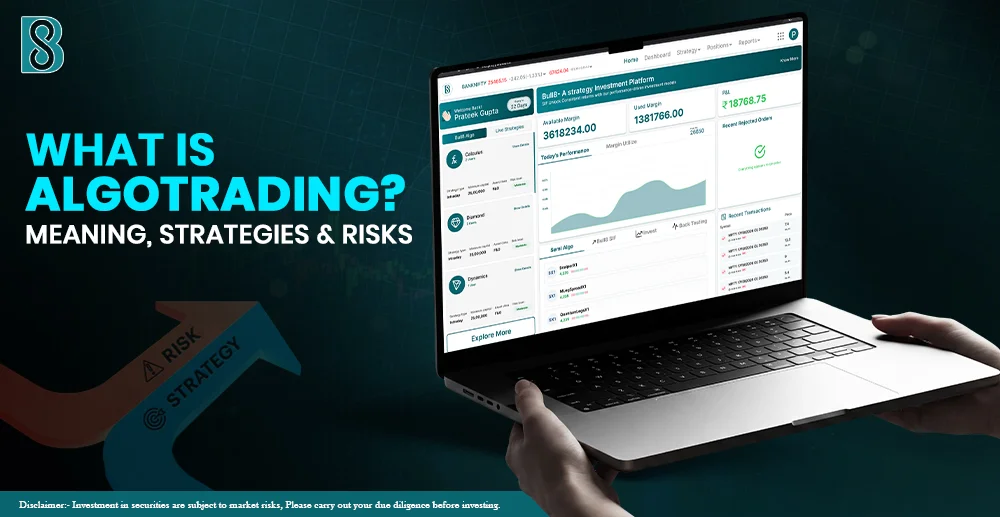


 Data
Data 


