
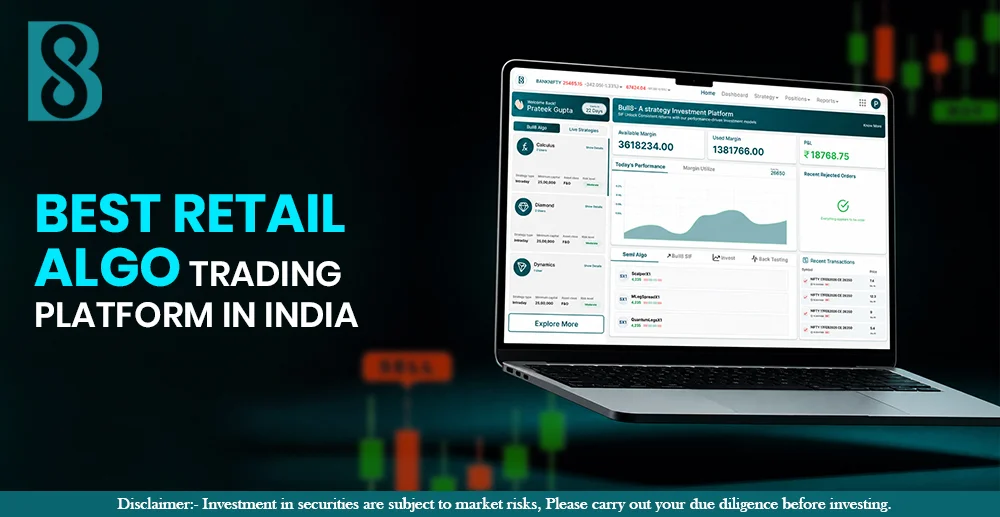
Best Retail Algo Trading Platform in India: Complete 2026 Buyer’s Guide for Smart Traders
Algorithmic trading has transformed the way financial markets operate across the world. What was once reserved for institutional investors, hedge funds, and proprietary trading firms has now become increasingly accessible to retail traders in India. With the evolution of broker APIs, cloud computing, automation technologies, and the implementation of SEBI’s retail algorithmic trading framework, retail traders today can leverage sophisticated trading tools without having to build complex infrastructure from scratch.
Whether you are an options trader, an intraday trader, or a working professional seeking disciplined trade execution, selecting the best retail algo trading platform in India has become one of the most important decisions in your trading journey.
This comprehensive 2026 buyer’s guide explains everything you need to know before choosing a retail algorithmic trading platform.
Introduction
The Indian stock market has witnessed remarkable growth in retail participation over the past few years. Millions of investors and traders now actively trade across equity, derivatives, commodities, and currency markets using advanced digital platforms. Alongside this growth, trading technology has evolved rapidly, making algorithmic trading increasingly accessible to individual traders rather than being limited to institutional participants.
Manual trading often requires constant monitoring of price movements, rapid decision-making, and strict emotional discipline. In reality, many traders struggle with fear, greed, delayed execution, overtrading, and inconsistent risk management. Even experienced traders may find it difficult to execute every trade exactly according to their predefined rules during volatile market conditions.
The growing adoption of retail algorithmic trading has been supported by technological advancements such as cloud-based infrastructure, faster broker APIs, mobile trading applications, real-time risk engines, and intelligent automation. The introduction of SEBI’s retail algo framework has also encouraged a more structured ecosystem where automation can be implemented with greater transparency and standardised risk controls.
Today, traders are increasingly looking for a retail algo trading platform that simplifies automation without requiring programming expertise. Modern platforms offer plug-and-play strategies, automated execution, live dashboards, integrated risk management, and real-time monitoring that help traders execute predefined strategies with greater consistency.
In this guide, you will learn:
- What a retail algo trading platform is
- How algorithmic trading works
- Current trends shaping India’s retail algo ecosystem
- Essential features every trader should evaluate
- SEBI-related considerations
- Risk management capabilities
- How to compare different platforms
- Why Bull8 is emerging as a preferred solution for retail traders
What is a retail algo-trading platform?
A retail algo trading platform is a technology-driven software system that enables individual traders to automate predefined trading strategies using algorithms instead of manually placing every order.
Rather than constantly watching market charts throughout the trading session, traders define a set of trading rules. The platform continuously monitors live market data, evaluates trading opportunities based on those rules, performs risk validation, and automatically executes trades whenever predefined conditions are met.
Unlike traditional manual trading, modern retail algorithmic platforms aim to reduce emotional interference while improving execution consistency.
How Algorithmic Trading Works
Every algorithm follows a logical sequence:
Market data is received in real time.
Trading rules are continuously evaluated.
Risk parameters are verified.
Eligible orders are sent to the broker.
Orders are monitored until completion.
Exit conditions are automatically executed.
The trader remains in control of the strategy while the software manages the repetitive execution process according to predefined instructions.
Manual Trading vs Automated Trading
| Manual Trading | Automated Trading |
| Human decision-making | Rule-based execution |
| Requires constant monitoring | Continuous automated monitoring |
| Emotional influence | Predefined logic |
| Slower execution | Faster order processing |
| Higher chances of missed trades | Consistent execution |
| Manual stop-loss updates | Automatic risk controls |
| Difficult to manage multiple positions | Simultaneous strategy monitoring |
Automation does not eliminate market risk, but it helps reduce many execution-related errors associated with manual trading.
Core Components of an Algo Trading Platform
Trading Strategy
This defines when to enter, modify, or exit trades based on predefined market conditions.
Broker API
The API securely connects the platform to the broking account, enabling order placement, modification, and cancellation.
Risk Engine
The risk engine evaluates trading limits before any order is executed. It checks parameters such as position size, exposure, capital allocation, and predefined loss thresholds.
Order Management System (OMS)
The OMS manages the complete lifecycle of every order from submission to execution.
Execution Engine
This component ensures that eligible orders are transmitted efficiently to the exchange through the broker’s infrastructure.
Monitoring Dashboard
A centralised dashboard enables traders to monitor the following:
- Active positions
- Executed trades
- Daily profit and loss
- Strategy status
- Margin utilization
- Risk alerts
Together, these components create an integrated environment that supports disciplined trading execution.
Indian Retail Algo Trading Market in 2026
Retail algorithmic trading in India has evolved significantly over recent years. Improvements in trading infrastructure, increased internet accessibility, broker API availability, and user-friendly automation tools have expanded access to algorithmic trading beyond professional institutions.
Today, retail traders increasingly seek technology-driven solutions that simplify execution while providing greater control over trading workflows.
Growing Retail Participation
Retail participation in Indian capital markets continues to expand across multiple asset classes, including:
- Equities
- Futures
- Options
- Commodities
- Currency derivatives
As participation grows, traders are increasingly exploring automation to manage execution complexity.
API Adoption is accelerating.
Modern brokers increasingly provide API connectivity, enabling approved platforms to automate order execution within supported frameworks. This has encouraged software developers to build solutions tailored specifically for retail users.
AI-Assisted Execution
Artificial intelligence is increasingly being used to improve operational efficiency through the following:
- Pattern recognition
- Execution optimization
- Monitoring assistance
- Performance analytics
- Risk notifications
These technologies support trading workflows but do not predict markets with certainty.
Cloud-Based Infrastructure
Cloud deployment has reduced the need for traders to maintain dedicated hardware. Cloud infrastructure offers the following:
- Improved availability
- Better scalability
- Centralized updates
- Simplified deployment
- Reduced maintenance
Mobile Algo Trading
Many platforms now allow users to monitor strategies through smartphones, enabling traders to review positions, risk alerts, and performance while away from their desks.
Low-Latency Execution
Advancements in network infrastructure and optimised software architecture have improved execution speed, helping reduce delays between signal generation and order placement.
Democratization of Algorithmic Trading
Historically, sophisticated algorithmic trading capabilities were primarily available to institutional participants with significant technological resources.
Today, user-friendly interfaces, cloud deployment, broker APIs, and plug-and-play strategy models have significantly lowered the entry barrier for retail traders. While institutional firms continue to maintain advanced proprietary systems, retail users now have access to increasingly sophisticated tools that support systematic trading approaches.
Manual Trading vs Retail Algo Trading
| Feature | Manual Trading | Retail Algo Trading |
| Market Monitoring | Continuous | Automated |
| Execution Speed | It depends on the trader. | Rule-based automation |
| Emotional Impact | High | Reduced |
| Multiple Trades | Difficult | Easier to manage |
| Stop Loss Management | Manual | Automated |
| Position Monitoring | Manual | Real-time |
| Discipline | Trader-dependent | Strategy dependent |
| Scalability | Limited | Higher |
Lifecycle of an Algo Trade
Understanding the lifecycle of an algorithmic trade helps traders appreciate how automation functions behind the scenes.
Step 1: Market Signal
The strategy continuously scans live market conditions.
Step 2: Rule Validation
Entry conditions are evaluated according to predefined logic.
Step 3: Risk Check
Capital allocation, exposure limits, and predefined safeguards are verified.
Step 4: Order Execution
Eligible orders are transmitted through the connected broker.
Step 5: Live Monitoring
Open positions are continuously monitored.
Step 6: Exit Management
The strategy exits positions according to predefined conditions such as targets, stop losses, trailing stops, or scheduled exits.
This structured workflow helps maintain consistency throughout the trading process.
Why More Retail Traders Are Switching to Algo Trading
Modern financial markets operate at extraordinary speed. Prices can change multiple times within seconds, especially in actively traded instruments such as index options, stock futures, and liquid equities. For many retail traders, keeping pace with these rapid market movements through manual execution alone has become increasingly challenging.
One of the primary reasons traders are exploring retail algorithmic trading is the desire to follow a more systematic approach. Instead of relying solely on real-time emotions or split-second manual decisions, algorithmic platforms execute predefined trading rules consistently.
Emotional Decision-Making
Fear and greed remain two of the most common challenges in manual trading. Traders may hesitate before entering a valid setup, exit profitable positions too early, or hold losing positions longer than planned. Automation helps reduce these execution inconsistencies by following predefined rules without emotional intervention.
Delayed Execution
In fast-moving markets, even small delays between identifying a trading opportunity and placing an order can affect execution quality. Algorithmic systems are designed to process trading rules continuously and send eligible orders automatically once conditions are met.
Missed Trading Opportunities
Manual traders cannot monitor every market movement throughout the day. Working professionals, business owners, and individuals with limited screen time may miss potential setups simply because they are occupied with other responsibilities. Automated monitoring enables strategies to remain active according to configured parameters, even when the trader is away from the screen.
Overtrading
Another common challenge is taking unnecessary trades due to boredom, impulsiveness, or the desire to recover previous losses. Algorithmic systems execute trades only when predefined conditions are satisfied, helping maintain greater consistency.
Screen Fatigue
Monitoring charts for extended periods can be mentally demanding. Automation reduces the need for continuous manual observation by allowing the platform to track market conditions in real time.
Practical Scenario
Imagine a trader who follows a rule-based options strategy with clearly defined entry, stop-loss, and exit conditions. During a busy workday, manually monitoring every price movement may not be practical. An algorithmic platform can continuously observe the market, validate the predefined rules, and execute eligible trades according to the configured strategy while the trader remains informed through the monitoring dashboard.
Rather than replacing trading knowledge, automation supports disciplined execution of an existing trading plan.
Analytics support informed decision-making when evaluating strategy behaviour.
Trade History
A detailed execution log enables traders to review previous trades for analysis and record-keeping.
Common information includes:
- Entry time
- Exit time
- Instrument
- Quantity
- Execution price
- Order status
- Strategy name
Trade history supports both learning and compliance.
Performance Reports
Reporting tools help traders evaluate performance over different time periods.
Reports may summarise:
- Daily activity
- Weekly performance
- Monthly summaries
- Strategy comparisons
- Risk metrics
- Trading statistics
Structured reporting assists in maintaining a disciplined trading journal.
Easy User Interface
Sophisticated technology should not require complicated navigation.
An intuitive interface allows traders to:
- Activate strategies easily
- Understand platform status
- Configure parameters
- Monitor activity
- Access reports quickly
Cloud Infrastructure
Earlier algorithmic trading systems required traders to maintain dedicated desktop computers or servers running throughout market hours. This setup involved regular maintenance, software updates, power backups, and internet stability.
Today, many modern platforms use cloud infrastructure to simplify deployment and improve reliability.
Cloud-based platforms offer several advantages:
- Centralized strategy management
- Reduced dependency on personal computers
- Improved uptime
- Automatic software updates
- Better scalability
- Easier maintenance
For retail traders, cloud execution removes much of the operational complexity while enabling access from multiple devices.
Low-Latency Execution
In financial markets, even small execution delays can influence trade outcomes. ‘Low latency’ refers to minimising the time between a trading signal and order placement.
Modern algo platforms optimise execution by using the following:
- Efficient order routing
- Optimized software architecture
- High-performance servers
- Fast broker API communication
- Stable network infrastructure
Although no platform can eliminate market dynamics such as slippage or volatility, reducing unnecessary delays contributes to more consistent execution.
AI-Based Monitoring
Artificial intelligence is increasingly being integrated into modern AI trading platform India solutions—not to predict markets with certainty, but to enhance platform efficiency and monitoring.
AI-assisted features may include:
- Strategy health monitoring
- Performance analytics
- Pattern recognition
- Execution alerts
- Risk notifications
- Dashboard insights
These capabilities help traders stay informed and respond more effectively to changing market conditions.
Smart Order Execution
Professional execution engines aim to transmit orders efficiently while following predefined trading rules.
A modern execution engine typically performs the following sequence:
Receives the trading signal.
Validates risk parameters.
Confirms broker connectivity.
Sends the order through the broker API.
Tracks execution status.
Updates the monitoring dashboard.
This structured process helps maintain consistency throughout the order lifecycle.
API Integration
Application Programming Interfaces (APIs) act as the communication bridge between the trading platform and the broker.
APIs enable functions such as:
- Order placement
- Order modification
- Order cancellation
- Position retrieval
- Margin updates
- Portfolio synchronization
Secure API integration is one of the most important components of a modern algo trading platform in India.
Intelligent Order Routing
When a strategy generates a valid trading signal, the platform determines how the order should be transmitted through the broker’s infrastructure.
Intelligent routing helps ensure that:
- Orders follow predefined logic.
- Risk validation occurs before execution.
- Execution status is monitored.
- Traders receive timely updates.
High-Speed Data Processing
Algorithmic trading depends on processing large volumes of live market data.
Modern platforms continuously analyse the following:
- Market prices
- Bid-ask spreads
- Volume
- Open interest
- Order status
- Strategy conditions
Efficient data processing enables the platform to evaluate trading rules in real time.
Failover Systems
Technology failures can occur due to internet interruptions, server issues, or connectivity problems.
Many professional platforms incorporate failover mechanisms designed to improve operational continuity.
Examples include:
- Backup servers
- Redundant infrastructure
- Automatic reconnection
- Session recovery
- Error notifications
These systems contribute to greater platform reliability.
Auto Recovery
Unexpected interruptions should not always require manual intervention.
Modern platforms increasingly include recovery mechanisms that can:
- Restore platform connectivity
- Reconnect broker sessions
- Synchronize open positions
- Resume monitoring after interruptions
Such capabilities improve operational resilience without guaranteeing uninterrupted service.
Why Technology Matters
An excellent trading strategy alone is not enough.
Execution quality depends on:
- Stable infrastructure
- Reliable connectivity
- Fast data processing
- Secure authentication
- Efficient risk management
- Continuous monitoring
The best retail algorithmic trading platforms combine these technologies to support disciplined and systematic execution.
Risk Management Features That Matter Most
Successful trading is not only about identifying opportunities—it is equally about managing risk. Experienced traders often emphasise that protecting capital is essential for long-term participation in the markets.
Modern retail algo trading platforms incorporate multiple layers of automated risk management that help traders follow predefined limits consistently.
Maximum Daily Loss
Many traders define a daily loss threshold before beginning the trading session.
If cumulative losses reach the configured limit, the platform may:
- Pause new entries
- Restrict further trades
- Notify the trader
- Await manual review
This feature helps prevent excessive trading during unfavourable market conditions.
Position Sizing
Position sizing determines how much capital is allocated to each trade.
Effective position sizing supports:
- Better diversification
- Controlled exposure
- Improved capital management
- Reduced concentration risk
Instead of placing oversized trades, traders can allocate capital according to their overall trading plan.
Capital Protection
Modern platforms often allow traders to configure limits that prevent excessive capital deployment.
Examples include:
- Maximum exposure
- Strategy-wise allocation
- Portfolio allocation
- Instrument-specific limits
Capital protection features encourage disciplined portfolio management.
Kill Switch
A kill switch is an emergency control that allows traders to stop automated activity under predefined circumstances.
Depending on platform functionality, it may:
- Halt new trades
- Close active strategies
- Disable execution
- Allow manual intervention
This feature is particularly useful during unexpected market conditions or operational issues.
Volatility Filters
Highly volatile markets may behave differently from normal trading conditions.
Volatility filters can help strategies avoid operating when predefined market conditions exceed configured thresholds.
These filters are designed to support disciplined execution rather than predict market direction.
Circuit Protection
Markets occasionally experience sharp price movements that trigger exchange-level circuit mechanisms.
Some platforms incorporate additional safeguards to manage trading activity during extraordinary market events.
Strategy Pause
There may be situations where traders prefer to temporarily suspend a strategy without removing its configuration.
Strategy pause functionality allows users to do the following:
- Stop execution temporarily
- Review market conditions
- Modify parameters
- Resume when appropriate
Future of Retail Algo Trading in India
The future of retail algorithmic trading in India looks increasingly promising as technology, regulation, and market participation continue to evolve. What was once considered a niche segment primarily used by institutional investors is steadily becoming an integral part of the retail trading ecosystem. Improvements in cloud computing, broker APIs, artificial intelligence, and user-friendly platforms are making automated trading more accessible than ever before.
While manual trading will continue to have its place, the adoption of automation is expected to grow as traders seek greater efficiency, disciplined execution, and better operational control.
Below are some of the major trends likely to shape the future of retail algo trading platform solutions in India.
AI-Assisted Trading
Artificial intelligence is expected to play a greater role in improving trading workflows. Rather than replacing traders, AI will increasingly assist with:
- Strategy monitoring
- Market analysis
- Trade analytics
- Risk notifications
- Performance insights
- Intelligent dashboards
AI can help traders process large volumes of information more efficiently, enabling better-informed decisions.
Machine Learning Enhancements
Machine learning technologies may further improve how trading systems analyse historical market behaviour and optimise operational workflows.
Possible applications include:
- Adaptive risk models
- Improved execution analytics
- Strategy optimization
- Performance evaluation
- Market condition classification
These tools are intended to support decision-making rather than guarantee trading outcomes.
Voice-Based Trading Interfaces
As conversational AI becomes more advanced, future trading platforms may incorporate voice-enabled functionality.
Potential features could include:
- Portfolio summaries
- Strategy status updates
- Risk notifications
- Performance reports
- Voice-assisted navigation
Such innovations could improve accessibility and user convenience.
Advanced Analytics
Retail traders increasingly expect institutional-quality analytics.
Future platforms may provide:
- Strategy benchmarking
- Portfolio heat maps
- Performance attribution
- Risk visualization
- Behavioral analytics
- Multi-strategy comparisons
Advanced reporting can help traders continuously evaluate and refine their trading processes.
Smarter Risk Engines
Risk management is expected to become even more sophisticated.
Future risk engines may include:
- Dynamic exposure monitoring
- AI-assisted risk alerts
- Adaptive volatility controls
- Intelligent capital allocation
- Automated scenario analysis
These enhancements can contribute to more structured and disciplined trading.
Personalized Algorithms
Rather than offering identical strategies to every trader, future platforms may allow greater personalisation.
Examples include:
- Customized risk settings
- Personalized dashboards
- Individual capital allocation
- Strategy customization
- User-specific alerts
This flexibility enables traders to tailor automation according to their objectives and trading style.
Cloud-Native Architecture
Cloud-first deployment is expected to become the industry standard.
Benefits include:
- Improved scalability
- Better availability
- Faster software updates
- Enhanced security
- Simplified maintenance
Cloud-native infrastructure also supports seamless access across multiple devices.
Faster API Ecosystems
Broker APIs continue to improve in terms of speed, reliability, and functionality.
Future enhancements may include:
- Faster authentication
- Improved order synchronization
- Better reporting
- Enhanced monitoring
- Expanded broker integrations
Reliable APIs remain one of the most critical components of modern algorithmic trading.
Greater Regulatory Maturity
As retail participation grows, India’s algorithmic trading ecosystem is expected to mature further through evolving regulatory frameworks, improved operational standards, and increased transparency.
A well-regulated environment can help build confidence among retail traders while supporting responsible adoption of automation.
2026 Retail Algo Trading Trends
The following trends are expected to define the next phase of retail algorithmic trading in India:
✔ Increased adoption of plug-and-play strategies
✔ Greater use of AI-powered analytics
✔ Improved mobile trading experiences
✔ More cloud-native trading platforms
✔ Enhanced broker API ecosystems
✔ Smarter risk management systems
✔ Increased transparency in execution
✔ Better strategy monitoring dashboards
✔ Personalized automation workflows
✔ Wider participation from retail traders
These developments are making algorithmic trading increasingly practical for traders across different experience levels.
Glossary of Common Algo Trading Terms
Understanding key terminology helps traders navigate the world of algorithmic trading more confidently.
API (Application Programming Interface)
A secure connection that enables communication between the trading platform and the broker for order execution and account information.
Algorithm
A predefined set of trading rules that determines when trades should be entered, modified, or exited.
OMS (Order Management System)
A system responsible for managing the complete lifecycle of trading orders.
RMS (Risk Management System)
A module that validates exposure, position size, margin, and predefined risk limits before and during trade execution.
Latency
The time taken for information or orders to travel between systems. Lower latency generally supports faster execution.
Slippage
The difference between the expected execution price and the actual executed price due to market conditions.
Execution Engine
The software component responsible for transmitting eligible orders through the broker’s infrastructure.
Plug-and-Play Strategy
A pre-configured algorithmic strategy that can be deployed without requiring programming knowledge.
Dashboard
A centralised interface displaying strategy status, positions, risk metrics, and trading performance.
Backtesting
The process of evaluating a trading strategy using historical market data. Historical performance should not be interpreted as a guarantee of future outcomes.
Cloud Trading
Deployment of trading systems on cloud infrastructure rather than relying solely on local computers.
Kill Switch
A risk control that allows traders to immediately stop automated trading activity under predefined circumstances.
Conclusion
Algorithmic trading has evolved from being an institutional advantage to becoming an increasingly accessible tool for retail traders across India. Advances in technology, cloud infrastructure, broker APIs, and user-friendly software have made automation practical for traders with varying levels of experience.
Choosing the best retail algo trading platform in India involves more than comparing subscription costs or marketing claims. Traders should carefully evaluate technology, execution quality, risk management, transparency, platform stability, reporting capabilities, and ease of use.
A reliable platform should empower traders to execute predefined strategies with discipline while maintaining visibility into positions, risk parameters, and overall performance. Features such as plug-and-play deployment, cloud-based execution, live dashboards, automated risk controls, and broker integration are becoming essential components of modern trading platforms.
Bull8 is emerging as a strong option for retail traders by focusing on simplified automation, disciplined execution, comprehensive monitoring, and user-friendly design. Rather than promising unrealistic returns, the platform emphasises technology, structured workflows, and risk-aware trading practices.
As India’s retail algorithmic trading ecosystem continues to mature, traders who embrace automation responsibly, understand their strategies, and prioritise disciplined risk management will be better positioned to navigate increasingly dynamic financial markets.
Before selecting any platform, evaluate its features, transparency, compliance considerations, and suitability for your individual trading style and objectives. A thoughtful platform selection today can support a more systematic and informed trading journey tomorrow.
FAQs
What is the best retail algo trading platform in India?
The best platform depends on your trading goals, preferred asset classes, broker compatibility, ease of use, risk management features, and transparency. Traders should evaluate platforms based on technology, operational reliability, and suitability rather than marketing claims alone.
Is algorithmic trading legal in India?
Algorithmic trading operates within the applicable regulatory framework. Traders should use supported broker integrations and remain updated with the latest guidelines issued by SEBI and their broking.
Can beginners use a retail algo trading platform?
Yes. Many modern platforms provide plug-and-play strategies and intuitive interfaces that make algorithmic trading more accessible to beginners.
Do I need coding knowledge?
Not necessarily. Many retail platforms offer no-code or low-code deployment options through pre-configured strategies.
What is Plug and Play Algo Trading?
Plug-and-play trading enables users to deploy predefined algorithmic strategies without writing program code.
Is algo trading only for institutions?
No. Retail traders increasingly have access to algorithmic trading platforms designed specifically for individual users.
Does algorithmic trading eliminate risk?
No. Automation can improve execution discipline, but market risk remains an inherent part of trading.
Can I monitor my strategies from a mobile phone?
Many modern platforms, including Bull8, offer mobile accessibility for monitoring positions, dashboards, alerts, and performance.
What should I look for in an algo trading platform?
Important factors include:
Ease of use
Risk management
Broker integration
Reporting
Cloud infrastructure
Dashboard quality
Customer support
Platform stability
Why is risk management important in algorithmic trading?
Risk management helps control exposure, protect capital, and maintain disciplined execution during changing market conditions.
What is a broker API?
A broker API enables secure communication between the trading platform and the broking for order execution and account information.
Can working professionals benefit from automated trading?
Yes. Automated monitoring and execution can help working professionals manage predefined strategies without continuously watching the markets.
Is cloud-based trading better than desktop-only trading?
Cloud infrastructure can improve accessibility, scalability, and operational convenience by reducing dependency on a personal computer.
How does Bull8 support retail traders?
Bull8 offers plug-and-play strategy deployment, automated execution, live monitoring, risk management features, dashboard visibility, and a user-friendly interface designed for retail participants.
What is the future of retail algo trading in India?
The future is expected to include AI-assisted analytics, smarter risk engines, cloud-native platforms, improved APIs, personalised automation, and continued growth in retail participation.
Why Choose Bull8?
If you’re looking for the best retail algo trading platform in India that combines plug-and-play automation, advanced risk management, live strategy monitoring, cloud-based execution, and a user-friendly experience, Bull8 provides a technology-driven ecosystem designed specifically for modern retail traders.
