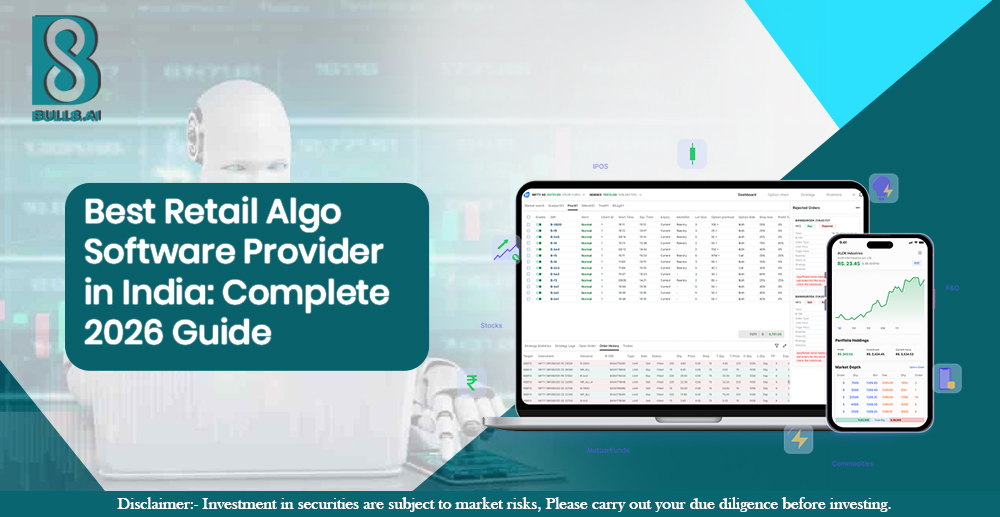
Best Retail Algo Software Provider in India: Complete 2026 Guide.
Introduction: The Retail Trading Revolution in India
Retail trading in India has undergone a massive transformation over the last decade. What once started as tip-based trading driven by WhatsApp messages, Telegram channels, and word-of-mouth recommendations has gradually evolved into indicator-heavy discretionary trading. Retail traders began learning charts, candlestick patterns, RSI, MACD, and dozens of other technical indicators in the hope of improving consistency.
But despite increased access to tools and education, the core problems of retail trading remained unchanged—emotions, over-trading, and inconsistent execution.
As markets became faster and more volatile, discretionary trading began exposing its limitations. Manual execution struggled to keep pace with rapid price movements. Decision fatigue increased. Stop-loss discipline broke down during high-pressure situations. The result was predictable: even knowledgeable traders found it difficult to remain consistent.
The year 2026 marks a decisive turning point for Indian retail traders.
Three forces are driving this shift:
The formalization of SEBI’s retail algo trading framework
A sharp rise in retail market participation
Markets that reward discipline and punish hesitation
In this environment, speed alone is not the advantage—execution discipline is. Retail traders are no longer asking which stock will move next. They are asking how to trade systematically, control risk, and remove emotional errors from their decision-making process.
This naturally leads to one critical question:
Which is the best retail algo software provider in India for 2026?
The answer is not about flashy dashboards or unrealistic profit claims. It lies in platforms that understand retail psychology, regulatory realities, and the need for structured, rule-based trading systems. Bull8 emerges in this context as a platform designed specifically for retail traders who want discipline, control, and scalability—without complexity or hype.
What Is Retail Algo Trading? (Concept Explained Simply)
Retail algo trading refers to the use of pre-defined rules and automated execution systems that allow retail traders to trade without manual intervention once a strategy is deployed. Unlike discretionary trading, where decisions are made moment-to-moment based on emotions or judgment, algo trading follows logic that is set in advance.
At its core, retail algo trading is not about predicting markets. It is about executing decisions consistently.
It is important to distinguish between institutional algos and retail algos. Institutional algorithms operate with massive capital, ultra-low latency infrastructure, and complex quantitative models. Retail algos, on the other hand, are designed to simplify trading for individual participants with limited capital and time.
Retail algo trading typically automates:
Entry rules based on predefined logic
Exit conditions including stop-loss and profit targets
Position sizing
Risk limits per trade and per day
What retail algo trading does not do is equally important. It does not guarantee profits. It does not eliminate losses. It does not act as a magical prediction engine.
A simple way to understand retail algo trading is through this flow:
Strategy → Rules → Automation → Execution → Risk Control
The quality of the outcome depends not on how complex the strategy is, but on how well the rules are defined and how strictly they are executed. This is where a reliable retail algo platform becomes critical.
Why Retail Traders Are Moving Away from Manual Trading
Manual trading places the trader at the center of every decision. While this may appear flexible, it exposes traders to psychological and structural weaknesses that become costly over time.
Common retail trading problems include:
Entering trades late after confirmation
Exiting early due to fear
Holding losses due to hope
Revenge trading after drawdowns
Missing stop-losses during volatility
Human limitations become more pronounced in modern markets. Machines execute instantly. Humans hesitate. Markets move faster than reaction times, especially during news-driven volatility or intraday momentum bursts.
By 2026, market conditions have intensified:
Higher volatility
Narrower profit margins
Faster stop-loss hunting
Increased algorithmic participation
In such an environment, manual execution is no longer competitive. Retail traders are realizing that automation is not about replacing intelligence—it is about protecting discipline.
Retail algo software has shifted from being a convenience to becoming essential trading infrastructure.
Key Features of the Best Retail Algo Software in India (2026 Benchmark)
Choosing the best retail algo trading software for retail traders in India requires focusing on fundamentals rather than marketing promises. In 2026, certain features are non-negotiable.
Rule-Based Strategy Execution
Once a strategy is deployed, execution must be purely rule-based. There should be no room for emotional overrides or discretionary interference. Discipline is effective only when it is enforced by the system.
Risk Management at Strategy Level
Risk management must be embedded at the strategy level, not left to user judgment. This includes fixed stop-losses, trailing stop-losses, maximum loss limits per day, and controlled capital allocation. Survival comes before profitability.
One-Click Deployment for Retail Users
Retail traders should not be burdened with coding, server setup, or VPS configurations. The platform must abstract complexity and allow strategies to be deployed with minimal technical friction.
Multi-Asset Support
The platform should support key retail instruments such as equities, index options, and futures where applicable. Fragmented platforms lead to fragmented discipline.
Clean Dashboard and Control
A single dashboard showing real-time positions, P&L, and risk exposure is critical. Retail traders must see what is happening without navigating multiple tools.
Compliance-Ready Architecture
With SEBI regulations shaping the future, platforms must operate with broker-linked execution, transparent logs, and clear disclosures. Grey-area automation is no longer sustainable.
These are not premium features. They are the baseline requirements for any platform claiming to be the best retail algo software provider in India in 2026.
SEBI Regulations and Retail Algo Trading in 2026
SEBI’s involvement in retail algo trading is not a restriction—it is a correction. For years, unregulated automation operated in grey areas, exposing traders to risks they often did not understand.
The regulator’s objectives are clear:
Transparency in strategy logic
Broker-level execution control
Mandatory risk disclosures
Elimination of misleading profit guarantees
Retail traders must understand the difference between compliant platforms and informal automation setups. Any system that bypasses broker oversight or hides strategy logic poses long-term risk.
In 2026, trust is built through regulation alignment, not avoidance. Platforms like Bull8 are designed to work within regulatory frameworks, ensuring sustainability and trader protection rather than chasing short-term loopholes.
Institutional Algo vs Retail Algo: Why Retail Needs a Different Approach
Institutional trading systems are built for scale, speed, and complexity. Retail traders require simplicity, discipline, and risk containment.
Institutions focus on execution speed advantages. Retail traders benefit more from execution consistency. Institutions absorb drawdowns as part of portfolio strategy. Retail traders must prioritize capital preservation.
Retail traders do not fail because they lack intelligence. They fail because tools were never designed for their constraints. A retail-first platform recognizes this difference and builds systems accordingly.
What Makes Bull8 the Best Retail Algo Software Provider in India
Bull8 is not a white-labeled institutional product repurposed for retail. It is built from the ground up for retail traders.
The platform follows a strategy-first philosophy. Instead of overwhelming users with indicators, it focuses on structured strategies that are tested, rule-based, and risk-managed.
Emotion-free execution is central to Bull8’s design. Once deployed, the system executes trades without hesitation or fear. Risk management is embedded, not optional.
Bull8 emphasizes loss control before profit chasing. This aligns with how successful traders actually survive long-term.
The concept of One App. All Trading. reflects Bull8’s unified approach. Retail traders do not need multiple platforms for signals, execution, and monitoring. Everything operates from a single, coherent dashboard.
Importantly, Bull8 scales with the trader. Beginners can start small, while experienced traders can expand logically without changing systems. Discipline remains constant regardless of scale.
Bull8 vs Traditional Algo Providers (Approach Comparison)
Traditional providers often rely on:
Coding-heavy workflows
Signal-selling models
Profit-focused marketing
Fragmented tools
Bull8 focuses on:
No-code execution
System-driven discipline
Risk-first frameworks
Unified trading infrastructure
This difference in philosophy defines outcomes.
Who Should Use Retail Algo Trading Software in 2026
Retail algo trading software is suitable for:
Beginners who want structure
Working professionals with limited screen time
Part-time traders seeking consistency
Disciplined investors transitioning to automation
However, algos are not meant for gamblers or shortcut seekers. Automation amplifies discipline—not recklessness.
Common Myths About Retail Algo Trading
One common myth is that algo trading guarantees profits. In reality, it guarantees consistency, not outcomes.
Another misconception is that only coders can use algos. Modern retail platforms eliminate this barrier.
Some believe algo trading is risky, while manual trading is safer. In truth, unmanaged discretion is often the highest risk.
Flexibility without discipline leads to chaos. Structure creates freedom.
How to Choose the Best Retail Algo Software Provider in India
Retail traders must evaluate platforms based on:
Strategy transparency
Embedded risk controls
Broker-level execution
Educational support
Ease of use
Regulatory readiness
If a platform does not prioritize risk control, it is not an algo—it is a gamble.
The Future of Retail Algo Trading in India (2026–2030 Outlook)
The next phase of Indian markets will favor disciplined participants. Tip culture will decline. Regulation will tighten. Platforms will become the backbone of trading behavior.
Retail traders who adapt early will gain consistency. Those who resist structure will struggle.
Bull8 is built not only for today’s market conditions but for tomorrow’s regulatory and behavioral realities.
Final Verdict: Why Bull8 Stands Out in 2026
The search for the best retail algo software provider in India is ultimately a search for discipline, transparency, and sustainability.
Bull8 stands out because it prioritizes:
Risk before reward
Logic before hype
Simplicity before complexity
Retail needs before institutional leftovers
In 2026, winning is no longer about predicting markets. It is about executing systems with discipline. Bull8 delivers exactly that—making it one of the strongest choices for retail traders looking to trade smarter, safer,
FAQ
What does “Best Retail Algo Software Provider in India” actually mean?
The term Best Retail Algo Software Provider in India refers to a platform that is specifically designed for individual traders, not institutions. Such a provider focuses on rule-based execution, built-in risk management, ease of use, and compliance with Indian regulations. Unlike generic or institutional-grade systems, retail algo software prioritizes simplicity, capital protection, and discipline. The best platforms help traders automate strategies without coding, avoid emotional decisions, and maintain consistency across market conditions. In 2026, the “best” provider is defined less by profit claims and more by transparency, risk control, and long-term sustainability.
How is retail algo trading different from manual trading in India?
Retail algo trading removes emotional decision-making by executing trades strictly based on predefined rules. Manual trading depends heavily on human judgment, which is often affected by fear, greed, and hesitation. The best retail algo software provider in India offers automated execution, real-time risk control, and consistent discipline—something manual trading struggles to maintain, especially in fast-moving markets. In 2026, when volatility and algorithmic participation are higher, retail algo trading provides an edge by ensuring timely entries, disciplined exits, and controlled losses without constant screen monitoring.
Is retail algo trading legal in India in 2026?
Yes, retail algo trading is legal in India when conducted within the framework defined by SEBI. The regulator emphasizes transparency, broker-level execution, and proper risk disclosures. The best retail algo software provider in India operates in alignment with these guidelines, ensuring that strategies are clear, execution is compliant, and traders are aware of risks. Platforms that bypass brokers or operate in grey areas may expose traders to regulatory and operational risks. In 2026, legality and compliance are key factors when choosing a retail algo trading platform.
Do I need coding knowledge to use retail algo trading software?
No, coding knowledge is not required when using a modern retail-focused platform. The best algo trading software for retail traders in India is designed as a no-code or low-complexity system where traders can deploy strategies with minimal technical effort. The platform handles execution logic, order placement, and risk controls automatically. This allows traders to focus on understanding strategy behavior and risk management rather than programming. In 2026, accessibility is a defining feature of the best retail algo software providers.
Can beginners use retail algo trading software safely?
Yes, beginners can use retail algo trading software safely—provided the platform is built for retail users. The best retail algo software provider in India offers predefined strategies, built-in risk limits, and structured execution, which actually reduces beginner mistakes. Instead of relying on intuition or tips, beginners learn disciplined trading through systems. However, beginners should avoid platforms that promise guaranteed profits. In 2026, safe retail algo trading is about learning consistency, managing risk, and growing gradually rather than chasing quick returns.
Does retail algo trading guarantee profits?
No, retail algo trading does not guarantee profits. Any platform claiming guaranteed returns should be avoided. The best retail algo software provider in India focuses on consistency, risk management, and disciplined execution—not profit promises. Algo trading helps remove emotional errors and improve execution quality, but market risk always exists. Losses are a natural part of trading. In 2026, successful retail traders understand that algos are tools for control and structure, not shortcuts to guaranteed income.
How does risk management work in retail algo trading software?
Risk management is the foundation of effective retail algo trading. The best retail algo software provider in India embeds risk controls directly into each strategy. This includes predefined stop-loss levels, trailing stops, daily loss limits, and controlled capital allocation. Unlike manual trading, where traders often override risk rules, algo systems enforce discipline automatically. In 2026’s high-volatility environment, such built-in risk management helps traders survive drawdowns and protect capital, which is more important than chasing aggressive profits.
What should I check before choosing a retail algo software provider in India?
Before selecting a platform, traders should evaluate transparency, risk controls, broker integration, and regulatory readiness. The best retail algo software provider in India clearly explains strategy logic, avoids unrealistic profit marketing, and operates within SEBI guidelines. Ease of use, customer support, and educational resources are also important. In 2026, traders should avoid platforms that rely on signal selling or manual intervention. A good retail algo platform prioritizes execution discipline and long-term trader protection.
Is AI-powered trading software suitable for Indian retail traders?
AI-powered trading software can be useful when it is logic-driven and rule-based rather than hype-driven. The best retail algo software provider in India may use AI elements to enhance execution or analysis, but it still relies on transparent rules and risk management. Retail traders should be cautious of platforms that market AI as a prediction engine. In 2026, effective retail algo trading focuses on structured systems, where technology supports discipline instead of replacing trader responsibility.
Why is 2026 an important year for retail algo trading in India?
The year 2026 is significant due to increased retail participation, tighter regulations, and faster market dynamics. Manual trading is becoming less effective in handling volatility and execution pressure. The best retail algo software provider in India helps traders adapt to this new environment by offering compliant, rule-based, and risk-managed automation. As SEBI frameworks mature and markets evolve, retail traders who adopt disciplined systems early are better positioned for long-term consistency and survival.
If you’ve spent even a few weeks in the stock market, you’ve probably heard statements like:
“This stock will go up tomorrow.”
“I feel the market is about to reverse.”
“Experts are predicting a big rally.”
Sounds familiar? This is prediction-based trading—and it’s exactly where most retail traders struggle.
In contrast, rule-based trading focuses on logic, data, and discipline. No guessing. No gut feeling. Just systems.
In this blog, we’ll break down why rule-based trading consistently outperforms prediction-based trading, especially for Indian retail traders—and how platforms like Bull8 make it practical, scalable, and stress-free.
Understanding Prediction-Based Trading
Prediction-based trading relies on:
Market opinions
News headlines
Personal intuition
Tips from Telegram, YouTube, or “experts”
Why Traders Love Predictions
Predictions feel exciting. They give:
A sense of control
Quick confidence
Hope of big profits
But here’s the harsh truth 👇
Markets don’t reward confidence. They reward consistency.
The Core Problems with Prediction-Based Trading
Emotions Drive Decisions Fear, greed, hope, and regret dominate every trade.
Inconsistency One day you follow indicators, next day news, next day gut feeling.
Overtrading Predictions push traders to trade more, not smarter.
No Repeatable Process If a trade works once, you can’t reliably repeat it.
Stress & Burnout Constant screen-watching, news tracking, and panic exits.
Most retail traders don’t lose because they lack knowledge. They lose because predictions change—but losses remain permanent.
What Is Rule-Based Trading?
Rule-based trading is the opposite of prediction.
Instead of asking:
“What will the market do next?”
You ask:
“What will I do if the market behaves in a certain way?”
Key Characteristics of Rule-Based Trading
Pre-defined entry rules
Fixed exit rules
Strict risk management
Emotion-free execution
Data-backed logic
Example:
Buy when condition A + B + C is met
Exit when target or stop-loss hits
Risk never exceeds X% per trade
No guesswork. No last-minute changes.
Rule-Based Trading vs Prediction-Based Trading
Aspect
Prediction-Based Trading
Rule-Based Trading
Decision making
Emotion-driven
Logic-driven
Consistency
Low
High
Risk control
Weak
Strong
Stress level
High
Low
Scalability
Poor
Excellent
Long-term survival
Unlikely
Sustainable
This is why professional traders, institutions, and algo desks never trade on predictions alone.
Why Rule-Based Trading Wins Every Time
1. Markets Are Probabilistic, Not Predictable
Markets don’t move because of opinions. They move due to probabilities, volume, liquidity, and behavior.
Rule-based systems:
Accept uncertainty
Work on probabilities
Focus on edge, not accuracy
You don’t need to be right every time. You just need rules that win more than they lose over time.
2. Emotions Are Removed from Execution
Prediction-based trading fails because humans:
Exit winners too early
Hold losers too long
Chase momentum late
Panic during drawdowns
Rule-based trading:
Executes trades automatically
Follows predefined logic
Treats wins and losses equally
This is where Bull8 becomes powerful—because once rules are set, execution happens without emotion.
3. Risk Management Is Built-In, Not Optional
In prediction trading:
“Let’s see, maybe it will bounce back.”
In rule-based trading:
“Stop-loss is hit. Exit.”
Rule-based systems define:
Position size
Maximum risk per trade
Maximum daily loss
Drawdown limits
Survival comes first. Profits come later.
4. Repeatability Creates Long-Term Results
One lucky trade means nothing.
Rule-based trading allows you to:
Repeat the same strategy
Measure performance objectively
Improve systems over time
Scale capital safely
This repeatability is what separates traders from gamblers.
5. Backtesting Builds Confidence (Not Hope)
Prediction relies on hope. Rule-based trading relies on data.
With rule-based strategies, you can:
Backtest on historical data
See drawdowns before real money
Understand win rates & expectancy
Bull8 allows traders to use pre-built, tested strategies, reducing trial-and-error for beginners.
Why Retail Traders Especially Need Rule-Based Trading
Indian retail traders face unique challenges:
Limited time (jobs, business, studies)
Emotional pressure from social media
Rapid intraday volatility
Information overload
Rule-based trading solves this by:
Reducing screen time
Automating execution
Eliminating impulse decisions
Making trading systematic
You don’t need to be a full-time trader to trade professionally.
How Bull8 Enables Rule-Based Trading for Everyone
Bull8 is designed to make professional-style rule-based trading accessible to retail traders.
What Bull8 Offers
Pre-built rule-based strategies Automated trade execution Risk-managed systems App + Web platform No emotional interference Beginner-friendly dashboards
Instead of:
Watching charts all day
Guessing market direction
Reacting to news
You simply:
Choose a strategy
Define risk limits
Let the system work
That’s the power of system-first trading.
Common Myths About Rule-Based Trading
“Rules limit profits”
Rules protect capital, which enables profits to compound.
“Prediction is needed for big moves”
Trends are captured through rules, not guesses.
“Algo trading is only for experts”
Platforms like Bull8 make it accessible for retail users.
Prediction Fails Where Discipline Wins
Ask yourself honestly:
How many times did a “sure-shot” prediction fail?
How often did emotions override your plan?
How many losses came from breaking your own rules?
The market doesn’t punish ignorance. It punishes indiscipline.
Rule-based trading doesn’t promise excitement. It promises clarity, control, and consistency.
Retail Trading Software in India & Market Transparency: How Bull8 Helps Traders Trade With Clarity (2026)
Retail participation in India’s stock market has grown fast—and that’s a good thing. More people are learning how markets work, building long-term wealth, and exploring trading as a skill. But growth also brings challenges: information overload, noisy “tips”, emotional decision-making, and confusion about what’s real vs what’s hype.
That’s where market transparency becomes the difference between smart trading and stressful trading.
In simple words, market transparency means you can see what you’re doing, why you’re doing it, and how your decisions impact risk and outcomes. And in 2026, one of the biggest drivers of transparency is the rise of retail trading software in India—platforms designed to turn messy market data into clear, rule-based actions.
In this blog, we’ll explore how modern retail trading software supports transparency—and how Bull8 is built to help Indian retail traders trade with discipline, control, and confidence.
What Market Transparency Actually Means for Retail Traders
Most people think transparency is only about exchanges showing prices and volumes. But for a retail trader, transparency is broader. It includes:
Clear data visibility (price, volume, trend, volatility)
Clear trade logic (why an entry happened, why an exit happened)
Clear risk (how much you can lose if the trade fails)
Clear performance (what strategy works, what doesn’t, and why)
When transparency is missing, traders fall into common traps:
Following random calls without understanding the “why”
Holding losers too long due to hope
Exiting winners too early due to fear
Overtrading after a few wins
Changing strategy every week
Transparency brings you back to basics: data, rules, and repeatable processes.
Why Retail Traders Often Struggle With Transparency in India
Even though market data is more accessible than ever, clarity is harder than it looks. Here’s why:
1) Too Much Information, Too Little Structure
News apps, Telegram groups, Twitter threads, YouTube videos—everything pushes “signals”. But the retail trader often lacks a system to filter what matters.
2) Emotion Replaces Logic
A fast-moving market triggers fear, greed, and urgency. Without a structured process, decisions become reactions.
3) Most Trading Is Not Tracked Properly
Many traders don’t journal trades. They don’t know what works for them. They only remember big wins or painful losses.
4) Risk Is Treated Like an Afterthought
A lot of retail traders focus on “targets” but don’t define:
stop-loss logic
position sizing
maximum daily loss
drawdown control
And without risk transparency, even a decent setup can blow up an account.
How Retail Trading Software in India Improves Market Transparency
Modern retail trading software isn’t just about placing orders. The best platforms help traders build transparency into every step of the process.
1) Data-to-Decision Clarity
A strong platform turns raw data into meaningful signals—trend, momentum, volatility, and confirmation. This reduces guesswork.
2) Rule-Based Trading Over “Tip-Based Trading”
Instead of “Buy this now”, software can guide decisions through conditions:
If price breaks a level + volume confirms → entry
If trend flips or SL hits → exit
This creates a logical audit trail.
3) Backtesting & Strategy Validation
Transparency improves when you can test a strategy on historical data before risking real money. It answers:
Does this strategy work in sideways markets?
How does it behave in volatility?
What is the worst drawdown?
4) Risk Controls That Force Discipline
This is crucial: good software doesn’t just “suggest” risk management—it makes it part of the system.
5) Performance Tracking & Reporting
Traders improve faster when they can see:
win rate
average profit vs average loss
best timeframes
best setups
mistakes repeated
Bull8: Built for Transparent, Rule-Based Retail Trading
Bull8 is designed around a simple belief: retail traders don’t need more noise—they need more clarity. That’s why Bull8 focuses on rule-based workflows, safer execution, and transparency-driven tools that support consistent decision-making.
Here’s how Bull8 supports market transparency in practical, trader-friendly ways:
1) Strategy-First Trading: Clear Logic Before Execution
Bull8 encourages traders to define their trading approach first—then execute it. This helps eliminate “random entries” and builds a clearer connection between:
market condition
strategy logic
entry/exit rules
outcome
When you trade based on logic, your results become explainable—and that’s transparency.
2) Rule-Based Automation to Reduce Emotional Trading
One of the biggest transparency killers is emotional execution:
entering late because of FOMO
exiting early due to fear
doubling down to recover losses
Bull8 supports structured, rule-based execution that helps traders stay aligned with their plan. Instead of relying on mood and impulse, trades follow pre-set conditions.
3) Clear Risk Framework: Control Before Profit
In transparent trading, risk is visible before you place the trade. Bull8 is positioned around safer retail participation by promoting:
predefined risk rules
risk-managed execution
disciplined position behavior
This matters because transparency isn’t only about “seeing profits”—it’s about seeing downside clearly.
4) Backtesting Mindset: Validate Before You Trade
Retail traders often jump into strategies after watching a video. Bull8 promotes a more professional approach—test ideas, validate logic, and understand performance across market phases.
Even if you’re not an expert, this mindset creates transparency:
Transparency improves when you avoid noise. A strategy-based platform helps you focus on higher-quality trades rather than “trading all day”.
Bull8 is built for retail traders who want:
more discipline
fewer emotional errors
more consistency
Not just “more trades.”
Market Transparency Isn’t Only for Pros—It’s for Beginners Too
Many beginners assume transparency is something they’ll achieve “after experience.” But the opposite is true: beginners need transparency the most, because early mistakes often come from confusion, not lack of intelligence.
With the right retail trading software in India, a beginner can learn faster because:
decisions are structured
results are measurable
mistakes become visible
risk becomes controlled
That’s why Bull8 is positioned as beginner-friendly: it supports a system-based trading journey instead of chaotic trial-and-error.
What to Look for in Retail Trading Software in India (2026 Checklist)
If you’re choosing a platform in 2026, use this transparency-focused checklist:
Does it support rule-based strategies (not just manual trading)?
Can you define entry/exit clearly?
Does it encourage proper risk management?
Can you track and review your performance?
Does it reduce emotional decision-making?
Is the experience clean, simple, and beginner-friendly?
The best platforms don’t make trading “easy.”
They make trading clearer—and that’s what creates long-term consistency.
Final Thoughts: Transparency Is the Real Edge in Modern Trading
Markets will always have uncertainty. No software can remove risk completely. But the right platform can remove avoidable mistakes—especially the ones caused by emotional execution, unclear strategy, and poor risk structure.
That’s why market transparency matters so much for Indian retail traders in 2026. It’s not a “bonus feature.” It’s the foundation of sustainable trading.
Bull8 is built to support that foundation—through rule-based trading, disciplined execution, and a transparency-first approach that helps retail traders stay in control.
If your goal is to trade smarter—not louder—start with transparency.
Because when your strategy is clear, your risk is defined, and your actions are rule-based… you’re no longer guessing. You’re trading with purpose.
Algorithmic trading is no longer limited to institutions or high-frequency trading desks. In India, retail traders are increasingly adopting algo trading platforms to gain discipline, speed, and consistency. Among the growing ecosystem of algo platforms, Bull8 has positioned itself as one of the best algo software solutions in India—built specifically for retail traders who want automation without complexity.
This blog explains why Bull8 stands out, how retail algo trading works, and what makes Bull8 a preferred choice for Indian traders in 2026.
What Is Retail Algo Trading?
Retail algo trading refers to the use of automated strategies that execute trades based on predefined rules—without manual intervention. These rules can be based on:
Price action
Technical indicators
Time-based conditions
Risk-management parameters
Once activated, an algo system monitors markets continuously and executes trades with speed and precision. This helps retail traders avoid emotional decisions, late entries, and inconsistent execution.
Why Algo Trading Is Becoming Essential for Indian Retail Traders
Indian markets have become faster, more volatile, and more competitive. Retail traders face challenges such as emotional losses, over-trading, and inconsistent discipline. Algo trading addresses these issues directly.
Key Reasons for Algo Adoption:
Markets move faster than human reaction time
Emotional decision-making leads to losses
Manual trading lacks consistency
Risk management is often ignored in live trading
Retail traders need scalable, rule-based systems
This is where platforms like Bull8 play a critical role.
What Makes Bull8 One of the Best Algo Software in India
Bull8 is designed as a strategy-based retail algo trading platform that focuses on simplicity, discipline, and automation. Instead of forcing traders to learn coding or complex systems, Bull8 offers a structured, user-friendly approach to algo trading.
Zero-Coding Algo Trading
Bull8 allows retail traders to deploy algorithmic strategies without writing a single line of code. This makes algo trading accessible even to beginners.
Pre-Built, Expert-Designed Strategies
Users can choose from ready-to-use trading strategies that are designed with predefined logic, risk controls, and execution rules.
Emotion-Free Trading Execution
Once a strategy is activated, Bull8 executes trades automatically. This removes fear, greed, hesitation, and over-trading—common reasons retail traders lose money.
Built-In Risk Management
Bull8 emphasizes risk-first trading with controls such as:
Defined position sizing
Capital allocation limits
Strategy-level risk boundaries
Automated exits
This aligns well with disciplined, long-term trading success.
Real-Time Monitoring and Transparency
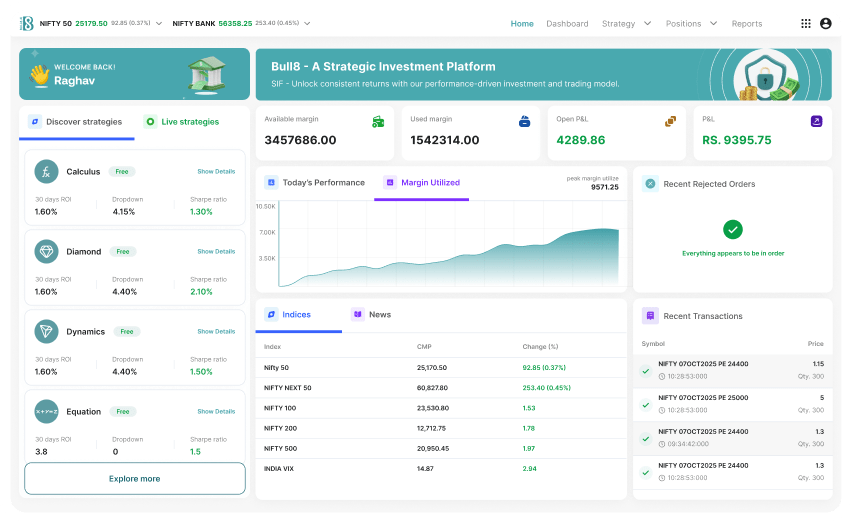
Traders can track strategy performance, open positions, and overall portfolio health in real time, ensuring clarity and control.
How Bull8 Works: Step-by-Step
Step 1: Account Setup
Create an account and complete onboarding.
Step 2: Capital Allocation
Allocate capital based on your comfort and risk appetite.
Step 3: Strategy Selection
Choose from available algorithmic strategies designed for different market conditions.
Step 4: Activate Automation
Once activated, the strategy executes trades automatically based on predefined rules.
Step 5: Monitor & Review
Track performance, review outcomes, and make data-driven decisions.
Who Should Use Bull8?
Bull8 is ideal for:
Retail traders who struggle with emotional losses
Beginners who want algo trading without coding
Working professionals who cannot track markets all day
Traders looking for structured, rule-based execution
Investors seeking technology-driven discipline
It is especially suitable for traders who want automation with control, not blind speculation.
Bull8 vs Traditional Manual Trading
Aspect
Manual Trading
Bull8 Algo Trading
Decision Making
Emotional & inconsistent
Rule-based & systematic
Execution Speed
Slow
Instant
Discipline
Hard to maintain
Built-in
Risk Control
Often ignored
Pre-defined
Scalability
Limited
High
This comparison highlights why algo trading platforms like Bull8 are becoming essential tools for retail traders in India.
Common Algo Strategies Used on Retail Platforms
While Bull8 focuses on strategy-driven automation, typical retail algo strategies include:
Trend-following strategies
Breakout-based strategies
Time-based execution strategies
Volatility-adjusted strategies
Risk-controlled positional strategies
The key is not just the strategy, but consistent execution, which Bull8 ensures.
Risk Awareness: Algo Trading Is Not Risk-Free
Algo trading reduces emotional errors, but it does not eliminate market risk. Traders must understand:
Markets can behave unpredictably
No strategy works in all conditions
Over-allocation increases risk
Discipline is required even with automation
Bull8 encourages responsible trading by focusing on controlled deployment rather than aggressive speculation.
Why Bull8 Fits India’s Retail Trading Future
India’s retail trading ecosystem is evolving rapidly with increasing focus on transparency, automation, and discipline. Platforms that combine compliance-friendly design, simplicity, and risk management are best positioned for the future.
Bull8 aligns with this evolution by offering:
Retail-friendly automation
Strategy-based execution
Technology-driven discipline
Focus on long-term sustainability
Final Verdict: Is Bull8 the Best Algo Software in India?
For retail traders looking to enter algo trading without coding, without emotional stress, and with structured risk control, Bull8 stands out as one of the best algo software platforms in India in 2026.
It bridges the gap between institutional-grade automation and retail simplicity—making disciplined trading achievable for everyday traders.
For too long, the world of high-finance trading has been an exclusive club. Wall Street giants with supercomputers and teams of quants have dominated the markets, while the retail trader was left to rely on gut feelings and fragmented information. That era is over.
Bull8 isn’t just a trading platform, it’s a movement toward financial freedom for retail traders. In a world where traditional investing often feels out of reach, Bull8 bridges the gap between cutting-edge technology and accessible, rule-based trading strategies. Our mission is simple: to empower everyday investors with the tools, infrastructure, and intelligence once reserved for institutions.
From Manual to Machine: The Evolution is Here
The trading landscape has fundamentally evolved from manual, intuition-based decisions to automated, rule-based systems. Bull8 embraces this shift by offering a platform where strategies are not only customizable but also grounded in institutional-grade research and execution logic. When rules are well-designed and consistently followed, they create a measurable edge and that’s exactly what Bull8 delivers.
This is why Bull8 is a powerful companion to retail traders and passive investors. It provides a simple yet powerful interface to monitor and control your automated trading strategies, finely crafted to make your financial journey robust. You choose and build your trading portfolio, and let Bull8 take care of everything for you executing trades in your own account as opportunities arise. It trades across all asset classes and ensures your money works for you across multiple time zones, maximizing your potential for returns.
Rethinking Risk: From Chaos to Clarity
Trading has long been viewed as a high-risk endeavor, especially for retail participants. Bull8 challenges that narrative by introducing a process-driven, algorithmic approach. Through rigorous research, backtesting, and built-in portfolio management, we help users move from guesswork to strategy turning trading into a disciplined investment tool.
The Bull8 Engine: Quant + Tech for Unmatched Access
At our core, we combine the analytical depth of quantitative finance with the scalability of modern technology. Our platform is designed for passive investors, working professionals, and anyone seeking smarter investment avenues.
But what truly sets Bull8 apart is its unmatched technology stack. We bring the power of institutional execution engines and low-latency infrastructure directly to you. This is institutional infrastructure with retail access, supporting advanced trading models that are typically too complex for conventional systems. It’s high-performance algorithmic trading, made accessible to everyone.
The Bull8 Promise: Your Partner in Profitability
Bull8 is more than a platform—it’s a partner in your financial journey. Whether you’re a seasoned trader or just starting out, our goal is to help you trade smarter, manage risk better, and pursue consistent profitability through automation and intelligence.
Ready to trade like a quant?
Stop leaving money on the table and start leveraging the power of automation. Explore Bull8 today and unlock the future of retail algorithmic trading.
For years, the high-tech world of algorithmic trading was the exclusive domain of institutional giants on Wall Street and Dalal Street. Armed with supercomputers, elite quant teams, and ultra-low-latency infrastructure, they dominated the markets while retail traders were left navigating with little more than charts, instincts, and hope. But that’s changing—fast.
In recent years, algorithmic trading in India has undergone a quiet revolution. What was once a niche reserved for hedge funds and proprietary desks is now becoming a powerful tool for everyday investors. Whether you’re a working professional, a part-time trader, or someone exploring alternative investments, algo trading is now within your reach. If you’ve ever wondered how to harness this power, you’re in the right place. This guide will walk you through what algorithmic trading is, how it’s evolved in India, and how you can get started plus how Bull8 is making this journey seamless for retail traders like you.
What is Algorithmic Trading?
Automatic Execution: Set your rules once, and the algorithm takes care of the rest.
Data-Driven Decisions: It says yes to logic and facts and no to emotional guesswork.
High Speed & 24/7 Monitoring: Reacts to market opportunities in milliseconds, even while you sleep.
Error-Free & Consistent: Drastically reduces manual errors and ensures disciplined execution.
Key Features that Make it Powerful:
Automatic Execution: Set your rules once, and the algorithm takes care of the rest.
Data-Driven Decisions: It says yes to logic and facts and no to emotional guesswork.
High Speed & 24/7 Monitoring: Reacts to market opportunities in milliseconds, even while you sleep.
Regulatory Framework: SEBI has established clear guidelines, ensuring a safe and structured environment for its growth.
Growing Awareness: Traders are realizing that in a fast-moving market, automation is the need of the day to avoid missing small, fleeting opportunities.
Your Step-by-Step Guide to Start Algo Trading in India
While the concept sounds technical, getting started is more straightforward than you think. Here’s your roadmap.
1
Step 1: Learn the Basics
Your viewer is only as good as the data it receives. Can it handle formats like Revit, SolidWorks, or IFC? Can it process assemblies and preserve metadata? A robust backend CAD conversion flow is critical.
2
Step 2: Pick Your Approach (Coding vs. Codeless)
Traditionally, you’d need to learn a language like Python. But what if you’re not a programmer? This is the biggest hurdle for most Indian retail traders.
3
Step 3: Select a Platform and Broker
This is the most critical choice. You need a SEBI-registered broker that supports API-based trading. This is where Bull8 changes the game.
4
Step 4: Build and Backtest Your Strategy
Start with a simple strategy—like trend-following or mean reversion. The golden rule is to backtest it rigorously on historical data to see how it would have performed.
5
Step 5: Try Paper Trading
Before risking real capital, test your strategy in a simulated environment with virtual money. This builds confidence and helps iron out any kinks.
6
Step 6: Go Live and Monitor
Start small, deploy your strategy with limited capital, and monitor its performance closely.
The Pros and Cons of Algorithmic Trading
Pros:
Emotion-Free, Disciplined Trading: It eliminates fear and greed from your decisions.
Speed and Efficiency: Executes trades faster than any human can.
Systematic Methodology: This is far superior to discretionary or recommendation-based trading, which is often prone to bias and delay.
Multi-Tasking: Manage multiple strategies or assets simultaneously.
Cons:
Technical Overload: The complexity of building, testing, and deploying systems can be overwhelming.
Risk of Over-Optimization: Creating a strategy that works perfectly in the past but fails in live markets.
System Dependency: Relies on a stable internet connection and robust software.
How Bull8 Empowers Your Indian Algo Trading Journey
This is where we solve the core challenges faced by an Indian retail trader. Bull8 is not just another platform; it’s your bridge to institutional-grade trading.
1
No Coding Required, Just Logic.
Bull8 eliminates Step 2’s biggest hurdle. You don’t need to be a Python expert. Our intuitive platform and pre-built, quant-validated strategies allow you to deploy sophisticated algorithms with a few clicks. You focus on the strategy, we handle the code.
2
Institutional-Grade Infrastructure for Retail.
Your trading decisions deserve the best execution. Bull8 provides the powerful, low-latency technology stack that institutions use, ensuring your orders are filled quickly and efficiently, giving you a real edge.
3
Trade in Your Own Account, Safely.
A common fear is transferring money to a third party. With Bull8, you trade in your own Demat and trading account with your preferred broker. Your capital never moves to a risky destination; we simply connect via secure API to execute trades on your behalf.
4
Built-In Backtesting and Paper Trading.
Bull8 integrates crucial Steps 4 and 5 directly into its platform. You can backtest strategies against years of Indian market data and then paper trade them risk-free, all within a single, unified interface.
5
Overcoming Retail Trading Challenges.
Bull8 addresses the key cons of algo trading. We manage the technical complexity, provide vetted strategies to avoid over-optimization, and offer a reliable platform, so you can focus on what matters—growing your wealth.
Ready to Start Your Algorithmic Journey?
Algorithmic trading is the future of retail investing in India. It’s about making your money work smarter, not harder. With Bull8, you are not alone in this journey. We provide the tools, the infrastructure, and the intelligence to help you trade with discipline and precision.
Start your journey with Bull8 today—and trade like a pro, without the complexity.