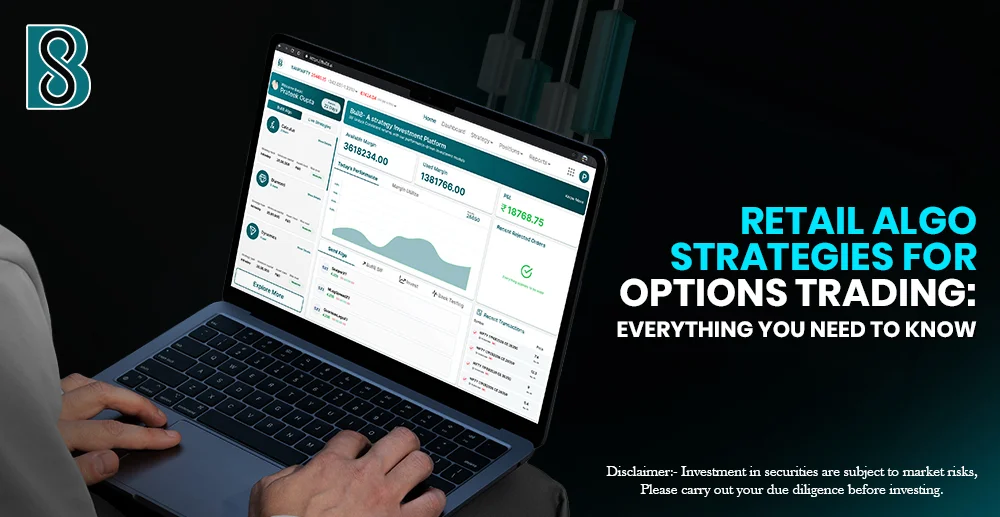
Retail Algo Strategies for Options Trading Everything You Need to Know.jpg
Introduction
Options trading often requires traders to analyse changing premiums, select suitable strikes, monitor volatility, and manage positions within a limited period. When these activities are performed manually, delays, emotions, or execution errors can affect the trading process.
Retail algorithmic trading offers a more systematic approach. It enables traders to define their trading conditions in advance and use software to monitor the market, place orders, and manage exits according to those rules.
However, automation should not be confused with guaranteed success. An algorithm can execute instructions efficiently, but it cannot predict every market movement or eliminate the risks associated with derivatives.
This guide explains how retail algo strategies for options trading work, the types of strategies that may be automated, their potential benefits, major risks and the safeguards traders should consider.
What Are Retail Algo Strategies for Options Trading?
Retail algo strategies for options trading are predefined, rule-based trading systems created for individual traders. These systems use software to perform selected trading activities automatically when specified market conditions are satisfied.
Depending on the platform and strategy, an algorithm may automate:
Monitoring the price of an underlying asset
Selecting an expiry or strike price
Tracking option premiums
Generating entry and exit signals
Placing single-leg or multi-leg orders
Applying a stop-loss or trailing stop-loss
Managing open positions
Monitoring strategy-level profit and loss
Closing positions at a specified time
The trader decides the strategy, capital allocation and risk parameters. The algorithm is responsible for following the configured instructions.
In simple terms, the trader defines what should happen and under which conditions, while the software handles monitoring and execution.
Can Retail Traders Use Algo Strategies for Options Trading?
Yes, retail traders can use algo strategies for options trading if their chosen platform supports options contracts, compatible brokers, relevant order types and suitable risk controls.
Algo trading is no longer limited to large institutions. Retail-orientated platforms now provide predefined strategies, rule-based configuration and automated execution tools that can be used without building an entire system from scratch.
The regulatory framework is also evolving. SEBI issued a circular on the safer participation of retail investors in algorithmic trading in February 2025, followed by implementation-related updates. Traders should therefore confirm the latest requirements, broker processes and platform compliance before activating an algorithm. SEBI’s retail algorithmic trading circular
Access to automation does not remove the trader’s responsibilities. Before deploying a strategy, a trader should understand:
How the options strategy is structured
Under which conditions it can lose money
How much capital and margin it requires
How strike and expiry selection affect the position
Whether the contracts have sufficient liquidity
What happens if one or more orders are not executed
How the algorithm behaves during rapid market movements
How Does Algo Options Trading Work?
The exact workflow depends on the software, broker and strategy, but a typical automated options trade follows these steps.
The trader chooses a strategy
The user selects a predefined strategy or creates rules based on price, time, volatility, technical indicators or other supported inputs.
The underlying instrument is selected
The strategy is linked to an eligible index, stock or other supported underlying instrument.
Contract-selection rules are defined
The system may be instructed to select contracts based on:
At-the-money, in-the-money or out-of-the-money strikes
Fixed premium ranges
Specific expiries
Strike distance from the spot price
Volume or open-interest conditions
Option Greeks, where supported
Entry conditions are configured.
The trader defines when the strategy should enter the market. An entry may depend on a particular time, price movement, indicator signal or volatility condition.
Capital and risk limits are set.
Before deployment, the user defines the permitted capital, position size, stop-loss, maximum number of trades and other risk limits.
The algorithm monitors the market.
The system continuously checks live market data to determine whether all configured conditions have been satisfied.
Orders are placed.
When the entry criteria are met, the algorithm sends the required order instructions through the connected broker.
The position is managed.
The system monitors premiums and the combined position. It may modify or exit the trade if a stop-loss, target, trailing stop, time condition or emergency instruction is triggered.
Types of Retail Algo Strategies Used in Options Trading
Options strategies can be grouped according to the market conditions they are designed to address. The following categories are educational examples, not trading recommendations.
Directional Strategies
A directional strategy is based on the expectation that the underlying asset may move upward or downward.
Examples include:
Long call
Long put
Bull call spread
Bear put spread
Protective put
An algorithm may monitor a breakout, moving average, momentum indicator or another specified signal before entering the position.
Non-Directional Strategies
Non-directional strategies are generally structured around a particular price range, volatility expectation or the passage of time rather than a strong directional view.
Examples include:
Short straddle
Short strangle
Iron condor
Iron butterfly
These strategies can carry significant risk, especially during sharp market moves. Selling uncovered options can expose traders to substantial or theoretically unlimited losses in certain positions.
Volatility-Based Strategies
Volatility-based algorithms use volatility-related conditions as part of their entry and exit logic.
They may consider:
Implied volatility
Historical volatility
Changes in option premiums
A volatility index
Differences between implied and realised volatility
A strategy based on volatility still needs protection against sudden market gaps, volatility expansion and inadequate liquidity.
Time-Based Strategies
Time-based algorithms enter or close positions at predefined times. A trader may instruct the system to avoid the opening minutes, enter after a particular time or square off all positions before the market closes.
These rules are simple to understand, but time alone does not make a strategy effective. Market conditions and risk limits remain important.
Indicator-Based Strategies
These strategies use technical indicators to generate signals. Common inputs can include:
Moving averages
Relative Strength Index
VWAP
Price breakouts
Momentum indicators
Support and resistance levels
The indicator usually tracks the underlying asset, while the algorithm uses a defined rule to select and trade the related options contract.
Single-Leg and Multi-Leg Options Automation
A single-leg strategy contains one options position, such as buying a call or put. It is usually easier to automate because the system needs to manage only one contract and one set of exit conditions.
A multi-leg strategy combines two or more options positions. Examples include spreads, straddles, strangles, iron condors and iron butterflies.
Multi-leg automation can help coordinate the position, but it introduces additional execution challenges.
Legging Risk
Legging risk arises when one order is executed but another is delayed, rejected or filled at an unfavourable price. During the delay, the trader may have an unintended directional or volatility exposure.
A robust platform should have clear rules for:
The sequence in which legs are placed
Maximum acceptable execution delay
Handling rejected or partially filled orders
Exiting an unmatched position
Monitoring the combined strategy instead of only individual legs
Important Inputs Used by an Options Algorithm
An options algorithm may evaluate several variables simultaneously.
Underlying Price
The price of the index or stock can determine the directional signal and the strike that the system selects.
Option Premium
Premium-based rules may be used to select contracts or trigger entries and exits. Premiums can change quickly because of price, volatility and time decay.
Strike Price and Expiry
Strike and expiry selection significantly influence risk. Near-expiry contracts may react sharply to movements in the underlying and can lose time value rapidly.
Implied Volatility
Implied volatility reflects the market’s expectation of future movement. A rise or fall in implied volatility can affect option premiums even when the underlying price does not move significantly.
Volume, Open Interest and Bid-Ask Spread
These factors can help assess whether a contract has sufficient trading activity. A wide bid-ask spread can increase execution costs and slippage.
Option Greeks
Where supported, an algorithm may consider:
Delta: sensitivity to movement in the underlying
Gamma: rate of change in delta
Theta: effect of time decay
Vega: sensitivity to implied volatility
Rho: sensitivity to changes in interest rates
Greeks are estimates rather than guarantees. They change as market conditions, time and the underlying price change.
Benefits of Retail Algo Strategies for Options Trading
Faster Rule-Based Execution
An algorithm can act as soon as its predefined conditions are satisfied. This may reduce the delay involved in identifying a signal and manually entering multiple order details.
Greater Consistency
The same entry, exit and position-sizing rules can be applied to every eligible trade. This helps prevent arbitrary changes during market hours.
Reduced Emotional Interference
Fear, greed, hesitation and the urge to recover losses can influence manual decisions. Automation can reduce emotional interference at the execution stage, provided traders do not repeatedly override or alter their systems impulsively.
Continuous Market Monitoring
A system can monitor prices and strategy conditions throughout trading hours without requiring the trader to watch every market movement manually.
Easier Management of Multiple Legs
Automation can help place and monitor the legs of a complex options position. However, the platform must also be able to handle partial fills, rejected orders and unexpected margin changes.
Systematic Risk Controls
Stop-losses, capital limits, time-based exits and maximum-loss rules can be built into the strategy. These controls support discipline, although they cannot guarantee execution at the expected price.
Risks and Limitations of Algo Options Trading
Options and algorithmic trading combine market risk with execution and technology risk. Traders need to understand both.
Time Decay
An options contract loses time value as it approaches expiry, although the rate of decay is not constant. A directional view may be correct, but a purchased option can still lose value if the move is too small or arrives too late.
Changes in Implied Volatility
A fall in implied volatility can reduce a purchased option’s premium. A sharp rise in volatility can significantly affect option-selling strategies.
Slippage
Slippage occurs when an order executes at a price different from the expected price. It can increase during volatile markets, in illiquid contracts or when a strategy sends several orders together.
Market Gaps
A stop-loss does not guarantee execution at the trigger price. If the market gaps, the order may be filled at a substantially different price.
Liquidity Risk
An options contract may show a theoretical value but lack sufficient buyers or sellers near that price. Low liquidity and wide spreads can materially affect actual results.
Technical Failures
Possible problems include:
Internet or network disruption
Broker-system downtime
Stale market data
API connectivity errors
Delayed order updates
Incorrect contract mapping
Software or configuration errors
Strategy Risk
Automation makes execution faster, but it also executes weak or incorrect rules consistently. A strategy based on overfitted data, unrealistic assumptions or poorly chosen parameters can produce repeated losses.
Regulatory and Broker-Level Changes
Order rules, margin requirements, position limits, contract availability and retail-algo processes may change. Traders should review current information from SEBI, exchanges and their broker before using a strategy.
The risks are not merely theoretical. SEBI reported that 93% of individual traders in the equity F&O segment incurred losses between FY22 and FY24. This does not mean every trader or strategy will have the same result, but it demonstrates why options automation must be approached with caution. SEBI’s equity F&O study
Risk Controls an Options Algo Should Include
Risk management should be part of the strategy from the beginning, not added after a loss occurs.
Capital Allocation Limit
Only a predefined amount of capital should be available to the strategy. This helps prevent one strategy from using the entire account balance.
Position-Sizing Rules
The position size should be calculated according to the available capital, margin requirement and acceptable risk.
Strategy-Level Stop-Loss
For multi-leg positions, monitoring the combined strategy loss may be more meaningful than observing each leg separately.
Daily Loss Limit
A daily risk limit can stop new trades and close eligible positions once a predetermined threshold is reached.
Maximum Trade Limit
A trade-count restriction can help reduce repeated entries during noisy or unsuitable market conditions.
Trailing Stop-Loss
A trailing stop may adjust as the position moves favourably. It should be configured carefully because excessive sensitivity can result in frequent exits.
Volatility Filter
The algorithm can be instructed to avoid new positions when volatility falls outside a predefined range.
Margin Monitoring
Options margin requirements can change. The system should detect insufficient margin before placing orders and monitor open positions for margin-related risk.
Duplicate-Order Protection
The platform should prevent repeated orders from being sent because of delayed responses or multiple triggers.
Re-Entry Controls
If re-entry is allowed, the number of re-entries and their conditions should be limited. Unlimited re-entry can lead to overtrading.
Go-Flat Functionality
A Go-Flat or emergency square-off feature can help close eligible open positions and stop further strategy execution. It is an important operational safeguard, though actual execution still depends on liquidity and broker or exchange availability.
Backtesting Retail Options Strategies
Backtesting applies a strategy’s rules to historical data to evaluate how the system might have behaved in earlier market conditions.
It can help traders study:
Trade frequency
Winning and losing periods
Drawdowns
Average gains and losses
Sensitivity to different parameters
Performance in trending and range-bound markets
The effect of transaction costs
However, options backtesting is particularly challenging. A realistic test should account for historical strike availability, expiry cycles, bid-ask spreads, liquidity, slippage, brokerage and statutory charges.
Backtested performance can be overstated when a model assumes that every trade was filled immediately at the displayed price. Historical results also cannot predict future performance.
Why Paper Testing Matters
After backtesting, a strategy can be observed in a simulated or controlled environment before full deployment.
Paper testing may reveal:
Incorrect strike selection
Unexpected trade frequency
Faulty entry or exit logic
Problems with multi-leg sequencing
Position-sizing errors
Differences between expected and real-time signals
Nevertheless, simulated trading cannot reproduce all live-market conditions. Paper orders do not always experience the same slippage, queue position, partial fills, margin pressure or emotional response as real orders.
A sensible transition may involve backtesting, paper observation and limited-capital deployment, followed by periodic review.
How to Choose Algo Trading Software for Options Trading
Retail traders should evaluate a platform beyond the number of strategies it advertises.
Important considerations include:
Support for single-leg and multi-leg options strategies
Compatibility with the trader’s broker
Transparent strike and expiry-selection rules
Real-time order and position monitoring
Capital-allocation controls
Strategy-level stop-loss
Trailing stop-loss support
Daily risk limits
Volatility filters
Go-Flat functionality
Backtesting or historical analysis
Execution logs and order records
Strong security and two-factor authentication
Clear pricing
Responsive technical support
Compliance with applicable regulatory and broker requirements
Traders should also understand whether a strategy is fully automated, semi-automated or signal-based. These models require different levels of monitoring and user intervention.
Are Retail Algo Strategies Suitable for Beginners?
A beginner can use an algo platform, but automation should come after learning the foundations of options.
Before activating a strategy, a user should understand:
Calls and puts
Strike prices
Expiry dates
Option premiums
Intrinsic and time value
Implied volatility
Option Greeks
Margin requirements
Liquidity and slippage
Assignment or settlement rules
Maximum possible loss
A user-friendly platform can simplify order execution. It cannot replace knowledge of the financial product being traded.
Beginners should avoid selecting a strategy only because its past performance appears attractive. They should first understand why the strategy enters a trade, what market condition it is designed for and how it behaves when that assumption fails.
How Bull8 Supports Systematic Options Trading
Bull8 is a retail-focused algo-trading platform designed to make automated trading more structured and accessible. It enables users to select predefined strategies, allocate capital and apply risk parameters before execution.
Depending on the chosen strategy and supported configuration, Bull8 can help users access features such as:
Fully automated strategy execution
Predefined trading strategies
Capital-allocation controls
Stop-loss and trailing stop-loss
Volatility-based filters
Live P&L monitoring
Broker connectivity
Go-Flat functionality
Web and mobile access
Security controls such as two-factor authentication
Bull8’s role is to execute predefined instructions and provide monitoring and risk-control tools. It does not guarantee profits, prevent every loss or remove the need to understand options trading.
Final Thoughts
Retail Algo Strategies for options trading can automate market monitoring, contract selection, order placement, position management and predefined exits. They may help retail traders follow a more disciplined process while reducing delays and emotional interference during execution.
At the same time, options remain complex and high-risk instruments. Time decay, volatility changes, market gaps, slippage, liquidity constraints and technical failures can all affect outcomes. Automating a strategy does not make the underlying strategy safe or profitable.
Retail traders should understand the options structure, test their logic carefully, define strict capital limits and use a platform with strong risk-management controls. In automated options trading, the quality of the rules and safeguards matters just as much as the speed of execution.
FAQs
What are retail algo strategies for options trading?
They are predefined, rule-based systems that help individual traders automate activities such as market monitoring, options selection, order placement and position management.
Can retail traders automate options trading in India?
Yes, subject to the applicable SEBI framework, exchange rules, broker requirements and the features supported by the selected algo-trading platform.
Which options strategies can be automated?
Directional, non-directional, volatility-based, time-based and indicator-based strategies may be automated. Examples include long calls, long puts, spreads, straddles, strangles and iron condors.
Can an algorithm select strike prices automatically?
Some platforms can select strikes according to predefined rules such as ATM position, strike distance, premium range or supported options metrics.
Can multi-leg options strategies be automated?
Yes, but the system needs appropriate controls for order sequencing, partial fills, rejected orders, margin availability and legging risk.
Does algo trading remove emotions completely?
It can reduce emotional interference during execution, but users can still make emotional decisions while choosing strategies, changing parameters or overriding the system.
Is backtesting enough before live trading?
No. Backtesting is useful, but it may not fully represent live slippage, liquidity, transaction costs, partial fills and technical conditions.
What is the biggest risk in automated options trading?
There is no single risk. Market movements, volatility, time decay, insufficient liquidity, incorrect strategy rules and technical failures can all result in losses.
Is options algo trading suitable for beginners?
Beginners may use an algo platform only after learning how options, margins, volatility, expiry and risk management work. Ease of execution does not reduce product complexity.
Does an options trading algorithm guarantee profits?
No. Algorithms execute predefined rules. They cannot guarantee profits or prevent losses.
Top Benefits of Using Retail Algo Trading Software for Daily Trading.jpg
The Complete Guide to Retail Algo Trading in India
The Indian stock market has undergone a remarkable transformation over the last decade. From investors placing orders through phone calls to brokers, to today’s instant mobile trading applications, technology has completely changed how people participate in the financial markets. Yet, one challenge remains constant for most retail traders—making decisions under pressure.
Emotions such as fear, greed, hesitation, and overconfidence often influence trading decisions more than logic or data. A trader may enter a position too late due to fear of missing out (FOMO), exit a profitable trade too early, or ignore stop-loss levels in the hope that the market will reverse. These emotional mistakes can significantly impact long-term profitability.
This is where retail algo trading is reshaping the trading landscape. Instead of manually monitoring charts throughout the day, traders can now rely on predefined algorithms that execute trades automatically based on specific rules and market conditions. Modern algorithmic trading platforms make it possible for retail investors to access technology that was once available only to large financial institutions and hedge funds.
The rise of affordable trading APIs, improved internet infrastructure, cloud computing, artificial intelligence, and regulatory support has accelerated the adoption of retail algorithmic trading in India. Today, traders no longer need to be programmers or quantitative analysts to benefit from automation. Many platforms provide ready-to-use, plug-and-play strategies designed specifically for retail participants.
As India’s financial ecosystem continues to evolve, the introduction of a structured regulatory framework for retail algorithmic trading has further increased transparency, investor protection, and confidence in automated trading solutions. This has encouraged more traders to explore automation as a disciplined and systematic approach to market participation.
This comprehensive guide explains everything you need to know about retail algo trading in India, including how it works; its benefits; regulatory developments; popular trading strategies; risk management practices; and how to choose the right platform for long-term success.
What Is Retail Algo Trading?
“Retail algo trading” refers to the use of computer-based algorithms to automatically execute trades in financial markets according to predefined rules. These rules may be based on price movements, technical indicators, volume, volatility, time, or various market conditions.
Unlike manual trading, where individuals constantly monitor price charts and place orders themselves, algorithmic trading systems analyse market data continuously and execute trades instantly when predefined conditions are met.
Simply put, an algorithm is a set of instructions.
For example:
Buy Nifty call options when the 20 EMA crosses above the 50 EMA and RSI is above 60. Exit if profit reaches 20 points or stop-loss hits 10 points.”
Once these rules are configured within an algorithmic trading platform, the system continuously monitors live market data and executes trades automatically without requiring constant manual intervention.
This automation significantly reduces human error while improving execution speed and consistency.
Why Is Retail Algo Trading Becoming Popular?
Several factors have contributed to the rapid growth of algorithmic trading among retail investors:
Faster Market Movements
Financial markets react instantly to economic news, earnings announcements, geopolitical events, and global developments. Human traders often struggle to react within seconds, whereas algorithms can process data and execute trades almost immediately.
Emotion-Free Decision Making
Retail traders frequently face psychological biases such as the following:
Fear
Greed
FOMO
Revenge trading
Overtrading
Confirmation bias
Algorithms execute only the predefined trading plan without emotional interference.
Improved Discipline
Successful trading requires consistency rather than occasional lucky trades. Algorithmic systems follow the same rules repeatedly, helping traders maintain discipline over time.
Time Efficiency
Many traders cannot actively monitor the market during trading hours due to professional or personal commitments. Automated trading allows strategies to operate without continuous supervision.
Manual Trading vs Retail Algo Trading
Feature
Manual Trading
Retail Algo Trading
Decision Making
Human
Rule-based Algorithm
Speed
Seconds or Minutes
Milliseconds
Emotional Influence
High
None
Execution Accuracy
Depends on Trader
Highly Consistent
Multiple Trades
Limited
Easily Managed
Monitoring
Continuous
Automated
Scalability
Low
High
Discipline
Varies
Consistent
The objective of algorithmic trading is not to predict the future but to execute a well-defined trading strategy consistently and efficiently.
Evolution of Algorithmic Trading in India
Algorithmic trading was initially introduced for institutional investors and large broking firms. These organisations used sophisticated systems to execute large orders with minimal market impact and high precision.
Retail investors had limited access to such technology due to:
High infrastructure costs
Lack of APIs
Technical complexity
Regulatory limitations
Limited awareness
Over time, several technological advancements changed this landscape.
Phase 1: Institutional Dominance
During the early years, algorithmic trading was largely restricted to:
Investment banks
Foreign Institutional Investors (FIIs)
Mutual funds
Proprietary trading firms
High-Frequency Trading (HFT) desks
Retail participation was minimal.
Phase 2: API-Based Trading
As brokers began offering secure trading APIs, developers gained the ability to build custom trading systems. This marked the beginning of accessible automation for technically skilled retail traders.
However, coding expertise was still required, limiting widespread adoption.
Phase 3: No-Code Automation Platforms
The emergence of user-friendly platforms eliminated the need for programming knowledge. Traders could now:
Choose predefined strategies
Configure risk parameters
Define capital allocation
Enable automated execution
Monitor performance through intuitive dashboards
This significantly lowered the barrier to entry for retail participants.
Phase 4: Retail Algo Trading
The Indian regulatory environment has evolved to address the growing adoption of retail algorithmic trading. Regulatory guidelines now emphasise the following:
Investor protection
Risk controls
Secure API usage
Broker oversight
Transparency in automated execution
Responsible deployment of retail algorithms
These developments have enhanced confidence in algorithmic trading among retail investors and encouraged the growth of compliant platforms.
How Retail Algo Trading Works
Understanding the workflow of an algorithmic trading system helps traders appreciate the technology behind automated execution.
Step 1: Market Data Collection
The algorithm continuously receives live market information such as the following:
Price movements
Volume
Open Interest
Bid-Ask Spread
Volatility
Option Chain Data
Index Levels
This data forms the foundation for decision-making.
Step 2: Strategy Evaluation
The trading engine evaluates predefined conditions based on the selected strategy.
Examples include:
Moving Average Crossover
Breakout Strategy
VWAP Strategy
Option Selling Strategy
Momentum Trading
Mean Reversion
Volatility-Based Entry
Trend Following
The system continuously checks whether all required conditions are satisfied.
Step 3: Signal Generation
When every condition is met, the algorithm generates a trading signal.
For example:
Buy Nifty CE
Sell Bank Nifty PE
Exit Existing Position
Modify Stop-Loss
Trail Profit
Square Off Position
Signals are generated without emotional bias or hesitation.
Step 4: Automated Order Execution
The trading platform sends the order to the connected broker through secure APIs.
Depending on the strategy, the system may place the following:
Market Orders
Limit Orders
Stop-Loss Orders
Stop-Limit Orders
Bracket Orders (where supported)
Basket Orders
Execution occurs within milliseconds, minimising delays that often occur during manual trading.
Step 5: Position Monitoring
After execution, the system continues monitoring the open position in real time.
It automatically manages the following:
Profit Targets
Stop-Loss Levels
Trailing Stop-Loss
Time-Based Exits
Volatility-Based Adjustments
Risk Limits
Maximum Daily Loss
This ensures positions are managed according to predefined rules without requiring constant manual supervision.
Step 6: Exit Strategy
Every successful algorithm includes clearly defined exit criteria.
Common exit triggers include:
Target achieved
Stop-loss hit
Trend reversal
Time-based square-off
Volatility spike
End-of-day exit
Portfolio risk threshold reached
By following predefined exits, the algorithm helps eliminate impulsive decisions that often arise during periods of market volatility.
Core Components of a Retail Algo Trading Platform
A robust retail algorithmic trading platform typically includes the following:
These components work together to provide traders with a seamless, disciplined, and scalable trading experience.
Manual Trading vs Algo Trading: Which Is Better for Modern Traders?
Every trader enters the market with the same objective—to generate consistent returns while managing risk effectively. However, the method of achieving that goal can vary significantly. Some traders rely on manual decision-making, while others use algorithmic systems that automate the trading process.
Neither approach guarantees profits. Success depends on the quality of the trading strategy, disciplined execution, sound risk management, and continuous learning. That said, Retail Algo Trading offers several operational advantages by removing emotional decision-making and improving execution consistency.
What Is Manual Trading?
Manual trading involves analysing the market, identifying opportunities, placing orders, and managing open positions entirely by yourself. The trader decides when to buy, sell, modify stop-losses, or exit a trade based on market observations.
Manual traders often use the following:
Technical analysis
Fundamental analysis
Price action
Candlestick patterns
News and economic events
Market sentiment
While experienced traders can succeed with this approach, it demands constant focus and quick decision-making—especially during volatile market conditions.
What Is Algo Trading?
In Retail Algo Trading, a predefined set of rules determines when trades should be executed. Once those rules are configured, the system continuously monitors live market data and executes trades automatically when the specified conditions are met.
For example, a strategy might be programmed to:
Buy a call option when short-term momentum aligns with a trend indicator.
Place a predefined stop-loss immediately after entry.
Book profits at a fixed target or trail the stop-loss.
Exit all open positions before market close.
Because the execution follows predefined rules, the algorithm avoids hesitation and emotional reactions.
Detailed Comparison: Manual Trading vs Retail Algo Trading
Parameter
Manual Trading
Retail Algo Trading
Decision Making
Human judgment
Rule-based automation
Speed
Seconds to minutes
Milliseconds
Emotional Bias
High
Eliminated from execution
Discipline
Can vary
Consistent with predefined rules
Monitoring
Continuous manual attention
Automated monitoring
Order Accuracy
Depends on the trader
High, subject to market execution conditions
Multiple Positions
Difficult to manage simultaneously
Can monitor multiple strategies and instruments
Scalability
Limited
Easier to scale with proper risk controls
Backtesting
Manual or limited
Often built into platforms
Time Requirement
High
Lower during market hours once configured
Key takeaway: Automation improves execution efficiency and consistency, but it does not eliminate market risk. A poorly designed strategy can still lose money.
Why Retail Traders Often Struggle with Manual Trading
Many retail traders experience inconsistent results not because they lack knowledge, but because psychological and operational challenges interfere with disciplined execution.
Emotional Decision-Making
Markets move rapidly, especially in derivatives such as options. Traders often react emotionally by:
Exiting profitable trades too early.
Holding losing trades for too long.
Increasing position size after losses.
Chasing fast-moving markets.
Algorithms simply execute predefined rules without fear or greed.
Delayed Execution
Even a small delay in placing an order can change the trade outcome during volatile sessions.
Automation can:
Detect conditions instantly.
Generate a signal.
Send the order to the broker through secure APIs.
Reduce reaction time compared with manual execution.
Lack of Consistency
Many traders follow a strategy for a few days, then switch approaches after a series of losses.
Successful trading generally depends on consistent execution over a meaningful sample of trades rather than frequent strategy changes.
Human Errors
Common manual mistakes include:
Entering the wrong quantity.
Selecting the wrong strike price.
Missing a stop-loss.
Forgetting to square off intraday positions.
Placing duplicate orders.
Well-designed automated workflows can reduce these operational errors, although users should still monitor their systems.
Understanding the Retail Algo Framework (2026)
As algorithmic trading became increasingly accessible to retail investors, the need for a structured regulatory framework also grew. To support innovation while enhancing investor protection, the Indian securities regulator introduced guidelines for retail algorithmic trading.
The framework is designed to promote safer participation by encouraging proper risk controls, transparency, and responsible deployment of automated strategies.
Why Was a Retail Algo Framework Needed?
Retail algorithmic trading has expanded due to:
Better internet connectivity.
Availability of broker APIs.
User-friendly trading platforms.
Growing awareness of automation.
Wider adoption of options trading.
Without appropriate oversight, automated systems could expose traders to operational risks such as the following:
Unintended order placement.
Poorly configured strategies.
Excessive order generation.
Inadequate risk management.
The regulatory approach aims to reduce these risks while allowing responsible innovation.
Key Objectives of the Framework
The framework broadly focuses on:
Investor Protection
Encouraging safeguards that help retail traders use automated systems responsibly.
Transparency
Promoting clarity regarding how trading systems operate and how orders are routed.
Risk Controls
Supporting mechanisms such as the following:
Position limits.
Stop-loss functionality.
Daily loss controls.
Order validation.
Monitoring of automated activity.
Broker Oversight
Brokers play an important role in supervising API access and implementing operational safeguards within their infrastructure.
Fair Market Practices
The framework seeks to maintain orderly markets by reducing the likelihood of disruptive automated activity.
Why Regulation Benefits Retail Traders
Some traders initially viewed additional regulation as a hurdle. In practice, stronger standards can increase trust in the ecosystem.
Benefits include:
Greater confidence in compliant platforms.
Better operational safeguards.
Improved transparency.
Enhanced protection against misuse.
Encouragement of responsible innovation.
For long-term adoption, regulatory confidence is just as important as technological advancement.
Major Benefits of Retail Algo Trading
Automation is not about eliminating risk—it is about improving execution quality, consistency, and operational efficiency.
Emotion-Free Execution
One of the biggest advantages of algorithmic trading is that the system follows predefined rules instead of emotions.
The algorithm does not:
Panic during market declines.
Become overconfident after profits.
Chase momentum impulsively.
Take revenge trades after losses.
Faster Trade Execution
Markets can move significantly within seconds.
Automated systems:
Monitor data continuously.
Generate signals immediately.
Send orders through connected broker infrastructure.
Help reduce manual reaction delays.
Improved Discipline
Every trade follows predefined conditions.
This creates consistency in:
Entries.
Exits.
Position sizing.
Stop-loss placement.
Risk management.
Ability to Monitor Multiple Opportunities
Manual traders often focus on only one or two charts.
Algorithmic systems can simultaneously evaluate multiple things:
Indices.
Stocks.
Options contracts.
Technical indicators.
Strategies.
The actual capacity depends on the platform and system resources.
Better Risk Management
Many modern platforms provide features such as the following:
Fixed stop-losses.
Trailing stop-losses.
Daily loss limits.
Position size controls.
Time-based exits.
Portfolio-level risk settings.
These tools help traders maintain discipline and manage exposure.
Time Efficiency
Many traders have full-time jobs or businesses.
Automation allows them to:
Configure strategies before the session.
Monitor performance periodically.
Reduce the need for continuous screen time.
Regular oversight is still important to ensure systems operate as intended.
Consistent Strategy Execution
Consistency is one of the most valuable aspects of algorithmic trading.
Instead of making different decisions under similar market conditions, the algorithm applies the same predefined logic each time. This consistency makes it easier to evaluate whether a strategy has a genuine edge over a large number of trades.
Who Should Use Retail Algo Trading?
Retail algorithmic trading is suitable for a wide range of market participants, provided they understand the risks and use appropriate risk management.
Working Professionals
People with limited time during market hours may benefit from automation, as it reduces the need for constant manual monitoring.
Options Traders
Options traders often face rapidly changing premiums and volatility. Automated execution can help implement predefined strategies more consistently.
Intraday Traders
Intraday trading frequently requires quick entries and exits.
Automation can assist with:
Timely execution.
Automated stop-loss placement.
Target management.
End-of-day square-off.
Systematic Traders
Traders who prefer rule-based approaches may find algorithmic platforms well suited to their style.
Experienced Investors Exploring Automation
Investors familiar with market dynamics who want to improve execution efficiency can explore automated strategies after understanding the platform and associated risks.
Who Should Be Cautious?
Retail algo trading is not ideal for those who:
Expect guaranteed profits.
Want “set-and-forget” investing with no oversight.
Use excessive leverage without understanding the risks.
Trade without a defined risk management plan.
Deploy strategies they have not evaluated.
Automation is a tool—not a substitute for knowledge, discipline, or prudent decision-making.
Common Myths About Retail Algo Trading
Myth 1: Algo Trading Always Makes Money
Reality: No strategy is profitable under all market conditions. Performance depends on market behaviour, strategy design, execution quality, and risk management.
Myth 2: Algo Trading Is Only for Institutions
Reality: Retail traders now have access to user-friendly platforms that support rule-based automation without requiring advanced programming skills.
Myth 3: You Must Know Coding
Reality: Many modern platforms offer no-code or low-code environments with ready-to-use strategies, making automation accessible to a broader audience.
Myth 4: Automation Removes All Risk
Reality: Market risk remains. Automation can improve execution discipline, but it cannot eliminate losses or predict future price movements.
Essential Features of a Modern Retail Algo Trading Platform
Choosing the right retail algo trading platform is one of the most important decisions a trader can make. Even the best trading strategy may underperform if executed on a platform with poor infrastructure, limited risk controls, or unreliable connectivity.
A modern platform should do much more than place orders. It should provide a secure, scalable, and user-friendly environment that helps traders automate strategies while maintaining control over risk.
Below are the essential features every retail trader should evaluate before selecting an algorithmic trading platform.
Rule-Based Strategy Automation
The foundation of any algorithmic trading platform is its ability to automate trading decisions based on predefined rules.
Instead of manually watching charts all day, traders configure conditions such as the following:
Entry rules
Exit rules
Stop-loss levels
Profit targets
Time-based exits
Position sizing
Once activated, the platform continuously monitors market conditions and executes trades only when the specified criteria are met.
This structured approach helps maintain consistency and reduces emotional interference.
Plug-and-Play Trading Strategies
Not every trader has programming knowledge or wants to build algorithms from scratch.
Modern retail platforms increasingly offer plug-and-play strategies that allow users to do the following:
Select a ready-made strategy
Configure capital allocation
Set personal risk limits
Start automated execution with minimal technical setup
These solutions make algorithmic trading more accessible, especially for beginners.
Secure Broker API Integration
A reliable algorithmic trading platform should integrate securely with supported broking APIs.
This enables:
Real-time order placement
Order modification
Position monitoring
Portfolio synchronization
Secure API connectivity is critical for efficient execution and operational reliability.
Real-Time Market Data
Algorithms are only as effective as the data they receive.
An effective platform should process live information such as the following:
Price movements
Volume
Open Interest
Bid-Ask Spread
Option Chain Data
Volatility
Market depth (where applicable)
Real-time data helps ensure trading decisions are based on current market conditions rather than delayed information.
Built-In Risk Management
Risk management is often more important than the entry signal itself.
Professional-grade retail platforms typically include features such as:
Fixed Stop-Loss
Trailing Stop-Loss
Maximum Daily Loss Limit
Position Limits
Capital Allocation Controls
Trade Quantity Restrictions
Auto Square-Off
Portfolio Risk Monitoring
These safeguards help traders maintain discipline and protect capital.
Live Dashboard and Performance Monitoring
A comprehensive dashboard allows traders to monitor the following:
Open positions
Running profit and loss
Closed trades
Daily performance
Capital utilization
Order status
Strategy health
Easy access to performance metrics supports better decision-making and strategy evaluation.
Strategy Backtesting
Before deploying any algorithm with real capital, traders should evaluate how it would have performed using historical market data.
Backtesting helps answer questions such as the following:
How did the strategy perform during trending markets?
What was the maximum drawdown?
What was the average win rate?
How much risk did it take to generate returns?
Was performance consistent across different market phases?
While historical results cannot guarantee future outcomes, backtesting is an important part of the strategy development process.
Multi-Strategy Support
Market conditions change frequently.
A strategy that performs well in a trending market may struggle during range-bound or highly volatile periods.
Platforms supporting multiple strategies allow traders to diversify their approach instead of depending on a single trading method.
Examples include:
Trend Following
Option Selling
Breakout
Mean Reversion
Momentum
Scalping
Volatility-Based Strategies
Diversification can help reduce dependence on one market regime, though it does not eliminate risk.
Popular Retail Algo Trading Strategies
Different market environments require different trading approaches. Below are some of the most commonly used rule-based strategies.
Trend-Following Strategy
Trend following is one of the simplest and most widely used algorithmic approaches.
The objective is to identify and participate in established market trends.
Typical indicators include the following:
Moving Averages
EMA Crossovers
ADX
Supertrend
Example:
Buy when the 20 EMA crosses above the 50 EMA.
Exit when the crossover reverses or a predefined stop-loss is triggered.
Trend-following strategies generally perform best during strong directional markets.
Breakout Strategy
Markets often consolidate before making significant moves.
Breakout strategies attempt to capture these movements when price exceeds key support or resistance levels.
Common conditions include:
The price breaks previous day’s high
Volume increases
Volatility expands
Confirmation candle closes beyond resistance
These strategies may experience false breakouts during sideways markets, making risk management essential.
Mean Reversion Strategy
This approach assumes that prices tend to return toward their historical average after moving significantly away from it.
Common indicators include:
Bollinger Bands
RSI
Moving Average Distance
Mean reversion strategies can work well in range-bound markets but may struggle during strong trends.
Momentum Strategy
Momentum strategies focus on securities that are already moving strongly in one direction.
Signals may be based on:
Relative Strength
Volume Expansion
Price Acceleration
Breakout Confirmation
The goal is to participate in sustained momentum while managing downside risk through predefined exits.
Option Selling Strategies
Option selling strategies are commonly used by experienced traders who aim to benefit from:
Time decay (Theta)
Stable or range-bound markets
Controlled volatility
Popular structures include the following:
Iron Condor
Short Strangle
Credit Spreads
Covered Calls
Because option selling can involve significant risk under certain market conditions, strong risk controls and position management are essential.
Volatility-Based Strategies
Market volatility changes continuously.
Some algorithms adjust their trading behaviour based on volatility indicators such as the following:
India VIX
Average True Range (ATR)
Implied Volatility
These strategies may reduce exposure during periods of extreme uncertainty or adapt position sizing according to market conditions.
Risk Management: The Foundation of Successful Retail Algo Trading
Many traders spend most of their time searching for the “perfect strategy”. In reality, long-term success often depends more on disciplined risk management than on finding the ideal entry signal.
A well-designed algorithm should include robust controls to manage downside risk.
Position Sizing
Never risk a disproportionate amount of capital on a single trade.
Appropriate position sizing helps ensure that one losing trade does not significantly impact the overall portfolio.
Stop-Loss Management
Every automated strategy should define clear exit criteria for losing trades.
Common stop-loss methods include:
Fixed Point Stop-Loss
Percentage Stop-Loss
Volatility-Based Stop-Loss
Indicator-Based Stop-Loss
Time-Based Exit
Using stop-losses does not prevent losses but helps limit their size.
Maximum Daily Loss Limit
Many professional traders stop trading after reaching a predefined daily loss threshold.
Automated systems can enforce this rule by:
Closing open positions.
Blocking new trades for the day.
This helps prevent emotional overtrading after losses.
Diversification Across Strategies
Relying on a single strategy can increase vulnerability to changing market conditions.
Diversifying across different approaches may improve resilience.
Examples:
Trend Following
Option Selling
Breakout
Momentum
Mean Reversion
Diversification should be combined with appropriate capital allocation and monitoring.
Continuous Monitoring
Although algorithms automate execution, they should not be left completely unattended.
Traders should periodically review the following:
Strategy performance.
Broker connectivity.
API status.
Market conditions.
Risk metrics.
Platform alerts.
Regular monitoring helps identify operational issues before they become significant problems.
Common Mistakes Retail Algo Traders Make
Automation can improve execution, but it cannot compensate for poor planning or unrealistic expectations.
Below are some common mistakes to avoid.
Mistake 1: Expecting Guaranteed Profits
No trading strategy wins all the time.
Even well-designed algorithms experience the following:
Losing trades.
Drawdowns.
Changing market conditions.
Successful traders focus on long-term consistency rather than short-term perfection.
Mistake 2: Ignoring Risk Management
Some traders spend weeks selecting strategies but only minutes thinking about risk controls.
Without appropriate safeguards, even a profitable strategy can lead to substantial losses during adverse market conditions.
Mistake 3: Frequent Strategy Switching
Changing strategies after every losing streak prevents meaningful evaluation.
Every systematic approach requires a sufficient number of trades before its performance can be assessed objectively.
Mistake 4: Over-Leveraging
Using excessive leverage can amplify both gains and losses.
A disciplined trader aligns position size with the following:
Capital.
Risk tolerance.
Strategy characteristics.
Mistake 5: Blindly Following Others
A strategy that works for one trader may not suit another.
Factors such as:
Capital.
Trading objectives.
Risk appetite.
Time horizon.
should influence strategy selection.
Mistake 6: Ignoring Platform Reliability
Choosing a platform solely based on low pricing may overlook critical factors such as:
Stability.
Customer support.
Security.
Risk controls.
Infrastructure quality.
Reliability is especially important for automated execution.
How to Choose the Best Retail Algo Trading Platform in India
Before selecting a platform, evaluate the following:
✔ Secure broker integration
✔ Strong risk management features
✔ Rule-based automation
✔ Plug-and-play strategy options
✔ Transparent pricing
✔ Reliable infrastructure
✔ Live monitoring dashboard
✔ Strategy backtesting capabilities
✔ Responsive customer support
✔ Educational resources and documentation
✔ Regular platform updates
✔ Compliance with applicable regulations and broker requirements
A careful evaluation helps ensure the platform aligns with your trading goals and operational needs.
Why Bull8 Is Built for Modern Retail Algo Traders
Retail trading has changed dramatically over the last few years. Today’s traders expect more than just a trading application—they want speed, automation, transparency, robust risk controls, and a simple user experience.
Bull8 is designed with these evolving needs in mind. Its objective is to make retail algo trading accessible to traders who want to automate strategy execution without building complex systems from scratch.
Rather than requiring traders to monitor charts continuously, Bull8 provides an environment where predefined, rule-based strategies can be deployed with integrated risk controls and real-time monitoring.
Whether you are a working professional, an active options trader, or someone exploring algorithmic trading for the first time, Bull8 focuses on making automation practical, structured, and easier to manage.
Key Features of Bull8
Plug-and-Play Strategy Deployment
Many retail traders are interested in automation but do not have programming experience.
Bull8 offers a plug-and-play approach that enables users to deploy supported strategies without writing code, helping reduce the technical barrier to entry.
Rule-Based Trade Execution
Bull8 executes trades according to predefined strategy conditions.
This approach helps:
Maintain consistency.
Reduce emotional decision-making.
Execute trades more efficiently than manual workflows.
Follow predefined entry and exit rules.
Integrated Risk Management
Risk management is a core component of systematic trading.
Bull8 includes features designed to support disciplined execution, such as the following:
Stop-loss controls
Trailing stop-loss functionality
Position management
Capital allocation settings
Automated square-off options (where applicable)
Strategy-level risk parameters
These controls help traders align execution with their risk management plan.
Live Monitoring Dashboard
A centralised dashboard allows users to monitor the following:
Open positions
Profit and loss
Strategy status
Trade activity
Portfolio performance
Having access to live information helps traders stay informed while their strategies are running.
Suitable for Different Experience Levels
Bull8 is designed to support the following:
Beginners exploring automation.
Working professionals with limited market time.
Active options traders.
Experienced systematic traders.
The platform’s simplified workflow allows users to focus more on strategy selection and risk management rather than manual execution.
Built for the Indian Market
Bull8 is designed specifically for Indian retail market participants, with support for trading workflows relevant to domestic exchanges and broker integrations.
Continuous Platform Improvement
Financial markets evolve continuously.
Modern algorithmic trading platforms should regularly improve:
Stability
Performance
User experience
Risk controls
Strategy support
Continuous enhancement helps platforms adapt to changing market conditions and user expectations.
Why Retail Traders Prefer Automated Trading
Retail participation in Indian financial markets continues to grow.
Several factors are driving increased adoption of automation:
More Working Professionals Are Trading
Many traders cannot monitor the markets throughout the day.
Automation allows predefined strategies to execute while users focus on their professional responsibilities, provided they continue to monitor performance appropriately.
Faster Market Movements
Today’s markets respond quickly to the following:
Economic announcements
Corporate earnings
Global events
Interest rate decisions
Policy changes
Automated systems help reduce delays associated with manual order placement.
Growing Awareness of Risk Management
Retail traders are increasingly recognising that successful trading depends not only on identifying opportunities but also on controlling risk.
Modern platforms support this through built-in risk management tools.
Better Technology Access
Cloud infrastructure, secure APIs, and improved trading software have made automation more accessible than ever before.
Technology that was once available mainly to institutional participants is now increasingly available to retail traders.
The Future of Retail Algo Trading in India
The Indian trading ecosystem is evolving rapidly.
Several long-term trends are likely to influence the future of retail algorithmic trading.
Increased Automation
Automation is expected to become a standard part of retail trading rather than a niche capability.
As platforms become more intuitive, more traders are likely to adopt rule-based execution.
Artificial Intelligence and Data Analytics
AI and advanced analytics are increasingly being used to support:
Pattern recognition
Market analysis
Strategy optimization
Risk assessment
Portfolio monitoring
These technologies can enhance decision support, though they do not eliminate uncertainty or guarantee trading success.
Smarter Risk Management
Future platforms are expected to include more adaptive risk controls, such as:
Dynamic position sizing
Volatility-based exposure adjustments
Portfolio-level monitoring
Automated alerts
Scenario analysis
These tools can help traders respond more effectively to changing market conditions.
Greater Regulatory Maturity
As retail algorithmic trading grows, the regulatory environment is also expected to evolve.
Continued emphasis on:
Investor protection
Transparency
Secure API usage
Operational safeguards
can strengthen confidence in the broader ecosystem.
Better User Experience
Future trading platforms are likely to focus on:
Simpler interfaces
Improved onboarding
Mobile-first experiences
Better educational resources
More intuitive strategy deployment
Ease of use will remain an important factor for wider adoption.
FAQs
What is Retail Algo Trading?
Retail Algo Trading is the use of predefined algorithms to automatically execute trades based on specific market conditions, reducing manual intervention while following a rule-based trading approach.
Is retail algo trading legal in India?
Yes. Retail algorithmic trading is permitted within the applicable regulatory framework. Traders should always use compliant platforms, supported broker integrations, and follow relevant exchange and regulatory requirements.
Do I need coding knowledge to start algo trading?
Not necessarily. Many modern platforms, including plug-and-play solutions, allow users to deploy predefined strategies without writing code.
Is algo trading suitable for beginners?
Beginners can explore algorithmic trading after understanding the basics of financial markets, trading strategies, and risk management. Starting with smaller capital and learning gradually is generally advisable.
Does Bull8 execute trades automatically?
Yes. Bull8 supports automated execution for configured strategies, subject to the platform’s features, broker integration, and user-defined settings.
Can algo trading eliminate trading losses?
No. No trading method can eliminate market risk. Algorithmic trading helps improve execution discipline, but profits and losses remain dependent on market conditions and strategy performance.
What markets can be traded using retail algo platforms?
Supported markets depend on the broker and platform but may include equities, futures, options, and other exchange-supported segments.
How important is risk management in algo trading?
Risk management is essential. Position sizing, stop-losses, daily loss limits, and capital allocation are key elements of responsible algorithmic trading.
Can working professionals use Bull8?
Yes. Bull8 is designed to support traders who may not be able to monitor markets continuously during trading hours.
Is backtesting enough before using a strategy?
Backtesting is valuable for evaluating historical performance, but it does not guarantee future results. Strategies should also be monitored in live market conditions and reviewed regularly.
Can I run multiple strategies simultaneously?
Many retail algorithmic trading platforms support multiple strategies, depending on platform capabilities, broker integration, and available capital.
What should I consider before choosing an algo trading platform?
Evaluate factors such as:
Security
Broker compatibility
Risk management features
Reliability
Customer support
Ease of use
Performance monitoring
Transparent pricing
Is algorithmic trading only for large institutions?
No. Advances in technology have made algorithmic trading accessible to retail traders through user-friendly platforms and broker APIs.
Can I monitor my trades after automation starts?
Yes. Modern platforms provide dashboards that display live positions, order status, and portfolio performance, allowing traders to supervise their strategies.
What is the biggest advantage of retail algo trading?
One of the biggest advantages is disciplined, rule-based execution. By following predefined trading rules consistently, traders can reduce emotional decision-making and improve operational efficiency.
Final Thoughts
Retail trading is entering a new era where technology plays an increasingly important role in how strategies are executed. While automation does not guarantee profits, it offers significant advantages in terms of speed, consistency, discipline, and operational efficiency.
The long-term success of any trader depends on several key principles:
Building a well-defined trading plan.
Using appropriate risk management.
Selecting reliable technology.
Monitoring strategy performance.
Continuously learning and adapting to market conditions.
Algorithmic trading should be viewed as a disciplined framework for executing strategies—not as a shortcut to guaranteed returns.
Why Bull8 Is a Strong Choice for Retail Algo Trading
Bull8 combines automation, user-friendly workflows, and structured risk management to help retail traders adopt a systematic approach to the markets.
With features such as plug-and-play strategies, rule-based execution, live monitoring, and integrated risk controls, Bull8 is designed to simplify the adoption of retail algo trading while supporting disciplined trading practices.
Whether you are just beginning your automation journey or looking to improve consistency in your existing trading process, Bull8 provides a platform built to support modern retail traders.
Introduction: Why Index Options Are So Popular in India
Every day, lakhs of traders actively participate in trading Nifty and Bank Nifty options, yet only a small percentage truly understand how these instruments work. Over the last decade, India has witnessed a massive surge in derivatives trading, particularly in index options. This rise has been fueled by increased retail participation, easy access to trading platforms, and the appeal of high returns with relatively small capital.
Index options dominate trading volumes on the National Stock Exchange because they offer high liquidity, tight bid-ask spreads, and consistent price movement. Unlike individual stock options, index options are less prone to sudden company-specific shocks, making them more predictable for strategy-based trading. The introduction of weekly expiries has further accelerated participation, as traders now get multiple opportunities within a single month to capture short-term market movements.
The boom in retail trading, especially post-2020, has made index options a preferred choice for both beginners and experienced traders. However, the fast-moving nature of options trading also brings significant risks. Prices can change within seconds, and even a small delay in execution can lead to missed opportunities or losses.
This is where platforms like Bull8play a crucial role. In a market where milliseconds matter, manual trading often falls short due to human limitations such as delayed reactions and emotional decision-making. Automation helps traders execute strategies with precision, discipline, and speed—something that is critical in the options segment.
In this blog, you will learn everything about how stock index options work in India, including Nifty and Bank Nifty, key terminologies, strategies, risk management, and how automation is transforming the way traders approach this market.
What Are Stock Index Options?
Stock index options are derivative instruments whose value is derived from an underlying stock index such as Nifty 50 or Bank Nifty. Instead of trading individual stocks, traders take positions based on the overall movement of a group of stocks represented by an index. These instruments allow traders to speculate on market direction, hedge existing portfolios, or generate income through various strategies.
One of the key differences between stock options and index options is that stock options are based on individual companies, while index options are based on a basket of stocks. This means index options are less affected by company-specific news such as earnings announcements or management changes, making them relatively more stable in terms of behavior.
Another important feature of index options in India is that they are cash-settled. Unlike some stock derivatives where physical delivery of shares may occur, index options do not involve buying or selling actual stocks. Instead, profits or losses are settled in cash based on the difference between the strike price and the final settlement price of the index.
For example, if a trader buys a Nifty call option and the index rises above the strike price at expiry, the trader earns the difference in cash. Similarly, if the market moves against the position, the loss is limited to the premium paid.
The two most popular index options in India are Nifty 50 and Bank Nifty. Nifty represents the top 50 companies across sectors, while Bank Nifty focuses specifically on major banking stocks. Both indices are highly liquid and actively traded, making them ideal for intraday and short-term strategies.
Traders prefer index options because of their high liquidity, predictable movement patterns, and the availability of multiple strike prices. Additionally, the leverage offered by options allows traders to control larger positions with relatively small capital, making it attractive for retail participants.
Understanding Nifty & Bank Nifty Index
To effectively trade index options, it is essential to understand the underlying indices—Nifty 50 and Bank Nifty. These indices serve as benchmarks for the Indian stock market and reflect the overall performance of specific segments of the economy.
Nifty 50 is a broad market index that consists of the top 50 companies listed on the National Stock Exchange across various sectors such as IT, banking, FMCG, energy, and pharmaceuticals. It is considered a representation of the overall Indian economy. Due to its diversified nature, Nifty tends to move in a relatively stable and balanced manner compared to sector-specific indices.
On the other hand, Bank Nifty is a sectoral index that includes the most liquid and large-cap banking stocks in India. Since banking stocks are highly sensitive to economic changes, interest rates, and policy decisions by the Reserve Bank of India, Bank Nifty tends to be more volatile than Nifty.
This difference in volatility plays a crucial role in trading decisions. Nifty is often preferred by beginners because its movements are smoother and less aggressive. It provides a more controlled environment for learning options trading. Bank Nifty, however, is favored by experienced traders who seek larger price swings and higher profit potential within a short period.
For example, a typical intraday movement in Nifty might range between 100–200 points, while Bank Nifty can move 300–600 points or more in a single session. This higher volatility makes Bank Nifty more attractive for aggressive strategies but also increases the risk significantly.
The choice between Nifty and Bank Nifty depends on a trader’s risk appetite, experience level, and trading strategy. Conservative traders and beginners may find Nifty more suitable, while those comfortable with rapid market movements often prefer Bank Nifty.
Understanding how these indices behave is the foundation of successful index options trading. It helps traders select the right strategies, manage risk effectively, and align their trades with market conditions.
How Options Work: Call vs Put Explained
To understand index options trading, it is essential to first grasp how options actually work. At the core, options are contracts that give the buyer the right, but not the obligation, to buy or sell an underlying asset (in this case, an index like Nifty or Bank Nifty) at a predetermined price within a specific time frame.
There are two primary types of options: Call Options and Put Options.
A Call Option represents a bullish view. When a trader expects the market to rise, they buy a call option. For example, if Nifty is currently trading at 22,000 and a trader believes it will go up, they might buy a 22,100 Call Option (CE). If the market moves above 22,100, the value of that option increases, and the trader can book a profit by selling it at a higher premium.
A Put Option, on the other hand, represents a bearish view. When a trader expects the market to fall, they buy a put option. For instance, if Nifty is at 22,000 and the trader expects it to drop, they might buy a 21,900 Put Option (PE). If the market falls below that level, the option gains value.
Every option contract has three key components:
Strike Price: The price at which the contract can be exercised.
Premium: The price paid to buy the option.
Expiry Date: The date on which the contract becomes invalid.
Let’s take a simple example. Suppose you buy a Nifty 22,100 Call Option at a premium of ₹100. If the premium rises to ₹150 due to market movement, you make a profit of ₹50 per lot. If the market does not move in your favor, your maximum loss is limited to the premium paid.
This limited risk but potentially high reward structure is what makes options attractive. However, it also requires proper timing and understanding because options lose value as they approach expiry due to time decay.
Understanding how call and put options behave is the foundation of all options strategies. Without this clarity, traders often take positions without knowing the risk involved, leading to losses.
Key Terminologies Every Trader Must Know
Before diving deeper into index options trading, it is important to understand the key terminologies that define how options behave in the market. These terms are not just theoretical—they directly impact trading decisions and outcomes.
One of the most important concepts is ITM, ATM, and OTM.
In-the-Money (ITM): An option is considered ITM when it has intrinsic value. For example, if Nifty is at 22,000, a 21,900 Call Option is ITM because it already has value.
At-the-Money (ATM): This is when the strike price is closest to the current market price. If Nifty is at 22,000, then the 22,000 strike is ATM.
Out-of-the-Money (OTM): These options have no intrinsic value. For example, a 22,200 Call Option when Nifty is at 22,000 is OTM.
Another key concept is Intrinsic Value vs Time Value. Intrinsic value is the real value of an option based on its position relative to the strike price. Time value is the extra premium traders are willing to pay for the possibility of future movement. As expiry approaches, time value decreases—a phenomenon known as time decay.
Open Interest (OI) refers to the total number of outstanding contracts in the market. It helps traders understand where major positions are built and can indicate support and resistance levels.
Volume represents the number of contracts traded during a session. High volume indicates strong participation and liquidity.
Implied Volatility (IV) is one of the most critical factors in options pricing. It reflects the market’s expectation of future volatility. Higher IV leads to higher premiums, while lower IV results in cheaper options.
Lot size is another practical factor. In index options, trading is done in fixed lot sizes. For example, Nifty and Bank Nifty have predefined lot sizes that determine the minimum quantity for trading. This directly affects capital requirements.
The Bid-Ask Spread is the difference between the buying price and selling price of an option. A narrow spread indicates high liquidity, while a wider spread can increase trading costs.
Understanding these terminologies is essential because they influence every decision—from selecting the right strike price to timing entry and exit. Traders who ignore these factors often make uninformed decisions, while those who master them gain a significant edge in the market.
Expiry System in India: Weekly vs Monthly
The expiry system is a crucial aspect of index options trading in India. It defines the lifespan of an option contract and plays a major role in determining price behavior, volatility, and strategy selection.
In India, index options have both weekly and monthly expiries. Weekly expiry contracts expire every week, typically on a fixed weekday assigned to each index. These contracts have become extremely popular among traders because they offer frequent opportunities to capture short-term market movements.
Monthly expiry, on the other hand, occurs once a month and represents a longer-duration contract. These are generally preferred by traders who want to hold positions for a longer time frame or use strategies that require more time for execution.
One of the key reasons weekly expiries are so popular is the rapid time decay. As expiry approaches, the premium of options decreases quickly, especially for out-of-the-money options. This creates opportunities for both buyers and sellers, depending on their strategies.
Expiry day is often characterized by high volatility. Prices can move sharply due to position unwinding, institutional activity, and last-minute adjustments. This makes expiry trading both highly rewarding and extremely risky.
For example, option sellers often benefit from time decay as premiums erode rapidly on expiry day. On the other hand, option buyers look for sharp directional moves to capture quick profits.
Strategy selection also changes based on expiry. Early in the week, traders may prefer directional trades with more time value. As expiry approaches, strategies like scalping, straddles, or intraday trades become more common.
Understanding the expiry system helps traders align their approach with market behavior. It allows them to choose the right contracts, manage time decay effectively, and avoid unnecessary risks.
In fast-moving markets, especially during expiry, timing becomes critical. This is where automated execution and disciplined strategies can make a significant difference, as even a small delay can impact profitability.
How Profit & Loss Works in Index Options
Understanding how profit and loss works in index options is essential before placing any trade. Unlike equity trading, where profits depend directly on price movement, options trading is influenced by multiple factors such as premium, time decay, volatility, and direction.
In options trading, you do not buy the index itself—you buy a contract at a certain premium. This premium is the price you pay to enter the trade, and it represents your maximum risk if you are an option buyer.
Let’s take a simple example. Suppose you buy a Nifty Call Option at a premium of ₹100. If the premium increases to ₹150, your profit is ₹50 per unit. If the lot size is 50, your total profit becomes ₹2,500. On the other hand, if the premium falls to ₹60, your loss is ₹40 per unit, or ₹2,000 per lot.
This structure makes options attractive because the risk is limited to the premium paid, but the profit potential can be significantly higher if the market moves strongly in your favor.
However, options are not just about direction. Even if the market moves slightly in your favor, you may still not make money if the movement is not fast enough. This is due to time decay, which reduces the premium value as expiry approaches. Therefore, timing plays a crucial role in profitability.
Leverage is another important aspect. With a relatively small amount of capital, traders can control a large position. While this increases profit potential, it also amplifies risk. A small unfavorable move can lead to a significant percentage loss on your capital.
For option sellers, the profit mechanism is different. Sellers receive the premium upfront and benefit if the option expires worthless. However, their risk can be unlimited if the market moves sharply against them.
In summary, profit and loss in index options depend on premium movement, not just index movement. Traders must consider direction, speed, volatility, and timing to succeed.
Why Most Beginners Lose Money in Options Trading
Despite the popularity of index options, a large number of beginners consistently lose money in this segment. The primary reason is not the complexity of the market, but the lack of understanding and discipline.
One of the biggest mistakes beginners make is entering trades without proper knowledge. Many traders jump into options trading after seeing quick profits on social media or hearing success stories, without understanding how options pricing works. This leads to unrealistic expectations and poor decision-making.
Overtrading is another major issue. Beginners often take multiple trades in a single day, trying to recover losses or chase profits. This not only increases transaction costs but also leads to emotional exhaustion and poor judgment.
Emotional decision-making plays a significant role in losses. Fear and greed drive most trading mistakes. Traders exit profitable trades too early due to fear, while holding onto losing positions in the hope of recovery. This behavior disrupts consistency and leads to long-term losses.
Another common problem is trading without a defined strategy. Successful trading requires a clear plan, including entry, exit, stop loss, and position size. Beginners often trade randomly based on market noise or tips, which results in inconsistent outcomes.
Ignoring risk management is perhaps the most critical mistake. Many traders risk a large portion of their capital on a single trade, hoping for high returns. When the trade goes wrong, it leads to significant losses that are difficult to recover.
Late entries and early exits further compound the problem. Traders often enter trades after a major move has already happened, reducing profit potential. At the same time, they exit too soon due to lack of confidence, missing out on larger gains.
To succeed in options trading, traders must focus on learning, discipline, and risk management rather than quick profits. Consistency comes from following a structured approach, not from impulsive decisions.
Popular Index Option Strategies
Index options trading offers a wide range of strategies that cater to different market conditions and risk appetites. Understanding these strategies helps traders move beyond guesswork and adopt a more structured approach.
One of the most common strategies is intraday scalping. This involves taking quick trades based on short-term price movements. Traders aim to capture small profits multiple times during the day. This strategy requires fast execution, strict discipline, and the ability to react quickly to market changes.
Option buying strategies are popular among beginners. These involve buying call or put options based on market direction. For example, if a trader expects the market to rise, they buy a call option. If they expect a fall, they buy a put option. While the risk is limited to the premium paid, consistent profits require accurate timing and strong directional conviction.
Option selling is a more advanced strategy. In this approach, traders sell options to earn premium income. Since options lose value over time, sellers benefit from time decay. However, this strategy carries higher risk, especially during sharp market movements, and requires proper risk management.
The straddle strategy involves buying both a call and a put option at the same strike price. This is used when a trader expects a big move in the market but is unsure of the direction. If the market moves significantly in either direction, one of the options generates profit.
The strangle strategy is similar to a straddle but involves buying options at different strike prices—one out-of-the-money call and one out-of-the-money put. This reduces the cost compared to a straddle but requires a larger market move to be profitable.
Iron Condor is a popular strategy for range-bound markets. It involves selling out-of-the-money call and put options while simultaneously buying further out-of-the-money options to limit risk. This strategy benefits when the market stays within a specific range.
Trend-based strategies focus on trading in the direction of the market trend. Traders use technical indicators and price action to identify trends and enter positions accordingly. These strategies work well in strong trending markets.
Range-bound strategies are used when the market is moving sideways. Traders aim to profit from small price movements within a defined range using strategies like selling options or using spreads.
Each strategy has its own risk and reward profile. The key to success is choosing the right strategy based on market conditions rather than forcing a single approach in all situations. Discipline, risk management, and consistency are essential for long-term profitability.
In fast-moving options markets, especially during intraday trading, execution speed and precision become critical. This is where structured systems and automation can significantly improve performance by ensuring trades are executed exactly as planned without emotional interference.
Role of Volatility in Nifty & Bank Nifty Trading
Volatility is one of the most important factors in index options trading, yet it is often misunderstood by beginners. In simple terms, volatility refers to the rate at which the price of an index moves up or down. Higher volatility means larger price swings, while lower volatility indicates relatively stable movement.
In the context of Nifty and Bank Nifty, volatility plays a direct role in determining option premiums. When volatility increases, option premiums rise because the probability of larger price movements increases. Conversely, when volatility decreases, premiums tend to fall.
Bank Nifty is generally more volatile than Nifty because it is concentrated in a single sector—banking. Banking stocks react quickly to economic data, interest rate decisions, and policy announcements. As a result, Bank Nifty often shows sharp intraday movements, making it attractive for traders seeking high momentum opportunities.
Volatility is also influenced by external factors such as global market trends, geopolitical events, inflation data, and decisions by the Reserve Bank of India. For example, on RBI policy days or major global announcements, volatility tends to spike, leading to rapid changes in option premiums.
Implied Volatility (IV) is a key metric used by traders to assess expected future volatility. High IV indicates that the market expects significant movement, which results in expensive options. Low IV suggests a calmer market, where options are relatively cheaper.
Trading strategies often depend on volatility conditions. In high volatility environments, traders may prefer option selling strategies to benefit from premium decay. In low volatility conditions, option buying strategies may be more effective if a breakout is expected.
Understanding volatility helps traders avoid common mistakes such as buying options when premiums are already expensive or selling options when risk is high. It also allows traders to align their strategies with market conditions.
In fast-moving markets, reacting to volatility changes in real time is critical. Delayed decisions can lead to missed opportunities or unexpected losses, highlighting the importance of speed and discipline in options trading.
How Algo Trading Is Changing Index Options Trading
Index options trading has evolved significantly with the introduction of algorithmic trading. Traditionally, traders relied on manual execution, which involved analyzing charts, identifying opportunities, and placing trades manually. However, in a market where prices change within seconds, this approach often leads to delays and emotional decision-making.
One of the biggest challenges in manual trading is execution speed. Even a delay of a few seconds can result in entering a trade at a worse price, especially in highly volatile instruments like Bank Nifty. This slippage can significantly impact profitability over time.
Another major issue is emotional bias. Fear, greed, hesitation, and overconfidence often influence trading decisions. Traders may exit profitable trades too early or hold losing positions for too long, leading to inconsistent results.
Algorithmic trading addresses these challenges by automating the entire trading process. Instead of manually placing trades, traders can use predefined rules and strategies that execute automatically when certain conditions are met.
Platforms like Bull8 are designed to bring institutional-grade trading capabilities to retail traders. With pre-built strategies, traders do not need to develop complex algorithms or have coding knowledge. These strategies are designed based on market behavior and are tested across different conditions.
Automation ensures that trades are executed instantly, without delay. This is particularly important in options trading, where milliseconds can make a difference between profit and loss. Real-time execution helps traders capture opportunities that may be missed in manual trading.
Another key advantage is consistency. Automated systems follow predefined rules without deviation, eliminating emotional interference. This leads to more disciplined trading and better long-term results.
Bull8 also offers mobile-based control, allowing traders to monitor and manage their strategies from anywhere. This flexibility is especially useful for working professionals who cannot constantly monitor the market.
Risk management is another area where algorithmic trading excels. Automated systems can incorporate stop losses, position sizing, and capital allocation rules, ensuring that risk is controlled at all times.
Backtesting is an important feature that allows traders to test strategies on historical data before deploying them in live markets. This helps in understanding how a strategy performs under different market conditions.
In summary, algorithmic trading is transforming index options trading by improving speed, accuracy, and discipline. It allows traders to move from reactive decision-making to systematic execution, which is essential in today’s fast-paced markets.
Manual Trading vs Algo Trading in Options
The debate between manual trading and algorithmic trading is becoming increasingly relevant as more traders enter the options market. Both approaches have their advantages, but the differences become significant in high-speed environments like index options trading.
Manual trading relies on human judgment. Traders analyze charts, interpret market conditions, and make decisions based on their experience and intuition. While this approach allows flexibility, it also introduces emotional bias and inconsistency.
Algorithmic trading, on the other hand, is rule-based. Trades are executed automatically based on predefined conditions. This eliminates emotional interference and ensures that every trade follows a consistent strategy.
One of the biggest differences between the two approaches is speed. Manual traders may take several seconds to analyze and execute a trade, while algorithmic systems can execute orders instantly. In options trading, where prices can change rapidly, this speed advantage is critical.
Accuracy is another important factor. Manual trading is prone to errors such as incorrect order placement or delayed execution. Algorithmic systems minimize these errors by following precise instructions.
Emotion control is where algorithmic trading has a clear edge. Human traders often struggle with fear and greed, which leads to poor decision-making. Automated systems operate without emotions, ensuring disciplined execution.
Consistency is another key advantage. Manual traders may deviate from their strategies based on market conditions or personal bias. Algorithmic trading ensures that the strategy is followed exactly as planned.
However, it is important to note that algorithmic trading is not a guaranteed profit system. The effectiveness of automation depends on the quality of the strategy and proper risk management.
For retail traders, platforms like Bull8 bridge the gap by offering easy-to-use, pre-built strategies that do not require coding knowledge. This makes algorithmic trading accessible to a wider audience.
In conclusion, while manual trading may work for experienced traders, the growing complexity and speed of the options market make algorithmic trading a more efficient and reliable approach for most participants.
Risk Management in Index Options Trading
Risk management is the foundation of long-term success in index options trading. While strategies and market knowledge are important, it is risk control that ultimately determines whether a trader survives and grows or faces consistent losses.
One of the most essential tools in risk management is the stop loss. A stop loss helps limit losses by automatically exiting a trade when it reaches a predefined level. In options trading, where premiums can drop rapidly, not using a stop loss can result in significant capital erosion within minutes.
Position sizing is another critical factor. Traders must decide how much capital to allocate to each trade. A common mistake among beginners is risking a large portion of their capital on a single trade in pursuit of quick gains. A disciplined approach involves allocating only a small percentage of capital per trade, ensuring that a single loss does not impact overall portfolio health.
Capital allocation goes hand in hand with position sizing. Instead of deploying the entire capital in one strategy or one index, traders should diversify across multiple trades or strategies. This reduces the overall risk and helps balance losses and profits.
Avoiding all-in trades is crucial. Options trading involves leverage, which can amplify both profits and losses. Going all-in on a single position increases the probability of large losses, especially in volatile markets like Bank Nifty.
Risk-reward ratio is another important concept. Before entering a trade, traders should evaluate the potential profit against the possible loss. A favorable risk-reward ratio ensures that even if some trades fail, overall profitability can still be maintained.
Diversification of strategies is also beneficial. Instead of relying on a single approach, traders can combine directional and non-directional strategies based on market conditions. This helps in managing risk across different scenarios.
Finally, discipline is the backbone of risk management. Even the best strategies fail if traders do not follow their own rules. Consistency in applying stop losses, maintaining position sizes, and avoiding impulsive decisions is what separates successful traders from unsuccessful ones.
In a fast-moving options market, effective risk management is not optional—it is essential.
Best Time to Trade Nifty & Bank Nifty Options
Timing plays a crucial role in index options trading. Not every hour in the market offers the same opportunities, and understanding when to trade can significantly improve results.
The market opening session, typically the first hour after the market opens, is known for high volatility. Prices move rapidly as traders react to overnight global cues, news events, and institutional activity. This period offers strong momentum but also carries higher risk. It is suitable for experienced traders who can handle fast price movements.
The mid-session, usually between late morning and early afternoon, is relatively stable. Trends become clearer, and price movements are more structured. This is often considered a safer period for traders to enter positions with better clarity and reduced noise.
The closing session is another important phase. During the last hour of trading, markets often show strong momentum as traders adjust positions and institutional activity increases. This period can offer good opportunities for short-term trades, especially on expiry days.
However, there are also times when trading should be avoided. Low-volume periods or uncertain market conditions can lead to unpredictable movements and poor trade setups. Trading without clarity often results in unnecessary losses.
Each time segment requires a different approach. Aggressive strategies may work during high volatility periods, while structured strategies are more suitable during stable sessions.
Understanding market timing helps traders align their strategies with market behavior, improving both accuracy and consistency.
Common Mistakes to Avoid
Many traders struggle in index options trading not because of lack of opportunity, but due to avoidable mistakes. Identifying and correcting these mistakes is essential for long-term success.
One of the most common mistakes is trading without a plan. Entering trades based on impulse or market noise often leads to inconsistent results. A clear strategy with defined entry, exit, and risk parameters is necessary.
Over-leverage is another major issue. Options provide high leverage, but using it excessively can lead to significant losses. Traders often take large positions relative to their capital, increasing risk unnecessarily.
Ignoring implied volatility is a critical mistake. Many traders focus only on price movement and ignore how volatility impacts option premiums. Buying options during high volatility can be risky because premiums may fall even if the market moves slightly in the expected direction.
Following blind tips is another common problem. Relying on unverified information without understanding the logic behind a trade can lead to losses. Successful trading requires independent analysis and decision-making.
Revenge trading is a dangerous behavior. After a loss, traders often try to recover quickly by taking impulsive trades. This usually leads to further losses and emotional stress.
Another mistake is exiting trades too early or too late. Fear causes traders to book profits prematurely, while hope leads them to hold losing positions longer than necessary.
Avoiding these mistakes requires discipline, patience, and a structured approach. Traders who focus on process rather than outcomes are more likely to achieve consistent success.
Who Should Trade Index Options?
Index options trading is not limited to a specific group of people. However, it is important to understand who is best suited for this segment and who should approach it with caution.
Beginners can trade index options, but only with proper learning and risk management. Starting with small capital and focusing on understanding market behavior is essential. Jumping into complex strategies without knowledge can lead to losses.
Working professionals often find index options attractive because of their flexibility. With the help of structured strategies and automation, they can participate in the market without being constantly active throughout the day.
Full-time traders are naturally suited for index options trading as they can dedicate time to analysis, strategy development, and execution. They can take advantage of intraday opportunities and adapt to changing market conditions.
However, there are also individuals who should avoid options trading. Those with no knowledge of the market, extremely low risk tolerance, or expectations of guaranteed profits may struggle in this segment.
Options trading involves risk, and not every trade will be profitable. It requires discipline, patience, and continuous learning. Traders must be prepared to handle losses and focus on long-term growth.
In summary, index options trading is suitable for those who are willing to learn, follow a structured approach, and manage risk effectively.
Future of Index Options Trading in India
The future of index options trading in India looks promising, driven by increasing retail participation, technological advancements, and evolving market structures.
Over the past few years, the number of retail traders has grown significantly. Easy access to trading platforms, low brokerage costs, and availability of educational resources have made the market more accessible than ever before.
Regulatory bodies like the Securities and Exchange Board of India continue to introduce measures to improve transparency, risk management, and investor protection. These changes aim to create a more stable and reliable trading environment.
Technology is playing a major role in shaping the future. Algorithmic trading, artificial intelligence, and data-driven strategies are becoming more common, even among retail traders. Platforms like Bull8 are making advanced trading tools accessible without the need for coding expertise.
Mobile-first trading is another key trend. Traders can now monitor and manage their positions from anywhere, making trading more flexible and convenient. This shift is expected to continue as technology evolves.
The integration of AI and automation is likely to further transform trading behavior. Traders will increasingly rely on systematic approaches rather than manual decision-making.
In the coming years, index options trading is expected to become more structured, technology-driven, and accessible. Traders who adapt to these changes and embrace disciplined, system-based trading are likely to have an advantage.
Conclusion: Mastering Index Options with the Right Approach
Index options trading offers immense opportunities, but it also comes with significant challenges. Understanding how Nifty and Bank Nifty options work is the first step toward becoming a successful trader.
Throughout this blog, we explored the fundamentals of index options, key terminologies, strategies, risk management, and the role of volatility. These elements form the foundation of informed trading decisions.
However, knowledge alone is not enough. Discipline, consistency, and risk control are equally important. Traders must focus on following a structured approach rather than chasing quick profits.
The fast-paced nature of options trading makes execution speed and accuracy critical. Manual trading often struggles to keep up with rapid market movements, leading to missed opportunities and emotional decisions.
This is where system-driven trading provides an edge. By using automation, traders can execute strategies with precision, eliminate emotional bias, and maintain consistency.
The key to mastering index options is not just understanding the market, but also adapting to modern trading methods. As markets evolve, traders must evolve with them.
Trade smarter, not harder. Use the right tools, follow disciplined strategies, and focus on long-term growth rather than short-term gains.
Real-Life Trading Example (Nifty Expiry Case Study)
Let’s understand how index options behave on expiry day with a practical example.
Assume it is a weekly expiry day and Nifty opens around 22,000. In the first 30 minutes, the market shows strong buying momentum and quickly moves to 22,120. This sharp move leads to a sudden spike in call option premiums, especially near-the-money strikes like 22,000 CE and 22,100 CE.
A call option buyer who entered early—for example, buying the 22,100 CE at ₹80—could see the premium rise to ₹140–₹160 within a short time. This creates a quick profit opportunity. However, timing is critical. Entering late, after the move has already happened, often leads to buying at inflated premiums, which can drop quickly if the market stabilizes.
Now consider a different scenario. After the initial spike, the market starts consolidating between 22,100 and 22,130. During this phase, time decay begins to play a major role. Option sellers benefit here. A trader selling out-of-the-money options like 22,300 CE or 21,800 PE can earn premium as these options lose value rapidly toward expiry.
But expiry days are unpredictable. A sudden reversal—say Nifty dropping back to 21,950—can sharply increase put option premiums. A put buyer entering at the right moment can capture quick gains, while option sellers may face losses if risk is not managed properly.
Most beginners make common mistakes on expiry days. They chase momentum after a big move, enter without a plan, or ignore stop losses. Many traders also hold positions too long, expecting further gains, only to see profits vanish due to rapid premium decay.
A system-driven approach changes this completely. Instead of reacting emotionally, predefined strategies execute trades based on conditions. With Bull8, entries and exits happen instantly when criteria are met. There is no hesitation, no delay, and no emotional bias.
For example, a breakout strategy can automatically enter a call position when Nifty crosses a key level, and exit when the target or stop loss is hit. Similarly, option selling strategies can capture time decay efficiently with controlled risk.
This kind of disciplined execution is what separates consistent traders from inconsistent ones, especially in fast-moving expiry markets.
Step-by-Step Guide to Start Index Options Trading
Starting index options trading requires a structured approach. Jumping directly into the market without preparation often leads to losses. Here is a step-by-step guide to help beginners get started the right way.
Step 1: Open a Trading Account
The first step is to open a trading and demat account with a reliable broker. Ensure that the platform supports derivatives trading and provides access to Nifty and Bank Nifty options.
Step 2: Understand the Basics
Before placing any trade, learn the fundamentals. Understand how Nifty and Bank Nifty work, the difference between Call (CE) and Put (PE) options, and how strike price, premium, and expiry function. This foundational knowledge is essential for making informed decisions.
Step 3: Start with Small Capital
Begin with a small amount of capital. Options trading involves leverage, and starting small helps you learn without taking excessive risk. Focus on gaining experience rather than chasing profits in the beginning.
Step 4: Choose a Simple Strategy
Avoid complex strategies initially. Start with basic option buying strategies based on clear market direction. As your understanding improves, you can gradually explore advanced strategies like spreads or option selling.
Step 5: Use Risk Management
Always define your risk before entering a trade. Use stop losses to limit potential losses and avoid risking a large portion of your capital on a single trade. Consistent risk management is the key to survival in the market.
Step 6: Move to Automation (Bull8)
As you gain confidence, consider shifting to a system-driven approach. Manual trading often leads to emotional decisions and delayed execution. Bull8 allows you to use pre-built strategies that execute automatically, ensuring discipline and consistency.
Step 7: Track and Improve
Maintain a record of your trades. Analyze what worked and what didn’t. Continuous learning and improvement are essential for long-term success. Focus on refining your strategy rather than increasing trade frequency.
Following these steps helps build a strong foundation in index options trading. The goal is not just to trade, but to trade smartly and consistently.
FAQs
What is Nifty option trading?
Nifty option trading involves buying or selling option contracts based on the movement of the Nifty 50 index. Traders take positions using call options if they expect the market to rise, or put options if they expect it to fall. These contracts are cash-settled and do not involve owning actual stocks. Nifty options are highly liquid and widely traded, making them suitable for both beginners and experienced traders.
Is Bank Nifty risky?
Bank Nifty is generally more volatile than Nifty because it represents the banking sector, which reacts quickly to economic and policy changes. This higher volatility creates more trading opportunities but also increases risk. Traders can experience rapid gains or losses within a short time. Proper risk management, disciplined strategy, and controlled position sizing are essential when trading Bank Nifty options.
How much capital is required?
The capital required for index options trading depends on the strategy and lot size. For option buying, traders can start with relatively small capital since the risk is limited to the premium paid. However, for option selling, higher capital is required due to margin requirements. Beginners are advised to start small, focus on learning, and gradually increase capital as they gain experience and confidence.
Can beginners trade options?
Yes, beginners can trade options, but they should start with proper education and a cautious approach. Understanding the basics of options, practicing with small capital, and following strict risk management are essential. Beginners should avoid complex strategies and focus on learning market behavior. A structured and disciplined approach helps reduce mistakes and improves long-term performance.
What is the safest options strategy?
There is no completely risk-free strategy in options trading. However, strategies like buying options with defined risk or using hedged strategies such as spreads are considered relatively safer. These approaches limit potential losses while offering reasonable profit opportunities. The key is to align the strategy with market conditions and always use proper risk management techniques.
What is expiry day trading?
Expiry day trading refers to trading options contracts on the day they expire. On this day, time decay accelerates, and premiums can change rapidly. This creates opportunities for both option buyers and sellers. However, expiry day is also highly volatile, and price movements can be unpredictable. Traders need to be quick, disciplined, and well-prepared to trade effectively on expiry.
How does volatility affect options?
Volatility directly impacts option premiums. When volatility increases, premiums rise because the probability of larger price movements increases. When volatility decreases, premiums fall. Traders must consider volatility before entering a trade, as buying options during high volatility can be expensive, while selling options during low volatility may limit profit potential.
Is algo trading legal in India?
Yes, algorithmic trading is legal in India and regulated by the Securities and Exchange Board of India. It must follow specific guidelines related to risk management, system controls, and compliance. Retail traders can also use algorithmic trading through platforms that provide pre-built strategies and broker integration, making it accessible without requiring coding knowledge.
Can I trade using mobile?
Yes, modern trading platforms allow users to trade directly from mobile devices. Traders can monitor markets, place orders, and manage positions from anywhere. Mobile-based trading provides flexibility, especially for working professionals. With advanced platforms, traders can even automate strategies and control them through mobile apps, making trading more convenient and efficient.
How does Bull8 help in options trading?
Bull8helps traders by providing a system-driven approach to options trading. It offers pre-built strategies, automated execution, and real-time order placement. This reduces emotional decision-making and improves consistency. With features like risk management controls, mobile access, and backtesting, Bull8 enables traders to execute strategies efficiently and adapt to fast-moving market conditions without manual intervention.
Manual Trading vs Algo Trading Why Retail Traders Are Switching Fast.jpg
Introduction: The Shift Every Trader Must Understand
A few years ago, trading was all about instinct.
Traders would sit in front of charts, analyze patterns, watch the news, and make decisions based on experience and gut feeling. It worked—sometimes. But today, the game has completely changed. Earlier traders used charts. Today, systems trade charts.”
The financial markets have evolved rapidly. What started as manual trading has now moved into a world driven by data, speed, and automation. We’ve transitioned from human decision-making to machine execution—and this shift is happening faster than most retail traders realize.
In India, nearly 55–60% of trades are now executed through algorithms, while globally, this number goes as high as 80%. This means the majority of trades are no longer being placed manually—they are being executed by systems that react in milliseconds.
Now ask yourself
Can a manual trader really compete in a market where decisions are made in milliseconds?”
This is the core challenge retail traders are facing today.
Markets have become faster, more competitive, and more data-driven. Price movements happen in seconds. Opportunities appear and disappear instantly. And in such an environment, human reaction time often becomes the biggest limitation.
Yet, many retail traders are still relying on traditional manual trading methods—analyzing charts, waiting for confirmation, hesitating before entering trades.
Manual Trading vs Algo Trading is no longer just a comparison—it’s a transformation happening in real time.
Manual trading is based on effort, emotions, and personal judgment.
Algo trading is based on logic, speed, and automation.
And as more traders understand this difference, they are making a clear choice.
They are switching.
Fast.
Platforms like Bull8 are making this transition easier than ever by bringing automation, strategy execution, and risk management into a simple, mobile-first experience. This is not about replacing traders. It’s about upgrading how traders operate.”
What is Manual Trading?
Manual trading is the traditional way of participating in the stock market.
It simply means that the trader makes every decision manually—from analyzing charts to placing orders and managing positions.
There is no automation. No system executing trades for you.
Everything depends on you.
In manual trading, a typical process looks like this
You open charts and analyze price movements
You apply indicators like RSI, MACD, or moving averages
You track news, global markets, and sentiment
You decide when to enter a trade
You manually place the order
You monitor the trade continuously
You decide when to exit
It sounds straightforward—but in reality, it’s mentally exhausting.
Manual trading requires constant attention. You need to be alert, focused, and quick in decision-making. Even a small delay can result in missed opportunities or losses.
One of the biggest advantages of manual trading is flexibility.
You have full control.
You can change your strategy anytime. You can adapt based on market conditions. You can take decisions based on experience and intuition.
For many traders, this feels empowering.
But there’s a hidden problem. Manual trading depends on how you feel. Markets don’t.
Emotions play a huge role in manual trading.
Fear can make you exit too early.
Greed can make you hold too long.
FOMO (Fear of Missing Out) can push you into bad trades.
Even experienced traders struggle with this.
Another limitation is speed.
Markets move quickly—but human reactions are slow. By the time you analyze, confirm, and execute a trade, the opportunity may already be gone.
Then comes inconsistency.
One day you follow your strategy perfectly.
Next day, emotions take over.
The result?
Unpredictable performance. Manual trading is not just about skill—it’s about controlling your psychology.
And that’s where most retail traders struggle.
What is Algo Trading?
Algo trading, or algorithmic trading, is a modern approach where trades are executed automatically based on predefined rules.
Instead of manually analyzing and placing trades, you create a system that does it for you.
Simple.
If condition is met → trade is executed automatically.
There is no hesitation. No second guessing. No delay.
Just execution.
At its core, algo trading works on three main components:
Strategy Logic
This defines the rules of your trade.
For example:
If Nifty crosses a certain level → Buy
If profit reaches a target → Exit
If loss hits a limit → Stop
These rules are clearly defined before the trade even begins.
Market Data
The system continuously monitors live market data.
It tracks price movements, volume, volatility, and other inputs in real time.
Execution Engine
Once conditions are met, the system automatically places the trade.
No manual intervention required.
This is where algo trading becomes powerful. Algo trading removes emotions and replaces them with discipline.
Unlike manual trading, there is no emotional interference.
The system doesn’t feel fear.
It doesn’t hesitate.
It doesn’t overthink.
It simply follows rules.
Algo trading has evolved rapidly in India over the last few years. Earlier, it was limited to institutions and large traders. But today, with the rise of APIs, cloud technology, and platforms like Bull8, it has become accessible to retail traders.
Now, you don’t need coding skills.
You don’t need complex setups.
You just need a strategy—and a platform that can execute it.
There are different types of algo trading strategies, such as:
Trend Following: Capturing market momentum
Options Strategies: Earning from time decay and volatility
Mean Reversion: Betting on price returning to average
Breakout Trading: Entering when price breaks key levels
Each strategy follows predefined rules, making trading structured and consistent.
Another major advantage is speed.
Algo systems execute trades in milliseconds.
Humans can’t compete with that.
And then comes scalability.
You can run multiple strategies at the same time—something impossible in manual trading.
Manual trader sochta hai… Algo trader execute karta hai.
This is the real difference.
Algo trading is not just a tool—it’s a shift in mindset.
From guessing → to system-based execution.
From effort → to automation.
From inconsistency → to discipline.
Manual Trading vs Algo Trading: Core Differences
When we talk about Manual Trading vs Algo Trading, the difference is not just in execution—it’s in mindset, structure, and outcomes.
Manual trading is human-driven.
Algo trading is system-driven.
Let’s break this down clearly:
Comparison Table
Factor
Manual Trading
Algo Trading
Decision Making
Emotional & judgment-based
Rule-based & logical
Speed
Slow (seconds to minutes)
Instant (milliseconds)
Emotion Impact
High (fear, greed, FOMO)
Zero (system executes rules)
Consistency
Low (varies daily)
High (same rules always)
Scalability
Limited (1–2 trades at a time)
Multiple strategies simultaneously
Time Required
High (constant monitoring)
Low (automated execution)
Accuracy
Depends on trader skill
Data-driven & tested
Understanding the Difference Deeply
Speed is Everything
Markets don’t wait.
A breakout can happen in seconds. A reversal can wipe out profits instantly. Manual traders often react late, while algo systems act instantly. By the time you click ‘Buy’, the opportunity may already be gone.
Discipline Gap
Manual traders know their strategy—but often fail to follow it.
Skip stop-loss
Exit early
Hold losing trades
Algo trading removes this gap.
The system follows rules—every single time.
Consistency vs Mood
Manual trading depends on how you feel that day.
Tired? You hesitate.
Confident? You overtrade.
Algo trading doesn’t have moods. Same rules. Same execution. Every time.
Scalability Advantage
A manual trader can manage limited trades.
But an algo system can:
Run multiple strategies
Trade across instruments
Execute simultaneously
This creates diversification and reduces dependency on a single trade.
Final Insight
Manual trading is unpredictable. Algo trading is structured.
In today’s fast markets, structure beats instinct.
And that’s why more traders are shifting toward automation.
Why Manual Trading Fails Most Retail Traders
Let’s be honest.
Most retail traders don’t fail because they lack knowledge.
They fail because of execution.
And that’s where manual trading breaks down.
Emotional Trading – The Biggest Enemy
This is the number one reason.
Fear.
Greed.
FOMO.
These emotions silently destroy trading performance.
You enter late because you’re unsure
You exit early because you’re scared
You hold losses hoping the market will reverse Emotion destroys strategy.
Even if you have a perfect setup, emotions can ruin it.
Lack of Discipline
Most traders know what to do.
But they don’t do it consistently.
Ignoring stop-loss
Taking random trades
Overtrading after a loss
Revenge trading
Manual trading gives you freedom—but too much freedom creates mistakes.
Slow Execution
Markets move fast.
Humans don’t.
By the time a manual trader:
Identifies the setup
Confirms the signal
Places the order
The move is already gone. Opportunities don’t wait for confirmation.
Time Dependency
Manual trading is not part-time friendly.
You need to:
Sit in front of screens
Track charts continuously
Monitor every move
For working professionals, this becomes impossible.
Missed trades become common.
Inconsistency in Results
One day you follow rules.
Next day you break them.
One day profit.
Next day loss.
No stability.
No repeatable system. Manual trading depends on mindset. Algo trading depends on system.
A Real-Life Scenario
You see a breakout forming.
You wait for confirmation.
Price moves up.
You hesitate.
You enter late.
Then price reverses.
You exit in panic.
Loss.
Sound familiar?
This cycle repeats for most traders.
Final Takeaway
Manual trading is not just about skill.
It’s about controlling your emotions, timing, and discipline—simultaneously.
And that’s extremely difficult.
Why Algo Trading is Winning in 2026
The shift toward algo trading is not a trend.
It’s a transformation.
And in 2026, algo trading is clearly leading the way.
Let’s understand why.
Emotion-Free Trading
This is the biggest advantage.
Algo trading removes:
Fear
Greed
Hesitation
Overthinking
The system doesn’t panic.
It doesn’t doubt.
It simply executes. No emotions. Only rules.
Lightning-Fast Execution
Speed is power in trading.
Algo systems execute trades in milliseconds.
Humans take seconds.
And in trading, seconds matter. You react. Algo executes.
This speed advantage helps capture opportunities instantly.
Backtestin g Power
Before risking real money, you can test your strategy.
Check historical performance
Analyze win rate
Optimize parameters
This reduces guesswork.
Manual traders often rely on assumptions.
Algo traders rely on data.
Consistency in Execution
Manual traders break rules.
Algo traders follow them.
Every trade in algo trading follows the same logic.
No deviation.
No emotional interference. Consistency creates long-term results.
Multi-Strategy Capability
This is where algo trading becomes powerful.
You can:
Run multiple strategies simultaneously
Trade different instruments
Diversify risk
Manual trading cannot match this level of scalability.
Smart Risk Management
Algo trading allows predefined risk control:
Stop-loss automation
Position sizing
Risk per trade limits
No emotional mistakes.
No last-minute decisions.
Time Freedom
You don’t need to sit in front of charts all day.
The system works for you.
You can trade while:
Working a job
Traveling
Relaxing
Trade without screen stress.
Retail Accessibility (Bull8 Positioning)
Earlier, algo trading was limited to institutions.
Today, platforms like Bull8have changed that.
Now retail traders can:
Start with pre-built strategies
Use one-tap automation
Trade directly from mobile
Avoid coding completely
Retail Algo Trading — Done Right.
Market Reality: The Shift Has Already Happened
Let’s stop thinking about the future for a moment.
Because the truth is— The shift to algo trading is not coming. It has already happened.
In India, more than 60% of trades are now executed through algorithms. Globally, that number is even higher—reaching 70–80% in advanced markets like the US.
This means something very important:
The majority of market activity is no longer human-driven.
It is system-driven
Institutional Dominance
Large institutions, hedge funds, and proprietary trading firms have been using algorithmic trading for years.
Why?
Because they understand one thing:
Speed + discipline = advantage
They don’t rely on emotions.
They don’t wait for confirmation.
They don’t hesitate.
They deploy systems.
Retail Traders: Late but Catching Up
For a long time, retail traders didn’t have access to this technology.
Algo trading required:
Coding knowledge
Expensive infrastructure
Direct exchange connectivity
But that has changed.
With the rise of:
APIs
Cloud-based platforms
Mobile trading apps
Algo trading has now become accessible to everyone.
Rapid Growth in Adoption
Over the last 2–3 years, retail participation in algo trading has grown significantly.
More traders exploring automation
More platforms offering no-code solutions
More awareness about disciplined trading
Retail traders are not early anymore—they are catching up.
The Hard Truth
Markets today are faster than ever.
Opportunities don’t wait.
Price movements are sharp, quick, and unpredictable.
And in this environment:
Manual traders are reacting
Algo traders are executing
That’s the difference.
Final Insight
The market doesn’t slow down for manual traders. It rewards those who adapt.”
The shift has already happened.
The only question is—
Are you adapting with it?
Why Retail Traders Are Switching Fast
The shift from Manual Trading vs Algo Trading is not just a trend—it’s a response.
A response to frustration.
A response to inconsistency.
A response to missed opportunities.
Retail traders are switching fast because they are tired of struggling with manual trading limitations.
Let’s understand the real reasons behind this shift.
Easy Access to Technology
Earlier, algo trading was complex.
Today, it’s simple.
Modern platforms have removed the technical barriers. Traders no longer need expensive setups or deep technical knowledge.
Everything is now:
Cloud-based
User-friendly
Accessible from mobile
What was once complex is now just a few clicks away.
No Coding Required
One of the biggest myths about algo trading was:
You need to know coding
Not anymore.
Platforms like Bull8 offer:
Pre-built strategies
Simple interfaces
One-tap execution
This means even beginners can start.
No technical background required.
Time Freedom
Manual trading demands time.
A lot of it.
You need to sit in front of charts, monitor every move, and react quickly.
But retail traders today are:
Working professionals
Business owners
Students
They don’t have 6–8 hours daily to watch markets.
Algo trading solves this. Set your strategy. Let the system work.
You don’t need to track every candle.
Better Accuracy with Data
Manual trading often relies on judgment.
Algo trading relies on data.
Strategies are:
Tested
Backtested
Optimized
This improves accuracy and reduces guesswork. Data replaces assumptions.
Controlled Risk Management
One of the biggest challenges in manual trading is managing risk.
Traders often:
Skip stop-loss
Hold losing trades
Take oversized positions
Algo trading fixes this.
Everything is predefined:
Stop-loss levels
Risk per trade
Exit conditions
No emotional decisions. Risk is controlled before the trade even begins.
Consistent Execution
Consistency is where most traders struggle.
Manual trading depends on:
Mood
Confidence
Mental state
Algo trading eliminates this.
Every trade follows the same rules.
No deviation. Consistency is the foundation of long-term success.
Mobile-Based Trading (Bull8 Advantage)
Today’s traders want flexibility.
They want to trade from anywhere.
With platforms like Bull8, you can:
Start strategies from your phone
Monitor trades in real-time
Activate automation in one tap
Trading is no longer tied to screens. It’s in your pocket.
Reduced Stress & Mental Pressure
Manual trading is stressful.
Constant decisions. Constant monitoring. Constant uncertainty.
Algo trading reduces this pressure.
You don’t need to:
Overthink
Second guess
Panic
Less stress. More structure.
Final Insight
Retail traders are not switching because it’s trendy.
They are switching because it works. They want results—not stress.
And algo trading delivers exactly that.
Role of SEBI & Regulations
One of the biggest concerns around algo trading has always been: Is it safe? Is it legal?
Let’s clear this.
Yes—algo trading is legal in India.
And more importantly—
It is now regulated and structured.
SEBI’s Role in Algo Trading
The Securities and Exchange Board of India (SEBI) is the regulatory authority that oversees trading activities in India.
Over the years, SEBI has introduced frameworks to ensure that algo trading is:
Transparent
Controlled
Safe for retail traders
New Framework (2025–2026)
SEBI has taken steps to make retail algo trading more structured and accessible.
Key focus areas include:
Approval of algo strategies
Broker-level monitoring
Risk management systems
Audit trails for transparency
This ensures that every trade executed through an algorithm is tracked and verified.
Built-In Safety Measures
Modern algo trading platforms now include:
Pre-defined risk checks
Trade validation systems
Position limits
Broker integration
This reduces misuse and increases reliability.
Transparency & Control
Unlike earlier misconceptions, algo trading does not mean loss of control.
In fact:
Trades are executed in your own trading account
You can monitor everything in real time
You can start or stop strategies anytime
Regulation = Trust
SEBI’s involvement has increased trust in algo trading.
It is no longer seen as risky or unregulated.
It is now
Structured
Monitored
Approved
Final Insight
Algo trading is no longer a grey area. It’s a regulated evolution of trading.”
With proper rules, safety systems, and oversight—
Retail traders can now adopt algo trading with confidence.
Common Myths About Algo Trading
As algo trading becomes more popular, many misconceptions still hold traders back. Let’s gently clear some of the most common myths around Manual Trading vs Algo Trading so you can make informed decisions.
Myth 1: Algo Trading is Only for Experts
Many traders believe that algo trading is only meant for professionals or institutions.
In reality, that is no longer the case.
Today, platforms are designed in a way that even beginners can use them comfortably. With pre-built strategies and simple interfaces, traders can start without deep technical knowledge. Algo trading has become beginner-friendly.
Myth 2: It Requires Coding Skills
This used to be true in the past.
However, modern platforms like Bull8 have removed this barrier completely. You no longer need to write code or understand programming languages.
Everything is simplified into:
Strategy selection
One-tap execution
Easy monitoring
No coding. Just structured trading.
Myth 3: Algo Trading Always Gives Profits
This is an important misconception.
Algo trading is not a guaranteed profit system. It works based on strategies, and outcomes depend on how well those strategies perform in different market conditions. It improves discipline—not guarantees profits
Myth 4: It is Too Complex to Understand
At first glance, algo trading may sound technical.
But when you break it down, it is simply: If this happens → do this.
That’s it.
With user-friendly platforms, even complex strategies are presented in a simple and understandable way.
Myth 5: Algo Trading is Expensive
Another common belief is that automation comes at a high cost.
Today, retail-focused platforms offer affordable pricing models, making algo trading accessible to a wider audience. It is no longer limited to high-net-worth traders
Final Thought
Algo trading is not complicated anymore—it is simply structured.
Once you move beyond these myths, you begin to see its true value.
Risks in Algo Trading
While algo trading offers many advantages, it is important to understand that no system is completely risk-free.
A balanced approach always works best.
Strategy Risk
Every strategy works under certain market conditions.
If the market behavior changes, the strategy may not perform as expected.
This is why testing and continuous monitoring are important.
Technical Risk
Algo trading depends on systems and technology.
Occasionally, there may be:
Internet issues
Platform delays
Execution glitches
Although rare, these situations should be considered.
Over-Optimization
Sometimes traders try to over-perfect a strategy using past data.
This may lead to unrealistic expectations in live markets.
A strategy that looks perfect in the past may not behave the same in the future.
Market Uncertainty
Markets are dynamic.
Unexpected events like:
Economic news
Global developments
Sudden volatility
can impact any trading system.
Import ant Perspective
Algo trading reduces emotional risk—but market risk always exists.
The goal is not to eliminate risk completely, but to manage it wisely.
Smart Approach
Successful traders focus on:
Proper risk management
Realistic expectations
Continuous learning
Final Thought
Smart traders do not avoid risk—they manage it with discipline.
Bull8: Making Algo Trading Simple for Retail Traders
As the shift from Manual Trading vs Algo Trading continues, one important question arises: How can a retail trader start algo trading easily?
This is where Bull8 plays a meaningful role.
Bull8 is designed to simplify algo trading so that traders can focus on results rather than complexity.
One-Tap Automation
Bull8 allows traders to activate strategies with just one tap.
No complicated setup. No technical steps. Start your algo in seconds.
Pre-Built Strategies
For beginners, creating strategies can feel challenging.
Bull8 solves this by offering ready-to-use strategies that are:
Structured
Tested
Easy to understand
This helps traders begin their journey with confidence.
No Coding Required
One of the biggest advantages of Bull8 is its simplicity.
You do not need:
Programming knowledge
Technical expertise
Complex tools
Everything is designed to be user-friendly. Trading becomes accessible to everyone.
Mobile-First Trading Experience
Bull8 is built for modern traders.
You can:
Start strategies from your phone
Monitor trades anytime
Stay connected to the market without being tied to a screen
Trade from anywhere, anytime.
Built-In Risk Management
Risk control is a key part of successful trading.
Bull8 includes features like:
Pre-defined stop-loss
Controlled position sizing
Strategy-based exits
This ensures that discipline is maintained in every trade.
Multi-Strategy Execution
Instead of relying on a single approach, Bull8 allows traders to run multiple strategies at once.
This helps in
Diversifying trades
Reducing dependency on one setup
Improving overall balance
Bull8 Philosophy
Guess mat karo. System follow karo.
Bull8 encourages traders to move away from emotional decisions and adopt a structured approach.
Final Insight
Bull8 is not just a platform.
It is a bridge between traditional trading and modern automated trading.
It helps traders:
Save time
Reduce stress
Improve discipline
Trade with structure
Trade with structure. Not stress.”
Real-Life Example: Manual vs Algo Trader
To truly understand the difference between Manual Trading vs Algo Trading, let’s look at a simple real-life scenario.
The Manual Trader
Rahul is a retail trader.
Every morning, he opens his charts, checks indicators, and scans for opportunities. He spends time analyzing levels, waiting for the “perfect” setup.
Today, he spots a breakout.
He thinks
Should I enter now… or wait for confirmation?
He waits.
The market moves.
Price goes higher.
Now he feels FOMO.
He enters late.
Suddenly, the market reverses.
He panics.
He exits early.
Loss.
By the end of the day, Rahul feels tired, confused, and frustrated. I knew the setup… but I couldn’t execute it properly.
The Algo Trader
Now let’s look at Aman.
Aman uses a system-based approach.
His strategy is already defined.
Entry conditions are fixed
Stop-loss is pre-set
Target is clear
When the market reaches the defined level—
The system executes automatically.
No hesitation.
No delay.
No emotional decision.
The trade is managed exactly as planned.
Whether profit or loss—
The process remains consistent.
The Core Difference
Both Rahul and Aman saw the same market.
Same opportunity.
Same movement.
But the outcome was different.
Why?
Rahul relied on emotion and timing
Aman relied on system and execution
Final Insight
Manual trader sochta hai… Algo trader execute karta hai.
This is the real gap.
Not knowledge.
Not strategy.
Execution.
The future of trading is not a prediction anymore.
It is already unfolding.
And it clearly points in one direction—
Automation.
Rise of AI and Data-Driven Trading
Markets are becoming more data-intensive.
Artificial intelligence and machine learning are being integrated into trading systems to improve:
Decision-making
Pattern recognition
Strategy optimization
This means trading will become smarter and more efficient over time.
Retail Participation is Growing
Earlier, advanced trading tools were limited to institutions.
Now, retail traders have access to:
Automated platforms
Real-time data
Strategy-based execution
This is leveling the playing field.
Technology is empowering retail traders like never before.
Faster Markets, Smarter Systems
Markets are evolving rapidly.
Price movements are quicker.
Volatility is higher.
Opportunities appear and disappear in seconds.
In such conditions
Manual trading struggles to keep up
Algo trading adapts instantly
Shift in Trading Mindset
The traditional mindset of
I will analyze and trade manually
is gradually being replaced by:
I will build a system and let it execute
This is a major psychological shift.
Will Manual Trading Disappear?
Not completely.
Manual trading will still exist for:
Learning
Strategy building
Market understanding
But for execution—
Automation will dominate.
Final Insight
Manual trading will become optional. Algo trading will become standard.
The traders who adapt early will gain an advantage.
Others may struggle to keep up.
Final Conclusion
The comparison of Manual Trading vs Algo Trading is no longer just a discussion.
It is a decision every trader must make.
Manual Trading
Requires constant effort
Depends on emotions and discipline
Limited by time and speed
Inconsistent in execution
Algo Trading
System-driven approach
Emotion-free execution
Fast and scalable
Consistent and structured
The Reality
Markets today are:
Faster
More competitive
More data-driven
In such an environment, relying only on manual trading can become a limitation.
The Shift
Retail traders are not switching randomly.
They are evolving.
They are choosing:
Structure over guesswork
Systems over emotions
Consistency over uncertainty
Bull8 Perspective
With platforms like Bull8, this transition becomes simple.
You don’t need to be a technical expert.
You just need the right approach. Guess mat karo. System follow karo.
Final Words
Markets reward discipline—not emotions.
And discipline comes from systems.
Not from guesswork.
Closing Thought
If you want to stay relevant in today’s markets—
Adapt.
Upgrade.
Evolve.
Because in the world of Manual Trading vs Algo Trading— Traders who adapt win. Others struggle.
Real-Life Example: Manual vs Algo Trader
To truly understand the difference between Manual Trading vs Algo Trading, let’s look at a simple real-life scenario.
The Manual Trader
Rahul is a retail trader.
Every morning, he opens his charts, checks indicators, and scans for opportunities. He spends time analyzing levels, waiting for the “perfect” setup.
Today, he spots a breakout.
He thinks:
Should I enter now or wait for confirmation?
He waits.
The market moves.
Price goes higher.
Now he feels FOMO.
He enters late.
Suddenly, the market reverses.
He panics.
He exits early.
Loss.
By the end of the day, Rahul feels tired, confused, and frustrated. I knew the setup… but I couldn’t execute it properly.
The Algo Trader
Now let’s look at Aman.
Aman uses a system-based approach.
His strategy is already defined.
Entry conditions are fixed
Stop-loss is pre-set
Target is clear
When the market reaches the defined level—
The system executes automatically.
No hesitation.
No delay.
No emotional decision.
The trade is managed exactly as planned.
Whether profit or loss—
The process remains consistent.
The Core Difference
Both Rahul and Aman saw the same market.
Same opportunity.
Same movement.
But the outcome was different.
Why?
Rahul relied on emotion and timing
Aman relied on system and execution
Final Insight
Manual trader sochta hai… Algo trader execute karta hai.”
This is the real gap.
Not knowledge.
Not strategy.
Execution.
Key Takeaway
In the debate of Manual Trading vs Algo Trading, the market rewards:
Discipline
Speed
Consistency
And these are exactly what algo trading delivers.
Future of Trading: What’s Next?
The future of trading is not a prediction anymore.
It is already unfolding.
And it clearly points in one direction—
Automation.
Rise of AI and Data-Driven Trading
Markets are becoming more data-intensive.
Artificial intelligence and machine learning are being integrated into trading systems to improve:
Decision-making
Pattern recognition
Strategy optimization
This means trading will become smarter and more efficient over time.
Retail Participation is Growing
Earlier, advanced trading tools were limited to institutions.
Now, retail traders have access to:
Automated platforms
Real-time data
Strategy-based execution
This is leveling the playing field. Technology is empowering retail traders like never before.
Faster Markets, Smarter Systems
Markets are evolving rapidly.
Price movements are quicker.
Volatility is higher.
Opportunities appear and disappear in seconds.
In such conditions:
Manual trading struggles to keep up
Algo trading adapts instantly
Shift in Trading Mindset
The traditional mindset of:
I will analyze and trade manually
is gradually being replaced by:
I will build a system and let it execute
This is a major psychological shift. Will Manual Trading Disappear?
Not completely.
Manual trading will still exist for:
Learning
Strategy building
Market understanding
But for execution—
Automation will dominate
Final Insight
Manual trading will become optional. Algo trading will become standard.”
The traders who adapt early will gain an advantage.
Others may struggle to keep up.
Final Conclusion
The comparison of Manual Trading vs Algo Trading is no longer just a discussion.
It is a decision every trader must make. Manual Trading
Requires constant effort
Depends on emotions and discipline
Limited by time and speed
Inconsistent in execution
Algo Trading
System-driven approach
Emotion-free execution
Fast and scalable
Consistent and structured
The Reality
Markets today are:
Faster
More competitive
More data-driven
In such an environment, relying only on manual trading can become a limitation.
The Shift
Retail traders are not switching randomly.
They are evolving.
They are choosing:
Structure over guesswork
Systems over emotions
Consistency over uncertainty
Bull8 Perspective
With platforms like Bull8, this transition becomes simple.
You don’t need to be a technical expert.
You just need the right approach. “Guess mat karo. System follow karo.”
Final Words
“Markets reward discipline—not emotions.”
And discipline comes from systems.
Not from guesswork.
Closing Thought
If you want to stay relevant in today’s markets—
Adapt.
Upgrade.
Evolve.
Because in the world of Manual Trading vs Algo Trading— “Traders who adapt win. Others struggle.”
FAQs
What is the main difference between Manual Trading vs Algo Trading?
The key difference in Manual Trading vs Algo Trading lies in how trades are executed. In manual trading, a trader analyzes charts, makes decisions, and places trades manually. This process depends heavily on emotions, experience, and timing. On the other hand, algo trading follows predefined rules where trades are executed automatically when conditions are met. This removes emotional bias and improves consistency. While manual trading offers flexibility, algo trading provides speed, discipline, and scalability. In today’s fast markets, many traders prefer algo trading because it ensures structured execution without hesitation or delay.
Is algo trading better than manual trading for beginners?
When comparing Manual Trading vs Algo Trading, beginners often find algo trading more structured and easier to follow. Manual trading requires constant monitoring, emotional control, and quick decision-making, which can be overwhelming for new traders. Algo trading simplifies this by automating execution based on predefined strategies. Many modern platforms offer beginner-friendly interfaces and pre-built strategies, allowing new traders to participate without deep technical knowledge. However, beginners should still understand market basics. Algo trading helps reduce emotional mistakes, but success still depends on using the right strategy and maintaining proper risk management.
Is algo trading legal in India?
Yes, algo trading is completely legal in India and is regulated by the Securities and Exchange Board of India (SEBI). When discussing Manual Trading vs Algo Trading, legality is not a concern for either method. SEBI has introduced guidelines to ensure transparency, risk control, and proper monitoring of algorithmic trades. Retail traders can use algo trading through broker-integrated platforms that comply with these regulations. This means trades are executed safely within your own trading account. With proper rules and safeguards in place, algo trading is now considered a structured and secure way of participating in the market.
Can I do algo trading without coding knowledge?
In the past, algo trading required programming skills, but this is no longer the case. In the context of Manual Trading vs Algo Trading, one major advantage of algo trading today is accessibility. Modern platforms provide no-code or low-code solutions, allowing traders to use pre-built strategies and simple interfaces. You can activate trades with just a few clicks without writing a single line of code. This makes algo trading suitable for beginners as well as experienced traders. The focus shifts from coding to understanding strategies and managing risk effectively.
Why are traders switching from manual to algo trading?
The shift from Manual Trading vs Algo Trading is happening because traders want better consistency, speed, and discipline. Manual trading often leads to emotional decisions, delayed execution, and inconsistent results. Algo trading solves these issues by automating trades based on predefined rules. It executes trades instantly, removes emotional bias, and allows traders to run multiple strategies simultaneously. Additionally, it saves time, making it ideal for working professionals. As markets become faster and more competitive, traders are switching to algo trading to stay relevant and improve their overall trading performance.
Is algo trading always profitable?
No, algo trading is not guaranteed to be profitable. In the debate of Manual Trading vs Algo Trading, both methods depend on the quality of strategy and risk management. Algo trading improves execution and discipline but does not eliminate market risk. A poorly designed strategy can still result in losses. However, algo trading allows backtesting and structured execution, which can improve decision-making over time. Traders should focus on building realistic expectations, testing strategies, and managing risk properly rather than assuming guaranteed profits from automation.
What risks are involved in algo trading?
When comparing Manual Trading vs Algo Trading, both involve risks, but the nature of risk differs. Algo trading carries risks such as strategy failure, technical glitches, and changing market conditions. While it removes emotional mistakes, it cannot eliminate market uncertainty. Sudden volatility or unexpected events can impact performance. However, algo trading helps manage risk better through predefined stop-loss and position sizing. The key is to monitor strategies regularly and avoid over-optimization. Smart traders understand that risk is part of trading and focus on managing it effectively.
How does Bull8 help in algo trading?
In the discussion of Manual Trading vs Algo Trading, platforms like Bull8 simplify the transition to automation. Bull8 offers one-tap execution, pre-built strategies, and a mobile-first experience, making algo trading accessible to retail traders. It removes the need for coding and provides built-in risk management features such as stop-loss and position control. Traders can run multiple strategies and monitor performance easily. Bull8 focuses on making trading structured and disciplined, helping users move away from emotional decisions toward a system-based approach.
Can I run multiple strategies in algo trading?
Yes, one of the biggest advantages in Manual Trading vs Algo Trading is scalability. In manual trading, managing multiple trades simultaneously is difficult and stressful. Algo trading allows traders to run multiple strategies at the same time without manual intervention. This helps in diversification and reduces dependency on a single trade or setup. Each strategy operates independently based on its rules, ensuring consistency and efficiency. This multi-strategy capability is one of the main reasons traders prefer algo trading in modern markets.
Will manual trading disappear in the future?
Manual trading will not completely disappear, but its role is changing. In the comparison of Manual Trading vs Algo Trading, manual trading will continue to be useful for learning, market understanding, and strategy development. However, for execution, algo trading is becoming more dominant due to its speed, consistency, and efficiency. As technology advances and markets become faster, more traders will adopt automation. Manual trading may become optional, while algo trading becomes the standard approach for structured and disciplined trading.
Best Retail Algo Trading Software with Pre-Built Strategies.jpg
Introduction
Over the past few years, India has witnessed a massive surge in retail participation in the stock market. Especially after 2020, with the rise of digital platforms, low brokerage models, and easy mobile access, millions of new traders entered the market. From college students to working professionals, everyone began exploring trading as a way to build additional income streams. However, while participation increased, consistent profitability remained a challenge.
One of the biggest issues retail traders face is emotional trading. Fear, greed, overconfidence, and panic often lead to poor decision-making. Many traders enter positions without a structured plan, exit too early due to fear, or hold losing trades hoping for recovery. Alongside this, time constraints also play a major role. Monitoring charts all day is not practical for most individuals who have jobs or other commitments.
This is where the shift from manual trading to automated trading began. Traders started realizing that success in markets is less about prediction and more about discipline and execution. Automation helps remove emotional bias and ensures trades are executed based on predefined rules.
Globally, algorithmic trading has been used by institutions for years. Now, with technological advancements, retail algo trading software is making this powerful capability accessible to everyday traders in India. Instead of manually placing trades, users can deploy strategies that automatically execute trades based on specific conditions.
This is where Bull8 comes in as a game-changing solution. Bull8 is designed specifically for retail traders who want to adopt a structured, rule-based approach without needing coding skills. With its pre-built trading strategies, Bull8 allows users to move away from guesswork and toward data-driven trading.
If you are looking for the best algo trading software in India, Bull8 offers a powerful combination of simplicity, discipline, and expert-backed strategies. It bridges the gap between institutional-level trading systems and retail accessibility, making automated trading practical, scalable, and efficient.
What is Retail Algo Trading?
Retail algo trading refers to the use of automated systems by individual traders to execute trades in financial markets based on predefined rules. Unlike manual trading, where a trader analyzes charts and places orders manually, algo trading allows trades to be executed automatically when certain conditions are met.
At its core, algorithmic trading works on a simple principle: rules → signals → execution. A trader defines specific conditions, such as price levels, indicators, or patterns. When those conditions are satisfied, the system automatically places the trade without any manual intervention.
For example, consider a moving average crossover strategy. When a short-term moving average crosses above a long-term moving average, the system generates a buy signal. Similarly, when it crosses below, it triggers a sell signal. In manual trading, you would need to constantly monitor charts to catch these signals. But with automated trading software, the system does this for you in real time.
Traditionally, algo trading was limited to institutions and hedge funds due to its complexity and infrastructure requirements. However, with the rise of modern algo trading for beginners, platforms now provide simplified solutions that allow retail users to benefit from automation.
Retail algo trading differs from institutional algo trading in scale and complexity. Institutional systems involve high-frequency trading, massive capital, and complex quantitative models. On the other hand, retail algo trading focuses on simplicity, usability, and practical strategies that can be deployed easily.
For retail traders, automation offers several key benefits. It eliminates emotional decision-making, ensures faster execution, and allows consistent strategy implementation. It also saves time, as traders no longer need to sit in front of screens all day.
In today’s fast-moving markets, relying solely on manual trading can put you at a disadvantage. Price movements happen in seconds, and missing the right entry or exit can significantly impact results. This is why retail algo trading is becoming an essential tool for modern traders who want efficiency, discipline, and scalability in their trading approach.
What Are Pre-Built Trading Strategies
Pre-built trading strategies are ready-made algorithmic trading systems designed by experts that can be deployed without any coding or technical expertise. These strategies are based on predefined rules, indicators, and market logic, allowing traders to automate their trades with ease.
In traditional trading, a trader needs to create their own strategy, test it, monitor it, and execute it manually. This process requires time, experience, and a deep understanding of markets. Many beginners struggle at this stage because they lack the knowledge to build reliable strategies.
This is where pre-built trading strategies play a crucial role. Instead of building strategies from scratch, traders can use professionally designed systems that are already tested and structured. These strategies are typically created by research analysts, quantitative experts, and experienced traders who understand market behavior.
There is a significant difference between manual strategies and pre-built strategies. Manual strategies depend heavily on individual judgment and discipline, which can vary from trader to trader. In contrast, ready-made trading strategies are standardized, rule-based, and consistently executed.
Some common examples of pre-built strategies include options selling strategies, which focus on generating income through premium decay; trend-following strategies, which capture market momentum; and intraday strategies, which aim to profit from short-term price movements.
Bull8 takes this concept further by offering a curated library of algo trading strategies in India that are designed for real-world conditions. These strategies are not based on guesswork or tips but are built using data, research, and structured logic.
One of the biggest advantages of Bull8 is that it eliminates the need for coding. Users can simply select a strategy, understand its risk parameters, and deploy it with a single click. This makes algorithmic trading accessible even to beginners who have no technical background.
By using pre-built strategies, traders can focus more on managing capital and risk rather than worrying about strategy development. It simplifies the entire trading process and allows users to adopt a disciplined, systematic approach.
Why Pre-Built Strategies Are a Game-Changer for Retail Traders
Pre-built strategies have transformed the way retail traders approach the stock market. Earlier, trading success depended heavily on individual skill, experience, and emotional control. Today, with the availability of structured strategies, traders can rely on systems rather than instincts.
One of the biggest advantages of pre-built strategies is that they remove the need for technical expertise. Not every trader understands indicators, coding, or backtesting. With ready-made strategies, users can directly access professionally designed systems without going through the learning curve.
Time-saving is another major benefit. Most retail traders have jobs or businesses and cannot monitor markets continuously. Pre-built strategies automate the execution process, allowing trades to happen even when the user is not actively watching the screen.
Emotional discipline is perhaps the most important factor. Fear and greed are the biggest enemies of traders. Pre-built strategies operate purely on rules, eliminating emotional interference. This leads to more consistent and structured trading outcomes.
Consistency is what separates successful traders from unsuccessful ones. Random trading decisions often lead to inconsistent results. Pre-built strategies ensure that the same rules are followed every time, creating a repeatable process.
Scalability is another key advantage. Once a strategy proves effective, it can be applied across different market conditions and capital sizes. This allows traders to grow their trading operations without increasing complexity.
Bull8 positions itself as a platform that shifts traders from guessing to structured execution. Instead of relying on tips or market rumors, users can depend on well-defined strategies that are designed for disciplined performance.
In a market where speed, discipline, and consistency matter the most, pre-built strategies act as a powerful tool for retail traders. They simplify trading, reduce stress, and create a more professional approach to market participation.
Key Features of the Best Retail Algo Trading Software
Choosing the best retail algo trading software requires understanding the features that truly matter for performance and usability. Not all platforms are designed equally, and the right features can significantly impact your trading experience.
Easy-to-Use Interface
A good platform should be simple and intuitive. Retail traders should not struggle with complex dashboards or technical jargon. A clean interface ensures smooth navigation and quick decision-making.
Pre-Built Strategy Library
The availability of pre-built trading strategies is essential. A strong library allows users to choose from multiple strategies based on their risk appetite and trading style.
Risk Management System
Risk management is the backbone of successful trading. The platform should include features like stop-loss, position sizing, and capital allocation rules to protect users from large losses.
Fast Execution Speed
In trading, speed matters. Delays in execution can lead to missed opportunities or slippage. A reliable system ensures that trades are executed instantly when conditions are met.
Broker Integration
Seamless integration with brokers is crucial. Users should be able to connect their trading accounts easily and execute trades directly through the platform.
Real-Time Monitoring
Traders should have access to real-time data and performance tracking. This helps in understanding how strategies are performing and making informed decisions.
Cloud-Based Automation
Cloud-based systems allow strategies to run continuously without requiring users to keep their devices active. This ensures uninterrupted trading even when the user is offline.
Bull8 combines all these features into a single platform. With one-click deployment, no coding requirements, and a strong focus on usability, it stands out as a leading algo trading platform in India.
Bull8 – The Best Retail Algo Trading Software with Pre-Built Strategies
Bull8 is a modern, strategy-driven algo trading platform designed specifically for retail traders in India. Unlike traditional platforms that focus only on tools, Bull8 focuses on outcomes by providing structured, rule-based strategies.
At its core, Bull8 is not just a trading app—it is a system that enables disciplined execution. It removes the need for guesswork and replaces it with data-backed decision-making.
What makes Bull8 different is its rule-based approach. Every strategy on the platform follows predefined conditions, ensuring consistency in execution. There are no tips, no predictions, and no emotional biases—only structured trading logic.
One of the key strengths of Bull8 is its research-backed strategies. These strategies are developed by experienced analysts and experts who understand market dynamics. They are designed to perform under real market conditions rather than just theoretical scenarios.
Bull8 also emphasizes forward testing, which is often ignored by other platforms. Instead of relying only on historical backtesting, strategies are tested in live conditions to evaluate their real-world performance. This adds an extra layer of reliability.
The platform follows a unique quarter-level observation model. Strategies are observed and monitored over a period before being recommended for deployment. This ensures that only stable and reliable strategies are made available to users.
Continuous monitoring is another major advantage. Once a strategy is deployed, it is not left unattended. Performance, execution quality, and market conditions are tracked regularly to ensure optimal results.
Bull8 is designed for a wide range of users. Beginners can use it to start their trading journey without technical knowledge. Working professionals can benefit from automated execution without spending hours on charts. Even experienced traders can use it to scale their operations.
Using Bull8 is simple and user-friendly, making it ideal for traders of all experience levels.
The first step is selecting a strategy from the available library. Each strategy comes with detailed information about its logic, risk parameters, and capital requirements. This helps users make informed decisions.
Once a strategy is selected, the next step is understanding the risk involved. Users should carefully review drawdown levels, position sizing, and capital allocation before deploying the strategy.
The third step is connecting your broker account. Bull8 integrates with supported brokers, allowing seamless trade execution.
After setup, users can deploy the strategy with a single click. From this point onward, the system automatically executes trades based on predefined rules.
The final step is monitoring performance. Users can track their trades, analyze results, and make adjustments if needed.
This step-by-step approach ensures that even beginners can start algo trading with confidence.
Risk Management in Algo Trading – Why It Matters Most
Risk management is the most critical aspect of trading, whether manual or automated. Without proper risk control, even the best strategies can lead to significant losses.
It is important to understand that there are no guaranteed profits in trading. Markets are unpredictable, and losses are a part of the process. The goal is not to avoid losses completely but to manage them effectively.
Drawdown control is essential. Traders must be aware of how much capital they are willing to risk on each trade and overall strategy.
Capital allocation plays a key role in reducing risk. Diversifying capital across multiple strategies can help balance performance and reduce dependency on a single approach.
Bull8 integrates risk management into its core system. It includes features like stop-loss logic, position sizing, and structured capital deployment.
By focusing on risk-first trading, Bull8 helps users protect their capital while pursuing consistent returns.
Bull8 vs Traditional Trading – A Clear Comparison
When comparing traditional trading with modern algorithmic systems, the differences are not just technical—they are psychological, operational, and performance-driven. Traditional trading relies heavily on human decision-making, which often leads to emotional bias. Traders frequently face fear during market downturns and greed during rallies, resulting in inconsistent decisions and unpredictable outcomes.
In traditional trading, execution is manual. This means traders must constantly monitor charts, news, and price movements. Even a slight delay in execution can lead to missed opportunities or unfavorable entry and exit points. Discipline becomes difficult to maintain over time, especially in volatile market conditions. Additionally, it demands a significant time commitment, making it unsuitable for working professionals or those who cannot monitor markets throughout the day.
On the other hand, Bull8—recognized as the Best Retail Algo Trading Software with Pre-Built Strategies—offers a completely different approach. It eliminates emotional interference by executing trades based on predefined rules. Every trade is systematic, ensuring consistency and removing guesswork.
Execution on Bull8 is automated and precise. Trades are triggered instantly when conditions are met, reducing slippage and improving efficiency. Discipline is built into the system, as strategies operate strictly within defined parameters without deviation.
Another major advantage is time efficiency. Bull8 allows users to automate their trading, freeing them from constant market tracking. Whether you are a beginner or an experienced trader, the platform ensures a structured and stress-free trading experience.
In essence, while traditional trading depends on human judgment, Bull8 brings automation, discipline, and consistency—key factors for long-term success in today’s fast-moving markets.
Bull8 vs Other Algo Trading Platforms in India
The Indian market has seen a surge in algorithmic trading platforms over the past few years. However, most of these platforms focus primarily on providing tools rather than complete solutions. They offer APIs, coding environments, and technical dashboards that require users to build and test their own strategies. While this may work for advanced users, it creates a significant barrier for retail traders and beginners.
Many platforms demand coding knowledge, backtesting expertise, and continuous optimization. This not only increases complexity but also leads to confusion and errors. As a result, traders spend more time building strategies than actually executing them effectively.
Bull8 takes a fundamentally different approach. Instead of being tool-centric, it is solution-oriented. As the Best Retail Algo Trading Software with Pre-Built Strategies, Bull8 simplifies the entire process by offering ready-to-use strategies designed by experts. Users do not need to write code or understand complex algorithms.
The platform is built specifically for retail traders, focusing on ease of use, clarity, and performance. Strategies undergo deep backtesting and forward testing before deployment, ensuring reliability and robustness. Additionally, Bull8 emphasizes risk management, which is often overlooked by other platforms.
Another key differentiator is accessibility. While many platforms feel overwhelming, Bull8 offers a clean and intuitive interface, making it easy for anyone to start automated trading.
In a market filled with technical tools, Bull8 stands out as a complete ecosystem—bridging the gap between complex technology and practical trading solutions for retail users.
Benefits of Using Bull8 for Retail Traders
Retail traders often struggle with consistency, discipline, and time management. Bull8 addresses these challenges by offering a structured and automated trading experience. As the Best Retail Algo Trading Software with Pre-Built Strategies, it brings professional-level trading capabilities to everyday users.
One of the biggest benefits of Bull8 is time-saving. Since trades are executed automatically, users do not need to monitor the market continuously. This is especially beneficial for working professionals who want to participate in trading without dedicating full-time hours.
Another major advantage is the elimination of emotional trading. Fear and greed are two of the biggest enemies of traders. Bull8 removes these factors by following predefined rules, ensuring objective decision-making.
The platform also provides access to expert-designed strategies. These strategies are built using research, data analysis, and market insights, giving users a strong foundation for trading. Unlike random tips or guesswork, Bull8 strategies are structured and tested.
Scalability is another important benefit. Traders can start with smaller capital and gradually scale their investment as they gain confidence. The system ensures consistent execution regardless of capital size.
Additionally, Bull8 promotes disciplined trading. Every trade follows a defined plan, reducing impulsive decisions and improving overall performance.
In summary, Bull8 empowers retail traders by combining automation, strategy, and discipline—helping them trade smarter, not harder.
Common Mistakes Retail Traders Make
Retail traders often enter the market with high expectations but lack a structured approach. One of the most common mistakes is overtrading. In an attempt to maximize profits, traders take excessive positions without proper analysis, leading to increased losses.
Another major issue is the lack of risk management. Many traders do not use stop-loss orders or proper position sizing, exposing their capital to unnecessary risk. This often results in significant drawdowns and emotional stress.
Following market tips blindly is another widespread mistake. Traders rely on social media, news channels, or unverified sources, making decisions without proper understanding. This leads to inconsistent and unreliable results.
Emotional trading is perhaps the biggest challenge. Fear during losses and greed during profits often lead to poor decision-making. Traders exit winning trades too early and hold onto losing trades for too long.
Bull8 addresses these issues effectively. As the Best Retail Algo Trading Software with Pre-Built Strategies, it enforces discipline through automation. Trades are executed based on predefined rules, eliminating impulsive decisions.
Risk management is built into the system, ensuring controlled exposure. Strategies are structured, reducing the need for guesswork or external tips.
By providing a systematic approach, Bull8 helps traders avoid common pitfalls and develop a more professional trading mindset.
Future of Retail Algo Trading in India
The future of trading in India is rapidly shifting toward automation and technology-driven solutions. With increasing internet penetration, smartphone usage, and financial awareness, retail participation in the stock market has grown significantly over the past few years.
Algorithmic trading, once limited to institutional players, is now becoming accessible to retail traders. Advances in artificial intelligence, machine learning, and cloud computing are making trading systems more efficient, faster, and scalable.
In this evolving landscape, platforms like Bull8 are playing a crucial role. As the Best Retail Algo Trading Software with Pre-Built Strategies, Bull8 is democratizing access to professional trading systems. It allows retail traders to leverage automation without requiring technical expertise.
The focus is shifting from manual trading to rule-based execution. Traders are increasingly recognizing the importance of discipline, consistency, and risk management. Automation helps achieve these goals effectively.
In the coming years, we can expect further innovation in trading technology. Real-time analytics, smarter strategies, and improved execution systems will enhance the trading experience. Regulatory frameworks will also evolve to ensure transparency and safety.
Retail algo trading is not just a trend—it is the future. And platforms like Bull8 are leading this transformation by making advanced trading accessible to everyone.
Who Should Use Bull8?
Bull8 is designed for a wide range of users, making it a versatile solution in the trading ecosystem. Whether you are a beginner or an experienced trader, the platform offers value through its structured and automated approach.
For beginners, Bull8 simplifies trading by eliminating the need for technical knowledge. As the Best Retail Algo Trading Software with Pre-Built Strategies, it provides ready-to-use systems that are easy to deploy and understand.
Working professionals can benefit significantly from Bull8, as it removes the need for constant market monitoring. Trades are executed automatically, allowing users to focus on their primary responsibilities.
Experienced traders can use Bull8 to enhance their efficiency and discipline. By automating strategies, they can reduce emotional bias and improve consistency.
Investors who want to explore active trading without dedicating full-time effort can also leverage Bull8. It offers a balanced approach between automation and control.
In short, Bull8 is suitable for anyone looking to trade smarter with minimal complexity and maximum efficiency.
Conclusion
Trading success is often misunderstood as the ability to predict market movements. In reality, it is about following a disciplined system consistently over time. Emotional decisions, lack of structure, and inconsistent execution are the primary reasons why many traders fail.
Bull8 transforms this approach by introducing rule-based trading. As the Best Retail Algo Trading Software with Pre-Built Strategies, it enables traders to move away from guesswork and adopt a systematic methodology.
The platform bridges the gap between retail traders and professional trading systems. It simplifies complex concepts and delivers them in an easy-to-use format. With automation, traders can ensure consistent execution without being influenced by emotions.
Bull8 is not just a tool—it is a complete trading ecosystem designed to promote discipline, efficiency, and scalability. By combining expert-designed strategies with automated execution, it empowers users to trade with confidence.
As the market continues to evolve, adopting structured trading systems will become increasingly important. Bull8 provides the foundation for this transition, helping traders achieve long-term success.
Ultimately, the journey from emotional trading to rule-based success begins with the right platform—and Bull8 stands at the forefront of this transformation.
FAQs
Q1. What is retail algo trading software?
Retail algo trading software is a platform that allows individual traders to automate their trades using predefined rules and strategies. Instead of manually placing orders, the system executes trades automatically when specific conditions are met. This improves speed, accuracy, and consistency in trading. It also helps eliminate emotional decision-making, which is a common challenge for retail traders. Platforms like Bull8, known as the Best Retail Algo Trading Software with Pre-Built Strategies, make this process simple by offering ready-to-use systems that require no coding knowledge.
Q2. Is algo trading legal in India?
Yes, algo trading is completely legal in India and is regulated by the Securities and Exchange Board of India (SEBI). It is widely used by institutional investors as well as retail traders. However, users must follow compliance guidelines and trade through authorized brokers and platforms. With the rise of retail participation, platforms like Bull8 are making algorithmic trading more accessible while ensuring adherence to regulatory standards. Using a structured and compliant system is essential for safe and effective trading in India.
Q3. What are pre-built trading strategies?
Pre-built trading strategies are ready-made trading systems designed by experts using predefined rules. These strategies eliminate the need for coding or technical expertise. Traders can simply select and deploy them based on their preferences and risk appetite. These strategies are usually tested using historical data and real market conditions to ensure reliability. Bull8, recognized as the Best Retail Algo Trading Software with Pre-Built Strategies, offers such solutions, allowing users to trade efficiently without building strategies from scratch.
Q4. Can beginners use algo trading software?
Yes, beginners can easily use algo trading software, especially platforms designed with simplicity in mind. Bull8 is a great example, offering user-friendly interfaces and pre-built strategies that do not require coding knowledge. Beginners can start trading by selecting strategies and automating execution. This reduces the learning curve and helps them understand market behavior gradually. Automation also helps beginners avoid common mistakes like emotional trading and overtrading, making it easier to develop discipline in the early stages.
Q5. How much capital is required for Bull8?
The capital required for Bull8 depends on the strategy selected by the user. Each strategy has its own minimum capital requirement based on factors like risk level, trading style, and asset class. Some strategies may require lower capital, making them suitable for beginners, while others may need higher investment for better scalability. Bull8 ensures transparency by clearly defining capital requirements for each strategy, helping users make informed decisions based on their financial goals and risk tolerance.
Q6. Is algo trading risky?
Yes, algo trading involves risk, just like any other form of trading. Market conditions can change rapidly, leading to potential losses. However, algorithmic trading helps reduce emotional errors and improves consistency. Platforms like Bull8 incorporate risk management features such as stop-loss, position sizing, and capital allocation rules. While risk cannot be completely eliminated, it can be controlled with proper strategies and disciplined execution. Using a structured system significantly improves the chances of long-term success.
Q7. What makes Bull8 different from other platforms?
Bull8 stands out because it focuses on providing complete trading solutions rather than just tools. As the Best Retail Algo Trading Software with Pre-Built Strategies, it offers ready-to-use systems designed by experts. Users do not need coding knowledge or advanced technical skills. The platform emphasizes risk management, simplicity, and consistent execution. Unlike other platforms that require users to build strategies, Bull8 provides a structured and user-friendly approach, making it ideal for retail traders.
Q8. Do I need coding knowledge for Bull8?
No, coding knowledge is not required to use Bull8. The platform is specifically designed for non-technical users. It offers pre-built strategies that can be deployed with just a few clicks. This makes it accessible to beginners and working professionals who may not have programming experience. By removing technical barriers, Bull8 ensures that anyone can participate in algorithmic trading and benefit from automation without complexity.
Q9. How does risk management work in Bull8?
Bull8 integrates risk management directly into its trading system. It includes features such as stop-loss orders, position sizing, and capital allocation rules. These mechanisms help control losses and protect capital. Each strategy is designed with predefined risk parameters, ensuring disciplined execution. Additionally, continuous monitoring helps maintain performance and adapt to changing market conditions. This structured approach makes Bull8 a reliable platform for managing trading risks effectively.
Q10. Can I monitor my trades in real-time?
Yes, Bull8 provides real-time monitoring of trades and performance. Users can track their strategies, view live positions, and analyze results through an intuitive dashboard. This transparency helps traders stay informed and make better decisions. Even though the system is automated, users maintain full visibility and control over their trading activities. Real-time insights also help in evaluating strategy performance and making necessary adjustments when required.
How AI and Automation Are Powering Retail Algo Trading in India.
Introduction
The Indian stock market has entered a new era—one driven by speed, data, and technology. What once required constant monitoring, manual execution, and emotional decision-making is now being transformed by Artificial Intelligence (AI) and automation.
Today, retail algo trading software in India is no longer limited to institutional traders. It has become accessible to everyday investors who want a smarter, faster, and more disciplined way to trade.
From analysing market movements in real time to executing trades automatically, AI and automation are redefining how retail traders participate in the market.
The Rise of Retail Algo Trading in India
Over the past few years, retail participation in the Indian stock market has grown significantly. With increasing awareness and access to trading platforms, more individuals are entering equity, derivatives, and commodities markets.
However, as markets become more volatile and fast-moving, manual trading becomes increasingly challenging. Missing a single opportunity or reacting late can impact profitability.
This is where retail algo trading software in India comes into play. It enables traders to automate their strategies and execute trades without delay.
The shift from manual trading to automated systems reflects a larger trend—retail traders are now adopting institutional-grade tools to compete in modern markets.
What is Retail Algo Trading Software?
Retail algo trading software is a platform that allows traders to automate their trading strategies using predefined rules and conditions.
Instead of manually placing buy or sell orders, traders define a set of instructions such as:
Entry and exit conditions
Stop-loss and target levels
Technical indicators
Time-based triggers
Once these rules are set, the software automatically monitors the market and executes trades accordingly.
In simple terms:
You create the strategy, and the system executes it.
This eliminates the need for constant screen monitoring and helps traders stay consistent in their approach.
Role of AI in Retail Algo Trading
Artificial intelligence plays a critical role in enhancing the capabilities of modern trading systems. It adds intelligence and adaptability to automated trading.
Real-Time Data Processing
AI systems can analyse vast amounts of market data within seconds. This includes price movements, volume trends, and historical patterns.
Pattern Recognition
AI can identify trading patterns and signals that are difficult for humans to detect, helping traders find better opportunities.
Predictive Analysis
While no system can guarantee outcomes, AI improves probability-based decision-making by analysing past market behaviour.
Smart Decision Support
AI-driven platforms can highlight potential trade setups and filter out unnecessary market noise.
This combination of speed and intelligence makes AI a powerful component of retail algo trading software in India.
Role of Automation in Algo Trading
Automation ensures that trading strategies are executed exactly as planned—without delay or emotional interference.
Key Functions of Automation
Automatic order placement
Instant execution of trades
Continuous market monitoring
Simultaneous execution of multiple strategies
Pre-defined stop-loss and target management
Automation allows traders to stay active in the market even when they are not physically monitoring it.
In a fast-paced environment like the Indian stock market, this capability provides a significant advantage.
Key Benefits of Retail Algo Trading Software in India
Speed and Efficiency
Algo trading executes trades in milliseconds, ensuring that opportunities are not missed due to human delay.
Emotion-Free Trading
One of the biggest challenges in trading is emotional decision-making. Automation removes fear and greed from the process.
Consistency and Discipline
Algorithms follow predefined rules, ensuring consistent execution of strategies.
Multi-Strategy Execution
Traders can run multiple strategies simultaneously across different segments such as equity, futures, and options.
Reduced Screen Time
Algo trading eliminates the need for continuous monitoring, allowing traders to focus on strategy rather than execution.
Backtesting Capabilities
Traders can test strategies using historical data before deploying them in live markets.
AI + Automation: A Powerful Combination
When AI and automation work together, they create a highly efficient trading system.
Aspect
Manual Trading
AI + Algo Trading
Decision Making
Human-based
Data-driven
Execution Speed
Seconds
Milliseconds
Emotional Impact
High
None
Strategy Testing
Limited
Advanced
Monitoring
Continuous
Automated
AI improves decision-making, while automation ensures flawless execution.
This combination is the backbone of modern retail algo trading software in India.
Why Retail Traders Are Adopting Algo Trading
Time Efficiency
Traders no longer need to watch charts all day.
Better Risk Management
Automated systems can manage stop-loss levels and exposure efficiently.
Accessibility
Modern platforms are designed for beginners, with easy interfaces and pre-built strategies.
Structured Approach
Retail traders are shifting from random trading to rule-based systems.
SEBI Regulations and Safety
With the increasing adoption of algorithmic trading, regulatory frameworks have been introduced to ensure safety and transparency.
Key elements include:
Controlled API access
Risk management systems
Trade monitoring and compliance
Order-level tracking
These measures ensure that retail algo trading software in India operates within a secure and regulated environment. Challenges of AI and Algo Trading
While algo trading offers many advantages, it is important to understand its limitations.
Over-Optimization
Strategies that perform well in past data may not always perform in live markets.
Technical Risks
System errors or connectivity issues can impact execution.
Market Uncertainty
Unexpected events like global news or economic changes can affect outcomes.
Learning Curve
Understanding strategies and risk management is still essential for success.
The Future of Retail Algo Trading in India
The future of trading is increasingly automated and technology-driven.
Key trends include
Growth of no-code algo trading platforms
Increased use of AI and machine learning
Expansion of mobile-based trading solutions
Rising participation of retail traders in derivatives markets
Bull8 is built to simplify algorithmic trading for retail investors and bring structured trading to everyone.
Key Highlights of Bull8
Strategy-driven trading system
Pre-built, research-based strategies
Deep backtesting with forward testing
Rule-based execution without emotions
Continuous monitoring and performance tracking
Bull8 focuses on discipline, consistency, and risk management—helping traders move from guesswork to structured execution.
Conclusion
AI and automation are transforming the way retail traders operate in the Indian stock market.
Manual trading is gradually being replaced by systems that are faster, smarter, and more disciplined. Retail algo trading software in India is enabling traders to:
Execute trades faster
Remove emotional bias
Follow structured strategies
Improve overall trading efficiency
Platforms like Bull8 are bridging the gap between institutional technology and retail traders, making advanced trading tools accessible to everyone.
FAQs
What is retail algo trading software in India?
Retail algo trading software in India allows individual traders to automate trading strategies using predefined rules and conditions.
How does AI improve algo trading?
AI helps in analysing large datasets, identifying patterns, and improving decision-making in trading strategies.
Is algo trading suitable for beginners?
Yes, many platforms offer user-friendly interfaces and pre-built strategies suitable for beginners.
Do I need coding knowledge for algo trading?
No, many modern platforms provide no-code solutions for retail traders.
What are the main benefits of algo trading?
Speed, accuracy, emotion-free trading, and the ability to run multiple strategies are key benefits.
Is algo trading safe in India?
Yes, it is regulated and operates under strict compliance frameworks.
Can algo trading reduce losses?
It helps manage risk better, but it cannot eliminate losses completely.
Can I use algo trading on mobile devices?
Yes, many platforms offer mobile-friendly trading solutions.
Why is algo trading becoming popular?
Due to increasing market speed, accessibility of tools, and the need for disciplined trading.
How is Bull8 different from other platforms?
Bull8focuses on strategy-based trading, forward testing, and continuous monitoring rather than just providing tools.