
Retail Algo Strategies for Options Trading Everything You Need to Know.jpg

Retail Algo Strategies for Options Trading: Everything You Need to Know
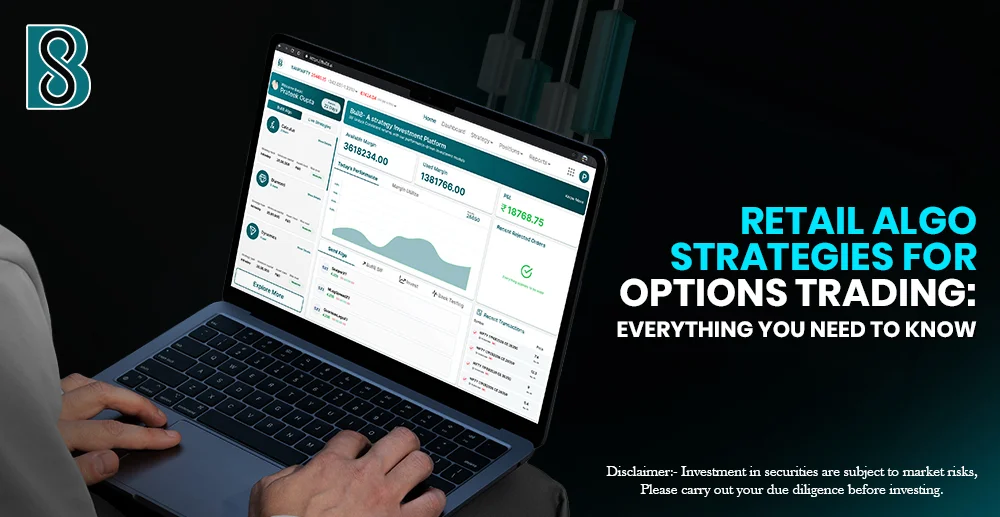
Retail Algo Strategies for Options Trading Everything You Need to Know.jpg

Introduction

Options trading often requires traders to analyse changing premiums, select suitable strikes, monitor volatility, and manage positions within a limited period. When these activities are performed manually, delays, emotions, or execution errors can affect the trading process.

Retail algorithmic trading offers a more systematic approach. It enables traders to define their trading conditions in advance and use software to monitor the market, place orders, and manage exits according to those rules.

However, automation should not be confused with guaranteed success. An algorithm can execute instructions efficiently, but it cannot predict every market movement or eliminate the risks associated with derivatives.

This guide explains how retail algo strategies for options trading work, the types of strategies that may be automated, their potential benefits, major risks and the safeguards traders should consider.

What Are Retail Algo Strategies for Options Trading?

Retail algo strategies for options trading are predefined, rule-based trading systems created for individual traders. These systems use software to perform selected trading activities automatically when specified market conditions are satisfied.

Depending on the platform and strategy, an algorithm may automate:

  • Monitoring the price of an underlying asset
  • Selecting an expiry or strike price
  • Tracking option premiums
  • Generating entry and exit signals
  • Placing single-leg or multi-leg orders
  • Applying a stop-loss or trailing stop-loss
  • Managing open positions
  • Monitoring strategy-level profit and loss
  • Closing positions at a specified time

The trader decides the strategy, capital allocation and risk parameters. The algorithm is responsible for following the configured instructions.

In simple terms, the trader defines what should happen and under which conditions, while the software handles monitoring and execution.

Can Retail Traders Use Algo Strategies for Options Trading?

Yes, retail traders can use algo strategies for options trading if their chosen platform supports options contracts, compatible brokers, relevant order types and suitable risk controls.

Algo trading is no longer limited to large institutions. Retail-orientated platforms now provide predefined strategies, rule-based configuration and automated execution tools that can be used without building an entire system from scratch.

The regulatory framework is also evolving. SEBI issued a circular on the safer participation of retail investors in algorithmic trading in February 2025, followed by implementation-related updates. Traders should therefore confirm the latest requirements, broker processes and platform compliance before activating an algorithm. SEBI’s retail algorithmic trading circular

Access to automation does not remove the trader’s responsibilities. Before deploying a strategy, a trader should understand:

  • How the options strategy is structured
  • Under which conditions it can lose money
  • How much capital and margin it requires
  • How strike and expiry selection affect the position
  • Whether the contracts have sufficient liquidity
  • What happens if one or more orders are not executed
  • How the algorithm behaves during rapid market movements

How Does Algo Options Trading Work?

The exact workflow depends on the software, broker and strategy, but a typical automated options trade follows these steps.

The trader chooses a strategy

The user selects a predefined strategy or creates rules based on price, time, volatility, technical indicators or other supported inputs.

The underlying instrument is selected

The strategy is linked to an eligible index, stock or other supported underlying instrument.

Contract-selection rules are defined

The system may be instructed to select contracts based on:

  • At-the-money, in-the-money or out-of-the-money strikes
  • Fixed premium ranges
  • Specific expiries
  • Strike distance from the spot price
  • Volume or open-interest conditions
  • Option Greeks, where supported

Entry conditions are configured.

The trader defines when the strategy should enter the market. An entry may depend on a particular time, price movement, indicator signal or volatility condition.

Capital and risk limits are set.

Before deployment, the user defines the permitted capital, position size, stop-loss, maximum number of trades and other risk limits.

The algorithm monitors the market.

The system continuously checks live market data to determine whether all configured conditions have been satisfied.

Orders are placed.

When the entry criteria are met, the algorithm sends the required order instructions through the connected broker.

The position is managed.

The system monitors premiums and the combined position. It may modify or exit the trade if a stop-loss, target, trailing stop, time condition or emergency instruction is triggered.

Types of Retail Algo Strategies Used in Options Trading

Options strategies can be grouped according to the market conditions they are designed to address. The following categories are educational examples, not trading recommendations.

Directional Strategies

A directional strategy is based on the expectation that the underlying asset may move upward or downward.

Examples include:

  • Long call
  • Long put
  • Bull call spread
  • Bear put spread
  • Protective put

An algorithm may monitor a breakout, moving average, momentum indicator or another specified signal before entering the position.

Non-Directional Strategies

Non-directional strategies are generally structured around a particular price range, volatility expectation or the passage of time rather than a strong directional view.

Examples include:

  • Short straddle
  • Short strangle
  • Iron condor
  • Iron butterfly

These strategies can carry significant risk, especially during sharp market moves. Selling uncovered options can expose traders to substantial or theoretically unlimited losses in certain positions.

Volatility-Based Strategies

Volatility-based algorithms use volatility-related conditions as part of their entry and exit logic.

They may consider:

  • Implied volatility
  • Historical volatility
  • Changes in option premiums
  • A volatility index
  • Differences between implied and realised volatility

A strategy based on volatility still needs protection against sudden market gaps, volatility expansion and inadequate liquidity.

Time-Based Strategies

Time-based algorithms enter or close positions at predefined times. A trader may instruct the system to avoid the opening minutes, enter after a particular time or square off all positions before the market closes.

These rules are simple to understand, but time alone does not make a strategy effective. Market conditions and risk limits remain important.

Indicator-Based Strategies

These strategies use technical indicators to generate signals. Common inputs can include:

  • Moving averages
  • Relative Strength Index
  • VWAP
  • Price breakouts
  • Momentum indicators
  • Support and resistance levels

The indicator usually tracks the underlying asset, while the algorithm uses a defined rule to select and trade the related options contract.

Single-Leg and Multi-Leg Options Automation

A single-leg strategy contains one options position, such as buying a call or put. It is usually easier to automate because the system needs to manage only one contract and one set of exit conditions.

A multi-leg strategy combines two or more options positions. Examples include spreads, straddles, strangles, iron condors and iron butterflies.

Multi-leg automation can help coordinate the position, but it introduces additional execution challenges.

Legging Risk

Legging risk arises when one order is executed but another is delayed, rejected or filled at an unfavourable price. During the delay, the trader may have an unintended directional or volatility exposure.

A robust platform should have clear rules for:

  • The sequence in which legs are placed
  • Maximum acceptable execution delay
  • Handling rejected or partially filled orders
  • Exiting an unmatched position
  • Monitoring the combined strategy instead of only individual legs

Important Inputs Used by an Options Algorithm

An options algorithm may evaluate several variables simultaneously.

Underlying Price

The price of the index or stock can determine the directional signal and the strike that the system selects.

Option Premium

Premium-based rules may be used to select contracts or trigger entries and exits. Premiums can change quickly because of price, volatility and time decay.

Strike Price and Expiry

Strike and expiry selection significantly influence risk. Near-expiry contracts may react sharply to movements in the underlying and can lose time value rapidly.

Implied Volatility

Implied volatility reflects the market’s expectation of future movement. A rise or fall in implied volatility can affect option premiums even when the underlying price does not move significantly.

Volume, Open Interest and Bid-Ask Spread

These factors can help assess whether a contract has sufficient trading activity. A wide bid-ask spread can increase execution costs and slippage.

Option Greeks

Where supported, an algorithm may consider:

  • Delta: sensitivity to movement in the underlying
  • Gamma: rate of change in delta
  • Theta: effect of time decay
  • Vega: sensitivity to implied volatility
  • Rho: sensitivity to changes in interest rates

Greeks are estimates rather than guarantees. They change as market conditions, time and the underlying price change.

Benefits of Retail Algo Strategies for Options Trading

Faster Rule-Based Execution

An algorithm can act as soon as its predefined conditions are satisfied. This may reduce the delay involved in identifying a signal and manually entering multiple order details.

Greater Consistency

The same entry, exit and position-sizing rules can be applied to every eligible trade. This helps prevent arbitrary changes during market hours.

Reduced Emotional Interference

Fear, greed, hesitation and the urge to recover losses can influence manual decisions. Automation can reduce emotional interference at the execution stage, provided traders do not repeatedly override or alter their systems impulsively.

Continuous Market Monitoring

A system can monitor prices and strategy conditions throughout trading hours without requiring the trader to watch every market movement manually.

Easier Management of Multiple Legs

Automation can help place and monitor the legs of a complex options position. However, the platform must also be able to handle partial fills, rejected orders and unexpected margin changes.

Systematic Risk Controls

Stop-losses, capital limits, time-based exits and maximum-loss rules can be built into the strategy. These controls support discipline, although they cannot guarantee execution at the expected price.

Risks and Limitations of Algo Options Trading

Options and algorithmic trading combine market risk with execution and technology risk. Traders need to understand both.

Time Decay

An options contract loses time value as it approaches expiry, although the rate of decay is not constant. A directional view may be correct, but a purchased option can still lose value if the move is too small or arrives too late.

Changes in Implied Volatility

A fall in implied volatility can reduce a purchased option’s premium. A sharp rise in volatility can significantly affect option-selling strategies.

Slippage

Slippage occurs when an order executes at a price different from the expected price. It can increase during volatile markets, in illiquid contracts or when a strategy sends several orders together.

Market Gaps

A stop-loss does not guarantee execution at the trigger price. If the market gaps, the order may be filled at a substantially different price.

Liquidity Risk

An options contract may show a theoretical value but lack sufficient buyers or sellers near that price. Low liquidity and wide spreads can materially affect actual results.

Technical Failures

Possible problems include:

  • Internet or network disruption
  • Broker-system downtime
  • Stale market data
  • API connectivity errors
  • Delayed order updates
  • Incorrect contract mapping
  • Software or configuration errors

Strategy Risk

Automation makes execution faster, but it also executes weak or incorrect rules consistently. A strategy based on overfitted data, unrealistic assumptions or poorly chosen parameters can produce repeated losses.

Regulatory and Broker-Level Changes

Order rules, margin requirements, position limits, contract availability and retail-algo processes may change. Traders should review current information from SEBI, exchanges and their broker before using a strategy.

The risks are not merely theoretical. SEBI reported that 93% of individual traders in the equity F&O segment incurred losses between FY22 and FY24. This does not mean every trader or strategy will have the same result, but it demonstrates why options automation must be approached with caution. SEBI’s equity F&O study

Risk Controls an Options Algo Should Include

Risk management should be part of the strategy from the beginning, not added after a loss occurs.

Capital Allocation Limit

Only a predefined amount of capital should be available to the strategy. This helps prevent one strategy from using the entire account balance.

Position-Sizing Rules

The position size should be calculated according to the available capital, margin requirement and acceptable risk.

Strategy-Level Stop-Loss

For multi-leg positions, monitoring the combined strategy loss may be more meaningful than observing each leg separately.

Daily Loss Limit

A daily risk limit can stop new trades and close eligible positions once a predetermined threshold is reached.

Maximum Trade Limit

A trade-count restriction can help reduce repeated entries during noisy or unsuitable market conditions.

Trailing Stop-Loss

A trailing stop may adjust as the position moves favourably. It should be configured carefully because excessive sensitivity can result in frequent exits.

Volatility Filter

The algorithm can be instructed to avoid new positions when volatility falls outside a predefined range.

Margin Monitoring

Options margin requirements can change. The system should detect insufficient margin before placing orders and monitor open positions for margin-related risk.

Duplicate-Order Protection

The platform should prevent repeated orders from being sent because of delayed responses or multiple triggers.

Re-Entry Controls

If re-entry is allowed, the number of re-entries and their conditions should be limited. Unlimited re-entry can lead to overtrading.

Go-Flat Functionality

A Go-Flat or emergency square-off feature can help close eligible open positions and stop further strategy execution. It is an important operational safeguard, though actual execution still depends on liquidity and broker or exchange availability.

Backtesting Retail Options Strategies

Backtesting applies a strategy’s rules to historical data to evaluate how the system might have behaved in earlier market conditions.

It can help traders study:

  • Trade frequency
  • Winning and losing periods
  • Drawdowns
  • Average gains and losses
  • Sensitivity to different parameters
  • Performance in trending and range-bound markets
  • The effect of transaction costs

However, options backtesting is particularly challenging. A realistic test should account for historical strike availability, expiry cycles, bid-ask spreads, liquidity, slippage, brokerage and statutory charges.

Backtested performance can be overstated when a model assumes that every trade was filled immediately at the displayed price. Historical results also cannot predict future performance.

Why Paper Testing Matters

After backtesting, a strategy can be observed in a simulated or controlled environment before full deployment.

Paper testing may reveal:

  • Incorrect strike selection
  • Unexpected trade frequency
  • Faulty entry or exit logic
  • Problems with multi-leg sequencing
  • Position-sizing errors
  • Differences between expected and real-time signals

Nevertheless, simulated trading cannot reproduce all live-market conditions. Paper orders do not always experience the same slippage, queue position, partial fills, margin pressure or emotional response as real orders.

A sensible transition may involve backtesting, paper observation and limited-capital deployment, followed by periodic review.

How to Choose Algo Trading Software for Options Trading

Retail traders should evaluate a platform beyond the number of strategies it advertises.

Important considerations include:

  • Support for single-leg and multi-leg options strategies
  • Compatibility with the trader’s broker
  • Transparent strike and expiry-selection rules
  • Real-time order and position monitoring
  • Capital-allocation controls
  • Strategy-level stop-loss
  • Trailing stop-loss support
  • Daily risk limits
  • Volatility filters
  • Go-Flat functionality
  • Backtesting or historical analysis
  • Execution logs and order records
  • Strong security and two-factor authentication
  • Clear pricing
  • Responsive technical support
  • Compliance with applicable regulatory and broker requirements

Traders should also understand whether a strategy is fully automated, semi-automated or signal-based. These models require different levels of monitoring and user intervention.

Are Retail Algo Strategies Suitable for Beginners?

A beginner can use an algo platform, but automation should come after learning the foundations of options.

Before activating a strategy, a user should understand:

  • Calls and puts
  • Strike prices
  • Expiry dates
  • Option premiums
  • Intrinsic and time value
  • Implied volatility
  • Option Greeks
  • Margin requirements
  • Liquidity and slippage
  • Assignment or settlement rules
  • Maximum possible loss

A user-friendly platform can simplify order execution. It cannot replace knowledge of the financial product being traded.

Beginners should avoid selecting a strategy only because its past performance appears attractive. They should first understand why the strategy enters a trade, what market condition it is designed for and how it behaves when that assumption fails.

How Bull8 Supports Systematic Options Trading

Bull8 is a retail-focused algo-trading platform designed to make automated trading more structured and accessible. It enables users to select predefined strategies, allocate capital and apply risk parameters before execution.

Depending on the chosen strategy and supported configuration, Bull8 can help users access features such as:

  • Fully automated strategy execution
  • Predefined trading strategies
  • Capital-allocation controls
  • Stop-loss and trailing stop-loss
  • Volatility-based filters
  • Live P&L monitoring
  • Broker connectivity
  • Go-Flat functionality
  • Web and mobile access
  • Security controls such as two-factor authentication

Bull8’s role is to execute predefined instructions and provide monitoring and risk-control tools. It does not guarantee profits, prevent every loss or remove the need to understand options trading.

Final Thoughts

Retail Algo Strategies for options trading can automate market monitoring, contract selection, order placement, position management and predefined exits. They may help retail traders follow a more disciplined process while reducing delays and emotional interference during execution.

At the same time, options remain complex and high-risk instruments. Time decay, volatility changes, market gaps, slippage, liquidity constraints and technical failures can all affect outcomes. Automating a strategy does not make the underlying strategy safe or profitable.

Retail traders should understand the options structure, test their logic carefully, define strict capital limits and use a platform with strong risk-management controls. In automated options trading, the quality of the rules and safeguards matters just as much as the speed of execution.

FAQs

What are retail algo strategies for options trading?

They are predefined, rule-based systems that help individual traders automate activities such as market monitoring, options selection, order placement and position management.

Can retail traders automate options trading in India?

Yes, subject to the applicable SEBI framework, exchange rules, broker requirements and the features supported by the selected algo-trading platform.

Which options strategies can be automated?

Directional, non-directional, volatility-based, time-based and indicator-based strategies may be automated. Examples include long calls, long puts, spreads, straddles, strangles and iron condors.

Can an algorithm select strike prices automatically?

Some platforms can select strikes according to predefined rules such as ATM position, strike distance, premium range or supported options metrics.

Can multi-leg options strategies be automated?

Yes, but the system needs appropriate controls for order sequencing, partial fills, rejected orders, margin availability and legging risk.

Does algo trading remove emotions completely?

It can reduce emotional interference during execution, but users can still make emotional decisions while choosing strategies, changing parameters or overriding the system.

Is backtesting enough before live trading?

No. Backtesting is useful, but it may not fully represent live slippage, liquidity, transaction costs, partial fills and technical conditions.

What is the biggest risk in automated options trading?

There is no single risk. Market movements, volatility, time decay, insufficient liquidity, incorrect strategy rules and technical failures can all result in losses.

Is options algo trading suitable for beginners?

Beginners may use an algo platform only after learning how options, margins, volatility, expiry and risk management work. Ease of execution does not reduce product complexity.

Does an options trading algorithm guarantee profits?

No. Algorithms execute predefined rules. They cannot guarantee profits or prevent losses.

Best Retail Algo Strategies for Nifty and Bank Nifty Traders.jpg

Best Retail Algo Strategies for Nifty and Bank Nifty Traders

Best Retail Algo Strategies for Nifty and Bank Nifty Traders.jpg

Introduction: Why Nifty & Bank Nifty Traders Are Moving to Algo Trading

The Indian stock market has witnessed a remarkable transformation over the last few years. What was once dominated by institutional players and professional traders is now increasingly being driven by retail participation. Along with this growth, algorithmic trading has emerged as one of the most significant trends shaping the future of trading in India.

In 2026, retail traders are no longer satisfied with traditional manual trading methods. They seek speed, discipline, consistency, and data-driven decision-making. This shift has led to a surge in demand for Retail Algo Strategies for Nifty and Retail Algo Strategies for Bank Nifty, allowing individual traders to access sophisticated trading systems that were once available only to hedge funds and large institutions.

Among all market instruments, Nifty and Bank Nifty continue to be the preferred choice for active traders. These indices offer excellent liquidity, tight bid-ask spreads, high trading volumes, and multiple opportunities throughout the trading session. Whether markets are trending, range-bound, or volatile, Nifty and Bank Nifty provide ideal conditions for systematic trading strategies.

However, manual trading comes with several challenges. Traders often struggle with emotional decision-making, delayed execution, inconsistent discipline, and poor risk management. Fear and greed frequently influence trading decisions, causing traders to deviate from their plans and make costly mistakes.

This is where algorithmic trading creates a significant advantage. Automated systems execute predefined trading rules without emotions, hesitation, or human error. They monitor markets continuously, react instantly to changing conditions, and follow risk management protocols consistently.

Bull8 has been designed specifically to bridge this gap for retail traders. As an advanced retail algo trading platform, Bull8 provides institutional-grade automated strategies that help traders participate in Nifty, Bank Nifty, and Sensex markets with greater confidence, discipline, and efficiency.

By combining automation, research-driven models, and advanced risk management, Bull8 enables retail traders to access some of the top algo trading strategies in India while maintaining complete control of their trading accounts.

What Makes a Successful Nifty & Bank Nifty Algo Strategy?

Many traders assume that profitable algorithmic trading simply means automating buy and sell signals. In reality, successful algorithmic trading involves much more than identifying market entries. A robust trading strategy requires a complete framework that combines opportunity identification, risk management, capital allocation, and execution efficiency.

Key Elements of Profitable Algo Strategies

Defined Entry and Exit Rules

Every successful strategy starts with clearly defined conditions for entering and exiting trades. These rules eliminate guesswork and ensure consistency across different market environments. The strategy reacts to market data rather than trader emotions.

Risk Management Systems

Risk management is often more important than signal generation. A strategy may generate winning trades, but without proper risk controls, a few losses can erase months of gains. Professional-grade strategies incorporate multiple layers of protection.

Position Sizing

Institutional traders understand that position sizing determines long-term survival. Effective algorithms calculate appropriate exposure levels rather than allocating excessive capital to a single opportunity.

Hedging Mechanisms

Modern option-based strategies use hedging techniques to reduce directional risk. Hedged positions can help control losses during unexpected market movements while maintaining the potential for consistent income generation.

Intraday Risk Controls

Intraday risk management systems continuously monitor exposure, volatility, and unrealised losses. If predefined risk thresholds are reached, positions can be adjusted or closed automatically.

Real-Time Execution

Markets move rapidly. Delayed execution can significantly impact performance. Algorithmic systems monitor opportunities continuously and execute orders instantly when conditions are met.

Why Retail Traders Need Institutional-Level Systems

Large institutions invest heavily in technology because speed and consistency matter. Retail traders face the same market conditions and therefore benefit from similar capabilities.

Institutional-level systems provide:

Faster execution

Consistent strategy implementation

Reduced emotional interference

Improved risk control

Better capital efficiency

Continuous market monitoring

For traders searching for retail algo strategies for Nifty or retail algo strategies for Bank Nifty, access to institutional-style infrastructure can significantly improve execution quality and overall trading discipline.

Bull8 combines these institutional capabilities into an easy-to-use platform that enables retail traders to deploy some of the top algo trading strategies in India without requiring programming skills or complex technical expertise.

Common Trading Challenges Faced by Retail Traders

Most retail traders enter the market with the goal of generating consistent returns. However, many struggle not because of a lack of market knowledge but because of psychological and execution-related challenges.

Fear and Greed

Fear and greed remain the two most powerful emotions in trading. Traders often exit profitable trades too early due to fear while holding losing positions too long in hopes of recovery.

Late Entries

Many traders wait for confirmation after a move has already occurred. By the time they enter, much of the opportunity has disappeared.

Overtrading

The desire to recover losses or increase profits frequently leads traders to take unnecessary trades. Excessive trading often results in higher transaction costs and poor decision-making.

Missing Opportunities

Markets can create opportunities within seconds. Retail traders who are busy with work or other commitments may miss high-probability setups entirely.

Poor Risk Management

Many traders focus heavily on profits while neglecting downside protection. Lack of stop-loss discipline can quickly damage trading capital.

Manual Execution Delays

Even when traders identify opportunities correctly, delays in order placement can impact performance. In fast-moving markets like Nifty and Bank Nifty, execution speed matters significantly.

How Bull8 Solves These Challenges

Bull8 addresses these issues through automation and disciplined execution:

Removes emotional decision-making

Executes predefined trading plans automatically

Monitors markets continuously

Applies risk management consistently

Eliminates execution delays

Prevents impulsive trading behaviour.

By leveraging automated systems, traders can focus on long-term strategy performance rather than reacting emotionally to short-term market fluctuations.

Bull8: Your Intelligent Trading Companion

Bull8 is designed to simplify algorithmic trading for retail participants while providing access to institutional-grade trading technology. The platform combines advanced research, automation, and execution infrastructure into a user-friendly ecosystem.

Expert-Backed System

Bull8 strategies are developed by experienced quantitative professionals who leverage data-driven research and systematic trading methodologies.

Research-Driven Models

Every strategy undergoes rigorous analysis and refinement before deployment.

Institutional-Grade Logic

The same principles used by professional trading desks inspire the design of Bull8’s strategy framework.

Effortless Automation

One of the biggest barriers to algorithmic trading has traditionally been coding and infrastructure requirements. Bull8 eliminates these complexities.

No programming required

Plug-and-play deployment

Automated trade execution

Easy strategy activation

Direct Broker Integration

Bull8 executes trades directly through the trader’s own broking account.

Benefits include:

Complete transparency

Full account ownership

Enhanced security

No third-party fund transfers

Multi-Asset & Broker-Neutral Platform

Bull8 supports multiple brokers and asset classes, allowing traders flexibility and scalability.

Mobile & Web Access

Users can monitor and manage strategies through both mobile and web interfaces.

Real-Time Portfolio Monitoring

The platform provides:

Live position updates

Performance tracking

Risk monitoring

Strategy analytics

Portfolio visibility

This combination of automation, transparency, and institutional-grade infrastructure makes Bull8 one of the most advanced solutions for traders seeking retail algo strategies for Nifty, retail algo strategies for Bank Nifty, and other top algo trading strategies in India.

Calculus (NSE) – Smart Nifty Premium Collection Strategy

Among the most popular retail algo strategies for Nifty, Calculus has been designed for traders who prioritise consistency, disciplined risk management, and systematic premium income generation. The strategy focuses on capturing opportunities within Nifty Options while maintaining a strong emphasis on capital protection.

Strategy Objective

The primary goal of calculus is to generate steady risk-adjusted returns through intelligent premium collection. Rather than relying solely on directional market predictions, the strategy uses a combination of market analysis, option pricing dynamics, and risk controls to identify favourable opportunities throughout the trading session.

How Calculus Works

Captures Option Theta Decay

Time decay, also known as theta decay, is one of the most predictable characteristics of options. As option contracts approach expiry, their time value gradually declines. Calculus is designed to systematically benefit from this phenomenon through carefully structured option positions.

Uses Directional and Neutral Setups

Markets do not always trend in one direction. Sometimes they remain range-bound, while at other times they move strongly upward or downward. Calculus dynamically deploys directional and non-directional setups based on prevailing market conditions.

Intraday Execution

All positions are managed within the trading day. This helps reduce overnight gap risk and keeps exposure aligned with intraday market behaviour.

Multi-Layered Hedging

Risk control remains a critical component of the strategy. Multiple hedging layers help manage adverse market movements and protect capital during periods of heightened volatility.

Ideal For

Calculus is particularly suitable for:

Conservative traders

Premium income seekers

Working professionals

Risk-conscious investors

Traders seeking systematic execution

Key Benefits

Controlled risk exposure

Fully automated execution

No emotional decision-making

Intraday position management

Reduced overnight risk

Institutional-grade logic

For traders searching for dependable retail algo strategies for Nifty, Calculus offers a disciplined approach focused on consistency rather than speculation.

Matrix (NSE) – Diversified Premium Harvesting Strategy

Matrix is one of Bull8’s most versatile strategies and is designed to generate income across a wide variety of market environments. Unlike strategies that perform well only during specific market phases, Matrix is engineered to adapt to changing conditions.

Strategy Objective

The primary objective of Matrix is to harvest option premiums systematically while maintaining balanced risk exposure. By combining multiple methodologies, the strategy seeks to create a diversified approach to Nifty options trading.

Core Methodology

Momentum Trading

When strong trends emerge, Matrix can identify and participate in directional opportunities using predefined quantitative models.

Range-Bound Trading

Not all market sessions trend aggressively. During sideways conditions, Matrix utilises structures that can potentially benefit from stable price movement.

Multi-Leg Option Structures

The strategy incorporates sophisticated option combinations designed to balance opportunity and risk. These structures allow exposure to multiple market scenarios while maintaining disciplined controls.

Dynamic Hedging

Market conditions evolve rapidly. Matrix continuously monitors volatility and price action to adjust risk exposure whenever necessary.

Why Traders Like Matrix

Works in Multiple Market Environments

One of Matrix’s biggest advantages is its adaptability. Whether markets are trending, consolidating, or experiencing moderate volatility, the strategy is designed to remain relevant.

Strong Volatility Protection

Volatility can create opportunities but also increase risk. Matrix incorporates protective mechanisms to manage sudden market fluctuations.

Automated Decision Making

The strategy removes emotional bias and executes based entirely on predefined rules.

Key Benefits

Diversified trading logic

Reduced emotional trading

Automated execution

Dynamic market adaptation

Professional risk controls

Intraday management

As one of the top algo trading strategies in India, Matrix offers traders a balanced framework for consistent market participation.

Quantum (NSE) – Fast Theta Decay Capture Strategy

Quantum has been developed for traders seeking systematic premium harvesting through efficient intraday execution. The strategy focuses on capturing opportunities created by rapid option time decay while maintaining disciplined risk management.

Strategy Focus

Quantum is specifically designed to capitalise on theta decay opportunities within Nifty options. Since time decay accelerates as expiry approaches, the strategy aims to identify favourable conditions for premium collection.

Key Features

Intraday Premium Harvesting

The strategy seeks opportunities throughout the trading session and manages positions actively to optimise risk-adjusted performance.

Adapts to Trending Markets

When directional momentum emerges, Quantum adjusts its approach to align with prevailing market behaviour.

Adapts to Sideways Markets

Range-bound markets often create favourable conditions for option premium decay. Quantum can leverage such environments systematically.

Diversified Hedges

Protective hedges are incorporated to reduce exposure during unexpected market movements.

Suitable For

Quantum is ideal for:

Premium income traders

Systematic investors

Traders seeking disciplined execution

Individuals looking for automation

Market participants focused on consistency

Benefits

Automated trade management

Institutional-grade risk controls

Intraday exposure management

No emotional interference

Continuous market monitoring

Quantum represents a practical choice for traders looking for modern retail algo strategies for Nifty focused on premium decay opportunities.

Theorem (NSE) – Balanced Nifty Income Strategy

Theorem has been designed for traders who value stability and disciplined income generation. Instead of pursuing aggressive returns, the strategy focuses on maintaining consistency across varying market conditions.

Strategy Objective

The strategy seeks to generate steady returns by utilising proven market patterns combined with robust risk management frameworks.

Highlights

Theta Decay Capture

The theorem systematically identifies opportunities to benefit from the natural decline in option time value.

Directional Equilibrium

Rather than depending entirely on bullish or bearish views, the strategy balances directional exposure to adapt to different market conditions.

Volatility Management

Volatility is continuously monitored to maintain favourable risk-reward characteristics.

Intraday Exits

Positions are managed within the trading session to reduce overnight uncertainty.

Best For

The theorem is suitable for:

Conservative traders

Long-term systematic participants

Traders prioritizing stability

Risk-aware investors

Advantages

Balanced risk-reward profile

Consistent execution

Automated monitoring

Reduced emotional trading

Professional-grade controls

For traders exploring retail algo strategies for Nifty, Theorem provides a disciplined and stability-focused alternative.

Dynamics (NSE) – Adaptive Market Response Strategy

Markets constantly evolve. Dynamics has been developed to adapt alongside them, making it one of Bull8’s most flexible algorithmic strategies.

Unique Advantage

The core strength of Dynamics lies in its ability to respond intelligently to changing market environments rather than relying on a single trading style.

Key Features

Trend-Following Models

When markets demonstrate clear directional strength, Dynamics can align itself with prevailing trends.

Sideways Market Models

The strategy also incorporates mechanisms designed for range-bound environments.

Dynamic Hedging

Risk controls adjust automatically as volatility and market conditions change.

Automated Execution

Every trade is executed according to predefined rules without emotional interference.

Ideal Traders

Dynamics is ideal for:

Active traders

Adaptive investors

Professionals seeking automation

Traders operating across different market cycles

Benefits

Flexible market participation

Real-time adaptation

Automated risk controls

Continuous monitoring

Consistent execution

Dynamics stands among the top algo trading strategies in India for traders seeking versatility across multiple market regimes.

Equation (NSE) – Balanced Risk-Reward Nifty Strategy

An equation has been developed to provide a balanced approach between opportunity generation and capital protection.

Strategy Goal

The primary objective is to generate stable premium income while maintaining controlled risk exposure through disciplined execution.

Features

Directional Setups

The strategy identifies favourable directional opportunities when market trends are clearly established.

Neutral Setups

During consolidation phases, the equation can utilise neutral structures to participate in premium collection.

Smart Exposure Management

Position sizing and exposure controls are integrated into the strategy framework.

Intraday Risk Controls

Continuous monitoring helps ensure risks remain within predefined parameters.

Benefits

Consistency-focused design

Controlled drawdowns

Automated execution

Intraday exits

Capital preservation focus

For traders seeking dependable retail algo strategies for Nifty, Equation offers an attractive balance between opportunity and risk.

Diamond (BSE) – Institutional-Grade Sensex Options Strategy

Diamond is Bull8’s flagship strategy for Sensex options traders, offering institutional-grade execution with sophisticated risk controls.

Strategy Objective

The objective is to generate steady intraday premium income while maintaining disciplined risk management and capital protection.

Methodology

Volatility Compression Trades

The strategy identifies periods where volatility conditions create favourable opportunities.

Option Theta Decay

Diamond systematically leverages time decay dynamics within option pricing.

Mean Reversion Models

Statistical market behaviour is used to identify potential opportunities when prices deviate from expected ranges.

Layered Hedging

Multiple protection mechanisms help manage downside risk effectively.

Advantages

Strong Downside Protection

Risk management remains a central component of the strategy.

Fully Automated

All execution decisions follow predefined quantitative rules.

Intraday Exits

Positions are generally managed within the trading day to reduce overnight exposure.

Ideal For

Index options traders

Systematic investors

Premium collection traders

Risk-conscious market participants

Diamond demonstrates how retail traders can access sophisticated execution previously available only to institutions.

Why Bull8 Strategies Are Different from Typical Algo Trading Software

Many algorithmic platforms simply automate order placement. Bull8 goes significantly further by providing a complete institutional-grade trading ecosystem.

Institutional Research

Every strategy is developed using extensive quantitative research and systematic testing.

Layered Hedging

Bull8 incorporates multiple protection mechanisms rather than relying on simple stop-loss models.

Real-Time Risk Monitoring

Continuous monitoring helps identify changing market conditions and manage risk proactively.

Exchange-Compliant Execution

Strategies are designed within current exchange and regulatory frameworks.

Broker-Neutral Architecture

Traders maintain flexibility and control through direct broker connectivity.

OMS & EOMS Infrastructure

Bull8 utilises advanced Order Management System (OMS) and Execution Order Management System (EOMS) technology.

Advanced Server-Based Execution

Server-side execution ensures strategies continue functioning efficiently without requiring constant user intervention.

These capabilities position Bull8 among the providers of the most advanced top algo trading strategies in India.

Advanced Risk Management: The Core of Every Bull8 Strategy

Successful trading begins with protecting capital. Every Bull8 strategy incorporates robust risk management systems designed to support long-term sustainability.

Key components include the following:

Downside protection mechanisms

Volatility controls

Margin optimization

Automated stop-loss frameworks

Exposure management

Real-time portfolio monitoring

Rather than focusing solely on profits, Bull8 prioritises risk-adjusted performance and capital preservation.

How Bull8 Helps Retail Traders Trade Like Institutions

Institutional traders rely on technology, research, and disciplined execution. Bull8 brings these advantages to retail traders through the following:

Quant-driven models

Automated trade execution

Real-time analytics

Continuous strategy monitoring

Capital allocation controls

Transparent performance tracking

This enables retail participants to access professional-grade trading infrastructure without needing programming expertise or large institutional budgets.

Conclusion: Trade with Intelligence. Execute with Confidence.

The future of trading belongs to systematic execution, disciplined risk management, and technology-driven decision-making. As markets become increasingly competitive, manual trading limitations become more apparent. Retail traders require tools that can help them execute efficiently, manage risk effectively, and remain consistent regardless of market conditions.

Bull8 offers a comprehensive suite of strategies, including Calculus, Matrix, Quantum, Theorem, Dynamics, Equation, and Diamond, each designed to address different market opportunities while maintaining strong risk controls.

Whether you are searching for retail algo strategies for Nifty, retail algo strategies for Bank Nifty, or the top algo trading strategies in India, Bull8 provides institutional-grade capabilities within a user-friendly retail platform.

FAQs

What are retail algo strategies for Nifty?

Retail Algo Strategies for Nifty are automated trading systems that execute trades in Nifty index derivatives based on predefined rules. These strategies remove emotional decision-making and help traders execute trades with discipline, speed, and consistency.

Why is Nifty popular for algorithmic trading?

Nifty is one of the most liquid indices in India, offering high trading volumes, tight spreads, and multiple trading opportunities throughout the day. Its liquidity and efficiency make it ideal for algorithmic trading strategies.

What are retail algo strategies for Bank Nifty?

Retail Algo Strategies for Bank Nifty are automated trading models specifically designed to trade Bank Nifty options and futures. These strategies use quantitative rules, risk management systems, and automated execution to capture market opportunities.

Is algo trading legal for retail traders in India?

Yes. Algo trading is legal for retail traders in India when conducted through compliant platforms and brokers that follow SEBI and exchange regulations. Traders should always use authorised and regulated platforms.

How does Bull8 help retail traders?

Bull8 provides institutional-grade algorithmic trading strategies, automated execution, real-time portfolio monitoring, advanced risk management, and direct broker integration, allowing retail traders to trade systematically without coding.

Do I need coding knowledge to use Bull8 strategies?

No. Bull8 is designed as a plug-and-play retail algo trading platform. Traders can activate and monitor strategies without any programming or technical development skills.

What is the calculus strategy in Bull8?

Calculus is a Nifty options premium collection strategy that aims to generate risk-adjusted income through theta decay capture, directional and neutral setups, intraday execution, and multi-layered hedging mechanisms.

What makes Matrix different from other strategies?

Matrix combines momentum trading, range-bound trading, dynamic hedging, and multi-leg option structures. It is designed to perform across different market environments, making it one of the most versatile strategies on Bull8.

What is theta decay in options trading?

Theta decay refers to the reduction in an option’s time value as it approaches expiry. Many premium collection strategies, including several Bull8 strategies, aim to systematically benefit from this natural decay process.

Are Bull8 strategies fully automated?

Yes. Bull8 strategies are designed for automated execution. Once activated, trades are executed according to predefined rules and risk management parameters without requiring manual intervention.

Can I trade in my own broking account with Bull8?

Yes. Bull8 integrates directly with supported brokers, allowing traders to execute strategies in their own trading accounts. This ensures transparency and full control over funds and positions.

Does Bull8 hold client funds?

No. Bull8 does not take custody of client funds. Trades are executed directly through the trader’s linked broking account, ensuring security and transparency.

What risk management features are available in Bull8?

Bull8 strategies include the following:

Automated stop-loss systems

Dynamic hedging

Exposure management

Intraday risk controls

Volatility monitoring

Real-time portfolio supervision

Which Bull8 strategy is suitable for conservative traders?

Calculus and Theorem are often preferred by traders seeking relatively conservative and stability-focused approaches due to their emphasis on risk management and controlled premium collection.

Can Bull8 strategies adapt to changing market conditions?

Yes. Strategies such as Matrix and Dynamics are specifically designed to adapt to trending, range-bound, and changing volatility environments through dynamic trading models and risk controls.

What is the advantage of automated execution over manual trading?

Automated execution offers:

Faster order placement

No emotional interference

Consistent strategy implementation

Reduced execution delays

Better risk discipline

Continuous market monitoring

Is Bull8 suitable for beginners?

Yes. Bull8 simplifies algorithmic trading through a user-friendly interface and pre-built strategies, making it suitable for both beginners and experienced traders.

How does Bull8 differ from traditional algo trading software?

Bull8 combines institutional research, layered hedging, advanced OMS/EOMS infrastructure, broker-neutral architecture, server-based execution, and real-time risk monitoring, providing a complete trading ecosystem rather than just order automation.

Can I monitor my portfolio in real time on Bull8?

Yes. Bull8 offers real-time portfolio monitoring through both web and mobile platforms, allowing traders to track positions, performance, and risk exposure at any time.

Why are Bull8 strategies considered among the top algo trading strategies in India?

Bull8 strategies are built using quantitative research, institutional-grade execution logic, dynamic hedging frameworks, advanced risk controls, and automated trade management. These features make them among the most advanced top algo trading strategies in India for retail traders.

Which is the best retail algo strategy for Nifty traders?

The best strategy depends on a trader’s risk appetite and objectives. ‘Calculus’, ‘Matrix’, ‘Quantum’, ‘Theorem’, ‘Dynamics’, and ‘Equation’ are among Bull8’s leading retail algo strategies for Nifty, each designed for different market conditions and trading styles.

What is the future of retail algo trading in India?

Retail algo trading Software is expected to grow rapidly as more traders adopt automation, systematic execution, and technology-driven strategies. Platforms like Bull8 are making institutional-grade trading accessible to retail participants across India.

Contact Us
close slider