
How Do Stop-Loss and Trailing Stop-Loss Work in Algo Trading?
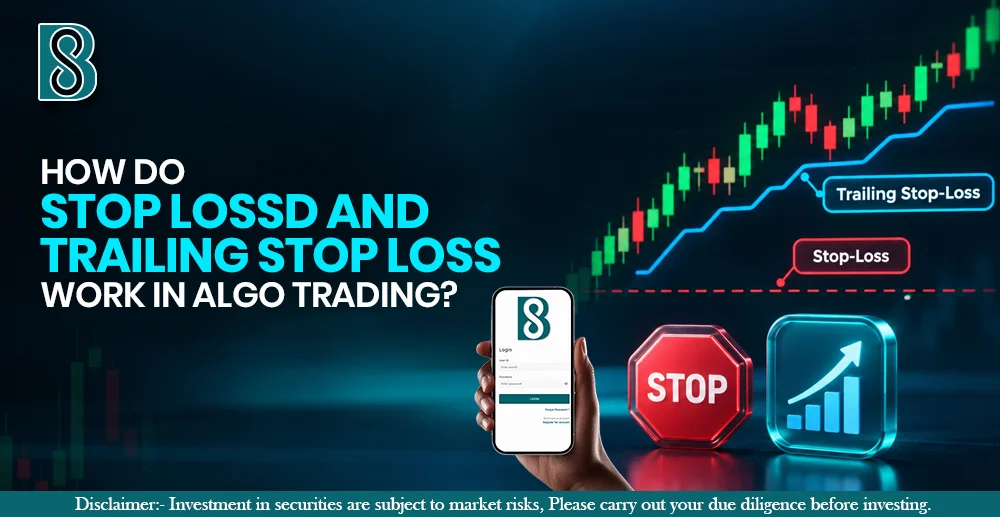
Introduction
A trading strategy needs more than an entry signal. It also needs a clear answer to two questions: when should a losing trade be closed, and how should an exit change when the market moves favourably?
Stop-loss and trailing stop-loss rules help answer these questions. In algo trading, software can monitor defined conditions and initiate an exit without requiring the trader to make a fresh decision each time.
However, automation does not remove market risk. A stop can trigger without filling immediately, and the execution price can differ from the intended level.
For retail traders exploring Bull8, understanding these distinctions is an essential part of evaluating a strategy and its risk controls.
What Is a Stop-Loss in Algo Trading?
A stop-loss is a predefined exit condition intended to manage an adverse price movement. For a long position, the stop usually sits below the entry price. For a short position, it usually sits above it.
NSE explains that an exchange stop-loss order activates when the relevant market price reaches or crosses its trigger. A sell stop triggers when the last traded price reaches or falls below the trigger; a buy stop triggers when it reaches or rises above it.
In algo trading, an exit condition may also be monitored by the trading platform rather than held as an exchange stop order. Knowing where the condition is maintained matters when assessing connectivity and execution risks.
A Simple Stop-Loss Example
Suppose a hypothetical strategy buys a stock at ₹500 and sets a stop at ₹490.
The planned price risk is:
₹500 − ₹490 = ₹10 per share
For 100 shares, the planned exposure between entry and stop is ₹1,000, before charges and any execution difference.
If the trigger condition is met, the strategy initiates its exit process. This does not mean the final loss must equal ₹1,000. A lower selling price or additional costs can increase it.
These figures illustrate the mechanism, not a recommended stop distance.
Trigger Price and Execution Price Are Different
The trigger price activates the order or exit instruction. The execution price is the price at which the trade actually happens.
The distinction becomes especially important during rapid market movements.
Stop-Market Orders
Where supported, a stop-market order becomes a market order after activation. It seeks execution at available market prices, so the trigger does not guarantee the fill price.
Stop-Limit Orders
A stop-limit order becomes a limit order after activation. It can execute only at its limit price or better, but it may remain unfilled if available prices do not satisfy that condition.
For example, consider a hypothetical sell stop-limit with a ₹490 trigger and ₹489 limit. Once activated, it permits a sale at ₹489 or higher. If available bids drop to ₹486, it may remain pending.
Order availability and validation requirements depend on the instrument, exchange and broker. Traders should verify the supported order type before deploying a strategy.
What Is a Trailing Stop-Loss?
A trailing stop-loss adjusts its exit threshold when the trade moves favourably. In a conventional trailing rule, it does not move backwards when the market reverses.
For a long position, the stop follows rising prices. For a short position, it follows falling prices. The distance may be expressed as an amount or percentage, depending on the implementation.
A fixed stop answers, “Where should the initial exit be?”
A trailing stop adds, “How should that exit change as the trade progresses?”
Trailing can move an exit threshold beyond the entry price, but it cannot guarantee a profitable exit.
How a Trailing Stop Works: A Practical Example
Assume a hypothetical long strategy enters at ₹200, activates trailing immediately and uses a ₹10 distance from the highest observed price since activation.
| Price movement | Highest observed price | Trailing stop |
| Entry at ₹200 | ₹200 | ₹190 |
| Price rises to ₹210 | ₹210 | ₹200 |
| Price rises to ₹225 | ₹225 | ₹215 |
| Price falls to ₹220 | ₹225 | ₹215 |
| Price reaches ₹215 | ₹225 | Exit condition is met |
When the price retreats to ₹220, the stop remains at ₹215. Moving it down to ₹210 would widen the risk after the favourable movement.
The simplified calculation is:
Trailing stop = Highest observed price since activation − Trailing distance
If the exit fills at ₹215, the gross gain would be ₹15 per unit. Actual results depend on the fill, position size and charges.
This example assumes continuous trailing. A strategy that updates only at specified intervals or price steps can behave differently.
How Does Trailing Work for a Short Position?
For a short position, falling prices are favourable, so the trailing threshold moves down.
Imagine a hypothetical instrument sold at ₹300 with an immediately active ₹12 trailing distance. Its initial threshold is ₹312.
If the price falls to ₹280, the threshold becomes ₹292. If it then rises to ₹286, the threshold stays at ₹292. A rise to that level meets the exit condition.
The corresponding simplified calculation is:
Trailing stop = Lowest observed price since activation + Trailing distance
The strategy must still specify the order used to close the position and what happens if it does not fill.
Fixed Stop-Loss vs Trailing Stop-Loss
| Feature | Fixed stop-loss | Trailing stop-loss |
| Exit threshold | Remains at its defined level | Adjusts after favourable movement |
| Reference | A predetermined price or condition | A moving reference defined by the strategy |
| Typical purpose | Define the initial adverse exit | Adapt the exit as the trade progresses |
| Main tradeoff | Does not automatically follow gains | Can trigger during temporary reversals |
| Execution certainty | No guaranteed fill at the trigger | No guaranteed fill at the trigger |
A strategy can combine both: an initial stop may operate first, with trailing activated only after a specified favourable movement.
That activation condition must be explicit. “Trailing enabled” alone does not explain the complete rule.
Which Trailing Parameters Should Traders Understand?
Before activating an algo, review the meaning and units of each setting.
Initial stop: What exit condition applies immediately after entry?
Activation threshold: Does trailing begin immediately, or only after a favourable move?
Trailing distance: Is the gap measured in rupees, price points, percentage or strategy profit and loss?
Update step: Does the threshold change continuously or only after a specified price movement?
Price reference: Is the rule monitoring the traded instrument, an underlying index or combined strategy value?
Exit scope: Does the trigger close one position, selected legs or the entire strategy?
For example, a ₹5 option-premium movement and a five-point index movement are different inputs. Confusing them can produce an exit very different from the one intended.
For multi-leg strategies, exiting one leg also changes the remaining exposure. The exit rule needs to account for the strategy as a whole.
How Can Traders Evaluate Stop Settings?
There is no universally suitable stop distance. An exit rule needs to be assessed alongside the entry logic, holding period and instrument.
A very tight stop may respond to ordinary price fluctuations. A wider stop allows more movement but increases planned risk for the same position size.
Position sizing connects these choices. In a simplified stock example, a ₹2,000 planned risk budget and ₹10 entry-to-stop distance imply 200 shares before costs and execution adjustments. Increasing that distance to ₹20 halves the corresponding quantity to 100 shares.
Derivatives require additional attention to contract quantities, leverage and changing exposure. This arithmetic does not establish a guaranteed maximum loss.
When testing settings, compare drawdowns, repeated stop-outs, trading costs and results across different market conditions. Avoid selecting a distance solely because it produces the strongest historical result.
Why Can an Automated Stop Fail to Deliver the Expected Exit?
Several factors can affect the outcome:
Slippage and sudden movement: A market exit can fill beyond the trigger. FINRA highlights that fast-moving markets can create substantial differences between stop and execution prices.
Insufficient liquidity: The available quantity may be inadequate, resulting in multiple fills or an incomplete exit.
Unfilled limit orders: A triggered stop-limit can remain pending when its limit condition cannot be met.
Connectivity problems: Platform-monitored conditions rely on the systems and connections involved in detecting and sending the exit.
Rejected instructions: An order or modification may be rejected, requiring the strategy to detect the failure and respond.
Temporary reversals: A brief move can activate a stop before the market resumes its previous direction.
Monitoring should therefore cover actual order status and remaining positions, not just whether the strategy generated an exit signal.
What Should Bull8 Users Check Before Going Live?
Bull8 presents its retail algo offering around strategy automation, execution and risk management. bull8.ai For a specific strategy, users should confirm the precise stop behaviour rather than assume every strategy has identical controls.
Ask whether the stop is maintained at the exchange or monitored by the platform. Check when trailing activates, how modifications are confirmed and what happens after a rejection or disconnection.
Also confirm whether stopping the algo closes existing positions or merely prevents new entries. Establish how to verify any remaining exposure through the broker account.
A demonstration or controlled test should make these behaviours understandable before live deployment.
Making Exit Rules Part of a Defined Trading Process
Stop-loss and trailing stop-loss rules support a structured exit process, but their effectiveness depends on clear parameters, suitable position sizing and reliable handling of execution events.
For traders exploring Bull8, the practical next step is to review the selected strategy’s documented exit logic and understand its limitations. Knowing how a stop triggers, adjusts and completes an exit helps traders assess automation with greater clarity.
This article is educational. Examples are hypothetical and exclude charges unless stated. Trading involves risk, and automated exits do not guarantee a maximum loss or profit.
