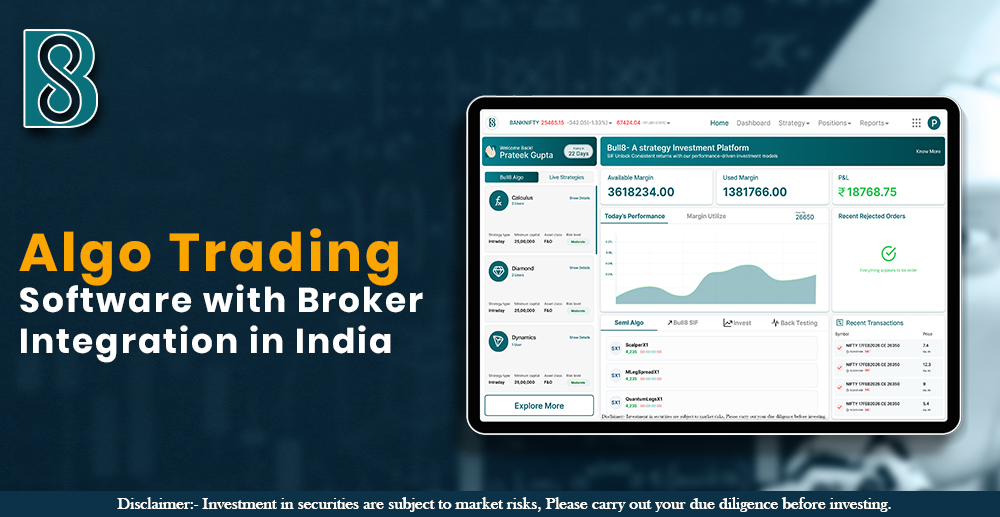
Algo Trading Software with Broker Integration in India
Complete 2026 Guide for Retail Traders
Introduction: Why Retail Trading Needs a Structural Shift
The Indian stock market has seen explosive growth in retail participation over the last few years. Millions of traders now actively participate in equities, derivatives, and commodities through mobile apps and online platforms. However, despite better access to tools and data, most retail traders continue to struggle with one major issue—inconsistent decision-making driven by emotions.
Manual trading often leads to:
- Overtrading due to excitement or panic
- Delayed entries and exits
- Lack of discipline in following stop losses
- Frequent strategy changes without validation
This is where Retail algo trading software in India with broker integration in India becomes a revolutionary shift. Instead of relying on human judgment, traders can now use structured, rule-based systems that execute trades automatically.
Why This Shift is Important
- Markets move in milliseconds—humans cannot react that fast
- Emotions distort logic, especially during volatility
- Consistency is impossible without predefined rules
Algo trading solves these problems by:
- Removing emotional decision-making
- Executing trades instantly through broker APIs
- Following a fixed strategy every time
What This Blog Covers
In this complete 2026 guide, you will learn:
- What algo trading software is and how it works
- How broker integration enables automation
- The role of APIs in execution
- Step-by-step setup for beginners
- Risks, compliance, and future trends
- How Bull8 simplifies algo trading for retail traders
The goal is simple: Help you move from random trading to structured execution.
What is Algo Trading Software?
Algo trading software is a technology-driven system that executes trades automatically based on predefined rules and strategies. Instead of manually analyzing charts and placing orders, the system performs these actions on your behalf using logic and data.
At its core, algo trading follows the principle:
If condition X happens, execute action Y.
Key Components of Algo Trading Software
Strategy Engine
Defines trading rules
Example: Buy when price crosses resistance
Works on indicators like RSI, Moving Averages
Market Data Processing
Tracks real-time price movements
Analyzes trends, volatility, and volume
Execution System
Places trades automatically
Eliminates delay in order placement
Risk Management Module
Controls capital exposure
Includes stop loss and position sizing
Types of Algo Strategies
- Intraday strategies
- Options trading strategies
- Trend-following systems
- Arbitrage strategies
Why Algo Trading is Growing in India
The adoption of retail algo trading software in India is increasing due to:
- Easy access to broker APIs
- Rise of mobile trading apps
- Demand for automation among retail traders
- Increasing awareness of disciplined trading
Key Benefits
- Eliminates emotional trading
- Ensures faster execution
- Enables consistent strategy implementation
- Allows multi-strategy trading
However, algo trading becomes truly powerful only when connected directly to your broker through integration.
What is Broker Integration in Trading? (Detailed Explanation
Broker integration is one of the most important pillars of modern algo trading. It refers to the process of directly connecting your trading software with your broker account using APIs (Application Programming Interfaces). This connection allows your trading system to automatically place, modify, and manage trades without requiring any manual action from you.
In simple terms, broker integration acts like a direct communication channel between your strategy and the market. Instead of you manually logging in and executing trades, the software does everything in real time based on predefined rules.
Traditional vs Integrated Trading
To understand its importance, let’s compare both approaches:
Manual Trading Process:
- You analyze charts and indicators
- You decide when to enter or exit
- You log into your broker platform
- You place the order manually
This process may seem simple, but it introduces delays and emotional bias. Even a few seconds of hesitation can lead to poor entry or exit.
With Broker Integration:
- Strategy automatically detects trading signals
- Algo software sends an order request via API
- Broker executes the trade instantly
This removes delay and ensures that trades are executed exactly as planned.
What is a Broker API?
An API (Application Programming Interface) is essentially a bridge that connects two systems:
Algo trading software
Broker trading platform
It enables seamless communication between them, allowing the software to:
- Place buy/sell orders automatically
- Fetch real-time market data
- Track open positions and portfolio
- Modify or cancel orders instantly
Without APIs, automation would not be possible.
Why Broker Integration is Critical
Broker integration is not just a convenience—it is essential for effective algo trading.
Key benefits include:
- Eliminates execution delays: Orders are placed instantly without manual intervention
- Reduces human errors: No wrong quantities or missed trades
- Improves accuracy: Trades are executed exactly as per strategy
- Enables full automation: Entire trading process becomes system-driven
In fast-moving markets, speed and precision can make a significant difference in profitability.
Key Features of Broker Integration
A strong broker integration system includes:
- Secure authentication: Ensures safe connection between software and broker
- Fast execution routing: Orders are processed in milliseconds
- Real-time trade confirmation: Instant updates on executed trades
- Seamless communication: Continuous data flow between systems
These features ensure reliability, speed, and safety in automated trading.
For Retail Traders
For retail traders, broker integration is a game-changer.
Without integration:
- Algo signals remain just theoretical
- You still need to execute trades manually
- Delays and errors reduce effectiveness
With integration:
- Signals are converted into real trades instantly
- Execution becomes faster and more efficient
- Trading becomes structured and disciplined
This is why automated trading with broker API in India is rapidly becoming the standard approach in 2026, especially for traders who want consistency and scalability in their trading journey.
How Algo Software Connects with Brokers (API Explained Simply) — Detailed Explanation
Understanding how algo trading software connects with brokers may seem technical at first, but when broken down into simple steps, the process is quite logical and easy to grasp. At its core, API-based trading in India acts as a bridge between your trading strategy and your broker account, enabling seamless and automatic execution of trades.
Step-by-Step Working Explained
Let’s simplify the entire process:
Strategy Identifies Opportunity
The algo strategy continuously monitors the market using predefined rules. For example, it may detect when a stock or index like NIFTY breaks a resistance level or shows a trend reversal.
Software Generates Trade Signal
Once the condition is met, the software instantly creates a trade signal such as “Buy” or “Sell.” This happens without any manual intervention.
API Sends Request to Broker
The software uses an API (Application Programming Interface) to send this signal directly to your broker. This is a secure, automated communication channel.
Broker Processes the Request
The broker validates the order—checking margin availability, risk parameters, and order details.
Order Sent to Exchange & Executed
After validation, the order is forwarded to the exchange (NSE/BSE), where it gets executed based on market conditions.
Confirmation Sent Back to Software
Once the trade is executed, confirmation is sent back to the software and reflected in your trading account in real time.
Example Flow (Real-Life Scenario)
- Condition: NIFTY breaks resistance level
- Action: Buy 50 quantity
- API Request: “BUY ORDER”
- Execution: Order placed instantly without delay
This entire process happens within milliseconds, ensuring precision and speed.
Key Elements of API Trading
Execution Speed
In trading, even a slight delay can impact profitability
API ensures trades are executed instantly
Faster execution = better entry and exit prices
Slippage
Slippage is the difference between expected price and actual execution price
Lower latency systems reduce slippage
Efficient APIs help maintain accuracy
Stability
Reliable infrastructure ensures smooth operation
Downtime can lead to missed trades or losses
High uptime systems are critical
Security
APIs are encrypted to protect user data
Secure authentication ensures safe transactions
Prevents unauthorized access
Challenges Faced by Retail Traders
Despite its advantages, API trading comes with challenges:
- Setting up APIs can be technically complex
- Requires understanding of coding or integrations
- Not all brokers offer seamless compatibility
- Errors in setup can lead to execution issues
Why Simplified Platforms Matter
Most retail traders are not programmers—they need simplicity, not complexity.
They look for:
- Ready-to-use trading systems
- Easy broker connection without technical setup
- Plug-and-play solutions with zero coding
This is exactly where platforms like Bull8 make a difference. By simplifying API integration and offering pre-built strategies, Bull8 allows traders to focus on results rather than technical setup—making automated trading accessible, efficient, and reliable for everyone.
Why Broker Integration is Critical
Broker integration is not just a feature—it is the backbone of successful algo trading.
Importance of Speed
Markets move quickly. Even a delay of seconds can lead to:
- Missed entries
- Reduced profit margins
- Higher losses
Key Benefits
Instant Execution
Trades executed without delay
No manual confirmation required
Accuracy
Orders placed exactly as strategy defines
Consistency
Same rules followed every time
Scalability
- Run multiple strategies simultaneously
Real-Life Comparison
Manual Trader:
- Thinks → Hesitates → Acts late
Algo Trader:
- Detects → Executes instantly
Impact on Trading Results
- Better entry and exit prices
- Reduced emotional errors
- Improved discipline
Why It’s Essential in 2026
- Increased competition in markets
- Faster price movements
- Higher volatility
Without integration, algo trading is incomplete. With integration, it becomes powerful.
Step-by-Step Setup Guide
Starting with algo trading software for beginners in India is now easier than ever, thanks to user-friendly platforms and seamless broker integration. Earlier, setting up automated trading required coding knowledge and technical expertise, but today, even a beginner can start with a structured approach in just a few steps.
Choose a Reliable Platform
The first and most important step is selecting the right algo trading platform. A good platform should simplify your entire trading journey rather than complicate it. Look for features such as:
- Pre-built strategies so you don’t need coding skills
- Easy and intuitive interface for smooth navigation
- Direct broker integration for seamless execution
A reliable platform ensures that your trading is not only automated but also structured and secure.
Open a Trading Account
To execute trades, you need a trading account with a broker. Always choose a broker registered with the Securities and Exchange Board of India to ensure safety and compliance.
- Complete the KYC (Know Your Customer) process
- Link your bank account
- Enable segments like equity, F&O, or commodities
This step ensures your account is ready for live trading.
Connect Broker via API
Once your account is ready, the next step is integration.
- Log in securely through the platform
- Authorize API access
- Enable trading permissions
This connection acts as a bridge between your strategy and the broker, allowing trades to be executed automatically without manual input.
Select a Strategy
Now comes the core of algo trading—strategy selection. Choose a strategy based on:
- Risk appetite (low, moderate, high)
- Available capital
- Trading style (intraday, options, positional)
Beginners should start with simple, well-tested strategies rather than experimenting with complex systems.
Configure Risk Settings
Risk management is the backbone of successful trading. Before activating automation, define:
- Stop loss to limit losses
- Capital allocation per trade
- Maximum trade limits
These settings ensure that even if the market moves against you, your losses remain controlled.
Activate Automation
Once everything is set, you can start the strategy.
- The system begins monitoring the market
- Trades are executed automatically
- No manual intervention is required
This is where the real power of automation comes into play.
Monitor Performance
Even though trading is automated, monitoring is essential. Track:
- Profit and loss (P&L)
- Drawdown levels
- Execution quality and slippage
Risks & Challenges
Algo trading offers speed, efficiency, and discipline—but it is not risk-free. In fact, many traders enter automated trading expecting consistent profits, only to realize that without proper understanding and risk control, losses can still occur. That’s why it’s important to clearly understand the risks before relying on any algo trading software with broker integration in India.
Major Risks
Over-Optimization (Backtest Trap)
One of the most common mistakes is over-optimizing a strategy based on historical data. A strategy may show excellent results in backtesting because it is “fitted” perfectly to past data. However, real markets are unpredictable.
- Market conditions keep changing
- Past patterns may not repeat
- Strategy may fail in live trading
This is known as curve fitting, and it creates a false sense of confidence.
Slippage (Execution Difference)
Slippage occurs when the actual execution price differs from the expected price. This usually happens in fast-moving markets or during high volatility.
- Example: You expect to buy at ₹100, but the order executes at ₹101
- Small differences can impact profitability significantly
Technical Failures
Algo trading depends heavily on technology, and any failure can disrupt trading.
Server downtime can stop execution
API errors can delay or reject orders
Internet or system issues can impact performance
Reliability of infrastructure becomes critical.
Market Changes
Markets are dynamic. A strategy that works in trending markets may fail in sideways or volatile conditions.
- No strategy works in all conditions
- Sudden events (news, global factors) can impact results
Continuous monitoring and adaptation are necessary.
Psychological Risks
Even though algo trading removes emotional execution, traders still face psychological challenges:
- Blindly trusting the system without review
- Ignoring drawdowns or poor performance
- Expecting guaranteed returns
Automation reduces emotions in execution—but not in expectations.
Risk Management Tips
To manage these risks effectively:
- Always use stop loss to limit downside
- Diversify across multiple strategies
- Monitor performance regularly
- Avoid unrealistic profit expectations
Reality Check
Algo trading is not a shortcut to easy money. It is a structured, probability-based system that improves consistency—but does not eliminate risk.
SEBI Rules & Compliance
Algo trading Software in India operates under the supervision of the Securities and Exchange Board of India, which ensures transparency, fairness, and investor protection in the financial markets.
Key SEBI Guidelines
- Brokers must provide regulated API access
- Platforms must follow risk control mechanisms
- Trade logs and audit trails must be maintained
- Transparency in execution is mandatory
What Traders Should Ensure
- Use SEBI-compliant platforms
- Avoid unregulated providers
- Understand risk disclosures
Compliance Benefits
- Increased safety
- Reduced fraud risk
- Better accountability
Future Regulatory Trends
- Stricter algo guidelines
- Increased monitoring
- Standardization of retail algo trading
Compliance is not optional—it is essential for long-term trading success.
Features to Look for in Algo Trading Software
Choosing the right platform is one of the most important decisions in your algo trading journey. The success of automated trading does not depend only on strategies—it heavily depends on the technology, execution quality, and risk control features offered by the platform. A well-designed platform can simplify trading, while a poor one can lead to errors, delays, and losses.
Essential Features
Pre-Built Strategies
For most retail traders, coding is a major barrier. A good platform should offer pre-built, expert-designed strategies that are ready to use. These strategies are typically:
- Backtested across different market conditions
- Designed by professionals
- Easy to deploy with a few clicks
This allows beginners to start trading without technical knowledge.
Broker Integration
Seamless broker integration is the backbone of automated trading. The platform should connect directly with your broker via APIs, enabling:
- Instant order execution
- Automatic trade placement
- Real-time updates
Without proper integration, your algo system cannot execute trades efficiently.
Risk Management
Risk management is the most critical feature in any trading system. A reliable platform must include:
- Stop-loss mechanisms
- Position sizing controls
- Capital allocation rules
This ensures that losses are controlled and trading remains sustainable.
Backtesting
Before deploying any strategy, it must be tested on historical data. Backtesting helps traders:
- Evaluate performance
- Understand risk levels
- Identify potential weaknesses
A strong backtesting engine increases confidence in the strategy.
Real-Time Monitoring
Even automated systems require supervision. Real-time monitoring allows you to:
- Track open positions
- Monitor profit and loss
- Check execution performance
This keeps you informed and in control at all times.
Multi-Device Access
Modern traders need flexibility. A good platform should work across:
- Mobile devices
- Web platforms
- Desktop systems
This ensures you can manage your trades anytime, anywhere.
Security
Since trading involves financial data, security is non-negotiable. Look for:
- Data encryption
- Secure login systems
- Protection against unauthorized access
A secure platform protects both your data and capital.
Advanced Features
In addition to essential features, advanced capabilities can significantly enhance trading efficiency:
- AI-Based Insights: Helps identify patterns and improve decision-making
- Strategy Customization: Allows flexibility to adjust strategies based on market conditions
- Portfolio Tracking: Provides a complete view of performance across multiple strategies
Bull8 Advantage
Bull8 is designed with a clear purpose—to make algo trading simple, structured, and accessible for retail traders without requiring technical expertise. In a market where most platforms are either too complex or too hype-driven, Bull8 focuses on delivering a practical, disciplined, and execution-focused trading experience. It bridges the gap between advanced algorithmic trading and everyday traders who want consistency without coding.
Core Strengths
One of the biggest advantages of Bull8 is its pre-built expert strategies. These strategies are not random setups or guess-based systems—they are:
- Designed by experienced professionals and research analysts
- Tested across multiple market conditions including trending, sideways, and volatile phases
- Built with a focus on real-world execution, not just backtesting results
This ensures that traders are not starting from scratch or relying on unverified strategies.
Another powerful feature is direct broker integration. Bull8 connects directly with your trading account, which means:
- Trades are executed in your own broker account
- You maintain full control over your funds
- There is no need to transfer money to third-party platforms, reducing risk significantly
For beginners, Bull8 removes the biggest barrier—technical complexity. With no coding required, users can:
- Select strategies easily
- Connect their broker in a few steps
- Start automated trading without programming knowledge
Risk management is another core pillar. Bull8 integrates strong risk controls into every strategy, including:
- Predefined stop losses
- Controlled position sizing
- Drawdown management
This ensures that trading remains disciplined even during volatile market conditions.
Additionally, Bull8 uses fast, server-based execution infrastructure, which:
- Reduces delays in trade execution
- Minimizes slippage
- Ensures accuracy in order placement
Why Bull8 Stands Out
Unlike many platforms that promote unrealistic returns, Bull8 focuses on discipline over hype. It emphasizes:
- Transparency in performance
- Secure systems and data protection
- Realistic expectations from trading
It is built specifically for real retail traders, not institutions or coders, making it highly practical and user-friendly.
Bull8 Approach
The philosophy behind Bull8 is simple yet powerful:
- Structured > Random
- Probability > Prediction
- Discipline > Emotion
Instead of chasing market predictions, Bull8 focuses on following a rule-based system with consistency.
Future of Algo Trading in India
The future of trading in India is clearly moving towards automation, and this shift is not just a temporary trend—it is a structural transformation of how markets operate. With increasing participation from retail traders, advancements in technology, and stronger regulatory frameworks, algo trading is becoming more accessible, efficient, and reliable than ever before. What was once limited to institutions and hedge funds is now rapidly becoming a standard approach for everyday traders.
Key Trends Shaping the Future
Several important trends are driving the growth of algo trading in India:
Rise of Retail Algo Traders
Retail traders are no longer limited to manual trading. With the availability of user-friendly platforms and pre-built strategies, more individuals are adopting retail algo trading software in India to bring discipline and structure into their trading approach.
AI-Powered Strategies
Artificial intelligence is enhancing trading strategies by analyzing vast amounts of market data, identifying patterns, and adapting to changing conditions. AI-driven systems can optimize decision-making and improve trade accuracy over time.
Faster Execution Infrastructure
Speed is becoming a critical factor in trading success. Advanced server-based execution, low-latency systems, and improved connectivity are enabling traders to execute orders in milliseconds, reducing slippage and improving efficiency.
Increased Broker Integrations
More brokers are now offering API access, making automated trading with broker API in India easier and more widespread. Seamless integration between platforms and brokers is removing barriers for retail traders.
Market Evolution
As these trends continue, the overall structure of the market is evolving:
Manual Trading Will Decline
Traditional trading methods that rely on human judgment and reaction time will gradually lose relevance due to inefficiency and inconsistency.
Automated Systems Will Dominate
Rule-based systems will take center stage, ensuring faster, more disciplined execution across all market conditions.
Data-Driven Decisions Will Increase
Traders will increasingly rely on analytics, backtesting, and quantitative models rather than intuition or speculation.
Opportunities for Traders
This transformation creates significant opportunities:
Early Adoption Advantage
Traders who adopt algo systems early gain a competitive edge in execution speed and consistency.
Better Consistency
Automated strategies remove emotional bias, leading to more stable performance over time.
Improved Risk Management
Predefined rules ensure disciplined risk control, helping traders protect capital during volatile markets.
Final Conclusion
Algo trading software with broker integration in India is no longer just an advanced option reserved for institutions or professional traders—it is rapidly becoming a basic necessity for retail traders who want to survive and grow in today’s fast-moving markets. The structure of the market has changed. Speed has increased, volatility has become more frequent, and competition has intensified. In such an environment, relying purely on manual trading is not only inefficient but also risky.
The biggest advantage of algo trading software with broker integration in India is the combination of speed, discipline, and consistency—three factors that define long-term success in trading.
Speed ensures that trades are executed instantly when an opportunity arises. In markets where prices change within milliseconds, even a slight delay can result in missed entries or poor execution. Automated systems eliminate this delay completely by placing trades directly through broker APIs.
Discipline comes from following a predefined strategy without deviation. Unlike human traders, who often change decisions based on emotions or market noise, algo systems strictly follow rules. This removes impulsive actions and ensures that every trade is based on logic, not feelings.
Consistency is what most traders lack. A strategy might work well, but inconsistent execution leads to poor results. Algo trading ensures that the same rules are applied every single time, across all market conditions.
At the same time, automation helps eliminate the biggest weaknesses of manual trading:
Emotions, such as fear and greed, which often lead to wrong decisions
Delays, caused by hesitation or manual execution
Guesswork, where trades are based on opinions rather than data
Instead, traders move towards a structured, probability-based approach where decisions are backed by data, testing, and predefined logic.
As we move further into 2026, the trading landscape will continue to evolve toward automation. Broker APIs are becoming more accessible, platforms are becoming more user-friendly, and retail participation in algo trading is increasing rapidly. This shift is not temporary—it is the future.If you truly want to trade smarter, reduce risk, and build consistency in your trading journey, adopting automation is no longer optional—it is inevitable.
Faq
What is algo trading software with broker integration in India?
Algo trading software with broker integration in India is a system that connects your trading strategies directly to your broker account using APIs. This allows trades to be executed automatically without manual intervention. Instead of placing orders yourself, the software sends instructions to the broker instantly. This improves execution speed, reduces human errors, and ensures disciplined trading. It is widely used in retail algo trading software in India because it simplifies automation for beginners and professionals. With proper setup, traders can run multiple strategies and maintain consistency without emotional decision-making.
How does automated trading with broker API work in India?
Automated trading with broker API in India works by connecting your algo trading software to your broker account through an API. When a trading condition is met, the software sends a request to the broker to execute the trade. The broker then places the order on the exchange. This entire process happens in milliseconds. API trading India ensures faster execution, reduced slippage, and better accuracy. It eliminates manual delays and allows traders to follow strategies without interruption. This system is essential for anyone using algo trading software for beginners in India.
Is retail algo trading software in India suitable for beginners?
Yes, retail algo trading software in India is now designed to be beginner-friendly. Many platforms offer pre-built strategies, simple dashboards, and easy broker integration. Beginners do not need coding skills to start automated trading with broker API India. Instead, they can select strategies, set risk parameters, and start trading. However, it is important to understand basic concepts like risk management, capital allocation, and market behavior. Choosing the best algo trading platform with broker integration ensures a smooth experience and helps beginners avoid common mistakes.
What are the benefits of algo trading software with broker integration in India?
Algo trading software with broker integration in India offers multiple benefits such as faster execution, better accuracy, and emotional-free trading. It allows traders to automate strategies and execute trades instantly through broker APIs. This improves consistency and reduces human errors. Retail algo trading software in India also enables multi-strategy execution and better risk management. Additionally, it saves time since traders do not need to monitor the market constantly. Overall, it transforms trading into a structured and disciplined process rather than a reactive one.
What risks are involved in automated trading with broker API India?
Automated trading with broker API India involves risks such as slippage, technical failures, and strategy underperformance. If the system experiences downtime or API issues, trades may not execute properly. Additionally, poorly designed strategies can lead to losses. Retail algo trading software in India requires proper risk management to handle these challenges. Traders should always set stop losses, monitor performance, and avoid over-automation. Using a reliable algo trading software with broker integration in India can reduce risks significantly by providing stable execution and strong infrastructure.
What features should I look for in the best algo trading platform with broker integration?
When choosing the best algo trading platform with broker integration, look for features like pre-built strategies, direct broker connectivity, risk management tools, and real-time monitoring. The platform should support API trading India and offer fast execution with minimal slippage. Security and data protection are also important. Additionally, beginner-friendly interfaces and multi-device access make trading easier. Retail algo trading software in India should also provide backtesting capabilities so traders can validate strategies before live execution.
How fast is execution in API trading India?
Execution in API trading India happens in milliseconds, making it significantly faster than manual trading. Once a trading condition is met, the algo trading software sends an order request to the broker instantly. This reduces delays and improves trade accuracy. Faster execution also helps in minimizing slippage, especially in volatile markets. Algo trading software with broker integration in India ensures that traders do not miss opportunities due to slow reactions. Speed is one of the biggest advantages of automated trading systems.
Can I use algo trading software for beginners in India without coding?
Yes, most modern algo trading software for beginners in India does not require coding knowledge. Platforms now offer pre-built strategies and easy-to-use interfaces that allow traders to start automated trading with broker API India quickly. Users can simply select a strategy, connect their broker, and define risk settings. Retail algo trading software in India is designed to simplify the process so that even non-technical users can benefit from automation. This has made algo trading accessible to a wider audience.
Is algo trading with broker integration safe in India?
Algo trading with broker integration in India is generally safe if you use SEBI-compliant platforms and trusted brokers. Systems using secure API trading India protocols ensure encrypted communication between software and broker. Additionally, proper risk management tools like stop loss and position sizing improve safety. However, traders must avoid unverified platforms and unrealistic promises. Retail algo trading software in India is safe when used responsibly, with proper monitoring and disciplined strategy selection.
What is the future of retail algo trading software in India?
The future of retail algo trading software in India is highly promising. With increasing access to broker APIs and advancements in technology, more traders are adopting automated trading with broker API India. The market is moving towards faster execution, AI-driven strategies, and better risk management systems. Algo trading software with broker integration in India will become more user-friendly and accessible. In the coming years, automation will likely dominate trading, making structured and disciplined trading the new standard for retail investors.