
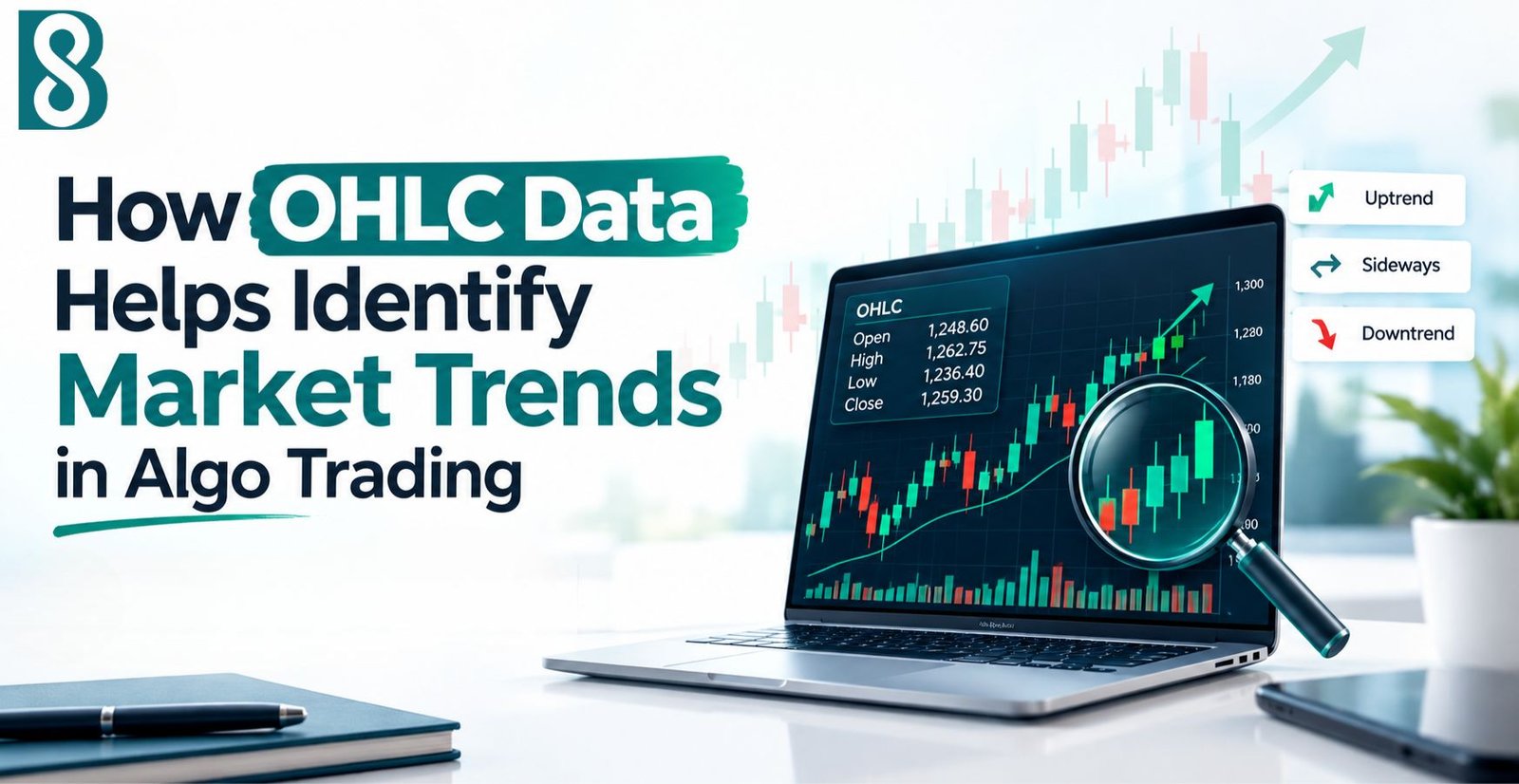
How OHLC Data Helps Identify Market Trends in Algo Trading

How OHLC Data Helps Identify Market Trends in Algo Trading
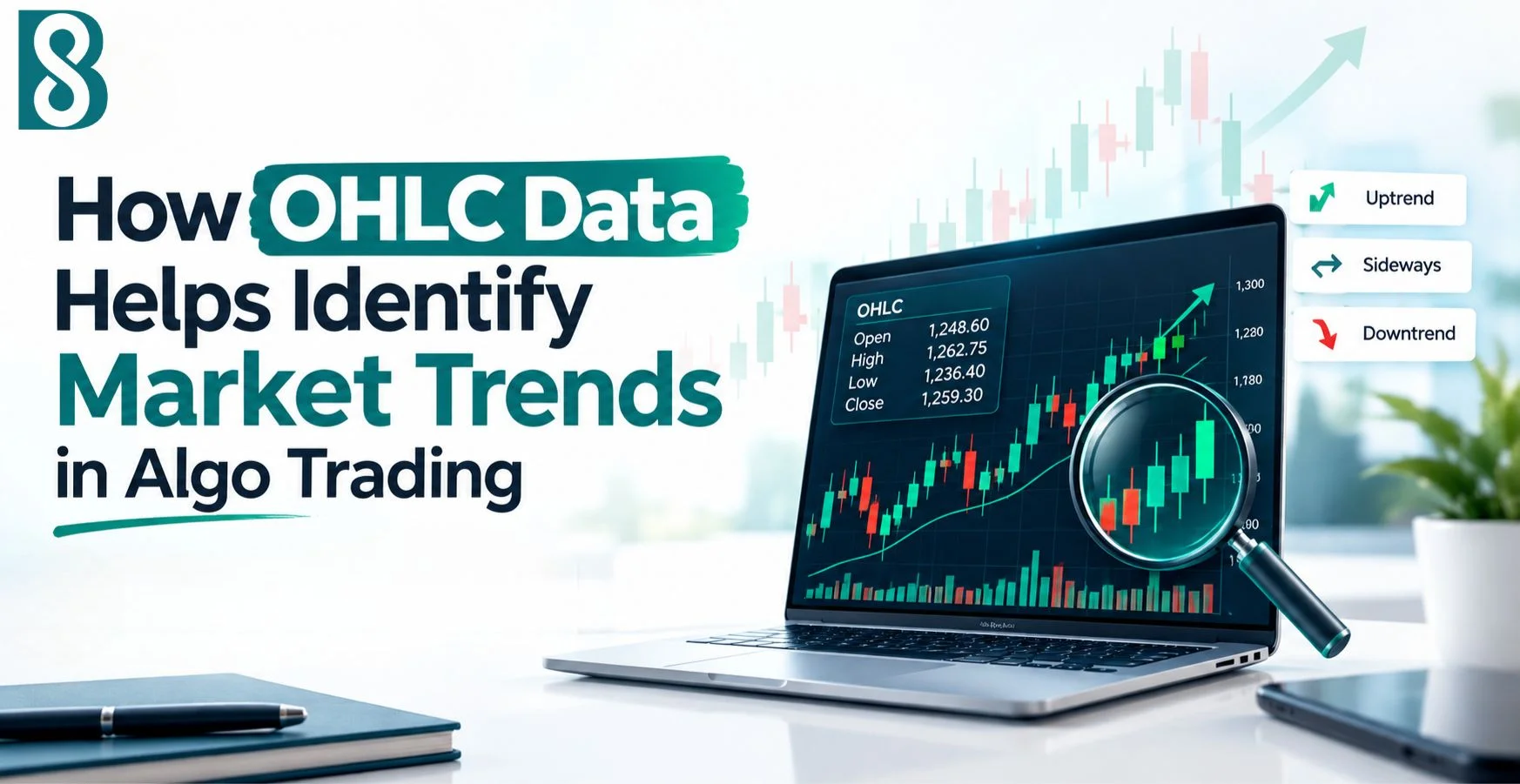
How OHLC Data Helps Identify Market Trends in Algo Trading

Markets generate thousands of price changes during every trading session. For a trader, reading every individual movement is difficult. For an algorithm, processing raw tick-by-tick information can also be unnecessarily complex for many strategies. OHLC data solves this problem by summarising price activity into four useful values: open, high, low and close.

These four prices help a retail algo trading system understand where a market started, how far it moved, where it faced resistance or support and where it finished during a selected period. When OHLC data is analysed across multiple candles, it can help classify the market as bullish, bearish, range-bound or volatile.

However, OHLC data is not a prediction tool by itself. It becomes useful only when it is converted into objective conditions and combined with appropriate confirmation, execution and risk-management rules.

What Is OHLC Data in Algo Trading?

OHLC represents four price values recorded for a particular timeframe:

  • Open: The first recorded or officially recognised price of the period.
  • High: The highest traded price during that period.
  • Low: The lowest traded price during that period.
  • Close: The last or officially calculated closing price of the period.

The selected period can be one minute, five minutes, fifteen minutes, one hour, one day or even one week. For example, a five-minute candle summarises all eligible trades completed during those five minutes into four prices.

Consider this illustrative five-minute data:

Time Open High Low Close
10:00–10:05 ₹1,000 ₹1,012 ₹996 ₹1,009

The price opened at ₹1,000, reached a high of ₹1,012, fell as low as ₹996 and closed the period at ₹1,009. Because the close is above the open and relatively near the high, this candle suggests buying strength during that interval. It does not, however, confirm that the price will continue rising.

An algorithm does not have to “look” at a candle as a human does. It can calculate the same information numerically and compare it with earlier periods.

What Each OHLC Price Reveals About the Market

Every component of an OHLC candle provides a different piece of information.

Open Price: The Starting Point

The open price shows where trading activity began during the selected interval. On a daily chart, it may reflect the market’s response to overnight developments, global cues, corporate announcements or changes in demand and supply.

Algorithms commonly compare the current open with the previous close:

  • Current open above previous close: Gap-up opening
  • Current open below previous close: Gap-down opening
  • Current open near previous close: Relatively neutral opening

A gap is not automatically a bullish or bearish signal. The system must analyse what happens after the opening. A gap-up followed by a weak close may indicate selling pressure, while a gap-down followed by recovery may show buying interest at lower levels.

High Price: The Upper Boundary

The high represents the highest price accepted during the period. It helps an algorithm identify:

  • Potential resistance areas
  • Breakout attempts
  • Recent swing highs
  • Volatility expansion
  • Price rejection from higher levels

When the market repeatedly approaches a level but fails to close above it, that area may act as resistance. A close above the earlier high can be used as one condition for a breakout, although additional confirmation is normally required.

Low Price: The Lower Boundary

The low is the lowest traded price during the interval. It can help locate:

  • Potential support levels
  • Breakdown attempts
  • Swing lows
  • Downside volatility
  • Rejection from lower prices

If price repeatedly falls near a level and recovers, an algorithm may classify it as a support zone. A close below that zone could indicate a possible breakdown.

Close Price: The Confirmation Point

The close receives significant attention because it shows where the market ended the period relative to its open, high and low.

A close near the high can suggest that buyers maintained control until the period ended. A close near the low may reflect sustained selling pressure. A close near the middle indicates a more balanced outcome.

Waiting for a candle to close can reduce premature signals, but it also creates some delay. This is a common trade-off between confirmation and speed.

How OHLC Data Creates Candlesticks

A candlestick is simply a visual representation of OHLC data.

The difference between the open and close forms the candle’s body. The distances from the body to the high and low form the upper and lower wicks.

A candle is generally considered bullish when the close is above the open and bearish when the close is below the open. However, the size and location of the body provide more information than colour alone.

An algorithm can calculate:

Candle Body = |Close − Open|

Candle Range = High − Low

Upper Wick = High − Maximum of Open or Close

Lower Wick = Minimum of Open or Close − Low

It can also measure how much of the total range is occupied by the body:

Body-to-Range Ratio = |Close − Open| ÷ (High − Low)

A higher ratio may indicate stronger directional movement. A smaller ratio may reflect indecision or rejection, although its meaning depends on the preceding trend and market context.

How OHLC Data Identifies an Uptrend

An uptrend is more than a single bullish candle. It is a market structure in which price generally forms higher highs and higher lows.

An OHLC-based algorithm may define an uptrend using conditions such as:

  • The current high is above the previous high.
  • The current low is above the previous low.
  • Closing prices are rising across several periods.
  • The close remains above a selected moving average.
  • Bullish candles close in the upper portion of their ranges.
  • Price closes above a previous resistance level.

Here is a simplified data example:

Candle Open High Low Close
1 ₹500 ₹507 ₹496 ₹504
2 ₹504 ₹512 ₹501 ₹509
3 ₹509 ₹518 ₹506 ₹516

The highs rise from ₹507 to ₹512 and then ₹518. The lows rise from ₹496 to ₹501 and then ₹506. Closing prices also move upward. Together, these observations indicate a developing bullish structure.

A basic algorithmic rule could be:

Classify the market as an uptrend when the latest three completed candles form higher highs and higher lows, and the latest close remains above the 20-period moving average.

This is only an illustrative rule. A practical strategy would also define volume, volatility, liquidity, risk and exit conditions.

How OHLC Data Identifies a Downtrend

A downtrend normally develops through lower highs and lower lows. It indicates that buyers are unable to push the price back to earlier highs and sellers continue to accept lower prices.

An algorithm may classify a bearish trend when:

  • The latest high is below the previous high.
  • The latest low is below the previous low.
  • Closing prices decline over several periods.
  • Price remains below a moving average.
  • Bearish candles close near their lows.
  • Price closes below established support.

Consider another illustrative dataset:

Candle Open High Low Close
1 ₹820 ₹824 ₹811 ₹814
2 ₹814 ₹818 ₹804 ₹807
3 ₹807 ₹811 ₹796 ₹799

The falling highs, lows and closes suggest sustained selling pressure. An algorithm could use these conditions to activate a trend-following setup or prevent a long-only strategy from entering.

Identifying a Sideways or Range-Bound Market

Not every market produces a clear trend. Prices frequently move between a defined support zone and resistance zone without establishing a lasting direction.

OHLC characteristics of a range-bound market may include:

  • Similar highs across several candles
  • Similar lows across several candles
  • Frequent movement above and below a moving average
  • Small candle bodies
  • Overlapping price ranges
  • Repeated breakout failures
  • No consistent sequence of higher highs or lower lows

For example, if the highest price recorded across 20 candles is ₹1,050 and the lowest is ₹1,020, while most closes remain inside that band, an algorithm may classify the market as range-bound.

This classification matters because a trend-following strategy may generate repeated false signals in a sideways market. A range-trading system, on the other hand, may look for price rejection near the upper and lower boundaries.

Market-regime identification allows an algorithm to decide not only when to trade but also when its strategy may be unsuitable.

Measuring Trend Strength with OHLC Data

Knowing the direction of a trend is not enough. An algorithm should also assess whether that movement is strong, weak or losing momentum.

Close Location Value

The position of the close inside the candle’s range can be measured as:

Close Location = (Close − Low) ÷ (High − Low)

The value normally falls between 0 and 1:

  • A value near 1 means the close is near the high.
  • A value near 0 means the close is near the low.
  • A value near 0.5 means the close is near the centre.

Suppose a candle has a high of ₹220, a low of ₹200 and a close of ₹218:

(218 − 200) ÷ (220 − 200) = 0.90

The closing price is in the top 10% of the candle’s range, indicating that buyers controlled much of that period. One candle is insufficient for a conclusion, but consistently high values during rising prices may support a bullish trend assessment.

Range Expansion

A widening high-low range may indicate increasing volatility or momentum. A narrowing range may indicate declining activity or consolidation.

Algorithms can compare the current range with an average:

Range Expansion Ratio = Current High-Low Range ÷ Average Range of Previous 20 Candles

A ratio above 1 means the current candle is wider than its recent average. Whether this is bullish or bearish depends on the direction of the close and the surrounding market structure.

Using OHLC Data to Identify Breakouts

A breakout happens when price moves beyond a recognised resistance level. A breakdown occurs when price falls below support.

A basic bullish breakout condition might be:

The current close is greater than the highest high of the previous 20 completed candles.

A bearish breakdown condition might be:

The current close is lower than the lowest low of the previous 20 completed candles.

Using the close instead of the intraperiod high or low can help filter brief price spikes. However, false breakouts can still occur. An algorithm may therefore add:

  • Volume confirmation
  • Minimum breakout distance
  • Volatility threshold
  • Market-trend filter
  • Retest condition
  • Time-of-day filter
  • Maximum entry-price deviation

For example, a system might accept a bullish breakout only when the close is at least 0.25% above resistance and the volume is higher than its recent average. The values must be tested for the chosen instrument rather than treated as universal settings.

Previous-Day High, Low and Close in Intraday Strategies

Previous-day OHLC levels are frequently used because they provide objective reference points before the new session begins.

An intraday algorithm may track:

  • Previous-day high as potential resistance
  • Previous-day low as potential support
  • Previous-day close as a sentiment reference
  • Current open relative to the previous close
  • Current price position inside the previous day’s range

Suppose the previous day’s high was ₹1,240, its low was ₹1,190 and its close was ₹1,225. If the next session opens at ₹1,232 and later closes a five-minute candle above ₹1,240, the system may identify a potential breakout.

The breakout alone should not directly imply a trade. The strategy must still evaluate liquidity, volatility, position size, stop-loss distance and the risk of entering after an extended move.

OHLC Analysis Across Different Timeframes

The same instrument can appear bullish on a five-minute chart and bearish on a daily chart. This is not a contradiction. Each timeframe describes a different section of market activity.

  • One- and five-minute candles: Useful for short-term execution but highly sensitive to noise.
  • Fifteen-minute and hourly candles: Provide a broader intraday view.
  • Daily candles: Commonly used for swing and positional analysis.
  • Weekly candles: Help identify broader market structure.

A multi-timeframe algorithm may use the daily chart to determine the primary direction and a shorter timeframe to identify entries. For instance, it could permit bullish entries on a fifteen-minute chart only when the daily close is above a long-term moving average.

The higher timeframe provides context, while the lower timeframe provides execution detail. Too many timeframes, however, can produce conflicting filters and an overcomplicated strategy.

Combining OHLC Data with Volume and Volatility

OHLC shows where price moved, but not how much participation supported that move. Volume can add this missing context.

A breakout accompanied by relatively high volume may show broader market participation. A breakout with low volume may be more vulnerable to reversal. Volume should still be interpreted carefully because its behaviour differs across cash equities, derivatives and trading sessions.

Volatility can be measured using the high, low and previous close. Average True Range, or ATR, estimates recent price movement and can help an algorithm:

  • Avoid trading during abnormally quiet periods
  • Reduce exposure during extreme volatility
  • Set adaptive stop-loss distances
  • Compare movement across different instruments
  • Avoid using a fixed risk distance in every condition

Indicators should be used to answer specific questions. Adding multiple indicators based on the same closing-price data may create the illusion of confirmation without providing genuinely independent information.

Using OHLC Data for Entry, Exit and Risk Rules

A complete algo strategy must define much more than market direction.

Entry Rules

An OHLC-based entry may require:

  • Confirmed trend structure
  • Close above resistance
  • Price above a moving average
  • Minimum candle-body strength
  • Suitable volume and volatility
  • Acceptable spread and liquidity

Exit Rules

The system may exit when:

  • Price closes below a recent swing low
  • The trend structure changes
  • A volatility-adjusted stop-loss is triggered
  • A predefined risk-reward level is reached
  • The position remains open beyond a time limit
  • A maximum daily loss is reached

Position Sizing

The distance between the entry and stop-loss can determine position size:

Position Size = Maximum Permitted Trade Risk ÷ Risk Per Unit

If a strategy permits a maximum trade risk of ₹1,000 and the difference between entry and stop-loss is ₹10 per share, the theoretical position size would be 100 shares before accounting for applicable limits, costs, liquidity and execution constraints.

Risk rules should be calculated before an order is placed. They should not depend on a trader’s reaction after the market moves.

Backtesting an OHLC-Based Algo Strategy

Historical OHLC data allows a strategy to be evaluated before live deployment. A responsible backtest should include:

  1. Clearly defined entry and exit conditions
  2. Reliable and correctly timestamped data
  3. Broking and applicable transaction costs
  4. Realistic slippage assumptions
  5. Position-sizing rules
  6. Maximum exposure limits
  7. Different market regimes
  8. Out-of-sample testing
  9. Forward or paper testing
  10. Analysis of drawdown and losing sequences

A critical limitation is that a single OHLC candle does not reveal the exact order in which its high and low occurred.

Suppose a daily candle has:

  • Open: ₹100
  • High: ₹110
  • Low: ₹95
  • Close: ₹108

If a strategy had both a target at ₹108 and a stop-loss at ₹97, daily OHLC data alone may not reveal which level was reached first. Using lower-timeframe data or conservative assumptions can reduce this form of backtesting error.

Developers should also avoid lookahead bias. A strategy cannot use the final high, low or close of a candle before that candle has been completed.

Limitations of OHLC Data

Although OHLC data is efficient and widely used, it has important limitations:

  • It compresses many individual trades into four values.
  • It does not show the exact intraperiod price sequence.
  • It may hide sudden changes inside a candle.
  • A completed-candle signal may enter after part of the move has occurred.
  • Low-liquidity instruments can produce unreliable candles.
  • Data adjustments and closing-price methods can vary.
  • Technical patterns may fail after unexpected news.
  • Historical behaviour cannot guarantee future performance.

The reliability of an OHLC strategy depends on the quality of its data. Missing candles, duplicated records, incorrect timestamps, unadjusted corporate actions and mismatched time zones can materially distort a backtest.

Common Mistakes When Using OHLC Data

Algo traders should avoid several frequent errors:

  • Treating one bullish candle as proof of an uptrend
  • Entering every high breakout without confirmation
  • Using incomplete candles as completed signals
  • Applying identical settings to every instrument
  • Ignoring spreads, slippage and liquidity
  • Testing only during favourable market periods
  • Optimising parameters until they perfectly fit historical data
  • Using too many indicators derived from the same prices
  • Assuming automation removes market risk
  • Deploying a strategy without risk limits and ongoing monitoring

SEBI has also cautioned investors about dealing with unregulated platforms offering algorithmic trading and about performance or return claims. Users should evaluate the regulatory status, transparency and risk controls of any service before sharing credentials or deploying capital. SEBI investor caution

Best Practices for OHLC-Based Algo Strategies

For a more disciplined development process:

  • Start with simple, explainable conditions.
  • Use completed candles unless the strategy explicitly handles live updates.
  • Test different market regimes, not only strong trends.
  • Keep training, validation and out-of-sample data separate.
  • Use realistic execution assumptions.
  • Combine signal logic with strict position and loss limits.
  • Maintain logs of signals, orders, rejections and executions.
  • Monitor live behaviour for data or execution failures.
  • Review the strategy when market conditions change.
  • Never describe historical backtest results as guaranteed future returns.

Conclusion

OHLC data provides a practical framework for converting market activity into measurable algo trading rules. Open prices help assess the starting context, highs and lows reveal trading boundaries, and closes help confirm how each period ended.

Across multiple candles, this information can identify higher highs, higher lows, lower highs, lower lows, breakouts, consolidations and changes in volatility. It can also support entry filters, trailing stops, position sizing and market-regime classification.

Its simplicity is both its strength and its limitation. OHLC data makes price behaviour easier to process, but it removes the detailed sequence of intraperiod trades. Therefore, a reliable strategy should use clean data, objective rules, realistic backtesting, execution controls and disciplined risk management.

OHLC-based algorithms do not need to predict every market move. Their purpose is to respond consistently when predefined conditions appear—and to control risk when the market behaves differently from historical expectations.

Frequently Asked Questions

What does OHLC mean in algo trading?

OHLC stands for Open, High, Low and Close. These values summarise price activity during a selected timeframe and can be converted into rules for trend identification, entries, exits and risk management.

Which OHLC price is most useful for identifying trends?

The close is commonly used for confirmation, while highs and lows help determine market structure. A reliable trend assessment normally uses all four values across multiple candles rather than relying on a single price.

How can an algorithm identify an uptrend?

An algorithm can look for higher highs, higher lows and rising closing prices. It may also require the price to remain above a moving average or close above resistance before classifying the structure as bullish.

How does OHLC data identify a downtrend?

A sequence of lower highs, lower lows and falling closes may indicate a downtrend. Additional momentum, volatility and volume filters can help determine whether the downward move has sufficient strength.

Can OHLC data identify a sideways market?

Yes. Repeated highs and lows within a limited range, overlapping candles and the absence of consistent directional structure can help an algorithm classify the market as sideways.

What is an OHLC breakout strategy?

It is a rule-based strategy that monitors whether the price closes above an earlier high or below an earlier low. Practical breakout systems generally include confirmation, liquidity and risk-management conditions.

Which timeframe is best for OHLC analysis?

There is no single best timeframe. The choice should match the strategy’s intended holding period, execution speed, trading costs and tolerance for market noise.

Can OHLC data be used for stop-loss placement?

Yes. Recent lows may support stop-loss placement for long positions, while recent highs may be used for short positions. Volatility and position size should also be considered.

Is OHLC data sufficient for algo trading?

OHLC data can support many strategies, but it does not show volume, order-book activity or the exact sequence of trades inside a candle. The required data depends on the strategy’s objective and execution style.

Does an OHLC-based strategy guarantee profitable trades?

No. OHLC data describes historical and current price behaviour but cannot guarantee future results. Every strategy requires testing, execution controls, monitoring and clearly defined risk limits.

Disclaimer: This article is intended for educational purposes only and should not be considered investment advice or a recommendation to buy or sell any security. Algo trading involves market, execution, technology and operational risks.

Best Algo Trading App in India.

Best Algo Trading App in India – Complete Guide for Retail Traders

Best Algo Trading App in India.

Introduction to Algorithmic Trading

The financial markets have evolved significantly over the past two decades. From traditional phone-based trading to online platforms and mobile applications, technology has transformed how traders participate in the stock market. One of the most revolutionary developments in modern trading is algorithmic trading, often referred to as algo trading.
Algorithmic trading uses computer programs and predefined rules to automatically execute trades in financial markets. Instead of manually analysing charts, placing orders, and constantly monitoring price movements, traders can rely on algorithms to perform these tasks quickly and efficiently.
With the rise of digital platforms and trading applications, algorithmic trading is no longer limited to large institutions or hedge funds. Today, retail traders in India can access advanced trading technology through algo trading apps, making automation accessible to everyone.
The concept behind algorithmic trading is simple: traders define a set of rules based on market data, price movements, technical indicators, or statistical models. Once these rules are programmed into a system, the algorithm automatically scans market conditions and executes trades when the predefined criteria are met.
For example, an algorithm might be designed to buy a stock when its price crosses above a moving average and sell when it drops below a certain level. The algorithm monitors the market continuously and executes trades instantly when conditions are satisfied.
This automation provides several advantages compared to manual trading. Algorithms eliminate emotional decision-making, reduce human errors, and execute trades at speeds that humans cannot match. These benefits make algo trading particularly attractive for active traders and intraday participants.
In India, the growing interest in algorithmic trading is driven by increasing retail participation in the stock market, improved internet infrastructure, and the availability of advanced trading technology through mobile applications.
Today, traders are looking for the Best Algo Trading App in India to automate strategies, manage risk efficiently, and improve trading performance.
Modern algorithmic trading apps provide powerful features such as strategy automation, backtesting tools, real-time market alerts, portfolio tracking, and automated execution systems.
For retail traders, these tools offer a structured approach to trading. Instead of relying on guesswork or emotional decisions, traders can implement disciplined strategies powered by data and technology.
This guide explores everything traders need to know about algorithmic trading, including how algo trading apps work, the benefits of automation, risk management techniques, and how modern platforms like Bull8 are transforming retail trading in India.

Evolution of Algo Trading in India

Algorithmic trading has undergone a remarkable transformation in India over the past decade. Initially, automated trading was primarily used by institutional investors, hedge funds, and proprietary trading firms that had access to advanced infrastructure and sophisticated trading systems.
These institutions used complex algorithms to analyze massive amounts of market data and execute high-frequency trades within milliseconds. Due to the technological barriers and high infrastructure costs, retail traders had very limited access to such capabilities.
However, the landscape began to change as financial markets embraced digital innovation. Online trading platforms, improved internet connectivity, and regulatory developments opened new opportunities for individual traders.
As more retail investors entered the stock market, the demand for advanced trading tools also increased. Traders started looking for ways to analyze markets more efficiently and execute trades faster.
This demand led to the development of algorithmic trading apps designed specifically for retail traders.
Unlike traditional institutional systems that required programming expertise and complex infrastructure, modern algo trading apps provide simplified interfaces and user-friendly tools that allow traders to automate strategies without deep coding knowledge.
This shift represents a major democratization of financial technology. Retail traders can now use advanced automation tools that were previously available only to professional trading firms.
Another important factor contributing to the growth of algorithmic trading in India is the increasing volatility in financial markets. Market movements can happen rapidly, and manual traders often struggle to react quickly enough.
Algorithms, on the other hand, can monitor markets continuously and execute trades instantly when predefined conditions occur.
This capability provides traders with a significant advantage, particularly in fast-moving markets.
Today, the popularity of algorithmic trading in India continues to grow rapidly as traders recognize the benefits of automation, speed, and precision.
Modern platforms like Bull8 aim to bring professional-grade trading technology to retail participants by offering advanced strategy tools, real-time market analysis, and automated execution systems.
As technology continues to evolve, algorithmic trading is expected to become an essential part of the trading ecosystem in India, empowering traders to make more informed and disciplined decisions.

What is an Algo Trading App?

An algo trading app is a digital platform that allows traders to automate their trading strategies using algorithms. Instead of manually placing buy or sell orders, traders can create predefined trading rules that automatically execute trades based on market conditions.
These apps function as intelligent trading assistants that continuously monitor the market and act according to programmed instructions.
For example, a trader may define a rule that instructs the system to buy a stock when its price breaks above a resistance level and sell when it reaches a certain profit target.
Once the strategy is activated, the algorithm handles the entire execution process automatically.
Algo trading apps provide several tools that help traders develop and manage automated strategies.
Key features commonly found in modern algorithmic trading apps include:
Strategy creation tools
Backtesting engines
Real-time market data analysis
Trade signal generation
Automated order execution
Portfolio monitoring tools
Risk management settings
These tools allow traders to create systematic trading approaches based on data rather than intuition.
One of the major advantages of using an algo trading app is speed. Markets move quickly, and manual traders may miss opportunities due to delayed reactions. Algorithms can execute trades within milliseconds, ensuring optimal entry and exit points.
Another advantage is consistency. Human traders often make emotional decisions influenced by fear or greed. Algorithms follow predefined rules without emotional bias, ensuring disciplined execution of trading strategies.
Algo trading apps are particularly useful for intraday traders and active market participants who need to monitor multiple stocks and indicators simultaneously.
By automating strategies, traders can reduce workload and focus on improving their trading systems.
Platforms like Bull8 are designed to make algorithmic trading accessible to retail traders by providing user-friendly interfaces, powerful strategy automation tools, and real-time market insights.
As financial markets become increasingly technology-driven, algo trading apps are becoming essential tools for modern traders.

How Algo Trading Apps Work

Algorithmic trading apps operate through a structured process that transforms trading ideas into automated execution systems. This process involves multiple stages, including market data analysis, rule creation, signal generation, and trade execution.
Understanding how these apps function helps traders appreciate the technology behind automated trading.
The first step in algorithmic trading is market data analysis. Trading algorithms rely on real-time market data such as price movements, volume trends, and technical indicators.
The app continuously collects and processes this information to identify potential trading opportunities.
The next stage involves defining trading rules. Traders specify conditions under which trades should be executed.
These rules may include technical indicators, price breakouts, trend signals, volatility levels, or statistical patterns.
Once these rules are established, the algorithm monitors the market continuously to detect when the conditions are met.
When the predefined criteria are satisfied, the system generates a trade signal. This signal indicates that a potential trading opportunity has been identified.
The algorithm then proceeds to execute the trade automatically through the connected trading account.
The execution stage is one of the most critical components of algorithmic trading. Speed and accuracy are essential because even small delays can impact profitability.
Modern algo trading apps use advanced infrastructure to ensure rapid order execution and minimal latency.
Another important feature of these platforms is backtesting.
Backtesting allows traders to test their strategies using historical market data before deploying them in live markets.
This helps traders evaluate the performance of their strategies and refine them for better results.
Advanced platforms like Bull8 also provide strategy builders that allow traders to design algorithms using simple interfaces.
Instead of writing complex code, traders can create automated strategies using visual tools and predefined indicators.
By combining data analysis, rule-based decision making, and automated execution, algo trading apps provide traders with powerful tools to participate in financial markets more efficiently.

Key Features of the Best Algo Trading App in India

When choosing the Best Algo Trading App in India, traders should evaluate several important features that determine the efficiency and reliability of automated trading systems.
One of the most important features is a strategy builder. This tool allows traders to design custom trading algorithms based on market indicators, price movements, or statistical models.
A good strategy builder should provide flexibility and ease of use so traders can experiment with different strategies.
Another essential feature is a backtesting engine. Backtesting allows traders to evaluate the historical performance of their strategies before using them in real markets.
This process helps identify potential weaknesses and optimize trading rules.
Real-time market alerts and trade signals are also important features. These notifications inform traders when strategies detect potential trading opportunities.
Even when strategies are automated, alerts help traders stay informed about market activity.
Effective risk management tools are crucial for long-term success in algorithmic trading.
These tools may include stop-loss settings, capital allocation controls, and maximum drawdown limits.
By managing risk effectively, traders can protect their capital during volatile market conditions.
Another important feature is portfolio management.
Automated trading platforms should provide clear insights into trading performance, open positions, profit and loss statistics, and strategy performance metrics.
Execution speed is also a key factor. Fast and reliable order execution ensures that trades occur at the intended prices without unnecessary delays.
Mobile accessibility is another advantage of modern algo trading apps. Traders can monitor strategies, review performance, and manage settings directly from their smartphones.
Platforms like Bull8 combine these features into a comprehensive trading ecosystem designed for retail traders who want to automate strategies and improve their trading efficiency.

Strategy Automation Explained

Strategy automation is the core concept behind algorithmic trading. Instead of manually analyzing charts and executing trades, traders create predefined rules that guide the trading process.
These rules form the foundation of automated trading strategies.
In traditional manual trading, traders must continuously monitor market movements, analyze indicators, and decide when to enter or exit positions.
This process can be time-consuming and prone to emotional errors.
Strategy automation eliminates these challenges by allowing computers to perform these tasks automatically.
A typical automated strategy consists of several components.
The first component is the entry condition. This defines when the algorithm should open a new trade.
Entry conditions may include technical indicators such as moving averages, momentum signals, or price breakouts.
The second component is the exit condition.
This rule determines when the algorithm should close a position.
Exit conditions may include profit targets, stop-loss levels, or indicator reversals.
Another important component is risk management.
Automated strategies can include position sizing rules, capital allocation limits, and maximum exposure settings.
These features help traders maintain disciplined risk control.
Once a strategy is defined, the algorithm continuously monitors the market to detect when the conditions occur.
When the predefined criteria are met, the algorithm executes trades automatically.
Platforms like Bull8 provide tools that allow traders to automate strategies easily using structured interfaces and advanced trading technology.
Automation allows traders to focus on developing strategies rather than constantly monitoring the market.
This approach helps improve trading discipline and consistency.

Benefits for Retail Traders

Algorithmic trading offers several advantages for retail traders who want to participate in financial markets more efficiently.
One of the biggest benefits is speed. Algorithms can analyze market data and execute trades within milliseconds.
This speed advantage is especially important in fast-moving markets where prices change rapidly.
Another major benefit is accuracy.
Algorithms follow predefined rules precisely, reducing the risk of human errors in trade execution.
Manual traders may sometimes enter incorrect order quantities or miss important signals due to distractions.
Automation eliminates such mistakes.
Emotion-free trading is another important advantage.
Human traders often make decisions influenced by fear, greed, or panic.
These emotions can lead to impulsive decisions and inconsistent results.
Algorithms follow predefined strategies without emotional interference.
Algorithmic trading also allows traders to monitor multiple markets simultaneously.
Instead of focusing on a single stock or asset, traders can run strategies across multiple instruments at the same time.
This improves diversification and increases potential opportunities.
Platforms like Bull8 aim to make these benefits accessible to retail traders by providing powerful automation tools and user-friendly trading interfaces.

Risk Management in Algorithmic Trading

Risk management is one of the most critical aspects of successful trading. While algorithmic trading offers many advantages, it must be implemented with proper risk control mechanisms.
Automated trading strategies can execute multiple trades quickly, which means losses can accumulate rapidly if risks are not controlled properly.
Therefore, effective risk management is essential.
One common risk management technique is the use of stop-loss orders.
Stop-loss levels automatically close positions when prices move against the trader beyond a predefined limit.
This prevents excessive losses during unfavorable market conditions.
Another important risk control tool is position sizing.
Traders should determine how much capital to allocate to each trade based on their overall portfolio size and risk tolerance.
Automated systems can enforce these rules consistently.
Diversification is another important strategy.
Running multiple trading strategies across different market segments can reduce the impact of losses from any single strategy.
Advanced trading platforms like Bull8 provide risk management tools that allow traders to control exposure, define capital limits, and maintain disciplined trading practices.
Effective risk management ensures long-term sustainability in algorithmic trading.

Future of Algorithmic Trading in India

The future of algorithmic trading in India looks extremely promising as technology continues to transform financial markets.
With increasing internet penetration, mobile trading adoption, and improved market infrastructure, more retail traders are exploring automated trading solutions.
One of the key trends shaping the future of trading is the integration of artificial intelligence and machine learning.
These technologies enable trading systems to analyze large volumes of market data and identify patterns that may not be visible through traditional analysis methods.
AI-driven algorithms can adapt to changing market conditions and improve strategy performance over time.
Another important trend is the growth of quantitative trading strategies.
Quantitative trading relies on mathematical models and statistical analysis to identify market opportunities.
Retail traders are gradually gaining access to such techniques through modern trading applications.
Mobile trading is also playing a major role in expanding algorithmic trading adoption.
Traders can now monitor automated strategies, analyze performance metrics, and manage portfolios directly from their smartphones.
Platforms like Bull8 aim to bring advanced trading technology to retail traders through innovative tools, automation features, and data-driven insights.
As financial markets become more technology-driven, algorithmic trading will likely become a standard approach for traders seeking efficiency and consistency.

Conclusion

Algorithmic trading represents a major shift in how traders interact with financial markets.
By combining data analysis, automation, and advanced technology, algo trading allows traders to execute strategies more efficiently and consistently.
Retail traders in India are increasingly adopting automated trading solutions as they recognize the limitations of manual trading methods.
Algo trading apps provide powerful tools that enable traders to automate strategies, analyze historical performance, and manage risk effectively.
These platforms reduce emotional decision-making and allow traders to focus on developing disciplined trading systems.
The growing popularity of automated trading reflects a broader trend toward technology-driven investing.
As financial markets continue to evolve, algorithmic trading will play an increasingly important role in shaping the future of trading.
Platforms like Bull8 aim to empower retail traders with advanced algorithmic trading tools that make automation accessible and practical.
By combining strategy automation, real-time market insights, and structured risk management, modern algo trading apps provide traders with the resources they need to navigate dynamic financial markets.
For traders seeking efficiency, discipline, and technological advantage, algorithmic trading offers a powerful path forward.

FAQs 

What is the Best Algo Trading App in India for retail traders?

The Best Algo Trading App in India is a platform that allows traders to automate their trading strategies using predefined rules and algorithms. Instead of manually analyzing the market and placing orders, traders can rely on automated systems to execute trades based on specific conditions. A good algorithmic trading app in India should provide features like strategy automation, backtesting tools, real-time market data, and risk management settings. Platforms like the Bull8 algo trading app are designed specifically for retail traders, enabling them to build, test, and deploy automated trading strategies with greater efficiency and discipline in the financial markets.

How does an algorithmic trading app work in India?

An algorithmic trading app in India works by converting trading strategies into automated rules that the system follows to execute trades. Traders define conditions such as entry price, exit level, stop-loss, and indicators. The automated trading app in India continuously monitors market data and executes trades when those conditions are met. This eliminates manual intervention and ensures faster execution. The Bull8 algo trading app uses advanced trading technology to analyze market signals, generate trade alerts, and execute orders automatically. This helps traders participate in the market more efficiently while maintaining disciplined trading strategies.

Why are traders searching for the Best Algo Trading App in India?

Traders are increasingly searching for the Best Algo Trading App in India because automation helps improve trading efficiency and consistency. Manual trading often involves emotional decision-making, delayed execution, and missed opportunities. With a retail algo trading app, traders can automate strategies and allow algorithms to monitor the market continuously. An automated trading app in India can analyze large volumes of data quickly and execute trades within milliseconds. Platforms like the Bull8 algo trading app are designed to simplify algorithmic trading for retail participants by providing strategy builders, real-time signals, and risk management tools.

Is algorithmic trading legal in India?

Yes, algorithmic trading in India is legal when executed through regulated systems that follow exchange and market guidelines. Many traders now use algorithmic trading apps in India to automate their strategies while complying with market regulations. Retail traders must ensure they use platforms that provide secure infrastructure and proper risk management features. A reliable retail algo trading app should offer transparent trading processes and allow traders to monitor strategy performance. The Bull8 algo trading app focuses on structured automation and disciplined trading strategies, helping traders participate in algorithmic trading while maintaining proper risk control.

What are the benefits of using a retail algo trading app?

A retail algo trading app provides several benefits compared to manual trading. One of the biggest advantages is speed, as algorithms can execute trades instantly when market conditions meet predefined rules. Another major benefit is emotion-free trading because automated systems follow logic instead of emotional reactions. The Best Algo Trading App in India also provides features like backtesting, portfolio monitoring, and automated risk management. Platforms like the Bull8 algo trading app help traders automate algo trading strategies, allowing them to focus on improving strategy performance rather than constantly monitoring the market.

Can beginners use an automated trading app in India?

Yes, beginners can use an automated trading app in India if the platform provides user-friendly tools and structured strategy-building features. Many modern algorithmic trading apps in India are designed to simplify automation for retail traders who may not have coding knowledge. These platforms provide visual strategy builders and ready-to-use indicators. The Bull8 algo trading app aims to make algorithmic trading accessible for beginners by offering easy-to-understand automation tools and structured trading frameworks. This allows new traders to learn about algo trading strategies while gradually building experience in automated trading.

What features should the Best Algo Trading App in India provide?

The Best Algo Trading App in India should provide several key features to support efficient trading. These include a strategy builder, backtesting engine, real-time market alerts, automated order execution, and portfolio performance tracking. A good retail algo trading app should also offer strong risk management tools such as stop-loss automation and capital allocation control. Another important feature is mobile accessibility, allowing traders to monitor strategies anytime. The Bull8 algo trading app combines these features with structured automation tools, enabling traders to implement algo trading strategies effectively in dynamic market conditions.

What is backtesting in algorithmic trading?

Backtesting is a process used in algorithmic trading apps in India to test trading strategies using historical market data. This allows traders to evaluate how their algo trading strategies would have performed in past market conditions before deploying them in live trading. Backtesting helps traders identify strengths and weaknesses in their strategies. The Best Algo Trading App in India should provide a reliable backtesting engine that analyzes data accurately. Platforms like the Bull8 algo trading app allow traders to experiment with different strategies and optimize them before applying them to real market scenarios.

What are the risks of algorithmic trading?

Although algorithmic trading apps in India offer many advantages, traders must understand the potential risks involved. Poorly designed algo trading strategies can lead to losses if market conditions change unexpectedly. Technology failures or incorrect parameters may also affect performance. This is why the Best Algo Trading App in India should include strong risk management tools. A reliable retail algo trading app should allow traders to set stop-loss levels, position limits, and capital allocation rules. The Bull8 algo trading app emphasizes structured risk management to help traders maintain discipline and protect their capital.

What are algo trading strategies?

Algo trading strategies are predefined sets of rules used by algorithms to analyze market conditions and execute trades automatically. These strategies may include technical indicators, trend-following systems, statistical models, or price breakout patterns. A retail algo trading app allows traders to design and automate such strategies without manual execution. The Best Algo Trading App in India provides tools to build, test, and optimize these strategies. Platforms like the Bull8 algo trading app enable traders to implement data-driven strategies that monitor market movements continuously and execute trades based on logic and discipline.

Why is speed important in algorithmic trading?

Speed is one of the biggest advantages of using an automated trading app in India. Financial markets move quickly, and delays in execution can affect profitability. Algorithms can process market data and execute trades within milliseconds. The Best Algo Trading App in India should provide reliable infrastructure and fast order execution systems. A retail algo trading app with high-speed execution ensures that trades occur at intended price levels. The Bull8 algo trading app focuses on efficient automation and rapid signal processing, helping traders capture market opportunities without delays caused by manual trading.

Can algorithmic trading reduce emotional trading?

Yes, one of the major advantages of using an algorithmic trading app in India is the elimination of emotional decision-making. Manual traders often experience fear, greed, and panic during volatile market conditions. These emotions can lead to impulsive decisions and inconsistent results. A retail algo trading app follows predefined algo trading strategies, ensuring trades are executed logically rather than emotionally. The Bull8 algo trading app allows traders to automate strategies so that decisions are based on data and rules instead of emotions, helping maintain trading discipline and consistency.

Is algorithmic trading suitable for intraday traders?

Yes, algorithmic trading is particularly beneficial for intraday traders because it allows fast execution and continuous market monitoring. Intraday trading requires quick decision-making and precise timing. A retail algo trading app can analyze market movements and execute trades instantly when conditions are met. The Best Algo Trading App in India should support multiple strategies and rapid signal generation. Platforms like the Bull8 algo trading app enable intraday traders to automate algo trading strategies, allowing them to capture short-term market opportunities more efficiently.

What is a retail algo trading app?

A retail algo trading app is a trading platform designed specifically for individual traders who want to automate their trading strategies. Unlike institutional systems that require complex programming, these apps offer simplified interfaces and automation tools. Traders can create strategies based on technical indicators or market conditions and deploy them automatically. The Best Algo Trading App in India provides strategy builders, backtesting tools, and automated order execution. The Bull8 algo trading app is designed to help retail traders access advanced automation technology that was previously available only to institutional investors.

How does Bull8 help retail traders in algorithmic trading?

The Bull8 algo trading app is designed to simplify automated trading for retail participants. It provides tools that allow traders to create, test, and deploy algo trading strategies efficiently. The platform focuses on automation, real-time market analysis, and structured risk management. As a retail algo trading app, Bull8 helps traders monitor market signals and execute trades automatically based on predefined rules. By combining automation technology with strategy tools, the Bull8 algo trading app aims to provide traders with a reliable environment for participating in algorithmic trading in India.

What is automated trading?

Automated trading refers to the use of computer programs to execute trades automatically based on predefined rules. Instead of manually placing orders, traders rely on algorithms to monitor market data and execute trades when conditions are satisfied. An automated trading app in India helps traders automate their strategies and manage trades efficiently. The Best Algo Trading App in India should provide tools that allow traders to build and deploy automated strategies easily. Platforms like the Bull8 algo trading app enable traders to implement algo trading strategies with minimal manual intervention.

Can algo trading apps improve trading discipline?

Yes, algorithmic trading apps in India can significantly improve trading discipline because they follow predefined rules consistently. Human traders may sometimes ignore their strategies due to emotional reactions or market pressure. A retail algo trading app executes trades exactly according to the programmed strategy. The Best Algo Trading App in India allows traders to automate entry, exit, and risk management rules. The Bull8 algo trading app helps traders maintain discipline by ensuring strategies are executed systematically without emotional interference.

What role does technology play in algo trading apps?

Technology plays a central role in algorithmic trading apps in India. These platforms rely on data processing systems, market analysis engines, and automated execution infrastructure. The Best Algo Trading App in India must provide reliable technology that ensures fast trade execution and accurate data analysis. Advanced systems allow traders to monitor markets, test strategies, and execute trades automatically. The Bull8 algo trading app integrates modern trading technology with user-friendly automation tools, enabling traders to implement algo trading strategies effectively in real market environments.

How is algorithmic trading changing the Indian stock market?

Algorithmic trading is transforming the Indian stock market by increasing efficiency, speed, and transparency in trade execution. More retail traders are now using algorithmic trading apps in India to automate strategies and participate in markets systematically. The Best Algo Trading App in India enables traders to analyze data quickly and execute trades without delays. Platforms like the Bull8 algo trading app are helping democratize automated trading technology, making it accessible to individual traders who previously relied only on manual trading methods.

Why is Bull8 considered a powerful algo trading app for retail traders?

The Bull8 algo trading app is designed to empower retail traders with advanced automation technology. It allows traders to build, test, and deploy algo trading strategies using a structured and user-friendly interface. As a retail algo trading app, Bull8 focuses on strategy automation, real-time market insights, and disciplined risk management. Traders can use the platform to automate trades and monitor performance efficiently. For traders looking for the Best Algo Trading App in India, Bull8 aims to provide the tools and technology needed to participate confidently in automated trading.

Contact Us
close slider