
What is a Portfolio in Algo Trading? – Complete Guide for Smart Traders
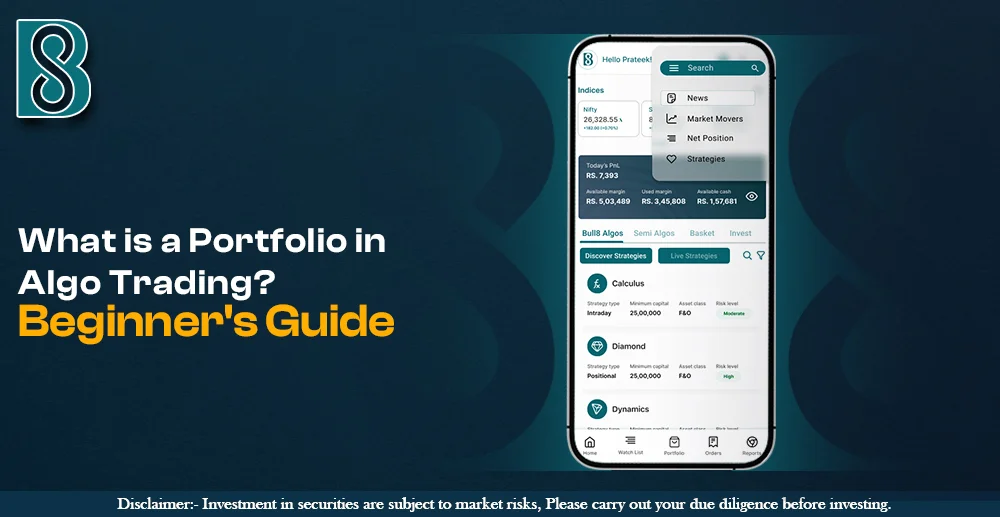
Introduction: Why Portfolio Matters in Algo Trading
Are you trading multiple strategies but still unsure how to manage them together? This is one of the most common problems traders face today. Many traders jump from one trade to another, try different strategies randomly, and still struggle to achieve consistency. The real issue is not the lack of strategies—it is the lack of structure. This is where the concept of a Portfolio in Algo Trading becomes crucial.
In simple terms, a portfolio is a structured collection of strategies, trades, and capital working together toward a common goal—consistent returns with controlled risk. Instead of relying on isolated trades, a portfolio approach ensures that every decision is part of a bigger system.
There is a big difference between random trading and a structured portfolio. Random trading is emotional, inconsistent, and unpredictable. A portfolio, on the other hand, is systematic, rule-based, and designed to balance risk and reward. This shift from randomness to structure is what separates amateur traders from smart traders.
In algo trading, the importance of a portfolio becomes even greater. Since algorithms execute trades based on predefined rules, combining multiple strategies into a portfolio helps diversify risk and improve performance across different market conditions. It also removes emotional interference, ensuring disciplined execution every time.
This is where platforms like Bull8 Algo Trading come into play. Bull8 is designed to help traders build and manage portfolios efficiently using pre-built strategies, automation, and risk control systems. It simplifies complex trading processes into a structured workflow.
The core philosophy remains simple: Trade with structure. Not stress.
In this guide, you will learn everything about Portfolio in Algo Trading—from basic definitions to advanced strategies, real-world examples, risk management techniques, and how to build a smart portfolio using Bull8.
🔹 2. What is a Portfolio in Algo Trading? (Core Definition)
A Portfolio in Algo Trading refers to a collection of multiple trading strategies, assets, and capital allocations managed together through automated systems. Instead of relying on a single trade or strategy, traders use a portfolio approach to distribute risk and improve consistency.
To understand this better, let’s break it down.
A single trade is just one position in the market. It can result in profit or loss based on market movement. However, when you combine multiple trades and strategies, you create a portfolio that works collectively. This reduces dependency on any one outcome.
Now consider the difference between manual trading and algo portfolios. In manual trading, decisions are often influenced by emotions such as fear, greed, or hesitation. Execution can be delayed, leading to missed opportunities. In contrast, an algo portfolio operates based on predefined rules. It executes trades instantly without emotional interference.
A portfolio is not just about holding multiple trades. It includes:
Different strategies
Different assets
Different timeframes
Structured capital allocation
For example:
Strategy A: Intraday options trading
Strategy B: Positional trading
Strategy C: Hedging strategy
Each strategy serves a different purpose. While one captures short-term opportunities, another protects capital, and a third focuses on long-term trends. Together, they create a balanced system.
In simple terms, a portfolio can be understood as:
Portfolio = Basket of strategies working together
This approach ensures that even if one strategy underperforms, others can compensate, maintaining overall stability.
In algo trading, portfolios are even more powerful because execution is automated. Strategies run simultaneously, monitor market conditions, and take actions without delay. This improves efficiency and consistency.
A well-designed Portfolio in Algo Trading is not about maximizing profits in one trade. It is about building a system that generates sustainable returns over time with controlled risk.
🔹 3. Types of Portfolios in Algo Trading
There are multiple ways to structure a Portfolio in Algo Trading, depending on trading style, risk appetite, and market exposure. Understanding these types helps traders design a portfolio that suits their goals.
Strategy-Based Portfolio
This type focuses on combining multiple strategies on the same asset. For example, a trader may use different strategies on Nifty options—one for trending markets, another for sideways markets, and a third for volatility spikes. This ensures that the portfolio performs across different conditions.
Asset-Based Portfolio
Here, diversification is achieved by investing in different asset classes such as equities, options, and commodities. If one market underperforms, another may perform better, balancing overall returns.
Time-Based Portfolio
This portfolio combines strategies based on timeframes. For example:
Intraday strategies for daily income
BTST strategies for short-term moves
Positional strategies for long-term trends
This ensures continuous engagement with the market across time horizons.
Risk-Based Portfolio
In this approach, strategies are divided based on risk levels. Conservative strategies focus on capital protection, while aggressive strategies aim for higher returns. A mix of both creates a balanced portfolio.
Diversified Portfolio
This is a combination of all the above approaches. It includes multiple strategies, assets, and timeframes to create maximum diversification.
Now let’s connect this with Bull8.
Bull8 provides pre-built strategies that fit perfectly into a portfolio structure:
Calculus: Designed for steady income through intraday options
Matrix: A diversified strategy combining multiple logics
Diamond: Focused on Sensex-based opportunities
By combining these strategies, traders can build a strong Portfolio in Algo Trading without needing technical expertise.
Each strategy plays a specific role, ensuring that the portfolio remains balanced, adaptive, and performance-driven.
🔹 4. Why Portfolio is Important in Algo Trading
A Portfolio in Algo Trading is not just a strategy choice—it is a necessity for long-term survival and growth in the market. Many traders fail because they rely on a single strategy or a single trade idea. When that one approach stops working, their entire performance collapses. A portfolio solves this problem by distributing risk and creating stability.
The biggest advantage of a portfolio is risk reduction through diversification. When multiple strategies are running together, losses in one strategy can be offset by gains in another. This reduces the overall impact of market uncertainty. Instead of experiencing sharp ups and downs, traders get a smoother equity curve.
Consistency is another major benefit. Markets do not behave the same way every day. Sometimes they trend strongly, sometimes they move sideways, and sometimes they become highly volatile. A single strategy may only work in one type of market condition. But a portfolio includes strategies designed for different conditions, ensuring performance across all scenarios.
For example, if a trending strategy underperforms during a sideways market, a range-based strategy can generate profits. This balance is what makes a Portfolio in Algo Trading more reliable than single-strategy trading.
Another important factor is better capital utilization. Instead of keeping capital idle or overexposing it to one idea, a portfolio allocates funds across multiple strategies. This ensures that capital is always working efficiently.
One key concept to understand is:
One strategy loss does not mean total portfolio loss.
This is the core strength of portfolio-based trading.
Now let’s look at the Bull8 advantage.
Bull8 is designed to support portfolio-based trading with:
Built-in risk management systems
Multi-strategy execution
Server-based automation for faster execution
With Bull8, traders can run multiple strategies simultaneously without manual intervention. The system ensures disciplined execution and monitors performance continuously.
In simple terms, a Portfolio in Algo Trading transforms trading from a risky activity into a structured process. It provides stability, consistency, and control—three elements that are essential for long-term success.
🔹 5. Key Components of an Algo Trading Portfolio
Building a successful Portfolio in Algo Trading requires more than just selecting strategies. It involves combining multiple components in a structured way to ensure performance and risk control. Each component plays a critical role in determining the overall outcome.
Capital Allocation
Capital allocation is the foundation of any portfolio. It defines how much money is assigned to each strategy. Proper allocation ensures that no single strategy dominates the portfolio or creates excessive risk.
For example, a trader may allocate:
40% to intraday strategies
30% to hedging strategies
30% to momentum strategies
This balanced approach reduces dependency on one strategy.
Strategy Selection
Choosing the right strategies is crucial. Not all strategies work consistently. Traders must select proven, backtested, and reliable strategies that perform well in different market conditions.
A strong Portfolio in Algo Trading includes strategies with different logics, such as trend-following, mean reversion, and hedging.
Risk Management
Risk management is the backbone of portfolio stability. Without it, even the best strategies can fail. Important aspects include:
Stop-loss levels
Maximum drawdown limits
Position sizing rules
These controls ensure that losses are contained and capital is protected.
Diversification
Diversification spreads risk across different strategies, assets, and timeframes. It reduces the impact of any single failure and improves overall performance stability.
A diversified portfolio is always more resilient than a concentrated one.
Execution Speed
In algo trading, execution speed is critical. Even a small delay can impact profitability, especially in fast-moving markets like options trading. Millisecond execution ensures better entry and exit prices.
Now let’s connect this with Bull8.
Bull8 simplifies all these components through automation:
Auto execution of strategies
Built-in risk control systems
No emotional decisions
Server-based speed for better execution
With Bull8, traders do not need to manually manage each component. The platform integrates everything into a seamless system.
A well-structured Portfolio in Algo Trading is not about complexity—it is about clarity, discipline, and system-driven execution.
🔹 6. Portfolio vs Manual Trading: Key Differences
Understanding the difference between manual trading and a Portfolio in Algo Trading is essential for modern traders. The gap between the two approaches is not just about technology—it is about mindset, execution, and consistency.
Let’s break it down in a structured way.
Manual Trading vs Algo Portfolio:
Emotion-driven vs Rule-based
Slow execution vs Millisecond execution
Inconsistent results vs Structured performance
Single trades vs Multi-strategy system
In manual trading, decisions are often influenced by emotions. Traders may hesitate before entering a trade, exit too early due to fear, or hold losses due to hope. These emotional reactions lead to inconsistent results.
On the other hand, an algo portfolio follows predefined rules. Every trade is executed based on logic, not emotions. This ensures discipline and consistency.
Speed is another critical factor. In manual trading, execution depends on human reaction time, which can lead to delays. In fast-moving markets, even a few seconds can result in missed opportunities or poor trade entries.
In contrast, a Portfolio in Algo Trading operates at millisecond speed. Orders are executed instantly, ensuring optimal pricing and reducing slippage.
Consistency is where algo portfolios truly outperform manual trading. Manual traders often struggle to maintain discipline over long periods. They may switch strategies frequently or deviate from their plan.
An algo portfolio eliminates this problem by sticking to a structured system. Multiple strategies run simultaneously, ensuring balanced performance.
Another key difference is scalability. Manual trading limits the number of trades a person can manage. In contrast, an algo portfolio can handle multiple strategies and trades at the same time without any additional effort.
Key insight:
Manual trading me delay = loss
Algo portfolio = speed + discipline
This shift from manual execution to automated portfolio management is what defines modern trading success.
A Portfolio in Algo Trading is not just an upgrade—it is a complete transformation of how trading is approached.
How Portfolio Works in Algo Trading (Step-by-Step)
Understanding how a Portfolio in Algo Trading works is essential for building confidence and clarity. While the concept may sound complex, the actual process becomes simple when broken down into structured steps.
Step 1: Select Strategies
The first step is choosing the right strategies. These strategies should be based on different market behaviors such as trend-following, range trading, or hedging. The goal is to ensure that your portfolio performs in multiple market conditions rather than depending on a single approach.
A strong portfolio typically includes a mix of:
Intraday strategies
Momentum strategies
Hedging strategies
This combination ensures balance and adaptability.
Step 2: Allocate Capital
Once strategies are selected, the next step is allocating capital. Each strategy should receive a portion of the total capital based on its risk level and expected performance.
For example:
40% capital to stable income strategies
30% to hedging strategies
30% to growth-focused strategies
This structured allocation prevents overexposure to any one strategy.
Step 3: Set Risk Parameters
Risk management rules are defined at this stage. This includes:
Stop-loss levels
Maximum drawdown limits
Position sizing
These rules ensure that losses are controlled and the portfolio remains stable even during adverse market conditions.
Step 4: Execute Automatically
This is where algo trading becomes powerful. Once everything is set, the system executes trades automatically based on predefined rules. There is no need for manual intervention, ensuring speed and accuracy.
Step 5: Monitor Performance
Even though execution is automated, monitoring is important. Traders should regularly review performance, check drawdowns, and ensure that strategies are functioning as expected.
Now let’s see how Bull8 simplifies this entire process.
Bull8 follows a simple flow:
Connect broker → Select strategy → Start automation
With Bull8, traders can build and run a Portfolio in Algo Trading without technical complexity. The platform handles execution, risk control, and monitoring, allowing traders to focus on strategy selection and growth.
This step-by-step approach transforms trading into a structured, repeatable system.
🔹 8. Real Example of an Algo Portfolio
To truly understand a Portfolio in Algo Trading, let’s look at a practical example.
Assume a trader has a capital of ₹1,00,000. Instead of using the entire amount in a single strategy, the trader builds a diversified portfolio.
Portfolio Structure:
₹40,000 → Intraday options strategy
₹30,000 → Hedging strategy
₹30,000 → Momentum strategy
Each part of the portfolio serves a different purpose.
Scenario 1: Trending Market
In a strong trending market, momentum strategies perform well. The ₹30,000 allocated to momentum trading generates profits. The intraday strategy may also benefit depending on direction, while the hedging strategy provides protection.
Overall result: Portfolio generates profit with controlled risk.
Scenario 2: Sideways Market
In a range-bound market, momentum strategies may struggle. However, intraday options strategies that capture time decay can perform well. The hedging strategy continues to protect capital.
Overall result: Loss in one strategy is offset by gains in another.
Scenario 3: Volatile Market
During high volatility, markets move unpredictably. Hedging strategies become crucial in protecting capital. Intraday strategies may capture quick opportunities, while momentum strategies may reduce exposure.
Overall result: Portfolio remains stable despite market uncertainty.
This example clearly shows that a Portfolio in Algo Trading is designed to balance outcomes. Instead of relying on one market condition, it adapts to all scenarios.
Now let’s connect this with Bull8.
Bull8 offers strategies like:
Calculus for steady intraday income
Matrix for diversified performance
Diamond for Sensex-based opportunities
By combining these strategies, traders can create a balanced portfolio without manual effort.
The key takeaway is simple:
A well-designed portfolio does not aim to win every trade. It aims to win consistently over time.
Risk Management in Algo Portfolio
Risk management is the most critical part of a Portfolio in Algo Trading. Without proper risk control, even the best strategies can lead to significant losses. Successful traders focus more on protecting capital than chasing profits.
Position Sizing
Position sizing determines how much capital is used in each trade. It ensures that no single trade has a large impact on the overall portfolio. Proper sizing helps maintain balance and prevents excessive losses.
Maximum Drawdown Control
Drawdown refers to the decline in portfolio value from its peak. Setting a maximum drawdown limit ensures that trading stops or adjusts when losses reach a certain level. This prevents further damage to capital.
Stop-Loss Rules
Stop-loss is a predefined level where a trade is exited to limit losses. In algo trading, stop-loss rules are executed automatically, ensuring discipline without emotional interference.
Strategy Correlation
One often overlooked factor is correlation between strategies. If multiple strategies behave similarly, they may all lose at the same time. A strong portfolio includes strategies with low correlation to reduce this risk.
Capital Protection Mindset
The most important principle is:
High returns without risk control = dangerous
Traders must prioritize stability over aggressive profits.
Now let’s see how Bull8 supports risk management.
Bull8 is built with a risk-first approach:
Built-in risk control systems
Automatic stop-loss execution
Continuous monitoring of strategies
Daily performance tracking
These features ensure that traders do not have to manually manage risks. The system enforces discipline at all times.
A well-managed Portfolio in Algo Trading focuses on survival first and growth second. Because in trading, protecting capital is the key to long-term success.
Common Mistakes in Portfolio Building
Building a Portfolio in Algo Trading is powerful, but many traders make critical mistakes that reduce its effectiveness. Understanding these mistakes can help you avoid losses and build a more stable system.
Over-Diversification
Diversification is important, but too much diversification can dilute returns. Adding too many strategies without proper planning leads to confusion and poor performance tracking. A portfolio should be balanced, not overloaded.
Using Untested Strategies
One of the biggest mistakes is including strategies that are not properly tested. Many beginners copy strategies blindly from others without understanding their logic or performance history. This increases risk and reduces reliability.
A strong portfolio should only include:
Backtested strategies
Forward-tested strategies
Proven performance records
No Risk Control
Ignoring risk management is a serious mistake. Without stop-loss rules, drawdown limits, and position sizing, even a good strategy can cause large losses.
A Portfolio in Algo Trading must always have defined risk parameters to protect capital.
Emotional Interference
Even in algo trading, some traders interfere manually when they see temporary losses. They stop strategies early, change settings frequently, or override the system.
This defeats the purpose of automation.
The core principle is:
System-based trading works only when you trust the system.
Ignoring Strategy Correlation
Many traders unknowingly use multiple strategies that behave similarly. When market conditions change, all strategies may lose together. This increases risk instead of reducing it.
A good portfolio includes strategies with different logics and behaviors.
Lack of Monitoring
Although algo trading is automated, it does not mean “set and forget forever.” Traders must review performance regularly and make necessary adjustments.
Beginner Trap
Beginners often chase high returns and ignore risk. They try aggressive strategies without understanding drawdowns.
The result is unstable performance.
A smart Portfolio in Algo Trading is built with discipline, testing, and continuous improvement—not shortcuts.
How Bull8 Helps You Build a Smart Portfolio
Creating and managing a Portfolio in Algo Trading can be complex, especially for beginners. This is where Bull8 simplifies the entire process by providing a structured, user-friendly, and powerful trading ecosystem.
Pre-Built Expert Strategies
Bull8 offers ready-to-use strategies designed by experienced traders and quants. These strategies are built for different market conditions, allowing you to create a diversified portfolio without technical expertise.
Examples include:
Calculus for steady intraday income
Matrix for diversified strategy execution
Diamond for Sensex-based trading
Each strategy plays a unique role in your portfolio.
No Coding Required
One of the biggest barriers in algo trading is coding. Bull8 removes this completely. You can build and run a portfolio without writing a single line of code.
This makes algo trading accessible to everyone—from beginners to experienced traders.
Server-Based Execution
Bull8 uses server-based execution, which means trades are executed even when your device is offline. This ensures uninterrupted trading and faster execution.
Speed matters in trading, and Bull8 ensures millisecond-level performance.
Built-in Risk Control
Risk management is integrated into the system. From stop-loss to drawdown control, Bull8 ensures that your portfolio operates within defined risk limits.
This eliminates emotional decision-making.
Real-Time Monitoring
Bull8 continuously tracks performance, execution quality, and strategy behavior. This helps traders stay informed and make better decisions when needed.
Automation at Its Best
The entire process is simple:
Connect broker → Select strategy → Start automation
Once activated, your portfolio runs automatically.
Key philosophy of Bull8:
Guess mat karo. System follow karo.
Your trading goes on autopilot
Bull8 transforms trading into a structured, disciplined, and efficient process. It empowers traders to build a strong Portfolio in Algo Trading without complexity.
Benefits of Portfolio-Based Algo Trading
A Portfolio in Algo Trading offers multiple advantages that make it superior to traditional trading approaches. These benefits are the reason why more traders are shifting toward portfolio-based systems.
Consistent Returns
A portfolio combines multiple strategies, ensuring that performance is not dependent on a single approach. This leads to more consistent returns over time.
Even if one strategy underperforms, others can compensate.
Reduced Risk
Diversification reduces overall risk. By spreading capital across different strategies and assets, the impact of losses is minimized.
This creates a more stable trading experience.
Better Decision-Making
In a portfolio system, decisions are based on data and rules, not emotions. This improves accuracy and removes impulsive actions.
Traders follow a structured plan instead of reacting to market noise.
Time-Saving
Manual trading requires constant monitoring. A portfolio-based algo system automates execution, saving time and effort.
Traders can focus on strategy improvement instead of watching the market all day.
Emotion-Free Trading
Emotions are one of the biggest challenges in trading. Fear and greed often lead to poor decisions.
A Portfolio in Algo Trading eliminates emotional interference by following predefined rules.
Scalability
A portfolio allows traders to scale their trading without increasing workload. Multiple strategies can run simultaneously without additional effort.
Adaptability
Markets change constantly. A portfolio adapts to different conditions through its diversified structure.
Whether the market is trending, sideways, or volatile, the portfolio remains active and responsive.
Long-Term Stability
The ultimate goal of trading is not short-term gains but long-term growth. A portfolio-based approach ensures stability, discipline, and sustainability.
In summary, a Portfolio in Algo Trading is not just a strategy—it is a smarter way to trade. It combines automation, diversification, and discipline to deliver better results.
Portfolio Optimization Techniques
Building a Portfolio in Algo Trading is just the beginning. To achieve consistent performance, traders must continuously optimize their portfolio. Optimization ensures that the portfolio adapts to changing market conditions and remains efficient over time.
Rebalancing Strategies
Markets evolve, and so should your portfolio. Rebalancing involves adjusting capital allocation between strategies based on performance. If one strategy consistently outperforms, you may increase its allocation. Similarly, underperforming strategies may require reduced exposure.
Regular rebalancing helps maintain the intended risk-return balance.
Performance Tracking
Tracking performance is essential for optimization. Traders should analyze:
Profit and loss trends
Drawdowns
Win-loss ratios
Strategy-specific returns
This data-driven approach helps identify strengths and weaknesses within the portfolio.
Removing Underperforming Strategies
Not all strategies work forever. Market dynamics change, and some strategies may lose their effectiveness. Removing or replacing underperforming strategies is critical to maintaining portfolio efficiency.
A disciplined trader focuses on results, not attachment to strategies.
Adding New Strategies
To keep the portfolio adaptive, traders should introduce new strategies that align with current market conditions. This ensures that the portfolio remains relevant and diversified.
Continuous Improvement
Optimization is not a one-time task—it is an ongoing process. A successful Portfolio in Algo Trading evolves continuously based on data, performance, and market behavior.
With platforms like Bull8, monitoring and optimization become easier through real-time insights and structured execution.
Portfolio vs Single Strategy: Which is Better?
A common question among traders is whether to use a single strategy or a Portfolio in Algo Trading. While a single strategy may seem simple, it comes with significant limitations.
Single Strategy Approach
A single strategy depends entirely on specific market conditions. For example, a trend-following strategy performs well only in trending markets. When conditions change, performance declines.
This creates instability and uncertainty.
Portfolio Approach
A portfolio combines multiple strategies designed for different conditions. This ensures that performance remains balanced regardless of market behavior.
For instance:
Trend strategies perform in directional markets
Range strategies perform in sideways markets
Hedging strategies protect capital during volatility
Together, they create a stable system.
Risk Comparison
A single strategy exposes the trader to concentrated risk. If the strategy fails, the entire capital is affected.
In contrast, a Portfolio in Algo Trading spreads risk across multiple strategies, reducing the impact of any single failure.
Stability Comparison
Portfolios offer smoother equity curves and consistent performance, while single strategies often show high fluctuations.
Final Verdict
While single strategies may deliver short-term gains, they lack long-term reliability.
A portfolio is always safer, more stable, and more scalable.
For serious traders, the choice is clear—a Portfolio in Algo Trading is the smarter approach.
Who Should Use Algo Portfolios?
A Portfolio in Algo Trading is suitable for a wide range of traders and investors. It is not limited to experts—it is designed for anyone looking for structured and disciplined trading.
Beginners
Beginners often struggle with emotional decision-making and lack of experience. A portfolio-based approach helps them follow a structured system without needing deep market knowledge.
With platforms like Bull8, beginners can start with pre-built strategies and gradually learn.
Working Professionals
People with full-time jobs do not have the time to monitor markets continuously. Algo portfolios automate trading, allowing them to participate in the market without constant attention.
Automation ensures that opportunities are not missed.
Full-Time Traders
Even experienced traders benefit from portfolios. Instead of manually managing multiple trades, they can automate execution and focus on strategy development and optimization.
Investors Shifting to Automation
Traditional investors looking to move into active trading can use algo portfolios as a bridge. It combines systematic investing with trading opportunities.
Risk-Conscious Traders
Traders who prioritize capital protection and consistency find portfolio-based trading more reliable than aggressive, single-strategy approaches.
In short, a Portfolio in Algo Trading is ideal for anyone who wants to trade with discipline, efficiency, and long-term focus.
Future of Portfolio-Based Trading in India
The future of Portfolio in Algo Trading in India is rapidly evolving. With increasing awareness, technological advancements, and retail participation, portfolio-based trading is becoming the new standard.
Rise of Algo Trading
Algo trading is no longer limited to institutions. Retail traders are adopting automated systems to improve execution speed and reduce emotional errors.
This shift is driving demand for structured portfolio-based solutions.
Increasing Retail Participation
India has seen massive growth in retail traders over the past few years. As more people enter the market, the need for disciplined and risk-managed trading approaches is increasing.
A portfolio-based system provides exactly that.
Technology-Driven Trading
Advancements in technology are making algo trading more accessible. Platforms are becoming user-friendly, eliminating the need for coding and complex setups.
This allows more traders to adopt portfolio-based trading.
Role of Platforms like Bull8
Platforms like Bull8 are playing a key role in this transformation. By offering:
Pre-built strategies
Automated execution
Built-in risk management
Server-based systems
Bull8 is making it easier for traders to build and manage a Portfolio in Algo Trading.
Shift Toward System-Based Trading
The future belongs to traders who rely on systems, not emotions. Portfolio-based trading aligns perfectly with this shift by combining structure, discipline, and automation.
India’s trading ecosystem is moving toward smarter, technology-driven solutions—and portfolio-based algo trading is at the center of this evolution.
Conclusion
A Portfolio in Algo Trading is not just a concept—it is the foundation of smart and sustainable trading. Throughout this guide, we explored how portfolios bring structure, discipline, and consistency to trading.
Instead of relying on random trades or single strategies, a portfolio approach combines multiple strategies, assets, and risk controls into one cohesive system. This reduces risk, improves performance stability, and ensures long-term growth.
We also saw how portfolio-based trading adapts to different market conditions—whether trending, sideways, or volatile. This adaptability is what makes it superior to traditional trading methods.
Risk management plays a crucial role, ensuring that losses are controlled and capital is protected. Combined with automation, it creates a powerful system that works efficiently without emotional interference.
Platforms like Bull8 make this process simple and accessible. With pre-built strategies, automated execution, and built-in risk management, traders can focus on growth rather than complexity.
The key takeaway is clear:
Stop random trading. Start portfolio-based trading with Bull8.
A well-structured Portfolio in Algo Trading is your path to disciplined, consistent, and stress-free trading.
FAQs
What is a Portfolio in Algo Trading?
A Portfolio in Algo Trading is a structured combination of multiple trading strategies, assets, and capital allocations managed through automated systems. Instead of relying on a single trade, traders use portfolios to diversify risk and improve consistency. It allows different strategies to work together across market conditions, ensuring stability and better performance. This approach removes emotional decisions and creates a disciplined, rule-based trading system for long-term success.
Why is Portfolio in Algo Trading important?
A Portfolio in Algo Trading is important because it reduces risk and improves consistency. By combining multiple strategies, traders avoid dependency on one approach. If one strategy underperforms, others can balance the outcome. This diversification leads to smoother returns and better capital protection. It also ensures structured trading, where decisions are rule-based rather than emotional, making it a more reliable way to trade in dynamic market conditions.
How does Portfolio in Algo Trading reduce risk?
A Portfolio in Algo Trading reduces risk by spreading capital across different strategies, assets, and timeframes. This diversification ensures that losses from one strategy do not significantly impact the overall portfolio. Additionally, built-in risk management tools like stop-loss and drawdown control further protect capital. By balancing different market approaches, a portfolio minimizes volatility and provides more stable performance compared to single-strategy trading.
What are the key components of Portfolio in Algo Trading?
The key components of a Portfolio in Algo Trading include capital allocation, strategy selection, risk management, diversification, and execution speed. Each component plays a vital role in ensuring the portfolio performs efficiently. Proper allocation prevents overexposure, while risk management protects capital. Diversification balances performance, and fast execution ensures better trade entries and exits. Together, these elements create a structured and disciplined trading system.
Can beginners use Portfolio in Algo Trading?
Yes, beginners can easily use a Portfolio in Algo Trading, especially with platforms offering pre-built strategies. It simplifies trading by removing the need for manual decision-making and technical expertise. Beginners can start with a structured approach, reducing emotional errors and improving consistency. With automation handling execution and risk control, new traders can focus on learning while still participating in the market effectively and safely.
What is the difference between single strategy and Portfolio in Algo Trading?
A single strategy depends on specific market conditions, making it risky and inconsistent. In contrast, a Portfolio in Algo Trading combines multiple strategies to handle different scenarios. This ensures stable performance regardless of market movement. While single strategies may give short-term gains, portfolios provide long-term consistency, reduced risk, and smoother returns. This makes portfolio-based trading a more reliable approach for serious traders.
How much capital is required for Portfolio in Algo Trading?
The capital required for a Portfolio in Algo Trading depends on the number of strategies and risk tolerance. Even with a moderate amount, traders can allocate funds across multiple strategies to create a balanced portfolio. The key is proper distribution rather than the total amount. A well-structured portfolio focuses on risk management and diversification, ensuring effective utilization of capital regardless of size.
How often should Portfolio in Algo Trading be updated?
A Portfolio in Algo Trading should be reviewed regularly to ensure optimal performance. Traders should monitor results, track drawdowns, and evaluate strategy effectiveness. Updates may include rebalancing capital, removing underperforming strategies, or adding new ones. However, frequent unnecessary changes should be avoided. The goal is to maintain a stable, data-driven system that adapts to market changes without disrupting overall performance.
Is Portfolio in Algo Trading suitable for working professionals?
Yes, a Portfolio in Algo Trading is ideal for working professionals because it automates trading. With pre-set strategies and rules, trades are executed without constant monitoring. This allows individuals to participate in the market while focusing on their jobs. Automation ensures no missed opportunities and eliminates emotional decisions, making it a convenient and efficient solution for those with limited time.
What are the benefits of Portfolio in Algo Trading?
The main benefits of a Portfolio in Algo Trading include consistent returns, reduced risk, better capital management, and emotion-free execution. It allows traders to run multiple strategies simultaneously, improving adaptability across market conditions. Automation saves time and ensures disciplined execution. Overall, a portfolio approach transforms trading into a structured, scalable, and reliable process for long-term growth.
