
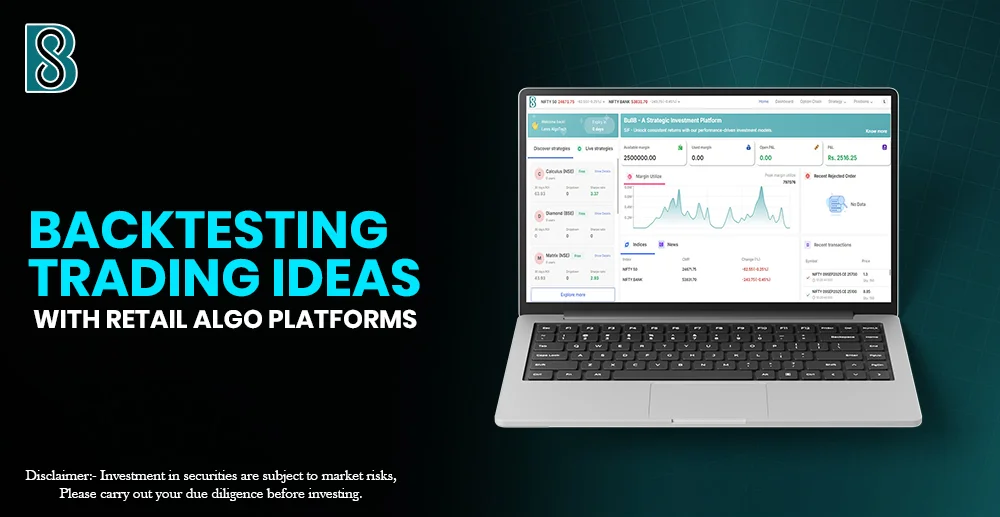
Backtesting Trading Ideas with Retail Algo Platforms
Introduction
Turning a trading idea into rules is only the beginning. Before considering live use, a trader should test those rules against historical data to understand how the strategy might have behaved under different conditions. This process is known as backtesting.
Retail algo platforms have made testing more accessible by bringing strategy creation, historical analysis, and risk controls into a structured environment. However, a backtest is neither a prediction nor a guarantee. It is an evidence-building exercise that helps traders question an idea before putting capital at risk.
This guide explains how backtesting works, what traders should evaluate, and how a retail algo platform such as Bull8 can support a more disciplined strategy-development process.
What Is Backtesting in Algo Trading?
Backtesting is the process of applying predefined trading rules to historical market data. The system checks when the strategy would have generated entry and exit signals, calculates the theoretical outcome of those trades, and produces performance statistics for review.
For example, a trader could test a trend-following idea that enters when a short-term moving average crosses above a longer-term average. The system applies those conditions to past data and records qualifying trades.
A useful backtest should define:
- The instrument or market segment being studied
- Entry and exit conditions
- Position size and capital allocation
- Stop-loss and profit-exit rules
- Trading hours and strategy frequency
- Brokerage, taxes, slippage, and other transaction costs
- The historical period and data interval
Clear rules matter because vague decisions cannot be tested consistently. If a strategy depends on intuition that changes from one trade to the next, its historical result may not be repeatable.
Why Backtesting Trading Ideas Matters
Backtesting helps traders move from assumption to measurable evidence. An idea may sound logical, but its weaknesses often become visible only after it is evaluated across numerous historical situations.
It checks the logic.
A backtest shows whether the rules produced positive, negative, or inconsistent results within the selected dataset. It cannot prove future success, but it can reveal ideas that failed historically.
It Reveals Risk, Not Just Profit
Net profit alone can mislead. A strategy may show a theoretical gain while experiencing an unacceptable drawdown. Testing exposes losing streaks, volatility, and trade concentration.
It Supports Rule Refinement
Testing may reveal that a stop-loss is too narrow, entries are too frequent, or results depend on a few exceptional trades. These findings can guide refinement without repeatedly changing the rules simply to fit past data.
It Encourages Disciplined Decisions
Written rules reduce impulsive reactions by defining entries, exits, and risk responses in advance. This creates a clearer foundation for paper trading and further evaluation.
How Retail Algo Platforms Support Strategy Evaluation
A retail algo platform can replace disconnected spreadsheets, charts, and manual calculations with a unified strategy-research workflow.
Rule-Based Strategy Setup
The first step is translating an idea into objective instructions. A platform may allow users to select instruments, indicators, price conditions, trading windows, order logic, and risk parameters. This makes the strategy easier to test consistently.
Rules must be specific. “Buy when the market looks strong” is not testable; defined price, indicator, and time conditions are. The user remains responsible for ensuring that the logic is coherent and suitable for their requirements.
Access to Historical Testing
Retail algo platforms can apply defined rules across historical data and simulate qualifying trades. This saves time compared with manually reviewing charts and recording hypothetical entries.
Tests should include trending, range-bound, volatile, and relatively quiet market phases. Testing only a favorable period may exaggerate the apparent reliability of a strategy. Data quality, corporate actions, contract changes, and selected candle intervals can also affect results.
Performance Reports and Meaningful Metrics
A responsible strategy evaluation goes beyond final profit. Platforms can present metrics that explain how the result was generated.
Important measurements include:
- Total trades: Indicates whether the test contains a sufficiently meaningful sample.
- Win rate: Shows the percentage of profitable trades but should be reviewed with average profit and average loss.
- Profit factor: Compares the strategy’s gross theoretical profit with its gross theoretical loss.
- Maximum drawdown: Shows the largest historical decline from a peak to a subsequent trough.
- Average gain and loss: Helps traders understand the payoff structure of the strategy.
- Consecutive losses: Highlights the emotional and financial pressure that may occur during an unfavorable period.
- Risk-adjusted performance: Evaluates performance in relation to the volatility or risk taken.
No single metric establishes strategy quality. A high win rate, for example, may hide occasional losses large enough to outweigh numerous small gains.
Transaction-Cost and Slippage Assumptions
Ignoring implementation costs is a common backtesting error. Brokerage, exchange charges, and taxes reduce theoretical results.
Slippage refers to the difference between the expected trade price and the price at which the order is actually filled. It can significantly affect fast or frequently traded strategies.
Liquidity, bid-ask spreads, and order size also matter. Assuming every order will be filled instantly at the displayed price can create an overly optimistic result. Traders should include realistic costs and stress-test the strategy using less favorable slippage assumptions.
Risk-Control Evaluation
Backtesting allows users to study how stop-losses, trailing stop-losses, daily loss limits, capital caps, and time-based exits might have influenced historical behavior.
On Bull8, tools such as stop-loss settings, capital controls, volatility filters, and Go-Flat functionality can support defined operating boundaries. However, these features cannot eliminate market risk, price gaps, execution risk, or technical disruptions.
Common Backtesting Errors Retail Traders Should Avoid
Overfitting Historical Data
An overfitted strategy contains too many parameters that have been tailored to a specific dataset. It may appear highly effective in the backtest but fail when market conditions change.
Traders should prefer understandable rules supported by a defensible market rationale instead of excessively optimized models.
Using a Short or Favorable Test Period
A short historical period rarely represents the full range of market behavior. Traders should use broader data and examine the strategy separately across bullish, bearish, sideways, and volatile market conditions.
Look-Ahead and Survivorship Bias
Look-ahead bias occurs when a backtest uses information that would not have been available when the simulated trading decision was made.
Survivorship bias occurs when the dataset excludes instruments that disappeared, were delisted, or became inactive. Both problems can make historical results appear stronger than they actually were.
Ignoring Execution Realities
Illiquidity, rapid price movements, gaps, partial fills, latency, and system availability can make live outcomes different from theoretical results. These factors must be considered before a strategy is used in live markets.
Treating a Backtest as a Forecast
Regulations, volatility, liquidity, market participation, and price relationships can change. Backtesting is a decision-making filter, not a certainty engine or prediction of future performance.
A Practical Strategy-Evaluation Workflow
Retail traders can follow this structured process:
Write the hypothesis: Explain why the trading idea may have a logical or behavioural basis.
Define exact rules: specify entries, exits, instruments, timings, position sizing, and risk limits.
Select appropriate data: Use a relevant timeframe and include different market environments.
Add realistic costs: account for applicable charges, bid-ask spreads, and conservative slippage assumptions.
Review multiple metrics: study drawdowns, losing streaks, trade distribution, and stability—not only the final outcome.
Validate separately: test the strategy using out-of-sample data that was not involved in developing or optimising the rules.
Stress-test the strategy: Examine what happens when transaction costs rise, entries are delayed, or market volatility changes.
Use paper trading: observe the strategy in current market conditions without immediately putting capital at risk.
Monitor cautiously: if the strategy is eventually used live, apply suitable limits and compare its actual behaviour with the backtest.
How Bull8 Helps Retail Traders Evaluate Ideas
Bull8 brings strategy automation, semi-automated execution, basket trading, backtesting, and monitoring tools together within a retail algo trading platform. Users can explore rule-based trading ideas, assess their historical behaviour, and monitor relevant positions, orders, and P&L through a unified interface.
Backtesting helps users inspect a strategy before considering deployment, while risk-management features can support defined operating limits. Nevertheless, the responsibility for selecting assumptions, interpreting results, and determining whether a strategy suits an individual’s objectives and risk tolerance remains with the trader.
Frequently Asked Questions
Can a profitable backtest guarantee profitable live trading?
No. A backtest describes theoretical historical behaviour under specified assumptions. Live results can differ because of changing market conditions, liquidity, slippage, execution timing, transaction costs, and technical issues.
How much historical data should traders use?
There is no universal period. The dataset should cover varied market conditions and provide a meaningful number of trades. The appropriate duration also depends on the instrument, timeframe, and strategy frequency.
What is out-of-sample testing?
Out-of-sample testing evaluates the strategy using historical data that was excluded from rule development. It helps indicate whether the logic is reasonably robust or simply fitted to the original dataset.
Conclusion
Backtesting trading ideas gives retail traders a structured way to examine strategy logic, risk, and historical consistency before considering real-market use. Retail algo platforms make this process more accessible by combining rule creation, historical testing, performance reports, and risk settings within one workflow.
The value of a backtest depends on the quality of its rules, data, and assumptions. Traders should include realistic costs, evaluate different market conditions, avoid overfitting, and follow historical testing with out-of-sample validation and paper trading.
When used responsibly, Bull8 can support this disciplined evaluation process while helping retail traders keep their strategy decisions organized, measurable, and risk-aware.
Disclaimer: This content is for educational purposes only and does not constitute investment advice or a recommendation to buy or sell any security. Trading and algorithmic strategies involve market, execution, and technology risks. Historical or simulated results do not guarantee future performance.
