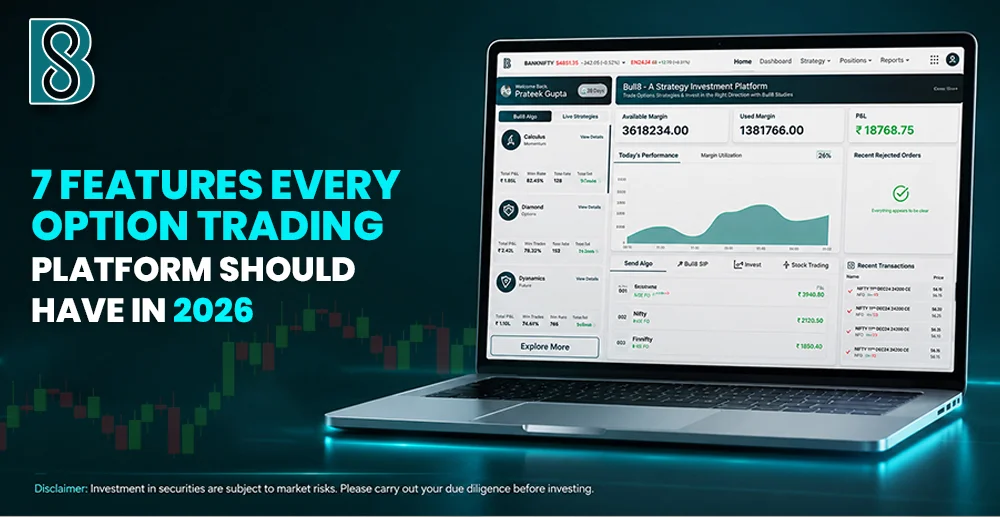
7 Features Every Option Trading Platform Should Have in 2026.jpg
Introduction
The popularity of options trading in India has grown rapidly over the past few years. Improved internet connectivity, greater financial awareness, and easy access to technology have encouraged more retail traders to participate in the derivatives market. At the same time, the expectations from an option trading platform have changed dramatically.
Today’s traders are not just looking for a platform to place buy or sell orders. They expect fast execution, automated trading capabilities, advanced risk management, real-time analytics, and a user-friendly interface that helps them make informed decisions.
Whether you are a beginner exploring options trading or an experienced trader looking to automate your strategies, selecting the right option trading platform can significantly impact your trading performance.
In this comprehensive guide, we’ll explore the seven essential features every option trading platform should offer in 2026 and explain why these features matter for consistent and disciplined trading.
Why Choosing the Right Option Trading Platform Matters
A Retail trading platform is more than just software. It serves as the foundation of your entire trading experience.
A reliable platform helps you:
Execute trades quickly
Reduce manual errors
Manage trading risks effectively
Monitor portfolio performance
Save time through automation
Maintain discipline during volatile markets
In contrast, a slow or outdated platform can lead to delayed executions, missed opportunities, and poor trading outcomes.
As competition in the financial markets continues to grow, traders increasingly rely on technology to gain an edge.
Feature 1: Fast and Reliable Order Execution
One of the most important features of any option trading platform is execution speed.
Options prices can change within seconds, especially during market openings, major news announcements, or expiry sessions. Even a slight delay in execution may impact entry price, exit price, and overall profitability.
A high-quality platform should provide the following:
Low-latency execution
Stable order routing
Minimal order delays
High server reliability
Smooth performance during market volatility
Fast execution becomes particularly important for strategies such as the following:
Scalping
Intraday option buying
Option selling
Expiry trading
Momentum trading
When your platform responds instantly, you gain better control over your trades and reduce the chances of slippage.
Remember, in options trading, every second matters.
Feature 2: No-Code Automated Trading
Automation has transformed the way retail traders participate in the stock market.
Modern traders increasingly prefer automated option trading because it removes emotional decision-making and improves execution consistency.
The ideal option trading software should allow traders to automate strategies without requiring programming knowledge.
Look for features such as the following:
One-click strategy activation
Ready-to-use trading strategies
Rule-based execution
Automatic entry and exit
Strategy scheduling
Real-time monitoring
No-code automation allows beginners and professionals alike to trade systematically without writing complex algorithms.
Instead of manually monitoring charts all day, traders can allow predefined rules to execute trades automatically.
This helps reduce stress while improving consistency.
Feature 3: Advanced Risk Management Tools
Successful traders understand that protecting capital is more important than chasing profits.
A professional option trading platform should include multiple built-in risk management features.
These include:
Stop Loss
Automatically exits trades when losses reach a predefined level.
Trailing Stop Loss
Protects profits while allowing winning trades to continue.
Daily Loss Limits
Stops trading after reaching a specified daily loss amount.
Capital Allocation
Allows traders to control how much capital is deployed in each strategy.
Auto Square-Off
Automatically closes positions before market close if required.
Emergency Kill Switch
Immediately exits all open positions during unexpected market conditions.
Risk management tools help traders remain disciplined and avoid emotional decisions during highly volatile sessions.
No trading strategy can eliminate losses completely, but proper risk management can significantly improve long-term consistency.
Feature 4: Multiple Strategy Support
Markets constantly change.
A strategy that performs well in trending markets may struggle during sideways conditions.
Therefore, every best-option trading platform should allow traders to run multiple strategies simultaneously.
Examples include:
Option Buying
Option Selling
Iron Condor
Straddle
Strangle
Calendar Spread
Directional Strategies
Hedging Strategies
Running multiple strategies helps diversify risk rather than depending on a single setup.
Professional traders often allocate capital across different approaches instead of relying on one trading method.
An advanced platform should also allow independent monitoring of each strategy’s performance.
This makes portfolio management significantly easier.
Feature 5: Live Performance Dashboard and Analytics
Modern trading is driven by data.
A professional option trading platform should provide a comprehensive dashboard showing real-time trading insights.
Useful analytics include:
Live Profit & Loss
Daily Performance
Weekly Reports
Monthly Reports
Win Rate
Average Profit
Average Loss
Risk-Reward Ratio
Drawdown Analysis
Trade History
These reports help traders evaluate what is working and identify areas for improvement.
Without performance tracking, traders often repeat the same mistakes because they lack measurable insights.
Regular analysis supports better decision-making and encourages disciplined trading habits.
Feature 6: Simple and User-Friendly Interface
Powerful technology should also be easy to use.
Many traders avoid complicated platforms filled with unnecessary features.
A user-friendly interface allows traders to focus on strategy rather than figuring out complicated software.
This is especially valuable for beginners entering the world of options trading.
Simple design improves productivity while reducing operational errors.
Feature 7: Strong Security and Reliable Infrastructure
Financial data security should never be compromised.
A trusted option trading platform in India must invest in secure technology and reliable infrastructure.
Important security features include:
Secure login authentication
Two-factor authentication (2FA)
Encrypted communication
Secure cloud infrastructure
Protected APIs
Regular security updates
Reliable server uptime
Strong security protects trading accounts, personal information, and financial transactions from unauthorised access.
Reliable infrastructure also ensures that the platform remains available during high market activity.
Downtime during trading hours can result in missed opportunities and unnecessary risks.
Bonus Features That Add Even More Value
While the seven core features are essential, many modern traders also look for additional capabilities that improve convenience and efficiency.
Some valuable additions include:
Broker integration
Cloud-based trading
Paper trading environment
Strategy templates
Backtesting tools
Mobile trading support
Portfolio analytics
Instant alerts
Trade notifications
Multi-device synchronization
These features make trading more flexible and help traders continuously improve their performance.
Common Mistakes Traders Make When Choosing an Option Trading Platform
Many traders choose a platform based only on pricing.
However, lower costs do not always translate into better trading experiences.
Some common mistakes include:
Ignoring Execution Speed
A slow platform can impact entry and exit prices.
Choosing Only Based on Brokerage
Technology often matters more than marginal broking savings.
No Risk Controls
Platforms without robust risk management expose traders to unnecessary losses.
Complex User Interface
Difficult software reduces efficiency and increases the likelihood of mistakes.
Lack of Automation
Manual execution often introduces emotional decision-making.
Poor Customer Support
Reliable support becomes critical when technical issues arise during market hours.
Selecting a platform should involve evaluating technology, reliability, ease of use, and safety—not just pricing.
Why Bull8 Is Designed for Modern Retail Traders
Retail traders today expect technology that simplifies trading while providing professional-level capabilities.
Bull8 is built with these expectations in mind.
The platform focuses on delivering an efficient trading experience through features such as the following:
Plug-and-play strategy deployment
No-code automated trading
Multiple strategy execution
Built-in risk management tools
Live performance tracking
User-friendly interface
Real-time monitoring
Fast order execution support
Instead of requiring traders to build complex algorithms, Bull8 enables users to deploy and manage strategies with minimal effort.
Whether you are beginning your options trading journey or looking to streamline your existing workflow, Bull8 offers technology designed to support disciplined and systematic trading.
Who Can Benefit from Bull8?
Bull8 is suitable for a wide range of market participants, including the following:
Beginners exploring options trading
Working professionals with limited trading time
Retail traders seeking automation
Traders who prefer rule-based execution
Option buyers
Option sellers
Experienced traders managing multiple strategies
Its intuitive interface and automation capabilities make it accessible to users with varying levels of market experience.
The Future of Option Trading Platforms
The next generation of trading platforms will continue to evolve through technology.
Some major trends shaping the future include:
Artificial intelligence-driven analytics
Smarter automation
Enhanced risk management
Cloud-based infrastructure
Faster execution systems
Personalized trading dashboards
Advanced portfolio insights
Mobile-first trading experiences
As technology advances, traders will increasingly rely on intelligent platforms that simplify execution while improving consistency and discipline.
Conclusion
Choosing the right option trading platform is one of the most important decisions a trader can make. While attractive pricing may catch your attention, long-term success depends on technology, execution quality, automation, and effective risk management.
The seven features discussed in this guide—fast order execution, no-code automation, advanced risk controls, multiple strategy support, performance analytics, user-friendly design, and strong security—form the foundation of a reliable trading platform.
Platforms such as Bull8combine these essential capabilities to help retail traders trade more systematically and efficiently. By leveraging automation, built-in risk management, and an intuitive user experience, traders can focus on strategy and discipline rather than manual execution.
As the Indian options market continues to evolve, selecting a modern, feature-rich platform can help traders stay prepared for changing market conditions and build a more consistent trading journey.
Introduction: Why Index Options Are So Popular in India
Every day, lakhs of traders actively participate in trading Nifty and Bank Nifty options, yet only a small percentage truly understand how these instruments work. Over the last decade, India has witnessed a massive surge in derivatives trading, particularly in index options. This rise has been fueled by increased retail participation, easy access to trading platforms, and the appeal of high returns with relatively small capital.
Index options dominate trading volumes on the National Stock Exchange because they offer high liquidity, tight bid-ask spreads, and consistent price movement. Unlike individual stock options, index options are less prone to sudden company-specific shocks, making them more predictable for strategy-based trading. The introduction of weekly expiries has further accelerated participation, as traders now get multiple opportunities within a single month to capture short-term market movements.
The boom in retail trading, especially post-2020, has made index options a preferred choice for both beginners and experienced traders. However, the fast-moving nature of options trading also brings significant risks. Prices can change within seconds, and even a small delay in execution can lead to missed opportunities or losses.
This is where platforms like Bull8play a crucial role. In a market where milliseconds matter, manual trading often falls short due to human limitations such as delayed reactions and emotional decision-making. Automation helps traders execute strategies with precision, discipline, and speed—something that is critical in the options segment.
In this blog, you will learn everything about how stock index options work in India, including Nifty and Bank Nifty, key terminologies, strategies, risk management, and how automation is transforming the way traders approach this market.
What Are Stock Index Options?
Stock index options are derivative instruments whose value is derived from an underlying stock index such as Nifty 50 or Bank Nifty. Instead of trading individual stocks, traders take positions based on the overall movement of a group of stocks represented by an index. These instruments allow traders to speculate on market direction, hedge existing portfolios, or generate income through various strategies.
One of the key differences between stock options and index options is that stock options are based on individual companies, while index options are based on a basket of stocks. This means index options are less affected by company-specific news such as earnings announcements or management changes, making them relatively more stable in terms of behavior.
Another important feature of index options in India is that they are cash-settled. Unlike some stock derivatives where physical delivery of shares may occur, index options do not involve buying or selling actual stocks. Instead, profits or losses are settled in cash based on the difference between the strike price and the final settlement price of the index.
For example, if a trader buys a Nifty call option and the index rises above the strike price at expiry, the trader earns the difference in cash. Similarly, if the market moves against the position, the loss is limited to the premium paid.
The two most popular index options in India are Nifty 50 and Bank Nifty. Nifty represents the top 50 companies across sectors, while Bank Nifty focuses specifically on major banking stocks. Both indices are highly liquid and actively traded, making them ideal for intraday and short-term strategies.
Traders prefer index options because of their high liquidity, predictable movement patterns, and the availability of multiple strike prices. Additionally, the leverage offered by options allows traders to control larger positions with relatively small capital, making it attractive for retail participants.
Understanding Nifty & Bank Nifty Index
To effectively trade index options, it is essential to understand the underlying indices—Nifty 50 and Bank Nifty. These indices serve as benchmarks for the Indian stock market and reflect the overall performance of specific segments of the economy.
Nifty 50 is a broad market index that consists of the top 50 companies listed on the National Stock Exchange across various sectors such as IT, banking, FMCG, energy, and pharmaceuticals. It is considered a representation of the overall Indian economy. Due to its diversified nature, Nifty tends to move in a relatively stable and balanced manner compared to sector-specific indices.
On the other hand, Bank Nifty is a sectoral index that includes the most liquid and large-cap banking stocks in India. Since banking stocks are highly sensitive to economic changes, interest rates, and policy decisions by the Reserve Bank of India, Bank Nifty tends to be more volatile than Nifty.
This difference in volatility plays a crucial role in trading decisions. Nifty is often preferred by beginners because its movements are smoother and less aggressive. It provides a more controlled environment for learning options trading. Bank Nifty, however, is favored by experienced traders who seek larger price swings and higher profit potential within a short period.
For example, a typical intraday movement in Nifty might range between 100–200 points, while Bank Nifty can move 300–600 points or more in a single session. This higher volatility makes Bank Nifty more attractive for aggressive strategies but also increases the risk significantly.
The choice between Nifty and Bank Nifty depends on a trader’s risk appetite, experience level, and trading strategy. Conservative traders and beginners may find Nifty more suitable, while those comfortable with rapid market movements often prefer Bank Nifty.
Understanding how these indices behave is the foundation of successful index options trading. It helps traders select the right strategies, manage risk effectively, and align their trades with market conditions.
How Options Work: Call vs Put Explained
To understand index options trading, it is essential to first grasp how options actually work. At the core, options are contracts that give the buyer the right, but not the obligation, to buy or sell an underlying asset (in this case, an index like Nifty or Bank Nifty) at a predetermined price within a specific time frame.
There are two primary types of options: Call Options and Put Options.
A Call Option represents a bullish view. When a trader expects the market to rise, they buy a call option. For example, if Nifty is currently trading at 22,000 and a trader believes it will go up, they might buy a 22,100 Call Option (CE). If the market moves above 22,100, the value of that option increases, and the trader can book a profit by selling it at a higher premium.
A Put Option, on the other hand, represents a bearish view. When a trader expects the market to fall, they buy a put option. For instance, if Nifty is at 22,000 and the trader expects it to drop, they might buy a 21,900 Put Option (PE). If the market falls below that level, the option gains value.
Every option contract has three key components:
Strike Price: The price at which the contract can be exercised.
Premium: The price paid to buy the option.
Expiry Date: The date on which the contract becomes invalid.
Let’s take a simple example. Suppose you buy a Nifty 22,100 Call Option at a premium of ₹100. If the premium rises to ₹150 due to market movement, you make a profit of ₹50 per lot. If the market does not move in your favor, your maximum loss is limited to the premium paid.
This limited risk but potentially high reward structure is what makes options attractive. However, it also requires proper timing and understanding because options lose value as they approach expiry due to time decay.
Understanding how call and put options behave is the foundation of all options strategies. Without this clarity, traders often take positions without knowing the risk involved, leading to losses.
Key Terminologies Every Trader Must Know
Before diving deeper into index options trading, it is important to understand the key terminologies that define how options behave in the market. These terms are not just theoretical—they directly impact trading decisions and outcomes.
One of the most important concepts is ITM, ATM, and OTM.
In-the-Money (ITM): An option is considered ITM when it has intrinsic value. For example, if Nifty is at 22,000, a 21,900 Call Option is ITM because it already has value.
At-the-Money (ATM): This is when the strike price is closest to the current market price. If Nifty is at 22,000, then the 22,000 strike is ATM.
Out-of-the-Money (OTM): These options have no intrinsic value. For example, a 22,200 Call Option when Nifty is at 22,000 is OTM.
Another key concept is Intrinsic Value vs Time Value. Intrinsic value is the real value of an option based on its position relative to the strike price. Time value is the extra premium traders are willing to pay for the possibility of future movement. As expiry approaches, time value decreases—a phenomenon known as time decay.
Open Interest (OI) refers to the total number of outstanding contracts in the market. It helps traders understand where major positions are built and can indicate support and resistance levels.
Volume represents the number of contracts traded during a session. High volume indicates strong participation and liquidity.
Implied Volatility (IV) is one of the most critical factors in options pricing. It reflects the market’s expectation of future volatility. Higher IV leads to higher premiums, while lower IV results in cheaper options.
Lot size is another practical factor. In index options, trading is done in fixed lot sizes. For example, Nifty and Bank Nifty have predefined lot sizes that determine the minimum quantity for trading. This directly affects capital requirements.
The Bid-Ask Spread is the difference between the buying price and selling price of an option. A narrow spread indicates high liquidity, while a wider spread can increase trading costs.
Understanding these terminologies is essential because they influence every decision—from selecting the right strike price to timing entry and exit. Traders who ignore these factors often make uninformed decisions, while those who master them gain a significant edge in the market.
Expiry System in India: Weekly vs Monthly
The expiry system is a crucial aspect of index options trading in India. It defines the lifespan of an option contract and plays a major role in determining price behavior, volatility, and strategy selection.
In India, index options have both weekly and monthly expiries. Weekly expiry contracts expire every week, typically on a fixed weekday assigned to each index. These contracts have become extremely popular among traders because they offer frequent opportunities to capture short-term market movements.
Monthly expiry, on the other hand, occurs once a month and represents a longer-duration contract. These are generally preferred by traders who want to hold positions for a longer time frame or use strategies that require more time for execution.
One of the key reasons weekly expiries are so popular is the rapid time decay. As expiry approaches, the premium of options decreases quickly, especially for out-of-the-money options. This creates opportunities for both buyers and sellers, depending on their strategies.
Expiry day is often characterized by high volatility. Prices can move sharply due to position unwinding, institutional activity, and last-minute adjustments. This makes expiry trading both highly rewarding and extremely risky.
For example, option sellers often benefit from time decay as premiums erode rapidly on expiry day. On the other hand, option buyers look for sharp directional moves to capture quick profits.
Strategy selection also changes based on expiry. Early in the week, traders may prefer directional trades with more time value. As expiry approaches, strategies like scalping, straddles, or intraday trades become more common.
Understanding the expiry system helps traders align their approach with market behavior. It allows them to choose the right contracts, manage time decay effectively, and avoid unnecessary risks.
In fast-moving markets, especially during expiry, timing becomes critical. This is where automated execution and disciplined strategies can make a significant difference, as even a small delay can impact profitability.
How Profit & Loss Works in Index Options
Understanding how profit and loss works in index options is essential before placing any trade. Unlike equity trading, where profits depend directly on price movement, options trading is influenced by multiple factors such as premium, time decay, volatility, and direction.
In options trading, you do not buy the index itself—you buy a contract at a certain premium. This premium is the price you pay to enter the trade, and it represents your maximum risk if you are an option buyer.
Let’s take a simple example. Suppose you buy a Nifty Call Option at a premium of ₹100. If the premium increases to ₹150, your profit is ₹50 per unit. If the lot size is 50, your total profit becomes ₹2,500. On the other hand, if the premium falls to ₹60, your loss is ₹40 per unit, or ₹2,000 per lot.
This structure makes options attractive because the risk is limited to the premium paid, but the profit potential can be significantly higher if the market moves strongly in your favor.
However, options are not just about direction. Even if the market moves slightly in your favor, you may still not make money if the movement is not fast enough. This is due to time decay, which reduces the premium value as expiry approaches. Therefore, timing plays a crucial role in profitability.
Leverage is another important aspect. With a relatively small amount of capital, traders can control a large position. While this increases profit potential, it also amplifies risk. A small unfavorable move can lead to a significant percentage loss on your capital.
For option sellers, the profit mechanism is different. Sellers receive the premium upfront and benefit if the option expires worthless. However, their risk can be unlimited if the market moves sharply against them.
In summary, profit and loss in index options depend on premium movement, not just index movement. Traders must consider direction, speed, volatility, and timing to succeed.
Why Most Beginners Lose Money in Options Trading
Despite the popularity of index options, a large number of beginners consistently lose money in this segment. The primary reason is not the complexity of the market, but the lack of understanding and discipline.
One of the biggest mistakes beginners make is entering trades without proper knowledge. Many traders jump into options trading after seeing quick profits on social media or hearing success stories, without understanding how options pricing works. This leads to unrealistic expectations and poor decision-making.
Overtrading is another major issue. Beginners often take multiple trades in a single day, trying to recover losses or chase profits. This not only increases transaction costs but also leads to emotional exhaustion and poor judgment.
Emotional decision-making plays a significant role in losses. Fear and greed drive most trading mistakes. Traders exit profitable trades too early due to fear, while holding onto losing positions in the hope of recovery. This behavior disrupts consistency and leads to long-term losses.
Another common problem is trading without a defined strategy. Successful trading requires a clear plan, including entry, exit, stop loss, and position size. Beginners often trade randomly based on market noise or tips, which results in inconsistent outcomes.
Ignoring risk management is perhaps the most critical mistake. Many traders risk a large portion of their capital on a single trade, hoping for high returns. When the trade goes wrong, it leads to significant losses that are difficult to recover.
Late entries and early exits further compound the problem. Traders often enter trades after a major move has already happened, reducing profit potential. At the same time, they exit too soon due to lack of confidence, missing out on larger gains.
To succeed in options trading, traders must focus on learning, discipline, and risk management rather than quick profits. Consistency comes from following a structured approach, not from impulsive decisions.
Popular Index Option Strategies
Index options trading offers a wide range of strategies that cater to different market conditions and risk appetites. Understanding these strategies helps traders move beyond guesswork and adopt a more structured approach.
One of the most common strategies is intraday scalping. This involves taking quick trades based on short-term price movements. Traders aim to capture small profits multiple times during the day. This strategy requires fast execution, strict discipline, and the ability to react quickly to market changes.
Option buying strategies are popular among beginners. These involve buying call or put options based on market direction. For example, if a trader expects the market to rise, they buy a call option. If they expect a fall, they buy a put option. While the risk is limited to the premium paid, consistent profits require accurate timing and strong directional conviction.
Option selling is a more advanced strategy. In this approach, traders sell options to earn premium income. Since options lose value over time, sellers benefit from time decay. However, this strategy carries higher risk, especially during sharp market movements, and requires proper risk management.
The straddle strategy involves buying both a call and a put option at the same strike price. This is used when a trader expects a big move in the market but is unsure of the direction. If the market moves significantly in either direction, one of the options generates profit.
The strangle strategy is similar to a straddle but involves buying options at different strike prices—one out-of-the-money call and one out-of-the-money put. This reduces the cost compared to a straddle but requires a larger market move to be profitable.
Iron Condor is a popular strategy for range-bound markets. It involves selling out-of-the-money call and put options while simultaneously buying further out-of-the-money options to limit risk. This strategy benefits when the market stays within a specific range.
Trend-based strategies focus on trading in the direction of the market trend. Traders use technical indicators and price action to identify trends and enter positions accordingly. These strategies work well in strong trending markets.
Range-bound strategies are used when the market is moving sideways. Traders aim to profit from small price movements within a defined range using strategies like selling options or using spreads.
Each strategy has its own risk and reward profile. The key to success is choosing the right strategy based on market conditions rather than forcing a single approach in all situations. Discipline, risk management, and consistency are essential for long-term profitability.
In fast-moving options markets, especially during intraday trading, execution speed and precision become critical. This is where structured systems and automation can significantly improve performance by ensuring trades are executed exactly as planned without emotional interference.
Role of Volatility in Nifty & Bank Nifty Trading
Volatility is one of the most important factors in index options trading, yet it is often misunderstood by beginners. In simple terms, volatility refers to the rate at which the price of an index moves up or down. Higher volatility means larger price swings, while lower volatility indicates relatively stable movement.
In the context of Nifty and Bank Nifty, volatility plays a direct role in determining option premiums. When volatility increases, option premiums rise because the probability of larger price movements increases. Conversely, when volatility decreases, premiums tend to fall.
Bank Nifty is generally more volatile than Nifty because it is concentrated in a single sector—banking. Banking stocks react quickly to economic data, interest rate decisions, and policy announcements. As a result, Bank Nifty often shows sharp intraday movements, making it attractive for traders seeking high momentum opportunities.
Volatility is also influenced by external factors such as global market trends, geopolitical events, inflation data, and decisions by the Reserve Bank of India. For example, on RBI policy days or major global announcements, volatility tends to spike, leading to rapid changes in option premiums.
Implied Volatility (IV) is a key metric used by traders to assess expected future volatility. High IV indicates that the market expects significant movement, which results in expensive options. Low IV suggests a calmer market, where options are relatively cheaper.
Trading strategies often depend on volatility conditions. In high volatility environments, traders may prefer option selling strategies to benefit from premium decay. In low volatility conditions, option buying strategies may be more effective if a breakout is expected.
Understanding volatility helps traders avoid common mistakes such as buying options when premiums are already expensive or selling options when risk is high. It also allows traders to align their strategies with market conditions.
In fast-moving markets, reacting to volatility changes in real time is critical. Delayed decisions can lead to missed opportunities or unexpected losses, highlighting the importance of speed and discipline in options trading.
How Algo Trading Is Changing Index Options Trading
Index options trading has evolved significantly with the introduction of algorithmic trading. Traditionally, traders relied on manual execution, which involved analyzing charts, identifying opportunities, and placing trades manually. However, in a market where prices change within seconds, this approach often leads to delays and emotional decision-making.
One of the biggest challenges in manual trading is execution speed. Even a delay of a few seconds can result in entering a trade at a worse price, especially in highly volatile instruments like Bank Nifty. This slippage can significantly impact profitability over time.
Another major issue is emotional bias. Fear, greed, hesitation, and overconfidence often influence trading decisions. Traders may exit profitable trades too early or hold losing positions for too long, leading to inconsistent results.
Algorithmic trading addresses these challenges by automating the entire trading process. Instead of manually placing trades, traders can use predefined rules and strategies that execute automatically when certain conditions are met.
Platforms like Bull8 are designed to bring institutional-grade trading capabilities to retail traders. With pre-built strategies, traders do not need to develop complex algorithms or have coding knowledge. These strategies are designed based on market behavior and are tested across different conditions.
Automation ensures that trades are executed instantly, without delay. This is particularly important in options trading, where milliseconds can make a difference between profit and loss. Real-time execution helps traders capture opportunities that may be missed in manual trading.
Another key advantage is consistency. Automated systems follow predefined rules without deviation, eliminating emotional interference. This leads to more disciplined trading and better long-term results.
Bull8 also offers mobile-based control, allowing traders to monitor and manage their strategies from anywhere. This flexibility is especially useful for working professionals who cannot constantly monitor the market.
Risk management is another area where algorithmic trading excels. Automated systems can incorporate stop losses, position sizing, and capital allocation rules, ensuring that risk is controlled at all times.
Backtesting is an important feature that allows traders to test strategies on historical data before deploying them in live markets. This helps in understanding how a strategy performs under different market conditions.
In summary, algorithmic trading is transforming index options trading by improving speed, accuracy, and discipline. It allows traders to move from reactive decision-making to systematic execution, which is essential in today’s fast-paced markets.
Manual Trading vs Algo Trading in Options
The debate between manual trading and algorithmic trading is becoming increasingly relevant as more traders enter the options market. Both approaches have their advantages, but the differences become significant in high-speed environments like index options trading.
Manual trading relies on human judgment. Traders analyze charts, interpret market conditions, and make decisions based on their experience and intuition. While this approach allows flexibility, it also introduces emotional bias and inconsistency.
Algorithmic trading, on the other hand, is rule-based. Trades are executed automatically based on predefined conditions. This eliminates emotional interference and ensures that every trade follows a consistent strategy.
One of the biggest differences between the two approaches is speed. Manual traders may take several seconds to analyze and execute a trade, while algorithmic systems can execute orders instantly. In options trading, where prices can change rapidly, this speed advantage is critical.
Accuracy is another important factor. Manual trading is prone to errors such as incorrect order placement or delayed execution. Algorithmic systems minimize these errors by following precise instructions.
Emotion control is where algorithmic trading has a clear edge. Human traders often struggle with fear and greed, which leads to poor decision-making. Automated systems operate without emotions, ensuring disciplined execution.
Consistency is another key advantage. Manual traders may deviate from their strategies based on market conditions or personal bias. Algorithmic trading ensures that the strategy is followed exactly as planned.
However, it is important to note that algorithmic trading is not a guaranteed profit system. The effectiveness of automation depends on the quality of the strategy and proper risk management.
For retail traders, platforms like Bull8 bridge the gap by offering easy-to-use, pre-built strategies that do not require coding knowledge. This makes algorithmic trading accessible to a wider audience.
In conclusion, while manual trading may work for experienced traders, the growing complexity and speed of the options market make algorithmic trading a more efficient and reliable approach for most participants.
Risk Management in Index Options Trading
Risk management is the foundation of long-term success in index options trading. While strategies and market knowledge are important, it is risk control that ultimately determines whether a trader survives and grows or faces consistent losses.
One of the most essential tools in risk management is the stop loss. A stop loss helps limit losses by automatically exiting a trade when it reaches a predefined level. In options trading, where premiums can drop rapidly, not using a stop loss can result in significant capital erosion within minutes.
Position sizing is another critical factor. Traders must decide how much capital to allocate to each trade. A common mistake among beginners is risking a large portion of their capital on a single trade in pursuit of quick gains. A disciplined approach involves allocating only a small percentage of capital per trade, ensuring that a single loss does not impact overall portfolio health.
Capital allocation goes hand in hand with position sizing. Instead of deploying the entire capital in one strategy or one index, traders should diversify across multiple trades or strategies. This reduces the overall risk and helps balance losses and profits.
Avoiding all-in trades is crucial. Options trading involves leverage, which can amplify both profits and losses. Going all-in on a single position increases the probability of large losses, especially in volatile markets like Bank Nifty.
Risk-reward ratio is another important concept. Before entering a trade, traders should evaluate the potential profit against the possible loss. A favorable risk-reward ratio ensures that even if some trades fail, overall profitability can still be maintained.
Diversification of strategies is also beneficial. Instead of relying on a single approach, traders can combine directional and non-directional strategies based on market conditions. This helps in managing risk across different scenarios.
Finally, discipline is the backbone of risk management. Even the best strategies fail if traders do not follow their own rules. Consistency in applying stop losses, maintaining position sizes, and avoiding impulsive decisions is what separates successful traders from unsuccessful ones.
In a fast-moving options market, effective risk management is not optional—it is essential.
Best Time to Trade Nifty & Bank Nifty Options
Timing plays a crucial role in index options trading. Not every hour in the market offers the same opportunities, and understanding when to trade can significantly improve results.
The market opening session, typically the first hour after the market opens, is known for high volatility. Prices move rapidly as traders react to overnight global cues, news events, and institutional activity. This period offers strong momentum but also carries higher risk. It is suitable for experienced traders who can handle fast price movements.
The mid-session, usually between late morning and early afternoon, is relatively stable. Trends become clearer, and price movements are more structured. This is often considered a safer period for traders to enter positions with better clarity and reduced noise.
The closing session is another important phase. During the last hour of trading, markets often show strong momentum as traders adjust positions and institutional activity increases. This period can offer good opportunities for short-term trades, especially on expiry days.
However, there are also times when trading should be avoided. Low-volume periods or uncertain market conditions can lead to unpredictable movements and poor trade setups. Trading without clarity often results in unnecessary losses.
Each time segment requires a different approach. Aggressive strategies may work during high volatility periods, while structured strategies are more suitable during stable sessions.
Understanding market timing helps traders align their strategies with market behavior, improving both accuracy and consistency.
Common Mistakes to Avoid
Many traders struggle in index options trading not because of lack of opportunity, but due to avoidable mistakes. Identifying and correcting these mistakes is essential for long-term success.
One of the most common mistakes is trading without a plan. Entering trades based on impulse or market noise often leads to inconsistent results. A clear strategy with defined entry, exit, and risk parameters is necessary.
Over-leverage is another major issue. Options provide high leverage, but using it excessively can lead to significant losses. Traders often take large positions relative to their capital, increasing risk unnecessarily.
Ignoring implied volatility is a critical mistake. Many traders focus only on price movement and ignore how volatility impacts option premiums. Buying options during high volatility can be risky because premiums may fall even if the market moves slightly in the expected direction.
Following blind tips is another common problem. Relying on unverified information without understanding the logic behind a trade can lead to losses. Successful trading requires independent analysis and decision-making.
Revenge trading is a dangerous behavior. After a loss, traders often try to recover quickly by taking impulsive trades. This usually leads to further losses and emotional stress.
Another mistake is exiting trades too early or too late. Fear causes traders to book profits prematurely, while hope leads them to hold losing positions longer than necessary.
Avoiding these mistakes requires discipline, patience, and a structured approach. Traders who focus on process rather than outcomes are more likely to achieve consistent success.
Who Should Trade Index Options?
Index options trading is not limited to a specific group of people. However, it is important to understand who is best suited for this segment and who should approach it with caution.
Beginners can trade index options, but only with proper learning and risk management. Starting with small capital and focusing on understanding market behavior is essential. Jumping into complex strategies without knowledge can lead to losses.
Working professionals often find index options attractive because of their flexibility. With the help of structured strategies and automation, they can participate in the market without being constantly active throughout the day.
Full-time traders are naturally suited for index options trading as they can dedicate time to analysis, strategy development, and execution. They can take advantage of intraday opportunities and adapt to changing market conditions.
However, there are also individuals who should avoid options trading. Those with no knowledge of the market, extremely low risk tolerance, or expectations of guaranteed profits may struggle in this segment.
Options trading involves risk, and not every trade will be profitable. It requires discipline, patience, and continuous learning. Traders must be prepared to handle losses and focus on long-term growth.
In summary, index options trading is suitable for those who are willing to learn, follow a structured approach, and manage risk effectively.
Future of Index Options Trading in India
The future of index options trading in India looks promising, driven by increasing retail participation, technological advancements, and evolving market structures.
Over the past few years, the number of retail traders has grown significantly. Easy access to trading platforms, low brokerage costs, and availability of educational resources have made the market more accessible than ever before.
Regulatory bodies like the Securities and Exchange Board of India continue to introduce measures to improve transparency, risk management, and investor protection. These changes aim to create a more stable and reliable trading environment.
Technology is playing a major role in shaping the future. Algorithmic trading, artificial intelligence, and data-driven strategies are becoming more common, even among retail traders. Platforms like Bull8 are making advanced trading tools accessible without the need for coding expertise.
Mobile-first trading is another key trend. Traders can now monitor and manage their positions from anywhere, making trading more flexible and convenient. This shift is expected to continue as technology evolves.
The integration of AI and automation is likely to further transform trading behavior. Traders will increasingly rely on systematic approaches rather than manual decision-making.
In the coming years, index options trading is expected to become more structured, technology-driven, and accessible. Traders who adapt to these changes and embrace disciplined, system-based trading are likely to have an advantage.
Conclusion: Mastering Index Options with the Right Approach
Index options trading offers immense opportunities, but it also comes with significant challenges. Understanding how Nifty and Bank Nifty options work is the first step toward becoming a successful trader.
Throughout this blog, we explored the fundamentals of index options, key terminologies, strategies, risk management, and the role of volatility. These elements form the foundation of informed trading decisions.
However, knowledge alone is not enough. Discipline, consistency, and risk control are equally important. Traders must focus on following a structured approach rather than chasing quick profits.
The fast-paced nature of options trading makes execution speed and accuracy critical. Manual trading often struggles to keep up with rapid market movements, leading to missed opportunities and emotional decisions.
This is where system-driven trading provides an edge. By using automation, traders can execute strategies with precision, eliminate emotional bias, and maintain consistency.
The key to mastering index options is not just understanding the market, but also adapting to modern trading methods. As markets evolve, traders must evolve with them.
Trade smarter, not harder. Use the right tools, follow disciplined strategies, and focus on long-term growth rather than short-term gains.
Real-Life Trading Example (Nifty Expiry Case Study)
Let’s understand how index options behave on expiry day with a practical example.
Assume it is a weekly expiry day and Nifty opens around 22,000. In the first 30 minutes, the market shows strong buying momentum and quickly moves to 22,120. This sharp move leads to a sudden spike in call option premiums, especially near-the-money strikes like 22,000 CE and 22,100 CE.
A call option buyer who entered early—for example, buying the 22,100 CE at ₹80—could see the premium rise to ₹140–₹160 within a short time. This creates a quick profit opportunity. However, timing is critical. Entering late, after the move has already happened, often leads to buying at inflated premiums, which can drop quickly if the market stabilizes.
Now consider a different scenario. After the initial spike, the market starts consolidating between 22,100 and 22,130. During this phase, time decay begins to play a major role. Option sellers benefit here. A trader selling out-of-the-money options like 22,300 CE or 21,800 PE can earn premium as these options lose value rapidly toward expiry.
But expiry days are unpredictable. A sudden reversal—say Nifty dropping back to 21,950—can sharply increase put option premiums. A put buyer entering at the right moment can capture quick gains, while option sellers may face losses if risk is not managed properly.
Most beginners make common mistakes on expiry days. They chase momentum after a big move, enter without a plan, or ignore stop losses. Many traders also hold positions too long, expecting further gains, only to see profits vanish due to rapid premium decay.
A system-driven approach changes this completely. Instead of reacting emotionally, predefined strategies execute trades based on conditions. With Bull8, entries and exits happen instantly when criteria are met. There is no hesitation, no delay, and no emotional bias.
For example, a breakout strategy can automatically enter a call position when Nifty crosses a key level, and exit when the target or stop loss is hit. Similarly, option selling strategies can capture time decay efficiently with controlled risk.
This kind of disciplined execution is what separates consistent traders from inconsistent ones, especially in fast-moving expiry markets.
Step-by-Step Guide to Start Index Options Trading
Starting index options trading requires a structured approach. Jumping directly into the market without preparation often leads to losses. Here is a step-by-step guide to help beginners get started the right way.
Step 1: Open a Trading Account
The first step is to open a trading and demat account with a reliable broker. Ensure that the platform supports derivatives trading and provides access to Nifty and Bank Nifty options.
Step 2: Understand the Basics
Before placing any trade, learn the fundamentals. Understand how Nifty and Bank Nifty work, the difference between Call (CE) and Put (PE) options, and how strike price, premium, and expiry function. This foundational knowledge is essential for making informed decisions.
Step 3: Start with Small Capital
Begin with a small amount of capital. Options trading involves leverage, and starting small helps you learn without taking excessive risk. Focus on gaining experience rather than chasing profits in the beginning.
Step 4: Choose a Simple Strategy
Avoid complex strategies initially. Start with basic option buying strategies based on clear market direction. As your understanding improves, you can gradually explore advanced strategies like spreads or option selling.
Step 5: Use Risk Management
Always define your risk before entering a trade. Use stop losses to limit potential losses and avoid risking a large portion of your capital on a single trade. Consistent risk management is the key to survival in the market.
Step 6: Move to Automation (Bull8)
As you gain confidence, consider shifting to a system-driven approach. Manual trading often leads to emotional decisions and delayed execution. Bull8 allows you to use pre-built strategies that execute automatically, ensuring discipline and consistency.
Step 7: Track and Improve
Maintain a record of your trades. Analyze what worked and what didn’t. Continuous learning and improvement are essential for long-term success. Focus on refining your strategy rather than increasing trade frequency.
Following these steps helps build a strong foundation in index options trading. The goal is not just to trade, but to trade smartly and consistently.
FAQs
What is Nifty option trading?
Nifty option trading involves buying or selling option contracts based on the movement of the Nifty 50 index. Traders take positions using call options if they expect the market to rise, or put options if they expect it to fall. These contracts are cash-settled and do not involve owning actual stocks. Nifty options are highly liquid and widely traded, making them suitable for both beginners and experienced traders.
Is Bank Nifty risky?
Bank Nifty is generally more volatile than Nifty because it represents the banking sector, which reacts quickly to economic and policy changes. This higher volatility creates more trading opportunities but also increases risk. Traders can experience rapid gains or losses within a short time. Proper risk management, disciplined strategy, and controlled position sizing are essential when trading Bank Nifty options.
How much capital is required?
The capital required for index options trading depends on the strategy and lot size. For option buying, traders can start with relatively small capital since the risk is limited to the premium paid. However, for option selling, higher capital is required due to margin requirements. Beginners are advised to start small, focus on learning, and gradually increase capital as they gain experience and confidence.
Can beginners trade options?
Yes, beginners can trade options, but they should start with proper education and a cautious approach. Understanding the basics of options, practicing with small capital, and following strict risk management are essential. Beginners should avoid complex strategies and focus on learning market behavior. A structured and disciplined approach helps reduce mistakes and improves long-term performance.
What is the safest options strategy?
There is no completely risk-free strategy in options trading. However, strategies like buying options with defined risk or using hedged strategies such as spreads are considered relatively safer. These approaches limit potential losses while offering reasonable profit opportunities. The key is to align the strategy with market conditions and always use proper risk management techniques.
What is expiry day trading?
Expiry day trading refers to trading options contracts on the day they expire. On this day, time decay accelerates, and premiums can change rapidly. This creates opportunities for both option buyers and sellers. However, expiry day is also highly volatile, and price movements can be unpredictable. Traders need to be quick, disciplined, and well-prepared to trade effectively on expiry.
How does volatility affect options?
Volatility directly impacts option premiums. When volatility increases, premiums rise because the probability of larger price movements increases. When volatility decreases, premiums fall. Traders must consider volatility before entering a trade, as buying options during high volatility can be expensive, while selling options during low volatility may limit profit potential.
Is algo trading legal in India?
Yes, algorithmic trading is legal in India and regulated by the Securities and Exchange Board of India. It must follow specific guidelines related to risk management, system controls, and compliance. Retail traders can also use algorithmic trading through platforms that provide pre-built strategies and broker integration, making it accessible without requiring coding knowledge.
Can I trade using mobile?
Yes, modern trading platforms allow users to trade directly from mobile devices. Traders can monitor markets, place orders, and manage positions from anywhere. Mobile-based trading provides flexibility, especially for working professionals. With advanced platforms, traders can even automate strategies and control them through mobile apps, making trading more convenient and efficient.
How does Bull8 help in options trading?
Bull8helps traders by providing a system-driven approach to options trading. It offers pre-built strategies, automated execution, and real-time order placement. This reduces emotional decision-making and improves consistency. With features like risk management controls, mobile access, and backtesting, Bull8 enables traders to execute strategies efficiently and adapt to fast-moving market conditions without manual intervention.