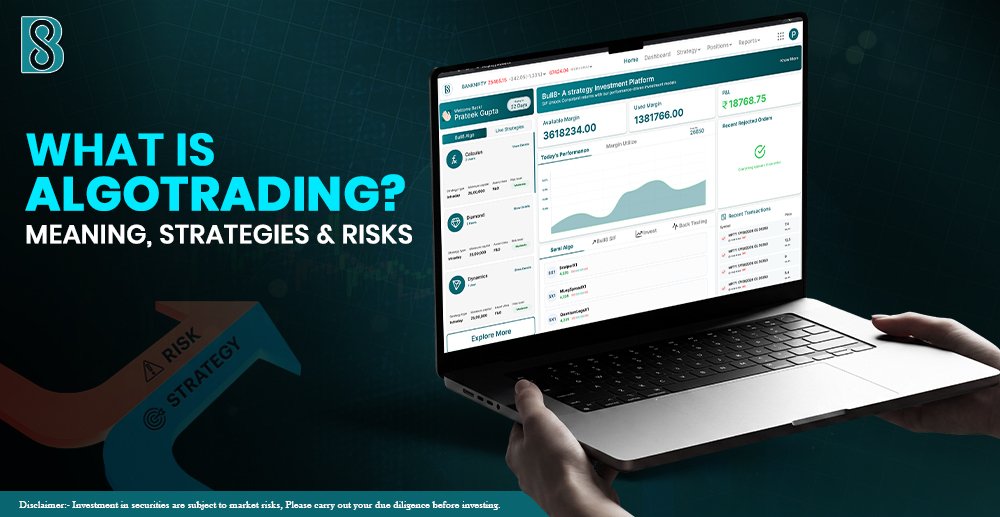
What Is AlgoTrading Meaning, Strategies & Risks.jpg
Introduction
Trading involves more than identifying an opportunity. Traders also need to decide when to enter, how much capital to allocate, when to exit, and how to respond if market conditions change. Following these decisions consistently can become challenging, especially when prices move quickly.
Algo Trading uses computer programs to carry out trading instructions according to predefined rules. These rules may relate to price, volume, technical indicators, timing, or position limits. Automation can reduce repetitive manual work, but it does not remove market risk or guarantee profitable trades.
Understanding how algo trading works, where it can help, and what can go wrong is essential before using it.
Regulatory information reviewed: 9 October 2026.
What Is Algo Trading?
Algo Trading, short for algorithmic trading, is the use of software to generate and execute trading orders when specified conditions are met.
An algorithm is a set of instructions. In trading, those instructions might tell a system to buy an instrument when a particular signal appears, limit the quantity purchased, and exit when another condition occurs.
NSE describes automated trading as a facility that automatically generates and sends buy or sell orders to the exchange when specified parameters are fulfilled, without manual order entry.
A strategy can be relatively simple, such as following a moving-average crossover, or more complex, involving several indicators and instruments.
Algo Trading does not necessarily use artificial intelligence. Many systems follow fixed rules written by a trader or developer. AI-based systems may use statistical models or machine learning, but they still require careful testing, execution controls and ongoing monitoring.
How Does Algo Trading Work?
An algorithmic trading system connects strategy logic with market data, risk controls and order execution.
The System Receives Market Data
The software receives information such as prices, trading volume or order-book data. Depending on the strategy, it may evaluate every price update or wait until a candle closes.
Accurate, timely data matters. Missing or delayed information can affect signals and trading decisions.
The Algorithm Checks Trading Conditions
The program compares incoming information with its predefined rules.
For example, a strategy may require a price breakout, minimum trading volume and a permitted trading time before generating an entry signal.
Risk Checks Evaluate the Order
Before submission, controls may check available margin, position size, existing exposure and trading limits. A signal should not automatically override these safeguards.
The Order Is Submitted
The system sends the order through the permitted broker connection. The broker processes it and routes it to the exchange, subject to applicable checks.
Execution and Positions Are Monitored
An order submission does not mean a trade has occurred. Orders can remain pending, execute partially or be rejected.
The system must track these outcomes and manage exits based on actual positions. Reliable order-status handling is as important as generating the original signal.
A Simple Example of Algo Trading
Consider a hypothetical strategy that evaluates a liquid equity instrument using completed price candles.
Its rules could be:
Generate an entry signal when a short-term moving average crosses above a longer-term moving average.
Allow only one open position.
Use a predefined quantity within the capital limit.
Submit a permitted limit order.
Exit when the opposite crossover occurs or the defined risk condition is triggered.
If the entry order remains unfilled, the system needs instructions for cancelling or managing it. If only part of the quantity executes, exit orders must reflect that actual quantity.
This example illustrates automation rather than a recommended strategy. Moving-average systems can experience repeated losses in sideways markets, and their results depend on parameters, costs and execution.
Common Types of Algo Trading Strategies
Different strategies use different assumptions about market behaviour.
Trend-Following Strategies
Trend-following systems attempt to participate in an established price direction. They may use moving averages, breakouts or other trend indicators.
They can struggle when prices repeatedly change direction without developing a sustained trend.
Momentum Strategies
Momentum systems look for defined measures of price strength or weakness. A strategy might assess recent price movement alongside trading volume.
A key risk is entering after a move has already become extended or immediately before momentum reverses.
Mean-Reversion Strategies
Mean-reversion strategies assume that certain price deviations may move back towards a reference level.
However, a price that appears unusually high or low can continue moving further away. The reference level and conditions for abandoning the trade must be clearly defined.
Arbitrage Strategies
Arbitrage systems attempt to capture price differences between related instruments or markets.
Apparent opportunities may disappear after accounting for transaction costs, execution delays and the risk of one side executing without the other.
Execution Algorithms
Some algorithms focus on managing order execution rather than selecting trading opportunities.
For example, TWAP-based approaches distribute orders over time, while VWAP-based approaches use trading volume as an execution reference. Their purpose is to manage execution objectives; they do not guarantee a favourable price.
Manual, Semi-Automated and Fully Automated Trading
The main difference between these approaches is how much responsibility the software takes for implementing instructions.
Approach
Typical workflow
Human involvement
Manual trading
The trader analyses conditions and places orders
Required for each trading decision and order
Semi-automated trading
Software assists with signals, order preparation or selected execution steps
Approval or intervention is required at defined stages
Fully automated trading
Software generates and submits orders under predefined rules
Required for setup, supervision and strategy changes
Semi-automated workflows vary between platforms. Users should understand exactly which actions require confirmation and which occur automatically.
Fully automated trading still needs supervision. Traders remain responsible for deciding whether a strategy should run, reviewing its behaviour and responding to problems.
Benefits of Algo Trading
Algo Trading can make the implementation of a trading plan more consistent.
A correctly configured system can apply the same conditions repeatedly, reducing discretionary changes at the moment of execution. It can also reduce the effort involved in repeatedly entering orders or monitoring several predefined conditions.
Automation may process signals faster than manual workflows. However, actual execution depends on the broker, connectivity, exchange processing, liquidity and order type.
Another benefit is recordkeeping. Logs can help traders review signals, submitted orders, rejections and completed trades. These records make it easier to investigate differences between expected and actual behaviour.
The value of automation comes from implementing defined instructions reliably. It cannot turn an unsuitable strategy into a successful one merely by executing it faster.
Risks and Limitations of Algo Trading
Understanding the risks is essential because automation can repeat mistakes quickly.
Flawed Strategy Logic
A strategy may use incorrect assumptions or poorly defined conditions. Software can execute those rules precisely while still producing undesirable outcomes.
Ambiguous instructions also create problems. A system needs clear rules for entries, exits, partial execution and exceptional situations.
Overfitting
Overfitting occurs when a strategy is adjusted too closely to historical data.
It may appear impressive in a backtest because its settings capture past patterns that do not repeat. Testing across different periods and using unseen data can help assess this weakness.
Slippage and Trading Costs
Actual execution prices can differ from expected prices. Brokerage, spreads, exchange charges, taxes and other applicable costs can substantially change results.
Strategies involving frequent trading are particularly sensitive to these costs.
Technical Failures
Internet disruptions, expired authentication, server problems, stale data or software errors can interrupt execution.
A recovery process should check existing orders and positions before restarting. Otherwise, a system could submit duplicate orders or operate with an incorrect view of exposure.
Liquidity and Partial Execution
An order may execute only partly or remain unfilled. In strategies involving multiple instruments, unequal execution can create unintended exposure.
Leverage and Changing Markets
Leveraged positions can magnify losses. A strategy that performed adequately in one environment may struggle when volatility, liquidity or market direction changes.
Automation does not remove these risks. It makes the quality of risk controls and monitoring more important.
Backtesting and Risk Management
Backtesting evaluates how a strategy would have behaved using historical data. It is useful for identifying weaknesses, but it is not proof of future performance.
A meaningful backtest should include realistic transaction costs, execution assumptions and the information available at each decision point.
Using future information accidentally creates look-ahead bias. Testing only surviving instruments can also distort results. Data quality and testing methods therefore deserve as much attention as the final performance chart.
Useful measures include maximum drawdown, average gains and losses, losing streaks, exposure and sensitivity to costs. Win rate alone is insufficient: a strategy can win frequently while occasional large losses outweigh those gains.
Paper trading provides another opportunity to inspect live signals and system behaviour. However, simulated execution may differ from real fills.
Before deployment, define position limits, maximum exposure, daily loss limits and conditions for stopping the strategy. Alerts and emergency controls should support a clear response process.
Stop-loss instructions also have limitations. Gaps, liquidity constraints or order-handling issues may prevent execution at the expected price.
Latest Algo Trading Rules in India
Algo Trading in India operates within SEBI and exchange requirements. A retail user should understand the arrangement through which the strategy is offered, rather than relying on a platform’s marketing description.
SEBI issued its “Safer participation of retail investors in Algorithmic trading” framework on 4 February 2025, followed by an implementation timeline extension on 30 September 2025.
NSE’s current algorithmic trading pages reference its consolidated circular NSE/INVG/73992, dated 30 April 2026, for relevant application procedures. Its algo-provider page also provides an exchange empanelment list and was updated on 8 October 2026. That page update should not be interpreted as a new regulation issued that day
Important areas include order identification, applicable algorithm registration requirements, provider empanelment, hosting arrangements and API access controls.
NSE’s linked retail algo FAQ explains that client API orders require appropriate algo tagging, including standardised tagging within the stated 10-orders-per-second threshold. It also distinguishes tech-savvy clients using their own API setup from users accessing broker-hosted provider systems: a personal static IP should not be described as mandatory for every retail algo user. Detailed circulars prevail over the FAQ where requirements differ.
Before activation, ask the broker to explain the requirements applicable to the chosen setup. Exchange registration or provider empanelment does not establish that a strategy will be profitable.
How Can Beginners Get Started?
Begin with the instrument and strategy rather than the software.
Understand how the instrument trades, what can cause losses and how margin works where relevant. Write down the entry, exit and risk rules clearly enough to explain them without relying on a platform interface.
Next, verify the broker and provider arrangements, review costs and test the strategy. Check how the system handles rejected orders, connectivity interruptions and open positions.
Coding knowledge may help with custom development, while no-code tools can simplify configuration. Both approaches require an understanding of the underlying rules.
Deploy only after testing and defining monitoring responsibilities. Review actual execution and system behaviour regularly.
Conclusion
Algo Trading helps implement predefined trading instructions through software. Its usefulness depends on strategy design, realistic testing, reliable execution and effective risk controls. For retail users, understanding current requirements and maintaining supervision are essential parts of using automation responsibly.
FAQ
Is Algo Trading Legal in India?
Algo Trading is permitted within the applicable SEBI and exchange framework. Users should confirm that their broker, provider and trading setup meet the requirements relevant to the service being used.
Can Beginners Use Algo Trading?
Beginners can learn to use algorithmic trading tools, but they should first understand trading instruments, order execution and potential losses. Automation does not replace basic market knowledge or risk management.
Do I Need Coding Knowledge for Algo Trading?
Coding is useful for developing custom systems. Some platforms offer no-code configuration, but users still need to understand strategy rules, testing assumptions, platform limitations and the actions performed automatically.
Does Algo Trading Guarantee Profits?
No. Algorithmic strategies can lose money because of market changes, flawed logic, trading costs or execution problems. Strong historical results do not guarantee that future trading will produce similar outcomes.
How Is Algo Trading Different From AI Trading?
Algo Trading follows programmed instructions. AI trading may use machine learning to analyse data or generate signals. Many algorithms use fixed rules without AI; both approaches require testing and oversight.
Do All Retail Algo Users Need a Static IP?
Requirements depend on the setup. NSE’s FAQ distinguishes tech-savvy clients using their own API arrangements from users of broker-hosted systems. Confirm the applicable requirement with the broker before activation.
How OHLC Data Helps Identify Market Trends in Algo Trading
Markets generate thousands of price changes during every trading session. For a trader, reading every individual movement is difficult. For an algorithm, processing raw tick-by-tick information can also be unnecessarily complex for many strategies. OHLC data solves this problem by summarising price activity into four useful values: open, high, low and close.
These four prices help a retail algo trading system understand where a market started, how far it moved, where it faced resistance or support and where it finished during a selected period. When OHLC data is analysed across multiple candles, it can help classify the market as bullish, bearish, range-bound or volatile.
However, OHLC data is not a prediction tool by itself. It becomes useful only when it is converted into objective conditions and combined with appropriate confirmation, execution and risk-management rules.
What Is OHLC Data in Algo Trading?
OHLC represents four price values recorded for a particular timeframe:
Open: The first recorded or officially recognised price of the period.
High: The highest traded price during that period.
Low: The lowest traded price during that period.
Close: The last or officially calculated closing price of the period.
The selected period can be one minute, five minutes, fifteen minutes, one hour, one day or even one week. For example, a five-minute candle summarises all eligible trades completed during those five minutes into four prices.
Consider this illustrative five-minute data:
Time
Open
High
Low
Close
10:00–10:05
₹1,000
₹1,012
₹996
₹1,009
The price opened at ₹1,000, reached a high of ₹1,012, fell as low as ₹996 and closed the period at ₹1,009. Because the close is above the open and relatively near the high, this candle suggests buying strength during that interval. It does not, however, confirm that the price will continue rising.
An algorithm does not have to “look” at a candle as a human does. It can calculate the same information numerically and compare it with earlier periods.
What Each OHLC Price Reveals About the Market
Every component of an OHLC candle provides a different piece of information.
Open Price: The Starting Point
The open price shows where trading activity began during the selected interval. On a daily chart, it may reflect the market’s response to overnight developments, global cues, corporate announcements or changes in demand and supply.
Algorithms commonly compare the current open with the previous close:
Current open above previous close: Gap-up opening
Current open below previous close: Gap-down opening
Current open near previous close: Relatively neutral opening
A gap is not automatically a bullish or bearish signal. The system must analyse what happens after the opening. A gap-up followed by a weak close may indicate selling pressure, while a gap-down followed by recovery may show buying interest at lower levels.
High Price: The Upper Boundary
The high represents the highest price accepted during the period. It helps an algorithm identify:
Potential resistance areas
Breakout attempts
Recent swing highs
Volatility expansion
Price rejection from higher levels
When the market repeatedly approaches a level but fails to close above it, that area may act as resistance. A close above the earlier high can be used as one condition for a breakout, although additional confirmation is normally required.
Low Price: The Lower Boundary
The low is the lowest traded price during the interval. It can help locate:
Potential support levels
Breakdown attempts
Swing lows
Downside volatility
Rejection from lower prices
If price repeatedly falls near a level and recovers, an algorithm may classify it as a support zone. A close below that zone could indicate a possible breakdown.
Close Price: The Confirmation Point
The close receives significant attention because it shows where the market ended the period relative to its open, high and low.
A close near the high can suggest that buyers maintained control until the period ended. A close near the low may reflect sustained selling pressure. A close near the middle indicates a more balanced outcome.
Waiting for a candle to close can reduce premature signals, but it also creates some delay. This is a common trade-off between confirmation and speed.
How OHLC Data Creates Candlesticks
A candlestick is simply a visual representation of OHLC data.
The difference between the open and close forms the candle’s body. The distances from the body to the high and low form the upper and lower wicks.
A candle is generally considered bullish when the close is above the open and bearish when the close is below the open. However, the size and location of the body provide more information than colour alone.
An algorithm can calculate:
Candle Body = |Close − Open|
Candle Range = High − Low
Upper Wick = High − Maximum of Open or Close
Lower Wick = Minimum of Open or Close − Low
It can also measure how much of the total range is occupied by the body:
Body-to-Range Ratio = |Close − Open| ÷ (High − Low)
A higher ratio may indicate stronger directional movement. A smaller ratio may reflect indecision or rejection, although its meaning depends on the preceding trend and market context.
How OHLC Data Identifies an Uptrend
An uptrend is more than a single bullish candle. It is a market structure in which price generally forms higher highs and higher lows.
An OHLC-based algorithm may define an uptrend using conditions such as:
The current high is above the previous high.
The current low is above the previous low.
Closing prices are rising across several periods.
The close remains above a selected moving average.
Bullish candles close in the upper portion of their ranges.
Price closes above a previous resistance level.
Here is a simplified data example:
Candle
Open
High
Low
Close
1
₹500
₹507
₹496
₹504
2
₹504
₹512
₹501
₹509
3
₹509
₹518
₹506
₹516
The highs rise from ₹507 to ₹512 and then ₹518. The lows rise from ₹496 to ₹501 and then ₹506. Closing prices also move upward. Together, these observations indicate a developing bullish structure.
A basic algorithmic rule could be:
Classify the market as an uptrend when the latest three completed candles form higher highs and higher lows, and the latest close remains above the 20-period moving average.
This is only an illustrative rule. A practical strategy would also define volume, volatility, liquidity, risk and exit conditions.
How OHLC Data Identifies a Downtrend
A downtrend normally develops through lower highs and lower lows. It indicates that buyers are unable to push the price back to earlier highs and sellers continue to accept lower prices.
An algorithm may classify a bearish trend when:
The latest high is below the previous high.
The latest low is below the previous low.
Closing prices decline over several periods.
Price remains below a moving average.
Bearish candles close near their lows.
Price closes below established support.
Consider another illustrative dataset:
Candle
Open
High
Low
Close
1
₹820
₹824
₹811
₹814
2
₹814
₹818
₹804
₹807
3
₹807
₹811
₹796
₹799
The falling highs, lows and closes suggest sustained selling pressure. An algorithm could use these conditions to activate a trend-following setup or prevent a long-only strategy from entering.
Identifying a Sideways or Range-Bound Market
Not every market produces a clear trend. Prices frequently move between a defined support zone and resistance zone without establishing a lasting direction.
OHLC characteristics of a range-bound market may include:
Similar highs across several candles
Similar lows across several candles
Frequent movement above and below a moving average
Small candle bodies
Overlapping price ranges
Repeated breakout failures
No consistent sequence of higher highs or lower lows
For example, if the highest price recorded across 20 candles is ₹1,050 and the lowest is ₹1,020, while most closes remain inside that band, an algorithm may classify the market as range-bound.
This classification matters because a trend-following strategy may generate repeated false signals in a sideways market. A range-trading system, on the other hand, may look for price rejection near the upper and lower boundaries.
Market-regime identification allows an algorithm to decide not only when to trade but also when its strategy may be unsuitable.
Measuring Trend Strength with OHLC Data
Knowing the direction of a trend is not enough. An algorithm should also assess whether that movement is strong, weak or losing momentum.
Close Location Value
The position of the close inside the candle’s range can be measured as:
Close Location = (Close − Low) ÷ (High − Low)
The value normally falls between 0 and 1:
A value near 1 means the close is near the high.
A value near 0 means the close is near the low.
A value near 0.5 means the close is near the centre.
Suppose a candle has a high of ₹220, a low of ₹200 and a close of ₹218:
(218 − 200) ÷ (220 − 200) = 0.90
The closing price is in the top 10% of the candle’s range, indicating that buyers controlled much of that period. One candle is insufficient for a conclusion, but consistently high values during rising prices may support a bullish trend assessment.
Range Expansion
A widening high-low range may indicate increasing volatility or momentum. A narrowing range may indicate declining activity or consolidation.
Algorithms can compare the current range with an average:
Range Expansion Ratio = Current High-Low Range ÷ Average Range of Previous 20 Candles
A ratio above 1 means the current candle is wider than its recent average. Whether this is bullish or bearish depends on the direction of the close and the surrounding market structure.
Using OHLC Data to Identify Breakouts
A breakout happens when price moves beyond a recognised resistance level. A breakdown occurs when price falls below support.
A basic bullish breakout condition might be:
The current close is greater than the highest high of the previous 20 completed candles.
A bearish breakdown condition might be:
The current close is lower than the lowest low of the previous 20 completed candles.
Using the close instead of the intraperiod high or low can help filter brief price spikes. However, false breakouts can still occur. An algorithm may therefore add:
Volume confirmation
Minimum breakout distance
Volatility threshold
Market-trend filter
Retest condition
Time-of-day filter
Maximum entry-price deviation
For example, a system might accept a bullish breakout only when the close is at least 0.25% above resistance and the volume is higher than its recent average. The values must be tested for the chosen instrument rather than treated as universal settings.
Previous-Day High, Low and Close in Intraday Strategies
Previous-day OHLC levels are frequently used because they provide objective reference points before the new session begins.
An intraday algorithm may track:
Previous-day high as potential resistance
Previous-day low as potential support
Previous-day close as a sentiment reference
Current open relative to the previous close
Current price position inside the previous day’s range
Suppose the previous day’s high was ₹1,240, its low was ₹1,190 and its close was ₹1,225. If the next session opens at ₹1,232 and later closes a five-minute candle above ₹1,240, the system may identify a potential breakout.
The breakout alone should not directly imply a trade. The strategy must still evaluate liquidity, volatility, position size, stop-loss distance and the risk of entering after an extended move.
OHLC Analysis Across Different Timeframes
The same instrument can appear bullish on a five-minute chart and bearish on a daily chart. This is not a contradiction. Each timeframe describes a different section of market activity.
One- and five-minute candles: Useful for short-term execution but highly sensitive to noise.
Fifteen-minute and hourly candles: Provide a broader intraday view.
Daily candles: Commonly used for swing and positional analysis.
Weekly candles: Help identify broader market structure.
A multi-timeframe algorithm may use the daily chart to determine the primary direction and a shorter timeframe to identify entries. For instance, it could permit bullish entries on a fifteen-minute chart only when the daily close is above a long-term moving average.
The higher timeframe provides context, while the lower timeframe provides execution detail. Too many timeframes, however, can produce conflicting filters and an overcomplicated strategy.
Combining OHLC Data with Volume and Volatility
OHLC shows where price moved, but not how much participation supported that move. Volume can add this missing context.
A breakout accompanied by relatively high volume may show broader market participation. A breakout with low volume may be more vulnerable to reversal. Volume should still be interpreted carefully because its behaviour differs across cash equities, derivatives and trading sessions.
Volatility can be measured using the high, low and previous close. Average True Range, or ATR, estimates recent price movement and can help an algorithm:
Avoid trading during abnormally quiet periods
Reduce exposure during extreme volatility
Set adaptive stop-loss distances
Compare movement across different instruments
Avoid using a fixed risk distance in every condition
Indicators should be used to answer specific questions. Adding multiple indicators based on the same closing-price data may create the illusion of confirmation without providing genuinely independent information.
Using OHLC Data for Entry, Exit and Risk Rules
A complete algo strategy must define much more than market direction.
Entry Rules
An OHLC-based entry may require:
Confirmed trend structure
Close above resistance
Price above a moving average
Minimum candle-body strength
Suitable volume and volatility
Acceptable spread and liquidity
Exit Rules
The system may exit when:
Price closes below a recent swing low
The trend structure changes
A volatility-adjusted stop-loss is triggered
A predefined risk-reward level is reached
The position remains open beyond a time limit
A maximum daily loss is reached
Position Sizing
The distance between the entry and stop-loss can determine position size:
Position Size = Maximum Permitted Trade Risk ÷ Risk Per Unit
If a strategy permits a maximum trade risk of ₹1,000 and the difference between entry and stop-loss is ₹10 per share, the theoretical position size would be 100 shares before accounting for applicable limits, costs, liquidity and execution constraints.
Risk rules should be calculated before an order is placed. They should not depend on a trader’s reaction after the market moves.
Backtesting an OHLC-Based Algo Strategy
Historical OHLC data allows a strategy to be evaluated before live deployment. A responsible backtest should include:
Clearly defined entry and exit conditions
Reliable and correctly timestamped data
Broking and applicable transaction costs
Realistic slippage assumptions
Position-sizing rules
Maximum exposure limits
Different market regimes
Out-of-sample testing
Forward or paper testing
Analysis of drawdown and losing sequences
A critical limitation is that a single OHLC candle does not reveal the exact order in which its high and low occurred.
Suppose a daily candle has:
Open: ₹100
High: ₹110
Low: ₹95
Close: ₹108
If a strategy had both a target at ₹108 and a stop-loss at ₹97, daily OHLC data alone may not reveal which level was reached first. Using lower-timeframe data or conservative assumptions can reduce this form of backtesting error.
Developers should also avoid lookahead bias. A strategy cannot use the final high, low or close of a candle before that candle has been completed.
Limitations of OHLC Data
Although OHLC data is efficient and widely used, it has important limitations:
It compresses many individual trades into four values.
It does not show the exact intraperiod price sequence.
It may hide sudden changes inside a candle.
A completed-candle signal may enter after part of the move has occurred.
Low-liquidity instruments can produce unreliable candles.
Data adjustments and closing-price methods can vary.
Technical patterns may fail after unexpected news.
The reliability of an OHLC strategy depends on the quality of its data. Missing candles, duplicated records, incorrect timestamps, unadjusted corporate actions and mismatched time zones can materially distort a backtest.
Common Mistakes When Using OHLC Data
Algo traders should avoid several frequent errors:
Treating one bullish candle as proof of an uptrend
Entering every high breakout without confirmation
Using incomplete candles as completed signals
Applying identical settings to every instrument
Ignoring spreads, slippage and liquidity
Testing only during favourable market periods
Optimising parameters until they perfectly fit historical data
Using too many indicators derived from the same prices
Assuming automation removes market risk
Deploying a strategy without risk limits and ongoing monitoring
SEBI has also cautioned investors about dealing with unregulated platforms offering algorithmic trading and about performance or return claims. Users should evaluate the regulatory status, transparency and risk controls of any service before sharing credentials or deploying capital. SEBI investor caution
Best Practices for OHLC-Based Algo Strategies
For a more disciplined development process:
Start with simple, explainable conditions.
Use completed candles unless the strategy explicitly handles live updates.
Test different market regimes, not only strong trends.
Keep training, validation and out-of-sample data separate.
Use realistic execution assumptions.
Combine signal logic with strict position and loss limits.
Maintain logs of signals, orders, rejections and executions.
Monitor live behaviour for data or execution failures.
Review the strategy when market conditions change.
Never describe historical backtest results as guaranteed future returns.
Conclusion
OHLC data provides a practical framework for converting market activity into measurable algo trading rules. Open prices help assess the starting context, highs and lows reveal trading boundaries, and closes help confirm how each period ended.
Across multiple candles, this information can identify higher highs, higher lows, lower highs, lower lows, breakouts, consolidations and changes in volatility. It can also support entry filters, trailing stops, position sizing and market-regime classification.
Its simplicity is both its strength and its limitation. OHLC data makes price behaviour easier to process, but it removes the detailed sequence of intraperiod trades. Therefore, a reliable strategy should use clean data, objective rules, realistic backtesting, execution controls and disciplined risk management.
OHLC-based algorithms do not need to predict every market move. Their purpose is to respond consistently when predefined conditions appear—and to control risk when the market behaves differently from historical expectations.
Frequently Asked Questions
What does OHLC mean in algo trading?
OHLC stands for Open, High, Low and Close. These values summarise price activity during a selected timeframe and can be converted into rules for trend identification, entries, exits and risk management.
Which OHLC price is most useful for identifying trends?
The close is commonly used for confirmation, while highs and lows help determine market structure. A reliable trend assessment normally uses all four values across multiple candles rather than relying on a single price.
How can an algorithm identify an uptrend?
An algorithm can look for higher highs, higher lows and rising closing prices. It may also require the price to remain above a moving average or close above resistance before classifying the structure as bullish.
How does OHLC data identify a downtrend?
A sequence of lower highs, lower lows and falling closes may indicate a downtrend. Additional momentum, volatility and volume filters can help determine whether the downward move has sufficient strength.
Can OHLC data identify a sideways market?
Yes. Repeated highs and lows within a limited range, overlapping candles and the absence of consistent directional structure can help an algorithm classify the market as sideways.
What is an OHLC breakout strategy?
It is a rule-based strategy that monitors whether the price closes above an earlier high or below an earlier low. Practical breakout systems generally include confirmation, liquidity and risk-management conditions.
Which timeframe is best for OHLC analysis?
There is no single best timeframe. The choice should match the strategy’s intended holding period, execution speed, trading costs and tolerance for market noise.
Can OHLC data be used for stop-loss placement?
Yes. Recent lows may support stop-loss placement for long positions, while recent highs may be used for short positions. Volatility and position size should also be considered.
Is OHLC data sufficient for algo trading?
OHLC data can support many strategies, but it does not show volume, order-book activity or the exact sequence of trades inside a candle. The required data depends on the strategy’s objective and execution style.
Does an OHLC-based strategy guarantee profitable trades?
No. OHLCdata describes historical and current price behaviour but cannot guarantee future results. Every strategy requires testing, execution controls, monitoring and clearly defined risk limits.
Disclaimer: This article is intended for educational purposes only and should not be considered investment advice or a recommendation to buy or sell any security. Algo trading involves market, execution, technology and operational risks.
Best Retail Algo Trading Software in India – Complete Guide to Bull8 Algo Trading.jpg
Best Retail Algo Trading Software in India – Complete Guide to Bull8 Algo Trading
Introduction: The Rise of Retail Algo Trading in India
“Markets now move at extreme speed — and without speed, survival becomes difficult.”
The Indian stock market has undergone a massive transformation in the last decade. What was once dominated by institutional investors and large hedge funds has now become increasingly accessible to retail traders. With the rise of digital platforms, mobile trading apps, and increased financial awareness, participation from retail traders has grown rapidly across India. However, with this growth comes a new challenge — the need for faster execution, better discipline, and smarter decision-making.
Traditionally, algorithmic trading was only available to institutions due to high infrastructure costs, technical complexity, and regulatory barriers. But today, with advancements in technology and supportive regulations from the Securities and Exchange Board of India, retail traders can now access powerful algorithmic tools. This has opened the door for a new era — Retail Algo Trading.
The Best Retail Algo Trading Software in India is no longer a luxury but a necessity. Markets operate in milliseconds, and manual traders often fail to keep up with this speed. Opportunities appear and disappear within seconds, making it almost impossible for human traders to react efficiently every time.
Another major factor driving this shift is the need for discipline. Manual trading often leads to emotional decisions driven by fear and greed. These emotions result in inconsistent performance and unnecessary losses. In contrast, automated trading systems execute trades based purely on predefined rules, eliminating emotional interference.
Retail traders are increasingly realizing that automation brings efficiency, consistency, and scalability. The demand for Algo Trading Software India is rising rapidly because it allows traders to focus on strategy rather than execution.
This is where Bull8 Algo Trading comes into the picture. Bull8 is designed to provide a Retail Algo Trading Platform that is simple, fast, and rule-based. It empowers traders with automation, structured execution, and built-in risk management.
In today’s fast-moving markets, success is no longer about guessing — it is about following a system. And that system is powered by algorithmic trading.
What is Retail Algo Trading Software?
Retail Algo Trading Software refers to a technology-driven system that automatically executes trades in the stock market based on predefined rules. These rules can be based on price movements, time conditions, volume changes, technical indicators, or a combination of multiple factors.
In simple terms, it is a type of Automated Trading Software India where the trader sets the logic, and the system executes trades without requiring manual intervention.
For example, a trader can create a rule such as:
“If Nifty crosses 22,000, automatically buy a Call Option.”
Once this condition is met, the system instantly places the trade without delay. This eliminates the need for constant monitoring and manual execution.
Retail Algo Trading Software operates on three key pillars:
Automation
Automation ensures that trades are executed without human involvement. This significantly reduces the chances of missing opportunities and ensures that every trade follows a predefined strategy.
Rule-Based Trading
Unlike manual trading, where decisions can be influenced by emotions, algorithmic trading follows strict rules. These rules are defined in advance and executed exactly as planned.
API-Based Execution
Modern trading platforms connect directly to brokers through APIs (Application Programming Interfaces). This allows seamless communication between the software and the exchange, ensuring fast and accurate execution.
One of the biggest advantages of using an Algo Trading App India is speed. Markets move extremely fast, and even a delay of a few seconds can result in missed opportunities. Algorithmic systems execute trades in milliseconds, giving traders a significant edge.
Another key benefit is the elimination of emotional decision-making. Fear, greed, hesitation, and overconfidence are common challenges in manual trading. Automated systems remove these emotional biases, leading to more consistent performance.
Retail traders are increasingly adopting Retail Algo Trading Platforms because they provide structure, discipline, and efficiency. Instead of reacting to market movements, traders can rely on pre-tested strategies that execute automatically. Bull8 Algo Trading simplifies this entire process by offering a user-friendly platform where traders can deploy strategies without coding. It combines automation, speed, and risk management into a single powerful solution.
In the modern trading environment, algorithmic trading is not just an advantage — it is becoming the standard approach for serious traders.
Why Retail Traders Are Switching to Algo Trading
The rapid shift from manual trading to algorithmic trading is one of the biggest transformations in the Indian financial markets. Retail traders are no longer relying solely on charts and instincts; instead, they are moving toward structured, automated systems. This growing adoption is a key reason why the demand for the Best Retail Algo Trading Software in India is increasing at a fast pace.
Manual trading comes with several limitations that directly impact performance. One of the biggest challenges is emotional decision-making. Traders often make impulsive decisions due to fear when markets fall or greed when prices rise. This leads to inconsistent results and unnecessary losses. Emotional trading is one of the primary reasons why many retail traders fail to sustain profitability over the long term.
Another major issue is slow execution. Markets today operate at lightning speed, and even a delay of a few seconds can result in missed opportunities or poor entry and exit points. Manual traders simply cannot match the speed of modern trading systems. This is where Algo Trading Software India provides a strong advantage by executing trades in milliseconds.
Consistency is another critical problem in manual trading. Even experienced traders struggle to follow their strategies with discipline every day. Human fatigue, distractions, and psychological pressure often lead to deviation from plans. In contrast, a Retail Algo Trading Platform ensures that every trade follows predefined rules without deviation.
Missed opportunities are also a common issue. Traders cannot monitor multiple stocks, indices, or strategies simultaneously. However, with an Automated Trading Software India, multiple strategies can run at the same time, ensuring that no opportunity is missed.
The benefits of algorithmic trading are clear and compelling. Speed is one of the biggest advantages, as trades are executed instantly without delay. Emotion-free trading ensures that decisions are based purely on logic and data. Consistency improves because the system follows rules strictly. Additionally, traders can deploy multiple strategies across different market conditions, increasing their chances of profitability.
Another important insight is that algorithmic trading significantly reduces human error. Mistakes such as wrong order placement, incorrect quantity, or delayed execution are minimized through automation. This improves overall trading efficiency.
The growing popularity of the Algo Trading App India reflects this shift. Retail traders are now looking for smarter ways to trade rather than relying on manual efforts. They want systems that provide structure, discipline, and scalability.
This shift in mindset is best summarized by one simple principle:
Do not guess. Follow the system.”
And that system is powered by the Best Retail Algo Trading Software in India, such as Bull8 Algo Trading, which enables traders to move from emotional decisions to rule-based execution.
What Makes the Best Retail Algo Trading Software? (500–600 words)
Choosing the Best Retail Algo Trading Software in India is one of the most important decisions for any trader looking to automate their trading journey. Not all platforms are created equal, and the right software can significantly impact performance, consistency, and risk management.
A high-quality Retail Algo Trading Platform must offer a combination of simplicity, speed, reliability, and advanced features. Below are the key factors that define the best Algo Trading Software India.
No-Code / Easy Setup
The best platforms are designed for retail traders, not programmers. A user-friendly interface with no coding requirement is essential. Traders should be able to create and deploy strategies easily without technical knowledge. This makes the platform accessible to beginners as well as experienced traders.
A good Algo Trading App India simplifies the entire process, allowing users to focus on strategy rather than coding complexity.
Pre-Built Strategies
Pre-built strategies are a major advantage, especially for beginners. These strategies are already tested and optimized based on historical data. Traders can start quickly without building systems from scratch.
The presence of ready-to-use strategies makes a platform more efficient and practical for real-world trading.
Fast Execution Engine
Execution speed is critical in trading. The best Automated Trading Software India ensures low latency and instant order placement. A delay of even a few milliseconds can impact profitability, especially in intraday and options trading.
A strong execution engine ensures that trades are placed exactly when conditions are met.
Advanced Risk Management System
Risk management is the foundation of successful trading. A reliable Retail Algo Trading Platform must include features such as stop-loss automation, position sizing, capital allocation, and drawdown control.
Automated risk management ensures that losses are controlled and capital is protected at all times.
Backtesting and Analytics
Backtesting allows traders to test their strategies on historical data before deploying them in live markets. This helps in understanding performance, identifying weaknesses, and improving strategies.
A good platform provides detailed analytics, helping traders make data-driven decisions rather than assumptions.
An important insight is that backtesting increases confidence and reduces uncertainty in trading.
Broker Integration
Seamless integration with brokers is essential for smooth execution. The best Algo Trading Software India connects directly with trading accounts, allowing automatic order placement without manual intervention.
This ensures that traders can execute strategies directly from their accounts with full transparency.
Cloud-Based Trading
Modern trading requires flexibility. A cloud-based system allows traders to access their strategies from anywhere, whether on mobile or desktop. This ensures uninterrupted trading without dependency on a single device.
Cloud-based infrastructure also improves reliability and scalability.
When all these features come together, they create a powerful and efficient trading ecosystem. The Best Retail Algo Trading Software in India is not just about automation — it is about providing traders with speed, discipline, and control.
Platforms like Bull8 Algo Trading are designed with these principles in mind, offering a complete solution that combines ease of use, advanced technology, and structured trading.
In today’s competitive market, choosing the right Automated Trading Software India can make the difference between random trading and consistent performance.
Top Features of Bull8 – Best Retail Algo Trading Software (500–600 words)
When it comes to choosing the Best Retail Algo Trading Software in India, traders look for a platform that combines simplicity, speed, automation, and reliability. Bull8 Algo Trading is designed specifically for retail traders who want to move from manual trading to structured, rule-based execution without dealing with technical complexity.
Bull8 stands out as a complete Retail Algo Trading Platform that focuses on automation, discipline, and performance. It is built to simplify trading while delivering professional-level execution.
Rule-Based Trading Engine
At the core of Bull8 is its powerful rule-based trading engine. This allows traders to execute strategies based on predefined conditions without manual intervention. Every trade follows a strict logic, ensuring consistency and eliminating emotional decision-making.
This is a key advantage over traditional trading, where decisions are often influenced by market noise and psychological pressure.
Pre-Built Strategies
Bull8 offers a range of pre-built strategies that are designed for real market conditions. These strategies are already tested and structured, allowing traders to start quickly without creating systems from scratch.
This feature makes Bull8 an ideal Algo Trading App India for beginners as well as experienced traders who want ready-to-use solutions.
No Coding Required
One of the biggest barriers in algorithmic trading has always been technical complexity. Bull8 removes this barrier completely by offering a no-code environment.
Traders do not need programming knowledge to use the platform. This makes it one of the most accessible Automated Trading Software India solutions available today.
Automated Execution
Bull8 ensures fully automated trade execution. Once a strategy is activated, the system monitors market conditions and executes trades instantly when conditions are met.
This eliminates delays, improves accuracy, and ensures that traders never miss opportunities.
Multi-Strategy Deployment
Unlike manual trading, where traders are limited by time and attention, Bull8 allows multiple strategies to run simultaneously. This increases diversification and improves overall trading efficiency.
A trader can deploy different strategies across various market conditions, all managed automatically within a single platform.
Built-In Risk Management
Risk management is integrated directly into the platform. Features such as stop-loss automation, position sizing, and capital control help protect traders from excessive losses.
This makes Bull8 a highly reliable Retail Algo Trading Platform focused not just on profits but also on capital preservation.
Mobile and Web Access
Bull8 provides seamless access across devices. Traders can monitor and manage their strategies from both mobile and web platforms. This ensures flexibility and convenience, allowing trading from anywhere.
High-Speed Execution
Speed is critical in trading, and Bull8 delivers fast execution through advanced infrastructure. Orders are placed instantly, ensuring that strategies perform as intended.
The combination of automation, speed, and discipline makes Bull8 a strong contender for the Best Retail Algo Trading Software in India.
Its core philosophy can be summarized in three words:
Automated. Fast. Disciplined.
Bull8 is not just a tool — it is a complete ecosystem designed to help retail traders trade smarter and more efficiently.
Bull8 Strategies Explained (400–500 words)
One of the key strengths of Bull8 Algo Trading is its well-structured and pre-built strategies. These strategies are designed to work across different market conditions while maintaining strong risk control. They are optimized for retail traders who want consistent performance without the complexity of manual trading.
Let’s understand the major strategy types available on Bull8.
Calculus Strategy (NSE)
The Calculus strategy is a premium collection-based approach focused on intraday trading in index options, particularly on the NSE.
This strategy aims to generate steady income by capturing option premium decay. It uses structured rules and layered hedging techniques to manage risk effectively.
Key characteristics include:
Intraday execution with no overnight exposure
Focus on time decay (theta advantage)
Strong risk control through hedging
Consistent and disciplined execution
The Calculus strategy is ideal for traders looking for stable, risk-adjusted returns in intraday markets.
Matrix Strategy
The Matrix strategy is a hybrid approach that combines trend-following and range-bound trading techniques. It is designed to adapt to different market conditions, making it highly versatile.
Unlike traditional strategies that work only in specific conditions, Matrix adjusts dynamically based on market behavior.
Key features include:
Combines momentum and sideways market strategies
Balanced approach between risk and reward
Automated adjustments based on market movement
Intraday execution with structured exits
This makes Matrix a powerful option for traders who want flexibility and adaptability in their trading approach.
Diamond Strategy (BSE)
The Diamond strategy focuses on Sensex-based options trading on the BSE. It is designed to deliver stable intraday returns with strong emphasis on capital protection.
This strategy uses predefined rules and hedging mechanisms to minimize risk while capturing consistent profits.
Key highlights include:
Focus on stability and consistency
Strong hedging to protect downside risk
Intraday trading with no overnight exposure
Automated execution for accuracy
Key Benefits of Bull8 Strategies
Across all strategies, Bull8 maintains a strong focus on discipline, risk management, and automation.
Works in different market conditions (bullish, bearish, sideways)
Includes built-in hedging for risk control
Eliminates emotional trading decisions
Ensures intraday exit to avoid overnight risk
Fully automated execution for consistency
These strategies make Bull8 one of the most practical and efficient Retail Algo Trading Platforms available today.
Instead of guessing market direction, traders can rely on structured systems that execute with precision.
Top Features of Bull8 – Best Retail Algo Trading Software
When it comes to choosing the Best Retail Algo Software Provider in India, traders look for a platform that combines simplicity, speed, automation, and reliability. Bull8 Algo Trading is designed specifically for retail traders who want to move from manual trading to structured, rule-based execution without dealing with technical complexity.
Bull8 stands out as a complete Retail Algo Trading Platform that focuses on automation, discipline, and performance. It is built to simplify trading while delivering professional-level execution.
Rule-Based Trading Engine
At the core of Bull8 is its powerful rule-based trading engine. This allows traders to execute strategies based on predefined conditions without manual intervention. Every trade follows a strict logic, ensuring consistency and eliminating emotional decision-making.
This is a key advantage over traditional trading, where decisions are often influenced by market noise and psychological pressure.
Pre-Built Strategies
Bull8 offers a range of pre-built strategies that are designed for real market conditions. These strategies are already tested and structured, allowing traders to start quickly without creating systems from scratch.
This feature makes Bull8 an ideal Algo Trading App India for beginners as well as experienced traders who want ready-to-use solutions.
No Coding Required
One of the biggest barriers in algorithmic trading has always been technical complexity. Bull8 removes this barrier completely by offering a no-code environment.
Traders do not need programming knowledge to use the platform. This makes it one of the most accessible Automated Trading Software India solutions available today.
Automated Execution
Bull8 ensures fully automated trade execution. Once a strategy is activated, the system monitors market conditions and executes trades instantly when conditions are met.
This eliminates delays, improves accuracy, and ensures that traders never miss opportunities.
Multi-Strategy Deployment
Unlike manual trading, where traders are limited by time and attention, Bull8 allows multiple strategies to run simultaneously. This increases diversification and improves overall trading efficiency.
A trader can deploy different strategies across various market conditions, all managed automatically within a single platform.
Built-In Risk Management
Risk management is integrated directly into the platform. Features such as stop-loss automation, position sizing, and capital control help protect traders from excessive losses.
This makes Bull8 a highly reliable Retail Algo Trading Platform focused not just on profits but also on capital preservation.
Mobile and Web Access
Bull8 provides seamless access across devices. Traders can monitor and manage their strategies from both mobile and web platforms. This ensures flexibility and convenience, allowing trading from anywhere.
High-Speed Execution
Speed is critical in trading, and Bull8 delivers fast execution through advanced infrastructure. Orders are placed instantly, ensuring that strategies perform as intended.
The combination of automation, speed, and discipline makes Bull8 a strong contender for the Best Retail Algo Trading Software in India.
Its core philosophy can be summarized in three words:
Automated. Fast. Disciplined.
Bull8 is not just a tool — it is a complete ecosystem designed to help retail traders trade smarter and more efficiently.
Bull8 Strategies Explained
One of the key strengths of Bull8 Algo Trading is its well-structured and pre-built strategies. These strategies are designed to work across different market conditions while maintaining strong risk control. They are optimized for retail traders who want consistent performance without the complexity of manual trading.
Let’s understand the major strategy types available on Bull8.
Calculus Strategy (NSE)
The Calculus strategy is a premium collection-based approach focused on intraday trading in index options, particularly on the NSE.
This strategy aims to generate steady income by capturing option premium decay. It uses structured rules and layered hedging techniques to manage risk effectively.
Key characteristics include:
Intraday execution with no overnight exposure
Focus on time decay (theta advantage)
Strong risk control through hedging
Consistent and disciplined execution
The Calculus strategy is ideal for traders looking for stable, risk-adjusted returns in intraday markets.
Matrix Strategy
The Matrix strategy is a hybrid approach that combines trend-following and range-bound trading techniques. It is designed to adapt to different market conditions, making it highly versatile.
Unlike traditional strategies that work only in specific conditions, Matrix adjusts dynamically based on market behavior.
Key features include:
Combines momentum and sideways market strategies
Balanced approach between risk and reward
Automated adjustments based on market movement
Intraday execution with structured exits
This makes Matrix a powerful option for traders who want flexibility and adaptability in their trading approach.
Diamond Strategy (BSE)
The Diamond strategy focuses on Sensex-based options trading on the BSE. It is designed to deliver stable intraday returns with strong emphasis on capital protection.
This strategy uses predefined rules and hedging mechanisms to minimize risk while capturing consistent profits.
Key highlights include:
Focus on stability and consistency
Strong hedging to protect downside risk
Intraday trading with no overnight exposure
Automated execution for accuracy
Key Benefits of Bull8 Strategies
Across all strategies, Bull8 maintains a strong focus on discipline, risk management, and automation.
Works in different market conditions (bullish, bearish, sideways)
Includes built-in hedging for risk control
Eliminates emotional trading decisions
Ensures intraday exit to avoid overnight risk
Fully automated execution for consistency
These strategies make Bull8 one of the most practical and efficient Retail Algo Trading Platforms available today.
Instead of guessing market direction, traders can rely on structured systems that execute with precision.
Next Part (Sections 7–8):
Bull8 vs Other Algo Trading Software in India (comparison table)
How Bull8 helps traders grow faster
Say “continue” and I’ll proceed.
continue
Here is Part 4 (Sections 7–8) of your 5000+ words blog, written in detailed sentence format, fully SEO-optimized, and continuing strong positioning for Bull8 Algo Trading.
Bul8 vs Other Algo Trading Software in India
With the growing demand for the Best Retail Algo Trading Software in India, multiple platforms have entered the market. However, not all platforms offer the same level of automation, simplicity, and performance. Choosing the right Algo Trading Software India is crucial for long-term success.
Many platforms available today are either semi-automated or require technical knowledge, making them less suitable for retail traders. This is where Bull8 Algo Trading stands out as a complete and practical Retail Algo Trading Platform.
To understand the difference clearly, let’s compare Bull8 with other popular platforms in India.
Comparison Table: Bull8 vs Other Platforms
Feature
Bull8 Algo Trading
Other Platforms
Ease of Use
Very Easy
Medium
Coding Requirement
No Coding Required
Sometimes Required
Pre-Built Strategies
Available & Structured
Limited
Risk Management
Advanced & Built-In
Basic
Execution Speed
High-Speed Execution
Moderate
Automation Level
Fully Automated
Semi-Automated
Understanding the Difference
Most traditional platforms focus only on providing tools, but they do not offer a complete trading system. Traders are often required to build their own strategies, manage execution manually, or rely on partial automation.
For example, platforms like Zerodha Streak provide rule-based strategies but still require manual confirmation in certain cases. Similarly, platforms like uTrade Algos focus on AI-based trading but may not be beginner-friendly due to complexity.
In contrast, Bull8 Algo Trading is designed specifically for retail traders who want a simple and fully automated experience. It eliminates the need for coding, reduces complexity, and ensures that strategies run automatically without manual intervention.
Another major difference is the level of risk management. Many platforms provide only basic stop-loss features, whereas Bull8 integrates advanced risk control directly into the system. This ensures that traders are protected from unexpected market movements.
Execution speed is another critical factor. In today’s fast-moving markets, delays can impact profitability. Bull8’s high-speed execution engine ensures that trades are placed instantly when conditions are met.
The level of automation is where Bull8 truly stands out. While many platforms offer semi-automation, Bull8 provides a fully automated environment where traders can deploy strategies and let the system handle execution completely.
Why Bull8 is the Better Choice
The goal of any trader is to achieve consistency, discipline, and efficiency. Bull8 delivers all three by combining automation with simplicity.
No technical barriers
Ready-to-use strategies
Full automation without manual intervention
Strong risk management
High-speed execution
These features make Bull8 a leading contender for the Best Retail Algo Trading Software in India.
In a market where speed and precision matter, choosing the right Automated Trading Software India is not just important — it is essential.
How Bull8 Helps Retail Traders Grow Faster
One of the biggest advantages of using the Best Retail Algo Trading Software in India is the ability to grow as a trader in a structured and disciplined manner. Bull8 Algo Trading is specifically designed to help retail traders improve performance, reduce mistakes, and achieve consistency over time.
Discipline in Trading
Discipline is one of the most important factors in successful trading, yet it is one of the hardest to maintain manually. Traders often break their own rules due to emotions or market pressure.
Bull8 solves this problem by enforcing rule-based execution. Once a strategy is set, it is executed exactly as planned. This eliminates deviations and ensures consistent behavior in trading.
Consistent Execution
Manual trading often leads to inconsistency because of delays, hesitation, or missed signals. With Algo Trading Software India, every trade is executed at the right time without delay.
Bull8 ensures that all strategies run consistently, regardless of market conditions or trader involvement. This improves overall performance and reliability.
Emotion-Free Trading
Emotions such as fear, greed, and overconfidence are major obstacles in trading. These emotions lead to poor decision-making and unnecessary losses.
Using a c like Bull8 removes emotional interference completely. Trades are executed based on logic and predefined rules, not feelings.
Time Efficiency
Manual trading requires constant monitoring of charts and markets, which can be time-consuming and stressful. Bull8 automates this entire process, allowing traders to focus on strategy rather than execution.
This makes it an ideal Algo Trading App India for working professionals and individuals who cannot dedicate full-time hours to trading.
Multi-Strategy Execution
One of the most powerful features of Automated Trading Software India is the ability to run multiple strategies simultaneously. Bull8 allows traders to deploy different strategies across various market conditions.
This increases diversification and improves the chances of consistent returns.
Key Insight
Algorithmic trading allows traders to scale their performance by executing multiple strategies at the same time without manual effort. This is something that is nearly impossible with traditional trading methods.
Final Perspective
Bull8 transforms the way retail traders approach the market. Instead of reacting to price movements, traders can rely on structured systems that execute with precision.
It helps traders move from randomness to consistency, from emotion to logic, and from manual effort to automation.
This is why Bull8 is emerging as one of the most effective Retail Algo Trading Platforms in India.
Risk Management in Algo Trading
Risk management is the foundation of successful trading, and it becomes even more powerful when combined with automation. One of the biggest advantages of using the Best Retail Algo Trading Software in India is that risk management is not dependent on human discipline — it is built directly into the system.
In manual trading, traders often ignore stop-loss levels, overtrade, or take larger positions due to emotions. This leads to significant losses and poor capital management. However, with a Retail Algo Trading Platform, risk management rules are predefined and strictly followed without deviation.
Key Elements of Risk Management in Algo Trading
Stop-Loss Automation
Stop-loss is one of the most important tools for protecting capital. In Algo Trading Software India, stop-loss levels are automatically executed when predefined conditions are met. This ensures that losses are limited and controlled. Position Sizing
Position sizing determines how much capital is allocated to each trade. A good Automated Trading Software India ensures that no single trade risks a large portion of the total capital. This reduces the impact of losses and improves long-term sustainability. Capital Protection
Algo trading systems are designed to preserve capital by limiting exposure during volatile conditions. Strategies can include drawdown limits, trade limits, and capital allocation rules. Discipline Through Automation
The biggest advantage of algorithmic trading is discipline. Once rules are set, the system follows them strictly without emotional interference. This eliminates common mistakes such as revenge trading or overtrading.
Key Insight
Algorithmic trading integrates risk management automatically, ensuring that every trade follows predefined safety rules. This significantly reduces the chances of large losses.
Bull8 Advantage in Risk Management
Bull8 Algo Trading provides built-in risk control features that help traders manage their capital efficiently.
Automated stop-loss execution
Controlled position sizing
Strategy-level risk limits
No emotional decision-making
These features make Bull8 a reliable Retail Algo Trading Platform focused on both performance and protection.
In trading, survival is more important than profit. With proper risk management, traders can stay in the market longer and achieve consistent results.
Is Algo Trading Legal in India?
One of the most common questions among traders is whether algorithmic trading is legal in India. The answer is clear — yes, algorithmic trading is completely legal and regulated.
The Indian stock market operates under the supervision of the Securities and Exchange Board of India, which has established guidelines to ensure transparency, fairness, and safety in trading activities. These regulations also cover algorithmic trading, making it a structured and compliant practice.
Regulatory Framework
SEBI allows both institutional and retail traders to use algorithmic trading systems. However, these systems must follow certain compliance requirements, especially when it comes to broker integration and API usage.
Retail traders can access Algo Trading Software India through broker-provided APIs. These APIs enable the software to connect directly with the exchange for order execution.
Key Points About Legality
Algorithmic trading is fully legal in India
Retail traders are allowed to use automated systems
Brokers provide API access for execution
Compliance with exchange and SEBI guidelines is required
Why Regulations Matter
Regulations ensure that the market remains fair and transparent for all participants. They prevent misuse of technology and ensure that trading systems operate within defined boundaries.
For traders, this means increased trust and security while using a Retail Algo Trading Platform.
Key Insight
The regulatory environment in India is evolving to support technological advancement in trading. This is encouraging more retail traders to adopt Automated Trading Software India.
Bull8 and Compliance
Bull8 Algo Trading operates within the regulatory framework by integrating with broker APIs and following industry standards. This ensures that traders can use the platform with confidence and peace of mind.
Final Perspective
The legality of algorithmic trading removes one of the biggest barriers for retail traders. With proper compliance and the right platform, traders can safely participate in automated trading.
As the market continues to evolve, the use of Algo Trading App India is expected to grow even further.
Who Should Use Retail Algo Trading Software?
The adoption of the Best Retail Algo Trading Software in India is growing rapidly, but it is important to understand who can benefit the most from it. While algorithmic trading is powerful, it works best for traders who are willing to follow a structured and disciplined approach.
Ideal Users of Retail Algo Trading Software
Beginners in the Stock Market
Beginners often struggle with decision-making, timing, and risk management. A Retail Algo Trading Platform simplifies this process by providing pre-built strategies and automated execution. This allows new traders to participate in the market without being overwhelmed by complexity.
Using an Algo Trading App India, beginners can start with structured systems instead of relying on guesswork or market tips. Working Professionals
Many individuals want to trade but do not have the time to monitor markets continuously. For them, Automated Trading Software India is an ideal solution.
Bull8 allows traders to deploy strategies and let the system handle execution automatically. This saves time and reduces the need for constant monitoring. Intraday Traders
Intraday trading requires fast decision-making and precise execution. Manual traders often miss opportunities due to delays or hesitation.
The Best Retail Algo Trading Software in India ensures instant execution, making it highly effective for intraday traders who rely on speed and accuracy. Options Traders
Options trading involves multiple variables such as time decay, volatility, and price movement. Managing all these factors manually can be challenging.
A Retail Algo Trading Platform like Bull8 helps options traders execute strategies efficiently while maintaining proper risk control.
Who Should Avoid Algo Trading?
While algorithmic trading offers many benefits, it may not be suitable for everyone.
Traders who rely purely on emotions or intuition
Individuals who are unwilling to follow rules
Those who prefer random or impulsive trading
Algorithmic trading requires discipline and trust in the system. Without this mindset, even the best tools cannot deliver results.
Final Insight
The Best Retail Algo Trading Software in India is designed for traders who want to move from unstructured trading to a systematic approach.
Bull8 enables traders to shift from emotional decision-making to rule-based execution, making it suitable for anyone who values consistency and discipline.
Future of Retail Algo Trading in India
The future of trading in India is clearly moving toward automation. As technology continues to evolve, the demand for the Best Retail Algo Trading Software in India is expected to grow significantly.
Retail participation in the stock market has already increased in recent years, and this trend is likely to continue. With more traders entering the market, the need for efficient and scalable trading solutions becomes even more important.
Key Trends Shaping the Future
AI-Based Trading Systems
Artificial Intelligence is playing a growing role in trading. Future Algo Trading Software India will integrate AI to analyze large volumes of data, identify patterns, and optimize strategies automatically. Cloud-Based Automation
Cloud technology is making trading more accessible and reliable. Traders can run their strategies from anywhere without depending on a specific device.
Modern Automated Trading Software India platforms are already adopting cloud infrastructure to improve performance and scalability. Growth in Retail Participation
More individuals are entering the stock market due to increased awareness and digital access. This is driving demand for user-friendly Algo Trading App India solutions.
Retail traders are no longer satisfied with manual trading methods. They are looking for smarter and more efficient ways to trade. Increased Focus on Risk Management
As markets become more volatile, risk management will become a key priority. Future Retail Algo Trading Platforms will focus even more on capital protection and advanced risk control mechanisms.
Key Insight
The algorithmic trading ecosystem in India is maturing rapidly. With better technology, improved regulations, and increasing awareness, retail traders are adopting automation at a faster pace. Future Outlook
The future of trading is fully automated, data-driven, and rule-based. Manual trading will continue to exist, but its dominance will decline as more traders shift to automation.
Platforms like Bull8 Algo Trading are already aligned with this future by providing simple, fast, and efficient solutions for retail traders.
Final Perspective
The next generation of traders will not rely on guesswork. They will rely on systems, data, and automation.
The Best Retail Algo Trading Software in India will play a central role in shaping this transformation, and platforms like Bull8 are leading this change.
How to Start with Bull8 (Step-by-Step)
Getting started with the Best Retail Algo Trading Software in India does not have to be complicated. One of the biggest advantages of Bull8 Algo Trading is its simple and beginner-friendly onboarding process. It is designed to help traders move quickly from manual trading to automated execution without technical barriers.
Step 1: Sign Up on the Platform
The first step is to create an account on the Retail Algo Trading Platform. The registration process is simple and requires basic details. Once the account is created, traders can access the dashboard and explore available features.
Step 2: Connect Your Broker Account
Bull8 integrates with brokers through APIs, allowing direct trade execution from your trading account. This ensures that all trades are executed securely and transparently.
This integration makes Bull8 a powerful Algo Trading Software India solution, as it connects strategy with execution seamlessly.
Step 3: Choose a Strategy
Traders can select from pre-built strategies such as Calculus, Matrix, or Diamond. These strategies are already structured and optimized for different market conditions.
This eliminates the need to create strategies from scratch, making it easier for beginners to start.
Step 4: Set Capital and Risk Parameters
Before activating a strategy, traders can define capital allocation, stop-loss levels, and risk limits. This ensures proper risk management from the beginning.
A well-defined setup improves discipline and helps protect capital.
Step 5: Start Automation
Once everything is set, traders can activate automation. The system will monitor market conditions and execute trades automatically based on predefined rules.
This is where the real power of Automated Trading Software India comes into play.
Final Insight
Bull8 simplifies the entire journey of algorithmic trading. From setup to execution, everything is designed to be fast, efficient, and user-friendly.
Even traders with no prior experience in automation can start using the Algo Trading App India within minutes.
Pricing & Accessibility
One of the key factors that make Bull8 the Best Retail Algo Trading Software in India is its affordability and accessibility for retail traders.
Unlike institutional-grade systems that require large investments, Bull8 offers a cost-effective subscription model designed specifically for individual traders.
Flexible Pricing Model
Bull8 follows a monthly subscription approach, making it accessible without requiring a large upfront investment. This allows traders to start small and scale gradually based on their comfort and performance.
An entry-level pricing model of approximately ₹1,250 per month makes it highly affordable compared to traditional trading infrastructure.
Accessible for All Traders
The platform is designed for everyone, from beginners to experienced traders. With no coding requirement and easy setup, it lowers the barrier to entry significantly.
This makes Bull8 a practical Retail Algo Trading Platform for anyone looking to adopt automation.
Value for Money
When compared to the benefits it provides — including automation, speed, discipline, and risk management — Bull8 offers strong value for money.
Instead of spending time and effort on manual trading, traders can leverage a complete Automated Trading Software India solution at an affordable cost.
Final Perspective
Bull8 makes algorithmic trading accessible, scalable, and practical for retail traders across India.
Conclusion: Why Bull8 is the Best Retail Algo Trading Software in India
The trading landscape in India is evolving rapidly, and automation is becoming the new standard. Manual trading, while still relevant, is increasingly challenged by speed, complexity, and emotional decision-making.
In this environment, the Best Retail Algo Trading Software in India is not just a tool — it is a necessity.
Manual trading often leads to stress, inconsistency, and missed opportunities. Traders struggle with timing, emotions, and execution. In contrast, algorithmic trading brings structure, discipline, and efficiency. Bull8 Algo Trading stands out as a complete solution that empowers retail traders to trade smarter.
It offers:
High-speed execution for capturing opportunities instantly
Rule-based systems that eliminate emotional decisions
Fully automated trading for consistent performance
Built-in risk management to protect capital
Multi-strategy deployment for better diversification
Bull8 transforms trading from a reactive process into a structured system. Instead of guessing market movements, traders can rely on predefined strategies that execute with precision.
The combination of simplicity and advanced technology makes Bull8 one of the most effective Retail Algo Trading Platforms available today.
FAQ’s
What is the Best Retail Algo Trading Software in India?
The Best Retail Algo Trading Software in India is a platform that allows traders to automate their trading strategies using predefined rules. It helps eliminate emotional decisions and ensures fast execution. Platforms like Bull8 Algo Trading are designed specifically for retail traders, offering no-code setup, pre-built strategies, and automated execution. A good Retail Algo Trading Platform should provide speed, risk management, and ease of use. With the growing demand for automation, traders are increasingly shifting to Algo Trading Software India solutions to improve consistency and efficiency in trading.
How does Algo Trading Software India work?
Algo Trading Software India works by executing trades automatically based on predefined rules such as price levels, time conditions, or technical indicators. Once a strategy is set, the system monitors the market and places trades instantly when conditions are met. This eliminates manual intervention and reduces errors. A reliable Automated Trading Software India connects with brokers through APIs to ensure seamless execution. Platforms like Bull8 Algo Trading simplify this process, allowing traders to deploy strategies without coding and benefit from a fully automated Retail Algo Trading Platform.
Is Retail Algo Trading Platform safe for beginners?
Yes, a well-designed Retail Algo Trading Platform is safe for beginners when used correctly. The Best Retail Algo Trading Software in India provides pre-built strategies, risk management tools, and automated execution, making it easier for new traders to start. Platforms like Bull8 Algo Trading reduce complexity by offering a no-code interface and built-in risk controls. Beginners can avoid emotional mistakes and follow structured systems. However, it is important to understand basic trading concepts and risk management while using Algo Trading Software India to ensure long-term success.
What are the benefits of using Automated Trading Software India?
Using Automated Trading Software India offers several advantages, including speed, accuracy, and consistency. Trades are executed instantly without delay, ensuring better entry and exit points. Emotional decision-making is eliminated, leading to more disciplined trading. A Retail Algo Trading Platform also allows traders to run multiple strategies simultaneously, increasing efficiency. Platforms like Bull8 Algo Trading provide built-in risk management, helping protect capital. Overall, the Best Retail Algo Trading Software in India helps traders improve performance by combining automation with structured execution.
Can beginners use the Best Retail Algo Trading Software in India?
Yes, beginners can easily use the Best Retail Algo Trading Software in India, especially platforms designed with simplicity in mind. Bull8 Algo Trading offers a no-code interface, making it accessible for users without technical knowledge. Beginners can start with pre-built strategies and gradually learn how the system works. A good Retail Algo Trading Platform provides automation, risk control, and easy setup, which helps new traders avoid common mistakes. With proper understanding and discipline, beginners can benefit greatly from Algo Trading Software India.
Is Algo Trading App India better than manual trading?
An Algo Trading App India is often considered better than manual trading because it eliminates emotional decisions and improves execution speed. Manual trading can lead to delays, errors, and inconsistent results. In contrast, Automated Trading Software India executes trades instantly based on predefined rules. Platforms like Bull8 Algo Trading provide structured systems that ensure discipline and consistency. While manual trading depends on human judgment, a Retail Algo Trading Platform focuses on data-driven decisions, making it more efficient in fast-moving markets.
How much does the Best Retail Algo Trading Software in India cost?
The cost of the Best Retail Algo Trading Software in India varies depending on features and platform capabilities. Many platforms, including Bull8 Algo Trading, offer affordable subscription-based pricing models designed for retail traders. Entry-level plans can start around ₹1,250 per month, making it accessible for beginners. Compared to traditional trading setups, Automated Trading Software India provides better value by offering automation, speed, and risk management in one package. A good Retail Algo Trading Platform ensures that traders get maximum benefits at a reasonable cost.
Is Algo Trading legal in India for retail traders?
Yes, Algo Trading Software India is completely legal for retail traders. It is regulated by the Securities and Exchange Board of India, which ensures that all trading activities follow proper guidelines. Retail traders can use a Retail Algo Trading Platform by connecting their accounts through broker APIs. Platforms like Bull8 Algo Trading operate within these regulations, ensuring compliance and transparency. The legality of Automated Trading Software India provides confidence and security for traders looking to adopt algorithmic trading.
What features should I look for in a Retail Algo Trading Platform?
When choosing a Retail Algo Trading Platform, traders should look for features such as no-code setup, pre-built strategies, fast execution, and strong risk management. The Best Retail Algo Trading Software in India should also offer backtesting, broker integration, and cloud-based access. Platforms like Bull8 Algo Trading provide all these features, making them suitable for both beginners and experienced traders. A good Algo Trading App India ensures that traders can execute strategies efficiently while maintaining discipline and consistency.
Why is Bull8 Algo Trading considered the best in India?
Bull8 Algo Trading is considered one of the Best Retail Algo Trading Software in India because it combines simplicity, automation, and performance. It offers a no-code platform, pre-built strategies, and fully automated execution, making it ideal for retail traders. The platform also includes advanced risk management features and high-speed execution. As a complete Retail Algo Trading Platform, Bull8 helps traders move from emotional trading to structured systems. Its affordability and ease of use make it a strong choice among Algo Trading Software India solutions.